
Introduction
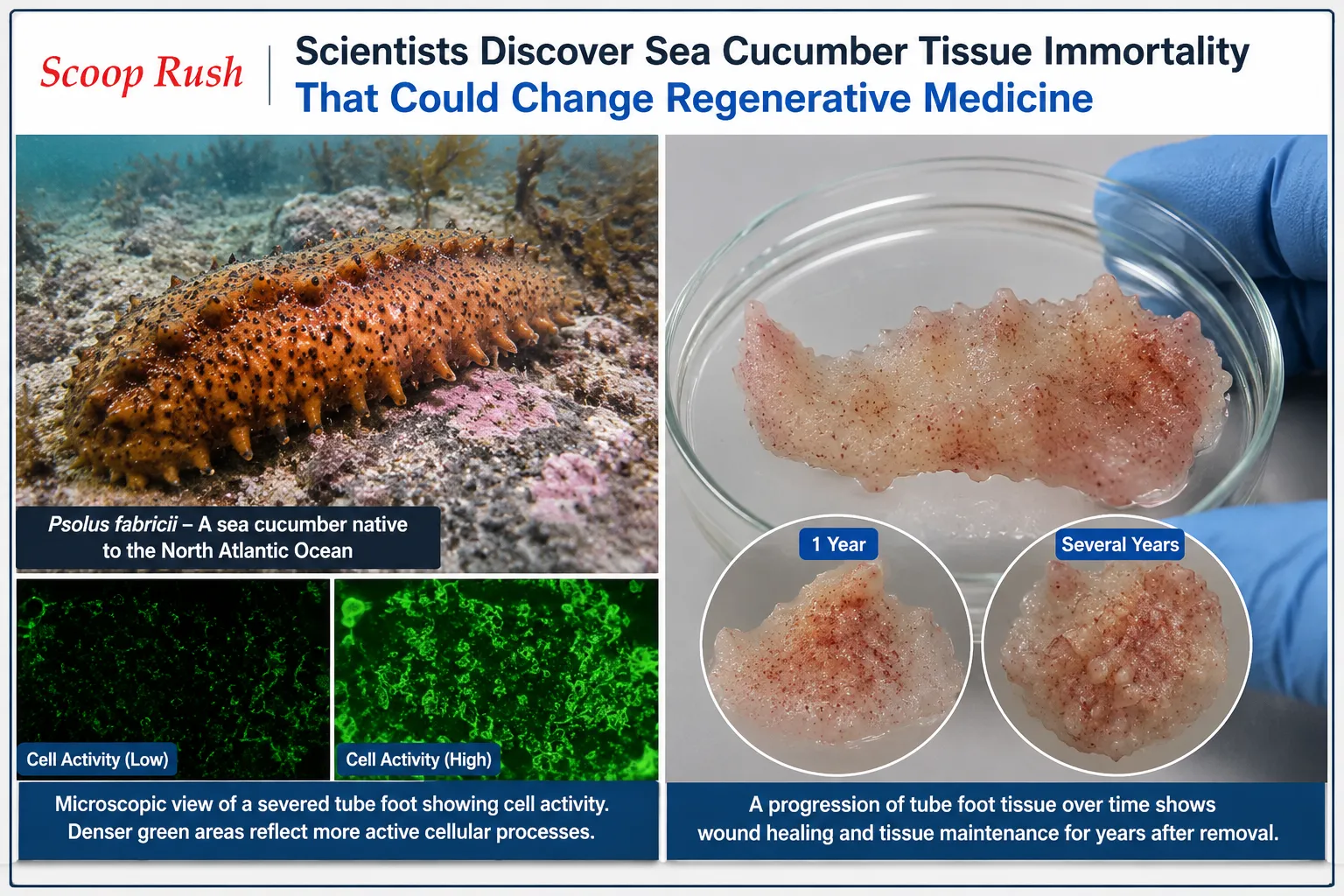
A piece of sea cucumber tissue that scientists expected to die after being separated from its body has shocked researchers by surviving, healing itself, and continuing biological activity for more than three years. This discovery of sea cucumber tissue immortality has challenged traditional scientific ideas about how tissues survive outside a complete organism.
Scientists studying the North Atlantic sea cucumber species Psolus fabricii discovered that detached tissues did not simply decay after being removed from the animal. Instead, these tissues continued repairing themselves, absorbing nutrients, and maintaining cellular activity without a mouth, digestive system, or connection to the original body.
The discovery has created new interest in regeneration, tissue repair, and aging research. Researchers believe this unusual ability could help scientists better understand how living tissues survive and maintain themselves in conditions where normal tissues would stop functioning.
Sea Cucumber Tissue Immortality Surprises Scientists
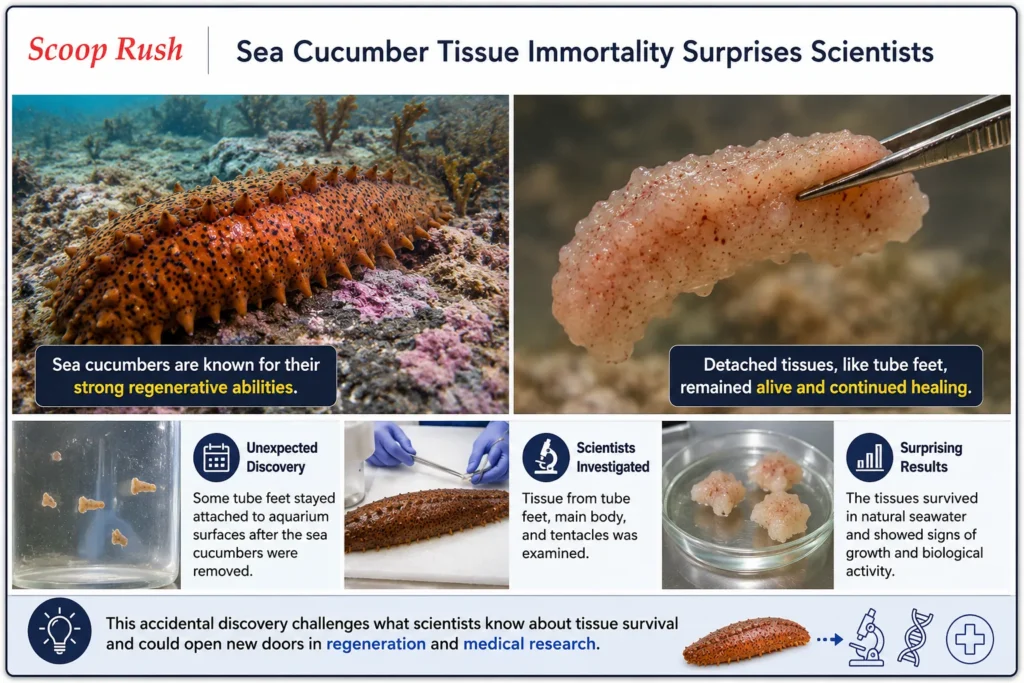
The discovery of sea cucumber tissue immortality happened unexpectedly during research at Memorial University of Newfoundland.
Scientists were studying live sea cucumbers when they noticed something unusual. Some tube feet from the animals remained attached to aquarium surfaces after the sea cucumbers were removed.
Normally, researchers expected these detached tissues to break down and die.
However, the tissues remained alive.
Days turned into weeks, and weeks turned into months. The detached pieces continued healing and showed signs of growth even though they were no longer connected to the original animal.
Lead researcher Sara Jobson explained that sea cucumbers are already known for their strong regenerative abilities. They can regrow lost body parts, but scientists had never closely studied what happens to tissues that are completely separated from the animal.
To understand this unusual behavior, researchers examined tissue removed from different parts of the sea cucumber, including:
- Tube feet
- Main body tissue
- Tentacle tissue
The results surprised the research team. The separated tissues survived in natural seawater and continued showing signs of biological activity.
How Did the Detached Sea Cucumber Tissue Survive?
Normally, when tissue is removed from an organism, it loses important support systems. Blood supply, nutrients, and communication signals from the body are no longer available.
Because of this, most tissues begin to deteriorate.
However, the sea cucumber tissue behaved differently.
Researchers found that the detached tissue could:
- Repair damaged areas
- Produce new cells
- Maintain immune activity
- Respond to touch
- Absorb nutrients from seawater
One of the most surprising findings was that the tissue survived without a mouth or digestive system.
Scientists discovered that the tissue appeared to absorb amino acids from the surrounding seawater. These nutrients helped the tissue continue functioning outside the animal’s body.
Furthermore, the research was performed in natural seawater instead of a highly controlled sterile environment.
Despite bacteria and microorganisms being present, the tissue continued to survive.
Why Scientists Call It “Zombie Tissue”
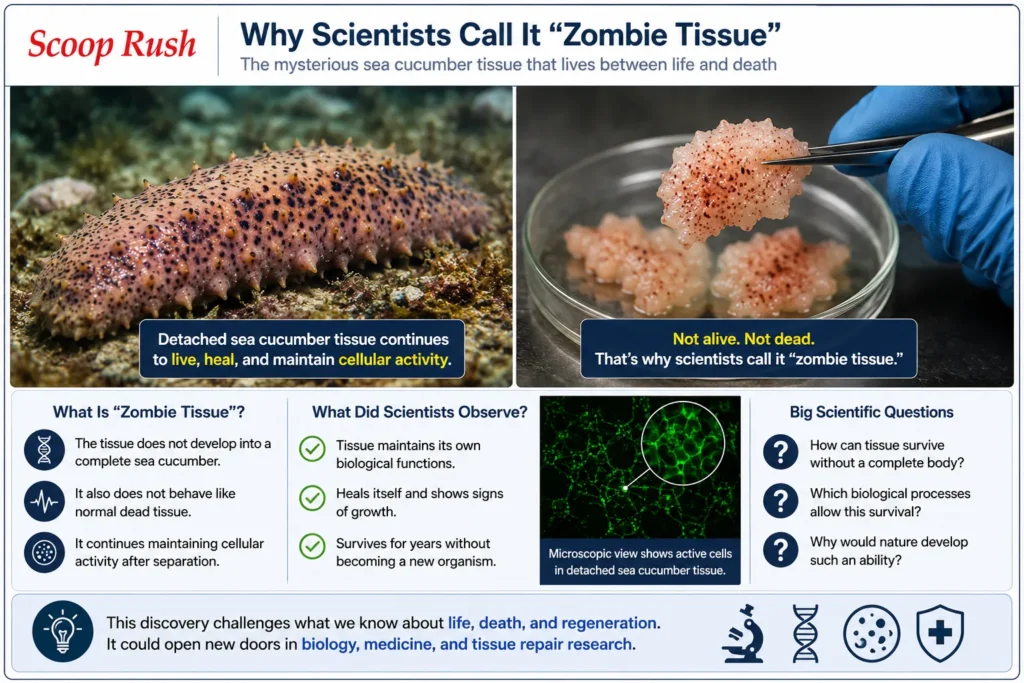
Researchers described the separated sea cucumber tissue as something between living and dead.
The tissue did not develop into a complete new sea cucumber. However, it also did not behave like normal dead tissue.
Because of this unusual condition, scientists compared it to “zombie tissue.” The term describes tissue that continues maintaining cellular activity even after being separated from a complete organism.
Sara Jobson explained that these tissues appeared to maintain their own biological functions. However, they did not become independent animals.
This discovery created several important scientific questions:
- How can tissue survive without a complete body?
- Which biological processes allow this survival?
- Why would nature develop such an ability?
Sea Cucumber Regeneration Has Long Interested Scientists
Sea cucumbers belong to a group of animals called echinoderms. This group also includes starfish and sea urchins.
These animals are widely known for their ability to regenerate.
For example, some sea cucumbers can remove internal organs as a defense mechanism and later replace them. Additionally, some species can reproduce through fission, where parts of the animal can develop into complete organisms.
However, scientists previously believed that separated tissues would eventually stop functioning.
The discovery of sea cucumber tissue immortality shows that tissue survival and regeneration may be more complex than researchers previously understood.
A New Model for Studying Aging and Healing
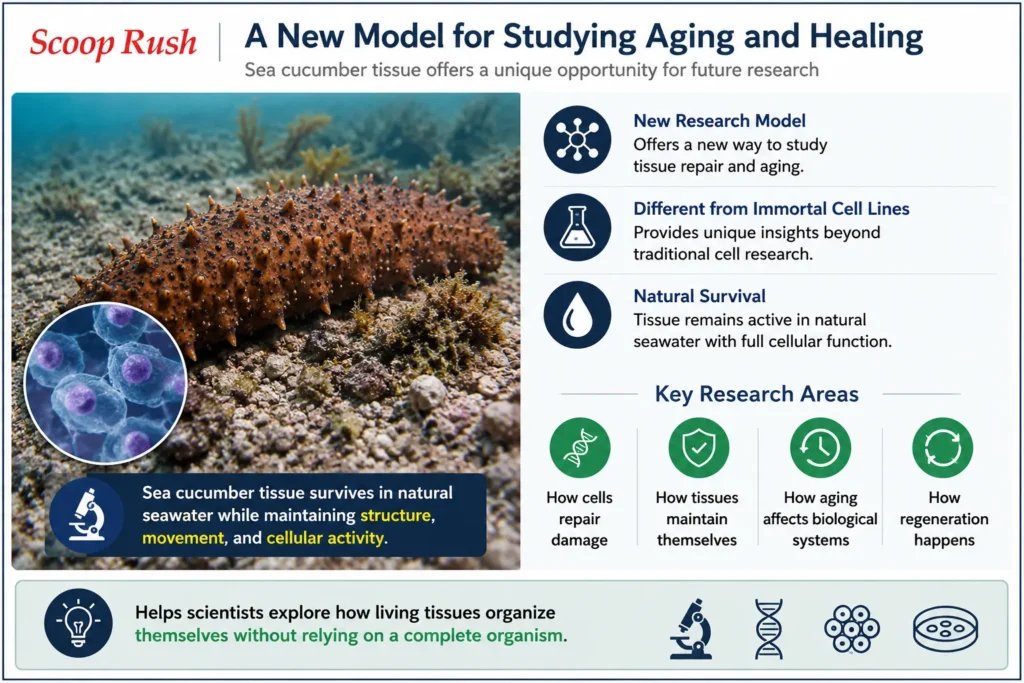
The discovery could provide scientists with a new model for studying tissue repair and aging.
Researchers have studied immortal cell lines for many years. One famous example is HeLa cells, which have helped scientists understand many biological processes.
However, sea cucumber tissue provides a different research opportunity.
The tissue survived in natural seawater while maintaining structure, movement, and cellular activity.
Scientists believe these tissues may help researchers study:
- How cells repair damage
- How tissues maintain themselves
- How aging affects biological systems
- How regeneration happens
Furthermore, this discovery may help scientists explore how living tissues organize themselves without depending completely on a full organism.
The Difference Between Immortal Cells and Immortal Tissue
Immortal cells and immortal tissues are not the same.
Some laboratory cell lines can continue growing under controlled conditions. However, the sea cucumber discovery involves tissue that maintained activity outside the body.
The tissue did more than survive. It continued healing, moving, and showing cellular organization.
Researchers observed that the tissue remained active for more than three years before ending the experiment to publish their findings.
However, scientists still need further research to confirm whether these tissues are truly immortal. Studying their DNA structure may help reveal whether the cells experience normal aging or have special survival mechanisms.
What This Discovery Means for Future Research
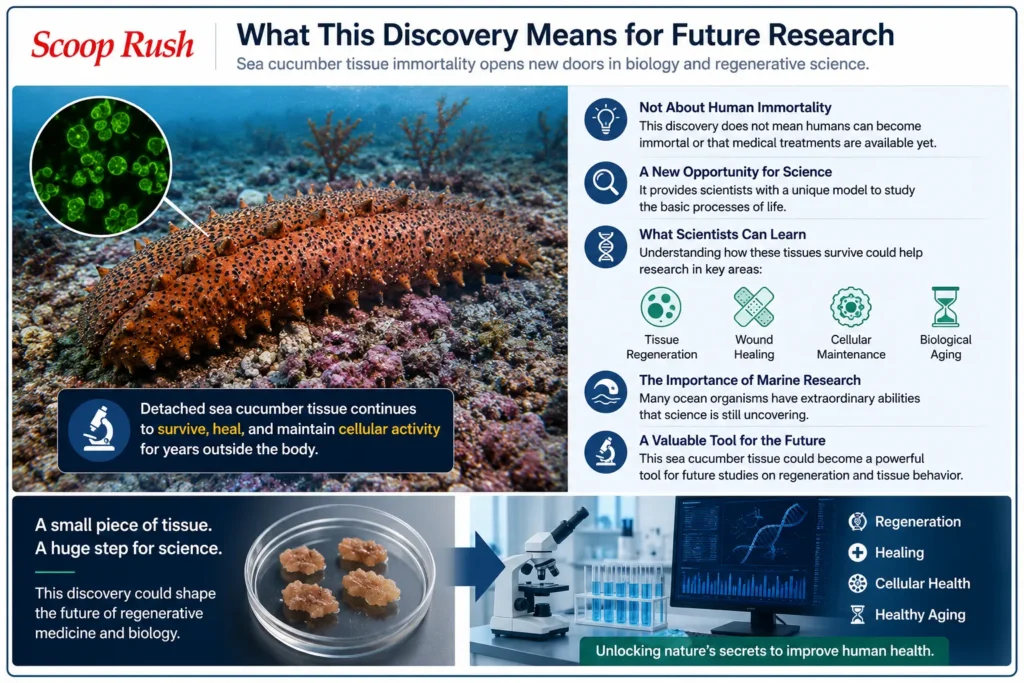
The discovery of sea cucumber tissue immortality does not mean humans can become immortal or that medical treatments are immediately available.
Instead, it gives scientists a new opportunity to study the basic processes of life.
Understanding how these tissues survive could provide information about:
- Tissue regeneration
- Wound healing
- Cellular maintenance
- Biological aging
Additionally, the discovery highlights the importance of marine research. Many ocean organisms have unique abilities that scientists are still working to understand.
The researchers believe this sea cucumber tissue could become a valuable tool for future studies focused on regeneration and tissue behavior.
Conclusion: Sea Cucumber Tissue Immortality Changes How Scientists View Life
The discovery of sea cucumber tissue immortality has challenged traditional ideas about what happens when tissue is separated from a living organism.
The pieces of Psolus fabricii did not become new animals, but they also did not die. Instead, they continued healing, absorbing nutrients, and maintaining cellular activity for years.
Although scientists need more research to understand the exact mechanisms behind this ability, the discovery provides a new way to study regeneration, aging, and tissue survival.
This finding also shows that nature still holds many biological mysteries, and unexpected discoveries can change how scientists understand life itself.
FAQs
1. What is sea cucumber tissue immortality?
Sea cucumber tissue immortality refers to the unusual ability of separated Psolus fabricii tissues to survive, heal, and maintain cellular activity for more than three years.
2. Which sea cucumber species showed this ability?
Scientists studied Psolus fabricii, a sea cucumber species native to the North Atlantic Ocean.
3. Can the sea cucumber tissue grow into a complete animal?
No. Researchers found that the tissue survived independently but did not develop into a complete sea cucumber.
4. Why is this discovery important?
This discovery may help scientists study tissue regeneration, healing, aging, and how cells maintain themselves over time.
5. Are sea cucumbers truly immortal?
No. Scientists have not confirmed that sea cucumbers or their tissues are completely immortal. More research is needed.

