Home Blog Page 42

World’s Most Livable City 2026: Copenhagen Retains Top Spot as Global Rankings Are Revealed

0

The World’s Most Livable City 2026 has officially been announced, and Copenhagen has once again claimed the number one position. The Danish capital topped the Economist Intelligence Unit’s (EIU) annual Global Liveability Index for the second consecutive year, thanks to its outstanding public services, safe environment, and excellent infrastructure.

The latest report ranked 173 cities worldwide using five key categories: stability, healthcare, education, infrastructure, and culture and environment. While Europe continued to dominate the rankings, Australia and Japan also delivered strong performances with multiple cities in the global top 10.

The report also reflects changing global conditions, with healthcare improvements boosting many Asian cities, while ongoing conflicts affected stability scores across parts of the Middle East and Eastern Europe.

World’s Most Livable City 2026: Why Copenhagen Leads Again

Copenhagen has built a reputation as one of the best places to live anywhere in the world.

The city received perfect scores for stability, infrastructure, and education. Residents also benefit from efficient public transportation, excellent healthcare, clean public spaces, and one of the world’s safest urban environments.

Cycling remains a major part of daily life, helping reduce traffic congestion while supporting a greener city. Strong public services and continued investment in sustainable development have helped Copenhagen maintain its position at the top.

These qualities make the Danish capital attractive not only to residents but also to international students, professionals, and families looking for a high quality of life.

Top 10 World’s Most Livable Cities 2026

Top-10-Worlds-Most-Livable-Cities-2026

According to the EIU Global Liveability Index, these are the highest-ranked cities in 2026.

RankCityCountry
1CopenhagenDenmark
2ViennaAustria
3MelbourneAustralia
4SydneyAustralia
5ZurichSwitzerland
6GenevaSwitzerland
7OsakaJapan
8AdelaideAustralia
9VancouverCanada
10TokyoJapan

Australia secured three places in the top ten, while Switzerland and Japan each had two cities on the list.

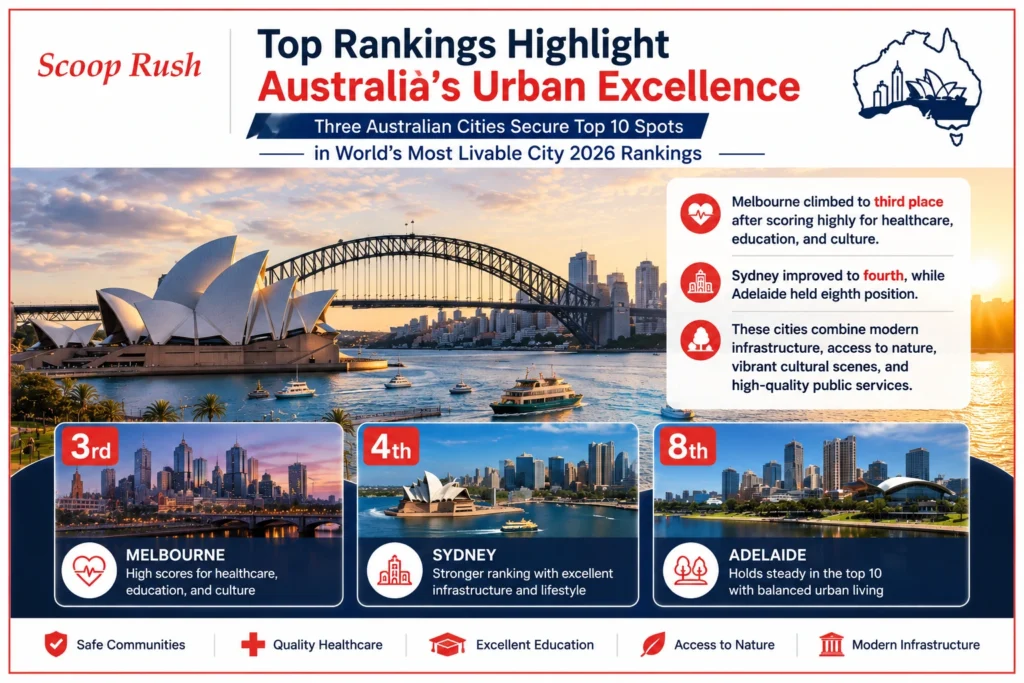
Top Rankings Highlight Australia’s Urban Excellence
Top-Rankings-Highlight-Australias-Urban-Excellence

Australia once again proved why it remains one of the world’s best countries for urban living.

Melbourne climbed to third place after scoring highly for healthcare, education, and culture. Sydney improved to fourth, while Adelaide held eighth position.

These cities continue to attract residents because they combine modern infrastructure with access to nature, vibrant cultural scenes, and high-quality public services.

Tokyo Moves Into the Global Top 10

Tokyo-Moves-Into-the-Global-Top-10

Tokyo climbed three places to finish tenth in this year’s rankings.

The Japanese capital improved its score in the culture and environment category while maintaining perfect scores for healthcare, education, and stability.

Recent investments in museums, cultural attractions, and public spaces have strengthened Tokyo’s position among the world’s leading cities.

Osaka also retained seventh place, making Japan one of the strongest-performing countries in the report.

Healthcare Improvements Lift Asian Cities

Asia recorded one of the biggest improvements in this year’s rankings.

The region’s average liveability score increased after several cities benefited from stronger healthcare systems and greater public investment.

Chinese cities also recorded better healthcare scores following improvements in medical funding and expanded long-term care programs.

The report shows that healthcare continues to play an increasingly important role in determining overall quality of life.

North America Delivers Mixed Results

North-America-Delivers-Mixed-Results

Vancouver remained the only North American city to secure a place in the global top ten, finishing ninth.

In the United States, Honolulu remained the country’s highest-ranked city at 25th place.

New York climbed to 66th after improvements in public safety and stability, reflecting lower crime rates and reduced security concerns.

Conflicts Continue to Affect Global Rankings

While many cities improved their healthcare and infrastructure scores, conflict continued to impact liveability in several regions.

Muscat and Kuwait City experienced some of the largest ranking declines because of lower stability scores.

Tehran also dropped significantly following the effects of regional conflict.

Kyiv’s ranking fell as the war in Ukraine continued, while Damascus remained the lowest-ranked city in the index.

What Makes a City Truly Livable?

The Global Liveability Index measures much more than beautiful streets or famous attractions.

Cities receive scores based on factors that directly affect daily life, including:

  • Personal safety
  • Access to healthcare
  • Quality education
  • Reliable infrastructure
  • Public transportation
  • Environmental quality
  • Cultural opportunities

Together, these factors help determine whether a city provides a comfortable, secure, and sustainable place to live.

Why These Rankings Matter

The World’s Most Livable City 2026 rankings offer useful insights for more than just governments.

Families considering relocation, international students, skilled workers, and businesses often use these rankings to compare destinations around the world.

Travelers can also benefit because highly ranked cities usually provide excellent transportation, reliable healthcare, clean public spaces, and safer environments.

Although every person’s priorities are different, the rankings provide a useful snapshot of how cities are performing in today’s rapidly changing world.

Conclusion

The World’s Most Livable City 2026 rankings once again highlight the importance of investing in people, public services, and sustainable urban development. Copenhagen’s continued success shows that safe communities, reliable infrastructure, quality healthcare, and excellent education remain the foundation of a great city.

While Australia, Japan, Switzerland, and Austria continue to perform strongly, the latest rankings also reveal how quickly global events can influence quality of life. As cities face new economic, environmental, and geopolitical challenges, those that prioritize long-term planning and resident wellbeing are likely to remain at the top in the years ahead.

FAQs

1. Which city is the World’s Most Livable City 2026?

Copenhagen, Denmark, has been ranked as the World’s Most Livable City 2026 by the Economist Intelligence Unit. It secured the top position for the second consecutive year.

2. How are the World’s Most Livable City 2026 rankings determined?

The rankings are based on five key categories: stability, healthcare, education, infrastructure, and culture and environment. The EIU evaluates 173 cities using dozens of performance indicators.

3. Which countries have the most cities in the top 10?

Australia leads with three cities: Melbourne, Sydney, and Adelaide. Japan and Switzerland each have two cities in the top ten.

4. Why did Tokyo enter the top 10 in 2026?

Tokyo improved its ranking after earning higher scores in the culture and environment category while maintaining excellent ratings for stability, healthcare, and education.

5. Why do these liveability rankings matter?

The rankings help governments, businesses, students, professionals, and families understand which cities offer the highest quality of life based on safety, healthcare, infrastructure, education, and public services.


Charli D’Amelio’s Mental Health Update: “It Keeps Declining” as She Turns 22

0

Introduction

Charli D’Amelio just gave her fans a reality check. The TikTok star admitted that her mental health keeps declining. Her comments resonated with many people in their early twenties.. The TikTok star, now 22, admitted that her mental health “keeps declining” even as she gets older, a confession that arrives right in the middle of swirling rumors about a rift with her parents.Charli D’Amelio just gave her fans a reality check. .

For someone with millions of followers watching her every move, this kind of honesty matters. It’s not just celebrity gossip. It’s a reminder that fame, money, and a massive online following don’t shield anyone from real struggles. Her openness also taps into a much bigger conversation happening online right now about mental health, family estrangement, and what it really means to grow up in public.

Charli D’Amelio’s Mental Health Comes Into Focus

Charli D'Amelio's Mental Health Comes Into Focus

Charli D’Amelio has never shied away from talking about her mental health, and her latest update continues that pattern. In a YouTube video posted on July 4, the content creator opened up while hiking, answering fan questions along the way. She described the outing as a way of disconnecting from her phone and reconnecting with herself, something she’s leaned on more as her public life has gotten heavier.

“Probably the fact that like my mental health keeps declining. The age keeps going up, but the number of therapy sessions keeps going up, too,” she admitted.

That single line captures something a lot of young adults quietly feel but rarely say out loud. Getting older doesn’t automatically mean things get easier. Sometimes it means facing new layers of pressure that require more support, not less.

Charli also talked about what she called the “biggest challenge” of being 22: handling life without the guidance she once had. She described “fully being in charge for the first time” and having to make major decisions about her future without mentors to lean on, a struggle that echoes how other young public figures, like Elliot Anderson, have had to navigate family dynamics under public scrutiny. Notably, she also shared that she’s excited to return to regular YouTube posting after taking a four month break from the platform, a hiatus that lined up directly with the family rumors swirling around her.

Why This Moment Feels Different

What makes this update stand out is the timing. Charli has spoken about therapy and mental health before, but this admission lands during a period of visible change in her personal life. She’s stepping into more independence, and she’s being upfront about how hard that transition actually is.

For her audience, many of whom are young people figuring out their own paths, that kind of transparency can feel validating. It shows that even someone who seems to have it all figured out is still working through uncertainty. She also hinted that she’d eventually like to share more of what happened during her time away, saying it was “very sensitive” and would need dedicated time to explain properly.

The Rumored Rift With Her Parents

Charli’s mental health comments come as speculation continues about tension between her and her parents, Marc and Heidi D’Amelio. Fans first noticed something was off months ago when they realized Charli and her parents no longer followed each other on Instagram, where she has around 40 million followers.

Since then, theories have circulated about what caused the apparent falling out, including claims that money played a role. Some reports have specifically pointed to a financial dispute connected to accounts that were reportedly set up during the years Charli’s career was managed by her parents, a dynamic that echoes other public adoption and paternity claims that have recently made headlines.

On June 4, PEOPLE confirmed that Charli had stepped away from Be Happy Snacks, the family’s popcorn brand launched in 2023. Marc and Heidi remain involved with the business. Meanwhile, her older sister Dixie last posted about the brand back in November 2025, adding another layer to the timeline that fans have used to piece together what may have happened behind the scenes. Situations like this show how quickly online speculation can escalate, not unlike the stalker allegations tied to Anne Hegerty that recently made headlines.

Marc D’Amelio Responds to the Rumors

In May, Marc addressed the speculation directly in the comments of a DeuxMoi post covering the alleged family dispute. That post included claims that Charli had discovered millions of dollars moved out of accounts set up during the period her parents managed her career.

Marc pushed back on the narrative, writing that reports about the situation weren’t accurate and that the family had stayed quiet about gossip for years. He indicated that was starting to change, suggesting more information could eventually come from the family’s side as well.

His response didn’t confirm or deny a rift outright, but it did acknowledge that something significant has been happening behind the scenes. For now, the full story remains unclear, and neither Charli nor her parents have laid out every detail publicly. Representatives for both sides have also not provided additional comment when reached, a familiar pattern seen in other celebrity disputes where families choose to stay silent, such as the ongoing Nancy Guthrie case that has drawn similar scrutiny.

Why Charli’s Openness About Therapy Matters

Why Charli's Openness About Therapy Matters

Charli isn’t new to talking about therapy. She’s mentioned it repeatedly over the years, and this latest comment continues that trend. Therapy sessions “going up” alongside her age isn’t framed as a failure. It’s framed as something she’s actively doing to take care of herself.

That distinction matters. Normalizing therapy, especially for younger audiences who follow influencers like Charli closely, can chip away at the stigma that still surrounds mental health care. She’s also said she’d like to use her platform to help others going through similar struggles, noting that she wasn’t the only one who had “a hard winter.” Other public figures have made similar choices, opening up about breast cancer or a final wish rather than staying silent about difficult personal news.

Consequently, when a public figure with her reach talks openly about needing more support as she gets older, it sends a message that struggling doesn’t mean something is wrong with you. It means you’re human.

The Bigger Picture for Young Adults

Charli’s situation touches on something a lot of people in their twenties experience: the shift from having built-in guidance, whether from parents, teachers, or mentors, to suddenly being responsible for every decision.

She described this exact feeling, saying she no longer has anyone telling her or helping her figure out the life she wants to live. That kind of independence can be exciting, but it can also be isolating, especially when it arrives alongside family tension.

Her willingness to name that difficulty, rather than pretend everything is fine, is part of why her audience continues to connect with her. It also mirrors a wider trend of young celebrities using their platforms to speak candidly about mental health rather than keeping struggles hidden behind a curated image, similar to how another star opened up about being bullied. Public perception can also shift quickly for entertainers trying to move forward from difficult chapters, as seen in reports about a planned comeback film facing a ban in Germany.

What Happens Next

What Happens Next

As of now, Charli hasn’t given a full explanation of what led to the rumored estrangement from her parents. She’s acknowledged that the topic is sensitive and would require more time to properly address, which suggests fans may eventually get more clarity directly from her.

Meanwhile, questions remain about her family’s business, the alleged financial dispute, and how the relationship between Charli and her parents will evolve. Neither Charli’s team nor her parents’ representatives have provided detailed public comments beyond what Marc shared in May. Public figures navigating sudden scrutiny is nothing new, as seen when Ryan Reynolds was involved in a drunk driver accident that quickly became a major news story, or when a BBC series was cancelled following backlash over old tweets.

For now, fans are left with a partial picture: a young star being honest about her mental health struggles while quietly navigating a complicated family situation in the background. As she returns to more regular content, it’s likely more details will surface over time, much like how fans followed the buildup to Thylane Blondeau’s wedding to Benjamin Attal in Paris before official confirmation arrived.

Conclusion

Charli D’Amelio mental health remains an important conversation as fans continue supporting her through this challenging period.Charli D’Amelio’s admission that her “mental health keeps declining” isn’t just a passing comment. It’s a reflection of how complicated growing up can be, even when you’re doing it in front of millions of people. Between newfound independence, unresolved family rumors, and the pressure of public life, her honesty offers a relatable window into what so many young adults quietly go through.

As the situation with her parents continues to unfold, one thing remains clear: Charli is choosing transparency over silence, and that choice alone says a lot about where she’s at right now.


FAQs

1. What did Charli D’Amelio say about her mental health?

Charli D’Amelio said her mental health “keeps declining” as she gets older, adding that her number of therapy sessions has increased along with her age. She shared this during a YouTube video posted on July 4.

2. Is Charli D’Amelio estranged from her parents?

There have been rumors of a rift between Charli and her parents, Marc and Heidi D’Amelio, after fans noticed they no longer follow each other on Instagram. Marc has pushed back on claims about the situation, though the full details haven’t been confirmed publicly.

3. Why did Charli D’Amelio leave her family’s popcorn business?

PEOPLE confirmed on June 4 that Charli had stepped away from Be Happy Snacks, her family’s popcorn brand. The exact reason hasn’t been officially detailed, though it coincides with the rumored family tension.

4. Has Charli D’Amelio talked about therapy before?

Yes, Charli has been open about attending therapy in previous interviews and social media posts. Her recent comments continue a pattern of transparency about her mental health journey.

5. What challenges did Charli D’Amelio say she faces at 22?

Charli said the biggest challenge of being 22 is fully being in charge of her own life for the first time, without the guidance or mentorship she previously had to help her make major decisions.

Is It OK to Drink Coffee on an Empty Stomach? Experts Reveal the Truth

0

Have you ever been told that drinking coffee on an empty stomach can damage your stomach or cause ulcers? It’s one of the most common health claims shared by family members and on social media. But is it actually true?

The good news is that current research paints a different picture. For most healthy adults, enjoying a cup of coffee before breakfast is generally safe. However, people with certain digestive conditions may notice uncomfortable symptoms.

Coffee can increase stomach acid production and speed up caffeine absorption. As a result, some people experience heartburn, acid reflux, jitters, or digestive discomfort. That doesn’t mean coffee is harmful to everyone.

In this article, we’ll separate myths from facts, explain what experts say, and help you decide whether drinking coffee on an empty stomach is right for you.

Is It OK to Drink Coffee on an Empty Stomach?

Is It OK to Drink Coffee on an Empty Stomach |scooprush

For most people, the answer is yes. Experts say a healthy stomach has a protective lining that prevents stomach acid from damaging its tissues. Drinking coffee alone does not usually harm this lining.

Your digestive system naturally produces stomach acid throughout the day, even when you haven’t eaten. Therefore, drinking coffee doesn’t automatically mean your stomach will become damaged.

However, everyone’s body responds differently. While some people can drink black coffee without any problems, others may feel discomfort after just one cup.

If coffee regularly causes heartburn, nausea, or stomach pain, it’s worth adjusting your routine instead of ignoring the symptoms. Building a few healthy habits in your 20s and 30s around meal timing can make a noticeable difference to how your body handles your morning cup.

Why Has This Become Such a Popular Health Debate?

The idea that coffee damages an empty stomach has been around for decades. More recently, social media has helped spread this claim even further.

Many posts suggest that coffee causes stomach acid to attack the stomach lining because there’s no food to digest. While this sounds convincing, research doesn’t fully support the claim.

Experts agree that coffee increases stomach acid production. However, a healthy stomach is designed to protect itself from that acid.

The real concern is people who already have digestive conditions, not healthy adults with normal stomach function.

Does Coffee Increase Stomach Acid?

Does Coffee Increase Stomach Acid? |scooprush

Yes, coffee can stimulate your stomach to produce more acid. Caffeine is one reason, but other natural compounds in coffee may also contribute.

For most healthy people, this extra acid doesn’t cause any problems. The stomach’s protective mucus layer prevents acid from damaging its walls.

However, people who already have acid reflux, GERD, or sensitive stomachs may notice burning or discomfort after drinking coffee.

If this happens frequently, drinking coffee with breakfast instead of before eating may help reduce symptoms.

Coffee Causes Heartburn and Acid Reflux

Heartburn happens when stomach acid flows back into the esophagus. This creates the burning feeling many people experience after eating or drinking certain foods.

Research on coffee and acid reflux has produced mixed results. Some studies found little connection, while others reported increased symptoms after consuming caffeinated beverages.

Experts believe coffee may temporarily relax the muscle that separates the stomach from the esophagus. At the same time, it may increase stomach acid production.

Together, these effects can make heartburn worse in people who already suffer from reflux. However, coffee is not considered the direct cause of GERD.

Tips to Reduce Heartburn

If coffee triggers reflux symptoms, you don’t necessarily have to give it up completely.

Instead, try drinking coffee with breakfast, reducing your caffeine intake, or adding low-fat milk. Some people also find that smaller servings are easier to tolerate.

Pay attention to how your body reacts. Simple changes are often enough to make coffee more comfortable.

Coffee Causes Stomach Ulcers

Coffee Causes Stomach Ulcers |scooprush

This is one of the biggest misconceptions about coffee. Modern medical research shows that coffee does not cause stomach ulcers.

Most stomach ulcers develop because of an infection caused by Helicobacter pylori (H. pylori) bacteria. Another common cause is long-term use of pain relievers such as ibuprofen and aspirin.

Large studies have found no meaningful link between coffee consumption and ulcer formation, even among people who drink several cups every day.

However, coffee can increase stomach acid. If you already have an ulcer, that extra acid may worsen pain, burning, or discomfort. Persistent, unexplained symptoms are always worth mentioning to a doctor, in the same way that recognizing early lung cancer symptoms early can make a real difference to outcomes.

What Does the Evidence Really Say?

Current evidence offers reassuring news for coffee lovers. Drinking coffee on an empty stomach does not appear to damage a healthy stomach or create ulcers.

However, people with GERD, heartburn, existing stomach ulcers, or sensitive digestion may experience stronger symptoms after drinking coffee before eating.

Rather than following internet myths, experts recommend paying attention to your own body’s response. If coffee makes you feel well, there’s usually no reason to stop.

In the next section, we’ll explore the possible side effects of drinking coffee on an empty stomach, including faster caffeine absorption, digestive changes, anxiety, cortisol, and the best time to enjoy your daily cup.

Side Effects of Drinking Coffee on an Empty Stomach

Side Effects of Drinking Coffee on an Empty Stomach |scooprush

Although coffee is safe for most people, drinking it before eating may cause a few unwanted side effects. These effects are usually temporary and vary from person to person.

If you regularly feel uncomfortable after your morning coffee, your body may be telling you to change how or when you drink it.

Faster Caffeine Absorption

When your stomach is empty, your body absorbs caffeine more quickly. This means you may feel its effects sooner than usual.

As a result, some people experience shakiness, nervousness, or a sudden burst of energy shortly after drinking coffee.

The effects usually begin within minutes and become stronger over the next hour.

Why Food Makes a Difference

Eating before or with your coffee slows down caffeine absorption. This helps your body process caffeine more gradually.

Because of this, you may feel more stable energy instead of a quick spike followed by a crash.

If caffeine often makes you feel anxious, pairing coffee with breakfast may help.

Coffee May Increase Heartburn

Coffee naturally stimulates stomach acid production. For healthy people, this usually isn’t a problem.

However, if you have acid reflux or GERD, the extra acid may trigger symptoms such as heartburn or a burning feeling in your chest.

Coffee may also relax the muscle between your stomach and esophagus, making acid more likely to move upward.

How to Reduce Reflux Symptoms

If coffee causes heartburn, try drinking it after breakfast instead of before eating.

You can also choose a smaller serving or add low-fat milk. These simple changes may reduce irritation without giving up coffee completely.

Digestive Changes and Bathroom Urges

Many coffee drinkers notice that they need to use the bathroom soon after finishing a cup.

Research suggests that coffee stimulates hormones involved in digestion. These hormones encourage the muscles in your digestive tract to move waste through your bowels.

This effect can happen whether or not you’ve eaten, although some people notice it more on an empty stomach.

If this is part of your normal routine and doesn’t cause discomfort, it usually isn’t a cause for concern. Staying active can also support healthy digestion — even something as simple as taking a 5-minute walk every hour has been shown to help.

Can Coffee Make You Feel Anxious?

Yes, especially if you’re sensitive to caffeine.

Because caffeine is absorbed faster on an empty stomach, some people feel restless, shaky, or irritable after drinking coffee.

Others may notice a faster heartbeat or temporary heart palpitations.

These symptoms are more likely if you drink several cups a day or consume more caffeine than your body can comfortably handle.

Does Coffee Raise Cortisol Levels?

Coffee can temporarily increase cortisol, often called the body’s stress hormone.

Cortisol plays an important role in regulating blood pressure, metabolism, and your natural wake-up response.

Fortunately, experts say the increase caused by caffeine is usually small and has not been linked to long-term health problems in healthy adults.

For most people, this temporary rise is not a reason to avoid coffee.

Does Coffee Affect Nutrient Absorption?

Some studies suggest that drinking coffee with iron-rich meals may reduce how much iron your body absorbs.

However, drinking coffee on an empty stomach does not appear to create this problem because there is no meal competing for absorption.

If you have iron deficiency or have been advised to increase your iron intake, consider separating coffee from iron-rich meals. It’s also worth being cautious about stacking multiple supplements around your coffee routine, since taking too many vitamins can create its own set of risks.

Who Should Be More Careful?

While most healthy adults can safely drink coffee before breakfast, some people should be more cautious.

You may want to avoid drinking coffee on an empty stomach if you have:

  • Frequent heartburn or acid reflux
  • GERD
  • A stomach ulcer
  • Irritable bowel syndrome (IBS)
  • Strong caffeine sensitivity

If coffee consistently causes pain, nausea, or digestive discomfort, speak with your healthcare provider instead of simply ignoring the symptoms. This is especially important for older adults, who should also stay mindful of related concerns like heat and humidity risks for seniors during warmer months when dehydration can compound stomach sensitivity.

Is Switching to Tea a Better Option?

Some people consider switching to tea because it usually contains less caffeine than coffee.

For individuals who are sensitive to caffeine, tea may cause fewer jitters or digestive symptoms.

However, tea can still contain caffeine. Therefore, it isn’t guaranteed to solve every problem.

The best choice depends on how your own body reacts rather than following a one-size-fits-all rule.

Should You Stop Drinking Coffee Before Breakfast?

If you enjoy coffee on an empty stomach and feel perfectly fine afterward, there is no strong evidence suggesting you need to change your routine.

On the other hand, if your morning coffee regularly causes heartburn, stomach discomfort, or anxiety, eating a light breakfast first may make a noticeable difference.

Listening to your body is often more helpful than following common myths.

When Is the Best Time to Drink Coffee?

There isn’t one perfect time to drink coffee. Experts say the best time depends on how your body responds to caffeine.

Some people feel great after drinking coffee before breakfast. Others feel better when they have it with or after a meal. The key is to choose the routine that works best for you.

Foods That Pair Well With Coffee

If coffee upsets your stomach, eating a light meal first may help. Certain foods can also slow caffeine absorption and reduce stomach irritation.

Good breakfast options include:

  • Whole-grain toast or oatmeal for fiber
  • Eggs, yogurt, or cottage cheese for protein
  • Avocados, nuts, or nut butter for healthy fats
  • Fresh fruit as part of a balanced meal

These foods may help you feel full while reducing the chance of heartburn or jitters.

Practical Tips for Drinking Coffee Safely

You don’t have to give up coffee to protect your digestive health. A few simple habits can make your morning cup easier on your stomach.

  • Limit caffeine if it causes anxiety or heartburn.
  • Drink coffee with breakfast if you have a sensitive stomach.
  • Avoid adding too much sugar, which can lead to an energy crash.
  • Stay within the recommended daily caffeine intake.
  • Pay attention to how your body reacts and adjust your routine if needed.

Small changes are often enough to improve your experience. If you’re building out a broader wellness routine, it’s worth thinking about how your morning coffee fits alongside other goals — whether that’s managing weight while preserving muscle on GLP-1 medications or simply staying consistent with better everyday healthy habits.

The Bottom Line

For most healthy adults, drinking coffee on an empty stomach is generally safe. Current research does not show that it causes stomach ulcers or damages a healthy stomach.

However, coffee can increase stomach acid and speed up caffeine absorption. As a result, people with acid reflux, GERD, stomach ulcers, or caffeine sensitivity may experience heartburn, digestive discomfort, or jitters.

Instead of relying on myths, pay attention to your own body’s response. If coffee makes you feel well, there’s usually no reason to stop drinking it. If it causes discomfort, having it with food or reducing your caffeine intake may help.

The best approach is a balanced one. Enjoy your coffee in a way that supports both your energy and your digestive health.

FAQs

1. Is it bad to drink coffee on an empty stomach every day? 

For most healthy adults, no. Research suggests it is generally safe. However, people with acid reflux, GERD, or stomach ulcers may notice worsening symptoms.

2. Can coffee on an empty stomach cause ulcers? 

No. Current evidence shows that coffee does not cause stomach ulcers. Most ulcers are linked to H. pylori infection or long-term use of NSAID pain relievers.

3. Why does coffee make me feel shaky before breakfast? 

Your body absorbs caffeine faster when your stomach is empty. This may lead to jitters, anxiety, or a rapid heartbeat in people who are sensitive to caffeine.

4. Does eating before coffee help? 

Yes. Eating first can slow caffeine absorption and may reduce heartburn, stomach discomfort, and feelings of nervousness.

5. Should I switch from coffee to tea?

Tea contains less caffeine than coffee and may be easier for some people to tolerate. However, the best choice depends on your personal tolerance and how your body responds.

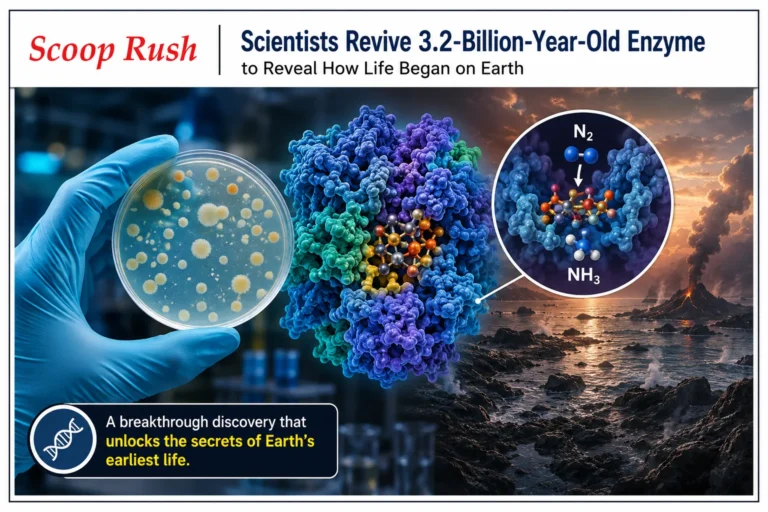
Scientists Revive 3.2-Billion-Year-Old Enzyme to Reveal How Life Began on Earth

0

Introduction

What if scientists could bring a tiny piece of Earth’s earliest life back into the laboratory? That idea sounds like science fiction, but researchers have now done exactly that. By reconstructing an ancient enzyme that likely existed around 3.2 billion years ago, scientists have uncovered new clues about how life survived on early Earth and how we might recognize life on distant planets.

This breakthrough, published in Nature Communications, gives researchers a powerful new way to study the deep history of life. Instead of relying only on ancient rocks and fossils, scientists recreated long-extinct versions of a vital enzyme inside living microbes to observe how it worked billions of years ago. The findings not only improve our understanding of Earth’s earliest ecosystems but could also support future agriculture, space exploration, and the ongoing search for extraterrestrial life.

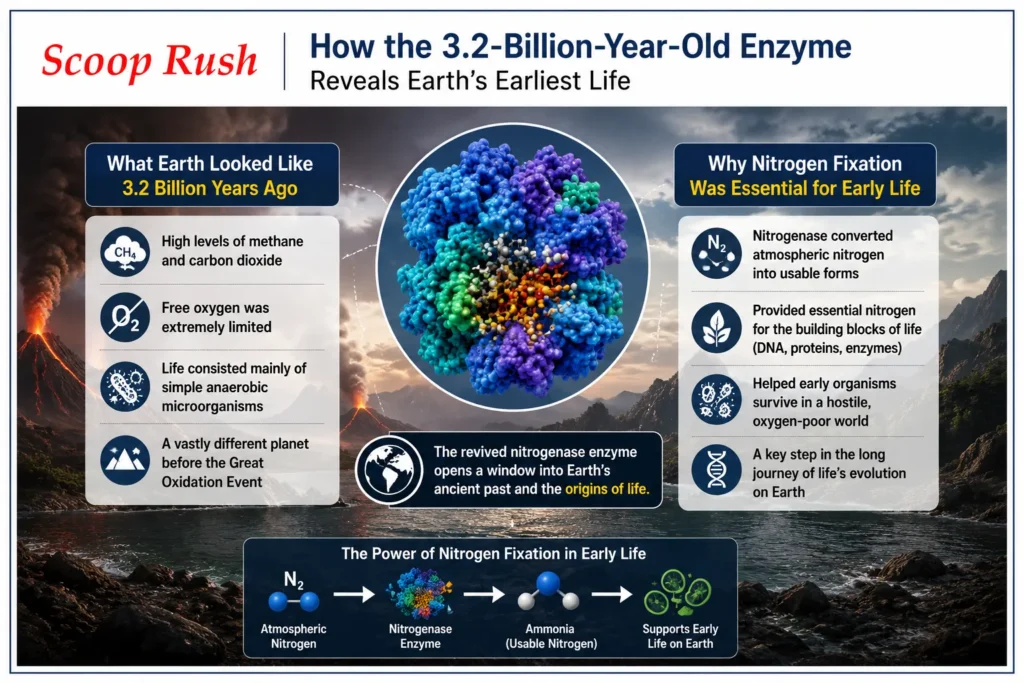
Nitrogen is one of the fundamental elements required by every known living organism. It plays a critical role in building DNA, RNA, proteins, enzymes, and many other cellular molecules. However, atmospheric nitrogen exists primarily as nitrogen gas (N₂), which is extremely stable and cannot be used directly by most living organisms. This is where nitrogenase becomes essential — it converts atmospheric nitrogen into biologically available compounds that plants can absorb, and animals and humans then obtain nitrogen by consuming plants or other animals.

Why the 3.2-Billion-Year-Old Enzyme Discovery Is So Important

Why the 3.2-Billion-Year-Old Enzyme Discovery Is So Important

Researchers from the University of Wisconsin-Madison, Utah State University, and collaborators in NASA’s Metal Utilization and Selection across Eons (MUSE) project successfully reconstructed ancient versions of nitrogenase, one of the most important enzymes for life.

According to Utah State University biochemist Lance Seefeldt, every living organism depends on this process in some way. Without nitrogen fixation, life as we know it simply could not exist.

By reviving ancestral versions of this enzyme using synthetic biology, researchers gained an unprecedented look at biological processes that occurred billions of years before complex life appeared. The research marks a significant step forward because it allows scientists to study ancient biology directly instead of depending entirely on geological evidence.

How Scientists Recreated the 3.2-Billion-Year-Old Enzyme

Using Synthetic Biology to Bring an Ancient Enzyme Back

Instead of searching for impossible-to-find fossilized enzymes, researchers used a technique known as synthetic biology. Scientists started with modern nitrogenase genes, and using evolutionary analysis, they predicted what ancestral versions of those genes likely looked like billions of years ago. They then synthesized those ancient genes in the laboratory and inserted them into living microbes — effectively allowing the team to “resurrect” enzymes that disappeared billions of years ago, much like how researchers elsewhere have studied ancient DNA mechanisms shaping biology today.

How Researchers Tested the Ancient Nitrogenase

According to senior scientist Derek Harris, researchers created a library of reconstructed nitrogenase genes and carefully measured how each version processed nitrogen under controlled laboratory conditions. These experiments helped reveal how ancient nitrogenases likely functioned on early Earth.

For decades, scientists have studied early life mainly through fossils and ancient rocks. While those records are valuable, they have important limitations — many rocks from Earth’s earliest history have been altered over billions of years, fossils from microbial life are extremely rare, and ancient enzymes almost never survive. This new approach changes that, giving scientists a much clearer picture of Earth’s biological history, similar to how the discovery of a new beetle species or a cannibal supergiant microbe expands our understanding of life’s diversity.

How the 3.2-Billion-Year-Old Enzyme Reveals Earth’s Earliest Life

How the 3.2-Billion-Year-Old Enzyme Reveals Earth's Earliest Life

What Earth Looked Like 3.2 Billion Years Ago

The Earth that existed more than three billion years ago looked nothing like today’s world. Before the Great Oxidation Event, Earth’s atmosphere contained much higher levels of methane and carbon dioxide, and free oxygen was extremely limited. Life consisted mainly of simple anaerobic microorganisms that survived without oxygen. Understanding how these organisms lived helps scientists reconstruct one of the most important chapters in Earth’s history.

Why Nitrogen Fixation Was Essential for Early Life

The revived nitrogenase offers a direct connection to that ancient world. Understanding how early organisms accessed usable nitrogen helps explain how life sustained itself long before complex ecosystems existed, much as researchers today study how neurons break DNA to build the brain to understand life’s more recent evolutionary leaps.

3.2-Billion-Year-Old Enzyme Confirms Ancient Rock Evidence

Understanding Nitrogen Isotope Biosignatures

Although enzymes themselves do not fossilize, their activity leaves behind chemical evidence. Nitrogen fixation creates distinctive nitrogen isotope signatures, and these isotope patterns can become preserved inside ancient rocks for billions of years. Scientists have long assumed that ancient nitrogenase produced the same isotope patterns seen today, but nobody had tested that assumption directly — until now.

Why the Ancient Enzyme Produced Modern Chemical Signatures

Researchers discovered that the reconstructed ancient nitrogenase produced nearly the same nitrogen isotope signatures as modern nitrogenase. This finding confirms an assumption that geologists have relied upon for decades. Even though the enzyme’s DNA sequence changed substantially during evolution, its basic chemical function remained remarkably consistent. That means scientists can have greater confidence when interpreting nitrogen isotope signatures found in Earth’s oldest rocks.

How the 3.2-Billion-Year-Old Enzyme Could Help Agriculture

How the 3.2-Billion-Year-Old Enzyme Could Help Agriculture

Improving Future Nitrogen Fixation Research

The study may also contribute to solving agricultural challenges here on Earth. Modern farming depends heavily on nitrogen fertilizers, and scientists believe that improving our understanding of nitrogenase could eventually support more efficient biological nitrogen fixation.

Supporting Food Production in a Changing Climate

Drought, climate change, and limited access to fertilizers create serious problems in many parts of the world, and rising El Niño-driven weather extremes are only expected to intensify these pressures. Although this study does not introduce new farming technology, it strengthens the scientific foundation for future research aimed at improving crop production.

Why the 3.2-Billion-Year-Old Enzyme Matters for Space Exploration

Searching for Life Beyond Earth

One of the most exciting aspects of the research is its connection to astrobiology. NASA funded the project through its MUSE consortium because understanding ancient Earth also helps scientists search for life elsewhere. If nitrogen isotope signatures reliably indicate biological activity on Earth, similar signatures could become valuable clues when studying Mars or other potentially habitable worlds, building on ongoing work around ancient life on Mars.

Professor Betül Kaçar, who leads the MUSE project, explains that scientists must first understand Earth’s own biological history before interpreting possible evidence of life beyond our planet. In other words, Earth serves as the testing ground for future discoveries across the universe — the kind of long-range observation also enabled by missions like the recently rescued Swift telescope.

Growing Food During Future Mars Missions

Nitrogen fixation is essential for growing crops. Future human missions to the Moon or Mars will likely require sustainable food production systems, and understanding nitrogenase more completely may help scientists develop better biological systems for supporting agriculture during long-duration space exploration.

What Scientists Will Study After Reviving the 3.2-Billion-Year-Old Enzyme

What Scientists Will Study After Reviving the 3.2-Billion-Year-Old Enzyme

Understanding How Nitrogenase Evolved

Although this study answered one major question, it also opened several new ones. Researchers now want to understand why nitrogenase maintained the same isotope signature despite major genetic changes.

Reconstructing More Ancient Enzymes

Researchers also plan to investigate other ancient enzymes that played key roles during Earth’s earliest biological evolution. Each reconstructed enzyme offers another opportunity to understand how life adapted to changing environments over billions of years, echoing how scientists are still uncovering why algae blooms die off in modern ecosystems.

Key Findings from the 3.2-Billion-Year-Old Enzyme Study

  • Scientists reconstructed nitrogenase enzymes that likely existed around 3.2 billion years ago.
  • The ancient enzymes functioned successfully inside modern microbes.
  • Ancient nitrogenase produced the same nitrogen isotope signatures as modern versions.
  • The findings strengthen scientists’ confidence in interpreting Earth’s oldest rocks.
  • The research supports future studies of Earth’s origins, agriculture, and astrobiology.

Conclusion: Why the 3.2-Billion-Year-Old Enzyme Changes Our Understanding of Life

Reviving a 3.2-billion-year-old enzyme represents far more than an impressive laboratory achievement. It gives scientists an entirely new way to investigate life’s earliest history. By reconstructing ancient nitrogenase, researchers confirmed that one of biology’s most important chemical signatures has remained stable across billions of years. That discovery strengthens our understanding of Earth’s oldest geological records while providing valuable tools for future research.

The work also bridges multiple scientific fields, from evolutionary biology and geology to agriculture and space exploration. As scientists continue reconstructing ancient enzymes, they may uncover even more clues about how life first emerged, adapted, and eventually transformed our planet. Understanding Earth’s distant past could ultimately help humanity answer one of science’s greatest questions: Are we alone in the universe?

FAQs About the 3.2-Billion-Year-Old Enzyme

What is the 3.2-billion-year-old enzyme?

Researchers reconstructed an ancient version of nitrogenase, an enzyme that converts atmospheric nitrogen into a usable form for living organisms.

Why is nitrogenase important?

Nitrogenase performs nitrogen fixation, allowing plants and other organisms to obtain the nitrogen needed to build DNA, proteins, and other essential molecules.

How did scientists recreate the ancient enzyme?

The original enzyme no longer exists. Instead, researchers used synthetic biology and evolutionary analysis to reconstruct what ancient versions likely looked like, then inserted the synthesized genes into living microbes.

Can this discovery help find alien life?

Yes. The study confirms that nitrogen isotope signatures produced by nitrogenase have remained stable for billions of years. Similar chemical signatures could help scientists identify evidence of life on other planets.

Could this research improve agriculture?

Potentially. A better understanding of nitrogen fixation may support future research aimed at improving crop production and reducing dependence on synthetic fertilizers.

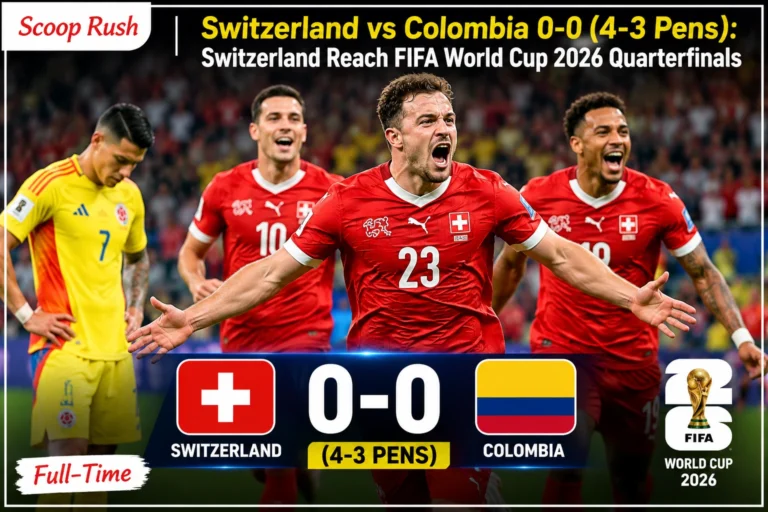
Switzerland vs Colombia 0-0 (4-3 Pens): Switzerland Reach FIFA World Cup 2026 Quarterfinals

0

Competition: FIFA World Cup 2026â„¢
Round: Round of 16
Venue: BC Place, Vancouver
Full-Time Result: Switzerland 0-0 Colombia
After Extra Time: Switzerland 0-0 Colombia
Penalty Shootout: Switzerland 4-3 Colombia

Switzerland vs Colombia Result: Swiss Advance After Dramatic Penalty Shootout 

Few World Cup matches are decided by such fine margins, and Switzerland vs Colombia 0-0 (4-3 pens) was a perfect example. After 120 minutes without a goal, Switzerland held their nerve in the penalty shootout to book a place in the FIFA World Cup 2026 quarterfinals.

The Round of 16 clash delivered drama, tension, and heartbreak in equal measure. Colombia created more chances, registered more shots, and looked dangerous throughout the match. However, Switzerland remained disciplined, organized, and resilient before eventually triumphing from the penalty spot. For Swiss supporters, it was a night of celebration. For Colombia, it was a painful exit after a performance that suggested they deserved more from the contest.

Match Overview

The match remained scoreless through regulation time and extra time despite both teams pushing for a breakthrough. Ultimately, penalties were needed to separate the sides. Switzerland converted four of their spot kicks and emerged victorious when Colombia failed to capitalize on key opportunities during the shootout.

Switzerland vs Colombia 0-0 (4-3 Pens): Tactical Analysis 

Switzerland vs Colombia 0-0 (4-3 Pens): Tactical Analysis

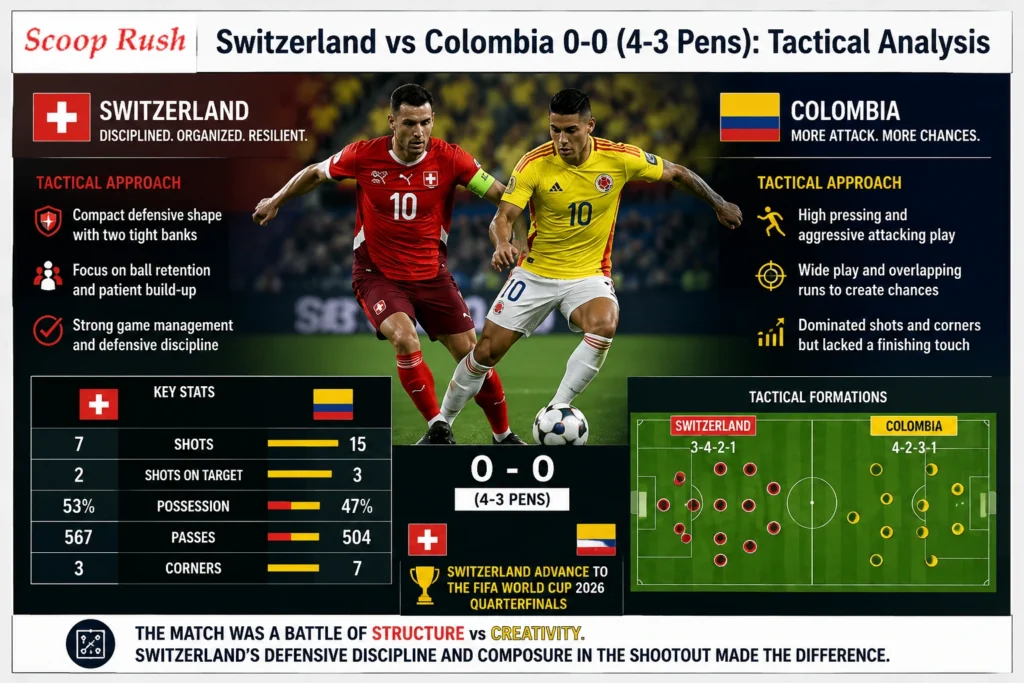
The Round of 16 encounter was a tactical battle from start to finish. Switzerland focused on defensive organization and ball retention, while Colombia looked more aggressive in attack. However, neither side could find the breakthrough despite several promising opportunities. Both teams remained defensively organized, forcing the contest into a tense stalemate. The result highlighted the fine margins that often determine knockout football. One mistake, one save, or one missed penalty can decide a nation’s World Cup fate.

Switzerland’s Defensive Structure Makes the Difference 

Although Colombia registered more shots, Switzerland maintained a compact defensive shape throughout the match. Their disciplined approach prevented Colombia from creating many clear-cut chances. 
Swiss Back Line Stands Strong

Although Colombia generated more attacking opportunities, Switzerland’s defense consistently rose to the challenge. The Swiss side limited Colombia’s clear-cut chances and defended set pieces effectively. Their compact shape made it difficult for Colombian attackers to find space in dangerous areas. Even when Colombia increased the pressure, Switzerland remained composed. The defensive unit’s concentration across 120 minutes played a major role in keeping the score level and creating the platform for eventual success in the shootout.

Goalkeeper Delivers When It Matters Most

In knockout football, goalkeepers often become heroes. Switzerland’s goalkeeper played a crucial role throughout the match by keeping Colombia off the scoreboard. His confidence also proved valuable during the penalty shootout, where every save and psychological advantage can shift momentum. As a result, Switzerland entered the quarterfinals thanks to a complete team defensive effort.
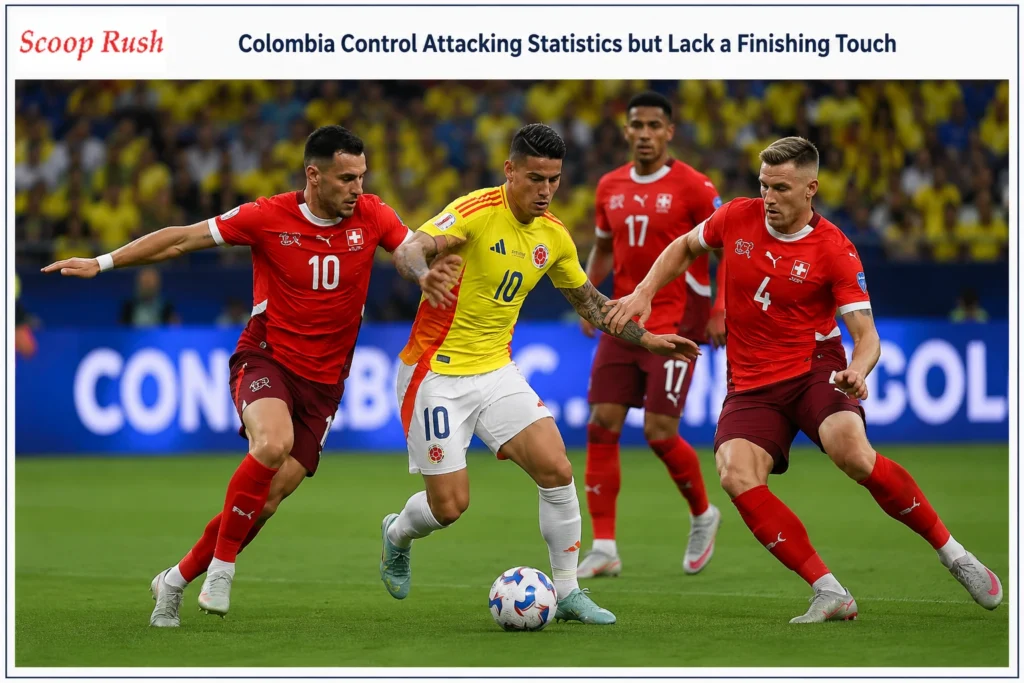
Colombia Control Attacking Statistics but Lack a Finishing Touch 

Colombia Control Attacking Statistics but Lack a Finishing Touch

Colombia recorded more shots and corners than Switzerland. However, the South American side could not convert their pressure into goals. As a result, the contest remained scoreless after both normal time and extra time.
Strong Attacking Numbers

The statistics showed Colombia’s attacking intent.

Colombia recorded:

  • 15 shots
  • 3 shots on target
  • 47% possession
  • 504 passes
  • 7 corners

Switzerland recorded:

  • 7 shots
  • 2 shots on target
  • 53% possession
  • 567 passes
  • 3 corners

 These numbers suggest Colombia carried the greater attacking threat. They produced more than twice as many shots and earned more corner kicks. However, football rewards efficiency rather than volume. Despite their pressure, Colombia could not find the decisive finish required to win the match.

Missed Opportunities Prove Costly

Knockout football often punishes missed chances. Colombia had several opportunities to take control of the contest but failed to convert them. Switzerland’s defenders and goalkeeper repeatedly denied attempts on goal. Consequently, Colombia allowed the match to drift into extra time and eventually penalties, where outcomes became increasingly unpredictable. That inability to capitalize on attacking moments ultimately proved decisive.

Switzerland vs Colombia Stats and Key Numbers

StatisticSwitzerlandColombia
Shots715
Shots on Target23
Possession53%47%
Passes567504
Pass Accuracy88%87%
Fouls2321
Yellow Cards32
Red Cards00
Offsides54
Corners37

Despite creating fewer chances, Switzerland controlled possession and completed more passes. Meanwhile, Colombia posed the greater attacking threat but failed to convert their opportunities.

Switzerland vs Colombia 0-0 (4-3 Pens): Penalty Shootout Breakdown 

Switzerland Keep Their Composure Under Pressure 

After a goalless 120 minutes, the match moved to penalties. Switzerland displayed remarkable composure throughout the shootout. Each penalty was taken with confidence, allowing the Swiss side to maintain control under immense pressure. Penalty shootouts often test mental strength as much as technical quality. Switzerland passed that test.

Colombia Fall Short in Crucial Moments 

Colombia fought hard throughout the match but could not finish the job from the penalty spot. Ultimately, Switzerland emerged 4-3 winners in the shootout and advanced to the quarterfinals. 

Why Switzerland Reached the FIFA World Cup 2026 Quarterfinals 

Several factors helped Switzerland secure qualification:

  • Strong defensive organization
  • Excellent concentration over 120 minutes
  • Effective game management
  • Mental resilience under pressure
  • Composure during the penalty shootout

These qualities often determine success in knockout football.

Reaching the quarterfinals of a FIFA World Cup is a significant achievement. Switzerland’s disciplined defending, patience, and composure under pressure helped them survive a difficult Round of 16 contest and continue their tournament journey. 

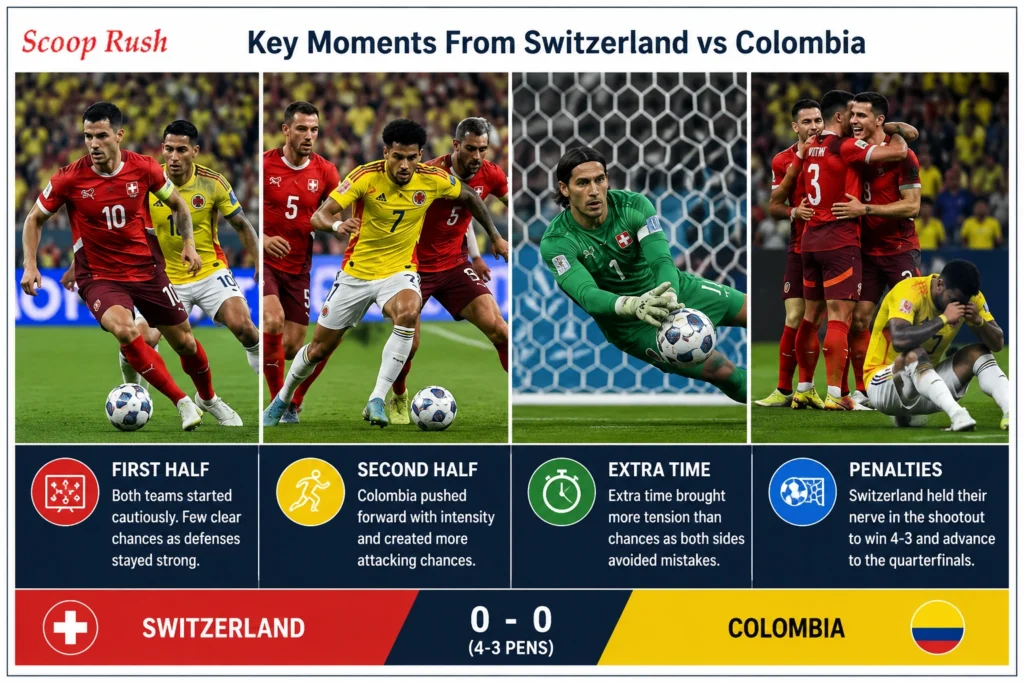
Key Moments From Switzerland vs Colombia

Key Moments From Switzerland vs Colombia

First Half Analysis

Both teams approached the match cautiously during the opening half. Switzerland focused on maintaining possession and defensive shape, while Colombia attempted to create openings through quick attacking moves. Despite a competitive start, neither side managed to create enough clear chances to break the deadlock.

Second Half Analysis

The tempo increased after the break as Colombia pushed forward more aggressively. The South American side registered more shots and earned several corners. However, Switzerland continued to defend effectively and prevented Colombia from finding a decisive breakthrough.

Extra Time Drama

Extra time produced more tension than clear opportunities. Both teams looked determined to avoid costly mistakes, knowing that a single error could end their World Cup campaign. As fatigue became a factor, defensive organization remained the key feature of the contest before penalties eventually decided the outcome.

Colombia’s FIFA World Cup 2026 Campaign Ends in Heartbreak 

Colombia can take pride in a strong overall performance. They created more chances, won more corners, and frequently threatened Switzerland’s defense. However, football often rewards efficiency rather than dominance. 

The final scoreline reflects the harsh reality of tournament football. Creating chances is important, but converting them is essential. Colombia’s inability to score despite their attacking effort left the door open for Switzerland. 

Consequently, their FIFA World Cup campaign ended in one of the most painful ways possible.

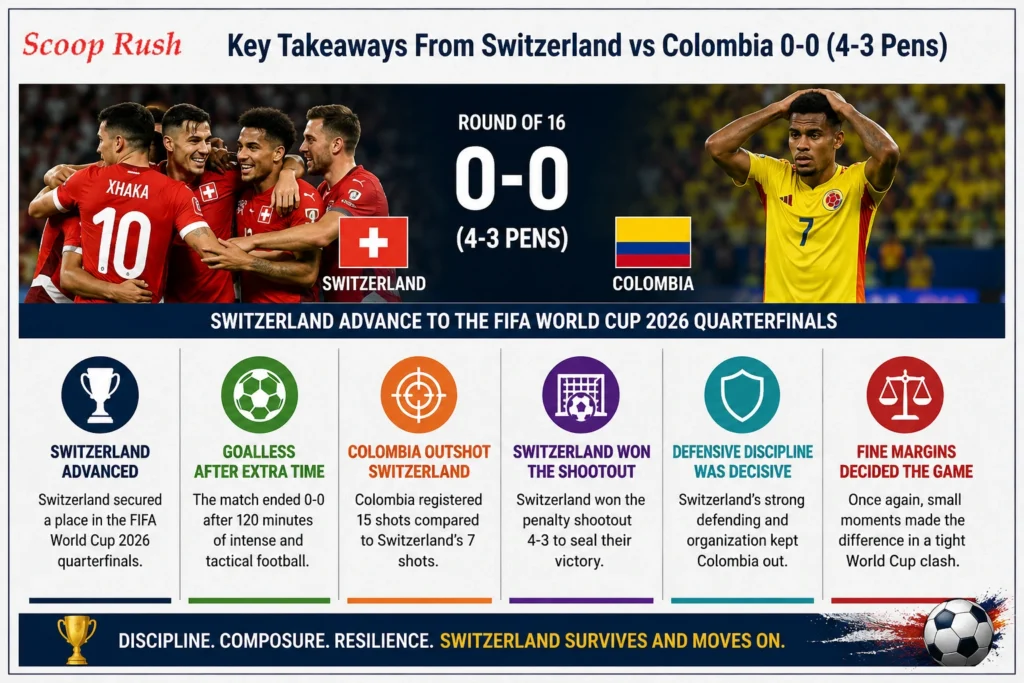
Key Takeaways From Switzerland vs Colombia 0-0 (4-3 Pens) 

Key Takeaways From Switzerland vs Colombia 0-0 (4-3 Pens)
  • Switzerland reached the FIFA World Cup 2026 quarterfinals.
  • The match ended 0-0 after extra time.
  • Colombia outshot Switzerland 15-7.
  • Switzerland won the penalty shootout 4-3.
  • Defensive discipline proved decisive.
  • Fine margins shaped the outcome.

Several important themes emerged from this Round of 16 encounter: Defensive organization remains vital in knockout football. Possession alone does not guarantee victory. Colombia created more opportunities but lacked finishing efficiency. Switzerland showed outstanding discipline over 120 minutes. Penalty shootouts reward composure and mental strength. Fine margins often determine World Cup matches. These lessons were visible throughout a tense and highly competitive contest.

What Comes Next for Switzerland?

Switzerland have moved into the quarterfinals with confidence after surviving one of the most tense matches of the tournament. Their defensive solidity and mental strength could make them a dangerous opponent in the next round. The victory provides momentum and confidence heading into the next stage. More importantly, it proves the team can remain composed under extreme pressure. If Switzerland continues to defend with the same discipline and efficiency, they could become a difficult opponent for any remaining team in the competition.

Conclusion

The Switzerland vs Colombia 0-0 (4-3 pens) Round of 16 clash showcased everything that makes World Cup knockout football special. Colombia created more chances and threatened throughout the contest, yet Switzerland’s discipline and composure ultimately proved decisive. After 120 scoreless minutes, the Swiss side held their nerve in the penalty shootout to secure a place in the FIFA World Cup 2026 quarterfinals. 

However, Switzerland’s disciplined defensive display kept the match level through regulation and extra time. Their 4-3 shootout victory secured a place in the quarterfinals and ended Colombia’s campaign in heartbreaking fashion. Ultimately, this was a reminder that World Cup football is not always won by the team that creates the most chances. Sometimes, success belongs to the team that remains calm when the pressure reaches its highest point.

FAQs

What was the final result of Switzerland vs Colombia?

Switzerland defeated Colombia 4-3 on penalties after a 0-0 draw following extra time.

Who advanced from Switzerland vs Colombia?

Switzerland advanced to the FIFA World Cup 2026 quarterfinals.

Where was Switzerland vs Colombia played?

The Round of 16 match took place at BC Place in Vancouver.

Which team had more shots in the match?

Colombia recorded 15 shots compared to Switzerland’s 7.

How did Switzerland qualify for the quarterfinals?

Switzerland qualified by winning the penalty shootout 4-3 after the match finished 0-0 following extra time.

What Is Meta Muse Image? Everything You Need to Know

0

Meta Just Launched Muse Image, and It Can Put Your Face in Photos You Never Posed For

Imagine finding an AI-made picture of yourself online that you never agreed to be in. That is not a far-off worry anymore. It is already happening on Instagram, thanks to a new tool from Meta called Muse Image.

Meta rolled out Muse Image this week, and within days it had people talking for reasons the company probably did not plan for. The tool lets anyone create AI images, but one feature in particular has sparked real concern: it allows users to pull another person’s public Instagram photos into AI-generated images, without asking that person first.

“Pulling real users into generated photos without explicit consent is a privacy landmine waiting to detonate.” An X user reacting to the news, as reported by The Verge

What Is Muse Image?

Muse Image is Meta’s new AI image generator, built by Meta Superintelligence Labs, the company’s dedicated AI research group. Inside Meta, the project was known by the code name Mango before it launched under its public name this week.

The tool is free to use through the Meta AI app, and it is also built directly into Instagram Stories and WhatsApp. That means you do not need to download a separate app or sign up somewhere new. If you already use Instagram or WhatsApp, Muse is sitting right there waiting for you.

Meta says everyday use of Muse is free. If you go beyond a certain number of image generations, though, you will need to move to a paid subscription plan to keep using it.

What You Can Actually Do With Muse

What you can do with Meta Muse Image AI generator

At its core, Muse works like most other AI image tools on the market right now. You type a prompt, and it generates an image based on your words. If you are not sure what to type, Meta has added ready-made “presets,” which are pre-written prompts designed to give you a starting point.

Here is a quick breakdown of what the tool is built to do:

FeatureWhat It Does
Text-to-image generationTurns a written prompt into a new AI-created image
PresetsReady-made prompt ideas for people who are short on inspiration
Prompt-based editingLets you edit existing photos, like removing a photobomber or adding a background
Marketplace integrationLets you preview furniture in your own space before buying it on Facebook Marketplace
Custom ad creationBusinesses can generate ad images using Muse
Instagram Story effectsNew AI filters and effects for Stories, powered by Muse

Some of these features are genuinely handy. Meta gave an example of using Muse to mock up a photo of yourself standing in front of a famous landmark, cleaning up a photobomber from an old picture, or even generating a working QR code from a simple text prompt. There is also a home decorating angle, where you can drop a secondhand couch from Facebook Marketplace into a photo of your own living room to see how it looks before you buy it.

The Tagging Feature That’s Raising Alarms

Now for the part that has people worried. Muse includes a feature that lets you tag another Instagram user and pull their public photos into your own AI-generated image. As long as that person’s account is public, you can use their picture to create something new, and you do not need their permission first.

The Verge was the first to point out how invasive this could be, and reactions online followed quickly. People are uneasy about a stranger being able to take their face and photos and turn them into new content they never agreed to and may never see.

Meta’s own policy spells this out plainly. According to the company, other people may be able to create content using your Instagram photos through Meta’s AI features, and you will not be told when that happens.

The key detail people are missing

This feature is opt-out, not opt-in. That means it is switched on for every public account by default. If you want to stop your photos from being used this way, you have to go find the setting and turn it off yourself.

Why Meta’s Privacy History Makes This Worse

Context matters here, and Meta’s track record on privacy is part of why people are reacting so strongly. This is not the company’s first run-in with concerns about how it handles personal data and images.

YearIncidentOutcome
2016 to 2018Cambridge Analytica harvested data from tens of millions of Facebook users without their knowledge to build political ad targeting profilesFacebook had known about the misuse for years before it became public
2019FTC investigation into the Cambridge Analytica scandalMeta paid a then-record 5 billion dollar fine to the FTC
2021Facebook’s facial recognition system, which automatically identified people in photos and videos, faced lawsuits and regulatory pressure over biometric data collectionFacebook shut the system down
2026Muse Image launches with an opt-out photo tagging featureUsers and privacy watchers point out the same pattern: your data is used unless you actively turn it off

That last row is really the heart of the issue. Whether it is data collection, facial recognition, or now AI image generation, the pattern keeps repeating. The feature is on unless you go looking for the switch to turn it off.

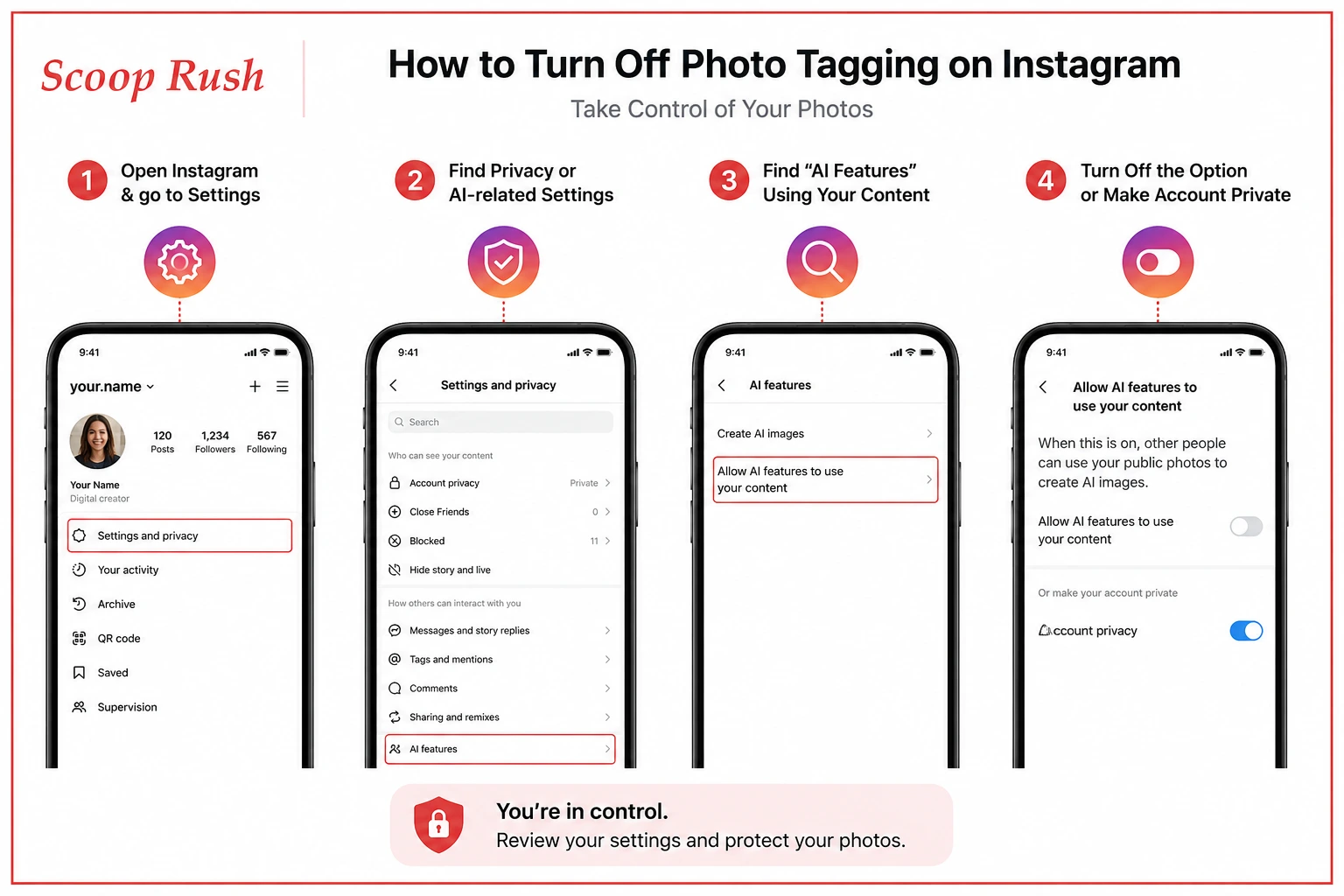
How to Turn Off Photo Tagging

How to turn off Muse AI photo tagging on Instagram

If you would rather not have your public Instagram photos used in other people’s AI creations, Meta says you have the ability to disable this. Here is how to go about it.

  1. Open the Instagram app and go to your profile settings.
  2. Look for privacy or AI-related settings, since Meta has placed controls for this feature there.
  3. Find the option related to AI features using your content, and switch it off.
  4. Alternatively, setting your account to private will limit who can access your photos for this purpose in the first place.

Meta has stated that users have control over this setting, but the burden currently falls on individual users to find it and turn it off rather than being asked upfront.

What’s Coming Next: Muse Video

Image generation might just be the beginning. Meta has confirmed that a video version, called Muse Video, is already in development. Details are thin for now, but given how Muse Image works, it is reasonable to expect similar prompt-based tools, and possibly similar questions about consent and control once it launches.

This launch also fits into a bigger pattern for Meta. Over the past year, the company has released several AI products, including an assistant called Creator and an app called Pocket that lets people build simple video games using AI prompts. Meta has faced criticism for having a scattered AI strategy, but it continues to pour significant money into AI infrastructure this year.

Final Thoughts

Muse Image is a capable tool, and plenty of its features are genuinely useful, from cleaning up old photos to previewing furniture before you buy it. But the photo-tagging feature has pulled the spotlight toward a bigger question that keeps following Meta around: who really controls your data, and how easy is it to protect it if the default setting works against you.

If you use Instagram, WhatsApp, or the Meta AI app, it is worth taking a few minutes to check your privacy settings now rather than finding out later that your photos were used in ways you did not expect. A small setting change today can save you a much bigger headache down the road.

For more updates like this, check out our full technology news section, where we cover the latest AI launches, privacy stories, and product releases as they happen.

Frequently Asked Questions

Muse Image is Meta’s new AI image generator, built by Meta Superintelligence Labs. It is available for free through the Meta AI app, Instagram Stories, and WhatsApp, and it lets users generate and edit images using text prompts.

Yes, if your Instagram account is public. Muse allows users to tag another person and use that person’s public photos to generate a new AI image, and this feature is turned on by default unless you switch it off.

You can check your Instagram privacy or AI settings and turn off the option that allows AI features to use your content. Setting your account to private also limits who can access your photos for this purpose.

Yes, Meta says everyday use of Muse is free. If you go beyond a certain usage limit, you will need a paid subscription to keep generating images.

No, not yet. Meta has confirmed that Muse Video is currently in development, but the company has not shared a release date or full details on how it will work.

Source: Reporting based on TechCrunch, “Meta rolls out Muse, a new AI image generator” (July 7, 2026).

Argentina vs Egypt 3-2: Dramatic World Cup Last-16 Victory Sends Argentina Into Quarterfinals

0

Competition: FIFA World Cup 2026â„¢
Round: Round of 16
Venue: Atlanta Stadium, Atlanta
Full-Time Result: Argentina 3-2 Egypt 

The FIFA World Cup knockout stage delivered another unforgettable spectacle as Argentina vs Egypt 3-2 turned into one of the most dramatic matches of the Round of 16. Despite entering the match as favorites, Argentina were pushed to the limit by a determined Egyptian side that refused to back down.

In a contest filled with goals, momentum swings, and late drama, Argentina eventually secured a 3-2 victory to book their place in the FIFA World Cup 2026 quarterfinals. Egypt, meanwhile, left the tournament with their heads held high after producing a spirited performance against one of football’s biggest nations.

Argentina vs Egypt 3-2: A Thrilling Knockout Battle

Knockout football often produces moments of tension and excitement, and this Round of 16 encounter was no exception.

Argentina emerged victorious by the narrowest of margins after a fiercely contested match that saw five goals scored. Both teams showed attacking intent throughout the game, creating a fast-paced encounter that kept supporters engaged until the final whistle.

While Argentina ultimately advanced, Egypt demonstrated why they had earned a place in the knockout rounds. Their ability to compete against a traditionally strong football nation highlighted the progress and quality within the squad.

The match was played at Atlanta Stadium and provided one of the most entertaining contests of the Round of 16.

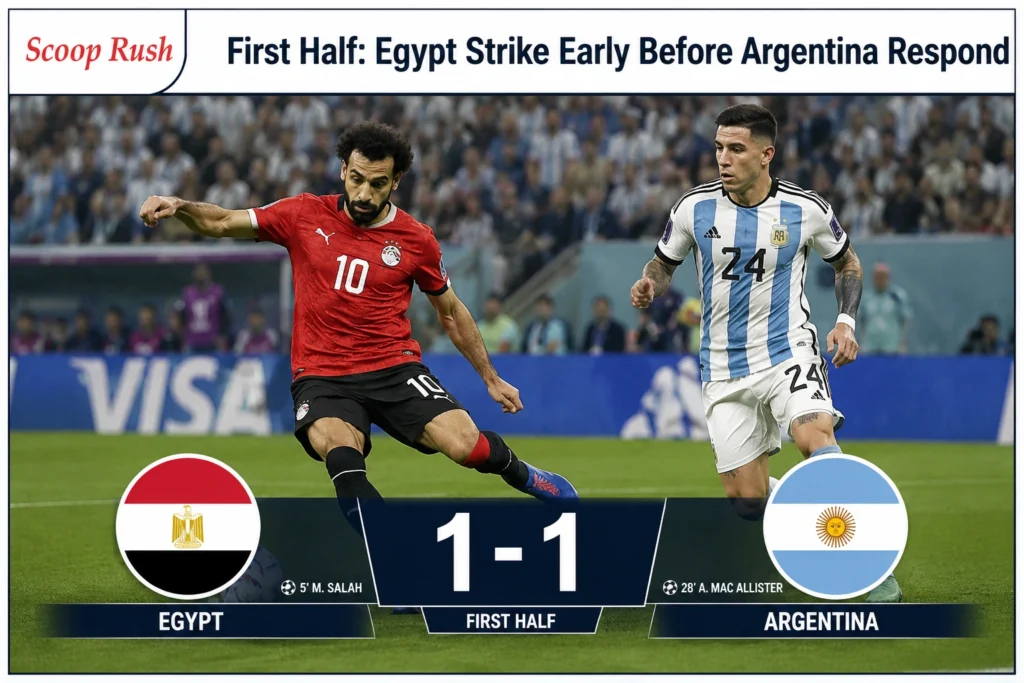
First Half: Egypt Strike Early Before Argentina Respond

First Half: Egypt Strike Early Before Argentina Respond

The game began with immediate intensity as both teams looked to establish control.

Egypt made the perfect start when Yasser Ibrahim found the net in the 15th minute. The early goal stunned Argentina and gave Egypt an important advantage in the opening stages.

However, Argentina responded positively rather than allowing the setback to affect their approach.

The South American side increased their attacking pressure and searched for an equalizer. Their persistence eventually paid off when Cristian Romero scored in the 73rd minute to bring Argentina level.

The goal shifted momentum and injected renewed belief into the Argentine players and supporters.

Egypt’s Defensive Discipline

For much of the match, Egypt remained organized and disciplined.

The defensive unit worked hard to limit Argentina’s attacking opportunities while also looking for chances on the counterattack. Their structure made it difficult for Argentina to create clear-cut openings during long periods of the contest.

Nevertheless, sustaining that defensive effort against continuous pressure proved increasingly challenging as the game progressed.

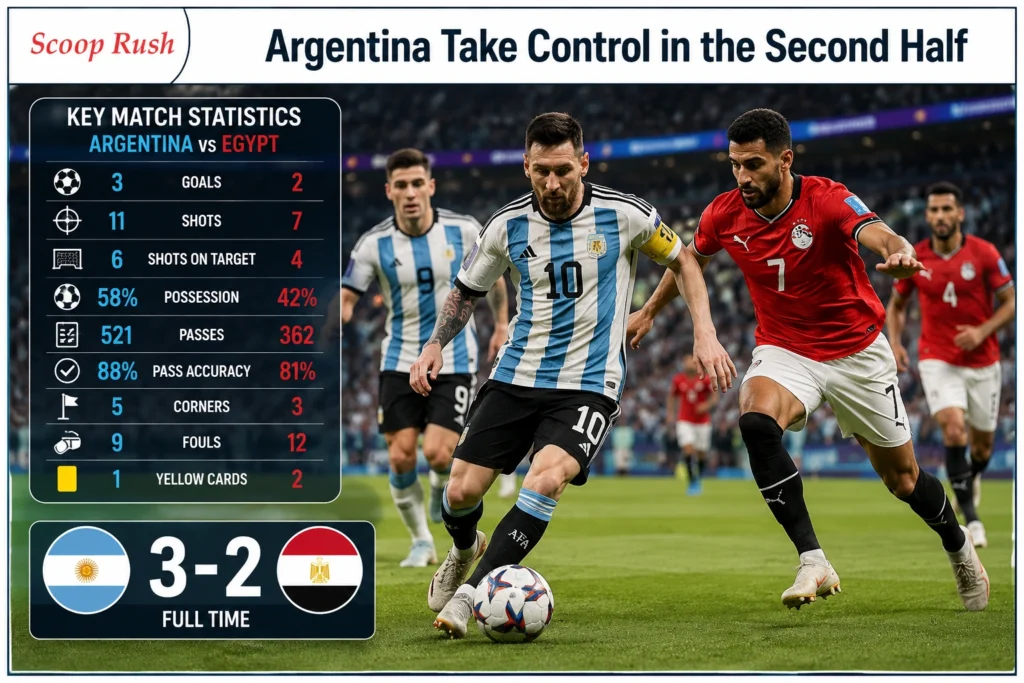
Argentina Take Control in the Second Half

Argentina Take Control in the Second Half

After finding an equalizer, Argentina began to look more dangerous in possession.

The team enjoyed a larger share of the ball and attempted to dictate the tempo. Statistical indicators reflected that control, with Argentina recording 61% possession and completing 600 passes compared to Egypt’s 337.

Those numbers illustrated Argentina’s ability to keep the ball and force Egypt to spend long periods defending.

Eventually, the pressure created further opportunities.

Lionel Messi put Argentina ahead in the 87th minute, giving his side a crucial advantage late in the contest.

The goal appeared to put Argentina firmly on course for victory. However, the drama was far from over.

Egypt Refuse to Surrender

One of the most impressive aspects of Egypt’s performance was their resilience.

Even after falling behind late in the match, the African side continued to push forward in search of a response.

Their determination was rewarded when Mostafa Ziko scored in the 87th minute, bringing Egypt level and creating a dramatic finale.

At that stage, the match seemed destined for extra time.

Yet knockout football often produces unexpected twists, and another decisive moment was still to come.

Argentina Find a Late Winner

Just when the contest appeared headed beyond regulation time, Argentina produced one final breakthrough.

Enzo Fernández scored in the 90+3rd minute to restore Argentina’s lead and send supporters into celebration.

The late goal proved decisive.

Egypt could not find another response before the final whistle, allowing Argentina to secure a thrilling 3-2 victory and progress to the next round.

The dramatic finish highlighted the fine margins that often define World Cup knockout matches.

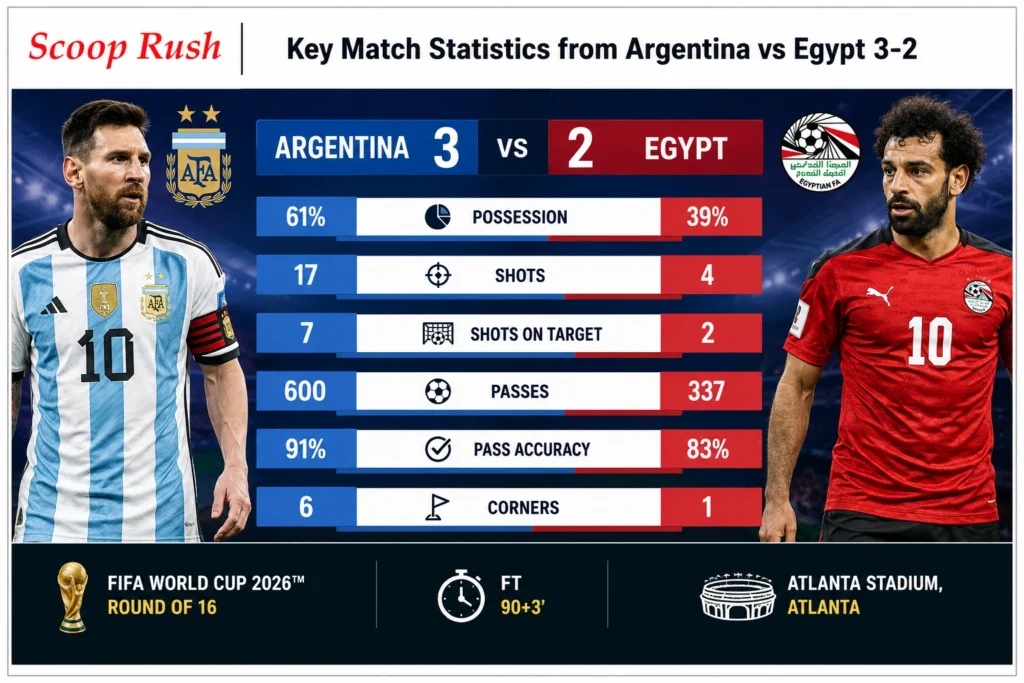
Key Match Statistics from Argentina vs Egypt 3-2

Key Match Statistics from Argentina vs Egypt 3-2

The numbers reveal how the match unfolded:

Possession
Argentina: 61%
Egypt: 39%

Argentina controlled possession for much of the game and dictated the rhythm of play.

Shots
Argentina: 17
Egypt: 4

Argentina generated significantly more attacking opportunities.

Shots on Target
Argentina: 7
Egypt: 2

The South American side tested the Egyptian goalkeeper more frequently throughout the contest.

Passing
Argentina: 600 passes
Egypt: 337 passes

Argentina’s passing advantage reflected their dominance in possession.

Pass Accuracy
Argentina: 91%
Egypt: 83%

The higher passing accuracy helped Argentina sustain attacking pressure.

Corners
Argentina: 6
Egypt: 1

Argentina’s attacking approach resulted in more set-piece opportunities.

These statistics demonstrate Argentina’s overall control while also emphasizing Egypt’s efficiency in front of goal.

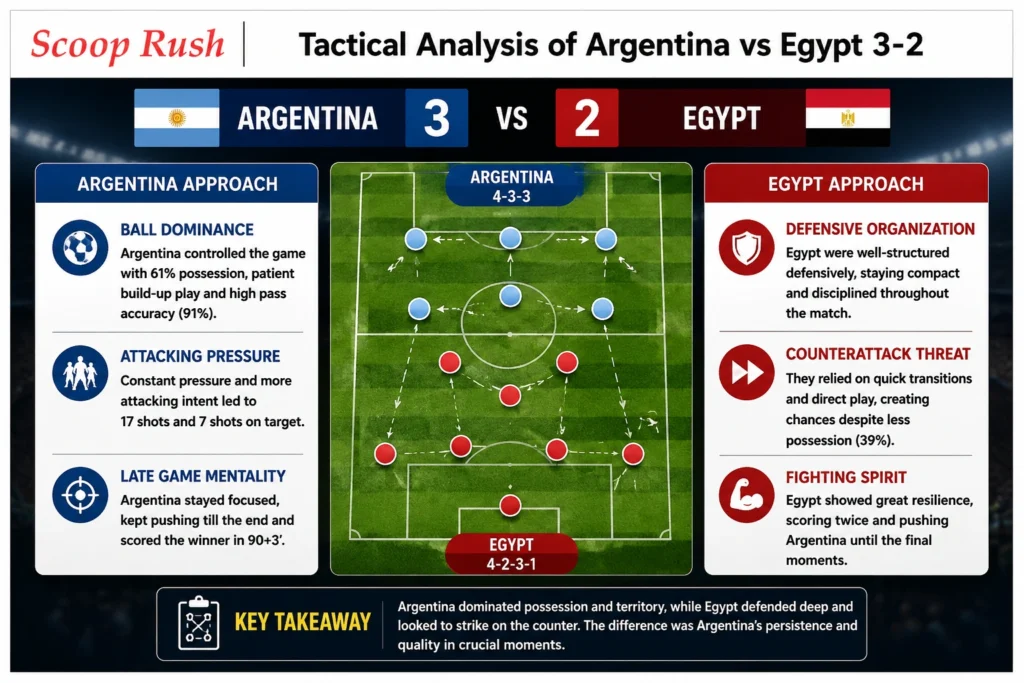
Tactical Analysis of Argentina vs Egypt 3-2

Tactical Analysis of Argentina vs Egypt 3-2

Argentina’s Ball Dominance

Argentina relied heavily on possession and patient build-up play.

The team moved the ball effectively across the pitch and looked to create openings through sustained pressure. Their high pass count and excellent accuracy reflected a structured and controlled approach.

As the game progressed, this style gradually wore down Egypt’s resistance.

Egypt’s Counterattacking Threat

Although Egypt saw less of the ball, they remained dangerous whenever opportunities emerged.

Their game plan focused on defensive organization and quick transitions. This strategy allowed them to remain competitive despite facing extended periods without possession.

The approach nearly produced a famous upset.

Late-Game Mental Strength

The closing stages highlighted Argentina’s experience and composure.

After Egypt equalized late in the match, many teams would have struggled emotionally. Instead, Argentina remained focused and continued searching for another opportunity.

That determination resulted in Enzo Fernández’s winning goal during stoppage time.

Standout Performers

Lionel Messi

Messi once again delivered a crucial contribution when Argentina needed inspiration.

His goal in the closing stages appeared set to secure victory and demonstrated his ability to influence major matches.

Enzo Fernández

Fernández produced the defining moment of the game.

His stoppage-time winner ultimately separated the two teams and ensured Argentina’s place in the quarterfinals.

Cristian Romero

Romero’s equalizing goal helped swing momentum back toward Argentina and played a key role in the comeback.

Yasser Ibrahim

Ibrahim gave Egypt the ideal start with an early goal and contributed to an impressive overall team performance.

Mostafa Ziko

Ziko’s late equalizer briefly reignited Egypt’s hopes and added another dramatic chapter to an already thrilling encounter.

What This Result Means for Argentina

The victory keeps Argentina’s FIFA World Cup 2026 campaign alive.

Reaching the quarterfinals is an important achievement, but the manner of the win also provides valuable lessons. Despite controlling large portions of the match, Argentina discovered how dangerous knockout football can be when opportunities are not converted efficiently.

The coaching staff will likely focus on improving defensive concentration ahead of the next round.

At the same time, the team’s ability to recover from setbacks and score a late winner demonstrates strong character.

What This Result Means for Egypt

Although Egypt’s tournament journey ends here, the performance offers plenty of positives.

Competing closely with Argentina on football’s biggest stage is an encouraging sign. The team showed determination, discipline, and resilience throughout the match.

Their ability to score twice against a strong opponent and remain competitive until the final moments reflects significant quality.

Supporters can take pride in a performance that pushed one of the tournament favorites to the limit.

Conclusion

The Argentina vs Egypt 3-2 Round of 16 clash delivered everything football fans could ask for: goals, drama, momentum shifts, and a dramatic stoppage-time winner.

Argentina controlled possession and created more chances, but Egypt’s fighting spirit ensured the contest remained competitive from start to finish. Goals from Cristian Romero, Lionel Messi, and Enzo Fernández ultimately secured Argentina’s place in the quarterfinals, while Yasser Ibrahim and Mostafa Ziko provided memorable moments for Egypt.

In the end, Argentina survived a major knockout-stage test, but Egypt’s brave performance ensured this match will be remembered as one of the most entertaining encounters of the FIFA World Cup 2026 Round of 16.

FAQs

1. What was the final score between Argentina and Egypt?

Argentina defeated Egypt 3-2 in the FIFA World Cup 2026 Round of 16.

2. Who scored for Argentina against Egypt?

Cristian Romero, Lionel Messi, and Enzo Fernández scored Argentina’s goals.

3. Who scored for Egypt against Argentina?

Yasser Ibrahim and Mostafa Ziko scored for Egypt.

4. Where was the Argentina vs Egypt match played?

The match took place at Atlanta Stadium during the FIFA World Cup 2026 Round of 16.

5. What happens after Argentina’s win over Egypt?

Argentina advanced to the quarterfinals of the FIFA World Cup 2026, while Egypt were eliminated from the tournament.

Marine Le Pen Cleared for 2027 Presidential Run Despite Electronic Tag

0

Paris, France | 7 July 2026

Marine Le Pen presidential run remains possible after a French appeal court reduced her ban from holding public office, allowing her to compete in the 2027 presidential election. However, the court also ordered her to serve one year under electronic monitoring with an ankle tag, leaving uncertainty over whether she will actually enter the race.

Le Pen has previously said she would not campaign if movement restrictions prevented her from traveling freely across France. She is expected to announce her final decision during a televised interview.

Marine Le Pen Presidential Run Back on Track After Appeal

The Paris Court of Appeal upheld Marine Le Pen’s conviction for misusing European Parliament funds. However, judges significantly reduced the political consequences of the sentence.

Her original five-year ban from holding public office was reduced to 15 months. Because the court backdated the ban to March 2025, it has already been completed. This means Le Pen is legally eligible to run in the French presidential election scheduled for April and May 2027.

The judges said they carefully balanced the punishment with the democratic rights of candidates and voters. They concluded that preventing her from standing in the election would no longer be proportionate.

Why Marine Le Pen Must Wear an Electronic Tag

Why-Marine-Le-Pen-Must-Wear-an-Electronic-Tag

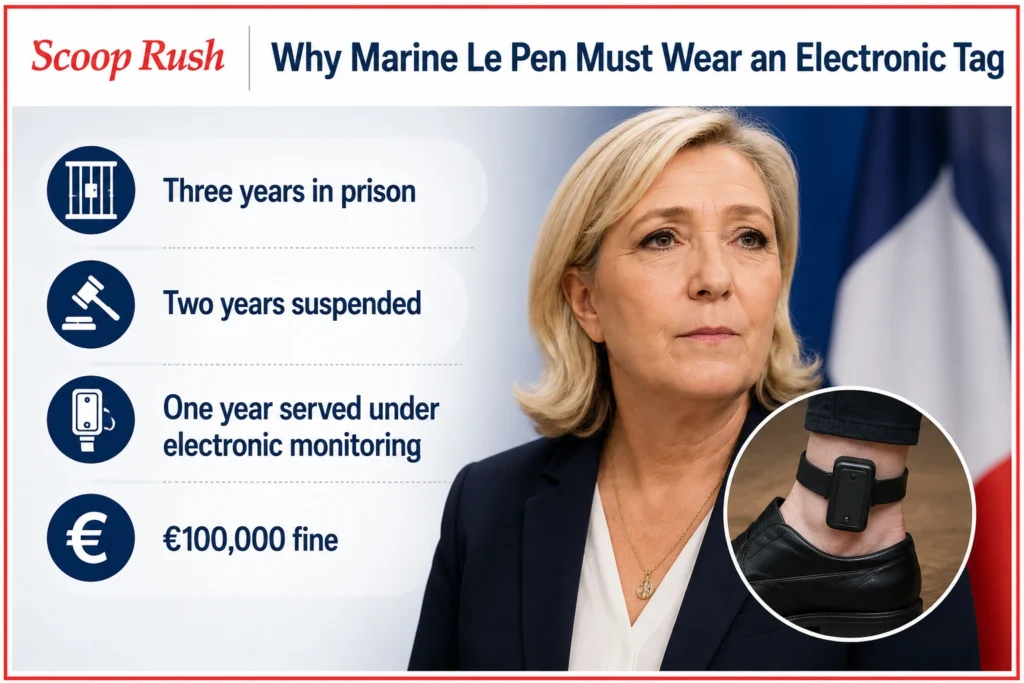
Although Le Pen can legally run, she must serve one year under house arrest while wearing an electronic ankle tag.

Her sentence includes:

  • Three years in prison
  • Two years suspended
  • One year served under electronic monitoring
  • €100,000 fine

The electronic tag could limit her daily movements. A supervising judge will later decide when she can leave home for work or political activities and when she must return.

Le Pen has repeatedly argued that a presidential candidate needs complete freedom to campaign across the country. She believes relying on judicial permission for travel would make an effective national campaign difficult.

Why Marine Le Pen Was Convicted

The court found Le Pen guilty of misusing European Parliament funds between 2004 and 2016.

According to judges, money intended to pay parliamentary assistants working for Members of the European Parliament was instead used to finance staff employed by her political party in France.

The court ruled that the system continued for years and involved several party officials. Judges said Le Pen played a central role after becoming leader of the party in 2011.

Le Pen has consistently denied wrongdoing and argued that the party acted in good faith.

Jordan Bardella Could Replace Marine Le Pen

If Marine Le Pen presidential run does not go ahead, National Rally president Jordan Bardella is expected to become the party’s candidate.

The 30-year-old has become one of France’s most recognizable political figures and already manages much of the party’s day-to-day leadership.

Le Pen and Bardella met with senior National Rally officials shortly after the court ruling to discuss the party’s strategy before her television interview.

Political Reactions to the Verdict

Political-Reactions-to-the-Verdict

The ruling quickly sparked political debate across France.

Several left-wing politicians argued that someone convicted of misusing public funds should not seek the country’s highest office.

Others rejected claims that the judiciary was politically motivated, saying the appeal court had already shown leniency by reducing her ban from public office.

Meanwhile, Le Pen’s supporters criticized the decision to require electronic monitoring, arguing it could still interfere with a fair presidential campaign.

What Happens Next?

Le Pen can still challenge parts of the ruling before France’s highest court. She may also request a shorter period of electronic monitoring if she meets legal requirements.

Her immediate focus is deciding whether campaign restrictions would allow her to run.

Opinion polls continue to place Le Pen among the leading contenders for the 2027 presidential election. President Emmanuel Macron cannot seek another term because of France’s constitutional term limits.

Her announcement is expected to determine whether National Rally enters the election with its longtime leader or hands the campaign to Jordan Bardella.

Conclusion

The appeal court’s decision has reopened the possibility of a Marine Le Pen presidential run in 2027. While her ban from public office has effectively ended, the requirement to wear an electronic ankle tag creates new political and practical challenges.

Her decision in the coming hours will shape the National Rally’s election strategy and could become one of the defining moments of France’s next presidential race.

FAQs

1. Can Marine Le Pen run in the 2027 French presidential election?

Yes. The appeal court reduced and backdated her ban from public office, making her legally eligible to run in 2027.

2. Why was Marine Le Pen convicted?

She was found guilty of misusing European Parliament funds that were intended for parliamentary assistants but were used to pay party staff in France.

3. Why does Marine Le Pen have to wear an electronic ankle tag?

The court ordered one year of electronic monitoring as part of her prison sentence. It replaces time in prison with supervised house arrest.

4. Who could replace Marine Le Pen if she decides not to run?

Jordan Bardella, president of the National Rally party, is expected to become the party’s presidential candidate.

5. Will the electronic tag stop Marine Le Pen from campaigning?

Not automatically. However, movement restrictions could make nationwide campaigning more difficult, which is why Le Pen has said she may choose not to run.

Elliot Anderson Brother: The Famous Athlete Many England Fans Never Knew About

0

Introduction

England midfielder Elliot Anderson has captured headlines with his impressive World Cup performances and a reported record-breaking transfer to Manchester City. As his popularity grows, fans are searching for details about Elliot Anderson Brother Wil Anderson, who has also built a public profile through reality television and boxing. The story of Elliot’s family has surprised many supporters because, while Elliot has earned fame on the football pitch, his older brother Wil has created his own journey in the spotlight.

The two brothers have followed different career paths, yet both have experienced life in front of the public eye while supporting each other through personal achievements and challenges. This article explores Wil Anderson’s boxing career, his rise to fame through Love Island, the close bond between the Anderson brothers, and why interest in Elliot Anderson’s family has increased during England’s World Cup campaign. heartbreak.

This article explores Wil Anderson’s boxing career, his rise to fame through Love Island, the close bond between the Anderson brothers, and why interest in Elliot Anderson’s family has grown during England’s World Cup campaign.

Elliot Anderson Brother: The Famous Athlete Many England Fans Never Knew About

Elliot Anderson Brother: The Famous Athlete Many England Fans Never Knew About

England midfielder Elliot Anderson has become one of the standout performers during the World Cup. His impressive displays, combined with a record-breaking move to Manchester City, have placed him firmly in the spotlight. However, many fans are only now discovering that football is not the only sporting talent in the Anderson family.

The story of Elliot Anderson brother has attracted growing attention as supporters learn that his older sibling, Wil Anderson, has built a public profile of his own. While Elliot dominates Premier League midfields and represents England on football’s biggest stage, Wil has found success through reality television before stepping into the boxing ring as a Misfits fighter.

The family’s story goes beyond sporting achievements. It is also one of resilience, public attention, and personal heartbreak. As Elliot continues to shine for England, interest in the people closest to him has grown rapidly.

Elliot Anderson’s Rise to England Stardom

Elliot Anderson has enjoyed a remarkable rise over the past year.

After impressing for Nottingham Forest in the Premier League, he established himself as one of England’s most reliable midfielders. His performances earned the trust of England manager Thomas Tuchel, who handed him his international debut last September.

Since then, Anderson has become a regular starter alongside Declan Rice in England’s midfield.

His consistent displays also attracted serious interest from Manchester City.

On July 2, Manchester City confirmed they had reached an agreement with Nottingham Forest for Anderson’s transfer.

According to reports, the deal is worth £116 million, making Anderson the most expensive British player in history. The reported fee surpasses the previous benchmark held by England teammate Jude Bellingham.

Meanwhile, Anderson has continued to play an important role during England’s World Cup campaign.

As England prepared for a challenging knockout clash against Mexico at the famous Azteca Stadium, Anderson once again started in central midfield, highlighting his growing importance to the national team.

Who Is Elliot Anderson’s Brother?

The growing attention surrounding Elliot Anderson brother has introduced many football supporters to Wil Anderson.

Although both brothers are elite athletes, they have chosen very different sporting careers.

While Elliot controls games with intelligent passing and composure in midfield, Wil competes inside the boxing ring.

The Anderson brothers also share a close relationship away from sport.

Wil has regularly supported Elliot throughout England’s World Cup journey, travelling to the United States to watch matches and celebrate his younger brother’s achievements.

Elliot Anderson Brother Wil Anderson’s Boxing Career

Wil Anderson has built a name for himself in influencer boxing through the Misfits Boxing promotion.

His boxing career is still developing, but it has already included both setbacks and victories.

Early Results Inside the Ring

Wil made his professional-style Misfits debut against Jordan Banjo.

Unfortunately, his first appearance ended in defeat after a technical knockout.

However, he quickly bounced back.

In March, Wil earned his first victory by knocking out Jake Cornish.

As a result, he demonstrated his determination to improve and continue building his boxing career.

His athletic background and competitive mindset have helped him establish himself in the growing world of crossover boxing.

From Love Island to Public Recognition

Before entering boxing, Wil Anderson became widely known through reality television.

He joined Love Island in 2024 as a bombshell contestant on day 12 of the series.

Soon after entering the villa, Wil formed a connection with Uma Jammeh.

The pair decided to recouple together during the show.

However, Wil’s time in the villa eventually ended on day 37 after newcomer Reuben Collins selected Uma during a recoupling.

Although their television journey came to an end, their relationship continued outside the show.

Following the series, Wil and Uma reunited and remained together.

Their relationship reached another milestone when Wil proposed during a trip to Mallorca.

Sharing the happy news on Instagram, he joked:

“I liked it, so I put a ring on it.”

The couple are now engaged.

A Family United During England’s World Cup Campaign

Despite pursuing different careers, the Anderson brothers have remained extremely supportive of each other.

Wil and Uma recently travelled to America to follow England throughout the World Cup.

They attended England’s opening victory over Croatia at Dallas Stadium.

Wil later shared several photographs and videos from inside the stadium on social media.

Among the highlights was a picture of the Anderson brothers together while celebrating England’s successful start to the tournament.

These moments offered fans a rare glimpse into their close family bond.

Personal Tragedy Behind the Success

While the Anderson family has celebrated Elliot’s remarkable achievements, they have also experienced deep personal loss.

In April, Elliot and Wil sadly lost their mother, Helen, following a short illness.

Wil later shared an emotional tribute on Instagram that revealed the family’s heartbreak.

He described his mother as his biggest supporter and strongest motivation throughout his life.

He also thanked her for everything she had done for the family and promised to continue making her proud.

His tribute reflected the close relationship they shared and resonated with many supporters.

The message highlighted that, despite the public attention surrounding football and boxing, the Anderson family has faced the same difficult challenges experienced by countless families.

Why Fans Are Searching for Elliot Anderson Brother

Why Fans Are Searching for Elliot Anderson Brother

Interest in Elliot Anderson brother has grown for several reasons.

First, Elliot’s outstanding World Cup performances have introduced him to a wider global audience.

Second, his reported record-breaking transfer to Manchester City has generated enormous media attention.

As fans searched for more information about the England midfielder, many discovered that his older brother had already established his own public profile.

Wil’s appearances on Love Island, engagement to Uma Jammeh, and growing boxing career have all increased curiosity about the Anderson family.

Consequently, both brothers now receive significant public attention, although for very different reasons.

Different Sports, Shared Competitive Spirit

Although football and boxing require different skills, both Elliot and Wil have demonstrated the determination needed to compete at a high level.

Elliot’s calm decision-making, passing ability, and tactical intelligence have made him one of England’s most trusted midfielders.

Meanwhile, Wil has embraced the physical and mental challenges of boxing after first becoming known through reality television.

Both careers demand discipline, preparation, and resilience.

Therefore, it is not surprising that sporting success runs within the Anderson family.

Elliot Anderson’s Growing Influence

Elliot Anderson's Growing Influence

At only 23 years old, Elliot Anderson has already achieved several major milestones.

He has become an England international.

He has established himself in the Premier League.

He has earned a reported record-breaking move to Manchester City.

Additionally, he has become one of England’s key players during the World Cup.

As his career continues to develop, interest in both his personal life and family background will likely remain high.

Many supporters now recognize that the Anderson family’s sporting success extends beyond football.

The Public Spotlight on the Anderson Family

Modern athletes often attract attention beyond their performances on the field.

Supporters want to know more about their families, friendships, and personal journeys.

The Anderson family has become one such example.

Elliot’s football achievements continue to make headlines.

Meanwhile, Wil’s boxing career and television appearances have created his own dedicated audience.

Despite following different career paths, the brothers continue to support one another publicly.

Their appearances together during England’s World Cup campaign have reinforced that close bond.

Conclusion

The growing interest in Elliot Anderson brother reflects just how much attention the England midfielder now commands.

As Elliot continues to impress for England and begins the next chapter of his career following his reported move to Manchester City, many fans are discovering that sporting talent runs throughout the Anderson family.

Wil Anderson has built his own reputation through Love Island and Misfits Boxing, creating a very different path to public recognition.

At the same time, both brothers have shown remarkable resilience following the loss of their mother while continuing to pursue their sporting ambitions.

Their shared journey combines success, family support, and determination. As Elliot’s football career reaches new heights, interest in the Anderson family story is likely to continue growing.

FAQs

1. Who is Elliot Anderson’s brother?

Elliot Anderson’s brother is Wil Anderson, a Misfits boxer who previously appeared on Love Island in 2024.

2. What sport does Wil Anderson compete in?

Wil Anderson competes in boxing and fights under the Misfits Boxing promotion.

3. Is Wil Anderson engaged?

Yes. Wil Anderson is engaged to Uma Jammeh after proposing during a trip to Mallorca.

4. Why is Elliot Anderson making headlines?

Elliot Anderson has impressed for England during the World Cup and reportedly completed a record-breaking £116 million transfer to Manchester City.

5. Did Elliot and Wil Anderson recently experience a family tragedy?

Yes. The brothers’ mother, Helen, passed away in April after a short illness. Wil later shared an emotional tribute on social media.

Exercise Reverses Muscle Aging: Scientists Discover the DEAF1 Gene Switch Behind It

0

Introduction

Exercise Reverses Muscle Aging is more than just a fitness claim. Researchers at Duke-NUS Medical School have identified a molecular switch centered on the DEAF1 gene that helps explain why physical activity keeps aging muscles stronger and healthier. The discovery could reshape how scientists and doctors understand age-related muscle loss and why some older adults respond better to exercise than others. Published in the Proceedings of the National Academy of Sciences (PNAS), the study provides new insight into the biology of muscle aging and repair. muscle loss in older adults.

Exercise Reverses Muscle Aging is more than just a catchy headline. A new study from Duke-NUS Medical School has identified the DEAF1 gene as a molecular switch that helps explain why physical activity keeps aging muscles stronger and healthier.

What Causes Muscles to Weaken With Age

What Causes Muscles to Weaken With Age

Muscle loss is often seen as an unavoidable part of getting older. However, its effects go far beyond simply feeling weaker.

Weaker muscles increase the risk of falls and fractures. They also slow recovery after illness or surgery. Additionally, muscle tissue plays a major role in regulating blood sugar, so declining muscle health can affect metabolism too.

At the center of this decline is a pathway called mTORC1, which controls how muscles build and maintain proteins. In younger bodies, this system works efficiently. It helps muscles grow and repair themselves after physical stress.

As people age, though, mTORC1 can become overactive. Instead of maintaining a healthy balance, it pushes muscles to keep producing new proteins while neglecting the cleanup of damaged ones. Over time, these damaged proteins accumulate inside muscle cells. This buildup places stress on the cells and contributes directly to the gradual loss of strength associated with aging.

For a long time, researchers understood this imbalance existed. What they didn’t know was what caused it.

The Genetic Driver Behind Muscle Aging

Researchers found that Exercise Reverses Muscle Aging through the DEAF1 gene and FOXO proteins.The Duke-NUS team, working alongside collaborators from Singapore General Hospital and Cardiff University, pinpointed DEAF1 as the missing piece.

According to the study, DEAF1 levels naturally rise as muscles age. As DEAF1 increases, it pushes mTORC1 activity even higher, disrupting the normal balance between building and clearing proteins. This accelerates muscle deterioration significantly.

Under healthy conditions, DEAF1 is kept in check by a group of proteins called FOXOs. However, FOXO activity declines with age. As a result, DEAF1 no longer faces the same regulatory control, allowing its levels to climb unchecked. This is similar to how a hidden genetic factor can quietly shift how a drug or pathway performs in the body.

This creates what researchers describe as a persistent, damaging cycle. The system that once protected muscles from wear and tear becomes part of the problem.

How Exercise Flips the Switch Back

How Exercise Flips the Switch Back

Exercise Reverses Muscle Aging by lowering DEAF1 levels and restoring the balance of the mTORC1 pathway.

Assistant Professor Tang Hong-Wen, the study’s senior author from Duke-NUS’s Cancer and Stem Cell Biology Program, explained the mechanism directly. Physical activity activates proteins that lower DEAF1 levels, which in turn brings mTORC1 back into balance. This allows aging muscles to clear out damaged proteins, rebuild themselves properly, and regain strength and resilience.

In simpler terms, exercise doesn’t just build muscle. It resets the internal switch that controls whether muscles repair themselves or slowly break down.

Tang described the discovery as striking, noting that exercise appears to target the actual switch responsible for muscle aging, rather than just addressing surface-level damage. That distinction matters because it points to a root cause rather than a temporary fix.

Why Exercise Doesn’t Work the Same for Everyone

The research also uncovered an important limitation. In some older muscles, DEAF1 levels rise so high, or FOXO activity drops so significantly, that exercise alone may not be enough to fully restore the muscle’s repair capacity.

This finding could explain a pattern many people have noticed anecdotally: some older adults see dramatic benefits from staying active, while others see far less improvement despite similar effort. Understanding the biology behind this difference could help doctors eventually tailor recommendations more precisely, much like how researchers studying omega-3 supplements have found that individual response can vary widely.

Testing the Theory in Flies and Mice

To confirm their findings, researchers ran experiments across two different species. They tested the DEAF1 mechanism in both fruit flies and aging mice, an approach that echoes how scientists studying new beetle species rely on careful cross-species comparison to validate biological patterns.

The results were consistent in both cases. When DEAF1 levels were artificially raised, muscles weakened more rapidly. When DEAF1 was lowered, muscles regained a healthier protein balance and improved strength.

In the mouse experiments specifically, researchers put older mice through structured endurance workouts, including treadmill sessions, while a separate group remained sedentary. The mice that exercised showed significant drops in mTORC1 activity, the overactive pathway tied to muscle loss and a condition known as sarcopenia.

Because the same pattern held true across two very different organisms, the findings suggest DEAF1 plays a conserved role in muscle aging that likely applies broadly across species, including humans.

Beyond Aging: What This Means for Recovery and Disease

Beyond Aging: What This Means for Recovery and Disease

The implications of this research may reach well beyond typical age-related muscle loss.

DEAF1 also influences muscle stem cells, which are responsible for helping muscles repair and regenerate damaged tissue. These stem cells naturally become less effective over time. When DEAF1 activity is disrupted, that decline appears to accelerate, making recovery even harder.

This connection could prove especially valuable for people recovering from surgery, serious illness, or chronic conditions such as cancer. In situations where physical activity is limited or impossible, understanding DEAF1 offers a potential path forward.

Researchers suggest that targeting DEAF1 directly, through future drug development, could potentially replicate some of the beneficial effects of exercise at the molecular level. That would mean helping patients maintain muscle strength even when they can’t work out in the traditional sense.

Priscillia Choy Sze Mun, the study’s first author, summarized the discovery memorably. She described exercise as essentially telling muscles to “clean up and reset,” with lowering DEAF1 helping older muscles regain strength and balance, almost like hitting a rewind button.

Professor Patrick Tan, Senior Vice-Dean for Research at Duke-NUS, added that identifying DEAF1 as a key regulator could open new avenues for bringing the benefits of exercise to aging populations worldwide, particularly as life expectancy continues to rise globally.

Conclusion

Exercise Reverses Muscle Aging by restoring the body’s natural muscle repair system, according to researchers at Duke-NUS Medical School. The discovery of the FOXO-DEAF1-mTORC1 pathway gives scientists a clear biological explanation for why physical activity remains one of the best ways to protect muscle health as people age.

For everyday readers, the practical message stays simple: physical activity continues to be one of the most powerful tools available for maintaining strength and independence with age. At the same time, this research opens the door to future treatments for people who cannot exercise due to illness, injury, or advanced age.

As Tang and his team continue this work, the hope is that understanding DEAF1 could eventually lead to therapies that mimic exercise’s protective effects at a cellular level, offering new options for millions of people at risk of muscle decline.

FAQs

What is DEAF1 and why does it matter for muscle aging?

DEAF1 is a gene regulator that rises in activity as muscles age. Higher DEAF1 levels push a growth pathway called mTORC1 into overdrive, disrupting the normal balance between building new muscle proteins and clearing out damaged ones. This imbalance contributes directly to muscle weakness over time.

How does exercise affect DEAF1 levels?

Physical activity activates FOXO proteins, which in turn lower DEAF1 levels. This helps restore normal mTORC1 activity, allowing muscles to clear damaged proteins and rebuild themselves more effectively.

Why doesn’t exercise help everyone’s muscles equally?

In some older muscles, DEAF1 levels become extremely high or FOXO activity drops too far. In these cases, exercise alone may not fully restore the muscle’s repair capacity, which may explain why individual responses to exercise vary.

Could this research lead to new treatments for muscle loss?

Yes. Researchers believe that targeting DEAF1 directly, potentially through medication, could help replicate some of the muscle-protective benefits of exercise. This could benefit people who cannot exercise due to illness, surgery, or limited mobility.

Was this research tested only in humans?

No. Scientists confirmed their findings using both fruit flies and aging mice. Results were consistent across both species, suggesting DEAF1 plays a conserved biological role that likely extends to humans as well.