Home Blog Page 6

What Are the Best Ways to Relieve Stress Fast?

0

Stress rarely announces itself politely. It shows up as a tight jaw during a work call, a racing heart before a big decision, or the low hum of worry that keeps you scrolling your phone at 2 a.m. instead of sleeping. Whether it’s a single bad day or a pressure that’s been building for months, the good news is that stress relief doesn’t have to mean a spa weekend or a total life overhaul.

Quick Fixes and Lasting Habits, Side by Side

Sometimes stress relief is a five-minute breathing exercise. Sometimes it’s a long-term shift in how you plan your week. This guide walks through both  the quick fixes and the lasting habits so you can build a stress-relief toolkit that actually fits your life, whether you need help right now or you’re looking to build resilience over the coming months.

What Exactly Is Stress, and Why Should You Take It Seriously?

What Exactly Is Stress, and Why Should You Take It Seriously?|Scoop Rush

Stress is your body’s natural response to pressure or perceived threats. In small, short bursts, it can sharpen focus and motivate you to meet a deadline. The trouble starts when stress becomes constant.

How Chronic Stress Affects Your Body and Mind

Left unmanaged, chronic stress has been linked to a higher risk of heart disease, anxiety disorders, and depression, and it can make it harder to think clearly, sleep well, or enjoy everyday life. Over time, it can also affect digestion, immune function, and energy levels, which is part of why people under chronic stress often report feeling run-down even when they haven’t done anything physically demanding.

Why Stress Feels Different for Everyone

Not everyone experiences stress the same way, and part of the reason comes down to individual differences such as genetics, personality, coping style, level of social support, past trauma, and even the demands of a particular job. Understanding that stress isn’t one-size-fits-all is the first step toward finding relief strategies that actually work for you, rather than borrowing a routine that works for someone else’s life and circumstances.

The Three Main Types of Stress

Type of StressWhat It Looks LikeExample
Acute stressA short-term reaction to a specific eventWorrying about an upcoming exam or a delayed flight
Episodic acute stressAcute stress that keeps repeatingConstantly feeling overwhelmed because of poor time management
Chronic stressA long-running pressure with no clear end dateOngoing financial strain or caring for a family member with a long-term illness

It’s worth noting that stress and mental health conditions like anxiety or depression are not the same thing. The strategies below can help manage everyday stress, but they are not a replacement for support from a licensed mental health professional if you’re struggling with a diagnosable condition.

How Do You Figure Out What’s Actually Causing Your Stress?

How Do You Figure Out What's Actually Causing Your Stress?|Scoop Rush

Before you can manage stress, it helps to know where it’s coming from and that’s often less obvious than it seems. It’s easy to blame an external factor like a heavy workload, but sometimes it’s a habit, like procrastination, that’s quietly driving the pressure.

Questions Worth Sitting With

A few questions worth asking yourself honestly:

  • Do you brush off stress as “temporary,” even though it’s been building for months?
  • Do you treat stress as just part of your job, home life, or personality?
  • Do you consistently blame outside events or other people for how you feel?
  • Have you noticed patterns in what triggers your stress and how you typically respond?

Why a Stress Journal Helps

Keeping a simple stress journal  noting what triggered the stress, how you felt physically and emotionally, and how you responded can reveal patterns you’d otherwise miss. Over a few weeks, you may start to notice that certain people, times of day, or types of tasks consistently spike your stress levels, which makes it much easier to plan around them.

What Are the 4 As of Stress Management?
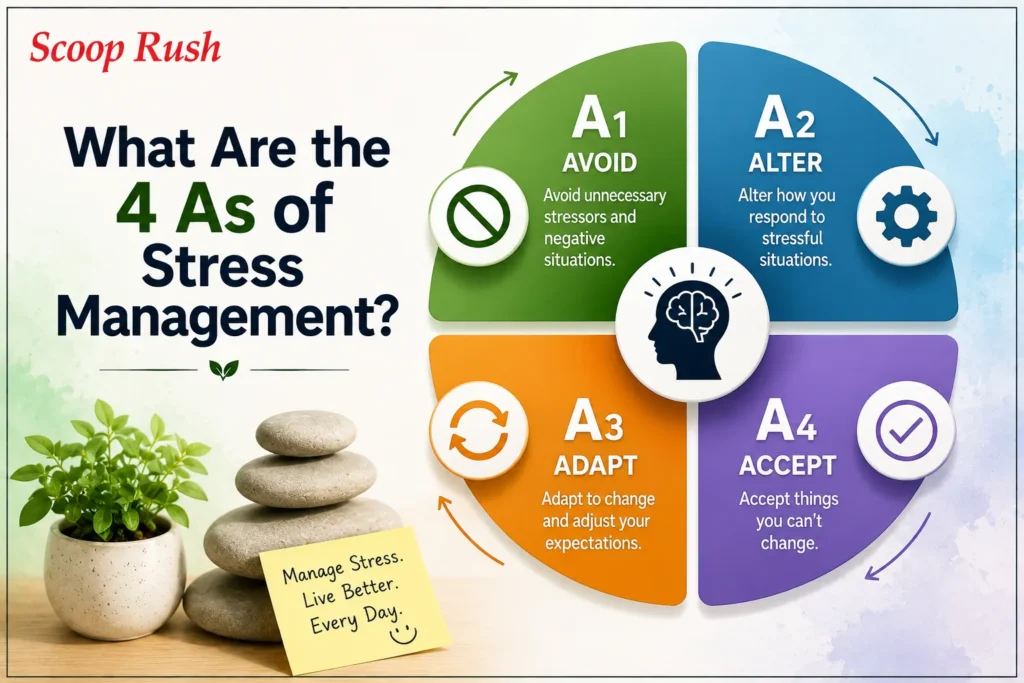
What Are the 4 As of Stress Management?|Scoop Rush

One widely used framework for managing stress breaks your options down into four approaches: avoid, alter, accept, or adapt. The right one depends on whether the stressor is something you can change.

1. Avoid Unnecessary Stress

  • Learn to say no and protect your limits, both at work and at home
  • Limit time with people who consistently add stress to your life
  • Take more control over your environment for example, choosing a quieter commute route
  • Steer conversations away from repeated hot-button arguments
  • Trim your to-do list down to what truly needs to get done

2. Alter the Situation

  • Speak up about what’s bothering you instead of bottling it up
  • Be willing to compromise when negotiating with others
  • Practice assertiveness rather than avoiding problems
  • Build in a real balance between work, responsibilities, and downtime

3. Adapt to the Stressor

  • Reframe a frustrating situation as an opportunity, like using traffic time to catch up on a podcast
  • Zoom out and ask whether the issue will matter in a month or a year
  • Loosen perfectionist standards and aim for “good enough”
  • Make a habit of noting things you’re grateful for

4. Accept What You Can’t Change

  • Focus your energy on your own reactions rather than trying to control others
  • Look for lessons or growth opportunities in difficult situations
  • Practice forgiveness and let go of resentment
  • Talk openly about what you’re going through, even if the situation itself can’t change

What Long-Term Habits Actually Reduce Stress Over Time?

Quick fixes matter, but lasting stress resilience usually comes down to daily habits. Here’s what the research and expert guidance consistently point to.

Move Your Body Regularly

Exercise remains one of the most reliable stress relievers because it triggers the release of endorphins and gives your mind a break from looping worries.

How Much Exercise Is Actually Enough?

Health guidelines generally recommend around 150 minutes of moderate exercise a week, plus strength training a couple of times a week. If that sounds like a lot, start small a daily walk or bike ride still counts, and consistency matters more than intensity. Even splitting that time into short 10-minute bursts throughout the day appears to offer real benefits, and pairing this with other healthy habits in your 20s and 30s can compound the stress-reducing effect over time.

Eat in a Way That Supports Your Mood

Diets heavy in ultra-processed foods and added sugar have been associated with higher perceived stress, while nutrient-dense whole foods vegetables, fruit, beans, fish, nuts, and seeds help supply the vitamins and minerals your body needs to regulate mood, including magnesium and B vitamins. If you’re looking to shift toward more whole-food meals, a plant-based diet guide can be a useful starting point. Skipping meals or relying heavily on caffeine and sugar to get through the day can create a cycle where your blood sugar swings make stress feel even more intense than it actually is.

Cut Back on Screens

Excessive smartphone and screen use has been linked to higher stress levels, partly because it interferes with sleep quality, which in turn drives stress even higher. A digital curfew an hour before bed can make a noticeable difference, as can turning off non-essential notifications during focused work blocks.

Build In Real Self-Care

Self-care doesn’t need to be elaborate. It can be as simple as:

  • Taking a walk outside
  • Reading for pleasure
  • Preparing a nourishing meal
  • Stretching before bed
  • Practicing a hobby you enjoy
  • Using calming scents or a warm bath to unwind

Try Journaling

Writing down your thoughts gives stress and difficult emotions a place to go instead of circling endlessly in your head. A guided journal can help if you’re not sure where to start, and even five minutes before bed can be enough to notice a difference in how quickly you fall asleep.

Watch Your Caffeine Intake

Too much caffeine can intensify stress and disrupt sleep. Health guidance generally suggests staying under about 400 mg a day roughly four to five cups of coffee. It also matters when you drink it for instance, drinking coffee on an empty stomach can amplify jitteriness for some people. If you notice jitteriness or a racing heart, it may be worth switching your afternoon cup for a lower-caffeine alternative like green tea.

Prioritize Your Relationships

Strong social support is consistently tied to lower stress levels. If friends or family aren’t available, consider a club, volunteer group, or sports team as an alternative source of connection. Even brief, regular check-ins with one or two close people can meaningfully lower your baseline stress over time.

Set Boundaries and Learn to Say No

Taking on too much is one of the most common and most avoidable sources of stress. Protecting your time and energy is a form of self-respect, not selfishness. Practicing a simple, polite way to decline requests in advance can make it much easier to actually say no when the moment comes.

Tackle Procrastination Head-On

Putting things off tends to increase stress rather than reduce it. A simple prioritized to-do list with realistic deadlines can break the cycle. Breaking a large task into smaller, clearly defined steps also makes it far less intimidating to simply get started.

Practice Yoga and Mindfulness

Both have been shown to lower stress hormones like cortisol while promoting a sense of calm. Mindfulness-based approaches, including meditation, are widely available through apps, classes, and therapists trained in mindfulness-based cognitive therapy. Even a few consistent minutes a day appears to matter more than occasional long sessions.

Get Outside and Spend Time in Nature

Even short exposure to a natural setting a park, garden, or green space has been linked to measurable improvements in perceived stress and overall well-being. You don’t need a dramatic hike; a short walk through a nearby green space during a lunch break can offer a similar reset.

Spend Time With a Pet

Physical affection with a pet can trigger the release of oxytocin, a hormone associated with calm and connection, while also lowering cortisol. Beyond the physical effects, caring for a pet can also add structure and a sense of purpose to your day, both of which help buffer against stress.

Talk to a Doctor About Supplements

Nutrients like magnesium play a role in your body’s stress response, and chronic stress can deplete your stores of it. Any supplement decision should involve a conversation with a healthcare provider first, since not every supplement is appropriate for everyone, especially alongside existing medications or health conditions and it’s worth understanding the risks of taking too many vitamins before adding several new supplements at once.

What Can You Do to Relieve Stress in Under Five Minutes?

Sometimes you don’t have time for a workout or a nature walk — you need relief right now, in the middle of a stressful meeting or a chaotic afternoon. These quick techniques are designed for exactly that, and simple habits like a 5-minute walk every hour can be worked into even the busiest schedule.

Quick TechniqueWhy It Works
Deep, slow breathingLowers heart rate and blood pressure almost immediately
A short walkCombines movement, fresh air, and a mental reset
Listening to musicShifts mood and can lower tension within minutes
Stepping into sunlightBright light has a mood-lifting effect
A hand or foot self-massageReleases tension that builds up in the hands and feet
Counting slowly to ten and backInterrupts spiraling thoughts
Stretching at your deskRelieves physical tension from sitting still
Closing your eyes for a momentOffers a quick mental reset from visual overload
Squeezing a stress ballChannels nervous energy in a harmless way
Progressive muscle relaxationTensing and releasing muscles calms the whole body
A few minutes aloneGives your mind space to reset
Tidying your immediate spaceReduces the visual clutter that can add to mental clutter
A supported yoga pose, like legs-up-the-wallEncourages physical and mental relaxation
A small piece of dark chocolateMay help regulate cortisol in small amounts
A brief meditationJust a couple of minutes of focused breathing can lower stress
Cuddling a petTriggers oxytocin release and eases tension
Chewing gumHas been associated with lower cortisol levels
Sipping green teaContains L-theanine, which may promote calm
Watching something that makes you laughBoosts blood flow and mood
Splashing cold water on your wristsCools major arteries close to the skin, which can have a calming effect
Creating a small “zen zone”A dedicated calm space you can retreat to for a few minutes
Jotting down your feelingsMakes emotions feel more manageable
A spoonful of honeyHas anti-inflammatory compounds that may ease anxiety
Talking to a friendSharing what’s bothering you is one of the fastest ways to feel supported

How to Choose the Right Quick Technique for the Moment

Not every technique fits every situation you probably can’t cuddle a pet in the middle of a client meeting. It helps to keep a mental shortlist of two or three options for different settings: something discreet for the office (breathing, stretching, closing your eyes), something physical for home (a short walk, stress ball, progressive relaxation), and something social for tougher days (calling a friend, talking things through with someone you trust).

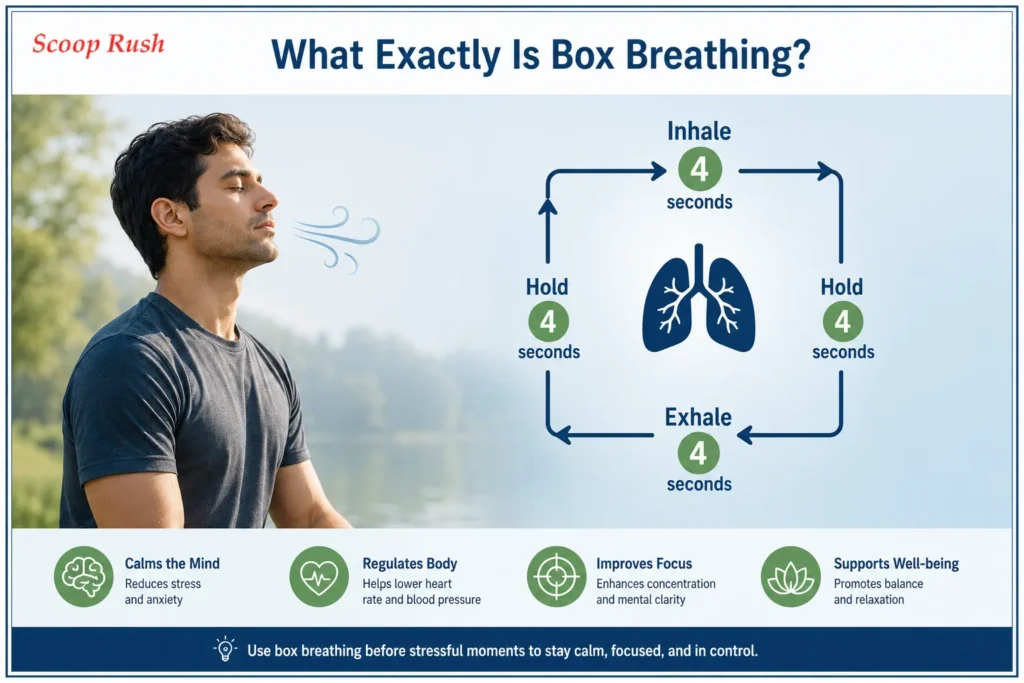
Why Is Box Breathing Becoming a Go-To Stress Technique?

Among all the quick stress-relief tools available, one breathing method in particular has been gaining attention: box breathing. The technique is simple — inhale for a set count, hold, exhale for the same count, then hold again before repeating the cycle. Four seconds is a common starting point, though the exact length matters less than keeping each phase equal.

One Woman’s Story: Coping With Distance and Disaster

Maria Medina, a 31-year-old programme manager living in Florida, experienced this firsthand. When catastrophic earthquakes struck her hometown of La Guaira, Venezuela, she found herself more than a thousand miles away, unable to help and unable to sleep. She had first learned box breathing years earlier from a therapist while juggling a demanding job and a master’s degree during the pandemic, and she returned to it during the sleepless nights that followed the earthquakes.

Where Box Breathing Comes From

Breathwork coach Stuart Sandeman explains that box breathing traces back to practices like yoga and has long been used in fields such as martial arts. He notes it has become popular recently because it can calm the mind while helping regulate the nervous system reportedly a technique favored by military units before high-pressure situations.

What Happens in Your Body During the Final Hold

According to Dr. Helen Garr, a GP who treats healthcare workers for stress-related mental health struggles, the final hold after exhaling may be the most physiologically important part of the cycle. During that pause, carbon dioxide briefly builds up in the body, and learning to tolerate that sensation without panicking can train the nervous system to handle stress more effectively over time.

How Others Are Using It Day to Day

Life coach Brittany Lamm uses box breathing every morning and incorporates it into sessions with her own clients, saying it helps people feel calmer before diving into difficult conversations. She points out that breathwork isn’t a single fixed technique different patterns can suit different moods or situations, which is part of why so many people experiment until they find a rhythm that works for them.

What the Research Says

Recent research out of Texas State University and the University of Toronto Mississauga found that the technique may help prevent sharp spikes in heart rate and other stress markers during high-pressure moments lending some scientific backing to why so many people, from therapists to elite athletes, keep coming back to it.

How to Try Box Breathing

  1. Sit comfortably and exhale fully
  2. Inhale slowly through your nose for a count of four
  3. Hold your breath for a count of four
  4. Exhale slowly for a count of four
  5. Hold again for a count of four before repeating

There’s no strict time requirement some people notice a difference after just a couple of minutes, while others prefer to continue for up to fifteen.

What Are Some Common Myths About Stress Relief?

Misunderstanding how stress works can lead people to try things that don’t actually help, or to feel discouraged when a technique doesn’t produce instant results.

Myth: You Need to Eliminate All Stress

In reality, a certain amount of stress is normal and even useful — it can sharpen focus and motivate action. The goal isn’t a stress-free life; it’s keeping stress at a manageable, temporary level rather than letting it become constant.

Myth: Relaxation Techniques Work Instantly for Everyone

Breathing exercises, meditation, and similar techniques often take a bit of practice before they feel natural or effective. Expecting immediate, dramatic results can lead people to give up too soon.

Myth: Only Big Life Changes Count as Stress Management

Small daily habits a short walk, a few minutes of journaling, a boundary set with a coworker often add up to more meaningful stress reduction than a single big lifestyle overhaul that’s hard to sustain.

Myth: Coping Mechanisms Like Screen Time or Snacking Are Harmless

Occasional use isn’t the issue, but relying on these as a primary coping strategy can mask the underlying stressor while adding new problems, like poor sleep or low energy, on top of it.

How Can You Build a Simple Weekly Stress-Management Routine?

Rather than trying to adopt every strategy above at once, it often works better to build a small, sustainable weekly rhythm.

A Sample Weekly Approach

  • Daily: A few minutes of deep or box breathing, ideally at the same time each day
  • Most days: 20–30 minutes of movement, even if it’s just a walk
  • A few times a week: Time with a friend, family member, or pet
  • Weekly: One dedicated block of leisure time with no obligations attached
  • Ongoing: A running to-do list with realistic deadlines, reviewed and adjusted regularly
  • As needed: A quick five-minute technique from the table above whenever stress spikes unexpectedly

Why Starting Small Matters

Trying to overhaul your entire lifestyle overnight often backfires, since it adds another source of pressure rather than relieving it. Picking just one or two habits to start with, and building from there once they feel automatic, tends to lead to changes that actually stick.

When Is It Time to Seek Professional Help for Stress?

Self-help strategies go a long way, but they’re not always enough on their own. It may be time to reach out to a therapist or other mental health professional if you notice:

  • Increasing reliance on alcohol, drugs, or other unhealthy coping habits
  • Withdrawal from friends, family, or social activities
  • Ongoing physical symptoms like headaches, muscle tension, or insomnia
  • Difficulty concentrating at work or school because of stress
  • A persistent sense that stress is out of your control, no matter what you try

Reaching out for support isn’t a last resort it’s simply another tool, and often one of the most effective ones available.

The Takeaway

Stress isn’t something you can eliminate completely, but it is something you can manage. Quick techniques like box breathing, a short walk, or a few minutes with a pet can help you get through a rough moment, while long-term habits regular movement, better sleep, stronger relationships, and healthier boundaries build resilience that lasts well beyond that moment. The goal isn’t a stress-free life; it’s a life where stress doesn’t run the show.

FAQs 

What is the fastest way to relieve stress?

Slow, deep breathing such as box breathing is one of the fastest ways to calm your body down, often within a couple of minutes. It works by directly lowering your heart rate and blood pressure, which helps interrupt the physical stress response.

How long does it take to feel calmer after a stressful event?

This varies by person and situation, but many quick techniques, like deep breathing or a short walk, can noticeably ease tension within five to ten minutes. Fully processing a stressful event emotionally can take longer, especially for major or ongoing stressors.

Can exercise really reduce stress, or is that a myth?

It’s not a myth. Physical activity releases endorphins and gives your mind a break from repetitive worry, and research consistently links regular movement to lower perceived stress. You don’t need an intense workout — even a daily walk provides real benefits.

Is it normal to feel stressed every day?

Occasional daily stress is common and often manageable with the techniques in this guide. However, if stress feels constant, uncontrollable, or is affecting your sleep, relationships, or ability to function, it may be worth speaking with a healthcare provider or therapist.

Does box breathing actually work, or is it just a trend?

There is genuine physiological reasoning behind it, and a recent academic study found it can help prevent sharp increases in heart rate and other stress markers during high-pressure situations. It’s not a cure-all, but it’s a low-effort technique with real potential benefit.

What’s the difference between stress and anxiety?

Stress is typically a response to an external pressure or demand and tends to ease once the situation resolves. Anxiety can persist even without a clear external trigger and, when it’s frequent or intense, may point to an anxiety disorder which is a medical condition best addressed with professional support rather than general stress-relief techniques alone.

Can diet really affect how stressed I feel?

Yes. Diets high in ultra-processed foods and added sugar have been associated with higher perceived stress, while balanced meals with whole foods help supply nutrients like magnesium and B vitamins that support your body’s stress response.

When should I stop trying to manage stress on my own and see a professional?

If you notice you’re relying on unhealthy coping habits, withdrawing from people you care about, struggling to concentrate, or experiencing ongoing physical symptoms like insomnia or headaches, it’s a good sign to reach out to a therapist or doctor rather than continuing to manage it alone.


Rent DVC Points and Save: A Complete 2026 Guide to Cheap Disney Deluxe Resorts

0

Imagine paying nearly $1,000 less for the same Deluxe Resort room at Walt Disney World, without giving up a single amenity. That’s not a fantasy. It’s what happens every day when travelers learn how to rent DVC points instead of booking directly through Disney.

If you’ve ever stared at Walt Disney World hotel prices and felt your stomach drop, you’re not alone. Deluxe Resort rates have climbed steadily. For many families, a stay at somewhere like Disney’s Animal Kingdom Lodge or the Polynesian Villas can feel out of reach. That’s exactly why so many savvy travelers are turning to Disney Vacation Club point rentals. It’s a strategy that lets everyday guests, not just DVC members, enjoy Deluxe Villa accommodations at prices closer to what you’d pay for a Moderate Resort.

This guide breaks down exactly how to rent DVC points safely, where to find the best deals, and what to watch out for along the way.

What Does It Mean to Rent DVC Points?

Disney Vacation Club is Disney’s timeshare-style membership program. Members purchase points, and they can use those points to book stays in Deluxe Villas at Disney resorts. However, many members don’t use all their points every year. As a result, they often rent out the unused points to non-members.

Here’s how the process actually works. A DVC member agrees to use their points to book a room on your behalf. In exchange, you pay that member a set price per point. The number of points required depends on the resort, room type, and travel dates.

For example, a stay at Animal Kingdom Lodge from December 1 through December 7 might require 60 points. At $25 per point, that comes out to $1,500 total. Compare that to booking the same stay directly through DisneyWorld.com, which could cost $2,451.38. That’s a savings of almost $1,000 for the same room during a peak holiday period.

As a general rule, renting DVC points gets you Deluxe Resort accommodations for roughly what you’d pay at a Moderate Resort. That’s a significant upgrade in comfort and location for a modest difference in price.

Why DVC Point Rental Saves So Much Money

The savings come down to supply and demand within the DVC point system. Since members are essentially reselling something they’ve already paid for through their membership, they can offer rooms at a lower per-night cost than Disney’s public rack rates. Additionally, renters gain access to villa-style rooms with kitchenettes, and in one-bedroom units or larger, full kitchens and in-unit laundry.

When Should You Book Your DVC Point Rental?

Timing matters enormously when you rent DVC points. DVC members can book reservations either 11 months in advance for their home resort or 7 months in advance for any DVC resort. Because of this, popular resorts and dates often sell out well before the 7-month window even opens for renters.

Therefore, the golden rule is simple: book as close to 11 months in advance as possible. It used to be that 7 months was enough lead time, but that’s no longer the case for in-demand resorts and travel windows.

Resorts near Magic Kingdom, EPCOT, and Disney’s Hollywood Studios consistently book up more than 7 months out during popular travel times. This includes the Villas at Disney’s Grand Floridian, the Polynesian, BoardWalk, and Beach Club. It’s especially true during the holiday season, school breaks, long weekends, and the start of EPCOT festivals.

Interestingly, demand can be even higher during so-called “off-peak” dates. Since the point charts require fewer points during slower seasons, DVC members often snap up those dates first. Many DVC owners have flexible schedules, so they gravitate toward the cheapest point windows. This drives up rental competition during those times too.

Timing Your DVC Point Rental: The Lakeshore Lodge Opportunity

Timing Your DVC Point Rental: The Lakeshore Lodge Opportunity

If you’re planning a trip for Summer 2027 or later, keep an eye on Disney’s Lakeshore Lodge, a massive new 967-room resort opening on July 1, 2027. As of now, this resort isn’t yet available for DVC point bookings. Cash reservations are expected to open in early October 2026, meaning point-based bookings will likely follow in late October or November 2026.

New DVC resorts tend to create a temporary window of opportunity. Because the resort is just beginning to sell points to members, there’s typically less competition for reservations in the first few months after opening. This pattern has held true for every previous new DVC resort. Given its size, it will likely continue through roughly early November 2027 for Lakeshore Lodge, possibly even longer.

Of course, booking difficulty will ultimately depend on the resort’s point charts, and Disney hasn’t released those yet. Guest interest in its lazy river, fireworks deck, and Club Level offerings suggests demand will be strong once Disney confirms those details.

Confirmed Reservations: A DVC Point Rental Trap to Avoid

Confirmed Reservations: A DVC Point Rental Trap to Avoid

If you wait too long to rent DVC points, your only option for popular resorts may be a confirmed reservation. It’s best to avoid these whenever possible.

In the past, confirmed reservations were rare bargains, usually the result of a member canceling a trip at the last minute. Today, confirmed reservations are almost exclusively offered by commercial renters looking to maximize profit. These renters target dates that require fewer points but can still command higher cash prices.

Confirmed reservations frequently cost $30 or more per point, well above typical rental rates. Since you’re essentially paying inflated prices for the same points, you might as well book directly through Disney and look for a public discount instead.

How to Rent DVC Points Safely

Once you’ve decided that renting DVC points is right for you, the next step is choosing how to do it. There are two main paths: using an established rental marketplace or renting directly from an individual DVC member.

Using a DVC Rental Marketplace

For most travelers, the safest and simplest option is going through an established rental company. Two names stand out in this space: David’s Vacation Club Rentals and DVC Rental Store. Both have operated for more than a decade, offer large inventories, and provide dedicated customer support.

David’s Vacation Club Rentals is generally the more affordable choice. It also offers a “Deferred Dreams” cancellation policy, which lets guests cancel their reservation and receive a travel credit that can be used within three years.

DVC Rental Store, meanwhile, focuses on flexibility. Its Stress-Free Cancellation Policy allows for lower-risk bookings, and full payment isn’t due until 75 days before check-in. This gives renters more breathing room if plans change.

Since both companies now offer comparable cancellation protections, price becomes the deciding factor for many travelers. That’s part of why David’s is often the recommended starting point for those simply looking to spend less.

Renting DVC Points Directly From an Individual Member

Some travelers prefer to rent directly from a DVC member, often through online forums or Facebook groups, in order to save even more money. This approach can shave a few dollars off the per-point cost. However, it comes with more risk, since there’s no formal buyer protection if something goes wrong.

If you do choose this route, a few precautions can help. Avoid renting from members with little to no posting history or reputation. Ask for references from previous renters. Additionally, paying with a credit card that offers strong purchase protection, such as American Express, adds an extra layer of security.

Reports of scams through these channels remain uncommon. Still, the peace of mind offered by an established marketplace is often worth the small premium, especially for longer or more expensive trips.

Disney’s Crackdown on Commercial DVC Point Renters

Disney's Crackdown on Commercial DVC Point Renters

Over the past year, Disney has increased its efforts to crack down on large-scale commercial DVC point renters. This move targets a small number of owners who have accumulated massive point balances purely to rent them out for maximum profit, not everyday members who occasionally rent unused points. In early 2026, Disney added stricter enforcement actions. These now include canceling future reservations or blocking online booking access for mega-commercial renters.

If you’re worried about how this affects you as a renter, the safest approach is sticking with established rental marketplaces. These companies function as intermediaries connecting members with guests, and Disney’s policies specifically distinguish between these marketplaces and true commercial renters. As long as you avoid confirmed reservations and steer clear of unverified social media sellers, you’re unlikely to run into any issues.

Perks You Get When You Rent DVC Points

Renting points doesn’t just save money on the room itself. It also unlocks several valuable on-site perks.

  • Early Entry, giving resort guests a 30-minute head start at any park before official opening hours.
  • Extended Evening Hours, exclusively for guests at Deluxe Resorts and Deluxe Villas, which includes DVC properties.
  • Free Water Park Day, granting admission to Typhoon Lagoon or Blizzard Beach on check-in day for arrivals between May 26 and September 8, 2026. Disney has confirmed this perk will return for Summer 2027, though it will exclude guests staying at the Campsites at Disney’s Fort Wilderness Resort that year.

Additionally, guests enjoy access to full kitchens in one-bedroom units and larger, along with free laundry facilities on-site.

One popular 2026 promotion worth knowing about, however, is Kids Eat Free through the Disney Dining Plan. This offer is only available to guests who book a full Walt Disney Travel Company package, meaning a resort room bundled with theme park tickets purchased directly through Disney. Renting DVC points gets you a room-only reservation, and you’ll buy park tickets separately. As a result, this particular promotion isn’t available to point renters. It’s an important distinction to keep in mind if Kids Eat Free is a big part of your vacation budget.

Pros and Cons of Renting DVC Points

Renting DVC points isn’t without trade-offs. Since someone else technically owns the reservation, you won’t have direct control over changes or modifications. Disney Vacation Club won’t discuss reservation details with non-members, so you’re relying on the point owner to handle any updates.

Housekeeping is also less frequent than at a standard hotel. Most stays include only one Mousekeeping visit rather than daily service.

Cancellation policies represent the biggest downside. There are no cash refunds if you need to cancel, and depending on the circumstances, even travel insurance may not fully cover your loss. As a result, it’s essential to read rental contracts carefully before committing.

Final Thoughts

Ultimately, renting DVC points remains one of the smartest ways to experience Deluxe Resort accommodations at Walt Disney World without paying Deluxe Resort prices. Whether you go through an established marketplace like David’s Vacation Club Rentals or rent directly from an individual member, the savings can be substantial, especially compared to booking a Moderate or Deluxe Resort directly through Disney.

The key is planning ahead. Book as early as possible, ideally 11 months in advance, avoid confirmed reservations, and stick with trustworthy rental sources. Do that, and you’ll set yourself up for a stress-free, budget-friendly Disney vacation.

Frequently Asked Questions

Is it safe to rent DVC points? 

Yes, renting DVC points is generally safe, especially when using established marketplaces like David’s Vacation Club Rentals or DVC Rental Store. These companies have operated for years, carry strong reputations, and offer buyer protections. Renting from individuals carries slightly more risk but is still relatively uncommon to result in problems.

How far in advance should I rent DVC points? 

You should aim to book as close to 11 months before your travel dates as possible. Popular resorts and travel windows, such as holidays and school breaks, can sell out even before the standard 7-month booking window opens to non-members.

What is the difference between renting points and a confirmed reservation? 

Renting points involves a member booking a reservation on your behalf using their available points, usually at a lower per-point cost. A confirmed reservation is an already-booked room that commercial renters resell, typically at a higher cash price.

Can I get Disney perks like Early Entry when renting DVC points? 

Yes. Guests renting DVC points receive the same on-site perks as other resort guests, including Early Entry and Extended Evening Hours at eligible Deluxe Resorts and Villas.

Which is the best DVC rental company to use? 

David’s Vacation Club Rentals is generally recommended for its lower prices and flexible “Deferred Dreams” cancellation credit. DVC Rental Store is a strong alternative for those who want more flexible payment timing and a stress-free cancellation policy.

Tottenham 0-2 Newcastle: Spurs Bottom of the Premier League After Another Home Defeat

0

Two games into the new season, and Tottenham already sit bottom of the Premier League. How does a squad rebuilt with more than £300 million end up last place after just two matches? That question is echoing around White Hart Lane, and Roberto de Zerbi needs an answer fast.

Spurs fans expected a fresh start this season. Instead, they got no goals, no points, and no sign of the European push that was meant to follow last year’s Europa League win. A 2-0 home defeat to Newcastle has left Tottenham bottom of the Premier League, and the mood inside the stadium says everything about where this club stands right now.

This article breaks down what happened against Newcastle, why Tottenham are bottom of the Premier League despite record summer spending, and what needs to change before the transfer window closes.

Tottenham Bottom of the Premier League: What Went Wrong Against Newcastle

The numbers tell the story. Two games played, two defeats, zero goals scored. Tottenham sit 20th out of 20 clubs. Spurs lost 3-0 away at Brentford last week, then fell 2-0 to Newcastle at home. Anthony Elanga and Yoane Wissa scored both goals inside a ten-minute spell in the second half.

The result stings because Tottenham did not play badly. They had 17 attempts on goal, and six of those hit the target. Yet they failed to score once. Newcastle, meanwhile, scored with both of their shots on target. Sometimes football comes down to ruthless finishing, and Spurs simply lacked it on the day.

Fans have every right to feel frustrated. The club spent heavily to avoid exactly this kind of start. Thousands of supporters headed for the exits before the final whistle, and that alone signals how thin their patience has grown.

Spurs’ Home Form Keeps Dragging Them Down

This defeat was not a one-off. Tottenham have won only three of their last 23 home league matches at their own stadium. That single statistic explains why fans are losing faith, no matter who picks the team. A stadium that should intimidate visiting sides has instead become a source of anxiety for Tottenham’s own supporters.

As a result, deeper questions are surfacing, not just about this season’s start, but about an ongoing problem that has followed the club across multiple campaigns.

Why Tottenham’s £300m Summer Spend Hasn’t Paid Off

Tottenham finished 17th in the Premier League in both 2024-25 and 2025-26, narrowly avoiding relegation on the final day last time out. To prevent a third straight relegation battle, the club backed De Zerbi with heavy investment in the transfer market.

The summer rebuild brought in several notable signings:

  • Mateus Fernandes, who joined from West Ham for £85m
  • Sandro Tonali, who arrived from Newcastle for £100m
  • Jan Paul van Hecke, a £52m defender from Brighton
  • Savio, formerly known as Savinho, a £75m winger from Manchester City
  • Omar Marmoush, on loan from Manchester City, with a permanent £60m move planned for next summer

Tottenham also added defenders Marcos Senesi and Andy Robertson, plus goalkeeper Martin Dubravka, on free transfers. Marmoush made his debut against Newcastle, though muscle fatigue kept Savio out of the squad.

On paper, this squad looks capable of chasing a European finish again. However, results so far suggest the new arrivals need more time to gel, and that process is testing a fanbase that wants improvement now.

Will Tottenham Make One More Signing Before the Deadline?

The transfer window closes on Tuesday, and De Zerbi has already confirmed he still wants “one player more in one specific position.” Meanwhile, rumours continue to link Kevin Danso, Pape Matar Sarr, and Richarlison with exits before deadline day.

De Zerbi addressed those rumours directly. He said any player who wants to leave must bring the club an acceptable financial solution first. In short, Tottenham are not pushing players out the door, but they won’t block a fair offer either.

De Zerbi Responds to Spurs Sitting Bottom of the Table

De Zerbi Responds to Spurs Sitting Bottom of the Table

Despite the alarming table position, Roberto de Zerbi struck a calm tone after the Newcastle defeat. He insisted his side actually outplayed Newcastle for long spells, at least until conceding the opening goal.

“We can improve in the defensive phases but today was an unfair result,” De Zerbi said. He admitted disappointment for the fans, yet he also expressed confidence in the club’s long-term direction.

“I am not angry, we are working well and were unlucky today with the result. There is no panic. I know where we are going and what the plan is. I’m sorry for the fans for the result. We have to improve. We have to work hard on the pitch and find the connection between the players.”

That last line matters. De Zerbi seems to view this as a squad still building its identity, not one that is fundamentally broken. He also pointed back to last season’s late rescue act, when Tottenham faced genuine relegation danger before a final-day win over Everton secured survival.

“We have to work hard on the pitch and find the connection with the players because last season before the end of the season we were in the Championship and we stayed up together,” he said. “Now we have to keep calm and focus on improvement. We have a great squad and great players.”

De Zerbi’s Managerial Record at Tottenham So Far

Since taking charge at the end of March, De Zerbi has won four, drawn two, and lost four of his ten matches across all competitions. That run included 11 points from seven matches that kept Tottenham in the Premier League last season.

Therefore, his overall record is far from disastrous. Still, expectations have climbed sharply given the scale of summer investment, and two winless, goalless games to open this campaign have reignited old doubts among fans.

Pundits React to Tottenham’s Poor Start

Former Tottenham and England goalkeeper Joe Hart did not hold back when he assessed the situation. He compared Spurs to Newcastle, noting how quickly Matthias Jaissle’s side has adapted despite going through significant squad changes of their own.

“When you see a Newcastle side who have been through massive change over the summer, and a more difficult change than Spurs have, it’s hard as in two games you can clearly see what Jaissle is trying to do,” Hart explained. “The players are on board with it and they are flying.”

By contrast, Hart suggested Tottenham’s identity under De Zerbi still looks unclear. He acknowledged that integrating so many new signings under pressure takes time, but he also noted that the club’s struggles are nothing new.

“They’ve not just suddenly fallen off a cliff, they’ve been struggling in the league for a while,” Hart said. He added that the Premier League moves fast, and Spurs currently look like a team “second-guessing everything.”

Former England goalkeeper Rob Green offered a similar view on BBC Radio 5 Live. He praised goalkeeper Lukas Hornicek for a string of first-half saves, but he felt Tottenham lacked creativity in attack.

“For Tottenham, the same questions last season are still here this season,” Green said. “Performances like this will indicate that they need a vast improvement from this set of players that have come into this club. They will need the characters as much as anything to turn this around. It doesn’t take much for these Spurs fans to turn and the belief starts to drain from the players.”

What Tottenham Need to Fix to Climb Off the Bottom

A few clear priorities stand out for De Zerbi and his squad heading into the coming weeks.

Finishing must improve immediately. Firing 17 shots without scoring once is not sustainable. Tottenham need their attacking players, including new arrival Marmoush, to start converting chances into goals.

New signings need time, but not too much of it. Five major first-team additions this summer always meant some adjustment period. However, the Premier League offers little patience, and results need to arrive soon to ease pressure on the squad.

Home form has to turn around. Three wins in 23 home league games falls well short of Tottenham’s resources and ambitions. Fixing performances at their own stadium should sit at the top of the priority list.

Deadline-day decisions still loom. Whether or not Danso, Sarr, or Richarlison leave, De Zerbi’s stated need for one more signing shows the club still sees a gap to fill before the window shuts.

Final Thoughts on Tottenham’s Rocky Start

Tottenham’s spot at the bottom of the Premier League does not reflect a broken project, at least according to De Zerbi. He instead frames it as a team still searching for cohesion after a busy transfer window. The manager stays publicly calm, pointing to last season’s great escape as proof that things can turn around quickly once his squad finds its rhythm.

Even so, patience is wearing thin among fans who watched thousands leave early against Newcastle. Tottenham spent more than £300 million and built a squad packed with talent, so expectations have shifted. Ultimately, results, not reassurances, will decide whether this season becomes another struggle or the start of real progress under De Zerbi.

As the transfer window closes and the season unfolds, all eyes will stay on whether Tottenham can finally build the connection De Zerbi keeps mentioning, both between his players and with a fanbase growing more restless by the week.

Frequently Asked Questions

Why are Tottenham bottom of the Premier League this season? 

Tottenham sit bottom of the Premier League after losing both opening matches without scoring a single goal, including a 3-0 defeat at Brentford and a 2-0 home loss to Newcastle.

Who scored for Newcastle against Tottenham? 

Anthony Elanga and Yoane Wissa scored Newcastle’s goals, both within a ten-minute spell in the second half.

How much did Tottenham spend in the summer transfer window? 

Tottenham spent more than £300 million in the summer, bringing in players such as Sandro Tonali, Mateus Fernandes, Savio, Jan Paul van Hecke, and Omar Marmoush.

Is Roberto de Zerbi under pressure at Tottenham? 

Results have been poor, but De Zerbi says he is “not angry” and insists there is “no panic,” pointing to his record of keeping the club up last season as evidence of progress.

When does the Premier League transfer window close? 

The transfer window closes on Tuesday, and De Zerbi has confirmed Tottenham are still looking to sign one more player in a specific position before the deadline.

How to Get More Google Reviews Organically: The Ultimate Guide for Local Businesses in 2026

0

Nearly 7 out of 10 consumers won’t even consider a business rated below four stars, which is exactly why so many local businesses are focused on how to get more Google reviews in 2026. Read that again, because it changes how you should think about every single review sitting on your Google Business Profile right now.

If you want to get more Google reviews but your profile is thin, outdated, or silent, you’re not just missing a few stars. You’re missing customers who never gave you a chance to earn their business in the first place.

That single fact explains why so many local business owners are asking the same question in 2026: how do you get more Google reviews without breaking the rules or wasting time on tactics that don’t actually work? The good news is that the answer isn’t complicated, and it doesn’t require gimmicks or shortcuts. It just requires consistency, the right timing, and a system you can realistically stick to over the long run.

This guide walks through what actually moves the needle. It’s based on how Google’s algorithm evaluates reviews today and what real local businesses are doing to grow their profiles the right way, without risking suspension or losing the trust they’ve spent years building.

Why Organic Google Reviews Matter More Than Ever

Why Organic Google Reviews Matter More Than Ever

Google’s algorithm has become increasingly sophisticated at detecting unnatural review patterns. Sudden spikes, repetitive language, or reviews from accounts with no real activity history can all trigger red flags. Consequently, businesses that get caught risk having reviews removed, profiles suspended, or losing the local search visibility they’ve spent years building.

Organic reviews, on the other hand, come with real names, real stories, and real credibility. They tell Google, and your customers, that you’re a business people genuinely trust. As a result, that trust translates directly into higher click-through rates, better local pack rankings, and more foot traffic through your door.

Before someone ever calls your business or walks inside, they’re almost certainly scrolling through your Google Business Profile first. They’re judging your star rating and reading what actual people have to say about you. Therefore, a weak or outdated review profile can quietly cost you customers you never even knew you lost.

There’s also a ranking angle worth understanding. Google’s local algorithm rewards businesses with a steady, consistent flow of recent reviews. A profile with regular monthly activity signals that a business is active and relevant to its community. Meanwhile, a profile that goes silent for months starts to look stale, even if the business itself is doing perfectly well — much like any small business, whether it’s a local shop or a growing side hustle, needs steady, visible momentum to keep customers coming back.

The Real Risk of Fake or Incentivized Reviews

It’s tempting to shortcut the process, but Google has gotten far better at spotting unnatural activity. Offering discounts or freebies in exchange for reviews violates Google’s policies, regardless of whether the incentive is tied to a positive rating. Similarly, review gating, which means filtering out unhappy customers before asking for public feedback, carries the same risk. Both practices can damage the lasting trust that keeps customers coming back.

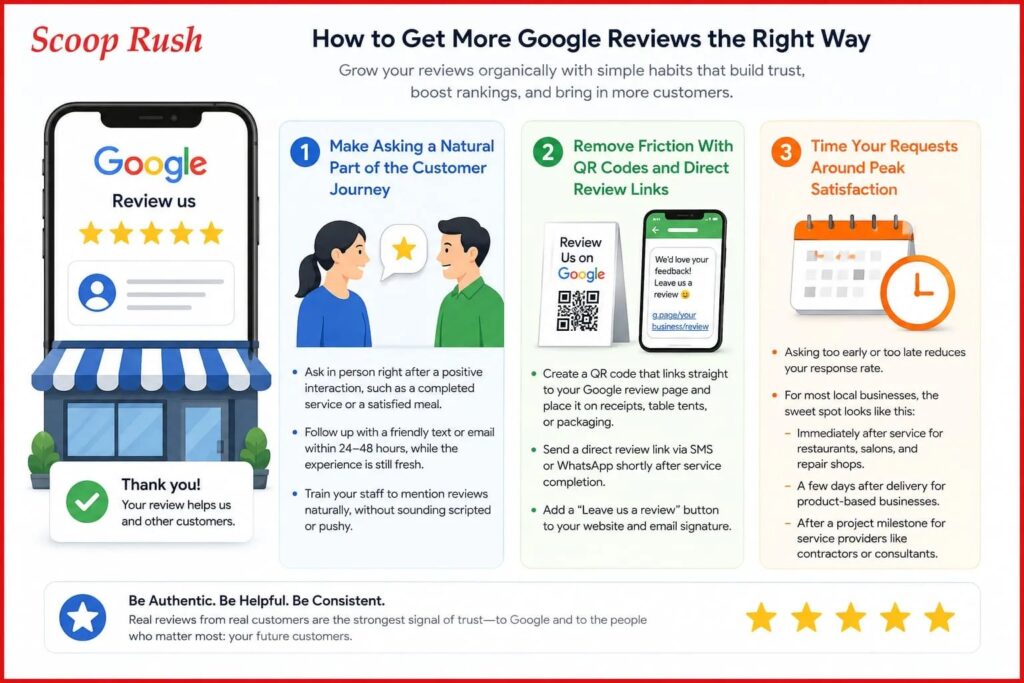
How to Get More Google Reviews the Right Way

How to Get More Google Reviews the Right Way

Growing your review count doesn’t require paid tricks. It requires a handful of habits, applied consistently, week after week.

1. Make Asking a Natural Part of the Customer Journey

The single biggest reason businesses don’t get enough Google reviews isn’t bad service. It’s that they simply forget to ask. Customers who had a great experience are usually happy to leave a review; they just need a gentle nudge at the right moment.

A few ways to build this into your routine:

  • Ask in person right after a positive interaction, such as a completed service or a satisfied meal
  • Follow up with a friendly text or email within 24 to 48 hours, while the experience is still fresh
  • Train your staff to mention reviews naturally, without sounding scripted or pushy

2. Remove Friction With QR Codes and Direct Review Links

The easier you make it to leave a review, the more reviews you’ll get. Customers rarely search for your business manually just to find the review button, so hand it to them directly instead.

Consider these approaches:

  • Create a QR code that links straight to your Google review page and place it on receipts, table tents, or packaging
  • Send a direct review link via SMS or WhatsApp shortly after service completion
  • Add a “Leave us a review” button to your website and email signature

3. Time Your Requests Around Peak Satisfaction

Timing changes everything here. Asking too early, before the customer has fully experienced your product or service, reduces your response rate significantly. Asking too late does the same, since the memory has already faded.

For most local businesses, the sweet spot looks like this: immediately after service for restaurants, salons, and repair shops; a few days after delivery for product-based businesses; and after a project milestone for service providers like contractors or consultants.

Respond to Every Google Review, Good or Bad

Respond to Every Google Review, Good or Bad

Nothing builds trust faster than a business that actively engages with its customers. Responding to reviews shows prospective customers that you’re present, attentive, and genuinely care about their experience.

Thank happy reviewers by name and mention specific details from their review. Meanwhile, address negative reviews calmly and professionally, with a clear path toward resolution. Never argue publicly. If a conversation needs detail, take it offline through a call or email instead.

This kind of engagement doesn’t just look good to customers. It’s also a strong signal to Google that your profile is active and well-managed, which can support your local ranking over time.

Optimize Your Google Business Profile First

Before you even start collecting reviews, make sure your Google Business Profile is fully optimized. A polished, complete profile converts review traffic into actual customers far more effectively than a half-finished one.

Fill out every section: categories, services, business hours, attributes, and photos. Additionally, upload fresh, high-quality photos regularly, since profiles with more images tend to see noticeably higher engagement. Post updates, offers, and events consistently to keep your profile looking active rather than abandoned.

One more detail matters more than people expect: keep your business name, address, and phone number consistent across every platform where your business appears.

Stay Consistent With Review Management Tools

Stay Consistent With Review Management Tools

Manually tracking review requests, follow-ups, and responses across dozens or hundreds of customers gets overwhelming fast, and inconsistency is exactly what kills momentum. This is where a dedicated review management platform can make a real difference.

Tools built for this purpose help local businesses streamline the entire review lifecycle, from sending timely requests to monitoring new reviews and staying on top of feedback in one place. Many businesses now pair this with AI-powered social listening tools to track what customers are saying across platforms, not just on Google. Instead of chasing reviews manually, you get a system that keeps the process consistent and easy to track over time.

Make It Part of Your Business Culture

The businesses that dominate local search aren’t the ones that ran a one-time review campaign. They’re the ones that built review collection into their everyday operations. When every team member understands that reviews matter and knows how to ask naturally, the results compound month after month.

Key Takeaways

Building a strong Google review profile isn’t about finding a quick trick. It’s about creating consistent, genuine touchpoints where happy customers get an easy, natural opportunity to share their experience.

Focus on great service, remove friction from the review process, respond with genuine care, and use the right tools to stay consistent. Do this well, and you won’t just rank higher. You’ll build the kind of trust that keeps customers coming back and brings new ones through the door.

FAQs

1. Is it okay to ask customers for a Google review?

Yes. Asking is encouraged, as long as you do it ethically. That means giving every customer the same opportunity to leave feedback, rather than filtering based on satisfaction.

2. Can I offer a discount for a Google review?

No. Offering any kind of incentive in exchange for a review violates Google’s policies, even if it isn’t tied to a positive rating.

3. What should I do if I get a negative review?

Respond calmly and promptly. Acknowledge the concern, apologize for the experience, and offer to resolve things through a private channel like phone or email.

4. How often should I be getting new Google reviews?

There’s no fixed number, but consistency beats volume. A steady trickle of new reviews each month looks far healthier than a big batch followed by months of silence.

5. Should I respond to positive reviews too, or just negative ones?

Definitely respond to both. Thanking happy customers by name shows you value their feedback and keeps your profile looking active.

Cheapest Accommodation in Paris Is Disappearing Because of Extreme Heat

0

The cheapest accommodation in Paris is under serious threat. Rising summer temperatures now make tiny rooftop rooms hard to live in. These small spaces, known as chambres de bonnes, once gave students and workers a cheap way to live in the city center. Today, extreme heat is turning that bargain into a health risk.

Around 55,000 people still call these rooms home across the Paris region. That makes this issue far bigger than a simple housing quirk. As summers grow hotter, experts warn some rooms could soon become unlivable. This shift could reshape affordable housing in Paris for years to come. 

What Are Paris’s Tiny Rooftop Rooms?

Chambres de bonnes started as servants’ quarters in wealthy Parisian homes. Builders placed them under the roofs of grand Haussmannian buildings. Over time, live-in domestic staff became less common. As a result, these rooms slowly turned into housing for students, workers, and retirees.

Their biggest draw was always the price. These rooms cost far less than a typical Paris apartment. However, that same rooftop location now creates a serious problem. Summer heat collects directly under the roof, with nowhere to escape.

Why Extreme Heat Is Making These Rooms Unsafe

Why-Extreme-Heat-Is-Making-These-Rooms-Unsafe

A 2024 study from the Paris Urban Planning Agency, or APUR, looked closely at this issue. Researchers examined summer comfort levels inside homes across the Paris region. They found that unprotected top-floor rooms heat up fast. Indoor temperatures can climb 10 degrees Celsius above outdoor readings.

That gap becomes dangerous during long heatwaves, especially at night. Many of these rooms lack proper insulation or airflow. Consequently, residents struggle to cool down even after sunset. People who spend most of their day at home face the greatest risk.

Life Inside a Nine-Square-Meter Room

Some residents still see these rooms as worth the trouble. Anatoly Novikov rents a nine-square-meter space in central Paris. His room sits in the upscale Notre-Dame-des-Champs area. He pays around 700 euros every month for it.

That price remains far below nearby property values in the same neighborhood. Novikov says the location makes up for the lack of space. For him, living in such a small room is simply part of student life in Paris. Still, he admits the trade-offs are significant during hot summer months.

Why Students Rely on Cheap Paris Housing

Students have long turned to chambres de bonnes for affordable living. These rooms sit close to universities, shops, and public transport. Therefore, many students accept the tight space in exchange for a central location. This trade-off has shaped student housing in Paris for decades.

Demand for this type of housing keeps growing. Paris has seen a 30 percent rise in its student population over 20 years. Many of these students arrive from outside France. Meanwhile, living costs across the city continue to climb, adding more pressure on young renters.

Thousands of Residents Still Call These Rooms Home

Thousands-of-Residents-Still-Call-These-Rooms-Home

These tiny rooms are not just a curiosity for tourists. Around 55,000 people currently live in chambres de bonnes across the Paris region. This group includes students, young professionals, and older residents. As a result, the issue affects far more than one type of renter.

An earlier APUR study from 2011 showed a wider mix of occupants. Unemployed residents and retirees also lived in these converted spaces. About 20 percent of occupants were over 60 years old. Many had stayed for decades simply because moving elsewhere cost too much.

Tourists Are Also Renting These Small Spaces

Short-term rental platforms have introduced these rooms to a new audience. Travelers sometimes book chambres de bonnes without knowing their original purpose. Emilie Reh experienced this firsthand during a recent trip to Paris. She stayed in a small studio in the popular Marais district.

Her room offered far less space than she expected. She also found that bathroom facilities were shared with other guests. The summer heat made her stay even less comfortable. Even so, she felt the price and location made it worthwhile overall.

Rising Heatwaves Add to the Danger

France recorded an unusually high number of heat-related deaths in summer 2026. The Paris region reported the highest number of these fatalities nationwide. Local climate officials pointed directly to risks inside poorly insulated top-floor homes. Rooftop residents therefore face some of the highest exposure to extreme heat.

This shift changes the nature of the problem. What was once simply uncomfortable could soon become unsafe. If that happens, thousands of low-cost homes may disappear from the market. That outcome would add even more strain to an already tight housing system.

Historic Buildings Complicate Renovation Plans

Historic-Buildings-Complicate-Renovation-Plans

Paris cannot easily redesign its rooftop apartments without careful planning. The city’s Haussmannian buildings are protected for their historic value. Their rooftops and facades face strict preservation rules. This makes major renovation work slow and complicated for architects.

Experts, including the Architects of the Buildings of France, are studying possible fixes. Better insulation and solar protection could help lower indoor temperatures. However, no single solution works for every building. Each renovation must balance comfort with historic preservation.

What Could Happen to Paris’s Cheapest Homes?

The future of these rooftop rooms remains uncertain. Housing expert Dominique Naert believes some rooms could eventually become illegal to rent. That shift would reflect growing concern over heat-related health risks. Long-term residents with limited income could struggle most if rules change.

The heat problem may not stay limited to top floors either. Experts warn that lower apartments are also getting warmer each summer. This means climate change threatens more than just the smallest Paris homes. Lessons learned here could guide renovation efforts across the wider city.

Why This Housing Problem Matters Beyond Paris

This challenge reaches far beyond the French capital. Many major cities have historic buildings with similar rooftop layouts. Bordeaux, Rome, Madrid, Berlin, and New York all share this concern. As temperatures rise worldwide, similar weaknesses could appear in older housing stock.

Paris now faces a tough balancing act between safety and affordability. Removing unsafe rooms could protect residents from dangerous heat exposure. However, losing them would also shrink an already limited affordable housing supply. Renovation may offer the best middle path for many buildings.

Conclusion

The cheapest accommodation in Paris now faces a turning point. Extreme heat has turned once-affordable rooms into a growing safety concern. Thousands of students, workers, and older residents still depend on these spaces. Losing them could deepen an already difficult housing crisis in the city.

Still, the story is not finished. Architects and city planners continue searching for practical fixes. Better insulation and smart renovation could help save many of these homes. The coming years will decide whether Paris keeps this unique piece of its housing history.

FAQs

1. What are chambres de bonnes in Paris? 

Chambres de bonnes are small rooftop rooms in historic Paris buildings. They once housed domestic servants. Today, they offer affordable housing to students and other residents.

2. Why are these rooms becoming too hot? 

Their rooftop position traps solar heat throughout the day. Poor insulation and weak ventilation stop that heat from escaping. This makes indoor temperatures rise well above outdoor levels.

3. How small are these Paris apartments? 

Many chambres de bonnes measure just a few square meters. French law sets nine square meters as the minimum legal size. Some rooms are roughly the size of a parking space.

4. Who lives in these tiny Paris homes? 

Students make up a large share of residents. Young professionals and retirees also rely on this housing type. About one-fifth of past occupants were over 60 years old.

5. Will Paris lose its cheapest rooftop housing? 

The outcome remains unclear as heat risks continue rising. Some rooms could face new rental restrictions in the future. Experts are still exploring renovation options to keep them livable.

Does Box Breathing Really Work?

0

When a natural disaster struck her hometown overseas earlier this year, one woman was thousands of miles away, unable to do anything but wait for news of family and friends.

She could do nothing but wait for updates. The sleepless nights that followed didn’t improve when she scrolled through the news or replayed worst-case scenarios in her head.

What helped, she says, was a technique so simple that it sounds almost too basic to work: counting her breaths in a box.

Box breathing—inhale for four seconds, hold for four, exhale for four, hold for four, then repeat—has quietly become one of the most talked-about stress tools in recent years. Elite soldiers, professional athletes, and therapists who work with burned-out healthcare workers all use and recommend the technique.

Unlike a lot of wellness trends that fade as quickly as they arrive, this one has research behind it. Understanding why it works can make it far more useful than simply following an animated guide on social media.

What Exactly Is Box Breathing?

What Exactly Is Box Breathing?|Scoop Rush

The technique gets its name from its shape: four equal phases, each lasting the same count, forming a mental “box.”

A breathwork coach who has taught the method to professional sports teams explains that the exact length of each phase doesn’t matter as much as keeping all four phases identical whether that’s four seconds, six, or eight.

There’s no fixed session length either. Some people notice a shift in their body within a couple of minutes; others prefer to sit with it for ten or fifteen. The point isn’t to hit a target number, but to give your nervous system enough repetitions to register the change.

Box breathing tends to work best as a pre-emptive tool. It’s something to use before a stressful event like an exam, a big presentation, or a difficult conversation rather than only reaching for it once anxiety has already taken hold.

How to Practice Box Breathing, Step by Step

If you’ve never tried it, the method is easy to learn in under a minute.

Sit comfortably with your back straight, or lie down if you’re using it before sleep. Start by exhaling fully through your mouth to empty your lungs.

From there, inhale slowly through your nose for a count of four, then hold the breath gently for a count of four don’t clench your chest or throat.

Exhale slowly through your mouth for a count of four, then hold again, with empty lungs, for a count of four. Repeat the cycle for two to fifteen minutes, depending on how you feel.

A few practical tips: keep your shoulders relaxed rather than raised, breathe through your nose on the inhale where possible, and don’t force the holds to the point of discomfort — especially when you’re just starting out. It’s fine to begin with a shorter count, like two or three seconds, and build up gradually.

Where the Practice Comes From

Where the Practice Comes From|Scoop Rush

Breathwork itself isn’t new. Its roots trace back to traditional yogic practice and to martial arts disciplines.

These traditions have used controlled breathing for centuries to sharpen focus and steady the body under pressure. What’s changed is how mainstream it’s become largely because it offers a dual benefit that few other quick techniques can claim.

It sharpens mental focus while simultaneously calming the nervous system. That combination is rare among stress-relief tools, most of which lean toward either relaxation or alertness, not both at once.

Its association with elite military and special-operations training, where the technique is reportedly used before entering high-stakes situations, has helped cement its reputation as a serious, performance-grade tool rather than a soft wellness fad.

That crossover appeal equally at home on a sports field, in an operating theatre, or in a therapist’s office is part of why it has spread so widely across very different professions and communities.

The Real Reason the Last Hold Matters Most

A doctor who treats healthcare workers experiencing mental health difficulties is one of many clinicians who now regularly recommend box breathing to patients.

She considers it one of the most effective evidence-based tools available for regaining control over the body’s stress response.

According to her, the final hold the pause after you exhale, before you breathe in agai is doing the real physiological work.

What Happens in the Body During the Hold

During that final hold, carbon dioxide builds up in the bloodstream. Because the brain interprets rising CO2 levels as a warning sign, it triggers a subtle sense of urgency or panic.

This generates the very same “need to breathe” sensation that stress produces naturally in everyday high-pressure moments the tight chest, the shallow gasping breath, the racing pulse.

By deliberately sitting with that discomfort in a controlled way, the theory goes, you’re training your nervous system to tolerate CO2 fluctuations without spiralling into panic.

Over repeated practice, this can blunt the intensity of the body’s stress response in real-world situations. That’s because stressed breathing patterns themselves alter CO2 levels in the blood, and box breathing essentially rehearses the body’s ability to stay calm through that shift, again and again, until it becomes a more automatic response.

What the Research Actually Shows

What the Research Actually Shows|Scoop Rush

A recent academic study looked at how effective box breathing is in genuinely high-pressure situations.

The findings suggest the technique can blunt the sharp spikes in heart rate and other physiological stress markers that typically accompany pressure-filled moments.

This lends scientific weight to what practitioners have been saying anecdotally for years that a few minutes of structured breathing can meaningfully change how the body responds to acute stress.

This matters because a lot of stress-relief advice circulating online is more folklore than fact. Box breathing stands out partly because it has been tested in controlled academic settings.

It also stands out because its mechanism CO2 tolerance and nervous system regulation is well understood in physiology, not just wellness marketing.

A Nightly Ritual and a Morning Reset

For one woman in her early thirties who works in tech, box breathing has become a bedtime tool.

It’s something she turns to when she’s lying awake, unable to switch her mind off. She first learned the technique from a therapist a few years ago, while juggling further study with a full-time job during a particularly demanding period.

Years later, it remains her go-to when worry threatens to keep her up at night, including during the recent crisis affecting people close to her.

Another woman, a life coach in her late twenties, uses the technique in the opposite direction first thing in the morning, right after waking.

She discovered box breathing online during a personally difficult period and found it effective enough that she went on to study other breathing methods. She eventually trained as a life coach and is now pursuing licensure as a therapist.

She now opens client sessions with the practice, particularly before conversations about emotionally heavy topics, because it helps both her and her clients arrive in a steadier state before the harder conversation begins.

Both women’s experiences highlight an important point: box breathing doesn’t follow a one-size-fits-all routine or depend on a specific time of day.It’s flexible enough to slot into whatever moment actually needs calming a racing mind before sleep, a jittery start to the morning, or the few minutes before a difficult meeting.

Common Mistakes People Make With Box Breathing

Because the technique looks so simple, it’s easy to do it in a way that blunts its benefits. A few common pitfalls:

  • Rushing the counts. Speeding through each phase to “get it over with” defeats the purpose the slowness is the mechanism, not a side effect.
  • Skipping the final hold. Many beginners shorten or drop the second hold because it feels uncomfortable, but that’s the phase doing most of the physiological work.
  • Tensing the body. Clenching the jaw, shoulders, or stomach during the holds keeps the nervous system activated instead of calming it.
  • Expecting instant results. Like most nervous-system training, benefits compound with repeated practice rather than appearing after a single session.
  • Using it only during a crisis. The technique is most effective as a regular practice, not just an emergency measure reached for once anxiety has already peaked.

Other Breathing Techniques Worth Knowing

Box breathing isn’t the only structured breathing method with stress-relieving potential. A few close relatives are worth trying if the four-count box doesn’t suit you:

  • Diaphragmatic (belly) breathing — breathing deeply enough that your belly rises rather than your chest, which naturally slows the heart rate.
  • Alternate nostril breathing — a yogic technique that involves breathing through one nostril at a time, often described as balancing the mind and body.
  • Extended exhale breathing — simply making your out-breath longer than your in-breath, which nudges the body toward its natural relaxation response.

The common thread across all of these is intentionality. Slowing down, lengthening the breath, and directing attention to the physical sensation of breathing rather than letting it happen unconsciously.

Beyond Breathing:Building a Broader Stress-Management Toolkit

Breathwork is powerful, but clinicians are consistent on one point: it works best as part of a wider set of habits rather than a standalone fix.

Stress specialists often group techniques into two categories things you can do in the moment, and healthy habits that build long-term resilience.

Fast Relief (Five Minutes or Less)

When stress hits and you need something immediate, these options can help take the edge off quickly:

  • Step outside for a few minutes of natural light and fresh air
  • Take a brisk five-minute walk around the block
  • Listen to a favourite song, or sing along if you’re somewhere private
  • Do a quick hand, neck, or shoulder stretch at your desk
  • Splash cold water on your wrists, where major arteries sit close to the skin
  • Chew a piece of gum or sip green tea
  • Cuddle a pet, or even just watch a funny video for a quick laugh
  • Close your eyes for a minute and simply be still

Daily Habits That Build Resilience

  • Move your body regularly. Even modest aerobic activity, done a couple of times a week, has been linked in research to meaningfully lower perceived stress.
  • Eat whole foods over ultra-processed ones. Diets heavy in processed food and added sugar are associated with higher reported stress levels.
  • Cut back on screen time, especially before bed, since excess use is linked to poorer sleep and higher stress.
  • Journal regularly to process emotions rather than let them build up silently.
  • Watch your caffeine intake staying under roughly 400mg a day (about four to five cups of coffee) helps avoid compounding anxiety and disrupted sleep. If you rely on your morning cup to function, it’s worth knowing what drinking coffee on an empty stomach does to your body.
  • Practise mindfulness or meditation, even in short daily bursts.
  • Spend time in green spaces, even briefly as little as ten minutes in a natural setting has been shown to improve psychological wellbeing.
  • Prioritise physical touch, whether that’s a hug, cuddling a pet, or spending time with people you trust physical contact is linked to lower cortisol.
  • Share meals with others when you can. Beyond the food itself, there are real benefits of eating together that extend to mood and stress levels.

A Simple Framework for Managing Stressors

Beyond individual techniques, therapists often recommend thinking about stress at the level of the situation itself, using a few broad strategies:

  • Avoid unnecessary stressors where possible learn to say no, limit time with people who drain you, and trim your to-do list to what actually matters.
  • Alter the situation by communicating openly, compromising, and being more assertive about your needs.
  • Adapt your expectations reframe problems, adjust perfectionist standards, and keep the bigger picture in view.
  • Accept what genuinely can’t be changed, and focus your energy on how you respond rather than the circumstance itself.

When It’s Time to See a Professional

Breathing techniques, journaling, and lifestyle tweaks can meaningfully reduce everyday stress. But they aren’t a substitute for professional support, particularly when stress starts affecting daily functioning.

It may be worth speaking to a doctor or therapist if:

  • You’re increasingly relying on alcohol, food, or other coping mechanisms to get through the day
  • Stress is straining relationships or making you withdraw from people you care about
  • You’re experiencing ongoing physical symptoms like headaches, muscle tension, or insomnia
  • Stress is interfering with your ability to concentrate at work or school

Quick Reference: Stress-Relief Techniques at a Glance

TechniqueTime NeededBest Used WhenWhy It Helps
Box breathing2–15 minutesBefore a stressful event, or when lying awake at nightTrains CO2 tolerance, calms the nervous system
Diaphragmatic breathing1–5 minutesAny time, especially during acute anxietySlows heart rate, engages relaxation response
Quick walk or sunlight5–10 minutesMid-task overwhelm, low moodBoosts circulation, lifts mood naturally
Journaling5–15 minutesEnd of day, or after a stressful eventProcesses emotion, reveals stress patterns
Movement/exercise20–30 minutes, few times a weekOngoing resilience buildingReleases endorphins, lowers baseline stress
Mindfulness/meditation5–20 minutesDaily practiceReduces rumination, improves emotional regulation
Connecting with othersVariesWhenever isolation increases stressTriggers hormones that counter fight-or-flight
A simple framework (avoid, alter, adapt, accept)Ongoing mindset shiftChronic or recurring stressorsAddresses the root cause, not just symptoms

The Takeaway

What makes box breathing stand out isn’t novelty it’s that a technique this simple has genuine physiological backing.

It has real endorsements from high-pressure professions, and a growing body of clinical research behind it. For the people who rely on it, it isn’t a cure-all; it’s one reliable tool in a much bigger stress-management toolkit.

It costs nothing, requires no equipment, and works anywhere from your bed at midnight to your desk before a big meeting.

In the moments where there’s little else you can do, remembering to breathe deliberately and intentionally can be more powerful than it sounds.

FAQs

Is box breathing the same as square breathing? 

Yes. “Box breathing” and “square breathing” refer to the same four-phase, equal-count technique. The names are used interchangeably, though “box breathing” is more common in military and athletic contexts.

How long does it take to see results from box breathing? 

Some people feel calmer within two to three minutes of a single session. The longer-term benefit better tolerance of stress overall tends to build with consistent, repeated practice over days and weeks rather than from one session alone.

Can box breathing help with panic attacks? 

Many people use it for acute anxiety, and its focus on slow, controlled breathing can help interrupt the physical spiral of a panic response. That said, it isn’t a clinical treatment for panic disorder, and anyone experiencing frequent panic attacks should speak with a healthcare provider.

Is there a “right” count to use? 

You don’t need to follow a fixed number. Four seconds per phase is the most common starting point, but some people use two, six, or even eight seconds. The key is to keep all four phases the same length.

Can box breathing be harmful for anyone? 

For most healthy adults it’s considered safe. However, people with certain respiratory or cardiovascular conditions should check with a doctor before practicing breath-holding exercises, since prolonged holds can affect blood pressure and oxygen levels.

What’s the best time of day to practice it? 

There isn’t a single best time it depends on what you need. Some people use it before bed to quiet a racing mind, others first thing in the morning to start the day calmer, and many simply use it right before a known stressful event, like a meeting or exam.

Disney’s Lakeshore Lodge First Wave Experience 2027: Everything DVC Members Need to Know

0

Imagine sleeping in a brand new Disney resort before almost anyone else on earth gets the chance. Disney Vacation Club now offers exactly that through the Disney’s Lakeshore Lodge First Wave Experience. Disney announced this limited preview event just one day after Walt Disney World revealed the resort’s official opening date.

This is not a small update buried in a press release. DVC members can walk through the doors of a brand new Walt Disney World hotel before the general public gets a chance to book a room. Disney fans who chase openings and firsts will want to pay close attention. This event comes with a very specific window of time to act.

Below, we break down everything currently known about the Disney’s Lakeshore Lodge First Wave Experience. That includes dates, pricing structure, what it includes, and how it compares to booking a standard opening night stay.

What Is Disney’s Lakeshore Lodge?

Before diving into the First Wave Experience details, it helps to understand the resort itself. Disney’s Lakeshore Lodge is a new hotel coming to Walt Disney World, set along the shoreline of Bay Lake. The design draws inspiration from nature as portrayed in classic Disney animation. It includes subtle nods to films such as Bambi, Pocahontas, and Brother Bear.

The resort will offer 967 accommodations, ranging from studios to larger multi-bedroom villas. Additionally, standalone one and two-bedroom Lake Houses will sit along the waterfront, similar in concept to the Cascade Cabins at Wilderness Lodge.

Guests will arrive through a tree-lined driveway leading to a porte-cochere inspired by a bird in flight. Water features surround the entrance. Floor-to-ceiling windows throughout the property bring natural light and the surrounding scenery into the interior spaces.

Disney’s Lakeshore Lodge officially opens on July 1, 2027. However, the newly announced preview event lets a select group of guests experience it nearly a week earlier.

Where Lakeshore Lodge Sits Within Walt Disney World

Where Lakeshore Lodge Sits Within Walt Disney World

The resort sits near Fort Wilderness and Wilderness Lodge, extending what many fans call the “wilderness region” of Walt Disney World. Once complete, it should also restore walking access between Wilderness Lodge and Fort Wilderness, something longtime visitors have missed.

Disney’s Lakeshore Lodge First Wave Experience: Key Dates

The Lakeshore Lodge First Wave Experience is a 4-day, 3-night, member-exclusive stay. It runs from June 24 through June 27, 2027, just ahead of the resort’s official opening on July 1, 2027.

Booking for this DVC preview event opens on Saturday, November 7, 2026, at 10:00 AM Eastern Time. Eligible DVC members can call Member Services at (800) 800-9800 or (407) 566-3800 once the window opens.

However, Member Services will only handle these bookings between 10:00 AM and 4:00 PM Eastern Time that day. This window also covers any other resort arrivals occurring within five days of November 7. Normal Member Services operations resume at 9:00 AM Eastern Time the following day, November 8, 2026.

Expect Longer Wait Times on Booking Day

Similar preview events have generated strong demand in the past, so members should expect longer wait times once the phone lines open on November 7.

What’s Included in the First Wave Experience

This is not a simple room-only stay. Disney packaged the event with a mix of accommodations, dining, and park access built specifically around the preview experience. Here is what members can expect:

  • A 4-day, 3-night stay at Disney’s Lakeshore Lodge
  • A 3-day Walt Disney World theme park ticket with the Park Hopper option for each guest ages 3 and older
  • One dinner at Moonglade, the resort’s new table-service restaurant
  • One breakfast at Pioneer Hall
  • One dinner at Hoop-Dee-Doo Musical Revue
  • A $200 Disney Dining Promo Card per person, ages 3 and older
  • Behind-the-scenes insights into the making of Disney’s Lakeshore Lodge
  • Commemorative keepsakes tied to the event

Disney has noted that it will release further itinerary details, including curated event experiences. Disney will open those experiences for booking at a later date. As a result, some elements of the trip are still evolving.

Dining Highlights of the Lakeshore Lodge Preview Stay

Dining Highlights of the Lakeshore Lodge Preview Stay

The dining lineup stands out as one of the most exciting parts of this package. Guests get access to Moonglade, the resort’s brand new table-service restaurant. Most of the public will not see the inside of this restaurant until later. Pairing that with a breakfast at Pioneer Hall and a dinner at the long-running Hoop-Dee-Doo Musical Revue rounds things out. Together, these meals give the event a nice mix of new and nostalgic Disney dining.

Booking Rules and Eligibility for the First Wave Experience

Not every DVC member automatically qualifies. Members must hold eligibility for Membership Extras benefits to book the Disney’s Lakeshore Lodge First Wave Experience. That said, anyone on an eligible membership can make the reservation itself.

Members should have their payment method ready before calling, since Member Services collects full payment at the time of booking. This event falls under the Disney Collection exchange, and its points chart uses double occupancy as the baseline.

There is good financial news too: Disney Vacation Club will waive the standard $95 transaction fee that normally applies to this type of reservation.

How Payment Works for This DVC Event

Payment rules follow a fairly specific structure. The first and second guests in a travel party must pay using Reservation Points only. At least one of these two guests must serve as the primary or lead guest on the reservation. Other members of the travel party can pay with either cash or points. However, guests cannot combine the two payment types for a single person.

Eligible members may book a maximum of two rooms per membership for this event. Interestingly, the usual “Rule of Four” does not apply here, which gives members a bit more flexibility than they might expect.

Given the demand these preview stays typically generate, the event will likely sell out fast. Members can join a waitlist by calling Member Services directly if that happens.

Is the First Wave Experience Worth Booking?

Most DVC members will ask themselves this question once booking opens. This event carries a real premium, both in points and in bundled extras like park tickets that some travelers may not need.

However, there is something undeniably special about being among the very first guests at a brand new resort. The energy on opening days tends to be contagious for guests and cast members alike. That kind of atmosphere often creates lasting goodwill toward a property, even years later.

At the same time, guests should set realistic expectations. Debut events like this typically come with a few hiccups, since large new resorts rarely run perfectly from day one. Guests who prefer polish and consistent guest service might instead wait a few months. Visiting around Halloween or Christmas 2026 gives the resort time to smooth out its operations.

First Wave Experience vs. Opening Night Stay

First Wave Experience vs. Opening Night Stay

Travelers often debate between the First Wave Experience and a standard opening night stay on July 1, 2027. The choice usually comes down to priorities. The First Wave event carries a higher points cost partly because it bundles in park tickets and dining. Not every traveler will use those extras. Meanwhile, the communal excitement that makes a debut special will likely still exist just a few days later on opening night, minus some of the added cost.

How to Book a Regular Stay at Disney’s Lakeshore Lodge

Guests who would rather skip the First Wave premium altogether can use the standard booking dates Disney has also announced.

  • October 6, 2026: Disney Vacation Club members can make early rental reservations by calling Member Services.
  • October 7, 2026: Walt Disney World Annual Passholders can make early rental reservations by phone.
  • October 8, 2026: All guests can book online or by phone, with no membership or pass required.

These early booking dates apply to cash reservations at standard rack rates. Those rates will likely run high given the resort’s new status. DVC members will gain access to points-based reservations separately at a later date.

What the Lakeshore Lodge First Wave Event Means for Walt Disney World Fans

Disney’s Lakeshore Lodge stands out as one of the more ambitious new builds at Walt Disney World in recent years. That ambition shows up both in scale and in its waterfront setting along Bay Lake. With 967 units and standalone Lake Houses, it adds meaningful new inventory to the DVC portfolio.

The First Wave Experience gives dedicated members a rare shot at experiencing that ambition firsthand, several days before the general public. Whether the premium price is worth it depends on each traveler’s budget and flexibility. It also comes down to their appetite for joining a brand new resort’s opening chapter.

Ultimately, the bigger picture here points to optimism. The resort’s nature-inspired design and its restored walking connection to Fort Wilderness both raise expectations. So does the attention to detail Disney Vacation Club has consistently brought to guest rooms across other properties. Together, these factors keep expectations high for Lakeshore Lodge heading into 2027.

Key Takeaways

The Disney’s Lakeshore Lodge First Wave Experience is a 4-day, 3-night member-exclusive preview. It runs June 24 through June 27, 2027, ahead of the resort’s official July 1, 2027 opening. Booking opens November 7, 2026. The package includes park tickets, exclusive dining experiences, a dining promo card, and behind-the-scenes resort insights. 

Eligible members can book up to two rooms, and Disney waives the usual $95 transaction fee for this event. Meanwhile, guests looking for a lower-cost option can wait for standard cash bookings starting October 6, 2026, or points-based reservations announced later.

Frequently Asked Questions

When does Disney’s Lakeshore Lodge officially open? 

Disney’s Lakeshore Lodge opens on July 1, 2027, at Walt Disney World Resort.

When can I book the Lakeshore Lodge First Wave Experience? 

Booking opens on Saturday, November 7, 2026, at 10:00 AM Eastern Time. Members can call (800) 800-9800 or (407) 566-3800 to reserve.

Who is eligible to book the First Wave Experience? 

Members must hold Membership Extras benefits to book. Anyone on an eligible membership can make the reservation.

What does the First Wave Experience package include? 

The package includes a 4-day, 3-night stay and a 3-day Park Hopper ticket. It also includes dinner at Moonglade, breakfast at Pioneer Hall, and dinner at Hoop-Dee-Doo Musical Revue. Guests also receive a $200 Disney Dining Promo Card per eligible person, along with resort insights and keepsakes.

How many rooms can I book for the First Wave Experience? 

Eligible members may book a maximum of two rooms per membership, and the usual Rule of Four does not apply to this event.

Eating Together: How Shared Meals May Support Mental and Brain Health

0

A meal can be much more than simply food on a plate. Sitting down with family, friends, or people we care about creates an opportunity to talk, laugh, share experiences, and feel connected.

Research increasingly suggests that eating together may be associated with better emotional wellbeing, stronger social relationships, and healthier aging. While shared meals are not a cure for depression or a guaranteed way to prevent dementia, they may be one simple part of a healthy lifestyle that supports both mental and social health.

This practice is known as commensality, which means sharing food and eating with other people.

Modern life, however, has made eating alone more common. Busy schedules, work commitments, smartphones, convenience foods, and social isolation can all reduce the time people spend sharing meals.

The good news is that creating more opportunities to eat together does not require expensive food or elaborate dinner plans. Sometimes, a simple breakfast, lunch, cup of tea, or shared snack can provide an opportunity for meaningful connection.

What Is Commensality?

What Is Commensality?|Scoop Rush

Commensality simply means eating with other people.

Throughout history, shared meals have played an important role in family life, friendships, celebrations, and community traditions. Food naturally brings people together because eating is already part of everyday life.

When meals are shared, they can offer more than nutrition. They can create opportunities for:

  • Conversation
  • Emotional support
  • Laughter and enjoyment
  • Family bonding
  • Social connection
  • Shared memories
  • A stronger sense of belonging

The World Happiness Report found a strong association between sharing meals and higher life satisfaction, positive emotions, and social connection.

Eating Together and Mental Wellbeing

One of the most interesting areas of research is the relationship between shared meals and emotional health.

Several studies have found that people who regularly eat with others tend to report better emotional wellbeing. However, it is important to understand that these studies generally show associations, not direct cause and effect.

In other words, eating alone does not automatically cause depression. A person may eat alone because of work schedules, personal preferences, living arrangements, or other circumstances.

At the same time, regular shared meals may create valuable opportunities for social interaction.

What Research Suggests

Studies have found connections between solitary eating and depressive symptoms, particularly among older adults.

Key findings include:

  • A study involving older women in China found that the number of people sharing meals was associated with depression risk.
  • Research among older adults in Japan found an association between regularly eating alone and higher odds of depressive symptoms.
  • Living with other people does not always prevent loneliness. Someone may live with family members but still have limited meaningful interaction.

A shared meal can provide a simple and regular opportunity to talk, listen, and feel connected.

Research Among Older Adults

For older adults, social connection may become especially important.

Retirement, living alone, reduced mobility, or changes in family life can sometimes make regular social interaction more difficult. A shared meal may offer a natural way to maintain contact with family members, friends, or neighbors.

Why Living Together Is Not Always Enough

Simply being in the same home does not necessarily mean people are connecting.

For example:

  • Family members may eat at different times.
  • Everyone may focus on separate screens.
  • Busy schedules may limit conversation.
  • A person may feel lonely despite living with others.

Sharing a regular meal can create intentional time for interaction.

Even a short conversation over breakfast or dinner may help create a greater sense of companionship and belonging.

Shared Meals and Happiness

Large international research has also highlighted the connection between meal sharing and wellbeing.

The World Happiness Report 2025 analyzed information from more than 150,000 people across 142 countries and territories.

Participants were asked how often they had eaten lunch or dinner with someone they knew during the previous week.

People who shared meals more frequently generally reported:

  • Higher life satisfaction
  • More positive emotions
  • Stronger social support
  • Lower levels of loneliness

Again, this does not prove that simply sitting at a table with someone automatically creates happiness.

People with stronger social relationships may naturally have more opportunities to share meals. Therefore, meal sharing may both reflect strong relationships and help strengthen them.

Why Does Eating Together Feel Good?

Why Does Eating Together Feel Good?|Scoop Rush

There may be several reasons why eating with others feels enjoyable.

1. Food Is Already a Positive Experience

Eating can be pleasurable, especially when enjoying foods we like. Sharing that experience with others may add another layer of enjoyment.

2. Conversation Provides a Mental Break

Meals can offer a break from:

  • Work
  • Responsibilities
  • Daily stress
  • Digital distractions
  • Busy schedules

Talking with others may help people relax and temporarily shift their attention away from everyday worries.

3. Shared Experiences Can Feel More Meaningful

Food often becomes connected to memories.

People may remember:

  • Family dinners
  • Holiday meals
  • Birthday celebrations
  • Traditional recipes
  • Meals prepared by loved ones

Often, people remember not only what they ate, but also who they shared the experience with.

Food Can Bring People Closer

Food has social meaning in cultures around the world.

Sharing bread, preparing meals together, and gathering around a table have long been connected with friendship, hospitality, and family life.

A meal does not need to be complicated to be meaningful.

It could be:

  • Breakfast with your spouse
  • Lunch with a coworker
  • Dinner with family
  • Tea with a neighbor
  • A weekend meal with friends
  • A simple snack shared with someone you enjoy

The social value comes from the interaction, not from how expensive or impressive the food is.

Eating Together and Family Bonds

For families, mealtimes can become an important opportunity for communication.

Parents and children may have more chances to talk when they regularly sit together without distractions.

During meals, children may share:

  • Stories about school
  • Experiences with friends
  • Personal interests
  • Everyday challenges
  • Funny moments from their day

Parents can listen, offer guidance, and learn more about what is happening in their children’s lives.

The conversation does not need to be serious. Everyday discussions, jokes, and laughter can also help strengthen trust and familiarity.

A Sense of Belonging

Regular family meals can create a sense of routine and stability.

This may be especially valuable in busy households where everyone has different schedules.

The goal does not have to be a perfect family dinner every night. Instead, focus on creating regular opportunities to connect.

Even one or two shared meals each week may help create a meaningful family routine.

Can Shared Meals Encourage Healthy Eating?

Family meals may also support healthier eating habits.

Meals prepared at home may include more opportunities to serve nutritious food such as:

  • Vegetables
  • Fruits
  • Whole grains
  • Beans and legumes
  • Protein-rich foods
  • Home-cooked meals

Children can also learn by observing the eating habits of adults around them.

How Children Learn During Shared Meals

Children may become more comfortable with healthy foods when they regularly see family members enjoying them.

Shared meals can help parents:

  • Introduce new ingredients
  • Encourage food variety
  • Model balanced eating habits
  • Make healthy foods feel familiar

Over time, repeated exposure may help children become more comfortable trying different foods.

Learning Through Meal Preparation

The benefits of shared meals can begin before everyone sits down at the table.

Involving children in simple food preparation can provide both practical skills and family time.

Age GroupPossible Activities
Younger childrenWashing vegetables, tearing salad leaves, setting the table
School-age childrenMixing ingredients, arranging food, helping prepare simple dishes
Older childrenLearning cooking techniques and understanding how ingredients work together

These activities can help children develop practical skills while also making them feel included in the family meal experience.

Put Phones Away During Meals

Technology can easily interfere with the social benefits of eating together.

People may sit at the same table while each person focuses on a separate phone or screen. Being physically present is not always the same as genuinely connecting.

Create a More Connected Mealtime

Try these simple habits:

  • Put phones away during meals.
  • Turn off the television.
  • Avoid checking social media while eating.
  • Give everyone a chance to participate in the conversation.
  • Aim for around 20 to 30 minutes of distraction-free time when possible.

The purpose is not to make meals strict or formal. The goal is simply to give people an opportunity to be present with one another.

Eating Together and Brain Health

Researchers are also exploring whether social isolation and solitary eating may be connected with changes related to cognitive aging.

A 2025 study published in npj Aging examined 727 cognitively healthy older Japanese adults. Researchers used brain imaging and dietary information to compare people who frequently ate alone with those who usually ate with others.

The study found that frequent solitary eating was associated with smaller brain volumes in several areas involved in memory and cognitive function.

These areas included parts of the:

  • Medial temporal lobe
  • Hippocampus

Important: The Findings Need Careful Interpretation

This research does not prove that eating alone causes brain shrinkage.

Several other factors may influence the results.

For example:

  • People who frequently ate alone also tended to have less healthy dietary patterns.
  • Existing social isolation may affect both eating habits and wellbeing.
  • Other lifestyle factors may influence brain health.

Researchers suggested that both nutrition and social interaction could potentially play a role.

Conversation itself involves listening, remembering, responding, and following ideas. These activities may provide everyday mental stimulation.

However, more research is needed to understand the exact relationship.

Can Eating Together Prevent Dementia?

It would be misleading to say that eating together prevents dementia.

Current evidence does not establish a direct cause-and-effect relationship.

Instead, shared meals may be considered one possible part of a broader lifestyle that supports healthy aging.

Other important areas include:

A shared meal can sometimes combine several of these elements at once by bringing together nutritious food, conversation, and companionship.

Italy’s Culture of Shared Meals

Different cultures approach mealtimes in different ways.

Italy is often recognized for placing a strong cultural emphasis on long, social meals with family and friends.

Meals may be viewed not simply as a way to satisfy hunger, but also as an opportunity to:

  • Spend time together
  • Talk and relax
  • Enjoy food slowly
  • Maintain family traditions

The lesson for other countries is not that everyone needs to copy Italian food culture.

Instead, it highlights how meals can become an important part of social and community life.

A meaningful shared meal does not need to be expensive or elaborate.

What If You Usually Eat Alone?

Many people live alone or have schedules that make shared meals difficult.

Eating alone occasionally is not necessarily a problem. The bigger concern may be persistent loneliness or social isolation.

Start With One Small Change

You could try:

  • Inviting a friend for lunch
  • Having dinner with a family member
  • Sharing a weekend breakfast
  • Eating with coworkers during a break
  • Inviting a neighbor for tea or coffee

Small changes can create regular opportunities for connection without requiring a major lifestyle change.

You Do Not Need a Fancy Meal

The food itself does not need to be complicated.

Simple options can work perfectly well, including:

  • Leftovers
  • Eggs
  • Beans
  • Salads
  • Frozen vegetables
  • Soup
  • Sandwiches
  • A simple homemade dinner

The focus should be on spending time together rather than creating a perfect meal.

Eating Together Can Improve Communication

Regular shared meals may help people communicate more comfortably.

When conversation becomes part of a routine, family members and friends may find it easier to discuss everyday experiences.

Create a Positive Atmosphere

Try to keep mealtimes relaxed.

Helpful habits include:

  • Listening without interrupting
  • Avoiding constant criticism
  • Talking about enjoyable moments from the day
  • Discussing future plans
  • Asking open and friendly questions
  • Allowing room for laughter

Meals should not become an interrogation or lecture.

A relaxed environment can make people more comfortable sharing their thoughts and experiences.

How Often Should You Eat Together?

There is no scientifically established number of shared meals that everyone needs each week.

Some families eat together every evening, while others may only manage once or twice a week. Both can still create opportunities for connection.

The most important factor may be consistency rather than perfection.

A Simple Approach

If your family rarely eats together:

  1. Start with one shared meal each week.
  2. Choose a time that works for everyone.
  3. Try to make it a regular routine.
  4. Add another meal later if it fits naturally into your schedule.

A realistic routine is more likely to last than an ambitious plan that creates additional stress.

Make Children Part of the Experience

Children can benefit from feeling involved in family meals.

Depending on their age, they may help with:

  • Washing produce
  • Stirring ingredients
  • Arranging food on plates
  • Setting the table
  • Choosing between healthy food options

Older children can gradually learn more advanced cooking skills.

Teach Without Pressure

Family meals can be a good opportunity to model healthy habits, but constant pressure about food can make mealtimes stressful.

Instead:

  • Offer a variety of nutritious foods.
  • Allow children to observe positive eating habits.
  • Keep the environment relaxed.
  • Avoid turning every meal into a lesson.

Over time, these experiences may help children develop a healthier relationship with food.

The Bigger Picture

Modern life has made eating alone increasingly convenient.

People work different schedules, order individual meals, spend time on digital devices, and may have fewer opportunities for face-to-face interaction.

Convenience itself is not necessarily harmful. However, when busy routines consistently reduce meaningful social contact, loneliness and isolation may become more common.

Shared meals offer one simple way to bring regular human interaction back into everyday life.

Key Research Findings

Study or SourcePopulationMain Finding
World Happiness Report 2025150,000+ people across 142 countries and territoriesMore frequent shared meals were linked with higher life satisfaction, positive emotions, and stronger social support
Study involving older women in ChinaOlder womenFewer people at the table were associated with a higher risk of depression
Research among older adults in JapanOlder adults living with familyRegularly eating alone was linked with higher odds of depressive symptoms
npj Aging (2025)727 cognitively healthy older Japanese adultsFrequent solitary eating was associated with smaller brain volume in some memory-related regions

Important Note

All of these findings show associations.

They do not prove that eating alone directly causes:

  • Depression
  • Dementia
  • Brain shrinkage
  • Poor mental health

Diet quality, existing social relationships, physical health, lifestyle habits, and other factors may also influence the results.

Quick Tips for Making Shared Meals a Habit

Here are some simple ways to make shared eating part of your routine:

  • Start with one or two shared meals per week.
  • Put phones away during mealtimes.
  • Turn off the television when possible.
  • Keep conversations relaxed and positive.
  • Involve children in simple meal preparation.
  • Do not worry about preparing complicated food.
  • Invite a friend, neighbor, family member, or coworker to join you.
  • Focus on consistency instead of perfection.

FAQs

What is commensality?

Commensality means eating and sharing a meal with other people. It can provide opportunities for conversation, companionship, and social connection.

Can eating together improve mental health?

Shared meals may support emotional wellbeing by creating regular opportunities for social interaction. However, research shows an association rather than proof that eating together directly prevents depression.

Does eating alone cause depression?

Not necessarily. Eating alone can happen because of work schedules, personal preferences, or living arrangements. However, frequent solitary eating has been associated with depressive symptoms in some studies.

Can shared meals help older adults?

Shared meals may help older adults maintain social connection and reduce feelings of isolation. Social interaction can be particularly valuable when retirement, mobility issues, or living arrangements reduce everyday contact.

Can eating together prevent dementia?

There is currently no strong evidence that shared meals directly prevent dementia. They may be one part of a healthy lifestyle that includes good nutrition, physical activity, sleep, and social engagement.

Do family meals encourage healthy eating?

They can. Children may learn healthy eating habits by observing adults, trying different foods, and participating in meal preparation.

How often should families eat together?

There is no fixed number that everyone needs. Even one or two shared meals per week can create regular opportunities for family connection.

Do meals need to be elaborate?

No. A simple breakfast, sandwich, soup, snack, or cup of tea can provide the same opportunity for conversation and connection. The social interaction matters more than the cost of the meal.

Should phones be avoided during shared meals?

Putting phones and other screens away can make it easier for people to focus on conversation and genuinely connect with one another.

Rayan Cherki Man of the Match: Two Goals in Man City’s Win Over Palace

0

What happens when a player calls his own first-half performance unprintable on live TV, then scores two of the finest goals of his career? You get exactly what Manchester City fans witnessed at Selhurst Park. Rayan Cherki earned man of the match honors after scoring twice in Man City’s win over Crystal Palace, and his display has quickly become the story of the weekend.

City beat Palace 4-1, but the scoreline only tells part of the story. Rayan Cherki delivered a second-half masterclass that changed the entire match. His performance matters for more than the result alone. It hints at what this rebuilt Man City side can look like under new manager Enzo Maresca in the post-Pep Guardiola era.

Fans have wondered whether City can maintain their dominance without Guardiola at the helm. This match offered a reassuring answer. Cherki’s brilliance suggests the club’s attacking future sits in very good hands.

Rayan Cherki’s Two Goals Against Crystal Palace

Cherki joined City from Lyon last season for a reported £30m, a fee that already looked like a bargain. However, his first campaign at the club was a mixed bag. He made 33 Premier League appearances, but 14 of those came from the bench. Consequently, fans always sensed more was still to come from him.

That “more” arrived in devastating fashion at Selhurst Park. City led 1-0 early in the second half when Cherki picked up Phil Foden’s pass on the edge of the box. He then embarked on a slalom run through four Palace defenders and calmly slotted a left-footed finish past goalkeeper Dean Henderson.

He celebrated with visible swagger, staring down the home fans on the Holmesdale Road end. It was the kind of moment that announces a player is ready to take center stage.

Palace briefly threatened a comeback and pulled a goal back. However, Cherki had other ideas. He restored City’s two-goal cushion with a rising right-footed strike from 20 yards, once again beating Henderson. Two goals, one masterclass, and a clear statement of intent for the season ahead.

Rayan Cherki’s Difficult Road Before This Breakthrough

This performance did not arrive out of nowhere. In fact, it followed a tough period for Cherki. He endured a difficult World Cup with France and mostly played a bit-part role. His only start came in the third-fourth place play-off against England, and Deschamps substituted him at half-time with his side already trailing 4-0.

Adding to the noise, videos surfaced showing Cherki appearing frustrated with France coach Didier Deschamps. Reports also emerged of animated conversations between Cherki and Maresca after City’s opening weekend win over Bournemouth. Consequently, questions began to form about his mood heading into the new season.

Maresca addressed this personality trait after that Bournemouth match. He noted that Cherki “wants to show it” when he isn’t happy. It’s a fair observation. Cherki built a reputation for being hard to please during his time on loan at Leicester City and later at Chelsea.

How Enzo Maresca Manages Rayan Cherki’s Talent at Man City

Despite this history, Maresca looked thoroughly satisfied after the Palace performance. “He’s happy and I’m happy,” the Italian coach said afterward. Rather than focusing only on the two goals, Maresca praised Cherki’s complete performance, both with and without the ball.

“He pressed and gave us a complete performance on the ball and off the ball,” Maresca explained. This marks a notable shift, since much of last season’s conversation around Cherki centered on his attacking output rather than his defensive work.

Maresca went further and described how Cherki neutralized Palace’s influential midfielder Adam Wharton. “Everyone knows his quality, but when he works hard off the ball, he was in charge of Adam Wharton. He controlled him. He was very good,” Maresca said.

That’s high praise, especially since reports link Wharton to City as a potential transfer target before the window closes. Cherki’s ability to nullify a player of that caliber speaks volumes about his tactical discipline that day.

Maresca’s Approach to a Player Who Refuses to Conform

Perhaps Maresca’s most telling comment centered on accepting Cherki’s personality rather than trying to change it. “Rayan is Rayan. We know him. He loves football, and it makes it so much easier to work with him,” Maresca said.

This managerial approach could prove crucial going forward. Mercurial talents often thrive when given freedom rather than rigid structure, and Maresca seems to understand this dynamic. As he put it, Cherki’s quality “helps the team, not just with assists but goals.”

This balance between accountability and freedom may be exactly what unlocks Cherki’s full potential at Man City.

Rayan Cherki’s Growing Influence in Manchester City’s Attack

Rayan Cherki's Growing Influence in Manchester City's Attack

Cherki’s influence did not start at Selhurst Park. On the opening weekend against Bournemouth, he came off the bench and assisted two late goals that secured victory for City. That contribution, combined with his Palace masterclass, suggests he is quickly becoming a genuine difference-maker.

His touch map from the Palace game reportedly showed him involved across almost every area of the pitch. This detail highlights just how central he was to City’s overall performance. It wasn’t simply about two moments of magic; Cherki stayed a constant presence throughout the second half.

Former England midfielder Jamie Redknapp praised the performance highly. He described Cherki as a “genius” whose ability with the ball is a rare sight in the Premier League. Redknapp compared Cherki’s first goal to former stars like Eden Hazard and Georgi Kinkladze, both known for gliding past defenders in tight spaces.

“Once Cherki is in the box, they are so scared to touch him,” Redknapp noted. He also praised the value City got from the £30m deal and added that Cherki gives the team a new attacking dimension.

The Eric Cantona Comparison for Man City’s New Playmaker

Redknapp also compared Cherki’s confident celebrations to the swagger once shown by Eric Cantona, another player who combined flair with unpredictability. “There was a bit of Cantona about him,” Redknapp said, adding that fans simply need to “let him do his thing.”

This comparison captures what makes Cherki such an intriguing player. He isn’t a conventional, textbook footballer. Instead, he thrives on self-expression, both in how he plays and how he celebrates. Manchester City, a club that often relied on tactical precision under Guardiola, now has a slightly different flavor of talent, one built on instinct and flair.

What Rayan Cherki’s Form Means for Manchester City’s Season

Plenty of speculation has surrounded how City will cope without Guardiola guiding the team. Understandably, some fans believed the club might decline after his departure. However, this performance against Palace suggests otherwise.

Maresca appears to be building a squad where individual talents like Cherki can express themselves within a structured system. The result: a comfortable win against a Palace side that, on paper, posed a reasonable threat.

Additionally, with the transfer window still open, City continue to explore ways to strengthen the squad further. Reported interest in players like Wharton shows the club’s ambition remains high. Meanwhile, Cherki’s development suggests City may already have more attacking quality than some critics assumed.

Occasional friction may still surface between Cherki’s temperament and Maresca’s demands as a coach. Nevertheless, this performance suggests City have found a way to get the best out of one of their most talented players.

Final Thoughts

Rayan Cherki’s performance against Crystal Palace could mark a genuine turning point in his Manchester City career. After a difficult World Cup and a slow start at the club last season, he delivered exactly the kind of statement performance that silences doubters.

His two brilliant goals impressed on their own. However, his work off the ball, particularly in shutting down Adam Wharton, impressed his manager the most. Combined with his contribution against Bournemouth, Cherki is proving himself far more than just a flair player. He is becoming a genuinely important figure in City’s evolving attack.

As the season progresses, all eyes will watch whether Cherki can maintain this level of consistency. If he does, Manchester City may have found the perfect blend of talent and personality to thrive in the post-Guardiola era.

FAQs 

1. How much did Manchester City pay for Rayan Cherki? 

Manchester City signed Rayan Cherki from Lyon for a reported fee of around £30m.

2. What did Rayan Cherki do against Crystal Palace? 

Cherki scored two goals in the second half as Manchester City beat Crystal Palace 4-1, with both strikes coming after City had taken the lead.

3. How did Enzo Maresca react to Cherki’s performance? 

Maresca praised both Cherki’s attacking output and his defensive work, and he specifically highlighted how Cherki controlled Palace midfielder Adam Wharton throughout the match.

4. Did Rayan Cherki play well at the World Cup? 

No, Cherki had a difficult tournament with France. He mostly played as a substitute and only started in the third-fourth place play-off, where Deschamps replaced him at half-time.

5. Is Rayan Cherki a guaranteed starter for Manchester City? 

Cherki impressed against Palace and contributed assists against Bournemouth. However, Enzo Maresca has multiple attacking options, so Cherki’s starting spot will likely depend on continued strong performances.

Why Are Hugh Bonneville and Nicola Coughlan Fighting AI Voice Cloning?

0

Imagine hearing your own voice say something you never said. That fear now drives more than 80 actors, including Hugh Bonneville, Matt Lucas and Nicola Coughlan, to demand urgent action on AI voice cloning.

The stars have joined a new campaign called Save Our Voices Now. They want Prime Minister Andy Burnham to give every person in Britain a legal right to own their voice. This story matters to far more than actors and singers. AI can now recreate anyone’s voice from just a few seconds of audio. That means anyone with a social media account or a saved voicemail could become a target. Performers are simply the most recognisable faces of a much bigger problem.

What Is the Save Our Voices Now Campaign?

What Is the Save Our Voices Now Campaign?

Peter Caulfield founded Save Our Voices Now to fight unregulated AI voice cloning. Luke Evans, Jen Brister, Siobhán McSweeney and Pearl Mackie all back the initiative. Audiobook narrator Alice Sockett co-founded the campaign too. She called the situation an existential threat to her industry.

Around 80 performers have signed an open letter to the Prime Minister. A petition has also launched on the Gov.uk website. It asks that every person in Britain receive statutory ownership of their own voice. The campaign wants more than awareness. It wants real change in the law.

AI voice cloning trains a system on recordings of a real person’s voice. The right software can create a basic clone in seconds. A convincing, high-quality version usually takes longer to build. Either way, the barrier to entry has dropped fast. Almost anyone with an internet connection can now try to copy a voice they do not own.

How Common Are Voice Cloning Scams in the UK?

This issue is not just theoretical. Save Our Voices Now says 28% of UK adults report being targeted by a voice-cloning scam. That figure shows the problem has moved from celebrity concern into everyday risk for ordinary families.

Scammers can use a cloned voice to impersonate a relative. They may request urgent money. They can also trick victims into trusting someone they are not actually speaking to. Caulfield described the danger bluntly. He said the right AI system can clone, steal and reuse a voice without the owner’s knowledge in just three seconds. He compared it to a Black Mirror episode. Unlike the show, he added, this is not fiction. It is happening right now, much like the harm AI-generated deepfakes have already caused elsewhere.

Why Are Actors Speaking Out Against AI Voice Cloning?

Why Are Actors Speaking Out Against AI Voice Cloning?

Paddington star Hugh Bonneville said his voice is unique and part of his identity. He added a playful line that his quote was handwritten, not created by AI. This highlights a growing need to prove authenticity, echoing wider worries over AI-generated content flooding online platforms.

Derry Girls actress Siobhán McSweeney said legislation and artists’ rights are not keeping pace with AI. However, she does not oppose AI as a whole. She believes performers can work alongside AI as a tool that benefits them, a debate similar to ongoing questions about whether AI will replace human jobs. Still, she called the situation an existential problem that needs legislative action soon.

McSweeney also raised a point that resonates with many performers. Audiences want human connection, not AI, she said. That sentiment sits at the emotional centre of this campaign. For many artists, a voice is not just a professional tool. It carries identity, training and personal history.

Scottish singer Sandi Thom also signed the letter. She wrote the 2006 hit “I Wish I Was a Punk Rocker (With Flowers in My Hair).” Thom said her voice is unique to her and was given to her at birth. It carries the emotion, life, pain, tears and joy she has experienced. Without creativity, she concluded, performers are nothing.

What Has the UK Government Said About Voice Cloning Laws?

A government spokesperson told the BBC that digital replicas can be a powerful tool for the creative industries. The spokesperson also admitted the risk of harm. The government values human creators, they said, and will launch a consultation to address these harms. This mirrors how the UK government has also pressed big tech companies over child safety failures, showing a wider pattern of regulators playing catch-up with fast-moving technology.

This response shows the government recognises the concern. However, campaigners say a consultation is not the same as real legal protection, especially while the technology keeps advancing fast.

Is UK Law Ready for AI Voice Cloning?

This campaign did not appear out of nowhere. Legal experts had already warned that UK legislation was becoming unfit for purpose months earlier. Dr Mathilde Pavis said in June that the law comes close but does not fully protect a person’s voice, face or identity.

This gap is exactly what the campaign wants closed. No single UK law currently gives individuals clear ownership over their own voice. Copyright law protects a song or a book, but voice ownership lacks that same protection. As a result, performers and everyday citizens have limited options when someone clones their voice without permission.

Other countries are moving faster. Denmark is reforming its laws to give citizens legal ownership over their own face, body and voice. Danish citizens could soon demand removal of unauthorised AI content and seek compensation under these reforms. This example will likely add real pressure on the UK government.

Does AI Voice Cloning Have Any Benefits?

Does AI Voice Cloning Have Any Benefits?

Voice cloning technology has also brought real comfort to some people, particularly those affected by illness. Yvonne Johnson lost her voice to motor neurone disease. She told the BBC’s Tech Life programme in February that AI voice cloning completely changed her outlook. It brought her closer to family members who had begun to forget how she originally sounded.

Pam Cronrath from Washington state used AI to create a holographic version of her late husband. This let him address mourners at his own funeral. She said the experience completely impressed her, and it stayed with her long afterward. This emotional use sits alongside other surprising applications of AI, including the world’s first AI-assisted brain surgery.

These examples show the debate is not simply about banning voice cloning outright. Instead, campaigners like McSweeney want a balanced approach. AI should still work as a helpful tool, but only with consent and proper legal safeguards. Save Our Voices Now does not want to erase the technology. It wants people to keep control over how their own voice gets used.

What Legal Protection Are Campaigners Asking For?

The core demand is fairly simple. Performers want the UK government to introduce legislation that gives every person a legal right to own their voice, similar to how someone owns their name or image. This would mean unauthorised use of someone’s voice, whether for adverts, scams or AI content, would carry real legal consequences.

For working actors and voice artists, this protection affects their livelihood, not just principle. Alice Sockett called the situation an existential threat. AI-generated voices could replace human narrators, dubbing artists and voice actors in commercial work. This would cut off income for professionals who spent years building their skills. It fits into a broader conversation across creative and corporate sectors about AI systems replacing human decision-makers and talent.

This campaign could ultimately shape how the UK approaches AI regulation as a whole. If voice ownership becomes a protected legal right, it may set a precedent for how future AI law treats likeness, image and other parts of personal identity.

Key Takeaways

More than 80 performers, including Hugh Bonneville, Nicola Coughlan and Matt Lucas, have joined the Save Our Voices Now campaign. They demand stronger legal protection against AI voice cloning. The campaign highlights a troubling statistic: 28% of UK adults report being targeted by a voice-cloning scam. The UK government has acknowledged the risks and promised a consultation. Yet campaigners say current law does not fully protect a person’s voice, face or identity. Denmark’s move to give citizens legal ownership of their face, body and voice shows what stronger protection could look like. At the same time, voice cloning has offered genuine comfort in cases involving illness and grief. The message from performers stays clear: audiences want human connection, not a synthetic replacement.

FAQs

1. What is the Save Our Voices Now campaign?

Peter Caulfield founded Save Our Voices Now to push for UK legislation that gives individuals legal ownership over their own voice, in response to growing concerns about unauthorised AI voice cloning.

2. Which celebrities are supporting the AI voice cloning campaign?

Hugh Bonneville, Nicola Coughlan, Matt Lucas, Luke Evans, Jen Brister, Siobhán McSweeney and Pearl Mackie back the campaign, alongside singer Sandi Thom and around 80 other signatories.

3. How does AI voice cloning actually work?

AI voice cloning trains a system using recordings of a real person’s voice. A basic clone can reportedly take as little as three seconds to make, though a high-quality replica that closely matches tone and emotion usually needs more audio and processing time.

4. Is AI voice cloning currently illegal in the UK?

No single UK law currently gives individuals full legal ownership over their voice. Legal experts say existing legislation does not fully protect a person’s voice, face or identity from AI misuse, which is why campaigners are pushing for new legislation.

5. How common are AI voice cloning scams in the UK?

Save Our Voices Now reports that 28% of UK adults say they have been targeted by a voice-cloning scam, showing the issue reaches far beyond the entertainment industry into everyday life.