Competition: FIFA World Cup 2026 Match: Belgium vs Spain, Quarter Final Venue: Los Angeles, United States Date: Friday, July 10, 2026
Belgium suffered a major setback before its World Cup quarter-final against Spain. The Zeno Debast Injury Update confirmed the defender will miss the crucial match. Sporting CP refused to clear the 22-year-old for competitive action because of his thigh injury. However, Belgium’s medical team believes he has recovered. The disagreement has created an unexpected club-versus-country dispute just before kick-off. Belgium must now prepare without one of its promising young defenders.
Zeno Debast Injury Update Confirms Belgium Blow
The Royal Belgian Football Association confirmed that Debast will not face Spain. According to the federation, Sporting CP informed the player that the club did not consider him medically fit to play. Belgium’s doctors reached a different conclusion after evaluating him. FIFA’s medical and insurance authorities also agreed with Belgium’s assessment. Despite that support, Sporting stood by its decision. As a result, Debast remains unavailable for one of Belgium’s biggest matches of the tournament.
The news arrived only hours before the quarter-final. Therefore, Belgium has little time to adjust its defensive plans. Losing an experienced international player before such an important fixture increases the challenge against the reigning European champions.
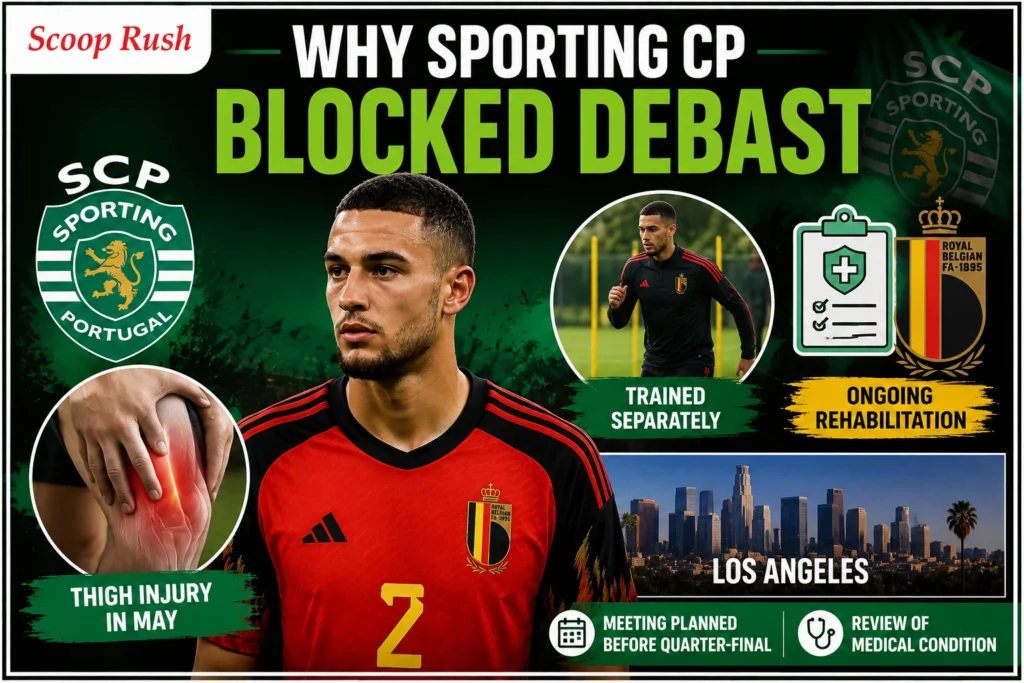
Why Sporting CP Blocked Debast
Debast suffered a thigh injury while playing for Sporting CP in May. The injury occurred shortly before the World Cup began. Even so, Belgium selected him in its 26-man squad because doctors expected him to recover during the tournament.
Since joining the national team, Debast has trained separately from the main group. He has continued his rehabilitation under Belgium’s Performance Department. Although he showed encouraging progress, he never returned to full match training.
Sporting remained in daily contact with the Belgian Football Association throughout his recovery. Reports also revealed that officials from both sides planned to meet in Los Angeles before the quarter-final. They hoped to review his medical condition together before making a final decision.
Zeno Debast Injury Update Highlights Medical Disagreement
The Zeno Debast Injury Update also exposed a clear disagreement between club and country. Belgium’s medical staff believes the defender has recovered enough to return. FIFA’s medical and insurance authorities reportedly shared the same opinion.
However, Sporting CP continued to express concerns about his fitness. The Portuguese club decided not to approve his return to competitive football. That decision ultimately ended any chance of Debast appearing against Spain.
The situation highlights how clubs often prioritize a player’s long-term health. National teams, meanwhile, focus on immediate tournament success. In this case, Sporting’s decision carried the final weight.
Debast Waits for His First World Cup Appearance
Debast has not played a single minute at the 2026 FIFA World Cup. He missed Belgium’s group-stage matches while recovering from injury. The coaching staff hoped he could return during the knockout rounds. Unfortunately, that comeback will have to wait.
Despite his absence, Debast remains one of Belgium’s brightest defensive talents. He already has 26 international appearances at just 22 years old. He also represented Belgium at the 2022 FIFA World Cup in Qatar. His experience and composure would have strengthened Belgium’s defense against Spain.
Debast Remains Positive During Recovery
Although the setback disappointed him, Debast continues to stay positive. Earlier in the tournament, he shared an encouraging update on his recovery. He said everything was progressing according to plan and that he felt physically strong.
The defender admitted that watching teammates compete without him had been difficult. Still, he expressed gratitude for remaining with the squad. He also thanked the medical staff for helping him recover. His focus now remains on returning to full fitness as soon as possible.
Belgium Faces More Injury Problems
Belgium’s problems do not end with Debast. Midfielder Amadou Onana will also miss the quarter-final. He suffered an ACL injury during Belgium’s 4-1 victory over the United States in the Round of 16.
Onana’s absence removes another key player from Rudi Garcia’s squad. Belgium must now find solutions in both defense and midfield. Those injuries increase the pressure on the remaining players before facing Spain.
Belgium Prepares for Spain Challenge
Spain enters the quarter-final with confidence after another impressive tournament. Belgium, however, must overcome fresh injury concerns to stay alive in the competition. The winner will advance to the semi-final and face France.
Belgium still has experienced players capable of competing at the highest level. Kevin De Bruyne and several senior stars will now carry greater responsibility. The team hopes determination and teamwork can overcome the loss of important players.
Conclusion
The Zeno Debast Injury Update has dealt Belgium a significant blow before one of its biggest matches. A disagreement between Sporting CP and Belgium’s medical staff prevented the defender from returning to action. While Belgium believes he could have played, the club chose a cautious approach. Debast now continues his recovery while his teammates battle Spain for a place in the World Cup semi-finals. Belgium will hope its remaining squad can rise to the occasion despite the growing injury list.
FAQs
1. What is the latest Zeno Debast Injury Update?
Sporting CP ruled Zeno Debast medically unfit. Therefore, he will miss Belgium’s World Cup quarter-final against Spain.
2. Why will Zeno Debast not play against Spain?
Sporting CP believes his thigh injury has not fully healed. The club refused to clear him for competitive action.
3. Has Zeno Debast played at the 2026 FIFA World Cup?
No. He has not appeared in any World Cup match because of his injury.
4. Why do Belgium and Sporting CP disagree?
Belgium’s medical team believes Debast can play. Sporting CP believes he still needs more recovery time.
5. Who else will Belgium miss against Spain?
Belgium will also miss midfielder Amadou Onana, who suffered an ACL injury during the Round of 16.
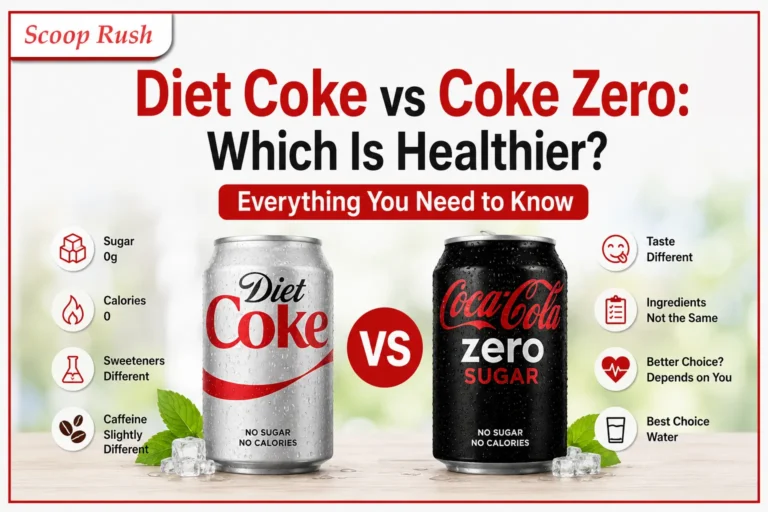
If you’re trying to cut back on sugar but still enjoy soft drinks, you’ve probably wondered whether Diet Coke or Coke Zero Sugar is the better choice. At first glance, the two drinks seem almost identical. Both contain zero sugar, zero calories, and are marketed as healthier alternatives to regular Coca-Cola.
However, there are important differences between them. They have different recipes, slightly different sweeteners, different caffeine levels in some countries, and most importantly, they were created for different tastes.
Many people also ask whether these drinks are actually healthy, whether they can help with weight loss, and if artificial sweeteners are safe to consume regularly. These are common questions, and fortunately, research has provided many answers.
In this guide, we’ll compare Diet Coke vs Coke Zero in detail, explain their ingredients, discuss their health effects, and help you decide which one fits your lifestyle.
What Is Diet Coke?
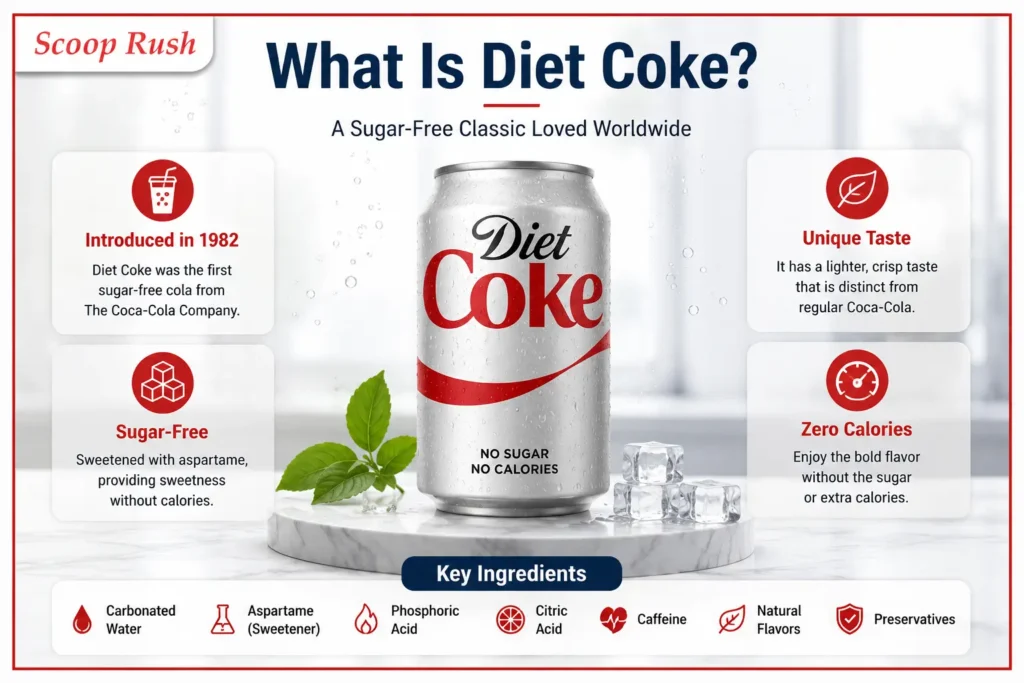
Diet Coke was introduced in 1982 as Coca-Cola’s first sugar-free soft drink. Unlike regular Coca-Cola, it wasn’t designed to taste exactly the same. Instead, Coca-Cola created a completely different flavor profile that quickly gained its own loyal fan base.
Diet Coke contains:
Carbonated water
Caramel color
Phosphoric acid
Aspartame
Natural flavors
Citric acid
Potassium benzoate (preservative)
Caffeine
Instead of sugar, Diet Coke uses aspartame, a low-calorie artificial sweetener that is around 200 times sweeter than sugar. Because only a tiny amount is needed, the drink contains virtually no calories.
Over the years, Diet Coke has become one of the world’s best-selling diet beverages and remains especially popular among people looking for a lighter-tasting cola.
What Is Coke Zero Sugar?
Coke Zero was introduced in 2005 and later reformulated as Coca-Cola Zero Sugar in many countries.
Unlike Diet Coke, Coke Zero was created to taste as close as possible to original Coca-Cola, while still containing no sugar.
Its ingredient list is similar but includes an additional sweetener:
Carbonated water
Caramel color
Phosphoric acid
Aspartame
Acesulfame Potassium (Ace-K)
Natural flavors
Potassium benzoate (preservative)
Potassium citrate
Caffeine
Note: Some current formulations also include a small amount of stevia extract. Exact ingredient lists can vary slightly by country and have been updated over time (notably in 2017 and 2021), so it’s worth checking the label on your specific can.
The combination of Aspartame and Acesulfame Potassium creates a sweeter flavor that closely resembles regular Coke.
For many people, Coke Zero offers the familiar Coca-Cola taste without the sugar or calories.
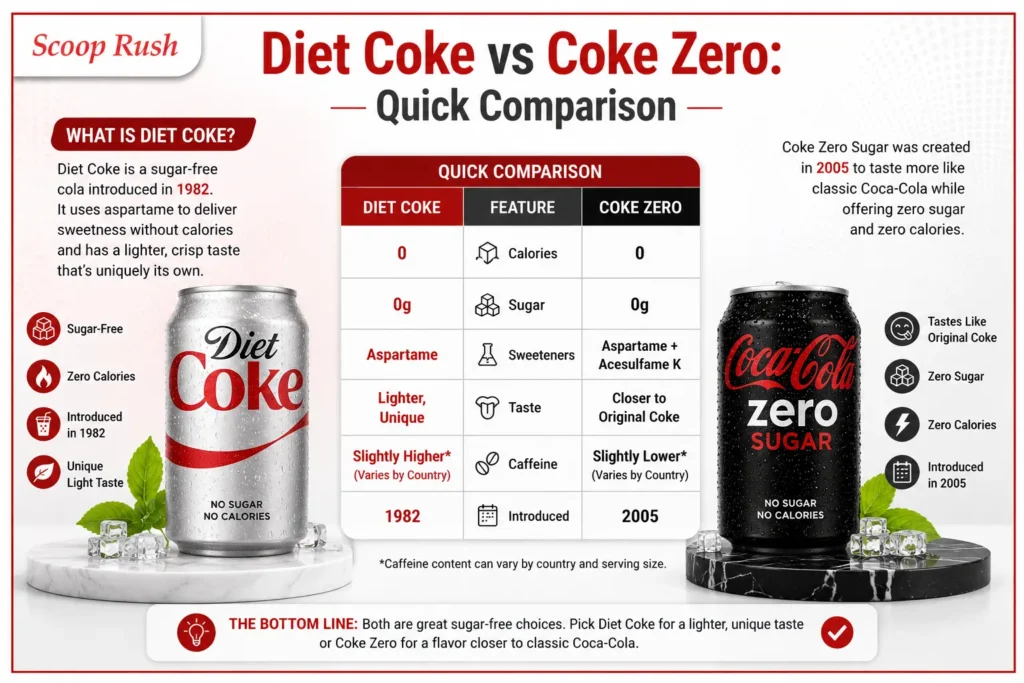
Diet Coke vs Coke Zero: Quick Comparison
Feature
Diet Coke
Coke Zero Sugar
Calories
0
0
Sugar
0 g
0 g
Fat
0 g
0 g
Carbohydrates
0 g
0 g
Main Sweetener
Aspartame
Aspartame + Ace-K
Taste
Lighter, unique
Similar to Original Coke
Caffeine
Slightly higher in some countries
Slightly lower in some countries
Purpose
Unique diet soda
Classic Coke taste without sugar
Why Do They Taste Different?
Many people assume Diet Coke and Coke Zero are the same drink with different labels. They’re not.
The biggest difference is their recipe.
Diet Coke was never meant to imitate regular Coca-Cola. It has its own lighter, slightly crisp taste that millions of people enjoy.
Coke Zero, on the other hand, was carefully developed to recreate the taste of original Coca-Cola while removing the sugar.
That’s why many people who switch from regular Coke prefer Coke Zero, while longtime Diet Coke drinkers often continue to choose Diet Coke because they enjoy its unique flavor.
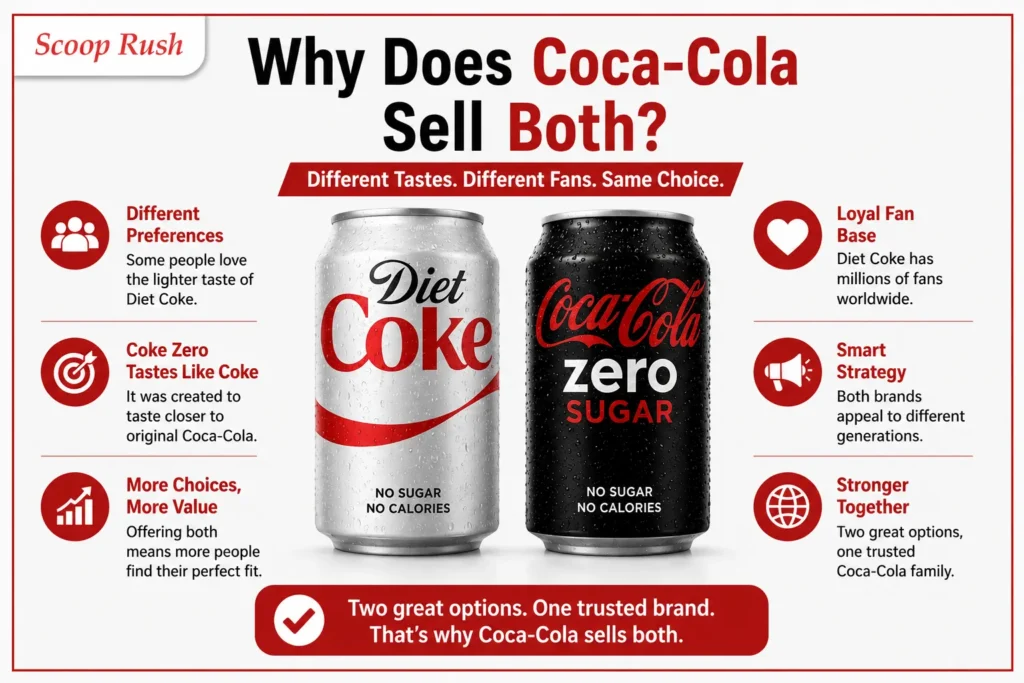
Why Does Coca-Cola Sell Both?
If both drinks contain zero sugar and zero calories, why hasn’t Coca-Cola replaced one with the other?
The answer is simple: consumer preference.
Diet Coke has millions of loyal fans who enjoy its distinctive taste. Removing it would disappoint many long-time customers.
At the same time, Coke Zero attracts people who want the familiar taste of classic Coca-Cola without the sugar.
Rather than competing against each other, the two drinks appeal to different groups of consumers.
This strategy has helped Coca-Cola maintain a strong presence in the sugar-free beverage market.
Ingredients Comparison
Although the ingredient lists look similar, there are a few notable differences.
Diet Coke contains:
Carbonated water
Caramel color
Phosphoric acid
Aspartame
Natural flavors
Citric acid
Potassium benzoate
Caffeine
Coke Zero contains:
Carbonated water
Caramel color
Phosphoric acid
Aspartame
Acesulfame Potassium
Natural flavors
Potassium benzoate
Potassium citrate
Caffeine
The addition of Acesulfame Potassium (Ace-K) in Coke Zero helps create a flavor that’s closer to regular Coca-Cola. Note that both drinks contain potassium benzoate as a preservative — this is common across most Coca-Cola products and helps protect flavor over shelf life.
Artificial Sweeteners Explained
Many people worry about artificial sweeteners because they sound unfamiliar. However, these sweeteners have been studied for decades.
Aspartame
Aspartame is one of the most widely researched food additives in the world.
Health authorities, including the U.S. Food and Drug Administration (FDA) and the European Food Safety Authority (EFSA), consider it safe for most people when consumed within recommended daily limits.
The only people who should avoid aspartame are those with phenylketonuria (PKU), a rare inherited condition that prevents the body from properly processing phenylalanine.
Acesulfame Potassium (Ace-K)
Ace-K is another calorie-free sweetener commonly used in beverages and sugar-free foods.
It works well when combined with aspartame because the two sweeteners enhance each other’s taste and reduce any aftertaste.
Regulatory agencies around the world also consider Ace-K safe within acceptable daily intake levels.
Are Artificial Sweeteners Safe?
This is one of the most frequently asked questions.
Current scientific evidence suggests that approved artificial sweeteners are generally safe when consumed in moderation.
Researchers continue studying their long-term effects, particularly regarding:
Appetite
Gut bacteria
Metabolism
Blood sugar regulation
Some studies suggest possible links between frequent consumption of artificially sweetened drinks and certain health outcomes, while others find little or no significant effect. Because the evidence is mixed, experts generally recommend moderation rather than excessive intake.
If you drink an occasional Diet Coke or Coke Zero as part of a balanced diet, current evidence does not show that it poses a significant health risk for most healthy adults.
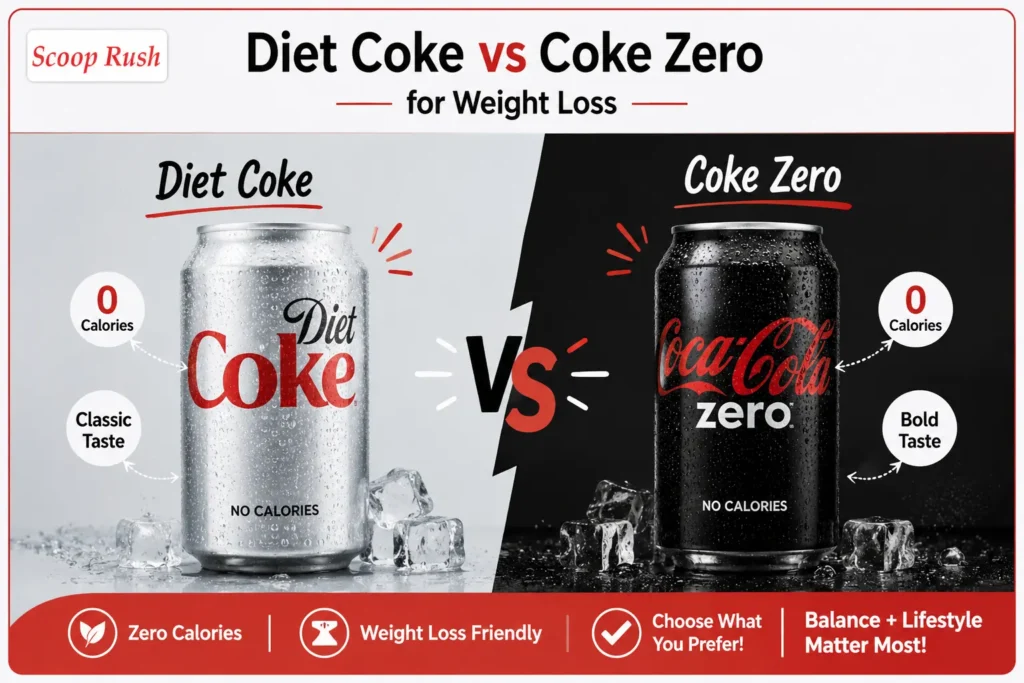
Diet Coke vs Coke Zero for Weight Loss
Many people switch from regular soda to Diet Coke or Coke Zero because they want to reduce their calorie intake. Since both drinks contain zero calories and zero sugar, they can help lower your daily calorie consumption if they replace sugary soft drinks.
However, they are not weight-loss drinks.
Losing weight depends on maintaining a calorie deficit through a balanced diet, regular physical activity, good sleep, and healthy lifestyle habits. Simply replacing regular soda with a diet version won’t guarantee weight loss if overall eating habits remain unhealthy. Small, consistent habits like the benefits of a 5-minute walk every hour often make a bigger difference than swapping one drink for another. If you’re building a broader routine, these healthy habits for your 20s and 30s are a good place to start.
Some research also suggests that artificial sweeteners may increase cravings for sweet foods in some people. While the evidence is mixed, experts recommend paying attention to how your body responds. If drinking diet soda makes you crave sugary snacks, it may work against your weight-loss goals. For people using newer weight-management medications, it’s also worth understanding the link between GLP-1 drugs and muscle loss, since diet alone including beverage choices isn’t the full picture.
The healthiest beverages for weight management remain:
Water
Sparkling water without added sugar
Unsweetened tea
Black coffee (in moderation)
Diet Coke and Coke Zero can be enjoyed occasionally, but they shouldn’t replace water as your main source of hydration.
Do Diet Coke and Coke Zero Affect Blood Sugar?
Since neither drink contains sugar, they generally do not cause the rapid rise in blood glucose that regular soft drinks do.
For people with diabetes, this makes them a better choice than sugar-sweetened beverages.
However, some researchers continue studying whether artificial sweeteners may indirectly affect insulin response or appetite over time. Results have been inconsistent, and there is currently no strong evidence that Diet Coke or Coke Zero significantly raises blood sugar in healthy individuals.
If you have diabetes or another medical condition, it’s always best to discuss beverage choices with your healthcare provider. For those newly diagnosed or at risk, it’s also worth staying informed about emerging treatments like teplizumab for type 1 diabetes.
Which Drink Has More Caffeine?
Both drinks contain caffeine, but the amount can vary by country and serving size.
In the United States, a 12-ounce (355 ml) can typically contains:
Drink
Approximate Caffeine
Diet Coke
46 mg
Coke Zero Sugar
34 mg
Regular Coca-Cola
34 mg
This means Diet Coke usually contains slightly more caffeine than Coke Zero in the U.S. — a detail that surprises many people, since a “diet” version might be assumed to have less of everything.
Caffeine may help improve alertness and concentration, but too much can lead to:
Difficulty sleeping
Nervousness
Increased heart rate
Restlessness
If you’re sensitive to caffeine, check the nutrition label in your country, as formulations may vary. Both brands also offer caffeine-free versions for anyone who wants to avoid caffeine entirely. If you tend to reach for a caffeinated drink first thing in the morning, it’s also worth reading about the effects of coffee on an empty stomach, since the same caffeine-sensitivity principles apply.
Are Diet Coke and Coke Zero Bad for Your Teeth?
Even though these drinks don’t contain sugar, they are still acidic.
Both contain phosphoric acid and other ingredients that can gradually weaken tooth enamel over time.
To protect your teeth:
Drink them in moderation.
Avoid sipping throughout the day.
Rinse your mouth with water afterward.
Wait about 30 minutes before brushing your teeth to help protect enamel.
Water remains the best beverage for dental health.
Can They Replace Water?
No.
Diet Coke and Coke Zero can contribute to your daily fluid intake, but they shouldn’t replace water.
Water is essential for:
Digestion
Temperature regulation
Joint lubrication
Kidney function
Healthy skin
Overall hydration
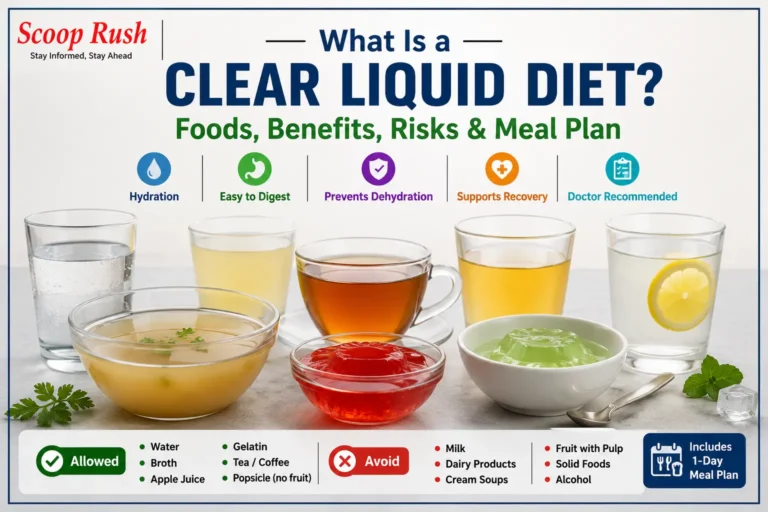
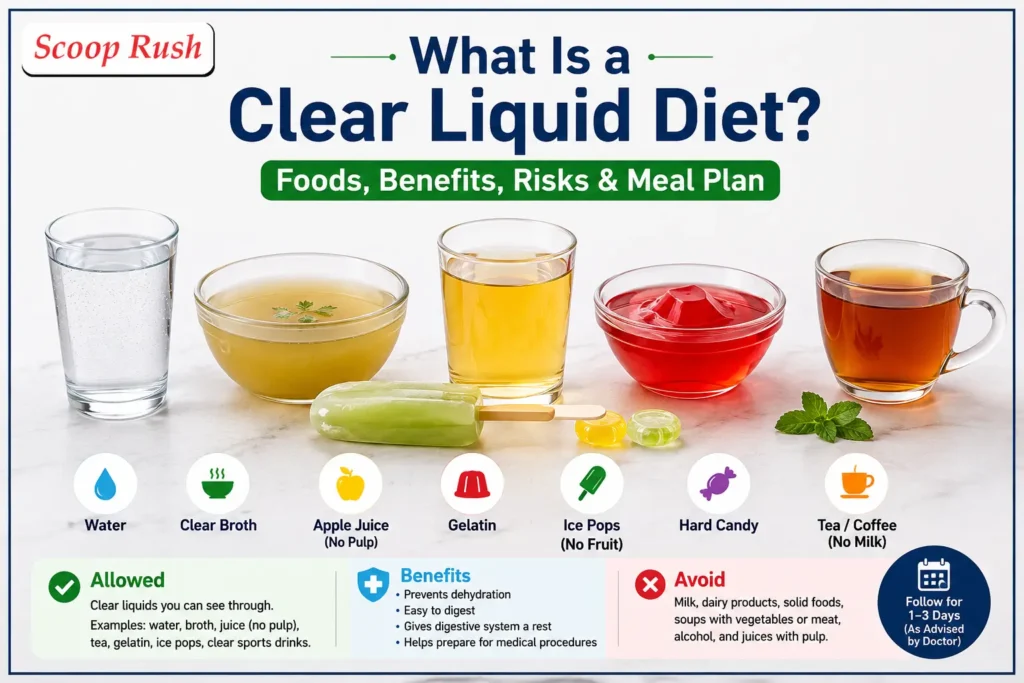
Most health experts recommend making water your primary drink and enjoying diet sodas occasionally rather than relying on them every day. If you’re ever medically advised to focus solely on hydration, it helps to understand what a clear liquid diet actually involves and why water takes priority in it.
Proper hydration matters even more during hot weather. Diet soda’s caffeine and acidity make it a poor substitute for water when temperatures rise, which is especially important for seniors facing heat and humidity risks or anyone caught in a heat dome. Pairing good hydration habits with these home cooling tips for hot weather is a far better strategy than relying on any soda, diet or otherwise.
Pros and Cons
Pros
Cons
Zero calories
Contains artificial sweeteners
Zero sugar
Acidic, which may affect tooth enamel
Better than sugary soda for reducing sugar intake
May increase sweet cravings in some people
Suitable for people reducing calorie intake
Contains caffeine
Available almost everywhere
Provides no vitamins or minerals
Diet Coke vs Coke Zero: Which Is Healthier?
From a nutritional standpoint, there is very little difference.
Both drinks:
Contain zero sugar.
Have zero calories.
Use approved artificial sweeteners.
Contain caffeine.
Offer little to no nutritional value.
The main difference is taste.
Choose Diet Coke if you enjoy its lighter, unique flavor.
Choose Coke Zero Sugar if you want something that tastes closer to classic Coca-Cola.
Neither drink is significantly healthier than the other.
Is Switching from Regular Coke Worth It?
If you regularly drink sugar-sweetened soft drinks, switching to either Diet Coke or Coke Zero Sugar can be a positive step toward reducing your daily sugar intake. A single can of regular Coca-Cola contains around 39 grams of added sugar, which can quickly contribute to excess calorie consumption if consumed frequently.
Replacing sugary soda with a zero-sugar alternative may help reduce overall calorie intake and lower the risk of consuming too much added sugar. This can be especially beneficial for people trying to manage their weight, control blood sugar levels, or improve their overall eating habits.
However, switching beverages alone isn’t enough to create lasting health improvements. A healthy lifestyle also includes eating plenty of fruits and vegetables, choosing whole grains, exercising regularly, getting enough sleep, and managing stress. Think of Diet Coke or Coke Zero as an occasional substitute rather than the foundation of a healthy diet.
How Your Taste Buds Can Change Over Time
One interesting fact about reducing sugar is that your taste preferences can gradually change.
People who regularly drink sugary beverages often become accustomed to very sweet flavors. When they first switch to Diet Coke or Coke Zero, the taste may seem unusual or different. However, after several weeks, many people find they become more sensitive to sweetness and begin enjoying drinks with less sugar.
This is one reason health professionals often encourage reducing added sugar gradually instead of trying to eliminate it overnight. Small, consistent changes are often easier to maintain than drastic dietary restrictions.
If your goal is to drink fewer soft drinks altogether, try alternating between diet soda and sparkling water with lemon or lime. Over time, you may naturally find yourself craving sweet beverages less often.
What Nutrition Experts Say About Moderation
Most registered dietitians agree on one important point: moderation matters more than perfection.
Enjoying a can of Diet Coke or Coke Zero once in a while is very different from drinking several cans every day. The occasional sugar-free soda is unlikely to have a major impact on your health if the rest of your diet is balanced.
Nutrition experts generally recommend focusing on overall dietary patterns rather than worrying about a single food or drink. If your meals include lean proteins, vegetables, fruits, healthy fats, and whole grains, having an occasional diet soda is unlikely to undo those healthy choices.
The key is balance. Water should remain your primary beverage, while sugar-free sodas can fit into a healthy lifestyle when enjoyed responsibly.
Common Myths About Diet Coke and Coke Zero
There are many myths surrounding sugar-free soft drinks. Let’s separate fact from fiction.
Myth 1: They Cause Instant Weight Gain Neither Diet Coke nor Coke Zero contains calories that directly cause weight gain. Weight gain occurs when you consistently consume more calories than your body burns. While some research has explored possible links between artificial sweeteners and eating habits, there is no evidence that these drinks alone automatically cause weight gain.
Myth 2: They Contain Sugar Both Diet Coke and Coke Zero Sugar are sugar-free. Their sweetness comes from approved low-calorie sweeteners rather than table sugar or high-fructose corn syrup.
Myth 3: They Are the Same Drink Although they look similar, the recipes are different. Coke Zero was designed to taste like classic Coca-Cola, while Diet Coke has its own unique flavor profile.
Myth 4: They’re Health Drinks Neither beverage should be considered a health drink. They provide almost no vitamins, minerals, protein, or fiber. They are simply lower-calorie alternatives to regular soft drinks. This is also a reminder that more isn’t always better when it comes to nutrition — the same logic applies to overdoing things in the other direction, as explained in this piece on the risks of taking too many vitamins and supplements.
Tips for Enjoying Soft Drinks More Mindfully
If you enjoy Diet Coke or Coke Zero, you don’t necessarily have to give them up. Instead, try drinking them more mindfully.
Here are a few practical tips:
Drink water before reaching for a soft drink.
Limit diet soda to one serving instead of multiple cans each day.
Avoid drinking soft drinks late in the evening if you’re sensitive to caffeine.
Pair your beverage with a balanced meal instead of sugary snacks.
Choose smaller serving sizes whenever possible.
Simple habits like these can help you enjoy your favorite drinks while supporting healthier daily routines.
Environmental Considerations
When choosing any canned or bottled beverage, it’s also worth considering its environmental impact.
Aluminum cans are among the most recyclable beverage containers in the world. Recycling helps reduce waste, conserve natural resources, and save energy during manufacturing. Plastic bottles can also be recycled in many areas, although recycling rates vary by country.
If you regularly buy canned beverages, recycling every empty can is one small way to reduce your environmental footprint.
Many beverage companies, including Coca-Cola, have also announced goals to increase the use of recycled materials and improve packaging sustainability in the coming years.
When Should You Avoid Diet Soda?
Although Diet Coke and Coke Zero are safe for most healthy adults in moderation, there are situations where limiting intake may be a good idea.
You may want to reduce or avoid diet soda if you:
Are highly sensitive to caffeine.
Experience frequent acid reflux or heartburn.
Have trouble sleeping after drinking caffeinated beverages.
Have phenylketonuria (PKU), which requires avoiding aspartame.
Notice that artificial sweeteners trigger cravings or digestive discomfort.
If you have any medical condition or dietary restrictions, it’s always wise to discuss your beverage choices with a healthcare professional.
The Bottom Line
When comparing Diet Coke vs Coke Zero, there isn’t a clear nutritional winner. Both drinks contain no sugar and virtually no calories, making them a better option than regular sugary soda for people looking to cut back on added sugar.
The biggest differences come down to taste, sweetener blend, and branding. Diet Coke offers a lighter, distinctive flavor that has remained popular for decades, while Coke Zero Sugar is crafted to closely resemble the taste of original Coca-Cola.
Ultimately, the healthiest choice isn’t necessarily deciding between Diet Coke and Coke Zero — it’s reducing your overall dependence on sweetened beverages and making water your everyday drink. If you enjoy a diet soda from time to time, current scientific evidence suggests that moderate consumption can fit within a balanced lifestyle for most people.
Rather than focusing on which can is in your hand, pay attention to your overall eating habits, physical activity, sleep quality, and hydration. Those everyday choices have a far greater impact on your long-term health than choosing between two sugar-free soft drinks.
FAQs
Is Coke Zero healthier than Diet Coke?
Not really. Both have similar nutritional profiles. The biggest difference is their flavor and sweetener blend.
Can I drink Diet Coke every day?
Most healthy adults can enjoy Diet Coke in moderation. However, it’s best not to rely on it as your primary beverage.
Is Coke Zero good for weight loss?
It may help reduce calorie intake if it replaces sugary soda, but it isn’t a weight-loss product.
Which tastes more like regular Coca-Cola?
Coke Zero Sugar was specifically designed to taste more like original Coca-Cola.
Which contains more caffeine?
In many countries, including the United States, Diet Coke contains slightly more caffeine than Coke Zero, although amounts vary by market.
Final Verdict
Diet Coke and Coke Zero Sugar are both popular sugar-free alternatives to regular soft drinks. They contain no sugar and almost no calories, making them a better choice than regular soda for people looking to reduce their sugar intake.
The biggest differences come down to taste, sweetener blend, and, in some regions, caffeine content. Diet Coke has a lighter, distinct flavor, while Coke Zero Sugar is formulated to closely match the taste of classic Coca-Cola.
Current evidence suggests that the artificial sweeteners used in these beverages are safe for most people when consumed within recommended limits. Still, moderation is important, as these drinks don’t provide essential nutrients and shouldn’t replace water or other healthy beverages.
If your goal is better overall health, focus on a balanced diet, regular exercise, quality sleep, and staying hydrated. Enjoy Diet Coke or Coke Zero occasionally if you like them, but remember that healthy habits matter far more than choosing one sugar-free soda over the other.
Jack Antonoff showed up alone to Taylor Swift’s wedding. That one detail was enough to set the internet ablaze with questions. Days later, those questions had an answer: Margaret Qualley Jack Antonoff split has been confirmed, ending a marriage that seemed, from the outside, like a genuine Hollywood love story.
For fans who watched this couple build a life together over the past five years, the news lands hard. Qualley recently starred in the music video for “You and Forever,” a song by Antonoff’s band Bleachers. That kind of creative partnership made the split feel especially unexpected. However, sources close to the couple say the breakup has been a long time coming, and it’s happening with far less drama than headlines might suggest.
Celebrity breakups have dominated headlines this year, from Ryan Reynolds’ drunk driver accident to other unexpected personal stories involving stars. This article breaks down everything confirmed so far about Qualley and Antonoff, including the timeline of their relationship, the reasons behind the split, and what both stars are doing next.
How the Margaret Qualley Jack Antonoff Split Came to Light
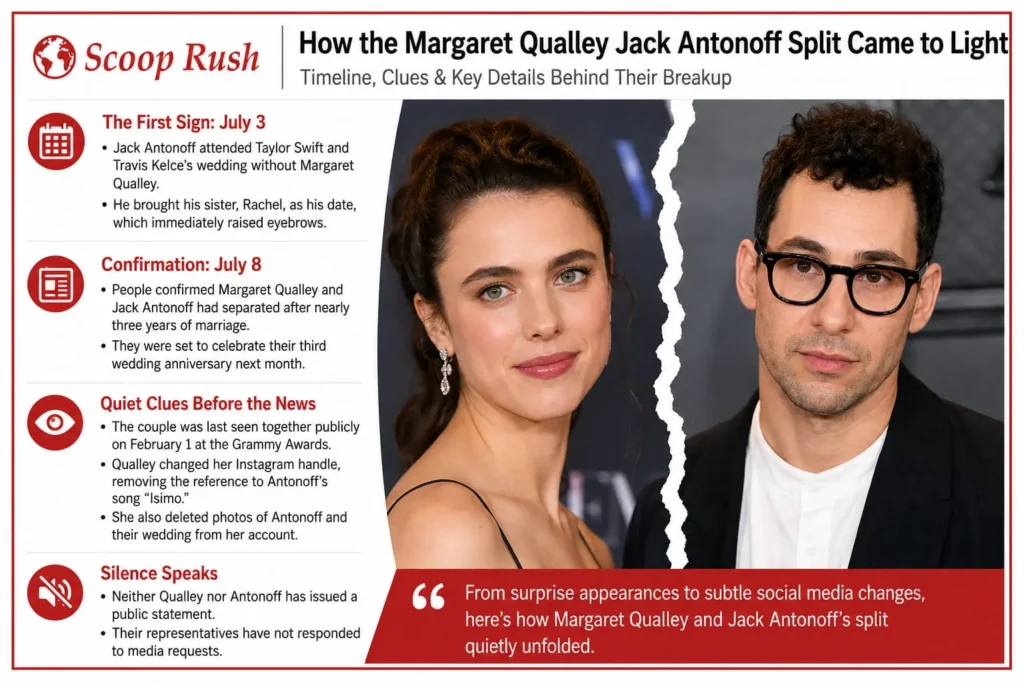
The first sign something was wrong came on July 3, when Antonoff attended Taylor Swift and Travis Kelce’s wedding without Qualley. Instead, he brought his sister, Rachel, as his date. For a couple that had long supported each other at major public events, the absence stood out immediately.
Antonoff has a close working relationship with Swift, having produced much of her music over the years. Therefore, his presence at her wedding wasn’t surprising. What raised eyebrows was who wasn’t standing beside him.
Just days later, on July 8, People confirmed what many had already suspected. Margaret Qualley and Jack Antonoff had separated after nearly three years of marriage. The two were set to celebrate their third wedding anniversary next month, making the timing especially notable.
Quiet Clues Before the Confirmation
Looking back, there were signs the marriage was struggling well before the official confirmation. The couple was last seen together publicly on February 1 at the Grammy Awards. After that appearance, their public presence as a couple essentially disappeared.
Two months later, Qualley quietly changed her Instagram handle. Her old username referenced “Isimo,” a song by Antonoff. Her new handle removed that connection entirely. Additionally, she has since removed photos of Antonoff and their wedding from her account altogether.
Neither Qualley nor Antonoff has issued a public statement about the split. Representatives for both stars have not responded to requests for comment. Silence in the face of speculation isn’t unique to this couple either; even in cases like the Nancy Guthrie case update, public figures often stay quiet until facts are confirmed.
The Timeline of Their Relationship
Understanding the Margaret Qualley Jack Antonoff split requires a look back at how their relationship began and grew.
The two first connected in 2021, shortly after Qualley ended her relationship with actor Shia LaBeouf. That same August, they were photographed together on a date in Brooklyn, sparking the first public speculation about a new romance.
Antonoff, meanwhile, had recently come out of a long relationship with Lena Dunham, the creator and star of HBO’s “Girls.” He and Dunham had dated from 2012 until late 2017.
Antonoff has described meeting Qualley as an instant connection. During an April 2026 appearance on SiriusXM’s The Howard Stern Show, he recalled the moment vividly, saying it felt like an unbelievable Hallmark movie scenario. He added that meeting her made him imagine things he’d never pictured before, including marriage.
The Engagement and Wedding
The couple announced their engagement in May 2022. They married in August 2023 in New Jersey, though their rehearsal dinner became an unexpected spectacle. Taylor Swift attended as a guest, and her fans reportedly swarmed the event. Antonoff later referenced the chaos in his 2026 Bleachers album “everyone for ten minutes,” specifically on the track “dirty wedding dress.”
Before their wedding, Qualley spoke glowingly about her relationship in an interview with Harper’s Bazaar. She said she felt she had found her person and described the feeling as the best in the world. That kind of public affection makes the current split feel even more surprising to longtime fans.
Why Did Margaret Qualley and Jack Antonoff Split?
This is the question everyone wants answered, and the response from insiders is refreshingly free of scandal.
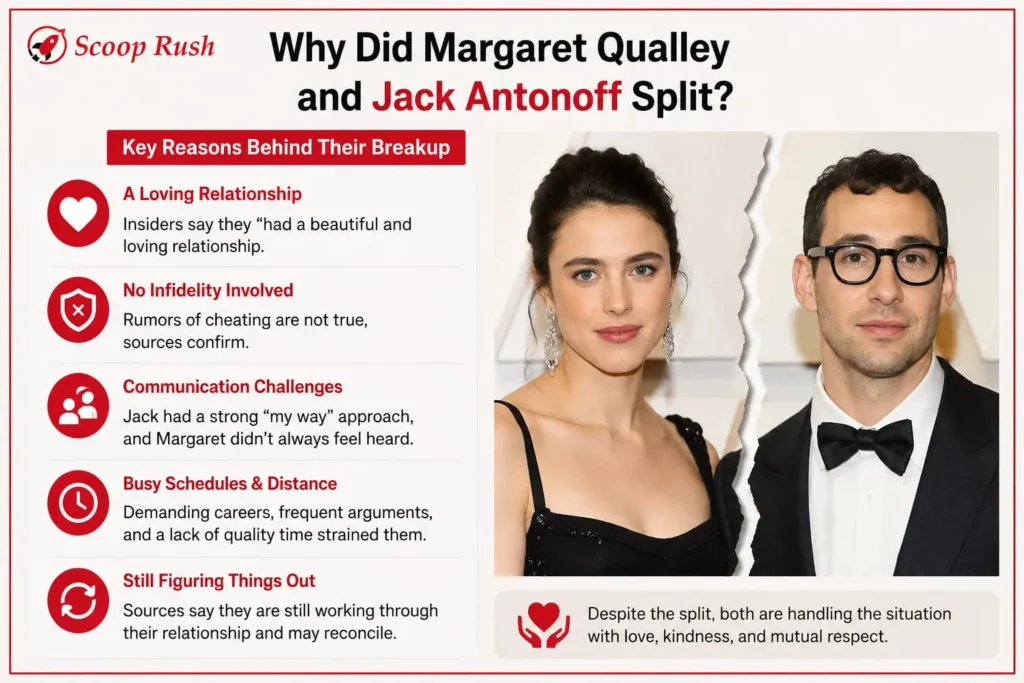
One source told Page Six that the couple has “had a beautiful and loving relationship.” The insider added that sometimes relationships simply don’t work out, and that doesn’t require a dramatic explanation. Importantly, this same source firmly denied rumors of infidelity that had started circulating online.
Another insider gave more specific insight into the day-to-day struggles. According to this source, Antonoff could be particular about how he liked things done. He often preferred situations handled his way, and Qualley didn’t always feel her perspective carried equal weight in the relationship. Communication, the source added, was a genuine challenge between the two.
A separate source speaking to People pointed to lifestyle pressures. The relationship had grown “rocky,” partly because of how often the couple argued. Between Qualley’s demanding acting career and Antonoff’s constant touring and studio schedule, spending quality time together became increasingly difficult.
They’re Still “Figuring Things Out”
Despite the split, the story isn’t entirely bleak. Multiple sources describe the couple as still working through their situation together. One insider specifically said they are “figuring things out,” suggesting the door to reconciliation may not be fully closed.
Another source reinforced this idea, noting the pair are handling the entire situation with love and kindness rather than public conflict. For a breakup involving two well-known public figures, that kind of mutual respect stands out, similar to how families navigate public scrutiny in cases like Peter Andre denying Lee Andrews adoption claims.
What’s Next for Both Stars
Life is moving forward for both Qualley and Antonoff, even amid the split.
Antonoff is currently fronting the Bleachers Forever tour, keeping him busy on the road. Meanwhile, Qualley is believed to be filming the horror movie “Possession” this summer. Both stars appear focused on their respective careers as they navigate this personal transition.
Interestingly, the timing of this split coincides with renewed attention on Antonoff’s past relationship with Lena Dunham. Dunham released her memoir, “Famesick,” in 2026, and it includes candid details about their years together. In the book, she recalls tension over Antonoff spending significant time with a teenage pop star he was working with professionally. According to an excerpt published by Variety, Dunham described coming home to find the young singer crying in Antonoff’s lap while he comforted her. Dunham has said this tension contributed to the eventual end of their relationship, during which she had an affair before she and Antonoff broke up.
Notably, both Dunham and Antonoff attended Taylor Swift’s wedding on July 3. It remains unclear whether the two crossed paths at the event, but the overlap has added another layer of interest to an already headline-heavy week for Antonoff.
What This Split Means for Fans
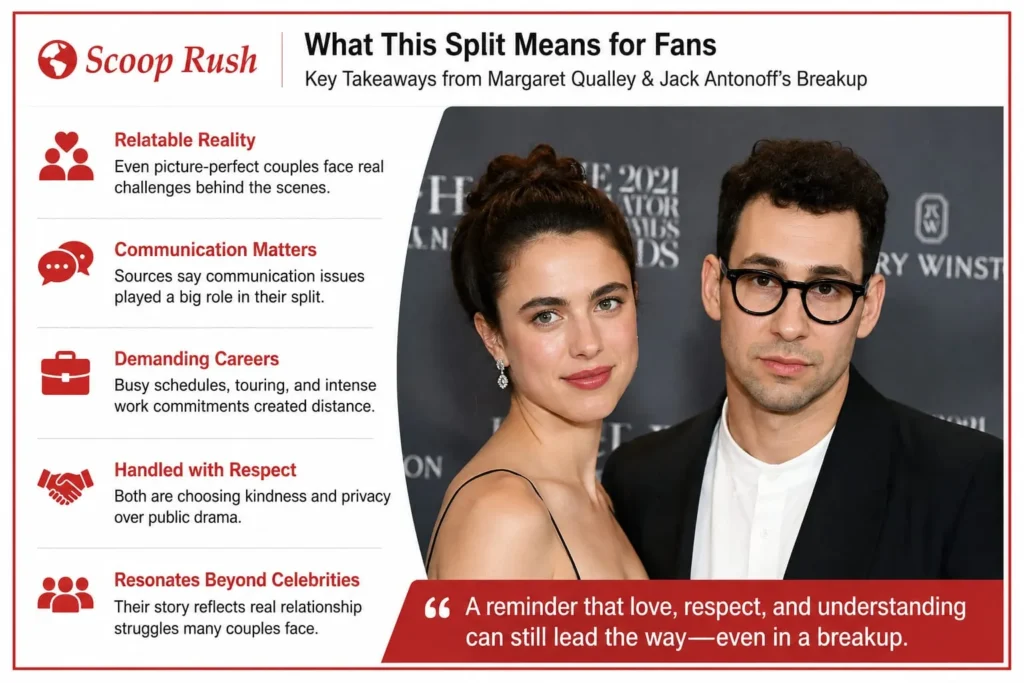
For many fans, the Margaret Qualley Jack Antonoff split serves as a reminder that even relationships that look picture-perfect from the outside can face real, relatable struggles. Communication issues and demanding careers are challenges many couples face, regardless of fame or public profile.
As a result, this story resonates beyond typical celebrity gossip. It reflects genuine relationship dynamics that everyday couples navigate too. Public life brings its own pressures, whether it’s relationship struggles or other personal battles fans follow closely, such as Olivia Attwood sharing her breast cancer diagnosis or family tensions like the one involving Elliot Anderson and his brother Wil Anderson. Ultimately, the way Qualley and Antonoff are choosing to handle their separation, with kindness rather than public blame, offers a different narrative than the usual dramatic celebrity breakup.
Conclusion
The Margaret Qualley Jack Antonoff split marks the end of a marriage that began with what looked like an instant, undeniable connection back in 2021. From their engagement in 2022 to their wedding in 2023, the couple built a public relationship full of affection and mutual support.
However, sources close to both stars confirm the split stems from communication struggles and the pressures of two demanding careers, not from infidelity or any single dramatic event. Both Qualley and Antonoff are currently focused on their work, with Antonoff touring with Bleachers and Qualley filming her next project.
While their future remains uncertain, insiders suggest the pair are approaching this transition with mutual respect. As more details potentially emerge, fans will continue watching how this story unfolds.
FAQs
Why did Margaret Qualley and Jack Antonoff split?
Sources say the marriage faced communication struggles and pressure from their demanding careers. Insiders have specifically denied that infidelity played any role in the breakup.
When did Margaret Qualley and Jack Antonoff get married?
The couple got engaged in May 2022 and married in August 2023, after first meeting and dating in 2021.
Did Jack Antonoff attend Taylor Swift’s wedding alone?
Yes. Antonoff attended Taylor Swift and Travis Kelce’s July 3 wedding with his sister, Rachel, instead of Qualley, which first sparked public speculation about the split.
Are Margaret Qualley and Jack Antonoff getting divorced?
As of now, sources confirm the couple has separated, though neither has publicly addressed divorce proceedings.
Is there a chance Margaret Qualley and Jack Antonoff could reconcile?
Multiple insiders have described the couple as still “figuring things out,” suggesting reconciliation hasn’t been ruled out at this stage.
She survived a cardiac arrest while doctors tried to wake her from a coma. Weeks later, Bonnie Tyler dies at 75 anyway.
Introduction
Bonnie Tyler dies at 75, the Welsh singer whose raspy voice turned “Total Eclipse of the Heart” into one of the most played songs in pop history. Her family confirmed the news on Thursday, ending months of uncertainty that began with an emergency surgery in Portugal back in April.
For fans who grew up belting out her power ballads at karaoke nights, this news lands hard. Tyler wasn’t just a hitmaker from decades past. She was still touring, still writing new music, and had a European tour planned to mark 50 years since her career-launching single “Lost in France.” That tour will now never happen.
Her death also comes during a heavy stretch of celebrity health news, following recent stories like Olivia Attwood’s breast cancer announcement, reminding fans how quickly health situations can shift for public figures.
Here’s everything we know about her death, the illness that led to it, and the legacy she leaves behind.
How Bonnie Tyler Died: The Timeline of Her Final Illness
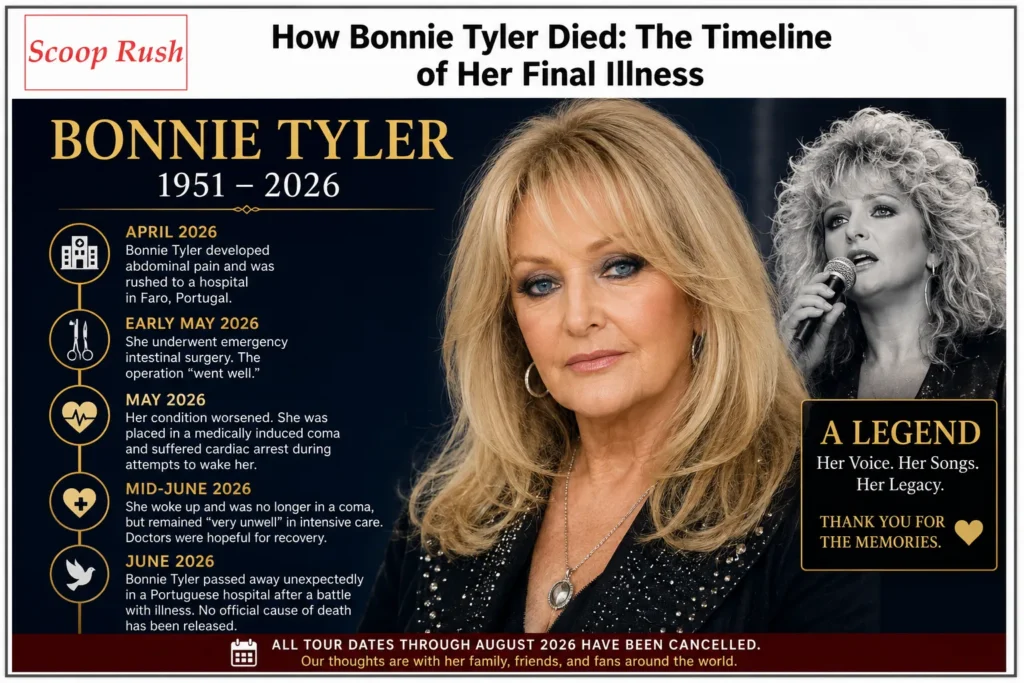
Tyler’s health troubles began quietly in April 2026. Doctors rushed her to a hospital near her home in Faro, Portugal, a city she had lived in part-time since 1988, after she started experiencing abdominal pain.
Doctors determined she needed emergency intestinal surgery. Her team confirmed the operation in early May, reassuring fans that the surgery “went well” and that she was recuperating. At that point, nobody expected the worst.
However, her condition took a serious turn shortly after. Doctors placed her into a medically induced coma to help her body recover from the operation. During attempts to bring her out of that coma, she suffered a cardiac arrest, a complication that made an already frightening situation even more dangerous.
By mid-June, there was a glimmer of hope. Her spokesperson announced she had woken up and was no longer in a coma. Still, the update came with a warning. She remained “very unwell” and stayed in intensive care. Doctors reportedly told her team they were confident she would make a full recovery.
That recovery never came. On Thursday, her family announced that she had passed away unexpectedly the night before in the same Portuguese hospital, confirming that Bonnie Tyler dies at 75 after a difficult few months. Her family has not released an official cause of death.
The Statement That Confirmed Her Death
Tyler’s team posted a statement on her official website and social media accounts confirming the news. Her family wrote that Bonnie’s family and team were heartbroken to announce she had unexpectedly passed away in a Portuguese hospital as a result of the illness she was being treated for, and asked for privacy to deal with the tragedy.
The word “unexpectedly” stood out to many who had been following her recovery. Just weeks earlier, things seemed to be moving in the right direction. Her death serves as a sobering reminder that recoveries from major surgery, especially in older patients, can take unpredictable turns even after signs of improvement. It’s a pattern echoed in other recent stories, such as Nancy Guthrie’s case update, where new developments continue to reshape what the public initially understood.
Her longtime manager, Judd Lander, also released a statement honoring her. He described her as “unique,” a “one-off” performer with a stunning voice and great stage presence, adding that the world had lost one hell of a great talent.
As a direct result of her passing, her team cancelled all scheduled tour dates through August. That included planned shows across the UK, along with performances in Germany, Malta, Austria, Hungary, Turkey, and Romania. Similarly, other entertainment plans have recently been scrapped following unexpected news, as seen when the BBC cancelled Ashley Cain’s series after backlash over old tweets.
Tributes Pour In From Music Icons and Political Leaders
News that Bonnie Tyler dies at 75 spread quickly, and tributes followed from across the entertainment and political world.
UK Prime Minister Sir Keir Starmer’s office released a statement calling her “one of Britain’s greatest recording artists.” A Downing Street spokesperson said her catalogue of music, from Total Eclipse Of The Heart to Holding Out For A Hero, continues to touch lives, flood dance floors, and fill karaoke booths.
Sir Cliff Richard remembered her as a “wonderful friend gone too soon.” In a Facebook post, he wrote that her infectious zest for life entertained so many around the world, adding that the news was shocking to wake up to.
Sir Rod Stewart shared a similarly personal tribute. He called her “a good pal, a true soul stirrer” and revealed that he performs her song “It’s A Heartache” every night on his current tour. Meanwhile, Spandau Ballet frontman Tony Hadley described her as “an incredible woman” who was kind and friendly to him when he was a young artist just starting out.
Doctor Who showrunner Russell T Davies said he had loved the “fabulous” singer since his teenage years. Wales Secretary Jo Stevens also paid tribute, calling Tyler “a Welsh music icon” and “the sound of my teenage years.”
These tributes, coming from such a wide range of public figures, show just how far Tyler’s influence reached beyond the music charts. Public figures reacting to sudden loss isn’t new in entertainment circles either, much like the wave of concern that followed reports around Oliver Tree’s final wish.
From a Welsh Chapel to Global Superstardom
Understanding why Bonnie Tyler’s death has hit so many people requires looking back at where she came from.
Born Gaynor Hopkins on June 8, 1951, in Skewen, Neath, in South Wales, she grew up in a council house as the daughter of a coal miner. She was one of six children in the family. Her earliest performance happened not on a concert stage, but in a chapel, where she sang the hymn “All Things Bright and Beautiful” as a child.
Tyler left school at 16 with no formal qualifications. In 1969, an aunt entered her into a local talent contest. She finished second and won just one pound. It wasn’t much, but it was enough to convince her that music might be worth pursuing.
She worked as a backing singer before her big break arrived in 1975. A talent scout named Roger Bell spotted her performing at a club in Swansea and invited her to record a demo in London. That led to a recording contract with RCA, and it was RCA who suggested she change her name to Bonnie Tyler.
The Surgery That Created Her Signature Voice
Her debut single failed to make an impact. However, her follow-up, “Lost in France,” became a hit, cracking the UK top ten in 1976 and landing her a spot on Top of the Pops.
Soon after that success, she developed a sore throat that turned out to be something more serious. Doctors found nodules on her vocal cords and had to remove them surgically. Doctors told her to rest her voice completely for six weeks, but she couldn’t manage it.
As a result, her voice changed permanently. It developed the husky, gravelly quality that would go on to define her entire career. She once described the moment producers first heard the new sound, joking that she suddenly sounded like a female Rod Stewart.
That distinctive voice became her greatest asset. In 1983, songwriter and producer Jim Steinman gave her “Total Eclipse of the Heart,” a soaring ballad built specifically to showcase her powerful, weathered vocals. The song topped the charts in both the UK and the US and has since sold more than 13 million copies worldwide.
Steinman also wrote her follow-up hit, “Holding Out for a Hero,” which later became a defining moment in the film Footloose.
A Career That Spanned Five Decades
Tyler didn’t fade after the 1980s. She kept recording and performing for the rest of her life, releasing 18 studio albums in total. Her most recent album, The Best Is Yet to Come, came out in 2021.
In 2013, she represented the United Kingdom at the Eurovision Song Contest in Malmo, Sweden, performing “Believe In Me.” She finished in 19th place, but the performance introduced her music to a new generation of fans across Europe.
Tyler is survived by her husband, Robert Sullivan. The couple had been married since 1973, meaning their marriage lasted more than five decades.
What Bonnie Tyler’s Death Means for Music Fans
Bonnie Tyler’s passing marks the end of an era for a certain kind of power ballad. Few singers have managed to make a single song as culturally durable as “Total Eclipse of the Heart,” which continues to fill dance floors, wedding receptions, and karaoke bars around the world.
Her story is also a reminder of how quickly health situations can change. She went from emergency surgery, to a coma, to cardiac arrest, to apparent recovery, and then to an unexpected death within just a few months. It’s a difficult and sobering arc, and it explains why so many people are describing this loss as sudden despite the months of hospital updates that came before it. Sudden, life-altering incidents have shaped headlines elsewhere too, including the recent Ryan Reynolds drunk driver accident and unsettling reports like Anne Hegerty’s Baby Reindeer-style stalker story.
For younger listeners discovering her music through the eclipse-driven streaming surges of recent years, her passing offers a moment to look back at the full scope of her career, from a chapel choir in South Wales to chart-topping success on both sides of the Atlantic. Family ties and legacy remain a recurring thread in entertainment stories, much like the connection explored in Elliot Anderson and his brother Wil Anderson or the joyful contrast of Thylane Blondeau’s wedding to Benjamin Attal in Paris.
Conclusion
Bonnie Tyler dies at 75 in a hospital in Portugal after months of serious illness that began with emergency intestinal surgery in April. She had been placed in an induced coma, suffered a cardiac arrest, and appeared to be recovering before her unexpected death. Tributes came from Prime Minister Keir Starmer, Sir Cliff Richard, Sir Rod Stewart, Tony Hadley, and Russell T Davies. She leaves behind a five-decade career built on hits like “Total Eclipse of the Heart,” “Holding Out for a Hero,” and “It’s a Heartache,” along with an MBE and a legacy that continues to influence pop music today. With Bonnie Tyler dies at 75 now confirmed, fans across the world continue to remember her through her timeless music.
FAQs
How did Bonnie Tyler die?
Her family said she passed away unexpectedly in a hospital in Portugal as a result of an illness she had been treated for. No official cause of death has been released.
What happened to Bonnie Tyler before she died?
She was hospitalized in April 2026 for emergency intestinal surgery near her home in Faro, Portugal. She was later placed in a medically induced coma and suffered a cardiac arrest during recovery attempts. In June, her team said she had woken up but remained very unwell.
How old was Bonnie Tyler when she died?
She was 75 years old.
What are Bonnie Tyler’s most famous songs?
Her biggest hits include “Total Eclipse of the Heart,” “Holding Out for a Hero,” “It’s a Heartache,” and “Lost in France.”
Is Bonnie Tyler’s family confirming a cause of death?
Not yet. Her family said only that her death resulted from the illness she was being treated for, and that further details would follow.
Europe Travel Rules 2026 are changing how millions of people travel, move, and even claim citizenship across the continent. Italy’s Supreme Court is reviewing controversial citizenship restrictions while the European Union has decided to keep its new biometric Entry/Exit System despite complaints from airlines. At the same time, Canada has reopened one of North America’s most spectacular hiking trails, giving international travelers another reason to plan an outdoor adventure.
Here is everything travelers should know before planning their next trip.
Europe Travel Rules 2026: Italy’s Citizenship Law Faces Supreme Court Review
Italy’s highest court has begun examining legal challenges against government restrictions on citizenship by descent.
The review focuses on the 2024 “minor issue” policy, which affected people whose Italian parents became citizens of another country while their children were still minors. The rule prevented many descendants from claiming Italian citizenship, especially in countries such as the United States where children automatically receive citizenship at birth.
The hearing comes after Italy introduced an even stricter law in March 2025. That legislation limited citizenship by descent to only two generations, removing eligibility for millions of people with Italian ancestry.
Lawyers representing American and Venezuelan families argued that people gain Italian citizenship at birth, and no one can take it away without their consent. The government’s legal adviser reportedly supported that interpretation during the hearing, raising hopes among families challenging the restrictions.
If the Supreme Court rules in favor of the plaintiffs, it could strengthen future legal challenges against Italy’s broader citizenship law. Many Italian descendants are closely watching the case because they had already started citizenship applications or even relocated to Italy before the rules suddenly changed.
Meanwhile, Italy continues to face a demographic crisis. The country’s fertility rate has fallen to a record low, with fewer young people and a rapidly aging population.
Europe Travel Rules 2026: EU Keeps New Entry Exit System Despite Airport Chaos
The European Union has confirmed that its new Entry/Exit System (EES) will remain in place despite growing criticism from airlines and airports. The biometric border system became fully operational in April 2026. It requires most non-EU visitors entering the 29-country Schengen Area to provide facial photographs and fingerprints when crossing external borders.
The aviation industry recently urged EU leaders to suspend the program during the busy summer travel season. Airlines warned that the new procedures were causing long queues, passenger confusion, and missed flights.
However, European Commission officials rejected the request. Officials said the system improves border security while allowing legitimate travelers to continue entering Europe. According to the Commission, the system has already processed more than 110 million border crossings and denied entry to around 45,000 travelers who did not meet the requirements.
Travelers visiting Schengen countries for stays of up to 90 days should expect additional time at border checkpoints and should arrive earlier than usual for international departures.
Europe Travel Rules 2026: Canada’s Iconic Berg Lake Trail Returns
While Europe introduces stricter travel procedures, outdoor travelers have received good news from Canada. The famous Berg Lake Trail in British Columbia has fully reopened after years of reconstruction following severe flood damage in 2021. Many people rank the Berg Lake Trail among North America’s most scenic alpine hikes. It features glacier-fed waterfalls, turquoise lakes, and spectacular views of Mount Robson, the tallest peak in the Canadian Rockies.
A major addition is the newly opened Robson Pass Hut, which began welcoming visitors in May 2026. The mountain hut allows hikers to stay overnight without carrying heavy camping equipment, making the trail more accessible for backpackers and winter visitors. The route was rebuilt with climate resilience in mind after devastating floods destroyed large sections of the original trail.
Reservations for the new hut sold out quickly following its opening, highlighting renewed interest in one of Canada’s most famous hiking destinations.
How These Travel Changes Affect International Travelers
Travelers planning international trips should prepare for several important changes.
Allow extra time when entering or leaving Schengen countries because biometric checks may increase waiting times.
Visitors with Italian ancestry should closely follow the Supreme Court’s decision if they hope to apply for citizenship by descent.
Outdoor enthusiasts may want to add Canada’s reopened Berg Lake Trail to their future travel plans, but reservations should be booked well in advance.
Together, these developments show how travel is evolving through stricter border security, changing immigration policies, and new tourism opportunities.
What Travelers Should Expect in 2026
Europe continues to balance stronger security measures with growing tourism demand. Italy’s citizenship dispute could reshape the future of citizenship by descent for millions of families around the world. At the same time, the European Union remains committed to biometric border controls despite criticism from the travel industry.
Outside Europe, Canada’s fully restored Berg Lake Trail offers travelers a fresh opportunity to experience one of North America’s most breathtaking mountain landscapes. For anyone planning international travel in 2026, staying informed about these policy changes can help avoid delays, unexpected restrictions, and missed opportunities.
FAQs
1. What are Europe Travel Rules 2026?
Europe Travel Rules 2026 include new biometric border checks under the EU Entry/Exit System, changes to Italy’s citizenship laws, and updated travel requirements across Europe.
2. What is the EU Entry/Exit System (EES)?
The Entry/Exit System is a biometric border program that records fingerprints and facial images of most non-EU travelers entering and leaving the Schengen Area.
3. Why is Italy’s citizenship law being challenged?
Several families argue that Italian citizenship is a birthright and should not be removed because of later changes in government policy. Italy’s Supreme Court is reviewing whether earlier restrictions were lawful.
4. Will travelers experience delays at European airports?
Yes. Travelers may face longer processing times because biometric information must be collected at many external Schengen border crossings.
5. Why is Canada’s Berg Lake Trail attracting attention?
The trail has fully reopened after extensive flood repairs and now features the new Robson Pass Hut, giving visitors easier access to one of Canada’s most scenic mountain hiking destinations.
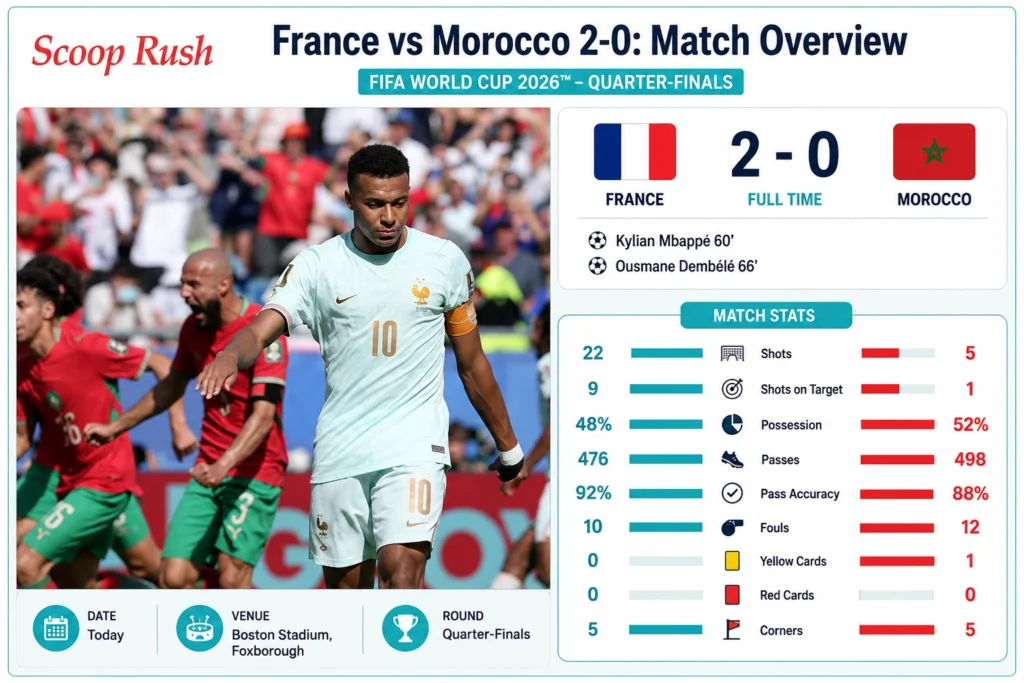
Competition: FIFA World Cup 2026 Round: Quarter-finals Venue: Boston Stadium, Foxborough Full-Time Result: France 2-0 Morocco
France vs Morocco 2-0 was a quarter-final clash that highlighted the difference between creating chances and converting them. Despite Morocco enjoying slightly more possession and completing more passes, France delivered when it mattered most. Two second-half goals from Kylian Mbappé and Ousmane Dembélé secured a 2-0 victory and sent France into the FIFA World Cup 2026 semi-finals.
For Morocco, the defeat marked the end of an impressive tournament run. However, they remained competitive throughout the match and showed their quality on the ball. France, meanwhile, combined attacking efficiency with defensive discipline to book their place among the final four teams.
France vs Morocco 2-0: Match Overview
The FIFA World Cup 2026 quarter-final at Boston Stadium in Foxborough brought together two ambitious teams with a place in the semi-finals at stake.
France entered the contest with confidence and eventually turned their superiority in front of goal into a winning advantage. Morocco worked hard to stay in the game and even edged possession statistics, but they struggled to create clear-cut opportunities against an organized French defense.
The match remained goalless for an hour before France finally broke through. Once the first goal arrived, the momentum shifted firmly in their favor.
The opening stages were closely contested. Morocco looked comfortable in possession and moved the ball well across midfield. France, however, appeared more dangerous whenever they advanced into attacking areas.
Neither side found a breakthrough in the first half. France generated opportunities but could not convert them, while Morocco struggled to test the French goalkeeper consistently.
The game changed after the hour mark.
In the 60th minute, Kylian Mbappé delivered the decisive opening goal. The strike gave France a crucial lead and forced Morocco to push forward in search of an equalizer.
Only six minutes later, Ousmane Dembélé doubled the advantage. His goal put France firmly in control and left Morocco facing a difficult challenge.
Although Morocco continued to battle and maintained their passing rhythm, they could not find a route back into the contest. France managed the remaining minutes effectively and secured a clean-sheet victory.
One of the biggest stories of the match was France’s efficiency in attack.
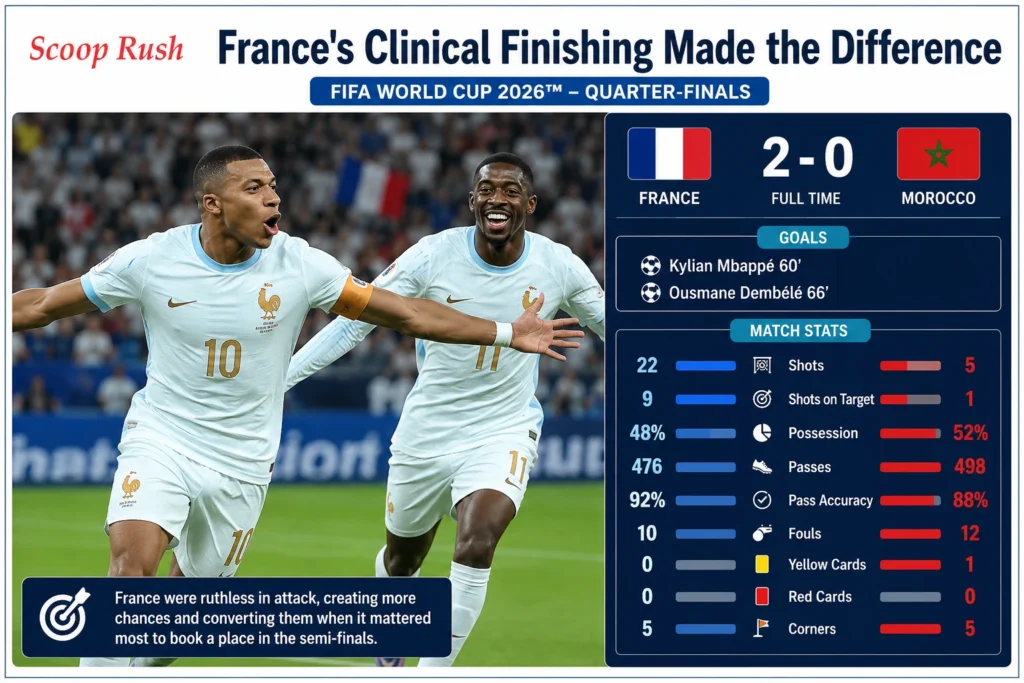
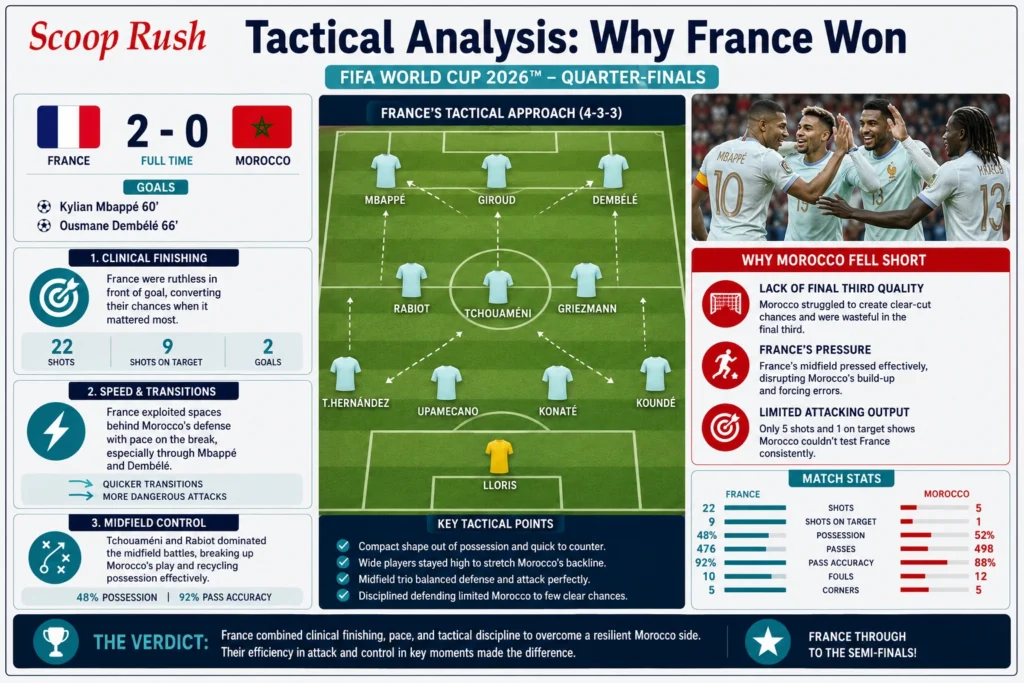
The French side recorded 22 total shots and nine efforts on target. Those numbers reflected sustained attacking pressure throughout the game.
Morocco, by comparison, managed only five shots and just one attempt on target.
This difference in attacking output ultimately decided the quarter-final.
While possession was almost evenly split, France consistently created more dangerous situations in and around the penalty area. Their forwards found space, tested the goalkeeper, and eventually converted key opportunities.
France’s Attacking Strength
Several factors contributed to France’s success:
High shot volume
Better shot accuracy
Strong movement in attacking areas
Effective finishing in crucial moments
The combination of Mbappé and Dembélé proved particularly important. Both players stepped up when France needed a breakthrough.
Morocco can leave the tournament with their heads held high.
The statistics show that they were far from overwhelmed in general play. In fact, Morocco finished with 52% possession compared to France’s 48%.
They also completed 498 passes, slightly more than France’s 476.
Those numbers demonstrate Morocco’s willingness to control the ball and build attacks patiently.
However, possession alone does not guarantee success.
France’s defensive structure limited Morocco to just one shot on target throughout the match. As a result, Morocco struggled to create the kind of opportunities needed to challenge a team of France’s quality.
Morocco performed well in several areas but faced difficulties in the final third.
Key challenges included:
Limited shooting opportunities
Only one effort on target
Difficulty breaking through France’s defensive lines
Lack of end product despite good possession numbers
Consequently, Morocco were unable to capitalize on their time on the ball.
Key Match Statistics
Statistic
France
Morocco
Shots
22
5
Shots on Target
9
1
Possession
48%
52%
Passes
476
498
Pass Accuracy
92%
88%
Fouls
10
12
Yellow Cards
0
1
Red Cards
0
0
Corners
5
5
Quick Takeaway
France were far more dangerous in attack, recording 22 shots and 9 on target, compared to Morocco’s 5 shots and 1 on target. Meanwhile, Morocco enjoyed slightly more possession (52%) and completed more passes (498), but France’s superior finishing quality proved decisive in the 2-0 quarter-final victory.
When knockout matches remain level deep into the second half, teams often need a star player to make the difference.
That moment arrived through Kylian Mbappé in the 60th minute.
His goal broke Morocco’s resistance and gave France the advantage they had been searching for throughout the match.
Beyond the goal itself, Mbappé’s influence stretched across the attacking third. His movement and threat forced Morocco’s defense to stay alert whenever France moved forward.
The opening goal also changed the tactical picture. Morocco had to take more risks, which created additional space for France.
Ousmane Dembélé Seals the Victory
Just six minutes after Mbappé’s breakthrough, Ousmane Dembélé struck to make it 2-0.
The second goal effectively ended Morocco’s hopes of a comeback.
With a two-goal cushion, France gained complete control over the quarter-final. Their confidence grew, while Morocco faced an increasingly difficult task.
Dembélé’s contribution underlined France’s attacking depth. Opponents cannot focus solely on Mbappé because other dangerous attackers are capable of deciding matches.
Third, France maintained excellent passing quality. Their 92% pass accuracy allowed them to control important phases of the game even though Morocco had slightly more possession overall.
Meanwhile, Morocco circulated the ball well but struggled to penetrate dangerous areas.
As a result, France’s balance between attack and defense proved decisive.
What This Result Means
For France, the 2-0 victory secures a place in the FIFA World Cup 2026 semi-finals.
Advancing from the quarter-finals is a major achievement and keeps their championship ambitions alive.
The performance also demonstrated several encouraging signs:
Strong defensive discipline
Efficient finishing
High pass accuracy
Contributions from key attacking stars
For Morocco, the tournament journey comes to an end. Despite the defeat, they competed against one of the world’s strongest teams and showed resilience throughout the contest.
Their ability to control possession and maintain passing quality against France reflects the progress they have made on the international stage.
Conclusion
The France vs Morocco 2-0 quarter-final was decided by efficiency in front of goal. Morocco enjoyed slightly more possession and completed more passes, but France created far more attacking opportunities and converted the chances that mattered.
Goals from Kylian Mbappé in the 60th minute and Ousmane Dembélé in the 66th minute secured a deserved victory. France finished with 22 shots and nine on target, while Morocco managed only five attempts and one effort on goal.
Ultimately, France’s attacking quality, defensive organization, and clinical finishing proved too much for Morocco. The result sends France into the FIFA World Cup 2026 semi-finals and keeps their dream of lifting the trophy alive.
FAQs
1. What was the final score between France and Morocco?
France defeated Morocco 2-0 in the FIFA World Cup 2026 quarter-finals.
2. Who scored for France against Morocco?
Kylian Mbappé scored in the 60th minute, and Ousmane Dembélé added a second goal in the 66th minute.
3. Where was the France vs Morocco quarter-final played?
The match was played at Boston Stadium in Foxborough.
4. How many shots did France have against Morocco?
France recorded 22 shots, including nine on target.
5. Did Morocco have more possession than France?
Yes. Morocco finished with 52% possession, while France had 48%.
The US-Iran ceasefire is facing its biggest challenge yet after both sides accused each other of launching new attacks across the Middle East. Iran claimed the United States carried out fresh strikes on coastal military sites, while Tehran said it responded by firing missiles toward a US military base in Jordan.
The latest exchange has raised fresh concerns that the fragile truce could collapse completely. Although neither Washington nor Tehran has officially ended the ceasefire agreement, the recent violence has made the path back to diplomacy increasingly uncertain.
At the same time, tensions in the Strait of Hormuz continue to disrupt global shipping, adding pressure to energy markets and increasing fears of a broader regional conflict.
US-Iran Ceasefire Comes Under Pressure After New Military Exchange
The situation escalated after Iranian state media reported that US forces launched another round of strikes on several locations along Iran’s southern coast. According to Iranian officials, the attacks followed overnight operations that targeted dozens of military facilities across the country. Tehran described the latest strikes as another violation of the temporary peace agreement that both sides entered into only weeks ago.
Iran quickly announced what it called a defensive response. Officials claimed missiles were launched toward a US military base in Jordan. Jordan later confirmed that missiles entered its airspace and were intercepted before reaching their targets. Authorities said there were no immediate reports of major casualties or significant damage.
The US military has not officially confirmed Iran’s claims regarding the latest attacks. While details continue to emerge, the renewed military activity highlights how quickly the security situation has deteriorated despite ongoing diplomatic efforts.
Even as military operations continue, international mediators are working to prevent the conflict from spiraling further.
Regional diplomatic sources say discussions between Washington and Tehran have not completely stopped. Several countries remain engaged in behind-the-scenes negotiations aimed at restoring confidence between both sides.
However, every new exchange of fire makes those talks more difficult. The ceasefire was intended to reduce military tensions while allowing both governments to negotiate long-term security issues. Instead, repeated accusations and retaliatory strikes have created new obstacles for negotiators.
Political analysts believe the coming days could determine whether diplomacy survives or whether both countries move toward a much larger confrontation.
Military Activity Expands Across the Region
The latest confrontation is no longer limited to Iran alone.
Over the past two days, military activity has spread across several parts of the Middle East. Iran has accused the United States of expanding its operations, while Washington continues to monitor Iranian military movements across the region. Jordan’s interception of incoming missiles demonstrates how neighboring countries are increasingly being drawn into the crisis.
Regional governments remain on high alert as air defense systems continue monitoring possible new attacks. Security experts warn that further escalation could increase the risk of accidental clashes involving additional countries.
Ali Khamenei Funeral Adds Political Uncertainty
The renewed fighting comes as Iran concludes the final day of funeral ceremonies for former Supreme Leader Ali Khamenei. Large crowds gathered across the country to pay their respects during several days of national mourning. Attention has also shifted toward Iran’s future leadership.
Sources familiar with the situation say Mojtaba Khamenei, the late leader’s son and designated successor, is unlikely to appear publicly during the final ceremonies. His absence has fueled speculation inside and outside Iran. However, Iranian authorities have not provided any official explanation regarding his decision to stay out of public view.
Political observers believe the leadership transition could influence Tehran’s future approach toward negotiations with the United States.
Strait of Hormuz Becomes a New Flashpoint
The conflict is also affecting one of the world’s most strategically important waterways. The Strait of Hormuz serves as a critical route for global oil exports. Any disruption there has immediate consequences for international energy markets.
Following the latest military escalation, commercial shipping traffic has slowed as companies assess security risks.
Iran has reportedly moved several oil tankers away from the area as a precautionary measure. Meanwhile, President Donald Trump has warned that the United States could restore a naval blockade if Iran continues actions that threaten maritime security. Energy analysts say prolonged instability in the Strait of Hormuz could push shipping costs higher and place additional pressure on global oil prices.
Global Leaders Watch Closely
Governments across Europe, the Gulf region, and Asia continue monitoring developments with growing concern. Many countries have urged both Washington and Tehran to avoid further military action and return to negotiations before the situation becomes more difficult to control.
Financial markets are also reacting cautiously as investors monitor developments affecting energy supplies and regional stability. Diplomatic observers say both sides still have an opportunity to preserve the ceasefire, but that window is becoming increasingly narrow.
Can the US-Iran Ceasefire Still Survive?
The ceasefire remains technically in place because neither country has formally withdrawn from the agreement. However, repeated military exchanges have weakened trust between both governments. Each new strike increases political pressure and reduces the chances of meaningful negotiations.
For now, mediators continue working behind closed doors to restore dialogue. Whether those efforts succeed may determine if the Middle East moves back toward diplomacy or enters another dangerous phase of conflict.
FAQs
1. What is the US-Iran ceasefire?
The US-Iran ceasefire is a temporary agreement designed to stop military attacks and create conditions for diplomatic negotiations between the two countries.
2. Why is the US-Iran ceasefire under pressure?
Fresh US strikes and Iranian missile attacks have increased tensions, making it harder for both governments to maintain the fragile peace agreement.
3. Did Iran launch missiles toward Jordan?
Iran said it targeted a US military base in Jordan. Jordan confirmed intercepting missiles in its airspace and reported no major casualties.
4. Why is the Strait of Hormuz important?
The Strait of Hormuz is one of the world’s busiest oil shipping routes. Any disruption there can affect global energy supplies and increase oil prices.
5. Has the US-Iran ceasefire officially ended?
No. Neither Washington nor Tehran has formally announced the end of the ceasefire, although recent military exchanges have placed the agreement under serious strain.
Before you ever opened your eyes to see the world, a silent chemical process was already deciding how clearly you’d see it. New research shows that vitamin A vision development plays a starring role in building sharp central vision, and the discovery is rewriting what scientists thought they knew about how the human eye forms.
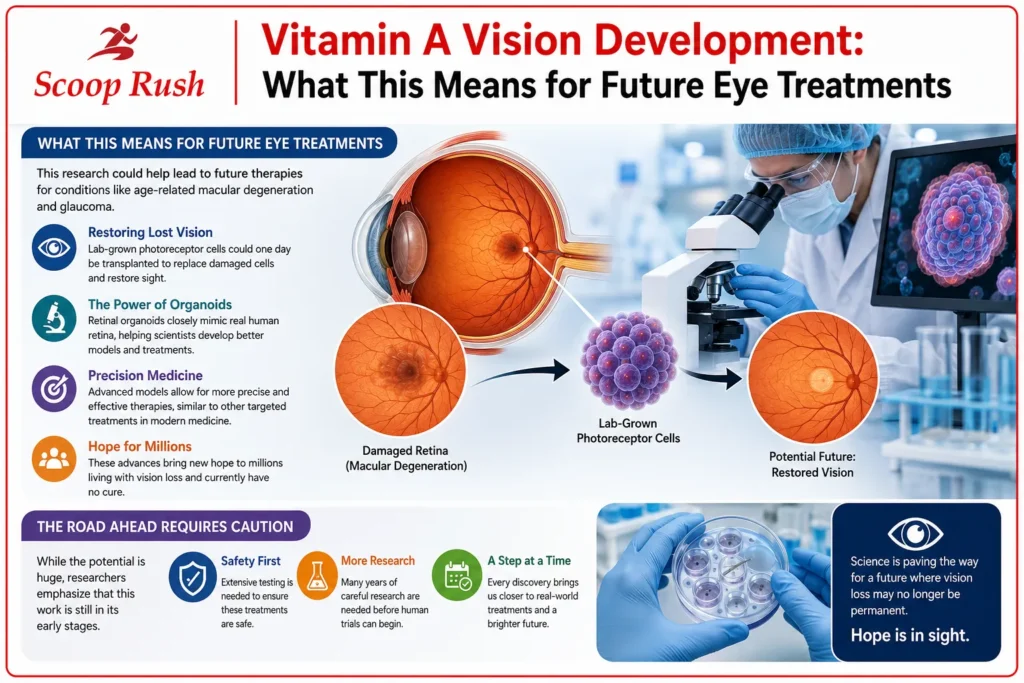
Scientists at Johns Hopkins University have uncovered how the human eye develops sharp central vision before birth. Their findings could pave the way for new treatments to restore sight in people suffering from serious eye diseases like macular degeneration and glaucoma.
This isn’t just a lab curiosity. Millions of people lose their sharp vision every year due to age-related eye conditions that currently have no cure. Therefore, understanding vitamin A vision development could be the first step toward rebuilding damaged sight artificially. old muscle stem cells and other regenerative research.
The Hidden Chemistry Behind Vitamin A Vision Development
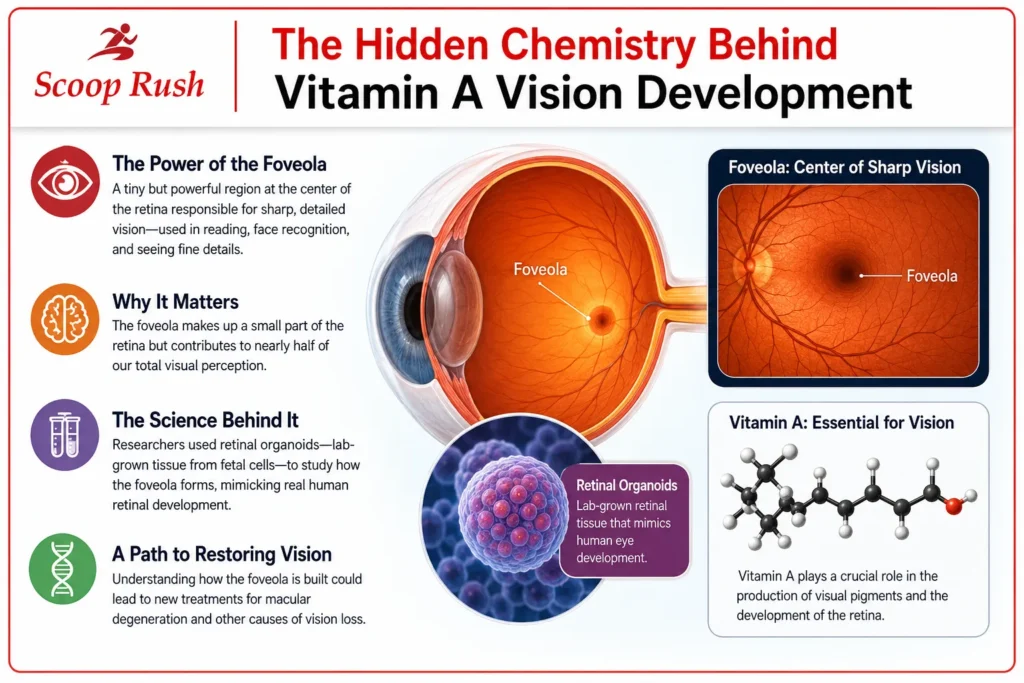
The study, published in the journal Proceedings of the National Academy of Sciences, focused on a tiny but powerful part of the eye called the foveola. This small region sits at the center of the retina and is responsible for your sharpest vision, the kind you use for reading, recognizing faces, or spotting details from far away.
Although the foveola makes up only a small fraction of the retina, it accounts for nearly half of a person’s total visual perception. That’s a massive amount of visual power packed into a tiny space.
To study how this region forms, researchers used retinal organoids. These are small pieces of retinal tissue grown in a lab from fetal cells. Because they closely mimic the structure and function of a real retina, organoids allow scientists to observe eye development in ways that would otherwise be impossible, similar to how researchers study neurons breaking DNA to build the brain to understand early development.
Why the Foveola Matters So Much
Robert J. Johnston Jr., associate professor of biology at Johns Hopkins and the study’s lead researcher, explained why this region deserves so much attention. He called it a key step toward understanding the center of the retina, since it’s often the first part of the eye damaged in people with macular degeneration.
In other words, if scientists can understand how the foveola is built, they may eventually learn how to rebuild it after disease damages it. That’s a big deal for anyone facing vision loss later in life, and it echoes a broader pattern in science where understanding how the brain visualizes things, such as in cases of aphantasia, continues to reshape what we know about perception.
The Cone Cells That Make Color Vision Possible
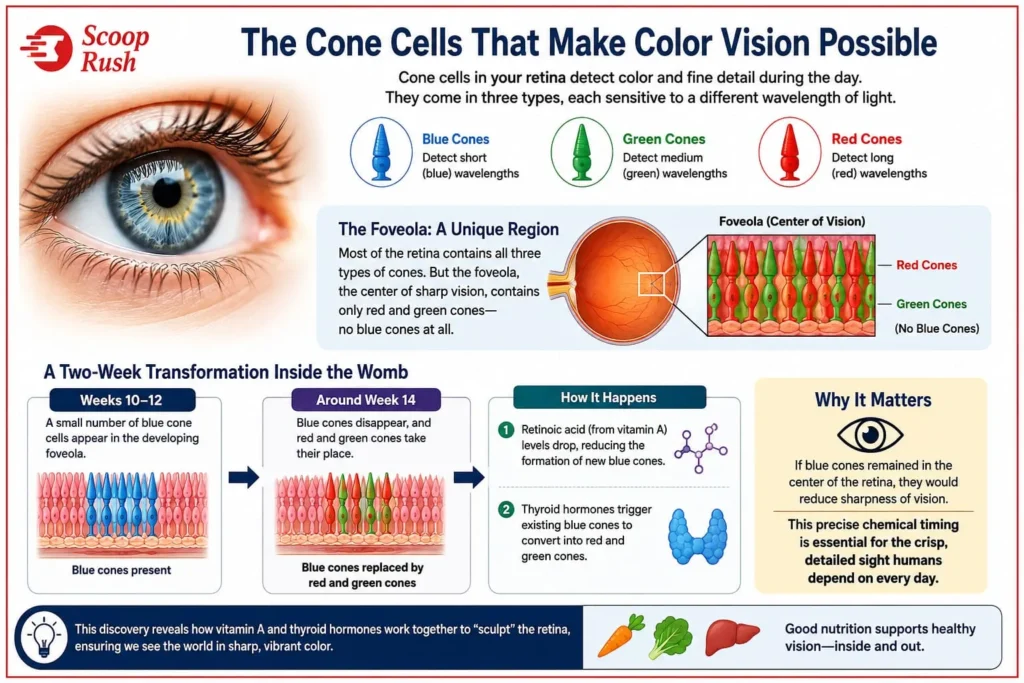
To understand this discovery, it helps to know a bit about cone photoreceptors. These are the specialized cells in your retina that allow you to see color and fine detail during the day. Cone cells develop into one of three types: blue, green, or red, and each type detects a different wavelength of light.
Most of the retina contains a mix of all three cone types. However, the foveola is different. It contains only red and green cones, with no blue cones at all. Scientists have long wondered how this unusual pattern comes together, and until now, nobody had a clear answer. Most of the retina contains a mix of all three cone types. However, the foveola is different. It contains only red and green cones, with no blue cones at all. Scientists have long wondered how this unusual pattern comes together, and until now, nobody had a clear answer for this part of vitamin A vision development.
A Two-Week Transformation Inside the Womb
The research team tracked exactly when and how this pattern forms. During weeks 10 through 12 of fetal development, a small number of blue cone cells appear in the developing foveola. Then, by around week 14, something surprising happens. Those blue cones disappear, and red and green cones take their place.
This transformation happens through two separate biological steps.
First, levels of retinoic acid, a molecule produced from vitamin A, begin to drop. This decrease reduces the formation of new blue cone cells. Second, thyroid hormones step in and trigger the remaining blue cones to convert into red and green cones.
Johnston emphasized why this sequence matters so much for vision quality. If blue cones remained in the center of the retina, they would reduce the sharpness of a person’s vision. As a result, this precise chemical timing is essential for building the crisp, detailed sight that humans depend on every day.
Rewriting Three Decades of Vision Science
Perhaps the most striking part of this discovery is how it overturns a theory that has guided vision research for about 30 years. Scientists previously believed that blue cone cells formed in the center of the retina and then physically moved outward, clearing space for red and green cones to take over.
However, this new study tells a different story. Instead of migrating away, blue cones actually stay in place. They simply change their identity, transforming directly into red and green cones over time.
This finding matters because it shifts the entire framework scientists use to understand retinal development. Additionally, it opens new questions about what else might trigger similar transformations in other parts of the body, in much the same way that a 3.2-billion-year-old enzyme recently forced scientists to rethink assumptions about how ancient biology worked. This finding matters because it shifts the entire framework scientists use to understand vitamin A vision development. Additionally, it opens new questions about what else might trigger similar transformations in other parts of the body.
Why This Discovery Took So Long
You might wonder why it took decades to figure this out. Part of the challenge lies in the animals typically used for vision research. Mice and fish, two of the most common lab animals, don’t develop the same three-cone arrangement found in human eyes.
Because of this, scientists lacked a good model to study the process directly. Human retinal organoids solved that problem. By growing lab-based tissue from fetal cells, researchers finally had a way to watch this transformation unfold step by step, a research approach not unlike how scientists identified a new beetle species by carefully observing traits that had gone unnoticed for years.
What This Means for Future Eye Treatments
This research isn’t just about satisfying scientific curiosity. It has real potential to shape future treatments for people living with vision loss.
Age-related macular degeneration and glaucoma both damage the retina and can eventually lead to blindness. Currently, there is no cure for macular degeneration, which makes discoveries like this one especially valuable.
Researchers hope to use organoid technology to eventually create healthy, made-to-order photoreceptor cells. These lab-grown cells could potentially be transplanted into damaged eyes to restore lost vision. Meanwhile, scientists continue refining these organoids so they more closely match the function of an actual human retina, a strategy that mirrors ongoing work using silica nanoparticles for prostate cancer treatment to precisely target damaged cells.
Better models mean better cells, and better cells mean a stronger foundation for cell replacement therapy. Consequently, this research brings scientists one step closer to real-world treatments, even though clinical use is still years away.
The Road Ahead Requires Caution
Despite the excitement, researchers are quick to point out that this work is still in its early stages. Much more research is needed to confirm both the safety and effectiveness of these approaches before they can ever be tested in patients.
This kind of caution is standard in medical science, and for good reason. Treatments involving cell transplantation require extensive testing to ensure they work safely inside the human body. Still, every discovery like this lays another brick on the path toward future therapies.
A Bigger Picture: Vitamin A’s Long History in Vision Science
This discovery builds on a much longer story about vitamin A vision development and its role in eye health. Vitamin A is essential for life, yet the human body cannot produce it on its own. It must come from the diet, primarily through foods like carrots, leafy greens, and animal liver.
For centuries, people have understood that vitamin A deficiency harms vision. Night blindness caused by low vitamin A levels was documented as far back as 3500 BC, with ancient remedies even suggesting the consumption of liver, a food naturally rich in the vitamin.
Modern science eventually confirmed why this remedy worked. A modified form of vitamin A, known as retinal, combines with a protein called opsin to create the visual pigments found in photoreceptor cells. When light hits these pigments, it triggers the chemical reaction that allows the eye to detect and process images.
Without enough vitamin A, these visual pigments cannot form properly, and photoreceptors become less sensitive to light. This is why vitamin A deficiency causes night blindness before it causes more severe vision problems, a reminder of how deeply diet shapes long-term health, much like ongoing debates around the risks of a no-sugar diet.
Beyond basic vision, retinoic acid, the active form of vitamin A, has been shown to influence many other processes in the body. It affects the pace at which certain cells, especially photoreceptors, develop. Interestingly, it has also proven effective in treating a form of leukemia, transforming what was once one of the deadliest cancers into one with a remission rate above 90 percent when caught early. Nutritional factors influencing disease outcomes are a growing research theme, as seen in studies linking omega-3 fish oil supplements to brain health.
Key Takeaways
This new study reveals that vitamin A vision development involves far more than general eye health support. It actively shapes the precise arrangement of cone cells that gives humans their sharp central vision.
Through a coordinated process involving retinoic acid and thyroid hormones, blue cone cells transform into red and green cones during a critical window of fetal development. This finding overturns a 30-year-old theory that assumed these cells simply migrated out of the way.
As a result, scientists now have a clearer path toward understanding how the human retina builds its most vital region, the foveola. Ultimately, this knowledge could help researchers develop lab-grown retinal tissue capable of restoring vision lost to diseases like macular degeneration and glaucoma.
While treatments are still years away, this discovery marks meaningful progress toward a future where blindness caused by retinal damage may finally become treatable.
FAQs
How does vitamin A help build sharp vision before birth?
Vitamin A produces a molecule called retinoic acid, which helps reduce the formation of blue cone cells in the developing retina. This process, combined with thyroid hormone activity, helps shape the arrangement of cone cells needed for sharp central vision.
What is the foveola and why is it important?
The foveola is a tiny region at the center of the retina responsible for the sharpest vision. Although it covers a small area, it accounts for nearly half of a person’s overall visual perception.
What did scientists previously believe about blue cone cells?
For about 30 years, scientists believed blue cone cells formed in the center of the retina and then migrated outward to make room for red and green cones. The new study shows these cells actually stay in place and transform instead.
Could this research help treat macular degeneration?
Yes, researchers hope that improved retinal organoids could eventually help produce healthy photoreceptor cells for transplantation, offering a potential path toward treating conditions like macular degeneration.
Are these vision treatments available now?
No, this research is still in an early stage. Scientists say more studies are needed to confirm the safety and effectiveness of these approaches before they can be tested in patients.
A clear liquid diet is a short-term medical diet that includes transparent liquids such as water, clear broth, apple juice without pulp, black coffee, tea, sports drinks, and plain gelatin. Doctors commonly recommend it before a colonoscopy, surgery, or during recovery from digestive illnesses. It helps keep you hydrated while allowing your digestive system to rest, but it should only be followed for a short period because it does not provide complete nutrition.
What Is a Clear Liquid Diet?
A clear liquid diet is a temporary eating plan that includes only liquids you can see through and foods that turn into clear liquids at room temperature. Unlike regular meals, these foods leave little or no residue in your digestive tract, making them easy to digest.
Doctors often recommend a clear liquid diet before medical procedures such as a colonoscopy or surgery. It may also be used when recovering from digestive problems like vomiting, diarrhea, or stomach infections.
Although the diet provides fluids, electrolytes, and a small amount of energy, it does not contain enough protein, healthy fats, vitamins, or minerals to meet your body’s nutritional needs. For this reason, it should only be followed for a short time and under the guidance of a healthcare professional.
In this guide, you’ll learn:
What a clear liquid diet is
Why doctors recommend it
Foods and drinks you can have
Foods to avoid
Benefits and possible risks
A sample meal plan
Frequently asked questions
Who May Need a Clear Liquid Diet?
A healthcare provider may recommend a clear liquid diet in several situations, including:
Before a colonoscopy
Before surgery requiring anesthesia
After stomach or intestinal surgery
During severe vomiting or diarrhea
While recovering from food poisoning
During certain digestive illnesses
Before some medical imaging tests
During short-term bowel rest prescribed by a doctor
Always follow your healthcare provider’s instructions because the duration and allowed foods may vary depending on your medical condition.
Why Is a Clear Liquid Diet Recommended?
Doctors recommend a clear liquid diet because it helps empty the stomach and intestines while keeping the body hydrated. This lowers the risk of complications during medical procedures and gives the digestive system time to recover.
Below are the most common reasons why healthcare providers prescribe this diet.
Before a Colonoscopy
Before a colonoscopy, your colon must be completely clean so the doctor can clearly examine the lining of your large intestine.
Even small amounts of undigested food can hide polyps or other abnormalities. A clear liquid diet helps remove residue from the digestive tract, making the procedure more accurate and reducing the need for repeat testing.
Before Surgery
Many surgeries require an empty stomach before anesthesia. Food remaining in the stomach can increase the risk of aspiration, a serious complication in which stomach contents enter the lungs during surgery.
A clear liquid diet helps keep the stomach empty while allowing you to stay hydrated until it’s time to stop drinking fluids before the procedure. Always follow your surgeon’s specific instructions regarding fasting.
After Surgery
After operations involving the stomach or intestines, your digestive system needs time to heal.
Doctors often begin with clear liquids before gradually introducing a full liquid diet and eventually regular foods. This gradual approach helps reduce nausea, prevents digestive discomfort, and allows your body to recover more comfortably.
During Vomiting or Diarrhea
Vomiting and diarrhea can quickly lead to dehydration and electrolyte loss.
A clear liquid diet replaces fluids while giving your digestive system a chance to rest. As your symptoms improve, your healthcare provider will usually recommend slowly returning to soft foods and then your regular diet.
During Digestive Illness
People experiencing stomach infections, food poisoning, or other digestive conditions may temporarily benefit from a clear liquid diet.
Because clear liquids are easy to digest, they reduce stress on the digestive tract while helping maintain hydration and electrolyte balance during recovery.
Why Does a Clear Liquid Diet Work?
Many people wonder why doctors recommend a diet made mostly of water, broth, juice, and gelatin.
The answer lies in how the digestive system works.
Solid foods contain fiber, fat, and protein, which take several hours to digest and leave residue in the stomach and intestines. Clear liquids contain little or no fiber and very little fat, allowing them to pass through the digestive tract much more quickly.
This is especially important before procedures such as a colonoscopy, where even small amounts of food residue can affect the results. It also reduces the risk of complications during surgery by ensuring the stomach is empty before anesthesia.
In addition, clear liquids help replace fluids, sodium, potassium, and other electrolytes lost through vomiting, diarrhea, or bowel preparation, helping prevent dehydration during recovery.
What Can You Eat on a Clear Liquid Diet?
Although a clear liquid diet is limited, there are still several foods and drinks you can safely consume. The key rule is simple: if you can see through it and it leaves little or no residue in your digestive tract, it’s usually allowed.
These liquids help keep you hydrated and provide small amounts of energy while giving your digestive system time to rest.
Clear Liquid Diet Food List
The following foods and drinks are generally allowed on a clear liquid diet.
Food or Drink
Examples
Water
Plain, sparkling, or flavored (without pulp)
Clear Broth
Chicken, beef, or vegetable broth
Fruit Juice
Apple juice, white grape juice, white cranberry juice (without pulp)
Tea
Black tea or herbal tea without milk or cream
Coffee
Black coffee without milk, cream, or non-dairy creamer
Sports Drinks
Gatorade®, Powerade®, or other electrolyte drinks
Clear Soft Drinks
Ginger ale, lemon-lime soda, or other clear sodas (if approved by your doctor)
Plain Gelatin
Lemon, orange, or lime gelatin without fruit pieces
Ice Pops
Clear ice pops without milk, fruit, or cream
Hard Candy
Peppermints, lemon drops, or clear hard candies
Sweeteners
Sugar or honey (if allowed by your healthcare provider)
These foods provide fluids, simple carbohydrates, and electrolytes that help reduce the risk of dehydration during short-term use.
Foods That Melt Into Clear Liquids
Some foods are acceptable because they become clear liquids at room temperature.
These include:
Plain gelatin (Jell-O®)
Clear ice pops
Fruit ice without pulp
Ice chips
Clear frozen treats without dairy
However, avoid frozen desserts that contain milk, yogurt, chocolate, fruit pieces, seeds, or nuts, as they are not considered clear liquids.
Foods and Drinks to Avoid
Many people assume that all soft or liquid foods are allowed, but that’s not true. Foods containing dairy, fiber, pulp, or solid ingredients can leave residue in your digestive tract and should be avoided.
Food or Drink
Why It’s Not Allowed
Milk
Contains protein and fat
Yogurt
Dairy product with protein
Ice Cream
Contains milk and fat
Smoothies
Usually contain fruit pulp and dairy
Protein Shakes
Too thick and high in protein
Cream Soups
Leave residue in the digestive tract
Soups with Vegetables, Rice, or Noodles
Contain solid foods
Orange Juice with Pulp
Pulp is not allowed
Tomato Juice
Not a clear liquid
Fresh Fruits
Solid food
Vegetables
Solid food
Oatmeal or Cereal
Contains fiber
Bread, Rice, or Pasta
Solid foods
Alcohol
Can increase dehydration
If you’re unsure whether a food is allowed, ask yourself one question: Can I clearly see through it? If the answer is no, it’s probably not suitable for a clear liquid diet.
Nutrition Facts of a Clear Liquid Diet
A clear liquid diet provides hydration but very little nutrition. That’s why it should only be followed for a short period unless your doctor advises otherwise.
Because the diet lacks essential nutrients, following it for several days may lead to fatigue, weakness, and nutrient deficiencies.
Sample One-Day Clear Liquid Diet Meal Plan
If your healthcare provider recommends a clear liquid diet, the following sample menu can help you plan your day.
Breakfast
1 glass apple juice (without pulp)
1 cup black tea
1 serving plain lemon gelatin
Mid-Morning Snack
Water
Clear sports drink
Lunch
Chicken broth
White grape juice
Plain gelatin
Afternoon Snack
Clear ice pop
Water
Dinner
Vegetable broth
Apple juice
Plain gelatin
Evening
Herbal tea (without milk)
Water
Note: This meal plan is only an example. Your healthcare provider may recommend different foods depending on your medical condition or procedure.
Tips for Following a Clear Liquid Diet
A clear liquid diet can feel restrictive because it doesn’t provide the same fullness as regular meals. These simple tips can make it easier.
Drink Fluids Regularly Instead of drinking large amounts at once, sip clear liquids throughout the day. This helps maintain hydration and may reduce nausea.
Choose Different Flavors Alternate between water, broth, tea, fruit juice, sports drinks, and gelatin to avoid getting bored.
Prevent Dehydration Don’t wait until you feel thirsty. Drink fluids regularly to replace water and electrolytes lost through vomiting, diarrhea, or bowel preparation.
Get Plenty of Rest Since this diet is low in calories, you may feel tired or weak. Avoid strenuous activities and allow your body time to recover.
Follow Your Doctor’s Instructions If you’re preparing for surgery or a colonoscopy, carefully follow your healthcare provider’s instructions. Eating foods that aren’t allowed could delay or affect your procedure.
Benefits of a Clear Liquid Diet
A clear liquid diet may seem restrictive, but it serves an important medical purpose. When followed for a short period under medical supervision, it can support recovery, prevent complications, and prepare your body for certain procedures.
Here are some of its key benefits.
1. Helps Prevent Dehydration
One of the biggest benefits of a clear liquid diet is that it keeps your body hydrated.
Water, clear broth, electrolyte drinks, and fruit juices help replace fluids lost through vomiting, diarrhea, or bowel preparation. Staying hydrated also supports normal body functions and reduces the risk of dehydration, especially in vulnerable groups.
2. Gives Your Digestive System Time to Rest
When you’re experiencing digestive problems, eating solid foods can place extra strain on your stomach and intestines.
Clear liquids are easy to digest because they contain little or no fiber. This allows your digestive system to rest while your body begins to recover.
3. Prepares the Body for Medical Procedures
Doctors commonly recommend a clear liquid diet before procedures such as a colonoscopy or certain surgeries.
Keeping the digestive tract free of solid food helps improve visibility during examinations and reduces the risk of complications related to anesthesia.
4. Provides Small Amounts of Energy
Although a clear liquid diet is low in calories, drinks like apple juice, sports drinks, and plain gelatin contain carbohydrates that provide a small amount of energy.
This can help support your body until you’re able to return to a regular diet.
5. Reduces Nausea and Digestive Discomfort
After surgery or during stomach illnesses, eating heavy meals may worsen nausea or cause discomfort.
Clear liquids are generally easier to tolerate and can help ease the transition back to solid foods.
Risks and Side Effects of a Clear Liquid Diet
A clear liquid diet is generally safe when followed for a short period. However, because it provides very few calories and nutrients, it is not intended for long-term use.
Following it for too long may lead to several side effects.
If you experience severe weakness, fainting, or signs of dehydration, contact your healthcare provider immediately.
Can You Drink Coffee on a Clear Liquid Diet?
Yes.
Black coffee is generally allowed on a clear liquid diet as long as it does not contain:
Milk
Cream
Non-dairy creamer
Whipped cream
You may be allowed to add a small amount of sugar or honey, but always follow your healthcare provider’s instructions.
If you’re preparing for a colonoscopy or surgery, some doctors may ask you to stop drinking coffee several hours before the procedure. Always follow the instructions provided by your healthcare team.
Can You Drink Tea?
Yes.
Plain black tea and most herbal teas are usually allowed because they are clear liquids.
However, avoid adding:
Milk
Cream
Coffee creamer
If you’re unsure whether a particular herbal tea is appropriate, check with your healthcare provider.
People with Diabetes Need Extra Caution
If you have diabetes, you should only follow a clear liquid diet under medical supervision.
Many approved liquids such as apple juice, sports drinks, and gelatin contain sugar, which can cause blood glucose levels to rise.
Your healthcare provider may recommend:
Sugar-free beverages
Frequent blood sugar monitoring
Adjustments to diabetes medications
Specific meal timing before procedures
Never make changes to your diabetes medication without consulting your doctor.
Who Should Avoid a Clear Liquid Diet Without Medical Advice?
Because this diet is very low in nutrients, some people should only follow it if their healthcare provider recommends it.
These include:
Pregnant women
Breastfeeding mothers
Young children
Older adults
People with diabetes
People with kidney disease
People with liver disease
Individuals with swallowing difficulties
Anyone who is malnourished
If you have a chronic medical condition, always speak with your healthcare provider before starting a clear liquid diet.
How Long Can You Stay on a Clear Liquid Diet?
A clear liquid diet is designed for short-term use only.
Since it does not provide enough protein, healthy fats, vitamins, or minerals, following it for too long can increase the risk of nutritional deficiencies.
Recommended Duration
Situation
Typical Duration
Before a colonoscopy
1 day
Before surgery
As directed by your doctor
Vomiting or diarrhea
1–3 days
After surgery
Until your doctor advances your diet
Maximum short-term use
Usually no more than 3–5 days
If you need to remain on a liquid diet for longer, your healthcare provider may recommend a full liquid diet or nutritional supplements.
Clear Liquid Diet vs. Full Liquid Diet
Although their names sound similar, these two diets are quite different.
A clear liquid diet contains only transparent liquids and leaves almost no residue in the digestive tract.
A full liquid diet includes thicker liquids, dairy products, and blended foods that provide more calories and nutrients.
Feature
Clear Liquid Diet
Full Liquid Diet
Transparent liquids
Yes
No
Milk
No
Yes
Yogurt
No
Yes
Smoothies
No
Yes
Cream soups
No
Yes
Leaves residue
Very little
More
Calories
Very Low
Higher
Nutrition
Limited
More complete
Typical Use
Before procedures and digestive illnesses
Recovery after surgery or transition to solid foods
Doctors often recommend a full liquid diet as the next step after a clear liquid diet, allowing your digestive system to gradually adjust before returning to regular meals.
When Should You Contact a Doctor?
Although a clear liquid diet is generally safe for short-term use, you should contact your healthcare provider if you experience:
Severe abdominal pain or cramping
Persistent vomiting
Difficulty swallowing
Severe weakness
Dizziness or fainting
Signs of dehydration, such as dark urine, dry mouth, or extreme thirst
Fever
Bloody stools
Worsening digestive symptoms
Seek immediate medical attention if you cannot keep any liquids down or develop severe symptoms.
Final Thoughts
A clear liquid diet is a short-term medical diet designed to give your digestive system time to rest while keeping your body hydrated. It is commonly recommended before a colonoscopy, before or after surgery, and during recovery from digestive illnesses such as vomiting or diarrhea.
Although this diet provides fluids, electrolytes, and small amounts of carbohydrates, it does not supply enough calories, protein, vitamins, or minerals for long-term health. That’s why it should only be followed for the amount of time recommended by your healthcare provider.
If you have diabetes, kidney disease, or another chronic health condition, speak with your doctor before starting a clear liquid diet. Once your digestive system has recovered, your healthcare provider will guide you in transitioning to a full liquid diet and eventually back to your regular meals.
When followed correctly, a clear liquid diet can help prepare your body for medical procedures, support recovery, reduce digestive discomfort, and lower the risk of complications part of building healthy habits that support long-term wellness.
FAQs
1. What is a clear liquid diet?
A clear liquid diet is a temporary eating plan that includes transparent liquids and foods that turn into clear liquids at room temperature. It is commonly recommended before medical procedures, after surgery, or during recovery from digestive illnesses to help keep you hydrated while allowing your digestive system to rest.
2. What foods can you eat on a clear liquid diet?
You can usually have:
Water
Clear chicken, beef, or vegetable broth
Apple juice (without pulp)
White grape juice
White cranberry juice
Black coffee
Plain tea
Sports drinks
Plain gelatin
Clear ice pops
Hard candy
Avoid anything containing milk, cream, fruit pulp, or solid ingredients.
3. Can I drink coffee on a clear liquid diet?
Yes. Black coffee is generally allowed as long as it does not contain milk, cream, non-dairy creamer, or whipped cream. If you’re preparing for a medical procedure, follow your doctor’s specific instructions.
4. Can I drink tea?
Yes. Plain black tea and most herbal teas are allowed, provided they do not contain milk or cream.
5. Can I eat Jell-O® on a clear liquid diet?
Yes. Plain gelatin is usually permitted because it melts into a clear liquid. However, if you’re preparing for a colonoscopy, avoid red, blue, or purple gelatin unless your healthcare provider says it’s acceptable.
6. Can I drink soda?
Some clear soft drinks, such as ginger ale or lemon-lime soda, are generally allowed. However, always follow the instructions provided by your healthcare provider.
7. Can I drink milk?
No. Milk is not considered a clear liquid because it contains protein and fat, making it harder to digest.
8. Can I eat soup?
Yes, but only clear broth or bouillon. Soups containing vegetables, noodles, rice, beans, or meat are not allowed.
9. Can I lose weight on a clear liquid diet?
You may lose some weight because you’re consuming fewer calories, but most of the weight lost is water. Once you return to a regular diet, your weight will usually return. A clear liquid diet should never be used as a weight-loss plan.
10. Can people with diabetes follow a clear liquid diet?
Yes, but only under medical supervision. Many approved liquids contain sugar, which can affect blood glucose levels. Your healthcare provider may recommend sugar-free alternatives and frequent blood sugar monitoring.
11. Is a clear liquid diet safe?
Yes, when followed for a short period under medical supervision. Because it lacks essential nutrients, it is not suitable for long-term use.
12. How long should I stay on a clear liquid diet?
Most people follow a clear liquid diet for 1 to 3 days. Your healthcare provider will tell you how long you should continue based on your medical condition or procedure.
13. What happens if I accidentally eat solid food before a colonoscopy?
Eating solid food may leave residue in your digestive tract, making it difficult for your doctor to examine your colon properly. In some cases, your procedure may need to be postponed. Contact your healthcare provider for guidance.
14. Can children follow a clear liquid diet?
Children should only follow a clear liquid diet if recommended and supervised by a healthcare professional.
15. What’s the difference between a clear liquid diet and a full liquid diet?
A clear liquid diet includes only transparent liquids and leaves very little residue in the digestive tract. A full liquid diet includes thicker liquids, milk, yogurt, cream soups, and other foods that provide more calories and nutrients.
Medical Disclaimer
Disclaimer: This article is intended for educational and informational purposes only. It should not be used as a substitute for professional medical advice, diagnosis, or treatment. Always consult your doctor or another qualified healthcare provider before starting a clear liquid diet or making changes to your diet, especially if you have an underlying medical condition or are preparing for a medical procedure.
Silica nanoparticles prostate cancer treatment offers a glimmer of hope in the fight against one of the most common cancers among men worldwide. Prostate cancer remains difficult to treat effectively when diagnosed late. Now, a new preclinical study shows scientists at Weill Cornell Medicine and Cornell Engineering have engineered silica nanoparticles that directly destroy prostate tumor cells while also waking up the body’s immune system to fight the disease. In mouse models, the treatment led to complete tumor remissions, opening the door to a potential new class of cancer therapies.
How the Nanoparticles Work
Researchers originally designed these particles, known as ultrasmall fluorescent core-shell silica nanoparticles or “C’ dots,” for medical imaging. The particles have already progressed to late-stage clinical trials for image-guided surgery. Researchers later discovered the particles could selectively damage cancer cells while sparing healthy tissue.
The study, published in Cancer Research, found that the nanoparticles pushed tumor cells toward ferroptosis. Ferroptosis is a form of cell death that oxidative damage to cell membranes triggers. Scientists believe the particles gather iron ions from the bloodstream and carry them into tumor cells. This process fuels the destructive oxidation that drives ferroptosis.
To ensure precision, researchers engineered the nanoparticles to target PSMA, a protein found specifically on prostate cancer cells. They reported no signs of toxicity in healthy tissue during testing.
Turning “Cold” Tumors “Hot”
The nanoparticles did more than attack tumor cells directly. They also reshaped the surrounding immune environment. Immune cells such as T cells and macrophages shifted from suppressed, inactive states into active cancer-fighting mode. This shift effectively transformed “cold” tumors into “hot,” immune-responsive ones. As a result, the tumors became significantly more receptive to existing immunotherapy drugs.
Combination Therapy Delivered the Strongest Results
The most striking outcomes emerged when researchers paired the nanoparticles with immunotherapy. Either treatment alone offered only modest survival benefits. But combining the nanoparticles with immune checkpoint blockade therapy produced complete or near-complete remission in four out of ten mice. Adding a third treatment that targets tumor-associated macrophages pushed that number to five out of ten mice.
Researchers called the durability of this response unprecedented. They said no other treatment they knew of produced such strong, lasting tumor suppression.
A Possible Environmental Connection
One researcher raised an intriguing idea. Silica’s presence in everyday foods, like leafy greens and cereal grains, might explain why the body interacts with it in such a targeted biological way. Scientists still don’t fully understand the exact mechanisms behind this. This connection between diet and cellular health echoes other recent findings, including how omega-3 fish oil supplements affect brain health.
Not all silica exposure is beneficial, though. Separate research on submicron silica particles, common in industrial and environmental settings, has linked prolonged exposure to metabolic disruptions. These disruptions may worsen prostate cancer progression through altered lipid metabolism. This distinction matters: particle size, engineering, and targeted delivery make all the difference. The therapeutic nanoparticles in this study are purpose-built and structurally different from naturally occurring or industrial silica dust.
Why Prostate Cancer Is Often Hard to Treat
Prostate cancer often grows slowly and without noticeable symptoms in its early stages. This frequently leads to delayed diagnosis. Once the disease spreads to the bones or lymph nodes, treatment becomes significantly harder. Some cancers even become resistant to hormone therapy over time. Current treatment options include active surveillance, surgery, radiotherapy, hormone therapy, chemotherapy, and immunotherapy, depending on the cancer’s stage. Scientists are still working to understand cellular aging and repair processes, as seen in research on old muscle stem cells and how exercise reverses muscle aging through the DEAF1 gene.
What Comes Next
This silica nanoparticles prostate cancer treatmentis promising, but researchers urge caution. This remains an early-stage, preclinical study conducted in mice. The team’s next goal is to move toward human clinical trials. These trials will evaluate the treatment’s safety and effectiveness in patients. Research involving a 3.2-billion-year-old enzyme shows a similar pattern: studying biological processes at the molecular level can unlock unexpected medical advances.
FAQs
What are silica nanoparticles used for in cancer treatment?
Researchers engineer them to target and destroy prostate cancer cells directly. They also activate the immune system to attack the tumor more effectively.
Is this treatment available for humans yet?
No. The study was conducted in mice. Human clinical trials have not yet begun.
What is ferroptosis?
Ferroptosis is a form of cell death caused by oxidative damage to a cell’s membrane. It’s distinct from typical cell death processes.
Did the nanoparticles harm healthy cells?
No. Researchers reported no signs of toxicity in healthy tissue during the study.