
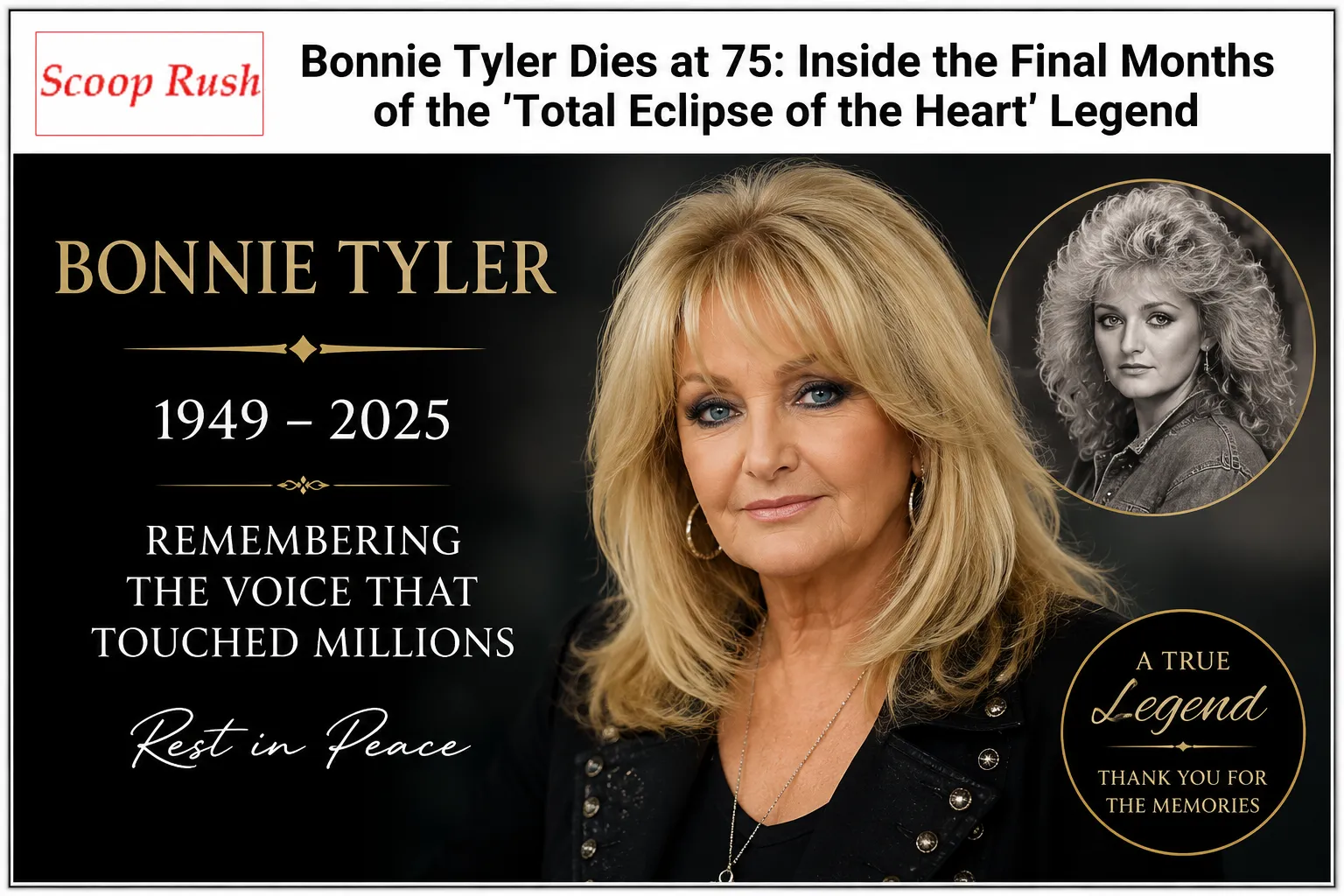
She survived a cardiac arrest while doctors tried to wake her from a coma. Weeks later, Bonnie Tyler dies at 75 anyway.
Introduction
Bonnie Tyler dies at 75, the Welsh singer whose raspy voice turned “Total Eclipse of the Heart” into one of the most played songs in pop history. Her family confirmed the news on Thursday, ending months of uncertainty that began with an emergency surgery in Portugal back in April.
For fans who grew up belting out her power ballads at karaoke nights, this news lands hard. Tyler wasn’t just a hitmaker from decades past. She was still touring, still writing new music, and had a European tour planned to mark 50 years since her career-launching single “Lost in France.” That tour will now never happen.
Her death also comes during a heavy stretch of celebrity health news, following recent stories like Olivia Attwood’s breast cancer announcement, reminding fans how quickly health situations can shift for public figures.
Here’s everything we know about her death, the illness that led to it, and the legacy she leaves behind.
How Bonnie Tyler Died: The Timeline of Her Final Illness
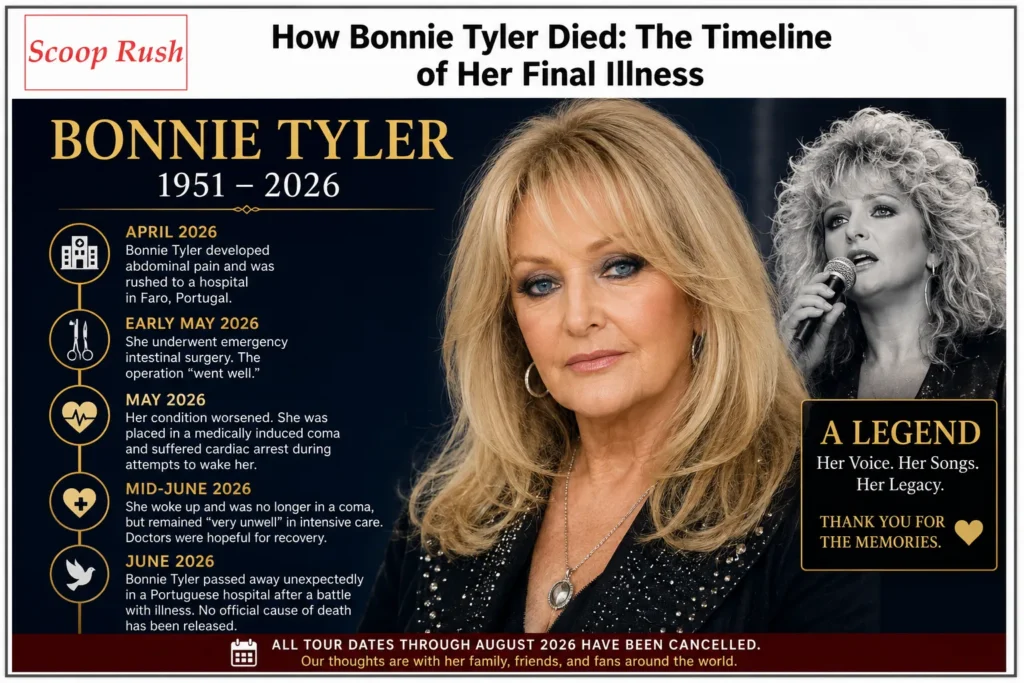
Tyler’s health troubles began quietly in April 2026. Doctors rushed her to a hospital near her home in Faro, Portugal, a city she had lived in part-time since 1988, after she started experiencing abdominal pain.
Doctors determined she needed emergency intestinal surgery. Her team confirmed the operation in early May, reassuring fans that the surgery “went well” and that she was recuperating. At that point, nobody expected the worst.
However, her condition took a serious turn shortly after. Doctors placed her into a medically induced coma to help her body recover from the operation. During attempts to bring her out of that coma, she suffered a cardiac arrest, a complication that made an already frightening situation even more dangerous.
By mid-June, there was a glimmer of hope. Her spokesperson announced she had woken up and was no longer in a coma. Still, the update came with a warning. She remained “very unwell” and stayed in intensive care. Doctors reportedly told her team they were confident she would make a full recovery.
That recovery never came. On Thursday, her family announced that she had passed away unexpectedly the night before in the same Portuguese hospital, confirming that Bonnie Tyler dies at 75 after a difficult few months. Her family has not released an official cause of death.
The Statement That Confirmed Her Death
Tyler’s team posted a statement on her official website and social media accounts confirming the news. Her family wrote that Bonnie’s family and team were heartbroken to announce she had unexpectedly passed away in a Portuguese hospital as a result of the illness she was being treated for, and asked for privacy to deal with the tragedy.
The word “unexpectedly” stood out to many who had been following her recovery. Just weeks earlier, things seemed to be moving in the right direction. Her death serves as a sobering reminder that recoveries from major surgery, especially in older patients, can take unpredictable turns even after signs of improvement. It’s a pattern echoed in other recent stories, such as Nancy Guthrie’s case update, where new developments continue to reshape what the public initially understood.
Her longtime manager, Judd Lander, also released a statement honoring her. He described her as “unique,” a “one-off” performer with a stunning voice and great stage presence, adding that the world had lost one hell of a great talent.
As a direct result of her passing, her team cancelled all scheduled tour dates through August. That included planned shows across the UK, along with performances in Germany, Malta, Austria, Hungary, Turkey, and Romania. Similarly, other entertainment plans have recently been scrapped following unexpected news, as seen when the BBC cancelled Ashley Cain’s series after backlash over old tweets.
Tributes Pour In From Music Icons and Political Leaders
News that Bonnie Tyler dies at 75 spread quickly, and tributes followed from across the entertainment and political world.
UK Prime Minister Sir Keir Starmer’s office released a statement calling her “one of Britain’s greatest recording artists.” A Downing Street spokesperson said her catalogue of music, from Total Eclipse Of The Heart to Holding Out For A Hero, continues to touch lives, flood dance floors, and fill karaoke booths.
Sir Cliff Richard remembered her as a “wonderful friend gone too soon.” In a Facebook post, he wrote that her infectious zest for life entertained so many around the world, adding that the news was shocking to wake up to.
Sir Rod Stewart shared a similarly personal tribute. He called her “a good pal, a true soul stirrer” and revealed that he performs her song “It’s A Heartache” every night on his current tour. Meanwhile, Spandau Ballet frontman Tony Hadley described her as “an incredible woman” who was kind and friendly to him when he was a young artist just starting out.
Doctor Who showrunner Russell T Davies said he had loved the “fabulous” singer since his teenage years. Wales Secretary Jo Stevens also paid tribute, calling Tyler “a Welsh music icon” and “the sound of my teenage years.”
These tributes, coming from such a wide range of public figures, show just how far Tyler’s influence reached beyond the music charts. Public figures reacting to sudden loss isn’t new in entertainment circles either, much like the wave of concern that followed reports around Oliver Tree’s final wish.
From a Welsh Chapel to Global Superstardom

Understanding why Bonnie Tyler’s death has hit so many people requires looking back at where she came from.
Born Gaynor Hopkins on June 8, 1951, in Skewen, Neath, in South Wales, she grew up in a council house as the daughter of a coal miner. She was one of six children in the family. Her earliest performance happened not on a concert stage, but in a chapel, where she sang the hymn “All Things Bright and Beautiful” as a child.
Tyler left school at 16 with no formal qualifications. In 1969, an aunt entered her into a local talent contest. She finished second and won just one pound. It wasn’t much, but it was enough to convince her that music might be worth pursuing.
She worked as a backing singer before her big break arrived in 1975. A talent scout named Roger Bell spotted her performing at a club in Swansea and invited her to record a demo in London. That led to a recording contract with RCA, and it was RCA who suggested she change her name to Bonnie Tyler.
The Surgery That Created Her Signature Voice
Her debut single failed to make an impact. However, her follow-up, “Lost in France,” became a hit, cracking the UK top ten in 1976 and landing her a spot on Top of the Pops.
Soon after that success, she developed a sore throat that turned out to be something more serious. Doctors found nodules on her vocal cords and had to remove them surgically. Doctors told her to rest her voice completely for six weeks, but she couldn’t manage it.
As a result, her voice changed permanently. It developed the husky, gravelly quality that would go on to define her entire career. She once described the moment producers first heard the new sound, joking that she suddenly sounded like a female Rod Stewart.
That distinctive voice became her greatest asset. In 1983, songwriter and producer Jim Steinman gave her “Total Eclipse of the Heart,” a soaring ballad built specifically to showcase her powerful, weathered vocals. The song topped the charts in both the UK and the US and has since sold more than 13 million copies worldwide.
Steinman also wrote her follow-up hit, “Holding Out for a Hero,” which later became a defining moment in the film Footloose.
A Career That Spanned Five Decades
Tyler didn’t fade after the 1980s. She kept recording and performing for the rest of her life, releasing 18 studio albums in total. Her most recent album, The Best Is Yet to Come, came out in 2021.
In 2013, she represented the United Kingdom at the Eurovision Song Contest in Malmo, Sweden, performing “Believe In Me.” She finished in 19th place, but the performance introduced her music to a new generation of fans across Europe.
The Queen’s Birthday Honours list named her an MBE for services to music in 2023. Her long, steady career mirrors other entertainers whose personal lives have recently come under public scrutiny, such as Peter Andre denying claims made by Lee Andrews about adoption or Armie Hammer’s attempted comeback film facing a ban in Germany.
Tyler is survived by her husband, Robert Sullivan. The couple had been married since 1973, meaning their marriage lasted more than five decades.
What Bonnie Tyler’s Death Means for Music Fans
Bonnie Tyler’s passing marks the end of an era for a certain kind of power ballad. Few singers have managed to make a single song as culturally durable as “Total Eclipse of the Heart,” which continues to fill dance floors, wedding receptions, and karaoke bars around the world.
Her story is also a reminder of how quickly health situations can change. She went from emergency surgery, to a coma, to cardiac arrest, to apparent recovery, and then to an unexpected death within just a few months. It’s a difficult and sobering arc, and it explains why so many people are describing this loss as sudden despite the months of hospital updates that came before it. Sudden, life-altering incidents have shaped headlines elsewhere too, including the recent Ryan Reynolds drunk driver accident and unsettling reports like Anne Hegerty’s Baby Reindeer-style stalker story.
For younger listeners discovering her music through the eclipse-driven streaming surges of recent years, her passing offers a moment to look back at the full scope of her career, from a chapel choir in South Wales to chart-topping success on both sides of the Atlantic. Family ties and legacy remain a recurring thread in entertainment stories, much like the connection explored in Elliot Anderson and his brother Wil Anderson or the joyful contrast of Thylane Blondeau’s wedding to Benjamin Attal in Paris.
Conclusion
Bonnie Tyler dies at 75 in a hospital in Portugal after months of serious illness that began with emergency intestinal surgery in April. She had been placed in an induced coma, suffered a cardiac arrest, and appeared to be recovering before her unexpected death. Tributes came from Prime Minister Keir Starmer, Sir Cliff Richard, Sir Rod Stewart, Tony Hadley, and Russell T Davies. She leaves behind a five-decade career built on hits like “Total Eclipse of the Heart,” “Holding Out for a Hero,” and “It’s a Heartache,” along with an MBE and a legacy that continues to influence pop music today. With Bonnie Tyler dies at 75 now confirmed, fans across the world continue to remember her through her timeless music.
FAQs
How did Bonnie Tyler die?
Her family said she passed away unexpectedly in a hospital in Portugal as a result of an illness she had been treated for. No official cause of death has been released.
What happened to Bonnie Tyler before she died?
She was hospitalized in April 2026 for emergency intestinal surgery near her home in Faro, Portugal. She was later placed in a medically induced coma and suffered a cardiac arrest during recovery attempts. In June, her team said she had woken up but remained very unwell.
How old was Bonnie Tyler when she died?
She was 75 years old.
What are Bonnie Tyler’s most famous songs?
Her biggest hits include “Total Eclipse of the Heart,” “Holding Out for a Hero,” “It’s a Heartache,” and “Lost in France.”
Is Bonnie Tyler’s family confirming a cause of death?
Not yet. Her family said only that her death resulted from the illness she was being treated for, and that further details would follow.

