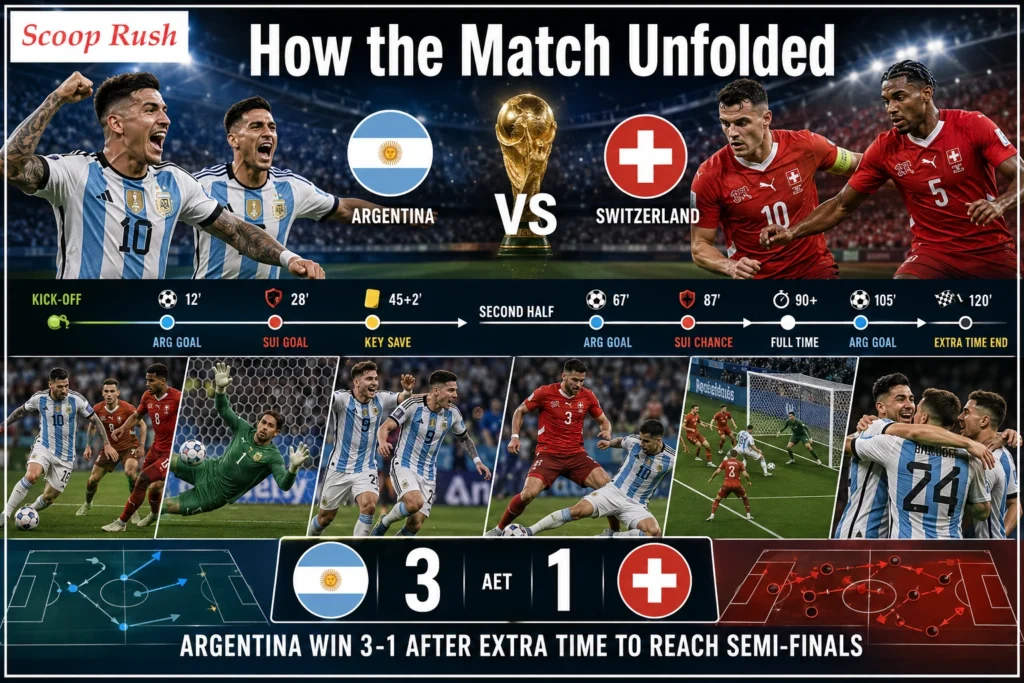
Competition: FIFA World Cup 2026 Round: Quarter-finals Venue: Kansas City Stadium, Kansas City Result: Argentina 3-1 Switzerland (After Extra Time)
Argentina vs Switzerland Result: A Hard-Fought Quarter-final Ends with Argentina Celebrating
The Argentina vs Switzerland Result delivered another unforgettable FIFA World Cup 2026 knockout match. Argentina defeated Switzerland 3-1 after extra time in the quarter-finals at Kansas City Stadium, Kansas City, securing their place in the semi-finals after a tense and competitive contest.
Although Argentina took an early lead, Switzerland fought back during normal time and forced the South American side to work until extra time. However, Argentina showed their quality in the final moments, scoring twice in extra time to seal an important victory.
The result keeps Argentina’s World Cup dream alive, while Switzerland bow out after a determined performance.
Match Summary
Argentina entered the quarter-final knowing they would face a disciplined Swiss side. The match proved exactly that, with Switzerland making life difficult despite Argentina controlling possession for long periods.
The game eventually needed extra time before a winner could be decided.
Just five minutes later, Switzerland suffered a major setback when Breel Embolo received a red card in the 72nd minute. Despite playing with ten men, Switzerland defended bravely and managed to hold Argentina until the end of regular time.
With the score level after 90 minutes, the quarter-final went into extra time.
Argentina finally broke the resistance in the 112th minute when Julián Álvarez restored the lead.
As Switzerland pushed forward in search of another equaliser, Argentina struck once more. Lautaro Martínez scored in 120+1 minutes, confirming a 3-1 victory and sending Argentina into the semi-finals.
Argentina vs Switzerland Result: Key Match Statistics
The statistics showed Argentina controlled much of the match.
Statistic
Argentina
Switzerland
Shots
23
13
Shots on Target
7
5
Possession
59%
41%
Passes
616
453
Pass Accuracy
88%
84%
Fouls
14
18
Yellow Cards
3
1
Red Cards
0
1
Offsides
4
3
Corners
8
2
Argentina enjoyed 59% possession, completed 616 passes, and created significantly more attacking opportunities.
Meanwhile, Switzerland defended with determination despite spending much of the match without the ball.
Goals and Major Incidents
10′ – Alexis Mac Allister Gives Argentina the Lead
Argentina started brightly and were rewarded early when Alexis Mac Allister scored after just ten minutes.
The early goal allowed Argentina to control possession while forcing Switzerland to chase the game.
67′ – Dan Ndoye Equalises
Switzerland responded impressively after the break.
Dan Ndoye found the equaliser in the 67th minute, bringing the score level and giving the European side renewed belief.
72′ – Breel Embolo Sent Off
Switzerland’s challenge became even more difficult when Breel Embolo received a red card.
Despite being reduced to ten players, Switzerland defended courageously and forced the match into extra time.
112′ – Julián Álvarez Restores Argentina’s Lead
Extra time finally produced the breakthrough Argentina needed.
Julián Álvarez scored in the 112th minute to put his side back in front.
120+1′ – Lautaro Martínez Seals Victory
Deep into extra-time stoppage time, Lautaro Martínez added Argentina’s third goal.
His finish ended Switzerland’s hopes and secured Argentina’s place in the semi-finals.
The victory showed Argentina’s patience and resilience in a difficult knockout match. Despite Switzerland’s strong defensive display, Argentina eventually made their superiority count in extra time.
Switzerland exit the tournament with credit after pushing one of the favourites beyond 90 minutes, even while playing with ten men for much of the second half.
Conclusion
The Argentina vs Switzerland Result will be remembered as a fiercely contested FIFA World Cup 2026 quarter-final.
Argentina defeated Switzerland 3-1 after extra time thanks to goals from Alexis Mac Allister, Julián Álvarez, and Lautaro Martínez. Switzerland equalised through Dan Ndoye, but Breel Embolo’s red card made an already difficult challenge even harder.
Argentina’s control of possession, greater attacking threat, and late composure ultimately earned them a deserved place in the semi-finals.
Frequently Asked Questions
1. What was the Argentina vs Switzerland result?
Argentina defeated Switzerland 3-1 after extra time in the FIFA World Cup 2026 quarter-final.
2. Who scored for Argentina?
Alexis Mac Allister, Julián Álvarez, and Lautaro Martínez scored for Argentina.
3. Who scored for Switzerland?
Dan Ndoye scored Switzerland’s only goal.
4. Was there a red card in the match?
Yes. Breel Embolo was sent off in the 72nd minute.
5. Where was the match played?
The quarter-final was played at Kansas City Stadium, Kansas City.
Dermot Murnaghan spent five decades telling the nation’s biggest stories His death comes just over a year after he first revealed his diagnosis, a period he spent turning his own health scare into a public health campaign that reached men across the country.Dermot Murnaghan spent five decades telling the nation’s biggest stories. He broke the news of Princess Diana’s death in 1997. Later, he announced the passing of Queen Elizabeth II in 2022. On 11 July 2026, Murnaghan himself became the story, as his family confirmed Dermot Murnaghan dies at home in north London following a battle with stage four prostate cancer.
He was 68 years old.
This isn’t just a story about a beloved broadcaster passing away. It’s a story about how a preventable delay in testing changed the course of one man’s life, and how he used his final months to warn others not to make the same mistake. health battles .”The news that Dermot Murnaghan dies joins a growing list of celebrities who have opened up about serious health battles in recent times.”
A Career Spanning Five Decades of British Television
Murnaghan’s journey through British journalism reads like a history of television news itself. He started at Channel 4 News before moving to ITV, where he fronted major programmes from 1993 to 1997. During this stint, he delivered the shocking news of Princess Diana’s death live on air, a moment that remains etched in broadcasting history.
In 2002, he joined the BBC, becoming one of the main presenters of BBC Breakfast, the Six O’Clock News, and the Ten O’Clock News. Viewers also knew him from a very different role. From 2003, he hosted the quiz show Eggheads for 11 years, showing off a lighter side away from the seriousness of the news desk.
Murnaghan then became one of the defining faces of Sky News, presenting there from 2007 until 2023. During this time, he announced the death of Queen Elizabeth II, a moment that once again placed him at the centre of a historic national event.
His work didn’t stop at traditional news.. He fronted true crime documentaries including Crimes That Shook Britain and, more recently, Killer Britain for Channel 5. Additionally, he launched a podcast called Legends of News, where he interviewed fellow journalists about the biggest stories of their careers.””The final episode aired in January this year.
Sky News presenter Anna Botting, who worked alongside Murnaghan on major events including the Queen’s funeral, praised his professionalism. She said his accuracy and conscientiousness brought real detail to stories, and that he remained fearless when questioning politicians, regardless of how articulate they were.
From Newsreader to Health Campaigner
In June last year, Murnaghan announced that doctors had diagnosed him with stage four prostate cancer. What made his story so striking was that he had no symptoms at all. He described how he had “fallen through the gaps” of the testing system, despite believing he was staying on top of his health.
“He explained that he had assumed doctors were testing him regularly.”. However, he later discovered that his private check-ups through his production company had never included a PSA test, the standard screening tool for prostate cancer. Because he wasn’t visiting his GP for other reasons, nobody flagged the gap.
That realisation became the driving force behind his campaigning. He partnered with Prostate Cancer UK and used his platform to urge men over 50, or those in high-risk groups, to request testing rather than assume it was already happening.
Why Prostate Cancer Is Often Called a Silent Disease
Murnaghan’s experience highlights something doctors have warned about for years. Prostate cancer has a reputation for stealth. It often develops slowly and silently, with few or no warning signs, which is exactly why so many cases go undetected until they reach advanced stages.
According to Prostate Cancer UK, roughly one in eight men will develop prostate cancer during their lifetime. Despite how common it is, the disease frequently causes no symptoms in its earlier and more treatable stages. Consequently, many men only discover something is wrong once the cancer has already spread.
“When symptoms do appear, people can easily mistake them for less serious conditions.”. Prostate cancer symptoms often overlap with benign prostatic hyperplasia (BPH) or general urinary tract issues, meaning men may dismiss warning signs as nothing more than a normal part of ageing.
Common Symptoms to Watch For
While many men experience no symptoms at all, prostate cancer can sometimes present through the following signs:
Urinary symptoms include difficulty urinating, a weak or interrupted urine flow, needing to urinate more urgently than usual, a feeling of incomplete bladder emptying, and blood in the urine.
Other symptoms can include blood in the semen, painful ejaculation, erectile dysfunction, and pain in the hip, back, or pelvic area.
Murnaghan himself stressed that early detection is crucial. He warned that the disease can progress rapidly without any obvious warning, which is why relying on symptoms alone simply isn’t safe.
A Friendship Forged Through Shared Diagnosis
One of the more personal aspects of Murnaghan’s final year was the bond he formed with Olympic cyclist Sir Chris Hoy. Hoy, a six-time Olympic gold medallist, revealed his own terminal prostate cancer diagnosis in October 2024. After hearing about Murnaghan’s diagnosis, Hoy reached out to him directly.
Murnaghan described this connection as a “rather unwanted bond” that nonetheless brought him genuine joy. He told the Telegraph that Hoy became something of a mentor figure through the ordeal, describing him as “the oracle.” Hoy reportedly told Murnaghan to think of treatment as a way of “punching the cancer back,” no matter how difficult things became.
Their friendship reflects a broader trend of public figures using their platforms to normalise conversations around prostate cancer, encouraging other men to seek testing rather than staying silent out of fear or embarrassment. It echoes how other public figures have opened up about deeply personal struggles, from mental health journeys like Charli D’Amelio’s to family disputes such as Peter Andre’s.
Family Statement and Tributes Pour In
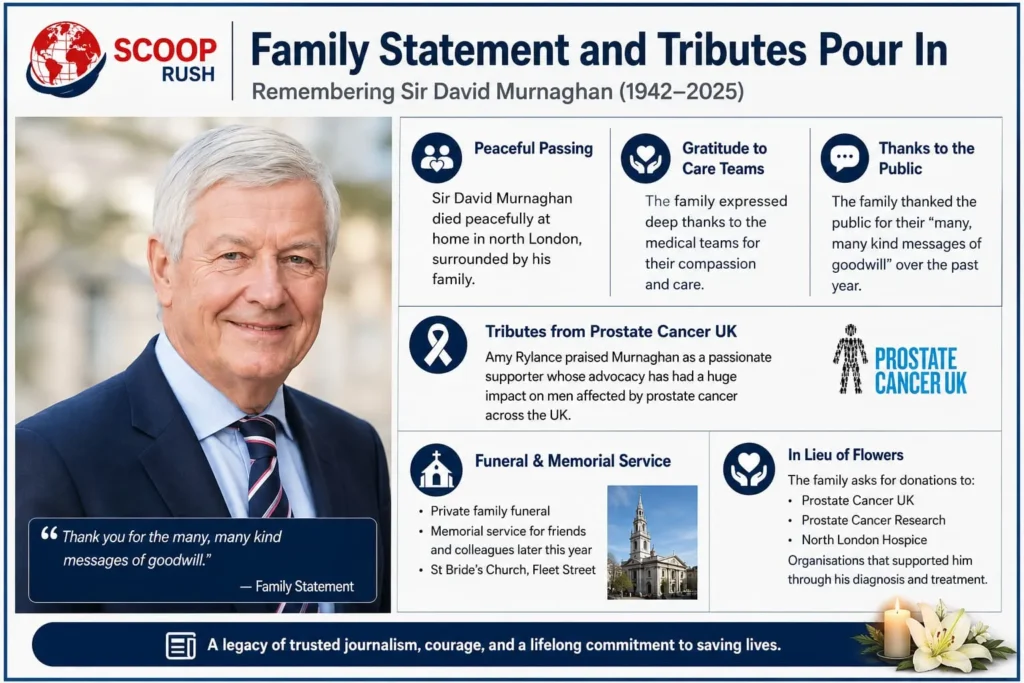
“Dermot Murnaghan’s family confirmed the news in a statement they shared on Saturday morning.”They said he died peacefully at home in north London, with his family by his side. The statement expressed deep gratitude to the medical teams who cared for him, praising their sensitivity and compassion throughout his illness.
The family also thanked the public for the “many, many kind messages of goodwill” Murnaghan received throughout the past year, particularly in response to his campaigning work around prostate cancer screening.
Amy Rylance of Prostate Cancer UK also paid tribute, describing Murnaghan as a passionate and dedicated supporter of the charity. She noted that his advocacy had a huge impact on the hundreds of thousands of men affected by prostate cancer across the country.
The family will hold a small, private funeral ceremony. However, the family will host a memorial service for friends and colleagues later this year at St Bride’s Church on Fleet Street, a location long associated with journalists and the media industry. His passing follows a string of recent tributes to public figures, including the singer Bonnie Tyler, whom fans across the country also mourned.
In lieu of flowers, the family has asked that anyone wishing to remember Murnaghan consider supporting Prostate Cancer UK, Prostate Cancer Research, and North London Hospice, the organisations that supported him through his diagnosis and treatment.
The Legacy of a Trusted Broadcaster
The fact that Dermot Murnaghan dies at 68 marks the end of an era for British broadcast journalism. Few presenters have delivered as many historically significant moments live on air, from royal deaths to national elections. Yet in his final year, he became known for something equally important: using his own health crisis to potentially save other lives.
His message was simple and consistent. Men over 50, those in high-risk groups, or anyone displaying symptoms should get tested rather than assuming routine checks already cover prostate screening. Given that he himself fell through those exact gaps, his warning carries particular weight.
As tributes continue to pour in from across the broadcasting world, the story of how Dermot Murnaghan dies will be remembered as a wake-up call for men everywhere to prioritise regular screening.
The fact that Dermot Murnaghan dies at 68 marks the end of an era for British broadcast journalism. Few presenters have delivered as many historically significant moments live on air, from royal deaths to national elections. Yet in his final year, he became known for something equally important: using his own health crisis to potentially save other lives.
His message was simple and consistent. Men over 50, those in high-risk groups, or anyone displaying symptoms should get tested rather than assuming routine checks already cover prostate screening. Given that he himself fell through those exact gaps, his warning carries particular weight.
“As tributes continue to pour in from across the broadcasting world, people will remember the story of how Dermot Murnaghan dies as a wake-up call for men everywhere to prioritise regular screening.”
Conclusion
“The news that Dermot Murnaghan dies closes the chapter on one of British television’s most trusted voices. From breaking the news of Princess Diana’s death to announcing the passing of Queen Elizabeth II, he shaped how the nation experienced its biggest moments for five decades.
Yet his final year may end up being his most impactful. By speaking openly about falling through the gaps in prostate cancer testing, he turned his own diagnosis into a warning that could genuinely save lives.”His message remains simple:”Men over 50, those in high-risk groups, or anyone displaying symptoms should get tested rather than assume routine checks already cover prostate screening.”
As the broadcasting world mourns a true professional, his legacy will live on through the awareness he raised and the men who choose to get tested because of him.
FAQs
Q: How did Dermot Murnaghan die?
A: Dermot Murnaghan died peacefully at his home in north London on 11 July 2026, following a period of illness with stage four prostate cancer. His family confirmed his loved ones surrounded him at the time of his death.
Q: When was Dermot Murnaghan diagnosed with prostate cancer?
A: “He revealed his stage four prostate cancer diagnosis in June 2025, explaining that he had experienced no symptoms and had missed routine PSA testing despite believing doctors regularly checked him.”
Q: What are the early signs of prostate cancer?
A: Many men experience no symptoms in the early stages. When they do occur, signs can include difficulty urinating, a weak urine flow, needing to urinate urgently, blood in urine or semen, erectile dysfunction, and pain in the hip, back, or pelvic area.
Q: What TV shows was Dermot Murnaghan known for?
A: Murnaghan presented BBC Breakfast, the Six O’Clock News, and the Ten O’Clock News for the BBC. He later became a leading Sky News anchor from 2007 to 2023 and hosted the quiz show Eggheads for 11 years.
Q: How can I support Prostate Cancer UK in Dermot Murnaghan’s memory?
A: Murnaghan’s family has asked that, instead of flowers, people consider donating to Prostate Cancer UK, Prostate Cancer Research, or North London Hospice, the organisations involved in his care and treatment.
The Norway vs England Result quickly became one of the biggest stories of the tournament. England showed resilience, determination, and quality under pressure, while Norway pushed one of the favorites to the limit in a memorable knockout clash.
Why This Norway vs England Result Matters
Quarter-finals often define World Cup campaigns.
For England, this victory keeps their dream of lifting the FIFA World Cup 2026 trophy alive. Furthermore, it demonstrated the team’s ability to recover from adversity against a disciplined opponent.
For Norway, the defeat ends a remarkable tournament run. However, reaching the quarter-finals and competing strongly against England highlights the progress they have made on the international stage.
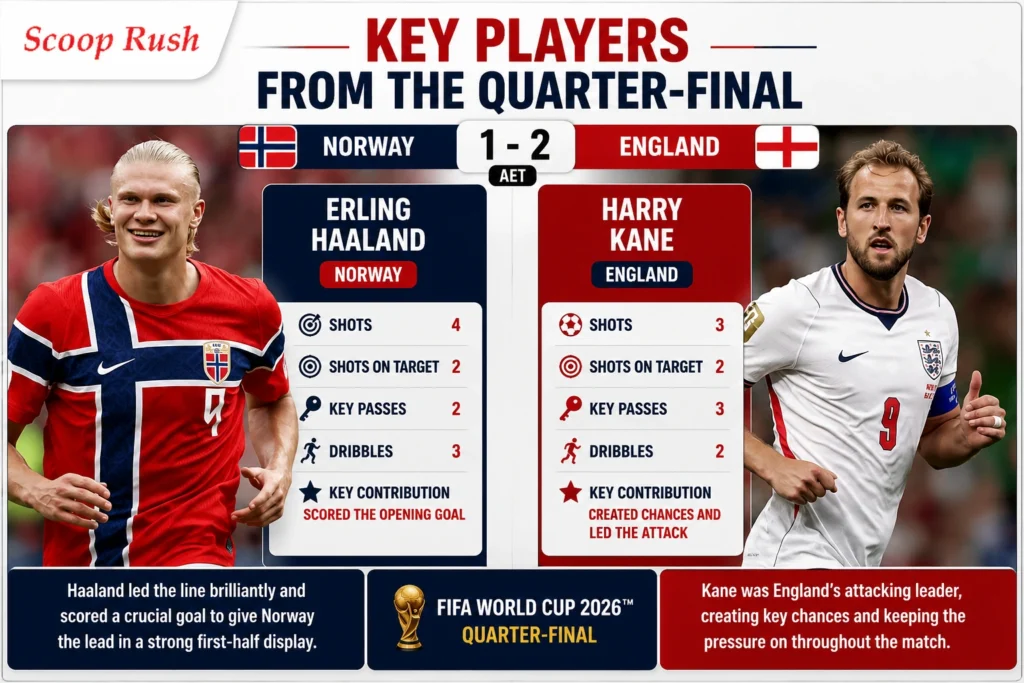
The match also reinforced Jude Bellingham’s growing influence. His two goals turned a difficult night into a historic victory for England.
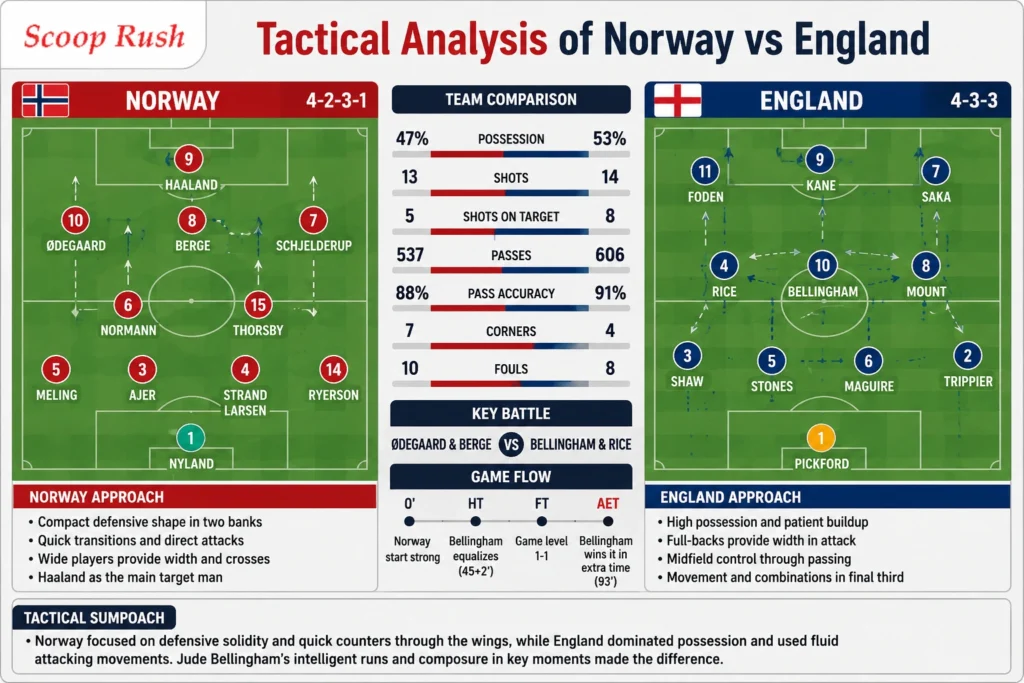
The quarter-final started at a high tempo as both teams looked to establish control.
Norway showed confidence from the opening whistle and refused to sit back. England enjoyed more possession, but Norway remained dangerous whenever they attacked.
The breakthrough arrived in the 36th minute.
Andreas Schjelderup found the net to give Norway a deserved 1-0 lead. The goal rewarded an impressive first-half display and increased belief among the Norwegian players.
England suddenly faced the possibility of elimination.
However, the response came at the perfect moment.
Deep into first-half stoppage time, Jude Bellingham scored in the 45+2nd minute to level the score. As a result, England entered halftime with renewed confidence and momentum.
The second half produced several tense moments, yet neither side could find the decisive goal.
Consequently, the match went into extra time.
Only three minutes into the additional period, Bellingham struck again. His second goal of the night completed England’s comeback and ultimately secured a place in the semi-finals.
Norway’s Impressive Performance Deserved Respect
Although Norway lost, they delivered one of their strongest performances of the tournament.
They remained organized defensively and consistently challenged England’s attack.
The Norwegian side defended with discipline and worked tirelessly throughout the match. Additionally, they created enough opportunities to trouble England’s back line.
Their opening goal reflected their positive approach.
Schjelderup’s strike rewarded a team that refused to be intimidated by the occasion. Norway continued to battle even after conceding the equalizer and forced England into extra time.
Few teams have pushed England this hard during the tournament.
Therefore, Norway can leave the competition with considerable pride despite the disappointment of defeat.
Jude Bellingham Proves Why He Is England’s Difference-Maker
The Goal Before Halftime Changed Everything
England desperately needed a response after falling behind.
Bellingham delivered exactly that.
His goal in first-half stoppage time prevented Norway from carrying a lead into the dressing room. More importantly, it shifted momentum toward England.
The timing could not have been better.
Instead of facing mounting pressure, England entered the second half believing they could take control of the contest.
Extra-Time Heroics Seal the Victory
The winning goal arrived in the 93rd minute.
Bellingham once again stepped up when England required leadership and composure.
His second goal completed the turnaround and placed England in front for the first time during the match.
Norway continued to fight, but England managed the remainder of extra time effectively.
The US Strikes on Iran have sharply increased tensions across the Middle East. The United States launched another large military operation after Iran attacked a commercial ship in the Strait of Hormuz. Iran quickly answered with missile and drone attacks across the Gulf. The latest fighting has raised fears that the conflict could spread beyond the region.
Military action has now replaced the brief period of calm that followed earlier diplomatic efforts. World leaders continue to watch the situation closely because the Strait of Hormuz remains one of the world’s most important shipping routes. Any disruption there could affect global trade, energy supplies, and regional security.
US Strikes on Iran Target 140 Military Sites
The United States carried out its third round of strikes against Iran this week. According to US Central Command, American forces attacked nearly 140 military targets across the country. The operation focused on missile launch sites, drone facilities, naval assets, ammunition storage areas, communication networks, and coastal surveillance systems. US officials described the strikes as a direct response to Iran’s latest actions in the Strait of Hormuz.
The Pentagon said the operation involved fighter aircraft, naval warships, and drones. Officials also confirmed that American forces have now targeted more than 300 military sites during the recent campaign. Washington believes these strikes will reduce Iran’s ability to threaten commercial shipping and launch future attacks across the Gulf.
US Strikes on Iran Follow Merchant Ship Attack
The latest military action began after Iran targeted the MV GFS Galaxy, a Cyprus-flagged container ship passing through the Strait of Hormuz. US officials said the attack caused serious damage to the vessel’s engine room. One civilian crew member remained missing after the incident, while the crew abandoned the damaged ship for safety.
Iran’s Islamic Revolutionary Guard Corps gave a different version of events. Iranian officials claimed they fired warning shots because the vessel ignored navigation instructions. The Guards also announced that the Strait of Hormuz would remain closed until further notice. That announcement immediately increased concern across international shipping and energy markets.
Iran Expands the Conflict Across the Gulf
Iran responded within hours after the latest American strikes. State media reported that the Revolutionary Guard launched retaliatory attacks against the Prince Hassan Air Base in Jordan. At the same time, several Gulf countries activated their air defense systems to intercept incoming missiles and drones.
The United Arab Emirates confirmed that its defenses intercepted ballistic missiles, cruise missiles, and drones. Bahrain also sounded air raid sirens and urged residents to move to safe locations. Meanwhile, Iranian media reported explosions along the country’s southern coastline as American strikes continued against military facilities.
Strait of Hormuz Crisis Deepens Regional Tensions
The Strait of Hormuz has become the center of the current confrontation. Iran insists that commercial vessels should follow a shipping route near its coastline. However, the United States supports an international route closer to Oman. This disagreement has increased the risk of direct military confrontation during commercial transit.
The latest attacks have made global shipping companies even more cautious. The Strait carries a significant share of the world’s oil exports every day. Any prolonged disruption could raise energy prices and create new economic uncertainty. Security experts now warn that restoring safe navigation has become one of the region’s most urgent priorities.
Diplomatic Efforts Continue Despite Military Escalation
Even as fighting continues, diplomatic contacts have not completely stopped. Oman remains the main mediator between Washington and Tehran. Officials from both countries have continued indirect discussions about reducing tensions and protecting commercial shipping through the Strait of Hormuz.
However, major disagreements still block meaningful progress. The United States wants Iran to guarantee safe passage for all commercial vessels. Iran continues to defend its own interpretation of shipping rules in the waterway. Until both sides reach common ground, the chances of another military exchange remain high.
Trump and Iran Exchange Fresh Warnings
US President Donald Trump warned that the United States would respond with overwhelming force if Iran threatened him or American interests. His comments came as the latest military operation unfolded. The White House continues to argue that strong military action remains necessary to protect international shipping and regional stability.
Meanwhile, Iran’s Supreme Leader Mojtaba Khamenei promised revenge for the death of his father, former Supreme Leader Ali Khamenei. His remarks reflected Tehran’s increasingly hardline position. With both sides exchanging strong warnings, many observers fear the conflict could become even more dangerous in the coming weeks.
What Happens Next?
The latest US Strikes on Iran have pushed the region into another period of uncertainty. Military operations continue while diplomatic efforts struggle to gain momentum. Regional governments remain on high alert as they prepare for possible further attacks.
The future now depends on whether both sides choose diplomacy or further escalation. Safe navigation through the Strait of Hormuz remains the immediate priority. Until tensions ease, the conflict will continue to affect regional security, global shipping, and international energy markets.
FAQs
1. Why did the US launch new strikes on Iran?
The United States said Iran attacked a commercial ship in the Strait of Hormuz, prompting military retaliation.
2. How many targets did the US strike?
US Central Command said American forces attacked about 140 Iranian military targets during the latest operation.
3. Why is the Strait of Hormuz important?
The Strait of Hormuz handles a large share of global oil shipments. Any disruption can affect world energy supplies and trade.
4. How did Iran respond to the US strikes?
Iran launched missile and drone attacks against regional targets and claimed strikes on a military base in Jordan.
5. Are diplomatic talks still taking place?
Yes. Oman continues to mediate indirect talks, but both sides remain divided over security and shipping issues in the Strait of Hormuz.
National Park Crowds continue to grow across the United States as millions of travelers head to famous destinations this summer. Parks such as Yellowstone, Yosemite, Zion, and Mount Rushmore have reported heavy traffic, long shuttle lines, and packed parking lots. Many visitors say the experience feels more like visiting a busy city or a major theme park than exploring nature. At the same time, park officials continue to manage record demand with fewer resources.
National Park Crowds Bring Heavy Traffic to Popular Destinations
Visitors across the country have shared similar experiences this season. Long vehicle lines now greet travelers before they even enter some of America’s most famous parks.
At Zion National Park in Utah, visitors waited nearly 45 minutes just to reach the entrance. Shuttle lines also stretched for long periods, leaving many travelers comparing the experience to waiting for rides at Disney World.
Yosemite National Park also experienced major congestion after officials ended its timed reservation system earlier this year. Parking lots filled early in the day, and many trailhead spaces disappeared before visitors arrived. Roads became packed with bumper-to-bumper traffic during peak hours.
National Park Crowds Continue to Break Visitor Records
The growing demand shows no signs of slowing down.
Last year, 26 National Park Service sites recorded their highest visitor numbers ever. This summer has continued the trend.
Yellowstone National Park reported another record-breaking May. Visitors faced crowded parking areas, busy roads, and longer travel times throughout the park. Yosemite also welcomed record numbers during the same month, making early summer one of its busiest periods in recent years.
Travel experts believe the strong interest reflects a long-term increase in outdoor tourism rather than a short seasonal trend.
Fourth of July Celebrations Added Even More Visitors
Holiday events increased crowds at several national parks.
Mount Rushmore National Memorial attracted thousands of visitors during its Independence Day celebrations. Many travelers planned their trips months in advance. However, some later discovered they needed to win a lottery just to attend the fireworks event.
Those who did not receive tickets watched the celebration from nearby campsites. Large crowds also filled gift shops, visitor areas, and surrounding roads throughout the holiday weekend. Additional security measures created more traffic after President Donald Trump attended the fireworks celebration.
Staffing Challenges Add Pressure on National Parks
While visitor numbers continue to rise, many parks now operate with fewer employees.
According to the National Parks Conservation Association, the National Park Service lost nearly one-quarter of its permanent workforce during 2025. Budget reductions and years of deferred maintenance have also placed additional pressure on park operations.
Park staff continue to focus on visitor services, maintenance, public safety, and protecting natural resources. However, experts warn that fewer employees may affect visitor experiences and long-term conservation efforts.
Some specialists also believe removing reservation systems has increased congestion at several popular parks.
Why National Park Crowds Keep Growing
Several factors continue to drive visitor numbers higher.
Many Americans enjoy affordable outdoor vacations that offer hiking, wildlife viewing, camping, and scenic landscapes. Social media also plays an important role. Stunning photos and travel videos inspire more people to visit famous destinations every year.
Researchers say this trend has continued for more than a decade. Although crowded conditions create challenges, they also encourage more people to appreciate nature and support conservation.
Travelers Can Still Find Less Crowded Parks
Experts recommend exploring lesser-known parks instead of visiting only the most famous destinations.
Popular parks often receive most of the attention, while many beautiful locations remain quiet throughout the summer.
Travel companies encourage visitors to consider places such as North Cascades National Park in Washington or Capitol Reef National Park in Utah. These parks offer breathtaking scenery, hiking opportunities, and a more peaceful experience without overwhelming crowds.
Planning weekday visits, arriving early in the morning, or traveling during spring and fall can also help visitors avoid the busiest times.
Outlook for the Rest of Summer
The summer travel season remains strong, and visitor numbers will likely stay high through August.
Travelers should expect busy roads, limited parking, and longer wait times at America’s most popular national parks. Planning ahead, checking park updates, and exploring lesser-known destinations can help create a more enjoyable experience.
Despite the crowds, national parks continue to inspire millions of visitors with their natural beauty and historic landmarks.
How Overcrowding Affects the Visitor Experience
The sharp rise in National Park Crowds has changed the way many people experience America’s most popular parks. Visitors now spend more time waiting in traffic, searching for parking, and standing in shuttle lines. In some locations, crowded trails make it difficult to enjoy peaceful hikes or take photographs.
Families also face longer waits at visitor centers, restrooms, and restaurants. During holiday weekends, many facilities reach full capacity early in the day. Travelers who arrive without planning ahead may struggle to find parking or even enter some attractions.
Many visitors still describe their trips as memorable because of the parks’ natural beauty. However, they also say that better planning has become essential for a successful visit.
Local Communities Also Feel the Impact
The increase in visitors benefits many communities located near national parks. Hotels, restaurants, campgrounds, and outdoor tour companies welcome more customers during the busy season. Local businesses often depend on summer tourism for a large share of their yearly income.
At the same time, nearby towns also face new challenges. More vehicles create traffic congestion on local roads. Popular restaurants and hotels often reach full capacity, while campgrounds sell out weeks in advance. Local services must work harder to meet the growing demand from visitors.
Experts Encourage Smarter Travel Planning
Travel experts believe visitors can still enjoy America’s national parks by making a few simple changes to their travel plans.
Booking accommodations several months before the trip can help travelers secure better options. Arriving early in the morning also reduces the chances of getting caught in long entrance lines. Many experts recommend visiting during weekdays because weekends usually attract the largest crowds.
Choosing lesser-known parks can also provide a better experience. These parks offer beautiful scenery, wildlife, hiking trails, and outdoor adventures without the heavy congestion found at the country’s most famous destinations.
The Future of America’s National Parks
Park experts believe visitor numbers will continue to increase over the coming years. Outdoor recreation remains popular with families, photographers, hikers, and international tourists. Social media continues to introduce millions of people to breathtaking landscapes across the United States.
This growing interest creates both opportunities and challenges. More visitors help people connect with nature and support local tourism. However, continued investment in park staff, infrastructure, and conservation will play an important role in protecting these landscapes for future generations.
Balancing tourism with conservation will remain one of the National Park Service’s biggest priorities as demand continues to grow.
Conclusion
National Park Crowds have reached record levels during the summer of 2026, turning many of America’s most famous destinations into some of the busiest tourist attractions in the country. Heavy traffic, packed parking lots, and long wait times have become common at parks such as Yellowstone, Yosemite, Zion, and Mount Rushmore. Despite these challenges, millions of visitors continue to choose national parks because of their breathtaking scenery, outdoor activities, and historic landmarks.
As travel demand continues to rise, careful planning will help visitors enjoy a smoother experience. Arriving early, avoiding peak travel days, and exploring lesser-known parks can reduce stress while supporting more sustainable tourism. With the right balance between visitor access and conservation, America’s national parks can continue to inspire travelers while protecting their natural beauty for generations to come.
FAQs
1. Why are national parks seeing record crowds in 2026?
National parks have become a top choice for summer travel. Many families prefer outdoor vacations, while social media continues to inspire more people to visit popular parks across the United States.
2. Which national parks are the busiest this summer?
Some of the busiest parks include Yellowstone National Park, Yosemite National Park, Zion National Park, and Mount Rushmore National Memorial. Visitors have reported long entrance lines, heavy traffic, and crowded attractions.
3. What caused the increase in Yosemite visitors?
Yosemite removed its timed entry reservation system earlier this year. As a result, more visitors have entered the park during peak periods, leading to busier roads, full parking lots, and longer wait times.
4. Do staffing shortages affect visitors at national parks?
Yes. The National Park Service continues to operate with fewer permanent employees. While staff members focus on visitor safety and essential services, limited staffing can increase wait times and place extra pressure on park operations.
5. What is the best way to avoid large crowds at national parks?
Plan your visit on weekdays, arrive early in the morning, and avoid holiday weekends whenever possible. You can also explore less-visited parks, such as North Cascades National Park or Capitol Reef National Park, for a quieter and more relaxing experience.
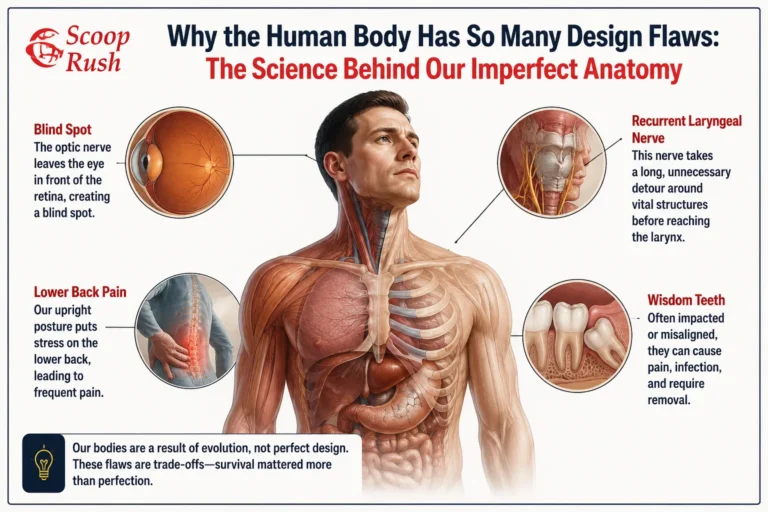
Your spine curves in ways that guarantee back pain. Your eyes have a permanent blind spot. And a nerve in your neck takes a completely unnecessary detour through your chest before reaching its destination just inches away. These aren’t birth defects or rare conditions. They’re standard features of every human body, and they explain why the human body has so many design flaws despite being called a marvel of nature.
The truth is simpler than you might expect. Evolution doesn’t design anything from scratch. Instead, it reworks old structures to serve new purposes, often leaving behind quirks, inefficiencies, and outright problems. This is somewhat similar to how neurons must break their own DNA to build the brain, a process that also looks messy and inefficient on the surface but reflects the improvisational nature of biology. Understanding why the human body has so many design flaws helps explain some of the most common health issues people face today, from lower back pain to impacted wisdom teeth.
This matters because these aren’t random misfortunes. They’re the direct result of millions of years of biological compromise. Once you see your body through this lens, conditions like sciatica, appendicitis, and difficult childbirth start to make a lot more sense .”This piece walks through the human body design flaws that show up across nearly every system, and where relevant, notes how engineers and design theorists push back on this framing.”
The Spine: A Structure Doing a Job It Wasn’t Built For
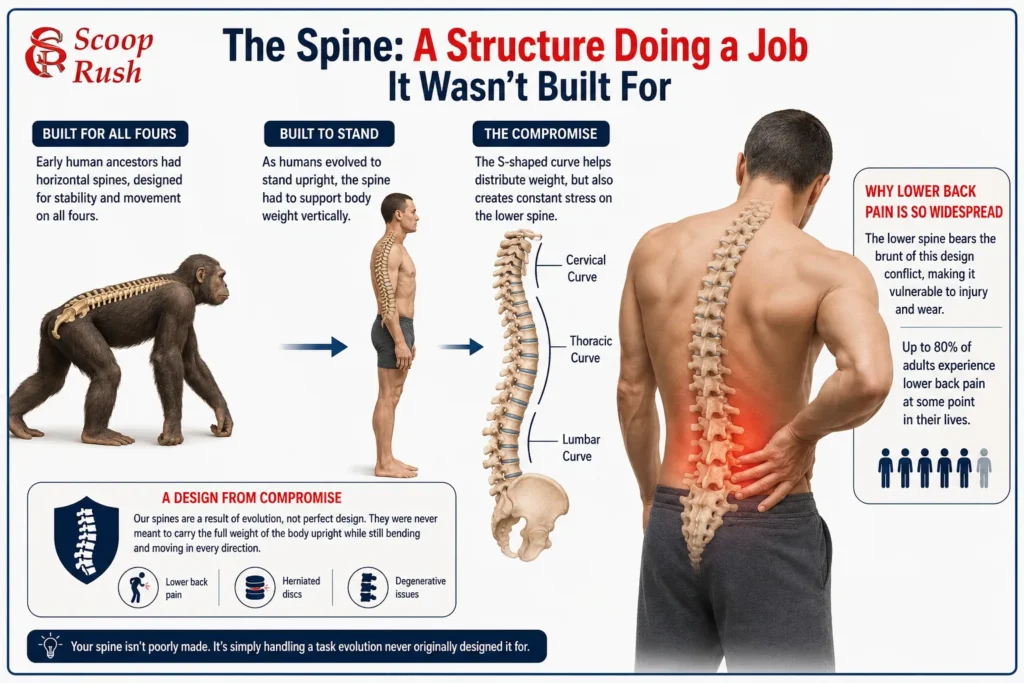
Your backbone started out as a horizontal support beam. Early human ancestors moved on four limbs, so their spines worked like flexible planks, built for smooth movement and basic protection of the spinal cord.
Then humans stood upright. Suddenly, that same spine had to support the body’s full weight vertically while still bending and flexing for movement. These two jobs pull in opposite directions, and the compromise created the S-shaped curve your spine has today.
This curve does help distribute weight more evenly. However, it also puts constant strain on the lower vertebrae. As a result, lower back pain, herniated discs, and other degenerative issues remain some of the most common medical complaints worldwide, with estimates suggesting around 80 percent of adults experience lower back pain at some point. Your spine isn’t poorly made. It’s simply handling a task evolution never originally designed it for.
Why Lower Back Pain Is So Widespread
Because the lower spine bears the brunt of this design conflict, it’s especially vulnerable to injury and wear. This is one of the clearest examples of how ancient anatomy struggles to keep up with modern demands like sitting at desks or standing for long shifts.
The Knee: A Hinge Under Constant Pressure
The knee sits between two long levers, the femur and the tibia, which puts enormous strain on a joint that only bends in one direction. Unlike the ball-and-socket design of the hip or shoulder, the knee can only move forward and back. That’s part of the reason so many sports rules exist specifically to protect this joint from sideways impact, and why knee injuries remain one of the most common sports injuries overall.
A Nerve That Takes the Long Way Around
Few examples illustrate evolutionary leftovers better than the recurrent laryngeal nerve. This nerve helps control speech and swallowing by connecting the brain to the voice box. Logically, it should take the shortest possible path.
Instead, it travels down into the chest, loops around a major artery, and then climbs all the way back up to the larynx. This roundabout route made sense in fish-like ancestors, where the nerve simply wrapped around gill arches. As necks grew longer over evolutionary time, the nerve stretched along with them rather than rerouting.
The result is a nerve that’s more vulnerable to injury, particularly during neck or chest surgery. It’s a structural inefficiency that persisted simply because it never caused enough harm to be selected against.
Eyes, Teeth, and the Pelvis: More Evolutionary Trade-Offs
The Backward-Wired Retina
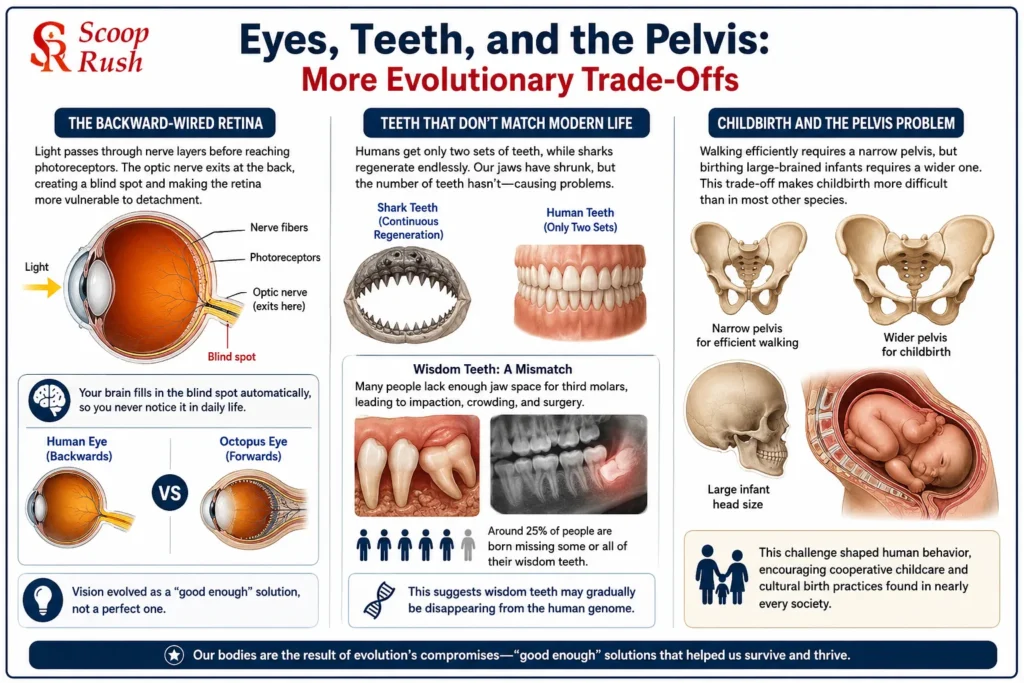
Human eyes are wired in a way that seems almost backward. Light has to pass through layers of nerve fibers before it even reaches the photoreceptor cells responsible for detecting it. Additionally, the optic nerve exits through the back of the retina, creating a blind spot in your visual field. This same wiring pattern is also thought to make the retina more prone to detaching from its supporting tissue, a leading cause of blindness.
Your brain fills in this gap automatically, so you never notice it in daily life. Still, this setup shows how vision developed as a “good enough” solution rather than an optimized one. Interestingly, octopuses and squids evolved retinas that face the correct direction, avoiding this blind spot entirely. This gap between what the brain perceives and what the eyes actually capture is a reminder of how much construction goes on behind the scenes, similar to how some people experience aphantasia and cannot visualize images in their mind at all.
Teeth That Don’t Match Modern Life
Humans get exactly two sets of teeth, unlike sharks, which regenerate their teeth continuously. Once adult teeth are lost, that’s it. Furthermore, human jaws have shrunk over time as diets became softer, but the number of teeth didn’t shrink at the same pace.
That mismatch is why wisdom teeth cause so many problems. Many people simply don’t have enough jaw space for their third molars, leading to impaction, crowding, and frequent dental surgery. Around a quarter of people today are born missing some or all of their wisdom teeth, which suggests this feature may gradually be disappearing from the human genome.
Childbirth and the Pelvis Problem
Perhaps no trade-off is more dramatic than the human pelvis. Walking efficiently requires a narrower pelvis, but birthing large-brained infants requires a wider one. Human babies have unusually large heads relative to their bodies, which makes childbirth more difficult and often more dangerous than in other species, frequently requiring outside assistance.
This tension didn’t just shape anatomy. It also influenced human behavior, encouraging cooperative childcare and the cultural practices around birth that exist across nearly every society.
Meandering Arteries and Blood Flow Quirks
Blood reaches your arms and legs through a single main artery that enters near the front of the limb, close to the biceps or hip flexors. To reach tissues at the back, like the triceps and hamstrings, that artery has to branch out and wind around bones, often bundling closely with nerves. This is why a sharp knock to your “funny bone” at the elbow sends a jolt down to your little finger. The artery and the ulnar nerve run close together just under the skin at that exact point, a byproduct of blood vessels taking indirect paths rather than the most efficient ones.
Structures That Stick Around for No Clear Reason
Evolution doesn’t necessarily remove features just because they’re not useful anymore. It only removes them if they cause serious harm. That’s why several body parts persist despite offering little modern benefit.
The appendix was once considered completely useless. Scientists now believe it may play a minor role in immune function. However, it can still become inflamed and cause appendicitis, a condition that can be life-threatening without treatment.
Similarly, the sinuses serve unclear purposes. They might lighten the skull or affect voice resonance, and their size and shape are even distinctive enough to be used in forensic identification. However, their drainage pathways make them prone to frequent blockages and infections. Meanwhile, tiny muscles around human ears are remnants from ancestors who could rotate their outer ears to detect sound direction. Most people today can’t use these muscles at all.
Even the male reproductive system shows a similar pattern. The testicles sit outside the body because sperm needs to stay slightly cooler than core body temperature to remain healthy until fertilization, leaving this vital organ more exposed to injury than if it were housed internally.
The Body’s Own Aging Process
These design compromises don’t just cause isolated problems. They also compound over time as tissues age and repair less efficiently. Researchers studying old muscle stem cells have found that the body’s ability to maintain and rebuild itself declines with age, though other studies show exercise may reverse some muscle aging through the DEAF1 gene. Diet also plays a role in how well these aging systems hold up, which is part of why understanding the risks of a no-sugar diet or the brain benefits of omega-3 fish oil supplements has become such a widely researched area.
Not Everyone Agrees the Body Is “Flawed”
It’s worth noting this isn’t a universally accepted framing. Some engineers and physicians argue that focusing on isolated quirks undersells just how remarkably the body’s systems work together. They point out that the body manages temperature, blood pressure, healing, and coordination across trillions of cells simultaneously, and that no human-engineered system comes close to matching this level of integration and self-repair. From this perspective, calling these features “flaws” overlooks the immense complexity required just to keep a body alive and functioning day to day. This is a genuinely contested debate, and readers may want to weigh both viewpoints for themselves.
What This Means for Understanding Your Own Health
“Recognizing why the human body has so many design flaws changes how you think about common health problems.”. Back pain, difficult childbirth, dental crowding, and sinus infections aren’t just bad luck. They’re the direct consequences of a body built through modification rather than fresh design.
This evolutionary perspective doesn’t make these conditions less frustrating. However, it does offer context. Your body isn’t broken. It’s the product of a long history of compromises that worked well enough to keep humans alive and reproducing, even if they didn’t produce perfection.
Conclusion
“These human body design flaws aren’t signs of poor engineering, but signs of a long, improvisational history.”The human body carries visible evidence of its evolutionary past in nearly every system. The spine juggles two conflicting jobs. A nerve in the neck takes a completely unnecessary detour. Eyes have a built-in blind spot. Teeth don’t match modern jaw size. The knee bends in only one direction. And the pelvis balances mobility against the demands of childbirth.
None of these features exist because evolution aimed for flaws. They exist because evolution works with what’s already there, adjusting existing structures rather than starting over. Ultimately, understanding this helps explain why so many common medical issues, from back pain to wisdom tooth removal, are so widespread across the human population. Whether you see these traits as flaws or as evidence of remarkable adaptability, they remain a fascinating window into where we came from.
FAQs
Why does the human body have so many design flaws?
The human body evolved through gradual modification of existing structures rather than being designed from scratch. This process, called evolutionary compromise, often results in structures that work well enough for survival but aren’t optimized for their current function.
Why does the recurrent laryngeal nerve take such a long path?
This nerve originally looped around gill arches in fish-like ancestors. As necks lengthened over millions of years, the nerve stretched along with them instead of taking a more direct route, leaving it vulnerable to injury today.
Why is the human pelvis linked to painful childbirth?
The pelvis must balance two conflicting demands: a narrow shape for efficient walking and a wide shape for birthing large-headed infants. This trade-off makes human childbirth more difficult compared to many other species.
Is the appendix completely useless?
No. While long considered a leftover structure, research suggests the appendix may have a minor role in immune function. However, it can still become inflamed and cause appendicitis, a serious medical condition.
Why do humans get wisdom teeth if they cause problems?
Wisdom teeth were useful when human ancestors had larger jaws suited to tougher diets. As jaws became smaller over time, the number of teeth didn’t decrease at the same rate, leaving many people without enough room for their third molars.
For more than ten years, physicists knew a topological crystalline insulator should exist. They just couldn’t build it.
Now they have. Researchers in Finland have successfully created a two-dimensional topological crystalline insulator, a quantum material scientists first predicted over a decade ago but could never physically produce. The breakthrough could bring room-temperature quantum electronics much closer to reality.
This isn’t just an academic milestone. This discovery matters because it opens the door to faster, more efficient electronics that don’t require the extreme cold most quantum devices depend on. If you’ve ever wondered why quantum computers live in refrigerator-sized cooling systems, this research points toward a future where that might not be necessary electronics.
What Exactly Did Scientists Build?
Physicists from the University of Jyväskylä and Aalto University in Finland created the material by growing an ultra-thin film made of just two layers of tin telluride. They placed this film on top of a niobium diselenide substrate, essentially stacking two different quantum materials to create something entirely new.
The team was led by Associate Professor Kezilbeiek Shawulienu, working alongside Aalto University researchers Professor Peter Liljeroth and Professor Jose Lado. Their combined expertise made it possible to finally overcome a problem that had stumped scientists for years: finding the right materials and conditions to actually build this theoretical structure.
Until now, every attempt to create this material had run into the same wall. The right combination of materials simply didn’t exist, or couldn’t be manufactured with enough precision.
Why This Material Is So Special
Topological crystalline insulators sound complicated, but the core idea is fairly simple. These materials act as insulators on the inside, meaning electricity doesn’t flow through their bulk. However, their edges behave completely differently.
Along the edges, electrons can travel freely through special conducting pathways. These pathways are protected by the symmetry of the material’s crystal structure, which means they’re remarkably stable and resistant to disruption.
This property makes topological materials incredibly valuable for electronics. Engineers could potentially use these edge states to move information with minimal energy loss, something conventional materials struggle to achieve.
How Researchers Confirmed the Discovery
Building the material was only half the challenge. The team needed to prove it actually behaved the way theory predicted.
To do this, researchers used molecular beam epitaxy combined with low-temperature scanning tunneling microscopy. This approach allowed them to examine the material’s electronic behavior at the atomic level, essentially watching individual atoms and their surrounding electron activity.
Their measurements revealed exactly what they were hoping to find: pairs of conducting edge states running along the material’s boundaries. This is the defining signature of a topological crystalline insulator, and its presence confirmed the material worked as predicted.
The Role of Strain in Stabilizing the Material
Here’s where things get particularly interesting. The researchers discovered that the tin telluride film gets compressed by the niobium diselenide substrate underneath it. This compression creates strain within the material.
That strain isn’t a flaw. It’s essential. Without it, the topological state wouldn’t stabilize at all.
Even more importantly, the team found they could adjust the edge states simply by changing the amount of strain applied to the material. This gives scientists a practical, controllable way to fine-tune the material’s electronic properties, something that could prove extremely valuable for future device engineering.
The conducting edge states also appear within a large electronic band gap, measuring more than 0.2 electron volts. This gap size matters because it directly relates to how stable the material remains under different conditions.
Why Room-Temperature Quantum Electronics Would Be a Big Deal
Most quantum materials only display their special properties at extremely low temperatures, often colder than outer space. This requirement makes quantum devices expensive, bulky, and impractical for everyday use.
Because this newly created material has a relatively large band gap, researchers expect its topological properties to remain stable even at room temperature. Therefore, this discovery could eliminate one of the biggest barriers standing between quantum technology and real-world application.
Consequently, this material could serve as a foundation for spin-based electronics, which use the magnetic spin of electrons rather than just their charge to process and store information. Spintronic devices are widely seen as a promising path toward faster, more energy-efficient computing.
Additionally, the material’s tunable nature through strain control makes it especially attractive for nanoscale device design. Engineers could potentially adjust a device’s electronic behavior after manufacturing, simply by controlling mechanical strain rather than redesigning the entire structure.
The Science Behind the Confirmation
The Finnish research team didn’t stop at experimental observation. They also ran first-principles quantum mechanical calculations to verify that the edge states they observed truly had a topological origin, rather than resulting from some other electronic effect.
These calculations confirmed the experimental findings, giving the research added scientific weight. The team also studied how neighboring edge states interact with one another. They found that the energy levels of these states shift because of a combination of electrostatic interactions and quantum tunneling.
Understanding these interactions matters because future devices will likely need multiple edge states working together. Knowing how they influence each other is a necessary step toward designing functional quantum electronics.
The full findings were published in the journal Nature Communications, a peer-reviewed publication known for high-impact scientific research.
What This Means for the Future of Electronics
While practical, room-temperature quantum devices aren’t arriving tomorrow, this discovery represents a meaningful step forward. Scientists have spent over a decade trying to physically realize this material, and now that goal has been achieved.
Moreover, the ability to control edge states through strain offers researchers a tunable, practical method for future experimentation. This flexibility could accelerate progress in fields ranging from quantum computing to advanced nanoscale sensors.
As a result, this research adds Finland to the growing list of countries pushing the boundaries of quantum material science. Similarly, it strengthens the broader global effort to make quantum technology more accessible and less dependent on extreme cooling systems, much like ongoing efforts to understand ancient discoveries that reshape our understanding of the natural world.
Conclusion
Physicists have finally built a two-dimensional topological crystalline insulator, a material predicted more than ten years ago but never before achieved in the lab. By layering tin telluride on a niobium diselenide substrate, researchers created a material with protected conducting edge states and a large electronic band gap.
The discovery that strain can control these edge states gives scientists a practical tool for tuning the material’s properties. Because the band gap is large enough to remain stable at room temperature, this breakthrough brings practical quantum electronics significantly closer to reality.
Ultimately, this research offers real promise for spin-based electronics and next-generation nanoscale devices. While there’s still work ahead before these materials appear in consumer technology, this milestone marks meaningful progress toward that future.
FAQs
Q1: What is a two-dimensional topological crystalline insulator?
A: It’s a quantum material that insulates electricity through its interior but allows electrons to flow freely along protected pathways at its edges. These edge states are stabilized by the material’s crystal symmetry.
Q2: Why did it take over a decade to create this material?
A: Scientists lacked the right combination of materials and manufacturing techniques needed to physically produce it. The breakthrough came from layering tin telluride on a niobium diselenide substrate, which created the necessary strain conditions.
Q3: How does strain affect the material’s quantum properties?
A: Strain from the underlying substrate compresses the tin telluride film, which stabilizes its topological state. Researchers also found that adjusting the strain lets them tune the material’s edge states, offering a controllable way to modify its behavior.
Q4: Could this material lead to room-temperature quantum computers?
A: It’s a promising step in that direction. Because the material’s band gap is large, its topological properties are expected to remain stable at room temperature, unlike many quantum materials that only work at extremely low temperatures.
Q5: Where was this research published?
A: The findings were published in Nature Communications, following research conducted by physicists at the University of Jyväskylä and Aalto University in Finland.
The Turkey F-35 Program could soon return to the spotlight after US President Donald Trump signaled a major shift in Washington’s policy toward Ankara. Speaking during the NATO summit in Turkey’s capital, Trump said the United States is considering restoring Turkey’s role in the F-35 fighter jet program. He also indicated that sanctions imposed over Turkey’s purchase of Russia’s S-400 air defense system could end soon.
Trump described Turkey as an important NATO ally and praised his relationship with President Recep Tayyip Erdogan. He said the United States should not continue sanctioning friendly nations. His comments raised hopes that both countries may finally move past years of strained defense ties.
Turkey F-35 Program Could Return After Years of Dispute
The Turkey F-35 Program came to a halt in 2019 after Ankara purchased the Russian-made S-400 missile defense system. The United States argued that operating the S-400 alongside the F-35 could expose sensitive stealth technology to Russia. As a result, Washington removed Turkey from the fighter jet program and stopped aircraft deliveries. Turkey also lost its role in producing several F-35 components. Later, the United States imposed sanctions under the Countering America’s Adversaries Through Sanctions Act, commonly known as CAATSA.
Now, the Trump administration appears ready to revisit that decision. Although no final agreement exists, officials from both countries continue discussing possible solutions.
Trump Wants Stronger Ties With Turkey
Trump believes Turkey remains a key strategic partner for the United States and NATO. He pointed to Turkey’s powerful military, its location between Europe and the Middle East, and its influence in regional security. According to Trump, rebuilding defense cooperation with Ankara could strengthen NATO and help counter growing regional challenges.
His remarks also suggest that Washington wants to improve relations instead of extending a dispute that has lasted several years. Trump confirmed that he will make a final decision on Turkey’s future participation in the F-35 program after further discussions.
A Possible Deal May Resolve the S-400 Issue
Reports indicate that both sides are exploring a compromise. One proposal would see Turkey transfer its Russian S-400 air defense system to a third country. In return, the United States could allow Ankara to rejoin the F-35 program.
Such an agreement would address one of Washington’s biggest security concerns. However, officials have not confirmed any final arrangement, and negotiations remain ongoing.
Congress Still Must Approve Any Major Change
Despite Trump’s support, Congress remains a significant hurdle. US lawmakers previously passed legislation preventing F-35 sales to Turkey while the country continues to possess the S-400 system.
Many members of Congress still believe the Russian defense system poses an unacceptable security risk. They argue that protecting advanced F-35 technology remains a top priority. Because of these concerns, any attempt to restore Turkey’s participation could face strong political opposition.
Israel Strongly Opposes Turkey’s Return
The Turkey F-35 Program has also created concern in Israel. Prime Minister Benjamin Netanyahu has reportedly urged Trump not to approve the deal. Israeli leaders fear that supplying Turkey with advanced stealth fighters could alter the regional military balance.
Israel also points to Turkey’s support for Hamas, its growing influence in Syria, and ongoing disputes with Greece and Cyprus. Israeli officials believe stronger Turkish air power could increase future tensions across the eastern Mediterranean, especially around important energy projects and shipping routes.
Turkey Sees the Move as a Diplomatic Success
For President Erdogan, returning to the F-35 program would represent more than a military purchase. It would signal that relations with Washington have improved after years of disagreements. It would also restore Turkey’s place in one of the world’s most advanced defense projects.
Ankara continues to argue that its role within NATO deserves closer military cooperation with the United States. Rejoining the program would strengthen Turkey’s defense industry and reinforce its position within the alliance.
The Decision Could Reshape Regional Security
The debate over the Turkey F-35 Program extends far beyond fighter jets. It reflects how the United States plans to balance its relationships with two important regional allies, Turkey and Israel.
Washington wants to maintain strong ties with both countries while protecting its own strategic interests. At the same time, lawmakers and defense officials continue weighing the security risks linked to the Russian S-400 system.
For now, Trump has opened the door to a possible reset in US-Turkey relations. However, Congress, legal restrictions, and ongoing security concerns still stand in the way. Until those issues are resolved, Turkey’s return to the F-35 program remains uncertain.
Conclusion
The future of the Turkey F-35 Program remains uncertain, but the latest developments mark a clear shift in US policy. Trump has expressed support for improving defense ties with Turkey and reopening discussions on the fighter jet program. However, Congress, legal restrictions, and security concerns over the S-400 system continue to stand in the way. At the same time, Israel’s strong opposition adds another layer of complexity. The coming months will determine whether Washington and Ankara can reach an agreement that satisfies both security and political concerns.
FAQs
1. Why did the United States remove Turkey from the F-35 program?
The US removed Turkey in 2019 after Ankara purchased the Russian S-400 air defense system. Washington said the system could threaten the security of F-35 technology.
2. What did Donald Trump say about Turkey’s return?
Trump said the United States is reviewing Turkey’s return to the F-35 program. He also indicated that sanctions on Turkey could end soon.
3. Why does Congress oppose the F-35 deal with Turkey?
Many US lawmakers believe Turkey should not receive F-35 jets while it still owns the Russian S-400 system. They argue that national security must come first.
4. Why is Israel concerned about Turkey receiving F-35 jets?
Israel fears the aircraft could change the military balance in the eastern Mediterranean. It also worries about Turkey’s growing regional influence.
5. Has the United States approved Turkey’s return to the F-35 program?
No. The US has not made a final decision. Officials are still reviewing the proposal, and Congress could play a major role before any agreement moves forward.
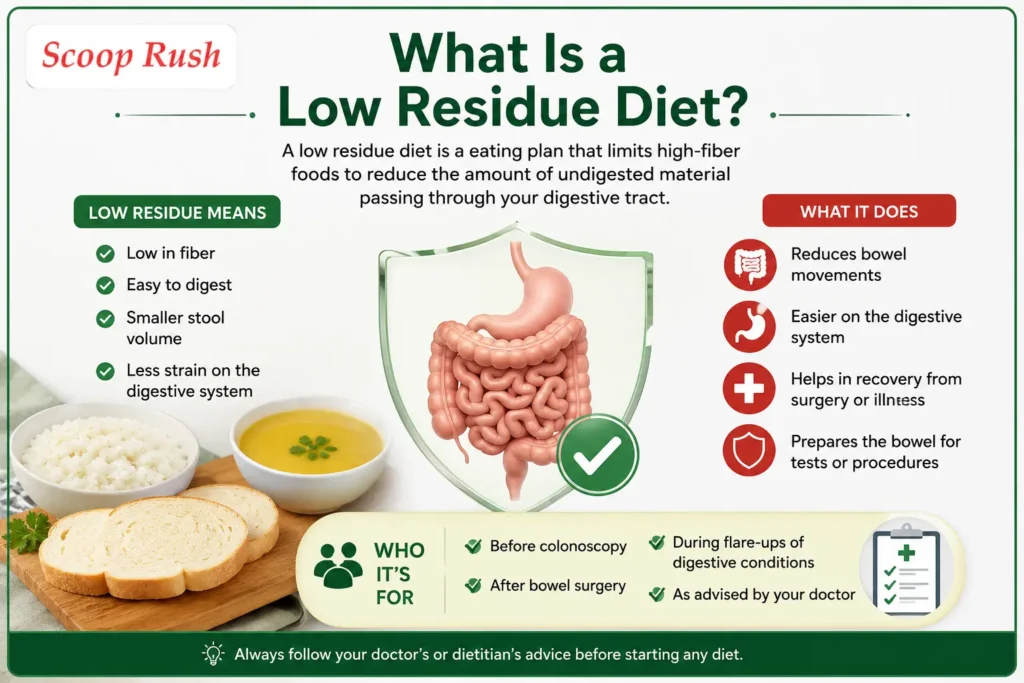
A low residue diet is often recommended when your digestive system needs a break. Whether you’re recovering from bowel surgery, managing inflammatory bowel disease (IBD), or preparing for a colonoscopy, this eating plan helps reduce the amount of undigested food moving through your intestines.
Unlike many popular diets, a low residue diet isn’t designed for weight loss. Instead, it temporarily limits high-fiber foods and other hard-to-digest ingredients to reduce bowel activity, making digestion easier and helping relieve uncomfortable symptoms.
In this guide, you’ll learn what a low residue diet is, who needs it, which foods are allowed, which foods should be avoided, and how to safely transition back to a normal diet.
What Is a Low Residue Diet?
A low residue diet is a short-term eating plan that limits foods leaving large amounts of undigested material, called residue, in your intestines.
Residue mainly consists of dietary fiber, but it can also include seeds, skins, connective tissue from meats, and certain dairy products that may be difficult to digest.
The goal is to:
Reduce bowel movements
Minimize stool volume
Ease abdominal pain
Reduce diarrhea
Lower gas and bloating
Allow the intestines to heal
Doctors usually recommend this diet only for a limited period.
Many people assume that all healthy diets should include plenty of fiber. While fiber is an essential part of a balanced diet for most people, there are times when your digestive system needs a temporary break — this is where a low residue diet can help.
Fiber passes through the digestive tract largely undigested. As it moves through the intestines, it adds bulk to stool and stimulates bowel movements. For someone with an inflamed bowel, recovering from surgery, or preparing for a medical procedure, this extra work can increase discomfort and slow healing. A low residue diet reduces the amount of undigested material that reaches the large intestine, resulting in fewer and smaller bowel movements and relief from symptoms like diarrhea, cramping, bloating, and excess gas.
It’s important to remember that this eating plan is a medical diet rather than a lifestyle diet. Most people should only follow it for the period recommended by their healthcare provider.
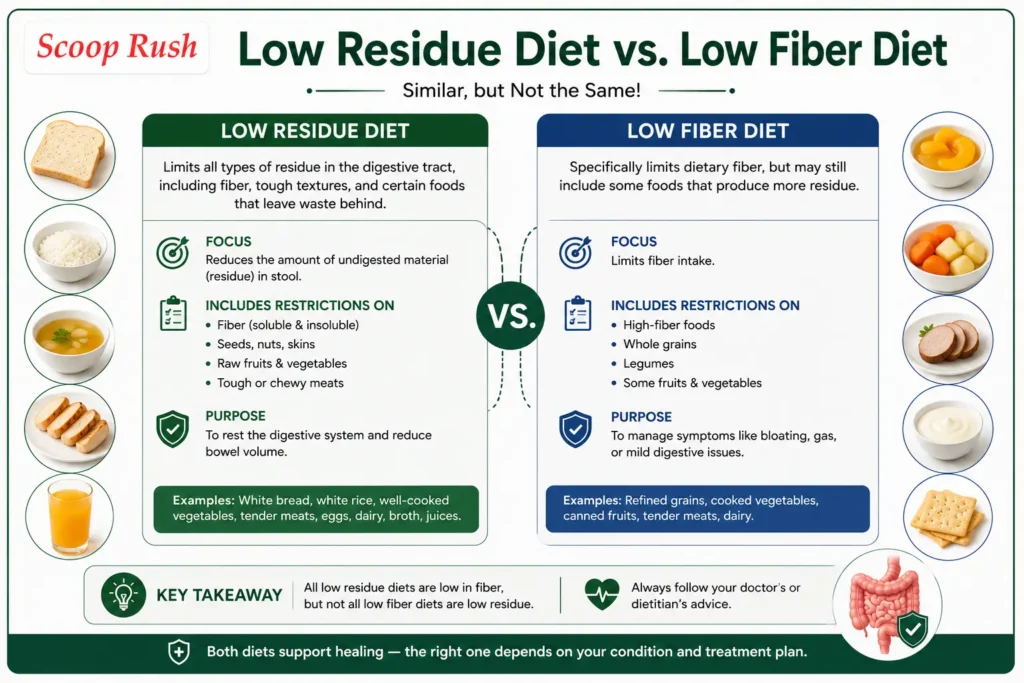
Low Residue Diet vs. Low Fiber Diet
Although the two terms are often used interchangeably, they are not exactly the same.
A low-fiber diet simply reduces fiber intake.
A low residue diet goes a step further by limiting foods that increase stool volume, including certain dairy products, nuts, seeds, legumes, and some tougher meats.
Because of these additional restrictions, a low residue diet is generally more limiting.
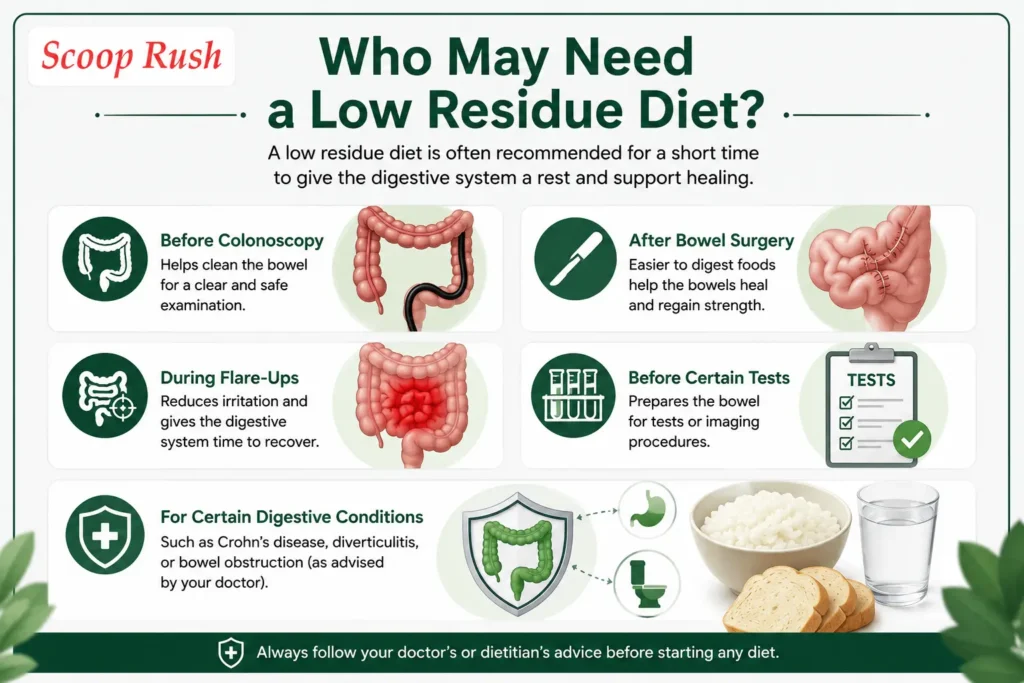
Who May Need a Low Residue Diet?
Healthcare providers may recommend this diet for people with certain digestive conditions or in preparation for specific procedures.
Crohn’s Disease Crohn’s disease causes chronic inflammation anywhere along the digestive tract. During a flare-up, high-fiber foods can worsen abdominal pain, diarrhea, and irritation, so a temporary low residue diet may reduce stress on the intestines while medication helps control inflammation.
Ulcerative Colitis This condition affects the lining of the large intestine and rectum. During active disease, reducing fiber intake may decrease bowel movements and improve symptoms until inflammation settles.
Diverticulitis A low residue diet may be recommended during recovery, with fiber gradually reintroduced afterward to support long-term colon health.
Before a Colonoscopy Doctors want the bowel as clean as possible before this procedure. Following a low residue diet for several days, then switching to clear liquids the day before, helps improve bowel prep and procedure effectiveness.
After Intestinal Surgery Following bowel surgery, softer foods reduce stress on the healing digestive tract and may lower the risk of complications.
Bowel Obstruction or Gastroparesis Some patients with slowed digestion or a partial bowel obstruction may benefit from this diet under close medical supervision, since high-fiber foods can be difficult to pass through narrowed areas.
Benefits of a Low Residue Diet
Following this diet for a short period may help:
Reduce diarrhea
Ease stomach cramps
Minimize bloating
Reduce intestinal irritation
Produce smaller bowel movements
Help prepare the bowel before medical procedures
Support recovery after gastrointestinal surgery
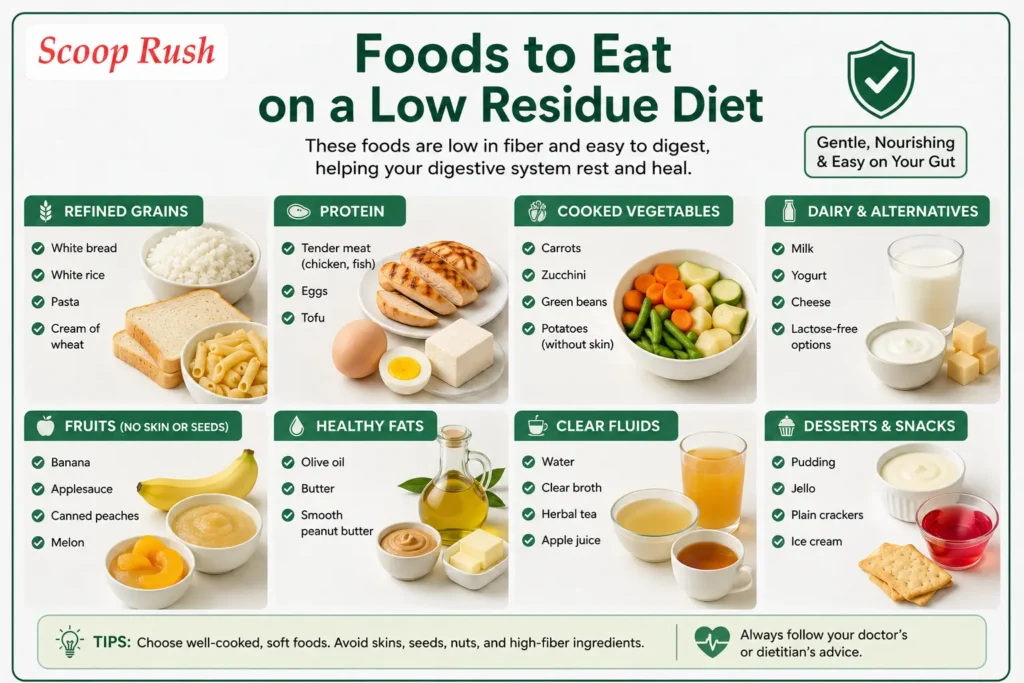
Foods to Eat on a Low Residue Diet
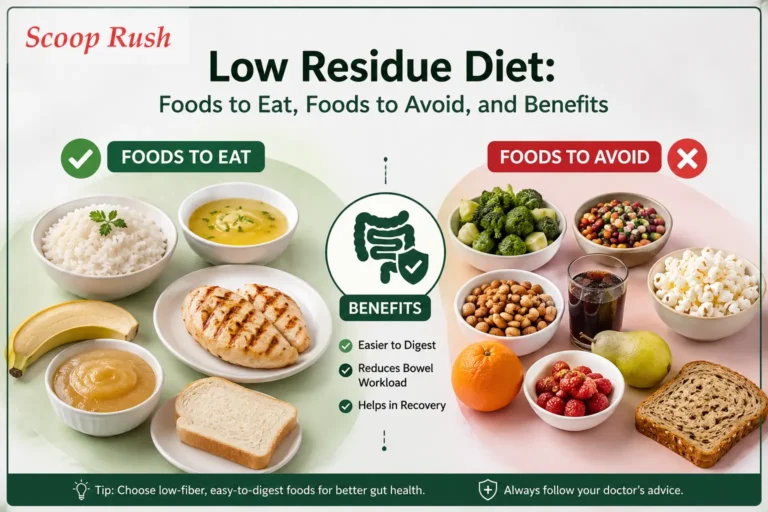
The emphasis is on foods that are soft, refined, and easy to digest.
Refined Grains: White bread, white toast, plain bagels, saltine crackers, white rice, regular pasta, Cream of Wheat, grits, corn flakes, Rice Krispies. (Avoid whole-grain products.)
Fruits: Bananas, applesauce, canned peaches, canned pears, ripe melon, honeydew, cooked apples without skin, fruit juice without pulp. (Avoid fruits with skins, seeds, or dried fruit.)
Vegetables (cooked until soft): Carrots, green beans, beets, asparagus tips, spinach, pumpkin, peeled potatoes, squash without seeds. (Avoid raw vegetables and vegetables with skins.)
Protein Foods: Chicken, turkey, lean beef, pork, fish without bones, eggs, smooth peanut butter. Choose tender, well-cooked meats.
Dairy (if tolerated): Milk (in moderation), yogurt without fruit, cottage cheese, mild cheese, pudding. People with lactose intolerance may need lactose-free alternatives.
Drinks: Water, apple juice, cranberry juice, tea, decaffeinated coffee, sports drinks, clear fruit drinks.
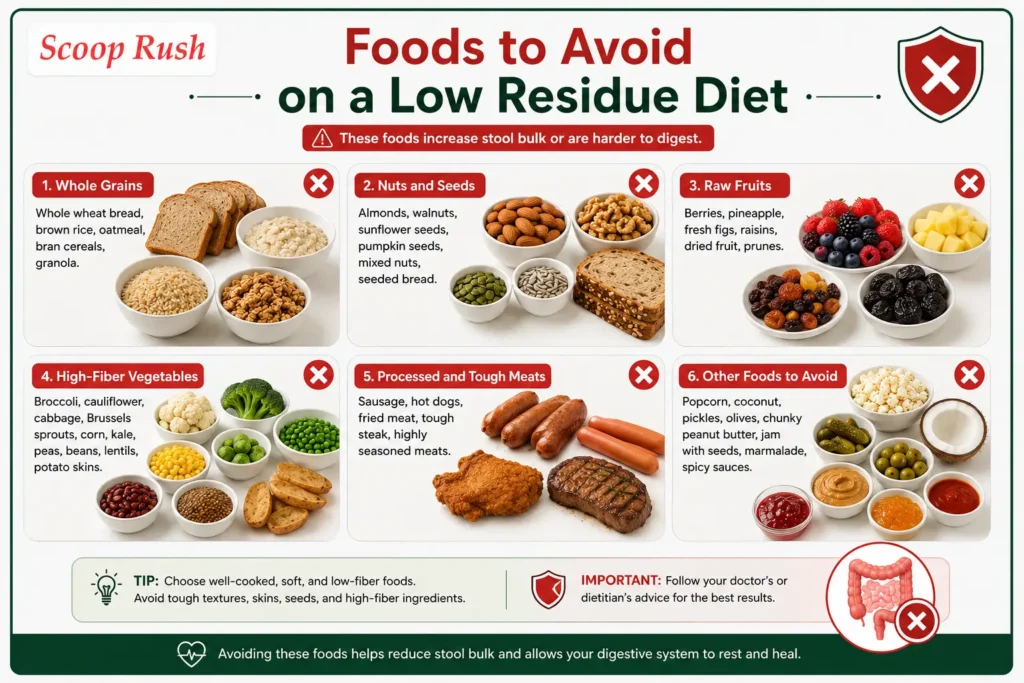
Foods to Avoid on a Low Residue Diet
These foods increase stool bulk or are harder to digest.
Pantry Items: Butter, olive oil, honey, jelly without seeds, plain gelatin, sugar, salt
Low Residue Diet vs. BRAT Diet vs. Clear Liquid Diet
People often confuse a low residue diet with other short-term eating plans, but each serves a different purpose.
BRAT Diet This stands for bananas, rice, applesauce, and toast. It’s typically used for a day or two after an acute stomach bug or bout of vomiting and diarrhea, mainly to settle the stomach. It’s much more limited than a low residue diet and isn’t meant to provide complete nutrition, even in the short term.
Clear Liquid Diet — This is the most restrictive of the three, allowing only liquids you can see through, such as broth, plain gelatin, water, and clear juices without pulp. It’s usually reserved for the day immediately before a colonoscopy or other procedure requiring a completely empty bowel, or for brief post-surgical recovery periods.
Low Residue Diet — This sits in the middle. It allows a wider variety of solid foods than the other two plans, including meats, dairy, and refined grains, while still limiting fiber and other hard-to-digest ingredients. Because it includes more food groups, it can be sustained for a longer period than a clear liquid or BRAT diet without major nutritional gaps, though it still isn’t meant to be permanent.
Understanding these distinctions matters because your doctor may move you between these diets depending on where you are in treatment or recovery. For example, someone preparing for a colonoscopy might follow a low residue diet for several days, then switch to clear liquids the day before the procedure, then return to a low residue diet for a short time afterward before gradually adding fiber back in.
Eating Out and Traveling on a Low Residue Diet
Following a low residue diet doesn’t mean you have to stay home. With a little planning, it’s possible to eat at restaurants or travel while still sticking to your plan.
At Restaurants
Choose grilled, baked, or roasted proteins instead of fried or heavily breaded options.
Ask for sauces, dressings, and gravies on the side so you can control the amount.
Request that vegetables be well-cooked rather than raw or lightly steamed.
Swap whole-grain bread or brown rice for white bread or white rice when available.
Avoid dishes with visible seeds, nuts, or skins unless they can be removed.
While Traveling
Pack portable low residue snacks such as saltine crackers, plain white bread, or single-serve applesauce cups.
Look up restaurant menus in advance so you’re not deciding under pressure when hungry.
Carry a bottle of water and stay hydrated, especially during flights or long car rides, since dehydration can worsen digestive symptoms.
If you’re staying in a hotel with a refrigerator, consider bringing shelf-stable items like pudding cups, canned fruit, or plain crackers.
Social Situations It’s common to feel self-conscious about food restrictions at gatherings or celebrations. You don’t need to explain your entire medical history to enjoy a meal with others — simply choosing the safest options from what’s available, or eating beforehand if you’re unsure what will be served, can help you participate without added stress.
Extended Sample Meal Plan (3 Days)
A single day’s menu can be helpful, but seeing a few days in sequence makes it easier to plan groceries and avoid repetition.
Day 1: A Simple Start
Begin your first day with gentle, easy-to-digest meals.
Breakfast: Scrambled eggs, white toast with a small amount of seedless jelly, and decaffeinated coffee.
Morning Snack: One ripe banana.
Lunch: Baked chicken breast with white rice and cooked carrots.
Afternoon Snack: Saltine crackers spread with a thin layer of smooth peanut butter.
Dinner: Baked white fish served with peeled mashed potatoes and cooked green beans.
Dessert: Vanilla pudding.
Day 2: Variety While Staying Low Residue
On the second day, continue choosing soft, low-fiber foods that are easy on the digestive system.
Breakfast: Cream of Wheat with a drizzle of honey and canned peaches.
Morning Snack: Plain yogurt without fruit pieces.
Lunch: Turkey sandwich on white bread with mayonnaise, served without lettuce or other raw vegetables.
Afternoon Snack: Applesauce.
Dinner: Lean ground beef with white pasta and a small amount of strained tomato sauce.
Dessert: Sherbet.
Day 3: Balanced and Easy to Digest
Finish the meal plan with another day of nutritious, low-residue meals.
Breakfast: Plain bagel with cream cheese and ripe melon.
Morning Snack: Cottage cheese.
Lunch: Grilled chicken served over white rice with cooked spinach.
Afternoon Snack: Rice Krispies with lactose-free milk, if tolerated.
Dinner: Baked pork tenderloin with peeled boiled potatoes and cooked squash.
Dessert: Plain gelatin.
Rotating proteins, grains, and cooked vegetables across several days like this can help prevent the diet from feeling monotonous, which is often one of the biggest challenges people report.
Low Residue Diets for Children
When a child needs to follow a low residue diet, whether for a digestive condition or before a procedure, the approach is similar but requires some additional care.
Children generally need consistent calorie and nutrient intake to support normal growth, so a low residue diet should always be guided closely by a pediatrician or pediatric gastroenterologist rather than managed on your own. Because the diet restricts many fruits, vegetables, and whole grains, providers often monitor growth and nutrient levels more closely in children than in adults, especially if the diet needs to continue for more than a few days.
Making the diet feel less restrictive can help with compliance in younger children. Presenting approved foods in fun ways, such as cutting white bread into shapes or offering approved fruits as a colorful snack plate, can make mealtimes feel more normal. It also helps to involve children in food choices from the approved list when appropriate, giving them a sense of control during a time that may already feel confusing or uncomfortable.
Preparing for a Colonoscopy
Doctors often recommend a low residue diet for several days before a colonoscopy. This usually includes white bread, white rice, tender chicken, eggs, pasta, applesauce, and bananas. The day before the procedure, most patients switch to a clear liquid diet according to their healthcare provider’s instructions.
How Long Should You Follow a Low Residue Diet?
This diet is intended to be temporary. For many people, it lasts:
2–5 days before a colonoscopy
Several days after bowel surgery
During flare-ups of Crohn’s disease or ulcerative colitis
Until symptoms improve
Long-term use may lead to nutritional deficiencies because many healthy foods are restricted.
Possible Nutritional Concerns
Since the diet limits many fruits, vegetables, legumes, and whole grains, you may not get enough:
Vitamin C
Folate
Calcium
Potassium
Magnesium
Dietary fiber
Some healthcare providers recommend a multivitamin if the diet continues beyond two weeks. Since taking too many vitamins or supplements can carry its own risks, always check with your doctor before adding one on your own. People with inflammatory bowel disease may already have difficulty absorbing nutrients, making proper medical guidance especially important during extended dietary changes.
Tips for Following a Low Residue Diet Successfully
Making temporary dietary changes can feel overwhelming, especially if you normally eat a high-fiber diet. Planning your meals in advance can make the transition much easier.
Read food labels and choose products containing very little fiber.
Peel fruits and vegetables before cooking whenever appropriate.
Cook vegetables until they become soft instead of eating them raw.
Choose tender cuts of meat and avoid heavily seasoned or fried foods.
Eat smaller meals throughout the day if large meals worsen symptoms.
Drink enough water unless your doctor has advised otherwise.
Keep a food diary to identify foods that improve or worsen your symptoms.
Everyone’s digestive system responds differently. Even foods considered acceptable may cause discomfort in some people, so tracking your meals can help you and your healthcare provider identify your personal triggers. Building sustainable habits now can also support your long-term gut health — see our guide on healthy habits to build in your 20s and 30s for ideas that complement your recovery once you’re back to a regular diet.
Mistakes to Avoid on a Low Residue Diet
Although the diet appears straightforward, several common mistakes can make it less effective.
Assuming all soft foods are safe — Some soft foods still contain large amounts of fiber. Oatmeal, bran cereal, and whole-grain bread may seem gentle but aren’t suitable for this diet.
Eating too much dairy — Milk products contain little or no fiber, but excessive dairy can trigger diarrhea or bloating in people with lactose intolerance. Moderate portions are usually recommended.
Forgetting hidden seeds — Seeds are sometimes hidden in breads, crackers, fruit preserves, and salad dressings. Always check ingredient labels carefully.
Staying on the diet too long — Because this diet is restrictive, remaining on it longer than necessary may increase the risk of vitamin and mineral deficiencies. Follow your doctor’s recommendations for transitioning back to a more balanced eating pattern.
How to Transition Back to a Regular Diet
Once your digestive symptoms improve, your healthcare provider will usually recommend slowly increasing fiber rather than returning to your normal diet all at once. A gradual approach allows your digestive system to adjust comfortably.
You might begin by adding one higher-fiber food every few days while continuing to drink plenty of water, monitoring how your body responds before introducing another new food.
Good first choices to reintroduce may include:
Oatmeal
Soft berries
Whole-grain bread
Brown rice
Cooked beans
Fresh vegetables
If symptoms return, speak with your healthcare provider before making additional dietary changes.
When to Talk to Your Doctor
Although a low residue diet may help relieve digestive symptoms, it is not a substitute for medical treatment. Contact your healthcare provider if you experience:
Persistent diarrhea or vomiting
Severe abdominal pain
Blood in the stool
High fever
Significant or ongoing weight loss
Difficulty eating
Signs of dehydration
Symptoms that continue despite following the diet
These symptoms may require further evaluation beyond dietary changes.
FAQs
Can I eat eggs on a low residue diet?
Yes. Eggs are naturally low in fiber and are generally well tolerated.
Is white rice allowed?
Yes. White rice is one of the most commonly recommended foods on a low residue diet.
Can I eat bananas?
Yes. Ripe bananas are considered one of the best fruit choices because they are easy to digest.
Can I drink coffee?
Decaffeinated coffee is generally preferred, as caffeine may worsen digestive symptoms in some people. If you’re used to having coffee on an empty stomach, it may be worth pairing it with food while on this diet to help reduce digestive irritation.
Is peanut butter allowed?
Smooth peanut butter is usually acceptable, but crunchy peanut butter should be avoided because it contains pieces of nuts.
Can I eat cheese on a low residue diet?
Mild, low-fat cheeses like mozzarella or cheddar are generally well tolerated in moderate amounts. Cheeses with added nuts, seeds, or dried fruit should be avoided.
Is popcorn ever allowed?
No. Popcorn hulls are difficult to digest and can irritate the intestinal lining, so it’s typically avoided even in small amounts.
Can I season my food while on this diet?
Mild seasonings like salt, a small amount of pepper, and herbs without seeds are usually fine. Spicy seasonings and hot sauces are generally discouraged since they can irritate the digestive tract.
Do I need to avoid all forms of dairy?
Not necessarily. Many people tolerate moderate amounts of milk, mild cheese, and plain yogurt well. However, if you have lactose intolerance or notice dairy worsens your symptoms, lactose-free alternatives are a reasonable substitute.
Is it safe to exercise while on a low residue diet?
Light to moderate activity is usually fine — even something as simple as a 5-minute walk every hour can support digestion without overexerting your body. However, intense exercise may be harder to sustain if you’re eating fewer calories or feeling fatigued. Listen to your body and check with your healthcare provider if you have concerns, especially if you’re following the diet after surgery.
Key Takeaways
A low residue diet is designed to temporarily reduce the amount of undigested material passing through your digestive tract. By limiting high-fiber foods and choosing softer, easy-to-digest options, it may help relieve symptoms associated with Crohn’s disease, ulcerative colitis, diverticulitis, bowel surgery recovery, and colonoscopy preparation.
While the diet can be highly effective for short-term symptom management, it is not intended as a permanent eating plan. As your digestive health improves, gradually returning to a balanced diet rich in fruits, vegetables, whole grains, and other fiber-containing foods is essential for long-term gut health.
Following your healthcare provider’s advice and making gradual dietary changes will help ensure you receive the nutrients your body needs while allowing your digestive system the time it needs to heal.
Competition: FIFA World Cup 2026™ Round: Quarter-finals Venue: Los Angeles Stadium Full-Time Result: Spain 2-1 Belgium
Spain vs Belgium Result: Late Mikel Merino Goal Sends Spain Into the Last Four
Just when the FIFA World Cup 2026 quarter-final appeared destined for extra time, Mikel Merino produced a decisive late moment that changed everything. The Spanish midfielder struck in the 88th minute to secure a dramatic 2-1 victory over Belgium and book Spain’s place in the semi-finals.
For Spanish supporters, it was another memorable World Cup night. For Belgium, it was a heartbreaking end to an impressive tournament run.
Match Details
Goalscorers
Fabián Ruiz (Spain) – 30′ Charles De Ketelaere (Belgium) – 41′ Mikel Merino (Spain) – 88′
Spain vs Belgium Result: How the Quarter-Final Unfolded
Spain entered the match full of confidence after defeating Portugal 1-0 in the Round of 16. to secure their place in the quarter-finals. Belgium, meanwhile, booked their spot in the last eight with an impressive 4-1 victory over the United States.
Both teams arrived in Los Angeles with momentum, setting the stage for a highly anticipated World Cup quarter-final.
From the opening whistle, Spain looked determined to take control of possession and dictate the tempo.
Belgium, meanwhile, adopted a more compact shape and focused on staying organized defensively. Their plan was to frustrate Spain and capitalize on any opportunities that emerged in transition.
For much of the opening half hour, Spain dominated the ball and pushed Belgium deeper into their own half. The pressure eventually produced the breakthrough they deserved.
Fabián Ruiz Gives Spain the Lead
Spain’s first goal arrived in the 30th minute through Fabián Ruiz.
After a sustained spell of pressure, Spain finally found a way through Belgium’s defensive structure. The goal rewarded their positive start and gave them a deserved advantage.
At that stage, Spain appeared comfortable. Their passing was sharp, their movement was fluid, and Belgium struggled to gain possession for extended periods.
Belgium remained patient and waited for their opportunity.
Charles De Ketelaere Brings Belgium Back Into the Match
Belgium responded brilliantly before halftime.
In the 41st minute, Charles De Ketelaere scored the equalizer to bring his side back into the contest. The goal arrived against the run of play but demonstrated Belgium’s ability to capitalize on limited opportunities.
The equalizer completely changed the mood of the game.
Instead of entering halftime with a lead, Spain suddenly found themselves level. Meanwhile, Belgium gained confidence knowing they had survived Spain’s early dominance.
The first half ended with the score tied at 1-1.
Spain Continue to Dominate After the Break
The second half followed a familiar pattern.
Spain controlled possession and looked to create openings through patient build-up play. Belgium defended with discipline and attempted to remain compact whenever Spain entered dangerous areas.
Despite Belgium’s determination, the statistics showed Spain’s superiority throughout the contest.
Match Statistics
Statistic
Spain
Belgium
Shots
18
5
Shots on Target
8
2
Possession
68%
32%
Passes
663
295
Pass Accuracy
91%
81%
Fouls
13
18
Corners
5
1
Spain vs Belgium Key Stats
Possession: Spain 68% – 32% Belgium
Shots: Spain 18 – 5 Belgium
Shots on Target: Spain 8 – 2 Belgium
Pass Accuracy: Spain 91% – 81% Belgium
Corners: Spain 5 – 1 Belgium
These numbers highlight the extent of Spain’s control.
They attempted more than three times as many shots as Belgium and completed more than twice as many passes. Furthermore, their 91 percent passing accuracy allowed them to maintain pressure for long periods.
The Decisive Moment in the Spain vs Belgium Result
As the match entered its final minutes, extra time seemed increasingly likely.
Spain, however, refused to settle.
Their persistence was rewarded in the 88th minute when Mikel Merino found the back of the net to restore Spain’s lead.
The goal sparked celebrations among Spanish players and supporters alike. After controlling large portions of the match, Spain finally had the breakthrough they had been seeking.
Belgium attempted to respond during the closing moments, but there was not enough time to force another equalizer.
Why Spain Beat Belgium 2-1 in the World Cup Quarter-Finals
Although Belgium competed admirably, several factors explain why Spain ultimately emerged victorious.
Superior Possession
Spain enjoyed 68 percent possession and controlled the rhythm of the match from start to finish.
Greater Attacking Threat
The Spanish side produced 18 shots compared to Belgium’s five, demonstrating a much stronger attacking presence.
Outstanding Passing Quality
Spain completed 663 passes with an impressive 91 percent accuracy rate. Consequently, they were able to dictate play and limit Belgium’s opportunities.
Relentless Pressure
Spain never stopped attacking, even after Belgium equalized. Their willingness to keep pushing forward eventually resulted in the winning goal.
Key Players in Spain vs Belgium
Mikel Merino
Merino’s winning goal made him the headline figure of the match. His late strike ensured Spain’s place in the World Cup semi-finals.
Fabián Ruiz
Ruiz opened the scoring and played a major role in Spain’s attacking play throughout the contest.
Charles De Ketelaere
Belgium’s standout performer found the equalizer before halftime and gave his team hope during difficult periods.
Tactical Analysis: Spain’s Possession Versus Belgium’s Discipline
One of the most interesting aspects of the quarter-final was the contrast in playing styles.
Spain focused on possession-based football. Their objective was to control the ball, create openings through movement, and gradually wear down Belgium’s defensive resistance.
Belgium adopted a more cautious approach. They defended deeper and looked to take advantage of moments when Spain committed players forward.
For long stretches, Belgium’s strategy worked effectively. However, continuously defending against a team enjoying nearly 70 percent possession is extremely demanding.
Eventually, Spain’s pressure became too much to contain.
The team has demonstrated consistency, tactical discipline, and attacking quality throughout the tournament. Their ability to remain patient under pressure was evident once again against Belgium.
Perhaps most importantly, Spain showed resilience after conceding an equalizer. Instead of losing confidence, they continued to attack and were rewarded late in the game.
Those qualities could prove vital as the competition enters its final stages.
Belgium Exit With Pride
Although Belgium’s World Cup journey ends here, their performance deserves recognition.
They faced one of the tournament’s strongest teams and remained competitive until the closing moments. Their defensive organization and determination kept the match balanced for much of the evening.
Charles De Ketelaere’s goal provided hope, while Belgium’s overall effort ensured Spain had to work hard for qualification.
Ultimately, the difference came down to Spain’s ability to create more opportunities and find a decisive moment late in the game.
What the Spain vs Belgium Result Means
The victory sends Spain into the FIFA World Cup 2026 semi-finals and keeps their dream of lifting the trophy alive.
Knockout football often depends on handling pressure, staying composed, and taking chances when they appear. Spain demonstrated all three qualities in Los Angeles.
Belgium, meanwhile, leaves the tournament after a respectable run that included several memorable performances. While disappointment is inevitable after such a narrow defeat, they can reflect positively on reaching the quarter-finals.
The upcoming encounter will feature two of the tournament’s strongest teams and promises to be one of the biggest matches of the competition. With a place in the World Cup final at stake, both sides will be eager to continue their impressive runs.
Conclusion
The Spain vs Belgium result produced one of the most dramatic quarter-finals of the FIFA World Cup 2026. Spain defeated Belgium 2-1 thanks to goals from Fabián Ruiz and Mikel Merino, while Charles De Ketelaere scored Belgium’s lone goal.
Spain dominated possession, created the majority of chances, and maintained pressure throughout the match. Belgium responded courageously and looked capable of forcing extra time, but Merino’s 88th-minute winner ultimately decided the contest.
As a result, Spain advances to the semi-finals with confidence and momentum, while Belgium exits the tournament after a determined and competitive performance.
FAQs
What was the Spain vs Belgium result?
Spain defeated Belgium 2-1 in the FIFA World Cup 2026 quarter-finals.
Who scored for Spain against Belgium?
Fabián Ruiz scored in the 30th minute, and Mikel Merino scored the winning goal in the 88th minute.
Who scored Belgium’s goal against Spain?
Charles De Ketelaere scored Belgium’s equalizer in the 41st minute.
Where was Spain vs Belgium played?
The quarter-final was played at Los Angeles Stadium.
How did Spain qualify for the FIFA World Cup 2026 semi-finals?
Spain won 2-1 against Belgium after controlling possession, creating more chances, and scoring a late winner through Mikel Merino.