
Introduction
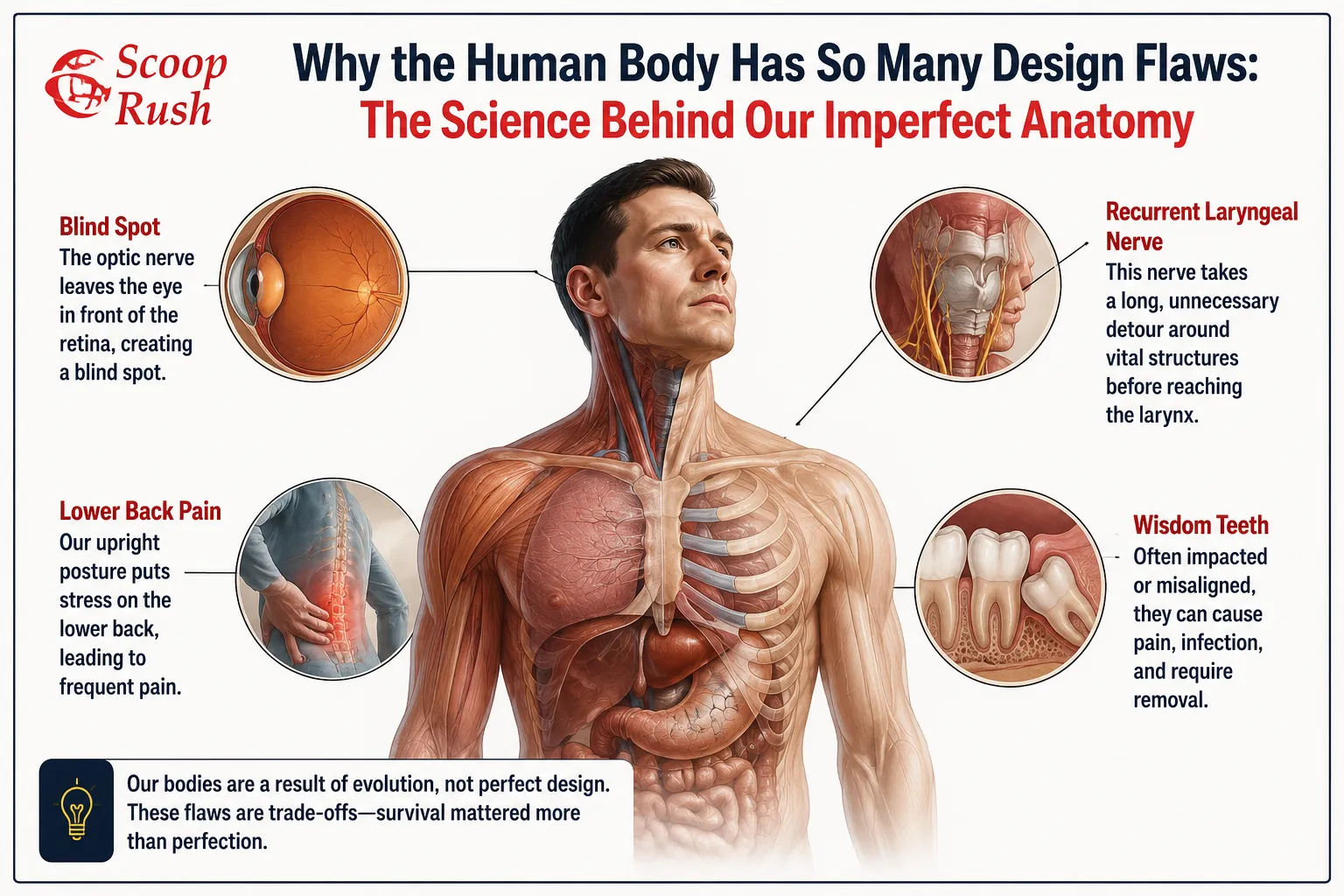
Your spine curves in ways that guarantee back pain. Your eyes have a permanent blind spot. And a nerve in your neck takes a completely unnecessary detour through your chest before reaching its destination just inches away. These aren’t birth defects or rare conditions. They’re standard features of every human body, and they explain why the human body has so many design flaws despite being called a marvel of nature.
The truth is simpler than you might expect. Evolution doesn’t design anything from scratch. Instead, it reworks old structures to serve new purposes, often leaving behind quirks, inefficiencies, and outright problems. This is somewhat similar to how neurons must break their own DNA to build the brain, a process that also looks messy and inefficient on the surface but reflects the improvisational nature of biology. Understanding why the human body has so many design flaws helps explain some of the most common health issues people face today, from lower back pain to impacted wisdom teeth.
This matters because these aren’t random misfortunes. They’re the direct result of millions of years of biological compromise. Once you see your body through this lens, conditions like sciatica, appendicitis, and difficult childbirth start to make a lot more sense .”This piece walks through the human body design flaws that show up across nearly every system, and where relevant, notes how engineers and design theorists push back on this framing.”
The Spine: A Structure Doing a Job It Wasn’t Built For
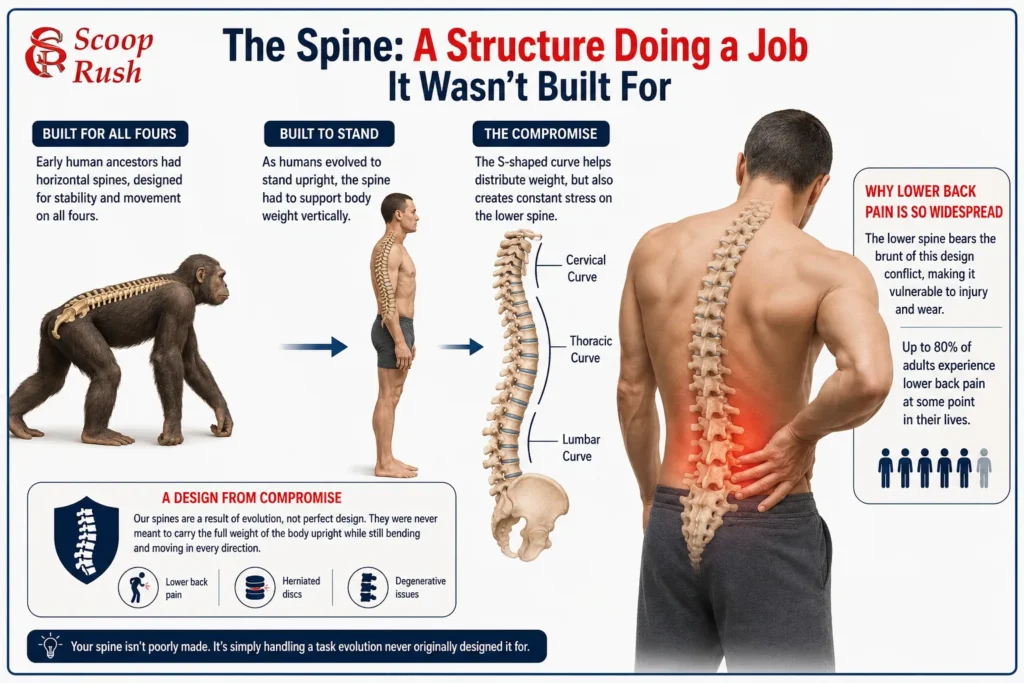
Your backbone started out as a horizontal support beam. Early human ancestors moved on four limbs, so their spines worked like flexible planks, built for smooth movement and basic protection of the spinal cord.
Then humans stood upright. Suddenly, that same spine had to support the body’s full weight vertically while still bending and flexing for movement. These two jobs pull in opposite directions, and the compromise created the S-shaped curve your spine has today.
This curve does help distribute weight more evenly. However, it also puts constant strain on the lower vertebrae. As a result, lower back pain, herniated discs, and other degenerative issues remain some of the most common medical complaints worldwide, with estimates suggesting around 80 percent of adults experience lower back pain at some point. Your spine isn’t poorly made. It’s simply handling a task evolution never originally designed it for.
Why Lower Back Pain Is So Widespread
Because the lower spine bears the brunt of this design conflict, it’s especially vulnerable to injury and wear. This is one of the clearest examples of how ancient anatomy struggles to keep up with modern demands like sitting at desks or standing for long shifts.
The Knee: A Hinge Under Constant Pressure
The knee sits between two long levers, the femur and the tibia, which puts enormous strain on a joint that only bends in one direction. Unlike the ball-and-socket design of the hip or shoulder, the knee can only move forward and back. That’s part of the reason so many sports rules exist specifically to protect this joint from sideways impact, and why knee injuries remain one of the most common sports injuries overall.
A Nerve That Takes the Long Way Around
Few examples illustrate evolutionary leftovers better than the recurrent laryngeal nerve. This nerve helps control speech and swallowing by connecting the brain to the voice box. Logically, it should take the shortest possible path.
Instead, it travels down into the chest, loops around a major artery, and then climbs all the way back up to the larynx. This roundabout route made sense in fish-like ancestors, where the nerve simply wrapped around gill arches. As necks grew longer over evolutionary time, the nerve stretched along with them rather than rerouting.
The result is a nerve that’s more vulnerable to injury, particularly during neck or chest surgery. It’s a structural inefficiency that persisted simply because it never caused enough harm to be selected against.
Eyes, Teeth, and the Pelvis: More Evolutionary Trade-Offs
The Backward-Wired Retina
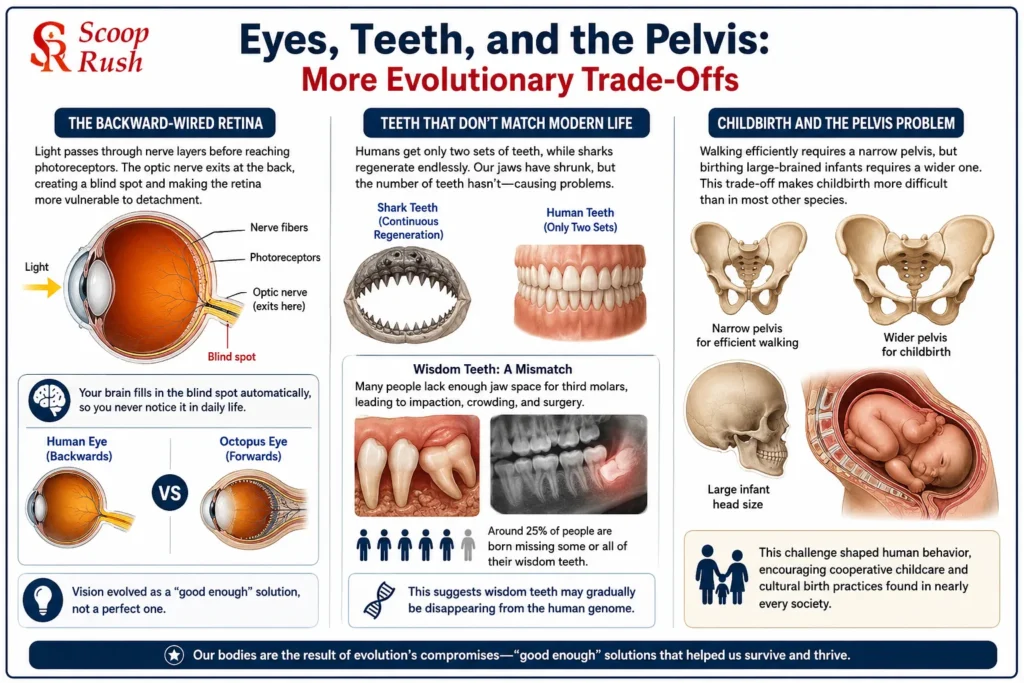
Human eyes are wired in a way that seems almost backward. Light has to pass through layers of nerve fibers before it even reaches the photoreceptor cells responsible for detecting it. Additionally, the optic nerve exits through the back of the retina, creating a blind spot in your visual field. This same wiring pattern is also thought to make the retina more prone to detaching from its supporting tissue, a leading cause of blindness.
Your brain fills in this gap automatically, so you never notice it in daily life. Still, this setup shows how vision developed as a “good enough” solution rather than an optimized one. Interestingly, octopuses and squids evolved retinas that face the correct direction, avoiding this blind spot entirely. This gap between what the brain perceives and what the eyes actually capture is a reminder of how much construction goes on behind the scenes, similar to how some people experience aphantasia and cannot visualize images in their mind at all.
Teeth That Don’t Match Modern Life
Humans get exactly two sets of teeth, unlike sharks, which regenerate their teeth continuously. Once adult teeth are lost, that’s it. Furthermore, human jaws have shrunk over time as diets became softer, but the number of teeth didn’t shrink at the same pace.
That mismatch is why wisdom teeth cause so many problems. Many people simply don’t have enough jaw space for their third molars, leading to impaction, crowding, and frequent dental surgery. Around a quarter of people today are born missing some or all of their wisdom teeth, which suggests this feature may gradually be disappearing from the human genome.
Childbirth and the Pelvis Problem
Perhaps no trade-off is more dramatic than the human pelvis. Walking efficiently requires a narrower pelvis, but birthing large-brained infants requires a wider one. Human babies have unusually large heads relative to their bodies, which makes childbirth more difficult and often more dangerous than in other species, frequently requiring outside assistance.
This tension didn’t just shape anatomy. It also influenced human behavior, encouraging cooperative childcare and the cultural practices around birth that exist across nearly every society.
Meandering Arteries and Blood Flow Quirks
Blood reaches your arms and legs through a single main artery that enters near the front of the limb, close to the biceps or hip flexors. To reach tissues at the back, like the triceps and hamstrings, that artery has to branch out and wind around bones, often bundling closely with nerves. This is why a sharp knock to your “funny bone” at the elbow sends a jolt down to your little finger. The artery and the ulnar nerve run close together just under the skin at that exact point, a byproduct of blood vessels taking indirect paths rather than the most efficient ones.
Structures That Stick Around for No Clear Reason
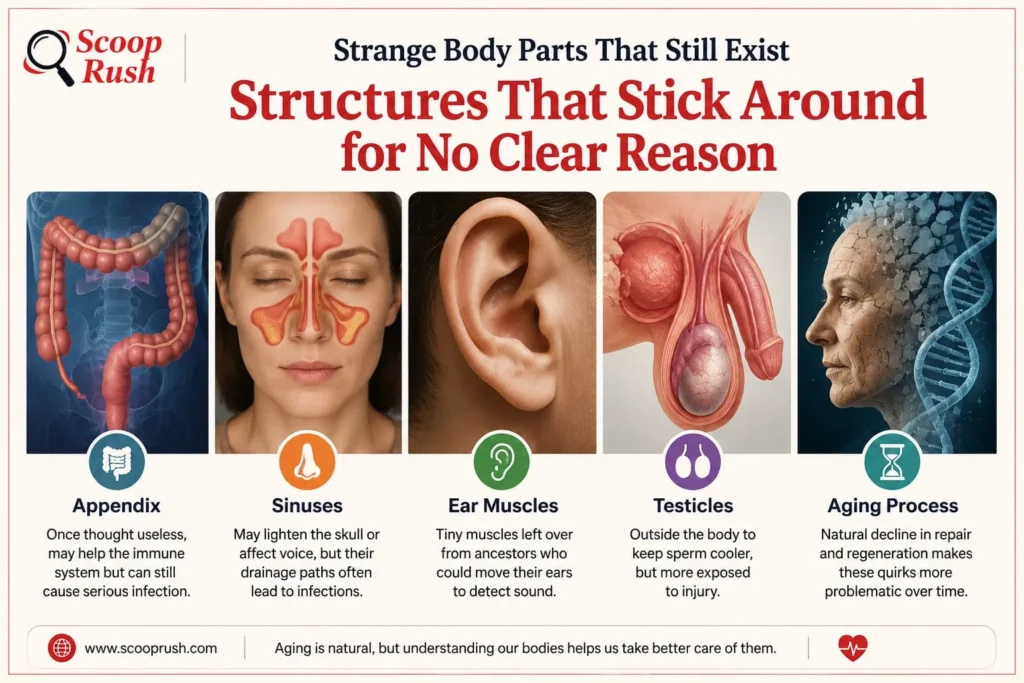
Evolution doesn’t necessarily remove features just because they’re not useful anymore. It only removes them if they cause serious harm. That’s why several body parts persist despite offering little modern benefit.
The appendix was once considered completely useless. Scientists now believe it may play a minor role in immune function. However, it can still become inflamed and cause appendicitis, a condition that can be life-threatening without treatment.
Similarly, the sinuses serve unclear purposes. They might lighten the skull or affect voice resonance, and their size and shape are even distinctive enough to be used in forensic identification. However, their drainage pathways make them prone to frequent blockages and infections. Meanwhile, tiny muscles around human ears are remnants from ancestors who could rotate their outer ears to detect sound direction. Most people today can’t use these muscles at all.
Even the male reproductive system shows a similar pattern. The testicles sit outside the body because sperm needs to stay slightly cooler than core body temperature to remain healthy until fertilization, leaving this vital organ more exposed to injury than if it were housed internally.
The Body’s Own Aging Process
These design compromises don’t just cause isolated problems. They also compound over time as tissues age and repair less efficiently. Researchers studying old muscle stem cells have found that the body’s ability to maintain and rebuild itself declines with age, though other studies show exercise may reverse some muscle aging through the DEAF1 gene. Diet also plays a role in how well these aging systems hold up, which is part of why understanding the risks of a no-sugar diet or the brain benefits of omega-3 fish oil supplements has become such a widely researched area.
Not Everyone Agrees the Body Is “Flawed”
It’s worth noting this isn’t a universally accepted framing. Some engineers and physicians argue that focusing on isolated quirks undersells just how remarkably the body’s systems work together. They point out that the body manages temperature, blood pressure, healing, and coordination across trillions of cells simultaneously, and that no human-engineered system comes close to matching this level of integration and self-repair. From this perspective, calling these features “flaws” overlooks the immense complexity required just to keep a body alive and functioning day to day. This is a genuinely contested debate, and readers may want to weigh both viewpoints for themselves.
What This Means for Understanding Your Own Health
“Recognizing why the human body has so many design flaws changes how you think about common health problems.”. Back pain, difficult childbirth, dental crowding, and sinus infections aren’t just bad luck. They’re the direct consequences of a body built through modification rather than fresh design.
This evolutionary perspective doesn’t make these conditions less frustrating. However, it does offer context. Your body isn’t broken. It’s the product of a long history of compromises that worked well enough to keep humans alive and reproducing, even if they didn’t produce perfection.
Conclusion
“These human body design flaws aren’t signs of poor engineering, but signs of a long, improvisational history.”The human body carries visible evidence of its evolutionary past in nearly every system. The spine juggles two conflicting jobs. A nerve in the neck takes a completely unnecessary detour. Eyes have a built-in blind spot. Teeth don’t match modern jaw size. The knee bends in only one direction. And the pelvis balances mobility against the demands of childbirth.
None of these features exist because evolution aimed for flaws. They exist because evolution works with what’s already there, adjusting existing structures rather than starting over. Ultimately, understanding this helps explain why so many common medical issues, from back pain to wisdom tooth removal, are so widespread across the human population. Whether you see these traits as flaws or as evidence of remarkable adaptability, they remain a fascinating window into where we came from.
FAQs
Why does the human body have so many design flaws?
The human body evolved through gradual modification of existing structures rather than being designed from scratch. This process, called evolutionary compromise, often results in structures that work well enough for survival but aren’t optimized for their current function.
Why does the recurrent laryngeal nerve take such a long path?
This nerve originally looped around gill arches in fish-like ancestors. As necks lengthened over millions of years, the nerve stretched along with them instead of taking a more direct route, leaving it vulnerable to injury today.
Why is the human pelvis linked to painful childbirth?
The pelvis must balance two conflicting demands: a narrow shape for efficient walking and a wide shape for birthing large-headed infants. This trade-off makes human childbirth more difficult compared to many other species.
Is the appendix completely useless?
No. While long considered a leftover structure, research suggests the appendix may have a minor role in immune function. However, it can still become inflamed and cause appendicitis, a serious medical condition.
Why do humans get wisdom teeth if they cause problems?
Wisdom teeth were useful when human ancestors had larger jaws suited to tougher diets. As jaws became smaller over time, the number of teeth didn’t decrease at the same rate, leaving many people without enough room for their third molars.

