
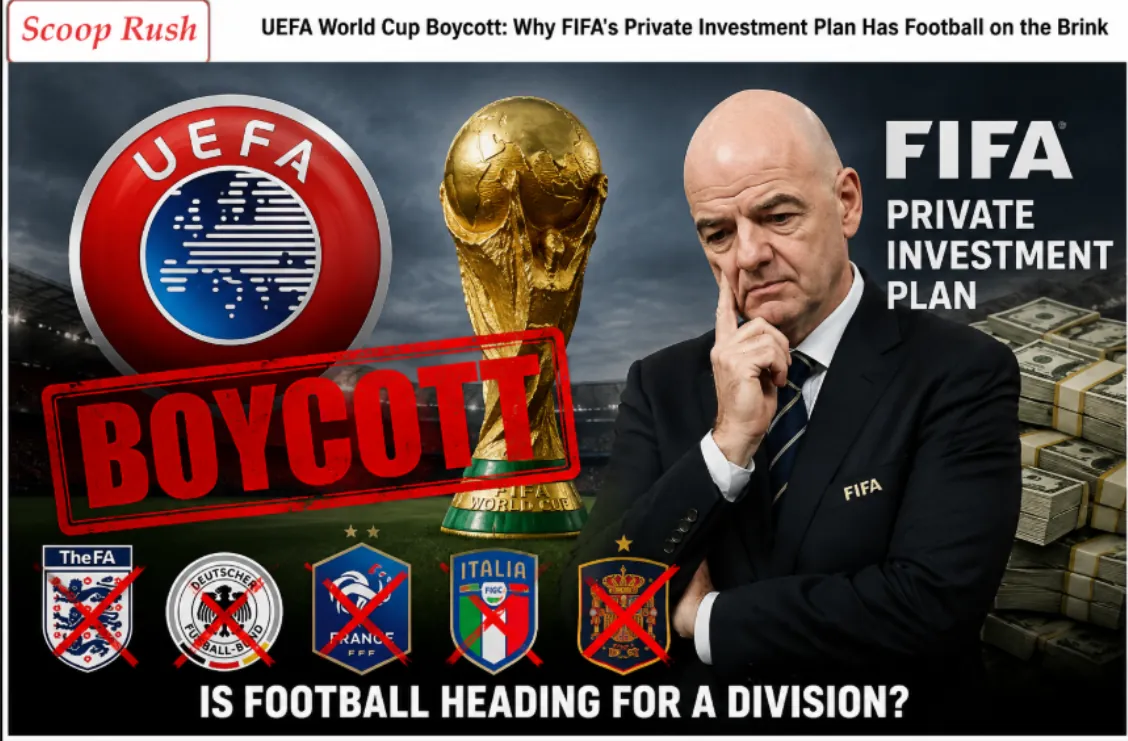
A UEFA World Cup boycott is no longer just talk. It’s now official. UEFA has voted to walk away from every FIFA competition, including the World Cup, unless FIFA drops its private investment plan. As a result, the tournament fans have followed for generations now hangs in the balance.
FIFA president Gianni Infantino insists that “nobody is selling football.” However, his own federation’s plan to bring private money into FIFA’s commercial operations has triggered open revolt. Some of the sport’s most powerful governing bodies are pushing back hard. This matters for every football fan. After all, it could reshape how the World Cup runs for decades to come.
This article breaks down what is happening. It also explains why UEFA and other confederations are furious, and what could come next.
What Is FIFA’s Private Investment Plan?
At the heart of the dispute sits a new commercial subsidiary called FIFA Forward Enterprise, or FFE. This subsidiary would run FIFA’s major events, including the World Cup. External investors would then buy stakes in it.
FIFA describes the plan as inviting “minority, non-controlling investments” from outside parties. In other words, private investors would not take full ownership. Still, they would gain a financial foothold inside one of the most valuable properties in global sport.
A 25-page document from investment bank JP Morgan lays out the numbers. It projects that FIFA’s tournaments will expand. As a result, member associations could see payouts rise to an estimated 24 million euros per association during the 2035-2039 cycle.
The document also talks up “new business initiatives” and incentive-driven pay for top talent. Notably, it calls the World Cup the most-watched sporting event on the planet. Yet it claims FIFA remains “under-monetised.”
A Notable Gap in the Proposal
One detail has raised eyebrows across the football world. The JP Morgan document reportedly skips any mention of the women’s game. This is surprising, since women’s football has seen record growth in viewership and investment. Consequently, this omission has become a major point of criticism.
FIFA, for its part, describes a different goal than critics claim. The federation says FFE lets every member association take real ownership of football’s commercial opportunity in their own country. FIFA insists this won’t cost the game its spirit or its governance.
Inside the UEFA World Cup Boycott Threat
The FIFA private investment plan has not gone down well with football’s most influential organizations. UEFA governs European football. It voted to boycott World Cups altogether if the plan goes ahead, and this UEFA World Cup boycott would cover every major FIFA tournament.
UEFA’s statement did not hold back. The organization argued that private investors should never own any part of the World Cup, calling it one of football’s greatest sporting legacies, built over generations by players, teams, and fans. UEFA framed the plan as a failure of leadership and a betrayal of FIFA’s duty to protect the game.
Concacaf also rejected the proposal. Concacaf governs football across North and Central America. This marks a significant blow to Infantino, since Concacaf hosted this year’s World Cup. The organization’s members raised deep concerns about the lack of due process behind the proposal. They also flagged the tight deadline federations faced to decide.
Additionally, Concacaf questioned why FIFA needed private investment at all. After all, FIFA itself called this year’s tournament the most profitable World Cup in history.
Asia and Other Confederations Weigh In
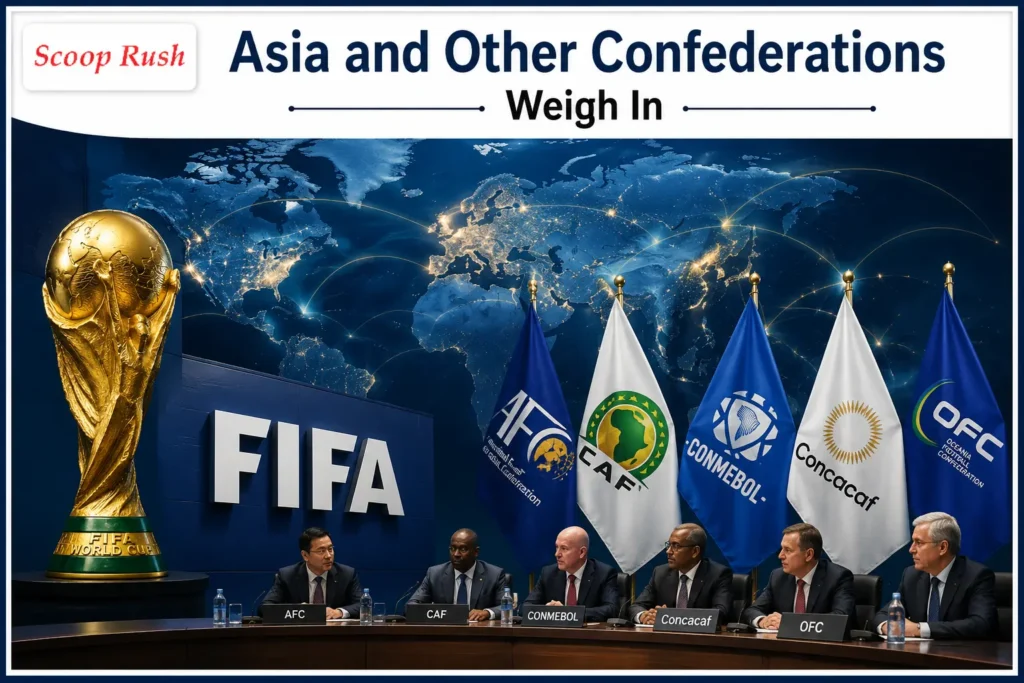
The Asian Football Confederation, or AFC, added its voice to the criticism. It said FIFA’s unilateral approach undermines the foundations of continental football. The AFC also complained that FIFA never consulted it before announcing the plan, and never shared governance, financial, or legal details in advance.
South America’s confederation, Conmebol, has not yet issued a public response. Meanwhile, the governing bodies for Africa and Oceania, CAF and OFC, plan to discuss the proposal in August.
The Voting Math Behind FIFA’s Plan
Infantino needs 106 of FIFA’s 211 member associations to vote in favor. However, UEFA and Concacaf combined already control 96 votes. That alone puts the plan on shaky ground, especially if other confederations follow their lead.
Adding to the tension, FIFA has dangled financial incentives to sway the vote. Infantino reportedly promised FIFA members $40 million each if they backed his proposal. He also gave federations a September 19 deadline to accept the plan and unlock an initial $20 million payment.
Critics argue this timeline pressures member associations into a rushed decision. Meanwhile, UEFA accused FIFA of enriching “themselves and their friends.” That’s a serious allegation, and it shows just how deep the mistrust runs.
Who Would Benefit From the Investment Deal?
If the plan wins approval, FIFA expects Thrive Eternal to lead the investor group behind FFE. Joshua Kushner founded this American venture capital firm. He is the brother of Jared Kushner, who is US President Donald Trump’s son-in-law.
This connection has added another layer of scrutiny to an already controversial proposal. It introduces a political dimension to what should be a purely footballing decision.
What Happens Next With the UEFA World Cup Boycott and FIFA’s Plan?
The road ahead holds real uncertainty. UEFA’s boycott only kicks in if enough member associations accept Infantino’s funding deal. Given the September 19 deadline, and payouts due from January 1, events could move fast.
There’s also a practical complication. The Under-20 Women’s World Cup starts on September 5 in Poland and features several European nations. If tensions boil over, countries could theoretically pull out mid-competition, even before the semi-finals.
After that event, the next major FIFA competition lands in October: the Women’s World Cup play-offs. These include England, Scotland, Wales, and Northern Ireland among the participating nations.
Infantino’s Political Position
This controversy hits at a sensitive time for Infantino personally. He became FIFA president in 2016, beating Asian Football Confederation president Sheikh Salman al-Khalifa by 115 votes to 88. He plans to stand for a fourth term in March. Until this week, most people expected him to win unopposed.
Many federations, including some in Europe, have already confirmed their support for him. However, sources say a large number of Concacaf members are losing confidence in his leadership. Some have lost it altogether. Infantino won unopposed in both 2019 and 2023.
Do Smaller Football Nations Need This Investment?
Not everyone opposes the plan. UEFA’s members rank among the wealthiest football federations in the world. Still, many nations elsewhere depend heavily on FIFA funding for basic infrastructure.
Former Football Association chief executive Mark Palios compared the situation to the failed European Super League attempt. He noted that smaller nations have real needs. Meanwhile, larger nations hold more power. This creates a fundamental tension in how the sport should run.
Rogers Byamukama of the Ugandan Football Federation offered a different view. He argued that football costs a lot to run, especially in regions like Africa, where resources run thin. According to Byamukama, FIFA funding has supported major infrastructure projects. It has also funded grassroots programs and football schools in countries like Uganda.
From his point of view, football should welcome any option that brings in more resources. These funds, he explained, ultimately reach the federations that need them most, particularly in Africa. He acknowledged UEFA’s right to voice concerns. However, he pointed out that UEFA’s wealthier members rely far less on FIFA funding than many other federations, where Infantino remains popular.
FIFA’s Funding Track Record So Far
To understand what’s at stake, it helps to look at FIFA’s existing funding programs. The FIFA Forward development initiative delivered $2.8 billion for investment across all 211 member associations. This covered its first two cycles, running through 2022.
The most recent cycle, FIFA Forward 3.0, covers 2023 to 2026. It delivered a 30% increase in available funding compared to previous cycles. FIFA also gave an additional $5 million to every member association. On top of that, each confederation received $60 million for its own projects.
This existing funding structure explains why the debate has grown so heated. Supporters of the plan argue it could boost these numbers significantly further. Critics, meanwhile, worry it comes at the cost of independence and long-term control over the sport’s most valuable assets.
Conclusion: A Defining Moment for FIFA
The FIFA private investment plan has exposed a deep divide in world football’s governing structure. FIFA argues the proposal will boost funding, expand tournaments, and give member associations more ownership of football’s commercial future. UEFA, Concacaf, and the AFC argue it threatens the integrity, independence, and spirit of the game itself.
UEFA is threatening a boycott. Concacaf has firmly rejected the plan. As a result, FIFA faces a serious challenge in reaching the 106 votes it needs. As the September 19 deadline approaches, the football world will watch closely. Will Infantino hold his coalition together? Or will this become the moment that redefines how the World Cup runs?
Ultimately, this dispute is about more than money. It’s a question of who controls the future of the world’s most popular sport, and whether private investors get a seat at the table.
Frequently Asked Questions
What Is FIFA’s Private Investment Plan Really About?
FIFA’s plan creates a commercial subsidiary called FIFA Forward Enterprise (FFE) to run major FIFA events, including the World Cup. Under the proposal, private investors could buy minority, non-controlling stakes in this subsidiary.
Why Is There a UEFA World Cup Boycott Threat?
UEFA voted to boycott World Cups if FIFA approves its private investment plan. UEFA argues the World Cup should never work as an investment product, and it believes the plan threatens the sport’s independence and integrity.
How Many Votes Does FIFA Need to Approve the Plan?
FIFA needs support from 106 of its 211 member associations to pass the plan. However, UEFA and Concacaf together hold 96 votes, and both have rejected the proposal. That makes approval far from certain.
Who Would Invest in FIFA’s New Commercial Subsidiary?
If FIFA approves the plan, Thrive Eternal, an American venture capital firm founded by Joshua Kushner, is expected to lead the investor group behind FIFA Forward Enterprise.
When Do Member Associations Need to Decide on the FIFA Plan?
FIFA gave member associations a September 19 deadline to accept the plan and unlock an initial $20 million payment. Further funding depends on future milestones.

