Competition: FIFA World Cup 2026™ (Round of 32) Date: 29 June 2026 Venue: Boston Stadium, Foxborough, Massachusetts Full Time: Germany 1-1 Paraguay (After Extra Time) Penalty Shootout: Paraguay won 4-3
Paraguay produced one of the biggest surprises of the FIFA World Cup 2026 by knocking Germany out in a dramatic Round of 32 clash. After a 1-1 draw across 120 minutes, Paraguay held their nerve in the penalty shootout to claim a 4-3 victory and book their place in the Round of 16.
FIFA World Cup 2026: Enciso Puts Paraguay Ahead
Germany dominated possession from the opening whistle and controlled the tempo with accurate passing. However, Paraguay remained compact and defended with discipline.
Despite seeing little of the ball, Paraguay struck first in the 42nd minute. Julio Enciso rose inside the penalty area to head home from a well-delivered cross, giving the South Americans a 1-0 lead before halftime.
Germany enjoyed most of the possession but failed to convert their control into goals during the opening period.
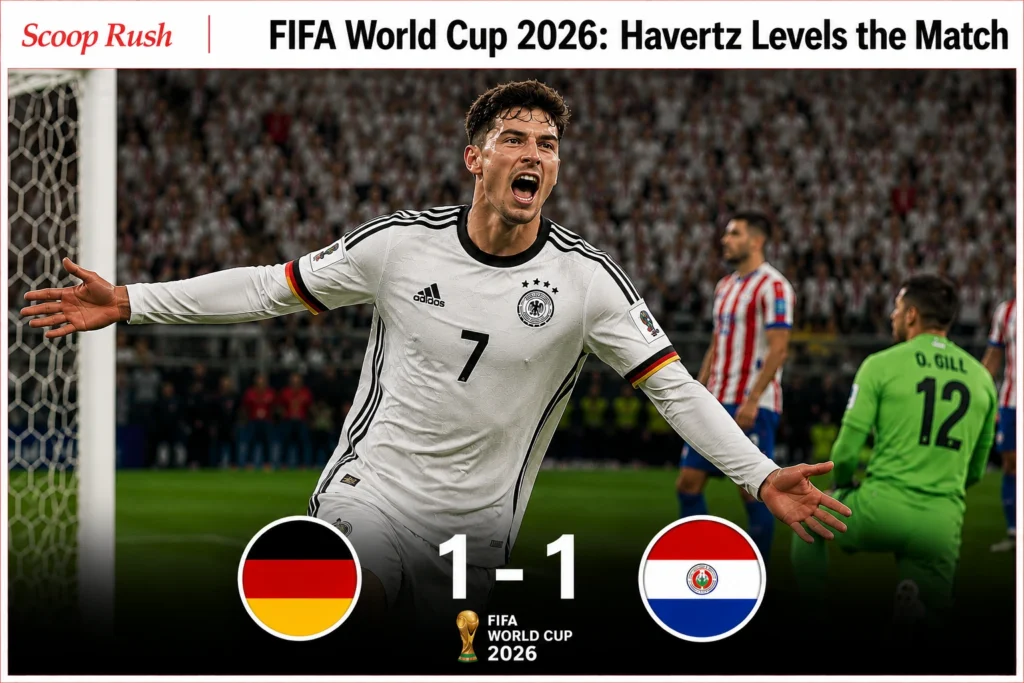
FIFA World Cup 2026: Havertz Levels the Match
Germany responded positively after the break and increased the pressure on Paraguay’s defence.
Their persistence paid off in the 54th minute when Kai Havertz headed home from a cross by Florian Wirtz, bringing Germany level at 1-1.
Both teams created opportunities during the remainder of normal time, but neither side found the decisive goal. The match therefore moved into extra time.
Extra Time Ends Without a Winner
Germany continued to dominate possession throughout extra time and pushed for a late winner. Paraguay, meanwhile, stayed organised and relied on disciplined defending and strong goalkeeping.
Germany thought they had scored the winning goal late in extra time, but the effort was ruled out following a VAR review for a foul in the build-up.
With the score still level after 120 minutes, the contest was decided by a penalty shootout.
Paraguay Win the Penalty Shootout
The shootout delivered another dramatic twist.
Paraguay goalkeeper Orlando Gill made crucial saves to deny Kai Havertz and Nick Woltemade, putting Germany under immediate pressure. Although Manuel Neuer kept Germany alive with an important save, Jonathan Tah missed Germany’s decisive sudden-death penalty.
José Canale then confidently converted the winning spot kick to seal a 4-3 shootout victory and send Paraguay into the Round of 16.
Match Statistics
Statistic
Germany
Paraguay
Shots
21
7
Shots on Target
7
4
Possession
75%
25%
Passes
753
262
Pass Accuracy
92%
69%
Fouls
18
12
Yellow Cards
2
2
Red Cards
0
0
Corners
16
6
Germany dominated possession and created far more chances, yet Paraguay’s defensive resilience and clinical penalty shooting proved decisive.
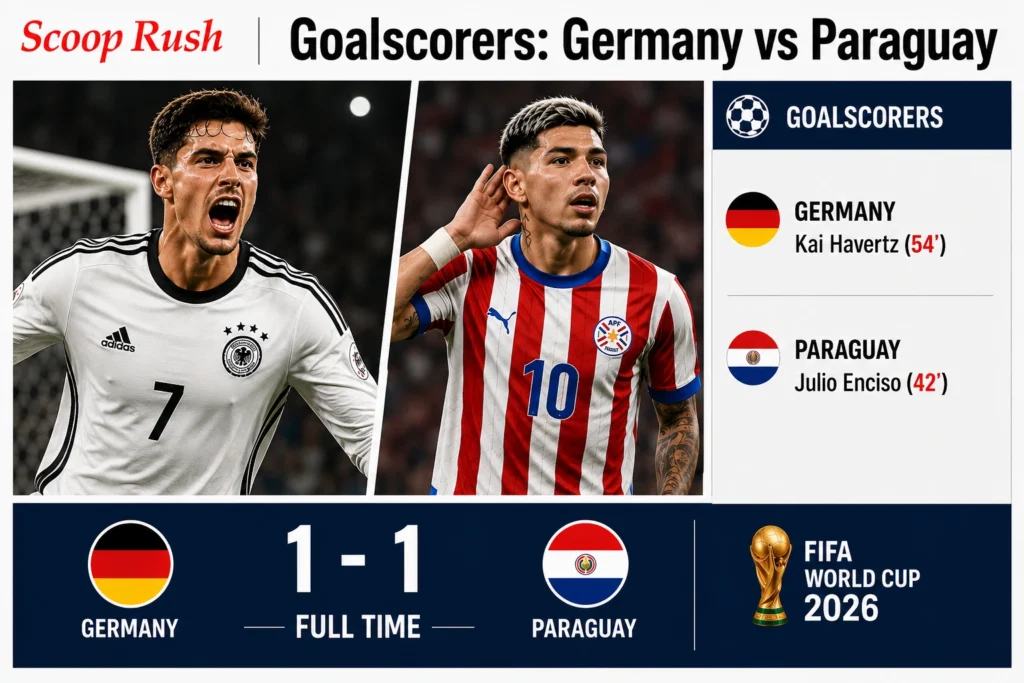
Goalscorers: Germany vs Paraguay
Germany: Kai Havertz (54′) Paraguay: Julio Enciso (42′)
Tactical Analysis
Germany operated in a 4-2-3-1 formation and controlled possession for long spells. Their midfield dictated play while the full-backs pushed forward to stretch Paraguay’s defence. However, Germany struggled to create enough clear-cut chances against a packed defensive block.
Paraguay lined up in a compact 4-5-1 system and focused on defensive organisation. They defended deep, limited space in central areas, and looked to counterattack whenever opportunities appeared. Goalkeeper Orlando Gill delivered an outstanding performance, while the defenders remained composed under constant pressure.
What the Result Means
Paraguay’s historic victory sends them into the FIFA World Cup 2026 Round of 16 after eliminating four-time champions Germany. Their disciplined display and composure in the penalty shootout earned one of the tournament’s biggest upsets.
For Germany, the defeat marks a disappointing end to their campaign despite dominating the match statistically. Their inability to convert chances, combined with missed penalties, proved costly as their World Cup journey came to an end.
What if a cough that won’t go away is more than just a lingering cold? Lung cancer often develops quietly, and many people don’t notice symptoms until the disease has already progressed. Recognizing the warning signs early and understanding the risk factors can make a real difference in when the disease is diagnosed and how well it can be managed.
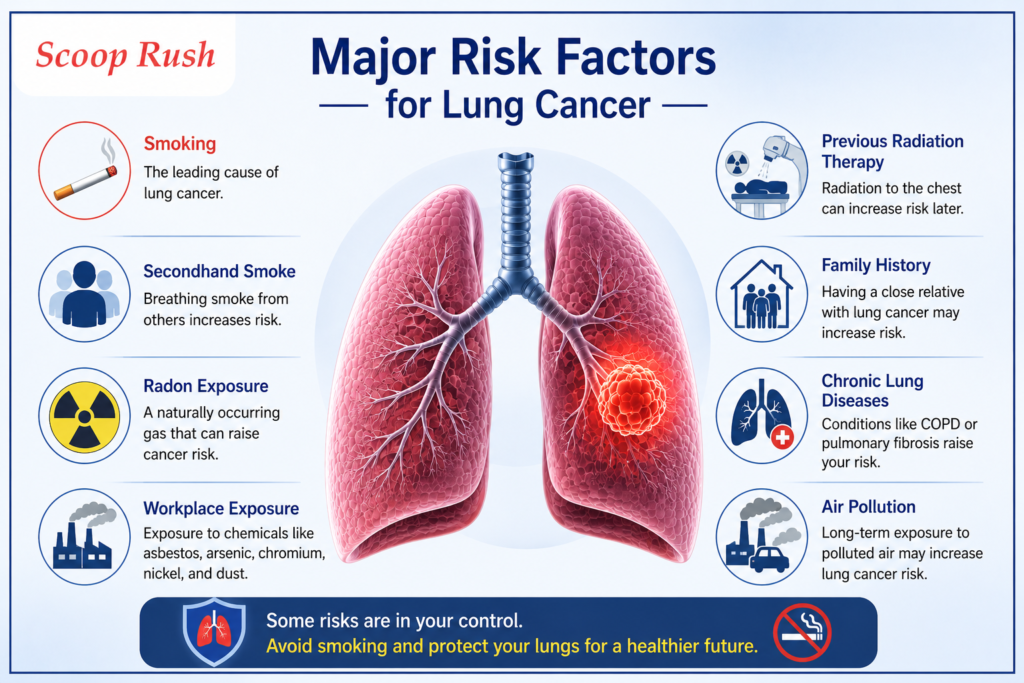
Lung cancer remains one of the leading causes of cancer-related deaths worldwide. Smoking is the most significant risk factor, but it isn’t the only one. People who have never smoked can still develop lung cancer due to secondhand smoke, radon exposure, air pollution, workplace chemicals, and family history.
This guide covers what lung cancer is, its symptoms, major risk factors, diagnostic tests, treatment options, and ways to lower your risk. It also looks at non-small cell lung cancer (NSCLC), the most common form of the disease, and explains why early detection matters so much — the same principle behind other cancer-prevention breakthroughs, such as how the HPV vaccine prevents cervical cancer deaths.
What Is Lung Cancer?
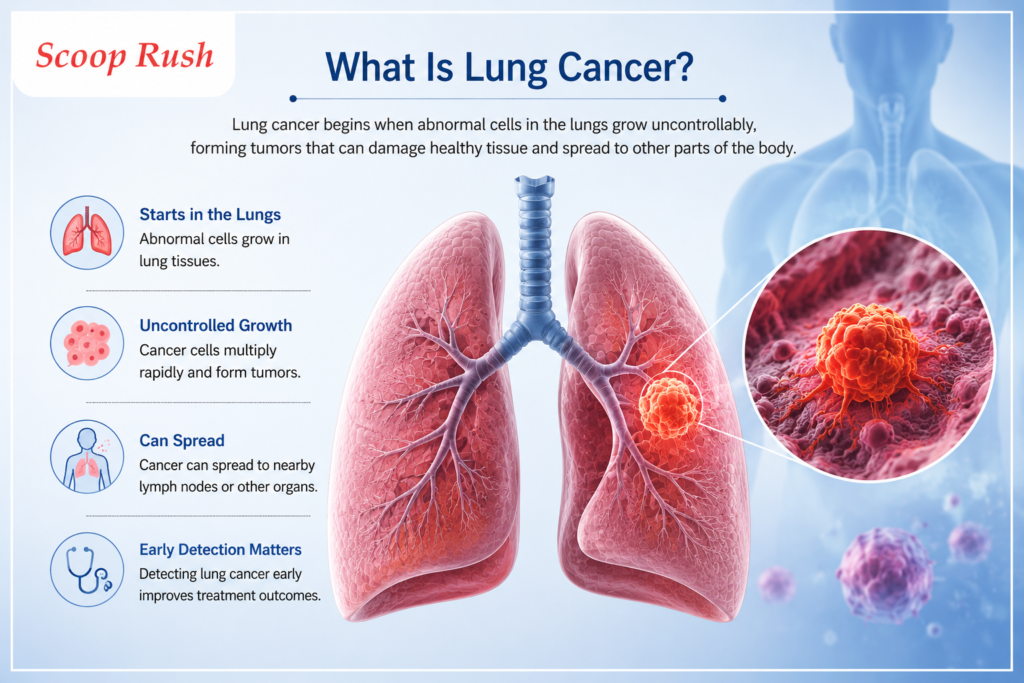
Lung cancer begins when abnormal cells in the lungs grow uncontrollably. Instead of dying off naturally, these damaged cells multiply and form tumors that interfere with normal lung function.
The lungs supply oxygen to the body and remove carbon dioxide. As tumors grow, they can block airways, reduce lung function, and eventually spread to nearby tissue or distant organs through the bloodstream or lymphatic system.
Lung cancer generally falls into two main categories:
Non-small cell lung cancer (NSCLC) — accounts for about 80–85% of all cases.
Small cell lung cancer (SCLC) — less common, but usually faster-growing.
Although these cancers behave differently and respond to treatment differently, early diagnosis matters for both.
Why Early Detection Matters
One of the biggest challenges with lung cancer is that it often causes few or no symptoms in its early stages. As a result, many people aren’t diagnosed until the disease has spread beyond the lungs. When lung cancer is caught earlier, treatment tends to be more effective and long-term outcomes are generally better.
Because of this, any persistent or unusual respiratory symptom is worth having checked by a healthcare professional rather than waiting it out.
Common Symptoms of Lung Cancer
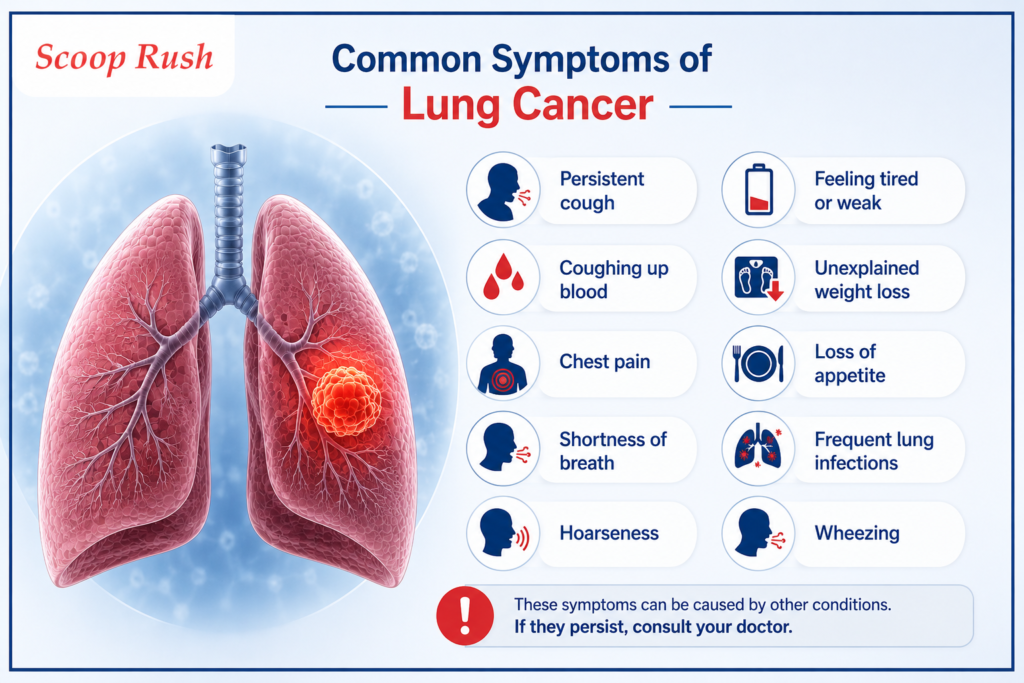
Symptoms vary depending on where the tumor is located and whether it has spread. The most common warning signs include:
A cough that doesn’t go away or gets worse over time
Coughing up blood or rust-colored mucus
Chest pain that worsens with coughing or deep breathing
Frequent lung infections such as bronchitis or pneumonia
These symptoms can result from other conditions too, but they should always be discussed with a doctor if they persist.
Symptoms of Advanced Lung Cancer
When lung cancer spreads beyond the lungs, additional symptoms can appear depending on which organs are affected:
Bone pain, especially in the back or hips
Persistent headaches, seizures, dizziness, or balance problems
Weakness or numbness in the arms or legs
Yellowing of the skin or eyes (jaundice)
Swollen lymph nodes in the neck or above the collarbone
These signs call for prompt medical evaluation, since they may point to metastatic disease. Older patients managing lung cancer should also be mindful of other health vulnerabilities that come with age, such as heat and humidity risks for seniors.
What Causes Lung Cancer?
Lung cancer develops after genetic changes occur in lung cells, allowing damaged cells to keep growing instead of dying off normally. Over time, these abnormal cells build up and form tumors. Smoking remains the leading cause, but the disease can also develop in people who have never smoked.
Major Risk Factors
Smoking is the single greatest risk factor. Risk rises with the number of cigarettes smoked and the number of years spent smoking though quitting substantially reduces risk, even after long-term use.
Secondhand smoke also raises risk for those regularly exposed to others’ tobacco smoke.
Radon exposure a naturally occurring radioactive gas that can build up inside homes and buildings significantly increases risk with long-term exposure.
Workplace exposure to substances such as asbestos, arsenic, chromium, nickel, metal dust, and mineral dust can damage lung tissue over time. The danger is greater for workers who also smoke.
Previous chest radiation, family history of lung cancer, and chronic lung disease — including COPD and pulmonary fibrosis — are also linked to increased risk. Genetic and immune factors influence many chronic illnesses beyond lung cancer, as seen in emerging treatments like teplizumab for type 1 diabetes.
Lung Cancer in Underserved Communities
Access to healthcare plays a major role in outcomes. Underserved communities often face limited access to routine care, lower screening rates, delayed diagnosis, and greater exposure to smoking, pollution, and workplace hazards — so lung cancer is often diagnosed at more advanced stages. Expanding access to screening and healthcare services could help close this gap, along with broader efforts to create Gen Z jobs with purpose and better pay in safer working environments.
Understanding Non-Small Cell Lung Cancer (NSCLC)
NSCLC is the most common form of lung cancer. It generally grows more slowly than small cell lung cancer, but many patients are still diagnosed after the disease has spread, since symptoms often appear late.
Main subtypes include:
Adenocarcinoma — usually develops in the outer regions of the lungs; the most frequently diagnosed subtype.
Squamous cell carcinoma — often begins near the central airways and is strongly linked to smoking.
Large cell carcinoma — can develop anywhere in the lungs and may grow rapidly.
Less common subtypes include sarcomatoid carcinoma and adenosquamous carcinoma.
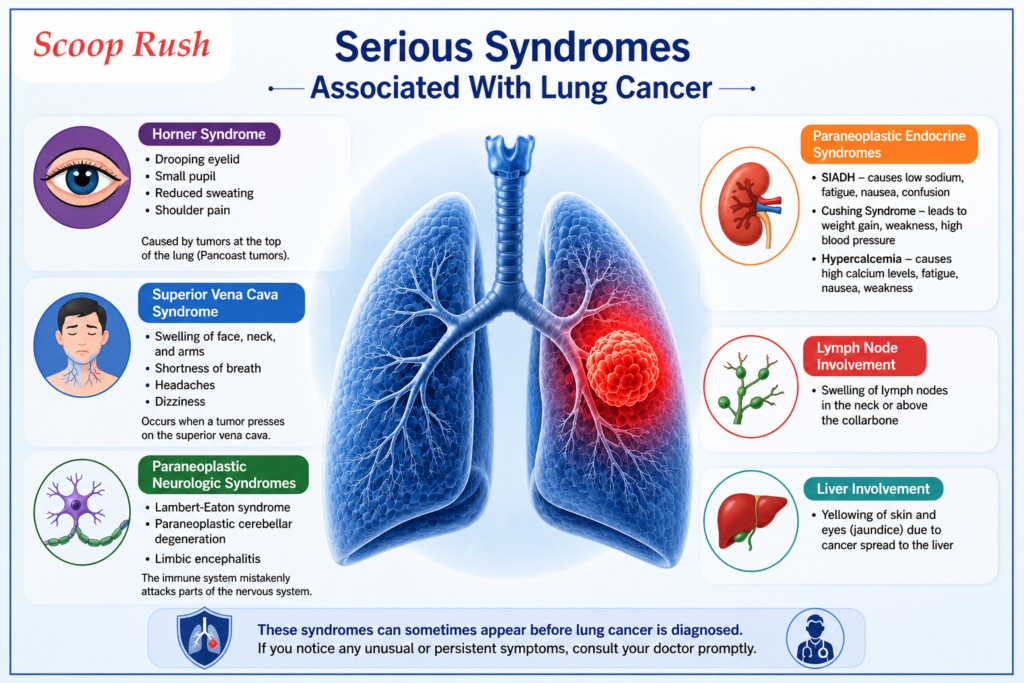
Serious Syndromes Associated With Lung Cancer
Some lung cancers cause symptoms that aren’t caused directly by the tumor itself.
Horner syndrome can occur when Pancoast tumors, located near the top of the lung, affect nearby nerves causing a drooping eyelid, a small pupil, reduced sweating on one side of the face, and shoulder pain.
Superior vena cava syndrome occurs when a tumor presses on the superior vena cava, interfering with blood flow. It can cause facial, neck, or arm swelling, difficulty breathing, headaches, and dizziness and in severe cases requires immediate medical attention.
Paraneoplastic syndromes happen when tumors release hormone-like substances or trigger immune responses affecting other organs, such as SIADH, Cushing syndrome, hypercalcemia, and Lambert-Eaton syndrome. These are uncommon but sometimes appear before lung cancer itself is diagnosed.
How Doctors Diagnose Lung Cancer
Diagnosis typically starts with a physical exam and medical history. If cancer is suspected, doctors may order chest X-rays, CT scans, PET scans, brain MRI, bronchoscopy, lung biopsy, or video-assisted thoracic surgery (VATS). A biopsy remains the definitive way to confirm a lung cancer diagnosis.
Treatment Options
Treatment depends on the cancer type, stage, tumor location, and the patient’s overall health. Many people receive more than one type of treatment.
Surgery — removes the tumor and surrounding tissue when cancer is confined to the lung; some patients need part or all of a lung removed.
Chemotherapy — uses medicines to destroy fast-growing cancer cells, given before or after surgery, alongside radiation, or as the main treatment.
Radiation therapy — directs high-energy beams at cancer cells while limiting damage to healthy tissue.
Targeted therapy — attacks cancers with specific genetic changes more precisely.
Immunotherapy — strengthens the immune system’s ability to recognize and attack cancer cells.
Possible Complications
Advanced lung cancer can lead to difficulty breathing, persistent coughing, coughing up blood, pleural effusion (fluid around the lungs), pain, and spread to the brain, bones, liver, or lymph nodes. Managing these complications is a key part of ongoing care.
Can Lung Cancer Be Prevented?
Not every case can be prevented, but healthy choices can lower risk:
Keep your home comfortable in extreme weather with simple home cooling tips for hot weather
Build healthy habits in your 20s and 30s to support long-term lung and overall health
When Should You See a Doctor?
Seek medical evaluation if you experience a cough lasting several weeks, coughing up blood, persistent chest pain, unexplained weight loss, ongoing shortness of breath, sudden wheezing, or repeated lung infections. Prompt evaluation can identify the cause and, if needed, lead to earlier treatment.
Outlook for People With Lung Cancer
Outlook depends on the type and stage of cancer, along with overall health. For NSCLC, outcomes are generally better when the disease is caught before it spreads. Even when a cure isn’t possible, modern treatments can slow progression, ease symptoms, and improve quality of life. Treatment options continue to expand, giving many patients more choices than ever before.
Conclusion
Lung cancer is serious, but understanding its warning signs, causes, and risk factors can help people seek care sooner. A persistent cough, coughing up blood, chest pain, unexplained weight loss, and breathing difficulties should never be ignored.
Smoking remains the leading risk factor, but lung cancer can affect non-smokers too environmental exposures, genetics, and chronic lung disease all play a role. Early diagnosis, accurate testing, and personalized treatment are central to better outcomes. By recognizing symptoms early, reducing avoidable risks, and talking to a healthcare provider about any concerns, people can take meaningful steps to protect their lung health alongside everyday wellness habits, from diet and exercise to simple routines like knowing how often you should brush your hair.
FAQs
1. What is the first symptom of lung cancer?
A persistent cough that won’t go away is one of the most common early symptoms, though some people have no symptoms in the early stages.
2. Can non-smokers get lung cancer?
Yes. Radon exposure, secondhand smoke, air pollution, workplace chemicals, and genetics can all lead to lung cancer in people who have never smoked.
3. What is the most common type of lung cancer?
Non-small cell lung cancer (NSCLC), accounting for roughly 80–85% of cases.
4. How is lung cancer diagnosed?
Through imaging tests such as chest X-rays, CT scans, PET scans, and MRI, along with bronchoscopy and lung biopsy for confirmation.
5. Can lung cancer be treated?
Yes. Options include surgery, chemotherapy, radiation therapy, immunotherapy, and targeted therapy, chosen based on cancer type, stage, and the patient’s overall health.
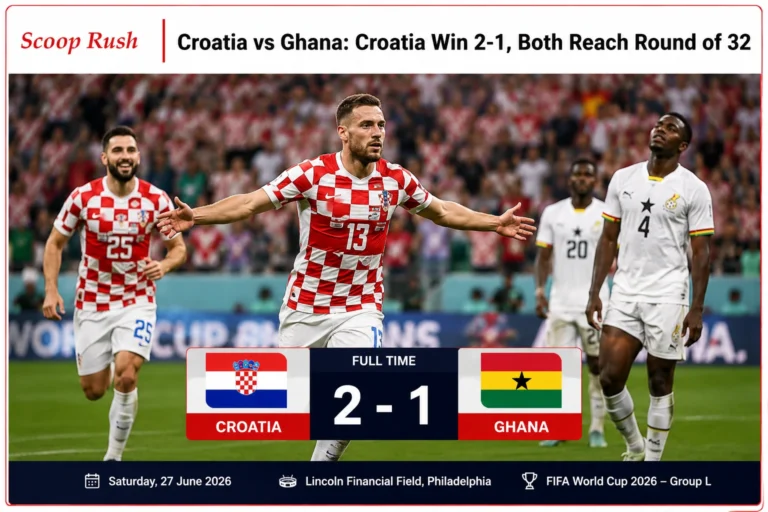
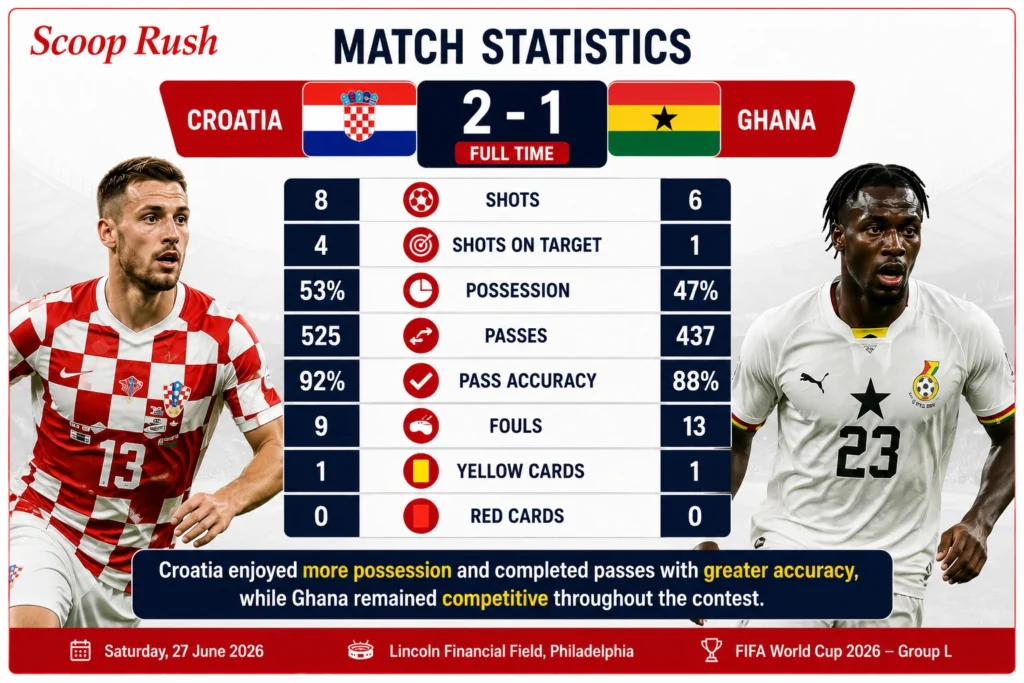
Competition: FIFA World Cup 2026 Stage: Group L Date: Saturday, 27 June 2026 Venue: Lincoln Financial Field, Philadelphia Full Time: Croatia 2-1 Ghana
Croatia vs Ghana delivered an entertaining Group L clash as Croatia claimed a 2-1 victory at the FIFA World Cup 2026. Croatia finished second in the group with six points to qualify for the Round of 32. Despite the defeat, Ghana also progressed after securing one of the best third-placed spots with four points, joining other group stage survivors such as Egypt and South Africa, who also advanced as strong third-placed finishers.
Croatia vs Ghana Match Summary
Croatia started brightly and controlled possession during the opening stages. Their midfield dictated the tempo and created several promising attacks.
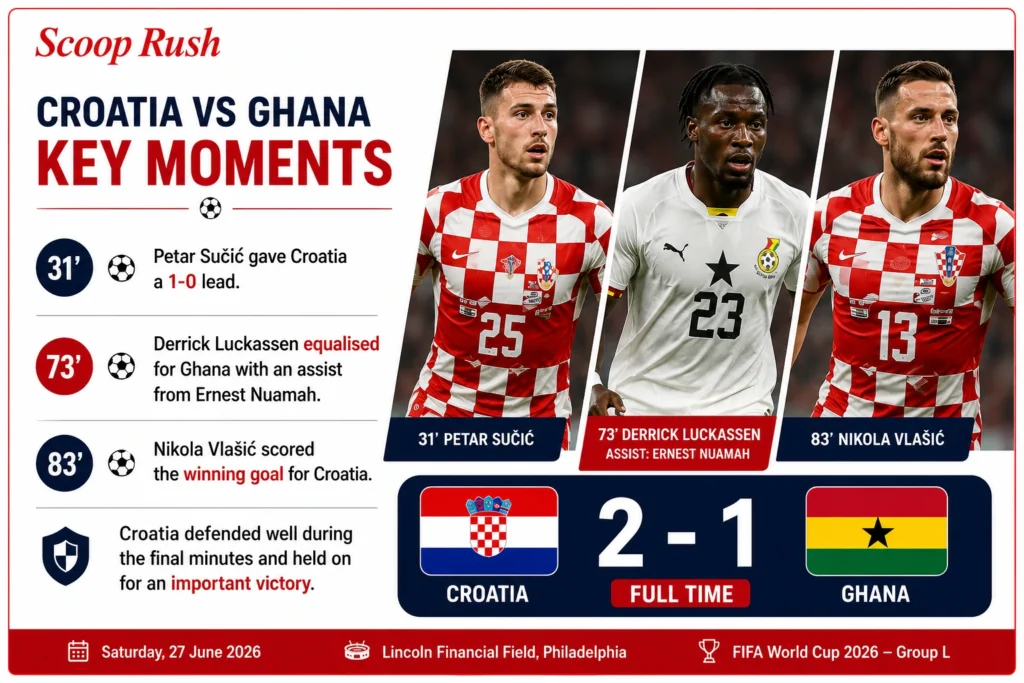
The breakthrough arrived in the 37th minute when Petar Sučić scored to put Croatia ahead. Ghana responded with greater intensity after the break and found an equaliser in the 72nd minute. Derrick Luckassen finished from close range after a well-worked move that was assisted by Ernest Nuamah.
The match remained evenly balanced until the closing stages. Then, in the 82nd minute, Nikola Vlašić scored the decisive goal to restore Croatia’s lead and seal all three points — a late winner reminiscent of Amad’s late strike against Ecuador earlier in the tournament.
Croatia vs Ghana Key Moments
37′ Petar Sučić gave Croatia a 1-0 lead. 72′ Derrick Luckassen equalised for Ghana with an assist from Ernest Nuamah. 82′ Nikola Vlašić scored the winning goal for Croatia.
Croatia defended well during the final minutes and held on for an important victory.
Tactical AnalysisCroatia vs Ghana
Croatia used a disciplined 4-3-3 formation and focused on controlling possession through midfield. Their passing remained sharp, while the full-backs regularly supported attacks down the flanks.
Meanwhile, Ghana relied on quick transitions and direct forward play. Their pressing improved after halftime, which led to the equaliser. However, Croatia stayed composed and made the most of their chances in the closing stages.
Croatia enjoyed more possession and completed passes with greater accuracy, while Ghana remained competitive throughout the contest.
Group L Standings
Position
Team
Played
Won
Drawn
Lost
GD
Points
1
England
3
2
1
0
+4
7
2
Croatia
3
2
0
1
0
6
3
Ghana
3
1
1
1
0
4
4
Panama
3
0
0
3
-4
0
What the Result Means
Croatia secured second place in Group L and advanced to the Round of 32. England topped the group with seven points after their final-round win over Panama. Ghana also qualified after finishing among the tournament’s best third-placed teams and will face the winners of Group K, which featured strong performances such as Colombia’s narrow win over DR Congo and Colombia’s goalless draw with Portugal, in the knockout stage. Panama finished bottom of the group without a point.
Player of the Match
Nikola Vlašić produced the decisive moment of the match with his late winning goal. His intelligent movement and composed finish ensured Croatia claimed all three points.
Conclusion
Croatia vs Ghana was a competitive encounter that showcased the quality of both teams. Croatia controlled possession, remained patient, and found a late winner through Nikola Vlašić. Although Ghana suffered a narrow defeat, their overall group performance was enough to secure a place in the FIFA World Cup 2026 Round of 32, joining other knockout-stage qualifiers like Switzerland, who topped Group B, and France, who finished top of Group I.
Introduction: Thylane Blondeau Wedding Sparks Debate Over Celebrity Privacy After Paris Ceremony
A wedding is usually one of the most private and emotional moments in a person’s life. However, for French model Thylane Blondeau, her wedding day quickly became an international discussion after paparazzi captured moments from her ceremony.
The Thylane Blondeau wedding gained attention not only because of her famous modeling career but also because of her message to photographers and media outlets. The model, who was famously called the “Most Beautiful Girl in the World,” said she was disappointed after some people entered the town hall and shared videos from her private wedding ceremony.
Blondeau explained that she respects photographers and understands their work, but she believes there is an important difference between covering a public event and invading a personal family moment. Public figures often find their private lives scrutinized in ways they never asked for — a pattern also seen in the case of Anne Hegerty’s Baby Reindeer-style stalker ordeal, where unwanted attention crossed personal boundaries.
Her statement has started a wider conversation about celebrity privacy, media boundaries, and how public figures experience major life events under constant attention.
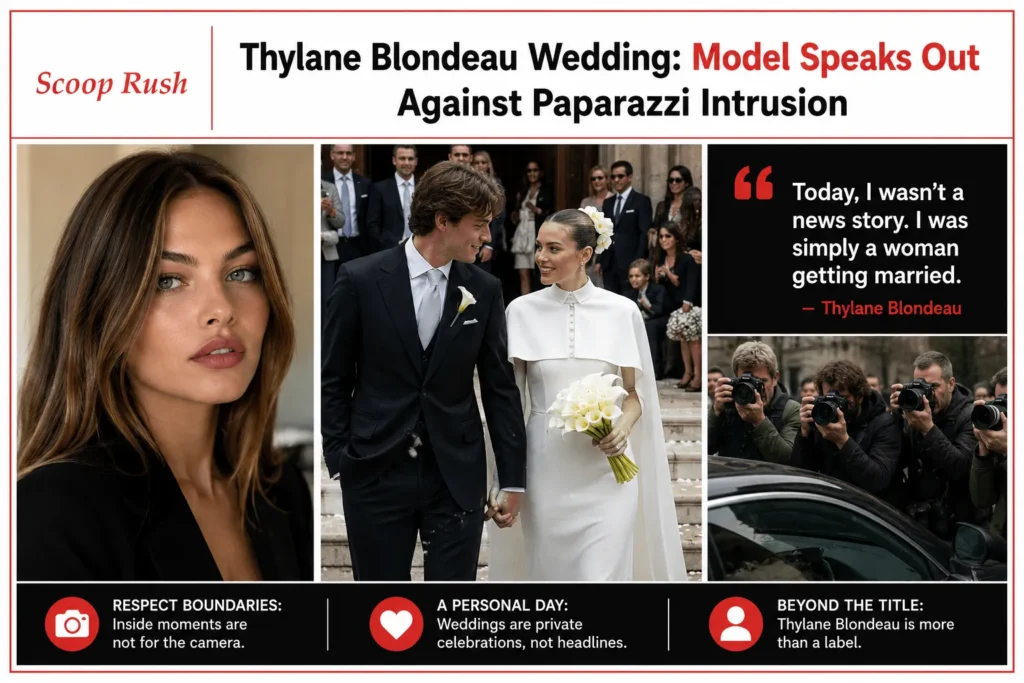
Thylane Blondeau Wedding: Model Speaks Out Against Paparazzi Intrusion
Following her Paris wedding, Thylane Blondeau shared an emotional message aimed at photographers and magazines.
She said that photographers waiting outside the town hall did not bother her because she has always respected the paparazzi industry. Since beginning her modeling career as a child, Blondeau said she tried to treat photographers with kindness and respect.
However, she said she was hurt when some individuals went inside the town hall and recorded parts of the ceremony.
According to Blondeau, taking photos from outside is different from entering a private celebration. She wanted her wedding to remain a personal memory instead of becoming only another entertainment story.
“Today, I wasn’t a news story. I was simply a woman getting married,” Blondeau said in her message.
Her comments received attention from fans who supported her request for privacy during such an important moment.
Who Is Thylane Blondeau?
Thylane Blondeau became famous around the world at a very young age. She started modeling when she was just four years old and worked with major fashion brands, including Dolce & Gabbana, Versace, and Hugo Boss.
Her early career attracted huge public attention, and she became one of the most recognizable young models in the fashion industry.
At the age of 17, Blondeau was included in TC Candler’s annual 100 Most Beautiful Faces of the Year list, continuing the attention surrounding her appearance.
However, Blondeau has previously explained that she does not fully identify with the famous title connected to her name.
She has said that she sees herself as a normal person and does not want to be defined only by a beauty label created by others.
Thylane Blondeau Marries Benjamin Attal in Romantic Paris Ceremony
The Thylane Blondeau wedding took place in Paris, where she married her longtime partner Benjamin Attal.
The couple had reportedly been together for several years before announcing their engagement. Blondeau shared the engagement news with fans by writing that she had said yes to her best friend.
Their wedding ceremony was a private celebration attended by close family members and friends.
For the special occasion, Blondeau wore a custom white bridal gown featuring a floor-length design and matching capelet. She completed the look with a sleek hairstyle decorated with white flowers.
She also shared glimpses of her wedding preparations and celebration with followers, including moments from the ceremony and photos with her new husband.
Meanwhile, wedding footage quickly spread online as fans congratulated the couple and celebrated their new chapter. Viral celebrity footage has a way of spreading fast and sparking unexpected controversy, much like the recent buzz around Ryan Reynolds’ alleged drunk driver accident, which dominated headlines within hours of breaking.
Who Is Benjamin Attal, Thylane Blondeau’s Husband?
Benjamin Attal is a French actor and DJ who comes from a well-known entertainment family.
He is the son of actor-director Yvan Attal and actress-singer Charlotte Gainsbourg. His family background has also placed him in the spotlight of French entertainment.
The couple’s relationship attracted attention because both Blondeau and Attal come from famous French families.
Despite public interest, they have kept much of their relationship away from the spotlight.
Their wedding marked a major milestone after years together.
Social Media Reaction to Thylane Blondeau’s Wedding
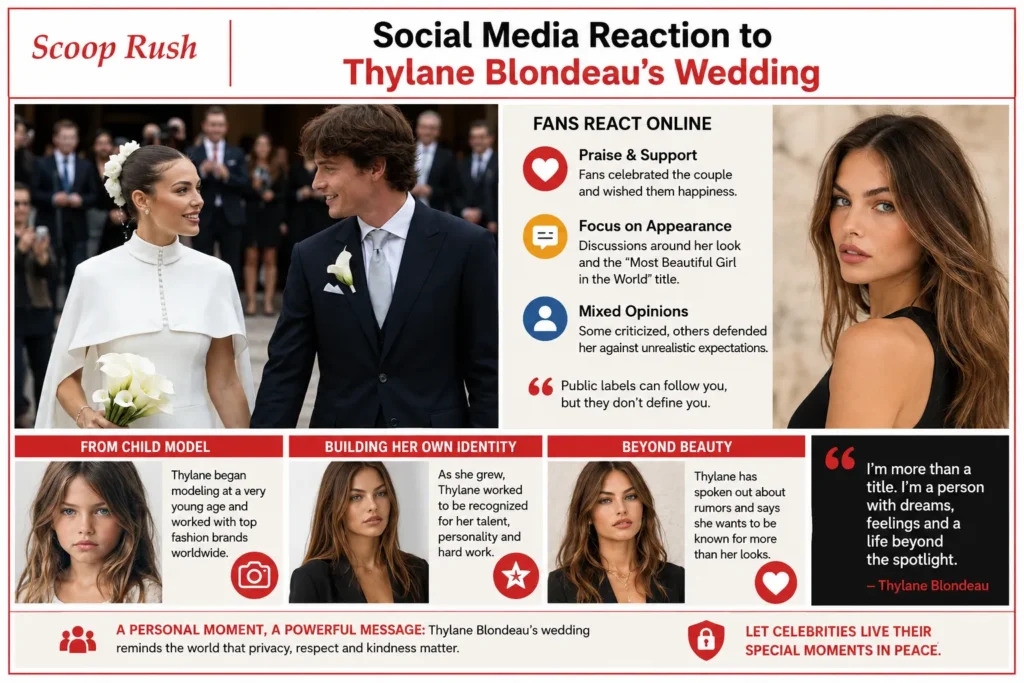
After images and videos from the ceremony appeared online, fans shared different opinions about the wedding.
Many people praised the couple and celebrated their marriage. Others discussed Blondeau’s appearance because of the long-running “Most Beautiful Girl in the World” title associated with her.
Some social media users criticized her wedding style, while others defended her against unrealistic expectations placed on public figures. Public opinion can shift quickly online, and the way fans rally around or scrutinize a celebrity often mirrors broader debates over fairness in the public eye — a dynamic also visible in discussions around Armie Hammer’s attempted comeback and the controversy over his film being banned in Germany.
The reactions showed how powerful public labels can become. A title given to Blondeau years ago continued to influence discussions about her, even during a personal moment like her wedding day.
Thylane Blondeau’s Journey From Child Model to Fashion Personality
Thylane Blondeau entered the modeling industry before she fully understood fame.
Starting as a child model, she worked with internationally recognized fashion brands and built a successful career over the years.
As she grew older, Blondeau worked to create her own identity beyond the title that made her famous.
She has also spoken openly about dealing with public comments and rumors about her appearance.
In 2021, she responded to claims about cosmetic procedures and explained that people often make assumptions based on makeup or styling. She denied changing her face and said comparisons online were unfair.
Thylane Blondeau Rejects Being Defined Only by Beauty
Although Blondeau has been known worldwide for her appearance since childhood, she has repeatedly explained that beauty is only one part of who she is.
She has said she wants people to recognize her as a person rather than only focusing on a title.
The discussion around the Thylane Blondeau wedding highlighted this message again. While many people focused on her famous past, Blondeau focused on celebrating her marriage and protecting a meaningful personal memory.
Thylane Blondeau’s Emotional Tribute During Wedding Celebration
The wedding also carried an emotional meaning for Blondeau’s family.
Her mother, Véronika Loubry, shared photos from the ceremony, including a tribute connected to her late husband Gérard Kadoche, who passed away in December 2025 after battling pancreatic cancer.
Blondeau had previously shared emotional words about Kadoche and expressed gratitude for his support and the role he played in her family’s life.
A framed photograph at the ceremony represented a meaningful way to remember him during such an important family occasion. Emotional family tributes often resurface unresolved public interest in earlier tragedies, similar to how renewed attention has followed updates and claimed video evidence in the Nancy Guthrie case.
Conclusion: Thylane Blondeau Wedding Highlights Love, Privacy, and Personal Boundaries
The Thylane Blondeau wedding became more than just a celebrity marriage story. It highlighted the challenges public figures face when personal moments become public events.
While fans celebrated Blondeau and Benjamin Attal’s new beginning, the model used the opportunity to remind people about the importance of respecting private moments.
From her early modeling career to becoming a global fashion figure, Blondeau has continued to deal with public attention. However, her wedding message showed that behind the famous title and media coverage, she simply wanted to experience one of the biggest moments of her life as a person, not a headline.
FAQs About Thylane Blondeau Wedding
1. Who did Thylane Blondeau marry?
Thylane Blondeau married Benjamin Attal, a French actor and DJ.
2. Why did Thylane Blondeau criticize paparazzi after her wedding?
She criticized some photographers after videos from inside her wedding ceremony were shared, saying her private moment should have been respected.
3. Why is Thylane Blondeau famous?
She became famous as a child model and was known internationally after being called the “Most Beautiful Girl in the World.”
4. Where did Thylane Blondeau get married?
Thylane Blondeau married Benjamin Attal in Paris.
5. When did Thylane Blondeau start modeling?
She started modeling at the age of four and worked with major fashion brands during her early career.
Your 20s and 30s are the ideal time to build habits that support long-term health. While many young adults focus on careers, relationships, and family, according to experts from Stanford Medicine, the healthy habits you build during your 20s and 30s can have a lasting impact on your physical and mental well-being.
You don’t need a complete lifestyle makeover. Small, consistent improvements in exercise, nutrition, sleep, and stress management can lower the risk of chronic diseases and help you stay healthier as you age.
Why Your 20s and 30s Matter
Early adulthood is when your body reaches peak muscle strength, bone density, and physical performance. These years are also when lifelong habits are formed.
Unfortunately, busy schedules, poor sleep, unhealthy eating, and long hours of sitting have become common. Making healthier choices now is much easier than trying to reverse unhealthy habits later.
During early adulthood, your body responds well to healthy lifestyle changes. Building muscle, improving cardiovascular fitness, and developing nutritious eating habits are often easier at this stage than later in life. Starting early can help reduce the risk of chronic diseases and make healthy routines easier to maintain over time.
Strength training helps build muscle, strengthen bones, and improve metabolism. Since muscle mass naturally declines with age, building strength now helps protect your health in the future.
Aim to include strength training at least twice a week using exercises such as:
Squats
Push-ups
Lunges
Planks
Resistance band exercises
Your workouts should feel challenging while allowing you to maintain proper form. You don’t need heavy weights—bodyweight exercises or lighter weights can also deliver excellent results when performed consistently.
2. Stay Active Throughout the Day
Cardiovascular exercise supports your heart, lungs, and overall fitness. Activities like brisk walking, cycling, swimming, or jogging can reduce the risk of heart disease, type 2 diabetes, and other chronic conditions.
Stanford experts recommend aiming for around 7,000 steps a day for meaningful health benefits.
Just as important is reducing long periods of sitting. If you spend hours at a desk, take a short movement break every 30 minutes. Stretch, walk around, climb stairs, or do a few bodyweight exercises to improve circulation and reduce the effects of prolonged sitting.
Remember, small daily movements add up. Walking during phone calls, taking the stairs, or parking farther away are simple ways to stay active.
3. Choose Nutritious Foods Most of the Time
Healthy eating doesn’t have to be complicated. Instead of following strict diets, focus on eating more whole, nutrient-rich foods.
A Mediterranean-style eating pattern is widely recommended because it supports heart and brain health while reducing inflammation.
It’s also important to drink enough water and limit processed foods, sugary drinks, and excessive alcohol. Making healthier choices consistently is more effective than trying to eat perfectly every day.
Meal planning can also make healthy eating easier. Preparing meals in advance, keeping healthy snacks on hand, and reading nutrition labels can help you make better food choices, even during busy weeks. These small, consistent improvements to your daily diet can have lasting benefits for your heart, brain, and overall health.
4. Prioritize Quality Sleep
Sleep is one of the most important factors for long-term health, yet it’s often overlooked during your 20s and 30s. Poor sleep can affect your mood, memory, immune system, and metabolism while increasing the risk of obesity, diabetes, and heart disease.
Good sleep also supports exercise recovery, hormone balance, concentration, and emotional well-being. Creating a relaxing bedtime routine can help improve both the quality and consistency of your sleep.
Most adults should aim for 7–9 hours of sleep each night.
To improve your sleep quality:
Go to bed and wake up at the same time each day.
Reduce screen time before bedtime.
Get natural sunlight in the morning.
Avoid heavy meals, alcohol, or intense exercise close to bedtime.
If you regularly wake up feeling tired despite getting enough sleep, consider speaking with a healthcare professional.
5.Learn Healthy Ways to Manage Stress
Your 20s and 30s often bring career goals, financial responsibilities, and family commitments. While some stress is normal, ongoing stress can affect both your physical and mental health.
Simple habits can help you manage stress more effectively, including:
Healthy eating, regular movement, and quality sleep also improve your body’s ability to handle daily stress. If stress or anxiety becomes overwhelming, don’t hesitate to seek support from a qualified mental health professional.
Healthy Habits Are Easier to Build Than to Break
Many people believe they need to make dramatic lifestyle changes to improve their health. In reality, small daily habits often have the greatest long-term impact. Choosing nutritious meals, taking a short walk after work, drinking enough water, or going to bed on time may seem like minor actions, but they can lead to significant health benefits over the years.
Experts recommend focusing on progress rather than perfection. If you miss a workout or have an unhealthy meal occasionally, simply return to your healthy routine the next day. Building sustainable habits is far more effective than following strict routines that are difficult to maintain.
Preventive Health Is Just as Important
Healthy habits should be combined with regular preventive healthcare. Scheduling routine medical checkups, monitoring blood pressure and cholesterol, staying up to date with recommended vaccinations, and visiting your dentist regularly can help detect potential health problems early.
Young adults often skip preventive care because they feel healthy, but regular screenings and checkups can identify issues before symptoms appear. Early detection often leads to better treatment outcomes and supports long-term wellness.
Build Healthy Habits That Fit Your Lifestyle
Everyone has different schedules and responsibilities, so there is no single routine that works for everyone. The key is finding healthy habits that fit naturally into your daily life. You might exercise before work, prepare healthy meals on weekends, take walking breaks during the day, or practice mindfulness before bed.
The goal isn’t to create a perfect lifestyle overnight. Instead, make small improvements that you can maintain consistently. Over time, these simple habits become part of your routine and help you build a healthier future.
Small Habits Create Lifelong Benefits
Building a healthier future doesn’t require dramatic lifestyle changes. Instead, it’s the small habits you practice consistently that make the biggest difference over time.
By staying active, strength training regularly, eating nutritious foods, getting enough sleep, and managing stress, you can improve your overall health and lower your risk of many chronic diseases.
The healthy choices you make today can shape your health for years to come. By focusing on regular exercise, balanced nutrition, quality sleep, stress management, and preventive healthcare, you can build a strong foundation for lifelong wellness. Even small changes made consistently can lead to meaningful improvements over time.
FAQs
1. Why are your 20s and 30s important for long-term health?
These years are when your body is at its strongest. Healthy habits developed during this stage can lower the risk of chronic diseases and support lifelong well-being.
2. How often should I do strength training?
Experts recommend strength training at least two days a week using exercises that challenge your muscles while maintaining good form.
3. Is walking enough for good health?
Yes. Walking is an excellent form of exercise, and aiming for about 7,000 steps a day can provide significant health benefits.
4. What should young adults eat?
A balanced diet rich in fruits, vegetables, whole grains, lean proteins, healthy fats, and plenty of water supports long-term health.
5. Can reducing stress improve physical health?
Yes. Managing stress can support heart health, improve sleep, strengthen the immune system, and enhance overall well-being.
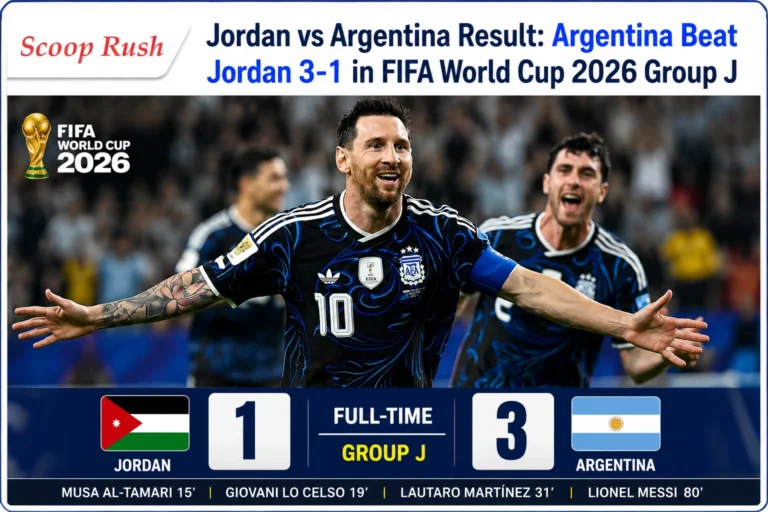
Competition: FIFA World Cup 2026 – Group J Date: Sunday, 28 June 2026 Venue: Dallas Stadium, Arlington Full-Time Result: Jordan 1–3 Argentina
Argentina once again proved why they remain one of the favorites for the FIFA World Cup 2026. Despite Jordan taking an early lead, the South American giants responded with three unanswered goals to secure an impressive 3-1 victory and finish top of Group J.
Introduction
The Jordan vs Argentina Result: Argentina Beat Jordan 3-1 in FIFA World Cup 2026 Group J was one of the standout matches of the final group-stage fixtures. Jordan shocked Argentina with an early breakthrough, but the reigning football powerhouse responded with calmness, quality, and clinical finishing.
Argentina dominated possession throughout the contest and created far more scoring opportunities. Their attacking stars stepped up when it mattered most, while Jordan showed determination despite eventually falling short. As a result, Argentina completed the group stage unbeaten and advanced confidently to the knockout rounds.
Match Summary
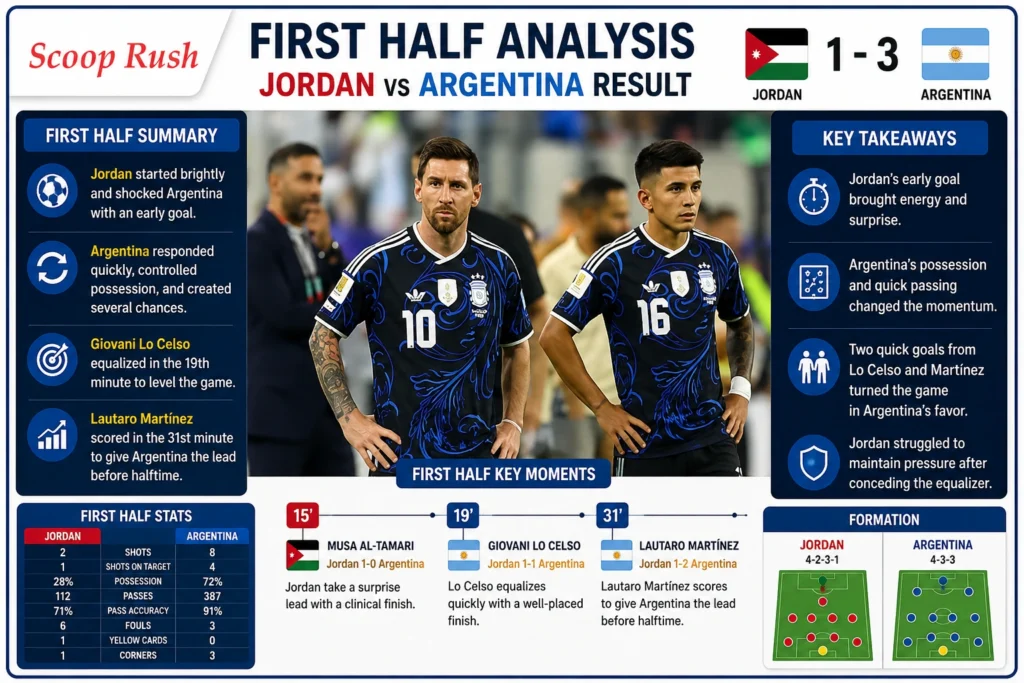
The match began with Jordan producing a dream start. Musa Al-Tamari found the net in the 15th minute, giving Jordan a surprising 1-0 advantage.
However, Argentina quickly regained control of the game. Their passing rhythm improved, and they consistently pushed Jordan deeper into their own half. Eventually, the pressure paid off.
Giovani Lo Celso equalized in the 19th minute, bringing Argentina back into the contest almost immediately.
Before halftime, Lautaro Martínez scored in the 31st minute to complete Argentina’s comeback and hand them a 2-1 lead.
Jordan attempted to recover after the break, but Argentina continued to dominate possession and limited their opponents to very few clear opportunities.
First Half Analysis Jordan vs Argentina Result
Jordan surprised everyone with their aggressive opening approach.
Musa Al-Tamari’s goal energized the underdogs and briefly put Argentina under pressure. However, Argentina responded almost immediately.
Their midfield dictated play through quick passing combinations and intelligent movement.
Giovani Lo Celso’s equalizer shifted the momentum completely. From that moment onward, Argentina became the dominant side.
Lautaro Martínez then finished another well-worked attacking move before halftime, allowing Argentina to enter the break with confidence.
Second Half Performance Jordan vs Argentina Result
Jordan attempted to push forward after halftime but struggled to maintain possession.
Argentina continued controlling the match through patient build-up play.
Meanwhile, Jordan searched for counterattacking opportunities but found limited space against Argentina’s organized defensive structure.
As the second half progressed, Argentina created additional chances before Lionel Messi added the third goal in the 80th minute.
That strike effectively ended Jordan’s hopes of mounting a comeback.
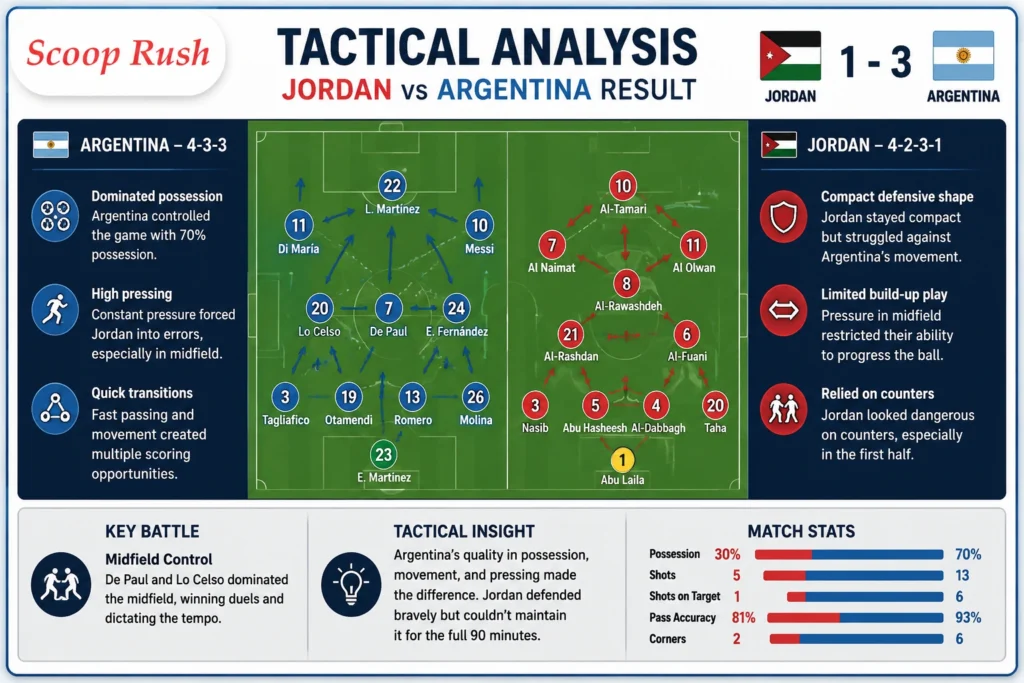
Jordan vs Argentina ResultMatch Statistics
The numbers reflected Argentina’s dominance throughout the contest.
Final Score: Jordan 1-3 Argentina
Shots: Jordan 5 | Argentina 13
Shots on Target: Jordan 1 | Argentina 6
Possession: Jordan 30% | Argentina 70%
Passes: Jordan 273 | Argentina 779
Pass Accuracy: Jordan 81% | Argentina 93%
Fouls: Jordan 12 | Argentina 7
Yellow Cards: Jordan 3 | Argentina 0
Red Cards: None
Offsides: Jordan 1 | Argentina 3
Corners: Jordan 2 | Argentina 6
These statistics clearly highlight Argentina’s control in both possession and attacking play.
Key Performers
Lionel Messi Delivers Again
Lionel Messi once again influenced the outcome with his late goal.
His movement, creativity, and composure gave Jordan’s defenders constant problems throughout the match. His finish in the 80th minute secured Argentina’s comfortable victory.
Lautaro Martínez Continues His Fine Form
Lautaro Martínez scored Argentina’s second goal in the first half.
His intelligent positioning inside the penalty area allowed Argentina to complete their comeback before halftime.
Giovani Lo Celso Changed the Momentum
Lo Celso’s equalizer arrived at a crucial stage of the game.
That goal restored confidence for Argentina and shifted momentum firmly in their favor.
Musa Al-Tamari Gave Jordan Early Hope
Jordan’s standout performer was Musa Al-Tamari.
His early finish stunned Argentina and rewarded Jordan’s positive opening spell. Although his team could not maintain the advantage, he remained one of Jordan’s brightest attacking players.
Tactical Analysis
Argentina controlled nearly every tactical aspect of the match.
Their midfield maintained possession through short passes and constant movement.
Argentina completed the group stage with a perfect record of three wins from three matches.
Jordan finished fourth despite showing moments of promise during the tournament.
What This Result Means
Argentina’s victory confirmed first place in Group J and strengthened their position ahead of the knockout rounds.
Winning all three group matches provides valuable confidence as stronger opponents await.
Jordan exits the competition without earning a point. Nevertheless, scoring against one of the tournament favorites demonstrated their willingness to compete until the final whistle.
Talking Points
Several major stories emerged from this Group J encounter.
Jordan shocked Argentina with an early goal.
Argentina responded with three unanswered goals.
Lionel Messi added another important World Cup goal.
Lautaro Martínez continued his strong tournament.
Argentina finished Group J with maximum points.
Conclusion
The Jordan vs Argentina Result: Argentina Beat Jordan 3-1 in FIFA World Cup 2026 Group J showcased Argentina’s experience, patience, and attacking quality.
Although Jordan started brightly and deserved credit for taking an early lead, Argentina gradually imposed their superior possession and technical ability. Goals from Giovani Lo Celso, Lautaro Martínez, and Lionel Messi completed an impressive comeback that secured another important victory.
With three wins from three matches, Argentina advances to the knockout stage full of confidence. Jordan leaves the tournament disappointed but can still reflect positively on competing bravely against one of world football’s strongest teams.
FAQs
1. What was the final score between Jordan and Argentina?
Argentina defeated Jordan 3-1 in the FIFA World Cup 2026 Group J match.
2. Who scored for Argentina against Jordan?
Giovani Lo Celso, Lautaro Martínez, and Lionel Messi scored for Argentina.
3. Who scored Jordan’s goal?
Musa Al-Tamari scored Jordan’s only goal in the 15th minute.
4. How much possession did Argentina have?
Argentina enjoyed 70% possession, while Jordan had 30%.
5. Did Argentina qualify for the knockout stage?
Yes. Argentina finished first in Group J with nine points after winning all three group-stage matches.
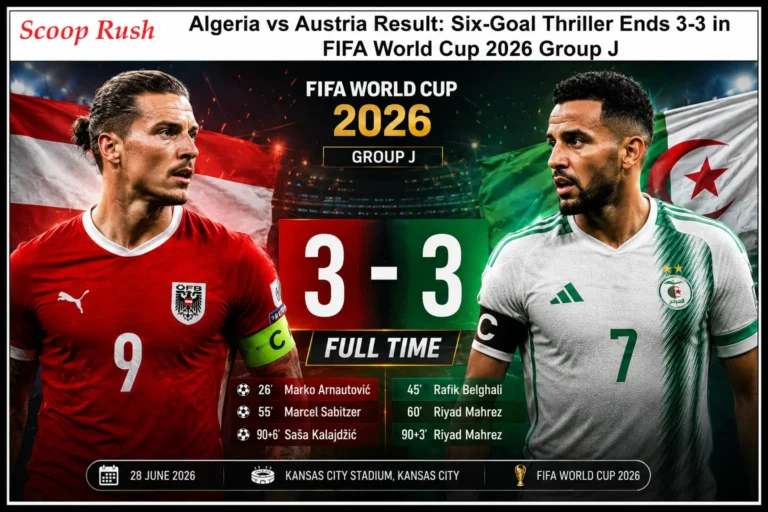
Competition: FIFA World Cup 2026 – Group J Date: Sunday, 28 June 2026 Venue: Kansas City Stadium, Kansas City Full-Time Result: Algeria 3-3 Austria
What looked like another dramatic World Cup night turned into one of the most entertaining matches of the tournament. The Algeria vs Austria Result delivered six goals, late drama, momentum swings, and a thrilling 3-3 draw that kept Group J wide open until the final whistle.
Introduction
The Algeria vs Austria Result produced an unforgettable contest in the FIFA World Cup 2026 Group J. Played on Sunday, 28 June, both teams battled relentlessly and shared the points after an action-packed 90 minutes.
Algeria twice fought to stay in control, while Austria refused to give up despite trailing late in the match. As a result, both nations collected one point in a game that highlighted attacking quality, determination, and resilience. Furthermore, the draw leaves the race for qualification in Group J finely balanced heading into the next stage of the competition.
Match Overview
Goalscorers
Algeria
Rafik Belghali (45′)
Riyad Mahrez (60′, 90+3′)
Austria
Marko Arnautović (26′)
Marcel Sabitzer (55′)
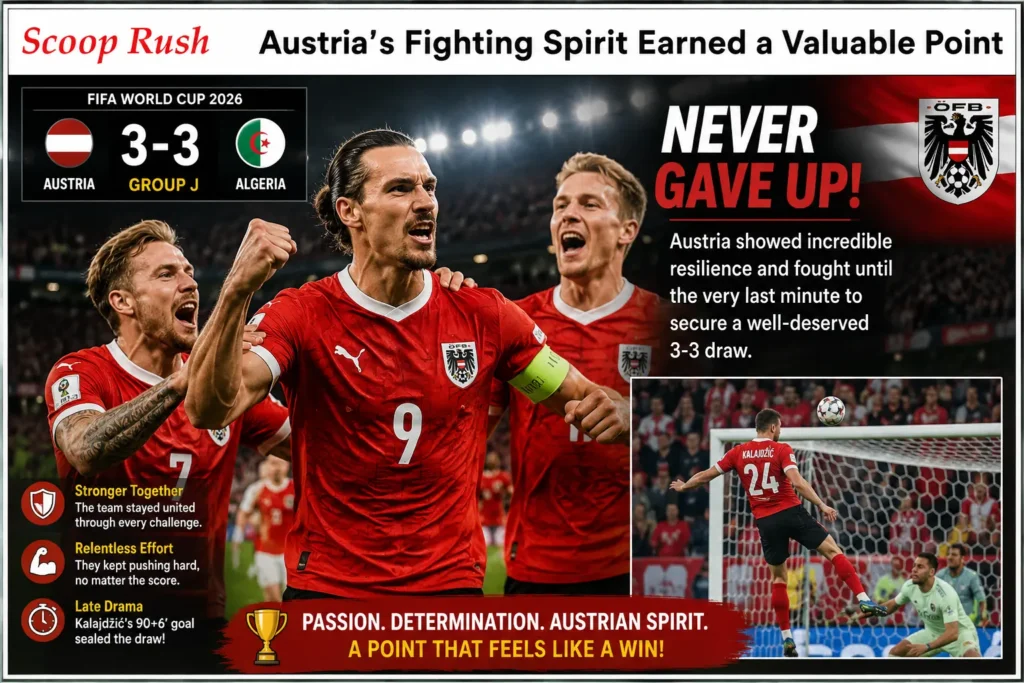
Saša Kalajdžić (90+6′)
Algeria vs Austria Result: Match Summary
The match began with both sides looking to establish control through possession and quick passing. Austria struck first when Marko Arnautović opened the scoring in the 26th minute, giving his side an early advantage.
However, Algeria responded perfectly before halftime. Rafik Belghali found the equalizer in the 45th minute, ensuring both teams entered the break level at 1-1.
The second half quickly became an end-to-end battle. Austria regained the lead through Marcel Sabitzer in the 55th minute. Nevertheless, Algeria answered almost immediately.
Just five minutes later, Riyad Mahrez scored to level the match at 2-2. As a result, the game remained open as both teams searched for another breakthrough.
In stoppage time, Algeria appeared to have secured victory when Mahrez scored his second goal in the 90+3rd minute. The celebrations, however, were short-lived.
Austria produced one final attack deep into added time. Saša Kalajdžić headed home in the 90+6th minute to rescue a dramatic 3-3 draw and earn an important point for his team.
Ultimately, both sides walked away with mixed emotions after one of the tournament’s most entertaining group-stage matches.
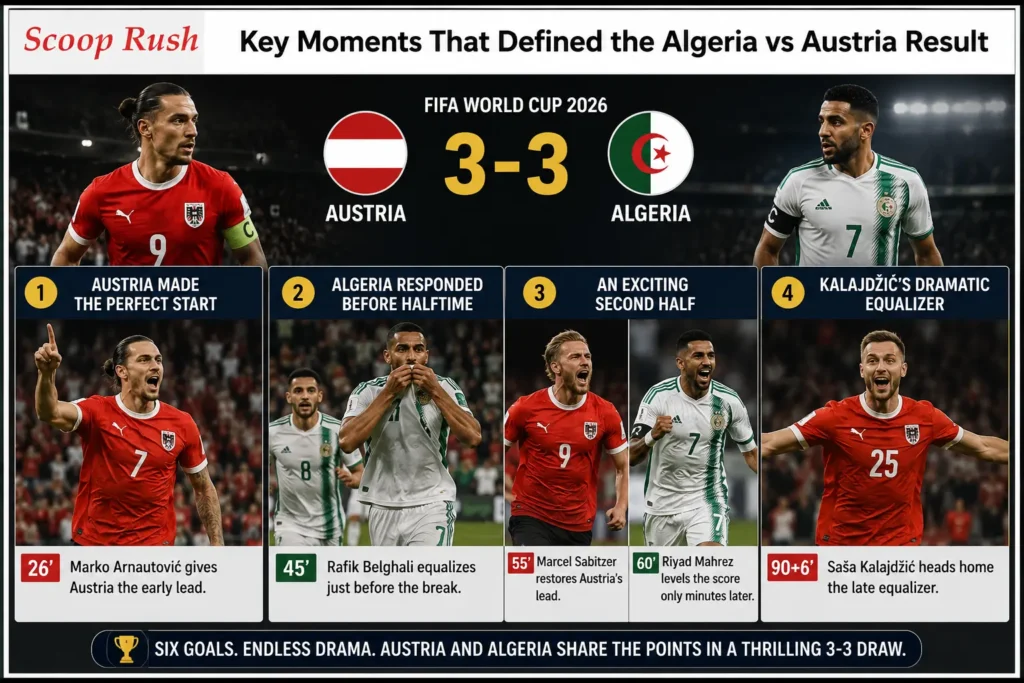
Key Moments That Defined the Algeria vs Austria Result
Austria Made the Perfect Start
Austria looked confident during the opening stages and took advantage of their attacking opportunities. Arnautović’s first-half goal rewarded Austria’s positive approach and placed Algeria under early pressure.
Although Algeria enjoyed more possession, Austria remained dangerous on the counterattack.
Algeria Responded Before Halftime
Equalizing just before the interval changed the momentum completely.
Belghali’s goal gave Algeria fresh confidence and prevented Austria from taking a lead into the dressing room. Consequently, the second half started with both teams believing they could win.
An Exciting Second Half
The second half featured constant momentum shifts. Sabitzer restored Austria’s lead, but Mahrez responded almost immediately. As a result, both teams continued attacking instead of settling for a draw. As the clock approached full time, Mahrez looked to have become Algeria’s match winner with his second goal in stoppage time. Even so, Austria never stopped pushing forward. Kalajdžić’s Dramatic Equalizer
The final twist arrived in the sixth minute of stoppage time.
Saša Kalajdžić rose to score a dramatic late equalizer, denying Algeria all three points and completing one of the most exciting finishes of the FIFA World Cup 2026 group stage.
Match Statistics
The statistics reflected how closely contested the match was.
Statistic
Algeria
Austria
Shots
11
11
Shots on Target
5
4
Possession
60%
40%
Passes
717
391
Pass Accuracy
94%
89%
Fouls
3
7
Yellow Cards
0
1
Red Cards
0
0
Offsides
1
3
Corners
0
3
Algeria controlled possession for long periods, completing 717 passes with an impressive 94 percent accuracy.
Austria, meanwhile, made the most of fewer opportunities. Despite having only 40 percent possession, they remained efficient in attack and matched Algeria’s shot total.
Algeria Controlled the Ball
One of the biggest stories behind the Algeria vs Austria Result was Algeria’s dominance in possession.
They completed nearly twice as many passes as Austria while maintaining excellent passing accuracy. This allowed Algeria to dictate the rhythm for much of the contest.
However, possession alone was not enough to secure victory.
Austria defended patiently and capitalized whenever space became available.
Austria’s Fighting Spirit Earned a Valuable Point
Austria demonstrated outstanding resilience throughout the match.
Whenever Algeria threatened to take complete control, Austria found a response.
Most importantly, they refused to give up after Mahrez’s late goal.
Instead, Austria pushed players forward and were rewarded when Kalajdžić scored a dramatic equalizer in stoppage time.
That determination ultimately secured a deserved point.
Riyad Mahrez Delivered When Algeria Needed Him
Riyad Mahrez produced another influential performance for Algeria.
His first goal restored parity early in the second half after Sabitzer’s strike.
Later, his stoppage-time goal appeared to have sealed victory.
Although Algeria could not hold their advantage, Mahrez once again showed his ability to deliver in crucial moments.
Austria occupies second place due to goal difference, while Algeria remains close behind. Therefore, every remaining result in Group J could prove decisive.
What the Result Means
The Algeria vs Austria Result leaves both teams with reasons for optimism and frustration.
Algeria will feel disappointed after conceding so late despite leading in stoppage time.
Meanwhile, Austria can celebrate earning a point through persistence and determination.
Additionally, the draw ensures that qualification scenarios remain highly competitive as the tournament progresses.
Conclusion
The Algeria vs Austria Result delivered everything football fans could hope for. Six goals, dramatic momentum swings, late stoppage-time drama, and outstanding individual performances combined to create one of the most memorable matches of the FIFA World Cup 2026 Group J.
Algeria impressed with their possession, passing quality, and attacking creativity. Austria, however, matched that quality with resilience and clinical finishing when it mattered most.
Ultimately, neither side secured victory, but both earned a valuable point in a thrilling 3-3 draw that could have a significant impact on the Group J standings.
FAQs
1. What was the final Algeria vs Austria result?
The match finished Algeria 3-3 Austria in FIFA World Cup 2026 Group J.
2. Who scored for Algeria?
Rafik Belghali scored once, while Riyad Mahrez scored twice.
3. Who scored for Austria?
Marko Arnautović, Marcel Sabitzer, and Saša Kalajdžić each scored one goal.
4. Where was the Algeria vs Austria match played?
The match took place at Kansas City Stadium, Kansas City.
5. How did the Group J standings change after the draw?
Argentina remained first with nine points, while Austria and Algeria each moved to four points, with Austria ahead on goal difference.
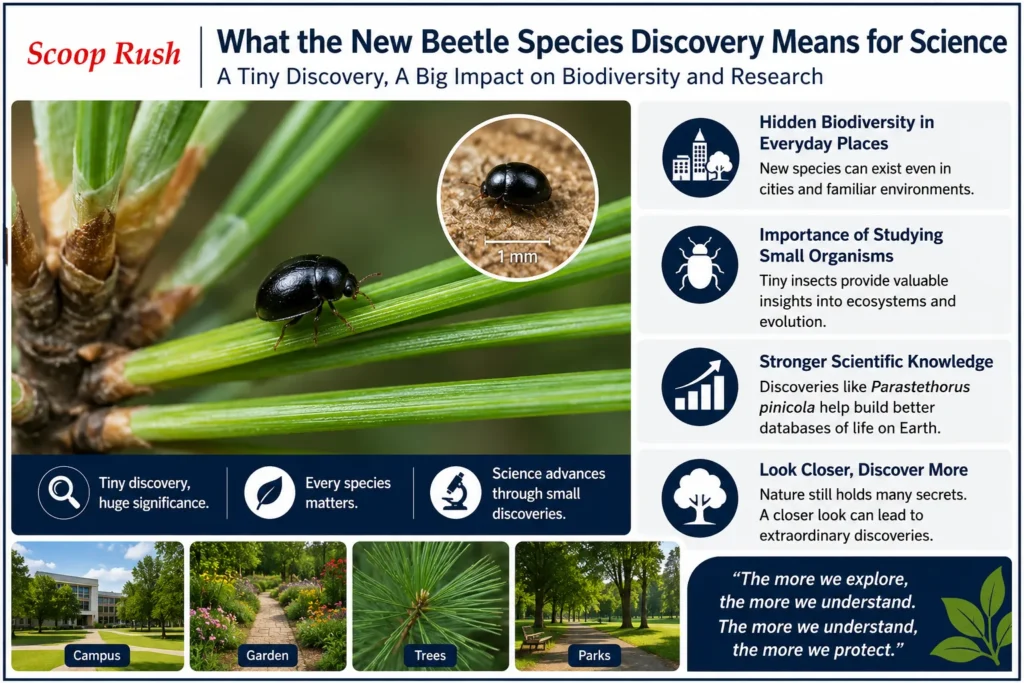
A new beetle species discovery at Kyushu University in Japan has surprised scientists after researchers found a tiny ladybird beetle living just steps away from their laboratory. The discovery of the new beetle species, named Parastethorus pinicola, shows that even familiar places like university campuses can still hide unknown wildlife.
The discovery of the new beetle species, named Parastethorus pinicola, shows that even familiar places like cities and university grounds can still contain wildlife that science has not yet documented. The tiny ladybird beetle, measuring just over one millimeter, remained unnoticed for years because of its small size and difficult identification process.
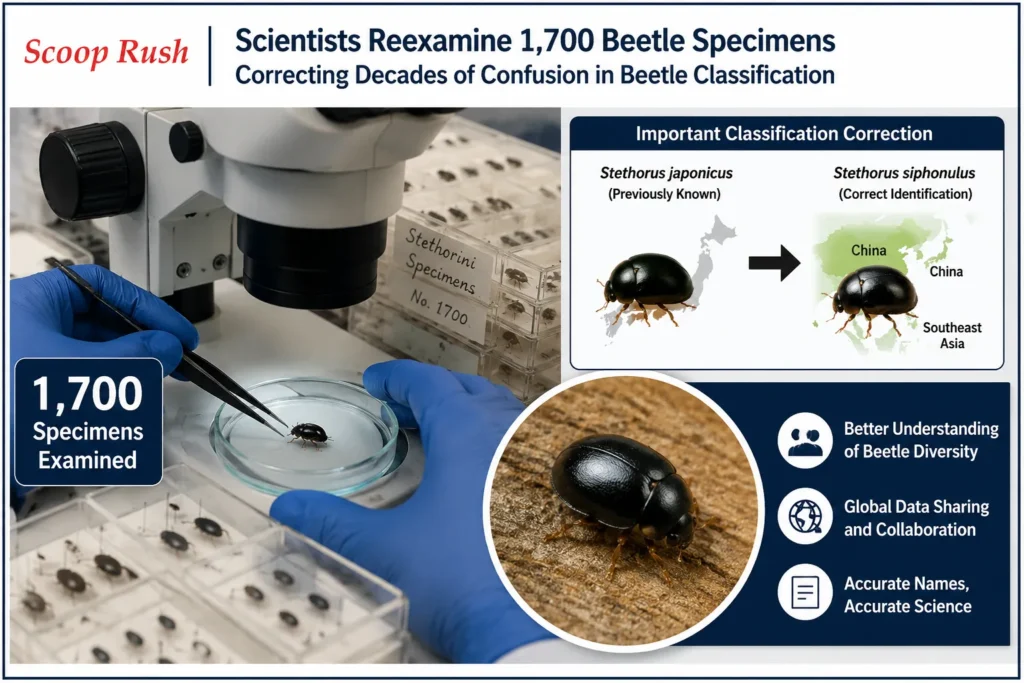
The finding came from a major research project studying tiny ladybird beetles called Stethorini, which feed on spider mites. Researchers examined around 1,700 beetle specimens and uncovered not only one new species but also another previously unknown beetle from Japan.
This discovery highlights an important message: biodiversity is not only found in remote forests or unexplored areas. Sometimes, new scientific discoveries can happen right outside our daily surroundings.
New Beetle Species Found on Kyushu University Campus
The newly identified new beetle species Parastethorus pinicola was discovered on Japanese black pine trees at Kyushu University’s Hakozaki Satellite campus in Japan.
The research was conducted as part of a three-year study focused on improving the classification of Stethorini, a group of extremely small ladybird beetles. The study was published in Acta Entomologica Musei Nationalis Pragae and became the first major review of this beetle group in Japan in more than five decades.
Researchers found that the tiny insect had been overlooked because scientists and collectors often paid less attention to pine trees where these beetles live.
How Researchers Located the Beetle
Ryōta Seki, a PhD student at the Entomological Laboratory, Graduate School of Bioresource and Bioenvironment Sciences, led the study. He explained that these beetles often live on pine trees, which helped guide the search.
Because Japanese black pines were growing at the university’s Hakozaki Satellite, researchers decided to investigate the area. Surprisingly, they discovered a species that had remained hidden in plain sight.
Why the Tiny Beetle Was Difficult to Identify
The discovery of the new beetle species was challenging because these insects are extremely small and look almost identical to related species.
According to researchers, small black ladybird beetles are difficult to study because physical differences between species are often impossible to see without detailed examination.
The beetles are barely larger than a grain of sand. Therefore, scientists must carefully analyze their bodies under microscopes and examine specific reproductive structures to accurately identify each species.
In the past, these difficulties caused several beetles to be incorrectly classified. As a result, scientists needed a detailed review to understand which species were truly different and which were actually the same.
Scientists Reexamine 1,700 Beetle Specimens
To solve long-standing classification problems, the research team studied approximately 1,700 specimens of Stethorini beetles.
The examination revealed that a beetle previously known in Japan as Stethorus japonicus was actually the same species as Stethorus siphonulus. This species is found across a wide region, including areas from China to Southeast Asia.
This correction helped scientists create a clearer understanding of beetle diversity in Asia.
Furthermore, the research showed why accurate species identification matters. Correct names allow scientists from different countries to share research data and better understand how species are distributed.
A Second New Beetle Species Discovered in Japan
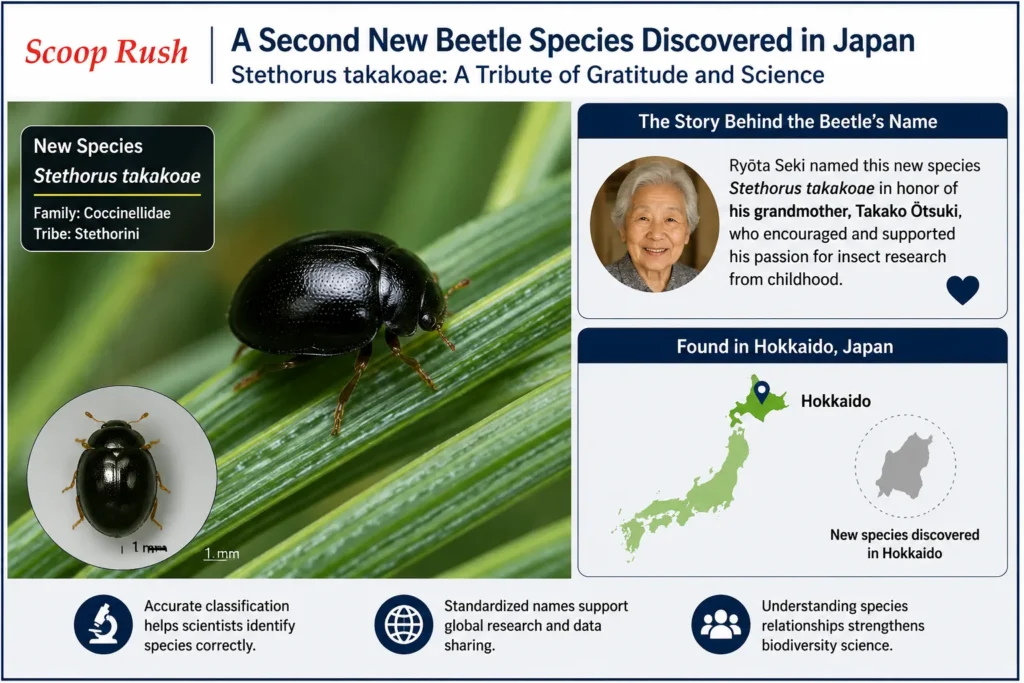
The study produced another important discovery. Researchers identified a second previously unknown species from Hokkaido, Japan.
They named this beetle Stethorus takakoae.
The Story Behind the Beetle’s Name
Ryōta Seki selected the name to honor his grandmother, Takako Ōtsuki, who supported his interest in insect research from childhood.
According to Seki, improving beetle classification helps researchers communicate more effectively. Additionally, accurate naming allows scientists to understand relationships between species across different regions.
Hidden Biodiversity Exists in Everyday Places
The discovery of the new beetle species at a university campus sends a powerful message about biodiversity.
Many people imagine new species discoveries happening only in distant jungles, mountains, or isolated islands. However, researchers continue to find unknown organisms in places that humans visit every day.
Associate Professor Munetoshi Maruyama from the Kyushu University Museum supervised the research. He explained that small insects are often ignored, even though they play important roles in ecosystems.
These tiny beetles may not attract much attention because of their size. However, studying them helps scientists understand the natural world and the connections between different organisms.
The discovery also reminds researchers that many species may still remain undocumented, even in areas surrounded by human activity.
Why Small Insects Matter to Science
Although the newly discovered beetle is extremely small, its scientific value is significant.
Insects contribute to ecosystems in many ways. Researchers study them to understand biodiversity, species relationships, and environmental changes.
The study of Stethorini beetles also provides better knowledge about insects that interact with plants and other small organisms.
Furthermore, discoveries like Parastethorus pinicola help create stronger scientific records. These records allow future researchers to compare species and track biodiversity more accurately.
Another Major Beetle Discovery From Indonesia
While researchers at Kyushu University discovered a new ladybird beetle species, another important beetle discovery was recently reported from Indonesia.
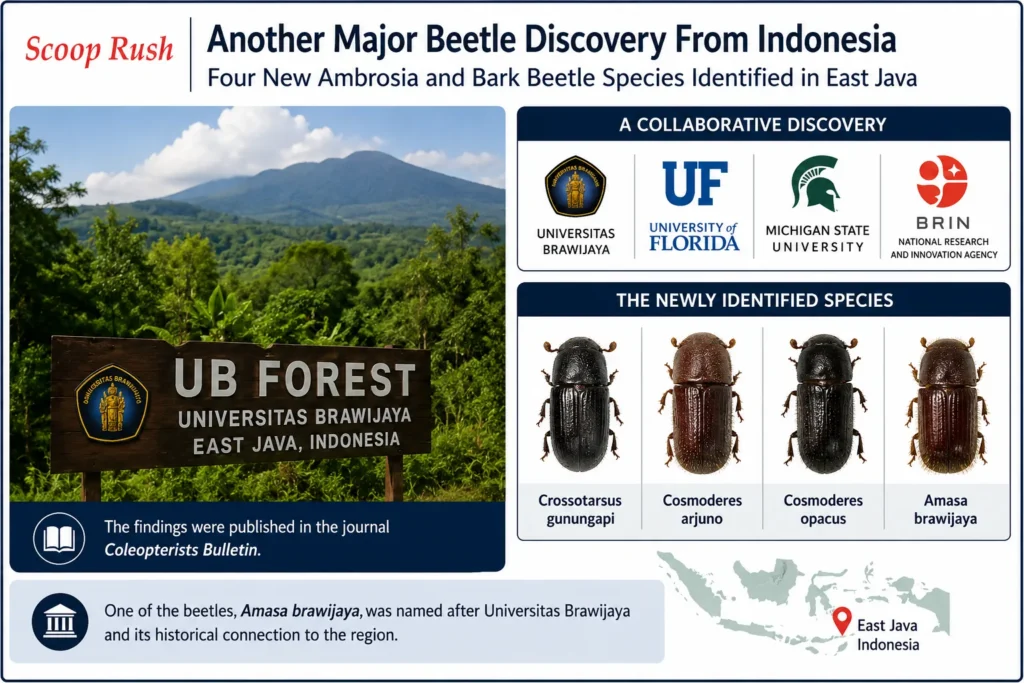
A research team from Universitas Brawijaya, together with researchers from the University of Florida, Michigan State University, and the National Research and Innovation Agency (BRIN), discovered four new species of ambrosia and bark beetles in UB Forest, East Java.
The findings were published in the journal Coleopterists Bulletin.
The Newly Identified Species
The newly identified species included:
Crossotarsus gunungapi
Cosmoderes arjuno
Cosmoderes opacus
Amasa brawijaya
One of the beetles, Amasa brawijaya, was named after Universitas Brawijaya and its historical connection to the region.
How Researchers Identify New Beetle Species
Scientists use different methods to confirm whether an insect represents a new species.
In the Indonesian research, scientists used both physical examination and DNA analysis.
Researchers compared beetle features with specimens stored in insect museums around the world. Additionally, they analyzed DNA sequences to identify genetic differences.
Similarly, the Kyushu University researchers used detailed scientific examination to separate closely related beetle species.
These methods help scientists avoid mistakes and create accurate records of Earth’s biodiversity.
What the New Beetle Species Discovery Means for Science
The discovery of Parastethorus pinicola demonstrates that nature still holds many surprises.
Even in developed areas, unknown species can exist unnoticed. Therefore, scientists continue to explore familiar environments because they may contain valuable discoveries.
The research also shows the importance of studying small organisms. Tiny insects often receive less attention, but they provide important information about ecosystems and evolution.
Ultimately, the discovery encourages people to look closer at the natural world around them. A simple tree, garden, or campus area may contain species that scientists have never documented before.
Conclusion: A Tiny Beetle With a Big Scientific Impact
The discovery of the new beetle species Parastethorus pinicola at Kyushu University proves that important scientific discoveries can happen in unexpected places.
Researchers found the tiny beetle on a campus pine tree, showing that hidden biodiversity exists even in everyday environments. The study also corrected previous beetle classifications and introduced another new species from Japan.
Meanwhile, discoveries in Indonesia further demonstrate that beetle diversity remains rich and largely unexplored.
Although these insects are small, their importance is enormous. Every new species discovery helps scientists better understand life on Earth and the ecosystems that support it.
FAQs
1. What is the new beetle species discovered at Kyushu University?
The newly discovered beetle species is called Parastethorus pinicola. It was found on Japanese black pine trees at Kyushu University’s Hakozaki Satellite campus.
2. How big is the new beetle species?
The beetle is extremely small, measuring just over one millimeter in length.
3. Why was the beetle not discovered earlier?
The beetle was difficult to identify because it is tiny, looks similar to other species, and requires microscopic examination for accurate classification.
4. What do Stethorini beetles eat?
Stethorini beetles are known as ladybird beetles that feed on spider mites.
5. Can new species still be discovered in cities?
Yes. The discovery at Kyushu University shows that unknown species can exist even in urban environments and familiar places.
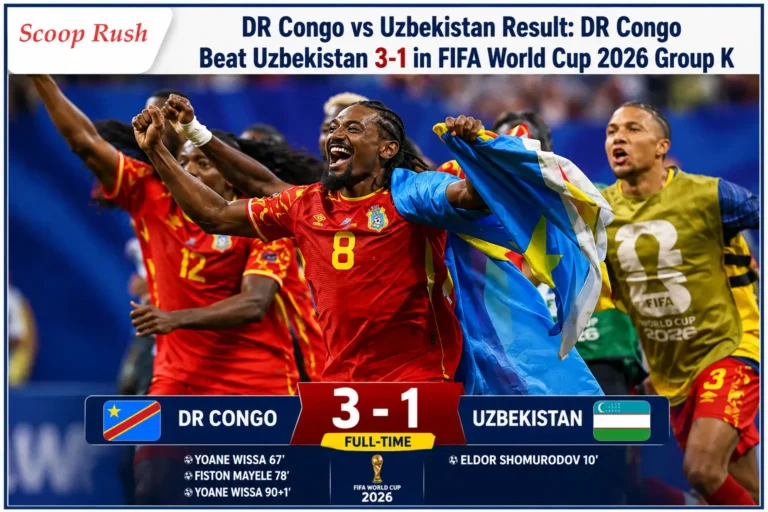
Competition: FIFA World Cup 2026 Full-Time Result: DR Congo 3-1 Uzbekistan Stage: Group K Date: Sunday, 28 June Venue: Atlanta Stadium, Atlanta DR Congo vs Uzbekistan Result delivers a crucial Group K victory. Three goals, an impressive attacking display, and three valuable points defined the match. The DR Congo vs Uzbekistan Result saw DR Congo defeat Uzbekistan 3-1 in the FIFA World Cup 2026 Group K clash on Sunday, 28 June.
The victory keeps DR Congo firmly in the race for a place in the knockout stage. Meanwhile, Uzbekistan finished the match with another defeat and remained at the bottom of the group standings.
With both teams entering the match needing points, the contest carried significant importance. DR Congo responded with an energetic performance and took advantage of their attacking opportunities to secure a deserved win.
Match Overview
Goalscorers
DR Congo
Yoane Wissa (67′)
Yoane Wissa (90+1′)
Fiston Mayele (78′)
Uzbekistan
Eldor Shomurodov (10′)
How the Match Unfolded
Uzbekistan made the brighter start and stunned DR Congo with an early breakthrough.
Eldor Shomurodov scored in the 10th minute to give Uzbekistan a valuable lead. The early goal forced DR Congo to chase the game for the remainder of the first half.
Although DR Congo enjoyed more of the possession, Uzbekistan defended well before halftime and protected their advantage.
However, the momentum changed completely after the break.
DR Congo increased the tempo, created more chances, and eventually found the equalizer through Yoane Wissa in the 67th minute.
That goal transformed the match.
Just eleven minutes later, Fiston Mayele completed the comeback by scoring in the 78th minute to make it 2-1.
As Uzbekistan pushed forward searching for another equalizer, spaces appeared at the back.
Consequently, Yoane Wissa struck again in stoppage time to seal a convincing 3-1 victory for DR Congo.
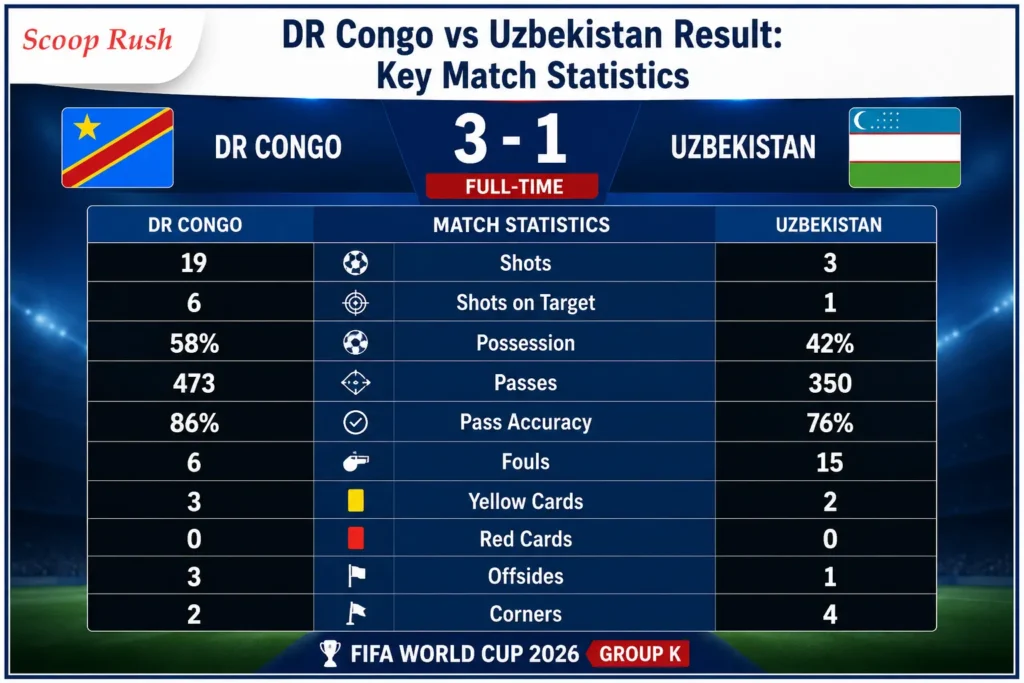
DR Congo vs Uzbekistan Result: Key Match Statistics
The numbers highlight DR Congo’s overall control throughout the contest.
Match Stat
DR Congo
Uzbekistan
Shots
19
3
Shots on Target
6
1
Possession
58%
42%
Passes
473
350
Pass Accuracy
86%
76%
Fouls
6
15
Yellow Cards
3
2
Red Cards
0
0
Offsides
3
1
Corners
2
4
DR Congo dominated nearly every attacking category.
They produced 19 shots compared to only three from Uzbekistan. Additionally, their passing accuracy reached 86%, allowing them to control possession and dictate the pace for long periods.
Meanwhile, Uzbekistan struggled to create opportunities after their early goal.
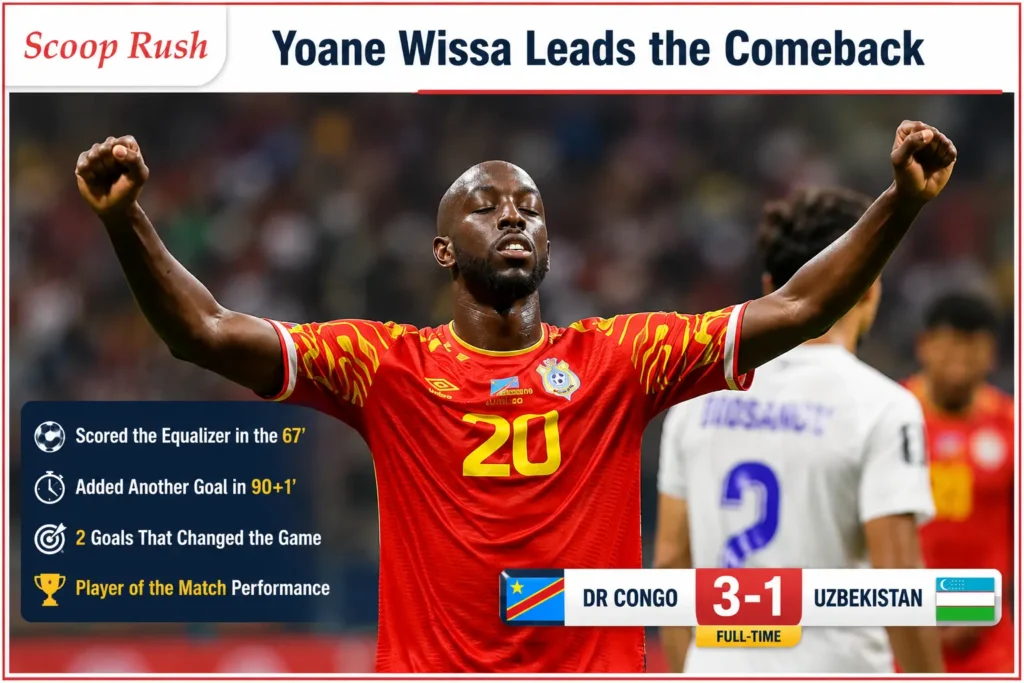
Yoane Wissa Leads the Comeback
Two goals make the difference
Yoane Wissa delivered an outstanding performance when his team needed him most.
His equalizer in the 67th minute shifted the momentum firmly toward DR Congo. Later, his stoppage-time finish confirmed the victory and rewarded DR Congo for their sustained pressure.
Scoring twice in such an important World Cup match made Wissa the standout performer of the evening.
Fiston Mayele Provides the Winning Goal
While Wissa grabbed the headlines, Fiston Mayele also played a decisive role.
His goal in the 78th minute completed DR Congo’s comeback and gave the team a lead they never surrendered.
The forward remained dangerous throughout the second half and was rewarded with a well-taken finish.
Eldor Shomurodov Gives Uzbekistan Early Hope
Uzbekistan started the match positively.
Eldor Shomurodov’s goal inside the opening minutes suggested Uzbekistan could produce an upset.
Unfortunately for them, they struggled to maintain attacking pressure after taking the lead.
As DR Congo grew stronger, Uzbekistan found it increasingly difficult to retain possession or threaten the opposing goal.
Tactical Analysis
DR Congo’s patience pays off
DR Congo remained calm after conceding early.
Rather than forcing attacks, they continued to build possession through midfield and gradually increased the pressure.
Their passing combinations stretched Uzbekistan’s defensive shape, creating space in the final third.
Eventually, that persistence resulted in three goals during an impressive second-half display.
Uzbekistan lose control after halftime
Uzbekistan defended with discipline during much of the first half.
However, they struggled to match DR Congo’s intensity after the interval.
The team’s attacking output dropped significantly, while defensive mistakes became more frequent under sustained pressure.
Ultimately, they were unable to stop DR Congo’s attacking momentum.
Group K Standings After the Match
Following this result, Group K became even more competitive.
DR Congo remain in contention for qualification with four points from three matches.
Meanwhile, Uzbekistan finished the group stage without earning a point.
What This Result Means
The victory gives DR Congo renewed confidence. It also keeps the team in the race for the knockout stage.
Colombia and Portugal remain in the top two positions. However, DR Congo’s victory keeps their qualification hopes alive.
For Uzbekistan, the defeat confirms a disappointing campaign despite showing promise during parts of the tournament.
Biggest Talking Points
DR Congo recovered after conceding an early goal.
Yoane Wissa scored twice to inspire the comeback.
Fiston Mayele added the decisive third goal.
DR Congo dominated possession and attacking statistics.
Uzbekistan managed only three total shots throughout the match.
Group K qualification remains highly competitive.
Player Performances
DR Congo
Yoane Wissa: Outstanding performance with two goals.
Fiston Mayele: Scored an important goal and remained a constant threat.
The midfield controlled possession effectively throughout the second half.
Uzbekistan
Eldor Shomurodov: Opened the scoring and remained Uzbekistan’s main attacking outlet.
The defensive unit worked hard but struggled under sustained pressure after halftime.
Match Summary
The DR Congo vs Uzbekistan Result reflected the difference between a team that kept believing and one that could not sustain its early momentum.
Uzbekistan started brightly with an early goal from Eldor Shomurodov. However, DR Congo responded with better possession. They also passed the ball more accurately and created constant pressure.
Yoane Wissa’s equalizer completely changed the direction of the match. Fiston Mayele then gave DR Congo the lead before Wissa added his second goal in stoppage time to complete an impressive 3-1 victory.
The result strengthens DR Congo’s position in Group K and keeps their hopes of reaching the knockout rounds alive.
Conclusion
The DR Congo vs Uzbekistan Result showcased resilience, patience, and clinical finishing from DR Congo.
After falling behind early, they responded with an excellent second-half performance to earn a deserved 3-1 victory. Strong possession, accurate passing, and efficient finishing proved decisive, while Uzbekistan could not recover after surrendering their lead.
With Group K still competitive, DR Congo will take confidence from this performance as they continue their FIFA World Cup 2026 campaign.
FAQs
1. What was the DR Congo vs Uzbekistan result?
DR Congo defeated Uzbekistan 3-1 in their FIFA World Cup 2026 Group K match.
2. Who scored for DR Congo?
Yoane Wissa scored twice, while Fiston Mayele added the third goal.
3. Who scored for Uzbekistan? Eldor Shomurodov scored Uzbekistan’s only goal in the 10th minute.
4. Which team had more possession?
DR Congo controlled 58% possession, compared to Uzbekistan’s 42%.
5. How many shots did DR Congo have?
DR Congo recorded 19 shots, including six on target, while Uzbekistan managed only three shots with one on target.
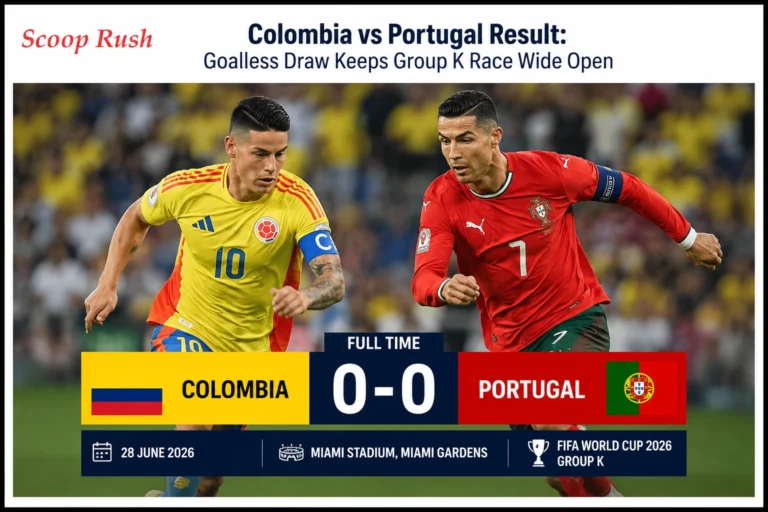
Competition: FIFA World Cup 2026 – Group K Date: 28 June 2026 Venue: Miami Stadium, Miami Gardens Full-Time Result: Colombia 0–0 Portugal
The goals never came, but the drama certainly did. Colombia and Portugal battled through 90 intense minutes in FIFA World Cup 2026 Group K, producing a hard-fought 0-0 draw that could have a significant impact on the race for the knockout stage. While neither side found the breakthrough, both teams displayed defensive discipline and tactical organization in a contest where every chance mattered.
Introduction
The Colombia vs Portugal Result ended in a scoreless draw on Sunday, 28 June, in Group K of the FIFA World Cup 2026. Played at Miami Stadium, Miami Gardens, the match featured two evenly matched sides fighting for valuable points in the group stage.
Although the scoreboard remained unchanged, the encounter offered plenty of tactical battles, disciplined defending, and competitive football. Colombia controlled possession for long periods, while Portugal relied on a compact defensive structure and looked to capitalize on transition opportunities. The single point earned by each team keeps the Group K standings highly competitive heading into the remaining fixtures.
Colombia vs Portugal Result: Match Summary
Colombia entered the match aiming to strengthen their position at the top of Group K, while Portugal knew that a positive result would improve their chances of qualifying for the knockout stage.
From kickoff, Colombia attempted to dictate the tempo through patient possession and organized build-up play. Portugal stayed compact defensively and limited clear scoring opportunities despite allowing Colombia more of the ball.
As the match progressed, both sides created moments of promise but neither could produce the finishing touch needed to break the deadlock.
After 90 minutes of disciplined football, the referee confirmed a 0-0 draw, with both nations sharing the points.
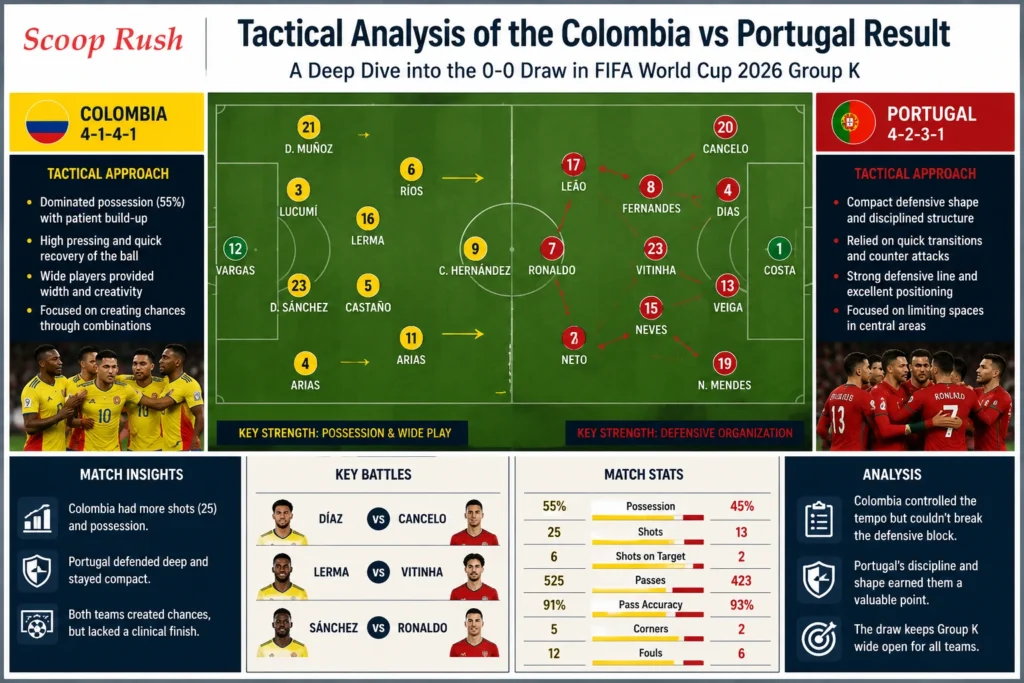
Colombia vs Portugal Result: Match Statistics
The numbers illustrate how closely contested the match was.
Match Stat
Colombia
Portugal
Goals
0
0
Shots
25
13
Shots on Target
6
2
Possession
55%
45%
Passes
525
423
Pass Accuracy
91%
93%
Fouls
12
6
Yellow Cards
1
0
Red Cards
0
0
Offsides
3
2
Corners
5
2
Colombia produced nearly twice as many attempts as Portugal and dominated possession, but Portugal’s organized defensive display prevented the South Americans from converting their opportunities.
Tactical Analysis of the Colombia vs Portugal Result
Both teams approached the match with different tactical priorities.
Colombia focused on controlling possession, patiently circulating the ball through midfield while attempting to stretch Portugal’s defensive line. Their passing accuracy of 91 percent reflected their composure throughout the match.
Portugal, meanwhile, emphasized defensive stability. Although they had less possession, they maintained an impressive 93 percent passing accuracy whenever they controlled the ball, showing efficiency rather than volume in possession.
The tactical battle ultimately became one of patience versus discipline, with neither approach producing the decisive goal.
Colombia Controlled the Ball but Could Not Find the Finish
One of the biggest talking points from the Colombia vs Portugal Result was Colombia’s inability to convert their territorial dominance.
The South American side registered:
25 total shots
6 shots on target
55% possession
5 corner kicks
Despite these attacking numbers, Portugal’s defensive organization and goalkeeping ensured the clean sheet remained intact.
Portugal’s Defensive Shape Earned a Valuable Point
Portugal may have created fewer chances, but their defensive structure proved highly effective.
They limited Colombia’s attacking opportunities in dangerous central areas while remaining disciplined throughout the match.
Portugal also avoided disciplinary problems, finishing the game without receiving a yellow or red card.
Although they managed only two shots on target, the draw keeps them firmly in contention within Group K.
Colombia vs Portugal Result: Team Lineups and Formations
Colombia Starting XI
Camilo Vargas, Santiago Arias, Dávinson Sánchez, Jhon Lucumí, Daniel Muñoz, Jefferson Lerma, Kevin Castaño, Richard Ríos, Luis Díaz, Jhon Arias, Cucho Hernández
Formation: 4-1-4-1
Portugal Starting XI
Diogo Costa, João Cancelo, Rúben Dias, Renato Veiga, Nuno Mendes, Vitinha, João Neves, Bruno Fernandes, Pedro Neto, Rafael Leão, Cristiano Ronaldo
Formation: 4-2-3-1
Key Match Events
The match featured limited major incidents despite its competitive nature.
64th Minute
Portugal made a defensive substitution after Nuno Mendes was forced off through injury.
Matheus Nunes entered the match.
Nuno Mendes left the field.
67th Minute
Colombia responded with changes of their own.
Daniel Muñoz was replaced.
Santiago Arias entered the match.
The substitutions injected fresh energy but neither side managed to produce the decisive breakthrough.
Defensive Performance Analysis
This fixture became a showcase of disciplined defending.
Colombia consistently pressed high and recovered possession quickly, while Portugal remained compact and denied space around the penalty area.
Both goalkeepers preserved clean sheets through solid positioning and calm decision-making.
The absence of major defensive mistakes ultimately determined the final scoreline.
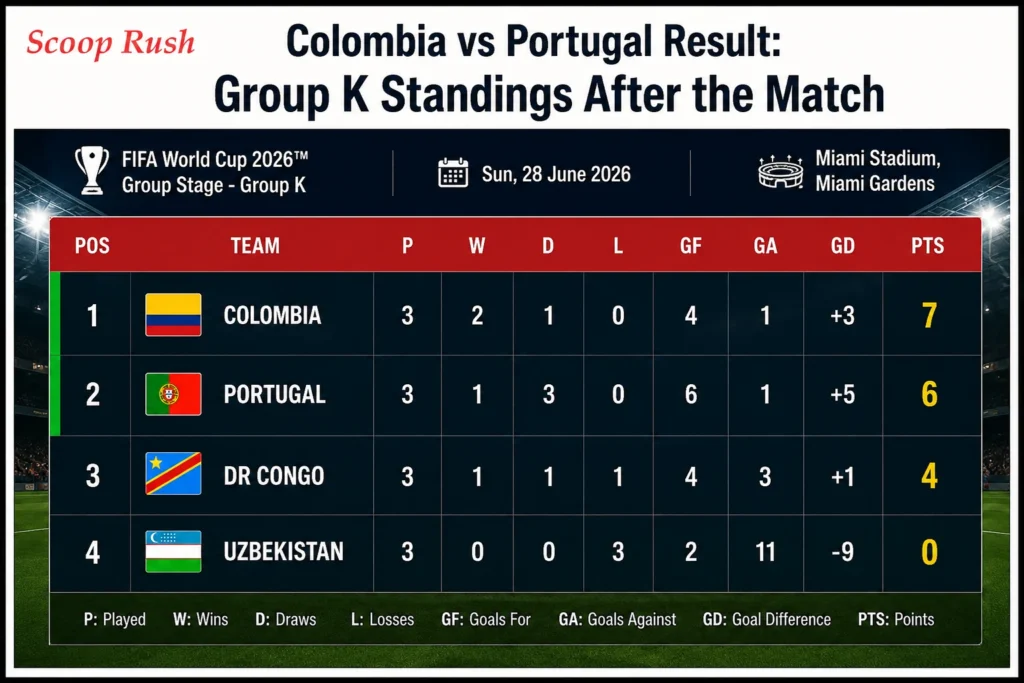
Colombia vs Portugal Result: Group K Standings After the Match
Following the draw, the Group K table stands as follows:
Colombia remain top of the group with seven points, while Portugal sit second with six. Both teams remain well placed in the qualification race as the group stage approaches its conclusion.
What the Colombia vs Portugal Result Means for Group K
The draw benefits both teams by adding another valuable point to their totals.
For Colombia, remaining unbeaten keeps them at the top of Group K and strengthens their position heading toward the knockout stage.
Portugal also left with a positive result. Despite facing sustained pressure, they demonstrated resilience and remained in second place with qualification still firmly within reach.
The outcome also increases the importance of the remaining Group K fixtures, where every point could determine the final standings.
Key Takeaways
Colombia and Portugal played out a 0-0 draw.
Colombia dominated possession and created more shooting opportunities.
Portugal delivered an organized defensive performance.
Both goalkeepers secured clean sheets.
Colombia remained top of Group K with seven points.
Portugal stayed second with six points.
The qualification race in Group K remains highly competitive.
Conclusion
The Colombia vs Portugal Result may not have produced goals, but it delivered a fascinating tactical contest between two disciplined sides. Colombia controlled much of the game through possession and attacking pressure, while Portugal defended with composure and efficiency to secure an important point.
With Colombia leading Group K on seven points and Portugal close behind on six, both teams remain in strong positions as the FIFA World Cup 2026 group stage moves toward its decisive final matches. The goalless draw ensures that the battle for qualification remains alive and promises an exciting finish to Group K.
FAQs
1. What was the Colombia vs Portugal Result?
Colombia and Portugal drew 0-0 in their FIFA World Cup 2026 Group K match.
2. Where was Colombia vs Portugal played?
The match took place at Miami Stadium, Miami Gardens.
3. Which team had more possession?
Colombia controlled 55% possession, while Portugal had 45%.
4. How many shots did Colombia register?
Colombia recorded 25 shots, including 6 on target.
5. Who leads Group K after the match?
Colombia lead Group K with 7 points, followed by Portugal on 6 points.