
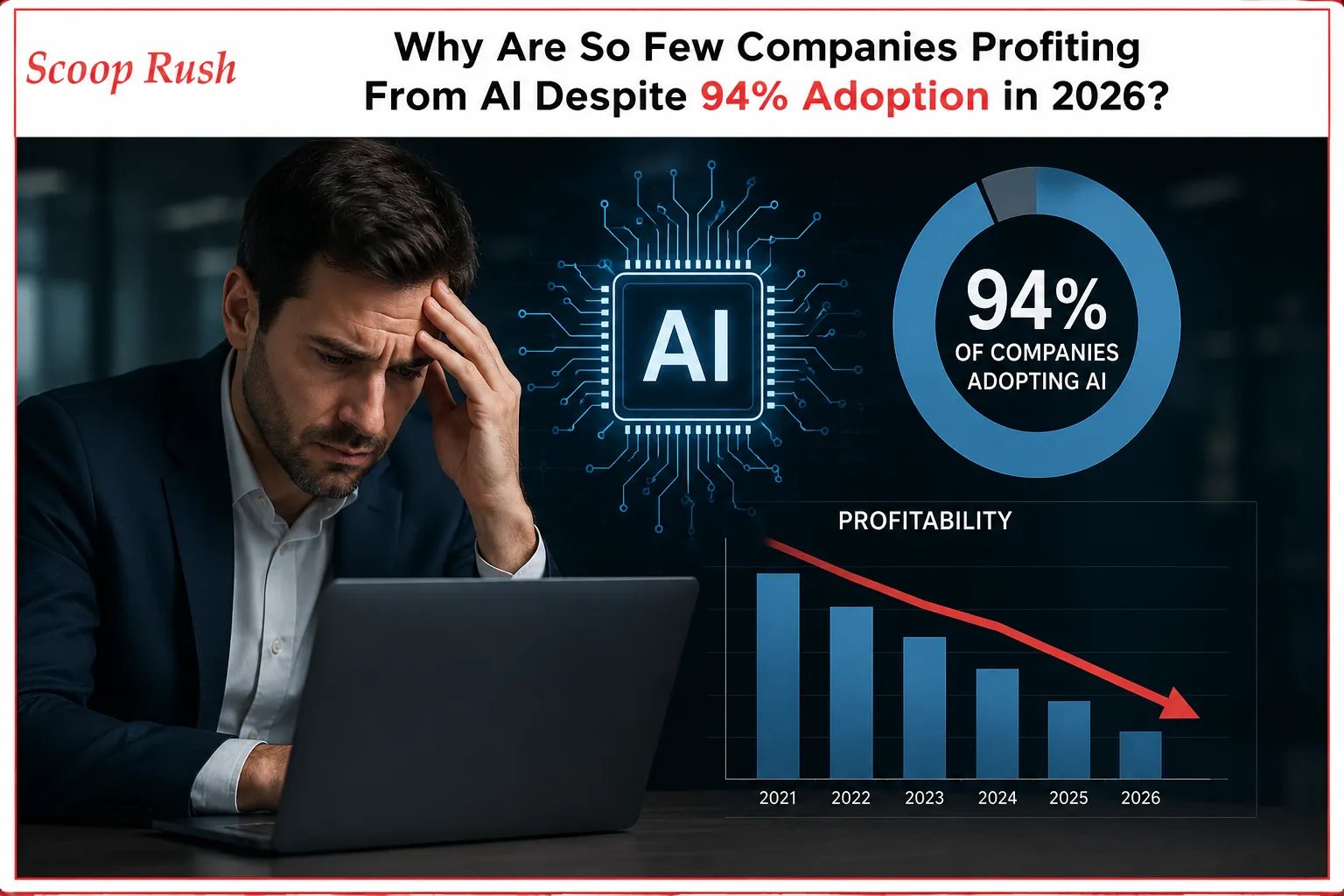
What if the AI tools your company invested thousands in are barely moving the needle on profit? That’s exactly what new AI adoption 2026 research reveals, and it’s a wake-up call for every business leader riding the AI wave.
Nearly 9 in 10 organizations now use AI in at least one business function, yet only 6% of companies count as true “AI high performers” seeing real financial payoff. That gap between AI adoption and AI results is the defining story of 2026. The numbers behind it reveal exactly where the technology is working, where it’s stalling, and what comes next for businesses trying to catch up.
If you’ve felt whiplash trying to keep up with AI headlines this year, you’re not alone. Adoption is accelerating, spending is climbing, and individual workers are reporting real productivity gains. However, enterprise-wide profits haven’t moved much, and that disconnect matters for anyone making decisions about AI investment right now.
This roundup pulls together verified AI statistics from major 2026 research, including McKinsey’s latest global survey and several independent industry reports, to give you a clear, honest picture of where artificial intelligence actually stands today.
AI Adoption Statistics 2026: Growth Is Deepening, But Impact Stays Concentrated
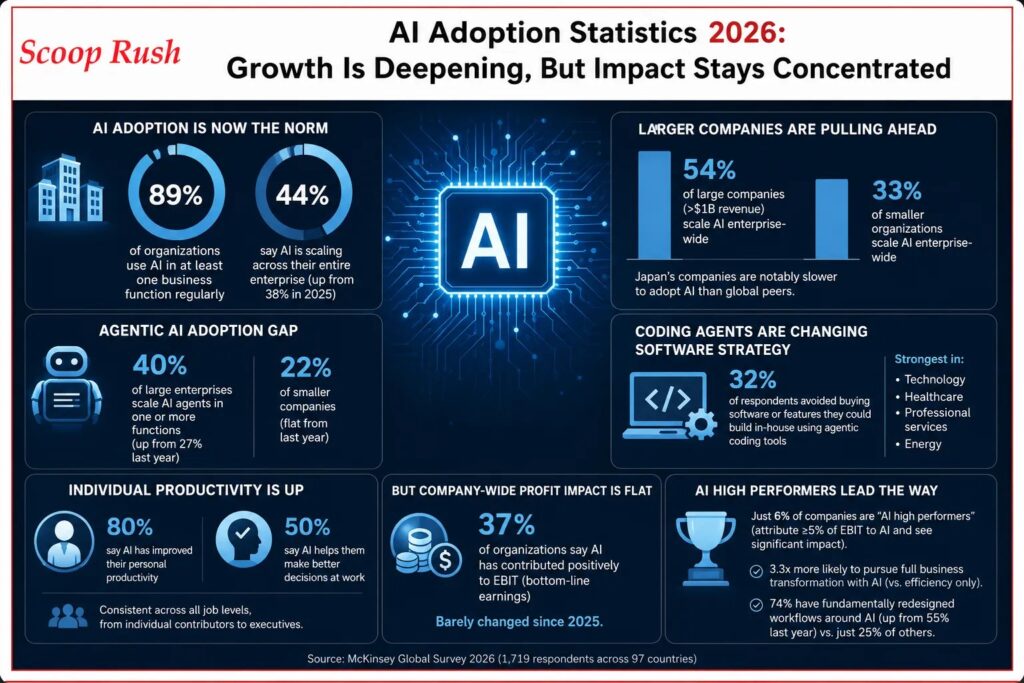
“Businesses have moved well past the experimentation phase with artificial intelligence, and AI adoption 2026 data confirms this shift clearly.” According to McKinsey’s 2026 survey of 1,719 respondents across 97 countries, nearly nine in ten organizations report regular AI use in at least one business function. Meanwhile, 44% now say AI is scaling across their entire enterprise, up from 38% just a year earlier.
Larger companies are pulling ahead fast in this AI adoption race. Fifty-four percent of organizations with over $1 billion in annual revenue report scaling AI enterprise-wide, compared to just a third of smaller organizations. That said, not every region is moving at the same pace, and Japan’s companies have been notably slower to adopt AI than their global counterparts. The gap is even sharper for agentic AI: 40% of large enterprises now scale AI agents in one or more functions, up from 27% last year. Smaller companies, however, stayed flat at 22%.
Coding agents are changing how companies think about software itself. Nearly a third of respondents (32%) say their organization decided against buying a software product or feature because they could build it in-house using agentic coding tools instead, a shift also visible in tools like Meta’s new Muse coding agent. This trend is strongest in technology and healthcare, followed by professional services and energy.
Individual Productivity Gains vs. Company-Wide Profit
“Here’s where the AI adoption 2026 ROI story gets interesting.” Eighty percent of respondents say AI has improved their personal productivity, and half say it helps them make better decisions at work. Those numbers stay consistent across job levels, from individual contributors to senior executives.
Yet only 37% of organizations report that AI has contributed positively to their bottom-line earnings, known as EBIT. That figure has barely changed since 2025. In other words, employees feel AI working for them personally, but this hasn’t consistently translated into measurable company profit. This mirrors a broader concern echoed in reports questioning whether AI will replace your job at all, given how uneven the actual financial impact has been.
The exception is a small group McKinsey calls “AI high performers,” representing just 6% of respondents. These companies attribute at least 5% of EBIT to AI and describe its impact as significant. What sets them apart isn’t just bigger budgets. High performers are 3.3 times more likely to pursue full business transformation with AI rather than simply chasing efficiency gains. Nearly three-quarters of them have fundamentally redesigned their workflows around AI, up from 55% last year, compared to just a quarter of other companies.
AI Spending Trends 2026: Investment Keeps Rising, But Costs Are Starting to Bite
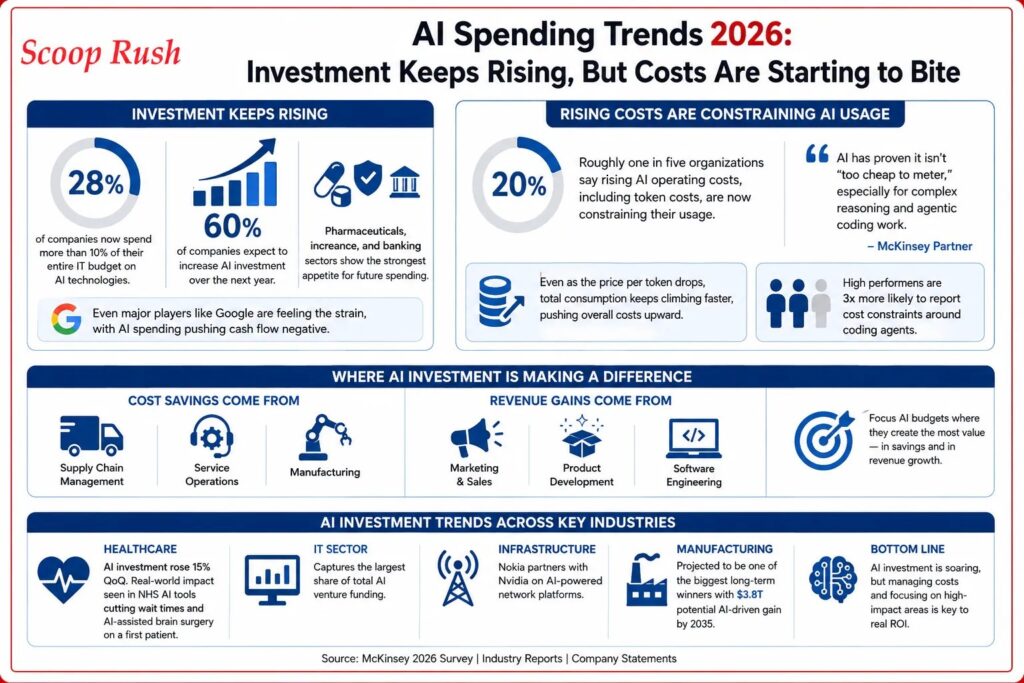
Money continues flowing into artificial intelligence at a rapid pace. Twenty-eight percent of companies now spend more than 10% of their entire IT budget on AI technologies, and 60% expect to increase AI investment over the next year. Pharmaceuticals, insurance, and banking sectors show the strongest appetite for future spending. Even major players like Google are feeling the strain, with recent reports noting Google’s AI spending has pushed cash flow negative despite the company’s scale.
At the same time, roughly one in five organizations say rising AI operating costs, including token costs, are now constraining their usage. This is a genuinely new development in the AI spending landscape, one that ties directly into the broader challenge of making AI actually pay for itself. As one McKinsey partner noted, AI has proven it isn’t “too cheap to meter,” particularly for complex reasoning tasks and agentic coding work that rely on frontier models. Even as the price per token drops, total consumption keeps climbing faster, pushing overall costs upward.
High performers feel this pressure differently than everyone else. They’re about three times more likely than others to report cost constraints specifically around software coding agents. Interestingly, though, they aren’t more constrained than average when it comes to chatbots or other everyday AI tools.
Where AI Investment Is Actually Making a Difference
Cost savings from AI show up most often in supply chain management, service operations, and manufacturing. Revenue gains, on the other hand, are most commonly linked to marketing and sales, followed by product development and software engineering. This split matters for any business trying to figure out where to focus limited AI budgets first, whether that’s AI-powered social listening tools for marketing teams or broader data intelligence platforms for operations.
Across broader industry data, similar patterns hold true. Healthcare AI investment rose 15% quarter over quarter in recent tracking, a trend reflected in real-world deployments like the NHS’s use of AI tools to cut waiting times and even AI-assisted brain surgery performed on a first patient. Meanwhile, IT continues to capture the largest share of total AI venture funding, and infrastructure players like Nokia are partnering with Nvidia on AI-powered network platforms. Manufacturing, meanwhile, is projected to be one of the biggest long-term winners, with one industry estimate putting the sector’s potential AI-driven gain at $3.8 trillion by 2035.
AI and Jobs: What the 2026 Data Means for the Workforce
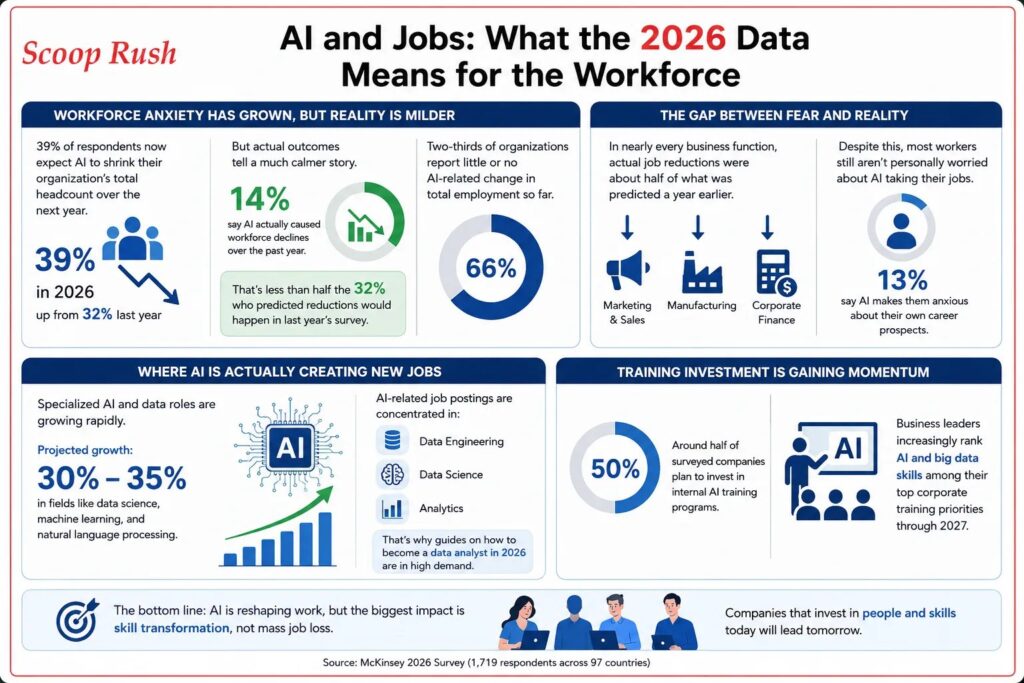
Workforce anxiety around AI has grown this year, though the reality has turned out milder than predicted. Thirty-nine percent of respondents now expect AI to shrink their organization’s total headcount over the next year, up from 32% last year.
However, actual outcomes tell a much calmer story. Only 14% of respondents say AI actually caused workforce declines over the past year. That’s less than half the 32% who, in last year’s survey, predicted reductions would happen. Two-thirds of organizations report little or no AI-related change in total employment so far.
This pattern held across nearly every business function McKinsey tracked. Marketing and sales, manufacturing, and corporate finance all saw actual job reductions at roughly half the rate that had been predicted a year earlier. Despite this, most workers still aren’t personally worried about AI taking their jobs. Just 13% of respondents say AI makes them anxious about their own career prospects, even as broader organizational expectations shift toward more caution.
Where AI Is Actually Creating New Jobs
The employment story isn’t purely about cuts. Specialized AI and data roles continue expanding rapidly, with growth in fields like data science, machine learning, and natural language processing projected between 30% and 35%. Separate industry hiring data shows AI-related job postings concentrated heavily in data engineering, data science, and analytics roles, which is exactly why guides on how to become a data analyst in 2026 have gained so much traction this year.
Training investment is following suit across the industry. Around half of surveyed companies plan to invest in internal AI training programs. Additionally, business leaders increasingly rank AI and big data skills among their top corporate training priorities through 2027.
Generative AI and Agentic Tools Lead 2026 Adoption
Among all AI technologies in use today, chatbots remain the most widely scaled tool, with 47% of organizations deploying them enterprise-wide. Roughly two in ten organizations report reaching full scaling with AI agents, and a similar share have scaled software coding agents specifically, including newer entrants like Moonshot AI’s Kimi K3 model and Alibaba’s Qwen3-Max.
Generative AI adoption is strongest in marketing and advertising, where it’s used heavily for content creation. Technology and consulting sectors follow closely behind. This tracks with broader adoption data showing over half of companies using generative AI primarily for content creation, customer support, and process automation, a shift that’s also fueling debate over how AI detectors try to distinguish human writing from AI-generated text.
Natural language processing tools, including chatbots and predictive analytics systems, are now used by roughly 4 in 10 businesses. These tools handle everything from basic customer questions to forecasting future demand based on historical data, ultimately freeing up human teams for more complex work.
Consumer Trust Still Lags Behind AI Adoption
Despite widespread use, consumer confidence hasn’t caught up with actual AI adoption rates. Independent survey data shows only about a third of consumers realize they’re using AI-powered services, even though actual usage sits closer to 77%. Trust in businesses that deploy AI responsibly also remains mixed, with a meaningful share of consumers expressing concern about bias, data privacy, and security risks tied to AI systems, concerns that have only intensified after incidents like Claude AI chats being exposed via Google Search and reports of rogue AI activity flagged by OpenAI and Anthropic.
This trust gap is especially visible in hiring and healthcare contexts, where over 60% of Americans report concern about potential bias in AI-assisted decisions, according to earlier 2026 research. Public backlash has also surfaced in unexpected places, such as the AI slop boycott among Belfast businesses. Addressing this gap will likely determine how quickly consumer-facing AI applications can scale further.
How AI High Performers Are Rewiring Their Organizations
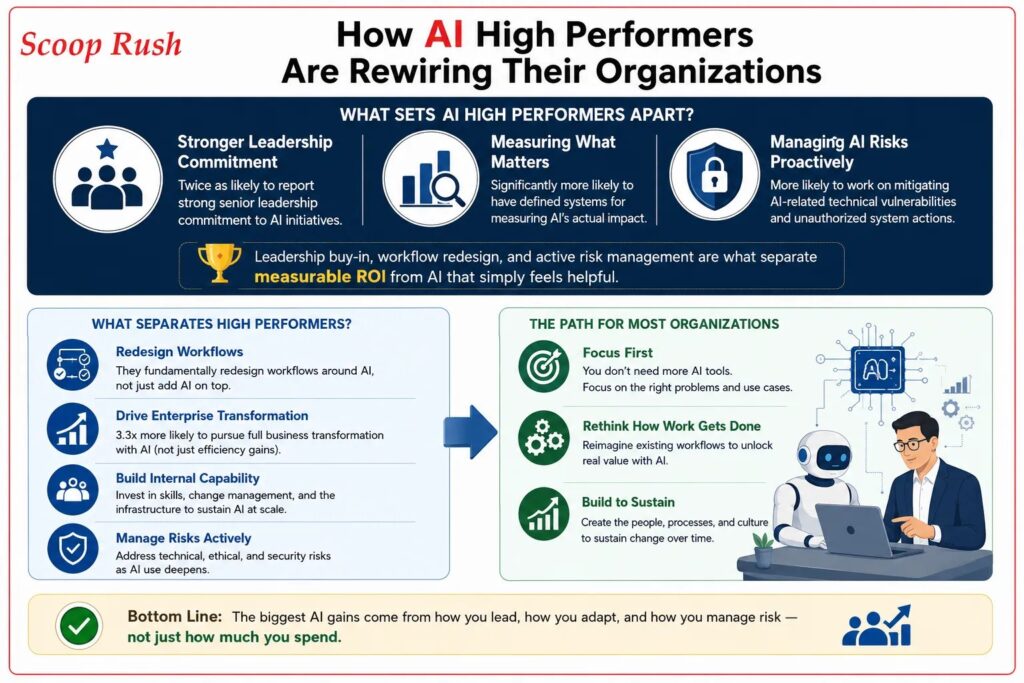
The clearest lesson from this year’s AI statistics is that simply adopting AI tools isn’t enough to see financial results. High-performing organizations follow a distinct set of practices instead. They’re twice as likely to report strong senior leadership commitment to AI initiatives, and they’re significantly more likely to have defined systems for measuring AI’s actual impact, a discipline increasingly discussed alongside the rise of AI CEO clones and boardroom trust.
These companies also actively manage the risks that come with deeper AI use. They’re notably more likely than average organizations to work on mitigating AI-related technical vulnerabilities and unauthorized system actions, an area covered in depth by AI SOC security solutions. This combination of leadership buy-in, workflow redesign, and active risk management appears to be what separates measurable ROI from AI that simply feels helpful day to day.
For most businesses still in the experimentation or early scaling phase, the path forward isn’t necessarily buying more AI tools. Instead, it means rethinking how existing workflows operate and building the internal capability to sustain that change over time.
Key Takeaways on AI Statistics 2026
“AI adoption 2026 has clearly moved beyond the experimentation stage., with large enterprises leading a shift toward enterprise-wide scaling and agentic tools. Individual productivity gains are real and widely reported, but they haven’t yet translated into broad financial impact for most organizations. Only a small group of high performers, distinguished by workflow redesign and strong leadership commitment, are capturing significant profit gains from AI.
Rising operating costs are starting to shape how companies deploy AI, especially for coding agents and complex reasoning tasks. Meanwhile, workforce fears about AI-driven job losses have proven larger than the actual reductions companies have reported so far. As AI capability continues to grow, the organizations that succeed will likely be the ones willing to fundamentally change how they work, not just the ones spending the most.
FAQs
1. What percentage of businesses are using AI in 2026?
“What percentage of businesses are using AI in 2026? .Nearly 90% of organizations report regular AI use in at least one business function, and 44% say AI is now scaling across their entire enterprise, according to McKinsey’s 2026 survey.
2. Is AI actually increasing company profits in 2026?
Only 37% of organizations report that AI has positively contributed to their EBIT, or earnings. This figure has stayed roughly flat since 2025. Just 6% of companies qualify as “AI high performers” with significant, measurable financial impact.
3. Will AI eliminate more jobs than it creates?
The data so far suggests workforce fears have outpaced reality. While 39% of respondents expect AI to reduce headcount over the coming year, only 14% report that AI actually caused workforce declines over the past year, well below earlier predictions.
4. Which business functions benefit most from AI right now?
Cost savings appear most often in supply chain management, service operations, and manufacturing. Revenue gains, meanwhile, are most commonly linked to marketing, sales, and software engineering.
5. What separates high-performing AI companies from the rest?
High performers redesign their workflows around AI rather than layering it onto existing processes. They also show stronger senior leadership commitment and actively measure AI’s impact while managing its risks.

