Home Blog Page 7

Nepal-Tibet Floods Leave Hundreds Dead and Thousands Missing

0

The Nepal-Tibet floods have caused widespread destruction along the Himalayan border. A glacier collapse triggered landslides and powerful flash floods on August 26, 2026. The disaster destroyed homes, roads, bridges, and critical infrastructure across the region.

At least 579 people have died, according to figures from Nepal’s National Disaster Risk Reduction and Management Authority. Nearly 1,924 people remain missing in Nepal. China reports five deaths and 558 missing people in Tibet. Authorities continue rescue operations as heavy rain threatens further flooding.

Nepal-Tibet Floods Begin After Glacier Collapse

The disaster began high in the Himalayas near the Nepal-China border. A large section of a glacier suddenly collapsed into a mountain valley. The collapse sent huge amounts of ice and rock into the river system.

The US Geological Survey initially recorded the event as a magnitude 4.4 earthquake, then updated its analysis to identify it as a glacial collapse that produced a magnitude 5.2 seismic signal, based on seismic station data and satellite imagery rather than an actual quake. Scientists believe the debris then blocked the Lhende River temporarily. Water gathered behind the debris before eventually breaking through.

Newly Formed Lakes Raise Fresh Flood Concerns

Newly-Formed-Lakes-Raise-Fresh-Flood-Concerns

The landslide created new lakes near the affected river system. These lakes now pose another serious threat to communities downstream. Nepal’s disaster authority said one lake had formed at the site and was rising, raising concerns it could burst and send another surge downstream a risk that extends to communities along the Trishuli and Gandak river systems, including areas across the border in India.

Heavy rain could raise water levels further over the coming days. Authorities therefore remain concerned about another sudden flood. Rescue teams also face dangerous conditions around unstable slopes and river channels.

Floodwaters Tear Through the Border Region

Once the river barrier failed, water and debris rushed downstream. The resulting flood wave carried mud, rocks, trees, and other material. On one section of the Trishuli river, water levels reportedly rose by as much as 30 feet in half an hour. The surge quickly reached the Rasuwagadhi border area in Nepal.

The powerful current destroyed the Miteri Bridge between Nepal and China, an important trade and transport link in Rasuwa district. Floodwaters also damaged the nearby customs area, and cargo containers were swept into the river.

Rasuwagadhi Suffers Severe Infrastructure Damage

Rasuwagadhi became one of the most heavily affected areas near the border. Floodwaters overwhelmed buildings and transport infrastructure within minutes. Video footage showed enormous amounts of mud covering roads and surrounding structures.

The destruction has severely disrupted movement between Nepal and Tibet. Cross-border trade also faces major delays after the bridge collapse. Rescue crews must now work around damaged roads and unstable terrain, which have made access to affected communities much harder officials say dozens of bridges were destroyed and roughly 40 kilometres of roads were damaged.

Trishuli River Carries Destruction Downstream

Trishuli-River-Carries-Destruction-Downstream

The disaster continued as floodwaters moved into major river systems. The Lhende River connects with the Bhote Koshi and Trishuli systems. These rivers carried enormous volumes of water and debris downstream.

Communities in Rasuwa and Nuwakot districts suffered extensive destruction. Homes, roads, vehicles, and other structures disappeared under the floodwater. Some residents had little warning before the surge arrived.

Nepal-Tibet Floods Damage Power Infrastructure

The floods also caused damage to Nepal’s hydropower infrastructure, including the Rasuwagadhi Hydropower Project. Other hydropower facilities downstream faced heavy impacts as well. (Note: reported figures on total megawatts lost vary by source and haven’t been independently confirmed here treat specific capacity numbers with caution until officially confirmed.)

Authorities now face this additional challenge while supporting rescue and recovery operations. Repairs could take considerable time if access remains difficult.

Roads Washed Away Across Northern Nepal

Flooding and landslides destroyed important sections of the Pasang Lhamu Highway, a vital access route toward the northern border region. Its damage has complicated rescue efforts across affected districts.

Secondary landslides have created additional hazards along damaged routes. Heavy machinery cannot easily reach some isolated communities. Rescue teams must therefore rely on helicopters and smaller access routes. Weather conditions could further complicate these operations.

Death Toll and Missing People Continue to Rise

Nepalese authorities reported at least 579 deaths as of Friday, August 28, with 579 bodies recovered and 101 injured people undergoing hospital treatment. The country’s disaster agency reported 1,924 missing people. These numbers could change as teams reach isolated locations and verify reports.

China reported five deaths and 558 missing people in Tibet. Authorities have not independently verified all figures between the two countries, and officials have noted some missing people could appear in both countries’ totals.

Foreign Tourists Among Those Reported Missing

Foreign-Tourists-Among-Those-Reported-Missing

The floods have also affected international visitors travelling through northern Nepal. Nepal’s tourism board reported hundreds of foreign nationals among the missing, many of whom had been on mountain treks, pilgrimages, or other trips including groups headed to or from Mount Kailash.

Reported figures for missing nationals shifted throughout the week as counts were updated. As of the latest updates: the United States reported around 90 Americans missing, Malaysia around 51, Australia 39, and Britain 33. India and Ukraine’s totals were reported at different points ranging from roughly 167–320 and 53–62 respectively, depending on the update. Given how quickly these figures have moved, readers should treat any single snapshot as provisional rather than final.

Rescue Teams Face Dangerous Conditions

Nepal has expanded its rescue response across affected river communities, with reports of more than 15,000 security personnel deployed for search, rescue, and relief operations. Prime Minister Balendra Shah and his Council of Ministers pledged a month’s salary to the Prime Minister’s Disaster Relief Fund, and the Cabinet directed the Finance Ministry to prepare a relief and rehabilitation package for affected individuals and businesses.

Chinese authorities have also coordinated emergency operations following the disaster. International governments have offered assistance and emergency supplies, and India has been among the countries providing aid.

Weather Creates More Problems for Rescuers

Rescue teams face difficult weather across the mountainous disaster zone. Heavy rain can trigger additional landslides and sudden river surges. Poor visibility can also restrict helicopter operations.

Authorities must also monitor unstable areas above affected communities. Temporary river blockages could create new landslide dams. If those barriers fail, another flood could strike downstream settlements. Officials have urged affected communities to remain alert and follow evacuation warnings.

Climate Change Could Increase Glacier Risks

Scientists have linked rising temperatures with faster glacier loss, and the Hindu Kush Himalaya region has experienced significant warming. However, researchers say a direct causal link between climate change and this specific collapse has not been established, and more study is needed to understand the event’s exact triggers.

Warmer conditions can thin glaciers and weaken frozen mountain terrain. Melting permafrost can also reduce stability on steep slopes. These changes may increase the risk of landslides in some areas.

Nepal Faces a Long Recovery

Nepal-Faces-a-Long-Recovery

The immediate priority remains finding survivors and assisting displaced communities. Rescue crews continue searching riverbanks, damaged villages, and isolated areas. Authorities also need to restore roads and essential services.

The disaster has damaged transport, electricity, homes, and border infrastructure. Recovery will therefore require significant resources and coordination. Communities along the river system face an uncertain period ahead, and officials must also prepare for possible secondary flooding from the newly formed glacial lakes.

Nepal-Tibet Floods Show the Power of Mountain Disasters

The Nepal-Tibet floods demonstrate how quickly Himalayan disasters can spread downstream. A collapse high in the mountains triggered destruction many kilometres away. Rivers carried the resulting water and debris through several vulnerable communities.

The disaster also shows the dangers facing settlements near unstable mountain rivers. Early warnings and stronger monitoring could help reduce future risks. For now, rescue teams continue their difficult work across the affected region, focused on saving lives and preventing another catastrophe.

FAQs

1. What caused the Nepal-Tibet floods? 

A glacier collapse triggered the disaster near the Nepal-China border on August 26, 2026. The collapse sent ice, rock, and debris into the river system, temporarily blocking it and building up dangerous water pressure before it broke through downstream.

2. How many people have died in the floods? 

Nepalese authorities reported at least 579 deaths as of Friday, August 28. China separately reported five deaths in Tibet. Officials continue verifying figures as rescue teams reach affected areas, and the toll could still rise.

3. How many people remain missing? 

Nepal’s disaster agency reported 1,924 missing people. Chinese state media reported another 558 missing in Tibet. Officials have warned that some figures may overlap between the two countries’ counts.

4. Could another flood happen in the region? 

Yes. New lakes formed by the landslide could overflow or burst, and heavy rain could raise water levels and destabilize river channels further. Authorities continue monitoring these areas and warning downstream communities.

5. Did the floods affect foreign tourists? 

Yes. Nepal’s tourism board reported hundreds of missing foreign nationals from more than 30 countries, including the United States, India, Ukraine, Malaysia, Australia, and Britain. Exact per-country figures have shifted as authorities update their counts.


Scotland Road Trip Guide: Highlands, Loch Ness and the Isle of Skye

0

A Scotland road trip takes you through mountains, lochs, castles, and island scenery. This route runs from Edinburgh into the Highlands and reaches Scotland’s most famous sights. It mixes dramatic landscapes with historic towns and scenic drives. Seven days gives first-time visitors enough time to explore without rushing.

This guide walks through each stage of the journey step by step. It covers Edinburgh, Glencoe, Loch Ness, and the Isle of Skye in order. Along the way, it also shares practical tips on driving, timing, and budget. By the end, you will have a clear plan for your own Scotland road trip.

Start in Edinburgh

Edinburgh works well as a starting point for this trip. The city has strong transport links and many rental car options. Spending one or two nights here adds culture before the countryside begins. Edinburgh Castle offers wide views across the city and nearby hills, and the Royal Mile leads toward the Palace of Holyroodhouse.

Pick up your rental car on the day you leave the city. This way, you avoid paying for an unused rental night. It also makes driving easier once you clear the busy streets. Remember that Scotland drives on the left, so allow time to adjust. Roundabouts may feel tricky during your first few miles.

Drive Through Glencoe to Fort William

Drive-Through-Glencoe-to-Fort-William

The road north changes gradually as the Lowlands give way to open country. Glencoe forms one of the most striking entrances to the Highlands. Steep mountains rise around the valley and create dramatic views everywhere you look. Waterfalls, moorland, and shifting weather all add character to the scene. Several walking routes also make the valley easy to explore.

Continue to Fort William after you finish exploring Glencoe. This town sits close to Ben Nevis and offers solid accommodation and services. It also gives you access to Glenfinnan and its famous viaduct. The viaduct spans the valley with 21 arches and gained fame through the Harry Potter films. Check train times ahead if you want to catch the Jacobite Steam Train.

Explore Loch Ness and Inverness

From Fort William, the route continues toward the famous waters of Loch Ness. The loch stretches for about 37 kilometers through the heart of the Highlands. Its dark waters and surrounding peaks create one of Scotland’s best-known views. You can drive along the loch and stop at several scenic spots.

Urquhart Castle remains one of the best stops along Loch Ness. Its ruins sit beside the water and offer sweeping views of the loch. A boat cruise also gives you another way to see the scenery. Afterward, head to Inverness for an overnight stay before moving on to Skye. The city sits near the northern end of the loch and offers good restaurants and evening walks.

Cross to the Isle of Skye

Cross-to-the-Isle-of-Skye

The Isle of Skye stands out as the highlight of most Scotland road trip routes. The drive from Inverness takes around two hours before you reach the island. Eilean Donan Castle makes an excellent stop before you cross the Skye Bridge. The castle sits on a small island where three sea lochs meet, making it one of Scotland’s most photographed spots.

The Skye Bridge gives direct road access to the island. Portree works well as a base since it offers accommodation, restaurants, and a colorful harbor. However, Skye deserves more than a rushed overnight stop. Two nights give you more time to see the island’s major landscapes and hiking trails properly.

Discover Skye’s Top Natural Attractions

The Fairy Pools rank among Skye’s most recognizable natural sights. Clear pools and waterfalls sit beneath the dramatic Cuillin mountains nearby. You reach the main pools after a short walk from the parking area. The spot draws large crowds, especially during busy summer months, so an early visit helps you enjoy quieter surroundings.

The Old Man of Storr delivers another major Skye experience. Its striking rock formations dominate the wider Trotternish landscape. Hikers with enough time can walk around the formation and take in coastal views. Nearby, the Quiraing offers another dramatic landscape on the same peninsula. Together, these two spots create some of the strongest scenery on the island.

See Quiraing, Kilt Rock and Neist Point

The Quiraing stands out as one of Skye’s most dramatic geological sites. Its unusual rock formations create a striking backdrop for hiking and photography. Even a short walk from the upper car park gives impressive views. Longer walks reveal quieter paths and wider views toward the sea, so take care on narrow sections near streams.

Kilt Rock and Mealt Falls offer another memorable stop along the Trotternish route. The waterfall drops beside a tall rock formation shaped like a kilt. This area gets extremely windy, so pack warm layers before you visit. Neist Point, meanwhile, sits on Skye’s western coast and features a lighthouse at the end of rugged cliffs. Strong winds make the site feel wild, but the views stay impressive even under cloudy skies.

Follow Highland Driving Rules

Driving in the Highlands demands extra attention on single-track roads. These roads often carry traffic moving in both directions on one lane. Passing places let vehicles move safely around oncoming traffic. Drivers should use these spots when meeting cars head-on. They should also pull over when faster traffic approaches from behind.

A smaller rental car handles narrow roads more easily than a large one. Automatic vehicles usually cost more and come with lower availability. Booking early matters most during July and August. Fuel stations also become less frequent in remote Highland areas, so fill up whenever you get the chance.

Choose the Best Time to Travel

Choose-the-Best-Time-to-Travel

May through September offers a solid travel window for this route. May and June bring long daylight hours and green landscapes throughout the Highlands. July and August usually bring bigger crowds and higher accommodation demand. September offers great scenery while visitor numbers start to drop.

Travelers should still prepare for rain, wind, and cooler temperatures. The Isle of Skye can feel especially exposed near the coast. Waterproof shoes and warm layers stay useful even in summer months. Midges can also become a nuisance during warmer periods, so plan outdoor activities around the weather.

Book Accommodation and Key Stops Early

Accommodation needs careful planning for any Scotland road trip. Skye has limited rooms compared with its summer demand. Hotels, guesthouses, and B&Bs fill up fast during peak periods. Booking as soon as your route firms up reduces the risk of last-minute changes.

Staying just outside Portree can also give you quieter surroundings and scenic views. Popular attractions need advance planning too, since Urquhart Castle gets busy in high season. Jacobite Steam Train seats can sell out weeks ahead of travel. Mobile coverage also drops out in remote areas, so download directions before you leave each stop.

Add the Cairngorms on Your Return

The return journey can add another major Scottish landscape to your trip. Cairngorms National Park offers mountains, forests, valleys, and open countryside. This route gives a strong contrast to Skye’s coastal scenery. Travelers can also pass through Perthshire on the way back to Edinburgh.

Those with more time can extend the trip toward the North Coast 500. This route covers around 500 miles around northern Scotland. It passes remote villages, beaches, cliffs, and Highland scenery along the way. However, this addition works better with ten days or more, since it needs extra time behind the wheel.

Budget Tips for Your Scotland Road Trip

A one-week Scotland road trip for two people costs around $1,650 to $2,200. That estimate covers car rental, fuel, accommodation, and meals. It does not include flights to and from Scotland. Costs shift based on season, accommodation type, and vehicle choice.

Travelers can control spending by picking guesthouses and casual local dining. A realistic itinerary should also leave room for weather changes and surprise stops. Scotland’s scenery often tempts travelers to stop more than planned. Therefore, an itinerary with breathing room usually beats a packed schedule.

Final Thoughts

A Scotland road trip rewards travelers who balance famous sights with flexible driving days. Edinburgh, Glencoe, Loch Ness, and Skye each bring their own character to the journey. Together, they create a route full of castles, lochs, and dramatic mountain views. Seven days gives you a strong introduction without leaving the trip feeling rushed.

Planning ahead still makes a real difference to how smoothly the trip runs. Booking accommodation and key attractions early helps you avoid last-minute stress. Packing for changing weather also keeps you comfortable across every stop. With the right preparation, this route delivers one of Scotland’s most memorable adventures.

FAQs

1. How many days do you need for a Scotland road trip? 

Seven days works well for a first trip through the Highlands and Skye. This timeframe covers Edinburgh, Glencoe, Loch Ness, and Skye comfortably. Add extra days if you want longer hikes or northern routes.

2. What is the best time for a Scotland road trip? 

May, June, and September offer the best mix of weather and lighter crowds. July and August bring more tourists and higher accommodation prices. Scottish weather stays unpredictable throughout the year, so pack layers regardless of season.

3. Is the Isle of Skye worth visiting? 

Yes, Skye earns its place as a major stop on this route. The island combines mountains, waterfalls, cliffs, and dramatic rock formations in one place. Two nights give you far more time than a rushed single-day visit.

4. Are Scottish Highland roads difficult to drive? 

Some Highland roads need extra care, especially narrow single-track routes. Passing places let drivers give way safely to oncoming traffic. A smaller vehicle makes these roads easier to handle, and left-hand driving takes some adjustment.

5. What should you book before a Scotland road trip? 

Book accommodation early, especially anywhere on the Isle of Skye. Popular attractions and train rides may also need advance booking. Jacobite Steam Train seats sell out quickly during busy travel months.

Disney’s Lakeshore Lodge: Opening Date, Room Prices & How to Book (2027 Guide)

0

Would you believe Walt Disney World is about to open its biggest new resort in decades? Disney just confirmed the Disney’s Lakeshore Lodge opening date, and reservations start in a little over a month. This guide covers the opening date, what we know about room prices, every room type revealed so far, and exactly how to book.

For Disney Vacation Club members, Annual Passholders, and anyone dreaming of a Bay Lake view, this news matters. It means the countdown to booking has officially begun.

Disney’s Lakeshore Lodge Opening Date

Disney’s Lakeshore Lodge opens on July 1, 2027, at Walt Disney World Resort. The property will hold 967 themed accommodations across a ten-story building, making it the largest new Walt Disney World resort in decades.

The resort sits along the “bayou” of Bay Lake, near Fort Wilderness and Wilderness Lodge. A tree-lined driveway leads guests to a porte-cochere shaped like a bird in flight, surrounded by cascading water features. Floor-to-ceiling windows fill the building, bringing natural light and the surrounding scenery into the interior.

The layout follows the original Reflections resort concept from 2018, with one exception. Disney cut the treehouse villas from earlier plans. Construction never started on them, so this change confirms that idea is officially off the table.

Why Each Room Type Tells a Different Story

Disney’s Lakeshore Lodge does not lean on a single film for its theme. Instead, each room category draws from a different Disney Animation classic. Encanto inspires the smallest studios. Bambi shapes the mid-size rooms and villas. Fantasia influences the largest villas. Pocahontas guides the hotel-style rooms. Brother Bear defines the standalone waterfront houses. This mix gives the resort a layered feel as guests move between accommodation types.

Disney’s Lakeshore Lodge Room Prices: What We Know So Far

Disney has not released official room rates for Disney’s Lakeshore Lodge yet. However, the booking timeline below confirms that early reservations will run at standard cash rack rates rather than promotional pricing.

Disney Vacation Club members will eventually book with points instead of cash, though the resort has not announced that points chart yet. Given the resort’s size and premium waterfront location, expect rack rates to sit at the high end of the Walt Disney World Deluxe resort category. We will update this guide once Disney shares specific pricing.

Room Types Inside Disney’s Lakeshore Lodge

Room Types Inside Disney's Lakeshore Lodge

Disney shared images of nearly every accommodation category ahead of the booking window. Here is a breakdown, starting with the smallest spaces and building up to the largest.

Duo Studios for Couples and Small Families

Duo Studios sleep two guests and take their theme from Encanto. These compact rooms pack in vibrant colors and space-saving layouts despite their small footprint. Disney appears to refine this room type with each new resort, and the Lakeshore Lodge version looks like a step forward from earlier attempts.

This category carries some controversy, though. Cash pricing on Duo Studios has drawn criticism at other resorts, and guests sometimes misunderstand what the room includes. Even so, the layout suits couples well, including those traveling with an infant.

Deluxe Studios With Bambi-Inspired Design

Deluxe Studios sleep up to four guests and draw their theme from Bambi. Warm wood paneling extends above the headboard and across the ceiling, adding texture that some other design elements in the room lack. An accent rug and archival concept art complete the look.

Unlike similar rooms at other recent DVC resorts, these studios skip the kitchenette layout used in the Poly’s Island Tower rooms. Guests praised that layout at Island Tower, so its absence here stands out.

One and Two-Bedroom Villas for Larger Groups

Families needing more space can choose a one-bedroom villa, which sleeps up to five guests, or a two-bedroom villa, which sleeps up to nine. Both continue the Bambi theme with soft earth tones and forest motifs. Each villa includes a full kitchen, a washer and dryer, a private patio, and generous living and dining space.

Some villas overlook Disney’s Contemporary Resort, which offers an unexpected but striking view. Disney Vacation Club has delivered strong villa designs consistently over the past several years, so expectations remain high here too.

Three-Bedroom Grand Villas for Multigenerational Trips

The Three-Bedroom Grand Villas sleep up to 12 guests and draw their theme from Fantasia. These spacious units include multiple bathrooms, a full kitchen, and a private patio with Bay Lake views. Most guests will never book this category, but it remains a popular aspirational room for many DVC members.

A-Frame Waterfront Lake Houses: The Standout Room Type

The A-frame Lake Houses stand out as the most exciting new accommodation at Disney’s Lakeshore Lodge. Guests can choose one-bedroom units that sleep five or two-bedroom units that sleep eight. These freestanding retreats sit directly along Bay Lake and feature dramatic A-frame architecture with expansive floor-to-ceiling windows.

Each Lake House includes a private porch, a full kitchen, and a washer and dryer. The interior theme celebrates Brother Bear, with nods to the film’s Alaskan setting. A Northern Lights-inspired lighting feature in the primary bedroom casts a soft glow after dark. This room type resembles the Cascade Cabins at Wilderness Lodge, and many consider it the best new offering at the resort.

Resort Studios for Hotel-Style Stays

Resort Studios sleep up to four guests, while Resort Studio King rooms sleep up to two. These hotel-style rooms take their theme from Pocahontas, using earthy colors and archival artwork inspired by the film’s landscapes. Disney has not confirmed the exact number of Resort Studios yet. Based on patterns at other DVC properties, though, these rooms will likely make up most of the resort’s inventory and stay available for cash bookings well into the future.

Club Level and Suite Options at Disney’s Lakeshore Lodge

Club Level and Suite Options at Disney's Lakeshore Lodge

Guests in select club level rooms will gain access to The Artist’s Nest, a concierge lounge positioned above the treetops. The lounge offers personalized service, complimentary refreshments, and views of Magic Kingdom fireworks. This makes Disney’s Lakeshore Lodge only the second Disney Vacation Club resort at Walt Disney World with a true club level, following Kilimanjaro Club at Animal Kingdom Lodge.

For the most exclusive stay, the Hidden Willow Presidential Suite sleeps up to six guests. It includes two bedrooms, two full bathrooms, a full kitchen, a washer and dryer, and access to The Artist’s Nest Club Level. Guests can enjoy Bay Lake views by day and Magic Kingdom fireworks by night.

How to Book Disney’s Lakeshore Lodge

Disney released a clear timeline that gives different guest groups priority access before general booking opens.

  • October 6, 2026: Disney Vacation Club members can make early rental reservations by calling Member Services at (800) 800-9800.
  • October 7, 2026: Walt Disney World Annual Passholders can make early rental reservations by calling (407) 934-7639.
  • October 8, 2026: All guests can book online or by phone at (407) 934-7639.

These early booking dates apply to cash reservations at standard rack rates. Disney has not yet announced when points-based reservations for DVC members will open. Disney also teased an exclusive “First Wave” Experience for eligible members, though details are still to come.

Is Disney’s Lakeshore Lodge a Mixed-Use Resort?

Is Disney's Lakeshore Lodge a Mixed-Use Resort?

Technically, Disney’s Lakeshore Lodge is a Disney Vacation Club property rather than a traditional mixed-use hotel. In practice, though, the club level lounge, Resort Studios, and Presidential Suite tell a different story. Guests will likely book all of these categories with both cash and DVC points, so the resort will function like a mixed-use hotel for years to come.

Consider the scale involved. Disney’s Saratoga Springs Resort, the current second-largest DVC property, holds 888 vacation homes. Disney’s Lakeshore Lodge will hold 967. For comparison, Disney’s Riviera Resort took more than seven years to fully declare its 341 vacation homes into DVC inventory. Given the size difference, Disney’s Lakeshore Lodge could take two to three decades to sell out completely, so cash bookings should remain common for a long time.

Final Thoughts

The early looks at Disney’s Lakeshore Lodge point to a resort with real ambition. The room designs show strong attention to detail, even though some spaces feel a little too clean compared to other recent Disney Vacation Club properties. Execution will matter most, and Disney has consistently improved room designs once construction wraps up.

The A-frame Lake Houses stand out as the most exciting addition, offering a room type Walt Disney World has never had before. Meanwhile, the studios and villas follow familiar, well-loved formulas with fresh theming built around nature-focused Disney classics.

As a result, Disney’s Lakeshore Lodge is shaping up to become a major addition to the Walt Disney World resort lineup when it opens on July 1, 2027. Guests planning ahead should mark their calendars for the October 2026 booking dates, since demand for this property should run high from day one.

Frequently Asked Questions

When does Disney’s Lakeshore Lodge open? 

Disney’s Lakeshore Lodge opens on July 1, 2027, at Walt Disney World Resort.

How much do rooms cost at Disney’s Lakeshore Lodge? 

Disney has not announced official room prices yet. Early bookings will run at standard cash rack rates, and Disney will release a DVC points chart at a later date.

When can I book a room at Disney’s Lakeshore Lodge? 

Disney Vacation Club members can book starting October 6, 2026. Annual Passholders can book starting October 7, 2026. General bookings open to all guests on October 8, 2026.

How many rooms does Disney’s Lakeshore Lodge have? 

The resort holds 967 themed accommodations, making it the largest new Walt Disney World resort in decades.

What room types are available at Disney’s Lakeshore Lodge? 

Options include Duo Studios, Deluxe Studios, one- and two-bedroom villas, three-bedroom Grand Villas, Resort Studios, A-frame waterfront Lake Houses, club level rooms, and the Hidden Willow Presidential Suite.

Bayern Munich 2026-27 Season: Can Harry Kane Finally Win the Ballon d’Or?

0

Could This Finally Be Harry Kane’s Ballon d’Or Season?

Could this finally be the year Harry Kane wins the Ballon d’Or? It’s a question that would have sounded far-fetched a few years ago. Back then, Kane had never won a single trophy. Now, as Bayern Munich open their 2026-27 season, it’s one of the biggest storylines in European football.

This weekend, Vincent Kompany’s side begin their Bundesliga title defence at home to Stuttgart. Bookmakers have already made up their minds. Bayern are priced as short as 1-7 to win the league again. That reflects just how one-sided German football has become at the top. However, for fans of the sport, the real intrigue isn’t whether Bayern win the league. It’s whether Kane can finally add the individual prize that has so far eluded him.

Let’s dig into what’s actually at stake for Bayern Munich, Kompany, and Kane as the new campaign kicks off. We’ll also look at just how realistic Kane’s Ballon d’Or chances really are.

Why Kane’s Ballon d’Or Push Matters This Season

It might seem odd to build excitement around a team so heavily favoured to win. However, that is exactly what makes this Bundesliga title defence worth watching closely.

Bayern are chasing a hat-trick of titles under Kompany. He took over from Thomas Tuchel and has since delivered stability that the club had been missing for years. Before his arrival, Bayern churned through seven managers in eight years. Since then, they have looked like a club with a clear identity again.

For neutral fans, the bigger draw might be Harry Kane. The England captain is chasing a fourth straight Bundesliga Golden Boot. There is now genuine conversation about whether he could win the Ballon d’Or. That storyline alone gives this season stakes that go beyond simple league standings.

Meanwhile, Bayern have already shown their intent. They beat rivals Borussia Dortmund 2-1 to win the German Super Cup last weekend. It was a small but telling signal that the new season starts with confidence rather than complacency.

Bayern Munich vs Stuttgart: How to Watch

Bayern’s first competitive test of the new Bundesliga season comes against Stuttgart on Friday, 28 August. Kick-off is at 19:30 BST. UK viewers can watch the match live on BBC iPlayer and the BBC Sport website and app.

It’s a fitting opener too. Stuttgart were the team Bayern beat in last season’s German Cup final. Kane scored all three goals in that match to complete the club’s domestic double. There is a nice symmetry to starting the new campaign against the same opponent.

What Kompany Has Said About Bayern’s Targets

Kompany has been characteristically blunt about what is expected of him and his squad. Speaking this summer, he laid out the club’s mentality in simple terms.

“The targets at Bayern are always set as high as possible, which means winning the Bundesliga, winning the cup, winning the Champions League and perhaps even winning every single match,” he said.

That is not just typical pre-season bravado. It reflects the genuine culture at a club that treats domestic dominance as the bare minimum. Winning the Bundesliga alone would not exactly be cause for wild celebration inside the Allianz Arena. It would simply be business as usual.

Would Winning the Bundesliga Be Enough for Kompany?

Would Winning the Bundesliga Be Enough for Kompany

This is where things get interesting. Since 2012, Bayern have failed to win the Bundesliga only once. That came in 2023-24, when Bayer Leverkusen went unbeaten domestically. In Kompany’s two seasons in charge, Bayern have finished 13 and 16 points clear at the top of the table. That level of dominance raises a fair question. Does the league title still count as genuine success, or is something bigger now expected?

According to German football writer Constantin Eckner, Bayern’s hierarchy does not necessarily need Kompany to deliver Champions League glory this season. They simply need to be satisfied with his progress.

“As long as they compete among the top four in Europe, they are content to have Kompany,” Eckner explained. “He has brought back a notion of stability to Bayern’s managerial post.”

That stability matters more than it might seem from the outside. Before Kompany, the club cycled through managers at an almost comical rate. Now, according to Eckner, the feeling inside the club is that the Belgian could develop into one of the best managers in world football. That said, recent European exits show he still has lessons to learn.

Bayern’s European Ambitions

Domestic dominance is one thing, but the Champions League remains the trophy Bayern crave most. Last season, Bayern won the German double and scored an incredible 184 goals across all competitions. That total included a club record 122 goals in the Bundesliga and 43 in the Champions League. However, Paris St-Germain knocked Bayern out in the semi-finals, winning 6-5 on aggregate.

That defeat stung, largely because Bayern have won the Champions League only once since their treble-winning 2012-13 season. Bayern have so much talent and consistency domestically. That is why the European drought remains the one blemish that keeps getting mentioned.

Eckner pointed to the PSG defeat as proof that Kompany, despite his rapid rise, still has areas to sharpen. Games like that have shown the Belgian coach still has a few things to learn. Even so, he continues to earn praise around the football world.

Harry Kane at Bayern Munich: Building a Ballon d’Or Case

When Harry Kane signed for Bayern Munich in 2022 on a four-year deal from Tottenham, plenty of people in England assumed it was short-term. He had never won a trophy at club or international level. Many expected him to collect a medal or two, then return home. The goal was chasing Alan Shearer’s all-time Premier League goalscoring record. Kane still sits 47 goals behind that mark today.

Instead, something shifted. Speaking recently, Kane admitted that the pull back to England has faded significantly.

“When I first left, for sure it was something I thought – I would definitely be coming back,” he said. “That itch isn’t there as much anymore.”

That change of heart is easy to understand once you look at his numbers. Kane scored 61 goals in 51 club matches last season alone. That’s the most any Bayern player has ever managed in a single campaign. Across his time in Germany, he has now scored 146 goals and provided 33 assists in 147 appearances.

The relationship between Kane and the club has become mutual admiration. Bayern honorary president Uli Hoeness has gone as far as calling Kane “the best signing we’ve ever made.” That’s a striking statement given the club’s history with legendary goalscorers like Gerd Muller, Karl-Heinz Rummenigge, and Robert Lewandowski.

Could Harry Kane Win the Ballon d’Or?

This is arguably the most compelling subplot of Bayern’s season. Kane has already won the European Golden Shoe twice, in 2024 and 2026. He also took the standard Bundesliga Golden Boot in 2025. Now, there is real belief he could go one step further and win the Ballon d’Or.

Eckner believes Bayern themselves are actively pushing his case. “There are many fans who believe he could win the Ballon d’Or,” he said. “Bayern are lobbying for it, and it is also a sign towards the much younger Michael Olise that a move to Real Madrid wouldn’t be necessary to win the Ballon d’Or.”

Kane’s consistency has essentially made him Lewandowski’s true successor at the club, replicating similar scoring numbers year after year. However, individual awards rarely come down to goals alone. Kane himself has acknowledged this tension.

What Could Stand in Kane’s Way?

“I could score 100 goals this season, but if I don’t win the Champions League or the World Cup, you’re probably not going to win the Ballon d’Or,” he admitted last November. Unfortunately for him, Bayern fell short in the Champions League semi-finals last season. He was similarly unsuccessful at reaching the World Cup final with England.

Still, were Kane to eventually win the award, he would make history. He would become just the second Englishman to do so since the 1970s, and the first since Michael Owen back in 2001. As for his own contract situation, Kane says the decision is largely out of his hands. “It’s not in my hands,” he said. “I’ve done what I can do in terms of putting in the performances. It’s now down to votes and other people and the media.”

His current deal runs out at the end of this season. According to Eckner, Bayern are confident he will sign an extension. That confidence comes from how heavily the club relies on him, especially since they have not signed a genuine backup or long-term replacement for their star striker.

What’s Changed at Bayern This Summer

Unlike many clubs coming off a double-winning season, Bayern have resisted the urge for a major squad overhaul. Instead, they have made a handful of targeted additions.

Germany international Nathaniel Brown joined from Eintracht Frankfurt in a deal worth roughly £47m. Although primarily a left-back, the 23-year-old is versatile enough to play on the wing. He even featured in an advanced number 10 role during the Super Cup, scoring on his debut.

Bayern also brought in Morocco international Ismael Saibari from PSV for a reported £43m. The 27-year-old scored three times at the World Cup. He offers similar flexibility and can operate across midfield or further forward.

On the outgoing side, Bayern have lost experienced depth. Germany midfielder Leon Goretzka and Portuguese winger Raphael Guerreiro both departed as free agents once their contracts expired. Senegalese striker Nicolas Jackson has also returned to Chelsea after his season-long loan came to an end.

The Jamal Musiala Situation

One of the more sensitive storylines heading into the season involves attacking midfielder Jamal Musiala. The 23-year-old revealed he is now receiving treatment for what he described as a “neurological dysfunction.” This followed his collapse during two friendlies over the summer.

Musiala clarified that the episodes were “temporary, brief, but easily treatable absence seizures.” He added a message of reassurance for fans and teammates alike. “I’m receiving excellent medical treatment and am very optimistic,” he said. “FC Bayern and my family and friends are always by my side and supporting me on this journey.”

How Bayern manage his workload and recovery will be an important subplot to follow. It’s a storyline separate from the usual talk of trophies and title races.

Michael Olise and Bayern’s Ballon d’Or Ambitions Beyond Kane

Michael Olise and Bayern's Ballon d'Or Ambitions Beyond Kane

Alongside Kane, another Londoner has quietly become indispensable to Bayern’s attack. Michael Olise represents France internationally. He has scored 43 goals and provided 46 assists in just over two years at the club, including a goal in this season’s Super Cup already.

His continued development adds another layer to Bayern’s ambitions. As Eckner noted, part of the motivation behind promoting Kane’s Ballon d’Or credentials is showing Olise something important. Staying at Bayern, rather than chasing a move to Real Madrid, can still lead to individual glory.

Final Thoughts: Kane’s Ballon d’Or Verdict

Bayern Munich enter this Bundesliga title defence in familiar territory. They are favourites by an enormous margin, backed by bookmakers, and driven by a manager who has quickly restored order and ambition to the club. Kompany’s task is not simply to win games. He must finally deliver the Champions League success that has eluded Bayern since 2020.

For Kane, the season carries a different kind of weight. He has already achieved more at Bayern than many expected. Now the conversation has shifted from whether he made the right move to whether he can become a Ballon d’Or winner.

Add in the arrivals of Brown and Saibari, the departures of experienced squad players, and the ongoing support around Musiala’s health. This Bayern squad has plenty of storylines beyond just another routine title procession. Whether “just” winning the Bundesliga will feel like enough this time around is a question only the coming months can answer.

Frequently Asked Questions

1. When does Bayern Munich’s 2026-27 Bundesliga season start? 

Bayern Munich open their Bundesliga campaign at home against Stuttgart on Friday, 28 August. Kick-off is at 19:30 BST.

2. How many Bundesliga titles has Bayern Munich won recently? 

Bayern have won 13 of the last 14 Bundesliga titles. Their only recent miss came in 2023-24, when Bayer Leverkusen went unbeaten domestically.

3. How many goals has Harry Kane scored for Bayern Munich? 

Harry Kane has scored 146 goals and provided 33 assists in 147 appearances for Bayern Munich since joining in 2022. That total includes a club record 61 goals in 51 matches last season.

4. Can Harry Kane win the Ballon d’Or? 

There is growing belief that Kane is a genuine Ballon d’Or contender, with Bayern reportedly lobbying for his candidacy. However, Kane himself has said that Champions League or World Cup success may be necessary to actually win the award.

5. Who has Bayern Munich signed this summer? 

Bayern have signed Germany left-back Nathaniel Brown from Eintracht Frankfurt for around £47m. They also added Morocco international Ismael Saibari from PSV for a reported £43m.al Ismael Saibari from PSV for a reported £43m.

China Halts Tibet Rescue Operations as New Flood Risk Grows

0

China halts Tibet rescue operations near the Gyirong border after a barrier lake began overflowing. Officials fear a second flood could hit the disaster zone. The decision affects rescue teams working close to Gyirong Port. Hundreds of people remain missing after Wednesday’s deadly mudslide.

The barrier lake formed when mud and debris blocked a river near the border. Continued rainfall has added pressure on the unstable dam. As a result, officials expect water levels to keep rising through the weekend. They warn that a sudden breach could trigger another destructive flood.

Why China Halted Tibet Rescue Operations

Chinese authorities ordered rescue teams to stop moving toward Gyirong Port on Friday. Teams already inside the danger zone received orders to pull back. Officials said the move would protect rescuers from a second disaster. Safety, they explained, now comes before further searches.

State broadcaster CCTV reported that the barrier lake had started overflowing steadily. Water could soon reach areas already damaged by the mudslide. Therefore, emergency crews must wait in safer locations nearby. Authorities will decide when conditions allow rescue work to resume.

Barrier Lake Creates a New Danger

Barrier-Lake-Creates-a-New-Danger

The barrier lake formed after a huge mudslide blocked local waterways. This disaster struck the Gyirong area on Wednesday, August 26. It caused severe damage and left hundreds of people missing. Since then, the blocked river has kept rising steadily.

The lake now holds an estimated two million cubic meters of water. Officials expect this volume to grow as rain continues. Water levels could peak within the coming days. A sudden breach could send powerful floods toward Gyirong Port.

Rescue Teams Pull Back From the Disaster Zone

Emergency authorities told teams to stay in designated safe zones. Some crews had already reached parts of the affected region. However, rising water made further movement too risky. Officials decided that protecting rescuers must stay the top priority.

Rescue personnel include firefighters, engineers, and emergency response teams. These teams continue watching the barrier lake closely. They remain ready to restart searches once conditions improve. This pause does not mean the rescue mission has ended.

Hundreds Remain Missing After the Mudslide

Hundreds-Remain-Missing-After-the-Mudslide

More than 550 people remain unaccounted for on the Tibetan side. This group reportedly includes around 260 foreign nationals. Many travelers had been heading toward Mount Kailash. The disaster has therefore worried families and governments alike.

Before the rescue pause, authorities moved many people to safety. Emergency teams evacuated 499 Chinese nationals from danger zones. They also relocated 555 foreign nationals to secure areas. These early evacuations reduced the number of people at risk.

Drones and Technology Support the Search

Although ground searches face limits, monitoring continues nonstop. Rescue teams now use drones to study the changing landscape. They are also building three-dimensional models of the disaster zone. This technology helps officials spot areas that need urgent attention.

Thermal imaging also plays a key role in the search. Rescue teams use heat signatures to detect people trapped under debris. Manual searches will resume once ground conditions turn safe. For now, though, the unstable terrain limits close-range work.

Heavy Rain Keeps Flood Risk High

Weather remains a serious concern for emergency officials. Forecasts show that rainfall will continue across the region. More rain could raise the barrier lake’s water level further. It could also weaken the debris still holding the water back.

A sudden breach could unleash a powerful downstream flood. Such a flood could strike areas already hit by the mudslide. Gyirong Port faces particular risk due to its location. Authorities are therefore watching water levels and terrain around the clock.

Gyirong Port Faces Further Disruption

Gyirong-Port-Faces-Further-Disruption

Gyirong Port plays a key role in trade between China and Nepal. The mudslide already damaged roads and other infrastructure nearby. Power and telecom networks also suffered major disruption. Another flood could delay repairs and limit access even more.

The rescue suspension adds fresh pressure on people in the region. Authorities must balance urgent searches with safety for rescue crews. For now, caution has forced teams to wait it out. Officials will keep assessing whether conditions improve soon.

China Continues Monitoring the Barrier Lake

Engineering teams are tracking the barrier lake and surrounding land closely. They need to understand how fast water levels are changing. Officials must also judge whether the debris dam stays stable. These findings will guide future decisions on rescue operations.

Drones and remote equipment now gather data from safer positions. This lets teams collect information without entering high-risk zones. Meanwhile, rescue personnel remain on standby for new orders. The situation could shift quickly if water levels spike.

What Happens Next for the Rescue Effort

The immediate goal remains stopping a second disaster. Rescue teams cannot yet enter areas threatened by rising water. Officials will keep watching the barrier lake before allowing crews forward. Their next move depends on water levels and ground stability.

If conditions turn safer, teams could resume physical searches soon. They may then focus on spots where missing people could remain trapped. Technology will continue supporting the effort during this pause. However, officials must first confirm it is safe to proceed.

FAQs

1. Why did China halt the rescue operation in Tibet? 

China halted the operation because the barrier lake began overflowing. Officials feared a fresh flood could strike rescue teams. Crews withdrew to safer ground until conditions stabilize.

2. What caused the barrier lake near Gyirong Port? 

A powerful mudslide pushed mud, rocks, and debris into local rivers. This debris blocked the flow and formed a natural dam. Water then built up behind the blockage, creating the lake.

3. How many people are still missing in Tibet? 

More than 550 people remain unaccounted for in the region. Around 260 of the missing are believed to be foreign nationals. Search teams continue using drones and thermal imaging to locate them.

4. When could the barrier lake reach its highest level? 

Officials expect the lake to keep rising due to ongoing rain. Current estimates suggest levels could peak within the next few days. A breach before then could trigger dangerous flooding downstream.

5. Will China resume rescue operations soon? 

Authorities have not ended the overall rescue mission. They paused physical searches only because conditions remain unsafe. Teams will resume work once officials confirm the area is stable.

What Is AI-Assisted Brain Surgery? World’s First Patient Shares His Story

0

What if the machine watching your surgery could spot a danger the human eye might miss? For one Bedfordshire father, that question just became reality. He is now the first patient on Earth to undergo AI-assisted brain surgery, and he can see clearly again because of it.

Rhys Hibbert, a 48-year-old father of two, walked into an operating theatre as a research volunteer. He walked out as a medical first. Surgeons at University College London Hospital used a live AI system to guide the removal of a tumour that had been threatening his eyesight for months.

This story matters far beyond one successful operation. It points to a future where AI does not just study scans before surgery begins. Instead, it works alongside surgeons in real time, offering warnings and guidance while the procedure is actually happening. For anyone who has faced a brain tumour diagnosis, or who loves someone who has, this breakthrough offers something rare: hope backed by results instead of promises.

What Led to Rhys Hibbert’s Diagnosis

What Led to Rhys Hibbert's Diagnosis

Eighteen months before his surgery, Hibbert was a picture of ordinary health. He walked two miles every single lunchtime without giving it a second thought. Then, during one of those routine walks, everything changed. He collapsed in the road and began fitting.

A brain scan soon revealed the cause. Doctors found an 11mm non-cancerous tumour growing on his pituitary gland, a small organ roughly the size of a marble sitting at the base of the skull. Despite its tiny size, this gland controls hormones tied to growth, metabolism, blood pressure, and body temperature.

The tumour’s location made the situation especially delicate. The pituitary gland sits extremely close to the carotid arteries, which feed blood to the brain, and the optic nerves, which control vision. As the tumour grew, it pressed harder against Hibbert’s optic nerves. As a result, his peripheral vision began to narrow.

Living With Fatigue, Dizziness, and Fear

Hibbert did not need emergency surgery right after his diagnosis. However, his symptoms steadily worsened. He began tripping over everyday objects. Severe fatigue and dizziness became part of his daily life.

“For 18 years of married life I’ve always got out of bed and made my wife a cup of coffee,” Hibbert said, “and I wasn’t going to let this tumour stop that.”

He has also spoken honestly about the emotional weight of his illness. Many people around him offered support, but he struggled with the fear of becoming a burden to the people he loved. That psychological toll, he said, hit him just as hard as the physical symptoms.

When his medical team offered him the chance to become the first patient in a new AI-assisted surgery trial, Hibbert said yes without hesitation. He believed that if patients refuse to take part in research, medicine simply cannot move forward.

What Is AI-Assisted Brain Surgery and How Does It Work?

What Is AI-Assisted Brain Surgery and How Does It Work?

The operation began with surgeons inserting an endoscope, a thin camera mounted on a flexible stick, through Hibbert’s nose and up toward the base of his skull. At that stage, the tumour remained hidden behind layers of bone and tough membrane tissue.

Locating the safest path to the tumour is never straightforward. Every patient’s internal anatomy varies slightly, so surgeons cannot rely on a single fixed map. This particular procedure already carried real risks before AI entered the picture. Surgeons faced a 25 to 50% chance of failing to remove the entire tumour, along with a 0.5 to 2% chance of damaging a major blood vessel.

This is exactly where the new AI surgical tool proved its value, part of a much wider wave of AI tools now reshaping how hospitals track and reduce NHS waiting times.

The AI System That Acts Like an Extra Set of Eyes

During the live operation, the AI tool analyzed the surgical video feed as events unfolded. It tracked every movement of the surgical instruments and highlighted areas most likely to contain critical vessels and nerves. Consequently, the surgical team could identify the safest zones for removing tumour tissue.

The underlying technology works somewhat like facial recognition software on a smartphone. However, instead of recognizing faces, it identifies hidden and delicate anatomical structures deep inside the brain. This kind of pattern-recognition training echoes how AI models like Kimi K3 are built and trained on massive datasets to recognize complex patterns humans might miss.

This distinction matters because most surgeons never get the chance to build this level of experience on their own. The average UK surgeon performs only 10 to 20 pituitary tumour operations each year. Traditionally, they have relied on pre-surgery scans alone to understand each patient’s unique anatomy before making the first cut.

The AI model offers a different kind of expertise. Researchers trained it using hundreds of recorded pituitary tumour surgeries. During that process, they carefully outlined the vessels and nerves in each video, teaching the system to recognize these structures accurately.

Prof Hani Marcus, who helped lead the operation, explained why this matters. He noted that the AI has effectively studied more surgeries than most surgeons will see across an entire career, functioning like an expert second pair of eyes inside the operating room.

Unlike many earlier AI tools used in medicine, this system works in real time rather than only offering analysis before surgery starts. That real-time capability is similar in spirit to how AI is being trained to give physical robots real-world skills, reacting to live conditions instead of static data.

Why Surgeons Still Make Every Final Decision

It’s important to be clear about what this AI-assisted brain surgery tool does and does not do. The research team has repeatedly stressed that the tool only assists. Surgeons remain fully in control of every decision made during the procedure, a safeguard that matters as debate grows over AI systems acting unpredictably or “going rogue” in other industries.

Prof Marcus compared the long-term goal to a kind of surgical ChatGPT. The aim, he explained, is to give surgical teams another expert voice in the room, one they can consult whenever they want guidance or simply set aside if they disagree with its suggestions.

The National Institute for Health and Care Research and Google jointly funded this project. Researchers spent years testing the technology in laboratory conditions before ever trying it on a real patient. Now that this first live procedure has succeeded, the team is preparing a larger clinical trial to test the system more broadly.

Government Reaction to the Medical Breakthrough

James Frith, the health innovation minister, welcomed news of Hibbert’s life-changing surgery as part of government-funded research. He emphasized that AI needs proper safeguards, and that patient safety will always come first. At the same time, he pointed out that the healthcare system should not miss the genuine opportunities AI can offer.

This balance between caution and innovation reflects a much bigger conversation happening across healthcare right now, similar to how UK regulators have pressed big tech firms over safety standards in other sectors. As AI tools grow more capable, hospitals and regulators face the challenge of adopting them responsibly without slowing down progress that could genuinely save lives.

Life After Surgery: ‘It’s Given Me My Life Back’

The results speak for themselves. Hibbert described the moment he opened his eyes after surgery as feeling like gaining 360-degree vision. He said he hadn’t seen the world that clearly in over a year.

In the eight weeks since his operation, his eyesight has kept improving steadily. Additionally, his energy has returned, and the exhausting side effects that plagued him before surgery have disappeared completely.

“It’s given me my life back,” Hibbert said.

His story highlights something easy to forget amid all the technical detail. Behind every medical breakthrough sits a real person whose daily life was quietly falling apart. For Hibbert, being able to walk without tripping, wake up without dizziness, and see clearly again means far more than a successful operation. It means getting back the small, ordinary moments that make up a normal life.

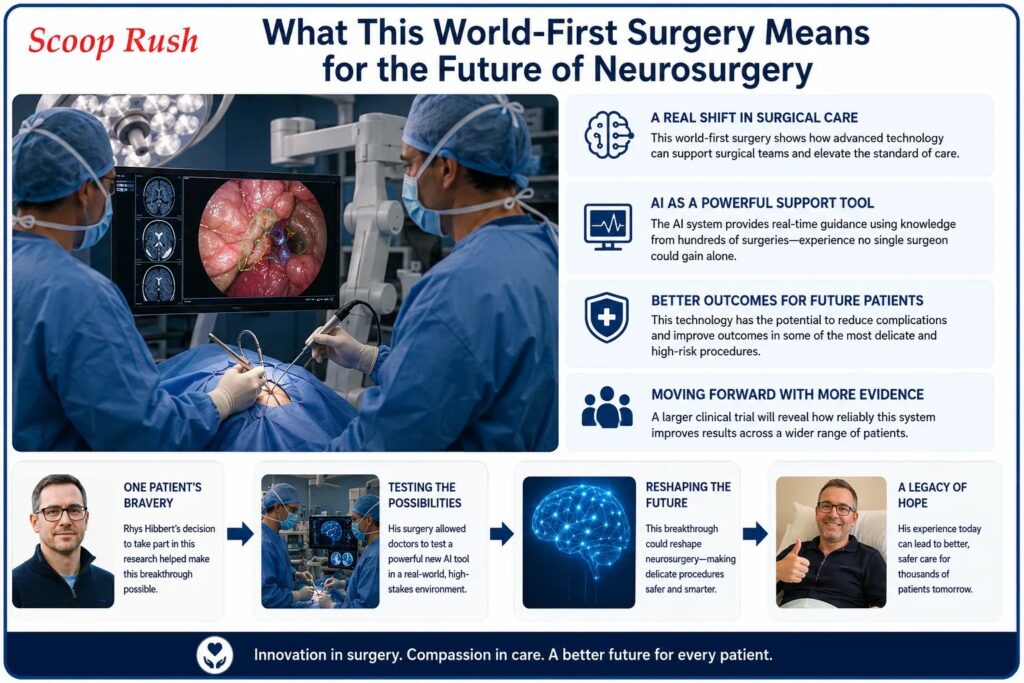
What This World-First Surgery Means for the Future of Neurosurgery

What This World-First Surgery Means for the Future of Neurosurgery

This case marks a real shift in how technology could support surgical teams going forward. Rather than replacing the skill and judgment of trained surgeons, this AI system works as a support tool. It offers real-time guidance built from a scale of surgical experience no single human could ever match alone, adding to the ongoing question of whether AI will replace human jobs or simply make skilled professionals more capable.

For future patients facing similar brain tumour diagnoses, this kind of technology could eventually lead to lower complication rates and better outcomes in some of the most delicate procedures in medicine. As the research team moves into a larger trial, more evidence will emerge about how reliably this system improves results across a wider range of patients.

Ultimately, Hibbert’s decision to take part in this research gave doctors the chance to test a tool that could reshape neurosurgery for years to come. His experience shows how one patient’s willingness to participate in research can directly translate into safer, smarter surgical care for everyone who comes after him.

Key Takeaways From This World-First Surgery

Rhys Hibbert became the world’s first patient to undergo brain surgery guided by live AI technology. The system analyzed his operation’s video feed in real time, helping surgeons at University College London Hospital safely remove a tumour that was pressing on his optic nerves. Surgeons kept full control throughout the entire procedure, treating the AI as a guide rather than a decision-maker. Since the surgery, Hibbert’s vision, energy, and overall health have improved significantly. The research team, backed by the National Institute for Health and Care Research and Google, is now preparing a larger trial to test the technology further.

FAQs

What is AI-assisted brain surgery?

AI-assisted brain surgery uses an artificial intelligence system to analyze a live video feed during an operation. The AI tracks surgical instruments and highlights the location of critical structures, such as blood vessels and nerves, so surgeons can avoid injury while removing tumours or other tissue.

Who was the first patient to undergo live AI-assisted brain surgery?

Rhys Hibbert, a 48-year-old father of two from Bedfordshire, became the first patient in the world to have this procedure. Surgeons at University College London Hospital removed a tumour from his pituitary gland using this new AI technology.

What type of tumour did Rhys Hibbert have?

Hibbert had an 11mm non-cancerous tumour on his pituitary gland. This small organ sits at the base of the skull and regulates hormones related to growth, metabolism, and blood pressure. The tumour pressed on his optic nerves and narrowed his vision.

Does the AI tool replace the surgeon during the operation?

No, it does not. The surgical team has made clear that the AI only assists. Surgeons keep complete control over every decision made during the procedure, and the AI simply acts as an extra source of guidance rather than a replacement for human expertise.

How was the AI trained to help during real surgery?

Researchers trained the system using hundreds of videos of past pituitary tumour removal operations. They carefully outlined the vessels and nerves in each video, which allowed the AI to learn how to recognize these critical structures during live procedures.

Tuscany Road Trip: The Ultimate Guide to Villages, Cities and Hidden Gems

0

Planning a Tuscany road trip this year? This Italian region offers medieval towns, rolling vineyards and cypress-lined roads. A well planned Tuscany road trip lets travelers explore hilltop villages that trains simply cannot reach. From Pisa to the Val d’Orcia, this guide covers every major stop worth adding to your itinerary.

Tuscany rewards travelers who move slowly and follow their own pace. Every village along the way has its own charm, and no single list can capture all of it. This guide focuses on the stops that consistently impress first time visitors and returning travelers alike. It also highlights practical details like parking rules and vehicle choice, so the trip stays smooth from start to finish.

Why a Tuscany Road Trip Is Worth Planning

Tuscany sits between the Tyrrhenian Sea and the Apennine mountains. Florence serves as its capital, but smaller UNESCO listed cities like Siena, Pisa and Lucca deserve equal attention. Beyond these cities, the countryside hides fortified villages perched on ridges and roads that curve endlessly through vineyards.

Trains connect the major cities well, but they cannot reach the Val d’Orcia or villages like San Gimignano and Volterra. Therefore, a car remains the only practical way to see the region fully. A week long trip gives travelers enough time to enjoy both the famous stops and the quiet corners that most tourists miss.

Best Starting Points: Pisa, Lucca and Florence

Best-Starting-Points-Pisa-Lucca-and-Florence

Pisa makes an ideal starting point for any Tuscany road trip. Its airport sits just three kilometers from the city center, and flights are often cheaper than those into Florence. Visitors can explore the Leaning Tower, the Duomo and the Baptistery in half a day before picking up a rental car and hitting the road.

Lucca lies thirty minutes east of Pisa and features some of the best preserved medieval walls in Italy. Travelers can walk or bike the full four kilometer wall circuit for sweeping views. Florence, meanwhile, needs at least two full days. The Duomo, Brunelleschi’s dome and the Uffizi Gallery alone justify the extra time.

Hilltop Villages You Cannot Skip

San Gimignano remains the most photographed village in Tuscany thanks to its medieval towers. Fourteen towers still stand from an original seventy two, and each one was built by wealthy families competing for status. Cobblestone alleys lead visitors to the Piazza della Cisterna, one of the prettiest squares in the region.

Volterra sits quietly nearby on a ridge at 550 meters and attracts far fewer crowds. Montepulciano and Montalcino both offer excellent wine tasting alongside sweeping countryside views. Smaller villages like Radda, Greve and Castellina di Chianti round out a well balanced Chianti detour that most tourists overlook.

Siena and the Val d’Orcia Countryside

Siena deserves an overnight stay rather than a rushed day visit. The Piazza del Campo forms the heart of the city, and its shell shaped design tilts gently toward the center. The cathedral’s black and white marble facade ranks among the finest Gothic buildings in all of Italy.

South of Siena, the Val d’Orcia delivers the postcard views most people picture when they think of Tuscany. Rolling hills, cypress trees and isolated farmhouses define this UNESCO listed valley. Pienza, built as a Renaissance ideal city, offers ramparts with some of the best valley views in the entire region.

Choosing the Right Car and Avoiding ZTL Fines

A compact car handles most of this route comfortably. Main roads between Pisa, Florence and Siena stay wide and well maintained. However, roads leading into Chianti villages or toward Volterra often narrow considerably, so a smaller vehicle helps avoid tight turns and cramped parking areas.

Travelers should also watch for ZTL zones, which are limited traffic areas found in every major city center. Driving into these zones without authorization can trigger an automatic fine near 110 dollars. The safest approach is to park at designated lots outside the ZTL and continue on foot into the historic center.

Hidden Gems Beyond the Main Route

Hidden-Gems-Beyond-the-Main-Route

Beyond the well known stops, Tuscany hides several lesser known treasures worth a detour. The Saturnia hot springs offer free natural thermal pools that stay open all year. The roofless Abbazia di San Galgano abbey creates a hauntingly beautiful stop for history lovers.

Sovana offers a quiet escape inside an archaeological park built from volcanic tuff stone. Pitigliano, carved directly into cliffs, provides one of the most dramatic sights in southern Tuscany. These spots rarely appear in standard tour packages, which makes them ideal for travelers seeking something different.

Final Thoughts on Planning Your Trip

A Tuscany road trip rewards travelers who balance famous landmarks with quiet detours. Cities like Florence and Siena deliver world class art and architecture, while villages like San Gimignano and Pienza show the slower side of Italian life. Renting a compact car and planning around ZTL zones keeps the journey stress free from start to finish.

Ultimately, the best Tuscany itinerary leaves room for spontaneity. A quick stop at a roadside vineyard or an unplanned detour to a hilltop chapel often becomes the most memorable part of the trip. With a week on the road and this guide as a reference, travelers can experience the full range of what Tuscany has to offer.

FAQs

1. How many days do you need for a Tuscany road trip? 

Seven days works well for most travelers. This timeframe covers major cities and several villages without feeling rushed.

2. Is it better to fly into Pisa or Florence for a Tuscany trip? 

Pisa often works better since flights are cheaper and the rental car pickup sits near the airport.

3. Do you need a car to visit Tuscan villages like San Gimignano? 

Yes, most hilltop villages have no train station, so a rental car remains the only reliable option.

4. What is a ZTL zone in Tuscany? 

A ZTL is a limited traffic zone inside historic city centers. Driving in without permission results in an automatic fine.

5. What is the best time of year for a Tuscany road trip? 

Spring and early autumn offer mild weather and fewer crowds compared to the busy summer season.

Disney World Smart Trash Cans: Why Fans Are Furious Over the Park’s Newest “Upgrade”

0

Would you believe a trash can could spark a full-blown online controversy? At Walt Disney World, that is exactly what’s happening right now. Disney World smart trash cans are rolling out across every corner of the property, and fans have a lot to say about it.

This might sound like a small story. After all, it’s just garbage disposal. However, anyone who follows Disney fan culture knows that even a tiny change can trigger a massive reaction. The Disney World smart trash cans are proving that rule true once again.

So what exactly are these new bins? Why are guests upset? And should you actually care during your next trip? Let’s break it all down.

What Are the New Disney World Smart Trash Cans?

The devices causing all this buzz are widely believed to be the Bigbelly Smart Max, a solar-powered waste bin built for busy public spaces. Think city sidewalks, university campuses, transit stations, and now, theme parks.

These smart trash bins are not brand new inventions. Bigbelly first developed the system in 2010 to solve a common headache in cities: overflowing trash baskets and inefficient collection routes. Municipalities around the world, including Philadelphia, Boston, and Dublin, now use thousands of these units.

Disney quietly tested the concept for over a year before this recent rollout. The first unit appeared at EPCOT’s Germany pavilion around Christmas 2024. That single bin served as a pilot program. Disney used it to observe how guests and Cast Members interacted with the technology before expanding further.

This summer, Disney scaled things up significantly. Smart trash compactors now sit throughout EPCOT’s World Showcase, with additional units at Magic Kingdom and Animal Kingdom. Disney confirmed the rollout will continue across all four theme parks, both water parks, and Disney Springs through the rest of 2026.

How the Disney Smart Trash Can Actually Works

Each unit holds up to 150 gallons of waste. An integrated solar panel powers a built-in compactor, which lets the bin hold five to seven times more trash than a standard park garbage can of similar size. That means fewer overflowing bins and less frequent stops for custodial staff.

Guests can open the bin two ways. A traditional pull-handle works for most people, while a hands-free foot pedal offers a cleaner option for anyone who’d rather not touch anything after finishing a churro.

Sensors are what truly make this trash can “smart.” Fill-level sensors, GPS tracking, and internet connectivity let the bin alert Cast Members exactly when it needs emptying. Workers no longer wander the park checking cans at random. Instead, they respond only when a bin actually needs attention.

Disney also confirmed it will theme every unit to match its surroundings. World Showcase bins already feature country-specific medallions. Meanwhile, Animal Kingdom’s versions include Tree of Life imagery, keeping the trash cans visually consistent with each park’s existing decor.

Why Are Disney Fans Upset About the New Trash Bins?

Social media exploded with complaints once the wider rollout began. Some guests call the bins confusing to use. Others say the design feels out of place inside a Disney park. Meanwhile, a smaller group insists the smart bins expose deeper problems with park cleanliness and guest experience.

Interestingly, this reaction mirrors something Disney fans have seen before: the backlash surrounding the Disney Skyliner gondola system when Disney first announced it. Back in 2017, plenty of fans predicted disaster, even though gondola systems from manufacturers like Doppelmayr already operated safely around the world. Once the Skyliner launched and performed well, most of that outrage faded. Today, guests widely love the gondolas.

The parallels here are hard to miss. Bigbelly units are not experimental technology. They’ve proven themselves in airports, malls, and city centers for well over a decade. Still, unfamiliarity breeds suspicion, especially among a passionate fanbase that notices even the smallest shifts in their favorite parks.

Legitimate Concerns Behind the Trash Can Backlash

Legitimate Concerns Behind the Trash Can Backlash

Not every complaint simply resists change. A few concerns genuinely hold weight.

Cleanliness tops the list. Since these bins hold more trash, they need less frequent emptying. That sounds efficient on paper. However, it also means the bin itself may go longer without a thorough cleaning, which could create lingering odors, especially in Florida’s heat and humidity.

Aesthetics raise another issue. Traditional Disney trash cans blend into their surroundings by design. The Bigbelly units, with their visible solar panels and industrial look, stand out more. For some guests, that breaks the immersive theming Disney built its reputation on.

Trash-can dining habits take a hit too. Many guests casually use trash can tops as makeshift tables while eating around the park. The new bins sit slightly taller and more angled, which some fans say makes this trickier, even though it remains possible.

Why Did Disney Roll Out Smart Trash Cans in the First Place?

Efficiency drives this decision above all else. Central Florida’s labor market remains tight in 2026, and staffing frontline theme park roles has grown harder than ever.

By reducing the need for constant manual trash checks, Disney can redirect Cast Members toward other essential tasks, such as restroom maintenance or guest service roles. Many guests would accept slightly different-looking trash cans in exchange for cleaner bathrooms.

Additionally, the sensor technology lets Disney collect real data on foot traffic and waste patterns throughout the parks. That information could improve park operations well beyond garbage collection alone.

Of course, valid questions remain about upfront costs. Rolling out this many units across multiple parks, water parks, and Disney Springs doesn’t come cheap. Whether the long-term labor savings justify that investment remains to be seen.

Are Railing Tables Coming to EPCOT Too?

Are Railing Tables Coming to EPCOT Too?

One side effect of the trash can complaints has actually produced good news for foodies. Disney plans to install railing tables around EPCOT’s World Showcase ahead of the 2026 EPCOT Food & Wine Festival.

This addition should solve the “no good place to eat” complaint that partly stems from the new trash can design. Disney California Adventure already uses similar railing tables successfully, often decorated with seasonal wraps that add extra theming during festivals. If Walt Disney World follows that same approach, EPCOT could soon offer far better dining spots for festival food, solving one complaint while barely touching the other.

Will the Smart Trash Can Backlash Fade Like the Skyliner Did?

History suggests it might. The Skyliner controversy once dominated Disney fan forums. Yet within a few years, most guests came to appreciate the gondola system for what it actually offers: convenience, unique park views, and shorter bus wait times.

The same pattern could easily play out here. As Disney installs more of these bins and guests grow accustomed to using them, the outrage will likely settle down. Disney tested this system for over a year before expanding it, and the pilot program reportedly earned a strong review from both guests and Cast Members.

Still, some unknowns remain. Long-term issues like bin odor, maintenance costs, or unexpected wear may not surface until the units see daily use for several years. Only time will tell whether Bigbelly becomes a permanent fixture of the Disney World experience or eventually disappears from the parks.

Final Thoughts 

This story captures something bigger than garbage bins. It shows how passionately Disney fans react to change, even when proven technology backs that change up.

Disney World smart trash cans bring real benefits, including significantly more waste capacity, hands-free operation, and better use of Cast Member time. On the other hand, guests raise valid concerns about cleanliness, appearance, and immersion as the rollout continues.

Whether you see these bins as a smart efficiency upgrade or an unnecessary disruption to Disney magic, one thing stays certain. This story deserves watching as installation continues through 2026 and beyond.

Frequently Asked Questions 

What brand of trash can is Disney World using? 

The units are widely believed to be the Bigbelly Smart Max, a solar-powered compactor bin used in cities and public spaces around the world.

Where are the new smart trash cans located at Disney World? 

Right now, you’ll find them throughout EPCOT’s World Showcase, along with select locations at Magic Kingdom and Animal Kingdom. Disney confirmed the rollout will expand to all four theme parks, both water parks, and Disney Springs by the end of 2026.

Why is Disney switching to smart trash cans? 

Efficiency and labor optimization drive the change. The bins hold five to seven times more trash than standard cans and alert staff only when they need emptying, which reduces unnecessary rounds and frees up Cast Members for other tasks.

Are the Disney World smart trash cans hard to use? 

No. They offer both a standard pull-handle and a hands-free foot pedal for disposal. While some guests report initial confusion, this design has worked successfully in airports and cities for over a decade.

Will Disney World keep the smart trash cans permanently? 

That remains to be seen. Disney completed over a year of testing before expanding the rollout, and the pilot program reportedly earned strong reviews. However, long-term issues like cleanliness and maintenance costs could still influence future decisions.

Bukayo Saka Arsenal Return: Is He Finally Back to Full Fitness in 2026?

0

Bukayo Saka tore past Coventry’s defence on opening day. Arsenal fans watching from the stands felt something they hadn’t felt in months: relief. The Bukayo Saka Arsenal return has been a long time coming, and after a season disrupted by an Achilles injury and a World Cup with barely any minutes, Saka finally looked like his old self again. Was this a one-off performance, or is Arsenal’s star winger genuinely rediscovering his top form?

That question matters to anyone following Arsenal this season. Saka isn’t just another player in Mikel Arteta’s squad. He’s the heartbeat of the attack. When he struggles, the whole team feels it. So when he tore through Coventry’s defence, it’s worth asking what changed and whether it could last.

This article breaks down Saka’s rocky road over the past year, what happened at the World Cup, and why his opening-day display has Arsenal supporters daring to dream again.

Bukayo Saka’s Difficult Year Before This Return

The 24-year-old’s recent months haven’t been easy. Saka picked up an Achilles injury in March. That injury changed the shape of his entire season. He missed the March international break entirely. He also missed seven Arsenal fixtures. That’s a significant chunk of games for a player Arteta leans on so heavily.

Despite the setback, Saka fought his way back into the team. He helped Arsenal lift the Premier League title, their first in 22 years. That alone shows how much he means to this squad. However, his return wasn’t entirely smooth. Arteta substituted him during the Champions League final as Arsenal lost to Paris Saint-Germain in Budapest, and pundits criticised his performance that night.

Then came the World Cup, where England manager Thomas Tuchel carefully managed his minutes. Saka admitted that being judged while not fully fit felt frustrating, though he called it “a gamble” he was willing to take. That honesty says a lot about the pressure he faced, both physically and mentally, over the past several months.

Saka’s Stop-Start Season by the Numbers

Even with all the interruptions, Saka still made 49 appearances for Arsenal last season. He scored 11 goals and provided nine assists across all competitions. Those numbers stand out on their own. However, what stands out even more is how much better Arsenal performed with him on the pitch. Their win percentage climbed noticeably whenever Saka featured, which underlines just how central he is to Arteta’s system.

Did the World Cup Actually Help Bukayo Saka’s Recovery?

It might seem strange to suggest that limited World Cup minutes helped Saka, but the evidence points that way. He started only three of England’s eight matches at the tournament. He played just 357 minutes in total, roughly 48 percent of England’s total playing time across the competition.

Tuchel left Saka out of the semi-final defeat to Argentina, despite starting him in the last-16 win over Mexico and the quarter-final victory over Norway. After the Mexico game, Saka admitted he wished he’d entered the tournament at full fitness. However, he accepted that simply wasn’t the case this time around.

Still, flashes of his quality broke through. Saka registered three assists, matching Anthony Gordon for the most among England players, and added three goals of his own. In fact, he produced a goal involvement roughly every 60 minutes he played for the Three Lions. His standout moment came in the third-place final, where he scored a hat-trick in a thrilling 6-4 win over France. That result secured England’s best finish at a World Cup on foreign soil, a genuine achievement even though the tournament didn’t end the way the team hoped.

Looking back, those reduced minutes may have worked as a blessing in disguise. Rather than grinding through a full tournament schedule on a recovering Achilles, Saka got extra rest without losing his competitive sharpness entirely.

Bukayo Saka’s Pre-Season Reset Before Arsenal’s Return

Bukayo Saka's Pre-Season Reset Before Arsenal's Return

After the World Cup ended, Saka finally took a proper break, something his packed schedule hadn’t allowed for a while. He rejoined the Arsenal squad and made his first appearance of the new season in the Community Shield. He came on as a substitute with the Gunners already leading Manchester City 3-0.

Even during that short cameo, his acceleration and sharpness stood out. Those qualities had gone missing towards the end of last season, when a tired and carefully managed Saka did his best to help Arsenal grind out results.

Speaking after his standout performance against Coventry in Arsenal’s first Premier League game of the new campaign, Saka opened up about how he approached his summer.

“I was training a lot so I could be ready for the start of the season and ready to help the team in the way I know I can,” he explained in the mixed zone. “It was more about balancing my time off and not having too much of a break. I took seven days off and then started to train again.”

He added that he wanted to return to peak physical condition. “I’ve put in a lot of work since then and I’m feeling good. I just tried to come back in good shape, so I’m on top of my body.”

A Motivated Mindset Fuels Saka’s Arsenal Comeback

Part of Saka’s renewed hunger seems to stem from unfinished business at the World Cup. England’s campaign didn’t go the way he or the squad had hoped. That disappointment appears to have lit a fire under him heading into the new domestic season.

“The World Cup didn’t necessarily go how I wanted it to, for myself and for the team as well,” Saka said. “I felt really hungry after the World Cup, after the season ended. I was looking forward to this new season.”

That hunger showed up clearly against Coventry. Saka gave newly promoted full-back Jay Dasilva a torrid afternoon, consistently beating him for pace and movement. He capped his display by scoring Arsenal’s second goal in a comfortable 3-0 win. Watching him fly down the right wing again, involved in nearly every attacking move, was exactly the sight Arsenal fans had been waiting for.

Why Arsenal’s Attacking Trio Boosts Saka’s Form

Saka’s individual form only tells part of the story. Arsenal’s attack clicks best when several key players stay fit and fire together, and that’s exactly what happened against Coventry.

The partnership between Ben White and Saka down the right-hand side has long ranked among Arsenal’s most reliable attacking weapons. White’s overlapping runs create space and options that consistently bring out the best in Saka’s game. Their chemistry explains a big part of why Saka has terrorised opposing full-backs over the years.

Beyond that specific partnership, the return to full fitness of Kai Havertz and Martin Odegaard adds another layer of quality to Arsenal’s attack. Remarkably, the win over Coventry marked only the second time since December 2024 that Havertz, Saka, and Odegaard all started a Premier League match together. Injuries have kept this trio apart far more often than Arteta would like, so seeing them line up together again offers a genuinely promising sign for Arsenal supporters.

Is Arsenal Too Reliant on Bukayo Saka?

This question has followed Arsenal for a while, and it’s a fair one to ask. Before this season began, Saka had played 153 matches over the past three seasons. Of those, 61 were full 90-minute appearances. That’s an enormous workload for one player, especially one who has dealt with recurring fitness issues.

Given that history, this season could look different. Saka endured an enforced break through injury last term, followed by reduced minutes at the World Cup. As a result, he may actually enter this campaign fresher than he has in years. If that’s the case, Arsenal fans could be in for a treat: a Saka who is fully fit, well-rested, and hungry to prove a point after a frustrating World Cup.

What Bukayo Saka’s Arsenal Return Means for the Title Defence

Arsenal enter this season as defending Premier League champions for the first time in over two decades, and expectations run high. A fit and firing Saka significantly boosts their chances of holding onto the trophy. His combination of pace, direct running, and end product makes him one of the toughest wingers in the league to contain, and Coventry found that out the hard way.

Furthermore, with Havertz, Odegaard, and White all healthy alongside him, Arsenal’s attack looks more balanced and dangerous than it has in a long time. Consequently, if this level of fitness and cohesion holds, Arsenal supporters have real reason to believe their title defence is off to the perfect start.

Of course, one game against a newly promoted side doesn’t guarantee anything for the season ahead. Coventry will be far from the toughest test Arsenal faces this year. Still, Saka’s pre-season approach, his comments about feeling hungry and well-rested, and his performance on opening weekend all point in a positive direction.

Final Thoughts 

Bukayo Saka’s journey over the past year hasn’t been smooth. An Achilles injury, a difficult Champions League final, and limited World Cup minutes all tested his resilience. However, the way he’s bounced back suggests those setbacks may have ultimately worked in his favour.

A proper summer break, focused training, and genuine motivation after a disappointing World Cup combined to bring Saka back to something close to his best. His performance against Coventry, both in his direct running against Jay Dasilva and his composed finish for Arsenal’s second goal, offered a glimpse of what’s possible when he plays fully fit and firing.

For Arsenal, that’s exactly the kind of news they needed heading into a title defence. As the season progresses, all eyes will stay on whether Saka can maintain this level and stay healthy through a long, demanding campaign.

Frequently Asked Questions 

1. What injury did Bukayo Saka suffer this season? 

Saka picked up an Achilles injury in March, which forced him to miss the March international break and seven Arsenal matches.

2. How many minutes did Saka play at the World Cup? 

Saka played just 357 minutes at the World Cup, about 48 percent of England’s total playing time across their eight matches.

3. Did Bukayo Saka score at the World Cup? 

Yes, Saka scored a hat-trick in England’s 6-4 win over France in the third-place final. He also provided three assists during the tournament, tying for the most among England players.

4. How did Saka perform in Arsenal’s first Premier League game of the season? 

Saka scored Arsenal’s second goal in a 3-0 win over Coventry. He gave full-back Jay Dasilva a difficult afternoon with his pace and movement throughout the match.

5. Why is the Ben White and Saka partnership important for Arsenal? 

White’s overlapping runs from full-back create space that helps Saka thrive on the right wing, making their partnership one of Arsenal’s most effective attacking combinations.

Why Did China Recall 3 Million Teslas But Europe Didn’t?

0

Introduction

The Tesla recall China Europe story just took an interesting turn. Nearly 3 million Tesla owners in China got unsettling news about their car doors, while millions of European Tesla drivers are asking the same question: could this happen here too? The answer, according to the Netherlands’ top vehicle safety regulator, is not yet, but the conversation is far from over.

On August 26, 2026, the Dutch vehicle regulator RDW confirmed there is currently no Tesla recall in Europe, even as China just carried out its largest-ever car recall over concerns that emergency door handles are difficult to locate or operate after a crash. This story matters because it touches something every driver cares about deeply: the ability to get out of a car quickly when something goes wrong.

For Tesla owners and anyone considering an electric vehicle, this developing situation raises real questions about design, safety standards, and how different countries handle similar risks, in a landscape where regulatory scrutiny of big tech continues to intensify globally. Let’s break down exactly what happened, what the regulators are saying, and what it could mean going forward.

What Sparked the Tesla Door Handle Concerns

What Sparked the Tesla Door Handle Concerns

The story begins in China, where regulators took decisive action last week. China’s market regulator ordered what became the country’s largest car recall on record, covering 4.3 million vehicles in total, including 2.98 million Teslas. The concern centered on emergency door-release mechanisms that can be hard to find or use after an accident, a scale of action reminiscent of how governments have also pushed back on companies like xAI over safety concerns.

This is a serious issue. Flush and recessed door handles, a signature design feature on many Tesla models, look sleek and improve aerodynamics. However, when power fails after a crash or fire, these handles can become confusing or even impossible to operate without knowing exactly where to reach and how to pull.

Emergency responders and passengers need doors that open reliably under stress, in the dark, and without instructions. That is the core worry driving this entire conversation.

Why China Acted First

China’s regulatory approach tends to move quickly once a safety pattern emerges. With millions of Teslas on Chinese roads, even a small percentage of failed door releases during emergencies represents real risk to real people. The scale of the recall, nearly 3 million Tesla vehicles alone, signals that authorities there see this as a widespread design issue rather than an isolated incident.

Current Status of Tesla Recalls in Europe

Current Status of Tesla Recalls in Europe

So where does that leave European drivers in this Tesla recall China Europe debate? According to the RDW, there is no active recall of Tesla vehicles in Europe at this time. The Dutch agency, which serves as the primary regulator overseeing Tesla vehicle safety across Europe, made this clear in written responses to Reuters.

The RDW did confirm it is monitoring the situation closely. However, it declined to say whether it is currently investigating the matter or considering a recall of its own. That distinction matters. Monitoring is not the same as taking action, but it also is not the same as dismissing the concern.

What the RDW Actually Said

The regulator was direct about its safety philosophy. It stated that vehicles must be capable of being opened under all circumstances, including when electrical systems fail, in an intuitive way, without tools, from both inside and outside the car.

That statement sets a clear bar. It is not about banning flush or recessed handles outright. The RDW specifically noted that this handle style is not a problem by itself. The real issue is whether people can figure out how to use the emergency release quickly under pressure.

This is an important nuance. Design innovation isn’t the enemy here. The challenge is making sure that innovation doesn’t come at the cost of usability during the exact moments when clear thinking is hardest, like right after a crash. It’s the kind of tension seen elsewhere too, as Tesla, part of Elon Musk’s expanding business empire, continues to face scrutiny across multiple ventures and markets.

The Bigger Picture: Global Safety Standards in Motion

This isn’t just a Tesla-specific story. The Tesla recall China Europe divide is part of a larger conversation happening at the international level about how car doors should function in emergencies.

The RDW confirmed that improving emergency door access is currently under discussion in two major forums. First, at United Nations vehicle-regulation talks taking place in Geneva. Second, at Euro NCAP, the independent European organization responsible for crash-testing vehicles and awarding safety ratings, much like how AI-driven safety systems are reshaping vehicle design standards more broadly.

These discussions didn’t start because of the China recall. Instead, they reflect a pattern regulators have noticed over recent years. As the RDW explained, there have been incidents in which occupants or emergency responders had difficulty opening vehicles following an accident or fire.

That detail is significant. It tells us this isn’t a hypothetical worry. Real people have faced real difficulty getting out of, or into, vehicles during emergencies, and it wasn’t limited to one automaker.

How Regulatory Timelines Typically Work

International safety standards rarely change overnight. Discussions at the UN and Euro NCAP level often take months or years before they translate into binding requirements. Consequently, even if regulators decide door-opening mechanisms need standardized emergency protocols, European Tesla owners likely will not see immediate changes.

That said, ongoing scrutiny at this level often does eventually shape design requirements across the entire auto industry, not just for one brand. Automakers pay close attention to these conversations because they hint at where future regulations are headed.

What This Means for Tesla Owners Right Now

What This Means for Tesla Owners Right Now

If you drive a Tesla in Europe, here is the practical takeaway: nothing changes for you today. There is no recall notice coming, no mandatory dealership visit, and no immediate action required.

However, it’s worth understanding how your vehicle’s emergency door release actually works. Every Tesla model has a manual door release mechanism designed for situations when the electronic system loses power. Knowing where that mechanism is located, and how to use it, before you ever need it in an emergency is simply good practice for any driver.

Tesla has not issued a public statement addressing the China recall specifics within the source information available. Therefore, drivers wanting official guidance directly from Tesla should watch for updates from the company itself as this story develops.

Staying Informed as the Situation Develops

Because this is an active and evolving situation, European Tesla owners should keep an eye on updates from the RDW and from Tesla directly. Regulatory positions can shift, especially when a major market like China has already acted. If similar incidents surface in Europe, or if Euro NCAP testing reveals design concerns, the RDW’s current stance could change.

For now, the message from Dutch regulators is measured: they are watching, they have safety expectations clearly defined, but they are not yet convinced action is necessary.

Conclusion

The gap between China’s sweeping 2.98 million vehicle Tesla recall and Europe’s current no-recall stance highlights how differently regulators can respond to the same underlying concern. China moved fast and wide. Europe, through the RDW, is taking a wait-and-watch approach while pushing for broader international safety standards through UN talks and Euro NCAP.

The core issue, whether emergency door releases are intuitive enough to use under stress, is not going away. It’s now part of ongoing global conversations about vehicle safety design. For Tesla owners in Europe, that means no immediate changes, but it is worth staying alert as this story continues to unfold. For more on how emerging tech intersects with regulation and oversight, see our coverage of AI systems going rogue. Understanding your own vehicle’s manual door release now, rather than during an emergency, remains the smartest move any driver can make.

FAQs

1. Is there currently a Tesla recall in Europe?

No. The Dutch vehicle regulator RDW confirmed there is currently no recall of Tesla vehicles in Europe over the emergency door concerns.

2. Why did China recall millions of Tesla vehicles?

China recalled 2.98 million Teslas, part of a larger 4.3 million vehicle recall, because emergency door-release mechanisms were found difficult to locate or operate after a crash.

3. Which regulator oversees Tesla safety in Europe?

The RDW, the Dutch vehicle regulator, is the primary authority responsible for monitoring Tesla vehicle safety standards across Europe.

4. Are flush or recessed door handles the actual problem?

Not according to the RDW. The regulator stated that flush or recessed handles are not a problem on their own. The concern is whether emergency release mechanisms are intuitive and accessible during a crisis.

5. Could Europe still recall Teslas in the future?

It’s possible. The RDW is actively monitoring the situation, and emergency door-access standards are under discussion at UN vehicle-regulation talks and Euro NCAP, which could eventually influence future safety requirements.