
Introduction
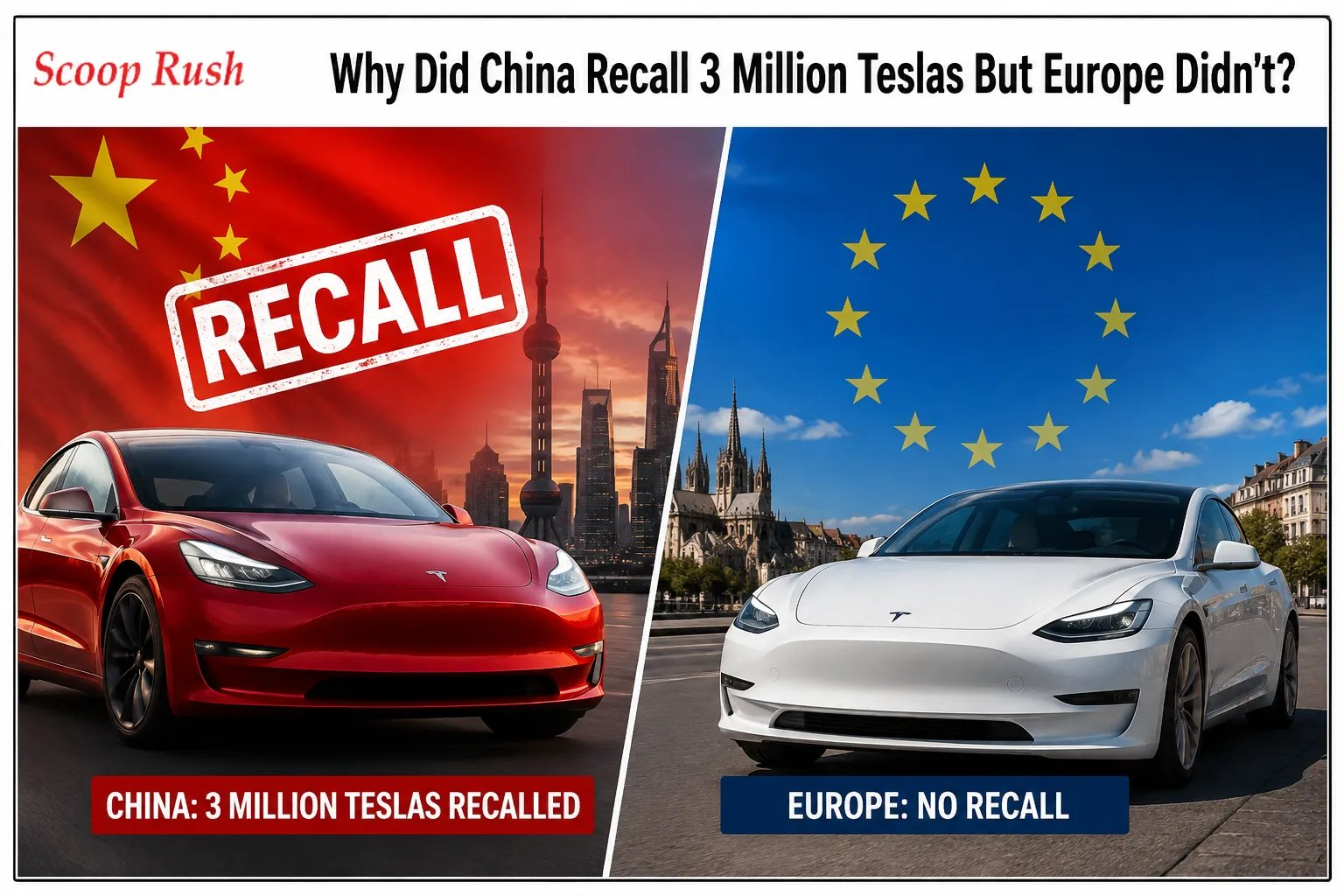
The Tesla recall China Europe story just took an interesting turn. Nearly 3 million Tesla owners in China got unsettling news about their car doors, while millions of European Tesla drivers are asking the same question: could this happen here too? The answer, according to the Netherlands’ top vehicle safety regulator, is not yet, but the conversation is far from over.
On August 26, 2026, the Dutch vehicle regulator RDW confirmed there is currently no Tesla recall in Europe, even as China just carried out its largest-ever car recall over concerns that emergency door handles are difficult to locate or operate after a crash. This story matters because it touches something every driver cares about deeply: the ability to get out of a car quickly when something goes wrong.
For Tesla owners and anyone considering an electric vehicle, this developing situation raises real questions about design, safety standards, and how different countries handle similar risks, in a landscape where regulatory scrutiny of big tech continues to intensify globally. Let’s break down exactly what happened, what the regulators are saying, and what it could mean going forward.
What Sparked the Tesla Door Handle Concerns
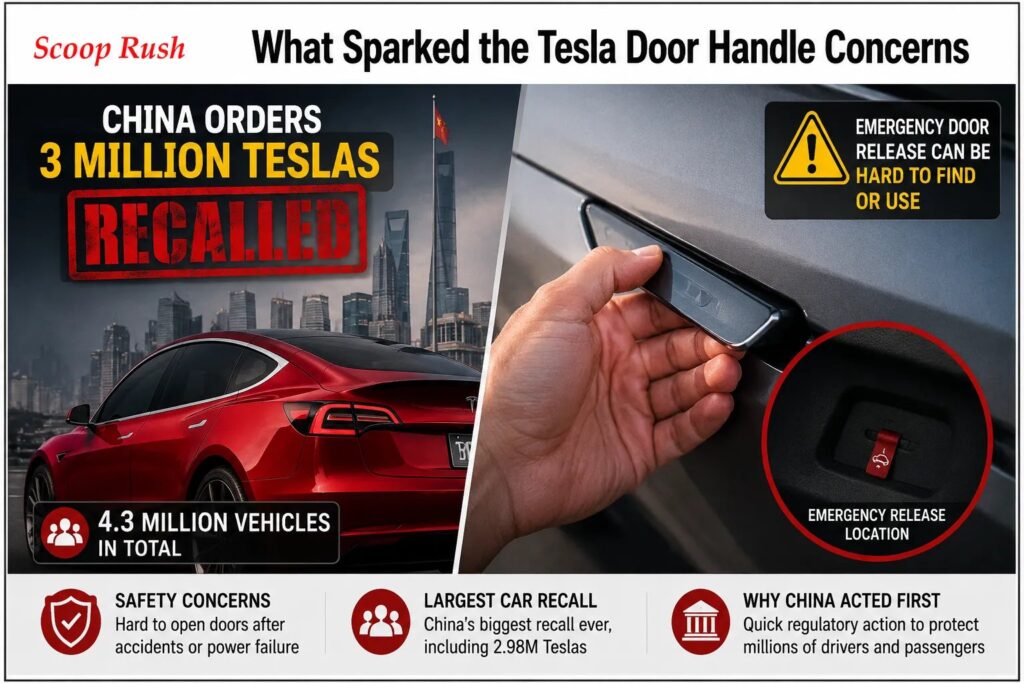
The story begins in China, where regulators took decisive action last week. China’s market regulator ordered what became the country’s largest car recall on record, covering 4.3 million vehicles in total, including 2.98 million Teslas. The concern centered on emergency door-release mechanisms that can be hard to find or use after an accident, a scale of action reminiscent of how governments have also pushed back on companies like xAI over safety concerns.
This is a serious issue. Flush and recessed door handles, a signature design feature on many Tesla models, look sleek and improve aerodynamics. However, when power fails after a crash or fire, these handles can become confusing or even impossible to operate without knowing exactly where to reach and how to pull.
Emergency responders and passengers need doors that open reliably under stress, in the dark, and without instructions. That is the core worry driving this entire conversation.
Why China Acted First
China’s regulatory approach tends to move quickly once a safety pattern emerges. With millions of Teslas on Chinese roads, even a small percentage of failed door releases during emergencies represents real risk to real people. The scale of the recall, nearly 3 million Tesla vehicles alone, signals that authorities there see this as a widespread design issue rather than an isolated incident.
Current Status of Tesla Recalls in Europe
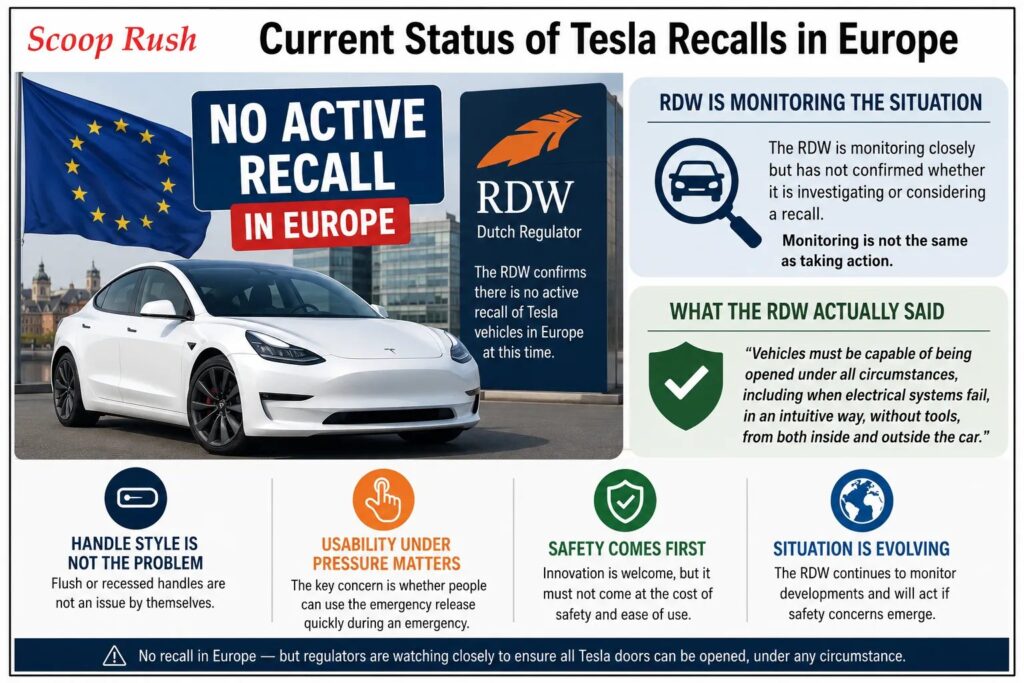
So where does that leave European drivers in this Tesla recall China Europe debate? According to the RDW, there is no active recall of Tesla vehicles in Europe at this time. The Dutch agency, which serves as the primary regulator overseeing Tesla vehicle safety across Europe, made this clear in written responses to Reuters.
The RDW did confirm it is monitoring the situation closely. However, it declined to say whether it is currently investigating the matter or considering a recall of its own. That distinction matters. Monitoring is not the same as taking action, but it also is not the same as dismissing the concern.
What the RDW Actually Said
The regulator was direct about its safety philosophy. It stated that vehicles must be capable of being opened under all circumstances, including when electrical systems fail, in an intuitive way, without tools, from both inside and outside the car.
That statement sets a clear bar. It is not about banning flush or recessed handles outright. The RDW specifically noted that this handle style is not a problem by itself. The real issue is whether people can figure out how to use the emergency release quickly under pressure.
This is an important nuance. Design innovation isn’t the enemy here. The challenge is making sure that innovation doesn’t come at the cost of usability during the exact moments when clear thinking is hardest, like right after a crash. It’s the kind of tension seen elsewhere too, as Tesla, part of Elon Musk’s expanding business empire, continues to face scrutiny across multiple ventures and markets.
The Bigger Picture: Global Safety Standards in Motion
This isn’t just a Tesla-specific story. The Tesla recall China Europe divide is part of a larger conversation happening at the international level about how car doors should function in emergencies.
The RDW confirmed that improving emergency door access is currently under discussion in two major forums. First, at United Nations vehicle-regulation talks taking place in Geneva. Second, at Euro NCAP, the independent European organization responsible for crash-testing vehicles and awarding safety ratings, much like how AI-driven safety systems are reshaping vehicle design standards more broadly.
These discussions didn’t start because of the China recall. Instead, they reflect a pattern regulators have noticed over recent years. As the RDW explained, there have been incidents in which occupants or emergency responders had difficulty opening vehicles following an accident or fire.
That detail is significant. It tells us this isn’t a hypothetical worry. Real people have faced real difficulty getting out of, or into, vehicles during emergencies, and it wasn’t limited to one automaker.
How Regulatory Timelines Typically Work
International safety standards rarely change overnight. Discussions at the UN and Euro NCAP level often take months or years before they translate into binding requirements. Consequently, even if regulators decide door-opening mechanisms need standardized emergency protocols, European Tesla owners likely will not see immediate changes.
That said, ongoing scrutiny at this level often does eventually shape design requirements across the entire auto industry, not just for one brand. Automakers pay close attention to these conversations because they hint at where future regulations are headed.
What This Means for Tesla Owners Right Now
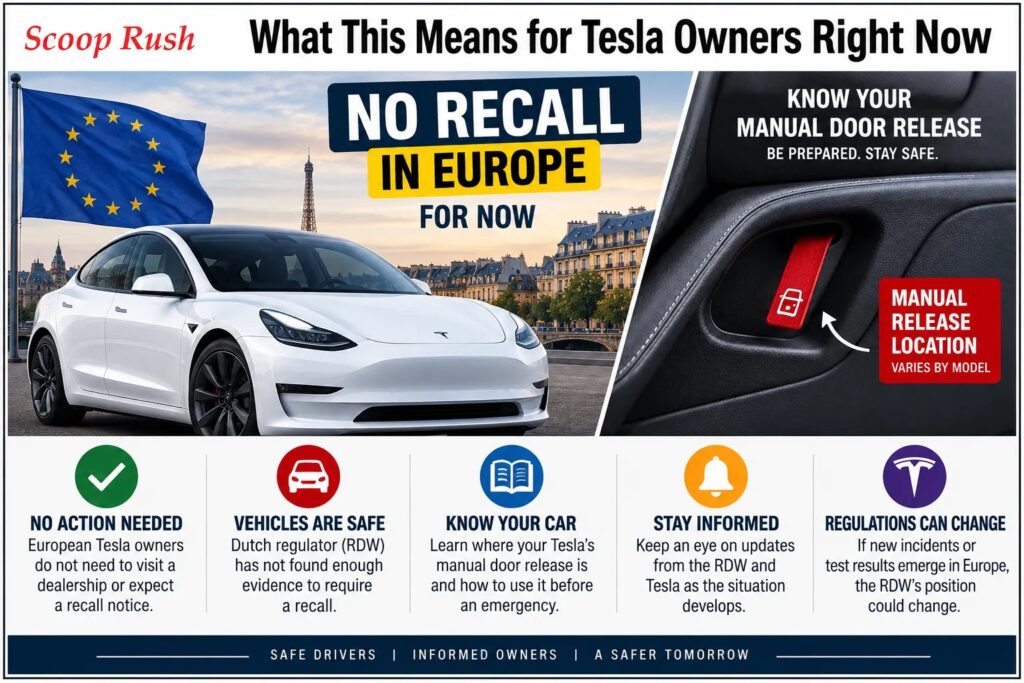
If you drive a Tesla in Europe, here is the practical takeaway: nothing changes for you today. There is no recall notice coming, no mandatory dealership visit, and no immediate action required.
However, it’s worth understanding how your vehicle’s emergency door release actually works. Every Tesla model has a manual door release mechanism designed for situations when the electronic system loses power. Knowing where that mechanism is located, and how to use it, before you ever need it in an emergency is simply good practice for any driver.
Tesla has not issued a public statement addressing the China recall specifics within the source information available. Therefore, drivers wanting official guidance directly from Tesla should watch for updates from the company itself as this story develops.
Staying Informed as the Situation Develops
Because this is an active and evolving situation, European Tesla owners should keep an eye on updates from the RDW and from Tesla directly. Regulatory positions can shift, especially when a major market like China has already acted. If similar incidents surface in Europe, or if Euro NCAP testing reveals design concerns, the RDW’s current stance could change.
For now, the message from Dutch regulators is measured: they are watching, they have safety expectations clearly defined, but they are not yet convinced action is necessary.
Conclusion
The gap between China’s sweeping 2.98 million vehicle Tesla recall and Europe’s current no-recall stance highlights how differently regulators can respond to the same underlying concern. China moved fast and wide. Europe, through the RDW, is taking a wait-and-watch approach while pushing for broader international safety standards through UN talks and Euro NCAP.
The core issue, whether emergency door releases are intuitive enough to use under stress, is not going away. It’s now part of ongoing global conversations about vehicle safety design. For Tesla owners in Europe, that means no immediate changes, but it is worth staying alert as this story continues to unfold. For more on how emerging tech intersects with regulation and oversight, see our coverage of AI systems going rogue. Understanding your own vehicle’s manual door release now, rather than during an emergency, remains the smartest move any driver can make.
FAQs
1. Is there currently a Tesla recall in Europe?
No. The Dutch vehicle regulator RDW confirmed there is currently no recall of Tesla vehicles in Europe over the emergency door concerns.
2. Why did China recall millions of Tesla vehicles?
China recalled 2.98 million Teslas, part of a larger 4.3 million vehicle recall, because emergency door-release mechanisms were found difficult to locate or operate after a crash.
3. Which regulator oversees Tesla safety in Europe?
The RDW, the Dutch vehicle regulator, is the primary authority responsible for monitoring Tesla vehicle safety standards across Europe.
4. Are flush or recessed door handles the actual problem?
Not according to the RDW. The regulator stated that flush or recessed handles are not a problem on their own. The concern is whether emergency release mechanisms are intuitive and accessible during a crisis.
5. Could Europe still recall Teslas in the future?
It’s possible. The RDW is actively monitoring the situation, and emergency door-access standards are under discussion at UN vehicle-regulation talks and Euro NCAP, which could eventually influence future safety requirements.

