
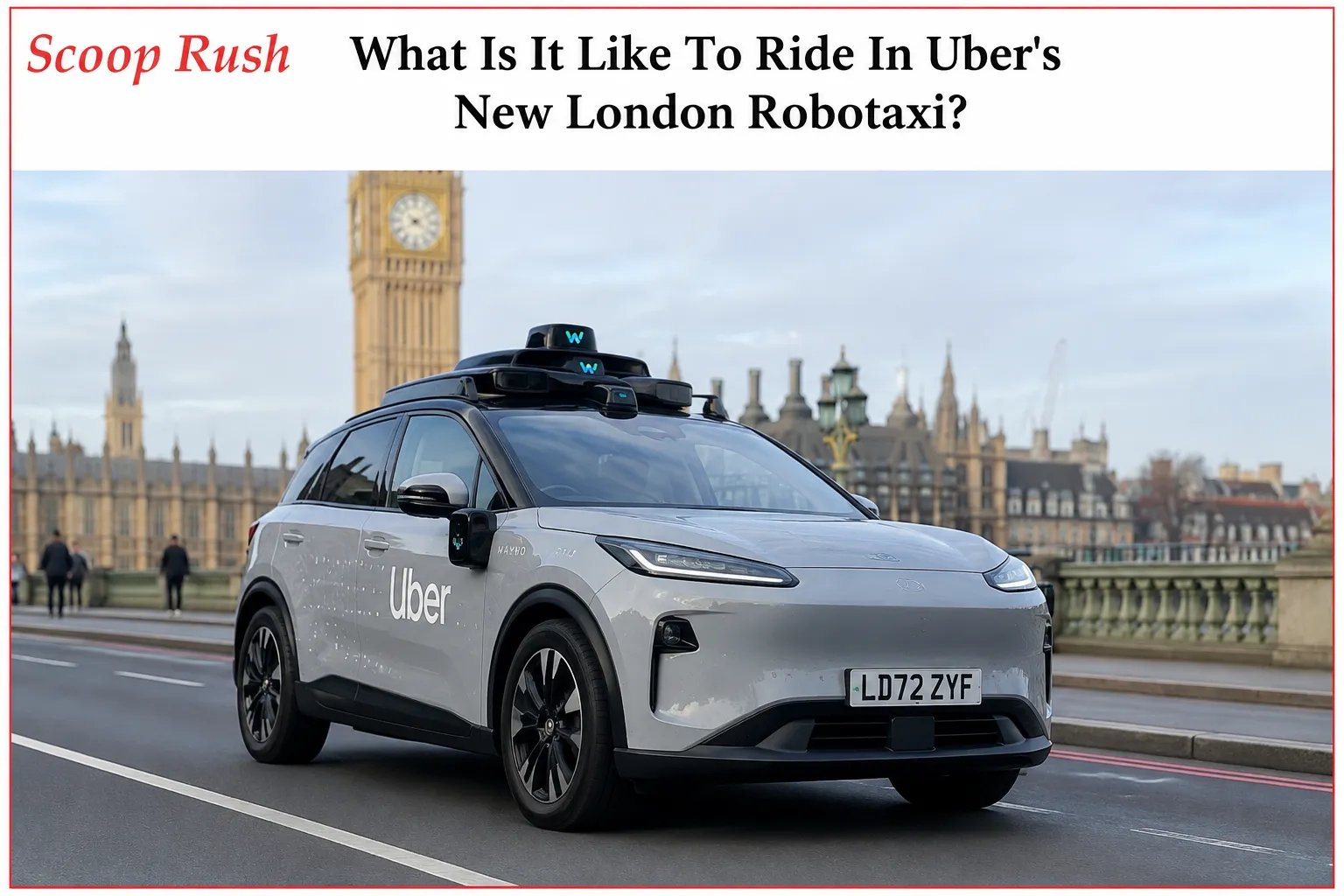
What if your next cab had no one driving it? That’s exactly what’s happening with the new Uber robotaxi London service, and the response from riders has already been huge.
Introduction
The Uber robotaxi London launch is officially live, and it marks the first time a self-driving minicab service has operated anywhere in the United Kingdom. Fifteen autonomous vehicles are now active on the app, and more than 100,000 London-based riders have already told Uber they would choose one over a regular car if given the chance.
This matters because it signals a real shift in how people move around one of the world’s busiest cities. However, this is not a fully driverless experience yet. Every robotaxi still carries a trained human safety driver behind the wheel, ready to step in at any moment. For riders curious about the future of urban transport, this launch offers a genuine first look at what is coming next.
In this article, we explain how the Uber robotaxi London service works, what it was like for a BBC journalist to ride in one, and what regulators and industry experts are saying about the road ahead.
What Is Uber’s Self-Driving Taxi Service In London?
Uber has become the first company to launch a self-driving minicab service in the UK capital. The initial robotaxi fleet is small, with only 15 autonomous vehicles licensed to operate in the city. : Uber built each car on the Ford Mustang Mach-E electric platform and fitted it with self-driving technology from Wayve, a UK-based artificial intelligence firm.
Unlike many older self-driving systems that rely on pre-set routes, Wayve’s technology works differently.Nobody pre-programs the cars. Instead, they use AI to interpret real-time data from sensors mounted in a bar on the roof and elsewhere on the vehicle, then decide how to respond to whatever is happening around them.
Riders cannot choose a robotaxi directly. Instead, the self-driving option only appears in the Uber app after a journey has already been booked, and only if one of the autonomous cars happens to be available nearby. Fares for these rides match the standard cost of an UberX, Uber Electric, or Uber Comfort trip, and the app shows the price upfront before the ride begins.
Why Every Uber Robotaxi Still Needs A Human Driver
Every robotaxi currently on London’s roads must carry a licensed human safety driver in the front seat. This person is there specifically to take control if anything goes wrong during the journey. Uber’s global head of autonomous mobility and delivery, Sarfraz Maredia, explained that the company wants to keep both options open for customers well into the future.
He noted that Uber expects human-driven cars to remain part of Uber London for a long time, even as the self-driving fleet grows. Additionally, Uber plans to phase in more autonomous vehicles gradually over the coming years rather than rushing a large-scale rollout.
What It’s Actually Like To Ride In A London Robotaxi
A BBC journalist became the first UK reporter to experience the Uber robotaxi London service firsthand this week. The ride began with a brief 30-second safety briefing from the human driver before setting off through central London traffic.
For the most part, the trip went smoothly. The vehicle successfully navigated busy streets, traffic lights, and roadworks, and it even passed a demonstration taking place outside parliament. At one point, a cyclist paused at a mini roundabout and waved the car forward with a hand gesture, and the robotaxi responded appropriately by moving ahead.
However, the ride was not entirely without incident. As the car began pulling away from a parked position, the back doors of a nearby van suddenly swung open. The vehicle braked sharply, an internal alarm sounded, and the safety driver immediately took manual control.
According to Wayve, the intervention was the driver’s own judgment call. The company later said it believed its AI system would have handled the situation safely on its own. Even so, the entire episode lasted only a couple of seconds, showing just how quickly these systems must respond to unpredictable street conditions.
London’s Robotaxi Race: Uber, Waymo, And Baidu
Uber is not the only company racing to bring driverless cars to London. Google’s autonomous vehicle division, Waymo, along with Chinese tech company Baidu, are also working toward launching services in the UK. Waymo vehicles have already been driving London streets for several months, though currently only for mapping purposes with safety staff on board. Notably, Waymo has said it does not intend to offer a service that includes a human at the wheel, which sets it apart from Uber’s current approach.
Wayve’s chief executive, Alex Kendall, described the broader race to develop this technology as nothing less than the space race of this generation. He pointed out that scaling autonomous driving to work reliably in a dense, unpredictable city like London involves solving genuinely difficult engineering problems.
Safety Concerns And Regulatory Roadblocks For Driverless Cars
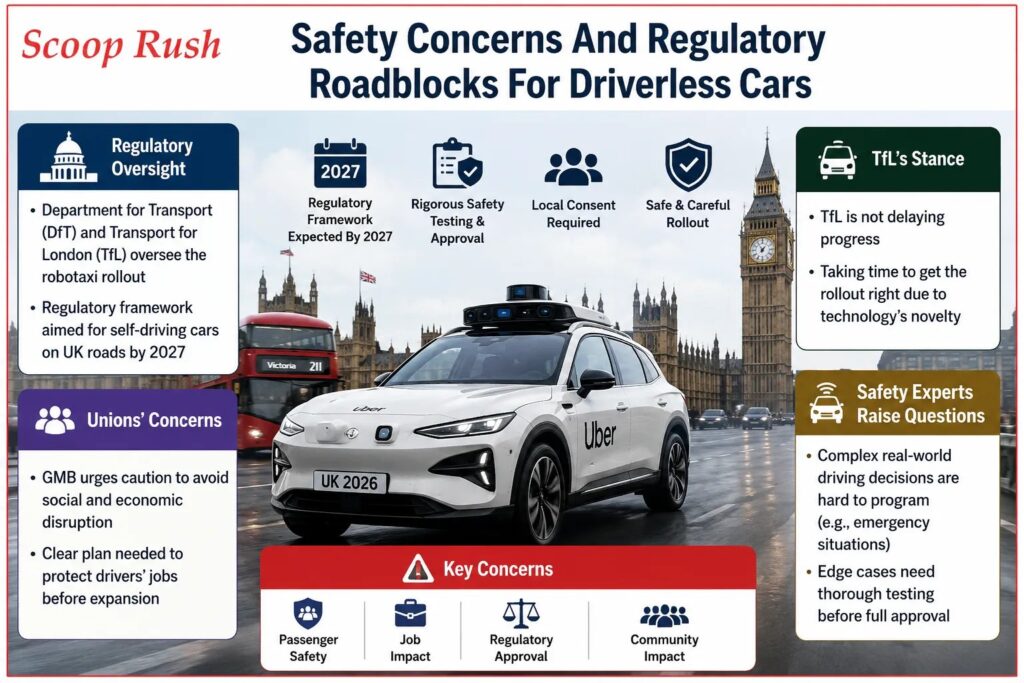
Earlier this year, both government officials and industry leaders suggested that fully driverless taxis could be operating in London by the end of 2026. That timeline now looks increasingly unlikely to hold.
Oversight of the rollout falls to the Department for Transport (DfT) and Transport for London (TfL), and both bodies have faced criticism for moving too slowly. A DfT spokesperson said the department is working toward putting a regulatory framework in place so self-driving cars can legally operate on UK roads by 2027, though no specific date has been confirmed.
The department stressed that these services will be introduced carefully and will remain subject to rigorous safety testing and regulatory approval. Furthermore, any expansion will require local consent, which takes into account potential effects on roads, jobs, and surrounding communities.
Christina Calderator, TfL’s director of transport strategy and policy, pushed back on suggestions that the authority is unnecessarily delaying progress. She said TfL is not holding up any decision, but is instead taking the time needed to get the rollout right, given how new this technology is to London’s streets.
What Unions And Safety Experts Are Saying
Not everyone is convinced the robotaxi rollout is moving at the right pace. David McMullen, senior organiser for the trade union GMB, warned that caution is essential unless people are prepared to face significant social and economic disruption. He called on TfL and the government to build a clear plan that protects existing drivers’ jobs before any wider expansion takes place, arguing that moving to driverless services now would be premature without one.
Safety researchers are also raising technical questions that go beyond basic navigation. Professor Siddartha Khastgir, head of safe autonomy at the University of Warwick’s Warwick Manufacturing Group, pointed to the complexity of everyday human driving decisions that are not always strictly legal. For example, human drivers sometimes mount a kerb to let an ambulance pass safely.
He questioned how a self-driving vehicle is meant to interpret and respond to emergency situations like this, especially in a crowded and unpredictable environment like central London. These are exactly the kinds of edge cases that regulators want tested thoroughly before granting wider approval for fully driverless operation.
Why The Uber Robotaxi Launch Matters For London’s Future
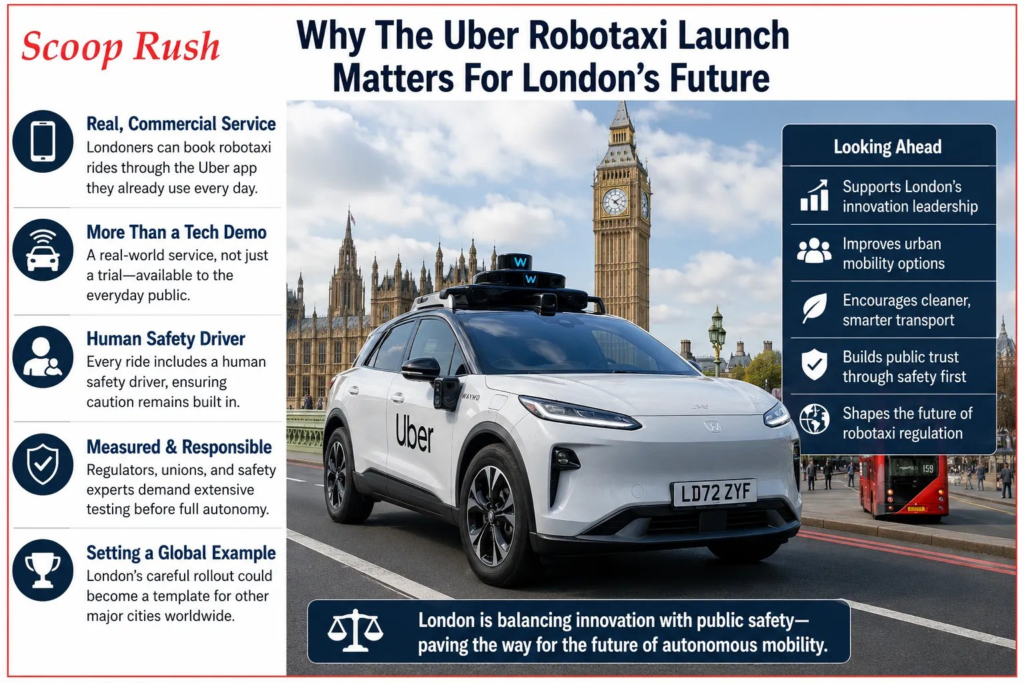
The Uber robotaxi London launch represents more than just a tech demo. It is a real, commercial service that ordinary Londoners can now book through an app they already use every day. That accessibility sets it apart from earlier autonomous vehicle trials, which were often limited to closed testing environments or small pilot groups.
At the same time, the presence of a human safety driver in every vehicle shows how much caution remains built into the system. Regulators, unions, and safety experts clearly are not willing to rush toward full autonomy without extensive real-world testing first. As a result, London’s approach looks measured rather than aggressive, even as competition from Waymo and Baidu continues to build pressure on Uber and Wayve.
Ultimately, this slow and careful rollout could shape how other major cities approach robotaxi services in the years ahead. If London succeeds in balancing innovation with public safety, it may become a template that other regulators look to follow.
Conclusion
Uber’s launch of the UK’s first robotaxi service marks a genuine turning point for transport in London, even though the technology is still far from fully driverless. With just 15 vehicles on the road and a human safety driver in every seat, this is very much a first step rather than a finished product. The BBC’s test ride showed both the promise and the limitations of the system, including one moment where human judgment overruled the AI.
Meanwhile, regulators continue working toward a broader framework that could allow fully autonomous rides by 2027, though that timeline remains unconfirmed. As competitors like Waymo and Baidu push to enter the London market, the pressure on Uber and Wayve to prove their technology is safe, reliable, and ready for a complex city will only increase. For now, Londoners have a new travel option to try, and the eyes of the entire industry are watching closely to see how it performs.
FAQs
1. Is the Uber robotaxi in London fully driverless?
No. Every current robotaxi in London includes a human safety driver who can take control of the vehicle if needed. Fully driverless rides are not yet available.
2. How many robotaxis does Uber currently operate in London?
Uber launched with 15 autonomous vehicles licensed to operate in the city, with plans to expand the fleet gradually over the coming years.
3. What technology powers Uber’s London robotaxis?
The vehicles are Ford Mustang Mach-E electric cars fitted with self-driving technology developed by the UK firm Wayve, which uses AI to interpret real-time sensor data rather than relying on pre-programmed routes.
4. How much does an Uber robotaxi ride cost in London?
Robotaxi fares currently match the standard price of an UberX, Uber Electric, or Uber Comfort ride, with the fare shown upfront in the app before booking.
5. When will fully driverless taxis be allowed in London?
The UK government is working toward a regulatory framework that could permit fully driverless cars on London roads by 2027, though officials have not confirmed an exact date.

