
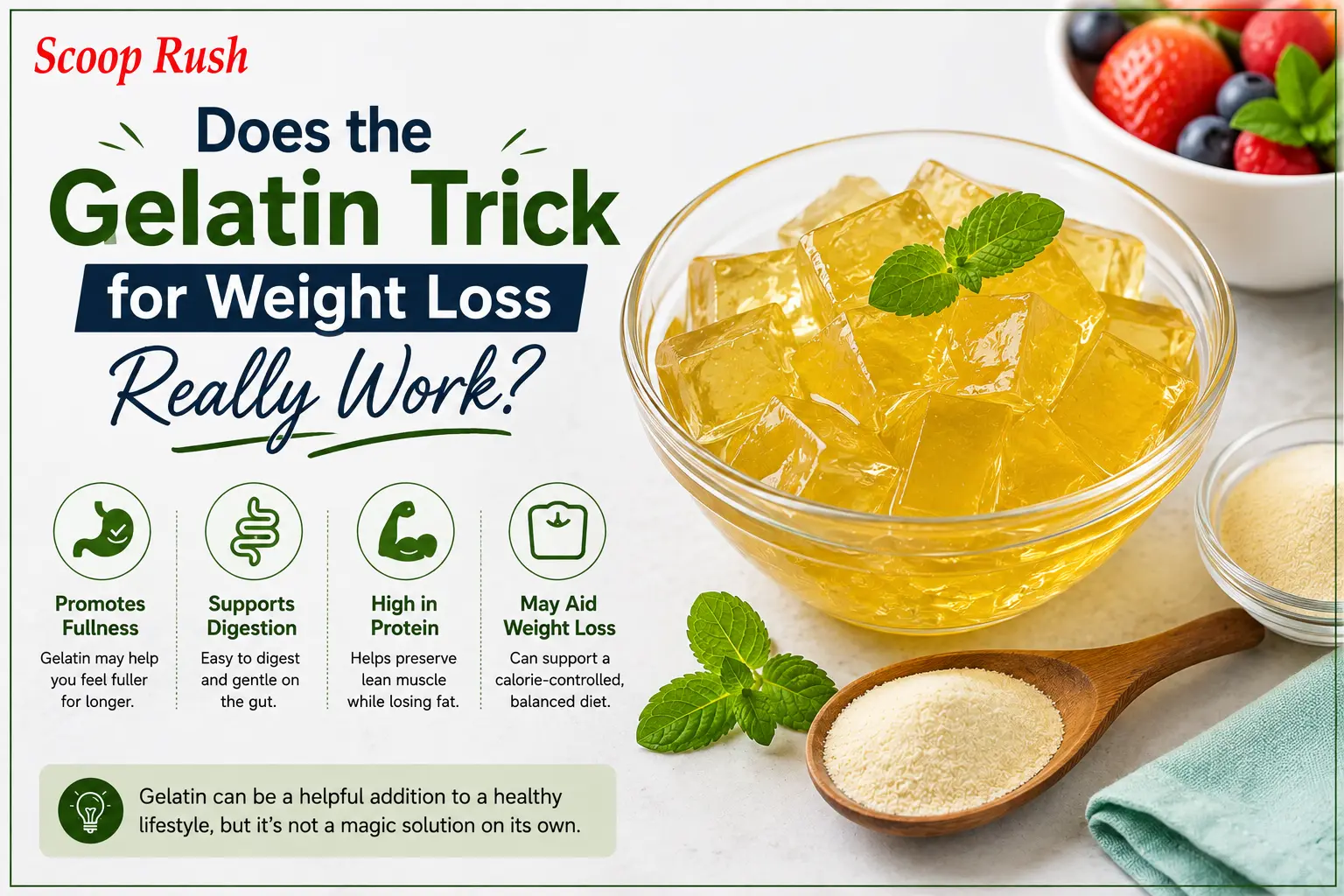
A cup of warm water, a spoonful of unflavored gelatin, and a few minutes of waiting that’s the entire “recipe” behind one of this year’s biggest diet trends. Across TikTok and Instagram, wellness creators (and, increasingly, AI-generated avatars) are promising that this simple drink can quiet your appetite, help you eat less, and jump-start weight loss, all without a prescription or a gym membership.
In a moment when GLP-1 drugs like Ozempic and Wegovy dominate the weight-loss conversation, a trick built from a grocery-store staple sounds almost too easy. But nutrition experts say the truth is more complicated and, in some cases, the hype outruns the science by a wide margin.
Here’s what the gelatin trick actually is, what happens in your body when you try it, what the research really shows, and whether it deserves a spot in your routine.
What Is the Gelatin Trick?
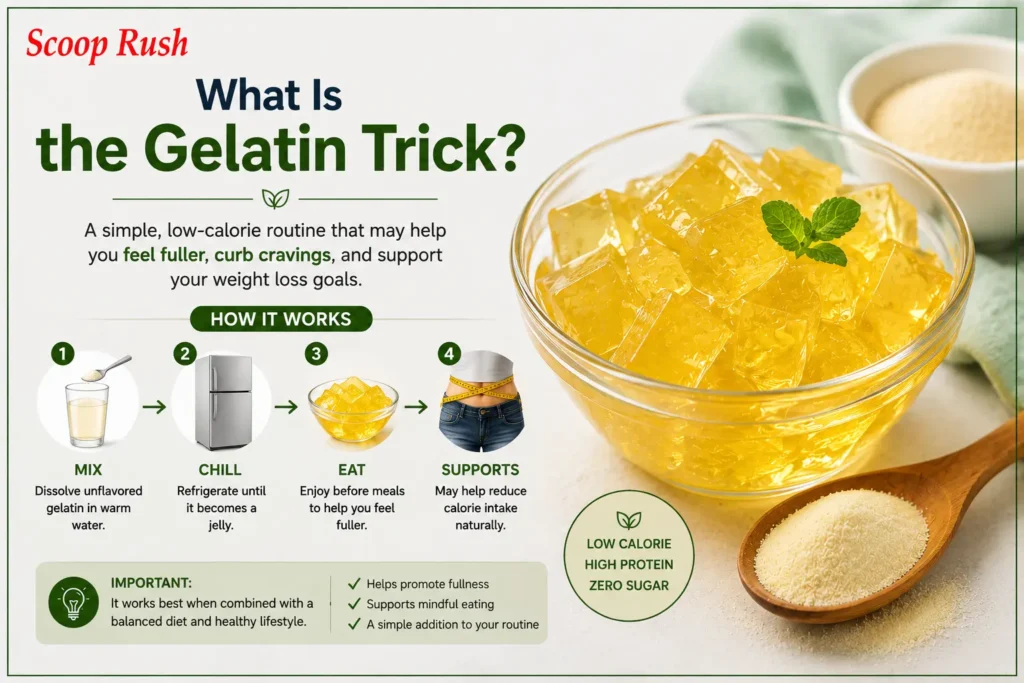
The gelatin trick involves dissolving a tablespoon or single packet of unflavored gelatin powder into a full glass of warm or cold water, then drinking it roughly 15 to 30 minutes before a meal. Some versions swap in green tea, apple cider vinegar, lemon, cranberry juice, or a pinch of salt, but the core idea stays the same: drink something thick and protein-containing before you eat, so you naturally eat less once the meal arrives.
Where the Trend Came From
The trend isn’t entirely new. Bone broth and gelatin-based pre-meal rituals have roots in culinary traditions across Northern Europe and East Asia, where people simply considered a warm, savory, protein-rich drink before dinner good practice for digestion not a weight-loss hack. What’s changed is the packaging. Short-form video has rebranded a centuries-old habit as a five-minute biohack, and algorithms amplify it by rewarding dramatic, easy-to-digest claims over nuanced ones.
Why It’s Spreading Right Now
Registered dietitians say the appeal makes sense given the current moment. A gelatin drink costs a few cents per serving, requires no doctor’s visit, no insurance approval, and no needle. It taps into genuine anxiety about the cost and accessibility of prescription weight-loss medications, many of which run several hundred dollars a month without coverage. For someone priced out of a GLP-1 prescription, a $6 tub of gelatin powder that promises even a fraction of the same effect can feel like a reasonable bet even if the comparison doesn’t hold up under scrutiny. It’s part of a long lineage of low-cost weight-loss shortcuts, from diet soda swaps to high-protein plans like the carnivore diet, that promise big results from a small, easy change.
There’s also a trust factor at play. Gelatin is a familiar kitchen ingredient, not a lab-made compound, and “food as medicine” framing tends to feel safer to people than pharmaceuticals, even when the actual evidence points in the opposite direction.
How the Gelatin Trick Is Supposed to Work
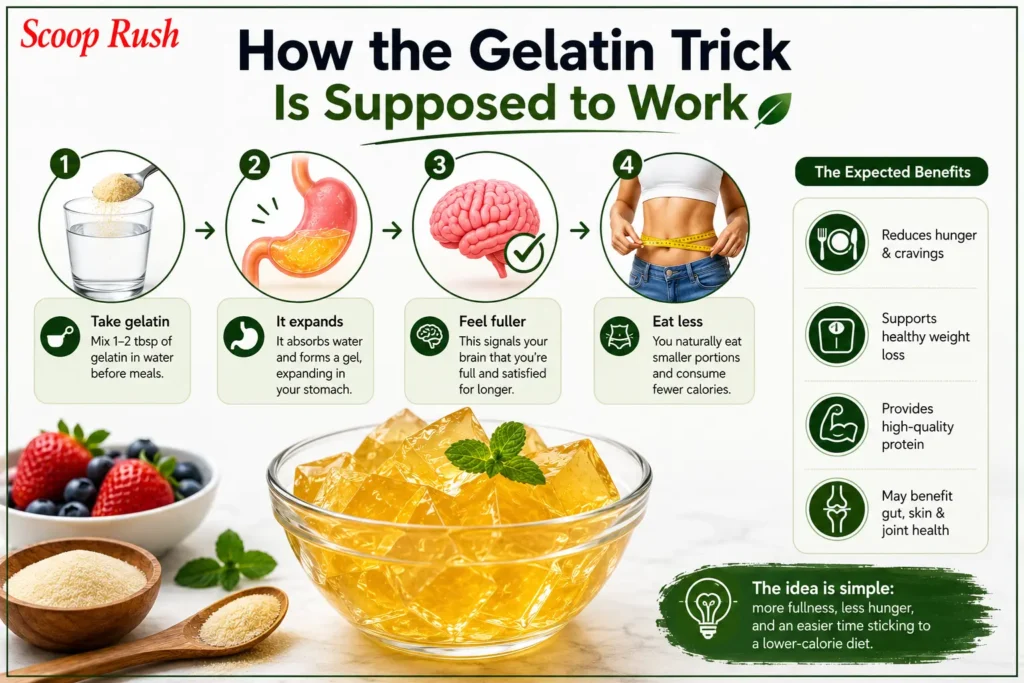
Believers in the trend point to two mechanisms:
- Volume and viscosity. Gelatin thickens in the stomach, creating a temporary sense of fullness before food even arrives.
- Protein content. Gelatin contains a modest amount of protein, and protein is well known to blunt hunger more effectively than carbohydrates or fat.
The GLP-1 Claim, Explained
Some newer explanations go further, claiming the drink triggers a release of the hormone GLP-1 the same hormone mimicked by drugs like Ozempic which slows digestion and signals fullness to the brain. There is early, limited research suggesting a hydrolyzed gelatin preload can raise GLP-1 and insulin markers in a lab setting. But dietitians caution against reading too much into that finding, since a short-term hormonal blip in a small study is a long way from a proven weight-loss strategy.
It helps to understand the scale of the difference. Prescription GLP-1 medications deliver a concentrated, engineered compound that keeps GLP-1 receptor activity elevated for days at a time, which is part of why they produce such dramatic and sustained appetite suppression. A gelatin drink, by contrast, may nudge the body’s own natural GLP-1 output slightly for perhaps an hour after you drink it. Comparing the two isn’t apples to apples — it’s closer to comparing a campfire to a furnace because both involve fire.
Gelatin Drink vs. Prescription GLP-1 Medication
| Gelatin Drink | Prescription GLP-1 Medication | |
| Mechanism | Mild, natural, short-term hormone nudge | Sustained receptor activation via engineered compound |
| Duration of effect | Roughly 30–60 minutes | Days, with weekly dosing |
| Typical weight loss | No reliable clinical data specific to gelatin | Often 10–20% of body weight over a year in trials |
| Cost | A few cents to a few dollars per serving | Often $300–$1,000+ per month without insurance |
| Medical oversight | None required | Prescribed and monitored by a physician |
| Side-effect profile | Minimal at normal doses | Nausea, GI effects, and other documented side effects |
The takeaway isn’t that one approach is “better” than the other in the abstract it’s that they aren’t solving the same problem at the same scale, and marketing that implies otherwise is misleading. It’s also worth knowing that prescription GLP-1 drugs come with their own trade-offs, including documented muscle loss risks with GLP-1 medications that a mild gelatin drink simply doesn’t carry.
The Gelatin Trick Recipe: Step by Step
If you want to try it, most versions follow the same basic structure.
| Step | What to Do |
| 1 | Measure 1 tablespoon (about 7 grams) of unflavored, unsweetened gelatin powder |
| 2 | Sprinkle it into 8 ounces of water — warm water dissolves standard gelatin more easily; hydrolyzed gelatin dissolves fine in cold water |
| 3 | Let it sit for 1–2 minutes to fully dissolve or “bloom” |
| 4 | Stir well until no clumps remain |
| 5 | Optional: add a squeeze of lemon, a splash of green tea, or a pinch of salt for taste — if you want it sweeter, stick to a keto-friendly sweetener rather than sugar, so you don’t undercut the point of the drink |
| 6 | Drink the full glass 15–30 minutes before your meal |
Nutritionally, plain gelatin powder delivers roughly 2 to 4 grams of protein and 5 to 20 calories per serving. Hydrolyzed gelatin supplements the kind sold as a powder for smoothies tend to pack more protein, closer to 8 to 12 grams per serving, similar to a standard collagen supplement. As an animal-based protein source, gelatin fits naturally into diets built around meat, bone, and connective-tissue nutrition, but it’s a poor fit for anyone eating primarily plant foods.
Gelatin Nutrition Facts at a Glance
| Nutrient | Standard Unflavored Gelatin | Hydrolyzed Gelatin/Collagen Powder |
| Protein | 2–4 g per serving | 8–12 g per serving |
| Calories | 5–20 | Slightly higher, varies by brand |
| Fiber | 0 g | 0 g |
| Fat | 0 g | 0 g |
| Amino acid profile | Incomplete (lacks some essential amino acids) | Incomplete |
| Source | Collagen from animal bones, skin, connective tissue | Same, further broken down for solubility |
That “incomplete protein” detail matters. Gelatin is missing several essential amino acids that the body can’t produce on its own, which means it doesn’t function nutritionally the same way a serving of chicken, fish, beans, or Greek yogurt would. Dietitians note that people online often overstate how much protein and how much genuine fullness a spoonful of gelatin can actually provide. It’s a good reminder that more supplementation isn’t automatically better; it’s worth understanding the broader risks of taking too many supplements before stacking gelatin on top of an already-crowded routine.
What Does the Science Actually Say?
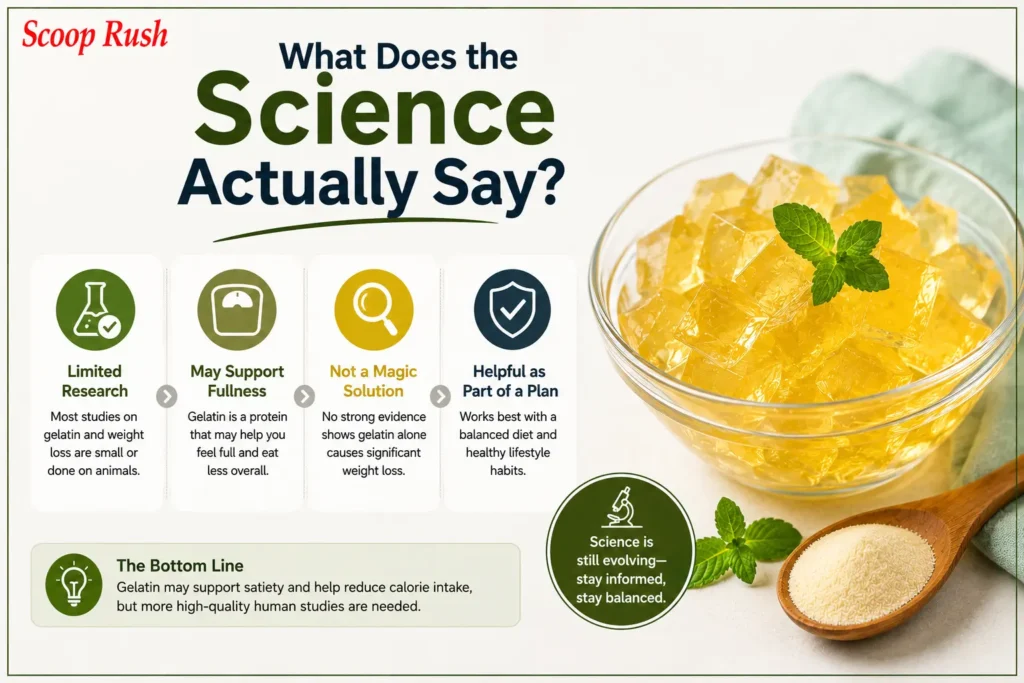
This is where the trend splits into two very different stories, depending on which body of research you’re looking at.
The Strong Evidence: Protein Preloading in General
Multiple controlled trials have found that eating or drinking a source of protein 15 to 30 minutes before a meal can modestly reduce the blood sugar spike that follows, and can nudge people toward eating somewhat less. This effect has been demonstrated with whey protein and other complete proteins in people with and without diabetes, and it’s one of the more consistently replicated findings in appetite research. It’s a legitimate, well-established strategy — it just isn’t specific to gelatin.
The Weaker Evidence: Gelatin Specifically
The evidence for gelatin on its own is considerably thinner. A handful of smaller, older studies have tested hydrolyzed gelatin as a pre-meal drink and found it can produce a similar, if less robust, hormonal response a short-term rise in satiety-related hormones. Sample sizes in this research tend to be small, follow-up periods short, and none of the available studies actually measured long-term weight change in people using a gelatin preload as their primary strategy. In other words, the mechanism is plausible; the outcome most people care about sustained weight loss has never actually been tested.
What the Dietitians Actually Say
Dietitians who spoke to reporters on the record about the trend were far more skeptical in practice than the lab data might suggest. Registered dietitian Natalie Rizzo, TODAY.com’s nutrition editor, has pointed out that any sense of fullness from the drink is likely to fade quickly, and that people are overestimating both the protein content and the staying power of the effect. Registered dietitian and author Frances Largeman-Roth has echoed that concern, noting that a temporary, low-calorie trick to suppress appetite isn’t a strategy she’s comfortable recommending, in part because it doesn’t address what actually keeps people full: fiber, healthy fats, and complete protein none of which gelatin provides in meaningful amounts.
Both experts agree on the bottom line: the gelatin trick will not burn fat, it is not a substitute for a balanced diet, and any appetite suppression is short-lived often less than an hour.
How the Gelatin Trick Went Viral: A Quick Timeline
Understanding how a trend like this spreads helps explain why the claims got bigger and less accurate over time.
- Late 2024: Early versions of the trend appear on TikTok, framed modestly as a bone-broth-adjacent pre-meal ritual for digestion and mild fullness.
- Early-to-mid 2025: The framing shifts toward weight loss specifically, with creators pairing gelatin drinks against the backdrop of rising GLP-1 medication searches. Claims about “GLP-1 release” begin appearing, often stripped of the nuance found in the original research.
- Mid-2025: AI-generated wellness accounts begin producing high volumes of near-identical videos, repeating the same statistics and testimonials without attribution, making the claims feel more established simply through repetition.
- Late 2025 into 2026: A parallel, riskier fad mixing Jell-O with baking soda and vinegar goes viral and draws media attention after a well-known figure says she tried it based on an AI deepfake video and experienced bloating and discomfort. That story puts a spotlight on the broader category of gelatin-based hacks, gelatin trick included, and prompts more dietitians to publicly weigh in with corrections.
This pattern a modest, plausible idea getting amplified into an overstated claim through repetition rather than evidence is common across viral wellness trends, not unique to gelatin.
The Rebound Problem
One risk that gets little attention in viral videos: what happens after the fullness wears off.
Why the Fullness Doesn’t Last
Because gelatin doesn’t provide fiber or a complete amino acid profile, the sense of satiety it creates tends to disappear faster than the fullness from a real meal or snack. Fiber, in particular, slows gastric emptying and keeps blood sugar more stable for hours gelatin has none. Dietitians warn this mismatch can set up a rebound effect: intense hunger a few hours later that leads to overeating, often of less nutritious foods, simply because the body is trying to catch up on both calories and nutrients it didn’t get earlier.
How This Plays Out at the Dinner Table
Eating while very hungry also tends to affect food choices and portion control. Decision fatigue and blood-sugar dips both make it harder to reach for a balanced plate and easier to reach for whatever’s fastest and most calorie-dense. That dynamic can quietly undercut the very goal — eating less overall that people are chasing when they start the trend in the first place. In practice, someone who ate a smaller dinner because of a gelatin drink may end up snacking more heavily later in the evening, which can cancel out any calorie savings entirely.
What People Are Actually Reporting
Beyond the lab research, it’s worth looking at the pattern of experiences people describe after trying the trend for themselves, since real-world use rarely matches a controlled study.
The Common Short-Term Report
Many people who try the gelatin trick for the first time describe a genuine — if brief — sense of fullness in the first meal or two. This tracks with the mechanism: a large volume of thick liquid does take up physical space in the stomach, at least temporarily. Some also report drinking less at the actual meal simply because they’re less thirsty, which can be mistaken for reduced hunger.
The Common Follow-Up Report
Fewer people report the same effect holding up after a week or two of consistent use. This lines up with what dietitians would predict: a habit built entirely around volume and mild protein, without addressing fiber or overall diet quality, tends to lose its novelty and its physiological impact once the body adjusts. It also explains why so many testimonial videos are filmed on “day one” rather than “day thirty.”
The Honest Read
None of this amounts to clinical proof either way — anecdotal reports aren’t controlled data, and social media testimonials in particular tend to overrepresent dramatic outcomes in both directions. But the pattern is at least consistent with the underlying science: a short-lived, modest effect rather than a sustained, meaningful one.
Who Should Avoid the Gelatin Trick
Who It’s Probably Fine For
Occasional, moderate use of a gelatin drink is generally considered low-risk for most healthy adults with no relevant medical conditions.
Who Should Be More Cautious
The following groups should either check with a doctor first or skip the trend altogether:
- People with kidney disease or a history of kidney stones. Gelatin is almost entirely protein by dry weight, and a concentrated protein load can increase strain on kidney filtration.
- Anyone on anticoagulant medication. Gelatin contains bioactive peptides that may interact with blood-clotting processes; check with a prescriber first.
- Pregnant people. Not inherently dangerous, but pregnancy already comes with elevated protein needs that a gelatin ritual doesn’t meaningfully add to.
- Children and teenagers. Gelatin as a food is fine, but building a daily “appetite suppression” habit isn’t appropriate for a still-developing relationship with food.
- Anyone with a history of disordered eating. Pre-meal rituals designed to blunt hunger can, for some people, reinforce restrictive patterns. This is a case where speaking with a doctor or therapist first is the safer move.
- Strict plant-based eaters. Gelatin is an animal product (typically derived from cow or pig collagen), so it’s not compatible with a plant-based diet.
Expert Opinions: Is It Worth Trying?
Dietitians interviewed about the trend are careful to separate two different claims: that gelatin “can create brief fullness” versus that it “causes weight loss.” The first is plausible and mild; the second isn’t supported by the evidence.
The Skeptical Camp
Rizzo has described the broader category trying to trick yourself into feeling full on something with almost no calories as an approach that doesn’t sit well with her as a long-term habit, a sentiment Largeman-Roth shares. Their concern isn’t that a glass of gelatin water is dangerous in isolation. It’s that hacks like this train people to look for shortcuts instead of building sustainable habits, and that repeated use can crowd out real food and the vitamin C, iron, potassium, and calcium that comes with it. Both dietitians frame the trend less as a health risk and more as a distraction from strategies that actually have a track record: adequate protein at meals, fiber intake, consistent sleep, and gradual, sustainable calorie management.
The Cautiously Supportive Camp
Obesity-medicine clinicians who study “satiety engineering” using pre-meal tools like broth or protein to reduce calorie intake without relying purely on willpower take a slightly more favorable view, framing gelatin as a low-cost entry point into that broader strategy. Even there, though, the caveat is consistent: it only works as one small piece of a bigger, calorie-conscious eating pattern, not as a standalone fix. This camp tends to see the gelatin trick less as a solution and more as a gateway habit something that might help a person notice how pre-meal protein affects their appetite, which could then lead them toward more substantial, food-based versions of the same strategy.
Where the Two Camps Agree
Despite the difference in tone, both groups land in roughly the same place: the gelatin trick is not dangerous for most healthy adults in moderation, it is not a proven weight-loss method on its own, and it should never replace medical guidance for someone pursuing significant weight loss.
A Note on the AI Hype Machine
Why So Many Videos Sound the Same
Part of what’s fueling the gelatin trick’s spread is a wave of AI-generated wellness content — auto-narrated videos that recycle the same unverified claims across dozens of accounts, often with near-identical scripts, statistics, and “expert” framing. This repetition can create a false sense of consensus: if the same claim appears in fifty different videos, it starts to feel established, even when all fifty are tracing back to the same unverified source.
A Cautionary Example
A related fad, involving Jell-O mixed with baking soda and vinegar, recently made headlines after a well-known figure said she tried it based on an AI deepfake video and ended up bloated and unwell. That episode is a useful reminder: virality is not the same as verification, and a trend spreading fast across social media is not evidence that it works. Before trying any viral health hack, it’s worth asking who’s actually behind the claim a licensed professional, or an anonymous account optimizing for watch time.
Healthier Ways to Curb Hunger Before a Meal
If the goal is simply to feel more satisfied and eat a bit less at dinner, dietitians say there are options with a better nutritional payoff than a glass of flavorless gelatin. Many of these overlap with staples of a low-carb diet, which tends to be naturally higher in protein and fat — two of the nutrients most linked to lasting fullness.
Quick, Grab-and-Go Options
- A small handful of nuts or seeds
- A serving of berries
- A hard-boiled egg
- A full glass of water, which adds volume and helps with hydration on its own
For a Heartier Pre-Meal Snack
- Greek yogurt or cottage cheese
- Beans or lentils in a small side dish
- Bone broth, which offers some of the same collagen-derived compounds as gelatin, along with more flavor, minerals, and often a bit more protein per serving
- A few keto-friendly snacks if you’re already watching carbs, such as cheese, olives, or avocado
These options bring fiber, healthy fats, and complete protein to the table the three things nutrition experts say actually drive lasting fullness, none of which unflavored gelatin can offer on its own.
The Bottom Line
The gelatin trick isn’t a scam, exactly, but it isn’t the fat-burning shortcut that viral videos claim, either.At best, it functions as a very mild, short-lived version of a well-documented strategy: eating a little protein before a meal to take the edge off your appetite. At worst, it sets people up for a hunger rebound a few hours later, displaces more nutritious food from the diet, and reinforces the idea that sustainable weight loss can come from a single trick rather than consistent habits.
If you enjoy the ritual and have no medical reason to avoid it, an occasional glass of gelatin water before dinner is unlikely to cause harm. Just don’t expect it to replace a balanced plate or to do the work that fiber, protein-rich whole foods, sleep, and movement do over time. If you’re looking for changes that actually move the needle, small, consistent healthy habits in your 20s and 30s like taking a 5-minute walk every hour tend to outperform any single pre-meal trick.
FAQs
Does the gelatin trick actually help you lose weight?
Not on its own. It may create brief fullness that leads to a slightly smaller meal, but there’s no strong evidence it burns fat or produces meaningful weight loss by itself. Any results depend on the overall diet around it.
How much gelatin should I use?
Most versions call for about 1 tablespoon (roughly 7 grams) of unflavored gelatin powder dissolved in a full 8-ounce glass of water, consumed 15 to 30 minutes before eating.
Is gelatin the same as collagen?
They’re closely related. Connective tissue contains collagen, the raw protein; cooking breaks that collagen down into gelatin. Manufacturers process hydrolyzed collagen powders even further so they dissolve more easily.
Can I use flavored Jell-O instead of plain gelatin?
No — flavored gelatin desserts are mostly sugar and don’t offer the same protein-to-calorie ratio. If you want to try the trend, unflavored, unsweetened gelatin powder is the version being discussed. (Flavored gelatin does have its place elsewhere, though it’s a staple of the clear liquid diet used before certain medical procedures.)
Is the gelatin trick safe for everyone?
Not necessarily. People with kidney disease, those on blood-thinning medication, pregnant people, children, and anyone with a history of disordered eating should talk to a doctor before trying it or avoid it altogether.
What should I do instead if I want to curb hunger before meals?
Reach for whole foods that combine protein, fiber, and healthy fats nuts, Greek yogurt, beans, berries, or a hard-boiled egg paired with a glass of water. These provide more complete nutrition and longer-lasting fullness than gelatin alone.
Why is this trend going viral right now?
It’s spreading partly because it’s cheap and easy compared with prescription weight-loss medications, and partly because of a wave of wellness content including AI-generated videos that repeats the same unverified claims across social platforms.
Does the gelatin trick really trigger GLP-1 like Ozempic does?
There’s early, small-scale research suggesting a mild, short-lived rise in the body’s own GLP-1 output after a gelatin preload. That’s a real but limited effect nothing close to the sustained receptor activation produced by a prescription GLP-1 medication, which works continuously for days rather than roughly an hour.
Can I take it with coffee?
Yes, mix the gelatin into water and have your coffee on the side rather than dissolving it directly into a hot cup. If you’re curious about the broader effects of caffeine before eating, it’s worth reading up on drinking coffee on an empty stomach as well.
Can I drink gelatin water every day long-term?
Occasional use is generally considered low-risk for healthy adults, but dietitians caution against relying on it daily as a substitute for real food. Doing so consistently can crowd out nutrients like fiber, vitamin C, iron, and calcium that a gelatin drink simply doesn’t provide.

