Home Blog Page 32

Morgan Rogers and Cole Palmer: Xabi Alonso’s Chelsea Plan

0

Chelsea’s newest partnership is already creating huge excitement among supporters. Morgan Rogers has finally reunited with his close friend Cole Palmer after completing his move from Aston Villa, giving Xabi Alonso two of England’s brightest attacking talents to build around. The challenge now is turning that friendship into one of the Premier League’s most dangerous attacking combinations.

Both players enjoy playing in similar areas of the pitch. However, their different strengths could make them the perfect fit in Alonso’s tactical system. If the new Chelsea manager gets the balance right, Rogers and Palmer could become the driving force behind Chelsea’s attack this season.

Introduction

Chelsea’s signing of Morgan Rogers is an important step in Xabi Alonso’s plans to strengthen Chelsea’s attack. Rogers arrives after impressing in the Premier League, while Cole Palmer has already established himself as one of the team’s key creative players.

Rogers arrives after impressing at Aston Villa, where he developed into one of the Premier League’s most adaptable attacking players under Unai Emery. His performances earned widespread praise for his pace, direct running, and ability to influence matches from several positions.

The move also reunites Rogers with Cole Palmer, his former Manchester City academy teammate and one of his closest friends. Rogers admitted after joining Chelsea that Palmer had been encouraging him to make the move because they had always hoped to play together again.

Now Chelsea supporters are eager to see whether Morgan Rogers and Cole Palmer can become one of the league’s most exciting attacking partnerships under Alonso.

Why Chelsea Signed Morgan Rogers

Chelsea identified Morgan Rogers as a player capable of strengthening several attacking positions.

Unlike many wingers who remain fixed on one side of the pitch, Rogers constantly changes positions throughout matches. His movement makes him difficult to mark and creates additional space for teammates.

At Aston Villa, he usually started from the left side of attack before drifting into central areas where he could combine with teammates or attack defenders directly.

This freedom allowed him to showcase the qualities that attracted Chelsea.

He combines:

  • Excellent ball control
  • Powerful running
  • Physical strength
  • Intelligent movement
  • Composure in attacking situations

These attributes allow Rogers to contribute in several different ways instead of relying only on goals.

Sometimes he attacks open spaces behind defenders.

At other times, he drops deeper to link attacks before driving forward with possession.

That versatility makes him an ideal fit for modern football.

Morgan Rogers Offers Tactical Flexibility
Morgan Rogers Offers Tactical Flexibility

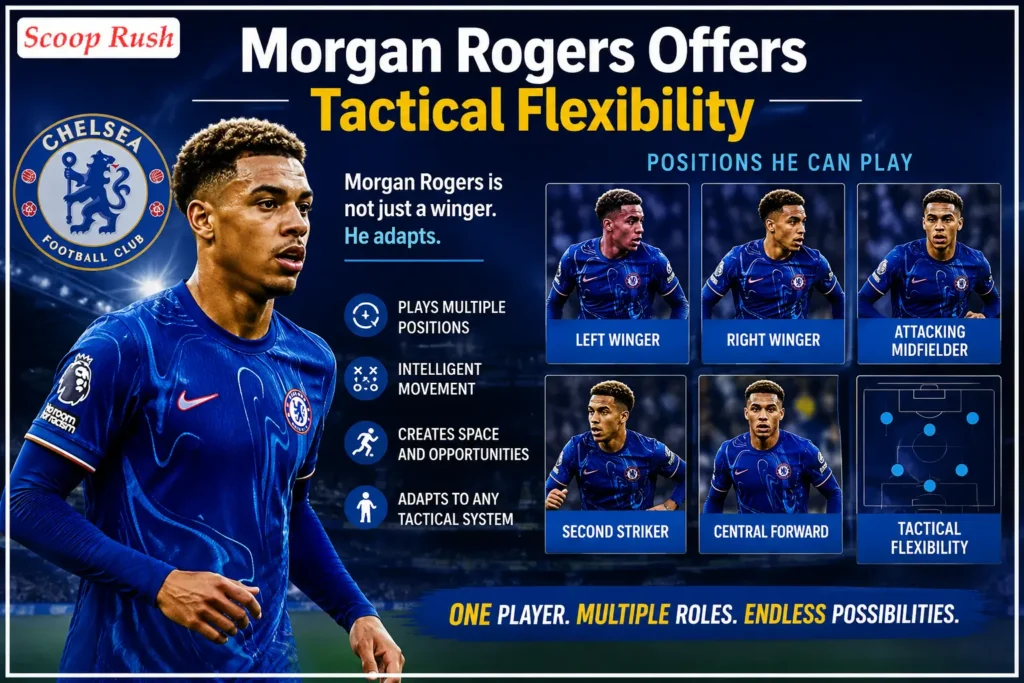
One of Rogers’ greatest strengths is his ability to perform multiple attacking roles.

He can comfortably play as:

  • Left winger
  • Right winger
  • Attacking midfielder
  • Second striker
  • Central forward during attacking phases

This flexibility gives Chelsea far more tactical options during matches.

Rather than making substitutions, Xabi Alonso can simply rotate players into different positions depending on the opposition.

As a result, Chelsea become much less predictable.

Morgan Rogers and Cole Palmer Could Become Chelsea’s Biggest Strength

One of the most exciting aspects of Rogers’ arrival is his partnership with Cole Palmer.

The two players already understand each other’s game.

They progressed through Manchester City’s academy together and celebrated FA Youth Cup success before their careers took different paths.

Their friendship has remained strong.

After joining Chelsea, Rogers revealed that Palmer regularly called and texted him because both wanted the chance to become teammates once again.

However, this partnership is built on much more than friendship.

Both players possess the technical quality, intelligence, and creativity required to succeed in Alonso’s football.

Different Strengths Create Better Balance

Although both players enjoy attacking central areas, they influence matches differently.

Cole Palmer prefers controlling attacks through intelligent passing and creative decision-making.

Morgan Rogers adds power, pace, and direct running.

That contrast creates natural balance.

While Palmer looks for opportunities to unlock defences with clever passes, Rogers attacks the spaces those passes create.

Instead of competing for possession, they complement one another.

This combination could make Chelsea’s attack far more unpredictable throughout the season.

Why Xabi Alonso’s Tactical Philosophy Suits Both Players

Xabi Alonso has built his reputation on organised possession football. His teams aim to dominate matches through intelligent movement, quick passing, and strong positioning. However, Alonso also understands the importance of adapting against aggressive pressing teams.

One of the biggest strengths of Xabi Alonso’s tactics is positional flexibility. His system allows attacking players to rotate freely while maintaining possession and creating overloads in central areas. These Chelsea tactics suit both Morgan Rogers and Cole Palmer because of their versatility, technical quality, and intelligent movement.

Modern football often becomes a series of one-on-one battles across the pitch. Therefore, attackers who can protect possession, beat defenders, and carry the ball forward have become increasingly valuable. Morgan Rogers possesses all of those qualities. Meanwhile, Cole Palmer provides the creativity needed to connect midfield with attack…

Beating High Pressing Teams

Premier League teams increasingly use aggressive pressing to disrupt build-up play.

Instead of forcing short passes through crowded midfield areas, successful teams often look for players capable of receiving direct passes under pressure.

Morgan Rogers excels in these situations.

His physical strength helps him protect possession.

His acceleration allows Chelsea to attack quickly once space appears.

Consequently, Chelsea gain another important solution against opponents who defend aggressively.

How Cole Palmer Complements Morgan Rogers

How Cole Palmer Complements Morgan Rogers

Cole Palmer has already established himself as Chelsea’s creative leader. His vision, technical ability, and composure allow him to control attacks from central areas rather than remaining close to the touchline.

Cole Palmer’s Chelsea career has continued to grow because of his creativity, composure, and ability to influence games in the final third. Playing alongside Morgan Rogers could give Chelsea another attacking dimension under Xabi Alonso, with both players capable of creating and finishing chances.

Instead of relying on pace alone, Palmer creates opportunities through intelligent movement and accurate passing. He constantly searches for spaces between the opposition’s midfield and defence before linking attacks with quick combinations.

Morgan Rogers naturally benefits from this style of play.

While Palmer prefers receiving possession in advanced central areas, Rogers enjoys making powerful runs beyond defenders or driving directly at them with the ball.

This combination creates natural balance.

Rather than occupying identical positions, both players can rotate throughout matches without disrupting Chelsea’s attacking shape.

As a result, defenders are forced to make difficult decisions about who to mark and when to step forward.

Why Their Different Strengths Could Make Chelsea Stronger

Why Their Different Strengths Could Make Chelsea Stronger

Although Rogers and Palmer are both creative attackers, they approach the game differently.

Cole Palmer controls the tempo.

Morgan Rogers increases the intensity.

Palmer looks for clever passes that unlock organised defences.

Meanwhile, Rogers attacks the spaces those passes create with pace and power.

This contrast gives Chelsea multiple ways to break down opponents.

Against teams sitting deep, Palmer’s creativity becomes invaluable.

Against teams pressing aggressively, Rogers’ ability to carry the ball forward offers another solution.

Consequently, Alonso gains two players capable of solving different tactical problems.

Xabi Alonso’s 3-2-2-3 System Explained

One of the defining features of Xabi Alonso’s football is his flexible attacking structure.

Although Chelsea may begin matches with either a back four or a back five, Alonso’s teams often reshape themselves once possession is secured.

During attacks, the structure usually resembles a 3-2-2-3 formation.

That system includes:

  • Three defenders building attacks.
  • Two midfielders controlling possession.
  • Two attacking midfielders operating between the lines.
  • Three advanced attackers stretching the opposition.

This setup allows Chelsea to dominate possession while keeping several passing options available at all times.

More importantly, it suits both Rogers and Palmer perfectly.

Rogers’ Best Position

Morgan Rogers produced many of his strongest performances at Aston Villa while attacking from the inside-left channel.

Rather than remaining close to the sideline, he regularly drifted into central positions where he could combine with teammates before attacking defenders directly.

That role could become even more effective under Alonso.

Chelsea’s full-back or wing-back can provide width, allowing Rogers to focus on influencing attacks closer to goal.

This positioning also places him much closer to Palmer.

The shorter distance between both players encourages quick passing combinations around the penalty area.

Palmer Controls the Right Side

Cole Palmer naturally prefers operating from the right half-space.

From there he can receive possession on his stronger foot before creating opportunities through passes or shots.

Together, Palmer and Rogers can control both sides of Chelsea’s central attack.

Meanwhile, Chelsea’s wide players stretch the opposition’s defensive line.

This balance makes Chelsea’s attacking shape much harder to defend.

Counter-Pressing Could Become Chelsea’s Biggest Strength

One of Alonso’s most important tactical principles is winning possession immediately after losing it.

Instead of dropping back into defensive positions, his players immediately pressure opponents high up the pitch.

Morgan Rogers is well suited to this style.

His strength, pace, and work rate allow him to close defenders quickly.

Meanwhile, Palmer’s intelligent positioning keeps him close enough to support the press whenever Chelsea lose possession.

This aggressive approach allows Chelsea to recover the ball before opponents can launch dangerous counter-attacks.

As a result, Chelsea can maintain sustained pressure throughout matches.

Why Tactical Flexibility Matters

Modern football rarely depends on fixed positions.

Successful teams constantly rotate players during attacks.

Morgan Rogers gives Chelsea exactly that flexibility.

He may begin on the left before moving into central areas.

Palmer can drop deeper before moving forward again.

Wide defenders provide attacking width while central attackers exchange positions.

These movements force defenders to constantly adjust their marking responsibilities.

Consequently, Chelsea become much more unpredictable.

What Chelsea Fans Can Expect

Chelsea supporters should expect an attack built around movement rather than fixed positions.

Morgan Rogers will not remain permanently on the left wing.

Cole Palmer will not always stay on the right.

Instead, both players will rotate throughout matches while looking to create space for one another.

Some attacks will begin through Palmer’s creativity.

Others will depend on Rogers’ direct running.

Together, they provide Chelsea with multiple attacking solutions against different opponents.

Why Morgan Rogers and Cole Palmer Could Transform Chelsea Under Xabi Alonso

Morgan Rogers and Cole Palmer could transform Chelsea under Xabi Alonso because they bring different strengths that complement each other.

Their long-standing understanding from their Manchester City academy days, combined with Rogers’ direct running and Palmer’s creativity, gives Chelsea a balanced attacking partnership. Alonso’s flexible tactical system also allows both players to rotate positions, create space between the lines, and perform effectively against high-pressing opponents.

Key reasons include:

  • Strong understanding from their Manchester City academy days.
  • Complementary attacking styles that balance creativity and direct play.
  • Tactical flexibility within Xabi Alonso’s system.
  • Intelligent movement between the lines to create chances.
  • Ability to beat aggressive high-pressing teams.

Conclusion

Morgan Rogers and Cole Palmer have every opportunity to become one of Chelsea’s most exciting attacking partnerships under Xabi Alonso.

Rogers brings pace, strength, versatility, and intelligent movement after impressing in the Premier League with Aston Villa. Palmer already offers creativity, vision, and composure that make him one of Chelsea’s key attacking players.

Together, their different qualities complement each other naturally.

Alonso’s tactical philosophy, built around possession, flexibility, and intelligent positioning, provides an ideal environment for both players to succeed.

The partnership between Morgan Rogers at Chelsea and Cole Palmer at Chelsea could become one of the biggest strengths of Chelsea’s attack this season. If Xabi Alonso’s tactics continue to evolve, Chelsea may develop one of the most balanced and exciting attacking units in the Premier League.

Frequently Asked Questions

1. Why did Chelsea sign Morgan Rogers? 

Chelsea signed Morgan Rogers because of his versatility, athleticism, and ability to play across several attacking positions.

2. Can Morgan Rogers and Cole Palmer play together? 

Yes. Their different strengths complement each other, allowing both players to operate effectively in Chelsea’s attacking system.

3. What position will Morgan Rogers play under Xabi Alonso? 

Rogers is expected to play mainly in the inside-left attacking role while remaining capable of operating across the front line.

4. What tactical system could Xabi Alonso use at Chelsea? 

Alonso is expected to use a flexible system that often develops into a 3-2-2-3 shape during possession.

5. Why is the Rogers and Palmer partnership important? 

Their existing understanding, combined with complementary playing styles, gives Chelsea two intelligent attackers capable of creating and finishing chances within Alonso’s tactical system.

Full Liquid Diet: Complete Guide to Foods, Benefits, Risks, Meal Plan, and More

0

Sometimes your body needs a break from solid food. Whether you’re recovering from surgery, dealing with swallowing difficulties, or preparing for a medical procedure, a full liquid diet can provide essential nutrition while giving your digestive system time to heal.

Although it may sound restrictive, this diet includes much more than just water or broth. From creamy soups and yogurt to protein shakes and smoothies, a well-planned full liquid diet can help support recovery and keep your energy levels up.

Why It’s Used

A full liquid diet is commonly recommended by healthcare providers for short periods when eating regular food isn’t possible or safe.

Unlike a clear liquid diet, it includes milk-based drinks, strained soups, pudding, yogurt, and other smooth foods that are liquid or become liquid at room temperature. These options provide more calories, protein, and nutrients, making the diet more suitable for healing and recovery.

A Short-Term Plan, Not a Lifestyle

A full liquid diet isn’t designed to be a long-term eating plan. While it offers more nutrition than a clear liquid diet, it still lacks enough fiber and several important vitamins and minerals.

That’s why it’s usually followed for only a few days, or until your healthcare provider recommends returning to soft or regular foods.

What This Guide Covers

In this complete guide, you’ll learn everything you need to know about a full liquid diet: who needs it, what foods you can eat, which foods to avoid, its benefits, possible risks, nutrition tips, and how to safely transition back to solid foods.

What Is a Full Liquid Diet?

What Is a Full Liquid Diet? |Scoop Rush

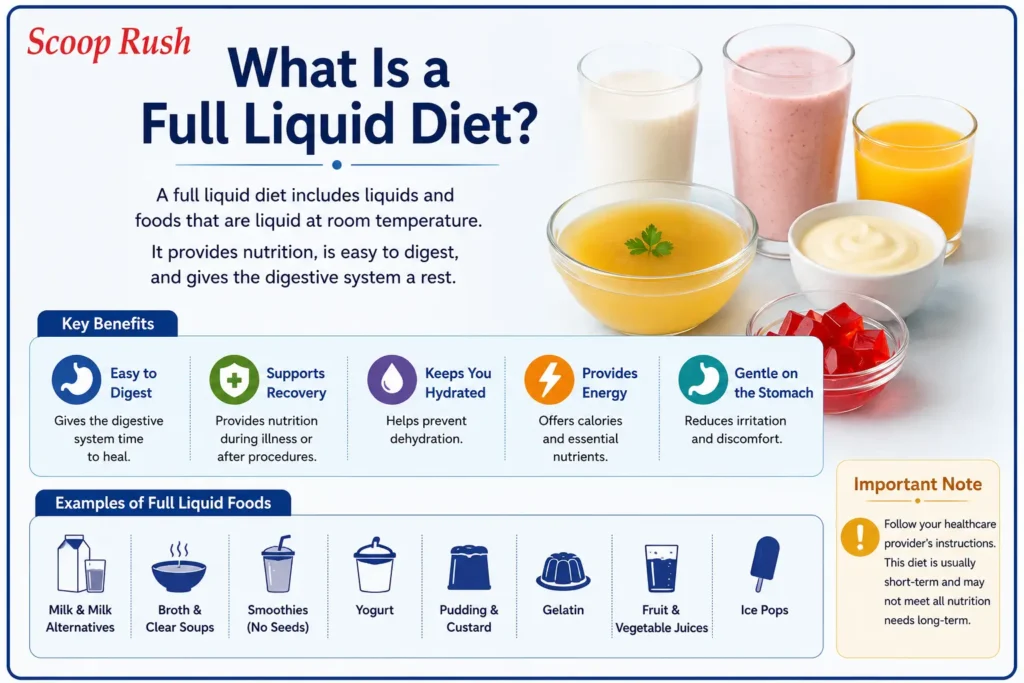
A full liquid diet is a temporary eating plan that includes foods and beverages that are liquid or become liquid at room temperature. Unlike a clear liquid diet, which only allows transparent liquids like broth and apple juice, a full liquid diet includes thicker, more nourishing foods such as milk, yogurt, pudding, strained soups, and nutritional shakes.

The goal is to provide enough calories, fluids, and protein while minimizing the work your mouth, throat, stomach, and intestines need to do during digestion.

Although you cannot eat solid foods, you can enjoy a wide variety of smooth liquids that are easy to swallow and digest. All foods should be free of chunks, seeds, pulp, nuts, or other solid pieces.

Healthcare providers often prescribe this diet for a short period during recovery from surgery, illness, or certain digestive conditions. Depending on your medical needs, your provider may recommend it for a few days, or up to a week, before transitioning to soft foods.

How Does a Full Liquid Diet Work?

How Does a Full Liquid Diet Work? |Scoop Rush

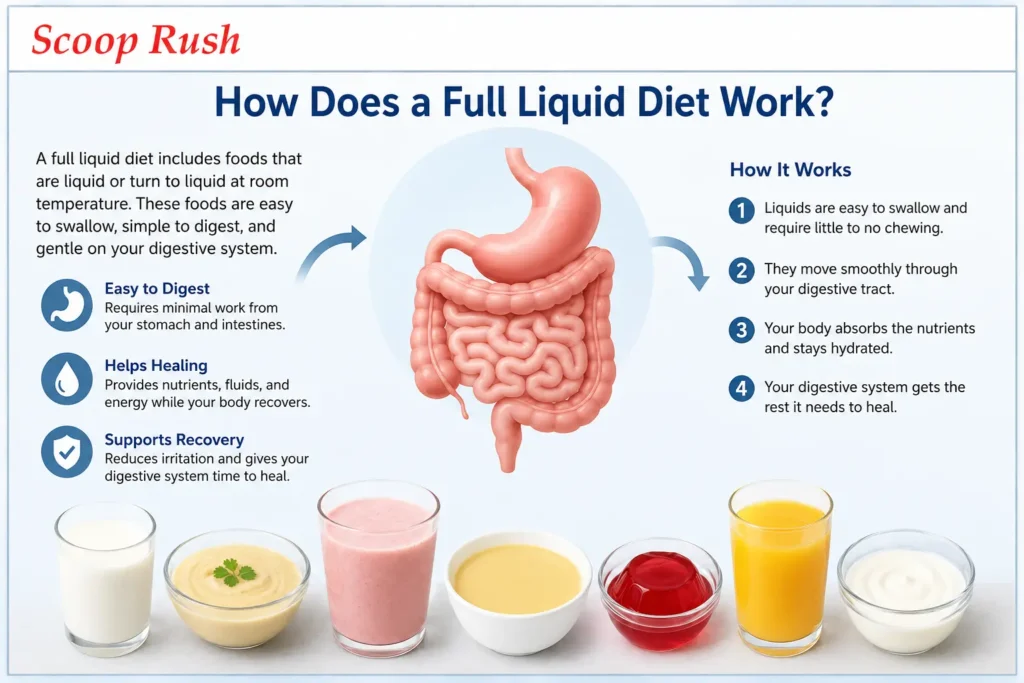
Your digestive system works hard to break down solid food. After surgery or during illness, this process may be uncomfortable or even unsafe. A full liquid diet reduces the amount of chewing and digestion required while still supplying fluids and nutrients.

Less Work for Your Digestive System

Because foods on this diet are already in liquid form or melt easily, they pass through the digestive system more gently than solid foods. This helps reduce irritation and allows healing after medical procedures involving the mouth, throat, stomach, or intestines.

Protein to Support Healing

Many full liquid foods also contain protein, which is essential for repairing tissues after surgery or illness. Milk, yogurt, protein shakes, and strained cream soups help maintain muscle and support recovery.

Built-In Hydration

Staying hydrated is easier on this diet because nearly every meal contributes to your daily fluid intake.

Who Needs a Full Liquid Diet?

Who Needs a Full Liquid Diet? |Scoop Rush

A healthcare provider may recommend a full liquid diet for several medical reasons. Every person’s situation is different, but common reasons include the following.

After Surgery

One of the most common reasons for following a full liquid diet is recovery after surgery. This is especially true after procedures involving the digestive tract, mouth, throat, or jaw.

Examples include:

  • Bariatric (weight-loss) surgery
  • Stomach surgery
  • Intestinal surgery
  • Dental surgery
  • Jaw surgery
  • Oral cancer surgery

Following surgery, your digestive system needs time to heal before handling regular food. Starting with liquids reduces stress on healing tissues and lowers the risk of complications.

Difficulty Chewing or Swallowing

People with swallowing disorders (dysphagia) or chewing problems often benefit from a full liquid diet.

Conditions that may cause swallowing difficulties include:

  • Stroke
  • Parkinson’s disease
  • Multiple sclerosis
  • Head and neck cancers
  • Neurological disorders
  • Severe dental problems

Smooth liquids are generally easier and safer to swallow than solid foods, reducing the risk of choking or aspiration.

Preparing for Medical Procedures

Some diagnostic procedures require your stomach or digestive tract to be relatively empty. Depending on the procedure, your provider may recommend a full liquid diet before transitioning to clear liquids.

Examples include:

  • Certain gastrointestinal procedures
  • Selected imaging studies
  • Some surgeries requiring bowel preparation

Always follow your provider’s instructions carefully, as preparation guidelines vary depending on the procedure.

Digestive Conditions

A temporary full liquid diet may help when your digestive system needs rest due to illness or treatment. In some cases, your provider may move you toward a low-residue diet or a bland diet as a next step once you’re ready for more texture.

Examples include:

  • Severe nausea and vomiting
  • Certain inflammatory digestive conditions
  • Recovery after bowel obstruction treatment
  • Pancreatitis (only when recommended by your healthcare provider)
  • Temporary digestive irritation

It is important not to start a full liquid diet on your own for digestive diseases without medical advice.

Cancer Treatment

Some people receiving chemotherapy or radiation therapy develop painful mouth sores, swallowing difficulties, or severe nausea that makes eating difficult.

A full liquid diet can provide nourishment while being easier to tolerate. High-calorie nutritional drinks, milkshakes, smoothies, and protein supplements often help maintain weight during treatment.

A registered dietitian may recommend additional protein or calorie supplements depending on individual needs.

Full Liquid Diet vs. Clear Liquid Diet

Many people confuse these two diets, but they serve different purposes.

FeatureFull Liquid DietClear Liquid Diet
CaloriesHigherVery low
ProteinModerateVery little
DairyYesUsually no
Cream soupsYesNo
MilkYesNo
YogurtYesNo
Nutritional shakesYesUsually no
BrothYesYes
PurposeRecovery and nutritionHydration and short-term digestive rest

A clear liquid diet is usually used only for one or two days because it doesn’t provide enough nutrients. A full liquid diet offers significantly more nutrition and is often the next step before returning to soft foods.

Foods You Can Eat on a Full Liquid Diet

Foods You Can Eat on a Full Liquid Diet |Scoop Rush

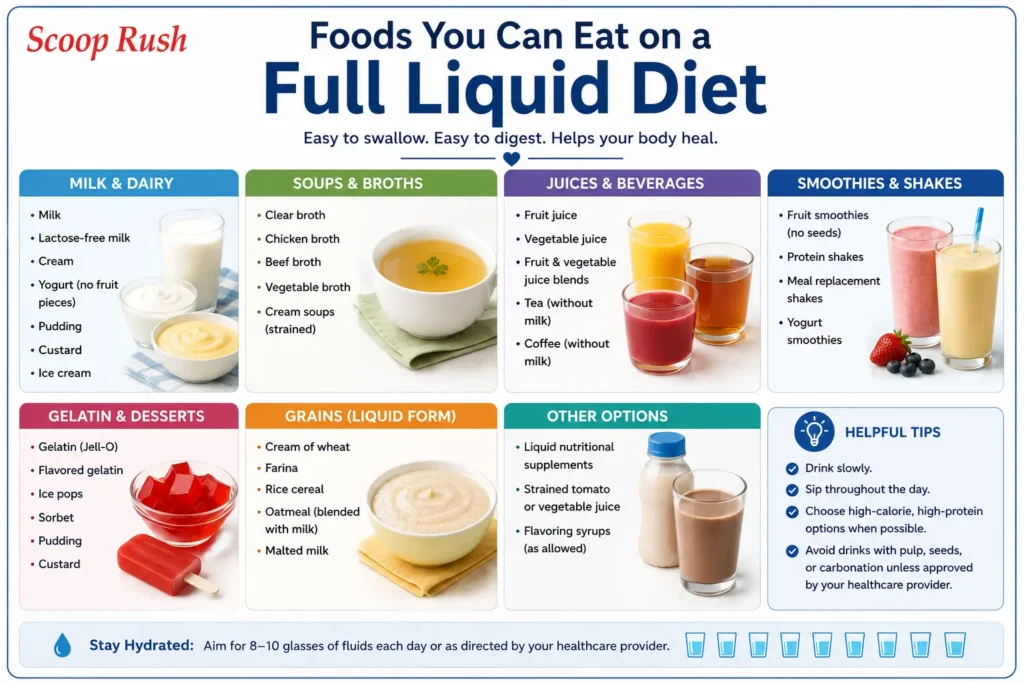
One of the biggest misconceptions about a full liquid diet is that it only includes water and soup. In reality, there are many foods you can enjoy, provided they are smooth and free of solid pieces. If necessary, blend foods until completely smooth and strain them to remove any lumps or seeds.

Dairy Products and Dairy Alternatives

Dairy foods are among the best choices because they provide protein, calcium, and vitamin D.

You can enjoy:

  • Whole, low-fat, or skim milk
  • Lactose-free milk
  • Soy milk
  • Almond milk
  • Oat milk
  • Rice milk
  • Plain yogurt without fruit pieces
  • Greek yogurt (thinned if needed)
  • Kefir
  • Cottage cheese blended until smooth (if approved)
  • Smooth pudding
  • Custard
  • Ice cream without nuts, cookie pieces, or candy
  • Frozen yogurt
  • Sherbet

These foods can help you meet your daily protein and calorie needs while supporting recovery.

Soups and Broths

Soups are filling, comforting, and easy to digest. Choose soups that are completely smooth.

Good options include:

  • Chicken broth
  • Beef broth
  • Vegetable broth
  • Bone broth
  • Bouillon
  • Consommé
  • Strained cream of chicken soup
  • Strained cream of mushroom soup
  • Cream of celery soup
  • Cream of potato soup
  • Pureed tomato soup
  • Blended pumpkin soup
  • Blended squash soup
  • Pureed carrot soup

Avoid soups containing noodles, rice, beans, vegetables, corn, meat chunks, or herbs that aren’t blended.

Cooked Cereals

Certain refined cereals become smooth enough for this diet.

Suitable choices include:

  • Cream of Wheat
  • Cream of Rice
  • Farina
  • Grits (well cooked and strained if needed)
  • Thin oatmeal (only if your provider allows)

Cook cereals with extra milk or water to create a smooth, pourable consistency.

Protein Drinks and Nutritional Supplements

Protein plays a vital role in wound healing and maintaining muscle mass something to watch closely if you’re already at risk of muscle loss during a period of reduced eating.

Excellent choices include:

  • High-protein shakes
  • Meal replacement drinks
  • Protein smoothies
  • Ready-to-drink nutrition supplements
  • Homemade protein shakes
  • Protein powder blended into milk or yogurt

These beverages are especially helpful after surgery or during cancer treatment when meeting nutritional needs can be difficult.

Beverages

Staying hydrated is just as important as getting enough calories.

Acceptable beverages include:

  • Water
  • Coffee
  • Tea
  • Decaffeinated coffee
  • Fruit juice
  • Vegetable juice
  • Sports drinks
  • Oral rehydration solutions
  • Lemonade without pulp
  • Apple juice
  • Cranberry juice
  • White grape juice
  • Soda (if tolerated)

If citrus juices irritate your mouth after surgery, choose less acidic options. If coffee is part of your routine, keep in mind that drinking it on an empty stomach can be harder on a sensitive digestive system, so it’s worth pairing it with other liquids.

Desserts

A full liquid diet doesn’t have to be boring. Several desserts fit the guidelines.

You may enjoy:

  • Plain gelatin
  • Fruit ice
  • Popsicles without fruit pieces
  • Smooth pudding
  • Custard
  • Ice cream
  • Frozen yogurt
  • Sherbet
  • Milkshakes
  • Smooth mousse

These foods can increase calorie intake, especially if you’re struggling with a poor appetite.

Healthy Fats

Healthy fats add calories without increasing meal volume.

Consider adding small amounts of:

  • Butter
  • Margarine
  • Olive oil
  • Avocado oil
  • Heavy cream
  • Half-and-half

These can be mixed into soups or cereals if approved by your healthcare provider.

Foods to Avoid on a Full Liquid Diet

Anything that requires chewing or contains solid pieces should be avoided. Even tiny chunks can make swallowing difficult or interfere with healing.

Bread and Grains

  • Bread
  • Toast
  • Rolls
  • Bagels
  • Crackers
  • Rice
  • Pasta
  • Cereal flakes
  • Granola

Fruits

  • Apples
  • Bananas
  • Oranges
  • Berries
  • Grapes
  • Pineapple
  • Dried fruit
  • Fruit cocktail

Even soft fruits like bananas or avocados usually aren’t allowed unless specifically blended into an approved consistency.

Vegetables

Avoid all whole vegetables, including:

  • Potatoes
  • Corn
  • Peas
  • Broccoli
  • Spinach
  • Carrots
  • Green beans
  • Salad vegetables

Vegetables are only allowed when completely blended and strained into smooth soups, if your healthcare provider approves.

Protein Foods

  • Chicken
  • Beef
  • Turkey
  • Fish
  • Eggs (unless blended into approved recipes)
  • Sausage
  • Bacon
  • Tofu chunks
  • Beans
  • Lentils

Dairy Products

Avoid dairy foods that contain solid pieces, including:

  • Cheese slices
  • Cheese cubes
  • Yogurt with fruit
  • Cottage cheese with curds
  • Ice cream containing nuts or cookie pieces

Snacks

  • Chips
  • Pretzels
  • Popcorn
  • Cookies
  • Cake
  • Chocolate bars
  • Nuts
  • Seeds

Benefits of a Full Liquid Diet

Although it is temporary, a full liquid diet offers several important advantages during recovery.

1. Supports Healing

After surgery or illness, your body requires additional nutrients to repair damaged tissues. Protein-rich liquids help rebuild muscles, skin, and organs while supporting immune function.

2. Easier to Swallow

For people with swallowing difficulties, smooth foods lower the risk of choking and aspiration. This makes eating safer while ensuring adequate nutrition.

3. Gentle on the Digestive System

Liquids require much less work from your stomach and intestines. This allows inflamed or healing digestive organs to recover with less irritation.

4. Better Nutrition Than a Clear Liquid Diet

Compared with a clear liquid diet, a full liquid diet contains more protein, more calories, more calcium, more healthy fats, and greater variety overall. These nutrients help prevent excessive weight loss during recovery.

5. Helps Maintain Hydration

Most foods on the diet contain significant amounts of water. Proper hydration helps support circulation, prevent dehydration, improve digestion, reduce fatigue, and promote healing.

6. Easier Transition to Solid Foods

Instead of immediately returning to regular meals, a full liquid diet allows your digestive system to adjust gradually. This often reduces nausea, stomach discomfort, and digestive complications. Once you’re cleared for more texture, a soft food diet is usually the next stop before regular meals.

Risks and Limitations of a Full Liquid Diet

A full liquid diet is generally safe when followed for a short time and under medical guidance, but it isn’t without downsides.

Nutrient Gaps

Because the diet limits whole fruits, vegetables, grains, and meats, it’s low in fiber and can fall short on iron, vitamin B12, vitamin A, folate, zinc, and thiamine. Staying on it longer than recommended can lead to deficiencies over time.

Unintended Weight or Muscle Loss

If calorie and protein targets aren’t met, some people lose more weight or muscle than intended, especially older adults or those already weakened by illness.

Temptation to Over-Supplement

Some people try to close nutrient gaps by taking extra vitamins or supplements on their own. This isn’t always safe taking too many vitamins or supplements can cause its own health problems, so any supplementation should be guided by your provider or a dietitian.

Not Suitable for Everyone

People with certain conditions, such as poorly controlled diabetes or kidney disease, may need a modified version of this diet. Always follow your healthcare team’s specific instructions rather than a generic plan.

Nutritional Value of a Full Liquid Diet

Nutritional Value of a Full Liquid Diet |Scoop Rush

While this diet offers more nutrition than clear liquids, it still has limitations.

A well-planned full liquid diet generally provides protein, calcium, vitamin D, healthy fats, carbohydrates, and fluids.

However, it may not provide enough:

  • Fiber
  • Iron
  • Vitamin B12
  • Vitamin A
  • Folate
  • Zinc
  • Thiamine

Because of these nutritional gaps, healthcare providers usually recommend following this diet only for a short time unless it’s carefully planned with supplements.

Daily Calorie and Protein Needs

Your individual needs depend on your age, weight, medical condition, and activity level. However, many adults recovering from illness or surgery aim for approximately:

NutrientGeneral Daily Goal
Calories1,400–2,000+ calories
Protein45–70 grams
Fluids2–3 liters (unless restricted)

Some people such as those recovering from major surgery, cancer treatment, or severe illness may need even more protein and calories. Your healthcare provider or dietitian can tailor recommendations to your specific needs.

How to Add More Calories and Protein

If you’re struggling to meet your nutritional needs, small changes can make a big difference.

Try these ideas:

  • Blend protein powder into milk, smoothies, or pudding.
  • Add nonfat dry milk powder to soups, cereals, or milkshakes.
  • Stir heavy cream into soups for extra calories.
  • Use whole milk instead of skim milk if appropriate.
  • Add smooth peanut butter only if your healthcare provider says it’s safe and it can be blended to the correct consistency.
  • Choose high-protein nutritional drinks between meals.
  • Eat five or six small meals throughout the day instead of three large ones.
  • Add healthy oils like olive oil to pureed soups for extra energy.

Sample One-Day Full Liquid Diet Meal Plan

This is a general example only. Always follow the specific plan and portions your healthcare provider or dietitian gives you.

Breakfast: Cream of Wheat made with whole milk, a glass of apple juice, and a protein shake.

Mid-Morning: Smooth yogurt or a milkshake.

Lunch: Strained cream of chicken soup, a glass of milk, and plain gelatin.

Afternoon: A nutritional supplement drink or blended fruit smoothie (if approved).

Dinner: Pureed vegetable soup, a milkshake, and custard for dessert.

Evening: Warm milk or a small protein drink before bed.

Transitioning Back to Solid Foods

Once your provider gives the go-ahead, food is usually reintroduced gradually rather than all at once. Many people move from a full liquid diet to a soft food diet, then to regular meals over several days. Light activity, such as a short walk every hour if you’re cleared for movement, can also support digestion during this transition. Introducing new textures slowly makes it easier to spot any foods that cause discomfort before they become a bigger problem.

Conclusion

A full liquid diet is a short-term tool, not a long-term way of eating. It gives your digestive system a break while still supplying the calories, protein, and fluids your body needs to heal whether you’re recovering from surgery, managing a swallowing problem, or getting through cancer treatment.

The key is following your healthcare provider’s specific instructions on how long to stay on the diet and when to move on to soft or regular foods. With the right mix of dairy, soups, protein drinks, and other smooth foods, it’s possible to eat well and support recovery, even without a single bite of solid food.

FAQs

How long can you stay on a full liquid diet?

Most people follow it for just a few days, and rarely more than one to two weeks. Because it’s low in fiber and several nutrients, staying on it longer without medical supervision isn’t recommended.

Can you lose weight on a full liquid diet?

Yes, unintentional weight loss is common if you don’t hit your daily calorie and protein targets. This diet is meant to support recovery, not for intentional weight loss.

Is oatmeal allowed on a full liquid diet?

Only thin, well-cooked oatmeal is sometimes allowed, and only if your provider approves it. Regular oatmeal is generally considered too thick and textured for this stage.

Can you drink coffee on a full liquid diet?

Coffee is usually allowed, though it’s best to check with your provider first, especially after digestive surgery, since caffeine and acidity can irritate a sensitive stomach.

What’s the difference between a full liquid diet and a pureed diet?

A full liquid diet includes only foods that are already liquid or melt into liquid at room temperature. A pureed diet is a step up  it includes blended solid foods, like pureed meats and vegetables, that have a thicker, spoonable texture.

Can children follow a full liquid diet?

Yes, but calorie, protein, and fluid needs differ from those of adults. A pediatrician or pediatric dietitian should set the specific plan.

Arctic Norway Road Trip Reaches Europe’s Last Untouched Coast

0

The Arctic Norway Road Trip offers one of Europe’s most remarkable driving experiences. Instead of famous western fjords, travelers head northeast into a remote Arctic wilderness. This unforgettable journey follows the Varanger Scenic Route. It stretches across treeless landscapes, empty beaches, historic villages, and dramatic coastlines where mainland Europe finally ends.

The 160-kilometer route follows the E75 and Fv341 roads. It begins at Varangerbotn and finishes in the abandoned fishing village of Hamningberg. Along the way, travelers discover Arctic wildlife, rich history, and peaceful scenery that remains untouched by mass tourism.

Arctic Norway Road Trip Begins in Remote Varanger

Most visitors associate Norway with towering fjords and waterfalls. However, the country’s northeastern corner offers a completely different experience. The road leaves behind forests and busy tourist attractions. Instead, endless tundra and the Barents Sea dominate every view.

The journey starts near Tana Bru before joining the E75 eastward. As traffic disappears, travelers enter one of mainland Europe’s largest true Arctic landscapes. The quiet surroundings create a feeling of complete isolation and natural beauty.

Arctic Norway Road Trip Crosses a True Arctic Landscape

Arctic-Norway-Road-Trip-Crosses-a-True-Arctic-Landscape

Scientists define the Arctic by ecology instead of geography. Trees no longer grow at sea level beyond Vadsø. This marks the beginning of mainland Europe’s largest continuous Arctic ecosystem.

Professor Rolf Anker Ims from the University of Tromsø describes this region as genuine Arctic territory. Average July temperatures remain below 10 degrees Celsius. Therefore, the landscape supports unique wildlife and fragile ecosystems found in very few European locations.

Historic Villages Preserve Arctic Traditions

The route passes several charming coastal communities with deep cultural roots. Vestre Jakobselv features colorful wooden homes and traditional racks where locals dry salted cod in Arctic winds.

Further east, Vadsø serves as the region’s administrative center. Despite its small population, the town welcomes birdwatchers from around the world. During summer, visitors often search for the rare Steller’s eider while enjoying endless daylight.

Vardø Combines History With Stunning Coastal Views

Vardo-Combines-History-With-Stunning-Coastal-Views

Vardø stands as Norway’s easternmost town. An underwater tunnel connects the island community to the mainland. The town sits even farther east than St. Petersburg, making it one of Western Europe’s most unique destinations.

History also shapes Vardø’s identity. The Steilneset Memorial honors 91 people executed during the 17th-century Finnmark witch trials. The striking memorial tells their stories while reminding visitors about one of Norway’s darkest historical chapters.

Hamningberg Marks the End of the Arctic Norway Road Trip

Beyond Vardø, the road continues along the dramatic Fv341 coastal highway. Massive rock formations, crashing waves, and roaming reindeer create unforgettable scenery. Every turn feels wild and untouched.

Finally, the road reaches Hamningberg. This abandoned fishing village overlooks the Barents Sea beneath towering hills. Residents left during the 1960s, yet many buildings remain standing. Today, silence replaces daily life, giving visitors a rare glimpse into Norway’s isolated Arctic past.

Best Time to Experience the Arctic Norway Road Trip

Best-Time-to-Experience-the-Arctic-Norway-Road-Trip

Summer offers the easiest conditions for exploring the Varanger Scenic Route. Between June and September, long daylight hours provide excellent wildlife viewing and comfortable driving conditions.

Winter transforms the region into a snowy Arctic wonderland. Northern Lights often illuminate the night sky. However, drivers need experience because snow, ice, and powerful Arctic storms create challenging road conditions.

Why This Journey Stands Apart

The Arctic Norway Road Trip offers much more than scenic driving. It combines untouched nature, fascinating history, and authentic Arctic culture into one unforgettable adventure.

Unlike Norway’s crowded western attractions, this route remains peaceful throughout the year. Travelers experience vast open landscapes where silence becomes part of the journey itself. It feels less like a destination and more like discovering another version of Earth.

Arctic Norway Road Trip Offers Incredible Wildlife Encounters

Wildlife adds another unforgettable layer to the Arctic Norway Road Trip. The Varanger Peninsula ranks among Europe’s best birdwatching destinations. Every summer, thousands of seabirds gather along the rugged coastline. Bird enthusiasts travel from around the world to observe these rare Arctic species.

Reindeer also roam freely across the open tundra. Travelers often spot small herds grazing near the roadside. Arctic foxes, sea eagles, and seals also inhabit this remote region. Every stop offers a chance to experience nature without crowds or distractions.

Arctic Norway Road Trip Reveals Norway Beyond the Fjords

Many travelers visit Norway for its famous western fjords. However, this eastern coastal route presents a completely different side of the country. Instead of steep cliffs and waterfalls, visitors find vast plains, rocky shores, and endless Arctic horizons.

The peaceful surroundings encourage slow travel and deeper exploration. Small fishing villages, quiet beaches, and dramatic skies replace busy tourist attractions. As a result, every kilometer feels personal and authentic. The landscape rewards those who appreciate simplicity and untouched beauty.

Arctic Norway Road Trip Tips for First-Time Visitors

Planning ahead makes this journey safer and more enjoyable. Fuel stations become less frequent as you travel east. Therefore, drivers should fill their tanks whenever possible. Carry warm clothing because weather changes quickly, even during summer.

Travelers should also allow extra time for photography and sightseeing. Many scenic viewpoints deserve longer stops than expected. Mobile coverage remains available in most areas, but downloading offline maps provides additional peace of mind. Respect wildlife and local communities throughout the journey.

Conclusion

The Arctic Norway Road Trip showcases one of Europe’s most extraordinary driving adventures. It takes travelers through a landscape where forests disappear, wildlife thrives, and history lives within quiet coastal communities. Every stop tells a different story, from historic churches and fishing villages to memorials and abandoned settlements.

Unlike Norway’s popular tourist routes, the Varanger Scenic Route remains peaceful and largely undiscovered. Travelers who venture this far east experience raw Arctic beauty, endless coastal views, and a rare sense of solitude. It is not simply a scenic drive. It is a journey to the edge of mainland Europe, where nature still shapes everyday life.

FAQs

1. Why is the Arctic Norway Road Trip different from other Norway road trips?

The route crosses mainland Europe’s largest true Arctic landscape. Instead of fjords, travelers enjoy tundra, rugged coastlines, wildlife, and remote fishing villages. The peaceful atmosphere makes it unlike any other Norwegian drive.

2. How many days should I spend on the Varanger Scenic Route?

A full day covers the drive comfortably. However, two days provide enough time to explore Vadsø, Vardø, Ekkerøy, and Hamningberg. This slower pace allows visitors to enjoy local history and wildlife.

3. Is the Arctic Norway Road Trip suitable during winter?

Yes, experienced drivers can enjoy the route during winter. Snow-covered scenery and the Northern Lights create unforgettable views. However, icy roads and changing weather require careful planning and winter driving skills.

4. What attractions should I not miss along the route?

Top highlights include Nesseby Church, Vadsø, Ekkerøy, the Steilneset Memorial in Vardø, and the abandoned fishing village of Hamningberg. Each destination offers unique scenery and historical significance.

5. What wildlife can I see on the Arctic Norway Road Trip?

Visitors commonly spot reindeer, seabirds, sea eagles, seals, and seasonal Arctic bird species. Summer offers excellent birdwatching opportunities, while the open tundra provides frequent wildlife sightings throughout the journey.

Jermain Defoe Leaves Woking After Four Months in Surprise Managerial Exit 

0

Jermain Defoe Leaves Woking just two weeks before the start of the new National League season, ending what was expected to be a promising first step into full-time management. The former England striker and Woking agreed to part ways after only four months, creating one of the biggest managerial stories ahead of the new campaign.

The decision came as a surprise because Defoe had recently spoken positively about the club’s future. Although he guided Woking to a 10th-place finish in the National League after winning two of his six league matches, he announced that circumstances had made it impossible for him to continue. As a result, both the club and the former striker now move in different directions at a crucial stage of pre-season.

Jermain Defoe Leaves Woking After Four Months in Charge 

The news that Jermain Defoe Leaves Woking came as a surprise across English football. 

Woking confirmed that both parties had mutually agreed to part ways with immediate effect, bringing Defoe’s first senior managerial role to an unexpected end. His departure comes only two weeks before the club begins its new National League season against Sutton United.

Defoe replaced Neal Ardley when he was appointed as Woking manager in March, taking charge of his first senior managerial role. 

Although his time in charge was brief, Defoe leaves after helping the club finish 10th in the National League last season. His exit also means Woking must now search for a new head coach shortly before competitive football returns.

Why Did Jermain Defoe Leave Woking?

One of the biggest questions supporters are asking is why Defoe decided to leave so suddenly.

In a statement shared on Instagram, Defoe said circumstances had made it impossible for him to continue but did not explain what those circumstances were. 

He said “Unfortunately, circumstances have ultimately made it impossible for me to continue in the position.”

He added: “I am extremely proud of the work undertaken during my time at the club and genuinely felt that we were building something special.” 

The former England international also thanked club owner Todd Johnson for giving him the opportunity to manage Woking.

Importantly, Defoe did not reveal the exact reasons behind the decision. Therefore, no official explanation has been provided beyond his public statement.

Defoe Describes First Managerial Role as “Eye-Opening”

Learning From His First Experience

Despite the unexpected ending, Defoe spoke positively about his first experience as a senior manager.

He said the role had been an “eye-opening managerial experience” that would make him stronger for future opportunities.

According to Defoe, he believed the club was building something special.

His comments reflected pride in the work completed during his time at Woking and optimism about his future in management.

Jermain Defoe’s Record at Woking

Although Defoe’s managerial spell lasted only four months, he oversaw several important matches.

League Record

  • Appointed in March
  • Managed six National League matches
  • Won two league games
  • Guided Woking to 10th place

Overall Record

His final match in charge was a 1-0 defeat to Braintree Town in one of Woking’s three pre-season friendlies on Tuesday. 

That fixture became his ninth and final game as Woking manager.

While the number of competitive games was limited, Defoe still played an important role in preparing the club for the upcoming campaign.

A Sudden Exit Before the New Season

Timing makes this announcement especially significant.

Woking are scheduled to begin the National League season against Sutton United in just two weeks.

Normally, clubs aim for stability during the final stages of pre-season. Instead, Woking must now quickly identify a replacement while preparing for competitive football.

That challenge becomes even greater because much of the current squad was assembled during Defoe’s time at the club.

Defoe Had Recently Spoken Positively About the Future

Only days before the announcement, Defoe had expressed excitement about the new season.

Because of those comments, his departure came as a surprise ahead of the new season. Instead, Thursday’s announcement came as a major surprise.

His departure changes the club’s preparations significantly just before the campaign begins.

The Squad Built During Defoe’s Time

One notable aspect of Defoe’s spell was his involvement in summer recruitment.

Working alongside director of football Jody Brown, he helped shape the squad ahead of the new season.

According to BBC Sport’s analysis, several summer signings joined Woking because of the opportunity to work with Defoe. 

That makes his departure even more significant because many of those signings expected Defoe to lead the team this season.

Jermain Defoe’s Journey From Player to Manager

Before moving into management, Defoe enjoyed one of English football’s most successful striking careers.

Across his professional career, he scored:

  • 305 goals
  • 763 senior appearances

He represented several well-known clubs, including:

  • West Ham United
  • Tottenham Hotspur
  • Portsmouth
  • Sunderland

Defoe retired from playing in 2022 after more than two decades at the highest level.

England Career

Defoe also enjoyed a successful international career.

His England statistics include:

  • 57 international appearances
  • 20 international goals

He represented England at:

  • 2010 FIFA World Cup
  • UEFA Euro 2012

Those experiences helped establish him as one of England’s most respected forwards during his generation.

Coaching Experience Before Woking

Although Woking marked his first senior managerial role, Defoe had already gained valuable coaching experience.

His coaching journey included:

  • Part of Rangers’ interim coaching staff in 2021
  • Coach within Tottenham Hotspur’s academy
  • Left Spurs in 2024 to pursue a full-time management career

Taking charge of Woking marked the next step in his coaching journey and his first opportunity to manage a senior team. 

What Defoe Said About His Departure

Throughout his statement, Defoe remained respectful toward the club.

He thanked:

  • Owner Todd Johnson
  • The players
  • Club staff
  • Supporters

He also repeated that he believed the club had been moving in a positive direction.

Rather than criticising anyone publicly, he focused on the lessons learned during his first managerial opportunity.

What Happens Next For Woking?

Woking now faces an important decision.

With the National League season fast approaching, appointing a new manager quickly becomes a priority.

The next head coach will inherit a squad largely assembled during Defoe’s short spell.

Maintaining stability will be important as players continue preparing for the opening fixture against Sutton United.

Finding a new head coach before the season begins is now one of Woking’s biggest priorities. 

Key Moments From Jermain Defoe’s Time at Woking

EventDetails
AppointedMarch
League Games Managed6
League Wins2
Final League Position10th
Total Matches Managed9
Final Match1-0 loss to Braintree Town (Pre-season)
DepartureMutual agreement
Next Scheduled FixtureSutton United

Why This Story Matters

Managerial changes are common in football. However, this situation stands out because of its timing.

Defoe arrived with considerable experience as a player and significant expectations for his first management role.

Although his time lasted only four months, he leaves after helping establish the foundations for the coming season.

Meanwhile, Woking must quickly adjust before competitive football begins.

For Defoe, the experience represents an important stage in his coaching development. As he stated himself, the lessons learned will help prepare him for the next challenge in his career.

Conclusion

Jermain Defoe Leaves Woking after only four months in charge, ending his first senior managerial role much earlier than expected.

The mutual decision comes just two weeks before the National League season begins, creating fresh uncertainty for Woking as they search for a new manager.

Although Defoe managed only six league matches, guided Woking to a 10th-place finish, and helped prepare the squad for the new season, he believes the experience has made him stronger for the future. 

His statement made clear that circumstances prevented him from continuing, but no further official details have been provided. As a result, attention now turns to Woking’s search for a replacement and to Defoe’s next opportunity in football management.

(FAQs)

1. Why did Jermain Defoe leave Woking?

Jermain Defoe said circumstances made it impossible for him to continue as manager. Neither he nor Woking has provided additional official details.

2. How long was Jermain Defoe Woking manager?

Defoe managed Woking for approximately four months after being appointed in March.

3. What was Jermain Defoe’s record at Woking?

He managed six National League matches, won two league games, and helped Woking finish 10th last season. His final match overall was a 1-0 pre-season defeat to Braintree Town.

4. What did Jermain Defoe say after leaving Woking?

He described the role as an “eye-opening managerial experience” and said it would make him stronger for the next stage of his coaching career.

5. Who will replace Jermain Defoe at Woking?

Woking has not announced a replacement manager following Defoe’s departure. The club is expected to begin the search before the new National League season starts.

US-Saudi Nuclear Deal Signed as Landmark Civilian Energy Partnership

0

The US-Saudi Nuclear Deal marks a major step in energy and strategic cooperation. The United States and Saudi Arabia signed the agreement on July 22, 2026. The partnership supports Saudi Arabia’s civilian nuclear program. It also creates new business opportunities for American companies.

US Energy Secretary Chris Wright and Saudi Energy Minister Prince Abdulaziz bin Salman signed the agreement. Both countries also signed a bilateral safeguards agreement. The deal now moves to the US Congress for review before it becomes law.

US-Saudi Nuclear Deal Creates Long Term Partnership

US-Saudi-Nuclear-Deal-Creates-Long-Term-Partnership

The US-Saudi Nuclear Deal establishes a partnership expected to last for decades. Officials describe it as a multibillion-dollar investment in civilian nuclear energy. The agreement strengthens economic and strategic ties between both countries.

The US Department of Energy said the partnership supports nuclear safety and nonproliferation. It also gives American companies greater access to Saudi Arabia’s growing nuclear energy sector. The agreement could generate billions of dollars in future contracts.

US-Saudi Nuclear Deal Supports Civilian Nuclear Energy

Saudi Arabia plans to diversify its energy sector through nuclear power. The country currently depends mainly on oil and natural gas for electricity generation. Nuclear energy could reduce domestic fossil fuel consumption.

The agreement allows American companies to help develop Saudi nuclear infrastructure. Industry leaders expect firms like Westinghouse, Bechtel, BWXT, and Centrus to benefit. The project could include advanced nuclear reactors and supporting facilities.

Uranium Enrichment Raises Global Concerns

Uranium-Enrichment-Raises-Global-Concerns

The US-Saudi Nuclear Deal reportedly allows Saudi Arabia to enrich uranium in the future. Uranium enrichment produces fuel for nuclear power plants. However, enriched uranium can also support nuclear weapons development.

Several nuclear experts expressed concern over this provision. They noted the United States rarely supports domestic uranium enrichment abroad. Critics fear the decision could increase future nuclear risks across the Middle East.

Congress Will Review the Agreement

US law requires Congress to review civilian nuclear cooperation agreements. Lawmakers now have 90 legislative session days to raise objections. The agreement moves forward unless Congress blocks it.

Republicans currently control both chambers of Congress. Still, several lawmakers from both parties voiced concerns. Many expect lawmakers to debate the agreement during the review period.

Critics Warn About Regional Security

Several Democratic lawmakers criticized the agreement after its announcement. They argued the deal could encourage a regional nuclear arms race. Some believe Iran may view the agreement as a strategic threat.

Senator Edward Markey strongly opposed the agreement. Senator Chris Murphy also warned about rising regional tensions. Critics believe uranium enrichment could weaken global nonproliferation efforts.

Trump Administration Defends the Agreement

Trump-Administration-Defends-the-Agreement

The Trump administration rejected claims that the agreement increases nuclear risks. Energy Secretary Chris Wright said the partnership follows strict safety standards. Officials insist the agreement supports peaceful nuclear cooperation.

Secretary of State Marco Rubio also defended the deal. He said the United States would never approve agreements encouraging nuclear weapons development. The administration believes strong safeguards remain in place.

Saudi Arabia Seeks Energy Independence

Saudi Arabia has pursued a civilian nuclear program for many years. Leaders want to expand clean energy while preserving oil exports. Nuclear power supports the country’s long-term economic strategy.

Saudi officials said the agreement extends existing energy cooperation with Washington. The kingdom considers nuclear energy essential for future electricity demand. Officials also welcomed stronger technological cooperation with American companies.

Agreement Differs From Previous US Nuclear Deals

The US-Saudi Nuclear Deal differs from earlier agreements with regional partners. The 2009 US-UAE agreement banned domestic uranium enrichment. Saudi Arabia appears to receive greater flexibility under the new arrangement.

Reports also suggest the agreement omits the International Atomic Energy Agency’s Additional Protocol. That protocol allows broader international inspections. Critics believe its absence reduces transparency.

Strategic Competition Influenced the Agreement

Washington wanted to strengthen its position in Saudi Arabia’s energy sector. Reports suggested China and Russia also pursued similar nuclear partnerships. The United States aimed to secure the project before competitors succeeded.

The agreement also strengthens broader US influence in the Gulf region. It supports long-term economic cooperation beyond traditional oil partnerships. American companies could gain major infrastructure contracts for decades.

What Happens Next

Congress will examine the agreement before final approval. Debate will likely focus on uranium enrichment and regional security. Lawmakers may seek additional safeguards during the review process.

If approved, the partnership could reshape civilian nuclear cooperation in the Middle East. Construction of reactors and supporting facilities would still require years. The full impact will develop gradually over the coming decades.

Conclusion

The US-Saudi Nuclear Deal represents one of the most significant energy agreements between both nations. It opens major commercial opportunities while supporting Saudi Arabia’s civilian nuclear ambitions. However, uranium enrichment remains the most controversial part of the agreement.

Supporters believe the deal strengthens energy security and American industry. Critics warn it may increase nuclear competition across the Middle East. Congress now holds the next important decision before the agreement takes effect.

FAQs

1. What is the US-Saudi Nuclear Deal?

The US-Saudi Nuclear Deal is a civilian nuclear cooperation agreement. It allows both countries to work together on developing Saudi Arabia’s peaceful nuclear energy program.

2. Why is the agreement considered significant?

The agreement strengthens economic and strategic ties between both nations. It also opens major opportunities for American companies in Saudi Arabia’s nuclear energy sector.

3. Can Saudi Arabia enrich uranium under the agreement?

Reports suggest Saudi Arabia could eventually enrich uranium using US-supported technology. Officials say the program will remain under nuclear safety and nonproliferation standards.

4. Why are some lawmakers and experts concerned?

Critics worry uranium enrichment could increase future nuclear proliferation risks. They fear it may encourage a regional arms race in the Middle East.

5. What happens before the agreement becomes official?

The agreement must undergo review by the US Congress. If lawmakers do not block it during the review period, it can move forward into effect.

Soft Food Diet: What to Eat, Foods to Avoid, and Meal Tips

0

A soft food diet can make eating safer and more comfortable when chewing or swallowing is difficult. Whether you’re recovering from surgery, dealing with digestive problems, or managing mouth sores during cancer treatment, choosing the right foods helps your body heal while ensuring you still get the nutrients you need.

Unlike fad diets, a soft food diet is usually temporary and designed to reduce stress on your digestive system. The focus is on foods that are easy to chew, swallow, and digest while avoiding anything tough, crunchy, or high in fiber that could cause discomfort.

What Is a Soft Food Diet?

What Is a Soft Food Diet? |ScoopRush

A soft food diet is a medically recommended eating plan consisting of foods that are soft in texture, easy to chew, and simple to swallow. It also emphasizes foods that are gentle on the digestive tract and low in fiber when necessary.

Healthcare providers often recommend this diet after surgery, during illness, or whenever the digestive system needs time to recover. Depending on your condition, your provider may recommend one of two versions:

Mechanical Soft Diet Foods are chopped, ground, minced, mashed, or soft-cooked. These require minimal chewing but still maintain some texture.

Pureed Soft Diet A more restrictive version where foods are blended until smooth think pureed vegetables, blended soups, smooth yogurt, mashed potatoes, and fruit purees. This version is commonly recommended for people with severe swallowing difficulties (dysphagia).

Who Should Follow a Soft Food Diet?

After Surgery — Often recommended after surgery involving the mouth, jaw, teeth, throat, neck, esophagus, or stomach. Soft foods reduce strain on healing tissues while making eating less painful.

Radiation Therapy — People receiving radiation to the head or neck may develop mouth sores, dry mouth, or difficulty swallowing, making soft foods easier to tolerate.

Digestive Disorders — May be recommended for IBS, diverticulitis, diverticulosis, ulcerative colitis, gastritis, or temporary digestive inflammation. Low-fiber, easy-to-digest foods may reduce irritation while symptoms improve.

Swallowing Difficulties (Dysphagia) — People with neurological disorders, stroke, Parkinson’s disease, or other conditions affecting swallowing often benefit from texture-modified diets to reduce choking risk.

Children — May need this diet after oral surgery, tonsil removal, cancer treatment, mouth ulcers, or swallowing disorders, helping them maintain adequate nutrition while minimizing discomfort.

Benefits of a Soft Food Diet

  • Reduces pain while chewing
  • Makes swallowing easier
  • Protects healing tissues
  • Lowers digestive irritation
  • Improves nutrient intake during recovery
  • Reduces choking risk
  • Supports faster healing

Foods to Eat on a Soft Food Diet

Choose soft, high-protein foods such as:

  • Chicken
  • Turkey
  • Lean ground beef
  • Tender pork
  • Fish
  • Eggs
  • Tofu
  • Cottage cheese
  • Greek yogurt
  • Ricotta cheese
  • Creamy peanut butter
  • Smooth nut butter
  • Baked beans

Fruits

Choose soft fruits, including:

  • Bananas
  • Avocados
  • Applesauce
  • Peeled or cooked apples
  • Canned peaches
  • Canned pears
  • Soft melon
  • Fruit puree
  • Fruit juice without pulp

Avoid:

  • Dried fruit
  • Frozen berries
  • Fruits with seeds
  • Coconut
  • Citrus juice if you have mouth sores

Vegetables

Good choices include:

  • Mashed potatoes
  • Baked potatoes without skin
  • Green beans
  • Green peas
  • Cooked spinach
  • Squash
  • Cooked carrots
  • Asparagus
  • Cooked beans
  • Tomato paste

Avoid:

  • Raw vegetables
  • Broccoli
  • Brussels sprouts
  • Corn
  • Cabbage
  • Onions
  • Kale
  • Pickles

Grains

Choose soft, easy-to-digest grains such as:

  • White rice
  • Oatmeal
  • Cream of Wheat
  • Grits
  • Soft pasta
  • Plain noodles
  • Soft bread
  • Pancakes
  • Waffles
  • Soaked cereal

Avoid:

Brown rice

Wild rice

Quinoa

Barley

Granola

Popcorn

Dairy

Soft dairy foods include:

  • Milk
  • Plant-based milk
  • Greek yogurt
  • Cottage cheese
  • Soft cheese
  • Ricotta cheese
  • Kefir
  • Pudding

Desserts

If you want a sweet treat, choose soft desserts such as:

  • Ice cream
  • Sherbet
  • Gelatin
  • Popsicles
  • Yogurt
  • Soft cookies
  • Cake without nuts

Soups and Liquids

These options are easy to swallow and digest:

  • Cream soups
  • Chicken soup
  • Vegetable soup
  • Clear broth
  • Smooth blended soups

Foods to Avoid

  • Tough meats: steak, jerky, bacon, sausage, hot dogs, kielbasa, meat with gristle
  • Nuts and seeds: almonds, walnuts, sunflower seeds, pumpkin seeds, chunky peanut butter
  • Raw vegetables: broccoli, carrots, celery, raw spinach, raw onions
  • High-fiber foods: whole-grain bread, bran cereal, granola, popcorn, brown rice
  • Hard fruits: apples/pears with skin, pineapple, coconut, dried fruit
  • Carbonated drinks: fizzy beverages may worsen bloating or digestive discomfort

Tips for Following a Soft Food Diet

  1. Cook foods until tender — Bake, boil, steam, or slow-cook foods until soft.
  2. Cut food into small pieces — Smaller bites require less chewing and are easier to swallow.
  3. Blend foods — Use a blender or food processor for smooth soups, fruit smoothies, vegetable purees, and mashed meals.
  4. Eat smaller meals — Try four to six smaller meals plus nutritious snacks instead of three large meals.
  5. Chew slowly — Even soft foods should be chewed thoroughly before swallowing.
  6. Stay hydrated — Aim for 8 to 10 glasses of fluids daily, including water, milk, soup, smoothies, gelatin, ice cream, and popsicles.
  7. Watch fiber intake — Many providers recommend limiting fiber temporarily. As symptoms improve, gradually reintroduce fiber-rich foods every few days to monitor tolerance.

Kitchen Tools That Make Soft Food Prep Easier

Having the right equipment on hand can turn soft food preparation from a chore into a quick, manageable part of your routine. A few useful tools include:

  • A good blender or immersion blender — Essential for turning soups, fruits, and cooked vegetables into smooth purees without lumps that could be hard to swallow.
  • A food processor — Useful for chopping or mincing meats and vegetables to a mechanical soft texture when a full puree isn’t necessary.
  • A fine-mesh strainer — Helps remove seeds, skins, or fibrous bits from purees and sauces, which is especially important for people with strict dysphagia diets.
  • Silicone ice cube trays — Handy for freezing broth, pureed fruit, or smoothies into small, ready-to-thaw portions, so you always have a soft option available without cooking from scratch every meal.
  • A slow cooker or pressure cooker — Both are excellent for breaking down tougher cuts of meat and fibrous vegetables until they’re tender enough to mash with a fork.
  • Small, easy-grip utensils — For people recovering from oral surgery or managing tremors, smaller spoons and cups can make self-feeding safer and less tiring.

Investing in even one or two of these tools can significantly cut down meal prep time, which matters when you’re already dealing with fatigue or discomfort from surgery, illness, or treatment.

Adding Flavor Without Irritation

One common complaint about soft food diets is that meals can start to feel bland or repetitive. The good news is that you don’t have to sacrifice flavor just because you’re limiting texture. A few gentle ways to boost taste include:

  • Herbs instead of heat — Fresh or dried herbs like basil, dill, parsley, and thyme add flavor without the irritation that comes from spicy seasonings like chili powder or hot sauce.
  • Broths and stocks — Cooking rice, oatmeal, or mashed vegetables in low-sodium chicken or vegetable broth instead of plain water adds savory depth.
  • Healthy fats — A small amount of olive oil, melted butter, or mashed avocado can make purees creamier and more satisfying without adding harsh texture.
  • Dairy-based sauces — Cheese sauces, gravies, and yogurt-based dressings can make plain proteins and grains more appealing while also adding calories for those struggling to eat enough.
  • Natural sweetness — Ripe bananas, applesauce, or a drizzle of honey can enhance oatmeal, yogurt, or smoothies without the need for anything crunchy or hard to chew.

If mouth sores or sensitivity are part of your recovery, it’s best to avoid acidic ingredients like citrus, vinegar, and tomato-based sauces until your provider confirms they’re tolerable again.

Sample One-Day Soft Food Meal Plan

More Simple Meal Ideas

Breakfast: oatmeal with mashed banana · scrambled eggs and soft toast · yogurt with applesauce Lunch: chicken noodle soup · tuna with mashed potatoes · soft pasta with cheese sauce Dinner: baked fish with white rice · ground turkey with mashed sweet potatoes · tender chicken with cooked vegetables Snacks: cottage cheese · pudding · smoothies · ice cream · applesauce

A Week’s Worth of Variety

Eating the same handful of meals every day can get old quickly, so here’s a broader rotation to keep things interesting across a full week:

  • Day 1: Cream of wheat with banana, cream of chicken soup, baked salmon with mashed potatoes and squash
  • Day 2: Soft scrambled eggs with cheese, turkey and rice soup, meatloaf (finely ground) with mashed sweet potatoes
  • Day 3: Yogurt parfait with soft fruit, grilled cheese made with soft bread, poached chicken with pureed carrots
  • Day 4: Pancakes with syrup, tomato soup (strained if needed) with soft crackers, baked cod with white rice
  • Day 5: Oatmeal with applesauce, egg salad on soft bread, shepherd’s pie with mashed cauliflower topping
  • Day 6: French toast made with soft bread, chicken and rice casserole, tender pot roast with gravy
  • Day 7: Smoothie bowl with soft fruit, minestrone soup (blended smooth), baked tilapia with mashed squash

Rotating proteins, grains, and cooking methods throughout the week not only prevents mealtime boredom but also helps ensure you’re getting a broader range of vitamins and minerals from your food.

Soft Food Diet Shopping List

  • Protein: eggs, chicken breast, ground turkey, fish, tofu, cottage cheese, Greek yogurt
  • Grains: white bread, white rice, oatmeal, pasta, cream of wheat
  • Fruits: bananas, applesauce, canned peaches, avocados, pears
  • Vegetables: potatoes, carrots, green beans, squash, spinach
  • Dairy: milk, yogurt, cheese, pudding

Nutrition Considerations

A soft food diet can sometimes be low in fiber, vitamin C, certain B vitamins, and iron. If you need to stay on this diet for more than two or three weeks, your healthcare provider may recommend a multivitamin, oral nutrition drinks, or protein supplements. Never start supplements without medical advice taking too many vitamins or combining supplements without guidance can cause its own problems, so it’s worth understanding the risks of over-supplementing before adding anything to your routine.

Timing matters too. If you’re adding a multivitamin or protein shake to your day, pay attention to how and when you take it for example, drinking coffee on an empty stomach alongside supplements can sometimes increase digestive irritation, which is worth avoiding while your gut is already sensitive.

Is a Soft Food Diet Healthy?

It can be healthy when it includes a variety of foods from all major food groups. Lean proteins, dairy products, cooked vegetables, soft fruits, and refined grains provide many important nutrients. However, because high-fiber foods, nuts, seeds, and raw vegetables are limited, the diet may not provide enough fiber and certain vitamins if followed long-term. Most people only need this diet temporarily before returning to a normal eating pattern.

Can You Lose Weight on a Soft Food Diet?

Weight loss is not the purpose of this diet. In fact, some people lose weight unintentionally because eating becomes more difficult. If you’re struggling to eat enough, choose nutrient-rich foods like eggs, yogurt, cottage cheese, smoothies, mashed potatoes, and healthy fats such as avocado. Your healthcare provider may also recommend nutrition shakes if needed.

How the Soft Food Diet Compares to Other Medical Diets

How the Soft Food Diet Compares to Other Medical Diets |Scoop Rush

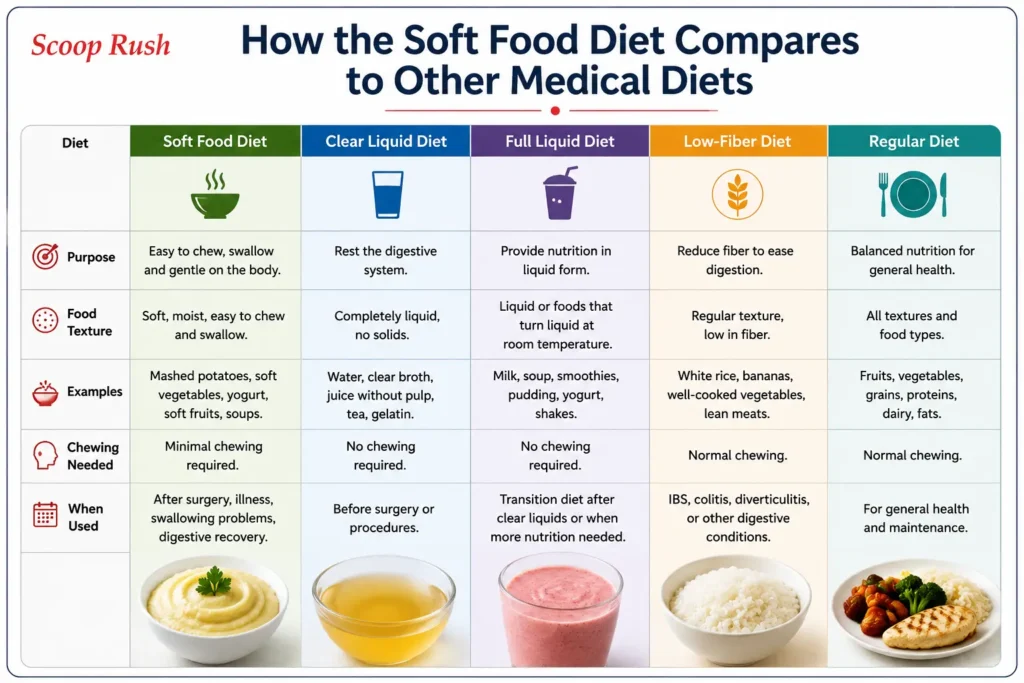
A soft food diet is just one of several texture- or ingredient-modified eating plans doctors use to support recovery, and it’s easy to confuse it with similar-sounding diets. Understanding the differences can help you follow the right plan for your specific condition.

Clear Liquid Diet

This is typically used for a much shorter period than a soft food diet, often before or immediately after certain surgeries or procedures, and includes only liquids you can see through, like broth and juice without pulp. If your provider has you moving between stages of recovery, you may transition from a clear liquid diet to a soft food diet as your digestive system becomes ready for more texture.

Bland Diet

While a soft food diet focuses on texture, a bland diet focuses more on avoiding spicy, fried, or acidic foods that irritate the stomach lining. The two overlap significantly, and many people recovering from digestive issues are advised to follow both principles at once soft in texture and bland in flavor.

Low-Residue Diet

This is closely related to the pureed and low-fiber side of the soft food diet, since both limit fiber to reduce how much undigested material passes through the intestines. If you have a digestive condition like ulcerative colitis or diverticulitis, your provider may specifically recommend a low-residue diet rather than a general soft food plan.

Diet for Hemorrhoids

Interestingly, some digestive conditions call for the opposite approach. If your concern is more about straining and irregularity than chewing or swallowing, a hemorrhoid-friendly diet actually emphasizes more fiber rather than less, which is why it’s important to follow the plan that matches your specific condition rather than assuming all “gentle” diets work the same way.

Low-Sodium Considerations

If you’re managing a condition like Ménière’s disease alongside a swallowing or digestive issue, you may need to combine soft food principles with sodium restriction. A low-sodium diet for Ménière’s disease can be adapted using many of the same soft, mashed, and pureed foods listed above, just with less added salt.

Because these diets can overlap or even conflict in their recommendations, always check with your doctor or dietitian before combining plans, especially if you’re managing more than one condition at once.

How to Prepare Soft Foods at Home

How to Prepare Soft Foods at Home | Scoop Rush

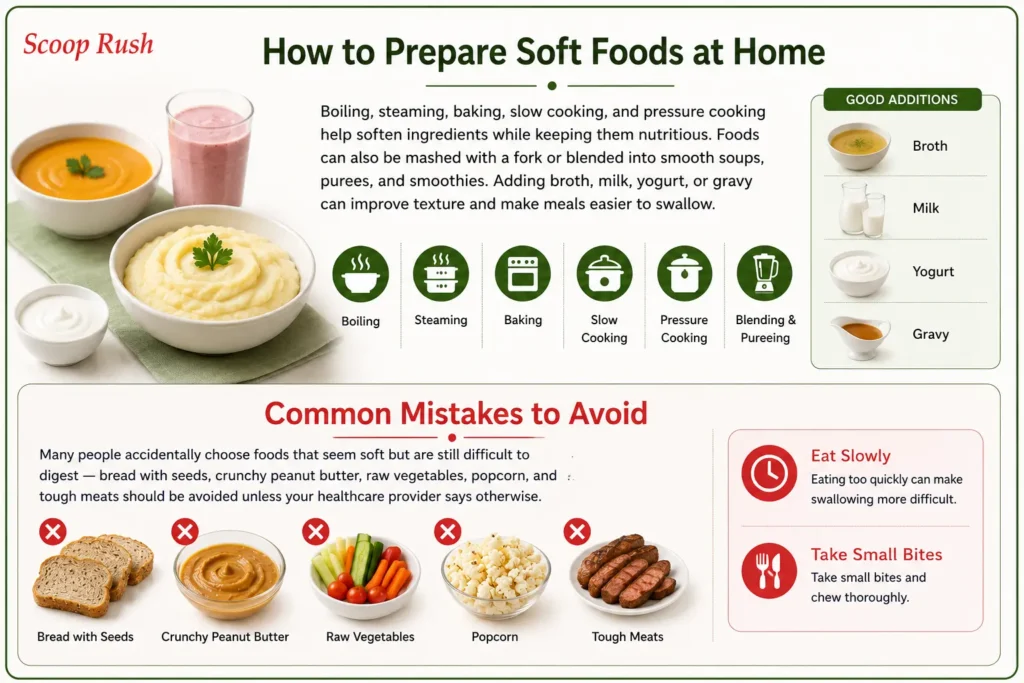
Boiling, steaming, baking, slow cooking, and pressure cooking help soften ingredients while keeping them nutritious. Foods can also be mashed with a fork or blended into smooth soups, purees, and smoothies. Adding broth, milk, yogurt, or gravy can improve texture and make meals easier to swallow.

Common Mistakes to Avoid

Many people accidentally choose foods that seem soft but are still difficult to digest — bread with seeds, crunchy peanut butter, raw vegetables, popcorn, and tough meats should be avoided unless your healthcare provider says otherwise. Eating too quickly or taking large bites can also make swallowing more difficult, so take small bites and chew thoroughly.

Soft Food Diets for Older Adults and Caregivers

Soft Food Diets for Older Adults and Caregivers |Scoop Rush

Older adults are especially likely to need a soft food diet, whether due to dental issues, a recent hospitalization, or a condition like dysphagia that develops over time. Caregivers play a major role in making sure meals stay both safe and appealing.

A few things caregivers can keep in mind:

  • Presentation matters — Serving pureed foods separately rather than mixed together (for example, keeping mashed potatoes, vegetables, and protein visually distinct on the plate) can make meals feel more appetizing and less like “baby food.”
  • Monitor swallowing closely — Watch for coughing, throat clearing, or a wet-sounding voice after swallowing, which can be signs that food or liquid consistency needs to be adjusted further.
  • Track intake — Since older adults on modified diets are at higher risk of unintentional weight loss and dehydration, keeping a simple log of what and how much is eaten each day can help catch problems early.
  • Watch for other risk factors — Older adults managing a soft food diet at home are often dealing with multiple health considerations at once, so it’s worth staying alert to any additional safety guidance their care team provides, particularly around hydration and temperature-related risks during the summer months.

If you’re a caregiver managing a loved one’s soft food diet long-term, don’t hesitate to ask their care team about a referral to a speech-language pathologist or registered dietitian, both of whom specialize in swallowing safety and nutritional adequacy.

The Emotional Side of Eating Difficulties

The Emotional Side of Eating Difficulties |Scoop Rush

It’s easy to focus purely on the physical logistics of a soft food diet and overlook how emotionally difficult it can be. Food is often tied to comfort, culture, and social connection, and having those foods restricted  even temporarily can feel isolating.

Some people find it helpful to:

  • Stay connected at mealtimes — Even if you’re eating something different from everyone else at the table, sitting together during meals can help preserve the social and emotional side of eating.
  • Get creative with presentation — Using nice dishware, garnishing purees, or plating meals attractively can make a real difference in how appetizing a soft meal feels.
  • Celebrate small wins — Being able to tolerate a new food or finish a full meal after surgery or treatment is worth acknowledging, especially during a difficult recovery period.
  • Talk to your care team about frustration — If you’re feeling discouraged, a dietitian, speech therapist, or counselor experienced in supporting patients through recovery can offer both practical and emotional support.

Recovery is rarely a straight line, and it’s normal to have days where eating feels harder than others. Being patient with yourself is just as important as following the dietary guidelines.

Transitioning Back to a Regular Diet

Once your healthcare provider says it’s safe, gradually add regular foods back into your meals. Start with slightly firmer foods before returning to raw vegetables, whole grains, and tougher meats. Introduce one new food every few days so you can monitor how your body responds. If pain or digestive symptoms return, speak with your healthcare provider before making further changes.

protein and calcium that are naturally soft and easy to digest.

When to Contact Your Healthcare Provider

Seek medical advice if you experience:

  • Difficulty swallowing liquids
  • Persistent vomiting
  • Weight loss
  • Severe abdominal pain
  • Fever
  • Signs of dehydration
  • Inability to eat enough food

These symptoms may require additional medical evaluation.

Final Thoughts

A soft food diet is a temporary eating plan that helps reduce discomfort while your body heals. By choosing foods that are easy to chew, swallow, and digest, you can support recovery without sacrificing nutrition. Focus on soft proteins, cooked vegetables, refined grains, dairy products, and plenty of fluids while avoiding hard, crunchy, and high-fiber foods until your healthcare provider says it’s safe to resume your normal diet.

FAQs

Can I eat eggs on a soft food diet? 

Yes. Scrambled, poached, soft-boiled, and hard-boiled eggs are excellent sources of protein and are easy to chew.

Is peanut butter allowed? 

Creamy peanut butter is usually acceptable, while chunky peanut butter should be avoided.

Can I drink coffee? 

Coffee is generally allowed unless your healthcare provider advises otherwise. If it causes stomach irritation, choose milk or herbal tea instead.

How long should I stay on a soft food diet?

 It depends on your medical condition. Some people only need it for a few days after surgery, while others may require it for several weeks or longer. Always follow your healthcare provider’s instructions.

Can I eat soft food diet meals if I have diabetes? 

Yes, but portion size and carbohydrate content still matter. Many soft foods like mashed potatoes, oatmeal, and fruit purees are higher in carbohydrates, so people managing blood sugar should work with a dietitian to balance portions and pair carbohydrate-heavy soft foods with protein or healthy fats.

Is it okay to season soft foods? 

Yes, mild herbs and seasonings are generally fine and can help meals taste better. It’s best to avoid very spicy, acidic, or heavily peppered seasonings, especially if you have mouth sores or a sensitive digestive system.

Can soft foods be frozen and reheated? 

Most soft foods, including soups, purees, and mashed dishes, freeze and reheat well. This makes batch cooking a great option for reducing daily meal prep, especially during recovery when energy levels may be low.

Do I need to avoid all dairy on a soft food diet? 

No, dairy is generally encouraged on a soft food diet unless you have a separate intolerance or your provider advises otherwise. Yogurt, cottage cheese, and milk are excellent sources of protein and calcium that are naturally soft and easy to digest.

DVC Welcome Home Weeks 2026: 40% Dining Discounts, Free Ice Cream, Exclusive Perks and Member Benefits

0

What if your next Disney vacation included free ice cream, complimentary treats, exclusive character experiences, and discounts of up to 40% at some of Walt Disney World’s most popular restaurants?

That is exactly what Disney Vacation Club members can enjoy during DVC Welcome Home Weeks 2026, which officially returns from July 22 through August 26, 2026. The annual celebration brings back a wide range of perks designed exclusively for eligible Disney Vacation Club members, including dining savings, special events, complimentary snacks, and unique member experiences.

For Disney fans, these benefits offer more than simple discounts. They create extra value during a vacation while rewarding loyal members with experiences that are not available to the general public. As a result, DVC Welcome Home Weeks has become one of the most anticipated seasonal promotions for Disney Vacation Club members.

In this guide, we’ll break down everything included in DVC Welcome Home Weeks 2026, from free treats and member-exclusive events to restaurant discounts and what these perks could mean for the future of Disney Vacation Club.

What Is DVC Welcome Home Weeks 2026?

DVC Welcome Home Weeks 2026 is a special celebration for eligible Disney Vacation Club members. Running from July 22 to August 26, 2026, the event includes complimentary food offerings, member gatherings, character experiences, and significant dining discounts.

The promotion first launched a few years ago and has continued to grow. This year’s edition is longer and includes a broader collection of benefits across Walt Disney World, Disneyland, Disney Springs, Disney Cruise Line, and select Disney resorts.

The goal is simple: provide added value for Disney Vacation Club members while creating memorable vacation experiences during the late summer season.

Free Ice Cream Returns for Members

One of the most popular perks during DVC Welcome Home Weeks 2026 is the return of complimentary ice cream.

Eligible members can receive a free Mickey Mouse Ice Cream Bar, ice cream sandwich, or fruit bar at participating Disney locations during scheduled event times.

Participating locations include:

Magic Kingdom EPCOT Disney’s Hollywood Studios Disney’s Animal Kingdom Disney Springs Disney’s Saratoga Springs Resort & Spa Disney’s Riviera Resort Disneyland Resort Aulani Resort Disney’s Vero Beach Resort Disney’s Hilton Head Island Resort

This simple giveaway continues to be a fan favorite because it offers a fun surprise during a park day while giving members another reason to visit participating locations.

Welcome Home Wakeup Events

Another returning benefit is the Welcome Home Wakeup experience.

These gatherings allow members to enjoy coffee and a morning treat while meeting fellow Disney Vacation Club members in a relaxed setting.

The events will take place at select locations, including:

Bay Lake Tower at Disney’s Contemporary Resort

Members can visit Top of the World Lounge on select Fridays and Saturdays during the promotion.

Disney’s Wilderness Lodge

Reunion Station will host Welcome Home Wakeup events on select weekends.

These gatherings help create a sense of community among Disney Vacation Club members while providing a casual and enjoyable start to the day.

Disney Character Closeups Bring Exclusive Meet-and-Greet Opportunities

Disney Character Closeups Bring Exclusive Meet-and-Greet Opportunities

Character interactions remain one of the biggest draws for Disney visitors.

During DVC Welcome Home Weeks 2026, members can attend exclusive Disney Character Closeups events at participating destinations.

These special experiences will be available at:

Walt Disney World Resort Disneyland Resort Aulani Resort Disney’s Vero Beach Resort Disney’s Hilton Head Island Resort

For many families, these meet-and-greet opportunities become some of the most memorable moments of a Disney vacation.

Additionally, the limited-access nature of these events often creates a more comfortable environment compared to standard character experiences inside the parks.

Exclusive Disney Springs Freebies

Disney Springs is also participating in the celebration with a collection of complimentary offerings available throughout the event.

Complimentary Donut at Everglazed

Members can receive a free Welcome Home Weeks donut without making a purchase.

Complimentary Desi Ice Cream at eet by Maneet Chauhan

Guests can enjoy a complimentary serving of Desi ice cream during designated event days.

Frontera Cocina Special Offer

Members can receive a complimentary Half & Half appetizer when purchasing the special DVC Welcome Home Weeks drink.

The Polite Pig Pretzel Promotion

The Polite Pig is offering a complimentary pretzel with the purchase of a specialty beverage.

Exclusive Slushie at City Works

Members who purchase an entrée can receive an exclusive DVC Welcome Home Weeks slushie.

These promotions add extra value for visitors planning to spend time at Disney Springs during their vacation.

Free Candy and Disney Cruise Line Perks

The perks do not stop at the parks and Disney Springs.

Eligible members can also receive complimentary candy during Movies Under the Stars at select Walt Disney World resorts.

Participating resorts include:

Disney’s Contemporary Resort Disney’s Wilderness Lodge Disney’s Animal Kingdom Lodge Disney’s Beach Club Resort Disney’s BoardWalk Resort Disney’s Old Key West Resort Disney’s Polynesian Village Resort Disney’s Riviera Resort Disney’s Saratoga Springs Resort Disney’s Grand Floridian Resort & Spa

Meanwhile, Disney Cruise Line guests can enjoy complimentary popcorn or popcorn refills at participating theaters throughout the promotional period.

These smaller benefits may seem simple, but together they contribute to a more enjoyable vacation experience.

DVC Welcome Home Weeks 2026 Dining Discounts

The biggest headline from DVC Welcome Home Weeks 2026 is undoubtedly the restaurant savings.

Eligible members can receive up to 40% off food and nonalcoholic beverages at select Walt Disney World table-service restaurants on Mondays through Thursdays during the promotion.

Restaurants Offering 40% Discounts

Participating locations include:

Hollywood & Vine Tusker House Restaurant Biergarten Restaurant Tiffins Restaurant Coral Reef Restaurant Garden Grill Restaurant Whispering Canyon Cafe Trattoria al Forno

Several of these restaurants are among the most popular dining experiences at Walt Disney World.

Character dining locations, in particular, provide exceptional value when combined with a 40% discount.

Magic Kingdom Participating Restaurants

Magic Kingdom Participating Restaurants

Some Magic Kingdom favorites are also included, though at a reduced discount level.

These include:

The Crystal Palace Be Our Guest Restaurant

While these locations receive a 20% discount rather than 40%, the savings can still be significant for families.

Why These Discounts Matter

Dining costs can represent a substantial portion of a Disney vacation budget.

As a result, a 40% discount can generate meaningful savings, especially for larger families.

For example, a family dining at character meals or signature restaurants multiple times during a vacation could save hundreds of dollars compared with standard pricing.

Therefore, many members consider these discounts the most valuable benefit of the entire promotion.

Why Disney Continues Expanding Welcome Home Weeks

The continued growth of Welcome Home Weeks suggests that Disney sees significant value in the program.

There are several possible reasons why the event continues to expand.

Strengthening Member Loyalty

Exclusive benefits help create positive experiences for current members.

When members feel appreciated, they are more likely to remain engaged with Disney Vacation Club and recommend membership to others.

Creating Additional Vacation Value

The collection of perks helps members maximize the value of their vacations.

Free treats, discounts, and exclusive events can improve the overall guest experience without requiring major spending.

Supporting Late-Summer Travel

Supporting Late-Summer Travel

The event also takes place during a period that is traditionally quieter than peak holiday seasons.

Offering attractive perks during this timeframe can encourage additional visits and dining activity.

Highlighting Membership Benefits

Programs like Welcome Home Weeks showcase the extra benefits available to Disney Vacation Club members.

For prospective buyers, these promotions provide a clear example of the added experiences that membership can offer beyond accommodations.

How Members Can Take Advantage of the Promotion

To participate in DVC Welcome Home Weeks 2026, eligible members should ensure they have:

A valid Disney Vacation Club Digital Membership Card Photo identification Any required park admission and reservations for in-park events

Additionally, many offerings have limits and availability restrictions.

Members should review event schedules carefully and plan ahead to maximize their benefits during the promotional period.

Arriving early for popular events can also improve the likelihood of participation.

The Growing Importance of Member Experiences

Disney has increasingly focused on creating experiences that go beyond attractions and accommodations.

Events such as Welcome Home Weeks demonstrate how small gestures can leave a lasting impression on guests.

Free ice cream, morning coffee gatherings, exclusive character interactions, and dining discounts may seem modest individually. However, together they create a stronger sense of community and appreciation.

That approach continues to resonate with many Disney Vacation Club members.

Conclusion

DVC Welcome Home Weeks 2026 delivers one of the strongest collections of member benefits Disney Vacation Club has offered in recent years.

From complimentary ice cream and exclusive Disney Springs treats to character experiences and restaurant discounts of up to 40%, the event offers meaningful value across multiple Disney destinations.

Most importantly, the promotion reinforces Disney’s commitment to rewarding its membership community with experiences that go beyond standard vacation offerings.

For eligible members visiting between July 22 and August 26, 2026, Welcome Home Weeks presents an excellent opportunity to enjoy additional savings, exclusive experiences, and memorable Disney moments.

FAQs

1. What are the dates for DVC Welcome Home Weeks 2026?

DVC Welcome Home Weeks 2026 runs from July 22 through August 26, 2026.

2. What is the biggest benefit of DVC Welcome Home Weeks 2026?

Many members consider the dining discounts of up to 40% at select Walt Disney World restaurants to be the most valuable benefit.

3. Can members get free ice cream during the event?

Yes. Eligible Disney Vacation Club members can receive complimentary ice cream at participating locations during scheduled event times.

4. Are Disney Springs locations participating in the promotion?

Yes. Several Disney Springs venues are offering complimentary treats and special promotions during Welcome Home Weeks.

5. Do members need identification to receive benefits?

Yes. Members generally need a valid Disney Vacation Club Digital Membership Card and photo identification to participate in promotional offerings.

Tesla SpaceX Merger: Musk Refuses to Rule Out Combining His Two Empires

0

Could the world’s two most valuable private-turned-public space and EV companies soon become one giant firm? That is the question buzzing across Wall Street today. On Wednesday, Elon Musk fueled fresh Tesla SpaceX merger speculation by openly admitting the overlap between his companies keeps growing, and he refused to shut the idea down.

For years, investors have wondered whether Musk would eventually combine his sprawling business empire into a single entity. Now, with SpaceX freshly public after a record-breaking IPO, that speculation has reached a new peak. Consequently, this story matters far beyond Wall Street. Tesla shareholders, SpaceX investors, and anyone following the world’s most talked-about entrepreneur all have a stake in how this plays out.

In this article, we break down exactly what Musk said, why analysts increasingly expect a Tesla SpaceX merger, and what could still block a deal.

What Elon Musk Said About a Tesla SpaceX Merger

What Elon Musk Said About a Tesla SpaceX Merger

Musk did not announce a merger. However, he also did not deny one was possible. When a question touched on the relationship between Tesla and SpaceX, Musk pointed straight to how closely the two companies already work together.

“As you can tell from the many collaborations on so many fronts with SpaceX, there’s more and more overlap,” Musk said during the earnings call.

He then added a line that grabbed everyone’s attention. “We can’t talk about, you know, combining companies and that kind of thing on an earnings call,” he said. “It’s got to be done with the appropriate process.”

That single sentence is why Tesla SpaceX merger talk is dominating headlines today. Musk did not say a merger would never happen. Instead, he simply said an earnings call was not the right venue to discuss it. Because Musk is known for blunt, unscripted remarks, choosing his words this carefully suggests the topic stays very much alive behind closed doors.

Tesla’s General Counsel Sticks to the Script

After Musk’s comments, he turned to Tesla General Counsel Brandon Ehrhart for additional context. Ehrhart gave a far more measured answer and described SpaceX as a “great partner” that provides “numerous beneficial transactions.” Companies typically use this kind of careful, boilerplate language to avoid legal or regulatory complications tied to merger speculation.

Still, Musk raised the overlap himself rather than avoiding the subject entirely, and that choice is exactly what has analysts talking.

Why Analysts Expect a Tesla SpaceX Combination

Why Analysts Expect a Tesla SpaceX Combination

Speculation about combining Tesla and SpaceX is not new. However, it intensified sharply after SpaceX completed its initial public offering, which raised a record 75 billion dollars. That IPO gave SpaceX a public shareholder base for the first time, and this shift changes the calculus around any future combination.

Gene Munster, managing partner at Tesla investor Deepwater Asset Management, said the earnings call left him even more confident a merger will eventually happen. “I would put the odds that these two will combine at 90% today,” he said in a video posted on social media. “If you were going to ask me yesterday I would have said it’s 80%.”

That single-day jump reflects just how closely investors are parsing Musk’s every word.

The Terafab Connection Between Tesla and SpaceX

One concrete example of overlap is Terafab, a semiconductor manufacturing facility the two companies are jointly developing to produce AI chips. Tesla already supplies batteries and manufacturing technologies for several SpaceX projects as well. As a result, Terafab represents the kind of shared infrastructure that makes a full Tesla SpaceX merger seem more logical over time.

JPMorgan analysts highlighted this trend in a research note this month, stating that “operational integration between the two entities is already deep.” They pointed to shared engineering talent, shared AI infrastructure, the Terafab project, and Musk’s leadership across both firms as factors that “would facilitate an eventual combination.”

Stifel analysts struck an even bolder tone. They wrote that “many investors consider it inevitable that Musk will move to combine SpaceX with Tesla, for them the question is not if but when.”

That statement carries real weight coming from a major Wall Street firm. Therefore, it suggests the debate among serious investors has shifted from whether a merger happens to when it happens.

The Case For Combining Tesla and SpaceX

Supporters argue that a Tesla SpaceX merger would simplify Musk’s increasingly complex corporate empire. Instead of managing separate leadership structures, boards, and reporting requirements across multiple firms, a single integrated company could span artificial intelligence, robotics, manufacturing, energy, and space infrastructure under one roof.

SpaceX President and Chief Operating Officer Gwynne Shotwell has also acknowledged the potential upside. Speaking to CNBC in June, she said combining the companies “might make Elon’s life a little easier” by streamlining management across his various businesses.

Given Musk’s many overlapping ventures, a simplified structure could reduce administrative friction. Additionally, it could allow faster decision-making across teams that already collaborate closely on projects like Terafab.

Obstacles That Could Still Block a Tesla SpaceX Merger

Obstacles That Could Still Block a Tesla SpaceX Merger

Despite growing optimism among some analysts, a Tesla SpaceX merger will not be simple to execute. Several significant hurdles remain in place.

Regulatory Approval Challenges

JPMorgan’s research note flagged what it called a “practical bottleneck.” Securing regulatory approval for a merger this size would prove difficult, particularly in China. National security concerns tied to SpaceX’s U.S. government ties could create friction with Chinese regulators, especially given Tesla’s large manufacturing presence and sales in that market.

Governance and Voting Power Concerns

Ownership structure creates another major complication. Analysts note that Musk holds a much larger voting stake in SpaceX than he does in Tesla. That imbalance raises tough governance questions for Tesla’s public shareholders, who would need reassurance that their interests stay protected in any combined entity. As a result, structuring a fair deal would require careful negotiation and, as Musk himself indicated, the appropriate legal process.

What the Tesla SpaceX Merger Talk Means for Investors

What the Tesla SpaceX Merger Talk Means for Investors

For now, nothing is official. Musk has not confirmed a Tesla SpaceX merger, and Tesla’s own General Counsel offered only cautious, neutral language about the relationship between the two firms. However, the direction of the conversation is clear. Musk raised the growing overlap unprompted, and he stopped short of ruling anything out.

Meanwhile, Wall Street’s confidence keeps rising. Analysts at JPMorgan and Stifel both describe a combination as increasingly likely, and they cite deep operational ties through projects like Terafab and shared leadership. Consequently, investors in both companies should expect this topic to stay in the spotlight, especially now that SpaceX operates as a newly public company.

Ultimately, the decision rests with Musk and both companies’ boards. Furthermore, any deal will need to navigate real regulatory and governance obstacles before it becomes reality.

Conclusion

Elon Musk did not confirm a Tesla SpaceX merger this week, but he also did not close the door on one. His comments about growing overlap, paired with rising analyst confidence and concrete examples like the Terafab chip facility, keep the speculation alive and arguably stronger than before. At the same time, real challenges around regulatory approval, particularly in China, and governance differences tied to Musk’s voting power remain significant barriers. For now, the Tesla SpaceX merger stays a possibility rather than a plan, and all eyes will remain on Musk’s next move.

FAQs

Is Elon Musk merging Tesla and SpaceX?

Musk has not confirmed a merger. During Tesla’s earnings call, he acknowledged growing overlap between the two companies but said the topic needed to go through the appropriate process rather than being discussed on an earnings call.

Why do analysts think a Tesla SpaceX merger could happen?

Analysts point to deep operational integration, including shared engineering talent, joint AI infrastructure, and the Terafab semiconductor facility, as reasons a combination could eventually make sense.

What is Terafab and why does it matter to the merger talk?

Terafab is a semiconductor manufacturing facility that Tesla and SpaceX are jointly developing to produce AI chips. It represents one of the clearest examples of overlap between the two companies.

What obstacles could prevent a Tesla SpaceX merger?

Potential hurdles include regulatory approval challenges, particularly in China due to national security concerns over SpaceX’s U.S. government ties, along with governance issues since Musk holds a much larger voting stake in SpaceX than in Tesla.

What did SpaceX’s president say about a potential merger?

SpaceX President and COO Gwynne Shotwell told CNBC in June that combining the companies “might make Elon’s life a little easier” by streamlining management across Musk’s businesses.

Leandro Paredes Suspension Debate Intensifies as Gavi Defends Argentina Midfielder

0

Could the Leandro Paredes suspension become one of the biggest stories after the FIFA World Cup 2026 final?

Spain celebrated a historic 1-0 victory over Argentina to lift the FIFA World Cup trophy. However, the celebrations quickly turned into controversy after a confrontation broke out between players from both teams.

Now, the Leandro Paredes suspension debate has become one of the biggest talking points following the final.

FIFA has already launched a disciplinary review. Meanwhile, Spain midfielder Gavi has surprised many by publicly saying that Paredes should not receive a suspension.

His comments have added a fresh perspective to an incident that continues to attract worldwide attention.

Why This Story Matters

World Cup finals are remembered for unforgettable football moments. However, emotions often remain high after the final whistle.

This time, attention shifted from Spain’s title celebration to an on-field confrontation involving several Argentina players and coaching staff.

As a result, FIFA has started reviewing what happened.

The outcome could affect individual players, coaching staff and even the Argentine Football Association.

Therefore, football fans around the world are closely following the investigation.

What Happened After the Spain vs Argentina World Cup Final?

Spain defeated Argentina 1-0 to become FIFA World Cup 2026 champions.

Shortly after the final whistle, a confrontation developed while Spanish players celebrated their victory.

According to the reported events, several Argentina representatives became involved.

Those identified in the incident include:

  • Leandro Paredes
  • Nahuel Molina
  • Thiago Almada
  • Assistant coach Roberto Ayala

The confrontation quickly became the main talking point after the match.

Leandro Paredes and Eric Garcia Incident

Leandro Paredes and Eric Garcia Incident

Reports state that Leandro Paredes appeared to push Spain defender Eric Garcia by the throat during the confrontation.

Spain midfielder Gavi, who did not play in the final, attempted to step into the situation.

However, Thiago Almada forced Gavi to the ground during the incident.

Moments later, Paredes also pushed Gavi by placing his hand on the Spaniard’s face.

These actions are now part of FIFA’s disciplinary review.

Why FIFA Is Investigating

Following the confrontation, FIFA appointed a disciplinary and ethics prosecutor to examine the events.

The investigation will determine whether any player or coach should face sanctions.

Possible disciplinary outcomes mentioned include:

  • Player suspensions
  • Coaching staff suspensions
  • A financial fine for the Argentine Football Association

Importantly, FIFA has not announced any punishment at this stage.

The review remains ongoing.

Gavi Explains Why Leandro Paredes Should Not Be Suspended

One of the biggest surprises came from Spain midfielder Gavi.

Despite being directly involved in the confrontation, he does not believe Paredes deserves a suspension.

Speaking after the match, Gavi said football naturally includes emotional moments.

He acknowledged that the incident was not a positive image for children.

However, he also argued that physical confrontations can happen in highly competitive matches.

According to Gavi, if officials believed Paredes had committed a serious offence, the referee should have punished him during the game.

Instead, he believes further punishment is unnecessary.

His opinion has become one of the most discussed reactions following the final.

Gavi’s Main Message

Gavi’s comments focused on several important points.

He believes:

  • Paredes should not receive a suspension.
  • The incident was not a good example for young fans.
  • Football naturally includes emotional and physical moments.
  • Any punishment should have happened during the match itself.

His comments stand out because they come from a player who was personally involved in the confrontation.

FIFA Investigation Continues

The FIFA disciplinary process is now the centre of attention.

Officials will carefully review the available evidence before making any decision.

The investigation may include:

  • Match reports
  • Video footage
  • Statements from those involved

Only after this review will FIFA decide whether disciplinary action is necessary.

For now, no player has received additional punishment following the final whistle.

Roberto Ayala Accepts Responsibility After the Post-Match Confrontation

Roberto Ayala Accepts Responsibility After the Post-Match Confrontation

While much of the attention has focused on the Leandro Paredes suspension debate, Argentina assistant coach Roberto Ayala also addressed his role in the Argentina post-match confrontation following the Spain vs Argentina World Cup Final.

Reports indicated that Ayala appeared to strike Spain midfielder Dani Olmo during the confrontation. However, Ayala later explained that the contact was “more of a push than a punch.”

He also said that he intends to apologise to Olmo.

Speaking after the match, Ayala explained that he entered the confrontation to prevent the situation from escalating.

According to him, his intention was never to start another altercation. Instead, he wanted to separate the players and help calm the situation.

Ayala accepted responsibility for his actions and acknowledged that the incident should not have happened.

His comments have become another key development as FIFA investigation into the post- match confrontation continues.

Confusion Over Leandro Paredes’ Red Card

One of the biggest talking points after the Spain vs Argentina World Cup Final involved reports that Leandro Paredes had been sent off.

Initially, FIFA’s commentator information system incorrectly showed that referee Slavko Vinčić had issued a red card to Paredes after the confrontation with Spain defender Eric Garcia.

However, that information was corrected shortly afterwards.

FIFA later confirmed that the report was incorrect and that no disciplinary action was taken against Paredes during the match.

As a result, any possible punishment will come only through the ongoing FIFA investigation rather than from decisions made during the game.

This clarification became an important part of the World Cup final controversy, as many supporters initially believed Paredes had already been sent off.

Instead, FIFA confirmed that no red card was officially issued.

Why the Correction Matters

The correction significantly changed the discussion surrounding the incident.

Had Paredes been sent off during the match, the disciplinary situation would have been very different.

Instead, FIFA will now determine whether further sanctions are necessary after reviewing all available evidence.

Therefore, the FIFA investigation remains the only process that could lead to additional punishment.

Enzo Fernandez Was the Only Argentina Player Sent Off

Although confusion surrounded Paredes, one Argentina player was officially dismissed during the Spain vs Argentina World Cup Final.

Midfielder Enzo Fernandez received a second yellow card during second-half stoppage time before being shown a red card.

Importantly, his dismissal occurred before the Argentina post-match confrontation.

Therefore, Enzo Fernandez’s sending-off is separate from the ongoing FIFA investigation into the events that followed the final whistle.

FIFA Investigation: What Happens Next? 

The FIFA investigation is now at the centre of attention after the Spain vs Argentina World Cup Final.

Officials will review all available evidence before reaching a final decision.

The review may include:

  • Match officials’ reports
  • Video footage from different angles
  • Statements from players and coaching staff
  • Additional evidence collected after the final

Only after completing this process will FIFA decide whether disciplinary action is necessary.

At present, no additional suspensions or sanctions have been announced.

Possible Outcomes

According to the information currently available, the FIFA investigation could result in:

  • Suspensions for players involved
  • Suspensions for coaching staff
  • A financial penalty for the Argentine Football Association

However, FIFA has not confirmed that any of these penalties will be imposed.

The investigation remains ongoing.

Spain vs Argentina World Cup Final: Key Facts 

Spain vs Argentina World Cup Final: Key Facts 

Here the confirmed facts from the Spain vs Argentina World Cup Final: 

  • Spain defeated Argentina 1-0 to win the FIFA World Cup 2026.
  • A confrontation broke out after the final whistle.
  • Leandro Paredes, Nahuel Molina, Thiago Almada and Roberto Ayala appeared to be involved.
  • Gavi attempted to intervene during the incident.
  • Thiago Almada forced Gavi to the ground.
  • Paredes later pushed Gavi by placing a hand on his face.
  • FIFA has appointed a disciplinary and ethics prosecutor.
  • Gavi comments on the incident suggest that Paredes should not receive a suspension.
  • Roberto Ayala accepted responsibility and said he intends to apologise to Dani Olmo.
  • FIFA confirmed that Paredes was not sent off during the match.
  • Enzo Fernandez was the only Argentina player dismissed during the final after receiving a second yellow card.

Key Takeaways

  • Spain defeated Argentina 1-0 to win the FIFA World Cup 2026.
  • A confrontation broke out after the final whistle.
  • FIFA has opened a disciplinary investigation.
  • Gavi believes Leandro Paredes should not be suspended.
  • Roberto Ayala accepted responsibility for his actions.
  • FIFA confirmed Paredes did not receive a red card during the match.
  • Enzo Fernandez was the only Argentina player sent off during play.
  • No further disciplinary decisions have been announced.

Conclusion

The Leandro Paredes suspension debate continues to dominate football headlines after the Spain vs Argentina World Cup Final.

Although the World Cup final controversy shifted attention away from Spain’s historic victory, FIFA has not yet reached a disciplinary decision. Meanwhile, Gavi’s comments defending Paredes have added a new perspective to the debate, while Roberto Ayala has accepted responsibility for his actions.

The latest Leandro Paredes news has kept the FIFA investigation in the spotlight as fans await an official decision.

For now, the football world awaits the outcome of the ongoing FIFA investigation, which will determine whether any further disciplinary action is necessary.

Frequently Asked Questions

1. Why is Leandro Paredes facing a possible suspension?

FIFA is reviewing his involvement in the post-match confrontation following Spain’s 1-0 victory over Argentina in the FIFA World Cup 2026 final.

2. Did Leandro Paredes receive a red card?

No. FIFA confirmed that Paredes was not shown a red card during the match. Earlier reports in FIFA’s commentator information system were corrected.

3. What did Gavi say about Leandro Paredes?

Gavi said he does not believe Paredes should be suspended. He acknowledged the incident but described emotional moments as part of football.

4. Who else was involved in the confrontation?

Reports identified Nahuel Molina, Thiago Almada and assistant coach Roberto Ayala among those involved. Eric Garcia, Dani Olmo and Gavi were also involved in different parts of the incident.

5. Has FIFA announced any punishment?

No. FIFA has only confirmed that a disciplinary investigation is underway. No additional suspensions or sanctions have been announced.

Best Brazilian Beaches Offer Brazil’s Hidden Coastal Paradise

0

The Best Brazilian Beaches extend far beyond Rio de Janeiro’s famous shoreline. Brazil’s southeastern coast hides untouched beaches, rainforest trails, fishing villages, and peaceful islands. Many international visitors still overlook these destinations despite their remarkable beauty.

São Paulo state’s coastline stretches about 370 miles beneath the Atlantic Forest. This region combines tropical beaches with waterfalls and mountains. Travelers can enjoy quiet beaches, rich wildlife, fresh seafood, and authentic local culture throughout the year.

Best Brazilian Beaches Along São Paulo’s Coast

São Paulo’s coastline divides into three distinct regions. These include Litoral Norte, Baixada Santista, and Litoral Sul. Each area offers unique landscapes and unforgettable beach experiences.

Litoral Norte attracts surfers and nature lovers with rainforest-covered mountains. Baixada Santista combines city life with relaxing beaches. Meanwhile, Litoral Sul remains peaceful with mangroves, estuaries, and protected natural reserves.

Best Brazilian Beaches Surrounded by Atlantic Forest

The Atlantic Forest creates one of Brazil’s richest natural environments. This ancient rainforest supports thousands of unique plants and wildlife species. It also protects many untouched beaches from heavy development.

Visitors often spot colorful birds, monkeys, orchids, and butterflies while hiking. Offshore waters also welcome dolphins, whales, sea turtles, and rays. Nature lovers can easily combine beach time with wildlife watching.

Best Brazilian Beaches on Ilhabela Island

Best-Brazilian-Beaches-on-Ilhabela-Island

Ilhabela ranks among the finest island destinations on Brazil’s southeast coast. Around 85 percent of the island remains protected by state parks. More than 300 waterfalls flow through dense rainforest before reaching the sea.

Bonete Beach offers one of Ilhabela’s most rewarding adventures. Visitors reach it by boat or a challenging forest hike. The remote village runs on solar power and delivers clear night skies for stargazing.

Best Brazilian Beaches for Surfing Adventures

Ubatuba has earned its reputation as Brazil’s surfing capital. Beaches like Itamambuca deliver consistent waves throughout the year. International surfing events regularly attract experienced surfers to the region.

Farther south, Maresias also enjoys a vibrant surfing culture. Praia do Tombo near Guarujá provides another excellent choice. These beaches combine strong waves with beautiful coastal scenery.

Best Brazilian Beaches for Hiking and Nature

Best-Brazilian-Beaches-for-Hiking-and-Nature

The Trail of Seven Beaches offers one of Brazil’s finest coastal hikes. The route links seven white sand beaches through rainforest landscapes. Most hikers complete the trail within six hours.

Several viewpoints overlook turquoise waters and hidden coves. Praia do Cedro stands out with calm tide pools and snorkeling opportunities. Cooler months provide the most comfortable hiking conditions.

Best Brazilian Beaches on Brazil’s Beautiful Islands

Brazil’s islands offer peaceful escapes beyond the mainland. Each island features different landscapes, traditions, and outdoor activities. Most maintain strong fishing communities and close ties with nature.

Fernando de Noronha leads the list with protected marine life and crystal-clear waters. Ilha Grande features jungle trails and over 100 beaches. Ilha de Boipeba welcomes visitors with car-free villages and quiet coastlines.

Best Brazilian Beaches for Island Escapes

Best-Brazilian-Beaches-for-Island-Escapes

Ilha do Mel provides sandy walking trails and historic landmarks. Visitors explore beaches, caves, and old fortresses without seeing many vehicles. The relaxed atmosphere attracts backpackers and nature enthusiasts.

Florianópolis combines island beauty with modern city comforts. More than 40 beaches surround the island. Surfing, hiking, sand dunes, and local seafood make it a year-round destination.

Best Brazilian Beaches and Local Food

Fresh seafood defines the local coastal cuisine. Fishermen supply restaurants with daily catches including grouper, mullet, snook, and weakfish. Traditional recipes celebrate simple ingredients and regional flavors.

Peixe Azul-Marinho remains a regional specialty. Cooks prepare fresh fish with green bananas and rich broth. Local fruits like jabuticaba, pitanga, and uvaia also appear in desserts and refreshing juices.

Best Brazilian Beaches Travel Tips

Best-Brazilian-Beaches-Travel-Tips

Renting a car offers the easiest way to explore the coastline. However, buses and ride-sharing services also connect major towns. Travelers should drive carefully because coastal roads include many sharp curves.

Insect repellent remains essential, especially on Ilhabela. English stays uncommon outside tourist centers. Learning a few Portuguese phrases makes local interactions much easier.

Why Best Brazilian Beaches Deserve More Attention

Brazil’s hidden coastline rewards travelers seeking quieter destinations. Visitors discover rainforest adventures, island life, excellent surfing, and authentic fishing communities. The region also protects some of South America’s richest biodiversity.

Unlike crowded tourist hotspots, these beaches remain peaceful throughout most of the year. Travelers who explore São Paulo’s coast often return for another unforgettable visit.

Conclusion

The Best Brazilian Beaches offer much more than beautiful coastlines. They combine untouched nature, rich culture, outdoor adventures, and peaceful island life. From the surf beaches of Ubatuba to the waterfalls of Ilhabela and the marine paradise of Fernando de Noronha, every destination has something unique to offer.

Whether you enjoy hiking, surfing, snorkeling, or simply relaxing by the sea, Brazil’s hidden beaches promise unforgettable experiences. Travelers looking beyond the country’s famous tourist spots will discover authentic communities, incredible biodiversity, and some of South America’s most spectacular coastal scenery.


Frequently Asked Questions

1. What are the best Brazilian beaches to visit?

The best Brazilian beaches include Itamambuca, Bonete Beach, Praia do Tombo, Praia do Cedro, and Fernando de Noronha. Each destination offers unique scenery, outdoor activities, and a peaceful atmosphere away from crowded tourist hotspots.

2. Which Brazilian island is best for nature lovers?

Ilhabela is one of Brazil’s top islands for nature lovers. It features hundreds of waterfalls, protected Atlantic Forest, hiking trails, remote beaches, and abundant wildlife. Fernando de Noronha is another excellent choice for marine life and snorkeling.

3. When is the best time to visit Brazil’s hidden beaches?

The best time to visit is between May and August. During these months, temperatures remain comfortable, rainfall decreases, and popular beaches become much less crowded. This period also provides excellent conditions for hiking and sightseeing.

4. Are Brazil’s hidden beaches good for surfing?

Yes. Ubatuba and Itamambuca rank among Brazil’s best surfing destinations. Maresias and Praia do Tombo also offer consistent waves for experienced surfers, while several nearby beaches suit beginners during calmer conditions.

5. How can travelers explore the best Brazilian beaches?

Renting a car provides the greatest flexibility for exploring Brazil’s coastline. Travelers can also use long-distance buses, ferries, and ride-sharing services to reach many beaches and islands. Learning a few basic Portuguese phrases can also make the journey smoother.