
Could the world’s two most valuable private-turned-public space and EV companies soon become one giant firm? That is the question buzzing across Wall Street today. On Wednesday, Elon Musk fueled fresh Tesla SpaceX merger speculation by openly admitting the overlap between his companies keeps growing, and he refused to shut the idea down.
For years, investors have wondered whether Musk would eventually combine his sprawling business empire into a single entity. Now, with SpaceX freshly public after a record-breaking IPO, that speculation has reached a new peak. Consequently, this story matters far beyond Wall Street. Tesla shareholders, SpaceX investors, and anyone following the world’s most talked-about entrepreneur all have a stake in how this plays out.
In this article, we break down exactly what Musk said, why analysts increasingly expect a Tesla SpaceX merger, and what could still block a deal.
What Elon Musk Said About a Tesla SpaceX Merger
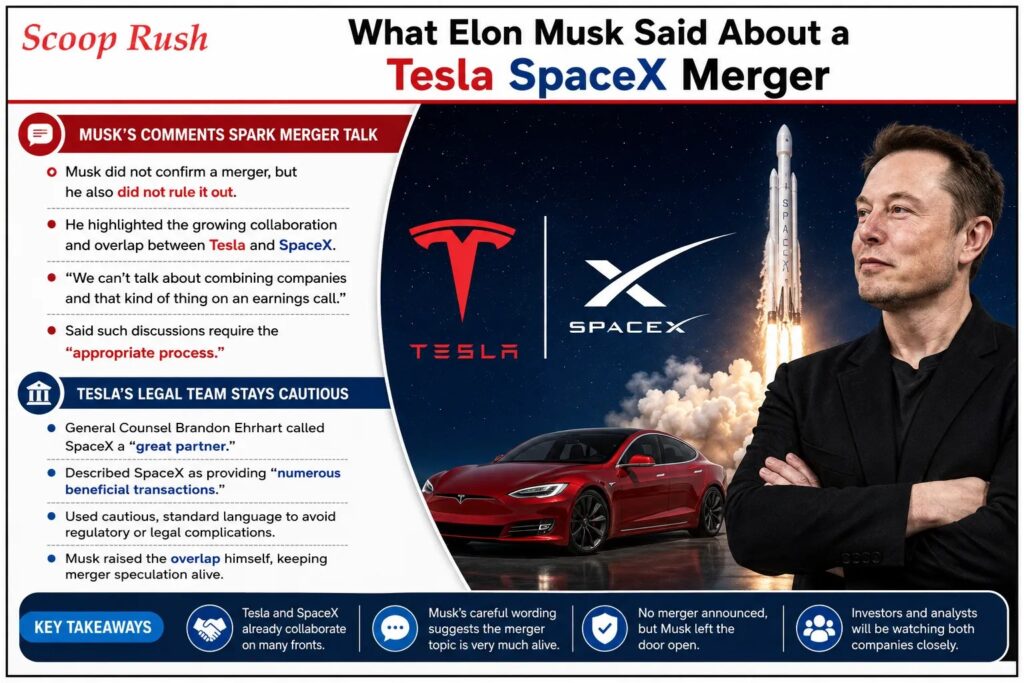
Musk did not announce a merger. However, he also did not deny one was possible. When a question touched on the relationship between Tesla and SpaceX, Musk pointed straight to how closely the two companies already work together.
“As you can tell from the many collaborations on so many fronts with SpaceX, there’s more and more overlap,” Musk said during the earnings call.
He then added a line that grabbed everyone’s attention. “We can’t talk about, you know, combining companies and that kind of thing on an earnings call,” he said. “It’s got to be done with the appropriate process.”
That single sentence is why Tesla SpaceX merger talk is dominating headlines today. Musk did not say a merger would never happen. Instead, he simply said an earnings call was not the right venue to discuss it. Because Musk is known for blunt, unscripted remarks, choosing his words this carefully suggests the topic stays very much alive behind closed doors.
Tesla’s General Counsel Sticks to the Script
After Musk’s comments, he turned to Tesla General Counsel Brandon Ehrhart for additional context. Ehrhart gave a far more measured answer and described SpaceX as a “great partner” that provides “numerous beneficial transactions.” Companies typically use this kind of careful, boilerplate language to avoid legal or regulatory complications tied to merger speculation.
Still, Musk raised the overlap himself rather than avoiding the subject entirely, and that choice is exactly what has analysts talking.
Why Analysts Expect a Tesla SpaceX Combination
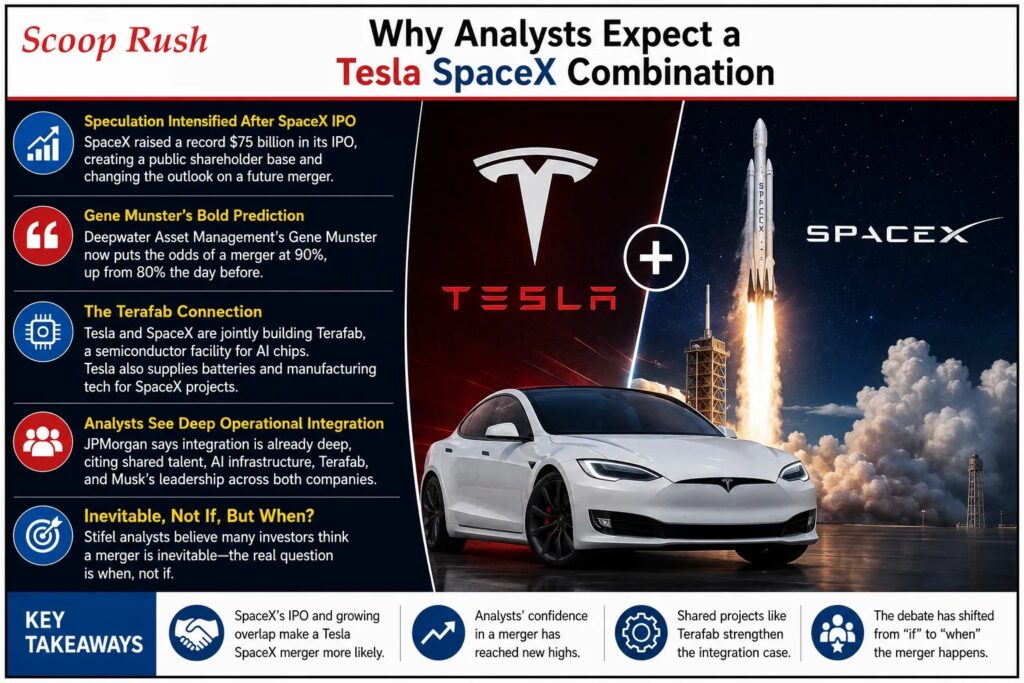
Speculation about combining Tesla and SpaceX is not new. However, it intensified sharply after SpaceX completed its initial public offering, which raised a record 75 billion dollars. That IPO gave SpaceX a public shareholder base for the first time, and this shift changes the calculus around any future combination.
Gene Munster, managing partner at Tesla investor Deepwater Asset Management, said the earnings call left him even more confident a merger will eventually happen. “I would put the odds that these two will combine at 90% today,” he said in a video posted on social media. “If you were going to ask me yesterday I would have said it’s 80%.”
That single-day jump reflects just how closely investors are parsing Musk’s every word.
The Terafab Connection Between Tesla and SpaceX
One concrete example of overlap is Terafab, a semiconductor manufacturing facility the two companies are jointly developing to produce AI chips. Tesla already supplies batteries and manufacturing technologies for several SpaceX projects as well. As a result, Terafab represents the kind of shared infrastructure that makes a full Tesla SpaceX merger seem more logical over time.
JPMorgan analysts highlighted this trend in a research note this month, stating that “operational integration between the two entities is already deep.” They pointed to shared engineering talent, shared AI infrastructure, the Terafab project, and Musk’s leadership across both firms as factors that “would facilitate an eventual combination.”
Stifel analysts struck an even bolder tone. They wrote that “many investors consider it inevitable that Musk will move to combine SpaceX with Tesla, for them the question is not if but when.”
That statement carries real weight coming from a major Wall Street firm. Therefore, it suggests the debate among serious investors has shifted from whether a merger happens to when it happens.
The Case For Combining Tesla and SpaceX
Supporters argue that a Tesla SpaceX merger would simplify Musk’s increasingly complex corporate empire. Instead of managing separate leadership structures, boards, and reporting requirements across multiple firms, a single integrated company could span artificial intelligence, robotics, manufacturing, energy, and space infrastructure under one roof.
SpaceX President and Chief Operating Officer Gwynne Shotwell has also acknowledged the potential upside. Speaking to CNBC in June, she said combining the companies “might make Elon’s life a little easier” by streamlining management across his various businesses.
Given Musk’s many overlapping ventures, a simplified structure could reduce administrative friction. Additionally, it could allow faster decision-making across teams that already collaborate closely on projects like Terafab.
Obstacles That Could Still Block a Tesla SpaceX Merger
Despite growing optimism among some analysts, a Tesla SpaceX merger will not be simple to execute. Several significant hurdles remain in place.
Regulatory Approval Challenges
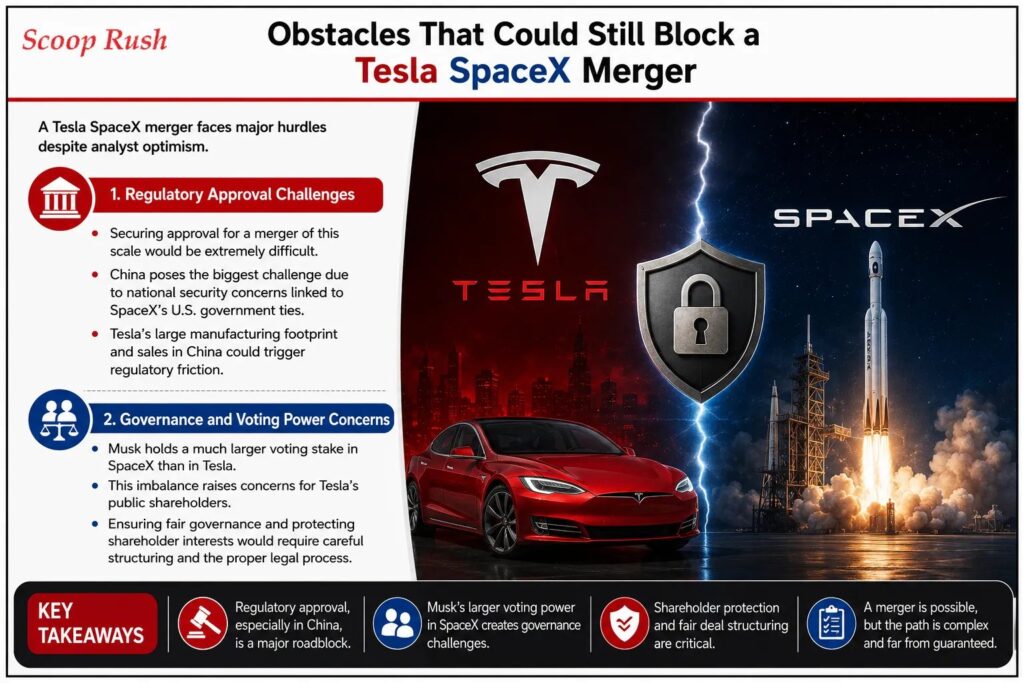
JPMorgan’s research note flagged what it called a “practical bottleneck.” Securing regulatory approval for a merger this size would prove difficult, particularly in China. National security concerns tied to SpaceX’s U.S. government ties could create friction with Chinese regulators, especially given Tesla’s large manufacturing presence and sales in that market.
Governance and Voting Power Concerns
Ownership structure creates another major complication. Analysts note that Musk holds a much larger voting stake in SpaceX than he does in Tesla. That imbalance raises tough governance questions for Tesla’s public shareholders, who would need reassurance that their interests stay protected in any combined entity. As a result, structuring a fair deal would require careful negotiation and, as Musk himself indicated, the appropriate legal process.
What the Tesla SpaceX Merger Talk Means for Investors
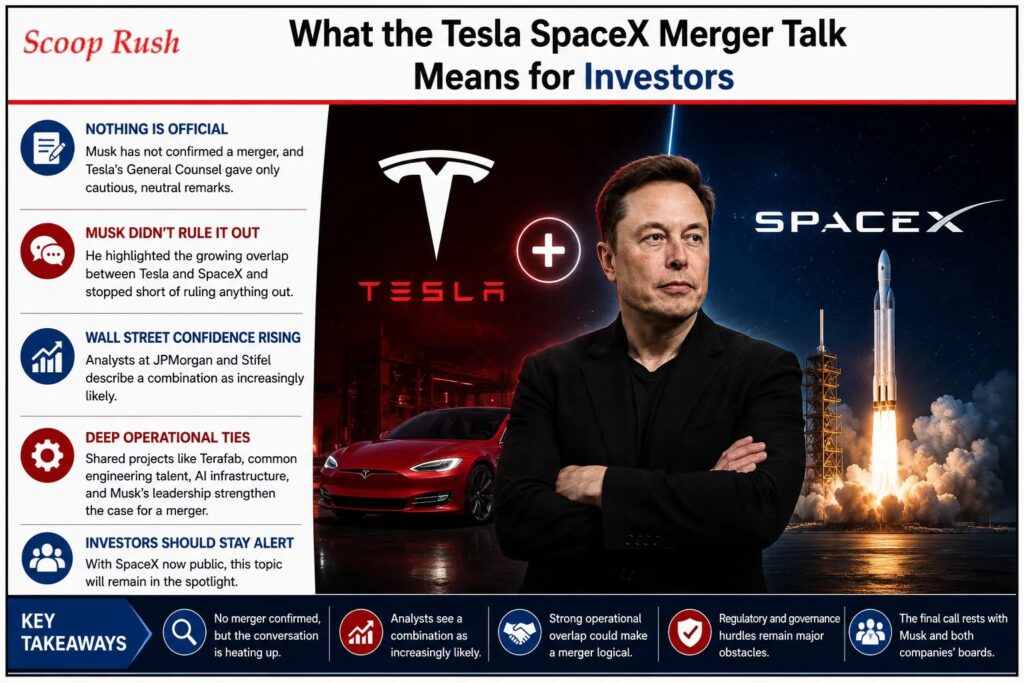
For now, nothing is official. Musk has not confirmed a Tesla SpaceX merger, and Tesla’s own General Counsel offered only cautious, neutral language about the relationship between the two firms. However, the direction of the conversation is clear. Musk raised the growing overlap unprompted, and he stopped short of ruling anything out.
Meanwhile, Wall Street’s confidence keeps rising. Analysts at JPMorgan and Stifel both describe a combination as increasingly likely, and they cite deep operational ties through projects like Terafab and shared leadership. Consequently, investors in both companies should expect this topic to stay in the spotlight, especially now that SpaceX operates as a newly public company.
Ultimately, the decision rests with Musk and both companies’ boards. Furthermore, any deal will need to navigate real regulatory and governance obstacles before it becomes reality.
Conclusion
Elon Musk did not confirm a Tesla SpaceX merger this week, but he also did not close the door on one. His comments about growing overlap, paired with rising analyst confidence and concrete examples like the Terafab chip facility, keep the speculation alive and arguably stronger than before. At the same time, real challenges around regulatory approval, particularly in China, and governance differences tied to Musk’s voting power remain significant barriers. For now, the Tesla SpaceX merger stays a possibility rather than a plan, and all eyes will remain on Musk’s next move.
FAQs
Is Elon Musk merging Tesla and SpaceX?
Musk has not confirmed a merger. During Tesla’s earnings call, he acknowledged growing overlap between the two companies but said the topic needed to go through the appropriate process rather than being discussed on an earnings call.
Why do analysts think a Tesla SpaceX merger could happen?
Analysts point to deep operational integration, including shared engineering talent, joint AI infrastructure, and the Terafab semiconductor facility, as reasons a combination could eventually make sense.
What is Terafab and why does it matter to the merger talk?
Terafab is a semiconductor manufacturing facility that Tesla and SpaceX are jointly developing to produce AI chips. It represents one of the clearest examples of overlap between the two companies.
What obstacles could prevent a Tesla SpaceX merger?
Potential hurdles include regulatory approval challenges, particularly in China due to national security concerns over SpaceX’s U.S. government ties, along with governance issues since Musk holds a much larger voting stake in SpaceX than in Tesla.
What did SpaceX’s president say about a potential merger?
SpaceX President and COO Gwynne Shotwell told CNBC in June that combining the companies “might make Elon’s life a little easier” by streamlining management across Musk’s businesses.

