Home Blog Page 50

Colombia vs DR Congo Result: Daniel Muñoz Fires Colombia to 1-0 FIFA World Cup 2026 Group K Victory

0

Result: Colombia 1-0 DR Congo

Competition: FIFA World Cup 2026 – Group K

Date: Wednesday, 24 June

Venue: Estadio Guadalajara, Zapopan

The Colombia vs DR Congo clash in FIFA World Cup 2026 Group K delivered a tense and highly competitive battle, with Colombia securing a hard-earned 1-0 victory on Wednesday, 24 June, at Estadio Guadalajara in Zapopan.

A first-half goal from Daniel Muñoz proved decisive as Colombia controlled possession, created the majority of scoring opportunities, and successfully protected their advantage against a determined DR Congo side. The result strengthened Colombia’s position in Group K and highlighted their ability to manage pressure in a tightly contested World Cup encounter.

While DR Congo demonstrated impressive defensive discipline throughout the match, they ultimately struggled to create enough attacking opportunities to challenge Colombia’s organized back line. In the end, a single goal separated the two teams in a match defined by patience, possession, and tactical discipline.

Colombia vs DR Congo Match Summary

The Colombia vs DR Congo encounter was closely contested despite the narrow scoreline. Colombia controlled much of the possession and dictated the tempo for long periods, while DR Congo relied on defensive organization and discipline to stay in the contest.

The breakthrough came during the first half when Daniel Muñoz scored in the 26th minute. That goal ultimately proved enough to secure all three points for Colombia.

Despite creating numerous opportunities throughout the match, Colombia had to remain patient against a resilient DR Congo side that defended with determination and commitment.

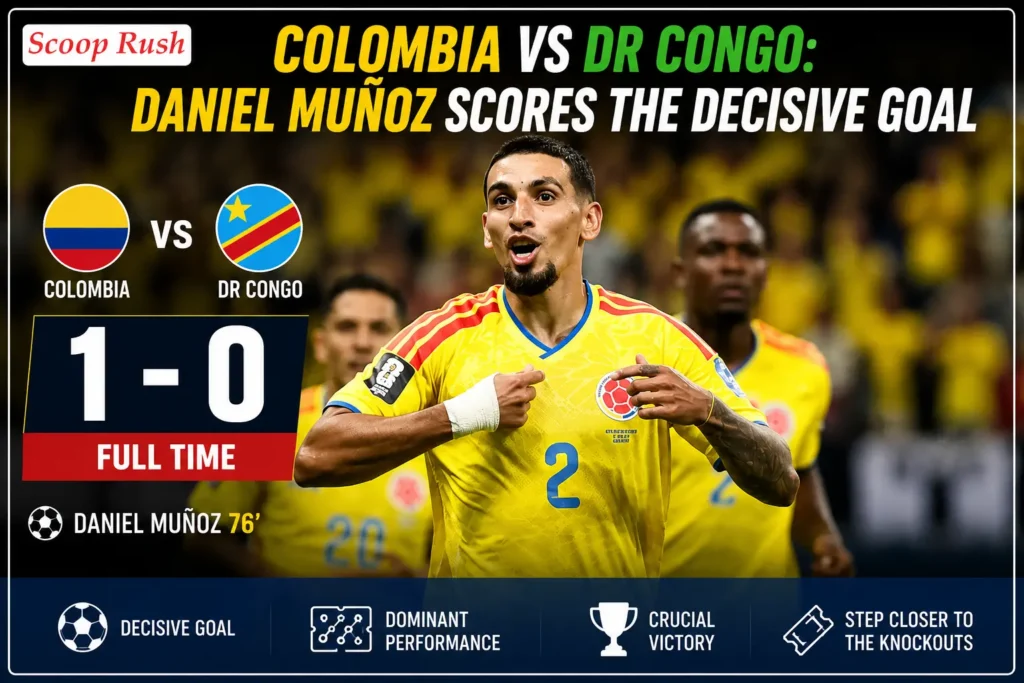
Colombia vs DR Congo: Daniel Muñoz Scores the Decisive Goal
Colombia vs DR Congo: Daniel Muñoz Scores the Decisive Goal

Early Goal Gives Colombia the Advantage

The defining moment of the match arrived in the 26th minute when Daniel Muñoz found the back of the net to put Colombia ahead.

The goal rewarded Colombia’s positive start and allowed them to take control of the match. Rather than chasing the game, Colombia could focus on maintaining possession, controlling territory, and forcing DR Congo to spend extended periods defending.

Although the match remained competitive throughout, Muñoz’s strike ultimately became the decisive moment that separated the two sides.

Scoring early also provided Colombia with a psychological advantage. The team appeared increasingly comfortable after taking the lead, while DR Congo faced the difficult challenge of trying to break down a disciplined Colombian defensive structure.

Why Muñoz’s Goal Was So Important

At the World Cup level, matches are often decided by small moments.

Daniel Muñoz’s goal not only secured victory but also highlighted Colombia’s ability to capitalize on key opportunities. While Colombia created several chances throughout the game, converting one of them early allowed them to dictate the rhythm of the contest.

His contribution ensured Colombia walked away with a valuable three points in Group K.

Colombia vs DR Congo Statistics Highlight Colombia’s Dominance

The statistics from the Colombia vs DR Congo match clearly illustrate Colombia’s superiority in several important areas.

StatisticColombiaDR Congo
Shots207
Shots on Target92
Possession66%34%
Passes506281
Pass Accuracy88%77%
Fouls1217
Yellow Cards21
Red Cards00
Offsides71
Corners54

These numbers demonstrate Colombia’s control over the match.

They attempted nearly three times as many shots as DR Congo and recorded more than four times as many efforts on target. Colombia’s dominance in possession also allowed them to dictate where and how the game was played.

Possession and Passing Quality

One of Colombia’s biggest strengths during the match was their ability to control possession.

Holding 66 percent of the ball allowed them to manage the tempo and prevent DR Congo from building sustained attacks. Colombia completed 506 passes with an impressive 88 percent accuracy rate, demonstrating composure and technical quality throughout the contest.

The midfield played a crucial role in maintaining control. By circulating possession efficiently, Colombia forced DR Congo to spend long periods without the ball and reduced opportunities for counterattacks.

Colombia Create More Attacking Opportunities

The attacking numbers tell an equally compelling story.

Colombia generated 20 shots compared to DR Congo’s seven and consistently pushed forward in search of additional goals. Although only one goal was scored, Colombia’s offensive pressure remained constant throughout the match.

Their willingness to attack helped keep DR Congo pinned back for large portions of the game and limited the opposition’s ability to build momentum.

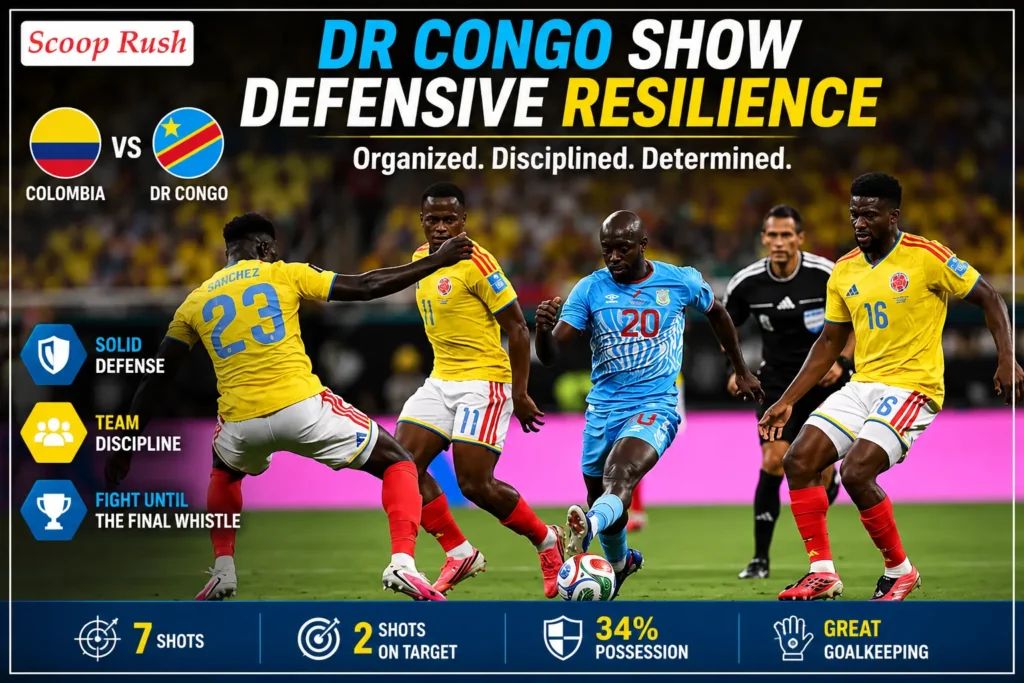
DR Congo Show Defensive Resilience
DR Congo Show Defensive Resilience

Organized Defensive Performance

Despite suffering defeat, DR Congo produced a disciplined defensive display.

Facing a team that controlled possession and created numerous chances is never easy, yet DR Congo remained organized and committed throughout the contest. Their defensive shape frustrated Colombia at times and prevented the scoreline from becoming more one-sided.

The defenders worked tirelessly to close spaces, block passing lanes, and limit Colombia’s opportunities inside dangerous areas.

Limited Threat Going Forward

The biggest challenge for DR Congo was creating meaningful attacking opportunities.

They managed only seven shots and two attempts on target, illustrating the difficulties they faced against Colombia’s defensive structure. With Colombia controlling possession for much of the game, DR Congo often struggled to sustain attacks and apply pressure in advanced areas.

While their defensive effort was admirable, the lack of attacking production ultimately proved costly.

Colombia vs DR Congo Tactical Analysis

Colombia’s Balanced Approach

Colombia demonstrated an effective balance between attack and defense.

After taking the lead, they did not retreat into a defensive shell. Instead, they continued pressing forward while maintaining enough structure to protect their advantage.

Their passing accuracy and possession figures highlight a team comfortable controlling matches through technical quality and intelligent positioning.

This balanced approach prevented DR Congo from gaining momentum and helped Colombia maintain control from start to finish.

DR Congo’s Tactical Challenge

DR Congo entered the match with a clear defensive strategy.

They sought to remain compact, limit space, and frustrate Colombia’s attacking players. For long stretches, that approach proved effective.

However, spending significant periods without possession made it difficult for DR Congo to create attacking opportunities. Many of their forward movements came through quick transitions rather than sustained periods of possession.

Ultimately, Colombia’s quality and patience proved too much to overcome.

Key Moments from Colombia vs DR Congo

Physical Battle in Midfield

The match featured several physical contests across the pitch.

DR Congo committed 17 fouls compared to Colombia’s 12, reflecting the intensity of the battle for possession and territory.

Both teams competed aggressively, knowing the importance of securing points in Group K.

Yellow Cards and Discipline

Discipline played an important role throughout the match.

Colombia received two yellow cards, while DR Congo collected one caution.

Among the players booked were:

  • Jefferson Lerma (Colombia)
  • Charles Pickel (DR Congo)

Despite the physical nature of the contest, neither team received a red card.

Important Substitutions

Both coaches turned to their benches in search of fresh energy and tactical adjustments.

One notable substitution saw DR Congo introduce Nathanaël Mbuku in an effort to add attacking threat during the latter stages of the match.

However, Colombia remained organized defensively and successfully protected their lead until the final whistle.

Group K Impact After Colombia vs DR Congo

The victory provided Colombia with an important boost in Group K.

Securing three points in such a competitive contest strengthened their standing and reinforced confidence heading into future matches.

For DR Congo, the defeat represented a missed opportunity, but their performance also demonstrated resilience and defensive quality that could prove valuable in the remainder of the tournament.

As the group stage continues, every point becomes increasingly significant, making Colombia’s victory particularly valuable.

Key Performers for Colombia

Daniel Muñoz

Daniel Muñoz was unquestionably the standout performer.

His 26th-minute goal proved decisive and ultimately secured victory for Colombia. Beyond scoring, he contributed energy, determination, and attacking intent throughout the match.

Colombia’s Midfield Unit

The midfield played a critical role in Colombia’s success.

Their ability to maintain possession, complete passes efficiently, and control the pace of the game helped Colombia dominate large portions of the contest.

Defensive Organization

While the goal scorer earned the headlines, Colombia’s defensive unit also deserves recognition.

Limiting DR Congo to only two shots on target demonstrated strong organization, concentration, and teamwork throughout the match.

What This Result Means Moving Forward

For Colombia, this victory provides momentum and confidence.

Winning tightly contested matches is often essential during major tournaments, and Colombia showed they possess the patience and discipline required to secure results even when goals are difficult to come by.

For DR Congo, there are lessons and positives to take from the performance. Their defensive resilience kept them competitive against a strong opponent, but improvements in attacking efficiency will be necessary moving forward.

Conclusion: Colombia vs DR Congo Ends with Colombia Taking All Three Points

The Colombia vs DR Congo match delivered exactly the kind of tension and drama expected at the FIFA World Cup.

Daniel Muñoz’s first-half goal proved to be the difference as Colombia secured a hard-fought 1-0 victory in Group K. Colombia controlled possession, created significantly more chances, and demonstrated tactical discipline throughout the contest.

DR Congo showed admirable defensive resilience and remained competitive until the final whistle, but they were unable to generate enough attacking opportunities to alter the outcome.

In the end, Colombia’s quality, patience, and organization ensured they claimed a valuable three points in an important Group K encounter.


Norway vs Senegal Highlights: Haaland Double Secures Thrilling 3-2 Victory in Group I 

0


Competition: FIFA World Cup 2026 Group Stage – Group I
Date: Tuesday, 23 June
Venue: New York New Jersey Stadium, East Rutherford
Full-Time Result: Norway 3-2 Senegal

Norway vs Senegal Highlights featured an exciting FIFA World Cup 2026 Group I clash as Erling Haaland scored twice to lead Norway to a thrilling 3-2 victory over Senegal. The dramatic victory kept Norway on course in Group I. What happens when clinical finishing meets relentless determination on the biggest stage in football. Fans at the FIFA World Cup 2026 Group I clash between Norway and Senegal witnessed exactly that as Norway secured a dramatic 3-2 victory in a match packed with goals, momentum swings, and late drama.

The result proved crucial in the Group I standings, with Norway collecting three valuable points after a hard-fought contest. Despite Senegal enjoying more possession and completing more passes, Norway made the most of their opportunities and held on through a tense finish to claim victory.

This thrilling encounter delivered everything football supporters could ask for: early attacking intent, tactical battles, quality finishing, and a dramatic stoppage-time goal that kept supporters on the edge of their seats until the final whistle.

Match Overview

Goalscorers

Norway
Marcus Holmgren Pedersen (43′)
Erling Haaland (48′)
Erling Haaland (57′)

Senegal
Ismaila Sarr (59′)
Ismaila Sarr (90+3′)

The scoreline reflected a fascinating battle between two teams with different approaches. Norway focused on efficiency in front of goal, while Senegal controlled more of the ball and created sustained pressure throughout the match.

First Half Analysis 

 First Half Analysis

Norway, however, remained organized and disciplined. Rather than chasing possession, they concentrated on maintaining their shape and waiting for opportunities to strike.

The breakthrough arrived late in the first half when Marcus Holmgren Pedersen found the net in the 43rd minute. The goal provided Norway with a significant boost just before halftime and shifted momentum in their favor.

Scoring so close to the break allowed Norway to enter the dressing room with confidence, while Senegal faced the challenge of responding after controlling significant portions of possession without converting their efforts into goals.

Pedersen’s Goal Changes the Match

Pedersen’s strike proved to be one of the key moments of the contest.

Until that point, the match had been relatively balanced, with Senegal enjoying territorial advantage. The goal rewarded Norway’s patient approach and forced Senegal to become more aggressive after the interval.

That tactical shift would create both opportunities and vulnerabilities as the second half unfolded.

Erling Haaland Takes Center Stage

Haaland Delivers When Norway Needed Him Most

If there was one player who shaped the outcome of this match more than any other, it was Erling Haaland.

The Norwegian striker wasted little time after halftime before extending his team’s advantage. Just three minutes into the second half, Haaland scored in the 48th minute to make it 2-0.

The goal immediately increased pressure on Senegal and gave Norway a valuable cushion.

Yet Haaland was not finished.

In the 57th minute, he struck again to complete his brace and push Norway into a commanding 3-0 lead.

At that stage, Norway appeared to be in complete control. With a three-goal advantage and less than an hour played, many observers would have expected the match to be effectively decided.

However, Senegal had other ideas.

Senegal Refuse to Surrender

One of the most impressive aspects of the match was Senegal’s refusal to give up despite falling three goals behind.

Instead of allowing the game to drift away, Senegal responded almost immediately.

Just two minutes after Haaland’s second goal, Ismaila Sarr found the net in the 59th minute to reduce the deficit to 3-1.

The goal injected fresh energy into Senegal’s performance and gave them renewed hope.

As the match progressed, Senegal continued to push forward in search of another breakthrough. Their persistence reflected the statistics, which showed their superiority in several key areas.

Team Statistics Tell an Interesting Story

Although Norway emerged victorious, the match statistics reveal how competitive the contest actually was.

StatisticNorwaySenegal
Shots1217
Shots on Target66
Possession43%57%
Passes347464
Pass Accuracy79%90%
Fouls135
Yellow Cards00
Red Cards00
Offsides04
Corners54

The numbers highlight Senegal’s ability to control possession and circulate the ball effectively.

With 57% possession, 464 passes, and an impressive 90% pass accuracy, Senegal enjoyed significant control of the game’s rhythm.

Norway, on the other hand, demonstrated remarkable efficiency. Despite seeing less of the ball, they converted their opportunities effectively and matched Senegal with six shots on target.

This efficiency ultimately proved decisive.

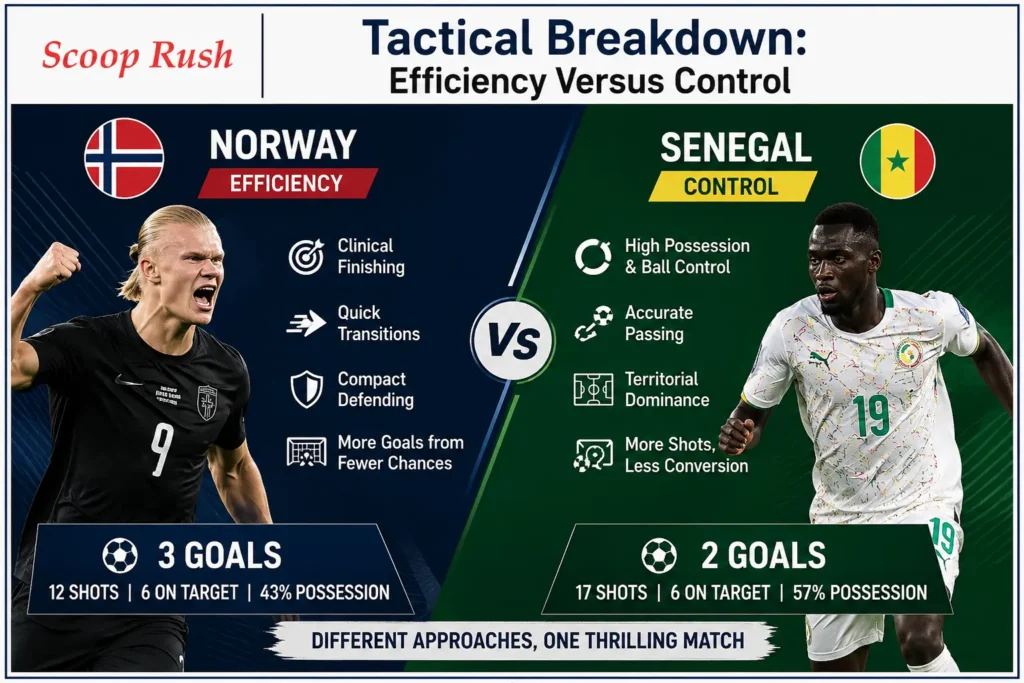
Tactical Breakdown: Efficiency Versus Control

Tactical Breakdown Efficiency Versus Control

The Norway vs Senegal Highlights showcased a fascinating tactical contrast, with Norway relying on clinical finishing while Senegal dominated possession.

Norway’s Direct Approach

Norway’s game plan centered on defensive organization and clinical attacking play.

Rather than dominating possession, they focused on:

  • Maintaining defensive shape
  • Limiting dangerous spaces
  • Transitioning quickly into attack
  • Maximizing scoring opportunities

The strategy worked exceptionally well during the decisive period between the end of the first half and the opening minutes of the second half.

Three goals across a short spell transformed the match and gave Norway a cushion they would ultimately need.

Senegal’s Possession-Based Style

Senegal’s approach emphasized:

  • Ball retention
  • Accurate passing
  • Territorial control
  • Sustained attacking pressure

Their 90% pass accuracy reflected a high level of technical quality throughout the match.

However, possession alone does not guarantee victory. Despite controlling many phases of play, Senegal struggled to convert their dominance into enough goals to overcome Norway’s lead.

Ismaila Sarr’s Late Fightback

As time began to run out, Senegal continued searching for a route back into the game.

Their determination was rewarded deep into stoppage time.

In the 90+3 minute, Ismaila Sarr scored his second goal of the evening, reducing the score to 3-2.

The goal created a tense conclusion and briefly raised the possibility of a dramatic comeback.

For Norway, those final moments required concentration and composure.

For Senegal, the late goal served as evidence of their resilience and attacking quality.

Ultimately, however, there was not enough time remaining to complete the comeback.

When the final whistle arrived, Norway had secured a crucial 3-2 victory.

Key Performers from the Match

Erling Haaland (Norway)

Haaland’s two goals proved decisive. His finishing quality helped Norway establish a three-goal advantage, and those strikes ultimately became the difference between victory and a potential draw.

Key contributions:

  • 2 goals
  • Constant attacking threat
  • Clinical finishing in crucial moments

Marcus Holmgren Pedersen (Norway)

Pedersen’s opening goal changed the dynamic of the match. Scoring just before halftime gave Norway momentum and confidence heading into the second half.

Key contributions:

  • Opening goal in the 43rd minute
  • Important momentum shift
  • Strong attacking contribution from defense

Ismaila Sarr (Senegal)

Despite ending on the losing side, Sarr delivered an impressive individual performance. His two goals ensured Senegal remained competitive until the final whistle.

Key contributions:

  • 2 goals
  • Led Senegal’s attacking response
  • Scored in both regular time and stoppage time

Impact on Group I Standings

The victory had a significant impact on the Group I standings.

Following the match:

Norway’s win allowed them to move level on points with France at the top of the group.

The standings remained tightly contested, but Norway placed themselves in a strong position by securing all three points from this encounter.

For Senegal, the defeat represented a missed opportunity despite an encouraging performance in many aspects of the game. Their possession statistics and attacking intent demonstrated quality, but the result left them needing a strong response in future matches.

What This Result Means for Norway

Norway will take several positives from this performance.

First, the team demonstrated excellent efficiency in front of goal. Second, key players stepped up when required, particularly Haaland and Pedersen. Third, the victory strengthened their standing within Group I and boosted confidence moving forward.

The ability to win matches without dominating possession can be an important trait in tournament football, and Norway showed exactly that against Senegal.

What Senegal Can Take Away

Although the result ended in disappointment, Senegal’s performance contained encouraging elements. The team controlled possession, passed accurately, created more total shots, and continued fighting until the end.

Their late push nearly produced an unlikely comeback, highlighting the character within the squad. The challenge moving forward will be converting territorial dominance into more efficient finishing and defensive solidity during critical moments.

Conclusion

Norway vs Senegal Highlights delivered one of the most entertaining FIFA World Cup 2026 Group I matches, as Erling Haaland’s brace helped Norway secure a thrilling 3-2 victory despite Senegal’s impressive fightback. Norway’s clinical finishing ultimately secured a vital win despite Senegal enjoying greater possession and passing accuracy. FIFA World Cup 2026 Group I so far. Norway’s clinical finishing, led by Erling Haaland’s second-half brace, ultimately secured a vital victory despite Senegal enjoying greater possession and passing accuracy.

Marcus Holmgren Pedersen’s first-half opener laid the foundation for success, while Ismaila Sarr’s two goals ensured the match remained competitive until the final whistle.

In the end, Norway’s ability to capitalize on key moments proved decisive. The win lifted them to six points in Group I and strengthened their position in the race for qualification, while Senegal were left to reflect on a spirited performance that fell just short of earning a result.

Neurons Break DNA to Build the Brain, Then Repair It Naturally

0

Introduction

Scientists discovered that neurons break DNA to build the brain during early development, but these cells have a powerful repair system that fixes the damage quickly.The human brain is one of the most complex structures in nature, built through millions of carefully controlled steps. During early development, newly formed neurons must travel through developing brain tissue and reach specific locations where they create the networks responsible for movement, learning, memory, and communication.

A new study has revealed a surprising part of this journey. Researchers found that developing neurons experience one of the most dangerous forms of DNA damage, known as double-strand breaks. This type of damage usually threatens cell survival because it can disrupt genetic information.

However, scientists discovered that young neurons have a unique ability. They can repair this damage quickly and continue developing normally.

The research, led by scientists from Kyoto University’s Institute for Integrated Cell-Material Sciences and collaborating institutions, shows that DNA damage and repair may be a normal part of healthy brain development.

The findings provide a new understanding of how neurons survive during growth and may help researchers explore how problems in DNA repair could influence neurological conditions.

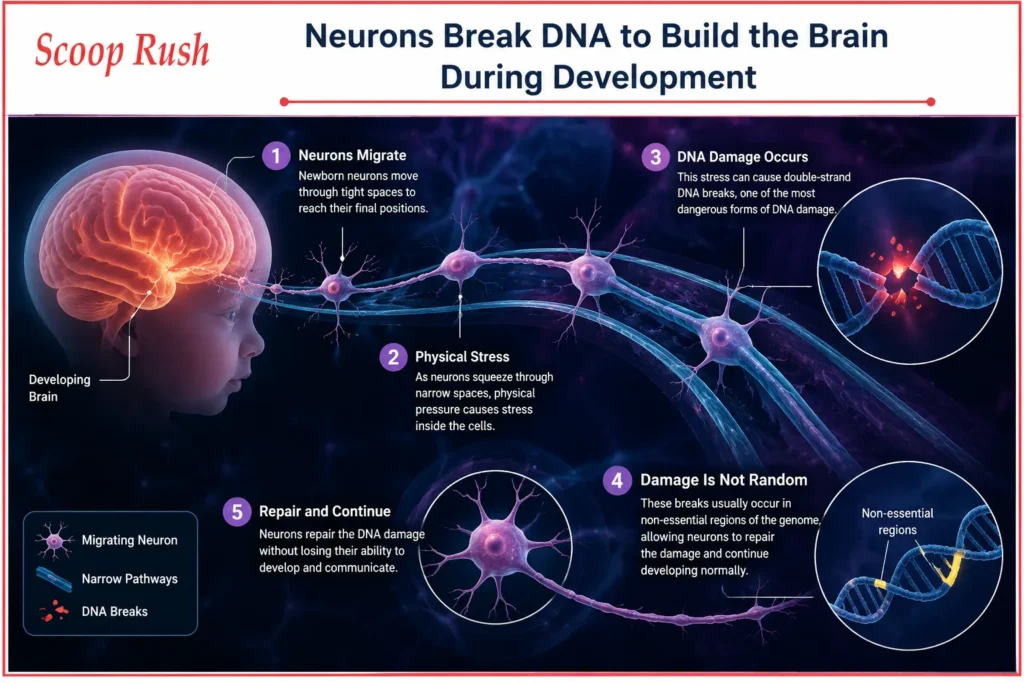
Neurons Break DNA to Build the Brain During Development

Neurons Break DNA to Build the Brain During Development

During brain development, newborn neurons do not immediately stay where they are created. Instead, they must migrate through the developing brain until they reach their final positions.

This movement is a challenging process. Neurons must squeeze through narrow spaces between tissues, fibers, and other cells. Researchers discovered that this physical pressure creates stress inside the cells.

As neurons move through these tight environments, their DNA can become damaged.

The study found that this movement causes double-strand DNA breaks, where both strands of the DNA double helix are separated.

Normally, this type of damage is considered extremely dangerous. If cells cannot repair it correctly, it can lead to mutations, abnormal cell behavior, or cell death.

However, developing neurons appear to handle this challenge in a different way.

Scientists found that these DNA breaks are not random. They usually happen in areas of the genome that are less likely to affect essential cell functions.

This allows neurons to repair the damage without losing their ability to develop and communicate.

Understanding DNA Double-Strand Breaks

DNA contains the instructions that cells need to survive and function. It is organized as a double helix made of two connected strands.

A double-strand break happens when both strands are damaged at the same location.

This is considered one of the most serious forms of DNA damage because both sides of the genetic structure are affected.

In many cells, large amounts of this damage can trigger a stress response or lead to cell death.

However, the new research shows that developing neurons have a special repair strategy.

Instead of stopping development, neurons quickly activate repair mechanisms that restore the broken DNA.

Researchers believe this ability allows the developing brain to continue growing despite the physical challenges neurons face.

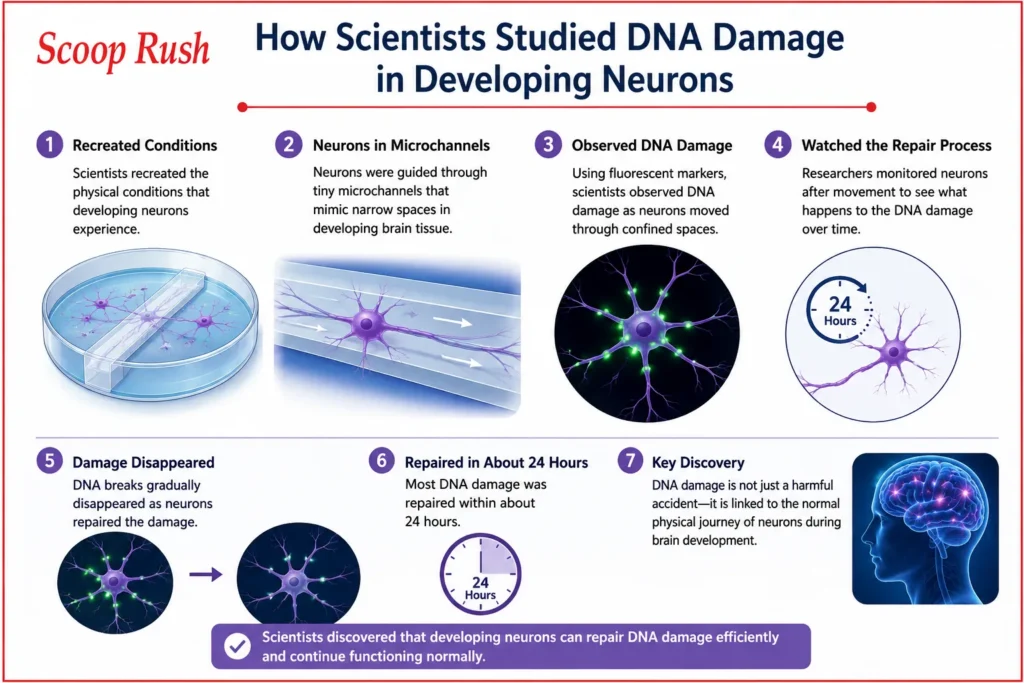
How Scientists Studied DNA Damage in Developing Neurons

How Scientists Studied DNA Damage in Developing Neurons

To understand how this process happens, researchers recreated the conditions that developing neurons experience.

The team guided neurons through tiny microchannels designed to copy the narrow spaces found inside developing brain tissue.

Using fluorescent markers, scientists observed DNA damage appearing as neurons moved through these confined spaces.

The researchers then watched what happened after the neurons completed their movement.

They found that the DNA breaks gradually disappeared as the cells repaired the damage.

Most of the damage was repaired within about 24 hours, and the neurons continued functioning normally.

This discovery showed that the DNA damage was not simply a harmful accident. Instead, it was connected to the normal physical journey neurons take during brain development.

The Role of Topoisomerase IIβ in DNA Repair

Scientists identified an enzyme called Topoisomerase IIβ as an important factor behind the DNA breaks.

Normally, this enzyme helps manage tension inside DNA.

During regular cell activity, DNA can become twisted and stressed. Topoisomerase IIβ temporarily cuts DNA strands, releases the tension, and reconnects them.

Researchers compared this process to cutting a tangled cable, fixing the problem, and joining it back together.

However, when neurons experience strong mechanical pressure while moving through narrow spaces, the enzyme can become stuck during this process.

This leaves parts of the DNA broken.

The cell then activates a repair system called non-homologous end joining.

This pathway reconnects broken DNA ends and restores the genetic material.

Why Neurons Survive While Other Cells May Fail

Scientists also compared developing neurons with cancer cells exposed to similar physical conditions.

The results showed that cancer cells experience DNA damage differently.

In cancer cells, damage can occur more randomly and may interfere with normal cell activity.

In contrast, neurons appear to control the process more effectively.

Their DNA breaks occur mainly in regions that do not contain critical genetic instructions.

Therefore, neurons can tolerate temporary DNA damage because their repair system works efficiently.

This discovery highlights the unique ability of developing brain cells to manage challenges that would be harmful to many other cell types.

What Happens When DNA Repair Fails?

To understand the importance of DNA repair, researchers studied mice with problems in Ligase 4, an enzyme required for fixing broken DNA.

The scientists removed Ligase 4 from newly developing neurons in the cerebellum.

The mice initially appeared normal. However, as they grew older, they developed gradual problems with balance and movement.

The findings suggest that when neurons cannot properly repair DNA damage during development, the effects may appear later in life.

Researchers believe this could provide important information about conditions linked to problems with genome stability.

Why This Discovery Matters for Human Brain Research

Why This Discovery Matters for Human Brain Research

Although the study was conducted using mice, researchers believe the findings may have important implications for understanding human brain development.

Human brains are larger and more complex than mouse brains. Because of this, developing human neurons may need to travel longer distances before reaching their final destinations.

This raises questions about whether human neurons experience even more DNA stress during development.

Scientists say more research is needed to understand exactly how this process works in humans.

However, the discovery provides a new way to study how the brain protects itself during one of its most important stages of growth.

Experts Explain the Importance of the Study

Professor Mineko Kengaku from Kyoto University explained that the developing brain appears to have evolved a system that allows neurons to tolerate and repair DNA damage efficiently.

The research changes how scientists view the neuronal genome.

Previously, DNA damage was mainly considered a harmful event. However, this study suggests that controlled DNA damage and repair may also play a role in normal brain development.

Researchers say the findings could help explain how small differences between neurons develop.

Although all neurons begin with the same DNA, repair processes may create small differences that contribute to individual characteristics of brain cells.

Future Research Questions

The study opens several new areas for investigation.

Scientists want to understand whether incomplete DNA repair during brain development contributes to neurological disorders.

Researchers are also exploring whether these DNA changes influence how individual neurons develop unique properties.

However, scientists emphasize that more studies are needed before connecting this process directly to specific diseases.

The current research provides important biological information about how developing neurons manage DNA damage.

Conclusion

Scientists have discovered that neurons break DNA to build the brain and then repair the damage naturally. The study showing that neurons break DNA to build the brain also highlights how the brain uses natural repair mechanisms to protect developing cells.

The finding challenges the traditional idea that DNA breaks are always harmful. In developing neurons, controlled damage and rapid repair appear to be part of a normal growth process.

The study reveals how young brain cells survive difficult conditions while forming the complex networks needed for brain function.

Future research will determine how this process works in humans and whether failures in DNA repair contribute to neurological conditions.

FAQs

Why do neurons break DNA during brain development?

Neurons can experience DNA breaks while moving through narrow spaces in developing brain tissue. Researchers found this is part of the normal development process.

Are DNA breaks dangerous for brain cells?

DNA breaks can be dangerous, but developing neurons repair them quickly and continue functioning normally.

How do neurons repair broken DNA?

Neurons use a repair pathway called non-homologous end joining to reconnect broken DNA strands.

What happens if DNA repair fails in neurons?

Studies in mice showed that failed DNA repair can lead to later problems with movement and balance.

Could this discovery help scientists understand brain diseases?

The research may provide new clues about neurological conditions, but scientists need more studies to understand the connection.

Switzerland vs Canada: Swiss Edge Canada 2-1 to Finish Top of Group B

0

Competition: FIFA World Cup 2026, Group B
Full Time: Switzerland 2-1 Canada
Venue: BC Place, Vancouver, Canada
Date: 24 June 2026

Switzerland vs Canada: Match Summary

Switzerland vs Canada ended with a 2-1 victory as Switzerland finished top of Group B with an unbeaten record. The opening half produced few clear chances, and both teams went into the break level at 0-0.

However, Switzerland made the perfect start to the second half. Ruben Vargas scored just 40 seconds after the restart before Johan Manzambi doubled the lead midway through the half. Canada responded through substitute Promise David, whose first touch produced a superb volley to set up a tense finish. Despite late pressure from the hosts, Switzerland held on to secure all three points.

The win lifted Switzerland to seven points and confirmed them as Group B winners. Meanwhile, Canada made history by reaching the FIFA World Cup knockout stage for the first time after finishing second in the group.

Switzerland vs Canada: Goalscorers

Switzerland-vs-Canada-Goalscorers
  • 46′ Ruben Vargas (Switzerland)
  • 57′ Johan Manzambi (Switzerland)
  • 76′ Promise David (Canada)

Switzerland vs Canada: Match Statistics

The statistics reflected a competitive contest. Canada created more chances, while Switzerland were more efficient in front of goal.

StatisticSwitzerlandCanada
Possession53%47%
Shots613
Shots on Target47
Expected Goals (xG)1.061.34
Passes448327
Pass Accuracy86%82%
Fouls1013
Yellow Cards02
Red Cards00
Corners37

Although Canada produced more attempts and a higher expected goals value, Switzerland converted their best opportunities and defended well under pressure.

Switzerland vs Canada: Tactical Analysis

Switzerland vs Canada showcased two teams with different approaches. After a cautious first half, the Swiss increased the tempo immediately following the restart. Quick passing and intelligent movement created gaps in Canada’s defence, leading to two decisive goals.

Canada responded with greater urgency as the match progressed. The hosts created several promising chances and gained momentum after Promise David scored with his first touch. Nevertheless, Switzerland stayed organised at the back and protected their lead until the final whistle.

Switzerland vs Canada: Key Performers

Ruben Vargas changed the game by scoring only 40 seconds into the second half. His early strike shifted the momentum firmly in Switzerland’s favour.

Johan Manzambi produced another influential display. His composed finish in the 57th minute gave Switzerland a valuable two-goal cushion.

Promise David made an immediate impact from the bench. He scored with his first touch of the match, giving Canada hope during a spirited late comeback.

Switzerland vs Canada: Final Group B Standings

Switzerland-vs-Canada-Final-Group-B-Standings
PositionTeamPlayedWonDrawnLostGoal DifferencePoints
1Switzerland3210+47
2Canada3111+54
3Bosnia and Herzegovina3111-14
4Qatar3012-81

Switzerland finished as Group B winners after collecting seven points. Canada secured second place on four points to qualify for the Round of 32. Bosnia and Herzegovina also advanced as one of the best third-placed teams after finishing with four points, while Qatar were eliminated.

Switzerland vs Canada: What the Result Means

Switzerland vs Canada confirmed Switzerland’s status as one of the strongest teams in the tournament. Winning Group B allowed the Swiss to carry valuable momentum into the knockout stage.

Canada suffered their first defeat of the campaign, but the result did not end their World Cup journey. The co-hosts reached the knockout stage for the first time in their history, marking a significant achievement despite the loss.

Conclusion

Switzerland vs Canada provided an exciting finish to Group B. After a quiet first half, Switzerland struck twice in quick succession to take control of the match. Canada responded bravely and pushed until the closing minutes, but the Swiss defence stood firm. Both nations now move into the Round of 32, where tougher challenges await.

Portugal vs Uzbekistan: Ronaldo Makes World Cup History in 5-0 Victory

0

Competition: FIFA World Cup 2026, Group K
Full Time: Portugal 5-0 Uzbekistan
Venue: Houston Stadium, Houston
Date: Tuesday, 23 June 2026

Portugal vs Uzbekistan: Ronaldo Leads Portugal to Dominant Win

Portugal vs Uzbekistan ended in a convincing 5-0 victory as Portugal produced their best performance of the FIFA World Cup 2026 so far. After drawing their opening Group K match against DR Congo, Portugal responded with an emphatic display to move into second place in the standings.

The biggest moment of the night came in the 12th minute when Cristiano Ronaldo scored to become the first player in football history to score in six different FIFA World Cup tournaments. Portugal maintained complete control throughout the match and comfortably secured all three points.

Match Summary

Portugal made an excellent start and opened the scoring after 12 minutes through Cristiano Ronaldo. The goal secured another historic milestone for the Portuguese captain.

Five minutes later, Nuno Mendes doubled Portugal’s advantage with a superb free kick that left the Uzbekistan goalkeeper with no chance.

Portugal continued to dominate possession and attacking play for the remainder of the first half. Ronaldo struck again in first-half stoppage time, scoring in the 45+1st minute to give his side a commanding 3-0 lead at the break.

The pressure continued after halftime. In the 50th minute, Uzbekistan goalkeeper Abduvohid Nematov accidentally diverted the ball into his own net, extending Portugal’s lead to four goals.

Substitute Rafael Leão completed the scoring in the 87th minute with a calm finish after another well-worked Portuguese attack.

Goalscorers

  • 12′ Cristiano Ronaldo (Portugal)
  • 17′ Nuno Mendes (Portugal)
  • 45+1′ Cristiano Ronaldo (Portugal)
  • 50′ Abduvohid Nematov (Own Goal)
  • 87′ Rafael Leão (Portugal)

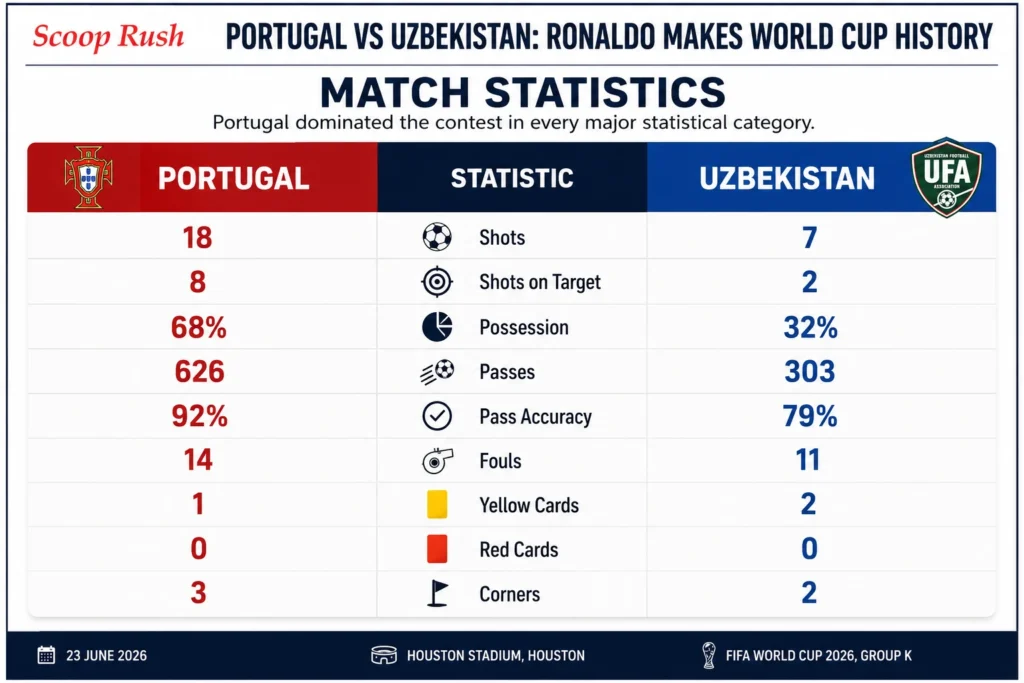
Match Statistics

Match-Statistics

Portugal dominated the contest in every major statistical category.

StatisticPortugalUzbekistan
Shots187
Shots on Target82
Possession68%32%
Passes626303
Pass Accuracy92%79%
Fouls1411
Yellow Cards12
Red Cards00
Corners32

Starting Lineups

Portugal (4-3-3)

Diogo Costa; João Cancelo, Rúben Dias, Gonçalo Inácio, Nuno Mendes; Vitinha, João Neves, Bruno Fernandes; Bernardo Silva, Cristiano Ronaldo, Diogo Jota.

Uzbekistan (3-4-3)

Abduvohid Nematov; Rustam Ashurmatov, Abdulla Abdullayev, Husniddin Aliqulov; Khojiakbar Alijonov, Odiljon Hamrobekov, Otabek Shukurov, Farrukh Sayfiyev; Jaloliddin Masharipov, Eldor Shomurodov, Abbosbek Fayzullayev.

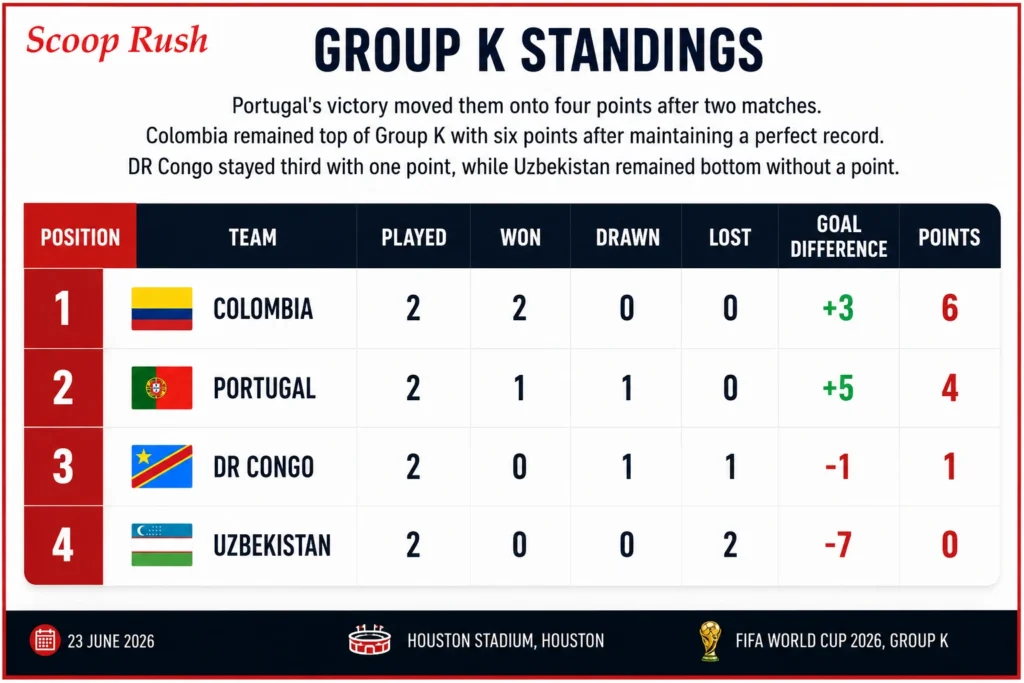
Group K Standings

Group-K-Standings

Portugal’s victory moved them onto four points after two matches. Colombia remained top of Group K with six points after maintaining a perfect record. DR Congo stayed third with one point, while Uzbekistan remained bottom without a point.

PositionTeamPlayedWonDrawnLostGoal DifferencePoints
1Colombia2200+36
2Portugal2110+54
3DR Congo2011-11
4Uzbekistan2002-70

What the Result Means

The Portugal vs Uzbekistan result significantly strengthened Portugal’s chances of qualifying for the Round of 32. After opening the tournament with a draw against DR Congo, Portugal responded with a dominant victory that greatly improved their goal difference ahead of the final group match.

For Uzbekistan, the defeat marked a second consecutive loss and confirmed their elimination from the tournament.

Player of the Match

Cristiano Ronaldo earned Player of the Match honors after delivering another memorable performance. The Portugal captain scored twice, led the attack throughout the evening, and became the first player in football history to score in six different FIFA World Cup editions.

Conclusion

The Portugal vs Uzbekistan clash will be remembered for Cristiano Ronaldo’s historic achievement and Portugal’s outstanding team display. Ronaldo’s brace, Nuno Mendes’ stunning free kick, Abduvohid Nematov’s unfortunate own goal, and Rafael Leão’s late strike secured a comprehensive 5-0 victory. Portugal now enter their final Group K fixture with strong momentum, while Colombia continue to lead the group standings.

Hantavirus: Should You Worry About This Rare Infection After the Latest Outbreak?

0

Hantavirus outbreak raises questions as experts explain the real risk

A rare infection that most people had never heard of suddenly became a global health concern after a reported hantavirus outbreak linked to a cruise ship. However, experts say the disease is not something most travelers need to panic about. The bigger concern is understanding how hantavirus spreads, why it can become dangerous, and how early medical care can improve outcomes.

Hantavirus is a group of viruses carried mainly by rodents. These viruses can cause severe illness in humans, including serious lung problems in the Americas and kidney-related complications in Europe and Asia. Although hantavirus infections can be deadly, they remain uncommon, especially compared with many everyday infectious diseases.

Medical experts, including infectious disease specialists, are encouraging people to stay informed rather than frightened. The recent attention around hantavirus highlights the importance of public health monitoring, disease research, and early detection.

What is hantavirus and why is it dangerous?

What is hantavirus and why is it dangerous?

Hantavirus refers to a group of viruses that naturally infect rodents. Different types of hantaviruses exist in different regions of the world. Rodents can carry these viruses without appearing sick, but they can spread the virus through their urine, droppings, and saliva.

Humans usually become infected after coming into contact with contaminated materials. For example, cleaning an area with rodent droppings can release particles into the air. When people breathe in these particles, infection can occur.

Unlike many common respiratory viruses, hantavirus behaves differently inside the body. New World hantaviruses, such as Andes virus and Sin Nombre virus, do not mainly destroy lung cells. Instead, they affect the cells that line blood vessels.

Scientists explain that infected blood vessel cells can lose normal function without dying. However, the connections between these cells can become weak, causing fluid from the blood to leak into surrounding tissues.

This process can quickly lead to serious breathing problems.

Why can hantavirus become life-threatening?

Hantavirus is unusual because the infection can progress rapidly after a person develops symptoms.

In severe cases, fluid can build up in the lungs, making it difficult for oxygen to enter the bloodstream. Patients may experience breathing failure, low blood pressure, and shock.

Experts studying Andes virus say the virus does not simply damage the body by destroying cells. Instead, it appears to interfere with the body’s normal balance and immune response.

One of the biggest mysteries is why blood vessels suddenly become more fragile during severe infection. Researchers are studying immune system chemicals called cytokines, including interleukin-6 (IL-6), because they may contribute to blood vessel leakage.


Hantavirus symptoms: What signs should people know?

Hantavirus symptoms: What signs should people know?

The early symptoms of hantavirus can look similar to common illnesses such as the flu.

Common early symptoms include:

  • Fever
  • Headache
  • Muscle aches
  • Tiredness
  • Abdominal discomfort
  • Nausea or vomiting

However, severe disease can develop later.

In the Americas, hantavirus may cause hantavirus pulmonary syndrome, a serious condition affecting the lungs. Symptoms can progress to:

  • Cough
  • Shortness of breath
  • Difficulty breathing
  • Low blood pressure
  • Respiratory failure

In Europe and Asia, some hantaviruses cause hemorrhagic fever with renal syndrome. This form can affect the kidneys and blood vessels and may lead to bleeding problems or kidney failure.

Symptoms usually appear after an incubation period that can range from days to several weeks depending on the virus type.

How does hantavirus spread?

The main way humans get hantavirus is through contact with infected rodents.

The virus can spread through:

  • Rodent urine
  • Rodent droppings
  • Rodent saliva
  • Contaminated dust particles

People with higher exposure risk often include those who clean abandoned buildings, work around rodents, or enter poorly ventilated spaces where rodents have been present.

For example, a reported case in Michigan involved a person who became infected after cleaning an abandoned house with a rodent infestation.

However, not all hantaviruses spread between people.

The Andes virus, found mainly in Argentina and Chile, is the only known hantavirus with documented human-to-human transmission. Even then, transmission is uncommon and usually requires close, prolonged contact.

Hantavirus and cruise ship concerns: Should travelers worry?

Hantavirus and cruise ship concerns: Should travelers worry?

The recent cruise ship situation increased public attention because many people were unfamiliar with hantavirus.

However, experts explain that travelers are much more likely to encounter common infections such as norovirus on cruise ships than hantavirus.

Similarly, people traveling by airplane are generally more likely to catch common respiratory infections than hantavirus.

Health specialists say the outbreak serves as a reminder of how connected the world has become and why disease monitoring systems are important.

Public health teams track possible cases, monitor close contacts, and provide guidance to prevent further spread.

How is hantavirus treated?

Currently, there is no specific antiviral medicine or approved vaccine that directly cures hantavirus infection.

Treatment mainly focuses on supportive medical care.

Doctors may provide:

  • Oxygen support
  • Breathing assistance
  • Monitoring of heart and kidney function
  • Treatment for complications

Early medical attention is extremely important.

Experts explain that patients who receive support quickly, especially when breathing problems begin, have a better chance of survival.

In severe cases, some patients may require advanced treatment such as mechanical ventilation or ECMO, a machine that supports the heart and lungs while the body recovers.

Researchers are also studying possible future treatments. Some approaches involve antibodies from recovered patients and medicines that may reduce harmful blood vessel leakage.

How can people prevent hantavirus infection?

The best protection against hantavirus is reducing contact with rodents.

Experts recommend:

Avoid disturbing rodent-infested areas

Do not enter places with signs of rodents unless necessary. If cleaning is required, take safety precautions.

Clean safely

Avoid dry sweeping or vacuuming rodent droppings because this can send contaminated particles into the air.

Instead:

  • Wet contaminated areas before cleaning
  • Use disinfectant solutions
  • Wear gloves
  • Wash hands afterward
  • Improve ventilation when possible

Prevent rodents from entering homes

People can reduce risk by:

  • Sealing holes and openings
  • Keeping food stored securely
  • Maintaining clean living spaces

These steps help reduce the chance of exposure.

Why scientists are studying hantavirus closely

Although hantavirus infections are rare, scientists continue researching them because they reveal important lessons about infectious diseases.

Researchers are studying how hantaviruses avoid immune defenses, how blood vessels become damaged, and how the body eventually recovers.

Interestingly, many survivors recover without permanent lung damage, which makes hantavirus different from several other severe respiratory illnesses.

Scientists hope that understanding these unusual features could lead to treatments not only for hantavirus but also for future infectious disease challenges.

Final thoughts: Is hantavirus something to fear?

Hantavirus is a serious infection that can become dangerous, but experts say it is not a common everyday threat for most people.

The biggest risk comes from direct exposure to infected rodents, especially in contaminated environments. Therefore, prevention and awareness remain the most effective protection.

The recent attention around hantavirus shows why public health systems, scientific research, and early diagnosis matter. While the infection deserves respect, accurate information is more valuable than fear.

FAQs About Hantavirus

1. What is hantavirus?

Hantavirus is a group of viruses carried by rodents that can cause serious illness in humans. Depending on the virus type and location, it can affect the lungs, kidneys, and blood vessels.

2. How do people get hantavirus?

People usually get infected by breathing in particles from infected rodent urine, droppings, or saliva. Exposure often happens while cleaning rodent-infested areas.

3. Is hantavirus contagious between people?

Most hantaviruses do not spread between humans. The Andes virus is a rare exception and has shown limited human-to-human transmission after close, prolonged contact.

4. Can hantavirus be cured?

There is currently no specific cure or approved vaccine for hantavirus. Doctors treat patients with supportive care, including oxygen and other medical support when needed.

5. How can I protect myself from hantavirus?

Avoid contact with rodents, clean contaminated areas safely, avoid dry sweeping rodent droppings, and keep homes protected from rodent entry.

England vs Ghana Ends in Goalless World Cup Draw 

0

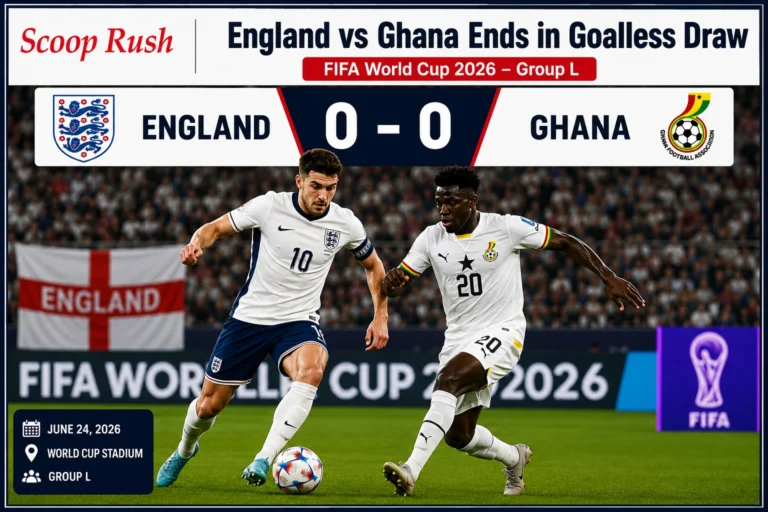
Final Score: England 0-0 Ghana
Competition: FIFA World Cup 2026 – Group L
Venue: Boston Stadium, Boston, Massachusetts, USA

England and Ghana battled to a 0-0 draw in their FIFA World Cup 2026 Group L encounter at Boston Stadium, with neither side able to find the decisive breakthrough despite an entertaining contest.

The result earned both teams a valuable point as the race for qualification from Group L remains closely contested. While England controlled much of the possession throughout the match, Ghana produced a disciplined defensive performance to deny their opponents all three points.

England vs Ghana: England Control Possession Without a Goal 

England dictated large portions of the match by enjoying the majority of possession and applying sustained pressure in Ghana’s half. However, despite controlling the tempo, they were unable to convert their territorial advantage into a goal.

England dominated possession, but Ghana’s resolute defending prevented them from finding a breakthrough, leaving both teams to share the points.

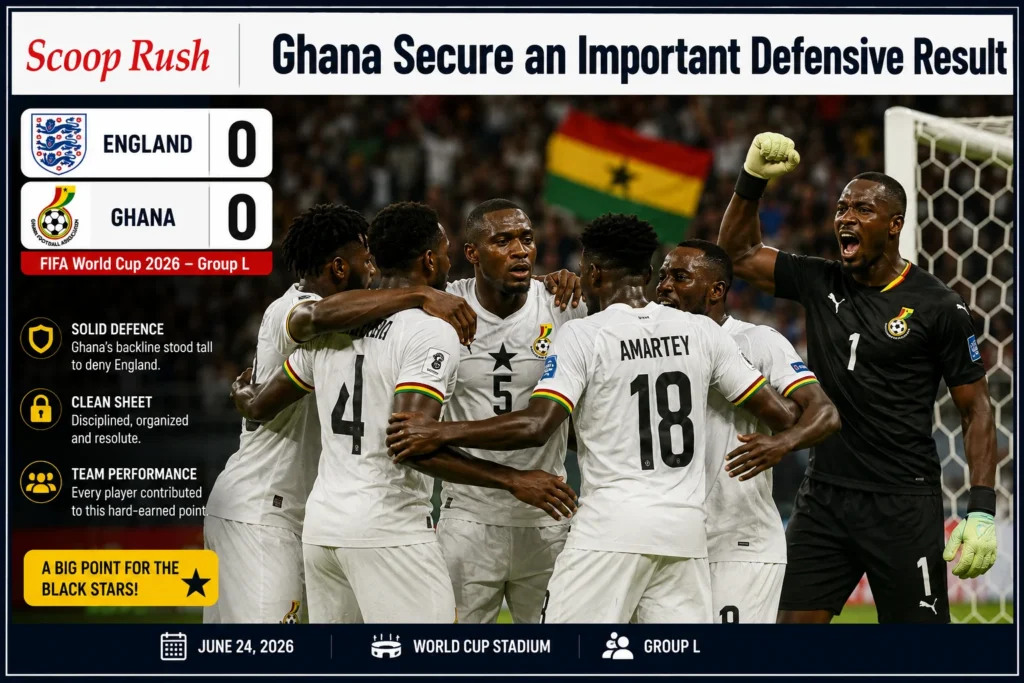
Ghana Secure an Important Defensive Result

Ghana entered the match knowing a positive result would strengthen their position in Group L, and their disciplined display ensured they left Boston Stadium with exactly that.

The African side defended with organization and resilience throughout the contest, limiting England’s opportunities and preserving a clean sheet against one of the tournament’s strongest teams.

England vs Ghana Match Summary 

The contest featured competitive football from both nations, with England seeing more of the ball while Ghana focused on maintaining a solid defensive structure. Although England spent long periods in control, neither side managed to produce the clinical finish needed to break the deadlock.

The match ultimately ended without a goal, reflecting Ghana’s defensive discipline and England’s inability to capitalize on their possession.

What the England vs Ghana Draw Means for Group L 

The draw leaves both England and Ghana with an important point in Group L as the battle for progression to the knockout stage continues.

With the group still wide open, every remaining fixture will carry added significance, making the race for qualification increasingly competitive.

Key Takeaways

  • England and Ghana played to a 0-0 draw.
  • The match was held at Boston Stadium in Boston, Massachusetts.
  • The fixture was part of the FIFA World Cup 2026 Group L stage.
  • England enjoyed the majority of possession but could not convert their control into goals.
  • Ghana’s disciplined defensive performance earned them a valuable point.
  • Both teams remain firmly in contention as Group L continues.

Final Thoughts

England may feel disappointed not to have turned their possession into victory, while Ghana will take confidence from a resilient defensive performance against one of the group’s strongest sides. With crucial matches still to come, the stalemate keeps the Group L standings finely balanced and ensures the fight for qualification remains wide open.

Jordan vs Algeria: Algeria Fight Back to Earn Crucial 2-1 FIFA World Cup 2026â„¢ Victory

0

Competition: FIFA World Cup 2026â„¢, Group J
Venue: San Francisco Bay Area Stadium, Santa Clara
Final Score: Jordan 1-2 Algeria

Jordan vs Algeria, Algeria kept their FIFA World Cup 2026â„¢ hopes alive with a spirited 2-1 comeback victory over Jordan in Group J. After trailing at halftime, the Desert Foxes produced an outstanding second-half performance to claim all three points. The result moved Algeria level with Austria on three points, setting up a decisive final group match between the two sides for a place in the Round of 32.

Jordan, already under pressure after losing their opening fixture, delivered a determined performance but were ultimately eliminated after suffering a second consecutive defeat. Meanwhile, Argentina secured first place in Group J with six points after defeating Austria.

Jordan Strike First Before Algeria Respond

Jordan frustrated Algeria throughout the opening half with disciplined defending and well-timed counterattacks. Their persistence paid off in the 36th minute when Nizar Al-Rashdan found the net to give Jordan a deserved 1-0 lead heading into halftime.

Algeria returned after the break with greater urgency and controlled the tempo for most of the second half. Their sustained pressure produced an equalizer in the 68th minute through Nadhir Benbouali, before Amine Gouiri completed the comeback with the winning goal in the 81st minute.

Jordan continued to fight until the final whistle, but Algeria managed possession effectively during the closing stages to secure a vital victory.

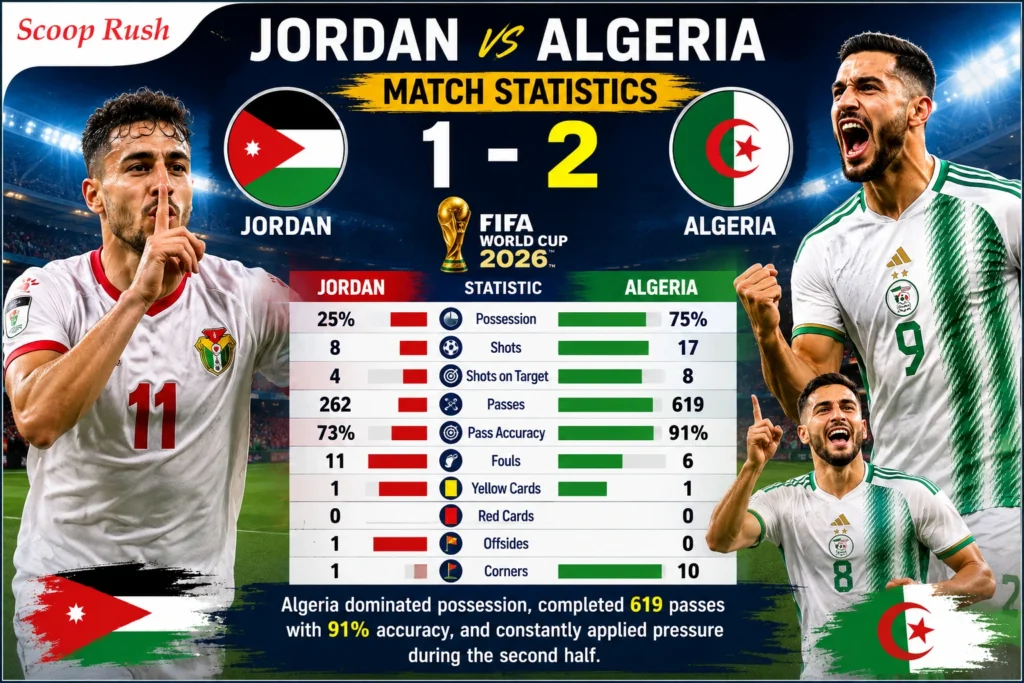
Jordan vs Algeria Match Statistics

Jordan-vs-Algeria-Match-Statistics

The numbers highlighted Algeria’s complete control of the game despite trailing at the interval.

StatisticJordanAlgeria
Possession25%75%
Shots817
Shots on Target48
Passes262619
Pass Accuracy73%91%
Fouls116
Yellow Cards11
Red Cards00
Offsides10
Corners110

Algeria dominated possession, completed 619 passes with an impressive 91 percent accuracy, and constantly applied pressure during the second half. Jordan defended resolutely but struggled to contain Algeria’s attacking momentum after the restart.

Team Lineups

Jordan (3-4-3)

  • Yazeed Abulaila (GK)
  • Abdallah Nasib
  • Husam Abu Dahab
  • Yazan Al-Arab
  • Ihsan Haddad
  • Noor Al-Rawabdeh
  • Nizar Al-Rashdan
  • Mohannad Abu Taha
  • Musa Al-Taamari
  • Ali Olwan
  • Mahmoud Al-Mardi

Algeria (4-3-3)

  • Luca Zidane (GK)
  • Rafik Belghali
  • Aïssa Mandi
  • Ramy Bensebaini
  • Rayan Aït-Nouri
  • Hicham Boudaoui
  • Ramiz Zerrouki
  • Ibrahim Maza
  • Riyad Mahrez
  • Amine Gouiri
  • Farès Chaïbi

Key Match Events

  • 36′  Jordan took the lead through Nizar Al-Rashdan.
  • HT: Jordan led 1-0 after a disciplined first-half display.
  • 68′  Nadhir Benbouali equalized for Algeria following sustained second-half pressure.
  • 81′  Amine Gouiri scored the winning goal to complete Algeria’s comeback.
  • FT: Algeria held firm during the closing minutes to earn a crucial 2-1 victory.

Group J Standings

Group-J-Standings
PositionTeamPlayedWonLostPointsStatus
1Argentina2206Qualified (Group Winners)
2Austria2113In Contention
3Algeria2113In Contention
4Jordan2020Eliminated

Argentina have secured first place in Group J after collecting six points from two matches. Austria and Algeria now enter their final group match level on three points, with a place in the Round of 32 at stake. Jordan have been eliminated after consecutive defeats.

What the Result Means

Algeria’s dramatic comeback kept their FIFA World Cup 2026â„¢ campaign alive and set up a high-stakes showdown with Austria in the final Group J fixture. A victory in that match would secure qualification for the Round of 32.

Jordan showed resilience by taking a first-half lead and defending well for long periods. However, Algeria’s quality, squad depth, and second-half tactical adjustments eventually proved decisive, ending Jordan’s hopes of progressing beyond the group stage.

Key Takeaways

  • Algeria came from behind to defeat Jordan 2-1.
  • Jordan led 1-0 at halftime through Nizar Al-Rashdan.
  • Nadhir Benbouali equalized before Amine Gouiri scored the winning goal.
  • Algeria dominated possession with 75 percent and completed 619 passes.
  • Argentina finished as Group J winners, while Algeria and Austria set up a high-stakes final-day showdown for the remaining Round of 32 place.

How to Keep Your Home Cool in Hot Weather: 6 Expert Tips That Really Work

0

Rising Temperatures? These Simple Cooling Tricks Can Make a Big Difference

When temperatures climb and heatwaves settle in, keeping your home comfortable can feel like a daily challenge. Many people immediately think of air conditioning as the only solution. However, experts say there are several simple, low-cost ways to stay cool while reducing energy use.

From improving airflow to using fans more effectively, small adjustments can help lower indoor temperatures and improve comfort during hot weather. These practical strategies are especially useful for people looking to stay cool without significantly increasing electricity bills.

Why Keeping Cool Matters During Hot Weather

Why Keeping Cool Matters During Hot Weather|scooprush

Extreme heat is more than just uncomfortable. It can affect sleep, reduce productivity, and increase the risk of heat-related illnesses. Homes can trap heat throughout the day, making indoor temperatures remain high long after the sun goes down.

Fortunately, experts recommend several straightforward methods that can help reduce heat buildup and improve air circulation. Many of these solutions cost little or nothing to implement. It is also worth knowing that heat and humidity risks for seniors are especially serious, as older adults are far more vulnerable to dangerous indoor temperatures.

Let in Cool Air and Improve Airflow

Let in Cool Air and Improve Airflow|scooprush

One of the most effective natural cooling methods is to encourage airflow throughout the home.

Open Windows at the Right Time

Experts recommend opening windows on opposite sides of the house when outdoor temperatures are cooler than indoor temperatures. This usually happens overnight or during the early morning hours.

Creating this cross-ventilation allows trapped warm air to escape while cooler air enters the home. As a result, rooms can feel fresher and more comfortable without relying on mechanical cooling.

Release Hot Air From Upper Floors

Because hot air naturally rises, upper levels of a home often become much warmer than lower floors.

If your home has loft vents, attic windows, or roof openings, opening them can help release accumulated heat. This strategy is particularly useful for bedrooms located on upper floors where sleeping conditions can become uncomfortable during hot nights.

Improve Airflow in Apartments

People living in apartments or flats with windows on only one side can still improve ventilation.

Opening interior doors and strategically placing a fan near a window can help move air through the living space and reduce stagnant heat.

Keep Hot Air Out During the Day

While opening windows can help during cooler hours, experts advise doing the opposite during the hottest part of the day.

Close Windows and Curtains

As temperatures rise, keeping windows shut prevents hot outdoor air from entering.

At the same time, closing curtains, blinds, or shades blocks direct sunlight from heating indoor spaces. This is particularly important for windows that face the sun for extended periods.

By limiting solar heat gain, homeowners can keep indoor temperatures lower throughout the afternoon.

Use Window Coverings Strategically

Curtains and blinds act as barriers against sunlight. Therefore, keeping them closed in sunny rooms can significantly reduce heat buildup.

This simple step often provides immediate relief and can lessen the need for air conditioning.

Use Fans to Enhance Cooling

Use Fans to Enhance Cooling|scoorush

Fans remain one of the most affordable and energy-efficient cooling tools available.

Create a Stronger Breeze

Positioning a fan near an open window can help draw cooler outside air into a room when outdoor temperatures are lower.

Meanwhile, using multiple fans can create a stronger cross-current that improves air circulation throughout the house.

Try the Ice-and-Fan Method

Experts also suggest placing a bowl of ice or ice cubes in front of a fan.

As air moves across the ice, it can feel noticeably cooler. Although this method does not lower room temperature significantly, it can improve personal comfort during hot periods.

Fan Placement Matters

According to heat experts, directing airflow toward the face can improve thermal comfort quickly.

However, moving air across the entire body may help lower body temperature more effectively.

Know When Fans May Not Help

Fans are most effective when temperatures remain below extreme levels.

When temperatures rise above 35°C (95°F), circulating hot air may actually increase heat stress. In these situations, fans alone may provide limited relief.

Limit Activities That Generate Heat

Many everyday activities add unnecessary heat to indoor spaces.

Reduce Cooking During Peak Heat

Ovens and stovetops generate substantial heat while in use. They also continue releasing heat after cooking is finished.

For this reason, experts recommend choosing cold meals such as salads during the hottest parts of the day.

This approach helps keep kitchens cooler while reducing overall indoor heat.

Delay Heat-Producing Chores

Household appliances such as washing machines and dishwashers also contribute to rising indoor temperatures.

Whenever possible, run these appliances during cooler morning or evening hours instead of during peak afternoon heat.

Reduce Indoor Humidity

Heat often feels worse when humidity levels are high.

Humidity makes it harder for sweat to evaporate, which reduces the body’s natural cooling ability.

Simple Ways to Lower Humidity

Experts recommend several easy steps:

  • Take shorter and cooler showers
  • Wipe excess water from bathroom and kitchen surfaces
  • Move indoor plants outdoors temporarily when possible

These small changes can help reduce moisture levels and improve comfort indoors.

Understand the Difference Between Heat Exhaustion and Heatstroke

Hot weather can lead to serious health problems if precautions are not taken.

Signs of Heat Exhaustion

Common symptoms include:

  • Feeling faint or dizzy
  • Heavy sweating
  • Clammy skin
  • Nausea or vomiting
  • Muscle cramps

Heat exhaustion is usually manageable if the person cools down quickly and stays hydrated. People managing chronic conditions such as type 1 diabetes should be especially cautious, as heat can affect blood sugar levels and make symptoms worse.

Signs of Heatstroke

Heatstroke is a medical emergency.

Symptoms may include:

  • Confusion
  • Hot, dry skin
  • Little or no sweating
  • Body temperature above 40°C
  • Loss of consciousness
  • Seizures

Immediate emergency medical assistance is required if heatstroke is suspected.

Cool Your Body Safely

Keeping your body temperature under control is just as important as cooling your home.

Take Tepid Showers

Experts recommend tepid rather than extremely cold showers.

Very cold water can cause blood vessels near the skin to constrict, making it harder for the body to release internal heat.

A moderately cool shower helps lower skin temperature while allowing the body to continue cooling itself naturally.

Use Ice Packs Carefully

Applying a cold-water bottle or ice pack can provide quick relief.

However, experts suggest wrapping it in a towel before placing it against the skin to prevent discomfort or irritation.

Wear Clothing That Helps You Stay Cool

The clothes you wear can have a major impact on comfort during hot weather.

Choose Natural Fabrics

Materials such as cotton and linen help regulate body temperature because they allow air to circulate more freely.

Loose-fitting clothing also creates space for airflow, helping sweat evaporate more effectively.

Don’t Forget Bedding

Cotton bed sheets can improve sleeping comfort by allowing heat and moisture to escape more easily during warm nights.

Stay Hydrated Throughout the Day

Hydration plays a crucial role in helping the body manage heat.

Experts recommend drinking water regularly and choosing foods with high water content.

Fruits, vegetables, and other water-rich foods can help maintain hydration levels while supporting overall health. It is equally important to be careful about what supplements you take during hot weather, as some vitamins and minerals can affect kidney function and fluid balance. Learn more about the risks of taking too many vitamins and supplements before adding anything new to your routine.

Seek Out Cooler Public Spaces

Sometimes home cooling strategies are not enough.

Use Air-Conditioned Public Buildings

Libraries, shopping centers, and leisure facilities often provide air-conditioned environments where people can cool down safely.

These spaces can offer valuable relief during prolonged periods of extreme heat.

Community Cooling Spaces

Some cities have established dedicated “cool spaces” that are open to the public during heatwaves.

These locations provide a safe environment for individuals who may struggle to keep their homes cool.

Conclusion

Keeping your home cool during hot weather does not always require expensive equipment or constant air conditioning. Experts recommend focusing on airflow, blocking heat during the day, using fans effectively, reducing indoor heat sources, and taking steps to cool your body safely.

Simple measures such as opening windows during cooler hours, closing curtains during the day, choosing lightweight clothing, and staying hydrated can make a significant difference. By combining these strategies, households can stay more comfortable, reduce energy use, and better protect themselves from the risks associated with extreme heat.

FAQs

1. What is the best way to cool a house naturally?

Opening windows on opposite sides of the house during cooler hours creates cross-ventilation, which helps remove trapped heat and bring in cooler air.

2. Should windows stay open during a heatwave?

Windows should generally remain closed during the hottest part of the day and opened when outdoor temperatures become cooler than indoor temperatures.

3. Do fans actually lower room temperature?

Fans do not significantly lower room temperature, but they improve air movement and help people feel cooler.

4. Why does humidity make hot weather feel worse?

Humidity reduces the evaporation of sweat, making it harder for the body to cool itself naturally.

5. What is the difference between heat exhaustion and heatstroke?

Heat exhaustion causes symptoms such as dizziness and heavy sweating, while heatstroke is a medical emergency that may include confusion, high body temperature, and loss of consciousness.

Argentina vs Austria: Messi Makes History in 2-0 FIFA World Cup 2026 Win

0

Competition: FIFA World Cup 2026 – Group J
Full Time: Argentina 2-0 Austria
Venue: Dallas Stadium (AT&T Stadium), Arlington, Texas, USA
Date: June 22, 2026

Argentina vs Austria: Match Summary

Argentina secured a comfortable 2-0 victory over Austria to continue their impressive FIFA World Cup 2026 campaign. The defending champions controlled possession, dictated the tempo, and created the majority of the game’s clear-cut chances while limiting Austria to very few attacking opportunities.

The match belonged to Lionel Messi, who bounced back from an early penalty miss to score both goals in Argentina’s victory. His first strike gave the defending champions the lead, while his stoppage-time finish sealed the 2-0 win and took his tournament tally to 18 FIFA World Cup goals, extending his record as the competition’s all-time leading goalscorer.

With the victory, Argentina booked their place in the Round of 32 with one group-stage match remaining.

Argentina vs Austria: Goals & Key Moments

The match featured drama from the opening minutes before Messi delivered another historic performance.

8′ – Penalty Miss: Argentina earned an early penalty after Lautaro Martínez was brought down inside the box. Messi stepped up but dragged his effort wide of the right post.

38′ – Lionel Messi (Argentina 1-0 Austria): Argentina finally found the breakthrough when Facundo Medina delivered a low cross into the area. Thiago Almada’s intelligent dummy allowed Messi to finish first time into the bottom corner.

90+4′ – Lionel Messi (Argentina 2-0 Austria): Deep into stoppage time, Messi reacted quickest to a loose ball inside the penalty area and calmly fired home to seal the victory and complete his historic brace.

Despite the early setback from the penalty spot, Messi responded in typical fashion with a match-winning performance.

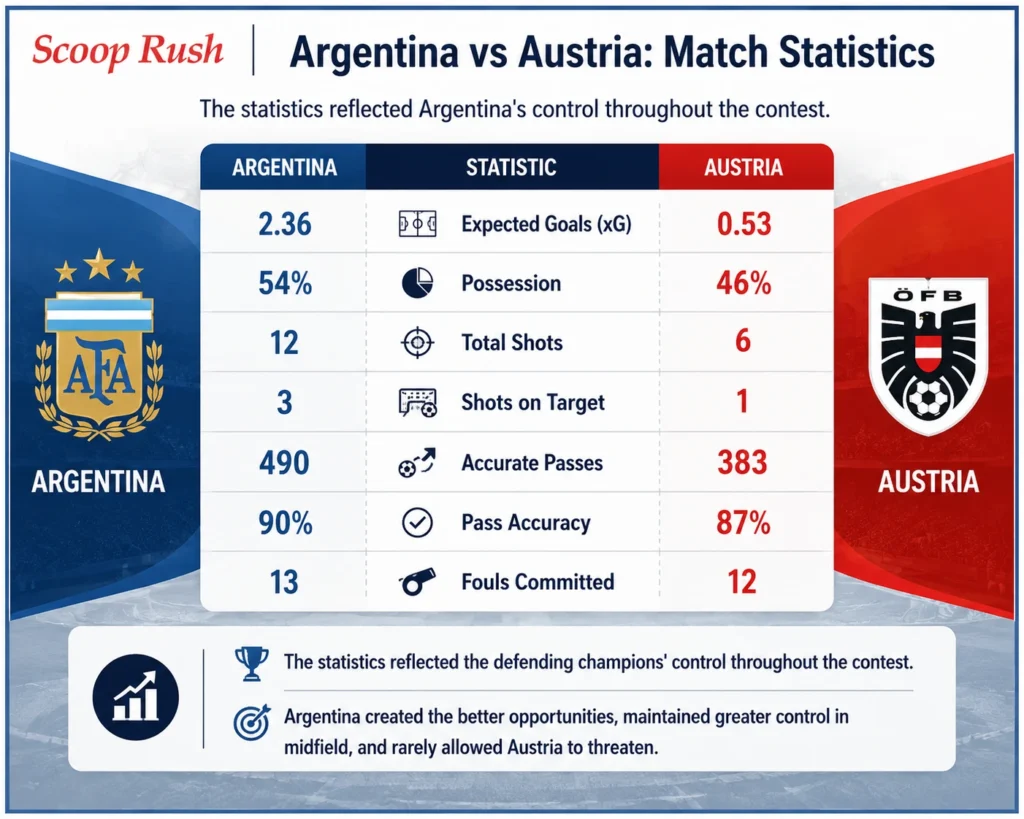
Argentina vs Austria: Match Statistics

Argentina-vs-Austria-Match-Statistics

The statistics reflected Argentina’s control throughout the contest.

StatisticArgentinaAustria
Expected Goals (xG)2.360.53
Possession54%46%
Total Shots126
Shots on Target31
Accurate Passes490383
Pass Accuracy90%87%
Fouls Committed1312

The statistics reflected the defending champions’ control throughout the contest.
Argentina created the better opportunities, maintained greater control in midfield, and rarely allowed Austria to threaten.

Argentina vs Austria: Tactical Analysis

Throughout the match, Lionel Scaloni’s side demonstrated why they remain among the tournament favorites. Patient build-up play, intelligent movement between the lines, and quick passing combinations consistently pulled Austria’s defensive shape out of position.

Facundo Medina and Thiago Almada played important supporting roles by providing width and creativity, while Messi frequently drifted into central pockets to influence attacks.

Austria defended with discipline in a compact shape and attempted to frustrate Argentina through organized defensive lines. However, they struggled to maintain possession in advanced areas and managed just one shot on target throughout the match.

Argentina’s defense remained composed, preventing Austria from creating sustained pressure for long periods.

Argentina vs Austria: Messi Rewrites FIFA World Cup History

The biggest talking point from the match was another historic milestone for Lionel Messi.

After missing an early penalty, the Argentine captain showed remarkable composure to score twice. His opening goal brought him level with the all-time FIFA World Cup scoring record, while his stoppage-time strike moved him clear with 18 career World Cup goals, making him the competition’s outright leading goalscorer.

The achievement highlighted both his resilience and his ability to deliver on football’s biggest stage.

Argentina vs Austria: What the Result Means

Argentina’s victory secured qualification for the Round of 32 and maintained their unbeaten start to the tournament. With six points from two matches, they also strengthened their position at the top of Group J heading into their final group fixture.

Austria suffered their first defeat of the campaign but remained in contention for a knockout-stage place. Their final group match against Algeria became a must-win encounter to keep their qualification hopes alive.

Conclusion

Argentina vs Austria will be remembered as the night Lionel Messi added another unforgettable chapter to his legendary career. Although he missed an early penalty, he responded with two goals that inspired Argentina to a deserved 2-0 victory and secured another historic World Cup milestone.

Argentina once again showcased their balance, control, and attacking quality, while Austria fought hard but struggled to create meaningful chances. With qualification already secured, the defending champions head into the knockout stage full of confidence, and Messi’s record-breaking performance will remain one of the defining moments of the FIFA World Cup 2026.