
Introduction
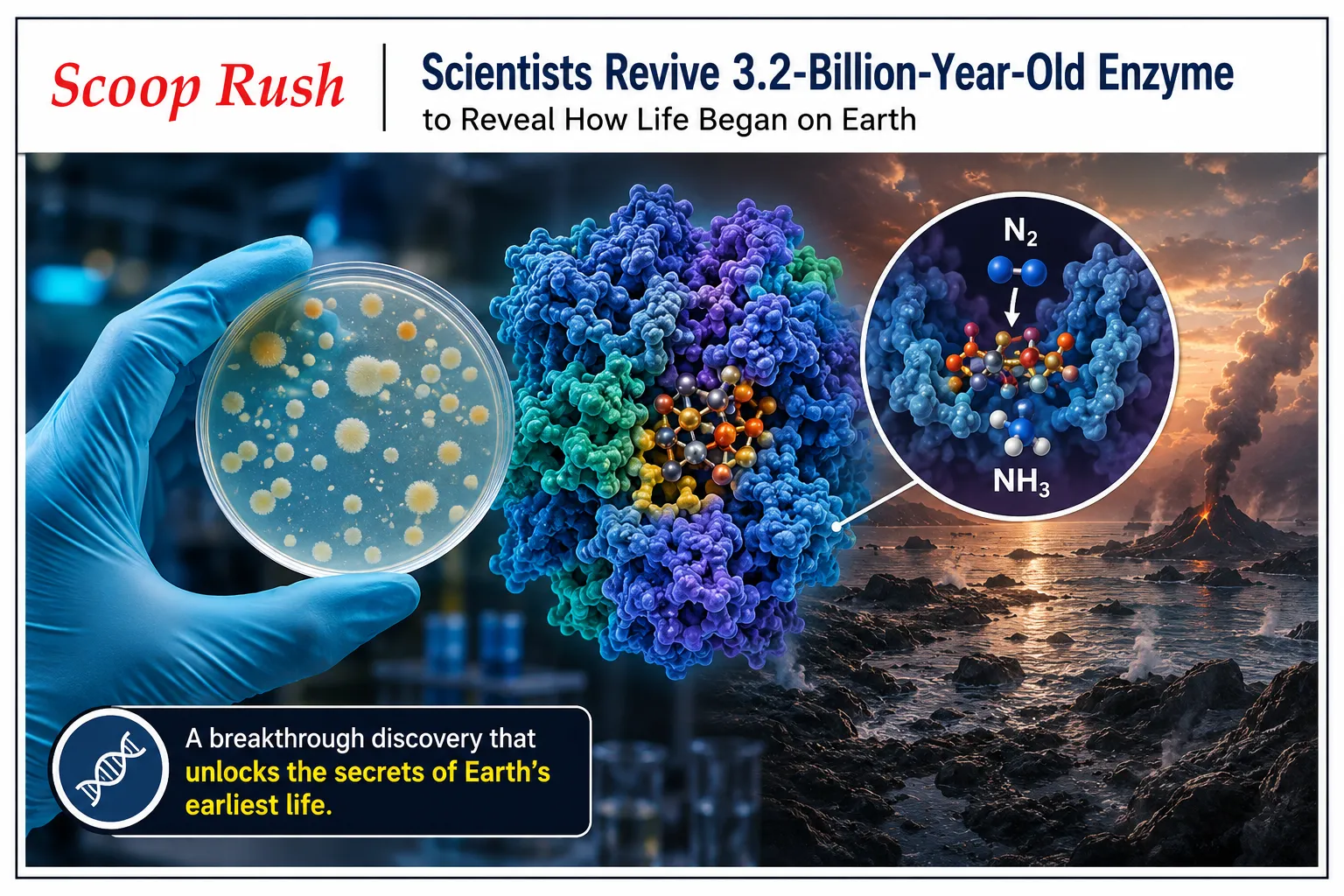
What if scientists could bring a tiny piece of Earth’s earliest life back into the laboratory? That idea sounds like science fiction, but researchers have now done exactly that. By reconstructing an ancient enzyme that likely existed around 3.2 billion years ago, scientists have uncovered new clues about how life survived on early Earth and how we might recognize life on distant planets.
This breakthrough, published in Nature Communications, gives researchers a powerful new way to study the deep history of life. Instead of relying only on ancient rocks and fossils, scientists recreated long-extinct versions of a vital enzyme inside living microbes to observe how it worked billions of years ago. The findings not only improve our understanding of Earth’s earliest ecosystems but could also support future agriculture, space exploration, and the ongoing search for extraterrestrial life.
Nitrogen is one of the fundamental elements required by every known living organism. It plays a critical role in building DNA, RNA, proteins, enzymes, and many other cellular molecules. However, atmospheric nitrogen exists primarily as nitrogen gas (N₂), which is extremely stable and cannot be used directly by most living organisms. This is where nitrogenase becomes essential — it converts atmospheric nitrogen into biologically available compounds that plants can absorb, and animals and humans then obtain nitrogen by consuming plants or other animals.
Why the 3.2-Billion-Year-Old Enzyme Discovery Is So Important

Researchers from the University of Wisconsin-Madison, Utah State University, and collaborators in NASA’s Metal Utilization and Selection across Eons (MUSE) project successfully reconstructed ancient versions of nitrogenase, one of the most important enzymes for life.
According to Utah State University biochemist Lance Seefeldt, every living organism depends on this process in some way. Without nitrogen fixation, life as we know it simply could not exist.
By reviving ancestral versions of this enzyme using synthetic biology, researchers gained an unprecedented look at biological processes that occurred billions of years before complex life appeared. The research marks a significant step forward because it allows scientists to study ancient biology directly instead of depending entirely on geological evidence.
How Scientists Recreated the 3.2-Billion-Year-Old Enzyme
Using Synthetic Biology to Bring an Ancient Enzyme Back
Instead of searching for impossible-to-find fossilized enzymes, researchers used a technique known as synthetic biology. Scientists started with modern nitrogenase genes, and using evolutionary analysis, they predicted what ancestral versions of those genes likely looked like billions of years ago. They then synthesized those ancient genes in the laboratory and inserted them into living microbes — effectively allowing the team to “resurrect” enzymes that disappeared billions of years ago, much like how researchers elsewhere have studied ancient DNA mechanisms shaping biology today.
How Researchers Tested the Ancient Nitrogenase
According to senior scientist Derek Harris, researchers created a library of reconstructed nitrogenase genes and carefully measured how each version processed nitrogen under controlled laboratory conditions. These experiments helped reveal how ancient nitrogenases likely functioned on early Earth.
For decades, scientists have studied early life mainly through fossils and ancient rocks. While those records are valuable, they have important limitations — many rocks from Earth’s earliest history have been altered over billions of years, fossils from microbial life are extremely rare, and ancient enzymes almost never survive. This new approach changes that, giving scientists a much clearer picture of Earth’s biological history, similar to how the discovery of a new beetle species or a cannibal supergiant microbe expands our understanding of life’s diversity.
How the 3.2-Billion-Year-Old Enzyme Reveals Earth’s Earliest Life
What Earth Looked Like 3.2 Billion Years Ago
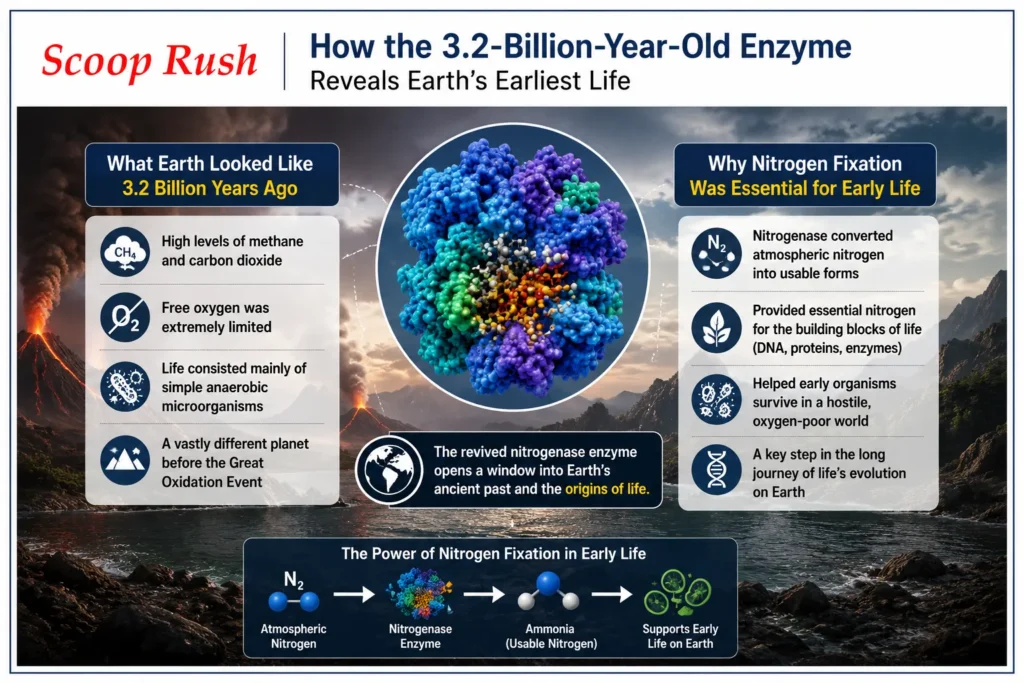
The Earth that existed more than three billion years ago looked nothing like today’s world. Before the Great Oxidation Event, Earth’s atmosphere contained much higher levels of methane and carbon dioxide, and free oxygen was extremely limited. Life consisted mainly of simple anaerobic microorganisms that survived without oxygen. Understanding how these organisms lived helps scientists reconstruct one of the most important chapters in Earth’s history.
Why Nitrogen Fixation Was Essential for Early Life
The revived nitrogenase offers a direct connection to that ancient world. Understanding how early organisms accessed usable nitrogen helps explain how life sustained itself long before complex ecosystems existed, much as researchers today study how neurons break DNA to build the brain to understand life’s more recent evolutionary leaps.
3.2-Billion-Year-Old Enzyme Confirms Ancient Rock Evidence
Understanding Nitrogen Isotope Biosignatures
Although enzymes themselves do not fossilize, their activity leaves behind chemical evidence. Nitrogen fixation creates distinctive nitrogen isotope signatures, and these isotope patterns can become preserved inside ancient rocks for billions of years. Scientists have long assumed that ancient nitrogenase produced the same isotope patterns seen today, but nobody had tested that assumption directly — until now.
Why the Ancient Enzyme Produced Modern Chemical Signatures
Researchers discovered that the reconstructed ancient nitrogenase produced nearly the same nitrogen isotope signatures as modern nitrogenase. This finding confirms an assumption that geologists have relied upon for decades. Even though the enzyme’s DNA sequence changed substantially during evolution, its basic chemical function remained remarkably consistent. That means scientists can have greater confidence when interpreting nitrogen isotope signatures found in Earth’s oldest rocks.
How the 3.2-Billion-Year-Old Enzyme Could Help Agriculture
Improving Future Nitrogen Fixation Research
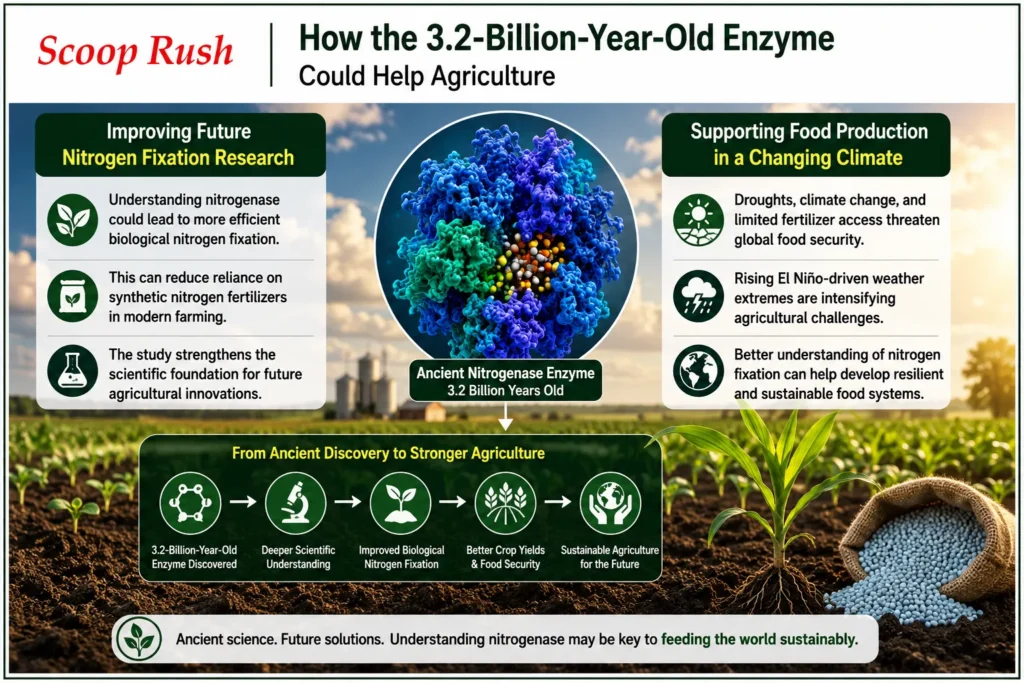
The study may also contribute to solving agricultural challenges here on Earth. Modern farming depends heavily on nitrogen fertilizers, and scientists believe that improving our understanding of nitrogenase could eventually support more efficient biological nitrogen fixation.
Supporting Food Production in a Changing Climate
Drought, climate change, and limited access to fertilizers create serious problems in many parts of the world, and rising El Niño-driven weather extremes are only expected to intensify these pressures. Although this study does not introduce new farming technology, it strengthens the scientific foundation for future research aimed at improving crop production.
Why the 3.2-Billion-Year-Old Enzyme Matters for Space Exploration
Searching for Life Beyond Earth
One of the most exciting aspects of the research is its connection to astrobiology. NASA funded the project through its MUSE consortium because understanding ancient Earth also helps scientists search for life elsewhere. If nitrogen isotope signatures reliably indicate biological activity on Earth, similar signatures could become valuable clues when studying Mars or other potentially habitable worlds, building on ongoing work around ancient life on Mars.
Professor Betül Kaçar, who leads the MUSE project, explains that scientists must first understand Earth’s own biological history before interpreting possible evidence of life beyond our planet. In other words, Earth serves as the testing ground for future discoveries across the universe — the kind of long-range observation also enabled by missions like the recently rescued Swift telescope.
Growing Food During Future Mars Missions
Nitrogen fixation is essential for growing crops. Future human missions to the Moon or Mars will likely require sustainable food production systems, and understanding nitrogenase more completely may help scientists develop better biological systems for supporting agriculture during long-duration space exploration.
What Scientists Will Study After Reviving the 3.2-Billion-Year-Old Enzyme
Understanding How Nitrogenase Evolved
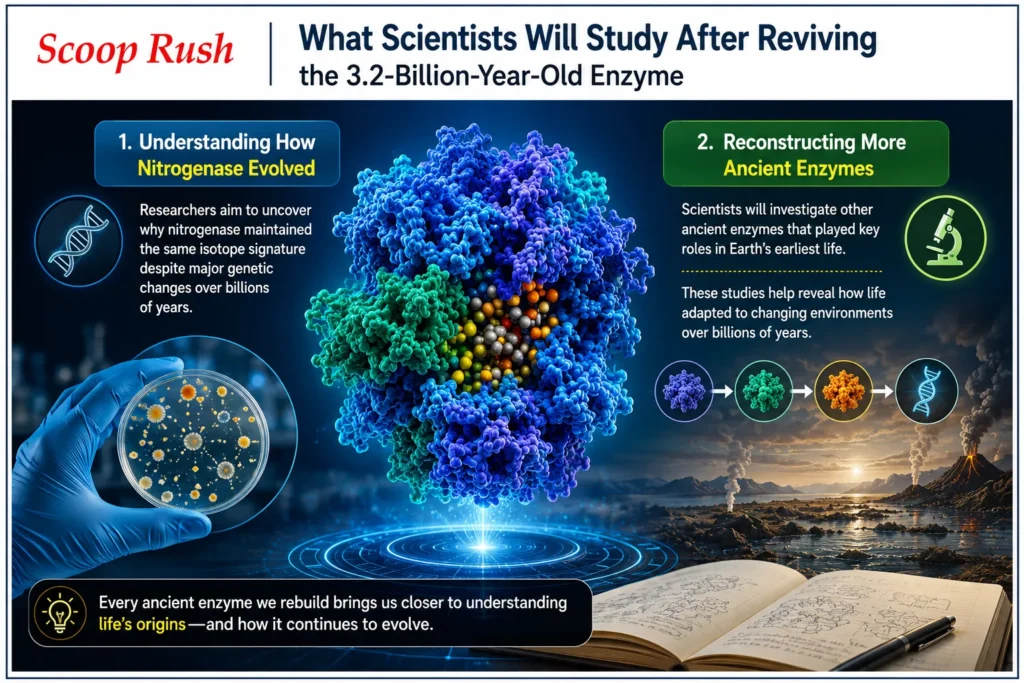
Although this study answered one major question, it also opened several new ones. Researchers now want to understand why nitrogenase maintained the same isotope signature despite major genetic changes.
Reconstructing More Ancient Enzymes
Researchers also plan to investigate other ancient enzymes that played key roles during Earth’s earliest biological evolution. Each reconstructed enzyme offers another opportunity to understand how life adapted to changing environments over billions of years, echoing how scientists are still uncovering why algae blooms die off in modern ecosystems.
Key Findings from the 3.2-Billion-Year-Old Enzyme Study
- Scientists reconstructed nitrogenase enzymes that likely existed around 3.2 billion years ago.
- The ancient enzymes functioned successfully inside modern microbes.
- Ancient nitrogenase produced the same nitrogen isotope signatures as modern versions.
- The findings strengthen scientists’ confidence in interpreting Earth’s oldest rocks.
- The research supports future studies of Earth’s origins, agriculture, and astrobiology.
Conclusion: Why the 3.2-Billion-Year-Old Enzyme Changes Our Understanding of Life
Reviving a 3.2-billion-year-old enzyme represents far more than an impressive laboratory achievement. It gives scientists an entirely new way to investigate life’s earliest history. By reconstructing ancient nitrogenase, researchers confirmed that one of biology’s most important chemical signatures has remained stable across billions of years. That discovery strengthens our understanding of Earth’s oldest geological records while providing valuable tools for future research.
The work also bridges multiple scientific fields, from evolutionary biology and geology to agriculture and space exploration. As scientists continue reconstructing ancient enzymes, they may uncover even more clues about how life first emerged, adapted, and eventually transformed our planet. Understanding Earth’s distant past could ultimately help humanity answer one of science’s greatest questions: Are we alone in the universe?
FAQs About the 3.2-Billion-Year-Old Enzyme
What is the 3.2-billion-year-old enzyme?
Researchers reconstructed an ancient version of nitrogenase, an enzyme that converts atmospheric nitrogen into a usable form for living organisms.
Why is nitrogenase important?
Nitrogenase performs nitrogen fixation, allowing plants and other organisms to obtain the nitrogen needed to build DNA, proteins, and other essential molecules.
How did scientists recreate the ancient enzyme?
The original enzyme no longer exists. Instead, researchers used synthetic biology and evolutionary analysis to reconstruct what ancient versions likely looked like, then inserted the synthesized genes into living microbes.
Can this discovery help find alien life?
Yes. The study confirms that nitrogen isotope signatures produced by nitrogenase have remained stable for billions of years. Similar chemical signatures could help scientists identify evidence of life on other planets.
Could this research improve agriculture?
Potentially. A better understanding of nitrogen fixation may support future research aimed at improving crop production and reducing dependence on synthetic fertilizers.

