
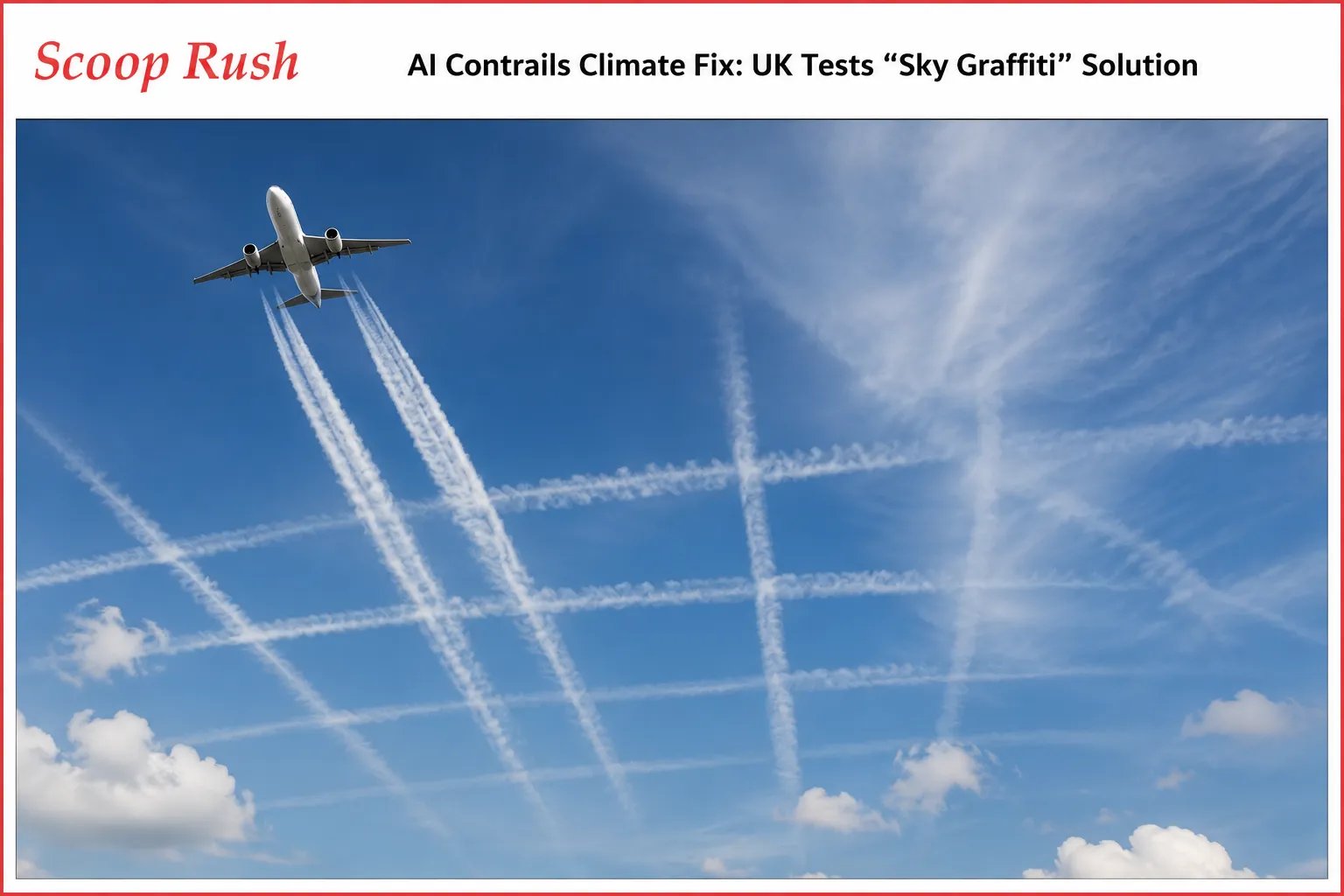
Ever looked up and wondered why those white lines behind a plane never seem to disappear? Scientists say an AI contrails climate trial is now underway to fix exactly this problem, since these streaks may be quietly fueling a third of aviation’s entire climate impact.
Introduction
Contrails, the icy white streaks that trail behind aircraft, are more than just a familiar sight in the sky. According to researchers, contrail warming may account for roughly a third of aviation’s total climate impact. That is why a new AI contrails climate trial is now underway in the UK, and it could change how planes fly across one of the world’s busiest air corridors.
Google, the UK government, the Met Office, air traffic control provider NATS, and researchers from Cambridge and Imperial College London have joined forces on a £5 million project called Operation Blue Skies. Their goal is straightforward. Use AI to predict where contrails are likely to form, then guide planes around those zones before the warming clouds ever appear.
This story matters because air travel keeps growing every year. Therefore, finding a low-cost way to cut aviation emissions without changing how people fly is a genuinely rare opportunity. If this AI contrails climate approach works, it could offer airlines a practical fix that barely touches passengers’ experience.
What Are Contrails and Why Do They Warm the Planet?
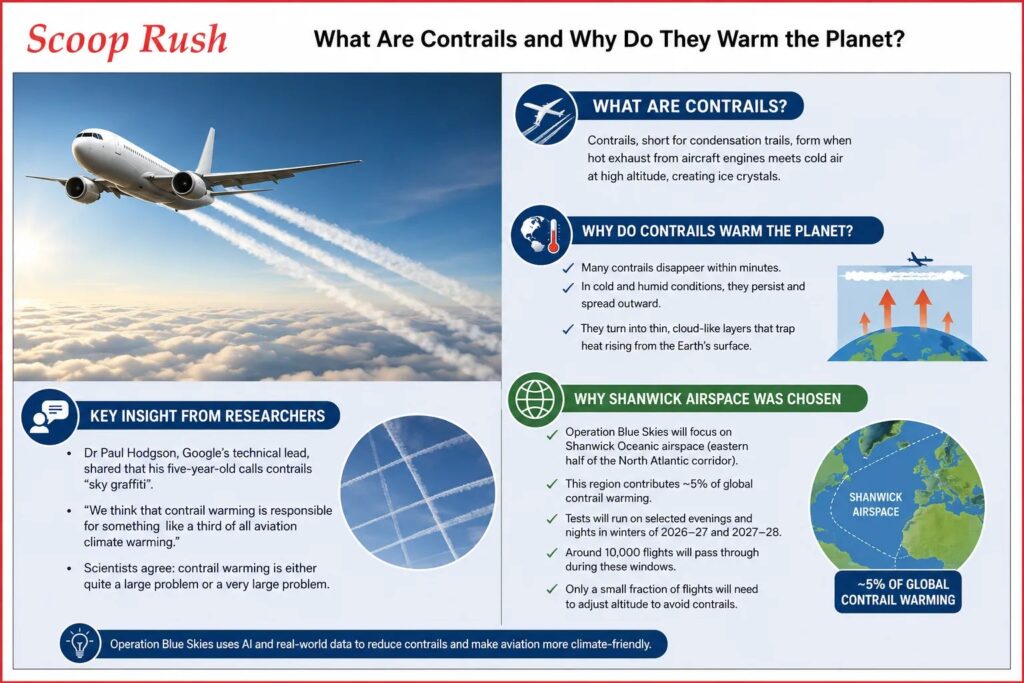
Contrails, short for condensation trails, form when hot exhaust from aircraft engines meets cold air at high altitude. This collision creates ice crystals, which is exactly what you see stretching behind a jet.
Many contrails disappear within minutes. However, in cold and humid conditions, they persist and spread outward. Over time, they turn into thin, cloud-like layers that trap heat rising from the Earth’s surface. As a result, this trapped heat becomes the main driver behind the aviation climate warming problem researchers are trying to solve.
Dr Paul Hodgson, Google’s technical lead on the project, shared a memorable detail during an interview with the BBC’s Tech Life programme. His five-year-old calls the white lines “sky graffiti,” a phrase that has since stuck with the team.
“We think that contrail warming is responsible for something like a third of all aviation climate warming,” Hodgson said. He admitted uncertainty remains around the exact figure. Still, he emphasized that scientists agree the issue is significant, calling it “either quite a large problem or a very large problem.”
Why Researchers Chose the Shanwick Airspace
Operation Blue Skies will focus on Shanwick Oceanic airspace, covering the eastern half of the North Atlantic corridor. This single region accounts for approximately 5% of global contrail warming, which makes it an ideal testing ground for this AI contrails climate initiative.
Testing will run during selected evenings and nights across the winters of 2026-27 and 2027-28, when air traffic volume drops. Around 10,000 flights are expected to pass through the airspace during these windows. Meanwhile, only a small fraction of those flights will actually need to adjust altitude to avoid forming contrails.
How the AI-Powered Contrail Prediction System Works
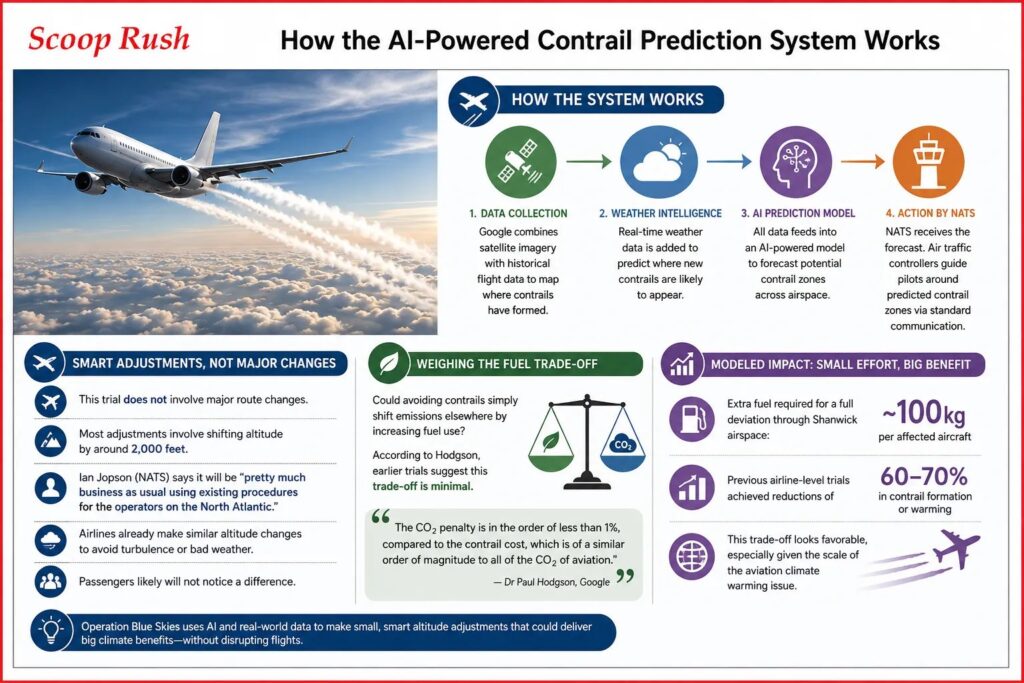
The system behind Operation Blue Skies pulls together multiple data sources into one predictive model, not unlike the kind of large AI model architecture powering other current AI tools. Google combines satellite imagery with flight data to map where planes have historically created contrails. Additionally, the team layers in real-time weather data to forecast where new contrails are likely to appear, a task that leans on the same kind of data intelligence platforms increasingly used across industries.
Once the forecast is ready, NATS receives the information directly. Air traffic controllers then guide pilots around the predicted contrail zones using standard communication channels.
Importantly, this trial does not involve major route changes. Instead, most adjustments will involve shifting an aircraft’s altitude by around 2,000 feet. Ian Jopson, director of sustainability at NATS, compared this to routine flight operations, noting it should be “pretty much business as usual using existing procedures for the operators on the North Atlantic.” Airlines already make similar altitude changes to avoid turbulence or bad weather, so passengers likely will not notice a difference.
Weighing the Fuel Trade-Off
Changing altitude naturally raises a fair question. Could avoiding contrails simply shift emissions elsewhere by increasing fuel use?
According to Hodgson, earlier trials suggest this trade-off is minimal. He explained that the extra fuel burned is far smaller than the climate benefit gained from preventing a warming contrail. “The CO2 penalty is in the order of less than 1%, compared to the contrail cost, which is of a similar order magnitude to all of the CO2 of aviation,” he said.
Modelling for Operation Blue Skies estimates that a full deviation through Shanwick airspace would require around 100kg of extra fuel per affected aircraft. Meanwhile, Hodgson noted that previous airline-level trials achieved reductions of around 60-70% in contrail formation or warming. That trade-off looks favorable, especially given the scale of the aviation climate warming issue.
Funding, Politics, and the Bigger Climate Picture
The Department for Transport is contributing £2.65 million toward the programme, while Google is providing £1.4 million through AI research, engineering, and computing infrastructure. Together, this funding supports a 30-month effort backed by some of the UK’s top research institutions.
Aviation Minister Keir Mather described the project as a milestone moment for British innovation. He explained that it would test “small tweaks to flight paths over the Atlantic” that could help make flying cleaner, adding, “This is a world-first, and it’s British ingenuity leading the way.”
Even so, the timing invites scrutiny. The trial launches just as the UK government backs expansion of several major airports. Consequently, this raises a broader question: can AI contrails climate solutions actually keep pace with aviation demand as flying continues to grow? There is also a notable irony here. Google, whose AI spending has been running cash-flow negative, is pouring billions into new data centres to power its systems, including its newly frozen v2 chip built for Gemini efficiency. Environmentalists worry these facilities could add further strain to the climate, even as tools like this one aim to reduce it. It is a tension that echoes wider debates about whether AI is going rogue in ways companies did not fully anticipate.
What Happens Next in the Trial
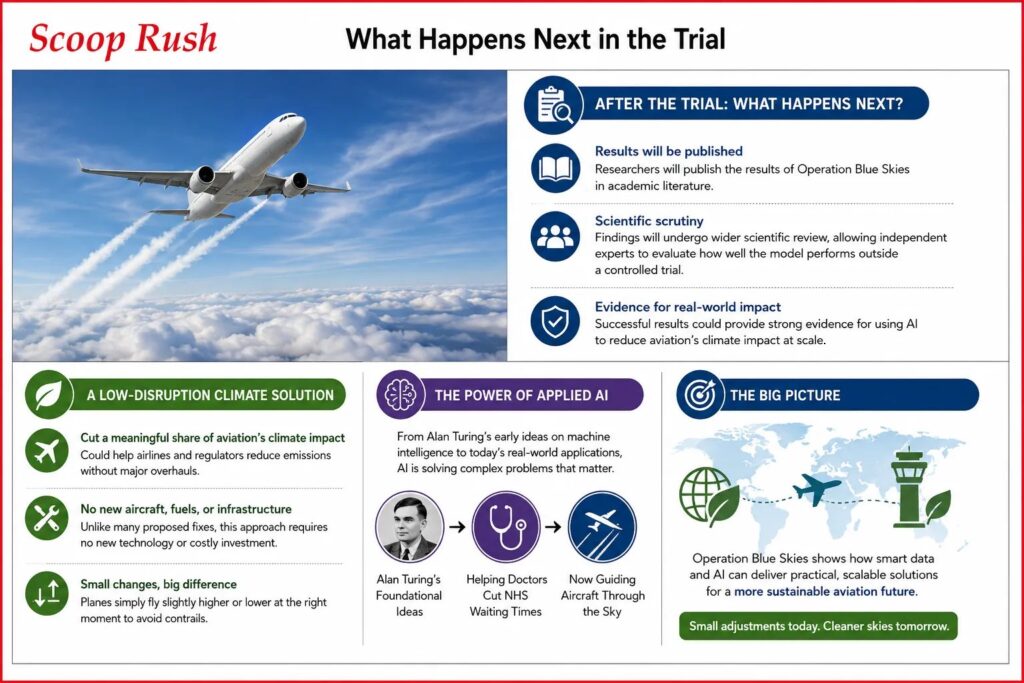
Once testing concludes, researchers plan to publish the results of Operation Blue Skies in academic literature. Consequently, the findings will undergo wider scientific scrutiny, allowing independent experts to evaluate whether the model performs as well outside a controlled trial.
If successful, this approach could give airlines and regulators a low-disruption method to cut a meaningful share of aviation’s climate impact. Unlike many other proposed fixes, it does not require new aircraft designs, alternative fuels, or costly infrastructure. It simply asks planes to fly slightly higher or lower at the right moment. It is a reminder of how far applied AI has come since the early days of Alan Turing’s foundational ideas on machine intelligence, from helping doctors cut NHS waiting times to now guiding aircraft through the sky.
Conclusion
Contrails might look like a minor visual detail of air travel, but the science tells a different story. Since warming from these icy streaks may account for as much as a third of aviation’s total climate impact, solving this problem could matter more than most travelers realize.
Operation Blue Skies offers a genuinely fresh approach to an old problem. By combining satellite data, weather forecasting, and AI prediction, the project aims to guide planes around contrail-forming conditions using small altitude shifts rather than major operational overhauls. Early modelling suggests the fuel cost is minor compared to the climate benefit gained.
As testing begins this winter, airlines, climate researchers, and everyday travelers will all be watching closely to see whether this UK-led AI contrails climate trial can finally put “sky graffiti” in the past.
FAQs
What are contrails and why are they a climate concern?
Contrails form when hot exhaust from aircraft engines meets cold air at high altitude, creating ice crystals. In cold, humid conditions, they persist and spread into cloud-like layers that trap heat, contributing significantly to aviation’s overall climate impact.
What is Operation Blue Skies?
Operation Blue Skies is a £5 million, 30-month UK trial involving Google, the UK government, the Met Office, NATS, and researchers from Cambridge and Imperial College London. The project uses AI to predict where contrails are likely to form and guides aircraft around those conditions.
Will passengers notice any changes during flights involved in the trial?
Unlikely. The trial mostly involves adjusting aircraft altitude by around 2,000 feet, similar to routine adjustments airlines already make to avoid turbulence or bad weather.
Does avoiding contrails increase fuel use and emissions?
Slightly, but the impact is small. Modelling suggests a full deviation through the trial airspace would require about 100kg of extra fuel per aircraft, which researchers say is far outweighed by the climate benefit of preventing a warming contrail.
When will the results of the trial be available?
Testing takes place during the winters of 2026-27 and 2027-28. Once complete, researchers plan to publish the results in academic literature for wider scientific review.

