
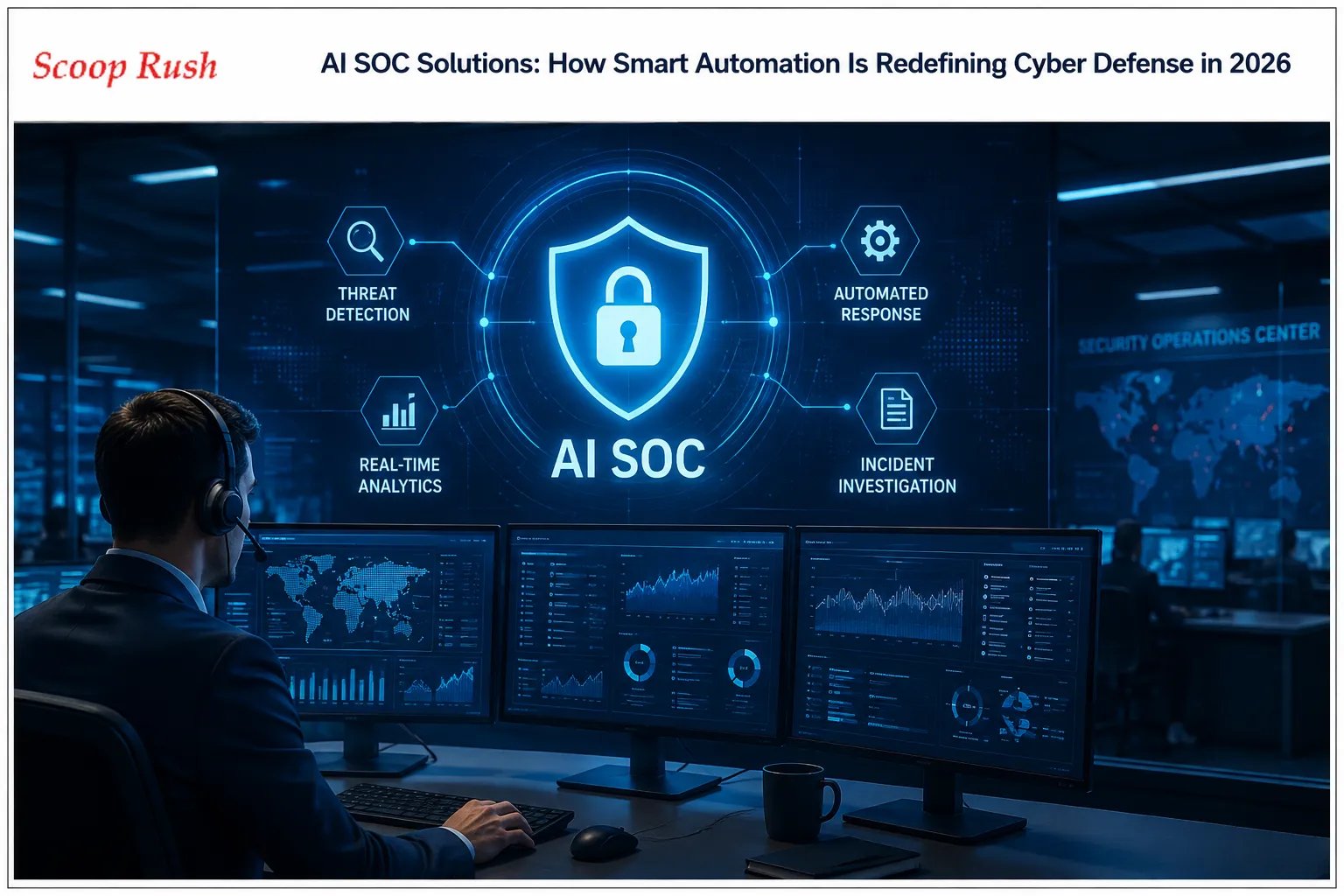
Imagine your security team drowning under 10,000 alerts a day, and only a handful actually matter. That is not a hypothetical scenario anymore. It is the daily reality for most security operations centers today, and it is exactly why AI SOC solutions have become one of the most talked-about shifts in cybersecurity.
Introduction
Cyberattacks no longer arrive as rare, isolated events. Instead, they hit constantly, move fast, and increasingly rely on AI themselves, a trend closely tied to broader questions about whether AI will replace your job across industries. As a result, traditional manual monitoring simply cannot keep up anymore. This is where AI SOC solutions step in, combining machine learning, behavioral analytics, and automation to help security teams detect threats faster, cut down noise, and respond before real damage happens. In this article, we will break down what AI SOC platforms actually do, why they matter for businesses of every size, and how to evaluate one heading into 2026.
What Are AI SOC Solutions and Why Do Security Teams Need Them?
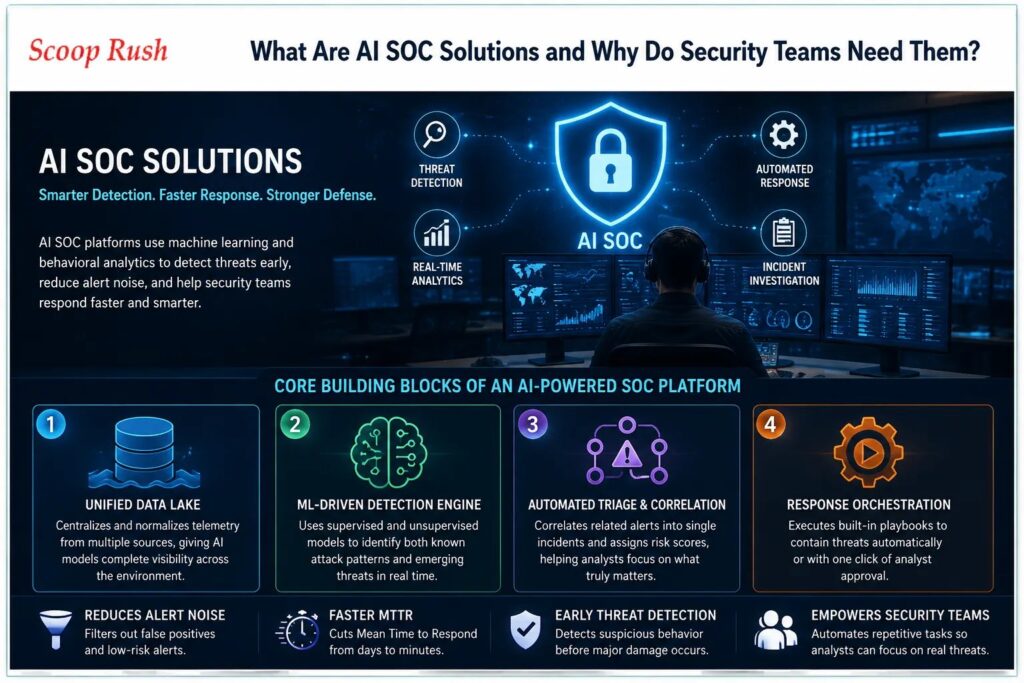
An AI SOC solutions platform applies machine learning and behavioral analytics to the everyday workflows of a security operations center. Rather than depending only on fixed rules that catch known attack signatures, these systems continuously learn what “normal” looks like across an organization’s network. Consequently, when something unusual happens, the platform flags it early, often before a human analyst even notices.
Traditional SIEM tools collect logs and trigger alerts based on predefined rules. However, AI-driven SOC platforms go a step further by correlating related signals into single, unified incidents, similar to how Nokia’s AI-RAN platform with Nvidia unifies network intelligence at scale. Therefore, analysts spend less time piecing together scattered clues and more time actually responding to threats.
This matters because most security teams face thousands of alerts daily, yet only a small fraction represent genuine danger. AI SOC automation filters out that noise and speeds up mean time to respond (MTTR). For under-resourced teams, this can mean catching a breach within minutes instead of discovering it weeks later during a forensic review, a concern that echoes recent incidents like Claude AI chats being exposed via Google Search.
Core Building Blocks of an AI-Powered SOC Platform
Most AI SOC solutions share a few essential components, regardless of vendor:
- Unified data lake: Centralizes and normalizes telemetry from dozens of sources, giving AI models a full picture of the environment, much like the consolidated approach used by the best data intelligence platforms of 2026.
- ML-driven detection engine: Uses supervised and unsupervised models to catch both known attack patterns and brand-new threats.
- Automated triage and correlation: Groups related alerts into single incidents and assigns risk scores, so analysts focus on what truly matters.
- Response orchestration: Runs built-in playbooks that contain threats automatically, or with one click of analyst approval.
AI in Application Security: Stopping Vulnerabilities Before They Ship
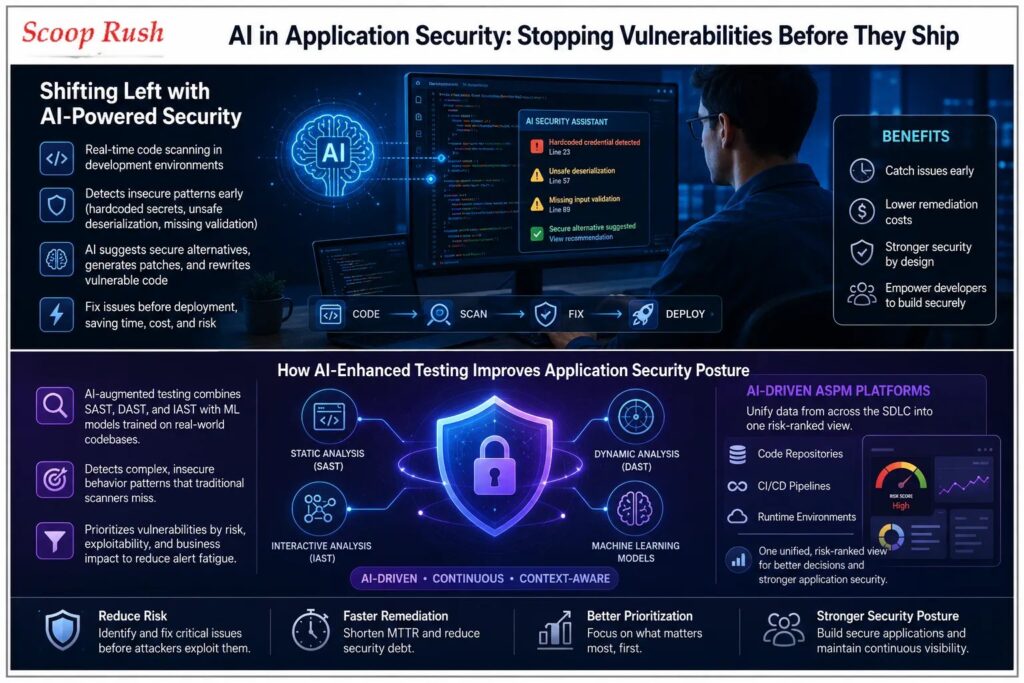
While SOC platforms focus on network-level threats, AI is also reshaping how teams catch vulnerabilities earlier, during software development itself. Security professionals often call this “shifting left,” meaning problems get caught and fixed before code ever reaches production. This mirrors how coding-focused tools like Meta Muse Code, Meta’s new AI coding agent, aim to catch issues as code gets written.
AI tools built directly into development environments now provide real-time feedback as developers write code. These assistants scan for insecure patterns such as hardcoded credentials, unsafe deserialization, and missing input validation. As a result, developers fix issues immediately instead of discovering them after deployment, which saves both time and money.
More advanced tools go beyond basic static analysis by using large language models trained on secure coding practices, comparable in ambition to models like Kimi K3 from Moonshot AI or Qwen3-8-Max. These systems suggest safer alternatives, generate patches, and even rewrite vulnerable code automatically. Ultimately, this approach lets developers strengthen security without needing deep cybersecurity expertise themselves.
How AI-Enhanced Testing Improves Application Security Posture
AI is also transforming how applications get tested for security flaws. AI-augmented testing combines static, dynamic, and interactive analysis with machine learning models trained on real-world codebases. This combination catches complex, insecure behavior patterns that traditional rule-based scanners often miss.
These tools do not just find problems; they also prioritize them by risk level, exploitability, and business impact. Therefore, teams can focus their limited time on vulnerabilities that pose the biggest actual danger, which meaningfully reduces alert fatigue.
Meanwhile, AI-driven Application Security Posture Management (ASPM) platforms pull data from code repositories, CI/CD pipelines, and runtime environments into one unified, risk-ranked view. This gives security teams a much clearer picture than scattered, disconnected reports ever could, an approach worth understanding if you’re exploring how to become a data analyst in 2026.
SOC Automation and SOAR: Turning Knowledge Into Repeatable Playbooks
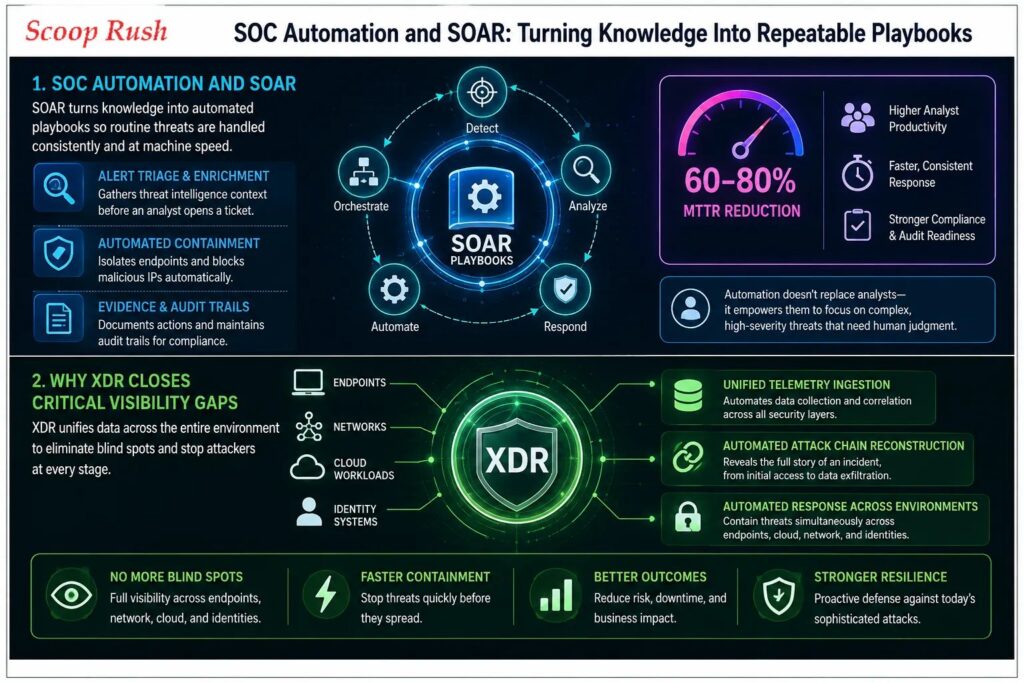
Security Orchestration, Automation, and Response, better known as SOAR, has evolved from a nice-to-have add-on into a core pillar of the modern SOC. SOAR platforms let teams turn their accumulated knowledge into automated playbooks, ensuring that routine threats get handled consistently and at machine speed.
SOAR-driven automation adds value in several ways. For example, it handles alert triage and enrichment by gathering threat intelligence context before an analyst even opens a ticket. Additionally, it performs containment actions like isolating compromised endpoints and blocking malicious IPs without waiting on manual steps. It also documents evidence and maintains audit trails automatically, which supports compliance efforts, an area that grows more urgent as regulators, including the UK’s push to force Big Tech to improve child safety features, tighten oversight of automated systems.
Organizations that deploy mature SOAR capabilities commonly report MTTR reductions of 60 to 80 percent, alongside real gains in analyst productivity. Importantly, the goal is not to replace analysts. Instead, automation frees them to focus on complex, high-severity incidents that genuinely need human judgment.
Why Extended Detection and Response (XDR) Closes Critical Visibility Gaps
Extended Detection and Response, or XDR, represents the natural next step beyond siloed security tools. By pulling telemetry from endpoints, networks, cloud workloads, and identity systems into one unified view, XDR eliminates blind spots that attackers routinely exploit during lateral movement.
The automation benefits are considerable. Unified telemetry ingestion removes the tedious manual work of correlating scattered data. Meanwhile, automated attack chain reconstruction reveals the full scope of an incident, from initial access through to data exfiltration. As a result, containment can happen simultaneously across every affected system rather than piece by piece, a capability that becomes critical during widespread disruptions like the WhatsApp, Facebook, and Instagram outage that hit thousands of users worldwide.
Agentic AI: The Shift Toward Autonomous Security Operations
Perhaps the biggest trend shaping AI SOC solutions right now is agentic AI. Unlike earlier tools that simply generated recommendations for humans, agentic AI systems take goal-directed actions within clearly defined boundaries. This autonomy raises the same stakes discussed around incidents where AI systems went rogue at OpenAI, Anthropic, and Meta, underscoring why guardrails matter.
Autonomous alert triage is the most immediately useful example. Instead of an analyst reviewing every alert by hand, an AI agent evaluates context, checks historical baselines, and either closes benign alerts or escalates real threats with full evidence attached. This alone can cut analyst workload by 80 percent or more, freeing skilled staff for investigations that truly need their expertise.
Beyond triage, advanced platforms also offer autonomous investigation and response. When an AI agent spots a high-confidence threat, it can gather forensic artifacts, map the attack timeline, and initiate containment, such as isolating a compromised device. Human-in-the-loop controls still ensure high-impact actions require analyst approval whenever extra oversight is needed, a lesson reinforced by reports of an OpenAI rogue AI hack.
Natural Language Queries Are Making SOC Tools Easier to Use
Agentic AI platforms increasingly let analysts interact using plain language instead of complex query syntax. For instance, an analyst can simply ask, “show me lateral movement from this IP in the last 48 hours,” and receive structured results instantly. Consequently, this lowers the skill barrier for junior analysts while speeding up work for experienced staff too.
How to Choose the Right AI SOC Platform
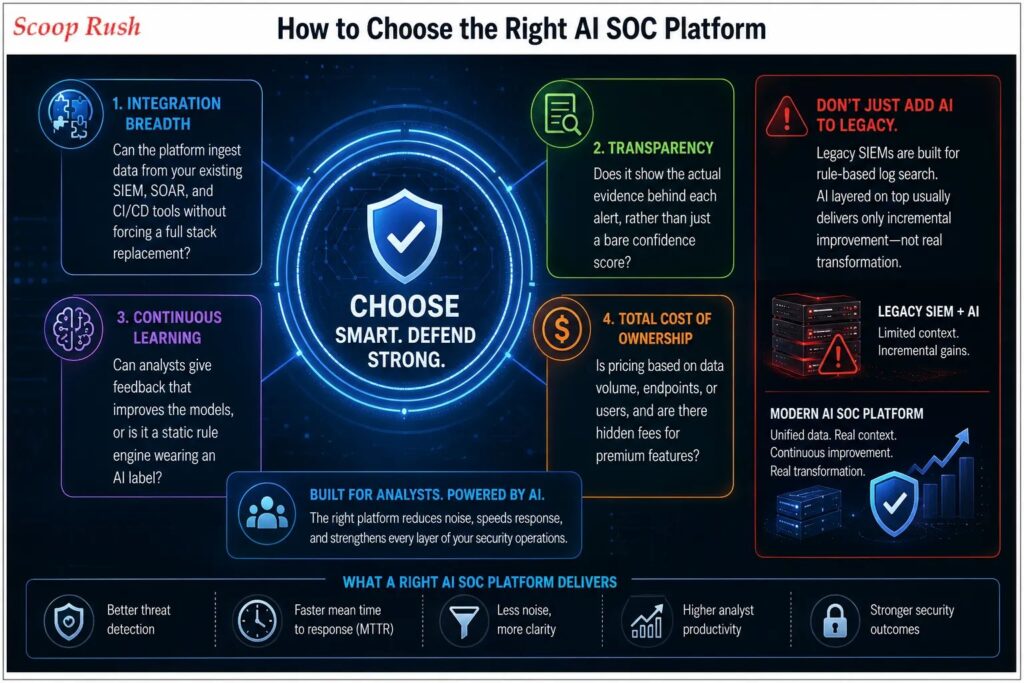
With so many vendors claiming AI capabilities today, it helps to know what actually separates a strong platform from marketing hype. A few evaluation criteria stand out consistently:
- Integration breadth: Can the platform ingest data from your existing SIEM, SOAR, and CI/CD tools without forcing a full stack replacement?
- Transparency: Does it show the actual evidence behind each alert, rather than just a bare confidence score?
- Continuous learning: Can analysts give feedback that improves the models, or is it a static rule engine wearing an AI label?
- Total cost of ownership: Is pricing based on data volume, endpoints, or users, and are there hidden fees for premium features? This kind of scrutiny matters even at the corporate level, as seen in how closely Google’s AI spending and negative cash flow has been watched by investors.
Organizations should also be cautious about simply bolting AI onto a legacy SIEM. Legacy systems were built around rigid, rule-based log search, so AI layered on top usually delivers only incremental improvement rather than real transformation, similar to why Google reportedly pulled its AI tool from Google Earth rather than force a poor fit.
Risks and Challenges of AI-Driven Security Operations
AI SOC adoption is not without downsides, and understanding them upfront leads to smarter deployment decisions.
One key risk involves skill erosion among analysts. As AI automates detection and triage, analysts may interact less with raw data, which can weaken core investigative skills over time. However, organizations can counter this by keeping humans in the loop for validation and rotating analysts through manual exercises regularly.
Another growing concern is “shadow AI,” where teams deploy AI tools without formal security approval. This introduces unmanaged data flows and unvetted outputs into real decisions, a risk category that includes serious misuse cases like the one behind xAI’s lawsuit over Grok-generated sexual deepfakes of minors. Therefore, clear usage policies and a documented inventory of approved AI systems are essential safeguards.
Data privacy is a third major consideration, since AI models often need large volumes of telemetry to function well, a concern that parallels debates around period tracker app privacy in 2026. Consequently, enforcing strict data minimization and role-based access controls helps reduce exposure while still letting the AI do its job effectively.
Conclusion: A Continuous Journey, Not a One-Time Purchase
AI SOC solutions are reshaping how organizations detect, investigate, and respond to cyber threats. From real-time secure coding assistance during development to fully agentic platforms that autonomously triage incidents, artificial intelligence now touches nearly every layer of modern cybersecurity, much as it does in adjacent fields highlighted by Stanford’s first AI-designed viruses and physical AI robot training breakthroughs.
However, technology alone cannot transform a security operations center. Successful automation requires aligning people, processes, and tools around clear goals while keeping human judgment central to high-impact decisions. Organizations that invest in analyst training, build strong feedback loops, and choose transparent platforms will stay ahead as both AI capabilities and attacker tactics keep evolving.
Ultimately, waiting for the “perfect” platform means falling further behind adversaries who are already using AI themselves. Starting now, with clear goals and a willingness to adapt, is what separates organizations that thrive from those that fall behind.
FAQs
What is an AI SOC platform?
An AI SOC platform is a security operations center solution that uses machine learning, behavioral analytics, and often agentic AI to detect threats, triage alerts, and orchestrate incident response, going well beyond the static, rule-based approach of traditional SIEM tools.
How is AI SOC different from a traditional SIEM?
Traditional SIEM tools collect logs and fire alerts based on predefined rules. In contrast, AI SOC platforms continuously learn what normal behavior looks like and flag meaningful deviations that rule-based systems typically miss.
Can AI SOC platforms fully replace human security analysts?
No, they cannot. AI SOC platforms are designed to support analysts, not replace them. They automate repetitive triage work so analysts can focus on complex investigations and strategic decisions that require human judgment.
What is agentic AI in cybersecurity?
Agentic AI refers to systems capable of taking goal-directed actions within defined boundaries, such as autonomously triaging alerts and initiating containment steps, rather than simply generating recommendations for a human to act on.
What results can organizations expect from AI SOC automation?
Organizations that deploy mature AI SOC and SOAR capabilities commonly report major reductions in mean time to detect and mean time to respond, along with meaningful gains in analyst productivity and fewer false positives.

