
Imagine closing five AI subscriptions and opening just one tab instead. Sounds too good to be true, right? That is exactly the promise behind this Abacus AI review. Every platform involves trade-offs, and Abacus AI is no exception.
Introduction
What if a single platform could replace your chatbot, your research tool, your image generator, and your automation app all at once? That question sits at the center of this Abacus AI review, and it explains why so many founders, developers, and business teams are suddenly paying attention.
Most people juggle a chatbot for writing, a research tool, an image generator, a coding assistant, and some kind of automation app to tie it all together. That stack adds up fast, both in cost and in mental overhead. Every extra tab is another login, another interface, another thing to remember, which is part of the reason more people keep asking will AI replace your job as these platforms take on more of the workload.
Abacus AI takes a different approach. Instead of offering one narrow feature, it bundles chat, research, app building, automation, and media generation into one connected system. In this Abacus AI review, we will break down what the platform actually does, how its main tools work together, what it costs, and whether it deserves a spot in your workflow.
What Is Abacus AI? A Quick Overview
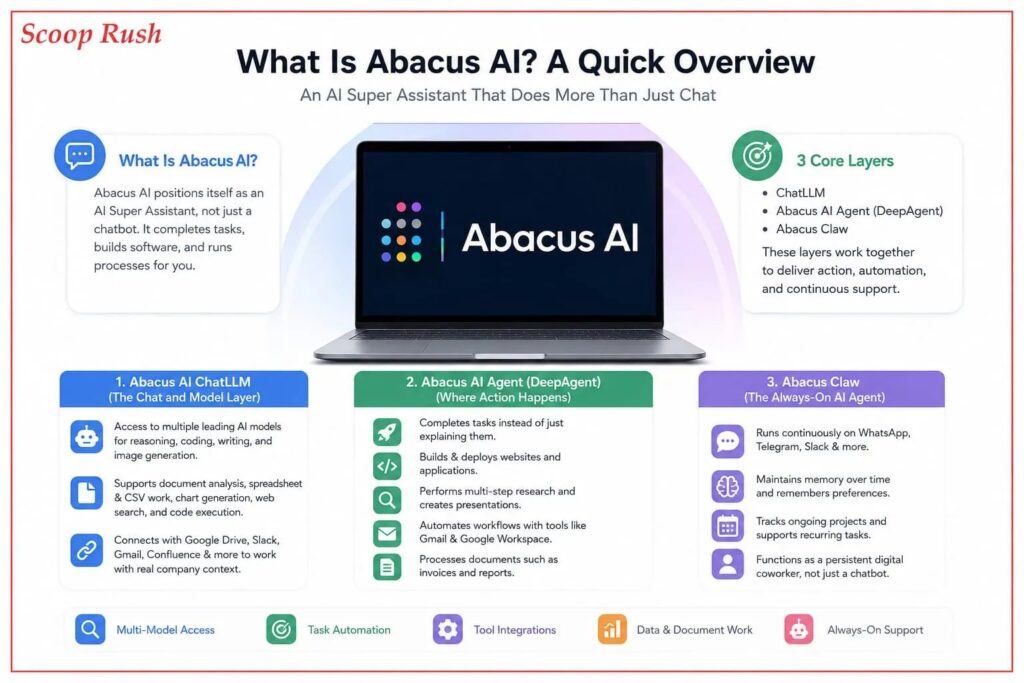
Abacus AI positions itself as an AI Super Assistant rather than a simple chatbot. Instead of just answering questions, it aims to complete tasks, build software, and run processes on your behalf. Three main layers work together to power the platform: ChatLLM, Abacus AI Agent, and Abacus Claw.
Abacus AI: ChatLLM, Agent, and Claw at a Glance
Abacus AI positions itself as an AI Super Assistant rather than a simple chatbot. It aims to complete tasks, build software, and run processes on your behalf. The platform runs on three layers: ChatLLM, Abacus AI Agent, and Abacus Claw.
ChatLLM gives you access to many AI models in one workspace, covering reasoning, coding, writing, and image generation, plus short video generation through Abacus Studio, similar to how Kimi K3 and Qwen3-8-Max are pushing model competition forward. It also supports document analysis, spreadsheet work, chart generation, web search, and code execution in one place. Teams can connect it to Google Drive, Slack, Gmail, and Confluence, much like Nokia’s AI-RAN platform built with Nvidia brings AI closer to real infrastructure.
Abacus AI Agent, or DeepAgent, focuses on execution rather than conversation. Instead of explaining how to research competitors, it can gather pricing data, compare positioning, and return a structured report directly. It can build and deploy websites, run multi-step research, create presentations, automate Gmail and Google Workspace tasks, and process invoices, an execution-first approach echoed by tools like Meta Muse’s AI coding agent.
Abacus Claw solves a common AI limitation: session memory that vanishes once you close the chat. Built on the open-source OpenClaw framework, Claw runs continuously inside WhatsApp, Telegram, and Slack, apps as woven into daily life as WhatsApp, Facebook, and Instagram themselves. Because it remembers context over time, Claw tracks ongoing projects and recurring tasks without anyone reintroducing them each session, so it functions more like a persistent digital coworker than a chatbot.
Key Abacus AI Features You Should Know
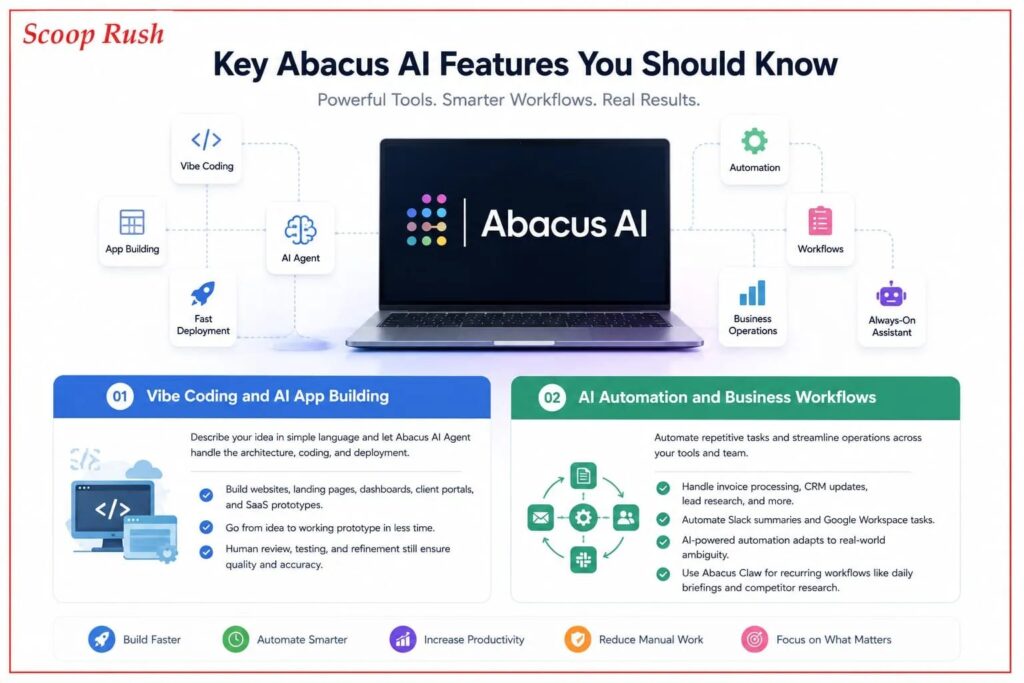
Abacus AI covers a lot of ground, so it helps to look at the features that show up most often in real use cases.
Vibe Coding and AI App Building
One of the more talked-about capabilities is what the platform calls vibe coding. In plain terms, this means describing an app or website in everyday language and letting the AI Agent handle the architecture, coding, and deployment. Reported use cases include landing pages, internal dashboards, client portals, and lightweight SaaS prototypes.
This does not remove the need for human review. Testing the logic, refining the user experience, and double-checking business assumptions still matter. However, it does shrink the distance between an idea and a working first version, which is often the hardest part of getting a product off the ground, not unlike how one mom built a $10K-a-month Etsy side hustle by moving quickly from idea to execution.
AI Automation and Business Workflows
For operations-heavy teams, automation is where Abacus AI Agent earns its keep. Examples mentioned in the source material include invoice processing, CRM updates, lead research, Slack summaries, and Google Workspace tasks.Because language models drive the automation rather than fixed rules, it can adapt to ambiguity in a way that simpler rule-based automation tools cannot, a shift that also fuels the rise of[ data intelligence platforms. data intelligence platforms built to feed cleaner data into exactly these kinds of AI workflows.
Meanwhile, Abacus Claw extends this further by allowing recurring workflows, such as a daily briefing pushed to Slack or a scheduled competitive research summary, to run without repeated manual setup.
Abacus AI Pricing: What You Actually Pay
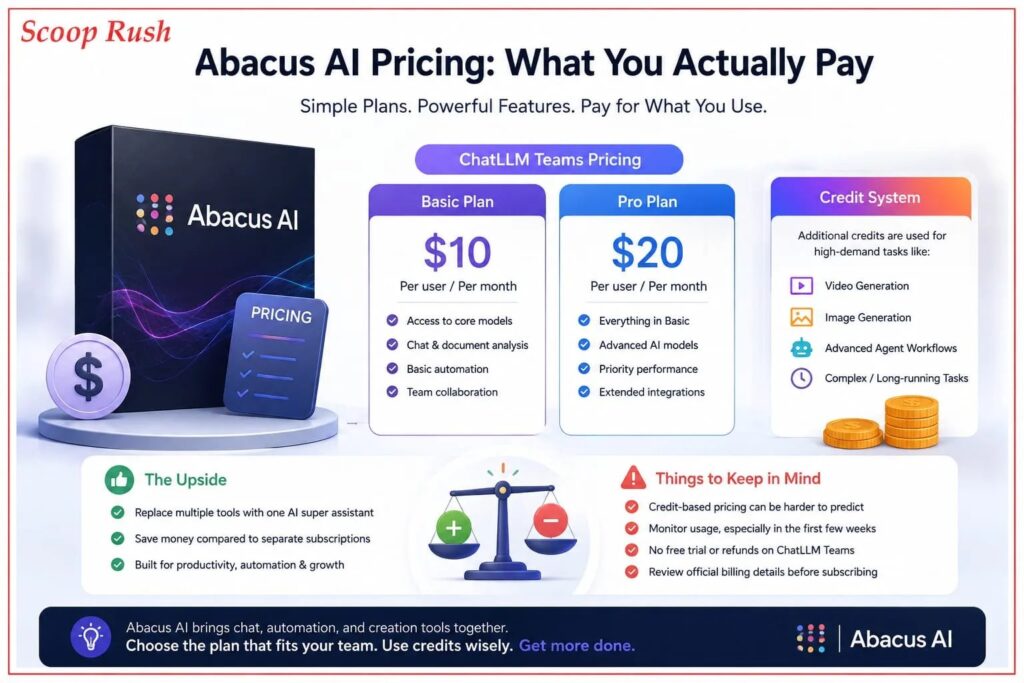
According to the source material, ChatLLM Teams pricing includes two listed tiers: a Basic plan at $10 per user per month and a Pro plan at $20 per user per month. On top of the subscription, certain tasks such as video generation, image generation, and heavier agent workflows draw from a credit system.
This pricing structure has a clear upside. If Abacus AI genuinely replaces a chatbot subscription, an image generator, a research tool, and an automation platform, users can save significantly compared to paying for each tool separately. On the other hand, credit-based pricing is harder to predict than a flat monthly fee, especially for complex or repeated agent tasks. Therefore, it makes sense to monitor usage closely, particularly during the first few weeks.
It is also worth noting that ChatLLM Teams does not offer a free trial or refunds, so reviewing the official billing details before subscribing is a reasonable precaution.
Abacus AI vs Other AI Tools
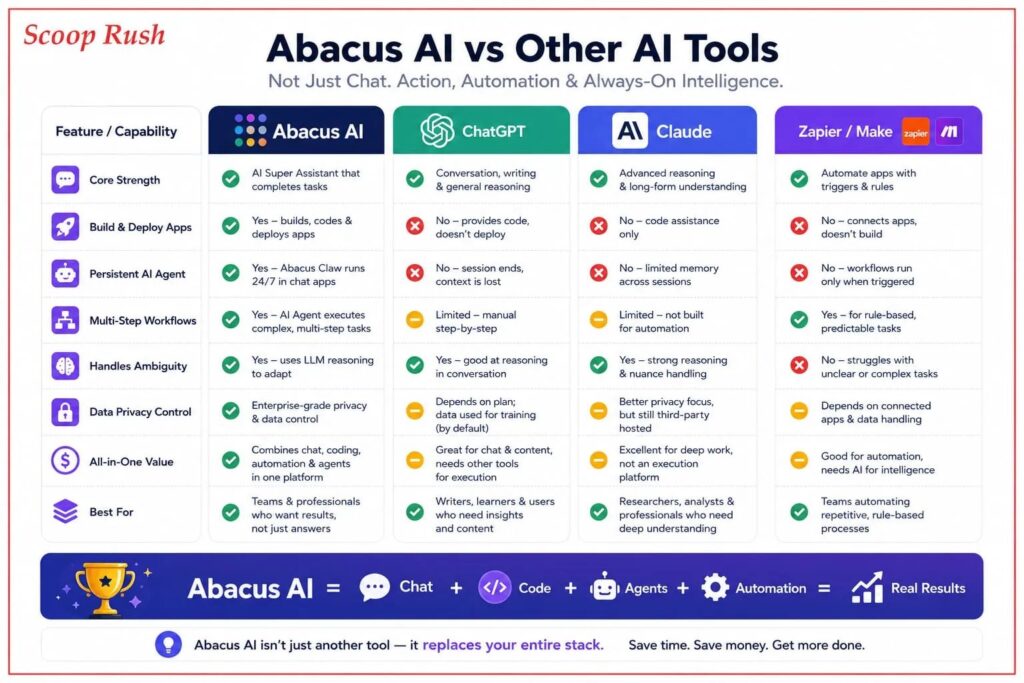
A common question people ask is how Abacus AI stacks up against tools like ChatGPT, Claude, or traditional automation platforms such as Zapier.
The short answer is that these tools are not solving the exact same problem.ChatGPT and Claude excel at general conversation, writing, and reasoning, and ChatLLM actually includes some models from both. However, standalone chatbots typically stop at the conversation. They do not build applications, run persistent agents, or execute multi-step workflows on their own. Data privacy also remains a live concern across the industry, as shown by reports that Claude AI chats were exposed through Google Search, which is a good reminder to check how any AI platform handles your data.
Traditional automation tools like Zapier or Make, meanwhile, connect apps together using triggers and rules. That works well for predictable, repetitive tasks, but it struggles with anything that requires judgment or handling ambiguity. The Abacus AI automation layer is built around language model reasoning, so it can adapt to context in ways that rule-based automation cannot.
Put simply, the more accurate comparison is not Abacus AI against a single competitor. It is Abacus AI against an entire stack of separate tools that would otherwise need to be pieced together and paid for individually.
Who Should Use Abacus AI?
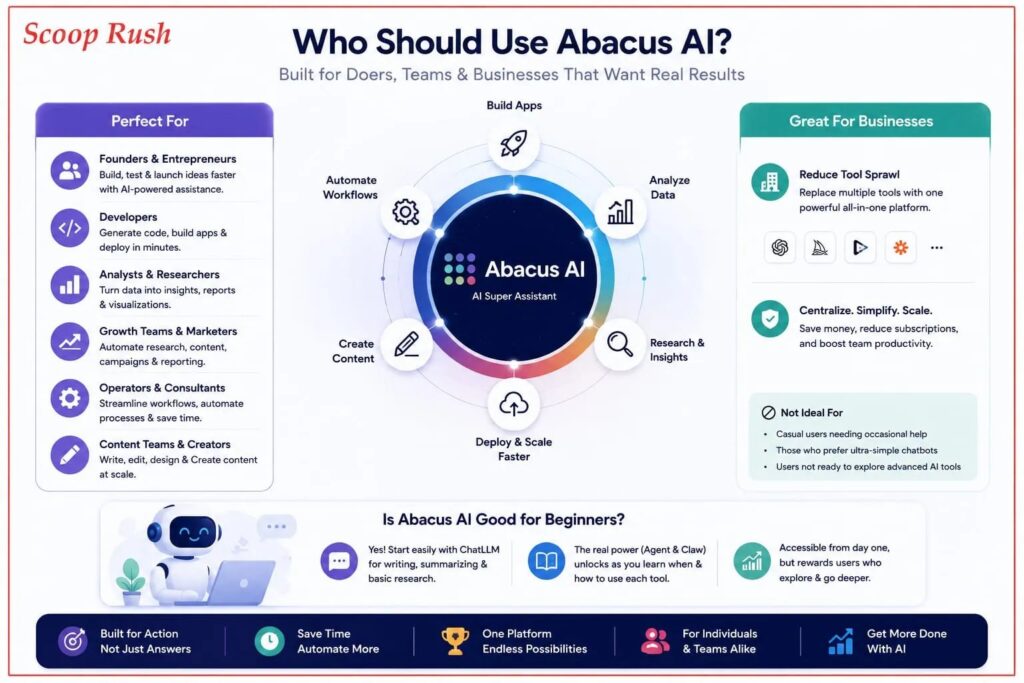
Abacus AI is clearly built with a specific type of user in mind. According to the source material, it is well suited for founders, developers, analysts, growth teams, operators, consultants, and content teams who want AI to produce finished output rather than just advice, including anyone exploring how to become a data analyst in 2026 and wanting hands-on AI tools to practice with.
Businesses looking to reduce tool sprawl are another strong fit. Instead of separately subscribing to a chatbot, an image generator, a video tool, and an automation platform, teams can centralize much of that work inside one system.
That said, Abacus AI is not necessarily the best starting point for everyone. Casual users who only need occasional help with writing or simple questions may find the platform bigger than they need. Because it has a real learning curve, beginners who want the simplest possible chatbot experience might prefer a lighter tool at first.
Is Abacus AI Good for Beginners?
Beginners can absolutely start using Abacus AI, particularly through ChatLLM for writing, summarizing, or basic research. However, the deeper value of the platform, including the Agent and Claw layers, becomes clear only once you learn when to use each tool and how the credit system works. In other words, Abacus AI is accessible from day one, but it rewards users who are willing to explore beyond basic prompting.
Abacus AI Pros and Cons
Every platform involves trade-offs, and Abacus AI is no exception.
On the positive side, the platform offers access to many top AI models in one place, genuine agent-driven execution rather than just advice, support for app and website building without a traditional development cycle, persistent always-on agents through Claw, and integrations with common workplace tools. For users currently paying for multiple separate AI subscriptions, the combined cost savings can be substantial.
On the other hand, the credit-based pricing model can be difficult to estimate at first, and the platform’s breadth means there is a real learning curve. Complex workflows may need several rounds of iteration before they run smoothly, and larger automations still benefit from human oversight rather than running fully unattended. It is not designed to be a simple plug-and-play chatbot, so users expecting that experience may find it overwhelming initially.
Conclusion
Abacus AI is not trying to be the simplest AI chatbot on the market, and it does not pretend otherwise. Instead, it is aiming at a different problem entirely, namely the fragmentation created by using five or six separate AI tools that never talk to each other.
Through ChatLLM, Abacus AI Agent, and Abacus Claw, the platform combines model access, task execution, and persistent memory into one connected system. For founders building products, analysts producing research, and teams automating repetitive workflows, that combination can meaningfully cut down on both cost and complexity.
If you only need occasional help drafting an email, a lighter chatbot might be enough. But if you are managing a growing AI workload across research, content, coding, and automation, Abacus AI is worth serious evaluation, especially given the pricing gap compared to running several standalone subscriptions side by side.
FAQs
What is Abacus AI used for?
Abacus AI is used for AI chat, deep research, document and data analysis, image and short video generation, app building, business automation, and running persistent AI agents.
What is the difference between ChatLLM and Abacus AI Agent?
ChatLLM is the chat interface that gives access to multiple AI models for everyday tasks, while Abacus AI Agent focuses on executing multi-step tasks such as research, app building, and automation.
How much does Abacus AI cost?
ChatLLM Teams lists two tiers: Basic at $10 per user per month and Pro at $20 per user per month, with additional credit usage for heavier tasks like video generation and complex agent workflows.
Can Abacus AI actually build apps without coding?
Yes, according to the source material, Abacus AI Agent can plan, build, and help deploy applications from a plain-language description, though human review and iteration are still recommended for production use.
Is Abacus AI better than ChatGPT?
Abacus AI is broader than a standard chatbot because it combines multiple models, agent-driven execution, automation, and persistent memory, while ChatGPT remains a strong option for simple, general-purpose conversation.

