
Ever noticed your Spotlight feed feeling repetitive lately? Snapchat just admitted why, and it’s officially cracking down on AI-generated videos across the platform.
Introduction
Snapchat is now joining a wave of tech giants trying to save social media from robotic content. On Friday, Snap announced that its recommendation system will stop favoring “wholly AI-generated videos” in Spotlight, the app’s public feed for shortform content. Instead, the company wants to spotlight, quite literally, authentic creativity from real people.
This shift matters because it signals a broader industry pushback against low-effort AI content. Additionally, it lands right alongside similar moves from YouTube, LinkedIn, and Substack.
For creators who rely on Spotlight for visibility, this change could reshape what gets seen and what gets buried. For everyday users, it means a cleaner, more human feed Either way, the crackdown on AI-generated videos Snapchat just launched is no longer a niche concern. It has become a mainstream priority for the biggest names in tech, at a time when will AI replace your job is already on everyone’s mind.
Why Snapchat Is Blocking AI-Generated Videos on Spotlight
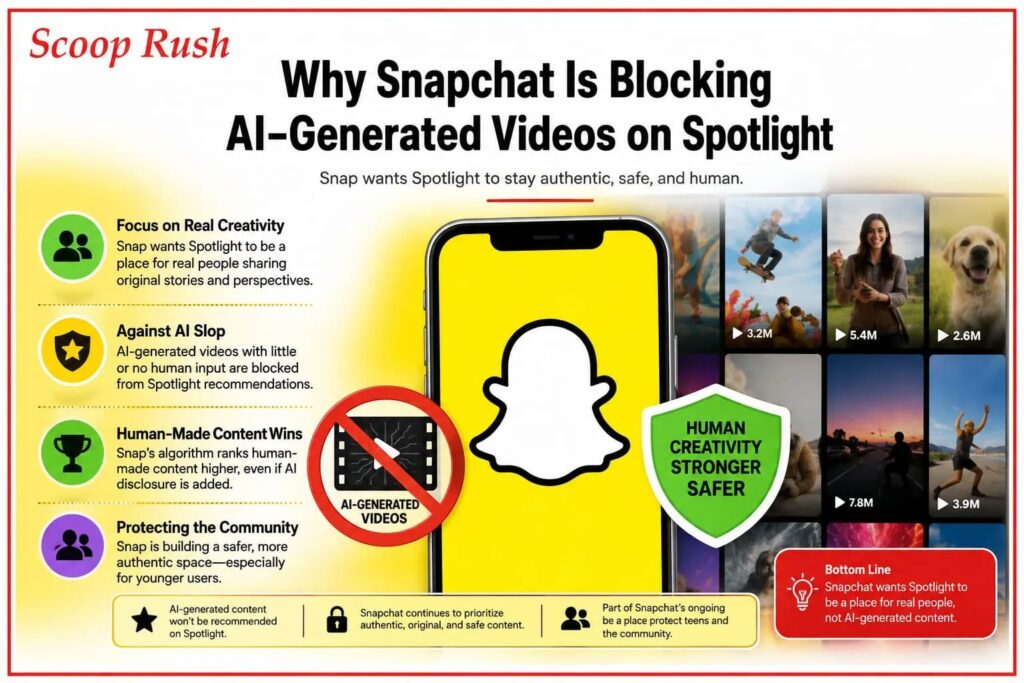
Snap explained its reasoning behind blocking AI-generated videos Snapchat clearly in a blog post announcing the update. The company said it wants Spotlight to remain a place where people can discover authentic creativity from real people. According to Snap, there is enduring value in rewarding original perspectives, personal storytelling, and the moments people choose to create and share themselves.
This isn’t a sudden reaction, however. Snapchat had already hinted at this direction back in April. At that time, the company indicated that users would see less AI-generated content in their feeds. Friday’s announcement therefore builds on that earlier signal and turns it into concrete policy.
Importantly, Snapchat isn’t declaring war on AI altogether. Creators can still use Snapchat’s own AI-powered tools, including augmented reality effects and image editing features, to enhance their content, similar to how Meta rolled out its own Meta Muse image generation tools. The distinction lies between AI-assisted content and content that is wholly generated by AI with little to no human input. The former still has a place in Spotlight. The latter does not.
Snapchat has also been transparent about how it treats disclosure. According to the company’s Spotlight guidelines, its content ranking algorithm rewards human-made content over wholly AI-generated content, even when creators add transparency disclosures. In other words, labeling a video as AI-made won’t earn it a pass into the recommendation system.
How the AI Slop Crackdown Fits Snapchat’s Bigger Content Strategy
This move doesn’t exist in isolation. Snapchat has been steadily tightening its content rules over the past few months. Just last month, the platform introduced new content control measures aimed at protecting younger users, echoing broader pressure from the UK’s child safety demands on Big Tech. Under those rules, users aged 13 to 15 can only share Spotlight posts with people they follow back, a change designed to guard against doxxing.
Taken together, these updates on AI-generated videos Snapchat is reducing suggest the platform is trying to rebuild trust in Spotlight. The platform wants to feel like a space for genuine, safe, human-driven content. Reducing AI-generated videos and tightening privacy protections for teens both serve the same underlying goal. Ultimately, Snapchat wants Spotlight to feel less like a content farm and more like a community, a concern that’s grown sharper since xAI faced a lawsuit over Grok-generated sexual deepfakes of minors.
The Bigger Picture: Every Major Platform Is Fighting AI Slop
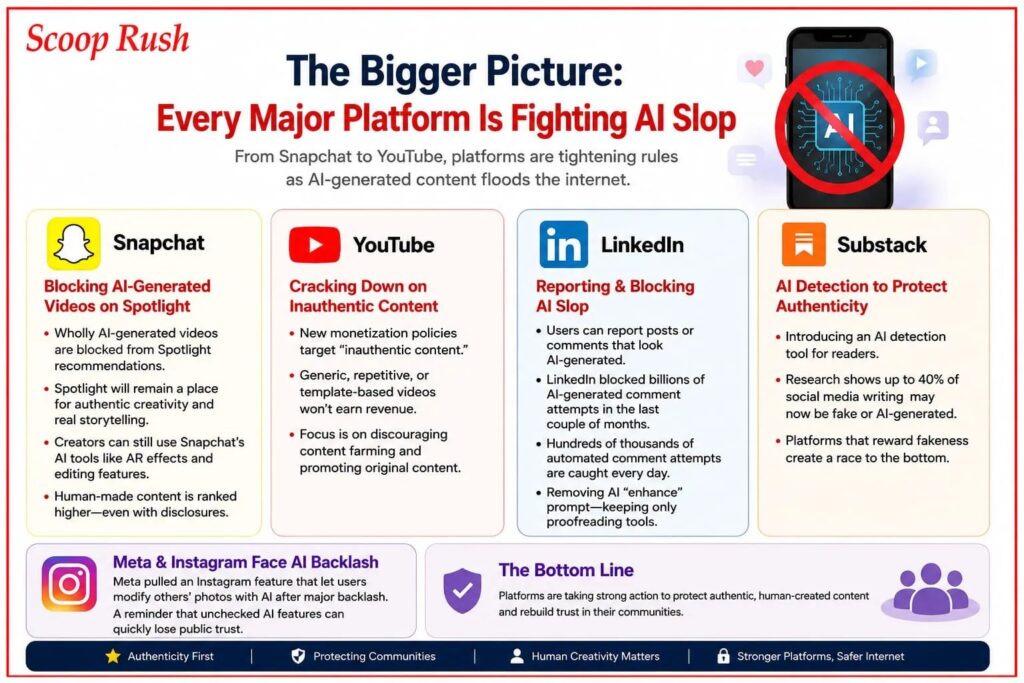
Snapchat’s announcement lands right in the middle of a broader industry trend. Over the past two weeks alone, YouTube, LinkedIn, and Substack have each rolled out their own strategies to combat AI-generated content. This wave of policy changes suggests the tech industry has reached a tipping point on the issue.
Substack was among the most vocal. Company co-founder and CEO Chris Best said it’s getting harder to tell what’s real on the internet. Announcing a new AI detection tool for readers, Best pointed to research showing that up to 40 percent of writing on social media may now be fake or AI-generated. He warned that platforms rewarding fakeness would create a race to the bottom.
LinkedIn took a different approach. The professional networking platform introduced a button that lets any user report a post or comment that appears to be AI-generated. LinkedIn’s chief product officer, Hari Srinivasan, called AI slop a top priority for the company. He noted that LinkedIn had blocked billions of attempts to post AI-generated comments in just the past couple of months. In fact, the platform now catches hundreds of thousands of automated comment attempts every day.
Notably, LinkedIn is also walking back one of its own AI features. The platform is removing an automated prompt that once offered to “enhance” posts using AI. Instead, it will revert to a simple proofreading tool.
YouTube’s approach has centered on money. The video platform owned by Google updated its monetization policies this month, targeting what it calls “inauthentic content.” Videos that are generic, repetitive, or template-based will no longer earn revenue. YouTube’s trust and safety chief, Matt Halprin, explained the thinking behind the policy. He said the same technology that enables great content also enables content farming, and that’s the kind of material YouTube wants to discourage. It’s a similar concern to what surfaced when rental listings flooded with AI-generated fakes, showing how AI slop spreads well beyond social feeds.
Meta and the Instagram AI Backlash
Not every AI experiment has gone smoothly. Earlier this month, Meta faced significant backlash over an Instagram feature that let users modify photos from public accounts using AI tools. The backlash grew strong enough that Meta pulled the feature entirely, a setback that came not long after WhatsApp, Facebook, and Instagram suffered a worldwide outage. This episode likely added pressure on other platforms to get ahead of similar controversies before they happen.
Why AI-Generated Content Has Become Such a Big Problem
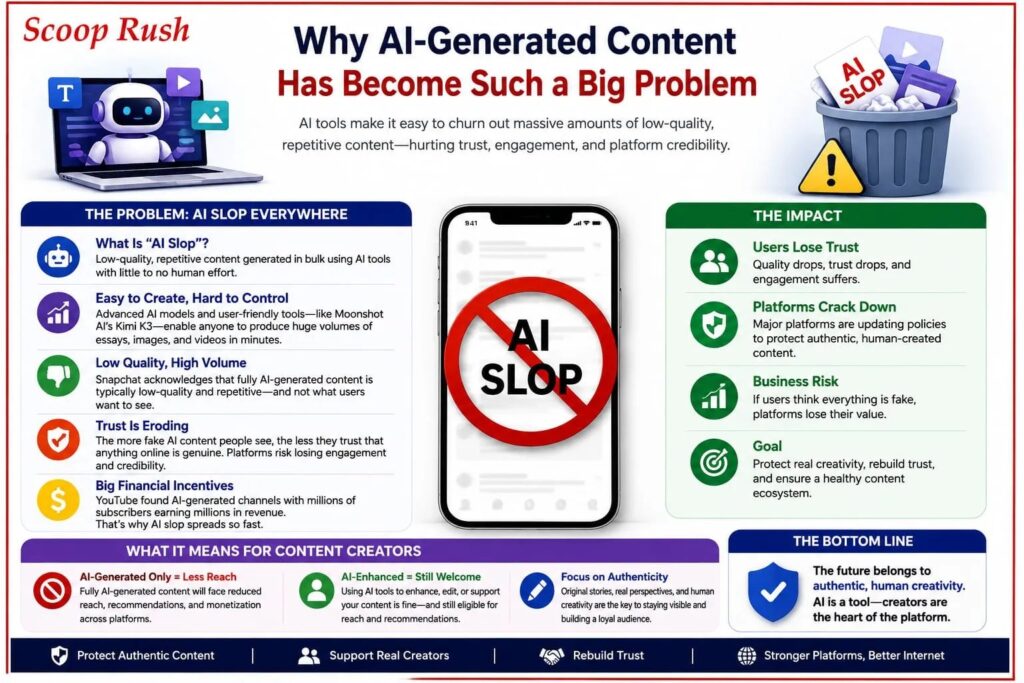
The term “AI slop” refers to low-quality, often repetitive content churned out quickly using generative AI tools. As these tools have become easier to use, powered by increasingly capable systems like Moonshot AI’s Kimi K3, they’ve made it possible to produce huge volumes of essays, images, and videos with minimal human effort.
Snap itself acknowledged that AI-generated videos Snapchat users encounter are typically low-quality and repetitive. Furthermore, the company noted this isn’t generally what Snapchat users want to see. Research into how people respond to AI-generated content backs this up. Additionally, a separate survey found that the more fake AI content people see in their social feeds, the less likely they are to trust that any of the content they encounter online is genuine.
This erosion of trust is exactly what platforms are trying to prevent. If users start assuming everything might be fake, engagement drops and the platform loses credibility. That’s a real business risk, not just a philosophical one, and it echoes wider anxieties around AI oversight, from Google’s frozen v2 AI chip push for Gemini efficiency to reports of OpenAI dealing with a rogue AI hack.
YouTube’s research findings illustrate the scale of the issue. Scores of channels on the platform turned out to be solely AI-generated. Some had millions of subscribers, and some earned millions of dollars in revenue. That kind of financial incentive explains why AI-generated content spread so quickly across the internet in the first place.
What the AI Slop Trend Means for Content Creators
For creators who depend on platforms like Snapchat for visibility and income, these policy shifts carry real consequences. Videos that lean entirely on AI generation, without any human creative input, will likely see reduced reach across Spotlight, YouTube monetization, and LinkedIn’s algorithm.
However, creators who use AI as a supporting tool rather than a replacement for their own creativity shouldn’t be affected. Snapchat has been clear that AI-enhanced or AI-edited content will still be part of its recommendations. The same logic applies at LinkedIn, where users who use AI to refine their posts are not the target of the crackdown.
This distinction between AI-assisted and AI-generated content is likely to become a defining line across the industry. Consequently, creators who want to stay visible may need to lean more heavily into personal storytelling and original perspectives, the same authentic approach behind stories like how one mom built a $10K-a-month Etsy side hustle, rather than fully automated production.
Conclusion
The decision to block AI-generated videos Snapchat made for Spotlight marks another significant step in the tech industry’s growing pushback against AI slop. Alongside YouTube, LinkedIn, and Substack, Snapchat is signaling that authenticity now carries real weight in how content gets distributed and monetized.
The message from these platforms stays consistent. AI tools remain welcome as a way to enhance human creativity. However, content that is entirely machine-made, generic, and repetitive is losing its place in mainstream feeds. As trust in online content continues to erode, platforms clearly see authenticity as a competitive advantage worth protecting. For creators, the path forward is simple: use AI as a tool, not a substitute for genuine human storytelling.
FAQs
Q1: Why is Snapchat blocking AI-generated videos on Spotlight?
Snapchat wants Spotlight to remain a place for authentic, human-made content. As a result, its recommendation system will no longer favor videos that are entirely AI-generated.
Q2: Is Snapchat banning AI content entirely?
No. Snapchat still allows creators to use its own AI tools to enhance or edit content. The crackdown specifically targets videos that are entirely AI-generated with no human creative input.
Q3: Which other platforms are fighting AI slop besides Snapchat?
YouTube, LinkedIn, and Substack have all introduced similar measures in recent weeks. These include monetization restrictions, AI-content reporting buttons, and AI detection tools.
Q4: Does disclosing AI use help a video get recommended on Spotlight?
No. Snapchat’s guidelines state that its algorithm rewards human-made content over wholly AI-generated content, even when that content includes transparency disclosures about AI use.
Q5: Why are platforms cracking down on AI-generated content now?
Research shows AI-generated content is often seen as low-quality and repetitive. Moreover, it erodes user trust in the authenticity of online content overall. Platforms are responding to protect user engagement and credibility.

