
Introduction
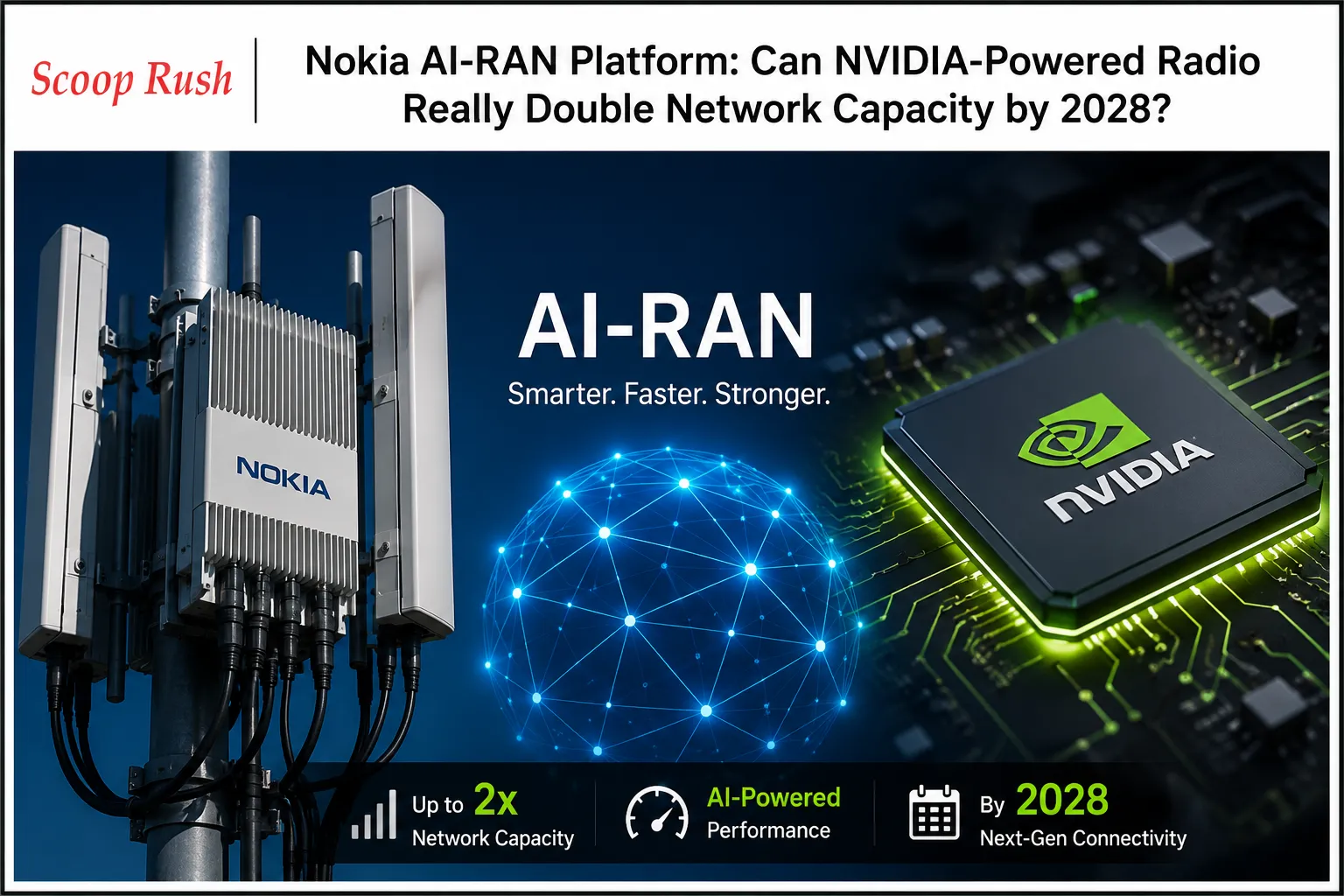
What if your phone network could double its capacity overnight, without a single new cable, tower, or slice of spectrum? That is exactly what Nokia is now promising with its new AI-RAN platform, and the claim has the telecom industry paying close attention. On July 15, 2026, Nokia announced what it calls the industry’s first commercial AI-native radio access network platform, built in partnership with NVIDIA. The launch matters because it could reshape how mobile operators deliver faster, more reliable service, especially as data demand keeps climbing every year. For everyday users, this could eventually mean fewer dropped calls, faster downloads, and better coverage in crowded areas, all without operators needing to dig up more radio spectrum.
This Nokia AI-RAN platform arrives at a critical moment for the Finnish telecom giant. Radio has been the company’s weakest business segment for years, and this launch represents a genuine attempt at a turnaround. However, the story is more layered than the headlines suggest, and it is worth understanding both the promise and the fine print.
What Is the Nokia AI-RAN Platform?
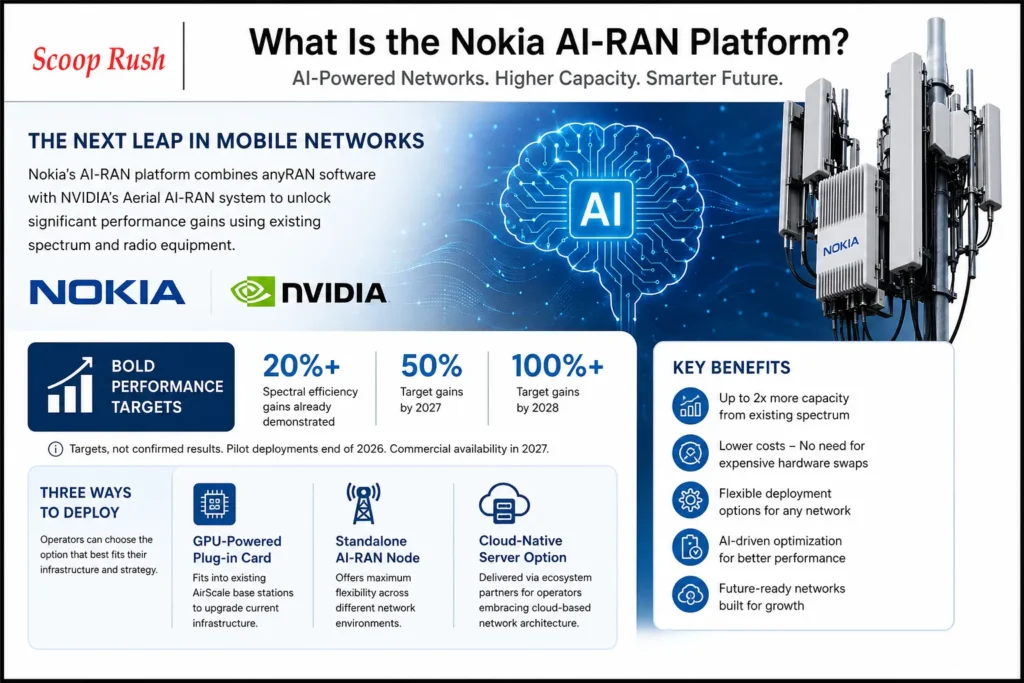
Nokia’s AI-RAN platform combines the company’s anyRAN software with NVIDIA’s Aerial AI-RAN system. Together, they aim to help mobile operators pull significantly more performance out of the spectrum and radio equipment they already own. Instead of forcing operators into expensive hardware upgrade cycles, the platform works through a software subscription model.
The numbers behind the announcement are bold. Nokia says the platform has already demonstrated more than 20% spectral efficiency gains through AI-driven radio improvements. The company is targeting 50% gains by 2027 and more than 100% by 2028. If that final target holds, operators could effectively double the capacity of their existing spectrum without adding new frequencies.
It is important to note that the 50% and 100% figures are targets, not confirmed results. Nokia’s own timeline places pilot deployments at the end of 2026, with commercial availability arriving in 2027. Therefore, the full performance picture will only become clear once real-world deployments begin.
Three Ways Operators Can Adopt the Platform
Nokia is offering operators flexibility in how they roll out the technology. There are three deployment paths:
A GPU-powered plug-in card that fits into existing AirScale base stations, allowing operators to upgrade current infrastructure rather than replace it. A standalone AI-RAN node designed for operators who want maximum flexibility across different network environments. A cloud-native server option delivered through ecosystem partners, aimed at operators embracing cloud-based network architecture.
This approach lets telecom providers modernize at their own pace, choosing the option that best matches their existing infrastructure and long-term strategy.
Why This Launch Matters for Nokia’s Turnaround
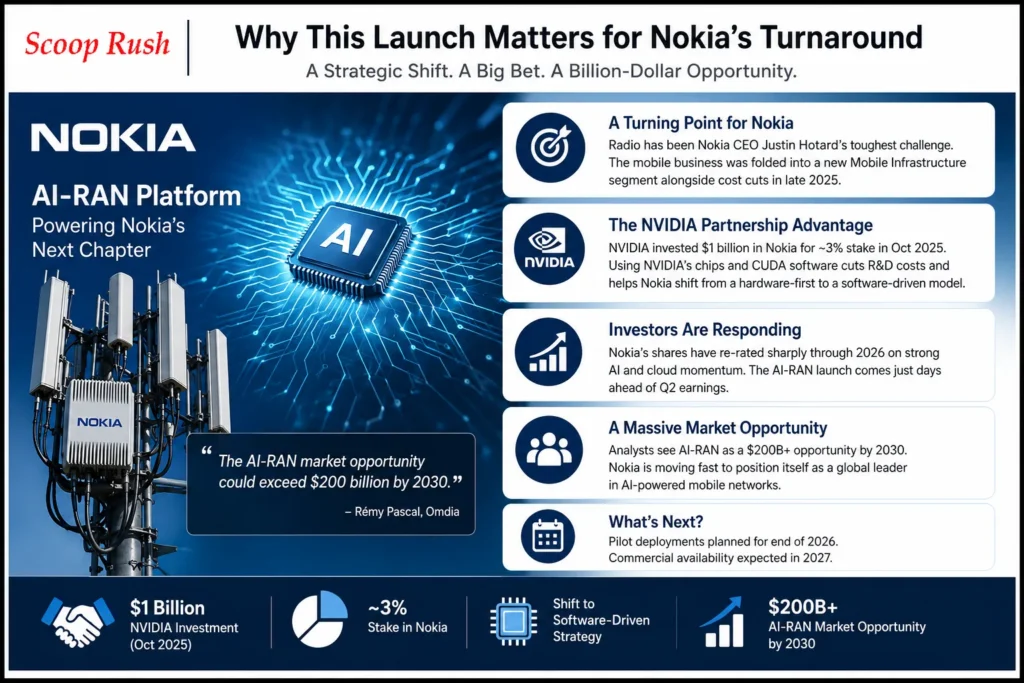
To understand why this announcement carries weight, you have to look at Nokia’s recent struggles. Radio has been CEO Justin Hotard’s toughest challenge since he took the helm in 2025. At Nokia’s November capital markets day, Hotard told investors the mobile business had not delivered acceptable returns, prompting him to fold it into a new Mobile Infrastructure segment alongside further cost cuts.
The NVIDIA partnership sits at the center of this recovery effort. NVIDIA invested $1 billion in Nokia in October 2025 for roughly a 3% stake in the company. By building on NVIDIA’s chips and CUDA software instead of developing its own custom silicon, Nokia can reduce costly in-house research spending and redirect resources toward software development. Hotard has described this as a shift away from Nokia’s traditional hardware-first business model. This kind of bold strategic pivot echoes moves elsewhere in big tech, like SpaceX’s historic IPO push toward Elon Musk’s trillionaire status.
Investors have responded positively to this strategy. Nokia’s shares have re-rated sharply through 2026, driven largely by growing confidence in its AI and cloud momentum. The AI-RAN announcement landed just days ahead of Nokia’s second-quarter earnings results, adding further weight to the moment.
Industry analysts also see genuine opportunity here. Omdia’s Rémy Pascal, quoted in Nokia’s own announcement, estimated the cumulative AI-RAN market opportunity could exceed $200 billion by 2030. That is a massive addressable market, and it explains why Nokia is moving quickly to stake its claim.
Is Nokia Really First? The Ericsson Question
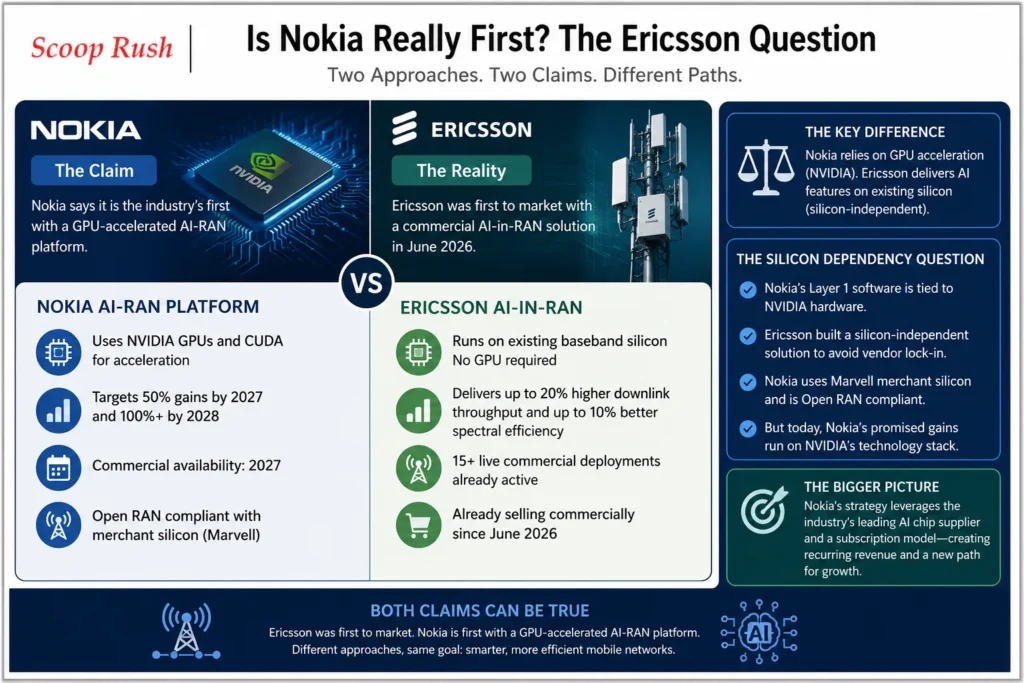
Nokia’s marketing leans heavily on the phrase “industry’s first.” However, this claim deserves closer scrutiny. In June 2026, Ericsson began selling its own commercial AI-in-RAN software subscription. Ericsson says its solution delivers up to 20% higher downlink throughput and up to 10% better spectral efficiency, and it is already running across more than 15 live deployments.
Here is the key difference: Ericsson’s solution runs on operators’ existing baseband silicon and requires no GPU at all. Meanwhile, Nokia’s platform depends specifically on GPU acceleration through NVIDIA’s hardware and software stack.
So when Nokia says it is first, it is referring narrowly to being first with a GPU-accelerated AI-RAN platform, which is a different technical approach than layering AI features onto existing baseband chips. Both companies’ claims can technically be true at the same time, which is exactly why the framing matters. Ericsson, notably, is already selling its solution commercially, while Nokia’s platform will not be commercially available until 2027.
The Silicon Dependency Question
The differences between Nokia and Ericsson go deeper than just timing. Nokia’s chief technology officer, Pallavi Mahajan, has acknowledged that at least some of the platform’s Layer 1 software is tied to the underlying NVIDIA hardware. Ericsson, by contrast, deliberately built its AI features to remain silicon-independent, avoiding that kind of vendor dependency altogether.
Nokia does point to merchant silicon from Marvell as part of its broader ecosystem, and it describes the entire platform as Open RAN compliant. Even so, the actual performance gains Nokia is promising currently run through NVIDIA’s technology stack. As of now, no equivalent alternative exists for delivering those same spectral efficiency numbers outside of NVIDIA’s system. In other words, the platform’s messaging emphasizes openness, while its underlying engineering leans heavily on a single powerful partner.
None of this necessarily makes Nokia’s strategy a mistake. Relying on the industry’s leading AI chip supplier is a reasonable way to solve a problem Nokia had struggled to fix independently for years. Additionally, the subscription-based model gives Nokia’s radio business the kind of recurring revenue that traditional hardware sales cycles never provided.
What This Means for the Future of Mobile Networks
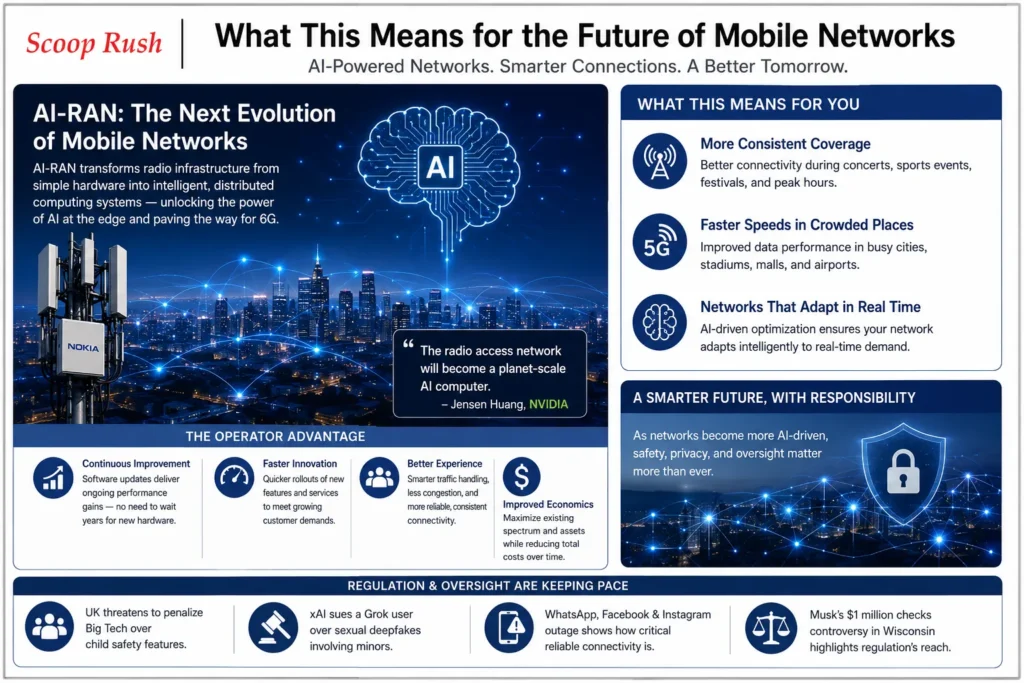
AI-RAN technology represents a broader shift happening across the telecom industry. As mobile networks increasingly need to handle AI-driven workloads themselves, radio infrastructure is evolving from simple hardware into something closer to distributed computing systems. NVIDIA’s Jensen Huang described this as transforming the radio access network into what he called a planet-scale AI computer, one that could also lay groundwork for future 6G services. Just as AI is reshaping physical networks, it is also reshaping consumer tools, from Meta’s new Muse Image feature to smarter public services like NHS AI tools aimed at cutting waiting times.
For operators, the appeal is straightforward. Instead of waiting years for the next major hardware refresh, they can continuously improve network performance through software updates. This could translate into faster rollouts of new features, better handling of network congestion, and improved economics across the board.
For everyday consumers, the benefits may take longer to materialize but could eventually include more consistent coverage during high-traffic events, improved data speeds in crowded urban areas, and networks that adapt more intelligently to real-time demand. Reliable connectivity also matters in moments of disruption, as seen when WhatsApp, Facebook, and Instagram went down for thousands of users worldwide during a recent outage.
As networks grow smarter and more AI-driven, questions around safety and oversight also grow louder. Regulators are already paying close attention, as shown by the UK’s threats to penalize Big Tech over child safety features and xAI’s lawsuit against a Grok user over sexual deepfakes involving minors. Even legal battles tied to Musk’s businesses, like the $1 million checks controversy tied to Wisconsin law, show how deeply intertwined tech infrastructure and regulation have become.
Final Takeaways
Nokia’s AI-RAN platform represents a genuine and ambitious step forward, built on a partnership with NVIDIA that could reshape how radio networks operate. Nokia has already shown real efficiency gains and it has an aggressive roadmap targeting even bigger improvements through 2028. However, the platform is not yet commercially available, its most impressive numbers remain projections rather than proven results, and Ericsson reached the commercial AI-RAN market first through a different technical approach.
Ultimately, Nokia’s future in this space is now closely tied to NVIDIA’s technology. Whether that dependency proves to be a smart strategic bet or a long-term risk will become clearer once pilot deployments begin later this year and commercial rollouts follow in 2027.
FAQs
Q1: What is Nokia’s AI-RAN platform?
A1: Nokia’s AI-RAN platform is a radio network system built on Nokia’s anyRAN software and NVIDIA’s Aerial AI-RAN technology. It uses AI and GPU acceleration to help mobile operators get significantly more capacity from the spectrum they already own, without needing new hardware installations.
Q2: When will Nokia’s AI-RAN platform be available?
A2: Pilot deployments are scheduled to begin at the end of 2026. Commercial availability is expected to follow in 2027, according to Nokia’s own timeline.
Q3: Is Nokia’s AI-RAN platform really the industry’s first?
A3: Nokia claims to be first with a GPU-accelerated AI-RAN platform specifically. However, Ericsson launched its own commercial AI-in-RAN software subscription in June 2026, which runs on existing baseband silicon without requiring GPUs. Both claims can be accurate depending on how “first” is defined.
Q4: How much will Nokia’s AI-RAN platform improve network capacity?
A4: Nokia says it has already achieved more than 20% spectral efficiency gains. The company is targeting 50% gains by 2027 and over 100% by 2028, which would effectively double existing spectrum capacity if the targets are met.
Q5: Does Nokia’s AI-RAN platform depend on NVIDIA hardware?
A5: Yes, at least partially. Nokia’s chief technology officer has confirmed that some of the platform’s Layer 1 software is tied to NVIDIA’s underlying hardware, meaning the headline performance gains currently rely on NVIDIA’s technology stack.

