
Introduction
When one of the world’s most respected climate scientists says a government report got the science wrong, people pay attention. The Benjamin Santer Climate Report debate has sparked fresh discussion about climate science after Santer and three leading researchers published a peer-reviewed paper challenging conclusions made in a recent U.S. Department of Energy (DOE) report. The scientists argue that decades of satellite observations continue to show clear evidence that human activities are warming Earth and that the government report misrepresented established climate research. Their response comes as climate science plays an increasingly important role in shaping environmental policy and public health decisions, much like the concerns raised around. NASA’s super El Niño warning based on satellite imagery.
Why the Benjamin Santer Climate Report Is Making Headlines
A leading climate scientist has challenged a U.S. government report that cited his own research while reaching what he describes as the opposite scientific conclusion.
Benjamin Santer, an Honorary Professor at the University of East Anglia, is one of the researchers who first identified the atmospheric “fingerprint” of human-caused climate change. His work helped shape the 1995 Intergovernmental Panel on Climate Change (IPCC) assessment, which concluded there was clear evidence that human activity was influencing Earth’s climate.
However, in July 2025, the U.S. Department of Energy (DOE) released a climate science report that referenced Santer’s research while arguing against that long-standing conclusion.
According to Santer, the report contains significant scientific errors and should not be used when making climate policy decisions.
What Is the DOE Climate Report?
The DOE report was released on the same day the U.S. Environmental Protection Agency (EPA) proposed overturning the 2009 Endangerment Finding.
The Endangerment Finding provides the legal authority for regulating greenhouse gas emissions from vehicles, power plants, and other industrial sources.
Earlier this year, the Trump administration moved forward with revoking the finding. That decision raised concerns among scientists about possible impacts on public health and future efforts to reduce greenhouse gas emissions — concerns that echo warnings tied to rising extreme weather patterns expected with El Niño in 2027.
Santer and his co-authors argue that because the DOE report contains factual scientific mistakes, it should not be used to support legal or regulatory decisions.
New Research Responds to the DOE Report
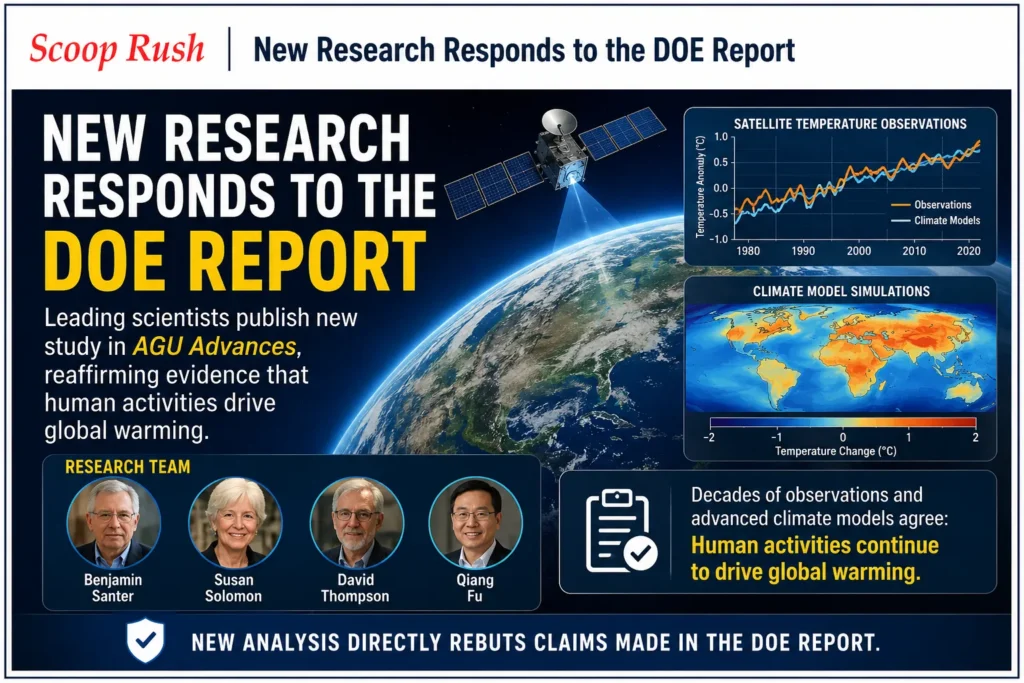
To address those claims, Benjamin Santer joined three internationally recognized climate scientists to publish a peer-reviewed paper in AGU Advances.
The research team includes:
- Benjamin Santer
- Susan Solomon
- David Thompson
- Qiang Fu
Their study re-examined decades of satellite temperature observations alongside modern climate model simulations.
According to the researchers, both independent observations and advanced climate models reach the same conclusion: human activities continue to drive global warming.
The authors say their analysis directly rebuts claims made in the DOE report.
Understanding the Climate Fingerprint
What Is the Atmospheric Fingerprint?
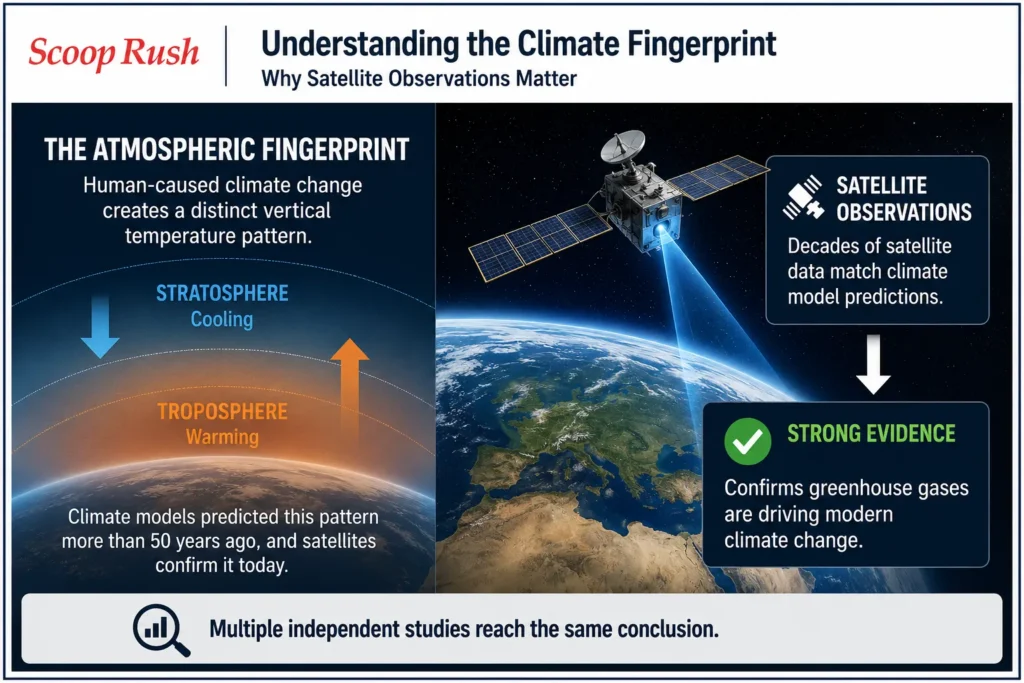
One of the strongest scientific indicators of human-caused climate change is the atmosphere’s vertical temperature pattern.
Scientists describe this pattern as the atmospheric fingerprint.
Instead of warming uniformly, greenhouse gases create a distinct structure throughout the atmosphere.
Researchers say this fingerprint includes:
- Warming of the troposphere, the lowest atmospheric layer.
- Cooling of the stratosphere above it.
Climate models predicted this pattern more than 50 years ago.
Today, satellite observations continue to detect exactly the same fingerprint — a reminder that Earth’s environmental systems are deeply interconnected, not unlike how scientists are still working to understand why algae blooms collapse.
According to Santer, this agreement between observations and climate models provides strong evidence that greenhouse gases are driving modern climate change.
Why Satellite Observations Matter
Satellite records allow scientists to measure atmospheric temperatures across the globe over several decades.
The new peer-reviewed study states that these observations closely match predictions made by climate models.
However, the DOE report claimed otherwise.
Santer says that conclusion is factually incorrect because satellite data consistently shows the expected atmospheric fingerprint associated with greenhouse gas emissions.
The researchers add that multiple independent scientific studies have reached the same conclusion, much like the growing body of peer-reviewed work behind other recent discoveries, including NASA’s evidence pointing to ancient life on Mars.
Scientists Say Accuracy Is Essential
The research team believes correcting scientific errors is particularly important when government reports influence public policy.
According to the authors, peer-reviewed research remains the most reliable source of scientific evidence.
They say publishing their response helps ensure that policymakers, courts, and the public have access to accurate climate information.
Other Concerns Raised About the DOE Report
The authors also note that additional scientists have questioned other sections of the DOE report, including its treatment of climate detection and attribution.
The report was cited 16 times in the EPA proposal concerning the Endangerment Finding.
Later, after a lawsuit alleged that required Federal Advisory Committee procedures had not been followed, the team responsible for producing the DOE report was dissolved.
However, the report itself remains available and has not been withdrawn or corrected.
Santer continues to argue that it should not be considered a reliable scientific source.
What This Means for Climate Science
The latest peer-reviewed paper reinforces decades of climate research rather than introducing a new theory.
According to the authors, satellite observations, atmospheric measurements, and modern climate models all continue to support the conclusion that human activities are warming Earth.
The researchers stress that scientific accuracy remains essential because climate evidence influences environmental regulations, public health policies, and future planning around the world — a principle that also applies to public health research, such as recent findings on a hidden DNA factor that could reduce Ozempic’s effectiveness and studies on omega-3 fish oil supplements and brain health.
Conclusion
“As climate policy evolves, the researchers say accurate scientific evidence should remain the foundation of future decisions. They add that careful, data-driven research remains essential across all areas of science.”
Their latest study reaffirms that the atmospheric fingerprint predicted by climate models remains visible today. As climate policy continues to evolve, the researchers say accurate scientific evidence should remain the foundation of future decisions — a pattern of careful, data-driven discovery seen across science, from the discovery of a new beetle species by Kyushu University to research on how neurons break DNA to build the brain.
FAQs
What is the Benjamin Santer Climate Report?
It refers to the debate surrounding Benjamin Santer’s response to a U.S. Department of Energy report that cited his research while reaching different conclusions about climate change.
Why did Benjamin Santer criticize the DOE report?
He says the report contains factual scientific errors and misrepresents decades of peer-reviewed climate research.
What is the atmospheric fingerprint?
It is the pattern of warming in the troposphere and cooling in the stratosphere that scientists associate with increasing greenhouse gas emissions.
What does the new study conclude?
The researchers conclude that satellite observations and climate models consistently support human-caused global warming.
Why is this debate important?
The DOE report has been used in discussions surrounding U.S. climate regulations, making scientific accuracy important for future environmental policy.

