
Introduction
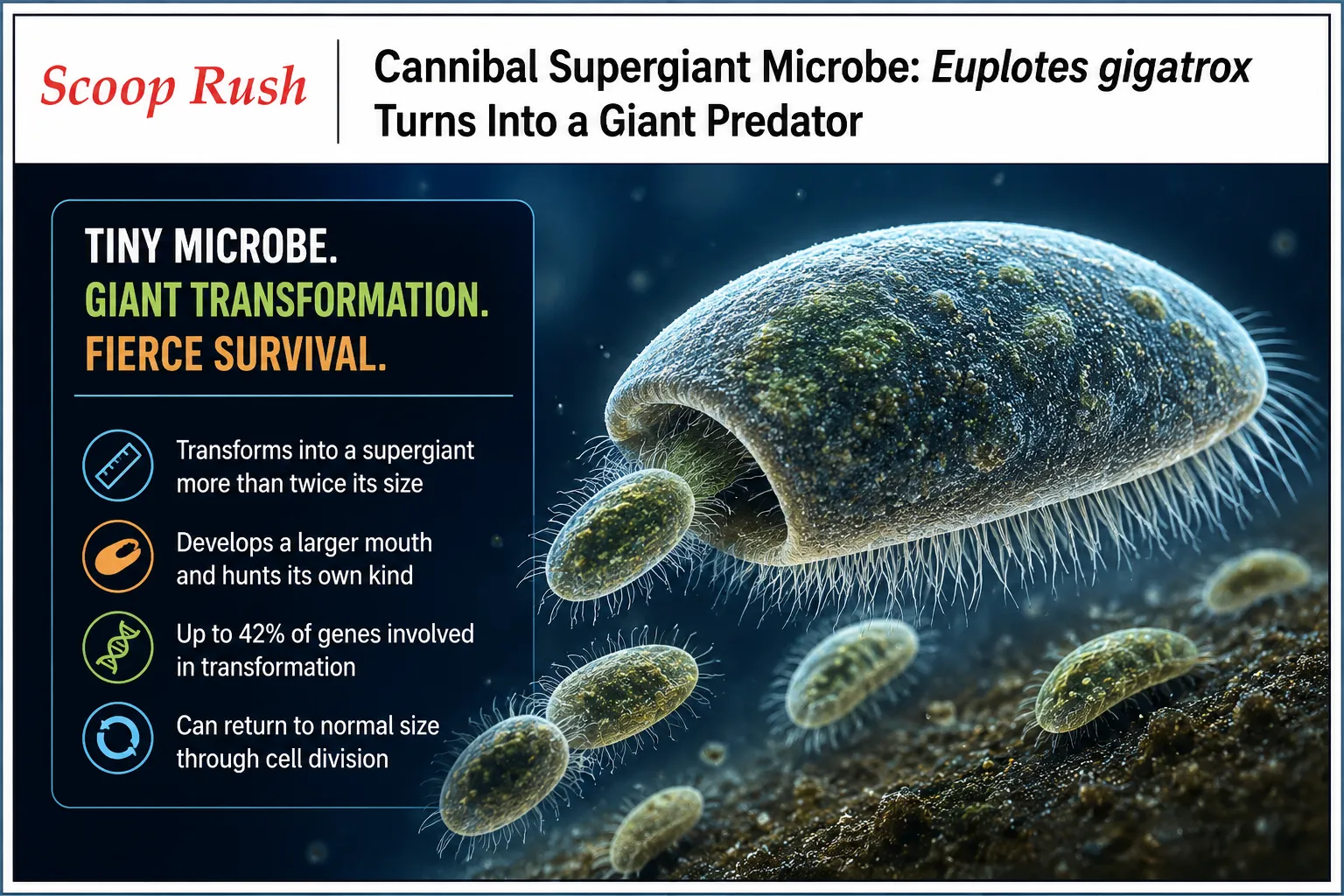
A microscopic organism has surprised scientists by revealing a behavior that was once thought to be limited to more complex forms of life. The newly discovered Euplotes gigatrox can transform into a giant version of itself, develop a larger mouth, and begin hunting and consuming members of its own species. A microscopic organism called Cannibal supergiant microbe Euplotes gigatrox has surprised scientists by revealing a behavior that was once thought to be limited to more complex forms of life.
This unusual cannibal supergiant microbe behavior has changed how researchers understand single-celled organisms. Instead of only feeding on bacteria, this tiny ciliate can completely change its body structure, movement, and feeding strategy when conditions around it shift.
Scientists say this discovery offers new insights into how individual cells control their development and adapt to environmental challenges. It also provides a new way to study how complex behaviors may have developed in simple organisms.
What Scientists Discovered About Euplotes gigatrox
Euplotes gigatrox is a single-celled organism known as a protist. It belongs to a group called ciliates, which use tiny hair-like structures called cilia to move and collect food.
Researchers discovered this microorganism from samples collected inside a seawater filtration system in Curaçao. After bringing the samples to the laboratory, scientists grew the organisms in artificial seawater with nutrients and bacteria.
At first, the cells behaved normally. They moved through the water and fed on tiny organisms around them.
However, after some time, scientists noticed something unusual. A small number of cells began increasing dramatically in size.
Normal Euplotes gigatrox cells measure around 54 micrometers long, while the transformed supergiant cells can reach about 140 micrometers.
The transformation was not only a physical change. The larger cells developed a completely different lifestyle.
Instead of filtering bacteria, they became predators that hunted smaller members of their own species.
How the Transformation Creates a Giant Predator
The change from a normal cell into a supergiant happens in stages.
Researchers found that the first major sign of transformation is the development of a much larger mouth structure. The cell becomes more active and begins moving differently.
At this stage, the organism is not yet an efficient hunter. However, after capturing another Euplotes gigatrox cell, the transformation continues.
The cell’s body structure changes completely.
It becomes larger and develops the ability to capture and consume other cells. Scientists describe this as a major biological transformation because a simple feeder becomes an active predator.
This behavior is especially surprising because advanced hunting strategies are usually linked with animals rather than single-celled organisms.
A Single Cell Showing Complex Behavior
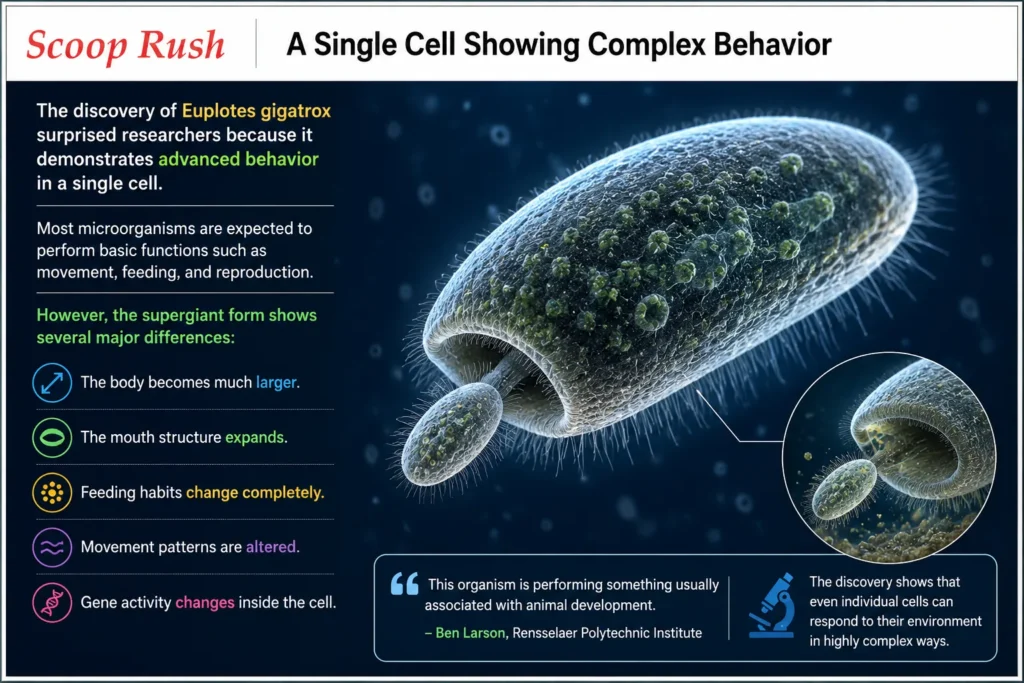
The discovery of Euplotes gigatrox surprised researchers because it demonstrates advanced behavior in a single cell.
Most microorganisms are expected to perform basic functions such as movement, feeding, and reproduction.
However, the supergiant form shows several major differences:
The body becomes much larger.
The mouth structure expands.
Feeding habits change completely.
Movement patterns are altered.
Gene activity changes inside the cell.
Researcher Ben Larson from Rensselaer Polytechnic Institute explained that this organism is performing something usually associated with animal development.
The discovery shows that even individual cells can respond to their environment in highly complex ways.
The Hunting Behavior of the Supergiant Form
The most unusual feature of Euplotes gigatrox is its cannibalistic feeding behavior.
In its normal state, the microorganism feeds on bacteria and other tiny organisms by filtering food from its surroundings.
After transforming into the supergiant form, however, it begins capturing smaller Euplotes gigatrox cells.
Researchers observed that these giant cells can hunt and consume another cell approximately every 10 minutes.
The hunting method is different from normal feeding. The supergiant moves over its target and pushes the smaller cell into its enlarged mouth area.
As a result, the same species can exist in two completely different forms.
Normal cells act as filter feeders, while supergiant cells behave like predators.
Why Does the Microbe Change Its Form?
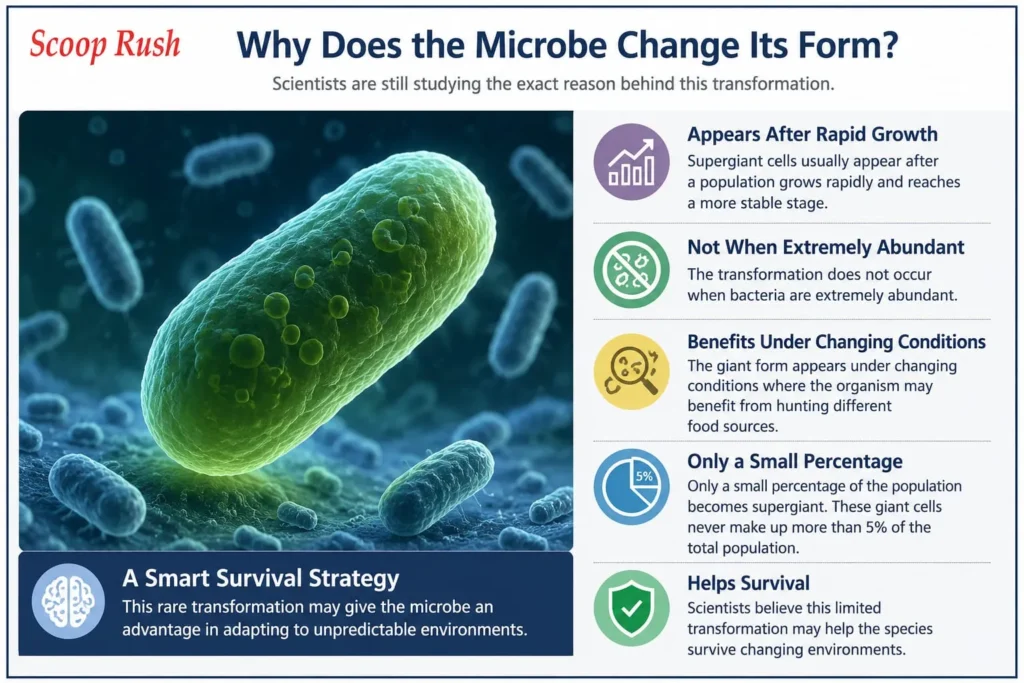
Scientists are still studying the exact reason behind this transformation.
However, researchers found that supergiant cells usually appear after a population grows rapidly and reaches a more stable stage.
The transformation does not occur when bacteria are extremely abundant.
Instead, the giant form appears under changing conditions where the organism may benefit from hunting different food sources.
Only a small percentage of the population becomes supergiant. Researchers found that these giant cells never made up more than 5 percent of the total population.
Scientists believe this limited transformation may help the species survive changing environments.
The Benefits and Costs of Becoming Larger
The supergiant form gives Euplotes gigatrox a major advantage because it allows the organism to hunt larger prey.
However, the transformation also creates disadvantages.
Normal cells can swim efficiently through water using their cilia and move with smooth spiral movements.
Supergiant cells are too large to move in the same way. Instead, they travel across surfaces in circular patterns while searching for prey.
When removed from a surface, they struggle to swim normally.
Therefore, becoming larger creates a tradeoff. The organism becomes a stronger hunter but loses some movement abilities.
How the Giant Cells Return to Normal
The supergiant stage is not permanent.
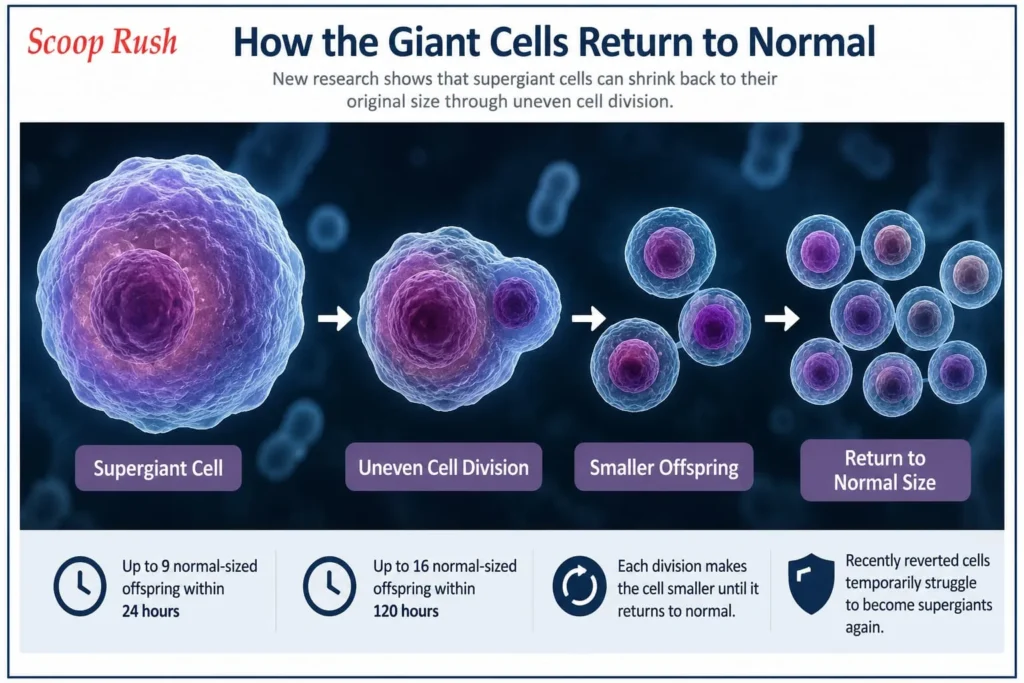
Scientists discovered that these giant cells can return to their original size through a process involving uneven cell division.
During this process, the large cell produces smaller normal-sized offspring.
A supergiant can produce up to nine normal-sized offspring within 24 hours and up to 16 within 120 hours.
With each division, the cell becomes smaller until it returns to its original form and behavior.
Researchers also found that recently reverted cells temporarily have difficulty becoming supergiants again.
Genetic Changes Behind the Transformation
To understand this unusual process, scientists studied gene activity in normal cells, supergiant cells, and recently reverted cells.
They discovered that many genes change their activity during the transformation.
Around 42 percent of the organism’s genes are involved in moving between normal and supergiant stages.
These genetic changes help explain how a single cell can completely alter its structure and behavior.
Why This Discovery Matters
The discovery of Euplotes gigatrox gives scientists a new opportunity to study how cells develop complex abilities.
For many years, developmental biology focused mainly on multicellular organisms such as animals.
However, this microorganism shows that even a single cell can perform advanced transformations.
The research may help scientists better understand how cells control their shape, behavior, and survival strategies.
Conclusion: A Discovery That Changes How We View Microbes
The discovery of the cannibal supergiant microbe Euplotes gigatrox has revealed a surprising side of microscopic life. The discovery of Euplotes gigatrox microbe shows that even tiny organisms can develop complex survival strategies and unexpected behaviors.
This tiny organism can transform from a normal bacteria-eating cell into a giant predator that hunts members of its own species.
Although researchers are still studying the exact reasons behind the transformation, the discovery proves that single-celled organisms can display highly complex behaviors.
Euplotes gigatrox shows that even the smallest forms of life can develop remarkable survival strategies.
FAQs
1. What is Euplotes gigatrox?
The Euplotes gigatrox microbe is important because it reveals how single-celled organisms can adapt and transform their behavior.
2. Why does Euplotes gigatrox become a supergiant?
Scientists believe the transformation helps the organism adapt to changing conditions by allowing it to hunt different types of food.
3. How large can the supergiant form become?
The supergiant form can grow to around 140 micrometers, while normal cells are about 54 micrometers long.
4. Does the supergiant stage last forever?
No. The giant cells can return to their normal size through uneven cell division.
5. Why is this discovery important?
It shows that single-celled organisms can develop complex behaviors that were previously associated mainly with larger organisms.

