
Introduction
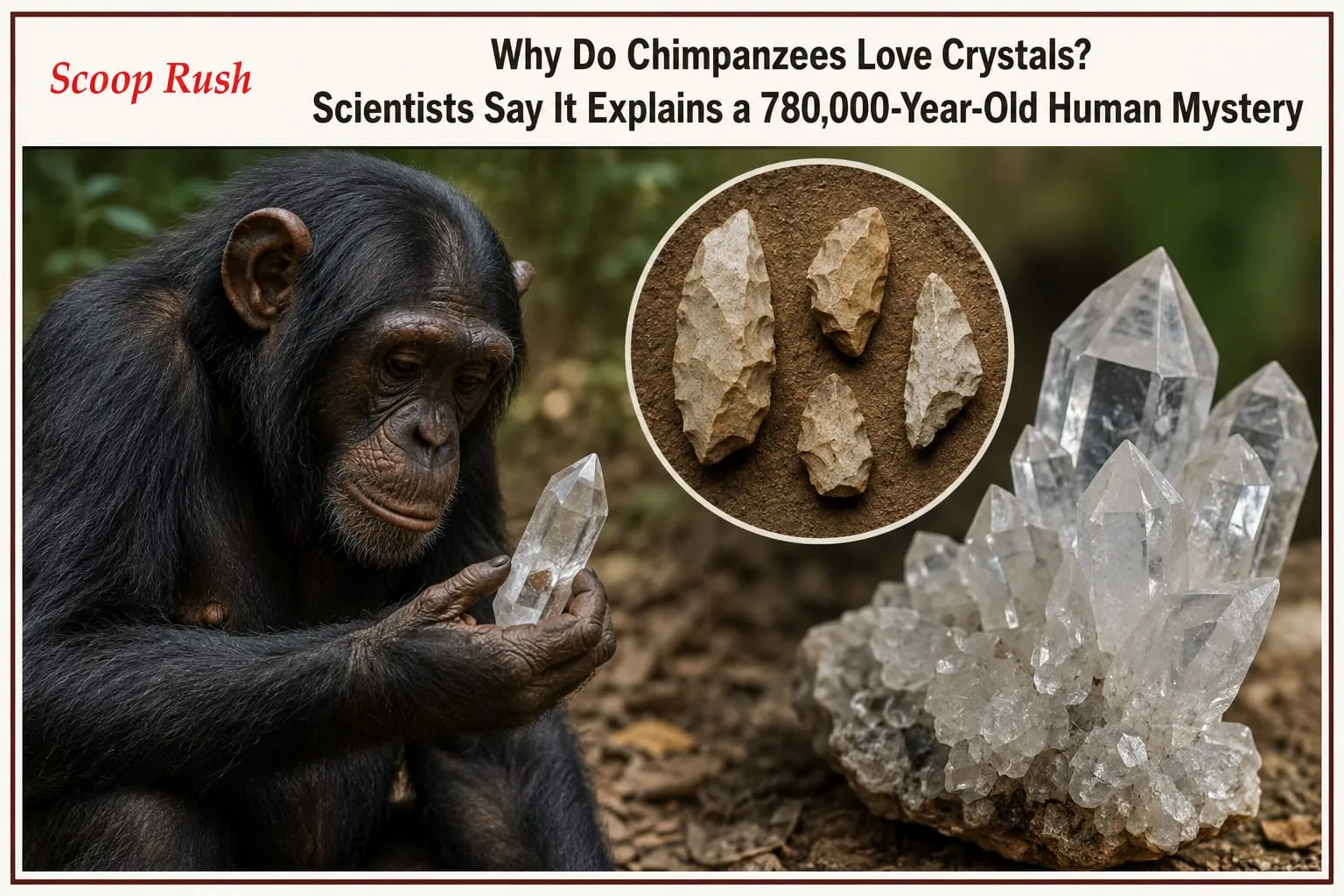
Why do chimpanzees love crystals so much that they choose them over ordinary rocks every single time? That question sits at the heart of a new study, and it also helps explain why humans collected crystals for hundreds of thousands of years, even when these stones served no practical purpose at all.
Researchers in Spain recently ran a series of crystal experiments with chimpanzees and found something remarkable. These apes naturally preferred crystals over ordinary rocks. They studied the crystals with intense curiosity, carried them around, and even hid them from caretakers. The findings, published in Frontiers in Psychology, suggest that our fascination with crystals may go back millions of years, long before early humans ever picked one up.
This discovery matters because it reshapes how we think about human behavior and cognition.”Understanding why do chimpanzees love crystals helps explain why our attraction to crystals isn’t just a modern trend.” If chimpanzees share this same pull toward shiny, transparent, geometric stones, then our attraction to crystals isn’t just a modern trend fueled by jewelry stores or wellness culture. Instead, it may be something deeply wired into primate psychology itself.”However, a new study finally answers why do chimpanzees love crystals, and the answer might explain human behavior too.”
The 780,000-Year-Old Crystal Puzzle Archaeologists Couldn’t Solve
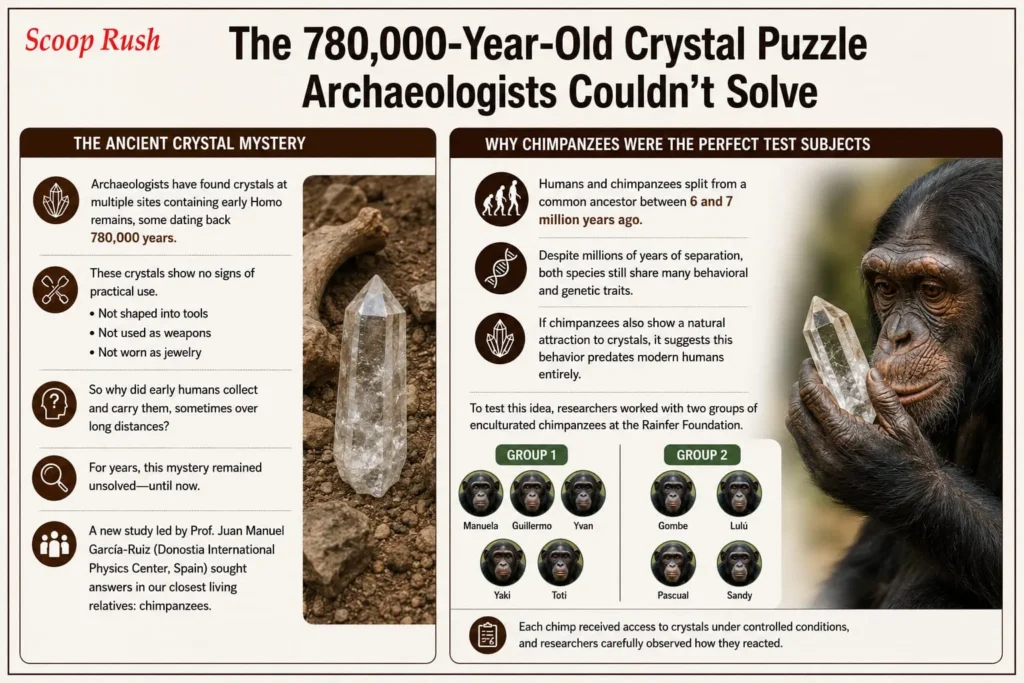
Archaeologists have found crystals at multiple sites containing the remains of early Homo species. Some of these discoveries date back an astonishing 780,000 years. What makes this so strange is that these crystals show no signs of practical use. Nobody shaped them into tools. No one turned them into weapons. They weren’t worn as jewelry either..
So why did early humans bother collecting them?
For years, this crystal mystery sat unanswered. Researchers could see that ancient humans valued crystals enough to carry them, sometimes over long distances, yet no one had a clear explanation. That’s where this new study comes in. A team led by Prof Juan Manuel García-Ruiz, a crystallography researcher at the Donostia International Physics Center in Spain, decided to search for clues in a species that shares deep evolutionary roots with us: the chimpanzee. “To understand why do chimpanzees love crystals, his team designed two separate experiments.”
Why Chimpanzees Were the Perfect Test Subjects for Crystal Attraction
Humans and chimpanzees split from a common ancestor between six and seven million years ago. Despite that huge span of time, the two species still share many behavioral and genetic traits. Because of this shared history, researchers reasoned that if chimpanzees also show a natural pull toward crystals, this would suggest the behavior predates modern humans entirely.
To test this idea, the team worked with two groups of enculturated chimpanzees at the Rainfer Foundation. The first group included Manuela, Guillermo, Yvan, Yaki, and Toti. The second group included Gombe, Lulú, Pascual, and Sandy. Each chimp received access to crystals under controlled conditions, and researchers carefully observed how they reacted.
What Happened When Chimpanzees Encountered Crystals
.and they offer real clues on why do chimpanzees love crystals so much.”The results turned out more striking than the researchers expected.
Experiment One: The Monolith Crystal Test
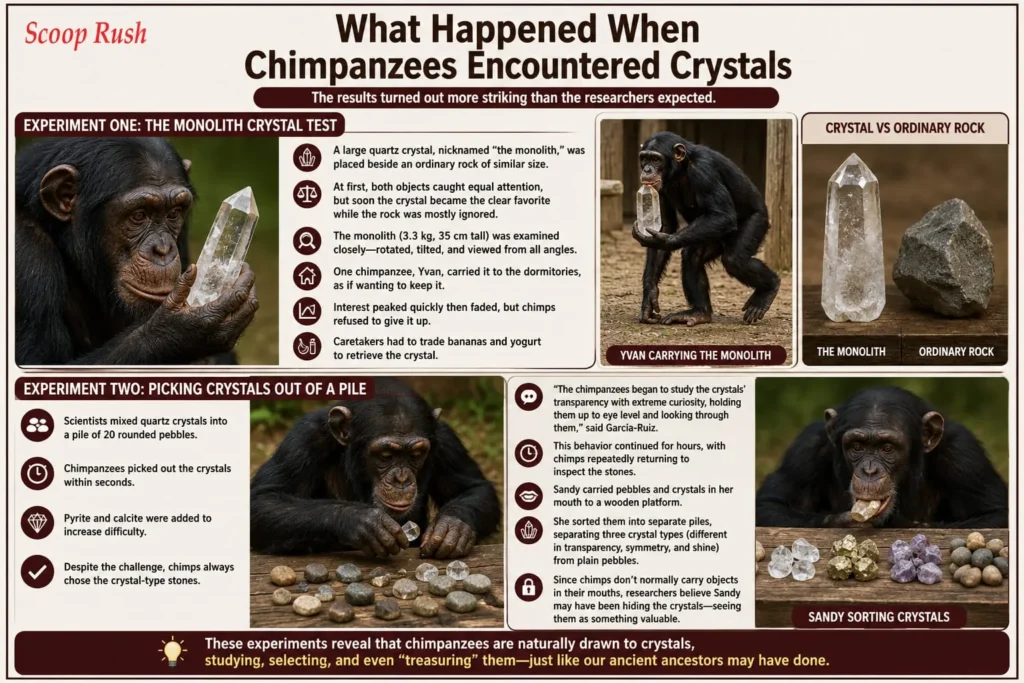
In the first experiment, scientists placed a large quartz crystal, nicknamed “the monolith,” on a platform beside an ordinary rock of similar size. At first, both objects caught the chimpanzees’ attention equally. However, that quickly changed. Within a short time, the crystal became the clear favorite, while the plain rock sat mostly ignored.
The monolith itself was an elongated quartz crystal weighing 3.3 kilograms and standing 35 centimeters tall. Once the chimps removed it from the platform, they examined it closely, rotating and tilting it to view it from different angles. One chimpanzee, Yvan, eventually picked up the crystal and carried it straight to the dormitories, almost as if he wanted to keep it for himself.
Interestingly, the chimps’ curiosity followed a pattern familiar to humans. Interest peaked right after they encountered the crystal, then gradually faded as the novelty wore off. Even so, when caretakers tried to retrieve the crystal, the chimps refused to give it up easily. Staff eventually had to trade bananas and yogurt just to get it back.
Experiment Two: Picking Crystals Out of a Pile
The second experiment tested something more specific: could chimpanzees recognize smaller crystals, similar in size to those collected by ancient hominins?
Researchers mixed quartz crystals into a pile of 20 rounded pebbles. The chimps identified and selected the crystals within seconds. Then the team raised the difficulty by adding pyrite and calcite crystals, both of which have different shapes than quartz. Even with this added complexity, the chimpanzees still recognized and chose the crystal-type stones every time.
“The chimpanzees began to study the crystals’ transparency with extreme curiosity, holding them up to eye level and looking through them,” said García-Ruiz. This behavior continued for hours, as some chimps repeatedly returned to inspect the stones.
One chimpanzee, Sandy, stood out in particular. She carried both pebbles and crystals in her mouth to a wooden platform, where she carefully sorted them into separate piles. She separated three different crystal types, each with its own transparency, symmetry, and shine, from the plain pebbles. Since chimpanzees don’t normally carry objects in their mouths, researchers believe Sandy may have been hiding the crystals, a behavior that suggests she saw them as something valuable.
What Makes Crystals So Special to Chimpanzees and Humans Alike
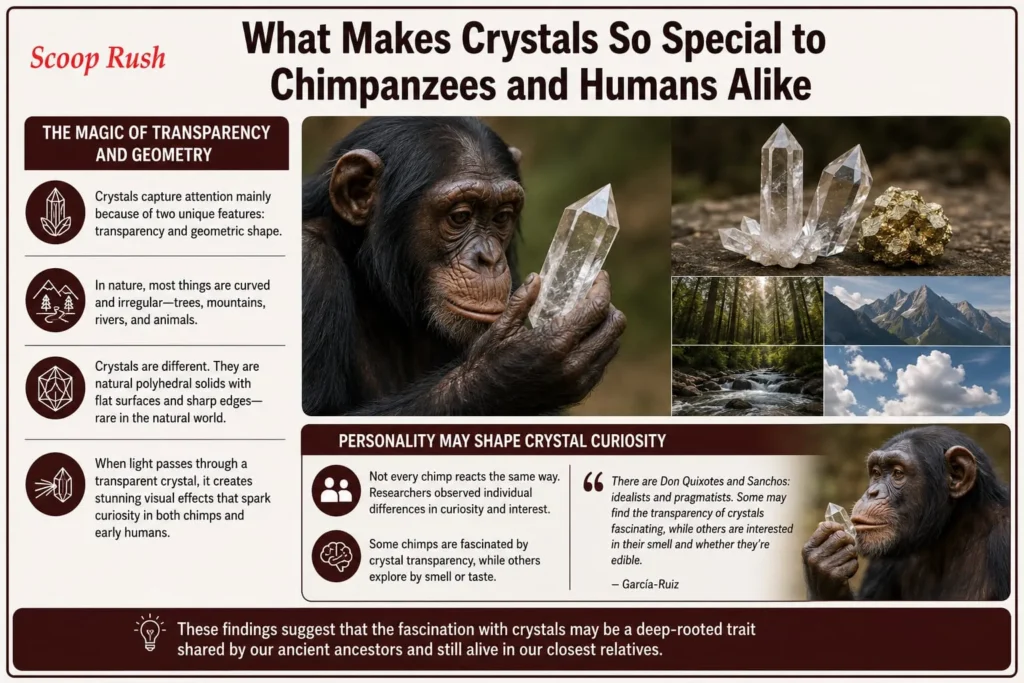
So what exactly makes crystals capture attention so strongly? According to the researchers, it comes down to two features: transparency and geometric shape. “These same features likely explain why do chimpanzees love crystals as much as they do.”
Consider the natural world our ancestors lived in. Trees, mountains, rivers, clouds, and animals all take shape through curves and branching forms. Straight lines and flat surfaces rarely appear in nature. Crystals break that pattern entirely. They stand as the only naturally occurring polyhedral solids, meaning flat surfaces and sharp edges define them unlike almost anything else outdoors.
That visual contrast may explain exactly why crystals stood out to early humans trying to make sense of their surroundings. Furthermore, light passing through a transparent crystal creates a visual effect unlike solid rock, something that likely sparked curiosity the same way it did in the chimpanzees observed in this study.
Personality May Shape Crystal Curiosity Too
Not every chimp reacted to the crystals in exactly the same way. The researchers didn’t formally study individual personality differences in this round of experiments. Still, García-Ruiz offered an interesting observation for future research.
“There are Don Quixotes and Sanchos: idealists and pragmatists,” he said. “Some may find the transparency of crystals fascinating, while others are interested in their smell and whether they’re edible.”
This observation suggests that, similarly to humans, chimpanzees may show individual differences in curiosity, something future brain and cognition studies could explore in more depth.
Limitations Behind the Chimpanzee Crystal Study
The chimpanzees involved in this study are enculturated, meaning they’ve spent significant time around humans and know objects that don’t naturally occur in the wild. Because of this, the researchers acknowledge their reactions might not perfectly reflect how wild, non-enculturated chimpanzees would respond to crystals.
As a result, the team recommends carrying out similar experiments with less enculturated apes, ideally wild populations. This step would help confirm whether the attraction to crystals is truly instinctive across the species or partly shaped by exposure to human environments.
Why This Crystal Discovery Matters for Human Evolution
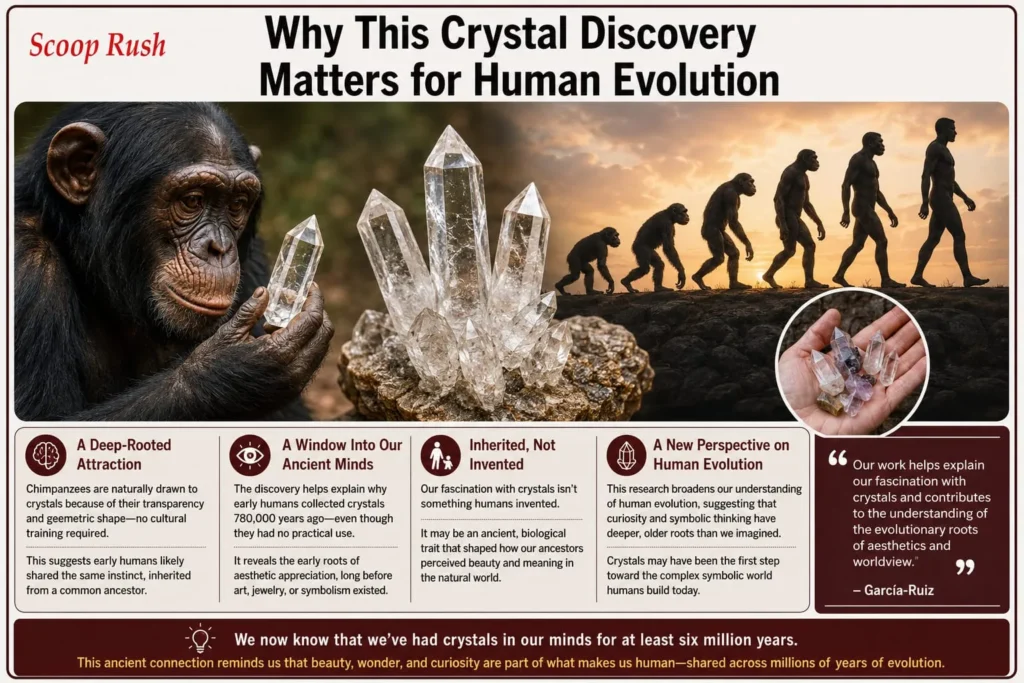
This research does more than explain a quirky animal behavior. It offers a genuine clue into how early humans may have developed an eye for aesthetics long before art, jewelry, or symbolic culture existed in any recognizable form.
If chimpanzees, without any cultural training around beauty or value, gravitate toward crystals because of their transparency and shape, then humans likely didn’t invent this reaction. Instead, we may have inherited this trait from a shared ancestor millions of years ago.
“Our work helps explain our fascination with crystals and contributes to the understanding of the evolutionary roots of aesthetics and worldview,” García-Ruiz concluded. “We now know that we’ve had crystals in our minds for at least six million years.”
That statement reframes the entire question. Ancient humans weren’t necessarily collecting crystals because of some learned cultural practice. Instead, they may have been responding to an ancient, deeply rooted attraction that chimpanzees still display today.
Conclusion
For hundreds of thousands of years, humans collected crystals without using them for any practical purpose, and until now, nobody had a solid explanation why. This new study offers a compelling answer by turning to our closest living relatives. “This new study finally answers why do chimpanzees love crystals, and the answer connects directly to our own ancient past.”
Chimpanzees showed a clear and consistent preference for crystals over ordinary rocks. They studied them closely, examined their transparency, sorted them by type, and in some cases even tried to hide or keep them. These behaviors suggest that the same features that fascinate humans, namely transparency and geometric shape, may have captured our ancestors’ attention millions of years before recorded history.
While researchers still need more studies, particularly with wild chimpanzee populations, this study offers one of the strongest clues yet into why crystals have held such a powerful pull on the human mind for so long. As García-Ruiz put it, we may have had crystals in our minds for at least six million years, long before anyone thought to write that story down.
FAQs
Why did early humans collect crystals if they didn’t use them as tools?
Archaeologists believe early humans felt drawn to crystals for reasons unrelated to practical use. This new study suggests transparency and unique geometric shapes likely made crystals visually captivating, similarly to how chimpanzees respond to them today.
What did the chimpanzee crystal study actually find?
Researchers found that chimpanzees consistently chose crystals over ordinary rocks, examined them closely, and even attempted to keep or hide them. This finding suggests a natural attraction to crystals that isn’t unique to humans.
How old is the evidence of humans collecting crystals?
Crystals have turned up at archaeological sites containing Homo remains dating back as far as 780,000 years, always without signs of tool use or practical purpose.
Why did the researchers choose chimpanzees specifically for this study?
Chimpanzees share a common ancestor with humans from six to seven million years ago and still share many genetic and behavioral traits, which makes them ideal subjects for exploring the evolutionary roots of human behavior.
What features make crystals so attractive to chimpanzees and humans?
According to the study, transparency and geometric, polyhedral shapes stand out as the main features. These qualities rarely appear in nature, since most natural forms take curved or branching shapes rather than flat-edged ones.

