
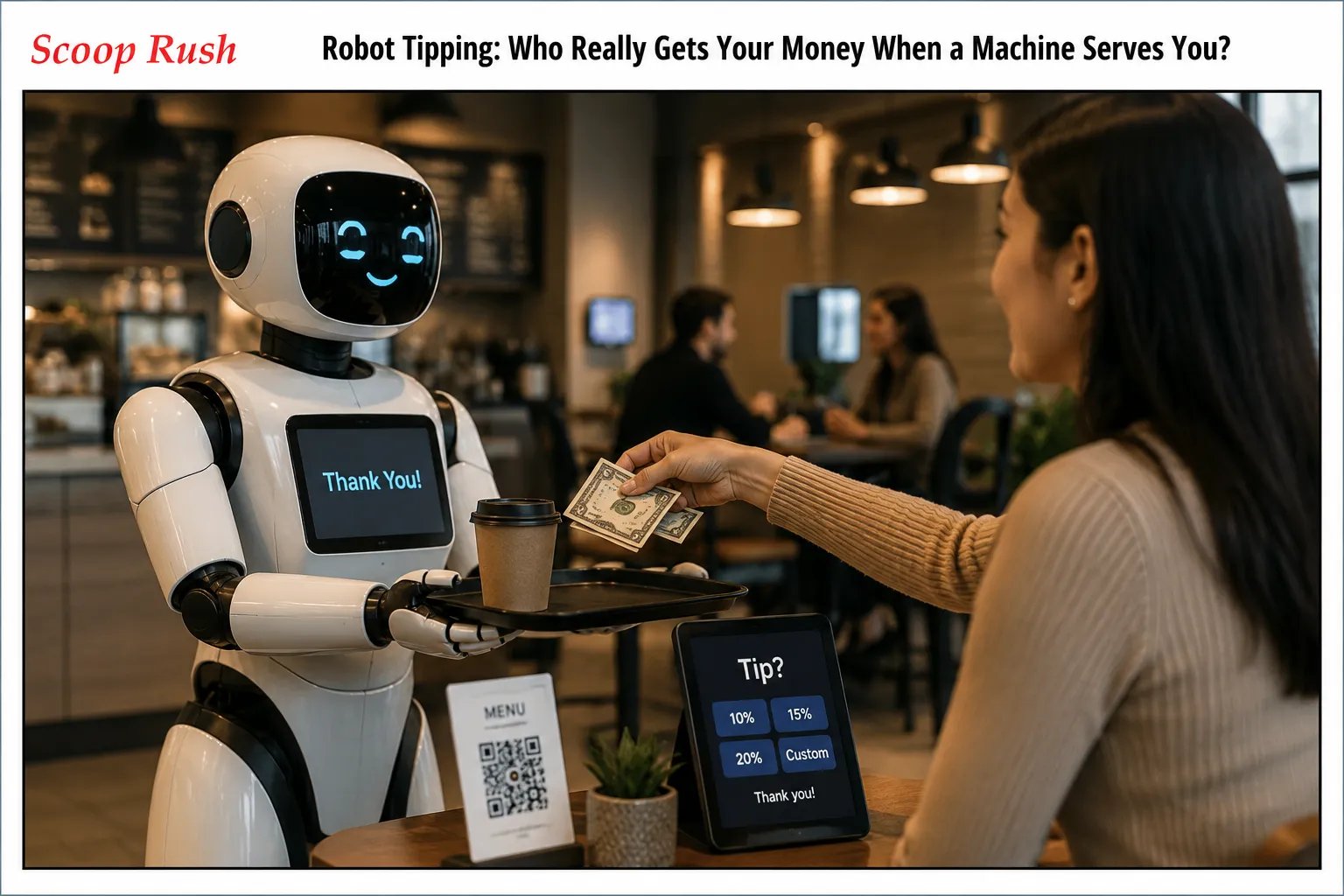
Imagine paying $17 for a margarita made by a robot, and then the screen asks you for a tip. That’s robot tipping in action, and it’s becoming more common than you might think.
Would you pay it? And if you did, would that money even reach a human being.
That exact scene is playing out right now in bars, coffee shops, and airports across the country. Robots are mixing drinks, pulling espresso shots, and rolling food to tables. Increasingly, they are prompting customers for gratuities just like a human server would. This raises an uncomfortable question that nobody has fully answered yet. When you tip a machine, where does that money actually go?
This is not a hypothetical scenario. It is happening at real venues today, and the answer changes depending on who you ask. Understanding robot tipping matters because it affects your wallet directly, and it also shapes how service workers get paid in an increasingly automated industry, a shift that is playing out across many industries as physical AI and robot training advances rapidly.
What Is Robot Tipping and Where Is It Happening?
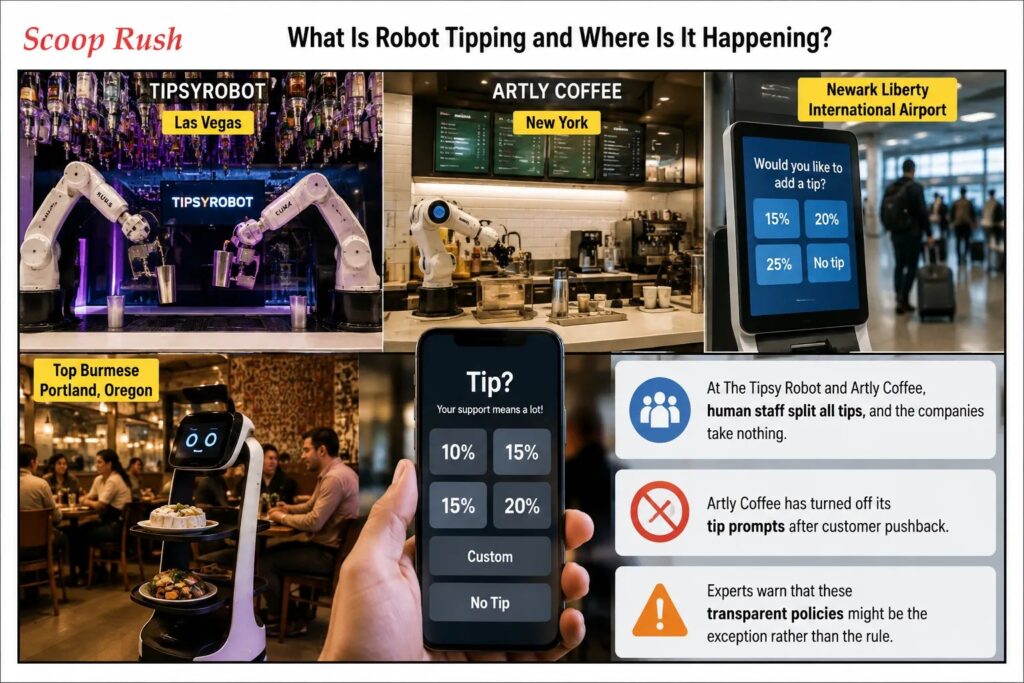
At The Tipsy Robot, a novelty bar inside Las Vegas’s Venetian Hotel, two robotic arms handle the entire cocktail-making process. Customers tap a screen, pick their drink, and watch the machine mix and pour with theatrical flair, a level of consumer-facing automation that echoes how Nokia is deploying AI-driven platforms with Nvidia in other industries. It is a fun gimmick, but the bill comes with a catch. A $17 drink arrives with a 10% “service fee,” and the robot wants a tip.
This is not an isolated case. Similar prompts have appeared at Artly Coffee in New York, where a robotic barista asks for gratuities after preparing drinks. Additionally, a self-checkout kiosk at Newark Liberty International Airport suggested a tip on something as simple as a bottled water purchase, with no staff in sight. Meanwhile, at Top Burmese in Portland, Oregon, a human takes your order, but a robot server wheels your food to the table.
Each of these situations creates the same awkward pause. Should you tip a machine? And more importantly, who benefits when you do?
According to representatives from both The Tipsy Robot and Artly Coffee, human staff split all tips, and the companies themselves take nothing. Artly has since turned off its tip prompts entirely after customer pushback. However, experts warn that these transparent policies might be the exception rather than the rule.
Why Robot Gratuities Sit in a Legal Gray Area
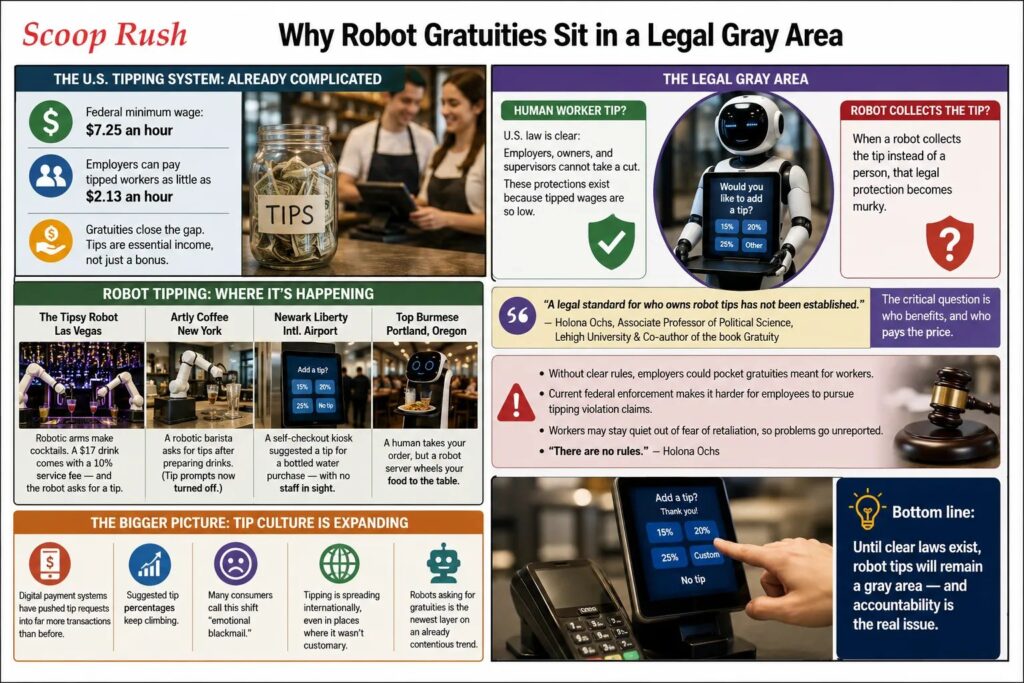
Tipping in the United States already runs on a complicated system. The federal minimum wage sits at $7.25 an hour, but employers can pay tipped workers as little as $2.13 an hour, using gratuities to close the gap. Therefore, tips are not just a bonus for many service workers. They are essential income, not unlike the extra earnings people chase through side ventures such as an Etsy side hustle bringing in $10,000 a month.
When a human worker receives a tip, US law is clear. Employers, owners, and supervisors cannot take a cut. That protection exists specifically because tipped wages are so low. But when a robot collects the tip instead of a person, that legal protection becomes murky.
“A legal standard for who owns robot tips has not been established,” says Holona Ochs, an associate professor of political science at Lehigh University and co-author of the book Gratuity. Ochs argues the real issue is not whether robots should be tipped. Instead, it is about accountability. “The critical question is who benefits, and who pays the price,” she says.
This gap matters because, without clear rules, some employers could pocket gratuities meant for workers. Ochs points out that current federal enforcement makes it harder for employees to pursue tipping violation claims. Consequently, workers may stay quiet out of fear of retaliation, which means problems could go unreported. “A lot of the time you can see people doing work in the kitchen or behind the bar, but the tip may well be going to a corporation,” Ochs explains. “There are no rules.”
How Automated Tip Prompts Fit the Bigger Tipping Trend
Robot tip prompts did not appear out of nowhere. Since the pandemic, digital payment systems have pushed tip requests into far more transactions than before, often with suggested percentages that keep climbing. Many consumers already describe this shift as “emotional blackmail,” referring to the pressure they feel when a screen flips around and displays tip options before checkout even finishes.
This expanding tip culture is not limited to the US either. The practice is spreading internationally, even in places where tipping was never customary. As a result, robots asking for gratuities is simply the newest layer on top of an already contentious trend, one that mirrors how quickly AI is being adopted across industries worldwide, even as some regions move slower than others, and how governments like the UK are threatening tech companies with penalties over consumer protection issues.
Are Service Robots Actually Bad for Human Workers?
It would be easy to assume robots are quietly replacing human jobs while still collecting tips meant for people. This question sits at the heart of a much bigger debate over whether AI will actually replace your job or simply reshape it, a debate that also plays out in fields like healthcare, where NHS AI tools are being used to cut waiting times rather than eliminate staff. However, the reality is more nuanced, at least according to some businesses using this technology.
At places like The Tipsy Robot and Artly Coffee, the robots themselves are the attraction. Customers show up specifically to watch a robotic arm make their drink. That novelty factor means human employees working alongside these machines might not have those jobs at all if the robots were not there drawing in customers.
Artly says its decision to disable tip prompts and raise employee pay came partly as a direct response to customer complaints. Some Artly locations have since added physical tip jars instead, and the company maintains that 100% of those tips go to human staff. “We don’t believe in automating for cost savings at the expense of humans,” says Abigail Smathers, Artly’s director of content.
Smathers also acknowledges a broader truth about the industry. There is a genuine labor shortage in food service, and robots can help fill gaps without necessarily displacing workers. Still, she admits AI is sometimes deployed in situations where it simply does not belong. “This technology is not inherently evil. Its morality lives in intent and execution,” she says.
Do Robot Service Fees Actually Cover Real Costs?
Katerina Berezina, an associate professor who studies hospitality technology at the University of Mississippi, pushes back against the idea that robot tipping is purely a corporate cash grab. “I don’t think it’s fair to assume this is just companies trying to make money at any cost,” she says. Berezina suggests that service fees tied to robots could genuinely cover the labor and maintenance needed to keep the machines running, not unlike how companies are grappling with the high cost of AI infrastructure and spending more broadly, or how firms weigh AI chip efficiency against operating costs. Tipping, she notes, is simply the existing norm in hospitality, and businesses are working within that framework.
Not everyone agrees with that framing, though. The advocacy group One Fair Wage argues that robot tipping is really just another method of keeping wages artificially low, which they identify as the actual root cause of labor shortages in restaurants.
Would You Actually Tip a Robot Bartender?
Here is where things get interesting from a psychological standpoint. Tipping has always been driven by specific human motivations, and robots break nearly all of them.
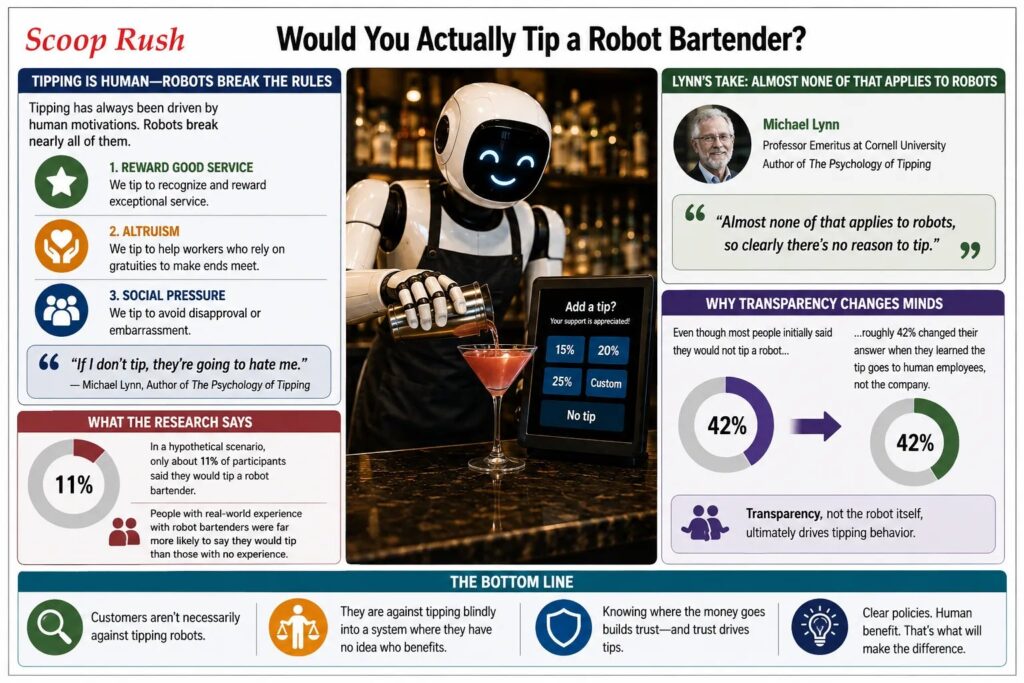
Michael Lynn, professor emeritus at Cornell University and author of The Psychology of Tipping, breaks down why people tip in the first place. Some tip to reward good service. Others tip out of altruism, wanting to help workers who rely on gratuities to make ends meet. Furthermore, a large share of tipping comes down to social pressure, the fear of disapproval if you do not leave enough. “If I don’t tip, they’re going to hate me,” Lynn explains, describing that sense of obligation many people feel.
“Almost none of that applies to robots, so clearly there’s no reason to tip,” Lynn says.
Despite that logic, people do not always act rationally when a screen prompts them. In one study Berezina co-authored, only about 11% of participants said they would tip a robot bartender in a hypothetical scenario. Interestingly, people who had actual real-world experience with robot bartenders were far more likely to say they would tip than those who had never interacted with one.
Why Knowing Where the Tip Goes Changes Everything
There is one detail that changes people’s minds more than anything else: knowing where the money goes. Even though most survey respondents initially said they would not tip a robot, roughly 42% changed their answer once they learned the tip would go directly to human employees rather than the company.
This finding suggests that transparency, not the robot itself, ultimately drives tipping behavior. Customers are not necessarily against tipping robots. They are against tipping blindly into a system where they have no idea who benefits, a concern that echoes wider public unease around AI systems acting without proper oversight and cases where xAI has faced lawsuits over misuse of its Grok chatbot.
Will Robot Tipping Become the New Normal?
According to Lynn, robot tipping is unlikely to become a permanent fixture of American service culture. He argues it is currently a deeply unpopular practice, and businesses may eventually abandon it if it starts pushing customers away rather than generating goodwill, much like how public backlash has shaped decisions around other tech rollouts, including why Google reportedly pulled an AI tool from Google Earth.
“There is no god of tipping, no one can make you pay. And the norms come from the bottom up,” Lynn says. In his view, tipping habits are shaped by collective consumer behavior, not corporate mandates. If enough people refuse to tip robots, businesses will likely stop asking.
Ultimately, Lynn frames this entire moment as temporary. “I believe that’s true,” he says of his own prediction that businesses will scale back robot tip prompts eventually. “But hey, anybody who says they can predict the future is lying.”
Key Takeaways on Robot Tipping
Robot tipping sits at the intersection of unclear labor law, evolving tip culture, and genuine consumer confusion. A few things stand out based on the current landscape.
There is no legal standard yet determining who owns a tip given to a robot. This creates real risk that some employers could keep gratuities meant for workers. Meanwhile, some companies, like The Tipsy Robot and Artly Coffee, say they pass 100% of tips to staff, though no industry-wide requirement forces them to do so.
Consumer behavior appears to be the biggest factor shaping whether robot tipping survives long-term. Transparency about where tips go significantly influences whether people are willing to give them at all. As automation expands into more service industries, customers will likely need to ask directly where their tip money is headed, rather than assuming it works the same way it does with human staff.
FAQs
Is it legal for companies to keep tips given to robots?
There is currently no established legal standard specifically addressing tips given to robots or automated kiosks. While US law prohibits employers from taking tips meant for human workers, that protection does not clearly extend to gratuities collected by machines, according to Lehigh University professor Holona Ochs.
Do robot baristas and bartenders actually need tips?
Robots themselves do not need tips, but the human staff working alongside them often do, especially in states where tipped minimum wage can be as low as $2.13 an hour. Companies like The Tipsy Robot and Artly Coffee say their human employees receive 100% of the gratuities collected.
Why did Artly Coffee turn off its robot tip prompts?
Artly Coffee disabled its digital tip prompts partly in response to customer complaints about being asked to tip a machine. The company also raised employee pay and introduced physical tip jars at some locations instead.
Should I tip a robot bartender or server?
Whether you tip is a personal choice, but research shows people are far more willing to do so when they know the money goes to human staff rather than the company. If you are unsure, it is reasonable to ask an employee directly where the tip goes.
Will robots asking for tips become permanent in restaurants and bars?
Experts like Cornell’s Michael Lynn believe robot tipping is unlikely to last long-term, since tipping norms are shaped by consumer behavior rather than corporate policy. If customers continue resisting the practice, businesses may phase it out.

