Home Blog Page 47

Egypt vs Iran Result: Egypt Hold Iran to 1-1 Draw in FIFA World Cup 2026 Group G

0

Competition: FIFA World Cup 2026 – Group G
Date: 27 June 2026 (Saturday)
Venue: Seattle Stadium, Seattle
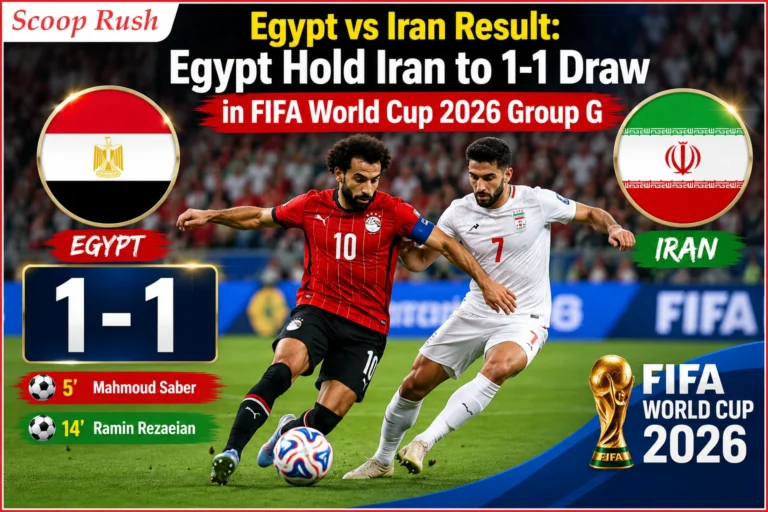
Full-Time Result: Egypt 1–1 Iran

The Egypt vs Iran Result: Egypt Hold Iran to 1-1 Draw in FIFA World Cup 2026 Group G delivered another dramatic finish in Seattle, with both sides scoring once to earn a point in a closely contested encounter. The result kept Group G finely balanced, leaving qualification hopes alive for both nations heading into the final stages.

The match featured disciplined defending, moments of attacking quality, and an intense midfield battle. Egypt struck first through Mahmoud Saber, but Iran responded before halftime thanks to Ramin Rezaeian. Neither side could find a winning goal after the break despite creating opportunities, and the contest ended 1-1.
Egypt and Iran entered the Group G clash knowing every point could prove decisive. The game lived up to expectations as both teams displayed determination and tactical discipline.

Egypt enjoyed more possession and completed significantly more passes throughout the match, while Iran remained dangerous on the counterattack and made the most of their opportunities in the final third.

At the final whistle, both teams settled for a draw that reflected the competitive nature of the contest.

Egypt vs Iran Result Match Summary
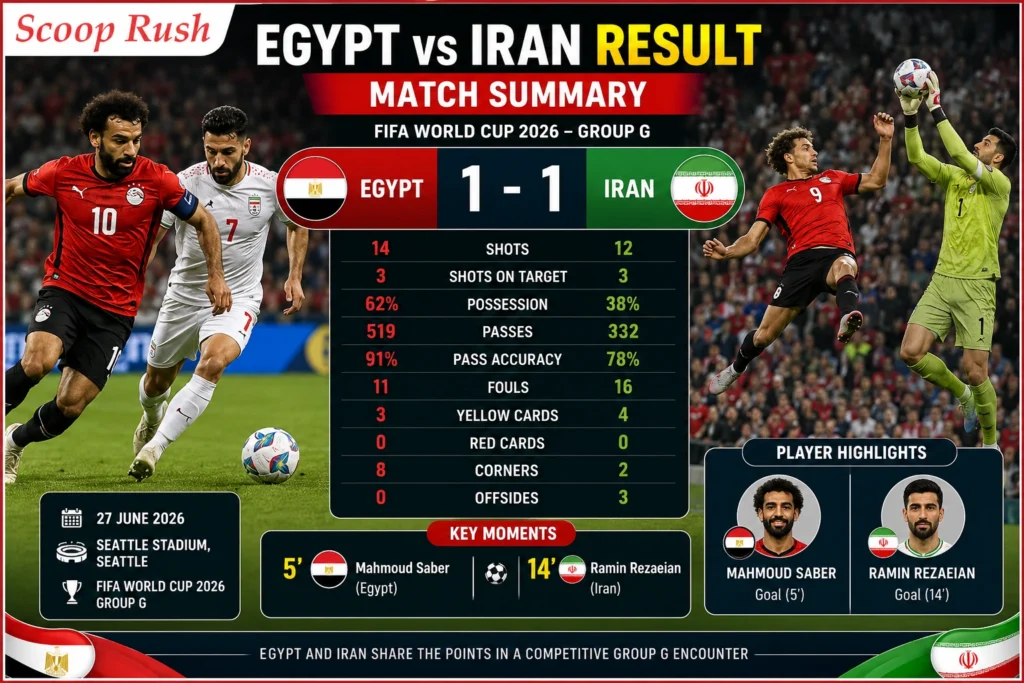
Egypt vs Iran Result Match Summary

Egypt made an encouraging start and looked comfortable in possession during the opening exchanges. Their patient build-up play eventually paid off when Mahmoud Saber found the net in the fifth minute, giving Egypt an early advantage.

The early goal forced Iran to respond positively. Instead of rushing forward recklessly, Iran remained organized and gradually found a more attacking rhythm.

Their persistence was rewarded in the 14th minute when Ramin Rezaeian scored the equalizer, bringing the match back to level terms.

From that point onward, both teams continued searching for another goal, but neither defense allowed many clear-cut opportunities.

The second half was more tactical than open, with each side carefully balancing attack and defense. Although both teams created promising moments, the finishing touch was missing.

After ninety minutes, the points were shared.

Goals

First Half

5′ – Mahmoud Saber (Egypt)
14′ – Ramin Rezaeian (Iran)

No further goals were scored during the remainder of the match.

Team Statistics

The match statistics highlighted two contrasting approaches.

Egypt

  • Shots: 14
  • Shots on Target: 3
  • Possession: 62%
  • Passes: 519
  • Pass Accuracy: 91%
  • Fouls: 11
  • Yellow Cards: 3
  • Red Cards: 0
  • Offsides: 0
  • Corners: 8

Iran

  • Shots: 12
  • Shots on Target: 3
  • Possession: 38%
  • Passes: 332
  • Pass Accuracy: 78%
  • Fouls: 16
  • Yellow Cards: 4
  • Red Cards: 0
  • Offsides: 3
  • Corners: 2

These numbers show Egypt controlled possession and circulated the ball efficiently, while Iran remained competitive despite spending less time on the ball.

Tactical Analysis
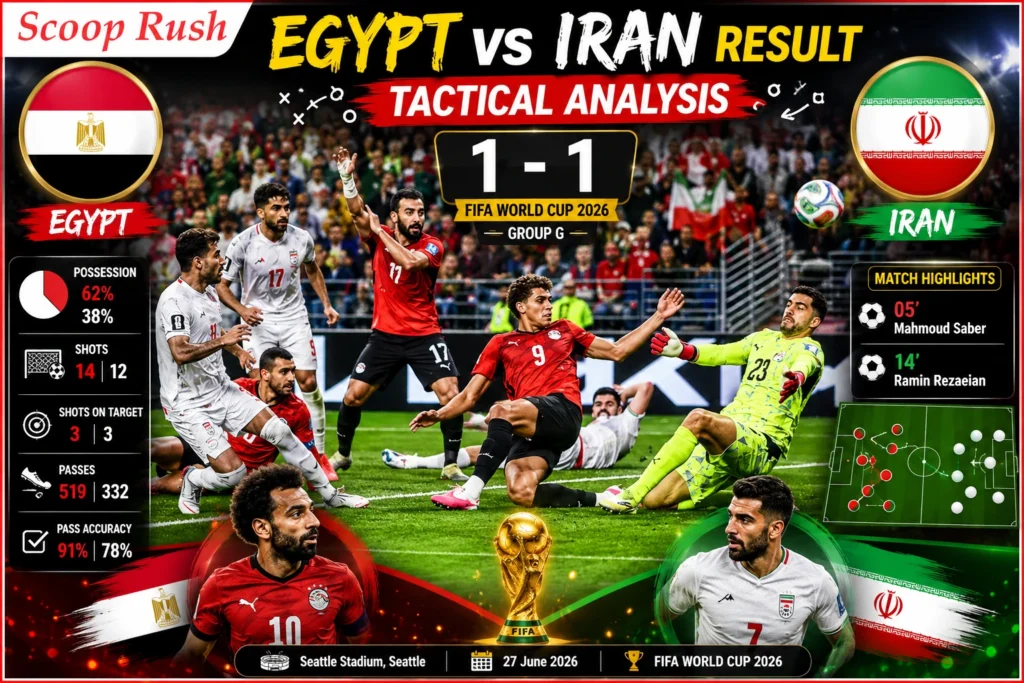
Tactical Analysis

Egypt Controlled the Ball

Egypt dominated possession with 62 percent of the ball and completed over 500 passes at an impressive 91 percent accuracy.

Their midfield focused on controlling the tempo, patiently moving possession across the pitch and attempting to create openings through structured attacks.

Eight corner kicks also reflected Egypt’s ability to spend long periods inside Iran’s defensive half.

Iran Focused on Efficiency

Iran accepted having less possession but defended compactly and looked to attack quickly whenever they regained the ball.

Despite recording fewer passes, Iran matched Egypt with three shots on target. Their direct approach ensured they remained dangerous throughout the contest.

The equalizer demonstrated Iran’s ability to capitalize on important attacking moments.

Defensive Performance

Both defensive units deserve significant credit.

Egypt limited Iran to relatively few clear opportunities despite allowing the equalizer early in the game.

Iran, meanwhile, remained organized under sustained pressure. Egypt’s possession advantage did not translate into a winning goal thanks to disciplined defending and timely interventions.

Neither goalkeeper was heavily overworked, reflecting how effectively both defensive structures restricted high-quality chances.

Discipline Played a Major Role

The physical nature of the contest resulted in several fouls and cautions.

Egypt received three yellow cards, while Iran collected four.

Neither team had a player sent off, allowing both sides to finish with eleven men.

The disciplined defensive approach ensured the match remained competitive without crossing into reckless play.

Egypt vs Iran Result Starting Lineups

Both managers selected balanced lineups designed to combine defensive stability with attacking threat.

Egypt relied on a structured formation that emphasized ball retention and midfield control.

Iran’s lineup prioritized defensive organization while maintaining enough pace and movement to threaten during transitions.

Throughout the match, substitutions were used to inject fresh energy and maintain tactical balance.

Egypt vs Iran Result Key Performers

Mahmoud Saber

Mahmoud Saber gave Egypt the ideal start by scoring inside the opening minutes.

His early strike rewarded Egypt’s positive opening spell and immediately placed pressure on Iran.

Ramin Rezaeian

Ramin Rezaeian responded brilliantly for Iran by scoring the equalizer in the first half.

His goal restored confidence and ensured Iran remained firmly in the contest.

What the Draw Means for Group G

The draw keeps Group G extremely competitive.

Current standings after the match:

  • Belgium – 7 points
  • Egypt – 5 points
  • Iran – 3 points
  • New Zealand – 1 point

Belgium remained at the top of the group, while Egypt strengthened their position with another valuable point.

Iran also remains mathematically alive and can still fight for qualification depending on future results.

With every point carrying enormous value in the FIFA World Cup group stage, this draw could prove significant when the final standings are determined.

Biggest Talking Points

Several moments defined the match.

  • Egypt made the perfect start with an early goal.
  • Iran showed resilience by equalizing quickly.
  • Egypt controlled possession but could not convert dominance into victory.
  • Iran defended effectively despite facing sustained pressure.
  • Both teams earned an important point in a tightly contested Group G battle.

Egypt vs Iran Match Analysis

This was a classic example of two different football philosophies.

Egypt preferred patient possession, building attacks through controlled passing and territorial dominance.

Iran prioritized defensive organization and attacking efficiency.

The statistics suggest Egypt had greater control for much of the match, but football is ultimately decided by goals rather than possession alone.

Iran’s disciplined defending prevented Egypt from finding another breakthrough, while their own attacking quality ensured they left Seattle with a deserved point.

The encounter also demonstrated the importance of taking chances when they arise. Although Egypt generated more attacking pressure, both teams finished with the same number of shots on target.

That balance ultimately explained why the match ended level.

Conclusion

The Egypt vs Iran Result: Egypt Hold Iran to 1-1 Draw in FIFA World Cup 2026 Group G produced an entertaining contest between two determined teams.

Mahmoud Saber’s early opener gave Egypt the perfect beginning, but Ramin Rezaeian quickly restored parity for Iran. Egypt dominated possession and passing statistics, while Iran remained disciplined and efficient throughout the ninety minutes.

The 1-1 draw leaves Group G finely poised, with qualification still to be decided. Both teams demonstrated resilience, tactical discipline, and the ability to compete under pressure, making this one of the more evenly balanced matches of the group stage.

FAQs

1. What was the final score between Egypt and Iran?

The match finished Egypt 1-1 Iran in the FIFA World Cup 2026 Group G.

2. Who scored for Egypt?

Mahmoud Saber scored Egypt’s goal in the fifth minute.

3. Who scored for Iran?

Ramin Rezaeian scored Iran’s equalizer in the 14th minute.

4. Which team had more possession?

Egypt dominated possession with 62%, compared to Iran’s 38%.

5. How does the result affect Group G?

The draw gives both teams one point, with Belgium remaining top of Group G, while Egypt strengthened their position and Iran kept their qualification hopes alive.
Panama vs England: Three Lions Beat Panama 2-0 to Top Group L at FIFA World Cup 2026

0

Competition: FIFA World Cup 2026

Stage: Group Stage, Group L

Full Time: Panama 0-2 England

Venue: MetLife Stadium, East Rutherford, New Jersey, USA

Date: 28 June 2026

Panama vs England: England Finish First in Group L

Panama vs England ended with a 2-0 victory for England as Thomas Tuchel’s side secured first place in Group L at the FIFA World Cup 2026. After a disciplined first-half display from Panama, England raised the intensity after the break and scored twice in five minutes to claim all three points.

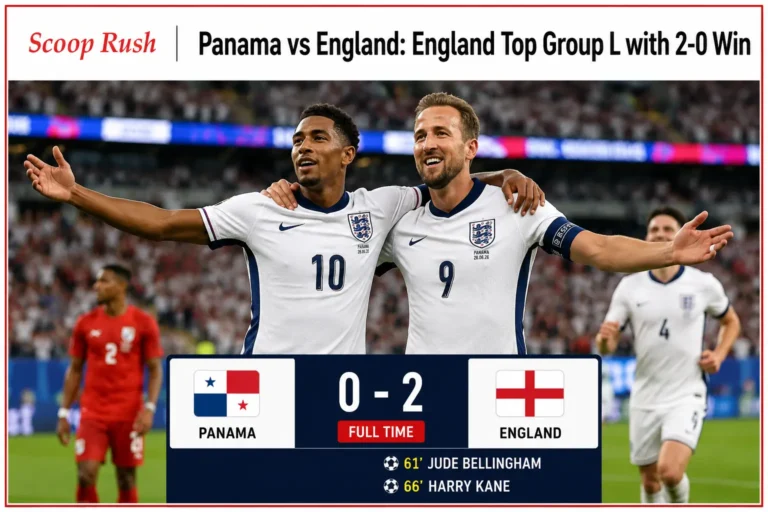
Jude Bellingham opened the scoring in the 61st minute after converting Bukayo Saka’s corner. Five minutes later, Bellingham delivered a precise cross for Harry Kane, who headed home to double England’s advantage.

The victory moved England to seven points from three matches and confirmed their place in the Round of 32 as Group L winners.

Panama vs England Match Summary

England controlled possession throughout the contest but found it difficult to break through Panama’s organised defence before halftime. Panama stayed compact and limited clear chances during a scoreless opening 45 minutes.

The breakthrough arrived in the 61st minute when Bukayo Saka’s corner found Jude Bellingham, who volleyed the ball into the net. Shortly afterwards, Bellingham turned provider with an excellent cross that Harry Kane powered home with a header in the 66th minute.

England comfortably managed the closing stages and secured another clean sheet to complete an unbeaten group campaign.

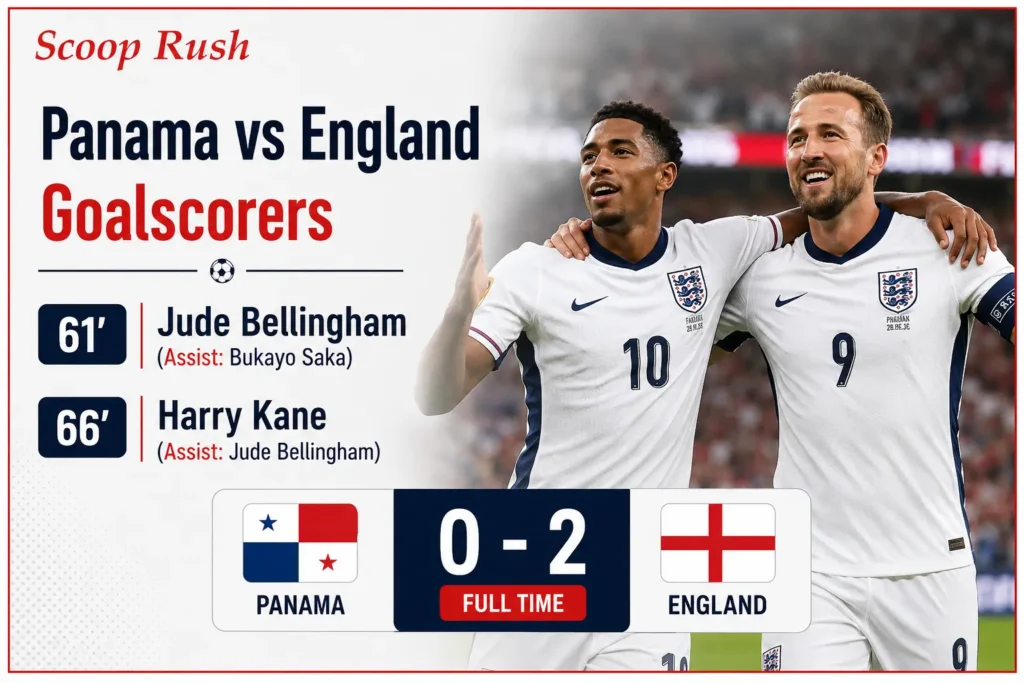
Panama vs England Goalscorers

Panama-vs-England-Goalscorers

• 61′ Jude Bellingham (Assist: Bukayo Saka)

• 66′ Harry Kane (Assist: Jude Bellingham)

Tactical Analysis Panama vs England

Panama vs England demonstrated England’s patience against a well-organised defensive block. Panama frustrated their opponents during the first half by defending deep and closing down space in central areas.

However, England increased the tempo after the interval. Their midfield circulated the ball more quickly, while the wide players stretched Panama’s back line. Consequently, the pressure eventually produced two decisive goals from set-piece and open-play situations.

England also remained solid defensively, allowing Panama very few opportunities throughout the match.

Harry Kane Makes World Cup History

Harry Kane’s second-half goal carried extra significance. It was his 11th FIFA World Cup goal, making him England’s all-time leading World Cup goalscorer. The strike moved him ahead of Gary Lineker, who previously held the national record with 10 World Cup goals.

The milestone added another memorable moment to England’s successful group-stage campaign under Thomas Tuchel.

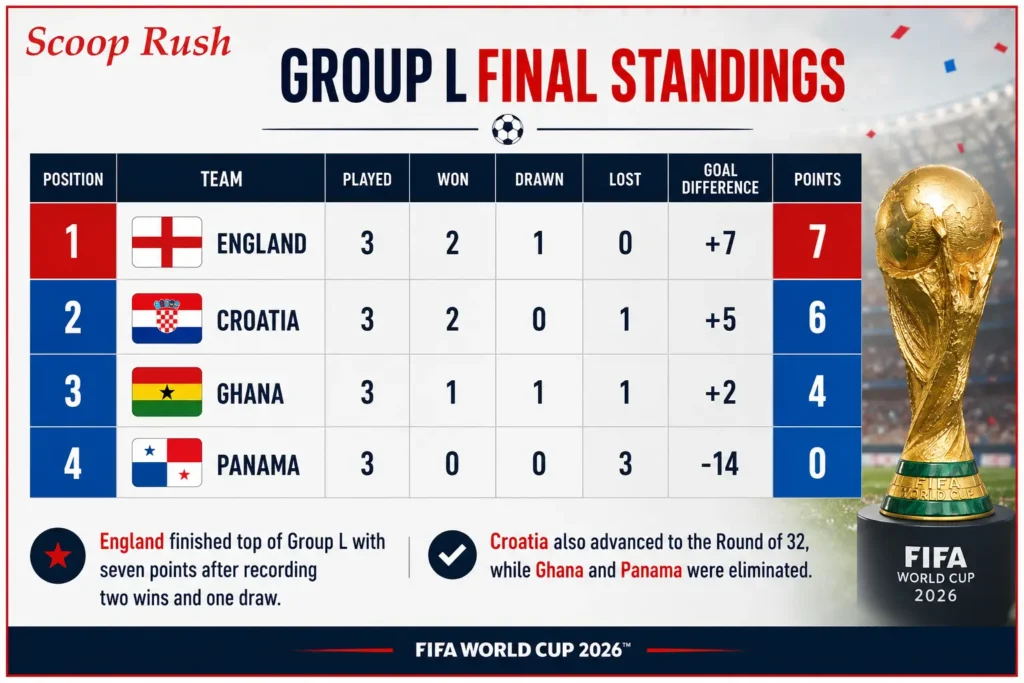
Group L Final Standings

Group-L-Final-Standings
PositionTeamPlayedWonDrawnLostGoal DifferencePoints
1England3210+77
2Croatia3201+56
3Ghana3111+24
4Panama3003-140

England finished top of Group L with seven points after recording two wins and one draw. Croatia also advanced to the Round of 32, while Ghana and Panama were eliminated.

What the Result Means

Panama vs England confirmed England’s status as Group L winners and extended their unbeaten run in the tournament. Thomas Tuchel’s side now head into the knockout stage with growing confidence after another composed performance.

Meanwhile, Panama exited the competition without a point. Although they defended resolutely for long periods, they were unable to contain England after halftime.

Player of the Match

Jude Bellingham delivered an outstanding all-round display. He scored the opening goal from Bukayo Saka’s corner before providing the cross for Harry Kane’s historic header. His influence in midfield and attacking areas proved decisive.

Conclusion

Panama vs England ended with England producing another professional performance at the FIFA World Cup 2026. Jude Bellingham inspired the victory with a goal and an assist, while Harry Kane made history by becoming England’s all-time leading World Cup goalscorer. The 2-0 win secured first place in Group L and sent Thomas Tuchel’s side into the Round of 32 with momentum.

Related Articles

• England vs Croatia Result

• Ghana vs Panama Result

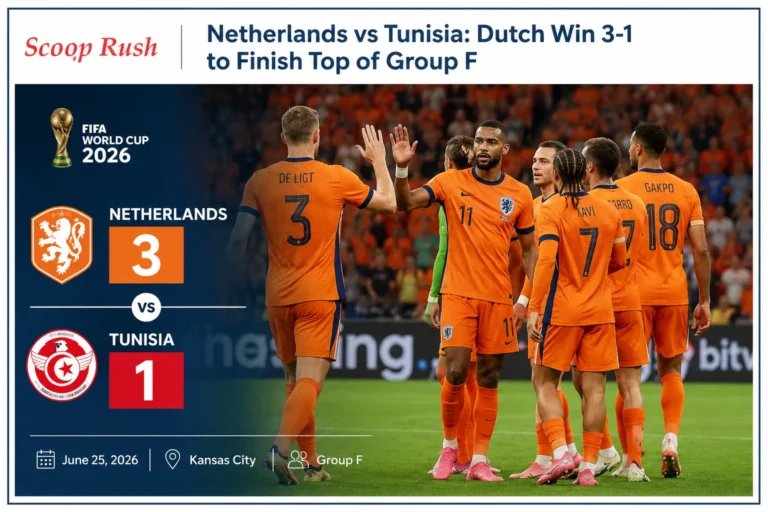
Netherlands vs Tunisia: Dutch Win 3-1 to Finish Top of Group F

0

Competition: FIFA World Cup 2026 – Group F
Final Score: Netherlands 3-1 Tunisia
Date: June 25, 2026
Venue: Kansas City

The Netherlands vs Tunisia clash concluded with an impressive 3-1 victory for the Dutch, who secured first place in Group F at the FIFA World Cup 2026. Played on June 25 in Kansas City, the result moved the Netherlands to seven points and guaranteed their place in the knockout stage as group winners. Tunisia showed determination throughout the match and managed to score once, but the Netherlands produced another composed performance to finish the group phase at the top of the standings.

Netherlands vs Tunisia Match Summary

The Netherlands entered their final Group F fixture knowing a positive result would be enough to secure top spot. They responded with a confident display, combining disciplined defending with effective attacking play to claim a deserved 3-1 victory over Tunisia.

Throughout the contest, the Dutch controlled key moments of the game and capitalized on their opportunities in front of goal. Their consistent performances across the group stage ensured they remained unbeaten and finished first in the standings with seven points.

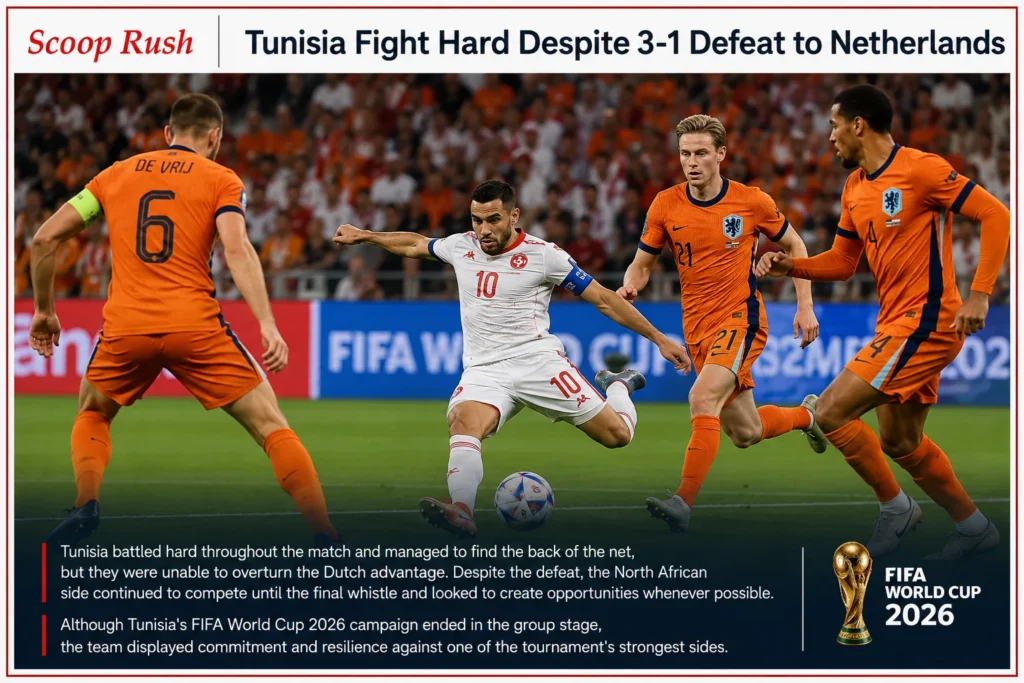
Tunisia Show Determination Despite Defeat

Tunisia battled hard throughout the match and managed to find the back of the net, but they were unable to overturn the Dutch advantage. Despite the defeat, the North African side continued to compete until the final whistle and looked to create opportunities whenever possible.

Although Tunisia’s FIFA World Cup 2026 campaign ended in the group stage, the team displayed commitment and resilience against one of the tournament’s strongest sides.

Match Statistics

The numbers reflected the Netherlands’ control over much of the match.

  • Possession: Netherlands 61% – Tunisia 39%
  • Total Shots: Netherlands 17 – Tunisia 10
  • Shots on Target: Netherlands 9 – Tunisia 4
  • Pass Accuracy: Netherlands 87% – Tunisia 76%
  • Corners: Netherlands 8 – Tunisia 4
  • Fouls: Tunisia 11 – Netherlands 8

The Dutch enjoyed more possession, completed passes with greater accuracy, and created more scoring opportunities, allowing them to secure another important victory.

Final Group F Standings

The win confirmed the Netherlands as Group F winners with seven points.

PositionTeamPoints
1Netherlands7
2Japan5
3Sweden4
4Tunisia0

The Netherlands advanced to the knockout stage as Group F winners, while Japan also progressed after finishing second.

Key Takeaways

  • The Netherlands defeated Tunisia 3-1 in Kansas City.
  • The match was played on June 25, 2026.
  • The victory secured first place in Group F with seven points.
  • The Dutch advanced to the knockout stage as group winners.
  • Tunisia exited the tournament after finishing fourth in the group.

Looking Ahead

Finishing at the top of Group F gives the Netherlands valuable momentum heading into the knockout stage. Their balanced performances during the group phase highlighted their quality in both attack and defense, making them one of the teams to watch as the tournament continues. Other strong sides such as Spain, Belgium, Brazil, and Argentina have also impressed during the group stage, setting up a compelling knockout round.

For Tunisia, the campaign ends at the group stage despite a determined effort in their final match. The experience gained from competing at the FIFA World Cup will provide valuable lessons as they prepare for future international competitions.

Final Thoughts

The Netherlands vs Tunisia encounter ended with the Dutch claiming a convincing 3-1 victory to secure first place in Group F. The win completed an unbeaten group-stage campaign and sent the Netherlands into the knockout rounds with seven points and growing confidence. Tunisia fought until the end and managed to score, but the Netherlands’ overall quality and consistency proved decisive in Kansas City.

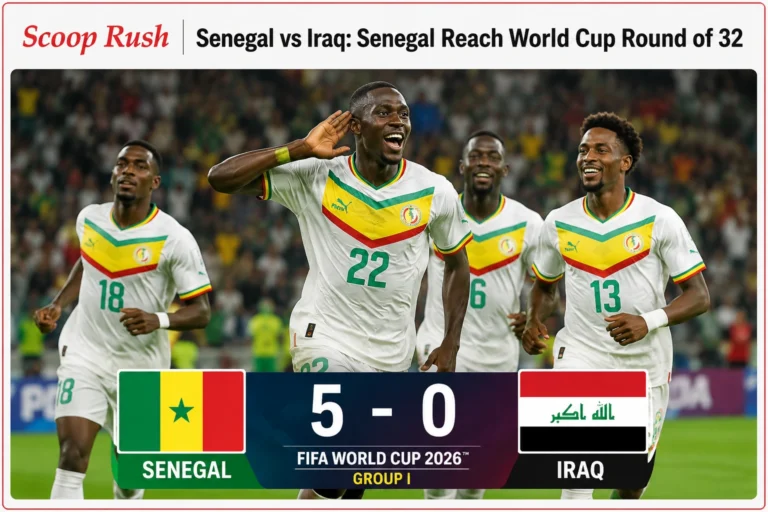
Senegal vs Iraq: Senegal Thrash Iraq 5-0 to Reach FIFA World Cup 2026 Round of 32

0

Competition: FIFA World Cup 2026™
Stage: Group I
Date: Friday, 26 June 2026
Venue: Toronto Stadium, Toronto
Full Time: Senegal 5-0 Iraq

Senegal secured a dominant 5-0 victory over Iraq to keep their FIFA World Cup 2026 campaign alive. The Teranga Lions entered the match needing a convincing win to strengthen their goal difference, and they delivered an outstanding performance. Iraq’s task became even more difficult after going down to 10 men in the opening stages. The result was enough for Senegal to qualify for the Round of 32 as one of the tournament’s best third-placed teams.

Senegal vs Iraq Match Summary

Senegal made a dream start and never looked back. They controlled possession, created regular chances, and took full advantage of their numerical superiority after Iraq’s early dismissal.

Habib Diarra opened the scoring in the fourth minute after reacting quickest inside the penalty area. Eight minutes later, Iraq suffered a major setback when defender Rebin Sulaka received a straight red card following a VAR review for denying Sadio Mané a clear goalscoring opportunity.

Senegal continued to dominate after the break. Ismaïla Sarr doubled the lead in the 56th minute before substitute Pape Gueye scored less than two minutes after coming on. Gueye struck again in the 71st minute to complete his brace, while Iliman Ndiaye added a superb fifth goal in the 82nd minute to complete an emphatic victory.

Goalscorers

  • 4′ Habib Diarra (Senegal)
  • 56′ Ismaïla Sarr (Senegal)
  • 59′ Pape Gueye (Senegal)
  • 71′ Pape Gueye (Senegal)
  • 82′ Iliman Ndiaye (Senegal)

Red Card

  • 12′ Rebin Sulaka (Iraq)

Senegal vs Iraq Match Statistics

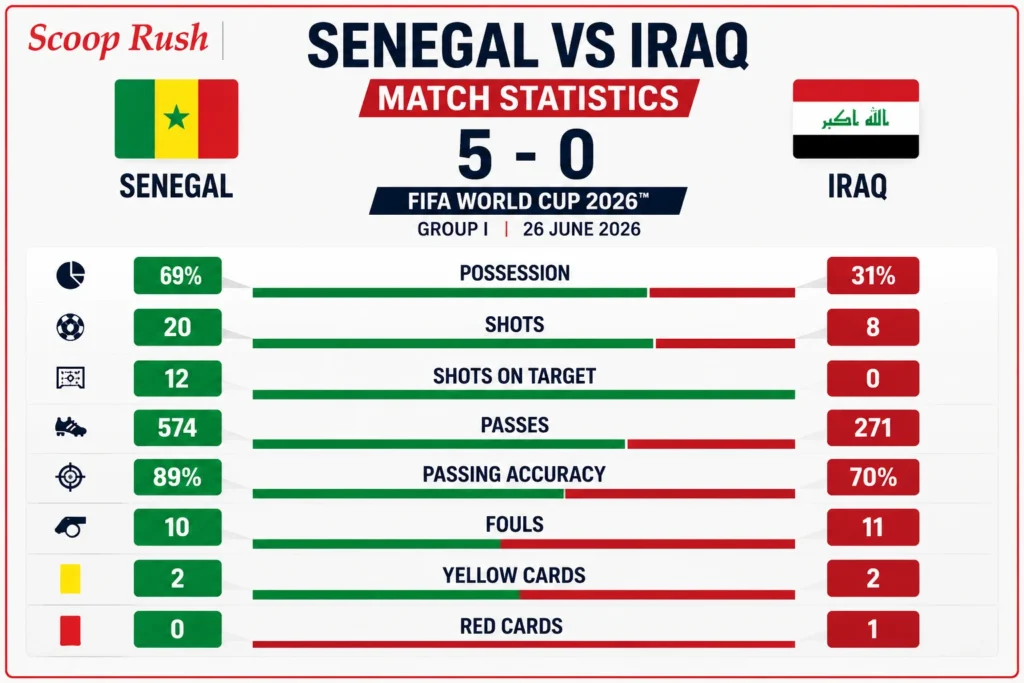
Senegal-vs-Iraq-Match-Statistics

The numbers reflected Senegal’s complete control throughout the match.

  • Possession: Senegal 69% – 31% Iraq
  • Shots: Senegal 20 – 8 Iraq
  • Shots on Target: Senegal 12 – 0 Iraq
  • Passes: Senegal 574 – 271 Iraq
  • Passing Accuracy: Senegal 89% – 70% Iraq
  • Fouls: Senegal 10 – 11 Iraq
  • Yellow Cards: Senegal 2 – 2 Iraq
  • Red Cards: Senegal 0 – 1 Iraq

Senegal vs Iraq Tactical Analysis

Senegal dominated the match with patient possession and quick ball circulation. After Iraq were reduced to 10 players, Senegal stretched the pitch effectively and created space through the wide areas. Their substitutions also added fresh energy, allowing them to maintain a high tempo throughout the second half.

Iraq reorganised defensively after the early red card and spent long periods protecting their penalty area. However, playing with a numerical disadvantage limited their attacking opportunities, and they failed to register a shot on target.

Senegal vs Iraq Player Performances

Pape Gueye changed the game after coming off the bench, scoring twice and providing an assist in an outstanding substitute appearance. Ismaïla Sarr also impressed with a goal and constant attacking threat, while Iliman Ndiaye capped a strong display with a goal and an assist.

Habib Diarra set the tone with the opening goal, and Senegal’s defence remained solid throughout the contest to secure a comfortable clean sheet. Despite conceding five goals, Iraq’s goalkeepers produced several important saves to prevent an even heavier defeat.

Final Group I Standings

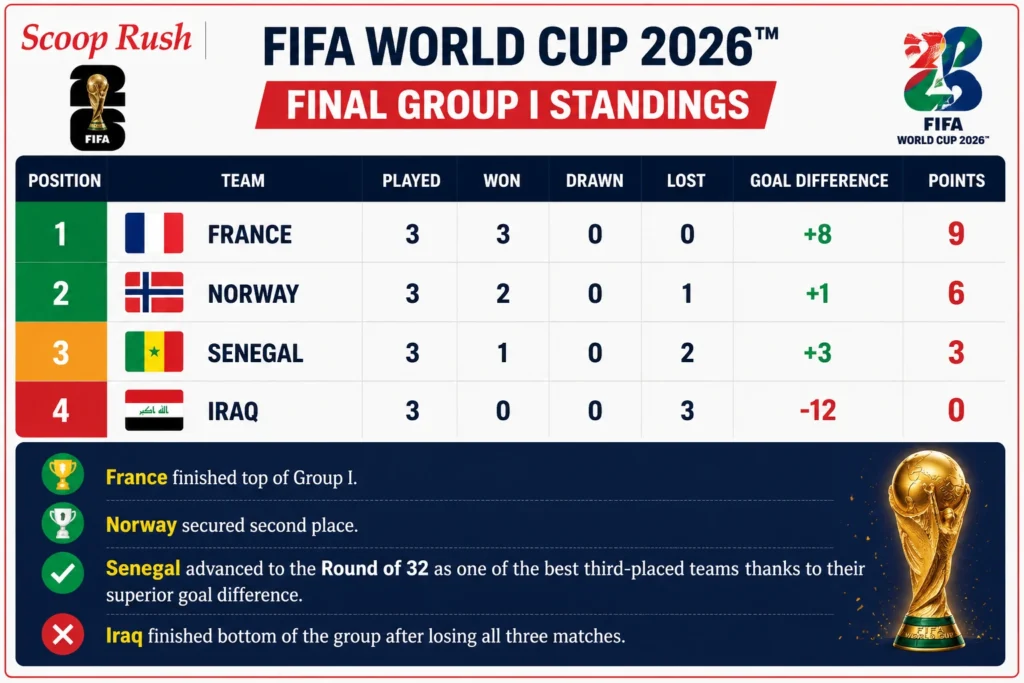
Final-Group-I-Standings
PositionTeamPlayedWonDrawnLostGoal DifferencePoints
1France3300+89
2Norway3201+16
3Senegal3102+33
4Iraq3003-120

France finished top of Group I, while Norway secured second place. Senegal advanced to the Round of 32 as one of the best third-placed teams thanks to their superior goal difference. Iraq finished bottom of the group after losing all three matches.

What the Result Means

Senegal’s commanding victory transformed their World Cup fortunes. The five-goal margin lifted their goal difference enough to secure a place in the knockout stage as one of the tournament’s best third-placed teams. It was a clinical and disciplined performance at a crucial moment.

For Iraq, the defeat brought a difficult campaign to an end. The early red card made an already challenging task even harder, and they exited the tournament without a point after three consecutive defeats.

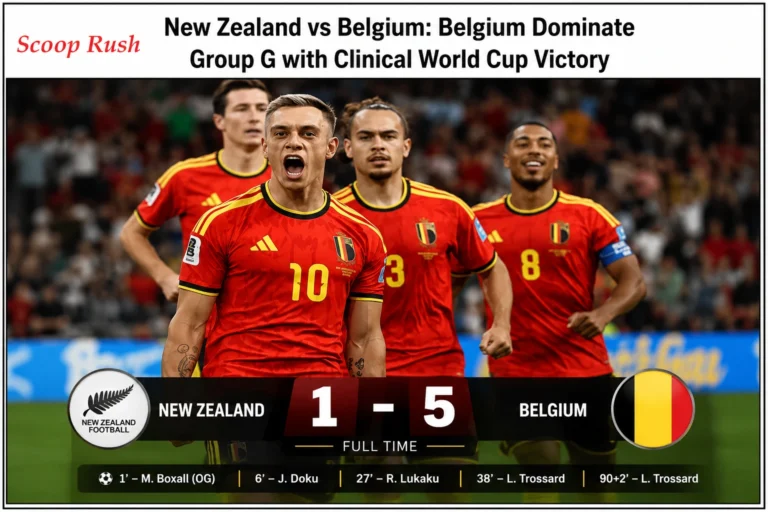
New Zealand vs Belgium: Belgium Dominate Group G with Clinical World Cup Victory

0

Competition: FIFA World Cup 2026
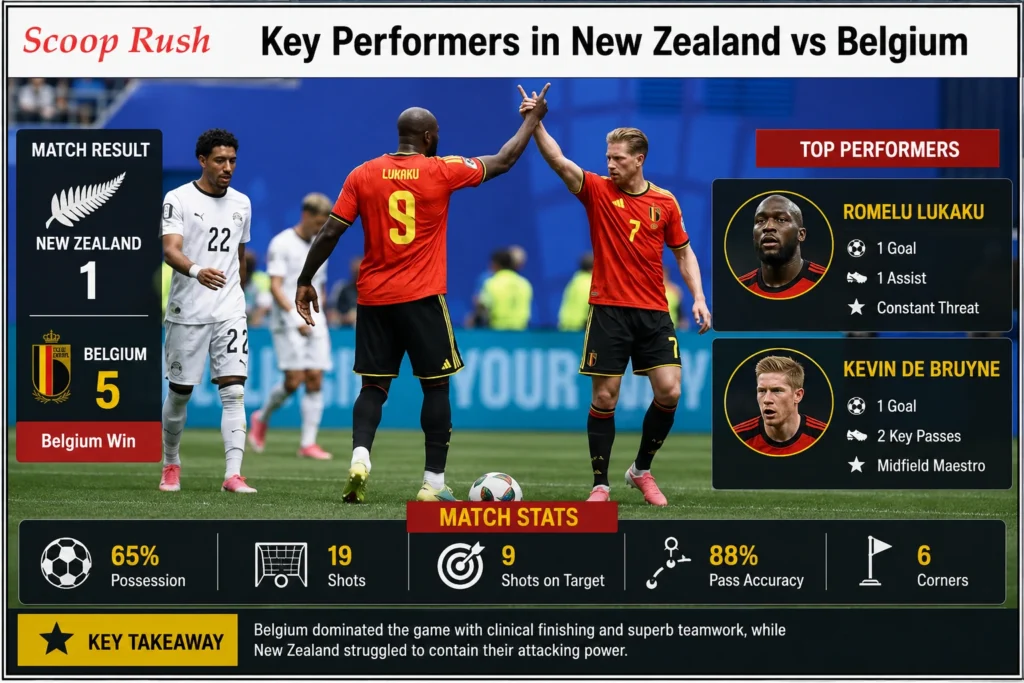
Final Score: New Zealand 1-5 Belgium
Date: Saturday, June 27
Venue: BC Place Vancouver, Canada

The scoreboard told the story of a completely one-sided contest. Belgium produced an emphatic display to defeat New Zealand 5-1 in a highly anticipated FIFA World Cup 2026 Group G match on Saturday. The victory secured the European side’s first win of the tournament, safely sealing their advancement into the knockout phases and reminding global football fans of their clinical attacking quality.

Despite New Zealand finding a late consolation net through Elijah Just, Belgium’s superior possession, overwhelming volume of shots, and midfield control proved completely decisive. Five different scoring moments helped the Red Devils claim all three points in a match that completely showcased their offensive efficiency. For fans tracking the complex permutations of Group G, this match was critical because it reinforced Belgium’s status as group leaders while leaving New Zealand facing immediate elimination at the bottom of the pile.

New Zealand vs Belgium : Match Overview

The crucial Group G encounter wrapped up with Belgium claiming a convincing 5-1 victory over New Zealand.

The ninety minutes featured six total goals and a relentless barrage of offensive opportunities, but Belgium was the side that consistently converted high-quality chances into goals. While New Zealand managed to break through the Belgian defense late in the game, the European attacking unit simply proved too deep and too physical for the Oceania representatives throughout the night.

Belgium’s Goals and Key Scorers

Belgium received goals from several important contributors, highlighting a refreshing depth in attack after quiet performances in their opening matches.

Belgium Goalscorers

  • Leandro Trossard (28′, 50′)
  • Kevin De Bruyne (66′)
  • Romelu Lukaku (86′)
  • Alexis Saelemaekers (90+4′)

Belgium’s scoring began mid-way through the first half via Leandro Trossard and continued at a steady, crushing pace. Trossard’s second goal early in the second half gave Belgium comfortable breathing room before maestro Kevin De Bruyne extended the advantage further past the hour mark. Late strikes from Romelu Lukaku and Alexis Saelemaekers officially completed the rout.

New Zealand Goal

  • Elijah Just (84′)

Contrary to initial match reports suggesting New Zealand entered the halftime break with momentum, their lone goal arrived deep in the second half. By the time Elijah Just found the back of the net in the 84th minute, Belgium already held a commanding three-goal lead. Any brief flash of hope for a dramatic Kiwi comeback was instantly extinguished when Belgium responded with two additional goals prior to the final whistle.

How Belgium Controlled the Match

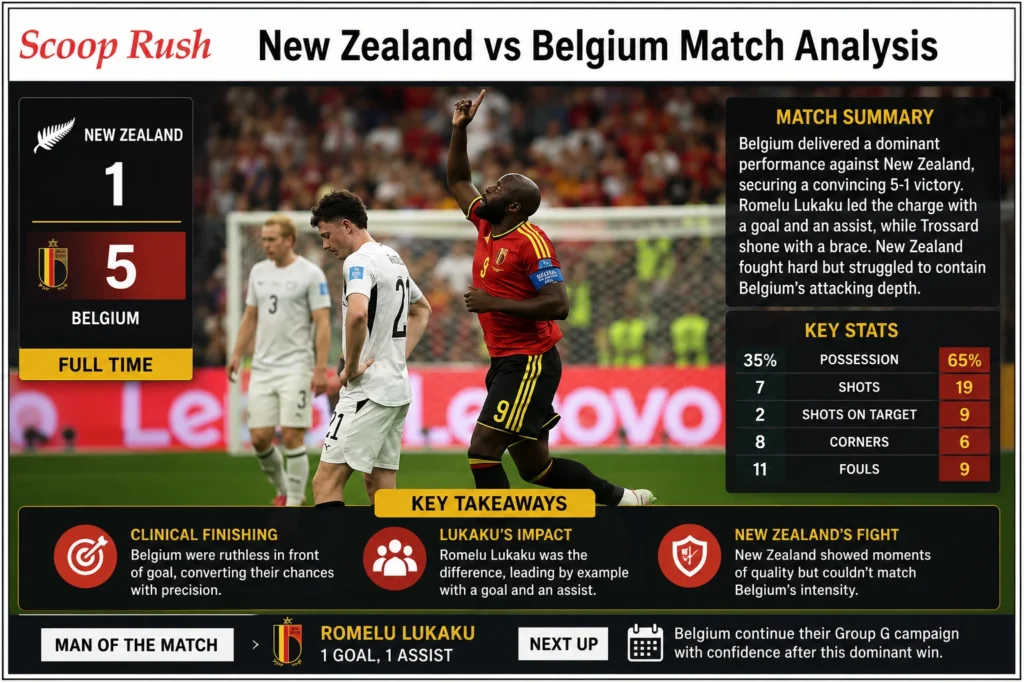
One of the primary catalysts behind this victory was Belgium’s absolute dominance in tracking possession and overall in-game management. According to the final post-match statistics, the tactical gulf between the two nations was stark.

StatNew ZealandBelgium
Shots633
Shots on Target210
Possession45%55%
Passes401522
Pass Accuracy87%88%
Fouls107
Yellow Cards20
Corners58

The numbers illustrate just how much structural pressure Belgium applied throughout the ninety minutes. Generating 33 total shots compared to New Zealand’s six highlights an overwhelming disparity in attacking output. Belgium also carved out significantly more attempts on target, forcing the New Zealand defensive line to spend almost the entirety of the fixture under siege. Their elite capacity to retain possession and complete short passes allowed them to comfortably dictate the tempo from start to finish.

New Zealand vs Belgium Match Analysis

New Zealand vs Belgium Match Analysis

Belgium’s Attacking Efficiency

Belgium successfully combined pure volume shooting with clinical edge in the penalty box. Creating 33 shots demonstrates how frequently they bypassed the midfield and penetrated dangerous areas. More importantly, they turned that territorial advantage into five distinct goals. The attacking partnership involving experienced veterans like Kevin De Bruyne and Romelu Lukaku delivered when it mattered most, while Leandro Trossard’s initial brace laid down the perfect foundation for victory. Belgium consistently stretched New Zealand’s defensive shape and capitalized on critical spacing errors across both halves.

New Zealand’s Brief Moment of Hope

Elijah Just’s goal in the 84th minute provided a solitary bright spot for the New Zealand fans in attendance. At that stage, the Kiwis were looking to salvage pride after spending the bulk of the second half pinned deep inside their own territory. Scoring against a top-tier European defense is always a notable achievement on the global stage, giving the All Whites a clear building block for future international cycles. However, Belgium’s immediate response completely snuffed out any prolonged celebration.

Midfield Control Made the Difference

While the raw passing percentages look relatively close on paper, Belgium utilized their shares of the ball with far greater intent. With 522 completed passes and an elite 88 percent pass accuracy rate, Belgium sustained high-pressure chains and regularly advanced into threatening positions. Kevin De Bruyne’s influence was reflected not only in his second-half goal but also in his ability to quickly shift the ball through transitions. This central dominance allowed Belgium to choose exactly where the match was played, stopping New Zealand from stringing together extended periods of dangerous field position.

Belgium Strengthen Their Position in Group G

Following the decisive victory in Vancouver, Belgium finished at the very top of Group G. Their massive goal differential upgrade proved to be the ultimate tiebreaker in a highly competitive group stage.

Official FIFA World Cup 2026 – Group G Final Standings

PosTeamPldWDLGDPtsStatus
1Belgium3120+45Advanced to Round of 32
2Egypt3120+25Advanced to Round of 32
3Iran303003Eliminated
4New Zealand3012-61Eliminated

With 5 points gathered from one win and two draws, Belgium secured their survival alongside Egypt, who drew 1-1 with Iran in the simultaneous final matchday fixture. The team’s potent combination of deep attacking options and experienced leadership has successfully converted them back into one of the strongest wildcards moving into the knockout bracket.

Key Performers in New Zealand vs Belgium

Key Performers in New Zealand vs Belgium

Leandro Trossard Steals the Spotlight

The Arsenal forward was arguably the standout performer on the pitch. His two goals came at defining moments, allowing Belgium to establish early control and reclaim momentum immediately after the halftime break. Scoring in both halves provided the exact offensive spark Belgium had been lacking in their previous group games. A brace in a crucial World Cup match is a massive resume-builder, and his clinical movement inside the box was central to the final scoreline.

Kevin De Bruyne Delivers Again

Kevin De Bruyne added Belgium’s third goal and continued to show why he remains the heartbeat of the Red Devils’ roster. His unique presence in the center of the park helped Belgium retain an organized shape, keep tabs on possession, and thread dangerous balls into the channels throughout the game.

Romelu Lukaku Makes His Mark

Romelu Lukaku’s late goal further highlighted Belgium’s intimidating firepower. Even after securing a highly comfortable lead, Belgium refused to take their foot off the gas. The prolific striker found the back of the net in the 86th minute, instantly responding to New Zealand’s lone goal just two minutes prior.

Alexis Saelemaekers Finishes the Job

Alexis Saelemaekers scored the final goal deep into stoppage time. His clean strike capped off a comprehensive Belgian performance, ensuring the final scoreline accurately reflected the massive structural balance of play seen on the field.

What Went Wrong for New Zealand?

New Zealand faced a monumental uphill battle against a star-studded Belgian side that brought relentless intensity. Several key tactical factors contributed heavily to their heavy defeat.

Limited Attacking Opportunities

New Zealand managed only six shots throughout the entire match, hitting the target just twice. Those low numbers show how difficult it was for their midfield to break through the lines and create sustained attacking threats against Belgium’s defensive structure.

Overwhelming Defensive Pressure

Facing 33 total shots is an exhausting assignment for any backline. Belgium routinely unlocked space in wide areas, forcing New Zealand’s fullbacks and center-backs to spend long, grueling periods tracking back under heavy physical duress.

Discipline Issues under Stress

New Zealand picked up two yellow cards over the course of the match as they struggled to cope with Belgium’s superior foot speed in transition. While discipline issues did not single-handedly decide the outcome, the fouls reflected the immense defensive stress the Kiwis experienced from kickoff to whistle.

New Zealand vs Belgium Tactical Picture of the Match

The statistics and scoring pattern illustrate a match where Belgium gradually tightened their grip on the game. Belgium created superior chances, earned more corners, completed more passes, and dictated possession for the vast majority of the encounter. The second half proved particularly lethal for the underdogs. Belgium responded to the unfolding group scenarios by firing in three additional goals after the break, completely crushing any possibility of a New Zealand comeback. The result highlighted Belgium’s peak physical conditioning and ability to maintain structural intensity for the full 90 minutes.

Summary of Group G Takeaways

The curtains have officially closed on Group G, leaving behind plenty of drama for analysts to dissect. Belgium and Egypt safely navigate their way through to the Round of 32 knockout bracket, carrying the banner for the group. Meanwhile, Iran‘s highly unusual run of drawing all three of their group games leaves them eliminated with 3 points, missing out on the best third-placed wildcard slots. New Zealand finishes their campaign at the bottom of the table with 1 point, heading home to reflect on a tough learning experience against elite international opposition.

Conclusion

Belgium’s 5-1 victory over New Zealand provides a definitive answer to critics who questioned the team’s attacking chemistry early in the tournament. By unlocking five separate scoring phases and creating a staggering 33 shots, the Red Devils demonstrated the terrifying depth of their offensive roster when operating at full capacity. Leandro Trossard’s clinical movement, paired with the elite playmaking of Kevin De Bruyne, allowed the European powerhouse to comfortably dictate the tactical tempo from kickoff until the final whistle.

While New Zealand exited the competition with a tough learning curve, Elijah Just’s late strike gave the Oceania representatives a historic moment to celebrate on the global stage. Ultimately, the night belonged to Belgium. Bouncing back from two previous draws, they maximized their final group fixture to leapfrog Egypt, capture the top spot in Group G, and march into the Round of 32 with massive wind in their sails. If Belgium can sustain this level of midfield dominance and volume shooting into the high-stakes knockout rounds, they remain an incredibly dangerous wildcard capable of making a deep run in the tournament.

FAQs

1. What was the exact final score of the New Zealand vs Belgium match?

Belgium defeated New Zealand with a final score of 5-1. The match took place on Saturday, June 27, during the final round of the group stage games.

2. Who scored the goals for Belgium during the match?

Belgium’s five goals were scored by Leandro Trossard, who secured a brace with goals in the 28th and 50th minutes, followed by Kevin De Bruyne (66′), Romelu Lukaku (86′), and Alexis Saelemaekers (90+4′).

3. When did New Zealand score their goal against Belgium?

Elijah Just scored the lone goal for New Zealand in the 84th minute of the match. This brought the score to 3-1 before Belgium struck back with two more late goals.

4. Which teams from Group G advanced to the knockout stage?

Belgium and Egypt both advanced from Group G to the Round of 32 knockout stage. Both teams finished with 5 points, but Belgium took the top spot due to a superior goal difference (+4 compared to Egypt’s +2).

5. Where was the New Zealand vs Belgium World Cup match played?
The match was played at BC Place Vancouver in Canada, which is one of the official host venues for the tournament.

Omega-3 Fish Oil Supplements May Not Improve Brain Health, New Study Finds

0

Introduction: New Study Questions the Brain Benefits of Omega-3 Fish Oil Supplements

Millions of people take omega-3 fish oil supplements every day hoping they can improve memory, support brain health, and reduce the risk of Alzheimer’s disease. However, a major new clinical trial has found that omega-3 fish oil supplements may not provide the brain benefits many people expect.

The study discovered that although omega-3 from supplements successfully reached the brain, it did not improve memory, thinking ability, or slow brain changes linked to Alzheimer’s disease after two years.

Researchers from Keck Medicine of USC studied older adults who had a higher risk of developing Alzheimer’s disease. The results showed that high-dose omega-3 supplements performed no better than a placebo when it came to protecting brain function.

This new research challenges the popular belief that fish oil pills alone can prevent cognitive decline. Instead, scientists suggest that overall lifestyle choices, including a balanced diet, regular exercise, and quality sleep, may play a bigger role in supporting long-term brain health.

Omega-3 Fish Oil Supplements and Brain Health: What the New Study Found

Omega-3 Fish Oil Supplements and Brain Health: What the New Study Found

Omega-3 fatty acids are essential nutrients that help maintain healthy cells, including brain cells. Since the human body cannot produce omega-3 naturally, people must get these nutrients from foods or supplements.

Common food sources of omega-3 include fatty fish, walnuts, chia seeds, and flaxseeds.

For many years, researchers have studied omega-3 because of its role in brain function. Many people started using fish oil supplements because they believed these pills could protect memory and lower Alzheimer’s risk.

However, the new clinical trial found that increasing omega-3 levels in the brain through supplements did not automatically improve brain performance.

The study involved 365 adults between 55 and 80 years old. None of the participants had dementia, but they had risk factors associated with Alzheimer’s disease.

Nearly half of the participants carried the APOE4 gene, which is known as one of the strongest genetic risk factors for late-onset Alzheimer’s disease.

Researchers divided participants into two groups. One group received a daily omega-3 supplement containing 2,000 mg of DHA, while the second group received a placebo.

The research continued for 24 months and included memory tests, blood analysis, and MRI brain scans.

Omega-3 Reached the Brain, But Results Surprised Researchers

One major goal of the study was to discover whether omega-3 from supplements could actually reach the brain.

The researchers confirmed that it did.

After six months, DHA levels in cerebrospinal fluid increased by around 17%. This showed that the supplement successfully delivered omega-3 to the area surrounding the brain and spinal cord.

However, reaching the brain did not lead to better results.

Participants who took omega-3 supplements showed no significant improvement in memory tests or cognitive performance compared with people who received the placebo.

Brain scans also showed that supplements did not slow shrinkage of the hippocampus, a brain area strongly connected with memory and Alzheimer’s research.

Why Did Omega-3 Supplements Not Improve Memory?

Researchers are now investigating why omega-3 reached the brain but did not create noticeable improvements.

One possibility is that omega-3 may work differently when consumed through a complete healthy diet instead of a supplement alone.

A Mediterranean-style diet includes natural omega-3 sources such as fish, nuts, and seeds. This eating pattern is often connected with healthier lifestyle habits.

Researchers believe that the benefits of omega-3 may come from a combination of nutrients and healthy behaviors rather than from taking one supplement.

For example, people with healthier diets may also exercise more, sleep better, and maintain better overall health.

Therefore, simply increasing omega-3 levels through pills may not provide the same results as improving overall lifestyle habits.

Omega-3 Fish Oil Supplements Do Not Replace a Healthy Lifestyle

Omega-3 Fish Oil Supplements Do Not Replace a Healthy Lifestyle

The study does not mean omega-3 is unnecessary. Instead, researchers explain that the way people consume omega-3 may influence its effects.

Omega-3 fatty acids remain important nutrients for the body. They support normal cell functions and are naturally found in foods that provide additional nutrients.

Fatty fish such as salmon and sardines provide omega-3 along with protein, vitamins, and minerals. Nuts and seeds also provide important nutrients that supplements may not contain.

However, researchers emphasize that supplements should not be viewed as a replacement for a healthy lifestyle.

Exercise, Sleep, and Diet Still Support Brain Health

Although lifestyle factors were not directly tested in this study, researchers highlighted several habits that may support brain function.

These include:

  • Regular physical activity
  • Good quality sleep
  • Balanced nutrition
  • Maintaining overall health
  • Reducing unhealthy habits

Healthy brain function depends on many factors working together. A single supplement may not provide the same benefits as a complete approach to wellness.

What This Study Means for People Taking Fish Oil Supplements

What This Study Means for People Taking Fish Oil Supplements

Many people may now wonder whether they should continue taking omega-3 supplements.

The study focused specifically on whether high-dose omega-3 supplements could prevent Alzheimer’s-related brain changes or improve memory in older adults at higher risk.

The findings do not prove that omega-3 has no value in every situation.

Instead, the research shows that omega-3 fish oil supplements alone may not protect brain health in the way many people hoped.

Future studies may explore how factors such as age, genetics, health conditions, and diet patterns affect how the brain uses omega-3.

The Future of Omega-3 Research and Alzheimer’s Prevention

Scientists continue to study how nutrition affects brain health and cognitive aging.

The new findings may change the way researchers study omega-3 and Alzheimer’s prevention. Instead of focusing only on supplements, future research may examine complete diets and personalized health approaches.

Researchers are also exploring whether certain people respond differently to omega-3 based on genetic factors such as APOE4.

Ultimately, protecting brain health appears to require multiple healthy habits working together rather than depending on one simple solution.

Conclusion: What the New Omega-3 Study Means for Brain Health

The latest research on omega-3 fish oil supplements shows that taking a supplement alone may not be enough to improve memory or protect the brain against Alzheimer’s-related changes.

Although omega-3 successfully reached the brain, researchers found no significant improvement in cognitive performance or brain structure compared with a placebo.

The study highlights the importance of looking at brain health as a complete picture. A balanced diet, regular exercise, quality sleep, and healthy daily habits may have a greater impact than relying only on supplements.

While omega-3 remains an important nutrient, this research suggests that the best approach may come from combining healthy food choices with an overall healthy lifestyle.

FAQs

1. Do omega-3 fish oil supplements improve memory?

A new clinical trial found that omega-3 fish oil supplements did not improve memory or thinking ability in older adults at higher risk of Alzheimer’s disease.

2. Did omega-3 supplements reach the brain?

Yes. Researchers found that DHA levels increased in cerebrospinal fluid, showing that omega-3 successfully reached the brain.

3. Should people stop taking omega-3 supplements?

The study does not suggest that everyone should stop taking omega-3 supplements. It shows that supplements alone may not provide the brain benefits many people expect.

4. What foods naturally contain omega-3?

Omega-3 can be found in foods such as fatty fish, walnuts, chia seeds, and flaxseeds.

5. What habits support brain health besides omega-3?

Researchers highlight healthy habits such as regular exercise, quality sleep, balanced nutrition, and maintaining overall health as important factors for brain function.

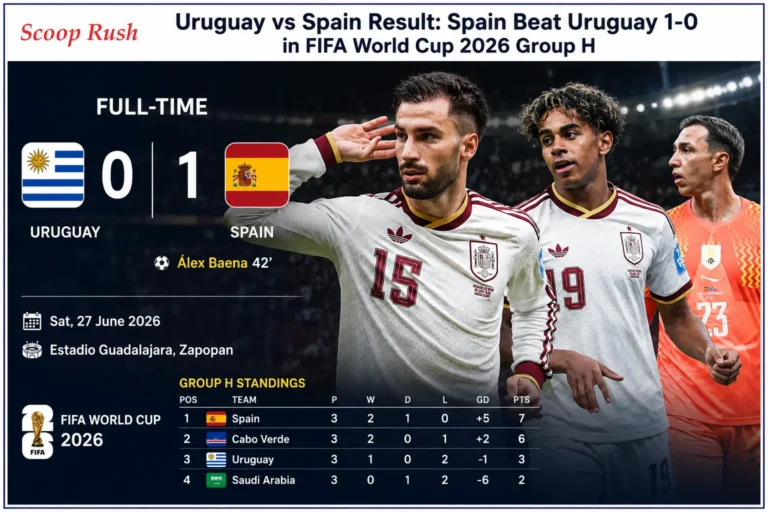
Uruguay vs Spain Result: Spain Beat Uruguay 1-0 in FIFA World Cup 2026 Group H

0

Competition: FIFA World Cup 2026
Date: Saturday, 27 June 2026
Venue: Estadio Guadalajara, Zapopan
Full-Time Result: Uruguay 0–1 Spain

Introduction

The Uruguay vs Spain Result was one of the most significant outcomes in Group H. Both teams entered the match knowing that every point mattered, but Spain handled the pressure brilliantly. Álex Baena’s first-half goal gave La Roja an advantage they never surrendered.

Uruguay fought hard throughout the contest, creating several opportunities and pushing forward in the closing stages. However, Spain defended with discipline and controlled possession for long periods, limiting Uruguay’s clear-cut chances despite facing constant pressure.

The victory means Spain finishes first in Group H with seven points, while Cabo Verde also progresses after finishing second.

A Single Goal Changed Everything

One moment of quality was enough to decide one of the biggest matches in FIFA World Cup 2026 Group H. Spain secured a narrow but crucial 1-0 victory over Uruguay, finishing the group stage at the top of the standings. Despite Uruguay creating more shots throughout the match, Spain’s clinical finishing and impressive control of possession proved to be the difference.

The result sends Spain into the knockout stage as Group H winners, while Uruguay’s campaign comes to an end after finishing third in the group.

Uruguay vs Spain Result Highlights

The match remained closely contested from start to finish.

Spain opened the scoring in the 42nd minute through Álex Baena, whose finish ultimately proved decisive. Uruguay increased the intensity after the break, attacking with greater urgency and forcing Spain to defend deep at times.

Late in the game, Uruguay suffered another setback when Agustín Canobbio received a red card deep into stoppage time, ending any remaining hopes of mounting one final attack.

Match Result

Winning Goal: Álex Baena (42′)

First Half Analysis Uruguay vs Spain Result

Spain looked comfortable from the opening whistle.

Rather than forcing attacks, they patiently circulated possession and waited for openings. Their passing accuracy allowed them to dictate the rhythm while Uruguay worked hard defensively.

The breakthrough finally arrived just before halftime.

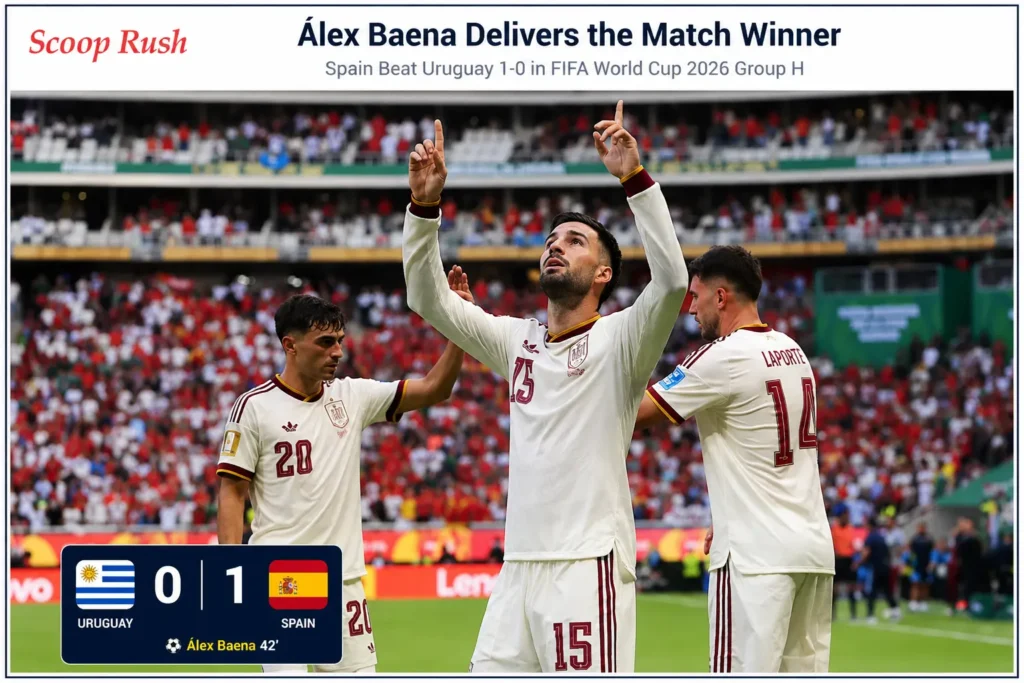
Álex Baena found space inside the attacking area and converted the opportunity in the 42nd minute, giving Spain a valuable lead heading into the break.

For Uruguay, conceding so close to halftime made the second half considerably more difficult.

Álex Baena Delivers the Match Winner

Álex Baena Delivers the Match Winner

Álex Baena produced the game’s defining moment.

His first-half strike rewarded Spain’s patient build-up play and ultimately decided the contest. Although Spain registered only one shot on target throughout the match, that opportunity was taken with impressive efficiency.

In knockout football, clinical finishing often matters more than creating numerous chances, and Spain demonstrated exactly that.

Uruguay Created Chances but Could Not Find the Equalizer

Uruguay certainly had opportunities.

The South American side finished with:

  • 6 total shots
  • 2 shots on target
  • 14 fouls won
  • 5 corners

However, converting those chances proved difficult.

Spain remained organized defensively and prevented Uruguay from finding the breakthrough despite sustained second-half pressure.

The frustration eventually showed late in stoppage time when Agustín Canobbio was sent off after receiving a red card.

Spain Controlled the Ball Throughout the Match

Although Uruguay attempted more shots, Spain dominated possession.

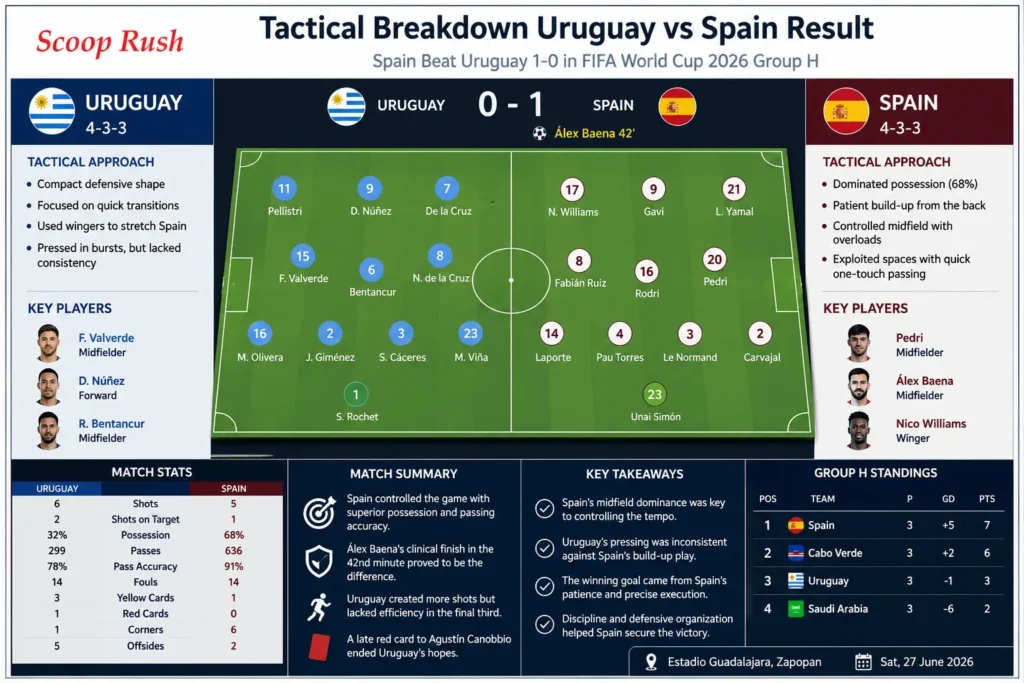
StatisticUruguaySpain
Goals01
Shots65
Shots on Target21
Possession32%68%
Passes299636
Pass Accuracy78%91%
Fouls1414
Yellow Cards31
Red Cards10
Offsides52
Corners16

Spain completed more than twice as many passes as Uruguay while maintaining an outstanding 91% passing accuracy.

Their ability to retain possession limited Uruguay’s time on the ball and forced them to spend long periods defending.

Tactical Breakdown Uruguay vs Spain Result

Tactical Breakdown Uruguay vs Spain Result

Spain relied on patience rather than constant attacking pressure.

Instead of chasing numerous scoring chances, they focused on:

  • Maintaining possession
  • Accurate passing
  • Structured defensive organization
  • Efficient finishing

Uruguay adopted a more direct approach.

Whenever possession was recovered, they quickly transitioned into attack and attempted to create scoring opportunities through faster forward movement. While this strategy produced more shots, it lacked the finishing quality needed to beat Spain.

Ultimately, Spain’s control of the midfield proved decisive.

Discipline Played an Important Role

The match was physical from beginning to end.

Uruguay received three yellow cards before suffering a late red card to Agustín Canobbio during stoppage time.

Spain also collected one yellow card but avoided major disciplinary issues that could have disrupted their game plan.

The red card effectively ended Uruguay’s final opportunity to push for an equalizer.

Group H Final Standings

The victory confirmed the final Group H table.

PositionTeamPoints
1Spain7
2Cabo Verde6
3Uruguay3
4Saudi Arabia2

Spain advances to the FIFA World Cup 2026 knockout stage as Group H winners.

Cabo Verde also qualifies after finishing second.

Uruguay exits the tournament despite earning one victory during the group stage.

Uruguay vs Spain Result Key Moments of the Match

Several moments shaped the final result.

  • Spain controlled possession from kickoff.
  • Álex Baena scored the only goal in the 42nd minute.
  • Uruguay increased attacking pressure after halftime.
  • Spain defended their lead effectively.
  • Agustín Canobbio received a red card deep into stoppage time.
  • Spain secured first place in Group H.

What This Result Means

For Spain, the victory represents another confident step toward the knockout rounds.

Finishing first in the group rewards their consistency across the three group-stage matches and provides momentum heading into the next phase of the competition.

For Uruguay, the defeat marks the end of their FIFA World Cup 2026 campaign.

Although they produced more attempts on goal in this match, they were unable to convert those opportunities into goals. The difference ultimately came down to efficiency in front of goal and Spain’s exceptional ball control.

Conclusion

The Uruguay vs Spain Result demonstrated that football is often decided by moments rather than statistics alone.

Uruguay finished with more shots on target, but Spain controlled possession, completed significantly more passes, and capitalized on their best opportunity. Álex Baena’s first-half strike proved enough to secure a 1-0 victory, top Group H, and book Spain’s place in the FIFA World Cup 2026 knockout stage.

Uruguay battled until the final whistle but could not find an equalizer, bringing their tournament journey to an end.

FAQs

1. What was the Uruguay vs Spain result in FIFA World Cup 2026?

Spain defeated Uruguay 1-0 in their Group H match.

2. Who scored the winning goal for Spain?

Álex Baena scored the match-winning goal in the 42nd minute.

3. Did Spain qualify for the knockout stage?

Yes. Spain finished first in Group H with seven points and advanced to the knockout stage.

4. Why was Agustín Canobbio sent off?

Agustín Canobbio received a red card during stoppage time, leaving Uruguay with ten players.

5. Which teams qualified from Group H?

Spain finished first and Cabo Verde finished second, with both teams advancing to the FIFA World Cup 2026 knockout stage.

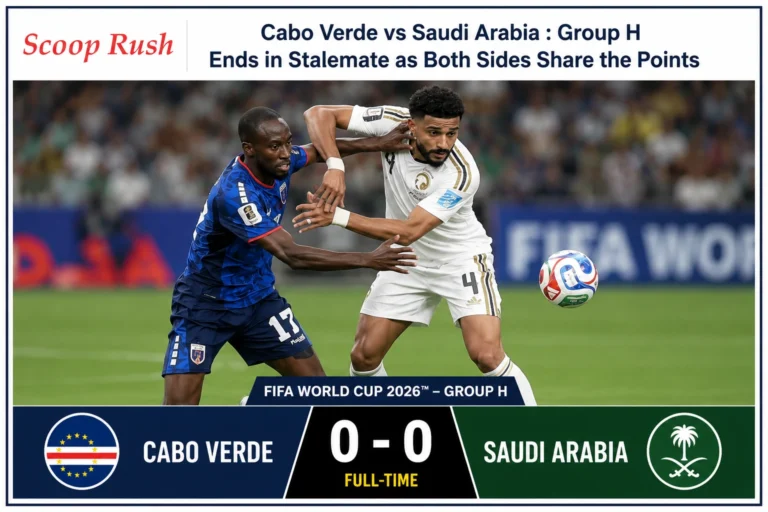
Cabo Verde vs Saudi Arabia : Group H Ends in Stalemate as Both Sides Share the Points

0

Competition: FIFA World Cup 2026
Date: Saturday, 27 June 2026
Venue: Houston Stadium, Houston
Full-Time Result: Cabo Verde 0-0 Saudi Arabia

Cabo Verde vs Saudi Arabia A Tense Group H Battle Finishes Without a Goal. In a match where every point mattered, Cabo Verde vs Saudi Arabia ended in a hard-fought 0-0 draw in Group H of the FIFA World Cup 2026. Despite several attacking moments and determined efforts from both teams, neither side could find the breakthrough during 90 minutes of competitive football.

The result reflected a closely contested encounter between two teams that remained organized defensively and disciplined tactically. While the scoreline may suggest a quiet game, the statistics reveal a balanced contest filled with battles for possession, defensive interventions, and moments of pressure at both ends of the pitch.

For supporters following Group H, the match provided another important chapter in a tightly contested group stage where every result influenced the final standings.

Cabo Verde vs Saudi Arabia : Group H Match Report

The meeting between Cabo Verde and Saudi Arabia saw two teams enter the field knowing the importance of avoiding defeat. From the opening whistle, both sides focused on maintaining structure and limiting opportunities for the opposition.

Cabo Verde enjoyed slightly more of the ball throughout the match and attempted to dictate the tempo through controlled possession. Saudi Arabia, meanwhile, relied on defensive discipline and organized pressing to prevent Cabo Verde from creating clear-cut chances.

Although there were moments when both teams threatened, the defenses remained strong. Goalkeepers and defenders did their jobs effectively, ensuring that neither side could gain the decisive advantage.

When the final whistle arrived, the scoreboard remained unchanged at 0-0.

Match Statistics: Cabo Verde vs Saudi Arabia

The numbers illustrate how evenly matched the contest was.

Team Statistics

StatisticCabo VerdeSaudi Arabia
Shots156
Shots on Target33
Possession51%49%
Passes433421
Pass Accuracy85%82%
Fouls1016
Yellow Cards13
Red Cards00
Offsides20
Corners42

Cabo Verde recorded more shots and earned more corners, indicating a greater attacking intent. However, Saudi Arabia matched their opponents in shots on target, demonstrating efficiency whenever opportunities arose.

Possession was almost evenly split, while pass completion rates were relatively similar. Saudi Arabia committed more fouls and received more yellow cards, highlighting the physical nature of their defensive approach.

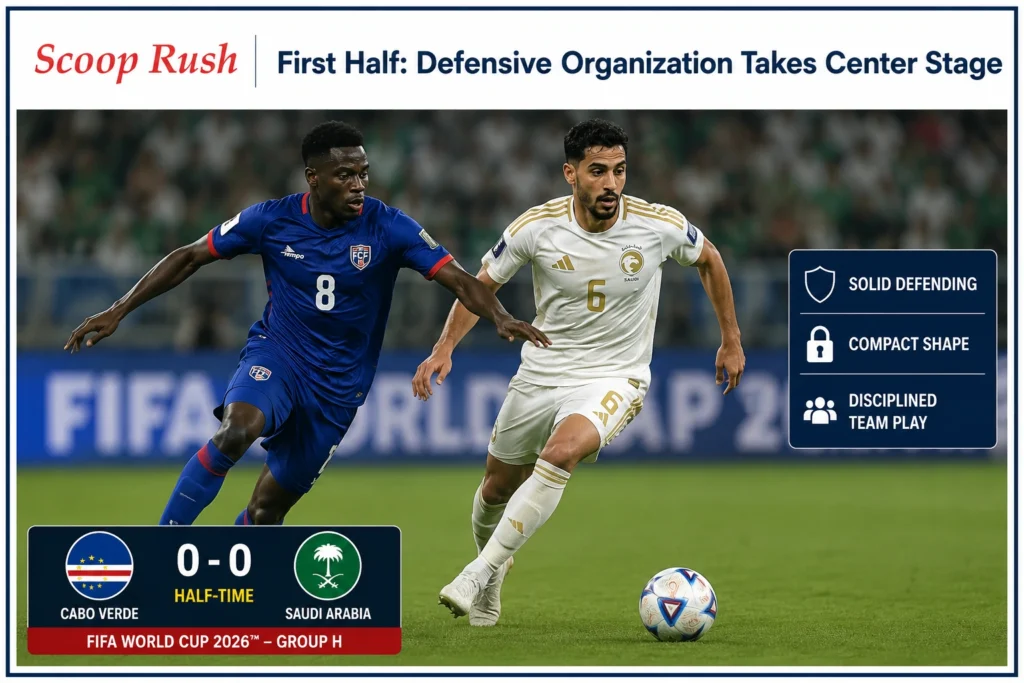
First Half: Defensive Organization Takes Center Stage

First Half: Defensive Organization Takes Center Stage

The opening half was characterized by caution from both teams.

Cabo Verde sought to build attacks patiently from midfield, using possession to advance into dangerous areas. Saudi Arabia responded by staying compact and closing down spaces between the lines.

While Cabo Verde generated more attempts on goal, Saudi Arabia prevented many of those opportunities from becoming genuine scoring chances. Defenders consistently tracked runners and blocked passing lanes.

Saudi Arabia also looked to create danger through transitions whenever possession was recovered. However, Cabo Verde’s defensive setup remained alert and denied clear routes toward goal.

As a result, neither side managed to break the deadlock before halftime.

Cabo Verde Show Greater Attacking Intent

One of the notable themes of the match was Cabo Verde’s willingness to push forward.

Their total of 15 shots compared to Saudi Arabia’s six reflected a team looking to take initiative. Cabo Verde spent long periods circulating possession and attempting to create openings around the Saudi defensive block.

The midfield worked hard to maintain control, while wide players attempted to stretch the opposition and create crossing opportunities.

However, despite generating more offensive activity, Cabo Verde struggled to convert territorial advantages into decisive chances. Saudi Arabia’s defensive organization consistently forced attacks into less dangerous areas.

The result was a frustrating afternoon for Cabo Verde’s attackers, who could not find the finishing touch required to secure victory.

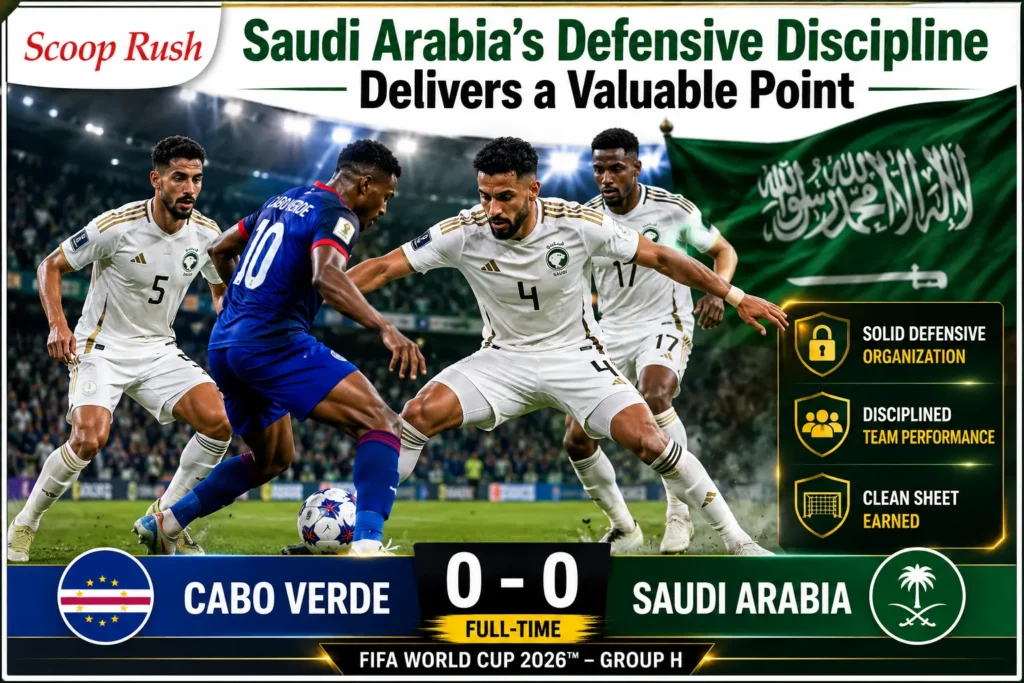
Saudi Arabia’s Defensive Discipline Delivers a Valuable Point

Saudi Arabia's Defensive Discipline Delivers a Valuable Point

Saudi Arabia approached the match with a clear focus on defensive solidity.

Although they had fewer shots, they remained difficult to break down throughout the contest. Their defenders maintained shape effectively, limiting space inside the penalty area and forcing Cabo Verde to work hard for every opportunity.

The Saudi side also demonstrated resilience when under pressure. Even during periods where Cabo Verde controlled possession, Saudi Arabia remained compact and disciplined.

This defensive commitment was reflected in the team’s ability to keep a clean sheet despite facing considerably more attempts on goal.

While the attack was unable to produce a winning goal, the defensive performance ensured Saudi Arabia left the match with a point.

Cabo Verde vs Saudi Arabia Key Moments from the Match

Several notable incidents shaped the flow of the game.

Saudi Arabia Make Defensive Changes

During the second half, Saudi Arabia introduced fresh defensive personnel in an effort to maintain stability at the back.

A substitution saw a defender enter the match while another player was withdrawn, reinforcing the team’s commitment to protecting their clean sheet.

The adjustment helped Saudi Arabia continue resisting Cabo Verde’s pressure during the closing stages.

Yellow Card for Saudi Arabia

A late yellow card highlighted the intensity of the contest.

As the pressure increased toward the end of the match, Saudi Arabia received another booking, bringing their total yellow cards to three. The caution reflected the physical challenges and tactical fouls used to disrupt opposition attacks.

Cabo Verde Also Turn to the Bench

Cabo Verde made changes of their own as they searched for a winning goal.

Fresh legs were introduced to inject energy into the attack and create new problems for the Saudi defense. Despite these efforts, the breakthrough never arrived.

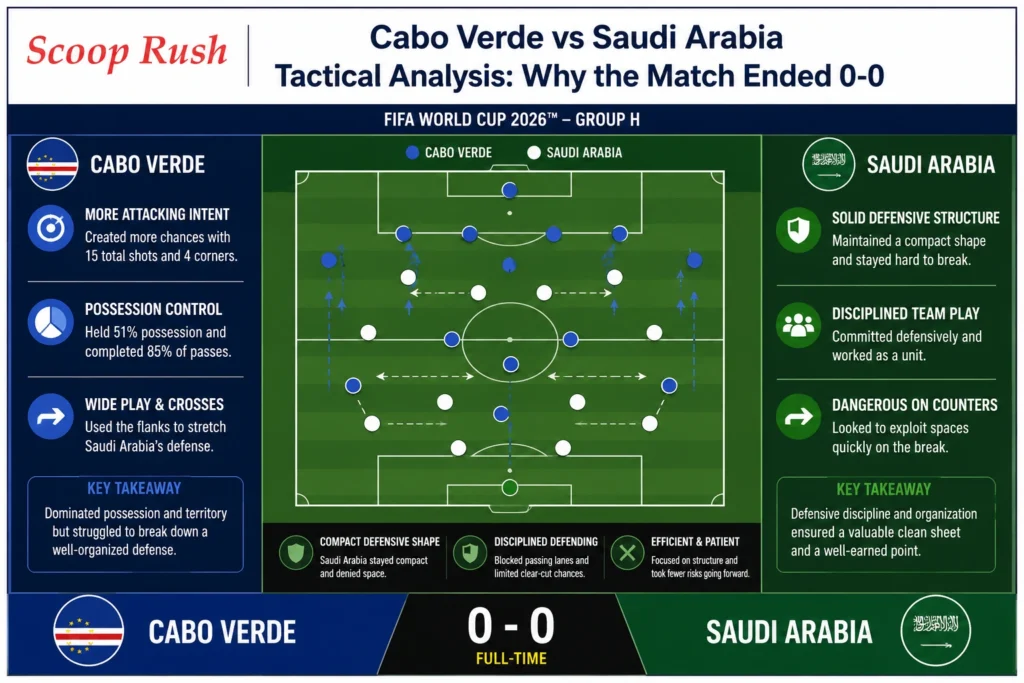
Cabo Verde vs Saudi Arabia Tactical Analysis: Why the Match Ended 0-0

Cabo Verde vs Saudi Arabia Tactical Analysis: Why the Match Ended 0-0

Cabo Verde Controlled More of the Offensive Play

The shot count suggests Cabo Verde were the more proactive side.

With 15 attempts and four corners, they spent more time in attacking positions and looked more likely to score for much of the game.

However, possession and territorial control alone were not enough. Saudi Arabia successfully limited the quality of opportunities created.

Saudi Arabia Focused on Defensive Structure

Saudi Arabia’s game plan revolved around discipline and compactness.

The team defended in numbers, restricted space in central areas, and remained organized when Cabo Verde advanced into the final third.

Their ability to absorb pressure while remaining difficult to break down ultimately proved decisive.

Balanced Midfield Battle

Another reason the game remained scoreless was the balanced midfield contest.

Possession was almost evenly shared, with Cabo Verde holding 51 percent compared to Saudi Arabia’s 49 percent. Neither side dominated the center of the pitch for extended periods.

This balance prevented either team from establishing sustained momentum.

Group H Standings After Cabo Verde vs Saudi Arabia

Following the draw, the Group H table showed a tightly contested battle among the participating teams.

The standings were:

Cabo Verde finished ahead of Saudi Arabia in the standings despite the draw. The result highlighted the importance of points earned earlier in the competition.

For Saudi Arabia, the draw provided another point but was not enough to move above Cabo Verde in the group rankings.

What the Result Means

The 0-0 scoreline may not have delivered dramatic moments in front of goal, but it showcased the importance of defensive organization in tournament football.

Cabo Verde demonstrated their ability to control possession and generate opportunities, while Saudi Arabia showed resilience and discipline under pressure.

The match also underlined how fine the margins can be at the World Cup. A single goal could have completely changed the outcome, yet both defenses ensured that no breakthrough arrived.

Ultimately, the point earned reflected the balance between two teams that matched each other in determination and tactical commitment.

Conclusion

The Cabo Verde vs Saudi Arabia clash ended in a goalless draw, but the match offered plenty of insight into both teams’ approaches. Cabo Verde created more opportunities and enjoyed slightly greater possession, while Saudi Arabia relied on a disciplined defensive performance to secure a clean sheet.

With 15 shots to six, Cabo Verde looked the more adventurous side, yet Saudi Arabia’s organization prevented those efforts from translating into goals. The result left both teams with a share of the points after a competitive and evenly fought Group H encounter.

In the end, neither side could find the decisive moment required to claim victory, and the match concluded exactly as it began: level at 0-0.

FAQs

1. What was the final score between Cabo Verde and Saudi Arabia?
The FIFA World Cup 2026 Group H match between Cabo Verde and Saudi Arabia ended in a 0-0 draw.

2. Which team had more shots in the match?
Cabo Verde recorded 15 shots compared to Saudi Arabia’s six.

3. How much possession did each team have?
Cabo Verde finished with 51% possession, while Saudi Arabia had 49%.

4. How many yellow cards were shown in the game?
A total of four yellow cards were shown, with Cabo Verde receiving one and Saudi Arabia receiving three.

5. Where did Cabo Verde and Saudi Arabia finish in the Group H standings?
After the match, Cabo Verde finished second in Group H with six points, while Saudi Arabia ended fourth with four points.

Anne Hegerty Baby Reindeer Style Stalker Story: The Chase Star Reveals Fan Moved Hundreds of Miles to Be Near Her

0

Introduction

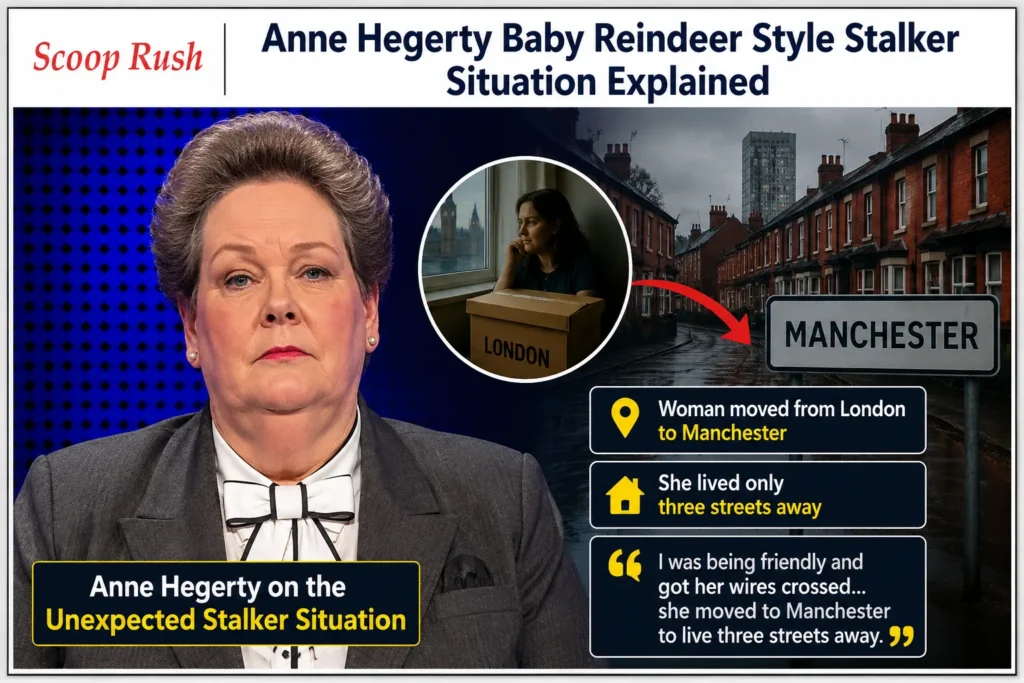
The Anne Hegerty stalker story has gained attention after The Chase star revealed that a woman moved hundreds of miles across the UK to be closer to her. Anne Hegerty explained that the woman moved from London to Manchester and later lived just three streets away after they became friendly.

Anne Hegerty, who is known as “The Governess” on ITV’s popular quiz show The Chase, explained that the situation happened in 2012, shortly after the programme became more popular. At the time, she was still adjusting to increased public attention and said she was simply trying to be kind and friendly.

However, Anne later realised that the relationship had developed differently than she expected. She explained that she had to carefully create distance and set personal boundaries while trying not to hurt the woman’s feelings.

The Chase star compared the experience to the Netflix series Baby Reindeer, although she clarified that her situation was not as serious as the events shown in the drama. Her comments have attracted attention because they highlight the challenges celebrities can face when fan relationships become too personal.

Anne Hegerty Baby Reindeer Style Stalker Situation Explained

Anne Hegerty Baby Reindeer Style Stalker Situation Explained

Anne Hegerty revealed that the situation started after she became friendly with a woman who appeared to misunderstand their relationship.

According to Anne, the woman packed up her home in London and moved to Manchester after they became closer. She then lived only three streets away from Anne.

Anne explained:

“There was a woman who I was being friendly with and got her wires crossed and the next thing I knew she packed up her home in London and moved to Manchester to live three streets away.”

Although Anne described the situation as difficult, she explained that she did not want to upset the woman. Instead, she gradually created distance until the woman understood the situation.

Why Anne Hegerty Had to Set Personal Boundaries

Anne said the experience taught her the importance of understanding boundaries, especially after becoming recognised by the public.

She explained that before becoming widely known through The Chase, she was not used to dealing with people who might form strong personal connections with her because of her television appearances.

Anne said she was “trying to be nice” but later realised that some people can overstep boundaries.

Fame and Unexpected Fan Relationships

For television personalities, popularity can change the way people interact with them. Fans often feel connected to celebrities because they regularly see them on television.

However, a connection through a screen does not always mean a personal friendship.

Anne’s experience shows why public figures may need to carefully manage relationships and maintain personal space.

The Connection Between Anne Hegerty’s Story and Baby Reindeer

Anne compared her experience to Baby Reindeer because of the similarities involving unwanted attention and personal boundaries.

The Netflix drama follows Donny Dunn, a comedian who becomes involved in a complicated situation with Martha Scott after a small act of kindness.

The series was created by and starred Richard Gadd and was based on his autobiographical stage performance.

However, Anne made it clear that her own experience was different and not as extreme. She handled the situation by creating distance and making her boundaries clear.

Anne Hegerty’s Career on The Chase

Anne Hegerty joined The Chase in 2010 and quickly became one of the show’s most recognisable Chasers.

Known as “The Governess,” she became popular with viewers because of her quiz knowledge, confident personality, and competitive approach.

The Chase first launched in 2009, with the original Chasers including Mark Labbett and Shaun Wallace. Over the years, Anne became one of the most familiar faces on the programme.

Her television success also increased public interest in her personal experiences.

Anne Hegerty’s Way of Handling the Situation

Anne Hegerty’s Way of Handling the Situation

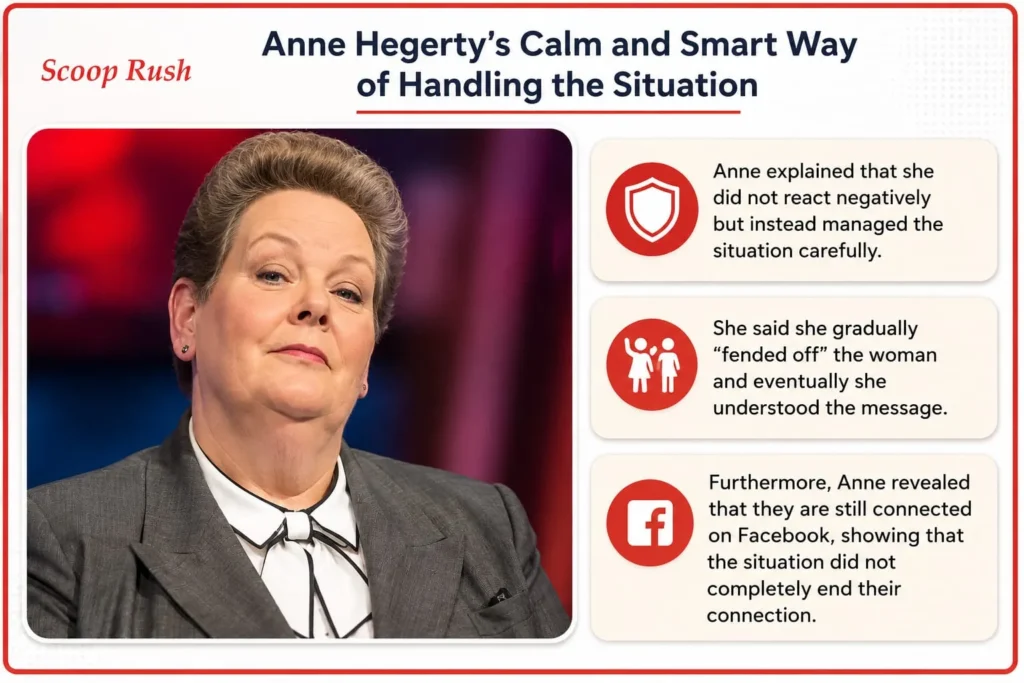
Anne explained that she did not react negatively but instead managed the situation carefully.

She said she gradually “fended off” the woman and eventually she understood the message.

Furthermore, Anne revealed that they are still connected on Facebook, showing that the situation did not completely end their connection.

What Anne Hegerty’s Story Shows About Celebrity Boundaries

Anne Hegerty’s story highlights how public figures sometimes face unexpected challenges when interacting with fans.

Television personalities can build a strong connection with viewers, but those relationships can sometimes be misunderstood.

Therefore, setting clear boundaries can help prevent uncomfortable situations and maintain healthy relationships.

Baby Reindeer’s Role in Public Conversations About Stalking

Baby Reindeer’s Role in Public Conversations About Stalking

Baby Reindeer became a widely discussed Netflix series because it explored themes including obsession, boundaries, and difficult personal relationships. The Anne Hegerty stalker story gained attention because it showed how public figures sometimes need to manage unexpected fan relationships.

The show created conversations about how acts of kindness can sometimes lead to complicated situations.

Meanwhile, Anne’s story presents a different example where communication and boundaries helped manage an uncomfortable experience.

Conclusion: Anne Hegerty Baby Reindeer Style Story Highlights Importance of Boundaries

Anne Hegerty’s Baby Reindeer style story has gained attention after she revealed that a woman moved from London to Manchester and lived just three streets away from her.The Anne Hegerty stalker story shows how celebrities sometimes need to create clear personal boundaries with fans.

The Chase star explained that the situation began after she was friendly with the woman, but she later realised she needed to create boundaries.

Although Anne compared the experience to Baby Reindeer, she clarified that it was not as serious as the events shown in the Netflix drama.

Ultimately, her story highlights the importance of personal boundaries, especially for people who live in the public eye.

FAQs

1. Who is Anne Hegerty from The Chase?

Anne Hegerty is a Chaser on ITV’s quiz show The Chase. She is known as “The Governess” and is one of the programme’s most recognised personalities.

2. Why did Anne Hegerty mention Baby Reindeer?

Anne mentioned Baby Reindeer because she saw similarities between her experience and the themes of the Netflix series, although she said her situation was not as serious.

3. When did Anne Hegerty’s experience happen?

Anne said the incident happened in 2012 after The Chase became more popular.

4. Did the woman move to Manchester because of Anne Hegerty?

According to Anne, the woman moved from London to Manchester and lived close to her after they became friendly.

5. How did Anne Hegerty deal with the situation?

Anne said she gradually created distance and the woman eventually understood. She also said they remain connected on Facebook.

GLP-1 Muscle Loss: How to Protect Muscle While Losing Weight

0

Losing weight with GLP-1 medications such as semaglutide and tirzepatide has helped millions of people improve their health. However, experts warn that rapid weight loss can reduce not only body fat but also muscle mass. Since muscle supports strength, metabolism, balance, and mobility, protecting it should be part of every weight-loss plan.

The good news is that muscle loss isn’t inevitable. Research suggests that combining GLP-1 treatment with resistance training, adequate protein intake, and regular physical activity can help preserve lean muscle while promoting healthy fat loss.

Why Muscle Matters During Weight Loss

Why Muscle Matters During Weight Loss |scooprush

GLP-1 medications work by reducing appetite, slowing stomach emptying, and improving blood sugar control. These effects help people lose significant amounts of weight, but like most weight-loss methods, some lean body mass is also lost.

Experts stress that this isn’t unique to GLP-1 medications. Losing muscle is common whenever calorie intake decreases. The goal is to minimize muscle loss while maximizing fat loss.

Dr. Chuck Svendsen, chief medical officer at Astride Health, says successful weight loss should focus on improving overall health, not simply lowering the number on the scale. Many clinics now use DEXA scans and other body composition tests to measure fat, muscle, and bone density instead of relying on body weight alone.

A Lifestyle Change Beyond the Scale

Minnesota resident Jenn Glass spent years losing and regaining the same weight before deciding to try a GLP-1 medication through a medically supervised program.

Instead of depending only on medication, the program combined body composition testing, nutrition coaching, and strength training. Glass has lost more than 30 pounds, but she says the biggest improvement has been changing her mindset and adopting healthier habits that she plans to maintain long term.

Why Preserving Muscle Is Important

Muscle does much more than improve appearance. It helps people perform everyday activities, supports healthy joints and bones, improves balance, and lowers the risk of falls.

It also plays an important role in metabolism because muscle burns more calories than fat, even while resting. In addition, healthy muscle improves insulin sensitivity by helping the body use glucose more efficiently — a benefit that works alongside medical advances like teplizumab for managing type 1 diabetes, which also targets insulin regulation.

These benefits make muscle preservation an essential part of healthy weight management.

Why Preserving Muscle Matters During GLP-1 Weight Loss

Why Preserving Muscle Is Important |Scoooprush

Muscle preservation becomes even more important because it supports long-term independence and overall quality of life. Healthy muscle helps maintain posture, balance, and endurance while making everyday activities easier. When muscle mass declines too much, people may notice increased fatigue, reduced strength, and slower recovery after exercise or illness.

This is especially important for older adults, who naturally lose muscle as they age and also face heat and humidity risks that can make exercise more dangerous. By protecting lean muscle during weight loss, people are more likely to maintain an active lifestyle, continue exercising comfortably, and reduce the risk of future health problems.

Experts increasingly recommend focusing on body composition instead of weight alone because a healthier balance of fat and muscle provides better long-term outcomes than simply reaching a lower number on the scale.

The Two Most Important Strategies for Preserving Muscle

Experts also emphasize that muscle preservation is a long-term commitment rather than a short-term goal. Building healthy habits early during GLP-1 treatment can make it easier to maintain strength as weight continues to decrease.

Consistency is more important than perfection. Missing an occasional workout or meal target is unlikely to affect progress, but regularly combining resistance exercise with adequate protein intake can produce meaningful results over time. Many healthcare providers recommend creating a realistic routine that fits daily life instead of following an overly strict program. A sustainable exercise schedule and balanced eating plan are more likely to support both successful weight loss and healthy muscle maintenance over the long term.

Does GLP-1 Weight Loss Cause Muscle Loss?

Does GLP-1 Weight Loss Cause Muscle Loss? |Scooprush

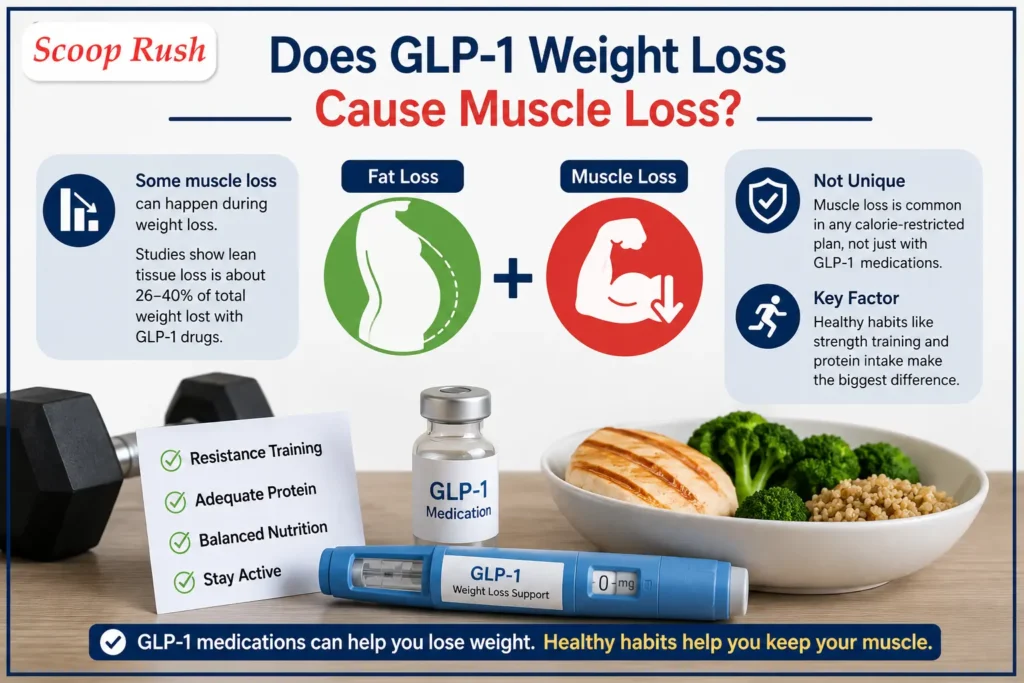
Studies show that lean tissue can account for about 26% to 40% of total weight lost during treatment with semaglutide or tirzepatide.

However, researchers note that lean body mass includes more than skeletal muscle. It also contains water and other tissues. Furthermore, some lean tissue loss naturally occurs during successful weight loss because a lighter body requires less muscle for support.

Researchers from Mass General Brigham emphasize that current evidence does not show GLP-1 medications cause unusually high muscle loss compared with other weight-loss methods.

How to Protect Muscle While Taking GLP-1 Medications

1. Prioritize Resistance Training

Strength training is the most effective way to preserve muscle during weight loss. Exercises using free weights, resistance bands, machines, or body weight signal the body to maintain muscle tissue even while losing fat.

Experts generally recommend resistance training two to three times each week. Squats, lunges, push-ups, rows, and resistance-band exercises are all effective options.

Even simple desk exercises and short activity breaks throughout the day can help people who spend long hours sitting research shows that a five-minute walk every hour meaningfully reduces fatigue and supports overall movement health.

2. Eat Enough Protein

Because GLP-1 medications reduce appetite, some people unintentionally eat too little protein. Protein supplies the building blocks needed for muscle repair and maintenance. Good choices include lean meats, fish, eggs, dairy products, beans, lentils, nuts, and seeds.

It is also worth being cautious about over-supplementing taking too many vitamins and supplements carries its own risks and does not replace a balanced diet. Current evidence suggests that combining higher protein intake with resistance training offers the greatest protection against muscle loss.

3. Stay Active Every Day

Exercise doesn’t have to happen only in the gym. Walking, cycling, climbing stairs, stretching, and other daily activities all contribute to maintaining muscle health and mobility.

Small amounts of movement performed consistently can complement structured workouts and improve long-term results. If you exercise outdoors, especially in summer months, make sure to follow safe home and outdoor cooling tips during hot weather to avoid heat-related setbacks.

4. Follow a Balanced Diet

Experts recommend focusing on nutrient-rich foods rather than simply eating less. Meals should include lean protein, vegetables, fruits, whole grains, and healthy fats to provide the nutrients needed for muscle recovery and overall health. Staying hydrated is equally important because muscles rely on adequate water for proper function.

Research Shows Healthy Habits Make a Difference

A recent case series followed three adults taking semaglutide or tirzepatide while following structured exercise programs and high-protein diets. Participants performed resistance training three to five days each week and stayed physically active throughout treatment.

The results were encouraging. One participant lost very little lean tissue despite major weight loss, while the other two actually increased lean body mass as they lost fat. Although the study included only three participants, the findings suggest that lifestyle habits can significantly influence body composition during GLP-1 treatment.

Preventive health habits matter beyond exercise too. Staying up to date with vaccinations such as understanding how the HPV vaccine helps prevent cervical cancer deaths is part of a complete long-term health strategy.

Future Treatments May Offer More Protection

Researchers at Stanford Medicine are studying an experimental drug that may improve muscle repair during GLP-1 treatment. In studies involving mice, the drug increased muscle stem cell activity and improved muscle regeneration after injury without reducing the fat-loss benefits of semaglutide.

While these findings are promising, the treatment has only been studied in animals for this purpose. Human clinical trials are still needed before it becomes available — much like teplizumab, which went through years of trials before becoming available for delaying type 1 diabetes.

Conclusion

GLP-1 medications have transformed obesity treatment, but preserving muscle is just as important as losing fat. Current evidence suggests that muscle loss can be reduced by combining medication with healthy lifestyle habits.

Regular resistance training, adequate protein intake, balanced nutrition, daily movement breaks, and body composition monitoring remain the most effective ways to protect lean muscle during weight loss. By focusing on both fat loss and muscle health, people can achieve better long-term results and improve their overall well-being.

FAQs

Does GLP-1 medication always cause muscle loss?

No. Some lean tissue loss is normal during weight loss, but healthy habits can significantly reduce muscle loss.

What is the best exercise while taking GLP-1 medications?

Resistance training two to three times per week, combined with regular daily activity, is considered the best approach.

How much protein should I eat?

Protein needs vary by individual. Experts generally recommend eating enough high-quality protein throughout the day to support muscle maintenance during weight loss.

Can you build muscle while taking semaglutide?

Some research suggests people can maintain or even gain lean muscle when they combine GLP-1 treatment with regular strength training and adequate protein intake.