Home Blog Page 52

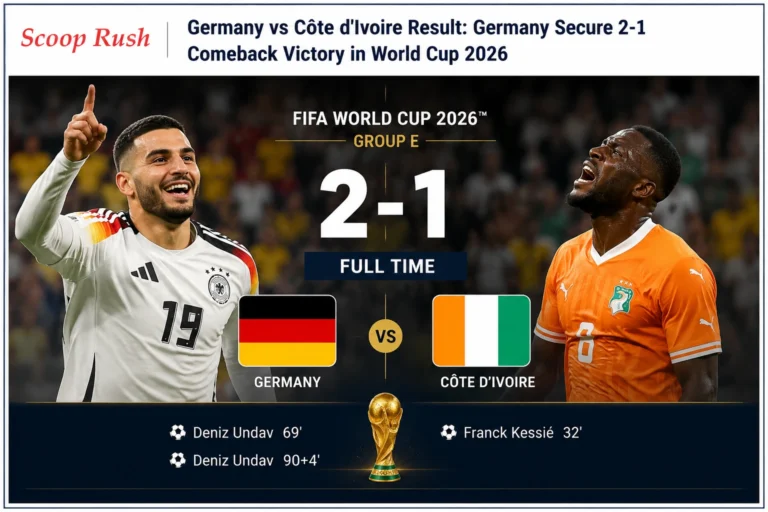
Germany vs Côte d’Ivoire Result: Germany Secure 2-1 Comeback Victory in World Cup 2026

0

FIFA World Cup 2026™
Group: Group E
Date: Sunday, 21 June
Venue: Toronto Stadium, Toronto
Final Score: Germany 2-1 Côte d’Ivoire

Germany Fight Back from Behind to Secure Crucial Group E Win, The FIFA World Cup is known for producing unforgettable moments, dramatic finishes, and heroes who emerge when their teams need them most. Germany’s thrilling 2-1 victory over Côte d’Ivoire in Group E delivered all of those elements and more, providing fans with one of the most entertaining matches of the tournament so far.

For much of the contest, Côte d’Ivoire appeared on course for a famous result. The African side defended with determination, took advantage of their opportunities, and held a valuable lead for a significant portion of the match. Germany, meanwhile, controlled possession and created chances but struggled to find the breakthrough that would reward their dominance.

However, football matches are rarely decided before the final whistle. Germany demonstrated patience, resilience, and belief, eventually overturning the deficit through a remarkable performance from Deniz Undav. His equalizer in the second half gave Germany hope, while his dramatic stoppage-time winner completed an unforgettable comeback.

The result not only earned Germany three valuable points but also strengthened their position at the top of Group E. For Côte d’Ivoire, the defeat was heartbreaking given how close they came to securing at least a draw, but their performance showed they remain a dangerous and competitive side capable of challenging any opponent.

Match Information

Goalscorers

  • Franck Kessié (32′) – Côte d’Ivoire
  • Deniz Undav (69′) – Germany
  • Deniz Undav (90+4′) – Germany

A High-Stakes Group E Encounter

Heading into the match, both teams understood the importance of securing a positive result.

Germany entered the contest seeking to continue their strong start to the tournament and strengthen their chances of reaching the knockout stages. As one of football’s traditional powerhouses, expectations were naturally high, and anything less than a victory would have increased pressure heading into the remaining group fixtures.

Côte d’Ivoire, meanwhile, arrived with confidence and determination. The African nation has consistently produced talented players and competitive teams on the international stage, and they were eager to prove they could compete with one of Europe’s elite sides.

The stakes were high, and both teams approached the match with intensity from the opening whistle.

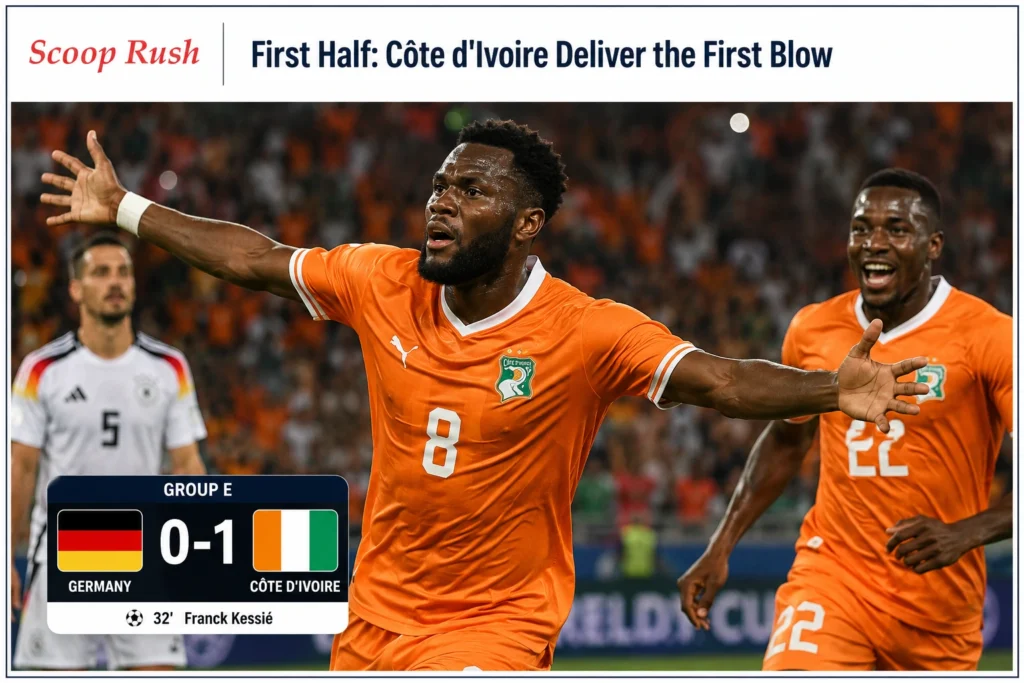
First Half: Côte d’Ivoire Deliver the First Blow
First Half: Côte d'Ivoire Deliver the First Blow

The opening period saw Germany attempt to establish control through possession and patient buildup play.

Their midfield circulated the ball effectively, while the attacking players searched for spaces behind the Ivorian defensive line. Germany looked comfortable in possession and spent significant periods inside the opposition half.

Despite Germany’s control of the ball, Côte d’Ivoire remained organized and disciplined. Rather than chasing possession unnecessarily, they maintained their defensive shape and waited for opportunities to launch attacks of their own. This approach allowed them to stay competitive while limiting Germany’s ability to create clear scoring chances.

The breakthrough eventually arrived in the 32nd minute.

Franck Kessié Gives Côte d’Ivoire the Lead

Côte d’Ivoire capitalized on one of their attacking opportunities when Franck Kessié found the back of the net.

The goal stunned many observers because Germany had enjoyed much of the possession up to that point. However, it also highlighted the effectiveness of Côte d’Ivoire’s tactical approach.

While Germany controlled the game territorially, Côte d’Ivoire demonstrated that efficiency in front of goal can be just as important as possession statistics.

Kessié’s strike gave his side a crucial advantage and significantly boosted their confidence.

For Germany, the goal represented a major setback. Suddenly, the pressure increased as they faced the challenge of recovering from a deficit against a disciplined opponent.

Germany Search for a Response

Following the goal, Germany intensified their attacking efforts.

The players pushed forward with greater urgency, looking to level the score before halftime. Several promising moves developed in and around the penalty area, but Côte d’Ivoire continued to defend effectively.

The African side showed impressive concentration and composure during this period. Every challenge, interception, and clearance helped preserve their advantage as Germany searched desperately for an equalizer.

When the referee signaled the end of the first half, Côte d’Ivoire remained in front.

Half-Time Score

Germany 0-1 Côte d’Ivoire

The halftime score reflected a fascinating contest. Germany had enjoyed more possession and territory, but Côte d’Ivoire’s clinical finishing had given them the edge.

Second Half: Germany Increase the Pressure

The second half began with Germany showing clear intent.

Recognizing the importance of securing points, they continued to dominate possession and commit players forward in attack. The team’s movement improved, and their passing became increasingly purposeful.

The statistics from the match reveal the extent of Germany’s overall control.

StatisticGermanyCôte d’Ivoire
Shots149
Shots on Target72
Possession55%45%
Passes543413
Pass Accuracy89%86%
Fouls87
Corners83

These numbers show Germany’s superiority in several important areas. They generated more shots, forced more saves, completed more passes, and won more corners. However, football matches are determined by goals rather than statistics, and Germany still needed a breakthrough.

Elsewhere in the tournament, similarly dominant possession performances were not always enough to guarantee results.

Deniz Undav Steps Forward

As the clock moved past the hour mark, Germany’s efforts finally produced the moment they had been seeking.

Equalizer Changes the Match

In the 69th minute, Deniz Undav scored Germany’s equalizing goal.

The strike transformed the atmosphere of the match. Germany suddenly appeared energized and confident, while Côte d’Ivoire faced the difficult challenge of regaining momentum after seeing their lead disappear.

The goal was a reward for Germany’s persistence throughout the contest. Despite trailing for much of the match, they continued believing that opportunities would come. Undav’s finish justified that belief and set up a tense final twenty minutes.

At 1-1, the match was once again completely open.

Côte d’Ivoire Show Character

Many teams might have collapsed after conceding an equalizer against a side of Germany’s quality. Côte d’Ivoire did not.

Instead, they continued competing with determination and discipline. The players worked tirelessly to maintain their defensive structure while still looking for opportunities to threaten Germany on the counterattack.

Their resilience was impressive. Even as Germany increased the pressure, Côte d’Ivoire refused to surrender control of the match completely. Every player contributed defensively, helping the team remain competitive deep into the second half.

As full time approached, a draw appeared increasingly likely. For Côte d’Ivoire, earning a point against Germany would have been a valuable achievement. For Germany, however, a draw would have felt disappointing considering their overall dominance.

Stoppage-Time Drama Decides the Contest

Football often produces its most memorable moments when least expected. This match was no exception.

As the game entered added time, supporters of both teams were preparing themselves for a draw. Then came the decisive moment.

Undav Scores Again

In the fourth minute of stoppage time, Deniz Undav struck for a second time.

The goal sparked celebrations among German players and supporters and completely changed the outcome of the match. After spending much of the afternoon chasing the game, Germany had finally completed the comeback.

The timing of the goal made it even more dramatic. Scoring in the closing moments left Côte d’Ivoire with virtually no opportunity to respond, ensuring Germany would leave the stadium with all three points. It was reminiscent of another late drama in the tournament, when a late goal completely altered a result elsewhere in the competition.

Deniz Undav: The Match Hero

Every memorable victory has a standout performer. For Germany, that player was unquestionably Deniz Undav.

Why Undav Was the Difference

  • Scored Germany’s equalizer.
  • Scored the winning goal in stoppage time.
  • Delivered under immense pressure.
  • Turned Germany’s dominance into a victory.
  • Produced the decisive moments when his team needed them most.

Players are often remembered for their impact in crucial matches, and Undav’s performance will undoubtedly be one of the defining stories of this Group E encounter. His two goals transformed what could have been a frustrating afternoon into a famous victory. He joins a growing list of individual match-winners at this tournament, alongside names like Erling Haaland, who also scored twice in a group stage win.

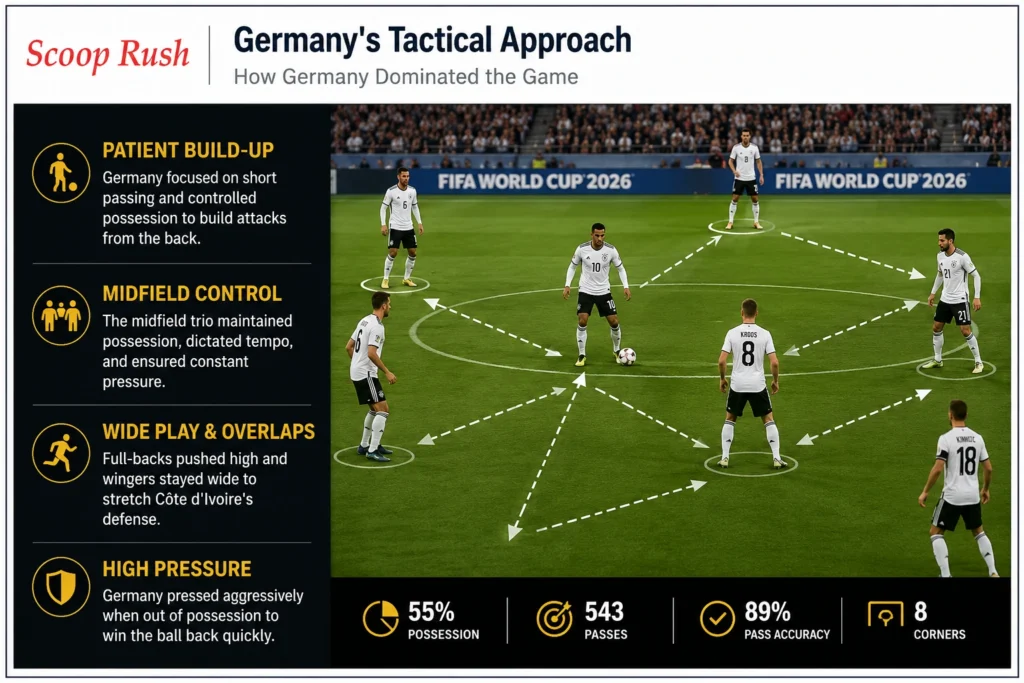
Germany’s Tactical Approach
Germany's Tactical Approach

Germany’s strategy throughout the match was clear. The team prioritized possession, patient passing, and sustained attacking pressure.

Their 543 passes and 89 percent passing accuracy demonstrate how effectively they controlled the ball. Rather than becoming desperate after falling behind, Germany remained committed to their tactical principles. They continued building attacks carefully and trusted that chances would eventually emerge.

That patience ultimately paid off. The ability to remain composed while trailing is often a characteristic of elite teams, and Germany displayed exactly that quality — a trait also evident in other European powerhouses competing at this World Cup.

Côte d’Ivoire Earn Respect Despite Defeat

Although the result was disappointing, Côte d’Ivoire can take numerous positives from the performance.

Positives for Côte d’Ivoire

  • Strong defensive organization.
  • Excellent discipline throughout the match.
  • Clinical finishing from Franck Kessié.
  • Competitive display against a top opponent.
  • Determination and resilience under pressure.

For long periods, Côte d’Ivoire executed their game plan effectively. They frustrated Germany, took their opportunity when it arrived, and came within minutes of earning a valuable result.

While the defeat will hurt, the performance demonstrated that they remain a serious contender in Group E. Similar grit was on display when smaller nations pushed strongly-fancied opponents hard across multiple group stage fixtures.

What the Result Means for Group E

The victory significantly strengthens Germany’s position in the standings. After two matches, Germany sat at the top of Group E with six points.

Group E Standings

TeamPoints
Germany6
Côte d’Ivoire4
Ecuador1
Curaçao0

Germany’s perfect record puts them in an excellent position to qualify for the knockout rounds. Meanwhile, Côte d’Ivoire remained firmly in contention despite the defeat. Their four points ensure qualification remains within reach heading into the remaining fixtures.

Across the tournament, the group stage picture was becoming clearer. Argentina and Brazil were also making strong starts, while England and other major nations were navigating their respective groups.

Key Lessons from the Match

1. Persistence Wins Games

Germany continued attacking despite trailing for much of the contest. Their determination eventually produced the goals required for victory.

2. Possession Must Be Converted into Goals

Germany dominated possession but initially struggled to break down Côte d’Ivoire. The match highlighted the importance of turning control into tangible rewards — a lesson also relevant to Türkiye, who dominated possession but still lost in their Group D fixture.

3. Defensive Organization Matters

Côte d’Ivoire’s disciplined structure made life difficult for Germany and nearly earned them a positive result. Scotland’s defensive discipline in Group C similarly proved crucial in their own tight encounter.

4. Fine Margins Decide World Cup Football

One late moment changed everything. For nearly ninety minutes, Côte d’Ivoire were on course for a draw. A single stoppage-time goal completely altered the final outcome — much like the late drama that unfolded in the Australia vs Türkiye Group D clash.

Final Thoughts

Germany’s dramatic 2-1 victory over Côte d’Ivoire was a perfect example of why the FIFA World Cup captivates football fans around the world.

The match featured tactical intrigue, quality football, emotional highs and lows, and a dramatic finish that will be remembered long after the tournament ends.

Côte d’Ivoire deserve enormous credit for their disciplined and courageous performance. They led for much of the match and came agonizingly close to securing a valuable result.

However, Germany’s quality, persistence, and belief ultimately proved decisive. Deniz Undav emerged as the hero with two crucial goals, including a dramatic stoppage-time winner that sent Germany to the top of Group E and strengthened their hopes of advancing deep into the competition.

For Germany, the victory represents another important step toward the knockout stages. For Côte d’Ivoire, the defeat serves as a reminder of how unforgiving tournament football can be.

Most importantly, for supporters watching around the world, the match delivered ninety-plus minutes of excitement and another unforgettable chapter in the FIFA World Cup 2026.
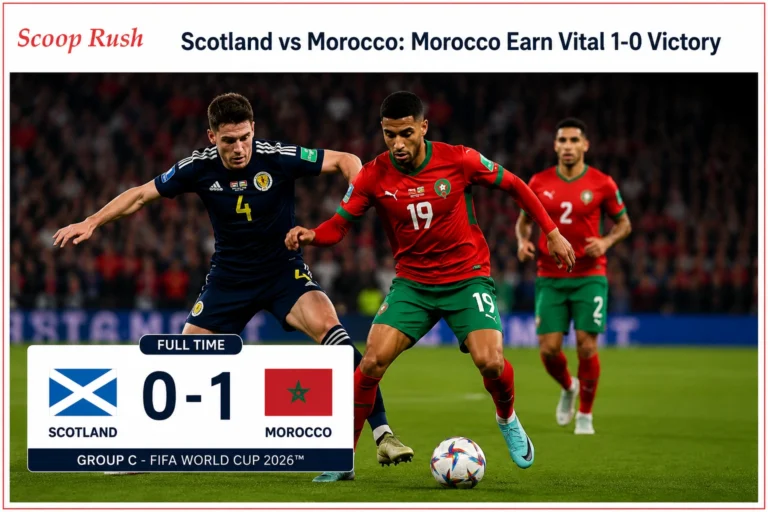
Scotland vs Morocco: Morocco Claim Crucial 1-0 Win in FIFA World Cup 2026

0

Competition: FIFA World Cup 2026 – Group C
Full Time: Scotland 0-1 Morocco
Date: 20 June 2026
Venue: Lumen Field

Scotland vs Morocco produced a hard-fought battle in FIFA World Cup 2026 Group C, with Morocco securing a valuable 1-0 victory. Although Scotland controlled possession for long periods, Morocco proved more clinical in attack and defended resolutely to earn all three points. As a result, the win boosted Morocco’s hopes of reaching the knockout stage.

Scotland vs Morocco: Match Summary

The Scotland vs Morocco clash was closely contested from the opening whistle. Scotland attempted to dictate the tempo and enjoyed more of the ball, while Morocco remained compact defensively and looked dangerous on the counterattack.

Morocco’s decisive goal ultimately separated the two sides. After taking the lead, the North Africans stayed organized and limited Scotland’s attacking opportunities. Despite their efforts, Scotland could not find a breakthrough and finished the match without a shot on target.

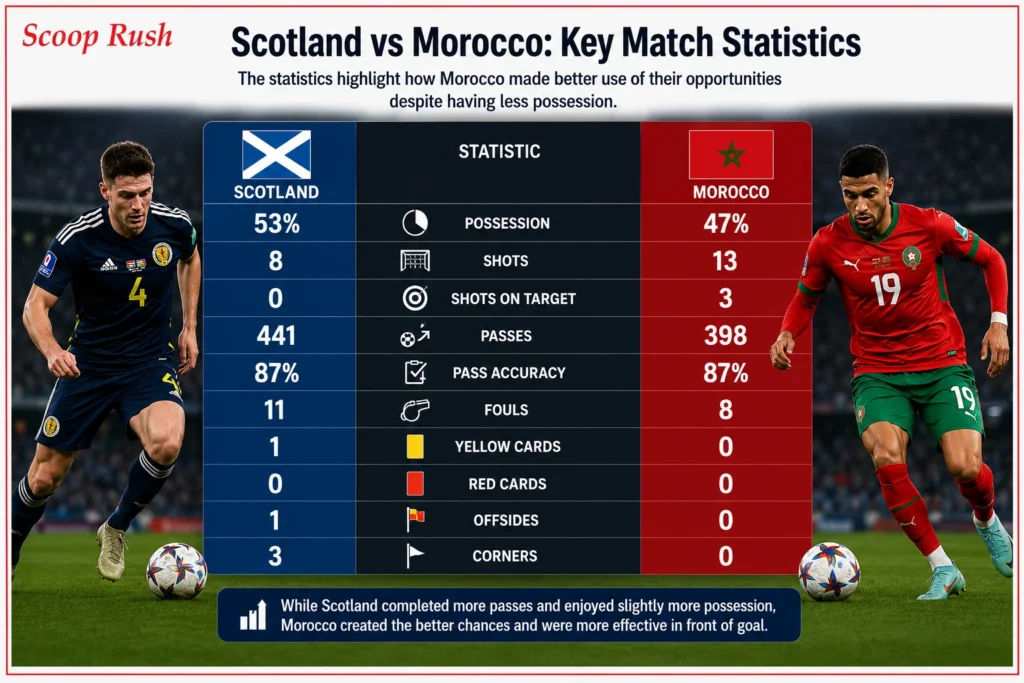
Scotland vs Morocco: Key Match Statistics

The statistics highlight how Morocco made better use of their opportunities despite having less possession.

StatisticScotlandMorocco
Possession53%47%
Shots813
Shots on Target03
Passes441398
Pass Accuracy87%87%
Fouls118
Yellow Cards10
Red Cards00
Offsides10
Corners30

While Scotland completed more passes and enjoyed slightly more possession, Morocco created the better chances and were more effective in front of goal.

Scotland vs Morocco: Starting Lineups

Scotland (3-5-2)

  • A. Gunn
  • J. Hendry
  • G. Hanley
  • K. Tierney
  • N. Patterson
  • K. McLean
  • L. Ferguson
  • J. McGinn
  • A. Robertson
  • A. Middleton
  • C. Adams

Morocco (4-2-3-1)

  • Y. Bounou
  • N. Mazraoui
  • C. Chadi
  • N. Aguerd
  • A. Hakimi
  • A. Ounahi
  • S. Amrabat
  • B. El Khannouss
  • A. Ezzalzouli
  • B. Ben Seghir
  • Y. En-Nesyri

Scotland vs Morocco: Player Performances

Morocco’s defensive unit delivered a disciplined performance throughout the match. Goalkeeper Yassine Bounou remained composed whenever Scotland entered dangerous areas and helped preserve the clean sheet.

In midfield, Sofyan Amrabat and Azzedine Ounahi controlled key phases of play. Meanwhile, Achraf Hakimi provided energy and attacking support from the right flank.

For Scotland, Andrew Robertson and John McGinn worked tirelessly. However, the team struggled to turn possession into clear scoring chances and failed to test the Moroccan goalkeeper.

Scotland vs Morocco: Group C Standings After Matchday 2

Following the result, Group C remained tightly contested heading into the final round of matches.

PositionTeamPoints
1Brazil6
2Morocco3
3Scotland3
4Haiti0

Brazil led the group with six points from two matches. Meanwhile, Morocco and Scotland were level on three points, setting up a dramatic final matchday.

Scotland vs Morocco: What the Result Means

The victory was a major boost for Morocco. By earning three points, they moved level with Scotland and kept qualification for the Round of 32 firmly within reach.

On the other hand, Scotland faced a challenging final group match. Despite controlling possession against Morocco, they lacked cutting edge in the attacking third. Consequently, their qualification hopes depended on producing a strong performance in their final fixture.

Scotland vs Morocco: Tactical Analysis

Scotland focused on building attacks through possession and patient passing. However, Morocco’s defensive structure limited the space available in dangerous areas.

In contrast, Morocco adopted a more direct approach. They created more shots, generated the game’s best chances, and capitalized on a key opportunity. Their defensive discipline ensured that Scotland never found a route back into the contest.

Final Thoughts

Scotland vs Morocco was a tactical and competitive FIFA World Cup 2026 encounter. Scotland controlled possession and completed more passes, but Morocco showed greater efficiency where it mattered most.

Ultimately, Morocco’s organized defending and clinical finishing secured a valuable 1-0 victory. The result kept their World Cup campaign on track and ensured that qualification from Group C would be decided on the final matchday.

Scotland-vs-Morocco-Key-Match-Statistics

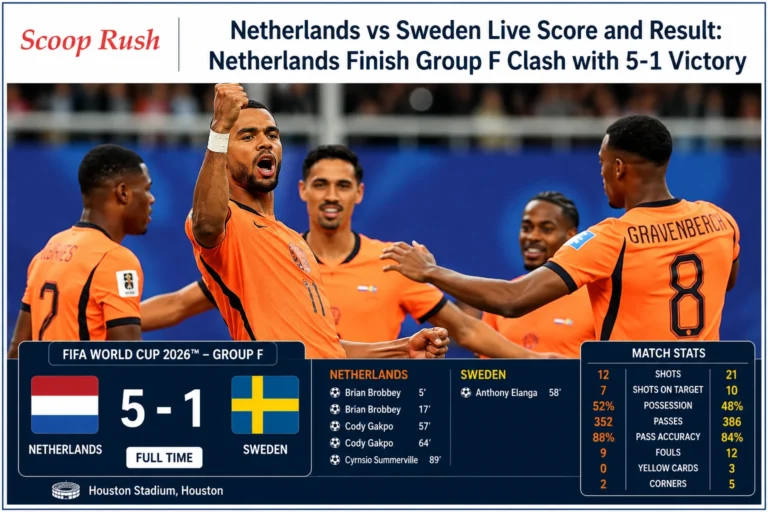
Netherlands vs Sweden Live Score and Result: Netherlands Finish Group F Clash with 5-1 Victory

0

FIFA World Cup 2026  Group F
Date: Saturday, 20 June
Venue: Houston Stadium, Houston
Final Score: Netherlands 5-1 Sweden

The Netherlands vs Sweden result delivered one of the most emphatic performances of the FIFA World Cup 2026 Group F stage as the Netherlands secured a commanding 5-1 victory over Sweden on Saturday, 20 June.

In a match packed with goals, attacking football, and clinical finishing, the Dutch side overwhelmed Sweden despite facing a determined opponent that managed to create numerous chances of its own. The victory strengthens the Netherlands’ position in Group F and highlights their impressive form in the tournament.

For football fans following the World Cup, this match showcased the Netherlands at their attacking best. From the opening minutes to the final whistle, the Dutch side maintained control of key moments and converted their opportunities with remarkable efficiency.

Why This Match Matters

World Cup group-stage matches can often define the course of a team’s tournament journey. A convincing victory not only boosts points and goal difference but also builds confidence heading into the knockout rounds.

The Netherlands achieved exactly that against Sweden. By scoring five goals and collecting three crucial points, they strengthened their standing in Group F while sending a message to potential future opponents  teams like England, Spain, and Belgium who are also making their mark in the tournament.

Sweden, meanwhile, showed attacking intent and produced several dangerous moments, but defensive lapses proved costly against a ruthless Dutch attack.

Match Summary

Goalscorers

Netherlands

  • Brian Brobbey  5′
  • Brian Brobbey  17′
  • Cody Gakpo  57′
  • Cody Gakpo 64′
  • Cyrnsio Summerville  89′

Sweden

  • Anthony Elanga  58′

The scoreline reflects the Netherlands’ clinical finishing and ability to capitalize on key moments throughout the contest.

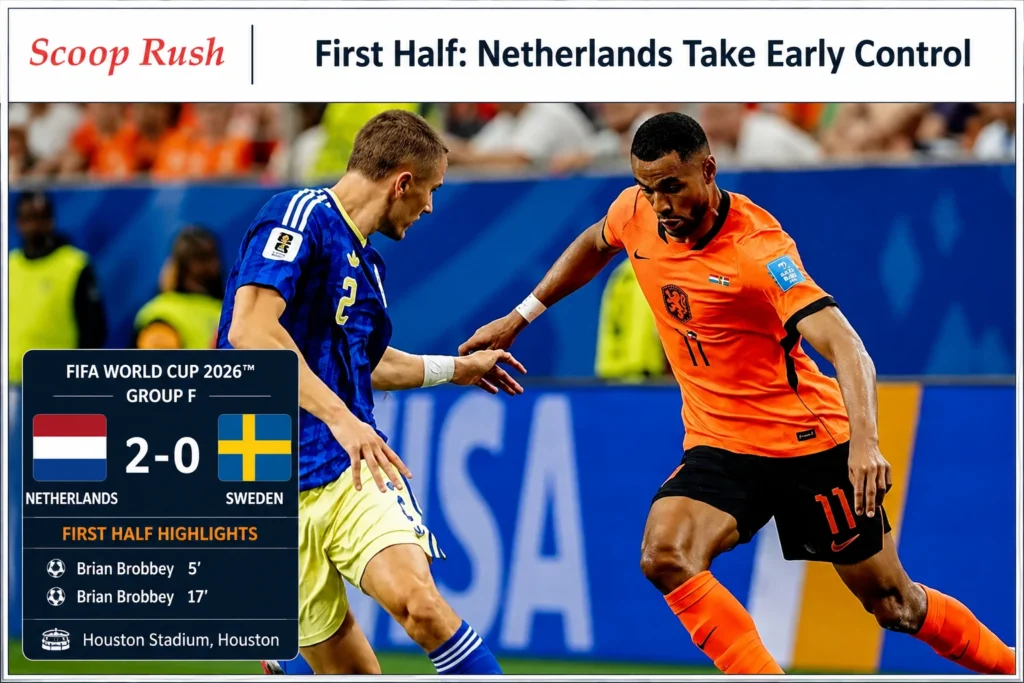
First Half: Netherlands Take Early Control

First Half: Netherlands Take Early Control

The Netherlands could hardly have asked for a better start.

Just five minutes into the match, Brian Brobbey found the breakthrough goal to give his side an early advantage. The goal immediately put Sweden under pressure and allowed the Dutch team to dictate the tempo.

Rather than sitting back, the Netherlands continued pushing forward. Their aggressive attacking approach paid off again in the 17th minute when Brobbey struck for a second time, doubling the lead and putting Sweden in a difficult position before the halfway mark.

Despite trailing, Sweden continued to search for openings and generated opportunities of their own. The match statistics later showed that Sweden actually recorded more total shots and more shots on target than the Netherlands.

However, the difference in the first half was efficiency. The Dutch side converted their opportunities, while Sweden struggled to find a way past the Netherlands’ defense and goalkeeper.

At halftime, the Netherlands held a comfortable 2-0 lead and looked firmly in control.

Second Half: Goals Continue to Flow

The second half produced even more excitement.

The Netherlands extended their lead in the 57th minute when Cody Gakpo got on the scoresheet. His goal appeared to put the match beyond Sweden’s reach and gave the Dutch a commanding 3-0 advantage.

Sweden responded almost immediately. Just one minute later, Anthony Elanga pulled a goal back in the 58th minute. The quick reply offered Sweden a glimmer of hope and briefly injected new energy into the contest.

However, any thoughts of a comeback were quickly extinguished. Cody Gakpo struck again in the 64th minute, restoring the Netherlands’ three-goal cushion and reaffirming their dominance. The Dutch attack continued to create problems for Sweden’s defense as the match progressed.

Late in the game, Cyrnsio Summerville added the fifth goal in the 89th minute to complete a memorable performance and put the finishing touch on a comprehensive victory.

When the final whistle arrived, the scoreboard read 5-1 in favor of the Netherlands.

Netherlands’ Clinical Finishing Made the Difference

One of the most striking aspects of the match was the contrast between the teams’ efficiency in front of goal.

Team Statistics

StatisticNetherlandsSweden
Shots1221
Shots on Target710
Possession52%48%
Passes352386
Pass Accuracy88%84%
Fouls912
Yellow Cards03
Red Cards00
Offsides33
Corners25

Looking at the numbers, Sweden actually attempted more shots and registered more efforts on target than the Netherlands.

However, the Dutch side demonstrated outstanding finishing quality. They converted five goals from seven shots on target, while Sweden managed only one goal despite producing ten shots on target.

That level of efficiency often determines the outcome of major tournament matches. It is a quality seen in other strong performers at this World Cup, including Brazil and Argentina, who have also impressed with their clinical displays.

Netherlands vs Sweden Result Highlights Dutch Efficiency

The Netherlands vs Sweden result illustrates a fundamental truth in football: creating chances is important, but converting them is what wins matches.

Sweden’s attacking numbers suggest they were involved in the game and consistently threatened the Dutch defense. Recording 21 shots and 10 shots on target is normally enough to produce a competitive scoreline.

The Netherlands, however, maximized their opportunities. With only 12 total shots and 7 on target, they still managed to score five times. Such clinical finishing can be devastating for opponents and is a sign of a team capable of competing deep into a World Cup tournament just as Portugal and Switzerland have also shown in their respective group matches.

Brian Brobbey Sets the Tone

Brian Brobbey played a crucial role in the victory.

His two early goals transformed the match and placed Sweden on the back foot from the start. By scoring in the 5th and 17th minutes, he gave the Netherlands breathing room and forced Sweden to chase the game.

Early goals can dramatically alter tactical approaches, and Brobbey’s contributions allowed the Netherlands to play with confidence and control.

His performance will undoubtedly be remembered as one of the key factors behind the Dutch victory.

Cody Gakpo Delivers in the Second Half

If Brobbey laid the foundation, Cody Gakpo ensured the result was secured.

His goals in the 57th and 64th minutes came during a crucial period of the match. Sweden had begun pushing forward in search of a comeback, and Anthony Elanga’s goal briefly gave them momentum.

Gakpo’s response effectively ended any realistic hopes of a Swedish recovery. By scoring twice within seven minutes, he restored Dutch control and shifted the momentum back in favor of his team.

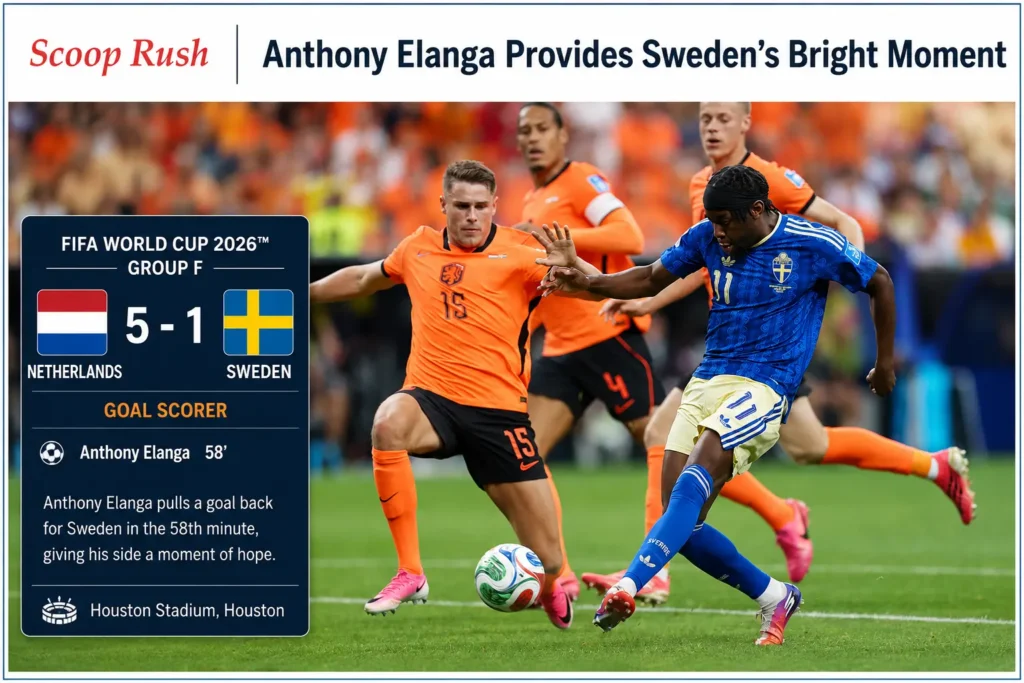
Anthony Elanga Provides Sweden’s Bright Moment

Anthony Elanga Provides Sweden's Bright Moment

Although the result was disappointing for Sweden, Anthony Elanga’s goal stood out as a positive moment.

His strike in the 58th minute rewarded Sweden’s attacking efforts and demonstrated their willingness to continue fighting despite trailing.

The goal briefly energized Sweden and offered supporters something to celebrate during an otherwise difficult evening.

Tactical Overview

From a tactical perspective, the match featured two teams willing to attack.

Sweden’s 21 shots and 10 efforts on target indicate they were not passive participants. They consistently pushed forward and tested the Dutch defense throughout the game.

The Netherlands, however, displayed superior efficiency in the final third. Their passing accuracy of 88% helped maintain control in important phases, while their finishing quality turned a relatively balanced statistical contest into a one-sided scoreline.

Discipline also favored the Dutch side. The Netherlands completed the match without receiving a yellow card, while Sweden collected three cautions. This kind of composure is something other disciplined sides such as Mexico, Ghana, and Austria have also demonstrated in the group stage.

Group F Implications

The victory has significant implications for Group F.

According to the standings shown after the match:

  1. Netherlands 7 points
  2. Japan  4 points
  3. Sweden 3 points
  4. Tunisia 0 points

The Netherlands strengthened their position at the top of the group and improved their goal difference with a five-goal performance.

For Sweden, the defeat represents a setback, but their position in the group means there is still work to be done in the remaining fixtures. Elsewhere in the tournament, teams like Saudi Arabia and Uruguay, Norway, Scotland, Australia, and Paraguay are also battling for crucial points in their respective groups.

Every point matters during the World Cup group stage, making the outcome of this match particularly important.

Key Takeaways From the Match

  1. Netherlands Were Ruthlessly Efficient The Dutch converted their chances at an exceptional rate and made every major opportunity count.
  2. Brian Brobbey Made an Immediate Impact His two early goals established control and set the tone for the rest of the match.
  3. Cody Gakpo Finished the Job Two second-half goals ensured Sweden never mounted a serious comeback.
  4. Sweden Created Chances  Despite the heavy defeat, Sweden generated more shots and more shots on target than the Netherlands.
  5. Group F Race Remains Important The result strengthens the Netherlands’ position while increasing pressure on Sweden in upcoming matches.

Conclusion

The Netherlands vs Sweden result will be remembered as one of the most convincing performances in FIFA World Cup 2026 Group F action. The Netherlands produced a clinical attacking display, defeating Sweden 5-1 at Houston Stadium and reinforcing their status as one of the standout teams in the group.

Brian Brobbey’s early double provided the perfect start, Cody Gakpo added two more after halftime, and Cyrnsio Summerville completed the scoring late in the match. Sweden showed determination and created numerous opportunities, but Anthony Elanga’s goal proved to be their only reward.

While the statistics suggest a more competitive contest than the scoreline indicates, the difference ultimately came down to finishing quality. The Netherlands seized their chances and delivered a performance that could prove crucial as the World Cup group stage continues.

El Niño Could Make 2027 Even Hotter as Weather Extremes Threaten the US

0

Scientists have warned that a powerful climate pattern returning to the Pacific Ocean could make 2027 even hotter while increasing the risk of extreme weather across the United States. El Niño has officially developed, and experts say this natural weather event could push global temperatures higher while creating more chances of heatwaves, storms, droughts, and flooding.

The National Oceanic and Atmospheric Administration (NOAA) has confirmed that El Niño conditions are now developing in the tropical Pacific Ocean. Forecasts suggest the event could become a very strong El Niño, which may rank among the strongest recorded events. As the planet is already experiencing rising temperatures, experts warn that the warming effect from El Niño could make future weather conditions more extreme.

Meteorologists believe 2027 could become hotter than 2026 because the strongest warming effects of El Niño often appear after the year when the climate pattern begins. For the United States, this could mean changing weather patterns, including heavy rainfall, flooding risks, drought conditions, and increased wildfire concerns.


What Is El Niño and Why Does It Matter?

What Is El Niño and Why Does It Matter?

El Niño is a natural climate pattern that occurs when ocean temperatures in the tropical Pacific become warmer than normal.

Normally, trade winds blow from east to west across the Pacific Ocean. These winds push warm surface water toward areas near Australia and New Zealand. At the same time, colder water rises from deeper parts of the ocean near the eastern Pacific.

However, during an El Niño event, these trade winds weaken or change direction. As a result, warm water spreads across the Pacific, changing rainfall and temperature patterns around the world.

Because the Pacific Ocean is connected to global weather systems, these changes can influence climates thousands of miles away.

El Niño Could Make 2027 Even Hotter

Scientists say the biggest concern is that El Niño is happening on top of an already warming planet.

A strong El Niño can increase global air temperatures by releasing ocean heat into the atmosphere. Therefore, the warming effect from El Niño can add extra heat to the temperatures already rising because of climate change.

Meteorologists suggest that 2027 may experience stronger warming because global temperatures usually respond most strongly after El Niño develops.

According to experts, the combination of a strong El Niño and long-term warming could create another year of unusually high temperatures.

Why Experts Are Watching 2027 Closely

Weather experts say the strongest effects of El Niño often appear months after the event begins.

Chad Merrill, a senior meteorologist at AccuWeather, explained that global temperatures usually become warmer following the year when El Niño develops.

This means that although 2026 is already expected to be extremely hot, 2027 could potentially become even warmer.

Scientists are especially concerned because higher temperatures can increase pressure on communities, agriculture, water supplies, and ecosystems.

How El Niño Could Affect the United States

How El Niño Could Affect the United States

The United States is expected to feel some of the impacts because of its large Pacific coastline.

According to meteorologists, El Niño could bring different effects to different regions.

More Storms and Flooding Risks

The warmer Pacific waters could increase the possibility of tropical systems developing near the eastern Pacific.

For areas such as Southern California and the southwestern United States, this could bring heavier rainfall and increase flooding risks.

However, while rain may temporarily reduce drought conditions, sudden heavy rainfall can also create problems such as flash floods and mudslides.

Drought and Wildfire Concerns

Meanwhile, other areas may face the opposite problem.

Parts of the western and northern United States could experience drought conditions, increasing concerns about wildfires.

Dry conditions combined with thunderstorms can create dangerous situations because lightning may start fires without producing enough rainfall to reduce the risk.

Challenges for Farmers and Gardeners

El Niño can also affect agriculture.

Farmers depend on predictable weather patterns, but changing rainfall and temperature conditions can make growing seasons more difficult.

Experts warn that unexpected cold periods in spring could damage crops planted early, while drought conditions could reduce water availability.

Weather Whiplash Could Become More Common

Meteorologists describe the changing conditions linked to El Niño as “weather whiplash.”

This means regions may experience rapid shifts between extreme conditions, such as heavy rainfall followed by dry periods.

For example, one area may deal with flooding while another region struggles with drought at the same time.

Therefore, communities may need to prepare for unpredictable weather patterns as El Niño continues.

Could La Niña Follow El Niño?

Scientists also warn that El Niño may eventually be followed by La Niña.

La Niña is considered the opposite phase of El Niño because it usually involves cooler Pacific Ocean temperatures.

However, La Niña can also create extreme weather conditions, including droughts, flooding, and unusual rainfall patterns.

Experts say strong El Niño events are sometimes followed by a return to neutral conditions or a shift toward La Niña.

This means the global weather system may continue experiencing unusual patterns even after El Niño weakens.

Scientists Predict Stronger Climate Extremes

Researchers are studying whether climate change could influence the strength of future El Niño and La Niña events.

Some studies suggest that these climate patterns may become stronger in the future, creating bigger impacts in regions far away from the Pacific.

Scientists have warned that stronger climate swings could increase risks such as flooding, drought, and agricultural disruption.

However, researchers continue studying the exact relationship between climate change and these natural weather cycles.

How El Niño Impacts the Rest of the World

How El Niño Impacts the Rest of the World

El Niño does not only affect the United States.

Different regions experience different consequences.

Some areas may receive increased rainfall and flooding, while others may face drought conditions.

For example, parts of East Africa, South America, Australia, and Indonesia can experience major weather changes during El Niño events.

These disruptions can affect food production, water supplies, and local economies.

What People Should Know About the Future

The arrival of El Niño does not mean every location will experience the same weather conditions.

Experts explain that each El Niño event has its own characteristics. However, stronger events generally increase the possibility of extreme outcomes.

Communities can monitor forecasts, prepare for changing conditions, and stay aware of local weather risks.

Conclusion

El Niño has officially returned, and scientists are closely watching its possible effects on global temperatures and weather patterns.

Experts believe the strongest warming impacts may appear in 2027, potentially making it hotter than 2026. In the United States, the event could bring a mix of storms, flooding risks, drought conditions, and wildfire concerns.

Although El Niño is a natural climate pattern, its effects are becoming more important in a world already experiencing rising temperatures.

Understanding El Niño and preparing for extreme weather will remain essential as scientists continue monitoring the planet’s changing climate.

FAQs

1. What is El Niño?

El Niño is a natural climate pattern where ocean temperatures in the tropical Pacific become warmer than normal, affecting weather patterns around the world.

2. Why could El Niño make 2027 hotter?

El Niño often increases global temperatures after it develops because heat stored in the ocean moves into the atmosphere.

3. How will El Niño affect the US?

The US could experience more extreme weather, including flooding, droughts, storms, and wildfire risks depending on the region.

4. Is El Niño caused by climate change?

El Niño is a natural climate event. However, scientists say a warmer planet can increase the impact of El Niño-related temperature changes.

5. Can La Niña happen after El Niño?

Yes. Strong El Niño events are sometimes followed by La Niña, which can also create unusual weather patterns.

No Sugar Diet May Harm Your Health: Study Reveals Hidden Risks of Cutting Sugar Completely

0

A “no sugar diet” sounds like the ultimate healthy choice, but a new study suggests that completely removing sugar may create unexpected problems inside the body. Researchers found that eliminating sucrose from a low-fat diet affected gut health, metabolism, and glucose control in mice.

For years, people have been told that reducing sugar is one of the best ways to improve health. However, new research presented at ENDO 2026 suggests that going completely sugar-free may not always bring the benefits people expect.

The study, carried out by researchers from the Dasman Diabetes Institute in Kuwait, explored how removing sucrose from a low-fat diet affected mice over 16 weeks. The findings showed that the animals developed several health changes that were not seen in the control group.

While the research does not prove the same effects happen in humans, it raises important questions about extreme diet restrictions and the role sugar plays in supporting the body’s internal systems.

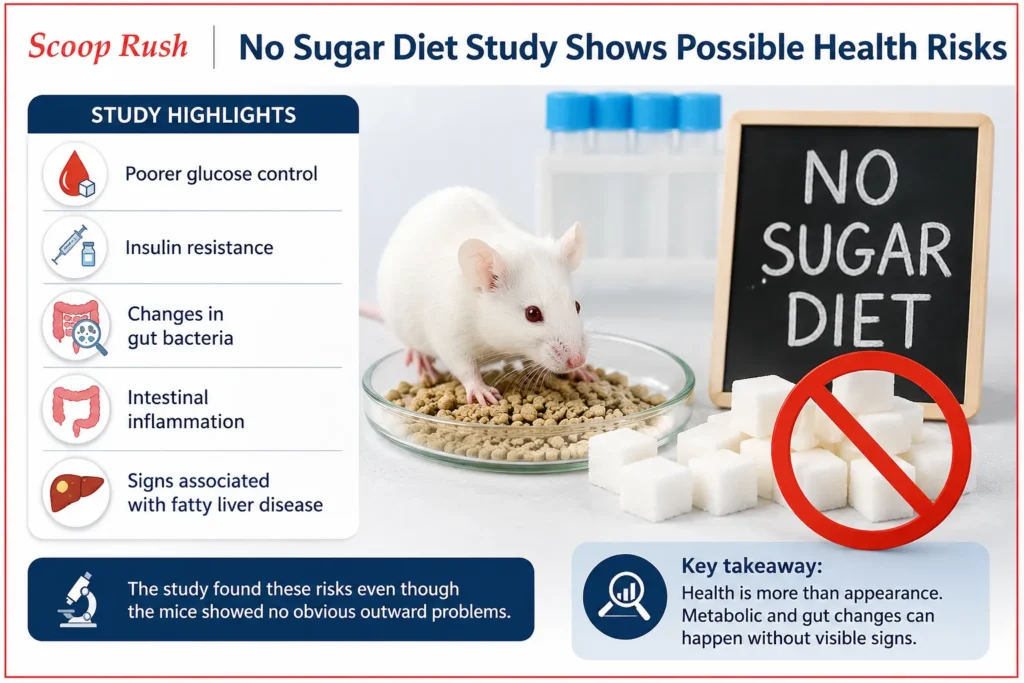
No Sugar Diet Study Shows Possible Health Risks

No Sugar Diet Study Shows Possible Health Risks

The new research focused on what happens when sugar is removed completely from a diet. Scientists tested mice by feeding them a low-fat diet without sucrose, which is a common form of sugar.

After 16 weeks, researchers noticed several changes linked to metabolic health. The mice developed problems that included:

  • Poorer glucose control
  • Insulin resistance
  • Changes in gut bacteria
  • Intestinal inflammation
  • Signs associated with fatty liver disease

The findings surprised researchers because the mice did not show obvious outward problems at first. However, deeper testing revealed that important internal processes had changed.

According to researchers, the results highlight that health is not only about appearance or body weight. A person may look healthy while experiencing problems with metabolism or gut function.

How No Sugar Diet May Affect Gut Health

The human digestive system contains trillions of microorganisms known as the gut microbiome. These bacteria help support digestion, immunity, and overall health.

Researchers explained that certain helpful bacteria rely on carbohydrates and simple sugars as fuel. When these sources disappear completely, the balance of gut bacteria may change.

Gut Bacteria Need a Balanced Food Supply

A completely sugar-free diet can reduce the nutrients available for some beneficial microbes. As a result, the balance between helpful and harmful bacteria may become disrupted.

The study suggested that this change could contribute to gut inflammation and metabolic problems.

However, researchers emphasized that the study involved mice, not humans. More research is needed before scientists can confirm whether the same effects happen in people following a strict no sugar diet.

The Difference Between Reducing Sugar and Removing It

The research does not suggest that people should eat large amounts of processed sugar. Excessive sugar intake has long been connected with health concerns, including obesity and type 2 diabetes.

Instead, the study highlights the difference between reducing added sugar and eliminating all forms of sugar.

Many processed foods contain high amounts of added sugar. Reducing these foods can still be an important part of a balanced diet.

However, removing every source of sugar may not provide the same benefits for everyone.

A balanced approach may be more helpful than extreme restrictions. Natural sources of carbohydrates, including fruits and vegetables, provide nutrients and fiber that support the body.

What Happens When You Stop Eating Sugar?

What Happens When You Stop Eating Sugar?

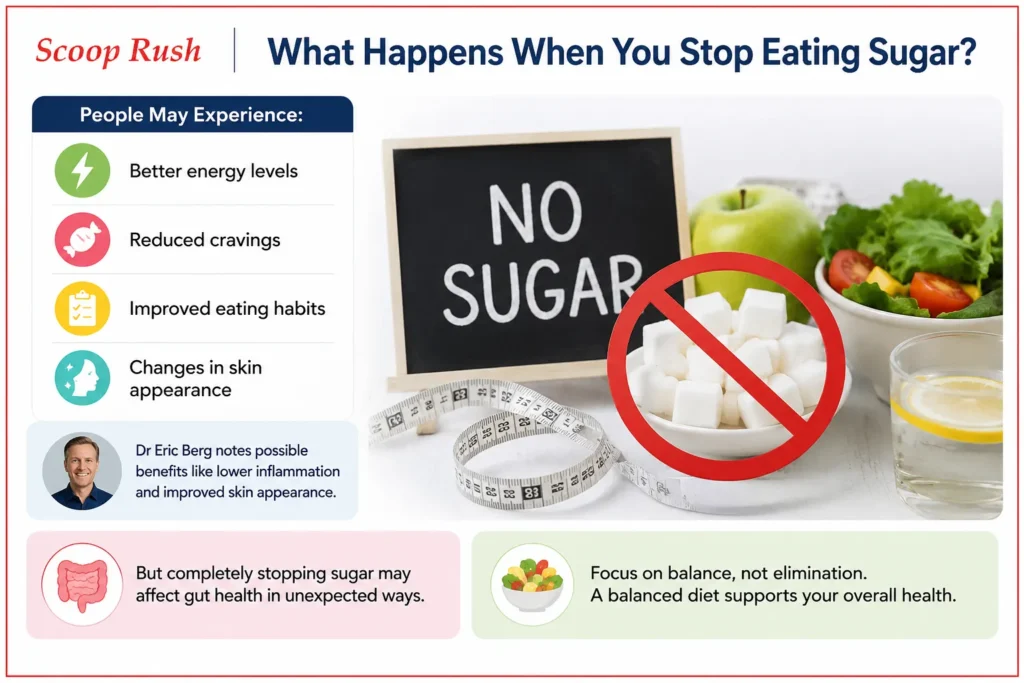
Many people report feeling better after reducing sweets and sugary foods. Some experience improvements such as:

  • Better energy levels
  • Reduced cravings
  • Improved eating habits
  • Changes in skin appearance

Dr Eric Berg discussed some possible benefits of reducing sugar, including lower inflammation and improved skin appearance.

However, researchers explained that completely stopping sugar may affect gut health in unexpected ways.

The goal should not be removing one food group entirely. Instead, the focus should be creating a balanced diet that supports the entire body.

Researchers Explain Why Extreme Diets Can Be Problematic

Rasheed Ahmad, head of the Immunology & Microbiology Department at the Dasman Diabetes Institute, explained that the research shows the importance of maintaining a healthy gut microbiome.

According to Ahmad, completely removing sucrose from a low-fat diet may disrupt gut health and contribute to inflammation and metabolic changes.

The research suggests that future dietary advice may focus more on supporting healthy gut bacteria rather than only restricting sugar.

How to Support Your Gut Health Naturally

How to Support Your Gut Health Naturally

If someone has followed a very strict low-sugar diet, researchers suggest focusing on rebuilding a healthy gut environment.

Eat a Variety of Whole Foods

A diverse diet provides different nutrients for gut bacteria. Foods such as fruits, vegetables, and grains contain natural sugars and fiber that support digestion.

Additionally, eating a wide range of foods helps maintain a healthier balance inside the gut.

Include Fermented Foods

Fermented foods may help introduce beneficial bacteria into the digestive system.

Examples include:

  • Live yogurt
  • Kefir
  • Sauerkraut

These foods can support the diversity of gut bacteria when included as part of a balanced diet.

Why This Study Matters for People Following Diet Trends

Why This Study Matters for People Following Diet Trends

The popularity of “clean eating” has encouraged many people to remove certain foods completely. Sugar is one of the most common targets because high sugar consumption is linked with several health concerns.

However, this research suggests that extreme elimination may not always be the best approach.

The body depends on a complex relationship between nutrients, hormones, metabolism, and gut bacteria.

Therefore, a healthy diet may be less about removing everything considered unhealthy and more about creating balance.

Conclusion: Balance May Be Better Than a No Sugar Diet

The latest research challenges the idea that completely removing sugar is always the healthiest choice.

The study found that a no sugar diet may affect gut bacteria, glucose control, and metabolic health in mice. However, researchers also warned that the findings do not directly prove the same effects in humans.

Ultimately, reducing processed sugar can still be beneficial. However, completely eliminating all sugar sources may not be necessary for good health.

A balanced diet with a variety of nutrients may provide better long-term support for the body.

FAQs

1. Is a no sugar diet bad for your health?

A completely no sugar diet may have unexpected effects, according to a mouse study. Researchers found changes in gut health and metabolism, but more human research is needed.

2. Does cutting sugar completely improve health?

Reducing added sugar can support healthier eating habits. However, removing all sugar sources may not always provide additional benefits.

3. Why does the body need some sugar?

Certain gut bacteria use simple carbohydrates as fuel. These bacteria help support gut health and normal body functions.

4. What foods support gut health?

Foods such as fruits, vegetables, grains, and fermented foods like live yogurt and kefir can help support a healthy gut environment.

5. Did the study prove that sugar is healthy?

No. The study does not suggest eating more processed sugar. It suggests that completely removing sugar may affect certain body processes.

Mom Turns Etsy Side Hustle Into $10,000-a-Month Passive Income Business

0

A 36-year-old mother has shared how she transformed an Etsy side hustle into a thriving business that now earns more than $10,000 per month in passive income.

Rachel Jimenez, an entrepreneur, professor, and mother of two, started selling digital products on Etsy while balancing family life, a full-time career, and graduate studies. What began as a small project during maternity leave eventually grew into a reliable source of income and greater financial freedom.

Her success story highlights the power of consistency, smart decision-making, and focusing on customer demand.

How Rachel Jimenez Started Her Etsy Side Hustle

Jimenez launched her Etsy store in 2020 during maternity leave after the birth of her second child. At the time, she was navigating postpartum depression and feeling dissatisfied with her traditional 9-to-5 job.

Looking for a creative and flexible opportunity, she began creating digital products such as business templates, budgeting tools, and party games.

The early stages were challenging. Despite spending months experimenting with social media content, blogging, and different product ideas, sales remained limited. Rather than giving up, she analyzed her store’s performance to understand what customers were actually buying.

That research revealed a valuable insight. A small collection of budgeting templates was generating steady sales, even though overall revenue was modest. The discovery helped her identify a clear direction for growth.

Focusing on What Works

Focusing-on-What-Works

One of the biggest turning points in Jimenez’s journey came when she stopped spreading her efforts across too many activities.

Instead of chasing social media trends or constantly launching unrelated products, she focused on improving the items that were already attracting customers. This allowed her to spend more time on tasks that directly contributed to revenue.

By concentrating on proven opportunities, she was able to build a stronger and more sustainable Etsy side hustle.

Using Data to Find Profitable Niches

Jimenez credits much of her success to learning how to use market data effectively.

When she first started, she created products based on personal interests. While she enjoyed making budgeting planners, she soon discovered that the category was highly competitive.

To identify better opportunities, she began researching customer demand through tools such as Pinterest Trends, Google Trends, and eRank. These platforms helped her uncover niche markets with healthy search volume and lower competition.

She found that specialized products often performed better than broad categories. For example, planners designed for specific audiences or needs attracted more attention than generic digital planners.

This data-driven approach helped her steadily increase both sales and revenue.

The Power of Consistent Daily Action

The-Power-of-Consistent-Daily-Action

Another key factor behind Jimenez’s success was her commitment to taking consistent action.

She dedicated several hours each day to researching trends, creating products, improving listings, and learning from successful Etsy sellers. She also enrolled in a digital product course that strengthened her understanding of market research and product testing.

Beyond the products themselves, she learned the importance of presentation. High-quality listing images played a major role in attracting buyers and increasing clicks.

Even with the demands of raising young children, she found ways to keep moving forward. She used available moments throughout the day to learn new skills, conduct research, or work on her store.

Building a Strong Support System

Jimenez believes she could not have grown her business alone.

Her husband supported the venture by taking responsibility for household tasks such as cooking, giving her more time to focus on the store. The family also hired a housekeeper to reduce daily pressures and create more room for business growth.

She also became an active member of online communities where Etsy sellers shared advice and experiences. By asking questions and learning from others, she gained valuable insights that helped her avoid costly mistakes.

Making Short-Term Sacrifices for Long-Term Freedom

Building a successful Etsy side hustle required dedication and patience.

During maternity leave and after returning to work, Jimenez spent many nights and weekends developing products and improving her store. While the schedule was demanding, she viewed those sacrifices as an investment in a better future.

Over time, the effort paid off. The business now provides a steady stream of passive income and gives her the flexibility to spend more time with her family while continuing to do work she enjoys.

Key Takeaways From Her Success

Rachel Jimenez attributes her growth to several important principles:

  • Focus on products that already show customer demand.
  • Use data and market research to guide decisions.
  • Stay consistent, even when progress feels slow.
  • Create professional listings with strong visuals.
  • Ask for help and build a reliable support system.
  • Be willing to make short-term sacrifices for long-term rewards.

Her journey demonstrates that building a profitable Etsy side hustle does not require overnight success. With persistence, smart planning, and a clear understanding of what customers want, a small online store can grow into a meaningful source of income.

FAQs

Q1. What is Rachel Jimenez’s Etsy side hustle?

Rachel Jimenez operates an Etsy store that sells digital products, including templates, planners, and printable resources.

Q2. How much does her Etsy side hustle earn?

According to Jimenez, her Etsy business regularly generates more than $10,000 per month in passive income.

Q3. Which tools helped her research product ideas?

She used Pinterest Trends, Google Trends, and eRank to identify profitable niches with strong demand and lower competition.

Q4. What contributed most to her success?

Jimenez says focusing on customer demand, using data to make decisions, and maintaining consistent effort were the biggest drivers of growth.

Q5. Can beginners start an Etsy side hustle with digital products?

Yes. Digital products typically require low startup costs, do not involve inventory management, and can be sold repeatedly, making them an attractive option for beginners.

Gen Z Jobs With Purpose: Why Young Workers Want Meaningful Careers but Need Better Pay

0

Gen Z Jobs With Purpose: Why Meaning Matters More Than Ever

What if the generation often criticized for job hopping and high expectations is actually searching for something deeper?

A new survey suggests that most members of Gen Z want careers that help other people and create a positive impact. However, many feel forced to choose between meaningful work and financial stability. As a result, young workers are facing a difficult dilemma: pursue purpose or protect their well-being.

The findings reveal an important shift in how younger Americans view work, happiness, and success. While Gen Z is eager to contribute to society, concerns about pay, stress, mental health, and personal well-being are making that goal harder to achieve.

Understanding why Gen Z jobs with purpose matter could help employers, educators, and policymakers create better opportunities for the next generation.

Why Gen Z Wants Jobs That Help Others

Why Gen Z Wants Jobs That Help Others

According to a Gallup survey conducted in partnership with the Walton Family Foundation and Harvard University’s Making Caring Common Project, nearly 80% of Gen Z respondents expressed interest in jobs that help other people.

This finding challenges common stereotypes that younger workers are primarily motivated by money or personal advancement. Instead, the survey shows that many young adults are looking for careers that allow them to make a positive difference.

Researchers found a strong connection between helping others and feeling that life has meaning. Among respondents who believed in making a positive impact on others, 89% agreed that their lives felt meaningful.

That relationship highlights an important reality. For many Gen Z workers, career choices are not only about earning a paycheck. They are also about finding purpose and contributing to something larger than themselves.

The Link Between Purpose and Mental Health

The Link Between Purpose and Mental Health

Helping Others Can Improve Well-Being

Experts involved in the research emphasized that meaningful work can play an important role in mental health.

Many Gen Z individuals report struggling with loneliness, stress, and emotional challenges. Consequently, finding opportunities to help others may provide a stronger sense of purpose and connection.

Researchers noted that helping people often creates a feeling that life has value and direction. In turn, that sense of purpose may support overall well-being.

The survey findings suggest that meaningful work is not simply a career preference. Rather, it may be an important factor in how young adults experience happiness and fulfillment.

Why Purpose Matters for Gen Z

The research also offers insight into how purpose develops.

Experts believe that purpose is often connected to serving others, contributing to communities, and making a difference in people’s lives. Therefore, jobs that involve care, support, education, health services, or community engagement may appeal strongly to younger workers.

For Gen Z, purpose appears closely linked to mental wellness. When individuals feel that their work benefits others, they are more likely to report that their lives have meaning.

The Biggest Barriers Preventing Meaningful Careers

Despite strong interest in helping others, many Gen Z respondents identified significant obstacles.

Financial Concerns Remain the Top Challenge

One of the biggest concerns involves money.

Nearly half of respondents said worries about finances prevent them from pursuing jobs focused on helping others.

Many young adults believe care-focused professions do not provide enough financial security. This perception creates tension between their desire to make a difference and their need to earn a stable income.

For many Gen Z workers, meaningful work becomes difficult to pursue when it does not offer competitive compensation.

Mental Health Challenges Create Additional Pressure

Mental health issues also emerged as a major barrier.

Almost half of respondents acknowledged that mental health struggles make it harder to develop a meaningful life.

Young adults today face significant emotional pressures. As a result, some find it difficult to focus on long-term goals, community involvement, or purpose-driven careers.

While helping others may improve well-being, many respondents feel they must first address their own mental health challenges.

Technology and Screen Time Are Taking a Toll

Another major concern involves technology use.

More than half of Gen Z respondents identified unproductive technology use as a significant obstacle to living a meaningful life.

As digital natives, Gen Z has grown up surrounded by smartphones, social media platforms, and constant online connectivity. However, many recognize that excessive screen time can reduce focus, limit personal growth, and interfere with meaningful relationships.

The findings suggest that younger adults are becoming increasingly aware of technology’s impact on their overall quality of life.

Lack of Strong Personal Relationships

Human connection also plays a major role.

About 34% of respondents said a lack of personal relationships contributed to feelings of purposelessness.

Relationships often provide support, belonging, and opportunities to help others. Therefore, when those connections are weak or absent, individuals may struggle to find meaning in daily life.

This finding reinforces broader concerns about loneliness among younger generations.

Why Care-Focused Jobs Are Not Always Attractive

Low Pay Creates a Major Disconnect

Although many Gen Z workers want to help others, they are also practical about career choices.

The survey found that nearly half of respondents are discouraged from entering care-focused professions because they believe such jobs do not pay enough.

This concern reflects broader economic realities facing young adults.

Rising living costs, student debt concerns, housing expenses, and financial uncertainty make income a critical factor when evaluating career opportunities.

As a result, many young people feel unable to prioritize purpose if doing so threatens their financial stability.

Emotional Burnout Is Another Concern

Pay is not the only issue.

Many respondents believe helping professions can be emotionally exhausting.

Jobs centered on caring for others often involve significant emotional demands. Consequently, some young adults worry that these roles may negatively affect their mental health.

The survey found that concerns about personal well-being were nearly as influential as financial concerns when considering care-focused careers.

This highlights a challenging reality. Gen Z wants meaningful work, but not at the cost of emotional burnout.

What Gen Z Wants Most From a Career

What Gen Z Wants Most From a Career

Balance Matters More Than Ever

The survey revealed a clear picture of Gen Z career priorities.

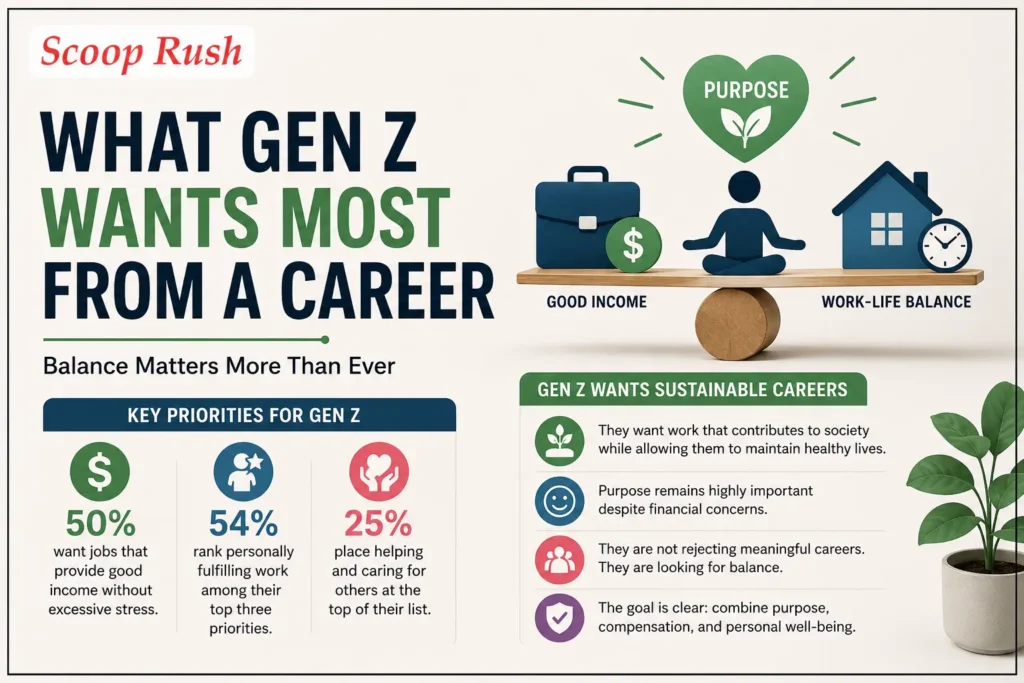
Half of respondents said they want jobs that provide good income without excessive stress.

This finding suggests that younger workers are not rejecting meaningful careers. Instead, they are looking for positions that balance purpose, compensation, and personal well-being.

In other words, Gen Z wants sustainable careers.

They want work that contributes to society while still allowing them to maintain healthy lives.

Fulfillment Remains a Top Priority

More than half of respondents ranked personally fulfilling work among their top three career priorities.

Additionally, one-quarter placed helping and caring for others at the top of their list.

These findings demonstrate that purpose remains highly important despite financial concerns.

Many Gen Z workers are not abandoning meaningful careers. Rather, they are searching for ways to combine purpose with economic security.

The Pressure to Succeed Is Increasing Stress

Achievement Pressure Is Affecting Young Adults

The survey uncovered another important trend.

More than half of Gen Z adults said pressure to achieve success causes significant stress.

This pressure was especially strong among respondents aged 19 to 21.

Many young adults feel compelled to succeed academically, professionally, and personally. Consequently, the pursuit of achievement itself can become overwhelming.

Experts noted that pressure to find meaning in life often overlaps with pressure to succeed.

Purpose Can Help Reduce Stress

Researchers suggested that achievement becomes healthier when connected to a larger purpose.

When people understand why they are working toward a goal, they may experience better mental health outcomes.

Purpose provides context and motivation. Therefore, individuals who see their work as meaningful may be better equipped to manage stress and setbacks.

This insight may help explain why Gen Z places such high value on meaningful careers.

Would Gen Z Choose Money or Meaning?

One of the most revealing findings explored a common career dilemma.

When asked whether they would choose a higher-paying job over a more meaningful one, nearly half said they would take the higher salary.

At first glance, this may appear to contradict Gen Z’s desire for purpose.

However, the survey included an important follow-up question.

If money were no longer a concern and respondents already had a comfortable income, most said they would stay in the more meaningful role.

This distinction is significant.

It suggests that financial realities, not a lack of idealism, are driving many career decisions.

Young workers still value purpose. They simply need enough financial security to pursue it.

What Employers and Educators Can Learn

A Major Opportunity Exists

Researchers described the findings as a story of opportunity.

The survey indicates that many Gen Z workers are eager to contribute to society when given the chance.

Therefore, organizations have an opportunity to attract and retain younger talent by connecting work to meaningful outcomes.

Employers who clearly demonstrate how their work benefits communities may resonate more strongly with Gen Z candidates.

Communicating Purpose Can Make a Difference

Experts suggested several practical approaches.

Recruiters could include information about community impact and outreach programs in job descriptions.

Meanwhile, schools could help students explore careers that combine purpose and professional growth.

Organizations that explain how daily tasks contribute to larger goals may help younger workers see greater meaning in their careers.

As a result, they may be more successful in attracting purpose-driven talent.

Conclusion

The latest Gallup research paints a nuanced picture of Gen Z and work.

Far from being indifferent or disengaged, many young adults want careers that help others and create positive change. They recognize the value of purpose and often connect meaningful work with stronger mental well-being.

However, financial concerns, emotional stress, mental health struggles, and the realities of modern life are creating significant barriers.

Gen Z is not rejecting meaningful work. Instead, they are asking for careers that combine purpose, fair compensation, and sustainable working conditions.

For employers, educators, and society as a whole, the message is clear. If meaningful careers can also provide financial security and support well-being, many Gen Z workers are ready to say yes.

FAQs

1. What are Gen Z jobs with purpose?

Gen Z jobs with purpose are careers that allow workers to help others, contribute to communities, or create a positive social impact while earning a living.

2. Why does Gen Z value meaningful work?

Many Gen Z workers associate meaningful work with a stronger sense of purpose, fulfillment, and improved mental well-being.

3. What prevents Gen Z from pursuing helping professions?

Financial concerns, low pay, emotional burnout, mental health challenges, and work-related stress are major barriers.

4. Does Gen Z care more about money or purpose?

The survey suggests Gen Z values both. While many would choose higher pay when necessary, most prefer meaningful work if financial needs are already met.

5. How can employers attract Gen Z workers?

Organizations can attract Gen Z by offering fair pay, supporting employee well-being, and clearly demonstrating how their work benefits society and local communities.

Türkiye vs Paraguay Result: Paraguay Beat Türkiye 1-0 in FIFA World Cup 2026 Group D Match 

0

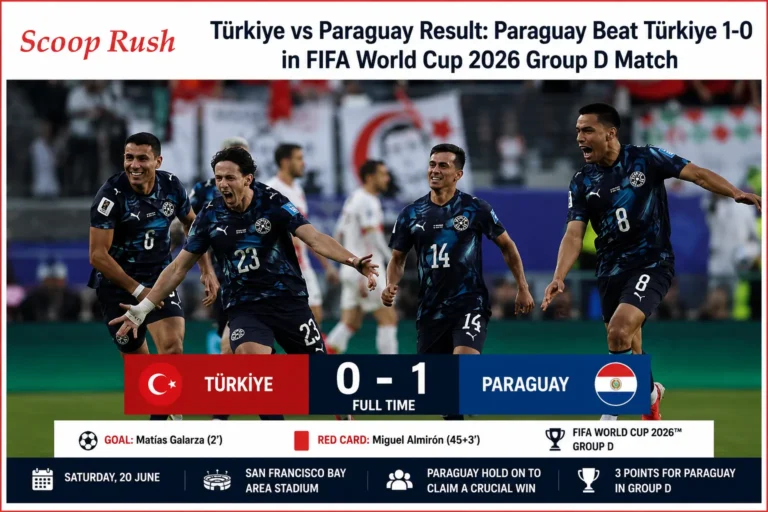
Competition: FIFA World Cup 2026 – Group D
Date: Saturday, 20 June
Result: Türkiye 0-1 Paraguay
Venue: San Francisco Bay Area Stadium, Santa Clara

What happens when a team spends most of the match defending, receives a red card, and still manages to secure all three points? That was the story of the Türkiye vs Paraguay result as Paraguay produced a disciplined and resilient performance to defeat Türkiye 1-0 in a tense FIFA World Cup 2026 Group D encounter on Saturday, 20 June.

In a match where Türkiye dominated possession, created more chances, and controlled large portions of play, Paraguay found the breakthrough early and then defended bravely to preserve their lead. Even after being reduced to ten men late in the game, the South American side held firm to record a valuable victory that strengthened their position in Group D.

For Türkiye, the defeat was a frustrating one. Despite enjoying nearly 80% possession and registering significantly more shots, they were unable to break down Paraguay’s organized defensive structure.

Match Overview

Goalscorer:

  • Matías Galarza (2′)

Red Card:

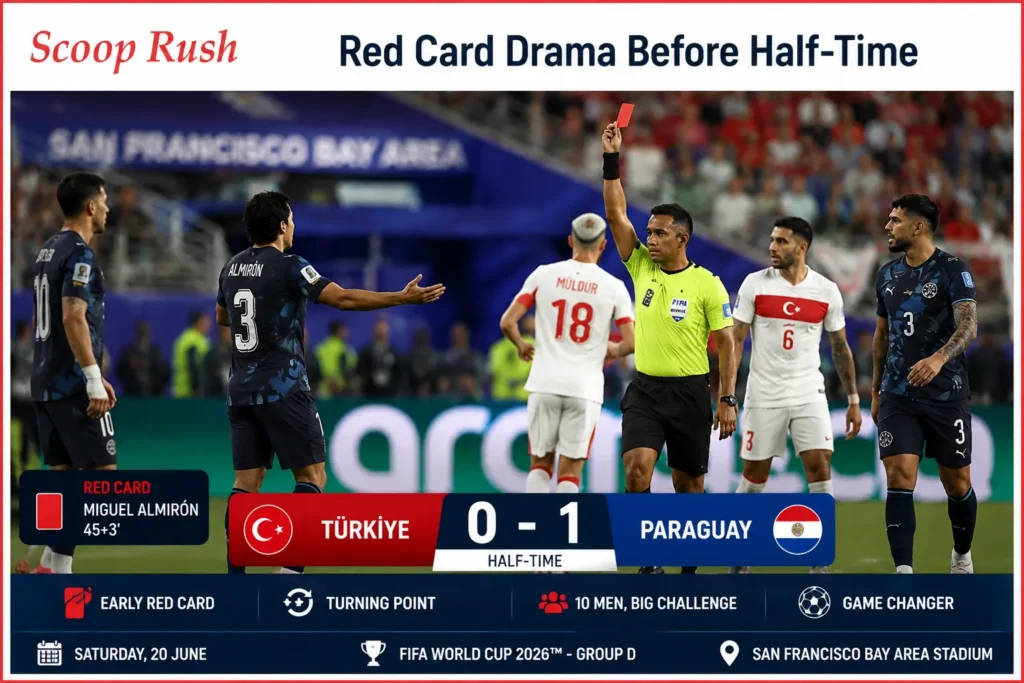
  • Miguel Almirón (45+3′)

The match was decided by an early goal from Matías Galarza, whose strike in the second minute gave Paraguay a lead they would never surrender.

Early Shock: Matías Galarza Strikes in the Second Minute

The game could hardly have started better for Paraguay.

Just two minutes after kickoff, Matías Galarza found the back of the net to put Paraguay ahead 1-0. The early breakthrough immediately changed the complexion of the contest and forced Türkiye to chase the game for almost the entire match.

Conceding so early meant Türkiye had to take control of possession and push forward in search of an equalizer. Paraguay, meanwhile, were able to settle into a defensive shape and focus on protecting their advantage.

The early goal ultimately proved to be the difference between the two sides.

Türkiye Dominate Possession But Lack the Final Touch

One of the most striking aspects of the Türkiye vs Paraguay result was the huge difference in possession.

Team Statistics

StatisticTürkiyeParaguay
Shots336
Shots on Target82
Possession78%22%
Passes638155
Pass Accuracy90%58%
Fouls1415
Yellow Cards11
Red Cards01
Offsides23
Corners120

The numbers reveal how much control Türkiye had throughout the game.

They completed 638 passes compared to Paraguay’s 155 and maintained an impressive 90% pass accuracy. Türkiye also generated 33 shots and earned 12 corners, repeatedly putting pressure on Paraguay’s defense.

However, dominance in possession does not always guarantee goals.

Despite creating numerous attacking situations, Türkiye could only manage eight shots on target and failed to find a way past Paraguay’s determined defending.

Paraguay’s Defensive Discipline Makes the Difference

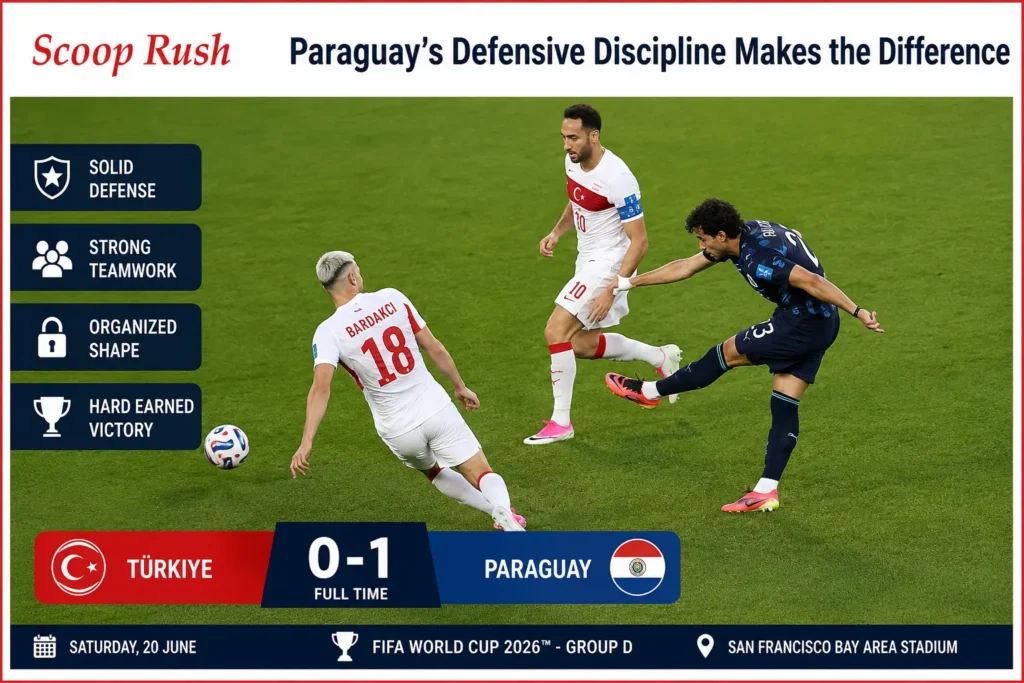
Paraguay’s Defensive Discipline Makes the Difference

If possession statistics told one story, Paraguay’s defensive resilience told another.

After taking the lead, Paraguay focused on maintaining defensive organization and limiting clear opportunities for Türkiye.

The South American side spent long periods without the ball but remained compact and disciplined. Their defenders consistently blocked shooting lanes, contested crosses, and protected the penalty area.

Even when Türkiye increased the pressure during the second half, Paraguay remained committed to their game plan.

The result highlighted the importance of defensive structure and concentration in tournament football.

Red Card Drama Before Half-Time

Red Card Drama Before Half-Time

Miguel Almirón Sent Off in Added Time

The match took a dramatic turn just before the halftime whistle.

Miguel Almirón received a red card in first-half stoppage time (45+3′), reducing Paraguay to ten men.

Losing a player so early could have dramatically altered the outcome. With an entire second half still to play, Türkiye appeared to have a significant numerical advantage and an excellent opportunity to rescue the match.

Instead, the red card seemed to strengthen Paraguay’s determination.

The team reorganized defensively and worked tirelessly to close spaces, frustrate Türkiye’s attacks, and protect their narrow lead.

Türkiye’s Attacking Pressure Continues

Türkiye vs Paraguay Result Highlights Missed Opportunities

The second half followed a familiar pattern.

Türkiye controlled possession and pushed more players forward in search of an equalizer. Their attack generated wave after wave of pressure, while Paraguay focused almost exclusively on defending.

The statistics underline the extent of Türkiye’s attacking intent:

  • 33 total shots
  • 8 shots on target
  • 12 corner kicks
  • 78% possession

These numbers would normally be enough to produce goals. However, football often rewards efficiency rather than volume, and Paraguay made the most of their limited opportunities.

Türkiye’s inability to convert chances ultimately proved costly.

Starting Lineups

Türkiye Starting XI

Türkiye lined up in a 4-2-3-1 formation:

  • U. Çakır
  • M. Müldür
  • M. Demiral
  • A. Bardakcı
  • F. Kadioglu
  • İ. Yüksek
  • A. Güler
  • K. Yıldız
  • Y. Akgün
  • H. Çalhanoğlu
  • U. Aktürkoğlu

Paraguay Starting XI

Paraguay also used a 4-2-3-1 setup:

  • G. Gatito
  • J. Alonso
  • O. Alderete
  • G. Gómez
  • J. Cáceres
  • M. Villasanti
  • M. Enciso
  • D. Gómez
  • M. Almirón
  • M. Galarza
  • J. Sanabria

Both teams entered the match with balanced tactical structures, but Paraguay’s early goal allowed them to adopt a much more defensive approach as the contest progressed.

Key Substitutions

Several substitutions were made during the match as both managers attempted to influence the outcome.

Paraguay Changes

Paraguay introduced fresh legs in the second half, including:

  • Julio Enciso replaced by Gabriel Ávalos
  • Omar Alderete replaced by Gustavo Velázquez
  • Matías Galarza replaced by Isidro Pitta

These changes helped Paraguay maintain defensive solidity and manage the closing stages.

Türkiye Changes

Türkiye also made multiple substitutions as they searched for an equalizer:

  • Deniz Gül
  • Can Uzun
  • İrfan Can Kahveci
  • Other attacking reinforcements

Despite the changes, Türkiye was unable to find a breakthrough.

End-of-Match Scenes

As the final whistle approached, Türkiye continued to attack while Paraguay defended deeper and deeper.

The pressure intensified during stoppage time, but Paraguay’s defenders held their positions and successfully cleared repeated dangers.

When the referee finally ended the contest, Paraguay celebrated an important victory earned through determination, discipline, and defensive commitment.

For Türkiye, the result was difficult to accept given their dominance in many statistical categories.

What the Result Means in Group D

The victory gives Paraguay a valuable three points in Group D and significantly boosts their hopes of progressing further in the tournament.

According to the standings shown after the match:

  1. USA – 6 points
  2. Australia – 3 points
  3. Paraguay – 3 points
  4. Türkiye – 0 points

Paraguay improved their position with a crucial win, while Türkiye remained without a point after two matches.

With group-stage qualification still at stake, every point becomes increasingly important as the tournament progresses.

Tactical Analysis: Why Paraguay Won

Several factors contributed to Paraguay’s success:

1. Early Goal Advantage

Scoring in the second minute allowed Paraguay to dictate the match narrative and play on their terms.

2. Defensive Organization

Despite facing constant pressure, Paraguay remained compact and disciplined throughout the game.

3. Efficiency in Front of Goal

Paraguay scored from one of their limited opportunities, while Türkiye failed to capitalize on a much larger number of chances.

4. Mental Strength After the Red Card

Playing with ten men for an entire half required exceptional concentration and teamwork. Paraguay successfully adapted and protected their lead.

Türkiye vs Paraguay Result: Match Summary

The Türkiye vs Paraguay result showcased one of football’s enduring truths: possession alone does not guarantee victory.

Türkiye controlled the ball, completed more passes, registered more shots, and earned more corners. Yet Paraguay’s early strike from Matías Galarza and their disciplined defensive effort proved enough to secure a hard-fought 1-0 win.

The red card shown to Miguel Almirón before halftime added further drama, but Paraguay responded with resilience and determination to hold onto their advantage.

As Group D continues to unfold, this victory could prove pivotal for Paraguay’s hopes of advancing in FIFA World Cup 2026, while Türkiye will need a strong response in their remaining fixtures to keep their campaign alive.

Brazil vs Haiti Result: Brazil Secure Dominant 3-0 Victory in FIFA World Cup 2026 Group C 

0

Competition: FIFA World Cup 2026™
Group: Group C
Date: Saturday, 20 June
Venue:Philadelphia Stadium, Philadelphia                                                                             

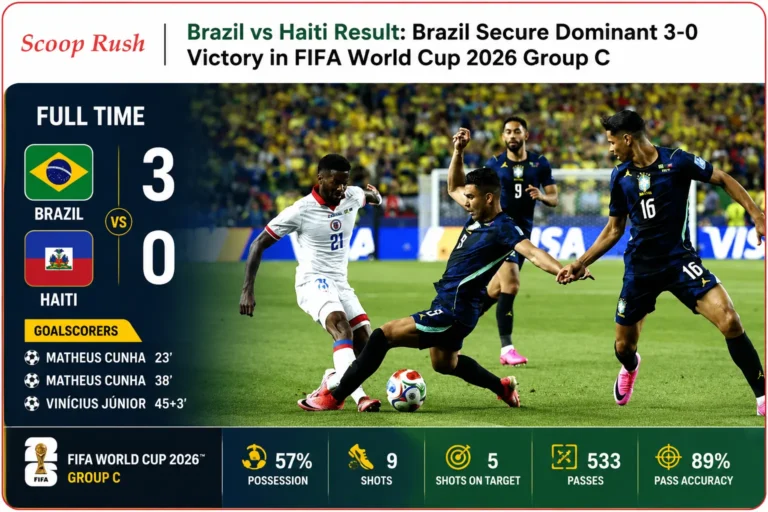
Brazil vs Haiti 3-0 was one of the standout results of FIFA World Cup 2026 Group C as the South American giants delivered a commanding performance to secure all three points. With goals from Matheus Cunha and Vinícius Júnior, Brazil controlled the match from start to finish, showcasing their attacking quality, possession dominance, and tactical discipline.

From the opening whistle at Philadelphia Stadium, Brazil looked determined to make a statement. Haiti fought hard and showed moments of resilience, but the quality gap between the two sides eventually proved decisive. Brazil’s victory not only strengthened their position in Group C but also demonstrated why they remain one of the tournament favorites.

Brazil vs Haiti 3-0: A Statement Victory in Group C

Few teams enter a World Cup carrying the expectations that Brazil does. Every match is scrutinized, every performance analyzed, and every result measured against the nation’s rich football history.

Against Haiti, Brazil delivered exactly what their supporters wanted to see: goals, control, and confidence.

The final scoreline of Brazil 3-0 Haiti reflected Brazil’s superiority across most areas of the game. They enjoyed more possession, completed significantly more passes, and created the better scoring opportunities throughout the contest.

For Haiti, the match represented another difficult challenge against one of world football’s elite nations. While they battled with determination, they struggled to contain Brazil’s movement and technical quality in key moments.

Match Overview

Goalscorers

  • Matheus Cunha – 23′
  • Matheus Cunha – 38′
  • Vinícius Júnior – 45+3′

The scoring pattern highlighted Brazil’s control of the first half. Cunha struck twice before halftime, while Vinícius Júnior added a third goal just before the break to effectively put the result beyond doubt.

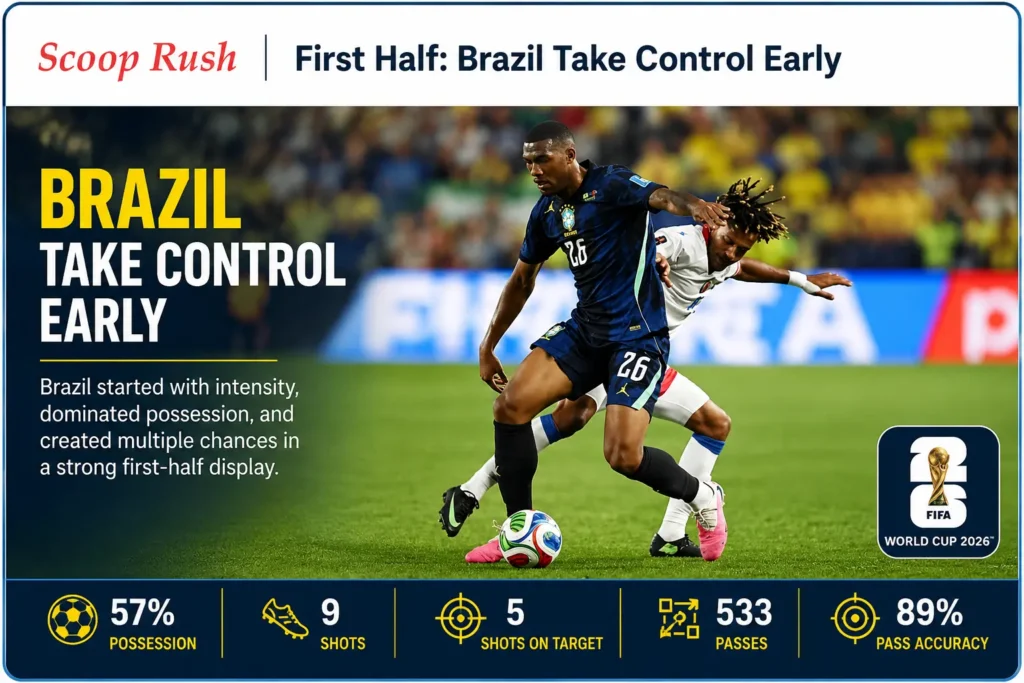
First Half: Brazil Take Control Early

First Half: Brazil Take Control Early

Brazil entered the match with confidence and immediately imposed themselves on proceedings.

Their passing was sharp, their movement fluid, and their attacking players constantly searched for spaces behind Haiti’s defensive line. The pressure eventually produced results when Matheus Cunha opened the scoring in the 23rd minute.

The goal rewarded Brazil’s positive start and allowed them to play with even greater freedom. Rather than sitting back after taking the lead, Brazil continued to push forward and create opportunities.

As Haiti attempted to reorganize defensively, Brazil maintained control of possession and continued dictating the tempo of the game.

Cunha Doubles the Advantage

The second goal arrived in the 38th minute, again through Matheus Cunha.

His second strike of the evening underlined Brazil’s attacking efficiency. While Haiti worked tirelessly to stay competitive, Brazil’s ability to convert chances made the difference.

At 2-0, the momentum was firmly with the South Americans. Haiti needed a response before halftime, but Brazil had one more decisive moment left.

Vinícius Júnior Extends the Lead

Deep into first-half stoppage time, Vinícius Júnior added Brazil’s third goal.

The strike was a significant moment because it effectively removed any remaining uncertainty from the contest. Going into halftime with a three-goal advantage allowed Brazil to approach the second half with confidence and composure.

For Haiti, conceding just before the interval was a major setback. Instead of entering the dressing room with hope of a comeback, they faced the challenge of overturning a substantial deficit against one of the strongest teams in the tournament.

Brazil vs Haiti 3-0 Match Analysis

The statistics tell a clear story about how the match unfolded.

Possession and Passing Dominance

Brazil controlled 57% possession, compared to Haiti’s 43%.

While the difference may not appear overwhelming, Brazil used the ball far more effectively. They completed 533 passes compared to Haiti’s 387, demonstrating their ability to dictate play and maintain control in midfield.

Pass accuracy also favored Brazil:

  • Brazil: 89%
  • Haiti: 84%

These numbers reflect Brazil’s composure on the ball and their success in building attacks through sustained possession.

Attacking Efficiency

Brazil registered:

  • 9 shots
  • 5 shots on target

Haiti recorded:

  • 8 shots
  • 4 shots on target

Interestingly, Haiti managed a respectable number of attempts, showing they were not completely overwhelmed. However, Brazil proved much more clinical in front of goal.

Three goals from five shots on target demonstrated the efficiency that separates elite teams from developing football nations.

Brazil converted their opportunities, while Haiti could not find a breakthrough despite creating several chances of their own.

Discipline and Physical Battle

The match featured a competitive physical contest.

Fouls committed:

  • Brazil: 13
  • Haiti: 15

Yellow cards:

  • Brazil: 1
  • Haiti: 3

Neither team received a red card, but Haiti’s three cautions highlighted the difficulties they faced while attempting to stop Brazil’s attacking movement.

 Matheus Cunha Leads the Way

 Cunha Delivers a Match-Winning Performance

Matheus Cunha emerged as the standout performer of the match.

His two goals provided the foundation for Brazil’s victory and ensured his side gained early control of the contest. Beyond his finishing, Cunha’s movement caused consistent problems for Haiti’s defense.

Great forwards often influence games by being in the right place at the right time, and Cunha demonstrated exactly that.

His first goal settled Brazil’s nerves, while the second gave the team a comfortable cushion heading into the latter stages of the first half.

The brace also highlighted Brazil’s attacking depth and the variety of threats available within their squad.

Vinícius Júnior Continues to Shine

Vinícius Júnior once again showcased why he is considered one of Brazil’s most dangerous attacking players.

His goal just before halftime represented more than a simple addition to the scoreline. It delivered a psychological advantage at a crucial moment and ensured Brazil entered the break with complete control.

Throughout the match, his pace, movement, and willingness to attack defenders created problems for Haiti.

Even when not directly involved in goals, Vinícius remained a constant threat that forced Haiti to stay alert defensively.

Tactical Breakdown

Brazil lined up in a structured system that emphasized possession and attacking width.

Their midfield controlled the rhythm of the game, allowing the forwards to receive the ball in dangerous positions.

Several tactical elements stood out:

1. Ball Retention

Brazil’s high pass accuracy allowed them to maintain control and limit Haiti’s opportunities to build momentum.

2. Quick Attacking Transitions

Whenever possession changed hands, Brazil transitioned quickly into attack, exploiting spaces before Haiti could reorganize.

3. Effective Forward Movement

The movement of Cunha and Vinícius Júnior stretched Haiti’s defensive shape and opened passing lanes throughout the match.

4. Defensive Stability

Although Haiti managed eight shots, Brazil generally looked comfortable and organized when defending.

Their structure prevented Haiti from creating enough clear-cut opportunities to threaten a comeback.

Haiti Show Determination Despite Defeat

While the scoreline favored Brazil comfortably, Haiti still produced some positive moments.

Their 43% possession and eight shots demonstrated a willingness to compete rather than simply defend deep for ninety minutes.

Haiti attempted to play forward when opportunities emerged and showed determination throughout the match.

Several players worked tirelessly to close down Brazil’s attackers and disrupt their passing sequences.

However, competing against a team of Brazil’s caliber requires near-perfect execution, and Haiti ultimately struggled to match the technical quality and efficiency of their opponents.

The defeat leaves Haiti with work to do in Group C, but their effort and commitment cannot be questioned.

Group C Standings After Brazil’s Victory

The updated Group C table shows Brazil sitting at the top after two matches.

Group C

TeamMPWDLGFGAGDPoint
Brazil211041+34
Morocco211021+14
Scotland21011103
Haiti200204-40

Brazil’s victory strengthens their position and places them in a favorable situation as the group stage progresses.

The battle for qualification remains competitive, with Morocco also sitting on four points and Scotland still within striking distance.

Key Takeaways from Brazil vs Haiti 3-0

  • Brazil secured a convincing 3-0 victory in Group C.
  • Matheus Cunha scored twice and delivered the standout performance.
  • Vinícius Júnior added a crucial third goal before halftime.
  • Brazil dominated possession with 57% of the ball.
  • The South Americans completed 533 passes with 89% accuracy.
  • Haiti fought hard and registered eight shots but failed to score.
  • Brazil moved to the top of Group C with four points.

Conclusion

The Brazil vs Haiti 3-0 result showcased the quality, efficiency, and professionalism of the Brazilian national team. A first-half brace from Matheus Cunha and a stoppage-time goal from Vinícius Júnior ensured Brazil secured a comfortable win and strengthened their position in FIFA World Cup 2026 Group C.

Brazil controlled possession, created the better chances, and demonstrated the attacking sharpness expected from one of football’s most successful nations. While Haiti showed determination and resilience, they were ultimately unable to overcome Brazil’s superior quality in key moments.

As the group stage continues, Brazil will take confidence from this dominant display, while Haiti will look to regroup and finish their campaign on a positive note. For now, the headline belongs to Brazil, who delivered a convincing 3-0 victory and took another important step toward the knockout rounds.

Armie Hammer’s Comeback Film Citizen Vigilante Faces Germany Ban After Controversial Reviews

0

Armie Hammer’s comeback film Citizen Vigilante has become one of the most controversial movie releases of the year, with early reviews calling it “morally bankrupt” and Germany reportedly blocking its release. After five years away from acting, Hammer returned to the screen hoping to restart his career, but his new project has immediately attracted criticism over its storyline, violent themes, and reception.

The actor stepped away from Hollywood after allegations made by an ex-girlfriend in 2021 caused major public attention. Following the controversy, Hammer disappeared from the spotlight, quit social media, and moved away from the public eye. However, his return through Citizen Vigilante has created a new wave of discussion, not only about his comeback but also about the film itself.

Armie Hammer’s Comeback Film Citizen Vigilante Creates Controversy

Armie Hammer’s comeback film Citizen Vigilante marks his first acting role in five years. The movie was expected to represent a fresh start for the actor, but instead, it has faced harsh criticism before its wider release.

The film follows Hammer’s character Sanders, an American businessman living in Croatia who becomes a vigilante. According to the reported plot, Sanders targets violent criminals, rapists, and corrupt judges after becoming frustrated with what he views as a failing justice system.

However, the movie’s storyline has caused concern because the criminals targeted in the film are portrayed as migrants. Critics argue that this creates a controversial message around violence and immigration.

Meanwhile, director Uwe Boll has defended the project and explained why he chose Hammer for the leading role. Boll said he wanted an actor who had experienced being cancelled and was looking for an opportunity to return to work.

Why Citizen Vigilante Has Been Called “The Worst Movie of All Time”

Why Citizen Vigilante Has Been Called “The Worst Movie of All Time”

The reaction to Citizen Vigilante has been extremely negative from some reviewers. One review described the film as potentially the “worst movie of all time,” while another critic called it “morally bankrupt.”

Variety criticized the movie heavily, describing it as a damaging project for Hammer’s comeback. The review suggested that the film could negatively affect the actor’s attempt to rebuild his career after years away from the entertainment industry.

The criticism has mainly focused on the movie’s themes, including its portrayal of violence, criminals, and migrants. Critics have questioned whether the film’s message crosses a line by presenting violent actions as a solution to social problems.

Additionally, online reactions have also been strongly negative. One reviewer on Reddit described Citizen Vigilante as a movie that promotes violence against migrants while presenting itself as an action thriller.

Although opinions about movies can differ, the early response shows that Citizen Vigilante has become a highly debated release.

Citizen Vigilante Director Uwe Boll Responds to Criticism

Uwe Boll Defends the Film’s Message

Director Uwe Boll has responded to the criticism surrounding Citizen Vigilante. He argued that the film is connected to real-world issues and claimed it was inspired by a real Hamburg gang rape case.

Boll said the film explores concerns about crime and justice. However, critics have focused on how the movie presents those themes and whether its approach creates harmful messages.

The director also addressed the decision to cast Armie Hammer. He said Hammer was chosen because he is a talented actor and because he wanted another opportunity after losing work during his public controversy.

According to Boll, Hammer had not been charged with a crime and was looking for a way back into acting. Hammer has previously denied the allegations made against him while also acknowledging his own role in the choices that affected his career.

Why Citizen Vigilante Was Reportedly Blocked in Germany

One of the biggest developments surrounding Citizen Vigilante is its reported situation in Germany.

According to director Uwe Boll, Germany’s rating system refused to give the film a classification. As a result, the movie cannot receive a standard cinema release through major chains in the country.

Boll claimed the decision was connected to concerns that the film promotes vigilantism and violence against migrants. He said he challenged the decision legally but lost the case.

However, the film’s situation has created debate about artistic freedom and the limits of movie content. Boll argued that the decision was a form of censorship, while critics have focused on concerns about the film’s themes.

The reported ban has increased international attention around Citizen Vigilante, making the controversy part of the film’s story before many audiences have even seen it.

Armie Hammer’s Career After Five Years Away

Before Citizen Vigilante, Armie Hammer was known for roles in major films and was considered a rising Hollywood actor. However, his career changed dramatically after allegations against him became public in 2021.

Following the controversy, Hammer stepped away from acting projects and largely disappeared from public attention. He later spoke about his situation and admitted that he believed he had created problems for himself through his own actions.

The actor said receiving the offer for Citizen Vigilante was emotional because it represented a chance to return to the profession he loved.

However, the response to the film shows that a comeback does not depend only on returning to the screen. The project itself has become a major factor in how audiences and critics view his return.

What Makes Citizen Vigilante So Controversial?

The controversy surrounding Citizen Vigilante comes from several areas.

First, the movie’s storyline has raised questions because it focuses on a character taking justice into his own hands. Many critics are concerned about how the film presents violence and punishment.

Second, the connection between the film’s violence and migrant characters has created additional criticism. Some reviewers believe the movie handles sensitive social issues in a problematic way.

Finally, Hammer’s personal history has influenced how audiences view the project. His return to acting was already attracting attention, and the negative response to Citizen Vigilante has made the comeback even more complicated.

Therefore, the film has become a discussion not only about entertainment but also about responsibility, storytelling, and public perception.

Citizen Vigilante Release Details and Public Reaction

Citizen Vigilante Release Details and Public Reaction

Citizen Vigilante is being released in the United States through Quiver Distribution. The film stars Armie Hammer as Sanders and also features Costas Mandylor.

The movie’s reception has been unusual because much of the attention has focused on controversy rather than traditional promotion.

While some films gain attention through positive reviews, Citizen Vigilante has gained headlines because of criticism, reported restrictions, and debates about its themes.

Meanwhile, Hammer’s return remains a major part of the conversation. Audiences are watching not only the movie’s performance but also how the actor’s career develops after such a long absence.

Final Thoughts on Armie Hammer’s Comeback Film Citizen Vigilante

Armie Hammer’s comeback film Citizen Vigilante has become one of the most debated releases because of its controversial story, negative reviews, and reported problems in Germany.

The film represents Hammer’s return after five years away from acting, but instead of a simple comeback moment, it has created a complicated situation involving criticism, public discussion, and questions about the movie’s message.

Ultimately, Citizen Vigilante’s future will depend on how audiences respond after seeing the film. However, the controversy surrounding the project has already made it a major talking point in entertainment news.

FAQs

1. What is Armie Hammer’s comeback film Citizen Vigilante about?

Citizen Vigilante follows Armie Hammer’s character Sanders, an American businessman living in Croatia who becomes a vigilante targeting criminals and corrupt officials.

2. Why is Citizen Vigilante controversial?

The film has faced criticism because of its violent storyline and its portrayal of migrants as criminals in the movie’s plot.

3. Was Citizen Vigilante banned in Germany?

According to director Uwe Boll, Germany’s rating board refused to classify the film, which effectively prevents a traditional release through major cinema chains.

4. Why did Armie Hammer leave acting?

Hammer stepped away from Hollywood after allegations made by an ex-girlfriend became public in 2021. He later returned with Citizen Vigilante.

5. Who directed Citizen Vigilante?

Citizen Vigilante was directed by Uwe Boll, who has defended the film and explained his reasons for casting Armie Hammer.