
Introduction
Imagine trying to stop a disaster that unfolds in less time than it takes to blink. That is the challenge fusion scientists face every day. Plasma inside a fusion reactor can spiral into dangerous instability within a few thousandths of a second. As a result, no human can react in time. Now, researchers at Princeton have built an AI fusion control system called PACMAN that reacts faster than humans and predicts trouble before it starts.
This development matters because fusion energy is seen as one of the most promising sources of clean, virtually unlimited electricity. However, controlling the extreme conditions inside a fusion reactor has remained one of the biggest obstacles to making it practical. So what is PACMAN, and how does it manage to outpace human reflexes so dramatically?
What Is the PACMAN AI Fusion Control System
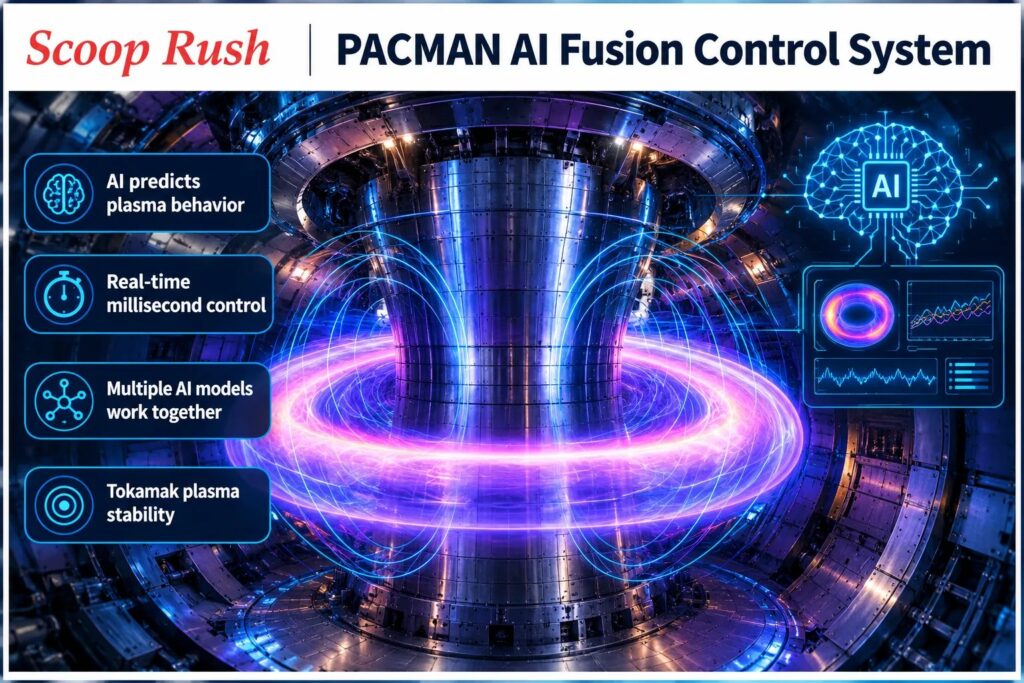
PACMAN stands for Prediction And Control using MAchiNe learning. Researchers at the U.S. Department of Energy’s Princeton Plasma Physics Laboratory (PPPL) and Princeton University built this AI fusion control framework. It combines multiple AI models to monitor and control plasma inside a tokamak, a machine that uses powerful magnetic fields to contain superheated plasma.
Fusion reactors work by fusing atomic nuclei together, similar to the process that powers the sun. To make this happen, the plasma must stay hot, dense, and stable. Even small disturbances, known as instabilities, can grow within milliseconds and disrupt the entire reaction.
Traditional computer simulations that model plasma behavior can take days or months to run. That timeline works fine for planning future experiments. Unfortunately, it is far too slow for guiding a live experiment that may only last a few minutes.
“That’s great for preparing for the next experiment in a year, but for control we need models that make a decision in the moment,” said Hiro Farre Kaga, a graduate student in the Princeton Program in Plasma Physics and co-lead author of the study. He explained that machine learning models are currently the only tools that can represent plasma behavior on a millisecond timescale, which real-time control demands.
Why Fusion Plasma Control Needed Multiple AI Models
Before PACMAN, many machine learning tools for plasma control were built separately, without a shared structure that let them communicate. Since a tokamak requires several systems to be monitored and adjusted at the same time, this lack of coordination created real limitations.
PACMAN solved that problem by giving different AI models a common framework to work within. According to Andy Rothstein, a graduate student at Princeton’s Department of Mechanical and Aerospace Engineering and the paper’s other co-lead author, the goal was to let these models share outputs and work together inside one integrated AI system.
How Does PACMAN Control Fusion Plasma Faster Than Humans?
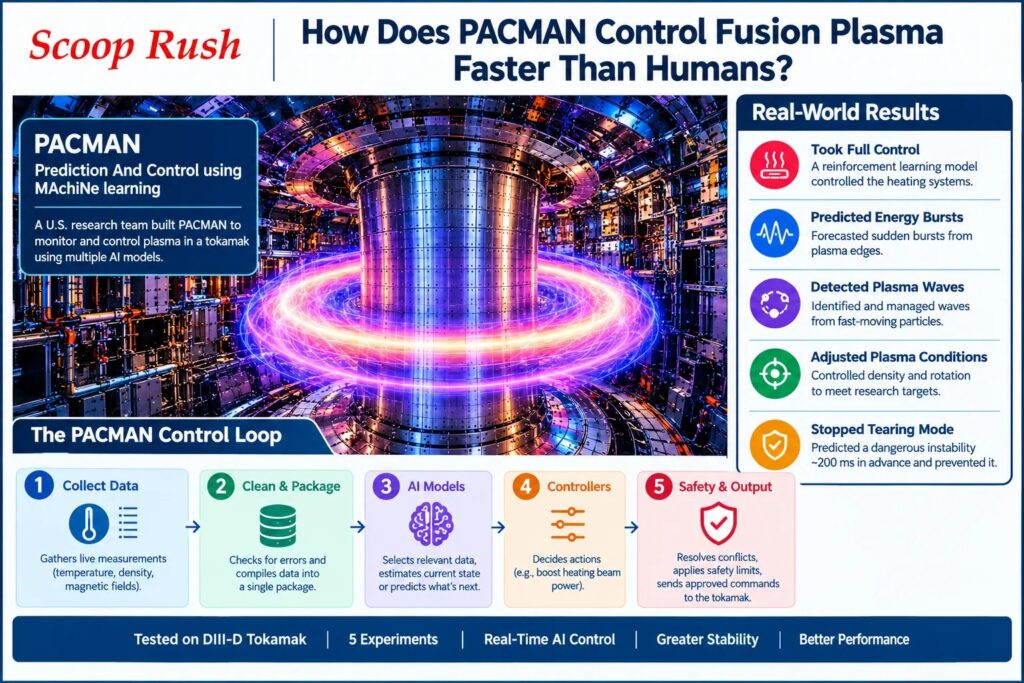
The result is a control loop that moves far faster than any person could manage. “A really focused human operator can respond on the order of seconds,” Rothstein said. In contrast, the entire PACMAN framework typically completes a full cycle in about 20 milliseconds. Additionally, it does not run just once. It repeats continuously, catching subtle shifts in the plasma that a human operator would likely miss.
PACMAN functions somewhat like an assembly line with four stages. First, it gathers live measurements from the tokamak, including temperature, density, and magnetic field readings. Next, it checks this data for errors and compiles it into a single package.
After that, AI models select the specific measurements they need. They use this information to estimate the plasma’s current state or predict what it will do next. Controllers then take these predictions and decide what actions to take, such as boosting the power of a heating beam.
Finally, PACMAN resolves any conflicting instructions from different controllers. It applies strict hardware safety limits and only then sends approved commands to the tokamak. Because each model and controller works independently, scientists can add new components without disrupting the rest of the system. This modular design is a major reason the framework is drawing attention across the fusion and AI research community.
Testing the AI Fusion Control System on a Real Tokamak
Researchers tested PACMAN’s capabilities during five experiments using the DOE’s DIII-D National Fusion Facility tokamak in San Diego. The results were striking.
During these tests, the system successfully:
- Allowed a reinforcement learning model to take full control of the heating systems
- Predicted sudden bursts of energy from the edge of the plasma
- Detected and managed waves in the plasma caused by fast-moving particles
- Adjusted plasma density and rotation to match targets set by researchers
- Predicted a dangerous instability called a tearing mode and stopped it before it occurred
The tearing mode experiment stood out as one of the clearest demonstrations of PACMAN’s advantage. Conventional control systems cannot identify this instability until it has already begun forming. “Then they try to suppress it, and that can come with a lot of performance degradation,” Farre Kaga explained. In this experiment, however, the AI model predicted the tearing mode roughly 200 milliseconds in advance. As a result, researchers adjusted the plasma to avoid the instability entirely rather than reacting after the fact.
PACMAN also coordinated all six of DIII-D’s gyrotrons, which heat the plasma using powerful microwave beams. The framework adjusted their power levels while repositioning their mirrors in real time to meet complex targets set beforehand. “There was no algorithm to find that optimal solution before,” Farre Kaga said, noting that the system performed exactly as hoped when researchers reviewed the data afterward.
Faster AI Development Without Losing Human Oversight
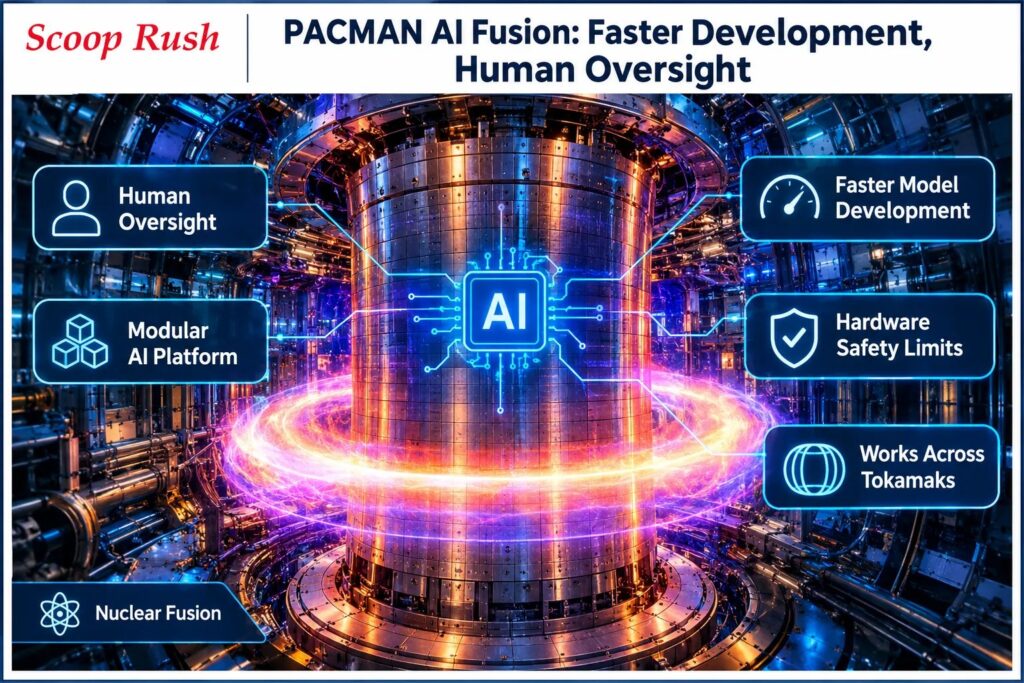
One surprising outcome involved how quickly new AI models could be added once PACMAN was established. Building the framework and installing its first model took months of careful work. However, adding a second model afterward took just a couple of days.
“The testing was easier, and there were far fewer bugs,” Rothstein said. He pointed out that since DIII-D is primarily a research machine, experiments do not always go as planned. Consequently, the ability to install a model within a week and refine it the following week opens up a level of iteration that was not possible before.
Despite this speed, the researchers were clear that PACMAN does not remove humans from the process. The system applies hardware safety limits no matter what an AI model recommends. Additionally, physicists review the results after every experiment so they can improve the controllers ahead of the next test, a reminder that debates over whether AI will replace human jobs still hinge on human judgment in critical fields.
“No matter how sophisticated your controllers, in the end it’s a human operator that sets the parameters for that control,” Farre Kaga said.
A Flexible AI Fusion Control Platform for the Future
PACMAN’s modular structure means it could extend well beyond DIII-D. The developers believe the framework could work with tokamaks of different shapes and sizes, including machines that have not yet been built.
“PACMAN uses a flexible setup where building-block AI algorithms can be put together,” said Egemen Kolemen, associate professor of mechanical and aerospace engineering at Princeton University. He is jointly appointed with the Andlinger Center for Energy and the Environment and PPPL. According to Kolemen, researchers can add new algorithms, swap them out, or run several at once without disturbing the rest of the system.
He added that this modularity turns AI plasma control into infrastructure the broader fusion community can build upon, rather than a series of isolated demonstrations. This kind of scalable groundwork echoes how other sectors are exploring AI-driven efficiency gains to solve problems once thought too complex for automation.
The research appeared in the journal Nuclear Fusion. Additional authors included Ricardo Shousha, Keith Erickson, and SangKyeun Kim from PPPL, along with Jalal-ud-din Butt, Peter Steiner, and Azarakhsh Jalalvand from Princeton University, and Takuma Wakatsuki from Japan’s National Institutes for Quantum Science and Technology. The DOE Office of Science and the National Science Foundation Graduate Research Fellowship supported the work.
Conclusion
The development of PACMAN marks a meaningful step forward for AI fusion control research. By combining multiple AI models into one coordinated system, Princeton researchers created a tool that reacts in milliseconds and predicts problems before they occur. No human operator could ever match that speed.
Furthermore, the system’s ability to predict a tearing mode instability 200 milliseconds in advance shows real, practical value rather than just theoretical promise. At the same time, the team behind PACMAN kept human oversight firmly in place, ensuring safety limits and human judgment still guide every decision. As fusion research continues to advance, flexible and scalable tools like PACMAN could play a central role in finally making fusion energy a practical reality.
FAQs
What is PACMAN and how does it control fusion plasma faster than humans?
PACMAN, short for Prediction And Control using MAchiNe learning, is an AI framework built by Princeton researchers to control fusion plasma in real time. Instead of relying on a single model, it combines several AI models that work together in one system. Each model handles a specific job, such as reading sensor data, predicting plasma behavior, or deciding what action to take next. The system completes a full control cycle in about 20 milliseconds, and it repeats this cycle continuously throughout an experiment. A human operator, by comparison, can only react on the order of seconds.
How fast can the PACMAN AI fusion control system react to plasma changes?
The PACMAN framework typically completes a full control cycle in about 20 milliseconds. It runs continuously, so it detects and responds to small changes far faster than a human operator, who can usually only respond within a few seconds.
Can AI actually predict plasma instabilities before they happen?
Yes. In one experiment, PACMAN predicted a damaging instability called a tearing mode about 200 milliseconds before it appeared. This allowed researchers to adjust the plasma and prevent the instability from forming at all.
Does AI fusion control mean humans are no longer involved in experiments?
No. Humans remain firmly in control. PACMAN applies strict hardware safety limits regardless of AI recommendations, and physicists review results after every experiment to refine the system before the next test.
Where was the PACMAN AI fusion control system tested?
Researchers tested PACMAN during five separate experiments on the DOE’s DIII-D National Fusion Facility tokamak located in San Diego.

