
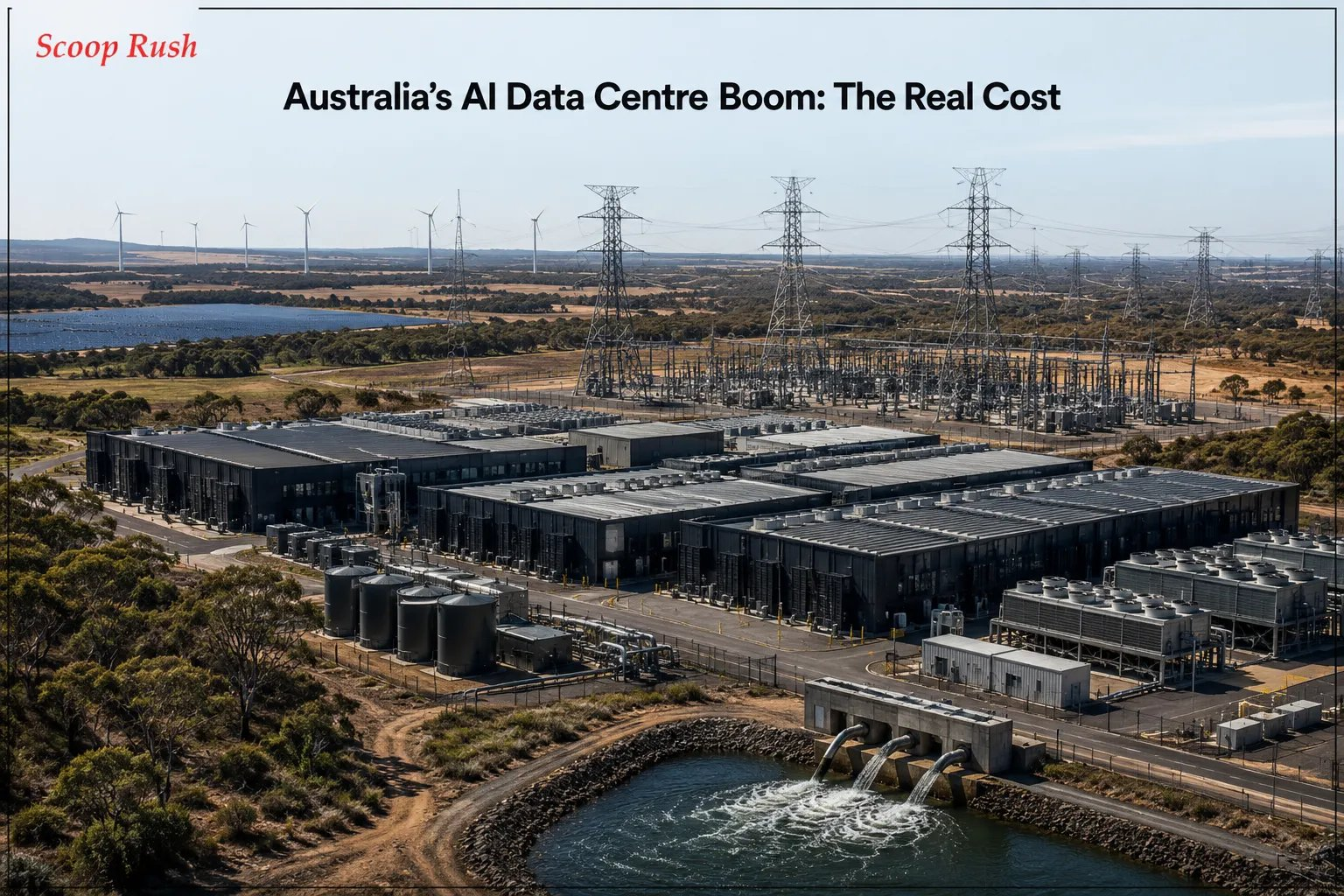
“Would you trade your drinking water for faster AI chatbots? Australia’s AI data centre boom is already showing up in the power bills and taps of thousands of residents living near new sites.”
A constant hum now drifts through homes in Sydney’s Lane Cove, just 350 metres from a data centre. Meanwhile, four more facilities are planned for the same suburb. This is the quiet reality behind Australia’s AI data centre boom, and it’s spreading fast across the country.
Introduction: Why Australia’s AI Data Centre Boom Matters to You
Australia is racing to become a global leader in AI infrastructure. OpenAI CEO Sam Altman even said earlier this year that Australia could become the data centre capital of the world if it wanted to. As a result, the country now hosts 162 data centres, with another 90 in the pipeline and more than A$155 billion in investment lined up.
However, this growth comes at a real cost. Communities near AI data centres in Australia are already dealing with noise, water shortages, rising energy prices, and health concerns. Therefore, understanding this trade-off matters for every Australian, not just those living next to a server farm. It’s part of a much bigger question many are now asking: will AI replace your job, and what else will it reshape along the way?
Why AI Data Centres Are Booming Across Australia
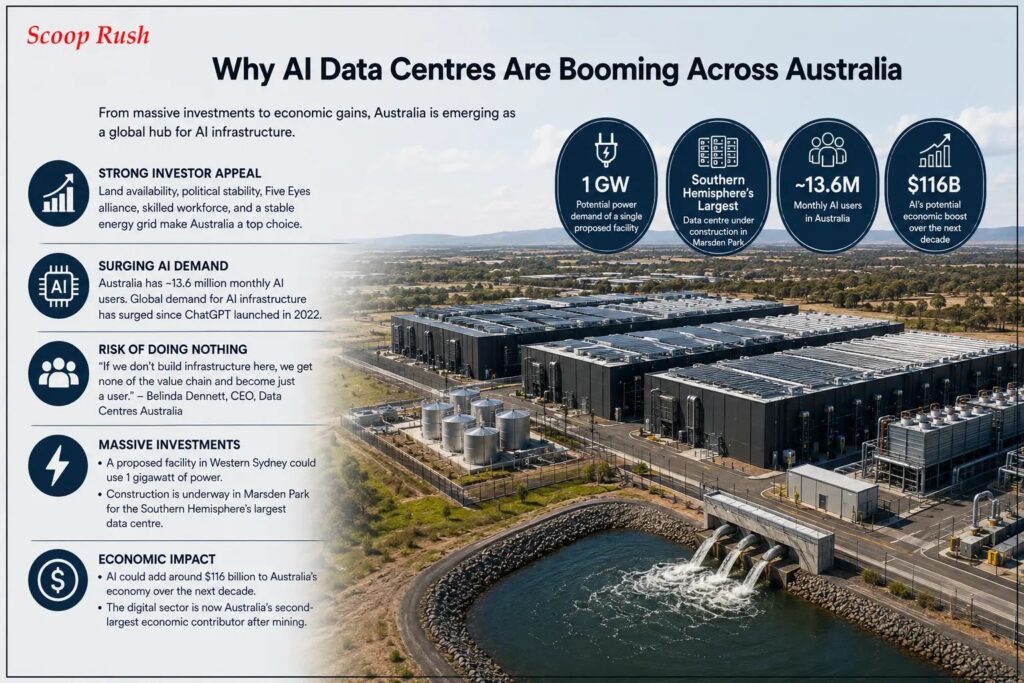
Australia’s appeal to data centre investors isn’t accidental. According to Belinda Dennett, CEO of Data Centres Australia, the country offers land availability, political stability, and membership in the Five Eyes security alliance. Additionally, Australia has a skilled workforce and a comparatively stable energy grid.
Since ChatGPT launched in 2022, global demand for AI infrastructure has exploded. Australia now has around 13.6 million monthly AI users, making it one of the most active AI markets worldwide. Consequently, pressure to build local data centres has grown quickly, echoing how models like Kimi K3 from Moonshot AI and Qwen3-Max are pushing global compute demand even higher.
Experts warn that skipping this investment carries its own risk. “If we think about it in reverse, what happens if we don’t build infrastructure here,” Dennett said. “We get none of the value chain, we are just importing tools from someone else and we become just a user.”
Jon Whittle, former director of the digital research centre at CSIRO, agrees the government has little choice but to keep investing, even while acknowledging the risks involved.
The Scale of Australia’s Data Centre Investment
The numbers involved are massive. One proposed facility in western Sydney could become the country’s largest single energy user, drawing one gigawatt of power if approved. Meanwhile, construction is already underway in Marsden Park on what will become the biggest data centre in the Southern Hemisphere.
The Productivity Commission estimates AI could add around $116 billion to the Australian economy over the next decade. As a result, the digital sector has become the country’s second-largest economic contributor, trailing only mining. This kind of capital flow mirrors what’s happening elsewhere too, including SpaceX’s historic Nasdaq debut, where investors are betting big on next-generation infrastructure.
The Real Power Cost of Australia’s AI Data Centre Boom
Every AI data centre needs constant electricity, and that need is growing fast. The Australian Energy Market Operator (AEMO) projects that data centre electricity demand could triple by 2030. In fact, AEMO’s latest ten-year forecast suggests data centres could eventually account for 14% of all power consumption nationwide, up from around 3% today.
This surge threatens household budgets too. The Climate Council warns that without major investment in renewables and storage, power prices in New South Wales could rise by 26% by 2035.
Why Gas and Diesel Keep Creeping Back In
Data centres need uninterrupted power, and wind and solar can’t always guarantee that on their own. As a result, some operators are turning to gas and diesel backup instead.
For example, Cloud Carrier plans to build three gas-fired power stations near Sydney to support its facilities. Similarly, a proposal in the NSW Southern Highlands for gas plants generating over 700 megawatts has sparked protests from more than 200 residents.
Diesel generators add another layer of concern. Many facilities still rely on Tier 2 diesel units, which emit significantly more nitrogen oxides than newer alternatives. In Melbourne’s West Footscray, one hyperscale facility is reportedly expanding its diesel fleet from 40 to 100 units.
NSW Treasurer Daniel Mookhey takes a more optimistic view. He argues that private investment in data centres is helping fund Australia’s shift away from coal. “We see data centres allowing us to replace a lot of our old coal-fired power with clean, green renewable energy,” he said. This tension between AI’s energy appetite and clean power goals is similar to what’s driving Google’s push for a more efficient AI chip with its Frozen v2 Gemini design.
Still, a timing gap remains. Building a data centre takes far less time than building the clean energy infrastructure needed to power it responsibly.
Water Scarcity: Another Hidden Cost of the AI Data Centre Boom
Electricity isn’t the only resource under pressure. AI data centres in Australia also consume enormous amounts of water to keep servers cool. Some facilities use up to 40 million litres per day, roughly equal to what 80,000 households use.
In a drought-prone country, this raises real concerns. Sydney Water has warned that data centres could account for up to 25% of the city’s drinking water supply by 2035. Meanwhile, the Water Services Association of Australia says Sydney already needs to expand its water capacity just to keep pace with population growth.
If water shifts toward data centres, households may end up paying more for alternatives like desalination, which costs considerably more than traditional supply.
Health Risks Linked to Australia’s Data Centre Expansion
Beyond power and water, there’s a less visible cost: air quality. Researchers Shaolei Ren and Adam Wierman estimated that AI data centres in the United States could impose a public health cost of up to US$20 billion by 2028, largely from air pollution linked to backup generators and coal-heavy electricity.
Australia faces a similar risk. Since more than half the country’s power still comes from coal, every data centre draw carries an indirect health cost. The pollutants released, including PM2.5 particulate matter and nitrogen oxides, have no truly safe exposure level.
Communities Facing the Heaviest Burden
These risks aren’t shared equally. In Western Sydney, a region already up to 10°C hotter than the rest of the city during heatwaves, a cluster of large facilities is emerging around Marsden Park. Studies suggest hyperscale sites can raise local land temperatures by an average of 2°C once running, with effects reaching communities up to 10 kilometres away.
Experts note that carbon offsets don’t fix this problem. A data centre can offset its carbon footprint on paper while still damaging local air quality if it’s built in the wrong place and powered by a coal-heavy grid.
What Local Communities Are Losing to the AI Data Centre Boom
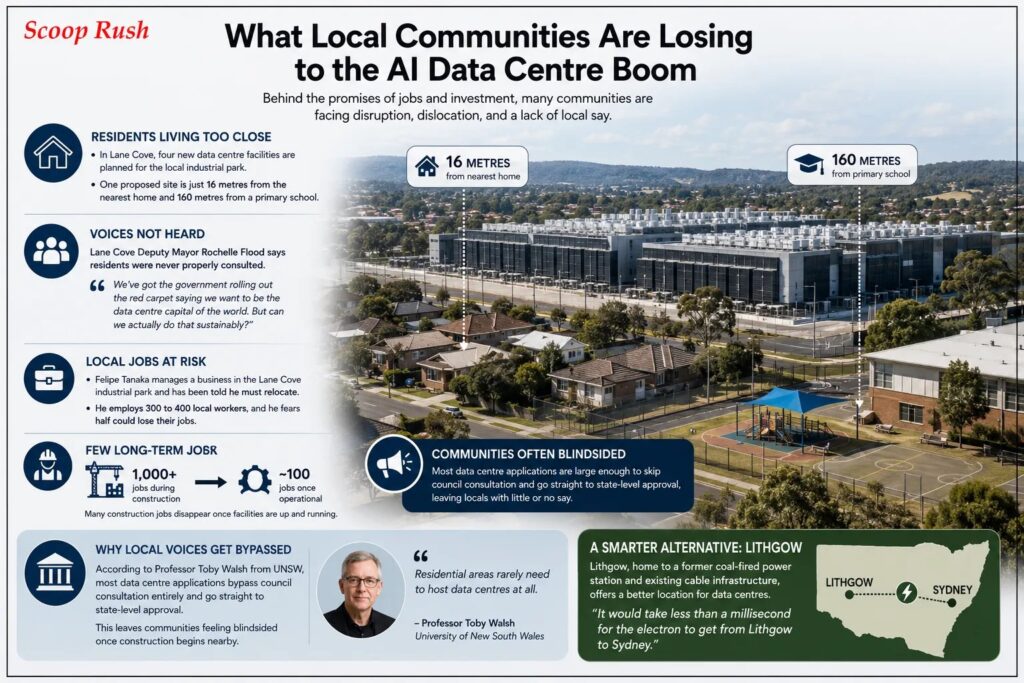
For residents, these concerns go beyond statistics. In Lane Cove, four new facilities are planned for the local industrial park. One proposed site sits just 16 metres from the nearest home and 160 metres from a primary school.
Rochelle Flood, Lane Cove’s deputy mayor, says residents were never properly consulted. “We’ve got the government rolling out the red carpet saying we want to be the data centre capital of the world,” she said. “But can we actually do that sustainably?”
Local jobs are at stake too. Felipe Tanaka manages a business in the Lane Cove industrial park and has been told he must relocate. He employs 300 to 400 local workers, and he fears half could lose their jobs.
Interestingly, while construction can temporarily employ more than a thousand workers, that number typically drops to around 100 once a facility becomes operational. It’s a pattern that fits into a wider conversation about how automation and AI are reshaping the workforce, something explored further in how to become a data analyst in 2026.
Why Local Voices Often Get Bypassed
According to Professor Toby Walsh from the University of New South Wales, most data centre applications are large enough to skip council consultation entirely and go straight to state-level approval. As a result, communities often feel blindsided once construction starts nearby.
Walsh believes residential areas rarely need to host data centres at all. He points to Lithgow, home to a former coal-fired power station and existing cable infrastructure, as a smarter location. “It would take less than a millisecond for the electron to get from Lithgow to Sydney,” he explained.
Government Response to Australia’s AI Data Centre Boom
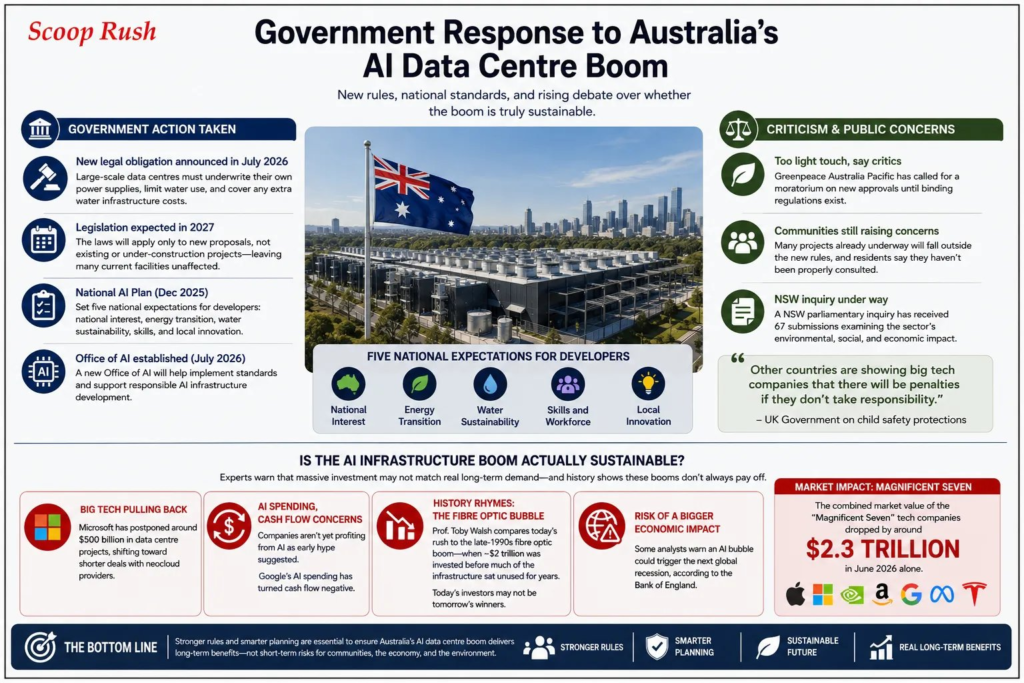
The government has started responding. In July 2026, Prime Minister Anthony Albanese announced a new legal obligation requiring large-scale data centres to underwrite their own power supplies, limit water use, and cover any extra water infrastructure costs.
This legislation, expected in 2027, will only apply to new proposals, not existing or under-construction projects. Consequently, many facilities currently causing concern will fall outside these rules.
Furthermore, the government’s National AI Plan, released in December 2025, set five national expectations for developers covering national interest, energy transition, water sustainability, skills, and local innovation. An Office of AI was also established in July 2026 to help implement these standards. This kind of regulatory scrutiny mirrors moves seen elsewhere, such as the UK threatening big tech with penalties over child safety features.
However, critics argue the approach stays too light touch. Greenpeace Australia Pacific has called for a moratorium on new approvals until binding regulations exist. Meanwhile, a NSW parliamentary inquiry has received 67 submissions examining the sector’s impact.
Is the AI Infrastructure Boom Actually Sustainable?
Some experts question whether investment matches real long-term demand. Dr Joseph Sweeney from Intelligent Business Research Services notes that Microsoft has already pulled back, postponing around $500 billion in data centre projects in favour of shorter deals with neocloud providers. This caution lines up with broader signs that companies aren’t yet profiting from AI the way early hype promised, and that Google’s own AI spending has turned cash flow negative.
Professor Walsh compares the rush to the fibre optic bubble of the late 1990s, when roughly $2 trillion was invested before much of the infrastructure sat unused for years. He suggests a similar pattern could unfold with AI, where today’s investors may not be the ones who eventually benefit. Some analysts have gone further, warning that an AI bubble could trigger the next global recession, according to the Bank of England.
Adding to the uncertainty, the value of the so-called Magnificent Seven tech companies dropped by around $2.3 trillion in June 2026 alone.
Conclusion: Is Australia’s AI Data Centre Boom Worth the Cost?
Australia’s AI data centre boom brings genuine opportunity alongside genuine risk. On one hand, the sector could add $116 billion to the economy and position Australia as a serious AI player. On the other hand, communities already face noise, water shortages, rising energy costs, and air quality concerns, often without a real say in the process.
Ultimately, smarter planning offers a way forward. Locating facilities away from homes, prioritising real renewable power over gas and diesel backups, and giving communities a genuine voice could help Australia capture AI’s benefits without repeating mistakes seen elsewhere.
FAQs
Why is Australia becoming a major hub for AI data centres?
Australia offers investors political stability, available land, a relatively stable energy grid, renewable energy potential, and membership in the Five Eyes security alliance, making it one of the most attractive markets for AI infrastructure investment.
How much water do AI data centres use in Australia?
Some large data centres use up to 40 million litres of water per day for cooling. This is roughly equal to the daily usage of 80,000 households.
Will AI data centres increase electricity prices in Australia?
Yes, potentially. The Climate Council warns that without major investment in renewable generation and storage, data centre demand could push power prices up by 26% in New South Wales by 2035.
Are new laws coming to regulate data centres in Australia?
The federal government announced new obligations in July 2026 requiring large-scale data centres to underwrite their own power, limit water use, and fund extra water infrastructure. This legislation is expected in 2027 and will only apply to new projects.
Do AI data centres create many long-term jobs?
Not many. Construction can temporarily employ more than a thousand workers, but operational data centres typically need only around 100 staff once running.

