
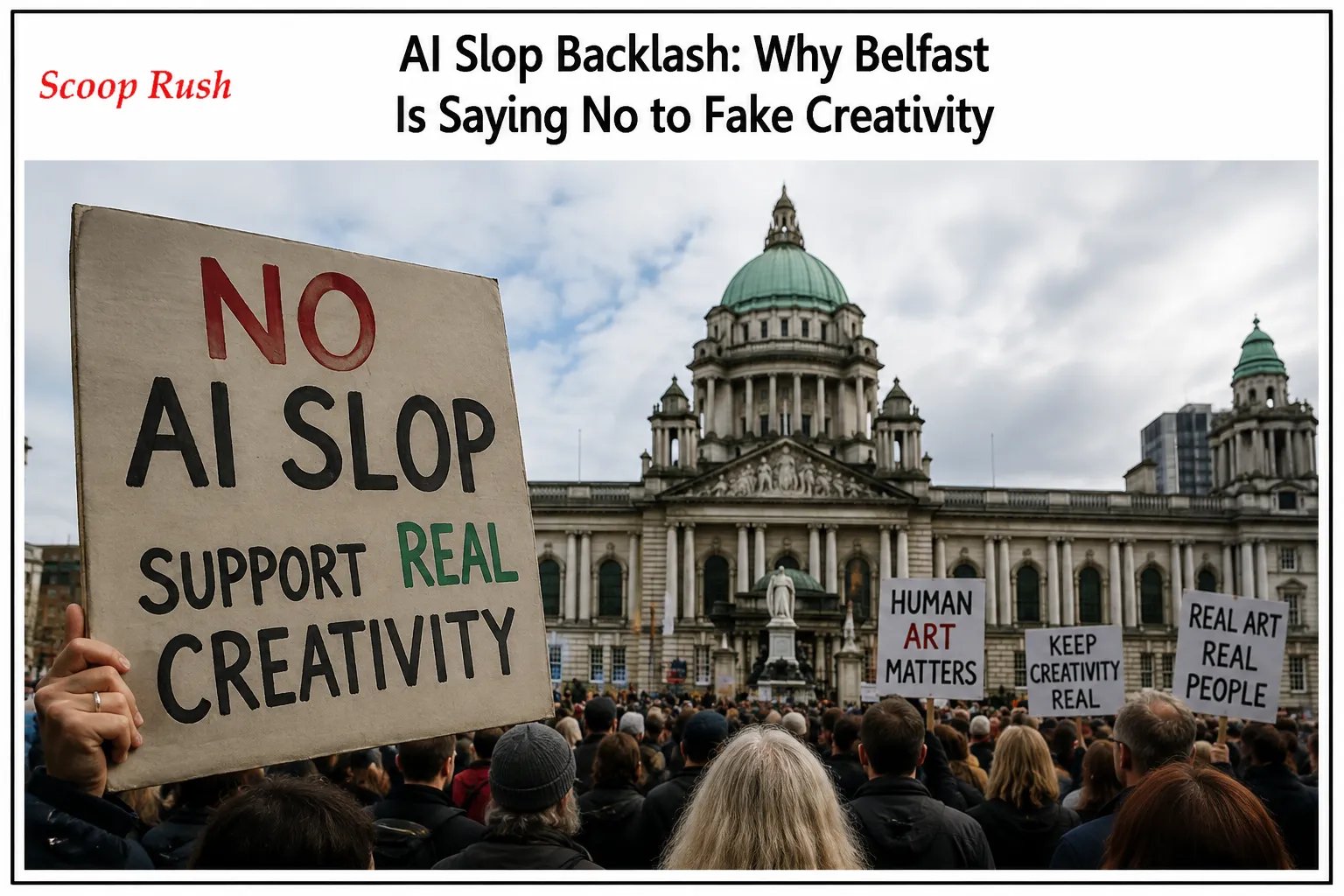
A single sticker on a bar’s flyer changed one restaurant owner’s mind about artificial intelligence. That sticker read only four words: “Say no to AI.” Within weeks, his business dropped what critics call AI slop entirely.
This is not an isolated reaction. Across Belfast, a growing number of artists, designers, and business owners are pushing back against what they call “AI slop,” rapidly produced and low-quality content made with generative artificial intelligence. From greeting cards to gig posters, the backlash is reshaping how local businesses think about creativity, cost, and who deserves to be paid for their work.
This story matters because it reflects a much larger question facing every industry today. As AI tools continue replacing traditional roles, communities are starting to decide, one business at a time, whether convenience is worth the cost to human creators.
What Is AI Slop and Why Has It Spread So Quickly?
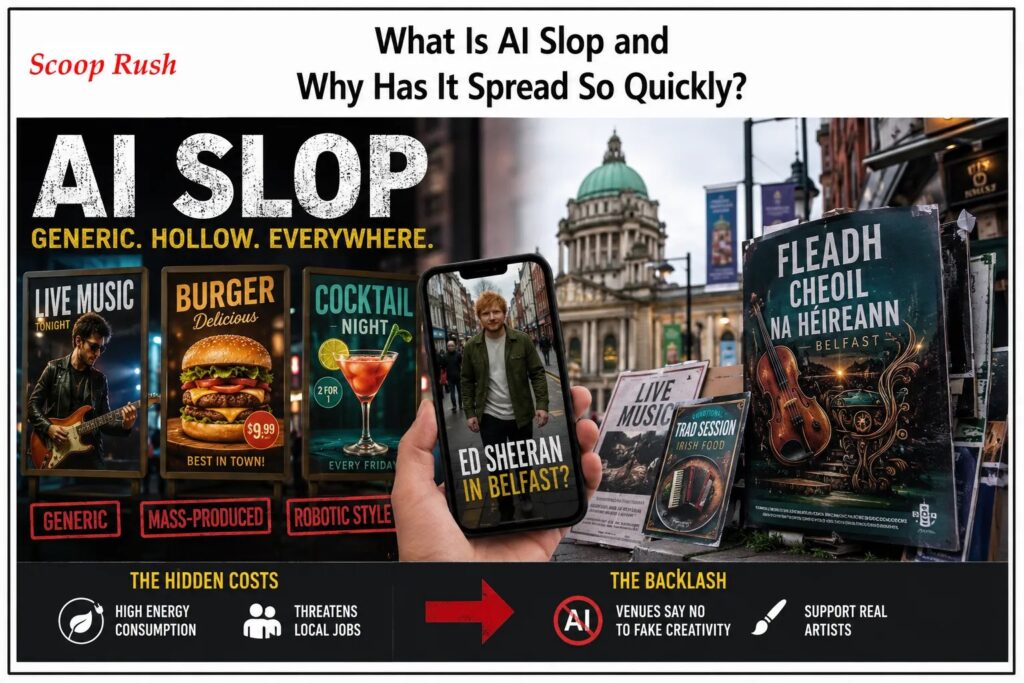
AI slop describes content that looks mass-produced, generic, and artistically hollow. Posters with distorted guitar players, menus showing unnaturally glossy burgers, and social media graphics that all share the same robotic style are common examples.
During Fleadh Cheoil na hÉireann, a major Irish music festival held in Belfast this month, AI-generated posters, flyers, and menus appeared across the city. At first, people could not tell where the content came from. However, patterns soon gave it away. Strange proportions, repeated visual quirks, and oddly perfect textures made the AI origin obvious, the same kind of giveaways that let people tell human writing apart from AI-generated text. Several images even showed musician Ed Sheeran seemingly wandering through Belfast, adding to the surreal effect.
Businesses turned to these tools because they are fast and nearly free to use. For companies under financial pressure, especially in hospitality, that appeal is easy to understand. As a result, AI-generated marketing content spread quickly through bars, restaurants, and shops across the city, much like AI-generated listings have flooded other industries, including rental property searches.
The Hidden Costs Behind Cheap AI Content
Beyond visual quality, critics raise two deeper concerns. First, AI systems carry a well-documented environmental cost due to the energy needed to run them, a factor tied to the massive AI spending and infrastructure race underway at major tech companies. Second, and more urgently for local creatives, AI threatens paid work that once belonged to designers, illustrators, and musicians.
These concerns have pushed several Belfast venues to move from quiet frustration to public action, turning individual complaints into an organized boycott of AI-generated content.
The Creatives Leading the Fight Against AI Slop
This backlash has real names and real businesses behind it, not just online commentary.
A Greeting Card Maker’s Viral Warning
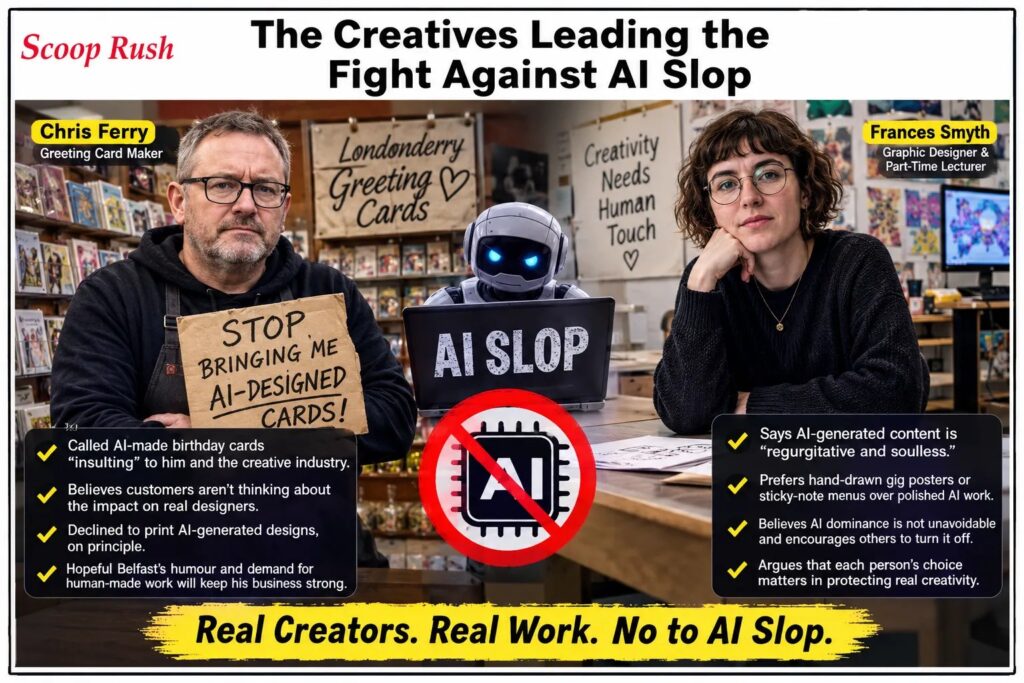
Chris Ferry runs a greeting card business built around Londonderry’s distinctive sense of humor. His frustration became public in a video that gained thousands of engagements online. In it, he told customers to stop bringing him birthday cards they had designed using ChatGPT.
Ferry called the practice insulting, not only to him personally but to everyone working in the creative industry. His entire business model depends on turning a customer’s idea into an original design. When people arrive with an AI version already finished, it undermines the service he offers.
Still, Ferry does not blame his customers directly. He understands that AI tools are convenient and widely available, and most people simply are not thinking about how it affects designers like him. When customers offered to pay him to print their AI-made designs, he declined every time, purely on principle.
He remains worried about the long-term impact AI could have on businesses like his. However, he is hopeful that Derry’s specific brand of humor, along with genuine customer demand for human-made work, will help his business stay relevant, much like small creators who have found success building things by hand, such as one mom who built a thriving Etsy side hustle around authentic, handmade products.
A Graphic Designer’s View From the Classroom
Frances Smyth offers a different perspective as both a freelance graphic designer and a part-time lecturer at Ulster University. She has watched AI reshape the creative industry firsthand since graduating in 2021, a time when AI barely featured in design education.
According to Smyth, creative agencies are losing clients as more businesses turn to AI tools to cut marketing costs. She said that whenever cost savings come up, one of the first questions businesses now ask is whether ChatGPT could replace a human designer, a shift also being tested by new AI coding tools like Meta’s Muse coding agent.
Often, the answer is yes. However, Smyth argues the results rarely match what a trained artist can produce. She described AI-generated content as regurgitative and soulless, lacking the authentic expression that comes from genuine creative effort.
Her comparison is direct and memorable. She said she would rather see a hand-drawn gig poster or a menu scrawled on a sticky note than a polished AI creation, simply because imperfect human work carries more integrity.
Importantly, Smyth rejects the idea that AI dominance is unavoidable. She has disabled AI features across her own devices wherever possible, and she encourages others to do the same, arguing that each person’s choice genuinely matters, an approach that echoes growing concerns around AI tools quietly exposing user data and privacy.
Belfast Bars Are Declaring Themselves AI-Free Zones
Individual protests are one thing. Organized business boycotts are another, and Belfast has seen both take shape this year.
The American Bar became one of the first businesses in Northern Ireland to officially declare itself an AI-free zone. This month, the bar announced a complete boycott of AI-generated content, covering everything from background music to gig posters shared on social media.
In their public statement, the owners argued that AI use poses a genuine threat to artists’ livelihoods. They also pointed to the well-documented environmental impact of AI technology as part of their reasoning.
Co-owner Tomas Gorman called AI a deeply damaging technology, particularly for local artists and creative workers. Co-owner Peter McCloskey went further, arguing that even a rough poster made by an inexperienced designer holds more creative value than anything AI produces.
Other venues have since followed the same path, including Mandela Hall inside Queen’s University Belfast’s Student Union, which has also taken a firm stance against AI on its premises.
From AI User to AI Skeptic: One Owner’s Change of Heart
Not every business started out opposed to AI. Mal Houston, who runs Three Rivers Restaurant, used AI-generated posters during the Fleadh to promote entertainment and food deals. At the time, it seemed like a practical and affordable solution during a busy festival.
Then came the sticker. Someone quietly placed a “Say no to AI” sticker on several of his flyers during the festival. Houston does not know who did it, but the message stayed with him.
Soon after, Houston announced that his restaurant and nightclub would stop using AI-generated art entirely, even though it meant giving up some cost savings. He explained that hospitality businesses are already under serious financial strain, which makes AI tempting as a quick fix.
However, Houston pointed out an important contradiction. While hospitality struggles with its own challenges, using AI only deepens the struggles of another group, graphic designers, who invested time and money into developing their skills at university. To Houston, that trade-off no longer felt fair.
Why the AI Slop Backlash Signals a Bigger Cultural Shift
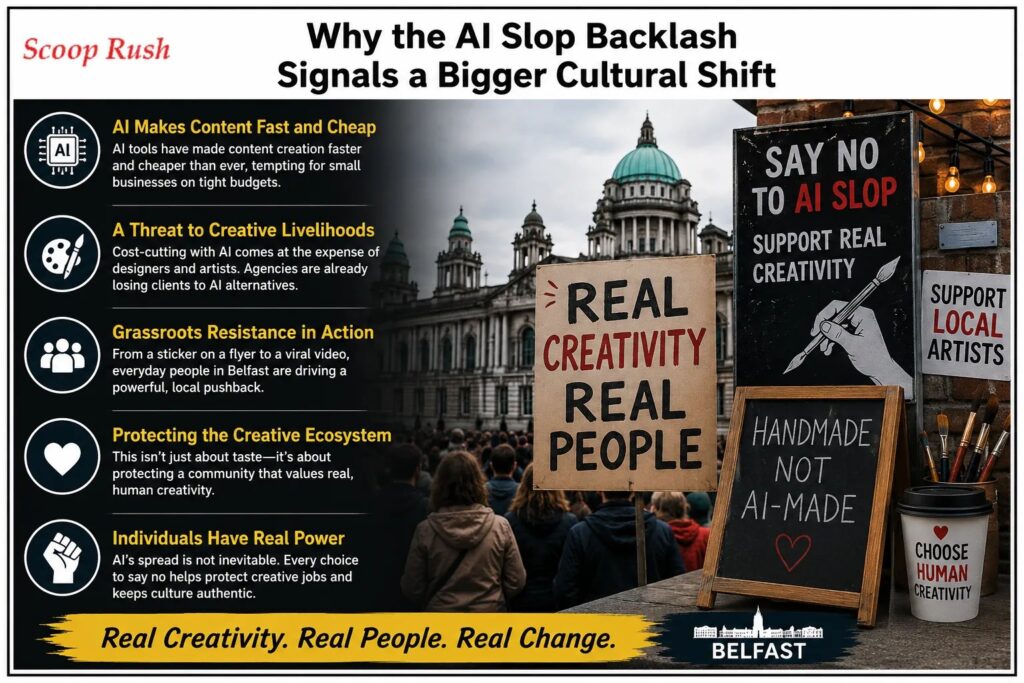
Belfast’s pushback reflects a wider tension playing out across the world. AI tools have made content creation faster and cheaper than ever before, part of the same wave that is reshaping careers and prompting more people to ask how to become a data analyst or pivot into AI-adjacent fields entirely. For small businesses working with tight budgets, that convenience is genuinely tempting.
At the same time, this cost-cutting comes directly at the expense of creative professionals whose income depends on paid design and artistic work. As Smyth pointed out, agencies are already losing clients to AI alternatives, and that trend shows little sign of slowing without active resistance, a pattern that mirrors debates in other sectors too, including the NHS’s use of AI tools to manage waiting times.
What makes Belfast’s story stand out is that the resistance is not coming from policymakers or distant tech critics. It is coming from small business owners, working artists, and everyday customers making individual choices. A sticker on a flyer changed one restaurant’s policy overnight. A viral video from a card maker sparked a citywide conversation. A single bar’s public boycott encouraged other venues to follow.
This grassroots pattern suggests that opposition to AI slop is not simply about aesthetics or taste. It is about protecting an entire ecosystem of creative labor that communities genuinely value, even when cheaper alternatives are readily available.
Ultimately, Smyth’s closing argument captures the movement’s core belief well. She rejects the idea that AI’s spread is inevitable and insists that individuals hold real power to say no. Whether this resistance grows into a lasting movement or remains a local trend in cities like Belfast is still an open question. For now, though, a visible and vocal group of creatives, business owners, and customers is choosing to push back against AI slop.
Key Takeaways
AI slop, the term for rapidly produced and low-quality AI-generated content, has become a major flashpoint in Belfast’s creative industry. Businesses like The American Bar and Three Rivers Restaurant have publicly rejected AI-made marketing materials, citing threats to local artists’ livelihoods along with environmental concerns. Meanwhile, creatives such as Chris Ferry and Frances Smyth are speaking out about how AI is affecting their industries, from greeting card design to freelance graphic work. As a result, a small but growing boycott movement is taking shape, driven not by large institutions but by individual business owners and artists choosing to say no to AI-generated content.
FAQs
What does “AI slop” mean?
AI slop refers to rapidly produced, low-quality digital content created using generative artificial intelligence. It often includes posters, menus, or images that look generic, distorted, or artistically empty.
Why are Belfast businesses boycotting AI-generated content?
Businesses like The American Bar and Three Rivers Restaurant say AI threatens the livelihoods of local artists and graphic designers. They also cite environmental concerns linked to AI technology as part of their decision.
How is AI affecting graphic designers and artists in Belfast?
Graphic designers report losing clients as businesses turn to AI tools like ChatGPT to cut marketing costs. Designers argue that AI-generated content lacks the authentic creative expression found in human-made work.
Which businesses in Belfast have declared themselves AI-free zones?
The American Bar was among the first in Northern Ireland to declare itself an AI-free zone. Mandela Hall and Three Rivers Restaurant have also moved away from using AI-generated content in their marketing.
Can individuals actually push back against AI slop?
Yes. Freelance designer Frances Smyth has disabled AI features on her own devices and encourages others to make similar choices. She argues that AI’s spread across creative industries is not inevitable if people actively choose to say no.

