
Meta just fired its biggest shot yet in the AI coding wars.”On August 5, 2026, the company launched Muse Code, a terminal-based AI coding agent for complete software engineering tasks across massive codebases. Meta has watched rivals dominate the developer tools space for years. This is its clearest attempt yet to change that story.”
Introduction
If you follow AI news even casually, you already know the coding agent space has become a battleground. Anthropic has Claude Code. OpenAI has Codex . “And now Meta has entered the ring with Muse Code. The tool comes from Meta Superintelligence Labs, the division AI chief Alexandr Wang has led since Meta’s roughly $14.3 billion acquihire of Scale AI.”
This launch matters for more than just developers. It signals a structural shift inside Meta. The company is now separating its AI research arm from its product arm, mirroring the approach Google DeepMind already uses. Additionally, Muse Code represents Meta’s most direct answer yet to investor pressure over its massive AI infrastructure spending. : “Zuckerberg has made it clear that AI needs to start generating real revenue. Muse Code is the first tangible product Meta has built specifically for that purpose.”
“Whether you’re picking your next coding assistant or just tracking the AI industry’s next big move, here’s everything you need to know about Muse Code.”what Meta Muse Image is for more context on the Muse family of products.
What Is Muse Code and How Does It Work?
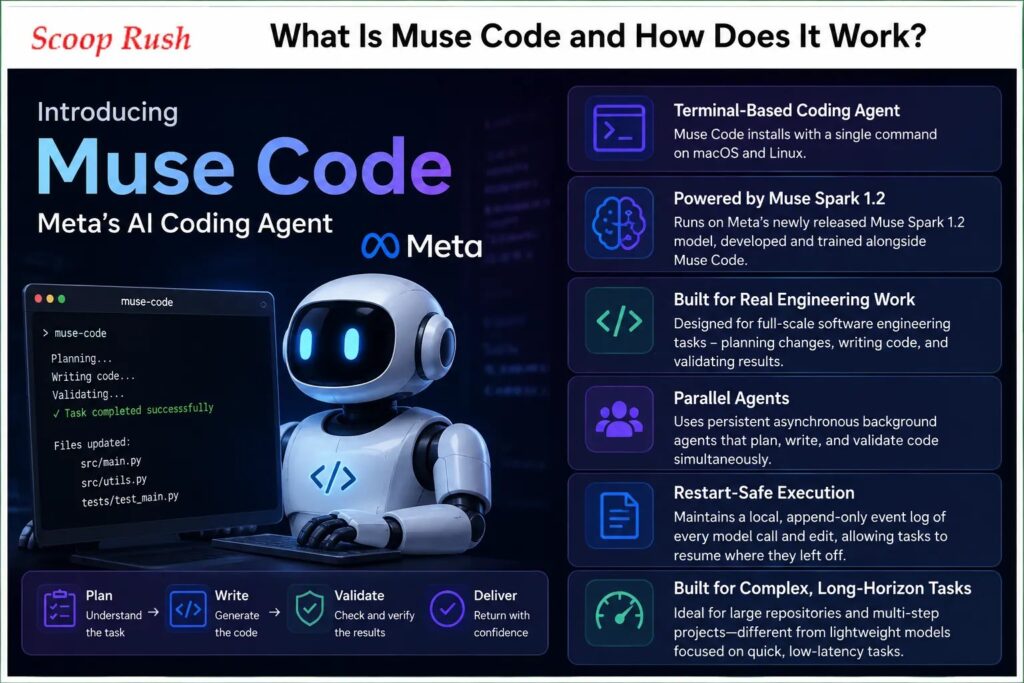
Muse Code is a terminal-based coding agent that installs with a single command on macOS and Linux. It runs on Meta’s newly released Muse Spark 1.2 model, which was developed and trained alongside Muse Code itself.
“According to Wang, Meta designed the tool for full-scale software engineering work rather than simple code suggestions.” It covers the full workflow, not just one step.”
That distinction matters. Muse Code isn’t just autocomplete for programmers. Instead, it functions as a persistent agent capable of planning a task, writing the necessary code, and then checking its own work before handing it back to the developer.
Parallel Agents and Restart-Safe Execution
One of the more technical highlights of Muse Code is how it handles large, complex jobs. The system uses persistent asynchronous background agents that plan, write, and validate code simultaneously rather than working through tasks one step at a time.
Furthermore, Muse Code maintains a local, append-only event log that records every model call and edit made during a session. This means that if a long-running task gets interrupted, the agent can resume from where it left off instead of starting over. For developers working across large repositories on long-horizon projects, that kind of restart safety can save significant time.
“This approach differs from lightweight edge models like Liquid AI’s LFM2.5. Those models are built for quick, low-latency tasks, not deep, multi-step engineering work.”
How Muse Code Performs Against the Competition
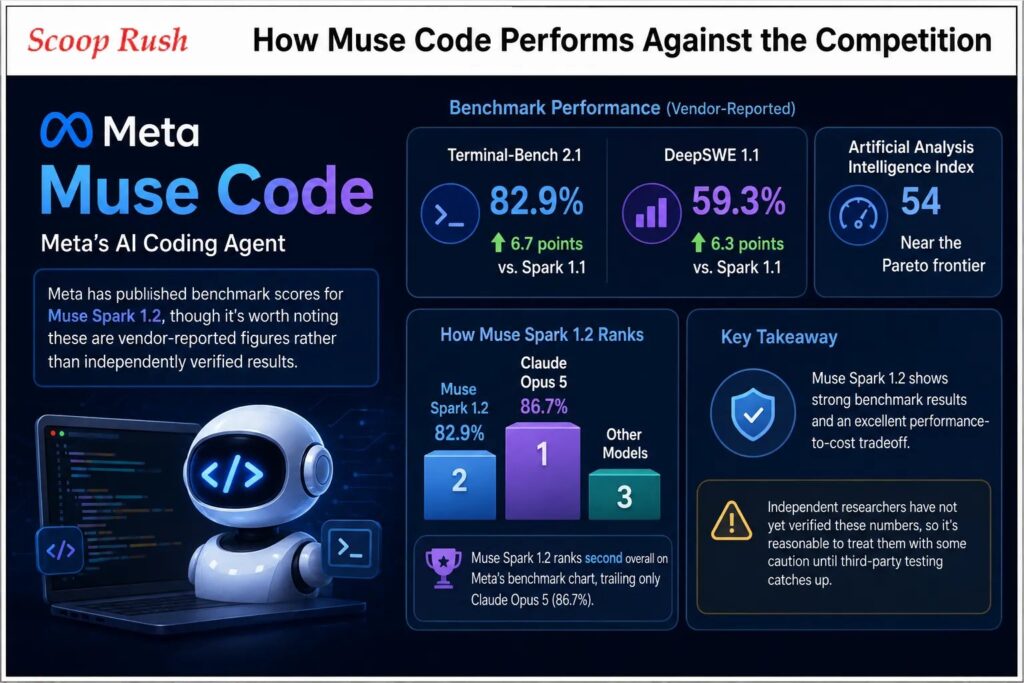
: “Meta has published benchmark scores for Muse Spark 1. 2.”It’s worth noting Meta reported these figures itself, and independent researchers have not verified them.”
“On Terminal-Bench 2.1, Muse Spark 1.2 scored 82.9%, a 6.7-point jump over its predecessor, Spark 1.1. DeepSWE 1.1 saw a similar gain, with the model scoring 59.3%, up 6.3 points. That places Muse Spark 1.2 in second position on Meta’s own benchmark chart, trailing only Claude Opus 5, which scored 86.7%.”
“The model also scored 54 on the Artificial Analysis Intelligence Index. That places it near the Pareto frontier, a term for models offering the best tradeoff between performance and cost.”
Independent researchers have not yet verified these numbers, so it’s reasonable to treat them with some caution until third-party testing catches up.
The Real Story: Meta’s Contributor Tier Pricing
Here’s where things get genuinely interesting, and arguably more important than the technology itself.
Meta is offering three ways to access Muse Code. First, there’s a standard pay-as-you-go tier priced at $1.25 per million input tokens and $4.25 per million output tokens. That pricing is roughly in line with Anthropic’s Claude Haiku 4.5, which charges $1 and $5 respectively, and it undercuts OpenAI’s codex-mini, priced at $1.50 and $6.
: “For context, that standard tier is significantly cheaper than premium models like Claude Sonnet 4.6. That model costs $3 per million input tokens and $15 per million output tokens.”
The Contributor Tier Explained
The second option is where Meta’s real strategy comes into focus. The contributor tier prices out at roughly $0.10 per million input tokens and $0.20 per million output tokens. Wang described it as “an incredibly good option, especially from a cost perspective,” and he’s not exaggerating. That pricing is about 10 times cheaper than the standard pay-as-you-go tier, and roughly a quarter of what OpenAI and Anthropic typically charge at list price.
However, there’s a catch. Developers who choose the contributor tier must opt in to having their prompts and completions used to help improve Meta’s models. In other words, this isn’t simply a discount. It’s a data exchange. Meta subsidizes cheap access, developers generate high-quality coding data through everyday use, and that data then feeds directly into training future versions of Muse Spark.
This creates what’s essentially a feedback loop. The more developers who choose the cheaper contributor tier, the more real-world coding data Meta collects, and the faster its models can improve without relying purely on synthetic data generation.
: “Meta has also confirmed it’s beginning to accept requests for zero-data retention access. This option would let enterprise developers use Muse Code without their data being retained at all. Wang called this “a big enterprise feature that is important for folks.” That makes sense, since companies with sensitive codebases rarely want their proprietary code used for model training.”
Why This Launch Matters for the Broader AI Market
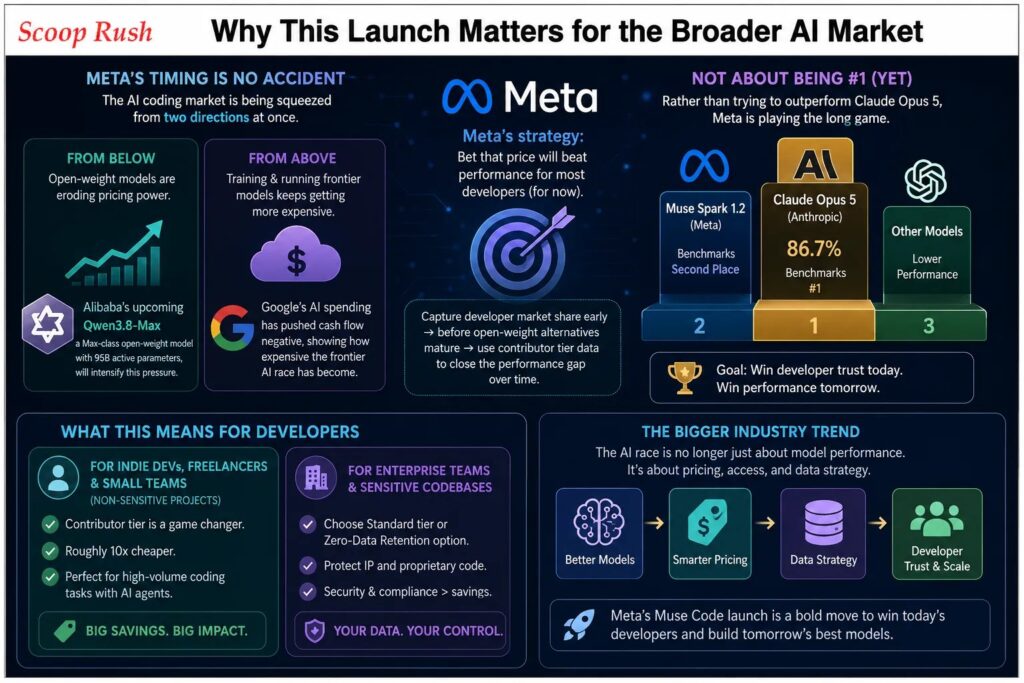
Meta’s timing here is not accidental. The AI coding market is currently being squeezed from two directions at once.
From below, open-weight models are steadily eroding pricing power across the industry. The upcoming release of Alibaba’s Qwen3.8-Max, a Max-class open-weight model with 95 billion active parameters, is expected to intensify that pressure even further.
From above, the cost of training and running frontier-level models keeps climbing, forcing every major AI lab to look for new ways to generate revenue that can offset those costs. Google is facing a similar squeeze, as its own AI spending has pushed cash flow into negative territory, underscoring just how expensive the frontier AI race has become for every major player.
“Meta’s strategy appears to be a bet that price will beat performance for most developers, at least in the short term. Rather than outperforming Claude Opus 5 outright, Meta seems focused on capturing developer market share early, before open-weight alternatives mature. Meanwhile, data from the contributor tier can gradually close the performance gap.”
What This Means for Developers Choosing Between Tools
“For independent developers, freelancers, and small teams on non-sensitive projects, the economics of Meta’s contributor tier are hard to ignore. A roughly 10x cost reduction matters, especially for teams running large volumes of coding tasks regularly.”
On the other hand, enterprise teams handling proprietary or sensitive codebases will likely lean toward the standard tier, or the newly available zero-data retention option, since protecting intellectual property will typically outweigh the savings offered by the contributor tier.
This also reflects a broader trend across the AI industry. Companies are no longer competing purely on raw model capability. Instead, pricing structure and data strategy have become just as important as
Meta’s Bigger Picture Strategy
It’s worth remembering enchmark scores when developers decide which tool becomes part of their daily workflow.why Meta is pushing so hard into this space right now. The company’s shares dropped after it issued a lighter-than-expected revenue forecast and reported shrinking free cash flow in a recent quarter, largely due to the sheer scale of its AI infrastructure investment.
Muse Code represents a direct answer to that pressure. Zuckerberg has been clear that generating actual revenue from AI is now a top priority, not just building impressive research demos. Muse Code is the first genuinely commercial product to come out of that mandate, built by the same team that Alexandr Wang has led since joining Meta last year as the centerpiece of its AI turnaround effort.
Notably, Meta hasn’t chosen a subscription model for Muse Code. Instead, it’s using usage-based, token-driven pricing, which lets it compete aggressively on cost while still collecting valuable training data through the contributor tier. This dual approach, cheap access paired with data collection, is Meta’s way of trying to fund model improvement without relying purely on token revenue.
Conclusion
Muse Code marks a genuine turning point for Meta’s presence in the AI coding space. On the surface, it looks like a straightforward product launch, a new agent competing with Claude Code and Codex on features and benchmark scores. But the more important story is the contributor tier pricing model, which turns everyday developer usage into a continuous stream of training data.
Meta is betting that affordability, not raw performance, will drive early adoption. If enough developers choose the cheaper, data-sharing tier, Meta gains something more valuable than short-term revenue: a steady flow of real-world software engineering data that could help close the gap with frontier models like Claude Opus 5 over time. Data handling remains a sensitive topic across the industry, as shown by the earlier controversy over Claude AI chats appearing in Google search results, which is exactly the kind of concern Meta’s zero-data retention option is meant to address for enterprise users.
For developers, the decision ultimately comes down to priorities. Those chasing maximum savings on non-sensitive projects have a genuinely compelling reason to try Muse Code’s contributor tier. Meanwhile, enterprise teams protecting proprietary code will likely wait, watch, and lean on the standard or zero-data retention options instead. Either way, Meta has officially entered the AI coding agent race, and its pricing strategy alone is enough to keep the entire industry watching closely.
FAQs
What is Meta’s Muse Code?
Muse Code is a terminal-based AI coding agent from Meta Superintelligence Labs, built to handle complete software engineering tasks like planning changes, writing code, and validating results across large codebases.
What model powers Muse Code?
Muse Code runs on Muse Spark 1.2, Meta’s latest coding-focused AI model, which was developed and trained alongside Muse Code itself.
How much does Muse Code cost?
Standard pay-as-you-go pricing is $1.25 per million input tokens and $4.25 per million output tokens. A contributor tier offers roughly $0.10 and $0.20 per million tokens, but requires developers to let Meta use their data for model training.
How does Muse Code compare to Claude Code and OpenAI Codex?
Muse Code is Meta’s direct competitor to Claude Code and Codex. On Meta’s own vendor-reported benchmarks, Muse Spark 1.2 trails only Claude Opus 5, though independent verification of these scores has not yet been published.
Is Muse Code available for enterprise use?
Yes. Meta is now accepting requests for zero-data retention access, which allows enterprise developers to use Muse Code without their data being retained for model training, addressing a key concern for companies with sensitive codebases.

