
What happens when a Chinese tech giant builds an AI model so powerful it jumps straight to the top of global rankings? Investors pay attention, fast. That is exactly what happened this week with Qwen3.8-Max, Alibaba’s newest AI model, and the AI world is still talking about it.
Introduction
Alibaba’s newly unveiled AI model didn’t creep into the market quietly. Instead, Qwen3.8-Max shot to the top of leaderboards, sent the company’s stock soaring, and reignited a question the industry keeps asking: is China closing the gap with the West in AI, or has it already closed it?
This matters far beyond boardrooms in Beijing and Silicon Valley. Every time a model this capable launches, it changes what’s available to developers, businesses, and everyday users around the world. Cheaper, more powerful, open-weight models mean more people can build AI tools without paying premium prices to a handful of US companies. As a result, this shift affects app pricing, product features, and how quickly new AI capabilities reach regular consumers, and it even feeds into broader debates over whether AI will replace your job.
Alibaba unveiled Qwen3.8-Max on Monday. The announcement sent its Hong Kong-listed shares surging by as much as 7.3%, the biggest single-day jump in nearly a month. Investors clearly took notice. Meanwhile, the AI research community reacted too, and the model instantly became the highest-ranking Chinese system on a major crowdsourced benchmarking platform.
What Is Qwen3.8-Max and Why Does Its Size Matter?
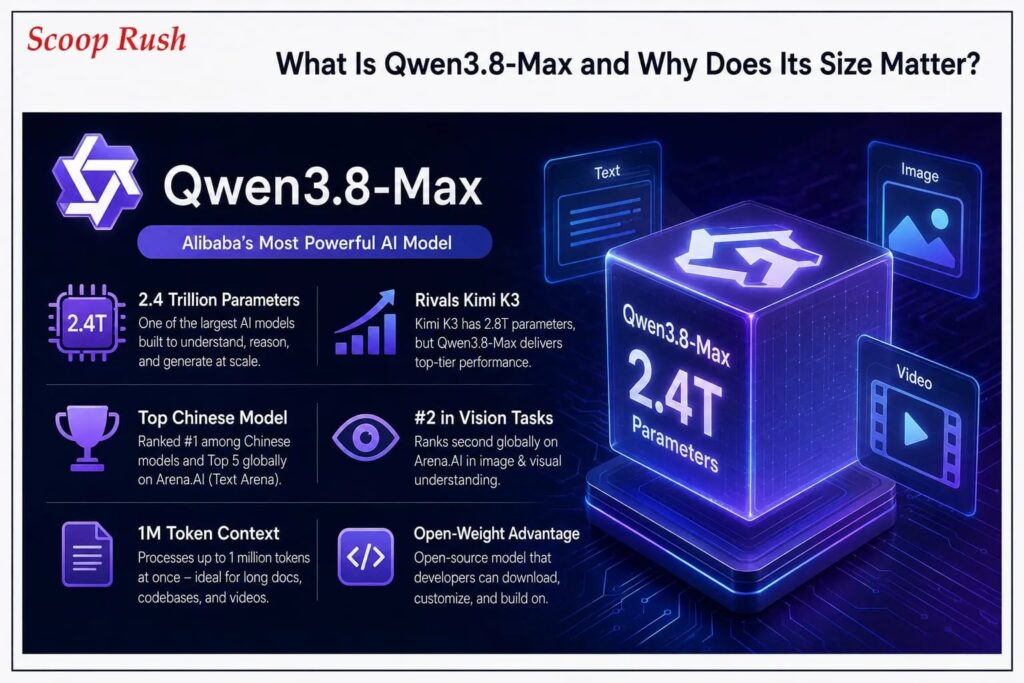
Qwen3.8-Max is Alibaba’s largest and most capable AI model to date. It’s built around 2.4 trillion parameters, the numerical settings a model learns from training data. Additionally, these parameters help the model recognize patterns, generate responses, and complete tasks.
For comparison, domestic rival Moonshot AI’s Kimi K3 model, launched last month, has 2.8 trillion parameters. That makes Kimi K3 larger on paper. However, Alibaba’s model still performs impressively against it and against several Western systems.
A bigger parameter count doesn’t automatically make a model smarter. However, it has become a widely used indicator of how much computing power and data went into building a system. Chinese AI companies tend to publish these numbers openly because their models are typically open-weight. This means developers can download and adapt the underlying technology themselves.
That’s a notable contrast with companies like OpenAI, Anthropic, and Google, which keep parameter counts private for their closed-source models. This openness has become one of the calling cards of Chinese AI labs as they compete for developer attention worldwide, even as Google faces its own scrutiny over AI spending and cash flow pressures.
How Qwen3.8-Max Ranks Against Global AI Competitors
Alibaba’s new model debuted on Arena.AI, a crowdsourced platform where users compare AI systems head-to-head. On the text-based leaderboard, Qwen3.8-Max became the top-ranked Chinese model. Still, it trails Claude Fable 5 and three Opus variants, all from Anthropic. According to rankings compiled by Alibaba, it landed fifth overall on the Text Arena leaderboard, which measures performance across math, coding, and creative writing tasks.
The model performed even better in a separate category. On Arena.AI’s leaderboard for AI systems that analyze images and visual material, Qwen3.8-Max ranked second globally. Only a Claude Fable 5 variant scored higher.
Both Qwen3.8-Max and Kimi K3 can process text, images, and video. Additionally, both can handle up to 1 million tokens at once. Tokens are small chunks of data, often parts of words. A high token limit means a model can process large amounts of material in a single request, such as lengthy legal documents, an entire software codebase, or hundreds of pages of text.
The Technology Behind Alibaba’s Latest AI Breakthrough
Alibaba said Qwen3.8-Max uses what’s known as a “mixture-of-experts” design. Instead of activating the entire model for every single request, this architecture divides tasks among specialized components within the system. As a result, only 95 billion of the model’s 2.4 trillion parameters are actually used at any given time.
This approach significantly reduces computing costs and response delays. Consequently, it makes the model more practical to run at scale. It’s a smart engineering choice, especially for a company competing with well-funded rivals while working within the constraints of limited access to advanced chips, a challenge that also shapes how Nokia’s AI-RAN platform and other infrastructure providers approach efficiency.
Alibaba also highlighted the model’s ability to handle complex, extended tasks. The company said Qwen3.8-Max independently completed a full software engineering project over 16 days during internal testing. That kind of sustained, autonomous performance on a long-horizon task signals real capability at practical coding work, not just short benchmark tests.
When and Where You Can Access Qwen3.8-Max
Qwen3.8-Max is scheduled for release next week through Alibaba Cloud’s Model Studio platform. Furthermore, Alibaba plans to make the model’s weights available for public download. This will let developers around the world customize and build on the technology directly.
This open-weight release strategy mirrors what Moonshot did with Kimi K3. Similarly, DeepSeek recently expanded access to its V4 Flash model. Together, these releases show a clear pattern among Chinese AI labs: build powerful systems, then open them up to the global developer community quickly.
Why the Qwen3.8-Max Launch Is Shaking Up the AI Industry
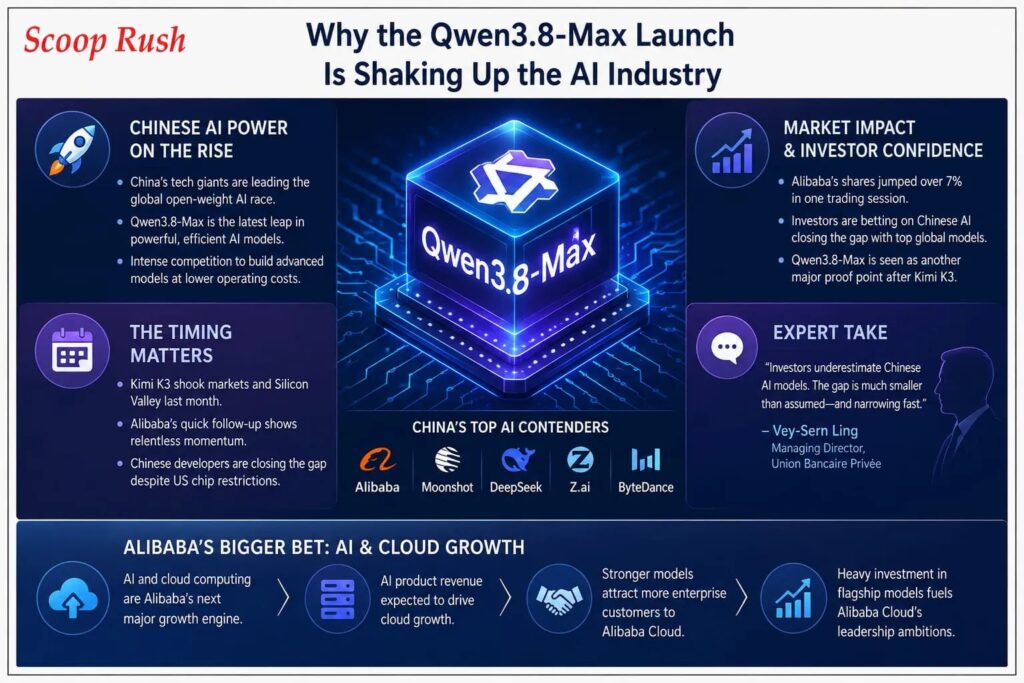
China’s tech companies have become a major force in open-weight AI models globally. They’re locked in an intense, fast-moving competition to build more powerful systems without making them too expensive to operate. Qwen3.8-Max is the latest proof of just how quickly that race is moving.
The timing is especially significant. Moonshot’s Kimi K3 sent shockwaves through stock markets and Silicon Valley last month. It demonstrated that Chinese developers could rapidly close the gap with leading US labs, despite facing tighter restrictions on advanced computing hardware. Alibaba’s release just weeks later suggests that momentum isn’t slowing down.
Vey-Sern Ling, managing director at Union Bancaire Privée, said many investors still underestimate Chinese AI models due to US chip restrictions or general skepticism. He added that in reality, the gap is likely much smaller than assumed and is narrowing quickly. He called Qwen3.8-Max another proof point following Kimi K3.
That sentiment appears to be reflected in the market reaction. Alibaba’s shares jumping over 7% in a single trading session shows investors are increasingly willing to bet on Chinese AI capabilities catching up to, or even matching, top-tier Western systems in certain areas, much like SpaceX’s own headline-making moment when SpaceX’s IPO made history on Nasdaq.
Alibaba’s Bigger Bet on AI and Cloud Growth
This release fits into a broader strategy at Alibaba. The company has been positioning AI and cloud computing as its primary growth engine for the next phase of its business. Earlier this year, Alibaba CEO Eddie Wu said the company expects AI-related product revenue to become the main driver of growth for its cloud segment.
That context helps explain why Alibaba is investing so heavily in flagship models like Qwen3.8-Max. Every improvement in benchmark rankings and real-world performance strengthens Alibaba Cloud’s pitch to enterprise customers shopping around for AI infrastructure providers, the same customers being courted by rivals building tools like Google’s efficiency-focused AI chip.
The competition isn’t limited to Alibaba and Moonshot either. DeepSeek, Z.ai, and ByteDance are all racing to release increasingly capable systems, turning China’s AI sector into one of the most competitive corners of the entire tech industry. Meanwhile, Moonshot recently secured a computing power deal with Alibaba for 20,000 Nvidia chips, showing how these companies are simultaneously rivals and, in some cases, business partners.
Key Takeaways
Alibaba’s Qwen3.8-Max represents a major step forward for Chinese AI development. With 2.4 trillion parameters, strong benchmark rankings, and an efficient mixture-of-experts design, the model positions itself as a serious global contender. It ranks fifth on the Text Arena leaderboard and second on the Vision Arena leaderboard, trailing only Anthropic’s top offerings.
Beyond the technical specs, this launch signals something bigger. Chinese AI labs are proving they can build frontier-level systems despite facing chip restrictions. Furthermore, they’re doing it through open-weight releases that invite global developers to build on their work. As a result, the competitive distance between Chinese and Western AI companies appears to be shrinking faster than many expected.
Investors have taken notice, and so has the broader tech industry. With Qwen3.8-Max set to launch fully next week, the coming months will reveal whether Alibaba can maintain this momentum as Moonshot, DeepSeek, and other rivals continue pushing their own models forward.
FAQs
What is Qwen3.8-Max?
Qwen3.8-Max is Alibaba’s newest and most capable AI model, built with 2.4 trillion parameters. It handles text, images, and video, and can process up to 1 million tokens in a single request.
How does Qwen3.8-Max compare to Moonshot’s Kimi K3?
Kimi K3 has more parameters at 2.8 trillion. However, Qwen3.8-Max ranks higher on several key benchmarks, including Arena.AI’s text and vision leaderboards.
When will Qwen3.8-Max be available?
Alibaba plans to release Qwen3.8-Max next week through Alibaba Cloud’s Model Studio platform, along with public access to the model’s weights for developers to download.
What makes Qwen3.8-Max more efficient than other large AI models?
It uses a mixture-of-experts design, which activates only about 95 billion of its 2.4 trillion parameters for any given task. This reduces computing costs and speeds up response times.
Why did Alibaba’s stock rise after the Qwen3.8-Max announcement?
Investors responded positively to the model’s strong benchmark performance and its position close to Anthropic’s top systems. This is viewed as evidence that Chinese AI labs are rapidly narrowing the gap with US competitors.

