
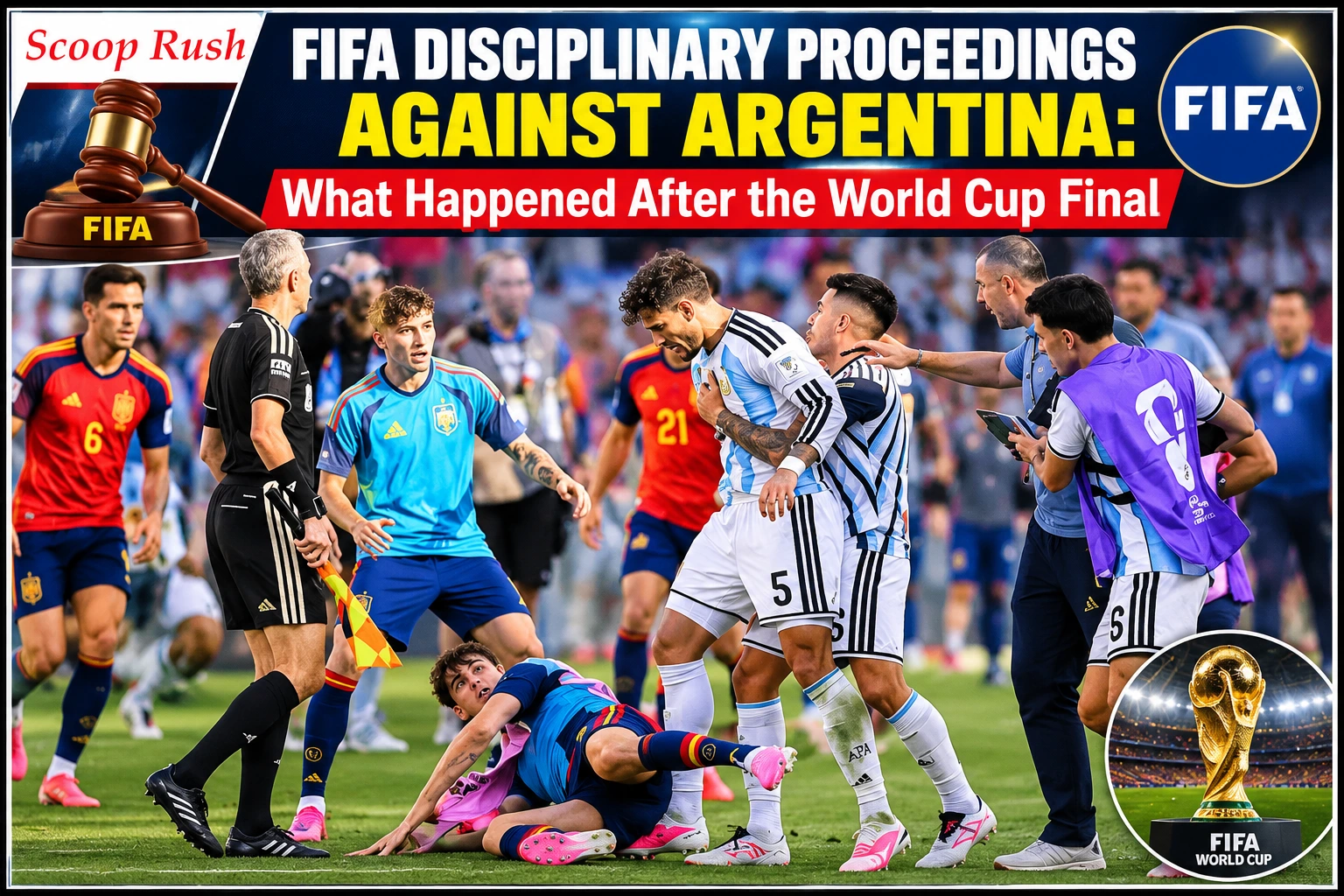
Football fans rarely expect a World Cup final to end in chaos off the pitch. Yet that is exactly what happened after Spain beat Argentina 1-0 at the New York New Jersey Stadium, and now FIFA disciplinary proceedings against Argentina have officially begun.
The final whistle should have marked a moment of heartbreak for Argentina and celebration for Spain. Instead, it triggered a fracas involving players and staff from both sides. Weeks later, the fallout is turning into one of the biggest off-field stories of the tournament.
So why does this matter to fans beyond Argentina and Spain? Because the outcome of these proceedings could shape how FIFA handles player conduct, political messaging, and crowd behavior at future tournaments. Whatever happens next will set a precedent that other federations will watch closely.
In this article, we break down exactly what happened, who is involved, and what could come next in this fast-developing story.
Why FIFA Disciplinary Proceedings Against Argentina Have Been Opened
According to BBC Sport, FIFA has opened disciplinary proceedings against Argentina following their behavior after the World Cup final loss to Spain, as well as their conduct throughout the tournament. This is not a single isolated incident. It covers a pattern of behavior that FIFA believes needs formal review.
Last week, FIFA appointed a disciplinary and ethics prosecutor specifically to assess what happened after the final whistle. That investigation has now produced clear recommendations, and FIFA is moving forward based on them.
This matters because FIFA rarely opens proceedings of this scale against a national federation right after a World Cup final. The fact that it is happening now signals how seriously the governing body views the incidents.
The Post-Match Fracas That Started It All
The trouble began immediately after Spain secured their second World Cup title with a narrow 1-0 win. Multiple Argentina players and backroom staff became involved in altercations with Spain players once the game ended.
For a match that should have closed with handshakes and mutual respect, the scenes instead raised serious questions. Consequently, FIFA felt compelled to act quickly rather than let the matter fade after the tournament wrapped up.
Which Players and Staff Are Under Investigation
Based on the prosecutor’s recommendation, FIFA will investigate several individuals connected to Argentina’s team. Understanding exactly who is named, and under which article of FIFA’s disciplinary code, helps explain how serious these charges could be.
Nahuel Molina and Leandro Paredes Face Assault Charges
Argentina defender Nahuel Molina faces two counts of alleged assault, while midfielder Leandro Paredes faces three counts. Both charges fall under article 14 of FIFA’s disciplinary code, which deals specifically with assault allegations.
Molina is additionally facing one count of alleged unsporting behavior, also under article 14. This means Molina alone could be looking at charges across two separate categories of misconduct.
Roberto Ayala Named as Well
Argentina assistant coach Roberto Ayala has also been named in the investigation, facing one count of alleged assault. His inclusion shows that FIFA’s proceedings extend beyond the playing squad and into the coaching staff, which adds another layer of seriousness to the case.
Thiago Almada and Gavi Both Named for Unsporting Behavior
Interestingly, the unsporting behavior charge is not limited to Argentina. Team-mate Thiago Almada and Spain midfielder Gavi are also accused of the same breach. This detail is important, since it shows FIFA’s investigation is not treating the incident as entirely one-sided, even though the bulk of the disciplinary action centers on Argentina.
What Punishments Could Argentina’s Players Face
Under FIFA’s disciplinary code, the potential penalties are clearly defined. Players and officials found guilty of unsportsmanlike conduct face a suspension of at least one match. Meanwhile, those found guilty of assault face a minimum three-match ban.
Given that Paredes faces three separate assault counts and Molina faces two, the cumulative punishment could be significant if FIFA finds the allegations substantiated. However, it is worth remembering that these are currently allegations under investigation, not confirmed rulings.
As a result, fans and pundits alike will be watching closely to see how FIFA balances the severity of the incidents with fairness toward the individuals involved.
The Broader Case Against the Argentinian Football Association
The disciplinary proceedings do not stop at individual players and staff. The Argentinian Football Association itself is facing scrutiny for potential breaches across multiple matches during the tournament, not just the final.
This broader case spans four separate articles of FIFA’s disciplinary code, each covering a different type of alleged misconduct.
Article 13: Non-Sporting Demonstrations
The first charge relates to using a sports event for demonstrations of a non-sporting nature. This connects directly to an incident from earlier in the tournament that had already drawn FIFA’s attention.
Article 14: Team Misconduct
Beyond the assault charges against individuals, the Argentinian Football Association also faces a broader team misconduct charge under article 14. This suggests FIFA views the post-final incident as reflecting on the team as a whole, not just the specific players involved.
Article 15: Discrimination and Racist Abuse
Perhaps the most serious of the federation-level charges, article 15 covers discrimination and racist abuse. FIFA has strict zero-tolerance policies around discriminatory conduct, and any breach here typically carries significant consequences for a federation.
Article 17: Breaching Order and Security
The final charge relates to breaching order and security at matches. According to the article, this covers several specific issues including discriminatory chants and gestures, late kick-offs, inappropriate messages displayed by the team and spectators, and objects being thrown by fans during matches.
The Falklands Banner Controversy Explained
One of the most talked-about incidents feeding into this broader investigation happened well before the final. After Argentina’s semi-final win over England, players celebrated by displaying a banner reading “Las Malvinas son Argentinas,” which translates as “The Falklands are Argentine.”
This banner reignited a politically sensitive topic tied to the long-standing dispute between Argentina and the United Kingdom over the Falkland Islands. FIFA had already confirmed it was assessing match reports over the banner before the final even took place.
This earlier incident is now part of the wider article 13 charge relating to non-sporting demonstrations. It shows how FIFA’s current disciplinary proceedings against Argentina are not solely about the final, but about a pattern of behavior across the tournament.
Why This Story Matters for the Future of Football
Some readers might wonder why any of this deserves this much attention. After all, tempers flare in football, and emotional moments after a World Cup final are hardly unprecedented.
However, the scale of these proceedings is unusual. FIFA is simultaneously investigating individual players for assault, a coaching staff member, and the national federation itself across four different disciplinary articles. Additionally, the case touches on politically sensitive symbolism, crowd behavior, and player conduct all at once.
Therefore, how FIFA rules on this case will likely influence how future federations and players behave during high-stakes matches. A strong disciplinary response could serve as a deterrent. A lenient one might raise questions about consistency in how FIFA enforces its own code.
Meanwhile, fans of both Argentina and Spain are left waiting to see how their teams’ reputations might be affected heading into future competitions.
What Happens Next
FIFA has not yet announced final rulings or specific suspensions. The current stage involves formal disciplinary proceedings based on the prosecutor’s recommendations. This means hearings, evidence review, and formal findings are still to come before any punishments are confirmed.
Fans should expect further updates as FIFA works through the individual cases against Molina, Paredes, and Ayala, as well as the broader federation-level charges against the Argentinian Football Association. Ultimately, the final outcome will depend on the evidence gathered and how FIFA’s disciplinary committee interprets the events under each relevant article.
Conclusion
The FIFA disciplinary proceedings against Argentina mark one of the most significant off-field football stories following this year’s World Cup final. What started as a post-match fracas has expanded into a wide-ranging investigation covering assault allegations against individual players and staff, unsporting conduct charges, and federation-level breaches involving discrimination, security, and political demonstrations.
With Nahuel Molina, Leandro Paredes, and Roberto Ayala all named in the case, and the Argentinian Football Association facing scrutiny across multiple articles of FIFA’s disciplinary code, the stakes are high. As a result, the football world will be watching closely to see how FIFA balances accountability with fairness in the weeks ahead.
Frequently Asked Questions
1. Why has FIFA opened disciplinary proceedings against Argentina?
FIFA opened proceedings after a fracas broke out between Argentina and Spain players and staff following the World Cup final, which Spain won 1-0. The investigation also covers Argentina’s conduct throughout the tournament.
2. Which Argentina players are facing FIFA charges?
Nahuel Molina faces two counts of alleged assault and one count of unsporting behavior. Leandro Paredes faces three counts of alleged assault. Assistant coach Roberto Ayala faces one count of alleged assault.
3. Is Spain involved in the FIFA investigation too?
Yes. Spain midfielder Gavi is also being investigated for alleged unsporting behavior alongside Argentina’s Thiago Almada, although the majority of charges relate to Argentina.
4. What is the Falklands banner controversy about?
After beating England in the semi-final, Argentina’s players displayed a banner reading “Las Malvinas son Argentinas,” referencing the disputed Falkland Islands. FIFA was already reviewing this before opening the broader disciplinary case.
5. What punishments could Argentina face if found guilty?
Under FIFA’s disciplinary code, unsporting conduct carries a minimum one-match suspension, while assault charges carry a minimum three-match ban. The Argentinian Football Association could also face separate sanctions as a federation.

