
Tesla just got caught in the middle of a merger storm. One report claimed a Tesla China sale was quietly in the works, and Elon Musk wasted no time firing back.
Introduction
“Is a Tesla China sale really on the table? That’s the question sending shockwaves through investors this week after a bombshell report claimed the EV giant was quietly preparing to sell or separate its Chinese operations. Elon Musk fired back within hours, calling the story “absurdly fake news.” However, the details behind the report have left plenty of people wanting answers.
This story matters because it touches two of the most valuable companies on the planet. Tesla and SpaceX are both worth well over a trillion dollars, and any hint of a merger between them sends ripples through the stock market. Additionally, for everyday investors, EV shoppers, and anyone following Musk’s business empire, understanding what’s actually happening with Tesla’s China business could shape decisions for months to come.
What The Tesla China Sale Report Actually Claimed
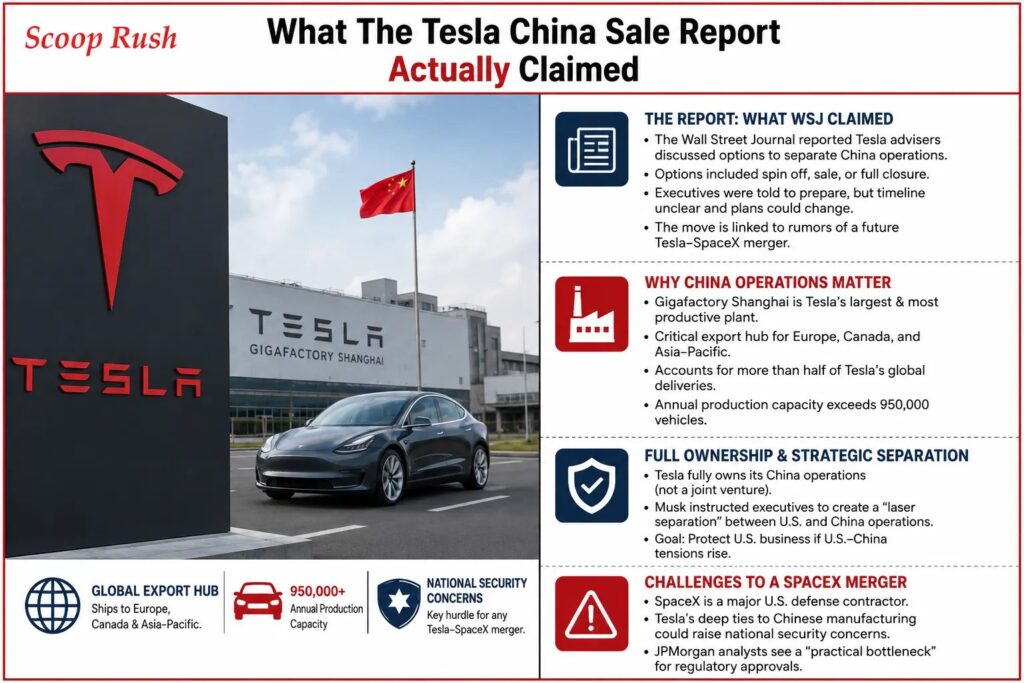
The Wall Street Journal reported on Thursday that Tesla advisers had discussed several options for separating the company’s China operations. These options reportedly included a spin off, an outright sale, or even a full closure of the business. According to the report, executives were told to prepare for this separation, although the timeline remained unclear and the plans could still change.
Furthermore, the report connected this potential move to persistent rumors about a future merger between Tesla and SpaceX. A combination like that would face serious hurdles, mainly because SpaceX operates as a major U.S. defense contractor. Meanwhile, Tesla runs large manufacturing facilities inside China, which could create national security concerns if the two companies became one.
Why Tesla’s China Operations Complicate a SpaceX Merger
Tesla’s Gigafactory Shanghai is not just another factory. It stands as the company’s largest and most productive plant worldwide. The facility serves as a critical export hub, shipping vehicles to Europe, Canada, and the wider Asia-Pacific region. In fact, this single plant has historically accounted for more than half of Tesla’s global deliveries, with an annual production capacity exceeding 950,000 vehicles.
Unlike many foreign automakers operating in China, Tesla did not structure its Chinese business as a joint venture with a local partner. This gives Tesla full ownership and control. Additionally, Musk reportedly instructed Tesla executives years ago to build a clear “laser” separation between the company’s U.S. and China operations. The goal was to protect the American half of the business if geopolitical tensions between the two countries ever worsened.
Because SpaceX handles sensitive government contracts, any merger involving a company with deep ties to Chinese manufacturing would likely draw intense regulatory scrutiny. JPMorgan analysts have already pointed to a “practical bottleneck” for approvals, particularly given China’s national security concerns around SpaceX’s U.S. government relationships.
Musk’s Response To The Tesla China Sale Rumors
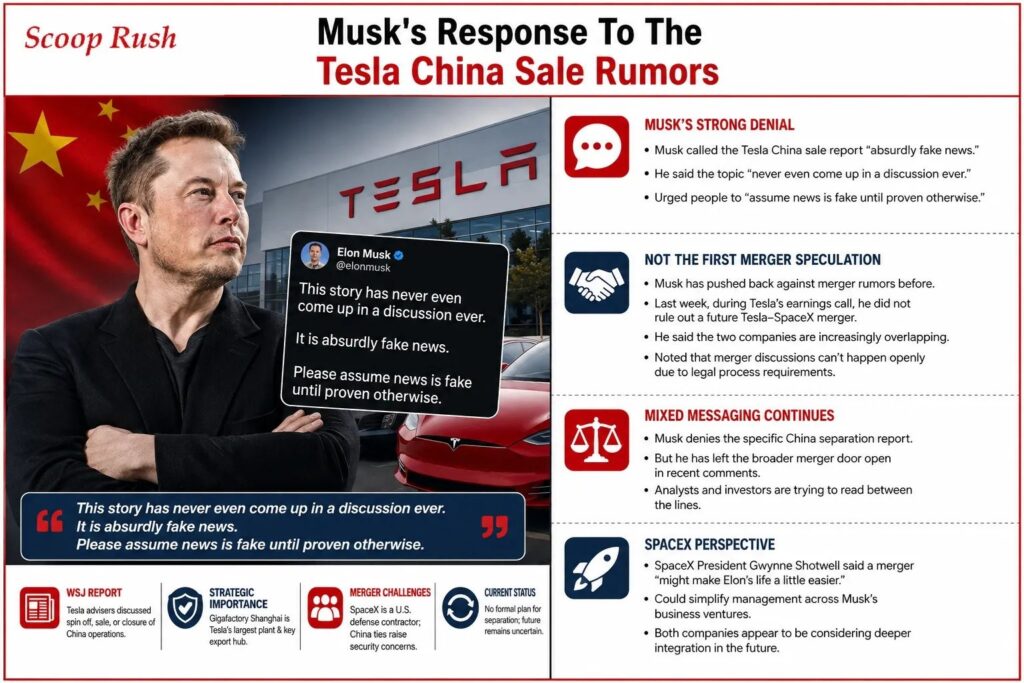
Musk did not waste time addressing the report. Responding to a post from a Tesla-focused account, he wrote that the story had “never even come up in a discussion ever.” He went further, describing it as “absurdly fake news” and urging people to “assume news is fake until proven otherwise.”
This is not the first time Musk has pushed back hard against merger speculation. Interestingly, though, he has not always denied the possibility of a Tesla-SpaceX combination. Just last week, during Tesla’s earnings call, Musk declined to rule out a future merger. He noted that the two companies are increasingly overlapping in their operations, and he acknowledged that combining companies is not something that can be discussed openly during an earnings call due to legal process requirements.
Consequently, this mixed messaging has left many analysts and investors trying to read between the lines. On one hand, Musk firmly denies the specific China separation report. On the other hand, he has left the broader merger door open in recent public comments.
The SpaceX Perspective On A Potential Merger
SpaceX’s own leadership has hinted at potential benefits from a closer relationship with Tesla. Gwynne Shotwell, SpaceX’s President and Chief Operating Officer, told CNBC in June that folding the companies together “might make Elon’s life a little easier” by simplifying management across Musk’s various business ventures.
This comment adds another layer to the story. Even if no formal separation plan exists today, executives at both companies appear to be thinking about how their businesses could eventually work more closely together.
Tesla’s Deep Roots In The China Market
China represents Tesla’s second-largest market globally, trailing only the United States. The company sources more than 95% of the components used in its China-made Model 3 and the refreshed Model Y locally. This localization strategy involves more than 400 domestic suppliers, and more than 60 of these suppliers also provide parts to Tesla’s operations worldwide.
Recent sales numbers show just how important this market remains. Deliveries of China-made Model 3 and Model Y vehicles rose 24.4% year-over-year in June. Meanwhile, second-quarter sales and exports from the Shanghai factory increased by 32.8%. These figures suggest strong momentum, even as Tesla faces intense competition from local rivals like BYD.
Given these numbers, any move to sell or spin off the China business would represent a massive shift in strategy. Consequently, many industry observers find it difficult to imagine Tesla walking away from such a productive and profitable operation without extremely compelling reasons.
Market Reaction Stays Muted
Despite the dramatic headlines, the market response remained relatively calm. Shares of Tesla were up about 2% in premarket trading following the report and Musk’s denial. This modest movement suggests that investors are not yet treating the story as confirmed or particularly alarming.
Tesla and SpaceX did not immediately respond to requests for comment outside regular business hours, which is common practice for breaking financial news that emerges outside standard trading periods.
Why Tesla-SpaceX Merger Speculation Keeps Resurfacing
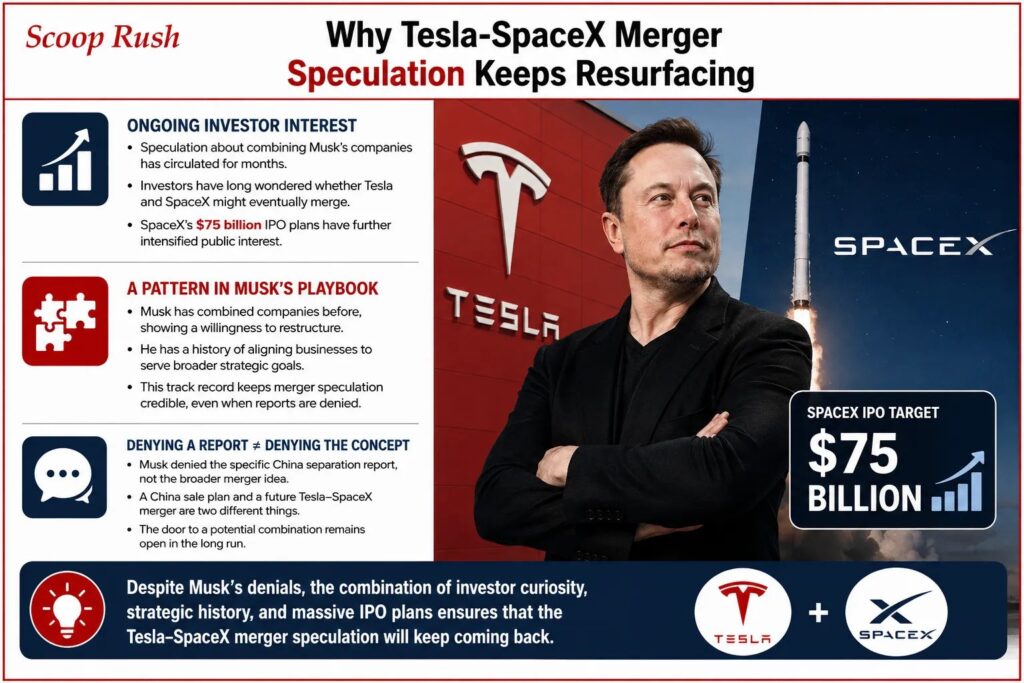
Speculation about combining Musk’s companies has circulated for months. Investors have long wondered whether Tesla and SpaceX might eventually merge, especially as SpaceX pursued its massive $75 billion initial public offering. That IPO process intensified public interest in how Musk’s various business interests might consolidate over time.
Furthermore, this pattern is not unprecedented in Musk’s career. He has combined companies before, showing a willingness to restructure his business empire when it suits his broader strategic goals. This history gives some credibility to ongoing merger speculation, even when specific reports get denied.
Still, denying a report and denying an entire concept are two different things. Musk’s statement focused specifically on the China separation plan, not on the broader question of whether Tesla and SpaceX might eventually combine in some form.
What Happens Next For Tesla And SpaceX
For now, the situation remains unresolved. The Wall Street Journal’s sources indicated that any separation plans could still change, and no clear timeline exists for when or if Tesla might act on these discussions. Therefore, investors and industry watchers will likely continue monitoring both companies closely for further signals.
Tesla’s next moves in China will be worth watching, especially given the strong sales momentum reported in recent months. Additionally, any further comments from Musk, whether on X or during future earnings calls, could offer more clarity about his long-term plans for both companies.
Conclusion
Elon Musk has firmly rejected reports that Tesla is preparing to sell or spin off its China business ahead of a potential SpaceX merger. He called the story “absurdly fake news” and insisted the topic had never been discussed. However, his own recent comments about growing overlap between Tesla and SpaceX suggest that broader merger speculation is unlikely to disappear anytime soon.
China remains a vital part of Tesla’s global operations, contributing significantly to both production and sales. Any move to separate this business would carry enormous consequences for the company’s bottom line. As this story continues to develop, staying informed on official statements from Tesla and SpaceX will be the best way to separate fact from speculation.
FAQs
Did Elon Musk confirm or deny the Tesla China sale report?
Musk denied the report, calling it “absurdly fake news” and stating that a separation of Tesla’s China business has never come up in any discussion.
Why would Tesla consider separating its China business?
The report suggested that separating Tesla’s China operations could reduce regulatory and national security hurdles ahead of a potential merger with SpaceX, since SpaceX is a major U.S. defense contractor.
How important is China to Tesla’s overall business?
China is Tesla’s second-largest market globally. The Gigafactory Shanghai plant has historically accounted for more than half of Tesla’s global deliveries and serves as a key export hub.
Has Elon Musk talked about merging Tesla and SpaceX before?
Yes. During Tesla’s most recent earnings call, Musk declined to rule out a future merger, noting that the two companies are increasingly overlapping in their operations.
How did Tesla’s stock react to the report?
Tesla shares rose about 2% in premarket trading after the report and Musk’s denial, suggesting investors did not view the story as a major immediate concern.

