
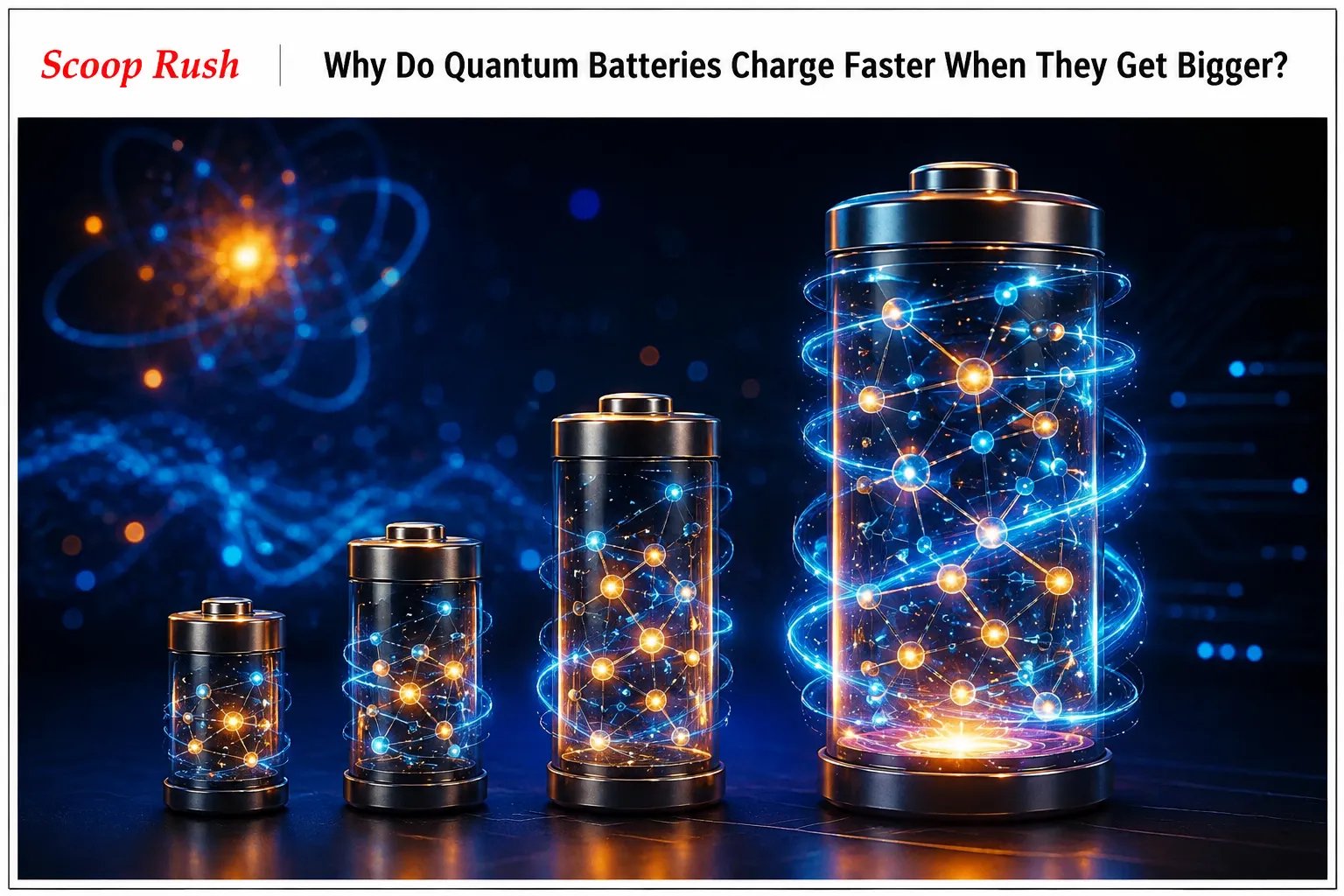
Imagine a battery that breaks the one rule every phone and EV owner knows by heart: the bigger it is, the longer it takes to charge. Now imagine the opposite happening instead. That is precisely what scientists have just built with a new quantum battery, and it is rewriting the basic physics of energy storage.
Everyone assumes size slows charging down. A laptop takes hours. An EV takes all night. However, a new quantum battery prototype flips this logic completely, charging faster the larger it becomes. In March 2026, a research team led by CSIRO scientist James Quach unveiled what they call the world’s first working quantum battery, and its behavior could eventually reshape how we think about powering everything from quantum computers to everyday gadgets.
What Is a Quantum Battery and How Is It Different?
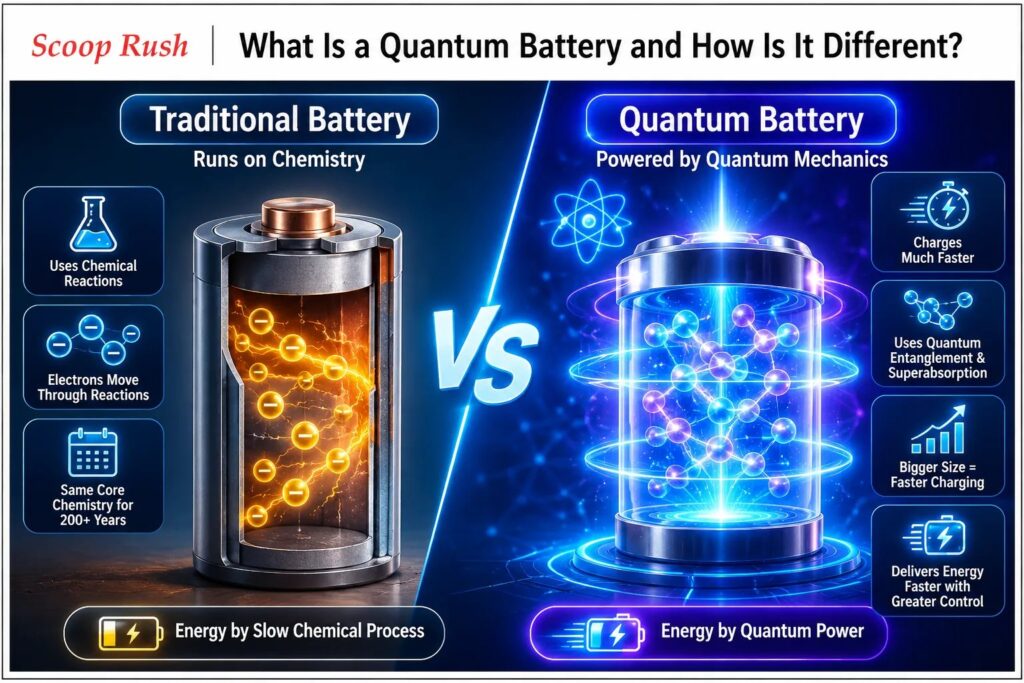
Traditional batteries run on chemistry. Inside them, more than 10 billion billion electrons rush through chemical reactions to release power. According to Dario Ferraro, associate professor of physics at the University of Genova, modern batteries still depend on electrochemical processes first explored over two centuries ago. Despite years of engineering progress, that core chemistry has barely changed.
Quantum batteries take a fundamentally different route. Instead of chemical reactions, they harness quantum mechanics, the physics that governs matter at the atomic and subatomic level. As Quach explains, quantum mechanics “sort of flips that on its head” when it comes to charging speed.
This idea is not brand new. A milestone paper from 2015 first suggested that quantum entanglement could let batteries charge and discharge more efficiently than conventional ones. That theory quietly laid the groundwork for the experiments now happening in real labs, echoing the kind of foundational thinking that once shaped Alan Turing’s early ideas about machine intelligence. Ferraro sums up the goal simply: quantum batteries are not built to store huge amounts of energy. Instead, they focus on delivering that energy faster and with far greater control.
The Science of Superabsorption
The real magic behind this quantum battery breakthrough lies in a phenomenon called superabsorption. To create it, Quach’s team built an optical microcavity, a tiny setup where two mirrors sit just 100 nanometers apart, about a thousand times thinner than a human hair. Organic dye molecules fill that narrow gap, and a laser beams light directly into it.
Once the laser hits, the light and molecules become strongly coupled, forming hybrid light-matter states. This coupling boosts the system’s ability to absorb and hold energy. In ordinary batteries, molecules behave like individual workers, each absorbing energy on its own. Quantum batteries behave very differently.
“They act in unison and synergise,” Quach says, “so that the rate at which you can absorb energy increases with the number of molecules there are.” Simply put, more molecules mean faster charging, not slower. This single fact is the opposite of everything we know about conventional battery technology, and it explains why scientists are paying close attention.
Inside the World’s First Working Quantum Battery
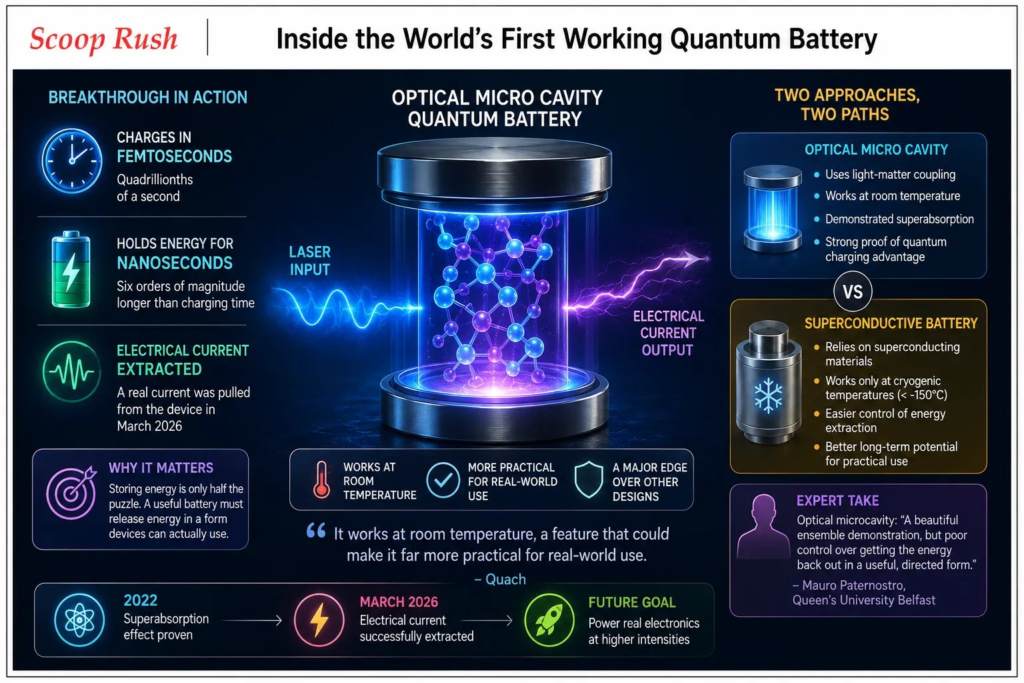
Quach’s prototype charged in femtoseconds, which are quadrillionths of a second. Afterward, it held that energy for nanoseconds, roughly six orders of magnitude longer than the charging time itself. The team first proved the superabsorption effect back in 2022. Then, in March 2026, they achieved something new: pulling an actual electrical current out of the device.
This step matters because storing energy is only half the puzzle. A useful battery must also release that energy in a form devices can actually use. At higher intensities, researchers believe this extracted current could eventually help power real electronics, though that remains a distant goal for now, not unlike the incremental progress seen in MIT’s lidar chip research for self-driving cars.
Quach’s optical microcavity approach is not the only method researchers are testing. Another design relies on superconductive materials, technology already common in quantum computing. Superconductive batteries, however, only work at cryogenic temperatures below -150°C. Quach points out that while this suits quantum computers just fine, it is “not so useful to power your mobile phone.”
The optical microcavity design has one clear edge here. Consequently, it works at room temperature, a feature that could make it far more practical for real-world use compared to its superconducting rival.
Mauro Paternostro, a quantum physicist at Queen’s University Belfast, offers a balanced take on both methods. He believes the optical microcavity route currently offers the strongest proof that quantum charging advantages are genuine physics rather than theory. Meanwhile, he suspects superconductive designs may hold the long-term advantage for practical applications, since extracting energy from them is easier to control. As he puts it, a microcavity delivers “a beautiful ensemble demonstration, but poor control over getting the energy back out in a useful, directed form.”
Why Are Scientists Still Cautious About This Technology?
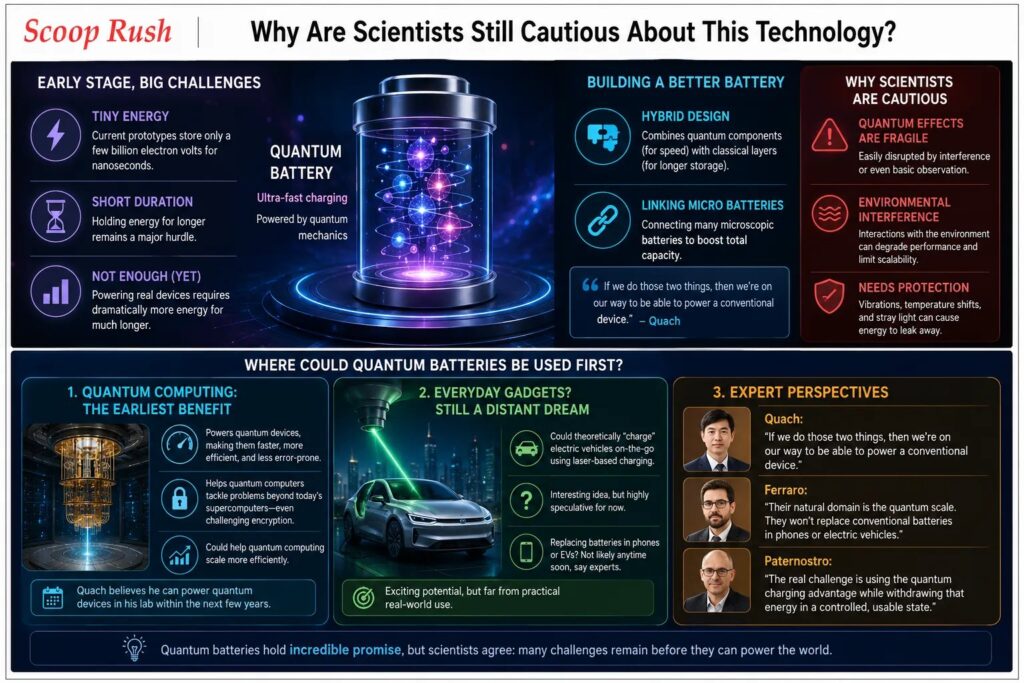
Despite the excitement, this quantum battery technology remains firmly in its early stages. Quach’s current prototype holds only a tiny amount of energy, roughly a few billion electron volts, for a matter of nanoseconds. Therefore, powering anything resembling a real device would require storing dramatically more energy for a dramatically longer time.
Quach says he has already made progress here. His team built a new hybrid design that pairs quantum components for ultra-fast charging with classical layers that hold energy longer. He is currently preparing to publish these findings. Additionally, he plans to link many microscopic quantum batteries together to increase total capacity. “If we do those two things,” he says, “then we’re on our way to be able to power a conventional device.”
Still, not every expert is convinced this will scale into something practical. Quantum effects are famously fragile and can be disrupted by outside interference or even basic observation. Ferraro warns that interactions with the environment can quickly degrade these effects, limiting both performance and scalability. He calls solving this issue “crucial to moving quantum batteries from theory to real-world applications.”
Protecting these systems takes serious effort. Scientists must shield quantum batteries from vibrations, temperature shifts, and stray light, since any outside interaction can cause stored energy to leak away entirely.
Where Could Quantum Batteries Actually Be Used First?
So where might this technology land first? Most experts agree quantum computing will likely see the earliest real benefit. Quantum computers promise to complete certain tasks far faster than today’s supercomputers, and researchers have warned they could eventually challenge global encryption systems, a concern already surfacing in debates about AI systems going rogue and data security more broadly.
Quach believes he can power quantum devices in his own lab within the next few years. If he succeeds, this could reduce the energy quantum computers consume while also making them faster and less error-prone. As a result, that combination could help quantum computing scale up more efficiently than it currently can, at a time when even tech giants are wrestling with AI spending and negative cash flow tied to compute-hungry systems.
Powering everyday gadgets is a different story altogether. Quach remains less confident here, though he has not ruled it out completely. Since the battery charges via laser, he suggests it could theoretically “charge electric vehicles on-the-go,” removing the need for drivers to stop and recharge at all. Even so, this scenario stays firmly speculative rather than imminent, much like other bold predictions about whether AI will replace your job anytime soon.
Ferraro takes a more doubtful stance on consumer applications. He does not think quantum batteries will ever replace conventional batteries in phones or electric vehicles. “Their natural domain is the quantum scale,” he says, suggesting these devices suit specialized quantum systems far better than mass-market electronics.
Paternostro frames the biggest remaining obstacle plainly. The real challenge is using the quantum charging advantage while also withdrawing that energy in a controlled, usable state. Whoever solves that problem, he says, “will have made the real breakthrough.”
The Bigger Picture for Quantum Battery Research
It helps to remember that not every futuristic technology lives up to its early hype. A recent paper grouped quantum computers alongside fusion energy and brain-computer interfaces as technologies that always seem to be “five years away.” Quantum batteries could easily fall into that same pattern if progress slows, similar to how skepticism has followed other ambitious efforts like AI-designed viruses out of Stanford.
For now, though, this research marks a genuine scientific milestone. Building a working prototype that demonstrates superabsorption and successfully extracts real electrical current is meaningful progress, even though commercial use remains years or decades off. As Quach and his team refine their hybrid designs further, the next few years should reveal whether quantum batteries can move beyond the lab and into something with real practical value.
Conclusion
This quantum battery breakthrough challenges a basic rule of energy storage by charging faster as it grows bigger, thanks to a quantum effect called superabsorption. CSIRO’s prototype has already proven this behavior is real, briefly storing energy and successfully pulling an electrical current from it. However, major obstacles remain, including tiny energy capacity, extremely short storage times, and the fragile nature of quantum states.
Quantum computing looks like the most realistic first application, and researchers hope it will improve efficiency while reducing errors in quantum systems. Powering phones or electric vehicles remains a much more distant possibility, and some scientists doubt it will ever happen at all. Ultimately, this research represents an important early chapter in a technology that could someday reshape how we think about charging, even though the biggest breakthroughs likely still lie ahead.
FAQs About Quantum Batteries
What is a quantum battery?
A quantum battery is a device that stores and releases energy using quantum mechanical effects, such as superabsorption, instead of the chemical reactions found in conventional batteries.
Why do quantum batteries charge faster as they get bigger?
Quantum batteries rely on superabsorption, a process where molecules act collectively rather than independently. As more molecules join the system, it absorbs energy at a faster combined rate, unlike traditional batteries that slow down as they scale up.
Can quantum batteries power phones or electric cars someday?
Not yet. Current prototypes hold only a tiny amount of energy for a few nanoseconds. Some researchers believe laser-based wireless charging could eventually help electric vehicles, but many scientists doubt this technology will ever reach everyday consumer devices.
How does the quantum battery prototype actually work?
It uses an optical microcavity, where two mirrors sit 100 nanometers apart with organic dye molecules in between. A laser excites these molecules, causing them to form hybrid light-matter states that boost energy absorption and storage.
What is the biggest challenge facing quantum battery technology today?
Quantum effects are extremely fragile and easily disrupted by outside interference. Scientists must find ways to extend storage time and extract energy in a controlled, usable form while keeping the system fully isolated from environmental disturbances.

