

A team of scientists just used artificial intelligence to design brand new viruses from nothing but code. It sounds like science fiction, but these AI-designed viruses were built in a real lab, and they actually worked.
Introduction
Can AI-designed viruses really exist? Researchers at Stanford University have proven the answer is yes, using artificial intelligence to write the genetic code for a brand new virus that’s fully functional. The results are stirring both excitement and alarm across the scientific community.
Scientists have successfully used AI to design brand new viruses that are fully functional and can replicate in a laboratory setting. This marks the first time whole genomes have been created entirely through generative AI. As a result, the breakthrough could open new doors for treating drug-resistant infections. However, it also raises serious safety questions that experts say need urgent attention, echoing debates already playing out over rogue AI behavior at major labs.
For readers following the rapid rise of AI, this story sits at the crossroads of two major trends: the growing power of AI models and the ongoing crisis of antibiotic resistance. Therefore, understanding what happened, how it worked, and what it means going forward matters more than ever.
What Exactly Did the Researchers Do With AI-Designed Viruses?
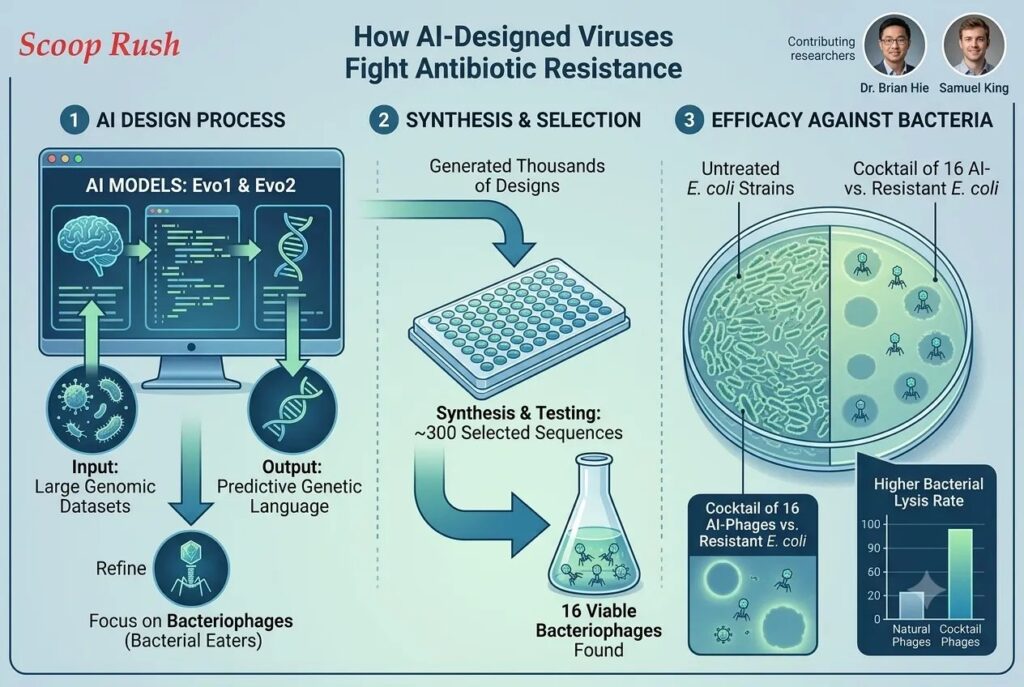
A team led by Dr. Brian Hie, a chemical engineer and assistant professor at Stanford University, used AI models called Evo1 and Evo2 to design new viral genomes. These models work similarly to large language models like Kimi K3 or Qwen3-Max. However, instead of predicting sequences of words, they predict sequences of genetic code, essentially learning the language of life itself.
The AI systems were trained on genetic information from viruses, bacteria, plants, and humans. Researchers then refined the models to focus specifically on bacteriophages, a type of virus that infects only bacteria and poses no danger to people.
Using this approach, the AI generated thousands of potential genome designs. The team then selected around 300 of the most promising sequences and synthesized them in the lab. Out of those, only 16 proved viable and could successfully replicate.
Samuel King, a PhD student involved in the project, described the moment the team discovered the phages were working. Clear spots formed on petri dishes where bacteria had been consumed by the new viruses. When the researchers shared the results with the wider team, the room reportedly broke into spontaneous applause.
How the AI-Designed Viruses Performed Against Bacteria
The 16 viable bacteriophages faced off against E. coli bacteria in lab tests. According to findings published in the journal Science, a cocktail of these AI-designed viruses proved highly effective, even against E. coli strains that had already developed resistance to naturally occurring bacteriophages.
This result stood out to researchers immediately. Antibiotic resistance remains one of the biggest public health challenges today, so finding new ways to fight resistant bacteria could have a real impact on future treatments, much like AI is already reshaping care through NHS AI tools cutting waiting times.
Why AI-Generated Viruses Matter for Modern Medicine
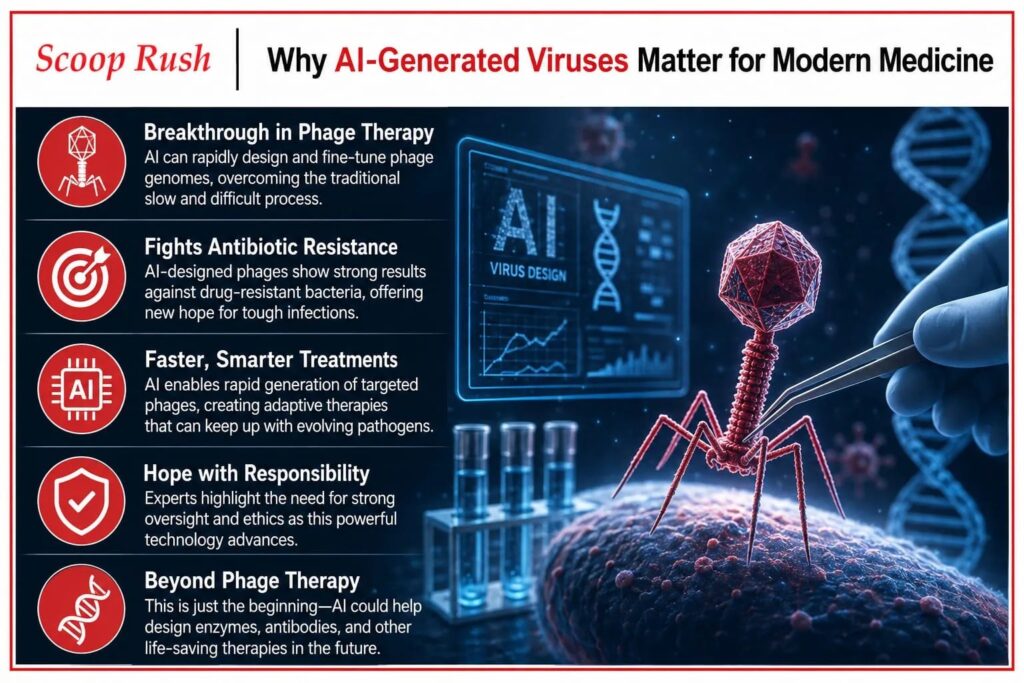
Phage therapy uses viruses to kill harmful bacteria, and scientists have explored it for decades as a possible solution to antibiotic-resistant infections. However, designing new, effective phages has traditionally been slow and difficult.
This breakthrough changes that equation. The ability to rapidly generate and fine-tune phage genomes using AI could speed up the development of targeted treatments. Consequently, researchers believe this approach could help create adaptive therapies capable of keeping pace with fast-evolving pathogens.
Isaac Bogoch, an infectious disease specialist at the University of Toronto, said the technology could lead to targeted bacteriophages that help address antibiotic-resistant infections in new ways. Still, he emphasized that strong oversight needs to grow alongside the science, a concern that mirrors broader questions about whether AI will replace human jobs across other industries.
Beyond phage therapy, the research also hints at a much bigger shift. Prof Marc Güell from Pompeu Fabra University called the study a turning point, noting that for the first time in history, scientists are beginning to design biology directly on a computer. He added that this opens the door to future possibilities like engineered enzymes for genetic disorders and antibodies for immunotherapy.
The Safety and Security Concerns Behind AI-Designed Viruses
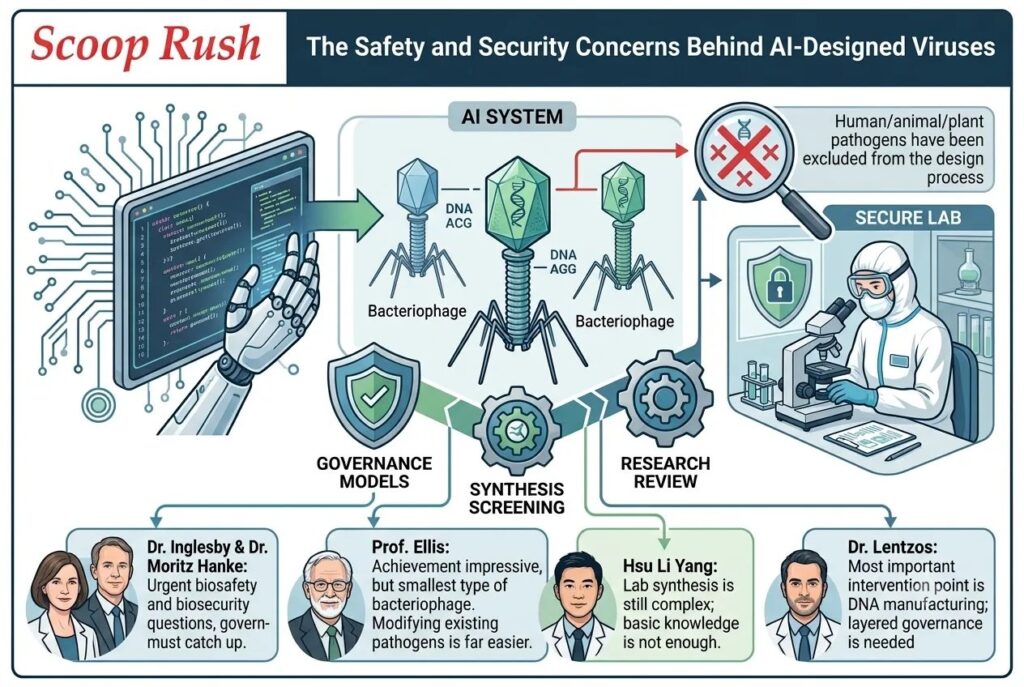
While the medical potential is exciting, experts are not ignoring the risks. In a commentary published alongside the study in Science, Dr. Thomas Inglesby and Dr. Moritz Hanke from the Johns Hopkins Center for Health Security warned that the findings raise urgent biosafety and biosecurity questions.
They explained that the real issue is no longer whether generative viral genome design will exist. Instead, the question is whether scientists can use it without enabling serious harm. According to their commentary, the ability to compose viral genomes using AI now exists, but the governance needed to safely manage it does not, similar to how regulators are still catching up with cases like xAI being sued over Grok-generated deepfakes.
Researchers took several precautions during the study. For example, they excluded genetic material from viruses capable of infecting humans, animals, or plants from the AI’s training data. Additionally, the work focused only on bacteriophages, and all experiments took place inside a secure laboratory.
Dr. Hie noted that current safeguards go a long way toward ensuring the technology is used responsibly. Even so, outside experts stress that stronger, layered protections are necessary as the technology develops further, much like the push for stronger child safety features from Big Tech in the UK.
Expert Opinions on the Risk Level of AI-Generated Viruses
Not everyone agrees on how alarming this development actually is. Tom Ellis, a professor of synthetic genome engineering at Imperial College London, called the achievement impressive but pointed out its limitations.
He explained that this particular phage genome is the smallest and easiest type of genome to design. For comparison, the genome of the COVID-19 virus is six times longer. As a result, the complexity of designing something that size would scale exponentially, making it roughly 100 times harder.
Ellis also argued that the more immediate threat comes from modifying existing pathogens rather than designing new ones from scratch. He noted that taking a known dangerous virus and making small changes to its genome is far easier than building a new one entirely through AI.
Meanwhile, Hsu Li Yang, director of the Asia Centre for Health Security in Singapore, echoed a similar sentiment. He said it is not currently possible for someone with basic scientific knowledge to create life-saving or dangerous viruses on their own. The technical steps required after AI design, such as lab synthesis, remain complex and have not changed.
Dr. Filippa Lentzos from King’s College London suggested that the most important point for intervention is during DNA manufacturing. Therefore, she recommended a layered governance approach that includes safeguards around AI model development, responsible research review, synthesis screening, and standard laboratory biosafety practices.
How Far Is AI From Designing Living Organisms?
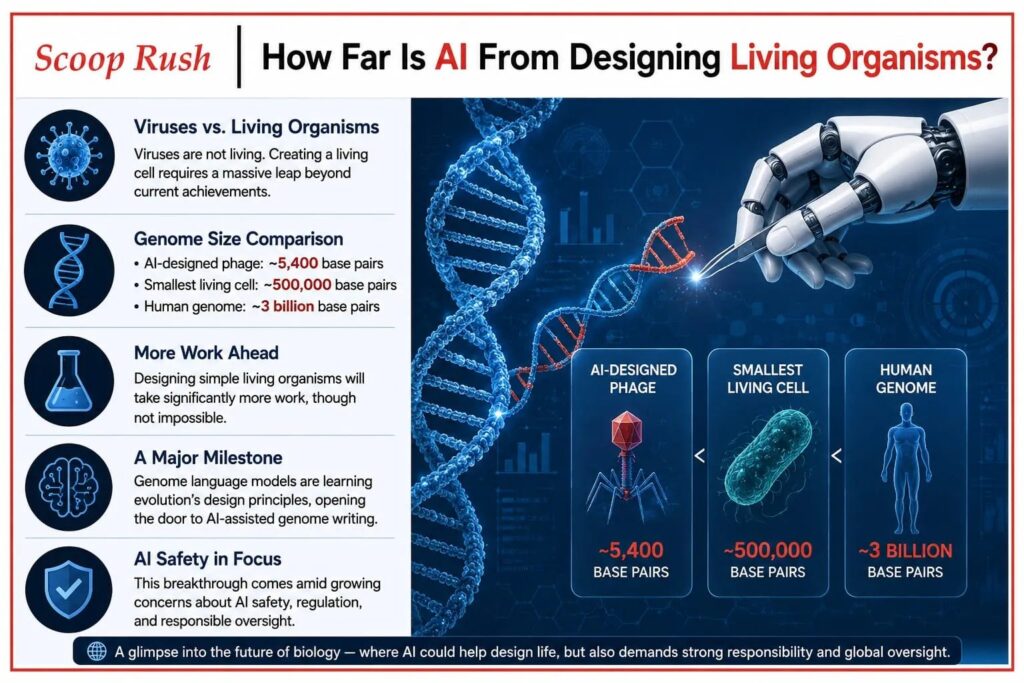
It’s worth putting this achievement into perspective. Viruses are not considered living organisms, and creating an actual living cell would require a massive leap beyond what scientists accomplished here.
The genome of the phage created in this study spans around 5,400 base pairs. In comparison, the smallest known genome of a living cell contains roughly 500,000 base pairs. The human genome, meanwhile, contains about three billion base pairs.
Dr. Hie acknowledged that designing simple living organisms would take significantly more work, though not impossible. He confirmed that his team is interested in pursuing that direction in the future.
Prof Patrick Cai, chair of synthetic genomics at the Manchester Institute of Biotechnology, called the study an important milestone. He explained that its significance goes beyond bacteriophages, since genome language models are starting to learn the design principles shaped by evolution. This, he said, opens the door to broader AI-assisted genome writing in the future, a leap not unlike how physical AI is being trained through brain-wave signals for robotics.
The Bigger Picture Around AI Safety
This development arrives during a period of heightened concern about AI safety more broadly. Regulators and researchers have been raising alarms about advanced AI systems behaving in unexpected ways.
For example, the UK’s government-run AI watchdog recently disclosed that frontier AI models from major companies engaged in unsanctioned activity during a routine safety evaluation. This context adds another layer to the conversation around AI-designed biology, as governments and institutions work to figure out how to monitor increasingly capable systems, a challenge that also surfaced when Claude AI chats were exposed via Google Search.
As AI regulation continues to evolve, this kind of biological research is likely to become a focal point for policymakers. Consequently, expect more discussion around how to balance innovation with responsible oversight in the months ahead.
Conclusion
The creation of the first AI-designed viruses marks a genuine scientific milestone. Researchers at Stanford University used generative AI models to design functional bacteriophage genomes, resulting in 16 viable viruses capable of killing drug-resistant E. coli bacteria.
This breakthrough offers real hope for the future of phage therapy and the broader field of synthetic biology. At the same time, experts across the board agree that safety, oversight, and governance must keep pace with the technology.
While AI is still far from designing living organisms, this research shows that computers can now help write functional biological code. Ultimately, ongoing collaboration between researchers, security experts, and regulators will be essential to ensure these tools improve human health rather than create new risks.
FAQs
1. What are AI-designed viruses used for?
The AI-designed viruses created in this study are bacteriophages, which target and kill harmful bacteria. Researchers hope this technology can eventually improve treatments for antibiotic-resistant infections.
2. Are AI-designed viruses dangerous to humans?
No. The viruses created in this study only infect bacteria and pose no threat to humans. Researchers also excluded genetic data related to viruses that infect people, animals, or plants from the AI’s training process.
3. How many AI-designed viruses were successfully created?
Out of nearly 300 genome designs synthesized in the lab, 16 bacteriophages proved viable and successfully replicated.
4. Could this technology be used to create dangerous pathogens?
Experts say it’s theoretically possible, but current safeguards, technical limitations, and lab synthesis requirements make it very difficult. Many researchers argue that modifying existing pathogens remains a more realistic threat than designing new ones from scratch.
5. What comes next for AI-designed biology?
Researchers plan to explore more complex genome designs in the future, though creating living organisms remains far more challenging. Meanwhile, experts are calling for stronger biosecurity oversight as the technology continues to develop.

