
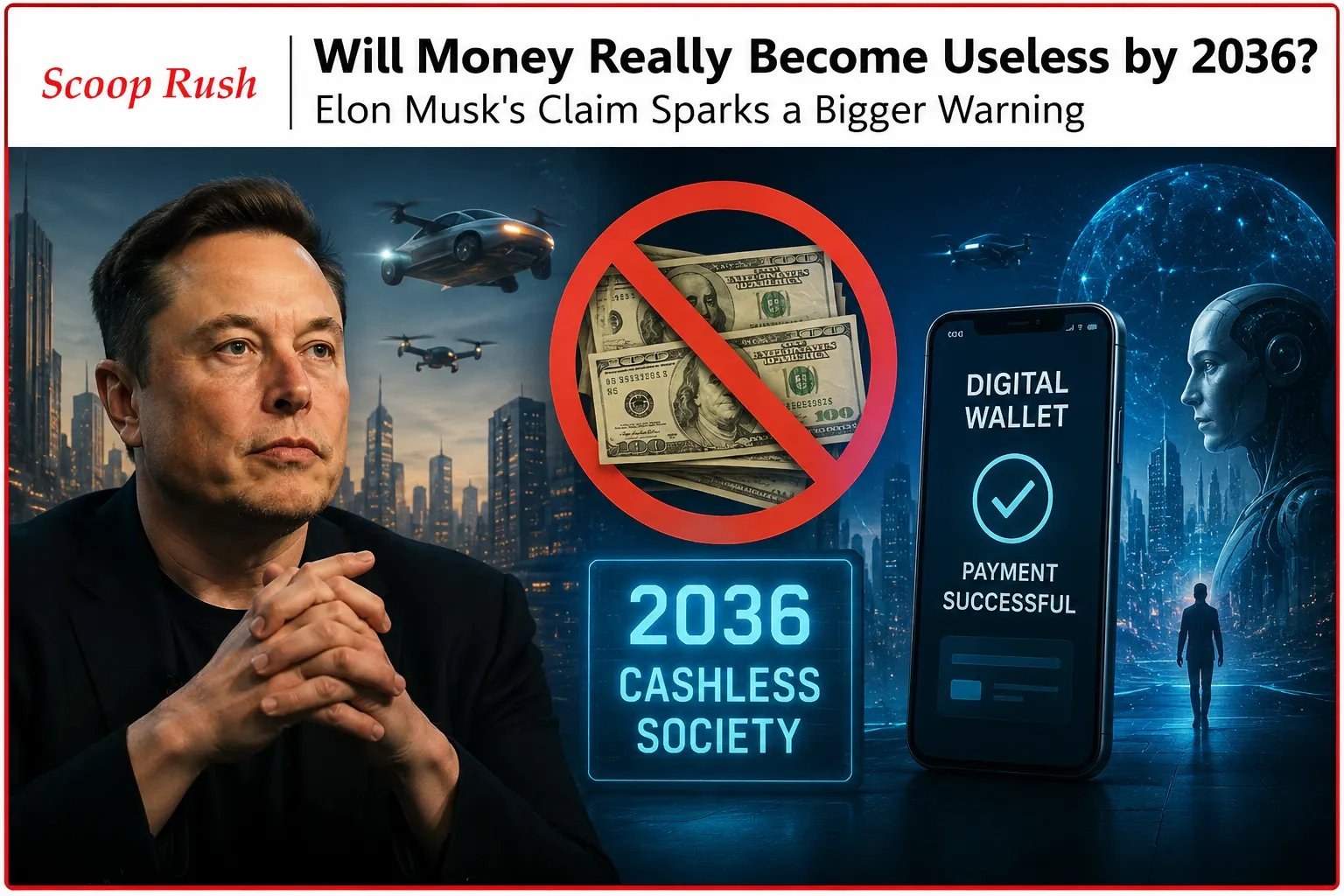
“Would you still worry about your salary if robots could give you everything you need for free? That is the question behind Elon Musk’s claim that money won’t matter by 2036, and his answer has split Silicon Valley right down the middle.”
Introduction
Elon Musk recently claimed that money won’t matter by 2036 because AI and robots will produce more goods and services than humans could ever consume. At first, the idea sounds like a dream. However, fellow tech billionaire Vinod Khosla looked at the same prediction and saw a warning most people missed. According to Khosla, this future depends entirely on one thing: politics.
This disagreement between two major AI investors matters to everyday readers, especially anyone wondering will AI replace your job in the years ahead. If abundance really is coming, the next question is who actually gets to benefit from it. Musk describes a smooth, effortless future, but Khosla suggests the road there could be far bumpier, and possibly unfair.
What Elon Musk Said About Money Becoming Irrelevant by 2036
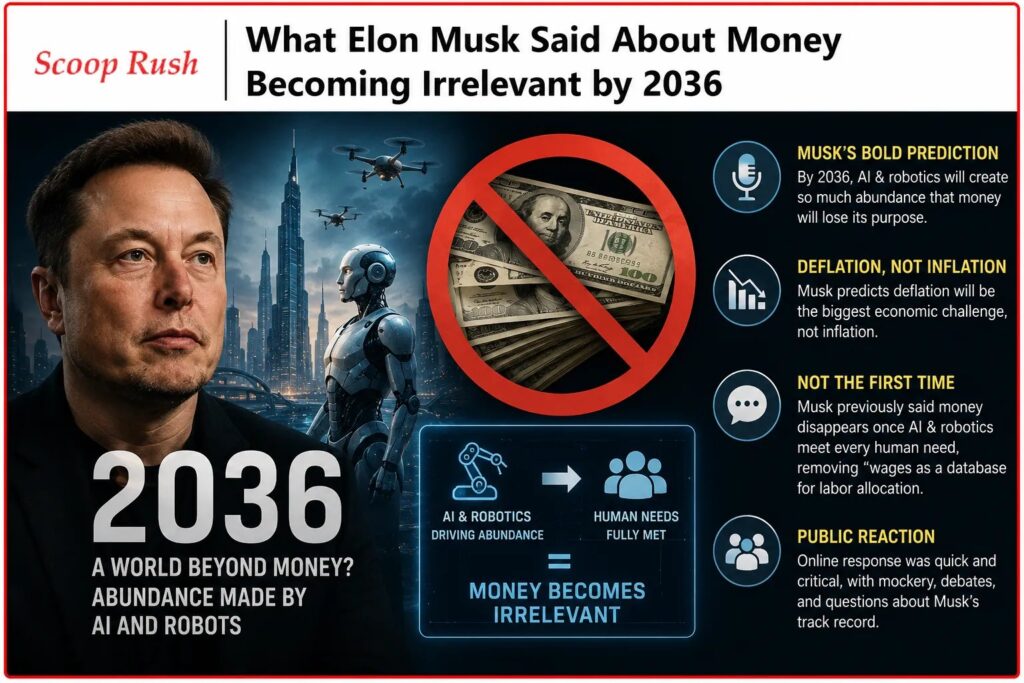
Musk shared his boldest prediction yet during an interview with The Economist’s editor-in-chief, Zanny Minton Beddoes. He argued that AI and robotics will create so much abundance by 2036 that money will simply lose its purpose.
His logic was straightforward. People want money mainly for goods and services. Therefore, once AI and robots can produce far more than any person could use, money no longer serves a real function.
Musk also predicted something unexpected: deflation, not inflation, will become the biggest economic challenge of that era. This stands out because most conversations about the future economy focus on rising prices, not falling ones.
Interestingly, Musk had floated this idea before. He made similar comments months earlier on the People by WTF podcast, saying money disappears as a concept once AI and robotics meet every human need, removing wages as what he called “a database for labor allocation.” This is not the only bold financial claim Musk has made recently either, since he also pushed forward $1 million checks under a Wisconsin law earlier this year.
Online Reaction Turns Into Mockery
The public response to Musk’s Economist interview was quick and largely critical. Gizmodo described Musk as melting down over ordinary questions and called several of his answers incoherent. Meanwhile, a widely upvoted Reddit thread triggered heated debate over Musk’s prediction record and the future of capitalism itself.
Eventually, though, one investor chose a different path than mockery, and his response reshaped the entire conversation.
Vinod Khosla’s Warning Hidden Inside His Agreement
Vinod Khosla, founder of Khosla Ventures, did not join the criticism. Instead, he posted on X that he would “modify” Musk’s prediction with one important condition. Money won’t matter in 2036, Khosla said, only if politics permits this great abundance.
That single condition changes everything about the prediction. Khosla was not fully endorsing Musk’s timeline. Rather, he used it as a starting point to make a separate argument: technology creating abundance and politics distributing that abundance fairly are two completely different problems. Solving one does not guarantee solving the other.
Khosla linked his post to an essay he published in 2024 titled “AI: Dystopia or Utopia?” That essay explains exactly why this distinction concerns him so much.
Why Khosla Believes AI Is Different From Past Technology
According to Khosla’s essay, AI could create a world where a small elite thrives while everyone else faces serious economic instability. This risk grows larger, he warns, in a democracy that drifts without active policy intervention.
Khosla argues that AI is fundamentally different from earlier innovations like the microprocessor or the internet. Those tools amplified what humans could already do with existing brainpower. AI, however, actually substitutes for brainpower itself, a shift already visible in how NHS AI tools are being used to cut waiting times and how models like Kimi K3 from Moonshot AI are advancing fast.
This difference is exactly what makes mass abundance technically possible, in Khosla’s view. AI could eventually replace most jobs in health care, law, retail, and beyond. As a result, productivity gains could theoretically support comfortable living standards for everyone, not just a wealthy few.
Khosla Has Warned About AI Inequality for Over a Decade
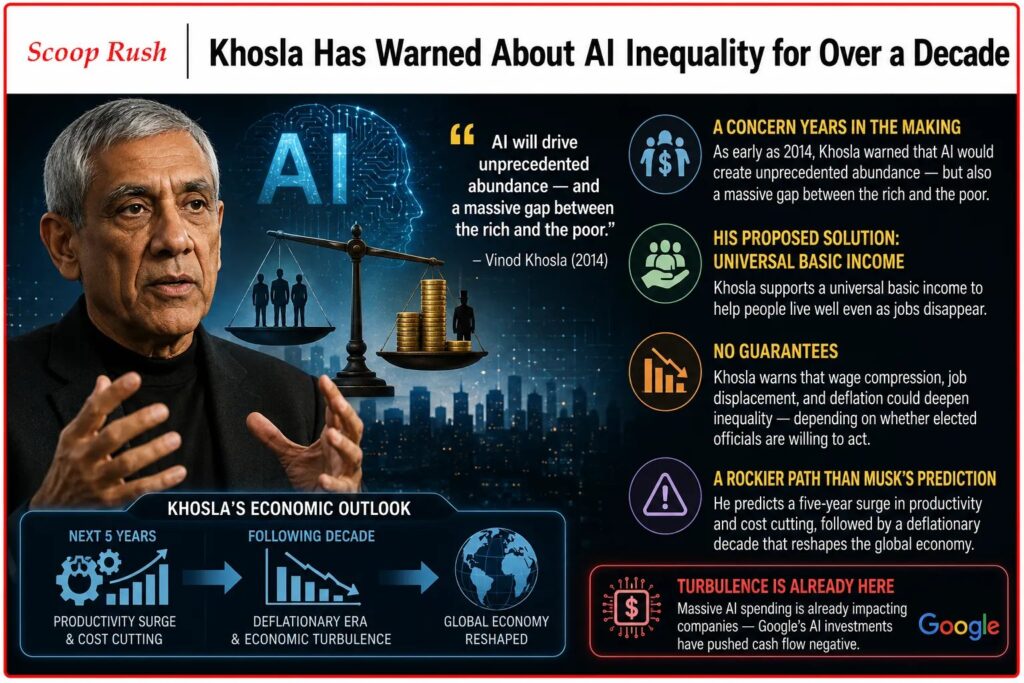
This concern is not new for Khosla. As early as 2014, he warned that AI would drive unprecedented abundance alongside a massive gap between the rich and the poor, according to a Substack analysis of his writing.
His proposed solution has stayed consistent over the years. Khosla supports a universal basic income to help people live well even as jobs disappear, based on earlier Fortune coverage.
However, Khosla’s essay stops well short of promising that governments will actually adopt these fixes. He warns that wage compression, job displacement, and deflation could just as easily deepen inequality as eliminate it. The real outcome, he says, depends on the willingness of elected officials to tackle the severe redistribution problem that pure capitalism may create.
A Rockier Path Than Musk’s Smooth Prediction
Khosla also gave a more near-term warning at a Stanford FIS event. He described a five-year burst of productivity and cost cutting, followed by a deflationary decade that reshapes the global economy. This picture is far rockier than the smooth abundance story Musk presents publicly.
This detail matters because even Khosla, who believes deeply in AI’s potential, expects real economic turbulence before ordinary people see any benefit. That turbulence is already showing up in tech spending patterns, as seen in reports that Google’s AI spending has pushed cash flow negative.
Why This Musk vs Khosla Debate Matters to Everyday People
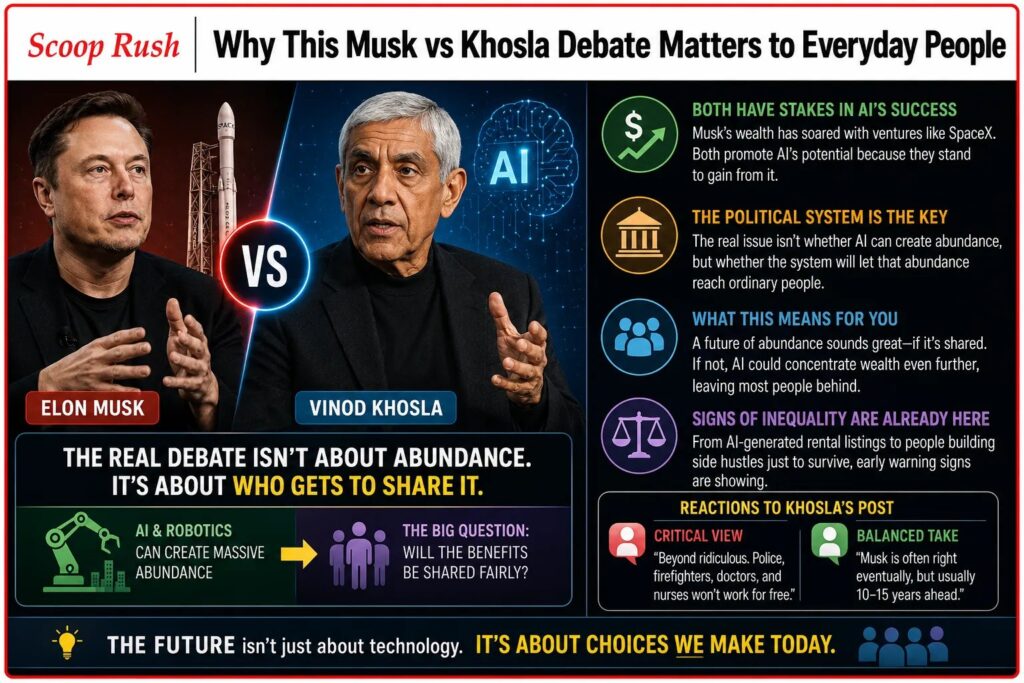
Both Musk and Khosla have significant financial stakes in AI’s success, so neither lacks incentive to promote its potential. Musk’s own fortune has grown alongside ventures like the SpaceX IPO, which pushed him toward trillionaire status. Despite that shared interest, their disagreement highlights something important for regular readers.
The real debate isn’t whether AI can produce abundance. Instead, it’s whether the political system will let that abundance reach people beyond those who already own the robots and companies building them.
This distinction changes how ordinary people should think about the AI conversation. A future filled with abundant goods sounds appealing, but only if the benefits are shared fairly. Otherwise, the same technology could concentrate wealth even further, leaving most people worse off. Some early signs of this imbalance are already visible, from AI-generated rental listings raising fairness concerns to ordinary people trying to build their own income streams, such as one mom who built a $10K-a-month Etsy side hustle.
Reaction to Khosla’s post reflected this exact tension. One reply called the entire abundance idea “beyond ridiculous,” pointing out that police, firefighters, doctors, and nurses will not simply work for free. Another commenter offered a more balanced take, noting that Musk is often right eventually, though usually about ten to fifteen years ahead of schedule.
Conclusion
Elon Musk’s claim that money won’t matter by 2036 sounds like a bold promise of comfort and abundance. However, Vinod Khosla’s response reminds readers that technology alone cannot guarantee that outcome. Abundance only matters if everyone gets to share in it, not just the people who control the machines producing it.
Khosla’s decade-long warning about AI creating both prosperity and inequality deserves just as much attention as Musk’s optimistic timeline. As AI reshapes jobs, wages, and entire industries, the real question isn’t when abundance arrives. It’s whether political systems choose to share it fairly once it does.
FAQs
What did Elon Musk say about money becoming irrelevant by 2036?
Musk told The Economist that AI and robotics will produce more goods and services than any human could consume by 2036, making money irrelevant. He also predicted deflation, rather than inflation, would become the era’s biggest economic challenge.
What is Vinod Khosla’s response to Musk’s money prediction?
Khosla agreed that money could become irrelevant only if politics permits the great abundance AI might create. He warned that the technology enabling abundance and the political will to distribute it fairly are two separate problems.
Why does Khosla believe AI is different from past technologies like the internet?
Khosla argues that past technologies amplified human brainpower, while AI actually substitutes for it. This distinction makes AI capable of replacing jobs across health care, law, and retail on a much larger scale.
Has Vinod Khosla warned about AI inequality before?
Yes, Khosla has raised this concern since at least 2014, warning that AI could drive both unprecedented abundance and a massive gap between the rich and the poor.
What solution does Khosla propose for AI-driven job losses?
Khosla has consistently supported a universal basic income as a way to ensure people can maintain a good standard of living even as AI displaces traditional jobs.

