

Introduction
Apple released its latest quarterly earnings on Thursday, and on the surface, the numbers looked great. However, iPhone, iPad, and Mac shortages are now expected to get worse in the coming months. Revenue jumped 16% to $109 billion, while profits climbed 26% to $29 billion. Despite these strong results, Apple’s stock fell more than 7% in after-hours trading. The drop came right after outgoing CEO Tim Cook warned that these shortages are set to worsen significantly.
This is important news for anyone planning to buy Apple products soon. If you’re eyeing a new iPhone, a Mac upgrade, or an iPad this fall, Apple’s own leadership is signaling that delays are coming. Understanding why these supply constraints are happening, and how they connect to the upcoming iPhone 18 Pro leaks, can help you plan your next purchase more wisely. Understanding the reasons behind iPhone, iPad, and Mac shortages can help buyers prepare for possible delays and make better purchasing decisions.
Why Is Apple Facing Supply Constraints?
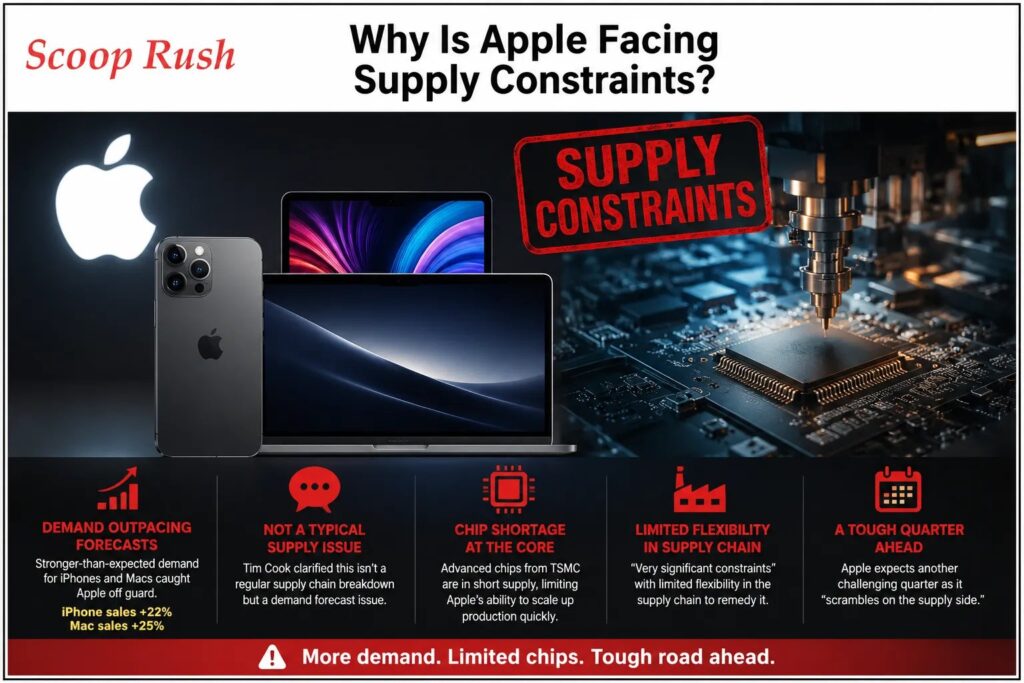
Cook was upfront about what’s really going on. He explained that this isn’t a typical supply chain breakdown caused by factory issues or supplier failures. Instead, it comes down to demand that simply outpaced Apple’s own forecasts. The growing iPhone, iPad, and Mac shortages are not caused by factory shutdowns but by demand that exceeded Apple’s expectations.
“We’re seeing some very significant constraints currently with limited flexibility in the supply chain to remedy it,” Cook said during the earnings call.
He went a step further to clarify the situation for investors and customers. “This is not a regular supply issue, it’s a demand forecast issue to be candid. We’ve got a quarter ahead where we’ll be scrambling on the supply side.”
In other words, more people are buying iPhones and Macs than Apple planned for. Sales of those two product lines grew 22% and 25% respectively during the June quarter. That kind of growth is impressive. However, it also means Apple underestimated how popular its latest devices would become.
The Chip Shortage Fueling Apple’s Supply Constraints
A big part of the issue traces back to semiconductors. Apple’s devices rely on microprocessors built using “advanced nodes,” a term for cutting-edge chip technology that makes devices faster and more efficient.
Most of these advanced chips come from TSMC, a Taiwan-based manufacturer that supplies processors to Apple and many other tech giants. When demand for iPhones and Macs spikes unexpectedly, it puts extra strain on an already tight chip supply chain. As a result, Apple has limited room to quickly scale up production to match current demand. This kind of chip crunch echoes wider industry pressure, similar to how Google has been racing to build more efficient AI chips to keep pace with demand.
Earlier this year, Apple already confirmed that the iPhone 17 launch was the biggest in company history. That early surge appears to have carried into this quarter. Now Apple is bracing for the ripple effects across its entire lineup. These chip constraints are becoming one of the biggest reasons behind the ongoing iPhone, iPad, and Mac shortages.
Rising Memory Costs Add to Apple’s Supply Chain Pressure
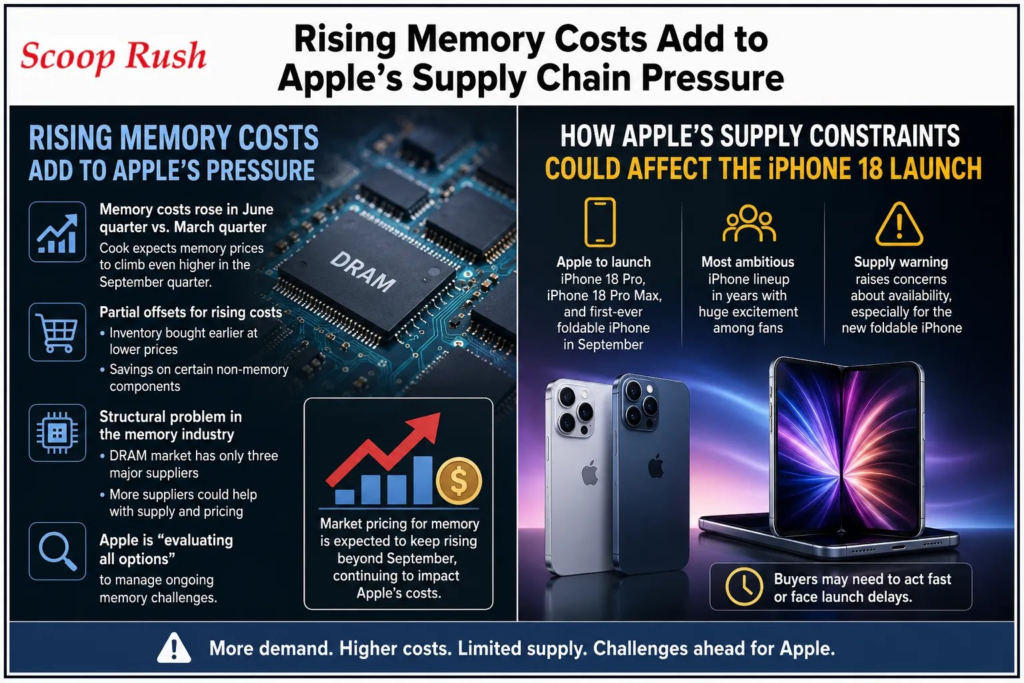
On top of chip shortages, Apple is also dealing with rising memory prices. Cook noted that Apple paid more for memory components in the June quarter compared to the March quarter. Looking ahead, he expects memory costs to climb even higher in the September quarter.
According to Cook, Apple can partially offset these rising costs in two ways. First, the company still has some benefit from inventory it purchased earlier at lower prices. However, that cushion is expected to shrink over time. Second, Apple anticipates savings on certain non-memory components, which could help balance things out.
Still, Cook didn’t sugarcoat the bigger picture. Beyond September, market pricing for memory is expected to keep rising, and that will likely keep affecting Apple’s costs. He also pointed to a structural problem within the memory industry itself.
“The DRAM market has three suppliers,” Cook explained. “Obviously, if there were more suppliers, that would be good, and it would help us on the supply side and perhaps the pricing side.”
With so few major players making DRAM memory chips worldwide, Apple has limited room to negotiate better pricing. Consequently, the company says it is “evaluating all options” to manage the ongoing challenge.
How Apple’s Supply Constraints Could Affect the iPhone 18 Launch
The current iPhone, iPad, and Mac shortages could also impact the availability of Apple’s upcoming devices, especially during launch week.Apple is preparing to release its next generation of iPhones in September, including the iPhone 18 Pro, iPhone 18 Pro Max, and the company’s first-ever foldable iPhone. This lineup is one of Apple’s most ambitious launches in years, and excitement is already building among fans and tech watchers.
However, the timing of Apple’s supply warning raises real concerns about availability. If Apple is already struggling to meet demand for existing products, a brand-new foldable device could be even harder to get during launch week. Buyers hoping to grab the foldable iPhone right away may need to act fast or prepare for delays.
Tariff Refunds and Domestic Manufacturing
Apple’s earnings call also touched on tariffs. The company reported that its gross margin was 2% higher than it otherwise would have been over the past three months, thanks to tariff refunds. Based on BBC calculations, that works out to roughly $1.1 billion in refunds.
Cook confirmed that Apple plans to reinvest these tariff refunds into the United States. This fits with the company’s earlier pledge to invest $600 billion in domestic manufacturing over the next four years. Currently, China remains the largest manufacturer of Apple’s products, though the company appears to be shifting more production toward the U.S. over time.
Siri’s AI Relaunch Moves Forward
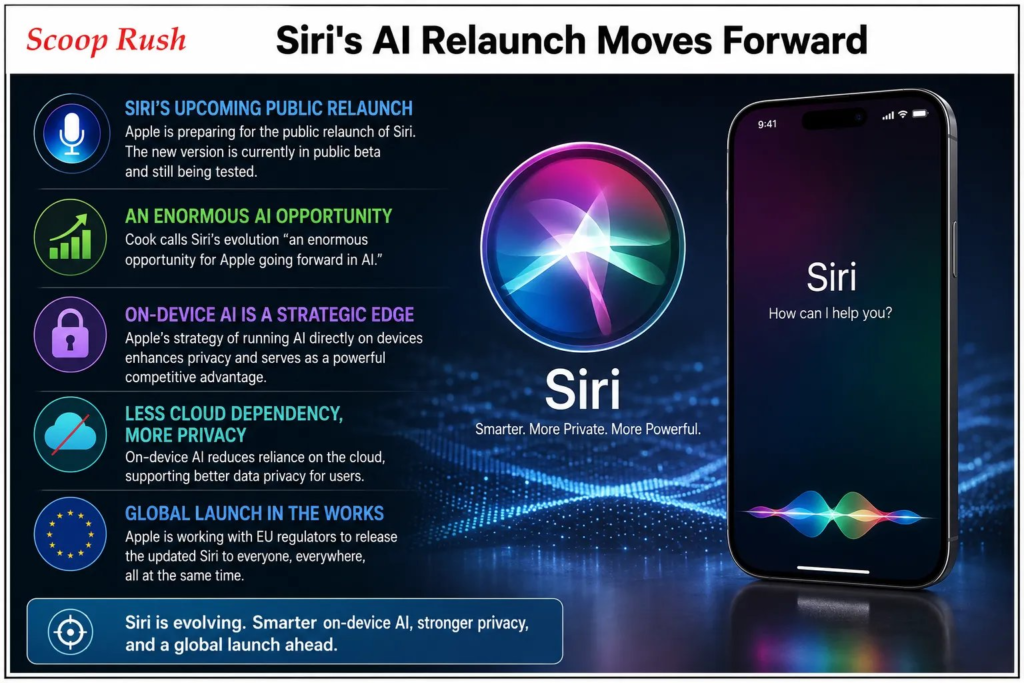
Alongside the supply chain discussion, Cook also spoke about Apple’s upcoming public relaunch of Siri. The voice assistant has struggled to keep up with competitors in the fast-moving AI chatbot race, a space where models like Kimi K3 from Moonshot AI have also been drawing attention. Nevertheless, Apple seems determined to close the gap.
The new version of Siri is currently in public beta, meaning it’s still being tested before a wider release. Cook called this “an enormous opportunity for Apple going forward in AI.” He specifically pointed to Apple’s strategy of running AI directly on devices instead of depending entirely on the cloud, a move that also raises fresh conversations about data privacy in AI-powered apps.
“The ability to run on device is also very strategic, and sort of a competitive weapon, if you will,” Cook said.
Meanwhile, Apple is continuing talks with regulators in the European Union. The goal is to release the updated Siri to everyone, everywhere, at the same time, instead of rolling it out region by region.
Amazon Tells a Very Different Story
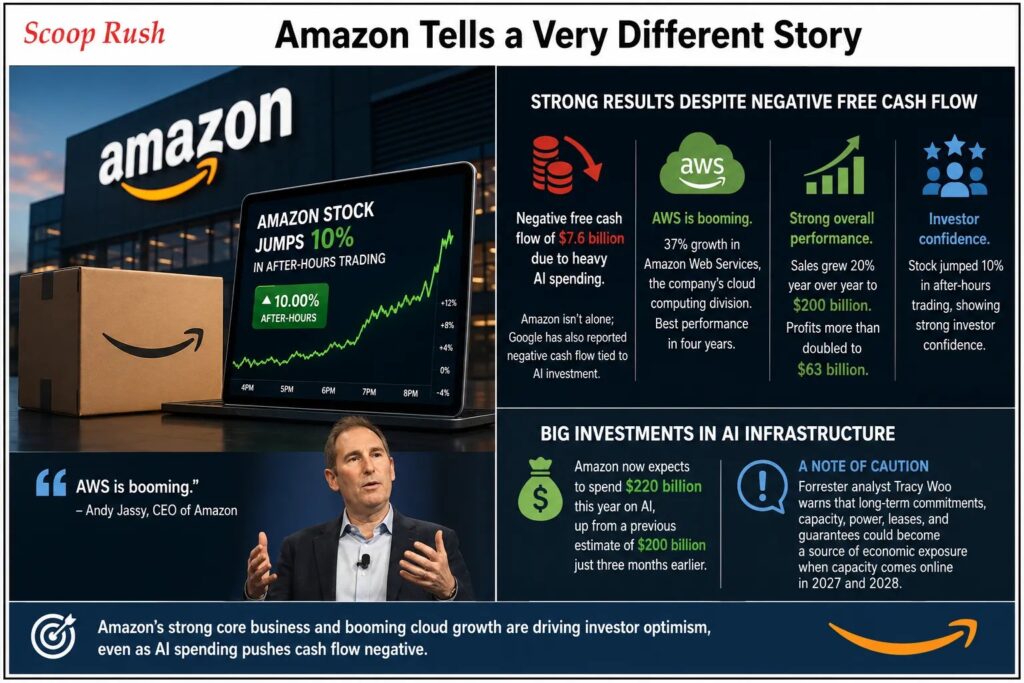
While Apple’s earnings rattled investors, Amazon had the opposite reaction on the same day. Despite reporting negative free cash flow of $7.6 billion due to heavy AI spending, Amazon’s stock jumped 10% in after-hours trading. Amazon isn’t alone in that pattern either; Google has also reported negative cash flow tied to aggressive AI investment in recent quarters.
Free cash flow measures how much money is left after a company covers its operating costs and investments. In Amazon’s case, the company has spent significantly more than it brought in over the past year. However, investors weren’t worried, thanks largely to strong performance across Amazon’s core businesses.
CEO Andy Jassy highlighted 37% growth in Amazon Web Services, the company’s cloud computing division. He called it the segment’s best performance in four years, simply stating, “AWS is booming.”
Overall, Amazon’s sales grew 20% year over year, reaching $200 billion. Profits more than doubled during the same period, hitting $63 billion. Forrester analyst Tracy Woo praised the results, noting that Amazon’s infrastructure investments appear to be matching real market demand rather than outpacing it.
Still, Woo raised a note of caution about Amazon’s spending path. The company now expects to spend $220 billion this year on AI, up from a previous estimate of $200 billion just three months earlier. “The bigger question is whether long-term commitments, capacity, power, leases, and guarantees will continue to be a source of economic exposure when capacity comes online in 2027 and 2028,” Woo said.
Conclusion
Apple’s latest earnings paint a picture of a company caught between strong success and mounting strain. High demand for the iPhone and Mac pushed revenue and profits well above expectations. However, that same demand is now driving supply constraints that Cook says will worsen significantly in the months ahead.
Chip shortages tied to advanced manufacturing, combined with rising memory costs from a limited pool of DRAM suppliers, are squeezing Apple’s ability to keep pace. As the company prepares to launch the iPhone 18 Pro, iPhone 18 Pro Max, and its first foldable iPhone this September, buyers should brace for possible delays and limited stock.
Meanwhile, Apple continues moving forward on other fronts, including reinvesting tariff refunds into U.S. manufacturing and rolling out its redesigned Siri assistant in public beta. Ultimately, whether Apple can manage these supply challenges smoothly will shape its performance for the rest of the year.
FAQs
Why is Apple running out of iPhones, iPads, and Macs?
Apple says the shortage comes from unexpectedly high demand, not supplier problems. Chip shortages tied to advanced manufacturing nodes and rising memory costs are making it harder to keep up with sales.
Will the new iPhone 18 be hard to find at launch?
It’s possible. Apple is launching the iPhone 18 Pro, iPhone 18 Pro Max, and its first foldable iPhone in September, right as supply constraints are expected to worsen. Early buyers may face limited availability.
Why did Apple’s stock drop after a strong earnings report?
Even though Apple reported a 16% revenue increase and 26% profit growth, investors reacted negatively to Tim Cook’s warning about worsening supply constraints in the next quarter.
Why are Apple’s memory chip costs going up?
Apple says the DRAM memory market has only three major suppliers, which limits pricing flexibility. Costs rose from the March quarter to the June quarter and are expected to climb further in the September quarter.
What is Apple doing with its tariff refund money?
Apple reported around $1.1 billion in tariff refunds during the past quarter and plans to reinvest that money into U.S.-based manufacturing as part of its broader $600 billion domestic investment plan.

