
Google has never lost money on a quarterly basis since its 2004 stock market debut. That changed this week, and the reason is Google AI spending.
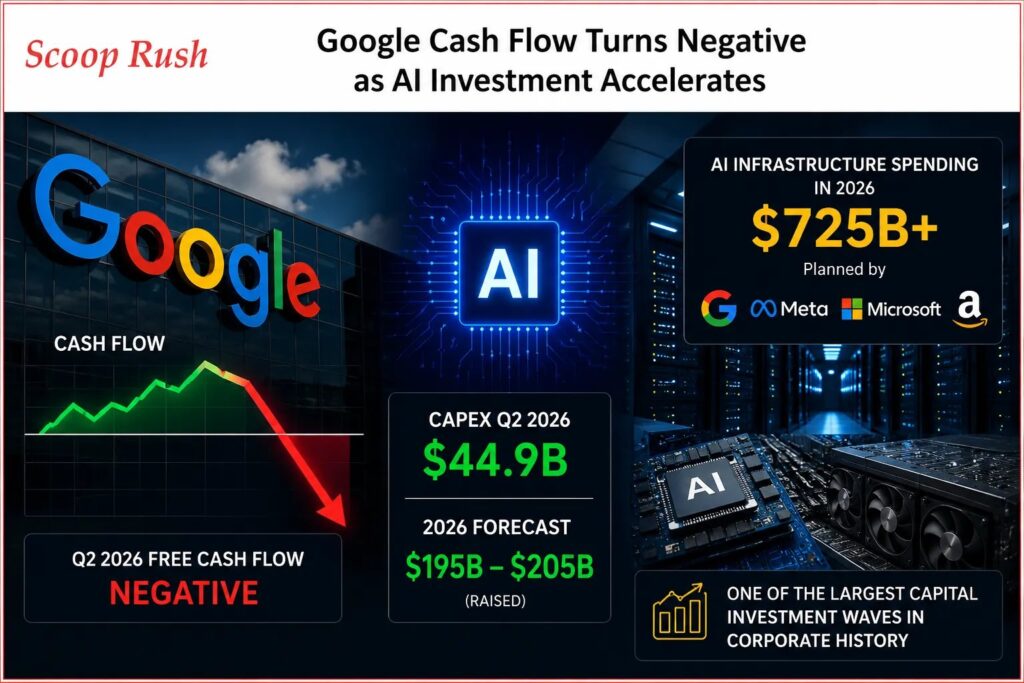
Alphabet, Google’s parent company, just reported negative free cash flow of $5.9 billion for the second quarter of 2026. For a business that has generated cash reliably for over twenty years, this is a genuinely rare moment. Consequently, investors and industry watchers are now asking a bigger question: how far will Google go in the AI arms race, and can its core business absorb the cost?
This story matters beyond Wall Street. Google’s AI investment decisions ripple across the cloud industry, the chip market, and even the job market for AI talent. Therefore, understanding why Google AI spending has surged, and what it means for the company’s future, helps make sense of the wider AI economy right now.
Google Cash Flow Turns Negative as AI Investment Accelerates
Free cash flow shows the money a company keeps after covering operating costs and capital spending. In short, it reveals how much real cash a business generates rather than just the profit it reports on paper.
For years, Google’s free cash flow stayed strongly positive. Its search advertising engine produced enormous cash with comparatively light capital needs. As a result, Google earned a reputation as an “asset-light” business, unlike capital-heavy industries such as manufacturing or telecoms.
That reputation is now shifting. Google’s spending on AI data centers, custom AI chips, and other infrastructure has grown so large that it outpaced incoming cash during the quarter. Alphabet’s chief financial officer, Anat Ashkenazi, said free cash flow will likely stay under pressure because the company keeps investing heavily in technical infrastructure.
Google Capex 2026: The Numbers Behind the AI Spending Surge
Google’s capital expenditures reached $44.9 billion in the second quarter alone. Additionally, company executives raised the full-year 2026 capex forecast to a range of $195 billion to $205 billion, up from earlier guidance of $180 billion to $190 billion.
This marks the second capex increase this year. Analysts had already priced in a large number, so this jump still caught investors off guard. Consequently, Google’s stock fell nearly 3.5% in after-hours trading following the announcement.
To put this AI infrastructure spending in context, Google, Meta, Microsoft, and Amazon together plan to spend more than $725 billion on AI infrastructure in 2026. In other words, this represents one of the largest capital investment waves in corporate history, concentrated in a single year.
Google Revenue and Cloud Growth Remain Strong Despite the Cash Burn
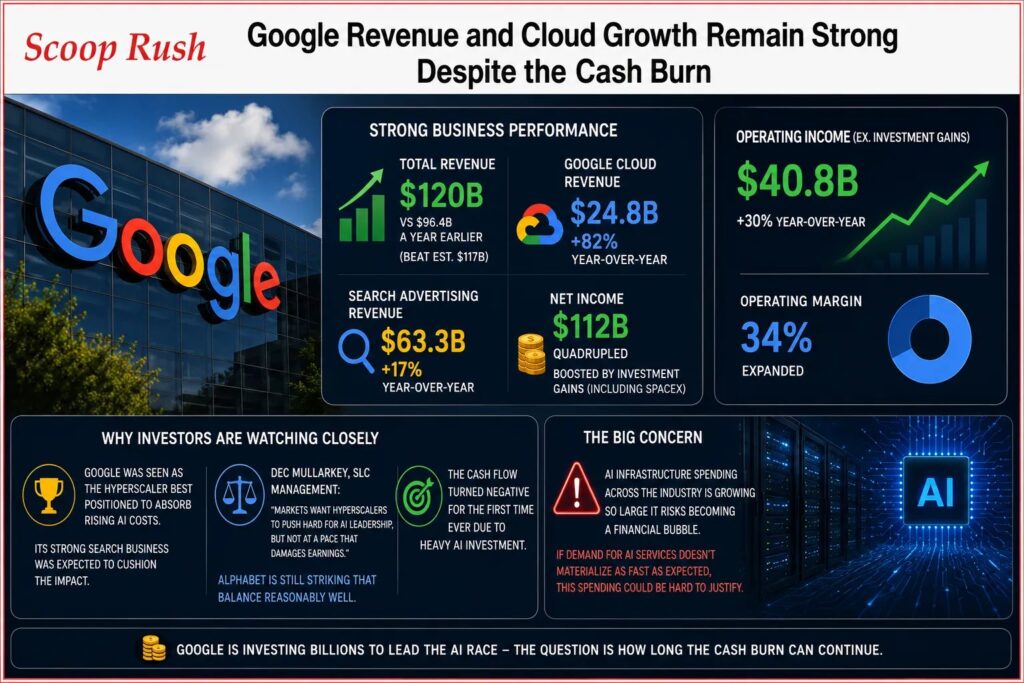
Despite the cash flow pressure, Google’s underlying business performance told a different story this quarter. Alphabet reported total revenue of $120 billion, up from $96.4 billion a year earlier. This figure beat analyst expectations of roughly $117 billion.
Google Cloud stood out as the strongest performer. The division posted 82% year-over-year growth, reaching $24.8 billion in revenue. This growth suggests that businesses are increasingly paying for AI-powered cloud services, which helps justify at least part of Google’s massive AI spending.
Meanwhile, the core search advertising business grew 17% year-over-year to $63.3 billion, slightly below expectations. However, CEO Sundar Pichai noted that search usage hit an all-time high over the summer, partly driven by World Cup traffic.
Net income quadrupled to $112 billion, though investment gains, including Google’s stake in SpaceX, boosted that figure significantly. Operating income, which excludes those investment gains, still rose 30% to $40.8 billion, and operating margin expanded to 34%.
Why Investors Are Watching Google’s AI Investment Strategy Closely
Before this earnings report, analysts widely viewed Google as the hyperscaler best positioned to absorb rising AI costs. Its enormous search business was expected to comfortably cushion the financial impact of AI investment.
That confidence now faces a real test. Dec Mullarkey, managing director at SLC Management, said markets want hyperscalers to push hard for AI leadership, but not at a pace that damages earnings. According to Mullarkey, Alphabet is still striking that balance reasonably well, even with this surprising cash flow result.
Still, some analysts and investors remain uneasy. They worry that AI infrastructure spending across the industry has grown so large that it risks becoming a financial bubble. If demand for AI services fails to materialize as quickly as companies expect, this spending could prove difficult to justify.
The Bigger AI Spending Race: Google, Meta, Microsoft, Amazon, and Nvidia
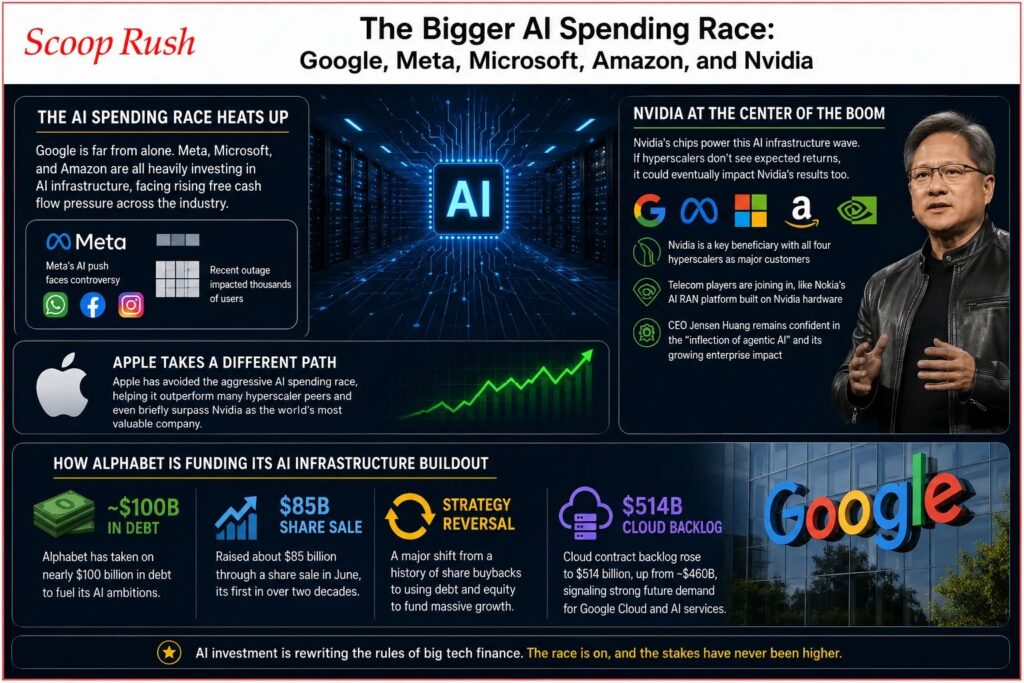
Google is far from alone in this situation. The broader hyperscaler industry, including Meta, Microsoft, and Amazon, expects free cash flow pressure to grow across the board as AI investment accelerates industry-wide. Meta’s own AI push has come with its own share of controversy, including its recent Muse Image tool and a separate outage that knocked WhatsApp, Facebook, and Instagram offline for thousands of users.
Nvidia, whose chips power much of this AI infrastructure boom, holds a direct stake in how this plays out. Even telecom players are getting pulled in, as seen with Nokia’s new AI RAN platform built on Nvidia hardware. All four major hyperscalers count among Nvidia’s biggest customers. Therefore, if their AI investments fail to generate expected returns, this could eventually hit Nvidia’s own financial results too.
Nvidia CEO Jensen Huang has worked to reassure investors about this risk. Earlier this year, he said he remains confident that hyperscalers’ cash flow will grow, citing what he called the “inflection of agentic AI” and its expanding usefulness across global enterprises.
Interestingly, Apple has taken a markedly different approach. The company has largely avoided the aggressive AI spending race seen among its rivals. As a result, Apple has outperformed many hyperscaler peers in the stock market recently, even briefly overtaking Nvidia as the world’s most valuable company.
How Alphabet Is Funding Its AI Infrastructure Buildout
To fund its growing AI ambitions, Alphabet has taken on nearly $100 billion in debt. Additionally, the company raised about $85 billion through a share sale in June, its first stock issuance in more than two decades.
This funding shift marks a significant reversal in strategy. For years, Alphabet prioritized share buybacks over issuing new stock. Now, the company is turning to both debt and equity markets to finance its infrastructure buildout.
Part of the reasoning lies in a growing backlog of cloud contracts, which rose to $514 billion by quarter’s end, up from about $460 billion previously. This backlog signals strong future demand for Google’s AI-powered cloud services, even though near-term cash flow numbers look concerning.
Google Gemini Models Face Growing Pressure from OpenAI and Anthropic
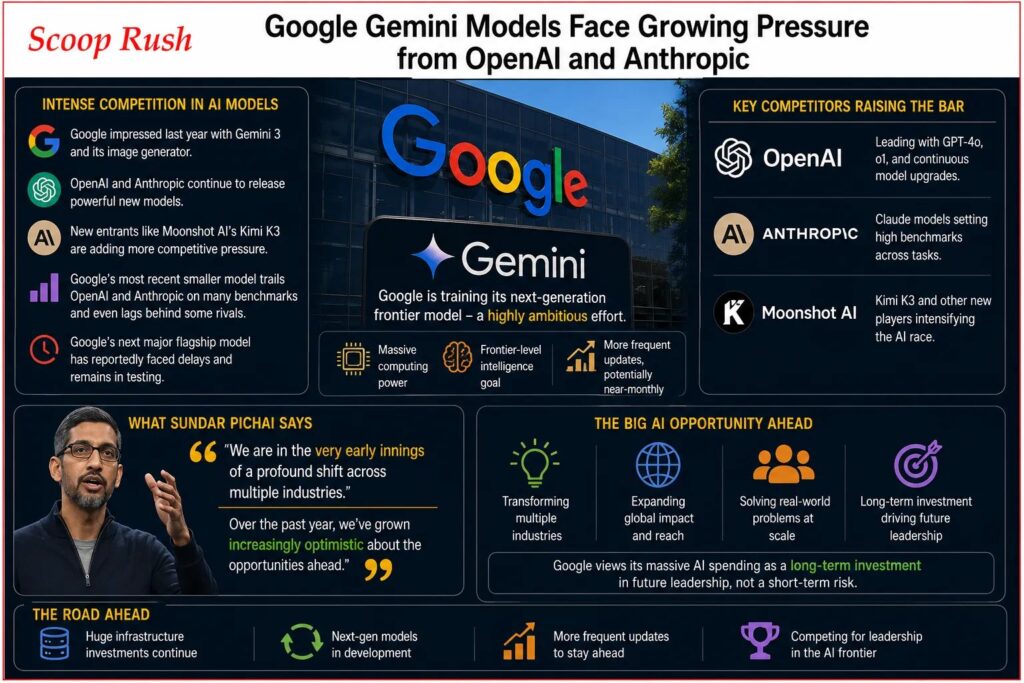
Beyond infrastructure spending, Google also faces mounting pressure on the AI product front. The company made a strong impression last year with Gemini 3 and its image generator, prompting many to question whether OpenAI’s leadership position in AI was at risk.
Since then, however, competitors like Anthropic and OpenAI have continued releasing high-profile model updates, and newer entrants like Moonshot AI’s Kimi K3 are adding to the competitive pressure. Google’s most recent smaller model reportedly trails the latest releases from OpenAI and Anthropic on many benchmarks, and it even lags behind some rival releases too.
Meanwhile, Google’s next major flagship model has reportedly faced delays. On the earnings call, Pichai confirmed that this model remains in testing.
Pichai also revealed that Google is now training its next-generation frontier model and called the effort highly ambitious. He explained that the company wants to compete at the frontier level expected once that model launches, which is why so much computing power and effort are going toward it.
Importantly, Pichai indicated that once this next flagship model becomes established, Google plans to release updates far more frequently, potentially on a near-monthly cadence going forward.
What Sundar Pichai Says About the AI Opportunity Ahead
Despite the financial pressure, Pichai remains confident about the long-term opportunity. He described the current moment as the “very early innings” of a major shift unfolding across multiple industries.
He also noted that Google has grown increasingly optimistic over the past year about the opportunities ahead. This suggests the company views its massive AI spending as a long-term investment rather than a short-term risk, even though it creates near-term financial strain.
Key Takeaways on Google’s AI Spending and Cash Flow
Google’s negative free cash flow marks a historic turning point. For the first time since going public, Alphabet is spending more cash than it generates, driven almost entirely by AI infrastructure investment.
At the same time, the company’s underlying business remains strong. Cloud revenue grew 82%, overall revenue beat expectations, and operating income rose sharply. However, rising debt, a massive share sale, and growing investor skepticism all highlight the real financial risk behind the AI spending race.
As Google, Meta, Microsoft, and Amazon keep pouring hundreds of billions of dollars into AI infrastructure, the coming quarters will reveal whether this spending delivers lasting returns, or whether concerns about an AI spending bubble and its effect on jobs become increasingly justified.
FAQs: Google AI Spending and Cash Flow Explained
Q1: Why did Google’s free cash flow turn negative?
A: Google’s free cash flow turned negative because record-high capital spending on AI infrastructure, including data centers and hardware, outpaced the cash the company generated from operations this quarter.
Q2: How much is Google spending on AI in 2026?
A: Google now expects to spend between $195 billion and $205 billion on capital expenditures in 2026, up from its earlier guidance of $180 billion to $190 billion.
Q3: Is Google’s core business still growing despite the cash burn?
A: Yes. Alphabet reported total revenue of $120 billion for the quarter. Google Cloud grew 82% year-over-year, and search advertising grew 17% year-over-year.
Q4: How is Google funding its AI spending?
A: Alphabet has taken on nearly $100 billion in debt and raised about $85 billion through a share sale in June, marking its first stock issuance in more than two decades.
Q5: Is Google’s AI spending part of a wider industry trend?
A: Yes. Google, Meta, Microsoft, and Amazon collectively plan to spend more than $725 billion on AI infrastructure in 2026 as they compete for AI leadership.

