
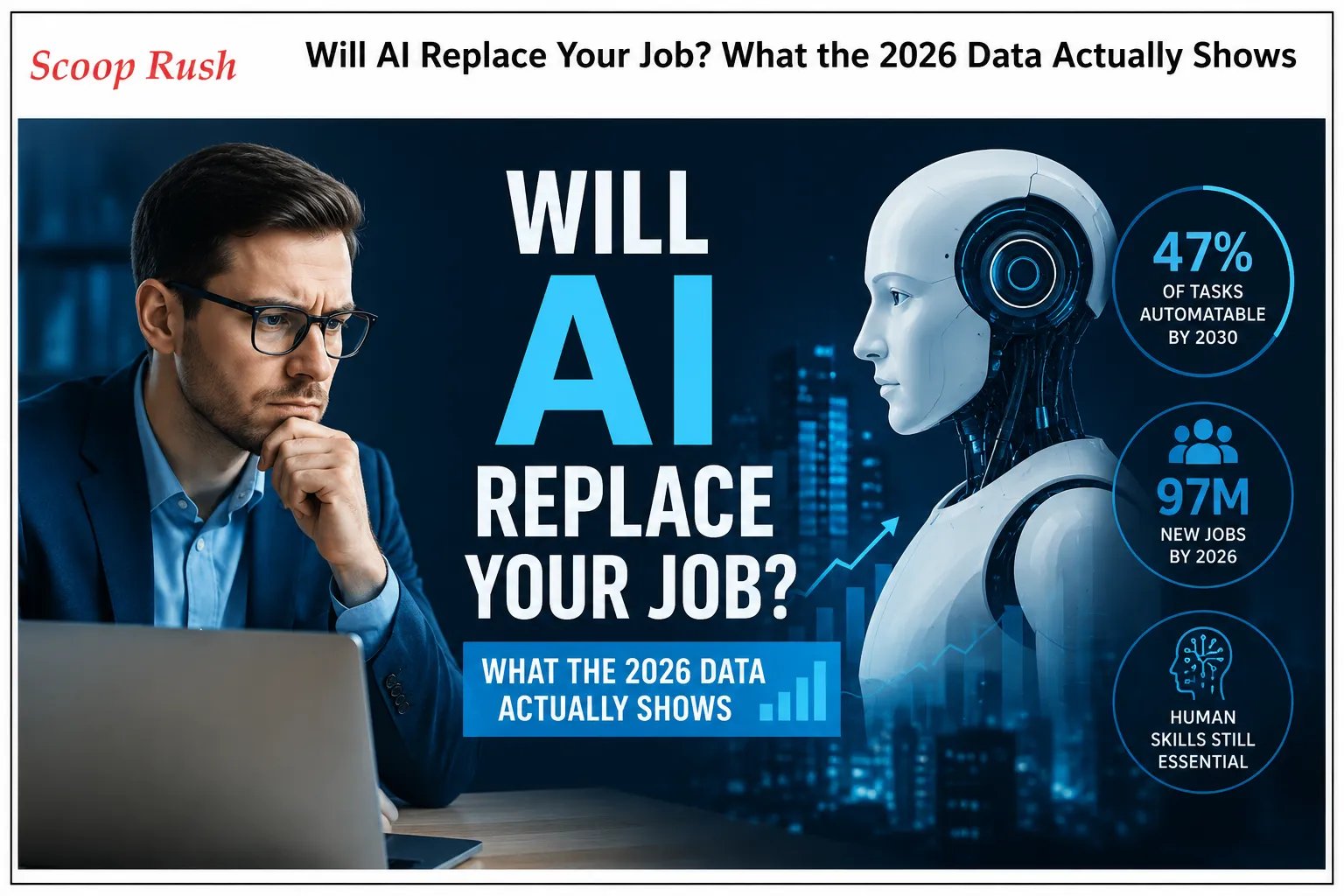
A 25-year-old software developer just lost a job that didn’t exist five years ago, and an AI model finished the work in minutes. That is not a hypothetical scenario anymore. It is a pattern showing up across real employment data in 2026, and it raises one urgent question: will AI replace your job next?
Introduction
Will AI replace your job, or will it simply change how you do it? That question is no longer theoretical. New data from Stanford, the OECD, and Boston College shows that AI is already reshaping who gets hired, who gets let go, and which careers count as safe. For millions of workers, the answer is not a distant “someday.” It is happening right now, in 2026.
Tech leaders keep promising that AI tools can replace human labor across entire industries. Some companies are already testing this idea by keeping headcount flat and leaning on “AI agents” instead of new hires. Investors call it “flat is the new up,” and it signals a real shift in how businesses think about growth. If even part of this trend holds true, it will touch nearly every sector and career path, and it may happen faster than most people expect.
This matters to you because the effects are not limited to tech workers. Younger employees, older professionals, and entire service industries are all showing measurable signs of disruption. Therefore, understanding what the data says can help you figure out where you stand and what to do next.
How Fast Is AI Improving, and Why It Threatens Jobs
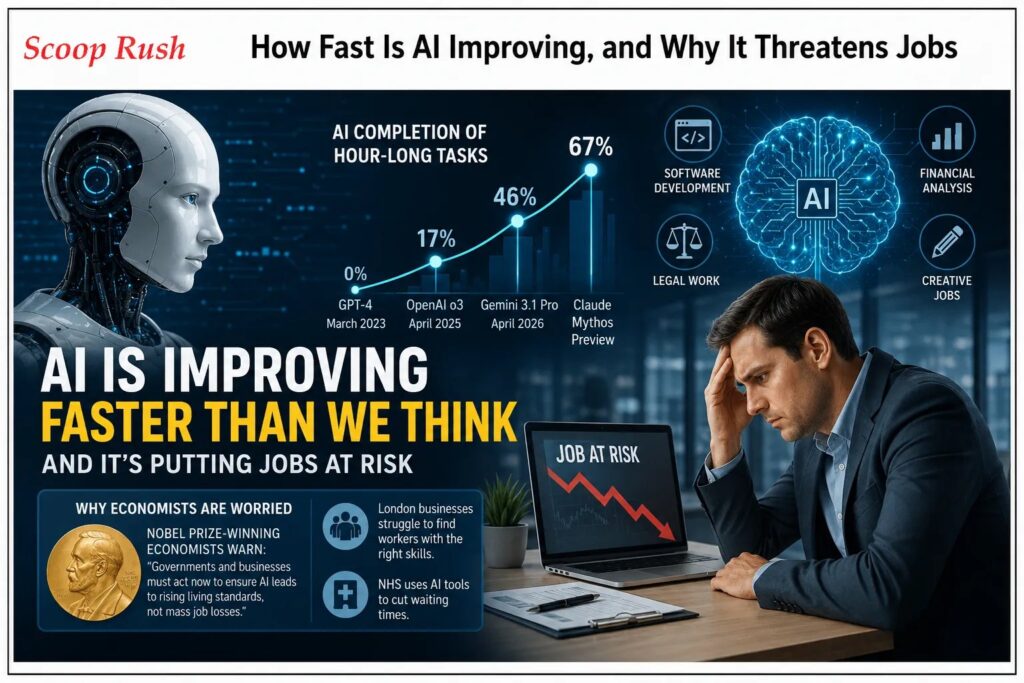
The clearest evidence of AI’s growing capability comes from a benchmark that tracks how well AI models complete tasks, based on how long those tasks would take a human expert. The results show a dramatic curve upward.
In March 2023, GPT-4 could reliably complete short tasks but failed at anything requiring more than an hour of human effort. By April 2025, OpenAI’s o3 model could complete 17% of hour-long tasks. Just a year later, Gemini 3.1 Pro pushed that number to 46%, and Claude Mythos Preview reached 67%.
In other words, AI models now complete tasks that once required a full hour of skilled human work. This trend started with software development. However, similar patterns are emerging in financial analysis, early-stage legal work, and even entry-level creative jobs. Some AI systems can now review problems in complex contracts. Others can refine their own underlying models, a task that would take a person several hours to finish.
Experts suggest the newest generation of AI models could begin improving themselves within the next year. That would mark a significant shift, since AI development itself could start to accelerate without the same level of human oversight it currently requires.
Why AI Job Losses Worry Economists
A group of Nobel prize-winning economists recently warned that governments and businesses “must act now” to make sure AI leads to rising living standards rather than large-scale job losses. Their concern is not abstract. London businesses have already reported difficulty finding workers with the right skills as AI reshapes job requirements across the city, a shift already visible in sectors like the NHS’s use of AI tools to cut waiting times.
AI Replacing Jobs: The Employment Numbers Behind the Headlines
Claims that AI will replace your job are easy to make. Proving them with real data is harder. Fortunately, researchers in the United States have spent four years tracking employment outcomes across occupations with high and low AI exposure.
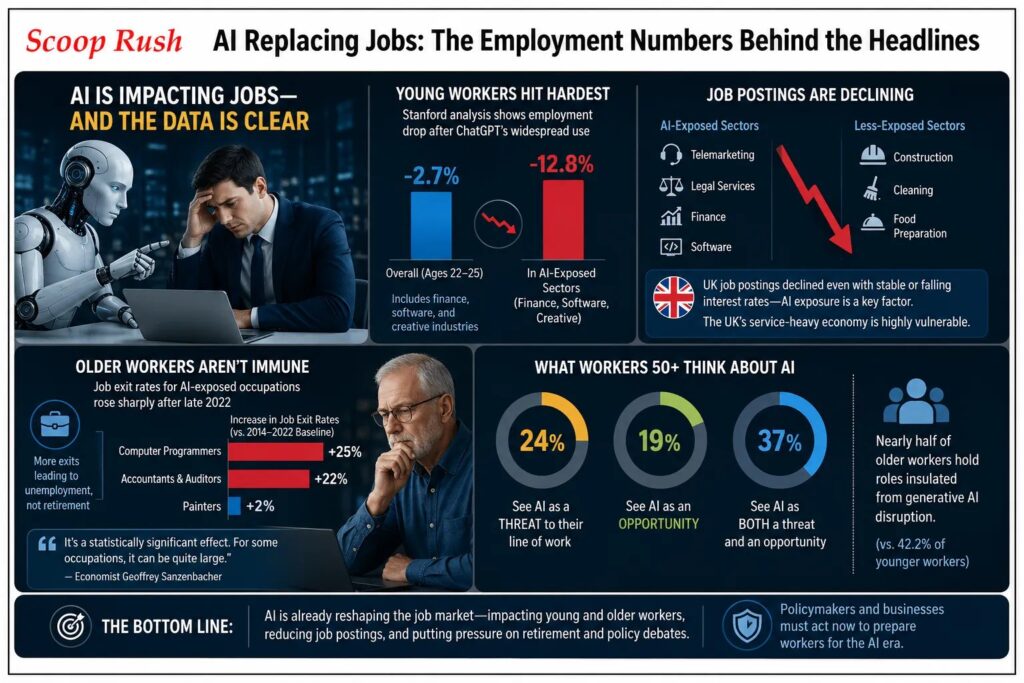
Stanford University’s analysis compared wage and job data before and after ChatGPT became widely used. The results show a 2.7% drop in employment for workers aged 22 to 25. However, in the most AI-exposed sectors, including finance, software, and creative industries, that number jumps to 12.8%.
Not every economist agrees with this conclusion. Some argue that other factors, such as interest rate increases, could explain part of the decline. Still, the pattern is consistent enough that it has caught the attention of policymakers and labor researchers alike.
Job postings tell a similar story. The OECD compared postings in highly AI-exposed sectors, such as telemarketing and legal services, against less exposed sectors like construction, cleaning, and food preparation. Notably, the United Kingdom stood out in this analysis. Job postings there took a notable hit even while interest rates stayed stable or fell. This decline also occurred before last year’s National Insurance increase. As a result, AI exposure alone appears to be playing a meaningful role. Because the UK’s economy leans heavily on service-sector jobs, it remains particularly vulnerable to further AI-driven disruption.
AI Job Displacement Is Hitting Older Workers Too
Younger workers are not the only ones affected. A June 2026 issue brief from the Center for Retirement Research at Boston College found that older employees in AI-exposed occupations are leaving their jobs at a faster rate than before. Economist Geoffrey Sanzenbacher combined federal labor data with AI exposure scores from Tufts University’s Digital Planet Initiative to track these transitions.
Before generative AI became mainstream, older workers in exposed occupations actually left their jobs less often than peers in lower-exposure roles. That advantage disappeared after late 2022. Furthermore, a meaningful share of these departures led to unemployment, not voluntary retirement.
The numbers by occupation are striking. Computer programmers saw job exit rates rise by more than 25% compared to the 2014-2022 baseline. Accountants and auditors experienced a similar surge, with exits climbing above 22%. Meanwhile, painters, whose work involves physical tasks that AI cannot easily replicate, saw only a 2% increase.
“It’s a statistically significant effect,” Sanzenbacher said. “For some occupations, it can be quite large.”
These findings carry weight beyond individual careers. They also complicate ongoing debates about raising the Social Security retirement age, since the trust fund could run dry by 2032 without policy changes. Consequently, if AI keeps pushing older workers out of their jobs earlier, asking them to work longer becomes a much harder proposition.
AARP research backs this up. Among adults aged 50 and older surveyed in March 2026, about 24% described AI as a threat to their line of work, while 19% called it an opportunity. Another 37% said it represented both at once. A joint AARP and LinkedIn report also found that nearly half of older workers currently hold roles considered insulated from generative AI disruption, compared to 42.2% of younger workers.
Is Replacing Humans With AI Actually Cheaper?
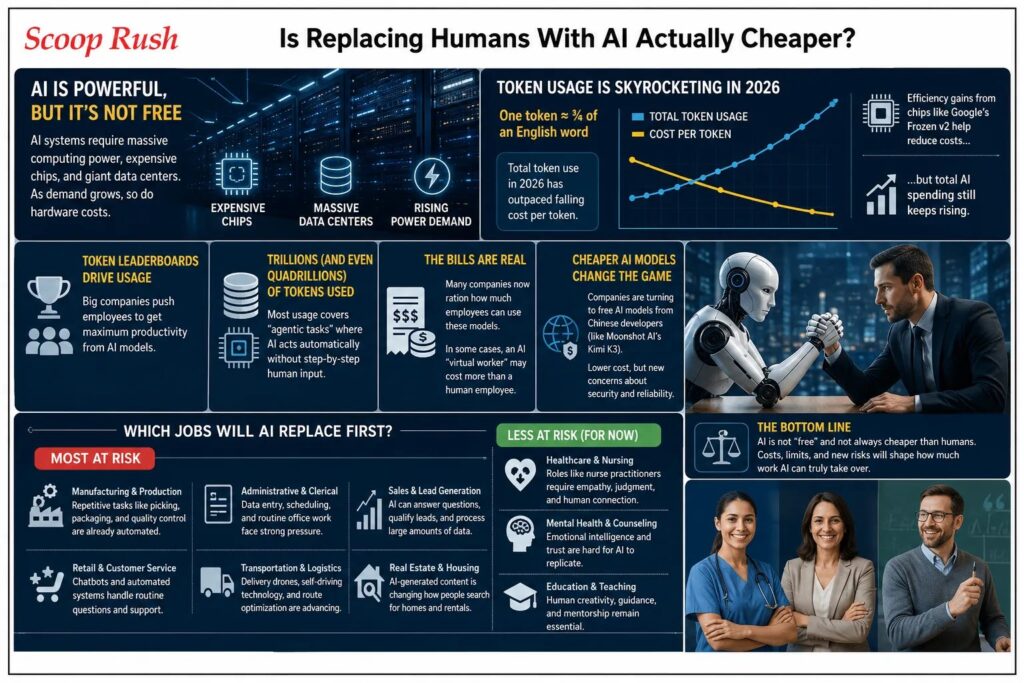
This question, will AI replace your job to save money, gets less attention than it deserves. AI systems don’t run for free. They require enormous computing power, and that power depends on expensive chips and massive data centers, the same infrastructure race behind moves like Nokia’s AI-RAN platform built with Nvidia. Therefore, as demand for AI keeps climbing, so does the pressure on hardware supply and cost.
AI usage is measured in tokens, small chunks of text that AI systems process to understand and generate language. On average, one token equals roughly three-quarters of an English word. Token use has skyrocketed throughout 2026, and this increase has outpaced the falling cost per token, even as chipmakers push efficiency gains like Google’s Frozen v2 AI chip built for Gemini. As a result, total AI spending keeps rising even as individual costs drop.
Some of the world’s largest companies now run internal “token leaderboards” that push employees to squeeze as much productivity as possible out of advanced AI models. As a result, businesses have burned through trillions, and in some cases quadrillions, of tokens over the past few months. Most of this usage covers agentic tasks, where AI systems act automatically without step-by-step human input.
The bills have piled up fast. So fast, in fact, that many companies now ration how much their employees can use these models. This detail matters because it suggests real limits on how much work AI can realistically automate. In some cases, running an AI “virtual worker” may cost more than paying a human employee, depending on the task’s complexity.
One factor works against these rising costs, however. Many companies, including Western firms, are shifting toward cheaper AI models that Chinese developers offer for free, such as Moonshot AI’s Kimi K3 model. This shift could lower the overall cost of AI adoption. Still, it raises new questions about reliability, data security, and long-term dependence on foreign technology providers.
Which Jobs Will AI Replace First?
Certain sectors show clearer signs of AI disruption than others. According to industry research, automation has already replaced repetitive tasks like picking, packaging, and quality control in manufacturing and production roles. Similarly, administrative and clerical work, including data entry and scheduling, faces pressure from AI systems that can process large volumes of information without human error.
Retail, customer service, and sales roles are also exposed, particularly where chatbots and automated systems can answer routine questions or generate leads. AI-generated content is even reshaping housing searches, as seen in reports on AI-written rental listings. Transportation and logistics show early signs of change too, as delivery drones and self-driving vehicle technology continue to develop.
On the other end of the spectrum, jobs relying on emotional intelligence, physical dexterity, and human judgment remain harder to automate. Experts frequently cite nurse practitioners, mental health counselors, and teaching roles as less vulnerable, since these positions depend on qualities AI still struggles to replicate.
Will AI Replace Your Job? What This Means for Your Career
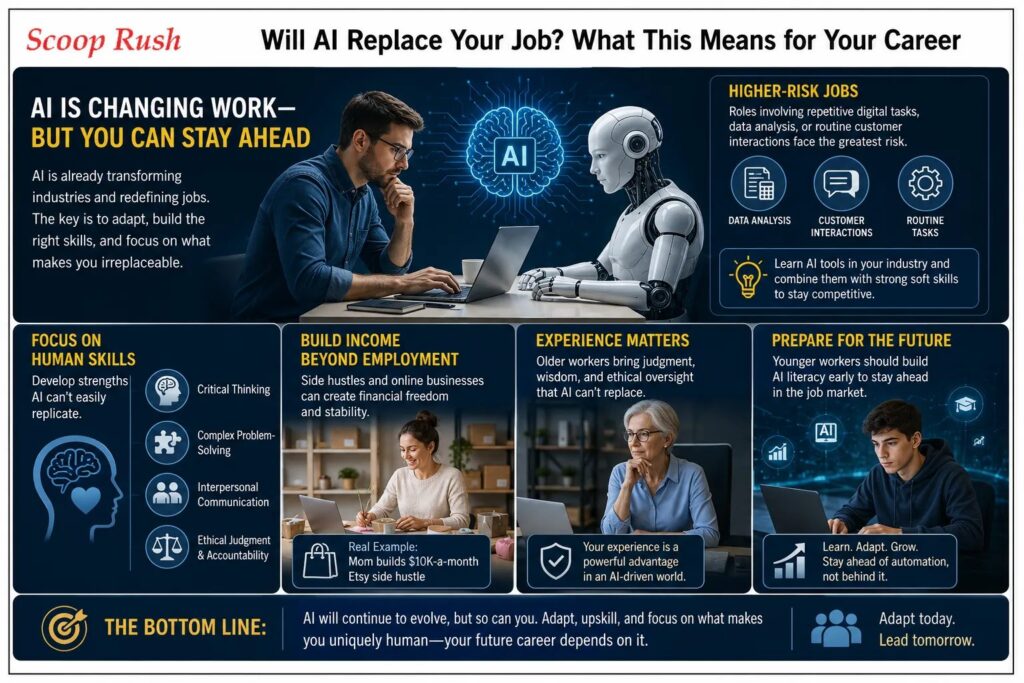
If your job involves repetitive digital tasks, data analysis, or routine customer interactions, it likely falls into a higher-risk category. However, building familiarity with AI tools relevant to your industry can help you stay competitive, since combining AI skills with strong soft skills tends to carry more value than either alone.
Career experts consistently recommend focusing on skills AI cannot easily replicate, including critical thinking, complex problem-solving, and interpersonal communication. Some workers are already building income outside traditional employment, like the mom who built a $10K-a-month Etsy side hustle. Older workers, in particular, bring judgment and ethical oversight that remain essential as AI systems take on more responsibility. Meanwhile, younger workers entering the job market may need to prioritize AI literacy earlier in their careers to remain competitive against automated alternatives.
Conclusion
AI is already changing the job market, and the data backs it up. Stanford’s research shows real declines in youth employment within AI-exposed sectors. Boston College’s findings reveal older workers leaving jobs earlier, often involuntarily. Meanwhile, the enormous cost of running advanced AI systems suggests replacing human workers is not automatically cheaper, at least not yet.
The situation remains uncertain, and not every economist agrees on how much of this shift comes from AI versus other economic factors. However, the overall trend is hard to ignore. Consequently, building AI literacy alongside distinctly human skills offers the most realistic path forward, regardless of your age or industry.
FAQs
Will AI actually replace most jobs?
AI is more likely to automate specific tasks within jobs rather than eliminate entire professions immediately. However, roles heavily focused on repetitive or data-based tasks face a higher risk of significant disruption.
Which jobs are safest from AI replacement?
Roles requiring emotional intelligence, physical skill, and human judgment tend to be safer. Examples include nurse practitioners, mental health counselors, teachers, and hands-on trades like painting.
Is AI actually cheaper than hiring human workers?
Not always. Companies have racked up massive bills from AI token usage, and many now ration usage. In some cases, running AI systems for complex tasks may cost more than paying human employees.
Are older workers more affected by AI than younger workers?
Both groups show measurable impact. Younger workers aged 22 to 25 have seen employment declines in AI-exposed sectors. Meanwhile, older workers are leaving jobs at accelerating rates, often involuntarily rather than through retirement.
What skills should I build to stay competitive with AI?
Focus on AI literacy combined with soft skills like critical thinking, communication, and problem-solving. Career experts recommend learning the AI tools relevant to your industry while strengthening abilities AI cannot easily replicate.

