
Elon Musk built his entire empire on clean energy. So why did the Elon Musk fossil fuel company deal just quietly close for $1 billion in gas turbines?
Introduction
Elon Musk fossil fuel company news just broke, and it’s a big deal. Elon Musk fossil fuel company APR Energy is the name behind his newest billion-dollar bet. The man who built his reputation on clean energy just spent nearly $1 billion on gas turbines. Solar roofs, electric cars, and battery storage were supposed to free us from fossil fuels. So when news broke that this deal had gone through, it stopped a lot of people in their tracks.
This deal did not come with a press release or a triumphant tweet. Instead, it surfaced quietly through a routine government filing. However, the implications are massive, both for Musk’s AI ambitions and for the environmental image he has built for years, an image that has only grown more complicated since SpaceX’s IPO pushed Musk toward trillionaire status.
What Is the Elon Musk Fossil Fuel Company He Just Bought?
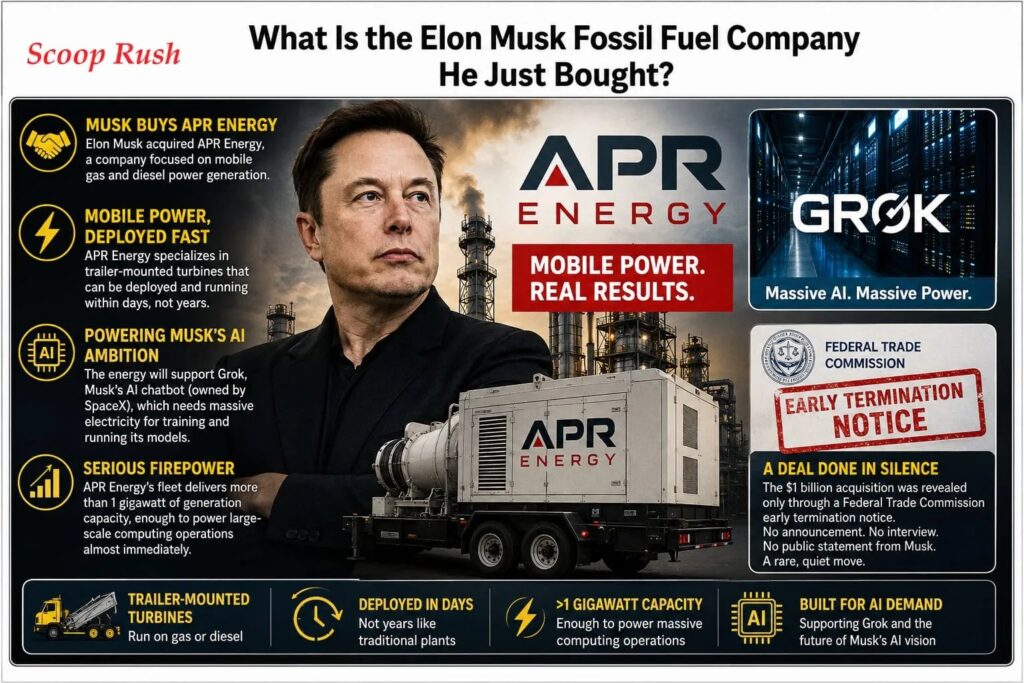
Musk acquired APR Energy, a company built entirely around mobile gas and diesel power generation. Unlike traditional power plants that take years to construct, APR Energy specializes in trailer-mounted turbines that can be deployed and running within days.
This speed is exactly why Musk wanted it. His AI chatbot Grok, owned by the now publicly traded SpaceX, needs enormous amounts of electricity to keep training and running its models. Traditional power infrastructure simply cannot keep pace with that demand.
APR Energy brings serious firepower to the table. Additionally, the company’s fleet delivers more than 1 gigawatt of generation capacity, according to reporting from Electrek. That is enough energy to make a real difference for large-scale computing operations almost immediately after installation.
How the Fossil Fuel Deal Was Structured
The acquisition did not follow the usual playbook for a billion-dollar business move. There was no announcement, no interview, and no public statement from Musk or his companies. Instead, the deal only became public knowledge through a Federal Trade Commission early termination notice, a routine regulatory filing that revealed the transaction had already closed.
This quiet approach stands out. Musk is typically vocal about his acquisitions and business decisions. However, this particular deal seemed designed to avoid the spotlight, likely because it directly contradicts the clean energy narrative he has promoted for years.
Why Musk Chose Gas Over Solar for His AI Power Needs
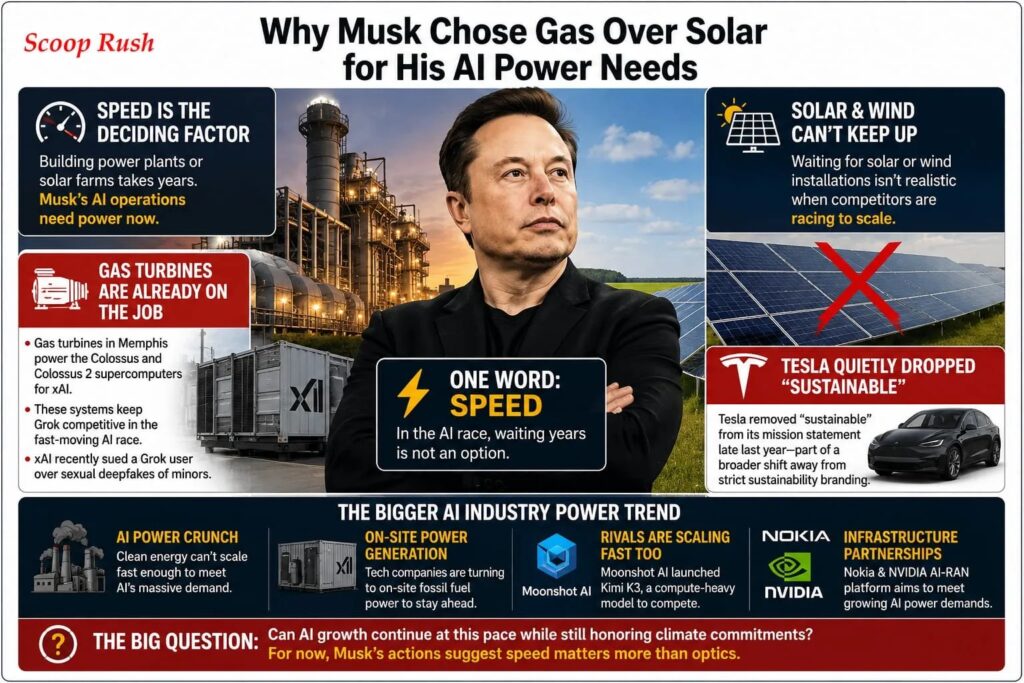
The answer comes down to one word: speed. Building a traditional power plant, even a green one, takes years of planning, permitting, and construction. Musk does not have years to wait, since his AI operations need power now.
In Memphis, gas turbines are already running the Colossus and Colossus 2 supercomputers that power xAI’s operations. These systems are central to keeping Grok competitive in an AI race that moves faster every month, a race that has already landed xAI in legal trouble after the company sued a Grok user over sexual deepfakes of minors. Meanwhile, waiting for a solar farm or wind installation to come online simply is not realistic when competitors are racing to scale their own AI infrastructure.
Additionally, this is not the first sign that Musk’s companies are quietly stepping back from strict sustainability branding. Tesla, the company most associated with Musk’s clean energy reputation, dropped the word “sustainable” from its mission statement late last year. That change did not receive much attention at the time, but it now looks like part of a broader pattern.
The Bigger AI Industry Power Trend
Musk is not alone in this shift. The entire AI industry is grappling with a power crunch that clean energy sources cannot solve fast enough. As a result, tech companies across the board are exploring on-site power generation, including fossil fuel options, just to keep their AI systems running. Rivals like Moonshot AI are pushing their own compute-heavy models forward too, as seen with the recent Kimi K3 model launch, while telecom players are betting on infrastructure partnerships such as the Nokia and NVIDIA AI-RAN platform to keep pace with demand.
This trend raises an uncomfortable question for the industry. Can AI growth continue at its current pace while still honoring the climate commitments many companies have made publicly? For now, Musk’s actions suggest that speed matters more than optics.
What This Elon Musk Fossil Fuel Company Deal Means for His Clean Energy Legacy
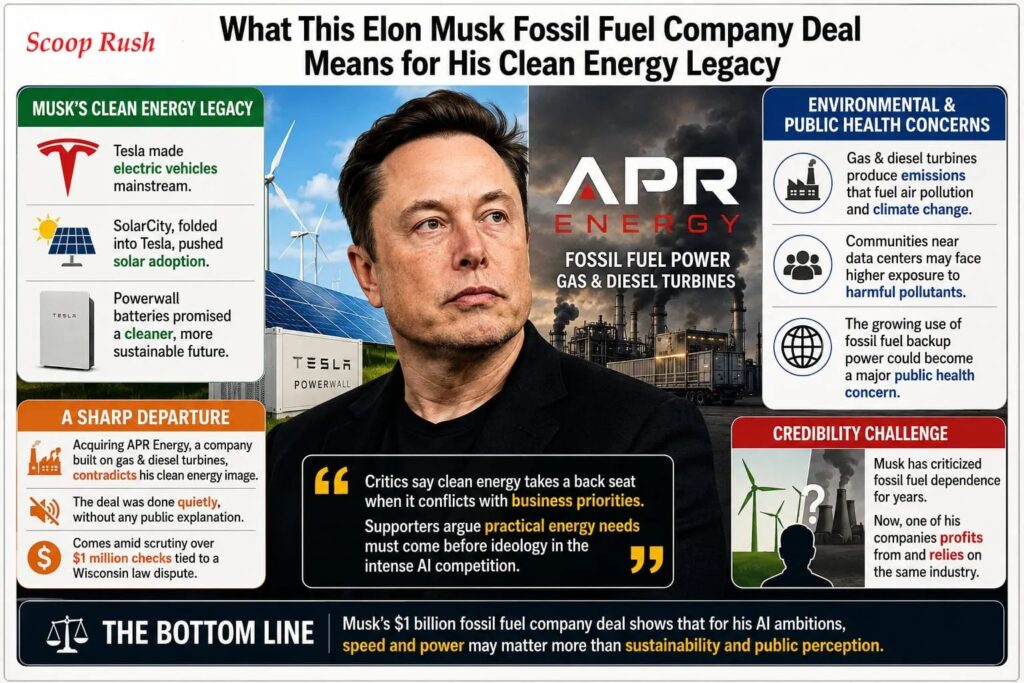
Musk has spent years positioning himself as a champion of renewable energy. Tesla popularized electric vehicles for mainstream buyers. SolarCity, later folded into Tesla, pushed solar adoption. Powerwall batteries promised a future less dependent on fossil fuels.
This latest acquisition complicates that legacy. Buying a company whose entire business model depends on gas and diesel turbines marks a significant departure from that image. Furthermore, doing so quietly, without any public explanation, suggests Musk himself may recognize the tension between this move and his brand, especially at a time when he has also faced scrutiny over $1 million checks tied to a Wisconsin law dispute.
Critics will likely point to this as evidence that clean energy commitments take a back seat when they conflict with business priorities. Supporters, on the other hand, may argue that practical energy needs must come before ideology, especially when AI competition is this intense. Either way, the optics are difficult to ignore.
Environmental and Public Health Concerns
Fossil fuel power generation carries real environmental consequences. Gas and diesel turbines produce emissions that contribute to air pollution and climate change, the very issues Musk’s other companies claim to fight against.
Communities near data centers powered by these temporary turbines may also face increased exposure to pollutants. As AI data centers multiply across the country, therefore, the cumulative environmental impact of fossil fuel backup power could become a significant public health concern, not unlike the scrutiny AI systems are already facing elsewhere, including the NHS’s use of AI tools to cut waiting times and the debate around AI-generated rental listings under NYC’s Rental Ripoff Report.
Moreover, this creates a credibility challenge for Musk personally. He has criticized fossil fuel dependence publicly for years. Now, one of his own companies is directly profiting from and relying on that same industry to fuel its AI ambitions.
What Comes Next for Musk’s AI Power Strategy
It remains unclear whether this acquisition represents a permanent shift or a temporary bridge solution. AI infrastructure needs are evolving rapidly, and today’s urgent power crunch could ease as new technologies and energy sources come online, even as SpaceX continues facing its own setbacks, including the aborted Starship flight 13 launch.
For now, though, the message is clear. When faced with a choice between waiting years for clean energy infrastructure or buying immediate fossil fuel capacity, Musk chose speed. Consequently, this decision will likely influence how other tech leaders approach similar power shortages in their own AI operations.
As a result, the tech industry may see more companies following this same path, prioritizing rapid deployment over environmental branding. If that happens, the broader conversation around AI’s environmental footprint will only grow louder in the coming months.
Conclusion
Elon Musk’s decision to acquire a fossil fuel company marks a significant turning point in his public identity. The man who built his reputation on solar power and electric vehicles is now betting on gas turbines to keep his AI ambitions alive. This Elon Musk fossil fuel company deal shows just how urgently AI infrastructure needs power, even if that means stepping back from long-held environmental commitments.
The quiet nature of the acquisition suggests Musk understands the contradiction it creates. Ultimately, whether this becomes a lasting shift or a short-term fix, one thing is certain: the race for AI dominance is reshaping energy priorities across the entire tech industry, and clean energy promises may not survive that race unchanged.
FAQs
What fossil fuel company did Elon Musk buy?
Musk acquired APR Energy, a company that specializes in mobile gas and diesel turbine power generation, in a deal estimated at $1 billion.
Why did Elon Musk buy a fossil fuel company?
Musk needed fast, reliable power for his AI operations, particularly the Grok chatbot and xAI’s supercomputers. Fossil fuel turbines can be installed in days, unlike traditional power plants that take years to build.
How much power capacity does APR Energy provide?
APR Energy’s fleet of trailer-mounted turbines delivers more than 1 gigawatt of generation capacity.
Did Elon Musk announce this acquisition publicly?
No. The deal became public through a Federal Trade Commission early termination notice rather than an official announcement from Musk or his companies.
Has Tesla also moved away from its clean energy messaging?
Yes. Tesla quietly removed the word “sustainable” from its mission statement late last year, which some see as part of a broader shift in priorities.

