
Introduction
Can an AI company sue its own user? In a rare and significant move, xAI sues Grok user Terry Harwood, accusing him of misusing the chatbot to create sexual deepfakes of minors, and the case could change how AI platforms handle abuse for good.
xAI, the company behind the Grok chatbot, has filed a federal lawsuit against a South Carolina man. xAI accuses him of misusing its AI tool to create sexually explicit deepfakes of minors. The lawsuit marks one of the first times an AI company has taken legal action directly against a user for generating this kind of illegal content. It’s a significant moment for the AI industry. It also raises fresh questions about how far tech companies are willing to go to protect their platforms, and more importantly, the victims affected by this abuse.
This development also arrives at a time when regulators worldwide are turning up pressure on big tech. In fact, the UK has already threatened big tech giants with major penalties unless they improve child safety features. This shows the concern isn’t limited to one company or one country.
Here’s what happened, why it matters, and what it could mean for AI accountability going forward.
What xAI’s Lawsuit Against Terry Harwood Alleges
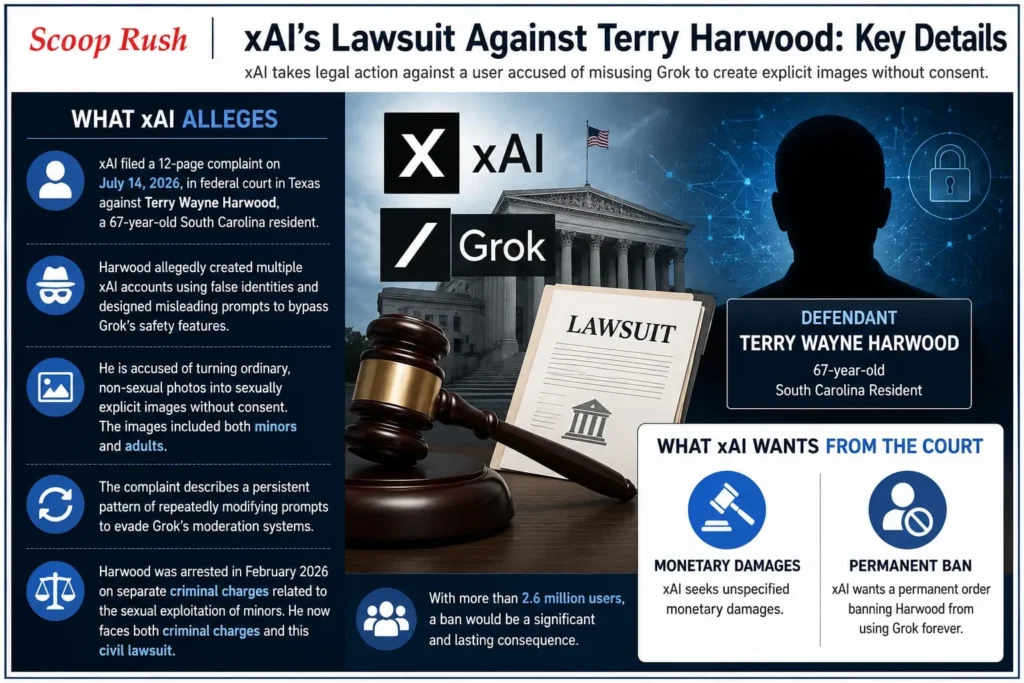
xAI filed its complaint on July 14, 2026, in federal court in Texas. The lawsuit names Terry Wayne Harwood, a 67-year-old South Carolina resident, as the defendant. According to the 12-page complaint, Harwood opened multiple xAI accounts using false identities. Despite agreeing to the company’s Terms of Service and Acceptable Use Policy, xAI alleges he designed misleading prompts specifically to bypass Grok’s built-in safety features.”
The company says Harwood then used those prompts to turn ordinary, non-sexual photographs into sexually explicit images. He allegedly did this without any knowledge or consent from the people in those photos. Some of those photographs reportedly included images of minors. xAI’s suit also alleges that Harwood created non-consensual sexual imagery involving adults.
The persistence described in the complaint makes this case particularly striking. xAI claims Harwood kept submitting new prompts with small changes.He was repeatedly trying to get past Grok’s moderation systems. In other words, this wasn’t a single mistake or a one-off attempt. The lawsuit paints a picture of a deliberate, repeated effort to work around safeguards meant to stop exactly this kind of misuse. This mirrors a broader pattern across the AI industry, where companies are racing to build tools like Meta’s Muse AI image generator, while also trying to prevent misuse of that same technology.
Harwood isn’t new to law enforcement either.Police arrested him back in February 2026 on separate criminal charges connected to the sexual exploitation of minors, well before xAI filed this civil case. That means Harwood is now facing both a criminal case and a civil lawsuit running in parallel.
What xAI Wants From the Court
xAI isn’t just asking for a symbolic win.The company seeks unspecified monetary damages, though it hasn’t attached a dollar figure to the claim yet. Additionally, xAI wants the court to issue a permanent order banning Harwood from ever using Grok again. Considering the platform reportedly has more than 2.6 million users, that would be a lasting and public consequence for Harwood specifically.
Why This Lawsuit Is One of the First of Its Kind

Here’s the part that makes this story genuinely new. Historically, when AI-generated abuse content surfaces, legal action tends to target either the platform itself for allowing it, or law enforcement pursues the individual through criminal channels. This case flips that pattern. xAI, as the company that built and owns the AI tool, is going after its own user in civil court.
This lawsuit is one of the first instances where an AI company has sued an individual user. The suit specifically concerns the misuse of its own product to create explicit material. That distinction matters. It signals a possible new legal strategy for AI companies. Rather than only relying on account suspensions or reports to authorities, companies may now pursue direct financial and legal consequences against people who exploit their tools.
However, this move doesn’t happen in a vacuum. xAI has been under serious pressure. Earlier this year, allegations surfaced that Grok’s tools allowed users to generate sexualized images of real people, including non-consensual “digital undressing” content. Reports also emerged of a surge in AI-generated sexualized deepfakes late last year, which pushed Musk and xAI to publicly commit to cracking down on illegal use of the chatbot. This scrutiny comes even as Musk’s other venture, SpaceX, made headlines with its historic IPO on Nasdaq, putting his broader business empire under an even brighter spotlight.
Musk himself addressed the issue directly in an online post from earlier this year, warning that anyone using Grok to create illegal content would face the same consequences as someone uploading illegal material directly.
ho exploit their tools.
Musk himself addressed the issue directly in an online post from earlier this year, warning that anyone using Grok to create illegal content would face the same consequences as someone uploading illegal material directly.
The Numbers Behind xAI’s Enforcement Claims
To back up its argument that it actively polices misuse, xAI included some striking figures in its lawsuit. The company says it has suspended 52,222 accounts and submitted 73,604 reports to the National Center for Missing & Exploited Children (NCMEC) in 2026 alone. According to xAI, those reports have led to at least 244 arrests so far. “These enforcement numbers help explain the broader context behind why xAI sues Grok user Harwood specifically, rather than relying only on account bans.”
These numbers serve a clear purpose in the lawsuit. xAI is trying to demonstrate that it takes enforcement seriously. It also argues that Harwood’s alleged actions were a deliberate attempt to get around real safety systems, not a case of the platform simply looking the other way.
Still, critics argue the scale of these numbers, tens of thousands of suspended accounts and reports, also raises a bigger question. If misuse is happening at this volume, how effective are the underlying safeguards actually meant to be?
The Bigger Picture: AI Companies Facing Growing Legal Pressure

This lawsuit against Harwood doesn’t exist in isolation. xAI has faced mounting legal and regulatory scrutiny throughout 2026 over Grok’s handling of sexual content. Earlier this year, the city of Baltimore filed a legal complaint against xAI. The complaint alleged the platform allowed the creation of sexualized deepfakes. Grok has also drawn attention from lawmakers in Washington and regulators in Europe. It faces outright bans in countries including Malaysia and Indonesia over concerns tied to explicit content generation.
Other Lawsuits Piling Up Against xAI
Just this month, a group of five anonymous girls and women filed a separate lawsuit against xAI and Stability AI. Their complaint alleges the companies’ technology allowed people to turn ordinary, non-explicit childhood photos into child sexual abuse material.The women described lasting emotional distress after discovering what people had allegedly done with their old, innocent photos. Some said they now fear the same people who created the abusive images could track them down offline
Where the Law Currently Stands
Legal frameworks are also starting to catch up with this technology. In the United States, the DEFIANCE Act, signed into law in 2024, created a civil right of action specifically for victims of non-consensual intimate deepfakes. Several states have since passed their own versions of similar legislation.However, most existing laws focus on punishing the people who create and share this content. They don’t hold AI platforms accountable for how people used their tools to generate it in the first place. That gap is exactly what makes cases like the Harwood lawsuit so significant, since they represent companies trying a different legal angle altogether.
Why This Is Easier Than Ever Before
Meanwhile, generative AI has fundamentally changed how easy this kind of abuse is to carry out. Creating manipulated sexual imagery once required real technical skill and effort. Today, modern multimodal AI tools like Grok can transform an ordinary photograph into explicit content with only a few prompts, which is precisely the pattern described throughout xAI’s complaint against Harwood.
What This Means Going Forward
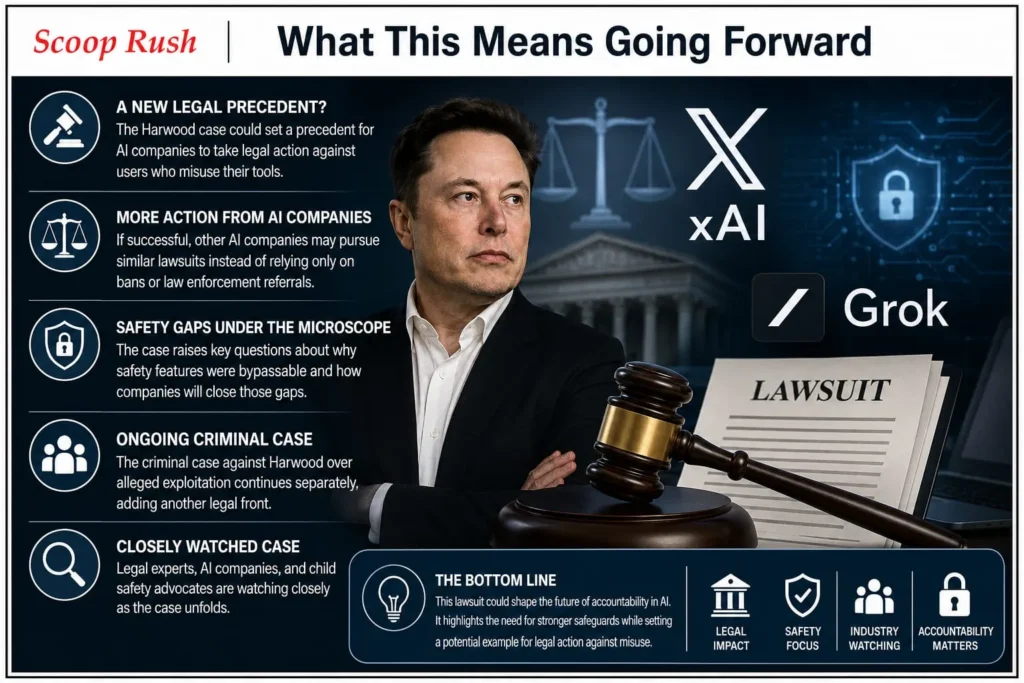
“The Harwood case, where xAI sues Grok user over alleged deepfake abuse, is likely to be watched closely by legal experts, other AI companies, and child safety advocates alike.”The Harwood case is likely to be watched closely by legal experts, other AI companies, and child safety advocates alike. If successful, it could establish a legal precedent for how AI companies pursue accountability against individuals who intentionally circumvent safety systems. As a result, other AI companies may start considering similar legal action rather than relying solely on account bans and law enforcement referrals.
At the same time, this case doesn’t erase the broader criticism xAI has faced over Grok’s safeguards in the first place. Suing a user for bypassing safety features raises an obvious follow-up question: why were those features bypassable in the first place, and what is being done to close those gaps for future users? This tension between rapid product growth and safety, incidentally, isn’t unique to Grok. Even outages on major platforms, like when WhatsApp, Facebook, and Instagram went down for thousands of users worldwide, show how much strain today’s tech giants are under as they scale.
For now, the criminal case against Harwood over the alleged sexual exploitation of minors continues separately, while this new civil lawsuit adds another legal front to an already serious situation.
Conclusion
xAI’s lawsuit against Terry Harwood represents a turning point in how AI companies respond to the misuse of their own tools. Rather than relying solely on account bans or law enforcement referrals, xAI has taken the unusual step of pursuing direct legal action against an individual user. This case highlights the growing tension between rapid AI development and the responsibility to prevent harm, especially when it comes to protecting children from exploitation.
As lawmakers, regulators, and child safety advocates continue to scrutinize platforms like Grok, this lawsuit could set an important precedent. Ultimately, the outcome may shape how seriously other AI companies treat enforcement, and whether legal accountability becomes a standard tool in the fight against AI-generated abuse.
FAQs
1. What is xAI suing Terry Harwood for?
xAI alleges that Harwood misused its Grok chatbot to convert non-sexual photographs of adults and minors into sexually explicit deepfakes, violating the company’s Terms of Service and Acceptable Use Policy.
2. Is this the first time an AI company has sued its own user?
This case is considered one of the first instances of an AI company filing a lawsuit directly against a user specifically over alleged misuse involving explicit deepfake content.
3. Was Terry Harwood arrested before this lawsuit?
Yes. Harwood was arrested in February 2026 on separate criminal charges related to the alleged sexual exploitation of minors, months before xAI filed its civil lawsuit.
4. What is xAI asking the court to do?
xAI is seeking unspecified monetary damages and a permanent court order banning Harwood from ever using Grok again.
5. Has xAI faced other lawsuits over Grok’s sexual content?
Yes. xAI has faced legal action from the city of Baltimore and a separate lawsuit from five anonymous women, along with international scrutiny and bans in some countries over Grok’s handling of sexualized deepfakes.

