
Millions of Fruit Bats Create One of Africa’s Most Incredible Wildlife Spectacles
While most travelers dream of seeing Africa’s famous safari animals, a far more extraordinary wildlife event takes place each year in Zambia, largely unnoticed by the world.
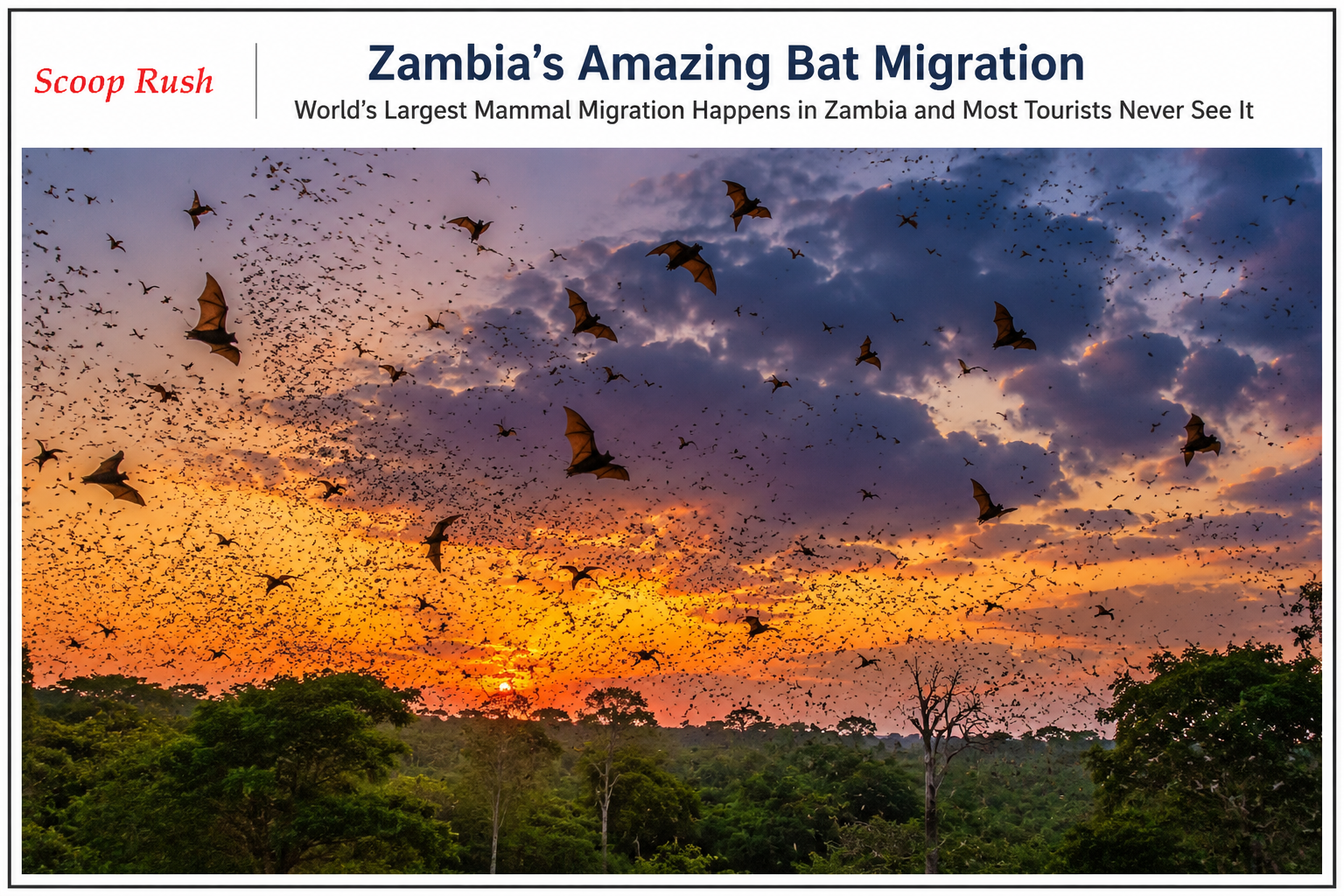
Between October and December, an estimated 8 to 10 million straw-colored fruit bats descend on Kasanka National Park in central Zambia. The massive gathering creates what scientists consider the largest mammal migration on Earth, yet fewer than 1,000 visitors witness it annually.
As the sun sets over the woodland canopy, millions of bats rise from the trees in a breathtaking display, filling the sky with a swirling cloud of wings that stretches as far as the eye can see.
A Hidden Natural Wonder in Zambia
Located about 500 kilometers north of Zambia’s capital, Lusaka, Kasanka National Park is one of the country’s smallest national parks. Covering roughly 390 square kilometers, it is known for its wetlands, forests, lagoons, and diverse birdlife.
Unlike the crowded safari destinations of East and Southern Africa, Kasanka remains quiet and relatively untouched. Visitors come primarily to experience the annual bat migration, which has become one of Africa’s most remarkable wildlife events.
The migration is driven by the seasonal abundance of fruit in the region. Bats travel from various parts of Central Africa to feed in the park’s forests before eventually dispersing again.
Why the Bat Migration Is So Important
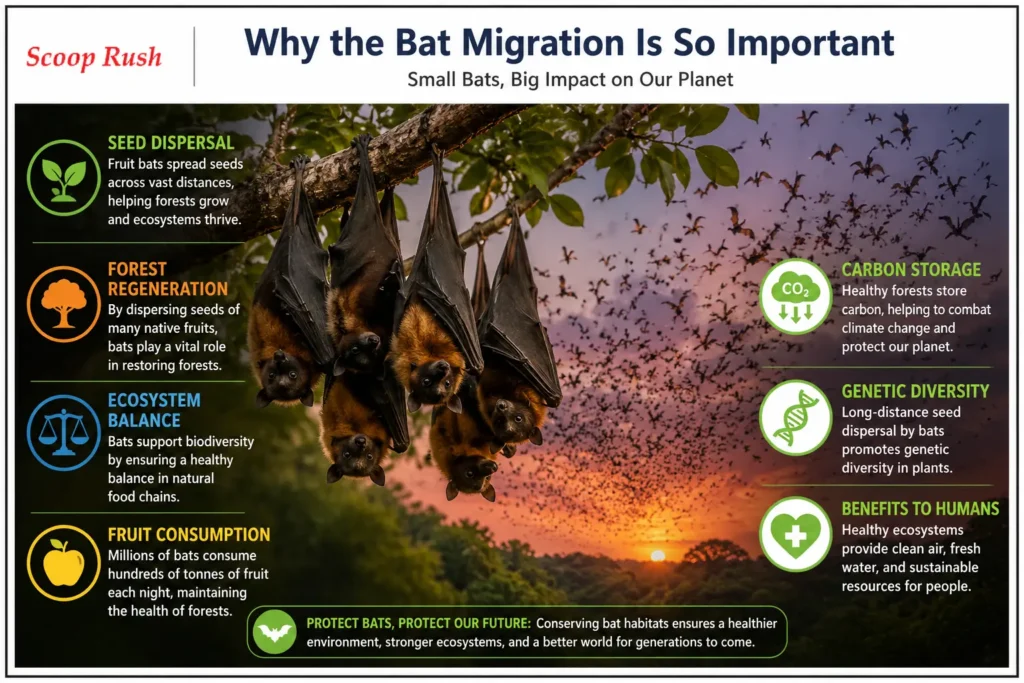
The straw-colored fruit bat, scientifically known as Eidolon helvum, plays a critical role in maintaining Africa’s ecosystems.
Each bat weighs around 250 grams and can consume nearly its own body weight in fruit every night. With millions of bats feeding simultaneously, researchers estimate they eat around 230 to 250 tonnes of fruit daily during their stay.
Over the migration season, the colony consumes approximately 330,000 tonnes of fruit.
More importantly, the bats help spread seeds across vast distances. According to bat ecologists, these animals are capable of dispersing seeds farther than many other large wildlife species, including elephants. This process helps regenerate forests and supports biodiversity throughout the region.
Long-Distance Travelers of the Night
Scientists continue to study the migration, and many questions remain unanswered.
Research has shown that some bats travel up to 96 kilometers in a single night while searching for food. Tracking studies have also revealed astonishing long-distance journeys.
In one notable study, bats fitted with satellite transmitters traveled more than 997 kilometers. One bat, nicknamed “Hercules,” flew over 2,400 kilometers, demonstrating the species’ incredible endurance.
Despite these discoveries, researchers still do not fully understand where all the bats come from or where they go after leaving Kasanka.
A Conservation Success Story
Kasanka National Park was not always thriving.
During the 1980s, extensive poaching severely reduced wildlife populations, putting the park’s future at risk. Conservation efforts began in the early 1990s under dedicated management that invested in infrastructure, habitat protection, and anti-poaching measures.
Today, many animal populations have recovered. Species such as puku, bushbuck, sable antelope, and even elephants have returned to the area.
The park has become an important example of successful conservation in Africa.
More Than Just Bats
Although the migration is the park’s biggest attraction, Kasanka offers much more for nature lovers.
The park is one of the best places in Africa to spot the elusive sitatunga, a rare swamp-dwelling antelope adapted to life in wetlands. Visitors may also encounter hippos, crocodiles, bushpigs, civets, blue monkeys, and numerous bird species.
With more than 450 recorded bird species, Kasanka is considered one of Zambia’s top birdwatching destinations.
A Rare Experience for Wildlife Travelers
Unlike the famous Serengeti migration, which attracts hundreds of thousands of visitors every year, the Kasanka Bat Migration remains relatively unknown.
The lack of crowds gives visitors a unique opportunity to experience one of the planet’s greatest wildlife events in near solitude.
As dusk falls and millions of bats rise into the sky, the scene resembles a living storm moving across the African landscape. For travelers fortunate enough to witness it, the experience is unforgettable.
Why the Kasanka Bat Migration Matters
The annual migration is more than a spectacular sight. It is a vital ecological event that supports forest regeneration across Central Africa.
Scientists continue to investigate the bats’ migration routes and behavior, while conservationists emphasize their importance to healthy ecosystems.
For visitors, however, the migration offers something equally valuable: a rare chance to witness one of nature’s greatest wonders before the rest of the world discovers it.
FAQs
1. Where does the world’s largest mammal migration take place?
The migration occurs in Kasanka National Park in Zambia, where millions of straw-colored fruit bats gather every year.
2. When is the best time to see the Kasanka Bat Migration?
The migration takes place from late October through December, with the largest numbers usually appearing in November.
3. How many bats participate in the migration?
Researchers estimate that between 8 million and 10 million straw-colored fruit bats gather in Kasanka during the migration season.
4. Why do the bats come to Kasanka National Park?
The bats are attracted by an abundance of seasonal fruit, which provides a rich food source during the migration period.
5. Why are straw-colored fruit bats important to the environment?
They play a major role in seed dispersal and forest regeneration, helping maintain healthy ecosystems across large parts of Africa.

