Home Blog Page 56

Young Women Face Near-Zero Risk of Cervical Cancer Death After HPV Vaccine, Study Finds

0

What if a vaccine given at age 12 could almost eliminate deaths from cervical cancer before age 30? According to a landmark UK study, that possibility is becoming reality. Researchers found that young women who received the HPV vaccine during their early teens now have a close to zero risk of dying from cervical cancer before the age of 30.

The findings mark a major milestone in cancer prevention. Experts say the results provide powerful evidence that the HPV vaccine saves lives and could eventually help eliminate cervical cancer as a public health problem.

The HPV Vaccine Is Preventing Cervical Cancer Deaths

A major study conducted by UK researchers and funded by Cancer Research UK revealed a sharp decline in cervical cancer deaths following the introduction of the HPV vaccine for girls aged 12 and 13 in 2008.

Between 2020 and 2024, there were no recorded cervical cancer deaths among women aged 20 to 24 in England. Researchers estimated that around 23 deaths would have been expected without vaccination.

The study also found:

  • An 80% reduction in cervical cancer deaths among women aged 20 to 24 between 2015 and 2019.
  • Nearly 200 deaths prevented through HPV vaccination in England by the end of 2024.
  • A 100% reduction in the risk of death from cervical cancer among vaccinated women under 30.
  • A 63% reduction in mortality among women aged 30 to 34.

These findings represent the first time researchers have directly shown that the HPV vaccine is saving lives.

Why the HPV Vaccine Is So Effective

Human papillomavirus (HPV) is a group of viruses spread mainly through sexual contact. Around 13 high-risk HPV types are responsible for nearly all cervical cancer cases.

Most HPV infections clear naturally. However, some infections can cause abnormal cell changes that develop into cancer years later.

The vaccine works best when given before exposure to the virus. That is why health authorities recommend vaccination for children around ages 12 and 13.

Vaccination at a Younger Age Provides Greater Protection

Researchers noted that women aged 30 to 34 received lower levels of protection because many were vaccinated later, between ages 15 and 18. By that time, some may have already been exposed to HPV strains 16 and 18.
Consequently, the vaccine was less effective for that age group compared with those vaccinated earlier.

Experts Call Results an Important Milestone

Professor Peter Sasieni, lead researcher at Queen Mary University of London, said the results show that the HPV vaccine works on a population scale.
He explained that before vaccination programs, there had never been a year without cervical cancer deaths among young women.
He also described the current results as “the tip of the iceberg.” According to him, the full benefits will become clearer as vaccinated generations age.
Meanwhile, Cancer Research UK called the findings an “incredible milestone.”
Michelle Mitchell, the charity’s chief executive, said the study proves the vaccine stops cervical cancer before it starts and is now clearly saving lives.

Falling Vaccination Rates Raise Concerns

Despite the encouraging results, experts remain worried about declining vaccine uptake.

Before the COVID-19 pandemic, HPV vaccine coverage in England reached between 80% and 90%. However, more recent figures show a decline.

By 2024-25:

  • About 76% of girls in England had received the vaccine by age 15.
  • In London, coverage dropped to around 61%.
  • Some local areas reported vaccination rates below 50%.

Professor Sasieni warned that lower uptake could lead to a resurgence of cervical cancer among young women.

Therefore, health experts are urging families to ensure eligible children receive the vaccine.

Ireland Continues Efforts to Improve HPV Vaccination

Ireland introduced the HPV vaccine for girls in 2010 and expanded it to boys in 2019.

However, vaccination rates declined sharply after 2015. According to the latest available data, overall vaccine uptake among first-year secondary school students during the 2023-2024 academic year stood at 74.9%.

The World Health Organization has set a target of 90% vaccine coverage. Ireland aims to meet that goal and eliminate cervical cancer by 2040.

The Laura Brennan Catch-Up Campaign

Laura Brennan became a leading advocate for HPV vaccination after being diagnosed with cervical cancer. She died at the age of 24.

To honor her legacy, Ireland launched a catch-up vaccination campaign in her name.

Initially offered to fifth and sixth-year students, the program will expand to include second through fifth-year students during the upcoming academic year.

Her brother, Kevin Brennan, said Laura would have been thrilled by the latest findings because she always believed the vaccine saves lives.

A Survivor Shares Why Vaccination Matters

Alexandra Legg missed receiving the HPV vaccine because she left school before the program began in England.

At age 30, while planning her wedding, she received a cervical cancer diagnosis.

Her treatment included surgery and the removal of lymph nodes. Fortunately, doctors preserved part of her cervix, allowing her to become pregnant later.

She gave birth to her daughter Ivy, whose middle name, Marvella, means “miracle.”

Today, Alexandra strongly supports vaccination and says her daughter will be among the first to receive the HPV vaccine when eligible.

HPV Vaccine Also Protects Against Other Cancers

The benefits of HPV vaccination extend beyond cervical cancer.

The vaccine can also help prevent:

  • Head and neck cancers
  • Mouth cancers
  • Throat cancers
  • Anal cancer
  • Penile cancer
  • Genital warts

Additionally, vaccinating boys helps reduce virus transmission and protects both sexes from HPV-related diseases.

Global Goal: Eliminate Cervical Cancer

In 2020, the World Health Organization launched its strategy to eliminate cervical cancer as a public health problem.

The WHO’s “90-70-90” targets aim to ensure:

GoalTarget
Girls vaccinated by age 1590%
Women screened by age 35 and 4570%
Women with cervical disease treated90%

The UK government and Ireland have both committed to eliminating cervical cancer by 2040.

Meanwhile, health officials continue promoting screening programs because regular cervical screening remains important even for vaccinated women.

Conclusion

The latest research offers some of the strongest evidence yet that the HPV vaccine is transforming women’s health. For girls vaccinated at ages 12 and 13, the risk of dying from cervical cancer before age 30 has become almost zero.

Furthermore, nearly 200 lives have already been saved in England. Experts believe many more deaths will be prevented as vaccinated generations grow older.

However, maintaining high vaccination rates remains essential. As health authorities push toward eliminating cervical cancer, the message from researchers and survivors is clear: vaccination saves lives.

FAQs

1. How effective is the HPV vaccine against cervical cancer?

Research shows the HPV vaccine reduces the risk of cervical cancer death by 100% in vaccinated women under age 30.

2. At what age should children receive the HPV vaccine?

Health authorities recommend vaccination around ages 12 to 13, before exposure to HPV.

3. Does the HPV vaccine protect boys too?

Yes. Boys benefit from protection against anal, penile, throat, and mouth cancers and help reduce virus transmission.

4. Is cervical screening still necessary after vaccination?

Yes. Women aged 25 to 64 are still advised to attend regular cervical screening appointments.

5. Can HPV cause other cancers besides cervical cancer?

Yes. HPV is linked to several cancers, including mouth, throat, anal, and penile cancers.
Sweden vs Tunisia Result: Sweden Thrash Tunisia 5-1 in FIFA World Cup 2026

0

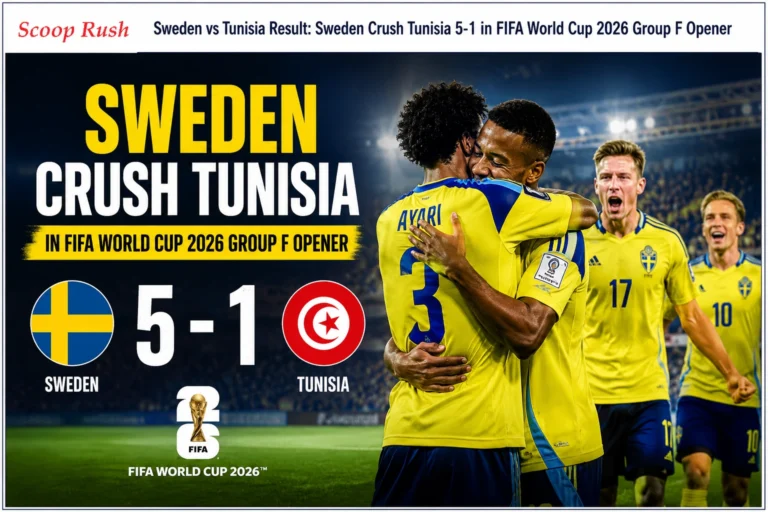
FIFA World Cup 2026™ – Group F

Full-Time: Sweden 5-1Tunisian

Date: Monday,15 Jun

Venue: Estadio Monterrey, Guadalupe 

Sweden made a stunning start to their FIFA World Cup 2026 campaign with a dominant 5-1 victory over Tunisia in Group F on Monday, 15 June. The Scandinavian side produced an attacking masterclass, scoring five goals and controlling large portions of the match to secure three valuable points. Tunisia briefly threatened to make the contest competitive, but Sweden’s quality, organization, and clinical finishing proved too much to handle.

The Sweden vs Tunisia result immediately places Sweden at the top of Group F after the opening round of fixtures. With an impressive goal difference and a confident performance, Sweden sent a strong message to their group rivals that they are serious contenders for a place in the knockout stages.

Sweden Start Brightly and Take Early Control

From the opening whistle, Sweden looked determined to dictate the tempo. Their midfield controlled possession, while the wide players constantly stretched the Tunisian defense. Sweden’s aggressive pressing prevented Tunisia from building attacks and forced several turnovers in dangerous areas.

The breakthrough arrived in the 17th minute when Yasin Ayari found space and finished calmly to give Sweden a deserved 1-0 lead. The goal rewarded Sweden’s energetic start and increased their confidence as they continued to push forward.

Tunisia struggled to deal with Sweden’s movement between the lines, and the pressure eventually led to a second goal. In the 30th minute, Alexander Isak doubled Sweden’s advantage with a composed finish, putting his team firmly in control before halftime.

Although Tunisia attempted to respond, Sweden’s defense remained organized and rarely allowed clear-cut opportunities. By the interval, the Europeans held a comfortable 2-0 advantage and looked capable of adding more goals after the break.

Tactical Battle and Team Lineups

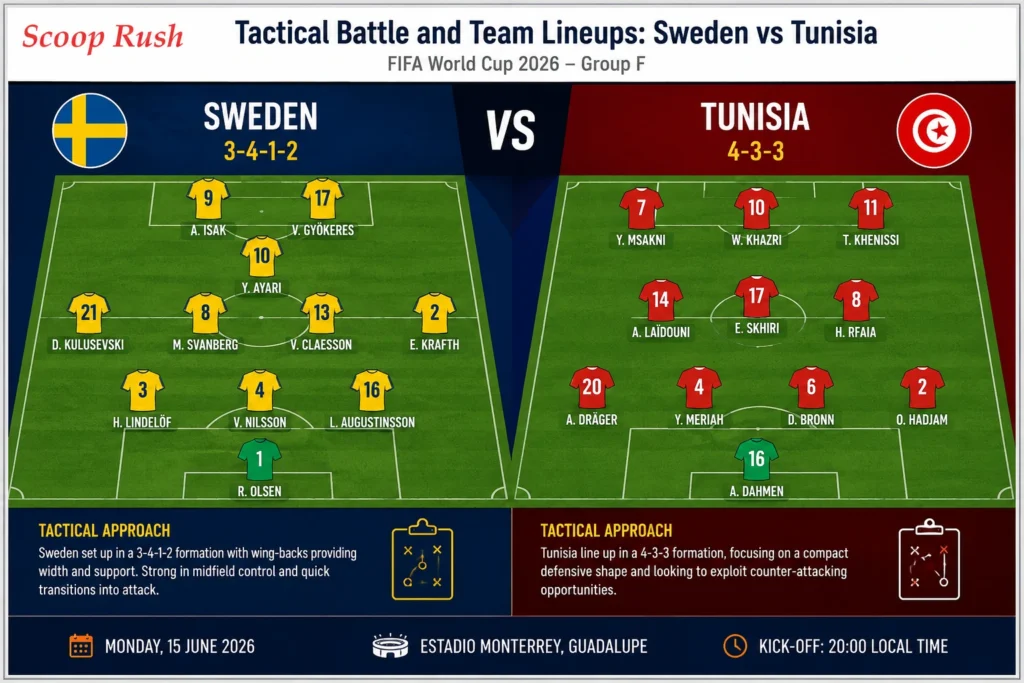
Sweden lined up in a balanced 3-4-1-2 formation designed to maximize attacking width while maintaining defensive stability. The back three provided security, allowing wing-backs to advance and support attacks.

Alexander Isak led the line and was supported by creative midfielders who consistently supplied dangerous passes into the final third. Sweden’s midfield trio excelled in controlling possession and winning second balls.

Tunisia adopted a more cautious approach, hoping to remain compact and exploit counterattacking opportunities. However, Sweden’s pressing limited the effectiveness of Tunisia’s transition play.

The difference between the teams became evident in midfield, where Sweden consistently won possession and created overloads. Tunisia found it difficult to progress the ball through central areas and often resorted to long passes that Sweden’s defenders handled comfortably.

Sweden Dominate the Second Half

The second half followed a similar pattern as Sweden continued to attack with confidence. Tunisia attempted to increase their intensity, but Sweden’s quality in possession repeatedly exposed defensive gaps.

The third goal arrived in the 59th minute when Viktor Gyökeres got on the scoresheet. His finish effectively ended any realistic hopes of a Tunisian comeback and gave Sweden a commanding 3-0 lead.

Despite trailing heavily, Tunisia continued to fight and eventually found a breakthrough. Omar Rafia scored in the 67th minute to reduce the deficit to 3-1 and briefly provide a spark for the North African side.

However, any momentum Tunisia gained was short-lived. Sweden responded almost immediately and restored their three-goal cushion. Their attacking players continued to exploit spaces left behind by Tunisia’s increasingly stretched defense.

Late Goals Seal an Emphatic Victory

As the match entered its final stages, Sweden remained relentless. Their substitutes added fresh energy, while Tunisia struggled physically and mentally against the constant pressure.

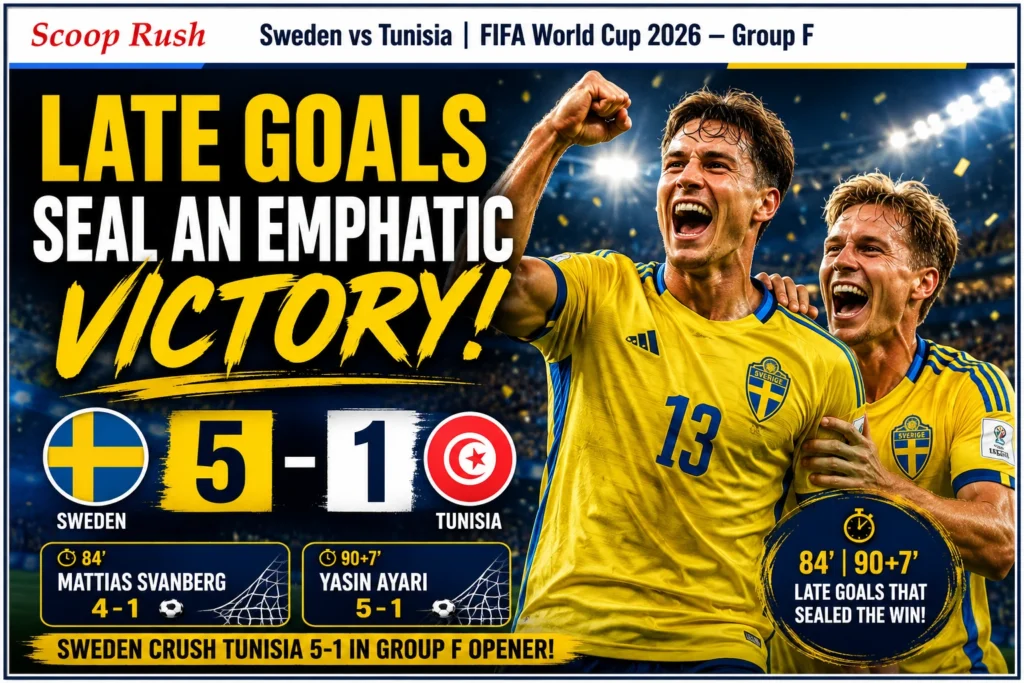
In the 84th minute, Mattias Svanberg added Sweden’s fourth goal. The midfielder’s strike highlighted Sweden’s attacking depth, with contributions coming from multiple areas of the pitch.

The scoring was completed in stoppage time when Yasin Ayari grabbed his second goal of the match in the 90+7th minute. The late finish capped a superb individual performance and ensured the final score reflected Sweden’s overall dominance.

The Sweden vs Tunisia result finished 5-1, a scoreline that accurately represented the difference between the two teams throughout the contest.

Key Match Statistics

The numbers further illustrated Sweden’s superiority across the pitch:

  • Shots: Sweden 13, Tunisia 5
  • Shots on Target: Sweden 8, Tunisia 2
  • Possession: Sweden 49%, Tunisia 51%
  • Passes: Sweden 320, Tunisia 331
  • Pass Accuracy: Sweden 82%, Tunisia 80%
  • Fouls: Sweden 9, Tunisia 8
  • Yellow Cards: Sweden 0, Tunisia 1
  • Offsides: Sweden 3, Tunisia 6
  • Corners: Sweden 4, Tunisia 2

Interestingly, Tunisia enjoyed slightly more possession, but Sweden were significantly more effective with the ball. Their attacking efficiency was the decisive factor, converting opportunities at a much higher rate and consistently testing the Tunisian goalkeeper.

Standout Performers

Yasin Ayari

Ayari delivered one of the best performances of the opening round. The Swedish midfielder scored twice, including the opening goal and a late strike in stoppage time. His movement, passing, and work rate caused continuous problems for Tunisia.

Alexander Isak

Isak once again demonstrated why he is one of Sweden’s most important players. His goal in the first half helped establish control, and his overall link-up play created numerous opportunities for teammates.

Viktor Gyökeres

Gyökeres provided a strong physical presence in attack and added Sweden’s third goal. His ability to hold up the ball and bring others into play was crucial throughout the match.

Mattias Svanberg

Coming from midfield, Svanberg contributed both defensively and offensively. His late goal rewarded another excellent all-around display.

Tunisia’s Difficult Night

For Tunisia, the result was a disappointing start to the tournament. Although Omar Rafia’s goal provided a brief positive moment, the team struggled to contain Sweden’s attacks and lacked consistency in possession.

Defensively, Tunisia found it difficult to cope with Sweden’s movement and pace. Several defensive transitions were poorly managed, allowing Sweden to create dangerous situations throughout the match.

The Tunisian coaching staff will likely focus on improving defensive organization ahead of their next Group F fixture. The team still has opportunities to recover, but they cannot afford another heavy defeat if they hope to advance.

What the Result Means for Group F

The Sweden vs Tunisia result has significant implications for Group F. Sweden move to the top of the standings with three points and a healthy goal difference of +4. Their convincing victory gives them an early advantage in the race for qualification.

Elsewhere in the group, Japan and the Netherlands played out a draw, meaning Sweden are the only team to secure a win in the opening round. As a result, the Swedes hold sole possession of first place after Matchday 1.

Current Group F Standings:

  1. Sweden – 3 points (+4 GD)
  2. Japan – 1 point
  3. Netherlands – 1 point
  4. Tunisia – 0 points (-4 GD)

This position gives Sweden momentum heading into the next round of matches and places additional pressure on Tunisia to respond.

Final Thoughts

The Sweden vs Tunisia result showcased a confident and clinical Swedish side capable of competing at a high level in FIFA World Cup 2026 Group F. Goals from Yasin Ayari (2), Alexander Isak, Viktor Gyökeres, and Mattias Svanberg secured a comprehensive 5-1 victory and sent Sweden to the top of the group standings.

While Tunisia showed determination and managed to score through Omar Rafia, they were ultimately outclassed by a Swedish team that combined tactical discipline with ruthless finishing. If Sweden can maintain this level of performance, they will be strong favorites to reach the knockout stage, while Tunisia must quickly regroup before their next crucial Group F encounter.

Olivia Attwood Shares Breast Cancer Scare After Finding “Sizeable Lump” and Urges Women to Get Checked

0

Olivia Attwood Shares Breast Cance

Reality TV star Olivia Attwood has opened up about her breast cancer scare after discovering a “sizeable lump” on her breast and is encouraging women to take health checks seriously.

The former Love Island and The Only Way Is Essex star revealed that she found a hard lump on her right breast in 2020. After becoming concerned, she visited a breast specialist who examined the lump and recommended that it be removed and tested.

Fortunately, the results showed that the lump was benign and not cancerous. Attwood explained that it was fatty tissue, and doctors confirmed that everything was fine.

She said the experience was frightening because finding any unusual change in your body can be worrying, but it helped her understand the importance of knowing your body and checking for signs of possible health problems.

Olivia Attwood Encourages Women Not to Ignore Breast Changes

Olivia Attwood Shares Breast Cancer Scare After Finding “Sizeable Lump” and Urges Women to Get Checked

Attwood has now shared her experience to raise awareness and encourage women and girls to check their breasts regularly.

She said many people may avoid getting medical advice because they feel embarrassed or scared, but delaying a check could be dangerous.

“Don’t be fearful, and definitely don’t be embarrassed,” Attwood said while discussing the importance of breast health.

She added that medical professionals carry out these checks every day and people should not allow embarrassment to stop them from seeking help.

The reality star also emphasized that early checks can make a major difference and encouraged people to pay attention to any unusual changes.

Olivia Attwood Talks Breast Cancer Awareness With Nadine Coyle

Attwood discussed the issue on her podcast, where she was joined by Nadine Coyle.

During the conversation, they spoke about the importance of removing fear around breast checks and encouraging friends and family members to look after their health.

Coyle also reflected on the death of her former Girls Aloud bandmate Sarah Harding, who died from breast cancer at the age of 39 in 2021.

The discussion highlighted how breast cancer can affect women of different ages and why awareness and early detection are important.

Breast Cancer Symptoms Women Should Know

Health experts recommend checking your breasts or chest regularly and speaking with a doctor if you notice anything unusual.

Possible signs of breast cancer can include:

  • A lump or swelling in the breast, chest, or armpit
  • Changes in breast size or shape
  • Skin changes such as dimpling, redness, or irritation
  • Changes in the appearance of the nipple
  • Unusual nipple discharge
  • Pain in the breast or armpit that does not go away

Not every lump or change means cancer, but getting medical advice can help identify the cause and provide peace of mind.

Olivia Attwood’s Message: Prioritize Your Health

Through her experience and awareness campaign with Breast Cancer Now, Attwood hopes more people will feel confident discussing breast health and getting checked.

Her message is simple: knowing your body, noticing changes, and seeking medical advice early can help protect your health.

Frequently Asked Questions

1. What happened to Olivia Attwood’s breast lump?

Olivia Attwood found a hard lump on her breast in 2020. Doctors removed it and tested it, and the results showed it was benign fatty tissue, not cancer.

2. Was Olivia Attwood diagnosed with breast cancer?

No. Olivia Attwood was not diagnosed with breast cancer. Her lump was found to be non-cancerous.

3. How often should women check their breasts?

Health experts recommend regularly checking your breasts or chest, often around once a month, so you can notice any changes early.

4. Does finding a breast lump always mean cancer?

No. Many breast lumps are caused by non-cancerous conditions such as cysts or fatty tissue. However, any new or unusual lump should be checked by a healthcare professional.

5. What are the early warning signs of breast cancer?

Early signs can include a new lump, changes in breast shape or skin, nipple changes, unusual discharge, or ongoing pain in the breast or armpit.

World’s Largest Mammal Migration Happens in Zambia and Most Tourists Never See It

0

Millions of Fruit Bats Create One of Africa’s Most Incredible Wildlife Spectacles

While most travelers dream of seeing Africa’s famous safari animals, a far more extraordinary wildlife event takes place each year in Zambia, largely unnoticed by the world.

Between October and December, an estimated 8 to 10 million straw-colored fruit bats descend on Kasanka National Park in central Zambia. The massive gathering creates what scientists consider the largest mammal migration on Earth, yet fewer than 1,000 visitors witness it annually.

As the sun sets over the woodland canopy, millions of bats rise from the trees in a breathtaking display, filling the sky with a swirling cloud of wings that stretches as far as the eye can see.

A Hidden Natural Wonder in Zambia

Located about 500 kilometers north of Zambia’s capital, Lusaka, Kasanka National Park is one of the country’s smallest national parks. Covering roughly 390 square kilometers, it is known for its wetlands, forests, lagoons, and diverse birdlife.

Unlike the crowded safari destinations of East and Southern Africa, Kasanka remains quiet and relatively untouched. Visitors come primarily to experience the annual bat migration, which has become one of Africa’s most remarkable wildlife events.

The migration is driven by the seasonal abundance of fruit in the region. Bats travel from various parts of Central Africa to feed in the park’s forests before eventually dispersing again.

Why the Bat Migration Is So Important

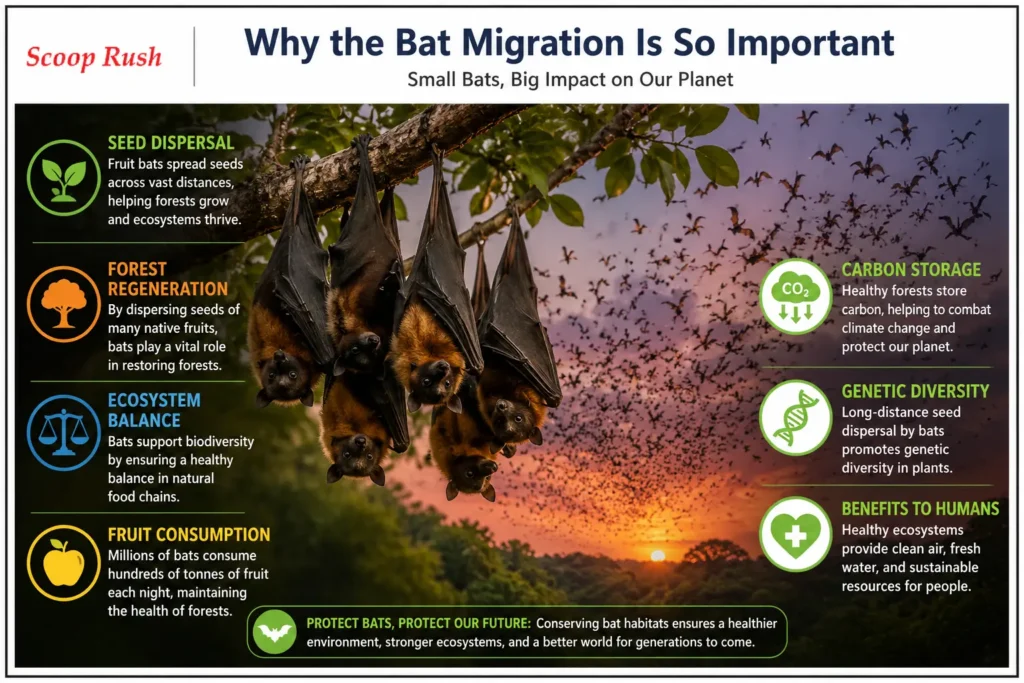
The straw-colored fruit bat, scientifically known as Eidolon helvum, plays a critical role in maintaining Africa’s ecosystems.

Each bat weighs around 250 grams and can consume nearly its own body weight in fruit every night. With millions of bats feeding simultaneously, researchers estimate they eat around 230 to 250 tonnes of fruit daily during their stay.

Over the migration season, the colony consumes approximately 330,000 tonnes of fruit.

More importantly, the bats help spread seeds across vast distances. According to bat ecologists, these animals are capable of dispersing seeds farther than many other large wildlife species, including elephants. This process helps regenerate forests and supports biodiversity throughout the region.

Long-Distance Travelers of the Night

Scientists continue to study the migration, and many questions remain unanswered.

Research has shown that some bats travel up to 96 kilometers in a single night while searching for food. Tracking studies have also revealed astonishing long-distance journeys.

In one notable study, bats fitted with satellite transmitters traveled more than 997 kilometers. One bat, nicknamed “Hercules,” flew over 2,400 kilometers, demonstrating the species’ incredible endurance.

Despite these discoveries, researchers still do not fully understand where all the bats come from or where they go after leaving Kasanka.

A Conservation Success Story

Kasanka National Park was not always thriving.

During the 1980s, extensive poaching severely reduced wildlife populations, putting the park’s future at risk. Conservation efforts began in the early 1990s under dedicated management that invested in infrastructure, habitat protection, and anti-poaching measures.

Today, many animal populations have recovered. Species such as puku, bushbuck, sable antelope, and even elephants have returned to the area.

The park has become an important example of successful conservation in Africa.

More Than Just Bats

Although the migration is the park’s biggest attraction, Kasanka offers much more for nature lovers.

The park is one of the best places in Africa to spot the elusive sitatunga, a rare swamp-dwelling antelope adapted to life in wetlands. Visitors may also encounter hippos, crocodiles, bushpigs, civets, blue monkeys, and numerous bird species.

With more than 450 recorded bird species, Kasanka is considered one of Zambia’s top birdwatching destinations.

A Rare Experience for Wildlife Travelers

Unlike the famous Serengeti migration, which attracts hundreds of thousands of visitors every year, the Kasanka Bat Migration remains relatively unknown.

The lack of crowds gives visitors a unique opportunity to experience one of the planet’s greatest wildlife events in near solitude.

As dusk falls and millions of bats rise into the sky, the scene resembles a living storm moving across the African landscape. For travelers fortunate enough to witness it, the experience is unforgettable.

Why the Kasanka Bat Migration Matters

The annual migration is more than a spectacular sight. It is a vital ecological event that supports forest regeneration across Central Africa.

Scientists continue to investigate the bats’ migration routes and behavior, while conservationists emphasize their importance to healthy ecosystems.

For visitors, however, the migration offers something equally valuable: a rare chance to witness one of nature’s greatest wonders before the rest of the world discovers it.

FAQs

1. Where does the world’s largest mammal migration take place?

The migration occurs in Kasanka National Park in Zambia, where millions of straw-colored fruit bats gather every year.

2. When is the best time to see the Kasanka Bat Migration?

The migration takes place from late October through December, with the largest numbers usually appearing in November.

3. How many bats participate in the migration?

Researchers estimate that between 8 million and 10 million straw-colored fruit bats gather in Kasanka during the migration season.

4. Why do the bats come to Kasanka National Park?

The bats are attracted by an abundance of seasonal fruit, which provides a rich food source during the migration period.

5. Why are straw-colored fruit bats important to the environment?

They play a major role in seed dispersal and forest regeneration, helping maintain healthy ecosystems across large parts of Africa.

Netherlands vs Japan Result: Late Kamada Goal Secures 2-2 Draw in FIFA World Cup 2026 

0

FIFA World Cup 2026 – Group F

Full-Time: Netherlands 2-2 Japan
Venue: Dallas Stadium, Arlington
Date: Monday,June 15

The Netherlands vs Japan clash in FIFA World Cup 2026 Group F delivered one of the most entertaining matches of the opening round as the two nations battled to a thrilling 2-2 draw at Dallas Stadium, Arlington, on Monday, June 15. Both teams showcased attacking quality, resilience, and tactical discipline in a contest that kept supporters on the edge of their seats until the final whistle.

The result leaves both nations with one point in Group F, while Sweden’s victory over Tunisia places the Scandinavian side at the top of the standings after the opening matchday.

Match Overview

Goalscorers

Netherlands

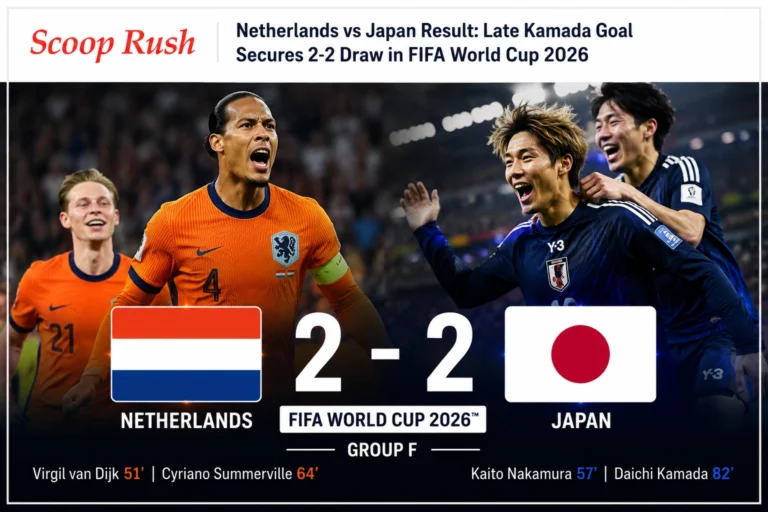
  • Virgil van Dijk (51′)
  • Cyriano Summerville (64′)

Japan

  • Kaito Nakamura (57′)
  • Daichi Kamada (82′)

The match featured several momentum swings, with the Dutch taking control early in the second half before Japan twice responded to secure a deserved point.

First Half: Tactical Battle With Few Clear Chances

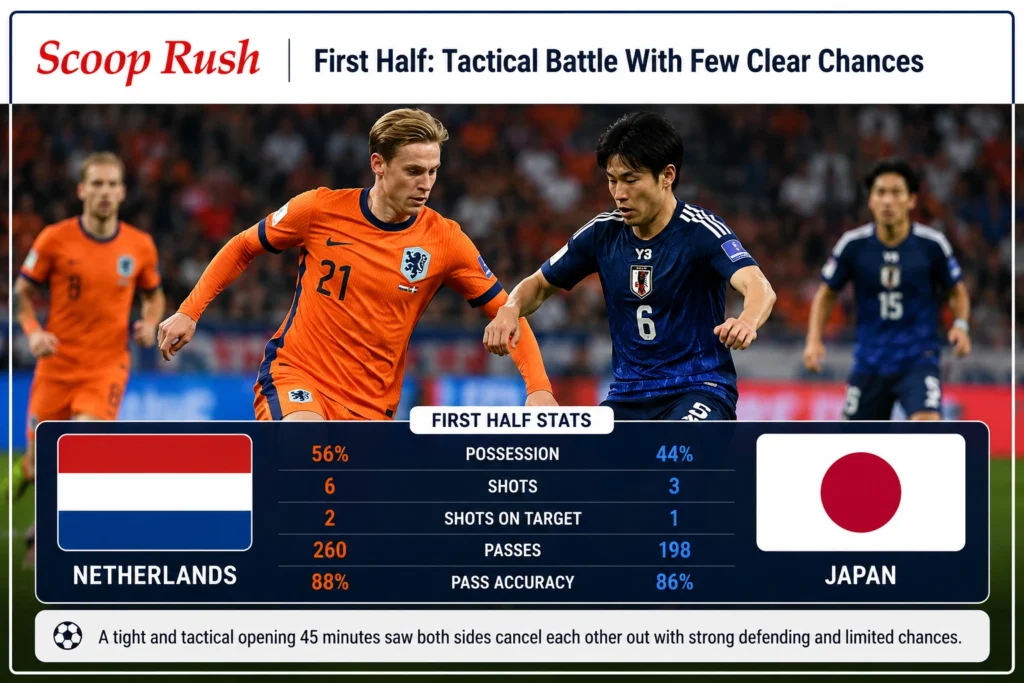
The opening 45 minutes were characterized by cautious play from both sides. The Netherlands enjoyed more possession and controlled the tempo, while Japan focused on compact defending and quick transitions.

Ronald Koeman’s side lined up in a 4-3-3 formation, with Virgil van Dijk marshalling the defense and Cody Gakpo leading the attack. Japan matched them with an organized setup designed to frustrate the Dutch midfield and exploit space on the counterattack.

Although the Netherlands dominated possession, clear opportunities were limited. Japan’s defensive structure remained disciplined, preventing the Oranje from creating many high-quality chances inside the penalty area.

Japan, meanwhile, looked dangerous whenever they broke forward. The pace and movement of their attackers caused occasional problems for the Dutch back line, hinting at the drama that would unfold after halftime.

The teams went into the break level at 0-0, with neither side able to convert their territorial advantage into goals.

Van Dijk Breaks the Deadlock

The second half began with greater intensity, and it did not take long for the Netherlands to make their breakthrough.

In the 51st minute, captain Virgil van Dijk rose highest inside the penalty area to score and give the Netherlands a 1-0 lead. The goal rewarded the Dutch for their sustained pressure and appeared to put them in control of the contest.

Van Dijk’s leadership was evident throughout the match, and his goal seemed likely to provide the platform for a Dutch victory.

However, Japan had other ideas.

Japan’s Immediate Response

Just six minutes after falling behind, Japan found an equalizer through Kaito Nakamura.

The goal highlighted Japan’s resilience and attacking quality. Rather than becoming discouraged by conceding first, the Samurai Blue increased their tempo and began committing more players forward.

Nakamura’s finish brought Japan level at 1-1 and completely changed the atmosphere of the match. Suddenly, the Dutch defense found itself under pressure from a Japanese side growing in confidence with every attack.

The equalizer also demonstrated why Japan continues to be regarded as one of Asia’s strongest football nations. Their ability to respond quickly to adversity prevented the Netherlands from settling into a comfortable rhythm.

Summerville Restores Dutch Advantage

The Netherlands regrouped well after conceding and once again moved in front in the 64th minute.

Crysencio Summerville produced an important finish to restore the Dutch lead and make it 2-1. The winger’s goal capped a strong attacking move and rewarded the Netherlands for their persistence.

At this stage, the Oranje appeared to have weathered Japan’s response and looked capable of seeing out the match. Their superior possession numbers and experience suggested they could manage the game effectively during the closing stages.

Yet Japan remained determined and continued searching for another equalizer.

Kamada’s Late Heroics

As the match entered its final ten minutes, Japan intensified their attacks and pushed more players into advanced positions.

Their persistence paid off in the 82nd minute when Daichi Kamada found the net to make it 2-2.

The goal sparked wild celebrations among the Japanese players and supporters. Kamada’s equalizer was the culmination of a courageous second-half performance that saw Japan twice come from behind against one of Europe’s traditional powerhouses.

Midfielder Koki Ogawa played a key role in the move, providing the assist that allowed Kamada to finish clinically and rescue a valuable point.

The final minutes were tense as both teams searched for a winning goal, but neither side could find the decisive breakthrough.

When the referee blew the final whistle, the score remained 2-2.

Team Statistics

The statistics illustrate the competitive nature of the contest while highlighting the Netherlands’ territorial advantage.

StatNetherlandsJapan
Shots118
Shots on Target73
Possession60%40%
Passes515342
Pass Accuracy89%88%
Fouls77
Yellow Cards30
Corners54

The Netherlands controlled possession and completed significantly more passes, but Japan proved highly efficient with their opportunities.

One particularly notable statistic was discipline. While the Dutch received three yellow cards, Japan completed the match without a single booking, demonstrating their composure and organization.

Key Performers

Virgil van Dijk (Netherlands)

The Dutch captain delivered another commanding performance. Beyond scoring the opening goal, he provided leadership and stability in defense. His aerial dominance was evident throughout the match.

Crysencio Summerville (Netherlands)

Summerville’s goal restored the Dutch lead and highlighted his attacking threat. He consistently stretched Japan’s defense with his pace and movement.

Kaito Nakamura (Japan)

Nakamura’s equalizer came at a crucial moment and shifted the momentum back toward Japan. His energy and attacking intent troubled the Netherlands throughout the second half.

Daichi Kamada (Japan)

The midfielder emerged as Japan’s hero with the late equalizer. His intelligent movement and composure in front of goal ensured the Samurai Blue left with a deserved point.

Tactical Analysis

Netherlands

The Dutch approach centered on possession, patient build-up play, and utilizing width through their front three. They successfully controlled large portions of the match and generated more shots than Japan.

However, defensive lapses after taking the lead twice prevented them from securing all three points. The Netherlands will be pleased with their attacking performance but concerned by their inability to protect advantages.

Japan

Japan’s tactical discipline was impressive. They remained compact defensively, absorbed pressure effectively, and attacked with purpose whenever opportunities arose.

Their willingness to respond after each setback show cased strong mentality and confidence. Japan’s quick transitions and efficient finishing ultimately earned them a valuable draw.

What the Result Means for Group F

After the opening round of matches, Group F remains wide open.

Current Standings

  1. Sweden – 3 points
  2. Japan – 1 point
  3. Netherlands – 1 point
  4. Tunisia – 0 points

With Sweden already holding an early advantage, both the Netherlands and Japan will view this result as respectable but slightly disappointing. Each side had opportunities to claim victory and take control of the group.

The draw means upcoming fixtures become increasingly important. Both nations remain strong contenders for qualification to the knockout stage, but neither can afford many more dropped points.

Final Thoughts

The Netherlands vs Japan result provided everything football fans could want from a World Cup group-stage encounter: quality goals, tactical intrigue, momentum shifts, and late drama.

The Netherlands will regret failing to hold the lead on two occasions despite dominating possession and creating more chances. Japan, meanwhile, can take enormous confidence from a performance that demonstrated resilience, organization, and attacking efficiency.

A 2-2 draw was ultimately a fair reflection of a closely contested match. While the Dutch showcased their technical quality and control, Japan proved once again that they can compete with the world’s best teams.

As Group F continues to unfold, both nations remain firmly in the race for a place in the knockout rounds, setting up an exciting battle in the matches ahead.

Germany vs Curaçao FIFA World Cup 2026 Highlights & Match Summary

0

FIFA World Cup 2026 – Group E
Full Time: Germany 7–1 Curaçao
Venue: NRG Stadium
Location: Houston
Date: 14 June 2026

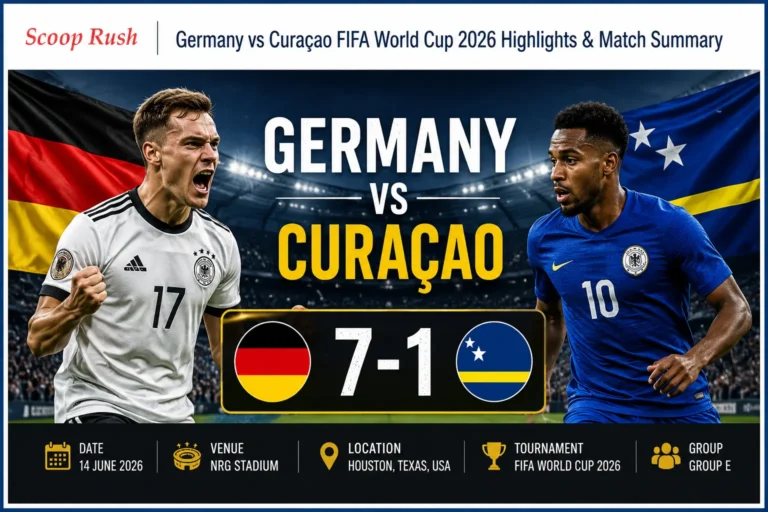
Germany delivered one of the most dominant performances of the FIFA World Cup 2026 group stage, defeating Curaçao 7–1 in a one-sided Group E encounter at NRG Stadium in Houston. The European giants showcased their attacking power, tactical discipline, and squad depth, overwhelming their opponents from start to finish.

Germany Take Complete Control

From the opening whistle, Germany dictated the pace of the match. Their superior ball control, movement, and pressing left Curaçao with little room to build attacks or retain possession.

Germany consistently pushed forward, creating chance after chance while maintaining firm control in midfield. The result was a relentless attacking display that produced seven goals and highlighted why Germany remains one of the strongest teams in international football.

The victory was not simply about possession dominance. Germany combined creativity with clinical finishing, ensuring that most of their dangerous opportunities were converted into goals.

Tactical Excellence on Display

Tactical-Excellence-on-Display

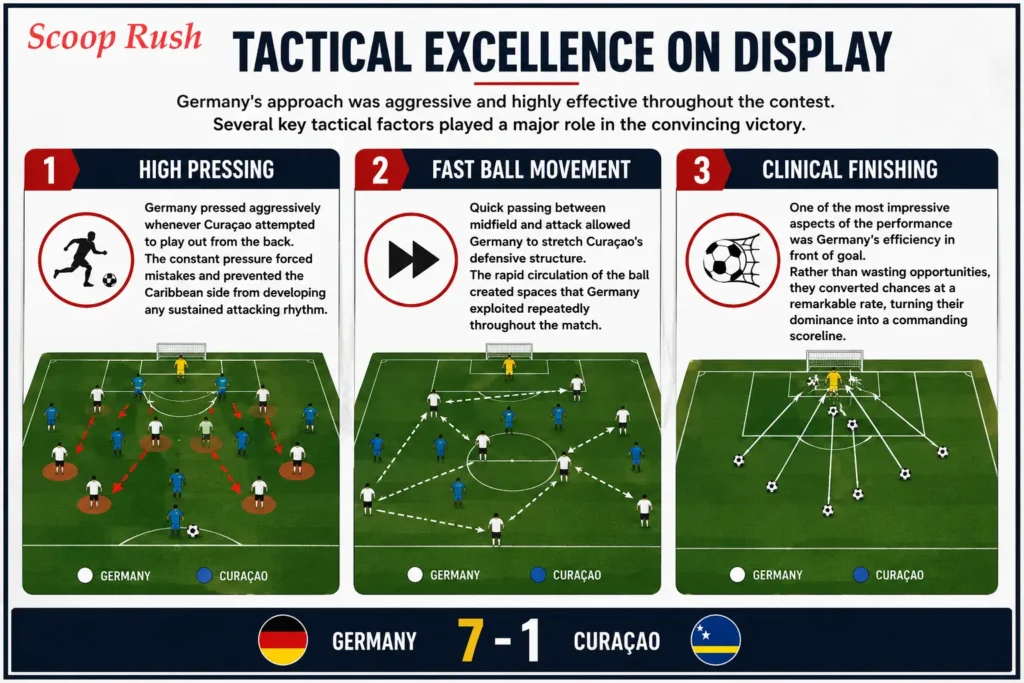
Germany’s approach was aggressive and highly effective throughout the contest. Several key tactical factors played a major role in the convincing victory.

High Pressing

Germany pressed aggressively whenever Curaçao attempted to play out from the back. The constant pressure forced mistakes and prevented the Caribbean side from developing any sustained attacking rhythm.

Fast Ball Movement

Quick passing between midfield and attack allowed Germany to stretch Curaçao’s defensive structure. The rapid circulation of the ball created spaces that Germany exploited repeatedly throughout the match.

Clinical Finishing

One of the most impressive aspects of the performance was Germany’s efficiency in front of goal. Rather than wasting opportunities, they converted chances at a remarkable rate, turning their dominance into a commanding scoreline.

A Difficult Night for Curaçao

Despite the heavy defeat, Curaçao entered the match facing one of football’s traditional powerhouses. The difference in resources, player development systems, and international experience was evident throughout the game.

Much of Curaçao’s effort was focused on defending deep and limiting Germany’s attacking opportunities. However, the constant pressure proved difficult to withstand over ninety minutes.

While the scoreline is disappointing, matches against elite nations provide valuable experience that can help emerging football countries continue their development on the international stage.

Germany’s Squad Depth Shines

Germanys-Squad-Depth-Shines

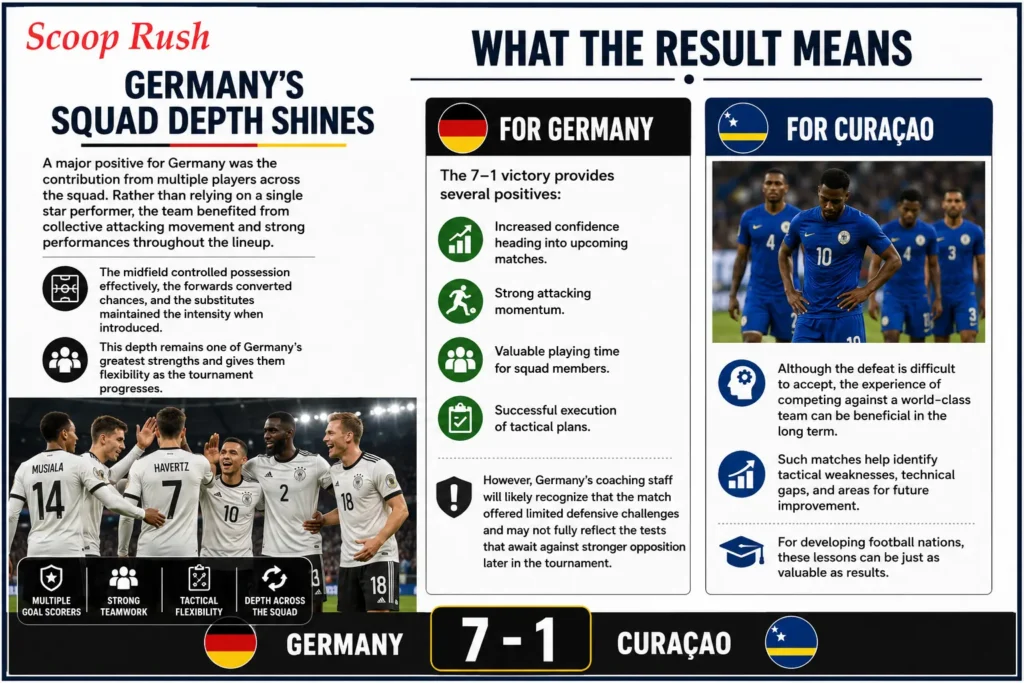
A major positive for Germany was the contribution from multiple players across the squad. Rather than relying on a single star performer, the team benefited from collective attacking movement and strong performances throughout the lineup.

The midfield controlled possession effectively, the forwards converted chances, and the substitutes maintained the intensity when introduced. This depth remains one of Germany’s greatest strengths and gives them flexibility as the tournament progresses.

What the Result Means

For Germany

The 7–1 victory provides several positives:

  • Increased confidence heading into upcoming matches.
  • Strong attacking momentum.
  • Valuable playing time for squad members.
  • Successful execution of tactical plans.

However, Germany’s coaching staff will likely recognize that the match offered limited defensive challenges and may not fully reflect the tests that await against stronger opposition later in the tournament.

For Curaçao

Although the defeat is difficult to accept, the experience of competing against a world-class team can be beneficial in the long term. Such matches help identify tactical weaknesses, technical gaps, and areas for future improvement.

For developing football nations, these lessons can be just as valuable as results.

The Wider Perspective

Germany’s emphatic win also highlights the continuing gap between football’s established powers and emerging nations. Differences in infrastructure, investment, player development, and competitive experience often create significant disparities on the international stage.

While Germany demonstrated their quality with a dominant performance, the match also served as a reminder of the challenges smaller nations face when competing against the world’s elite teams.

Conclusion

Germany’s 7–1 victory over Curaçao was a commanding display of attacking football, tactical organization, and squad depth. The Germans controlled nearly every aspect of the match and fully deserved their convincing win.

For Germany, the result strengthens their FIFA World Cup 2026 campaign and provides momentum for the challenges ahead. For Curaçao, the defeat is a tough lesson but also an opportunity to gain valuable experience against one of football’s most successful nations.

Ultimately, the match showcased Germany’s strength while underlining the ongoing challenge of closing the gap between football’s elite and developing national teams.

US-Iran Peace Deal Explained: All 14 Points of the Ceasefire Agreement

0

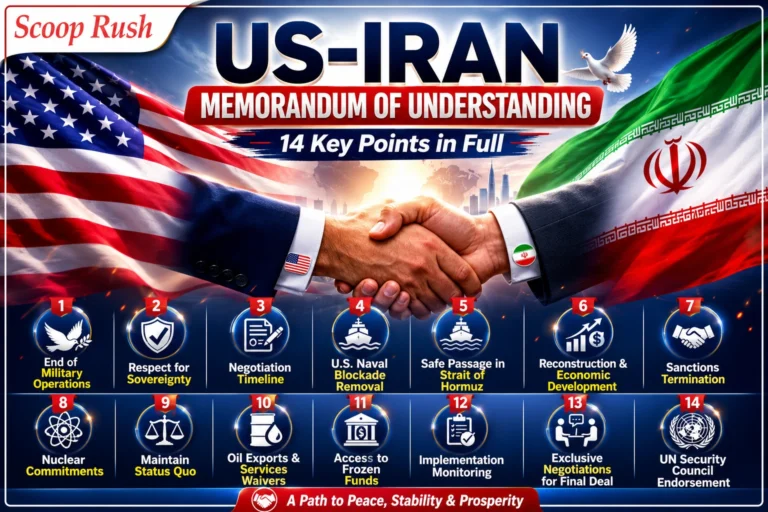
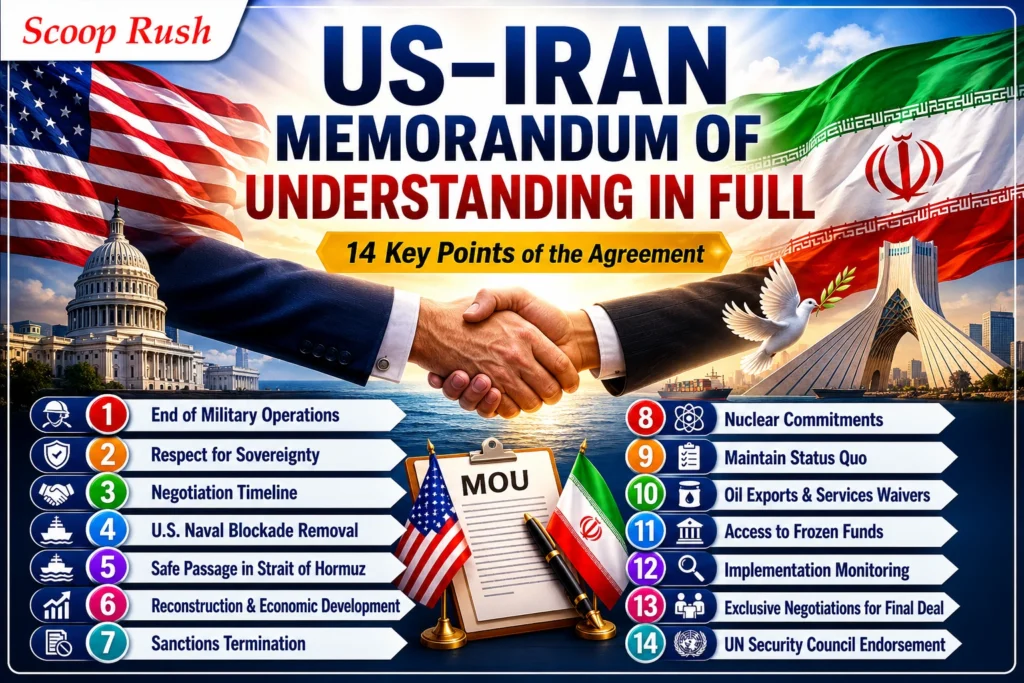
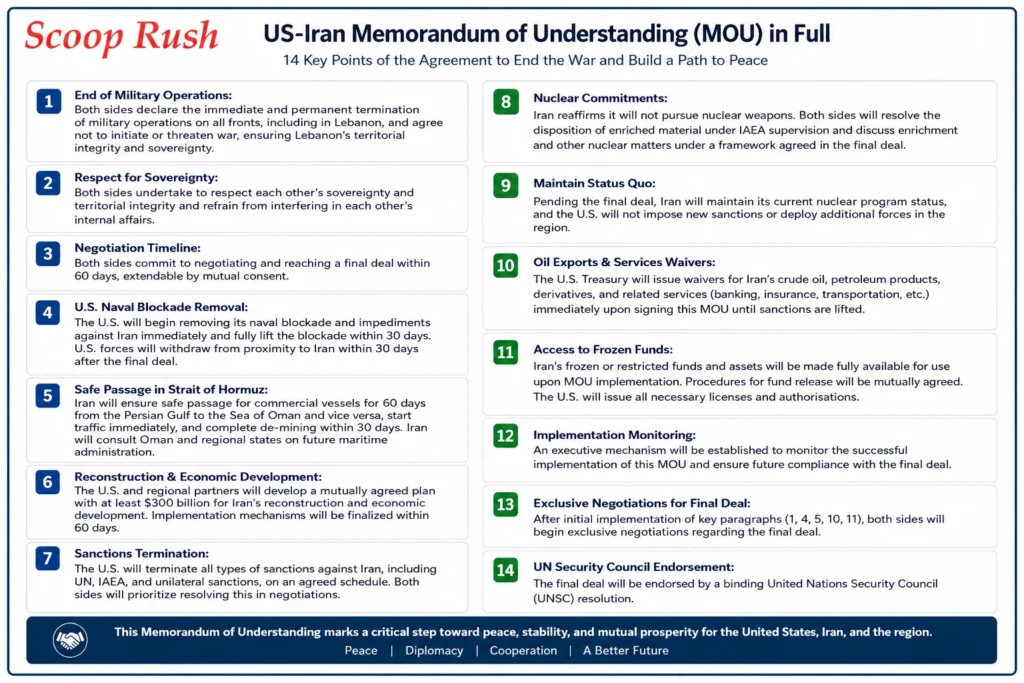
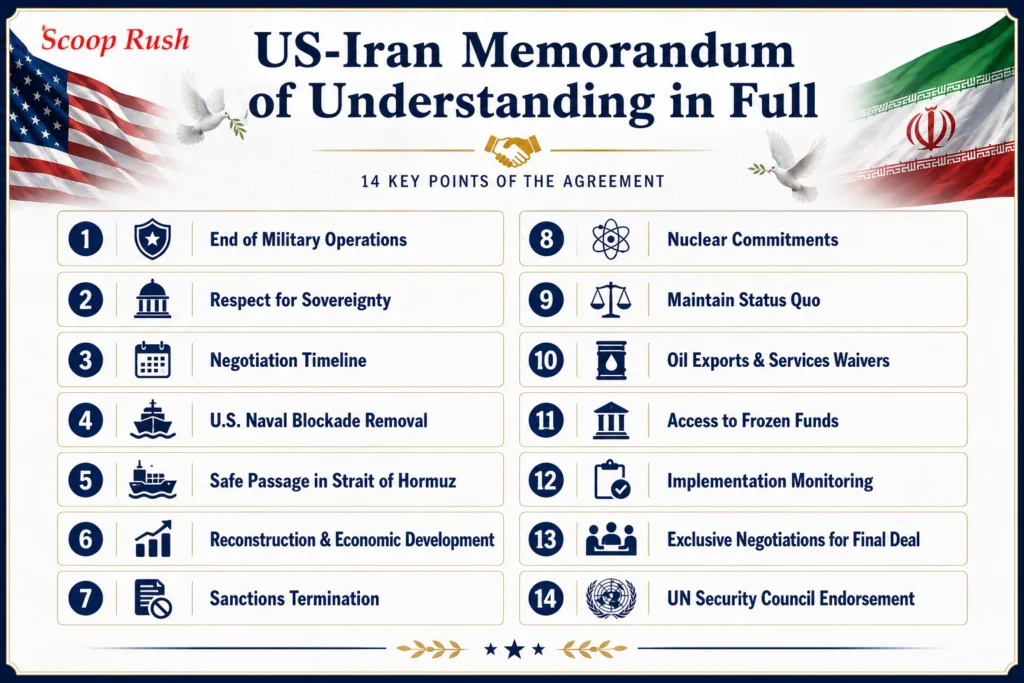
The United States and Iran have signed a 14-point memorandum of understanding (MOU) aimed at ending their war, covering an immediate ceasefire, the lifting of US sanctions, a $300 billion reconstruction fund, and the future of Iran’s nuclear program. A senior US official read the full agreement to reporters this week, confirming both countries have committed to finalizing a comprehensive deal within 60 days.

This article breaks down all 14 points of the US-Iran agreement, what each one means, and what happens next.

What Is the US-Iran Memorandum of Understanding?

The memorandum of understanding is not the final peace treaty — it is a framework agreement. It locks in an immediate stop to military operations while setting a 60-day deadline for both countries to negotiate the harder details: sanctions relief, the nuclear program, and the disbursement of reconstruction funds. Once that final deal is reached, it is expected to be backed by a binding United Nations Security Council resolution.

All 14 Points of the US-Iran MOU Explained

All 14 Points of the US-Iran MOU Explained

Point 1 — Immediate and Permanent End to Military Operations

The US and Iran, along with their respective allies in the conflict, agree to immediately and permanently stop military operations on every front, including in Lebanon. Both sides commit to never initiating war or military action against each other again, and to refraining from threatening or using force going forward. The agreement specifically calls out the need to protect Lebanon’s sovereignty and territorial integrity, reflecting how far the conflict had spread beyond a purely bilateral fight.

Point 2 — Mutual Respect for Sovereignty and Non-Interference

Both nations pledge to respect each other’s sovereignty and territorial integrity and to stay out of each other’s internal affairs. This language is aimed at reducing the kind of proxy tensions and interference that have defined US-Iran relations for decades.

Point 3 — 60-Day Timeline to Reach a Final Deal

The MOU sets a maximum 60-day window for both sides to negotiate and finalize a comprehensive agreement. The deadline can be extended if both parties mutually agree to do so.

Point 4 — US Naval Blockade to Be Lifted Within 30 Days

Once the MOU is signed, the US commits to immediately begin dismantling its naval blockade against Iran, with a full end to the blockade within 30 days. Ship traffic will scale back up gradually, matched to pre-war shipping levels. The US has also agreed to withdraw its forces from areas near Iranian territory within 30 days of the final deal being signed.

Point 5 — Safe Passage Through the Strait of Hormuz

Iran agrees to make its best effort to provide safe, free passage for commercial vessels traveling between the Persian Gulf and the Sea of Oman for an initial 60-day period. Commercial shipping is expected to resume immediately, with full normalization within 30 days once Iran clears military obstacles and de-mines the relevant waters. Iran has also committed to talks with Oman and other Gulf states on long-term governance of the Strait of Hormuz, one of the world’s most critical oil shipping routes.

Point 6 — $300 Billion Reconstruction and Development Fund for Iran

The US has agreed to work with regional partners on a reconstruction and economic development plan for Iran worth at least $300 billion. The specific mechanism for distributing these funds will be finalized within 60 days as part of the final deal. The US has committed to issuing all licenses, waivers, and approvals needed to enable the related financial transactions.

Point 7 — US to Terminate All Sanctions Against Iran

The US commits to ending all sanctions against Iran, including United Nations Security Council resolutions, IAEA Board of Governors resolutions, and unilateral US sanctions — both primary and secondary. The exact schedule for lifting them will be worked out during negotiations, though both countries have flagged this as an immediate priority.

Point 8 — Iran Reaffirms It Will Not Develop Nuclear Weapons

Iran reaffirms in the agreement that it will not pursue nuclear weapons. Both countries have agreed to resolve what happens to Iran’s stockpiled enriched material, with on-site back-blending under International Atomic Energy Agency (IAEA) supervision set as the baseline approach. Broader discussions on enrichment levels and Iran’s nuclear needs are deferred to the final-deal stage.

Point 9 — Status Quo Freeze Until the Final Deal

Until a comprehensive agreement is reached, both sides agree to a standstill: Iran will keep its nuclear program at its current state, while the US will not impose any new sanctions or deploy additional forces to the region.

Point 10 — Immediate Oil Export Waivers for Iran

The US Treasury Department will begin issuing waivers immediately upon signing the MOU, allowing Iran to export crude oil, petroleum products, and derivatives, along with all associated services including banking, insurance, and transportation. These waivers remain in place until sanctions are formally terminated.

Point 11 — Frozen Iranian Funds and Assets to Be Unblocked

The US commits to making Iran’s frozen or restricted funds and assets fully usable again once the MOU is implemented. The specific procedures for releasing the funds will be agreed during negotiations. All released funds will be available for payment to any beneficiary designated by Iran’s central bank, and the US will issue the necessary licenses and authorizations accordingly.

Point 12 — Joint Mechanism to Monitor Implementation

A joint executive mechanism will be established to track whether both sides are following through on their commitments under the MOU, and later, under the final agreement. This gives both governments a formal process to raise and resolve compliance concerns.

Point 13 — Full Negotiations Begin Only After Early Steps Are Taken

Broader negotiations on all remaining issues will only begin after both countries have started implementing the core early provisions: the ceasefire (Point 1), the naval blockade rollback (Point 4), safe shipping passage (Point 5), oil export waivers (Point 10), and the unfreezing of assets (Point 11). This sequencing is designed to build confidence before the harder bargaining begins.

Point 14 — Final Deal to Be Endorsed by the UN Security Council

Once negotiators reach a final agreement, it will be formally endorsed through a binding United Nations Security Council (UNSC) resolution, giving it the full weight of international law.

All 14 Points of the US-Iran MOU Explained

Frequently Asked Questions

What is the US-Iran memorandum of understanding?

It is a 14-point framework agreement signed by the US and Iran that immediately halts military operations and sets a 60-day roadmap for negotiating a full, final peace deal covering sanctions, reconstruction funding, and Iran’s nuclear program.

Is this MOU the final peace deal between the US and Iran?

No. The memorandum is a preliminary framework. Both countries have committed to negotiating a comprehensive final deal within 60 days, extendable by mutual agreement, which will then be endorsed by a binding UN Security Council resolution.

How much money is included in the Iran reconstruction fund?

The US, alongside regional partners, has committed to a plan worth at least $300 billion for Iran’s reconstruction and economic development. How the funds will be distributed is to be finalized as part of the final deal.

Will the US lift all sanctions on Iran?

Yes, in principle. The US has agreed to terminate all sanctions, including UN Security Council resolutions, IAEA Board resolutions, and all unilateral US sanctions. The exact schedule will be negotiated in the final deal.

What happens to Iran’s enriched uranium stockpile?

Both sides have agreed it will be resolved through a yet-to-be-finalized mechanism, with on-site back-blending under IAEA supervision as the minimum approach. Broader enrichment questions are left for the final negotiations.

When will the Strait of Hormuz fully reopen?

Commercial shipping is expected to resume immediately after the MOU is signed, with full normalization expected within 30 days once Iran clears military obstacles and completes de-mining. Long-term governance will be discussed between Iran, Oman, and other Gulf states.

How long do the US and Iran have to reach a final deal?

Up to 60 days from the signing of the MOU, with the option to extend the deadline if both sides agree.

Will US troops leave the region?

Yes. The US has agreed to withdraw its forces from areas near Iranian territory within 30 days after the final deal is signed.

Why does Point 13 matter?

Point 13 means the full negotiation process will not begin until both sides have demonstrated good faith by acting on the ceasefire, shipping, and sanctions relief provisions first. It is a trust-building safeguard built into the structure of the agreement.

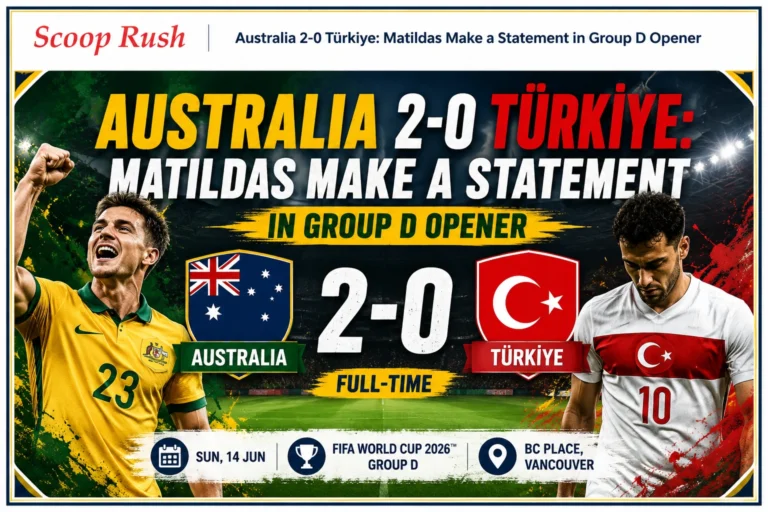
Australia vs Türkiye Result: Socceroos Beat Türkiye 2-0 in FIFA World Cup 2026 Group D Clash   

0

FIFA World Cup 2026™ – Group D

Full-Time: Australia 2–0 Türkiye
Date: Sunday,14 June
Venue: BC Place, Vancouver

Australia vs Türkiye Result: Socceroos Beat Türkiye 2-0 in FIFA World Cup 2026 Group D Clash as Australia kicked off their FIFA World Cup 2026 Group D campaign in impressive fashion, securing a comfortable 2–0 victory over Türkiye at BC Place in Vancouver. Goals from Nestory Irankunda and Connor Metcalfe ensured the Socceroos claimed all three points and immediately positioned themselves as serious contenders in Group D.

Fast Start Sets the Tone

Australia wasted little time asserting their authority. The breakthrough arrived in the 27th minute when Nestory Irankunda found the net, rewarding Australia’s bright start and giving the home crowd plenty to cheer about.

The Australians continued to press forward, creating chances and stretching Türkiye’s defensive line. Their persistence paid off again just before halftime when Connor Metcalfe doubled the advantage in the 45th minute, putting Australia firmly in control heading into the break.

At 2–0, Türkiye faced an uphill task in the second half against a confident Australian side.

Match Statistics Tell the Story

While Türkiye dominated possession, Australia were far more efficient in the decisive areas.

StatisticAustraliaTürkiye
Shots828
Shots on Target47
Possession37%63%
Passes273675
Pass Accuracy75%91%
Fouls124
Yellow Cards01
Offsides13
Corners58

The numbers reveal a fascinating contest. Türkiye controlled the ball for long periods and produced a remarkable 28 shots, but Australia’s defensive organization and goalkeeping resilience prevented them from finding a breakthrough.

Australia, by contrast, demonstrated clinical finishing. Four shots on target yielded two goals, highlighting their efficiency in front of goal.

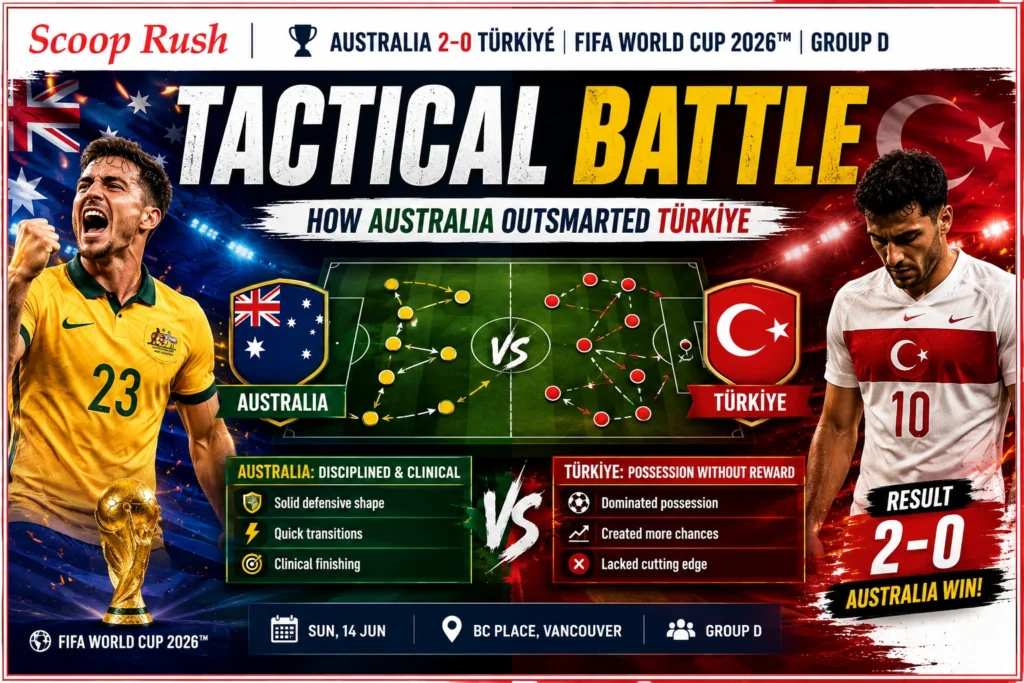
Tactical Battle

Australia: Compact and Clinical

Australia adopted a disciplined approach, allowing Türkiye to enjoy possession while remaining compact defensively. Their game plan revolved around:

  • Quick transitions after regaining possession.
  • Direct attacks exploiting space behind Türkiye’s defense.
  • Strong defensive shape limiting high-quality scoring opportunities.
  • Effective finishing when chances arose.

The strategy worked perfectly, especially during the first half when Australia punished Türkiye’s defensive lapses.

Türkiye: Possession Without Reward

Türkiye’s approach was based on controlling the tempo through possession and patient build-up play. Their midfield dominated the ball, completing significantly more passes and maintaining over 60% possession.

However, despite generating numerous attempts on goal, they struggled to convert opportunities into goals. Australia’s defensive block forced many efforts from less dangerous positions, and the final touch was often missing.

Key Performers

Nestory Irankunda

The young Australian attacker opened the scoring and provided a constant threat whenever Australia broke forward. His pace and direct running troubled Türkiye throughout the match.

Connor Metcalfe

Metcalfe’s goal just before halftime proved crucial. It gave Australia breathing room and shifted momentum firmly in their favor heading into the second half.

Australian Defense

Although Türkiye registered 28 shots, Australia’s back line remained composed under pressure. Their collective discipline ensured the clean sheet never looked seriously threatened.

Discipline and Substitutions

The match remained relatively clean throughout. Australia finished without a booking, while Türkiye received a late yellow card for Yunus Akgün.

Both managers turned to their benches during the second half in search of fresh energy, but the substitutions failed to alter the scoreline as Australia comfortably managed the final stages.

Group D Implications

The victory gives Australia an ideal start in Group D. With three points secured and a positive goal difference, they move into a strong early position in the standings.

Group D Standings After Matchday 1

  1. USA – 3 points (+3 GD)
  2. Australia – 3 points (+2 GD)
  3. Türkiye – 0 points (-2 GD)
  4. Paraguay – 0 points (-3 GD)

Australia’s win keeps them firmly in contention for qualification to the knockout rounds, while Türkiye will need a positive response in their next fixture to keep their campaign on track.

Final Thoughts

Australia may have had less possession and fewer shots, but football is ultimately decided by moments of quality. The Socceroos produced those moments through Irankunda and Metcalfe, while their disciplined defensive performance neutralized Türkiye’s attacking threat.

The 2–0 scoreline reflected Australia’s efficiency, organization, and maturity—qualities that could make them one of the dark horses in Group D as the tournament progresses.

Final Score: Australia 2–0 Türkiye
Goals: Nestory Irankunda (27′), Connor Metcalfe (45′)
Venue: BC Place, Vancouver
Competition: FIFA World Cup 2026 – Group D

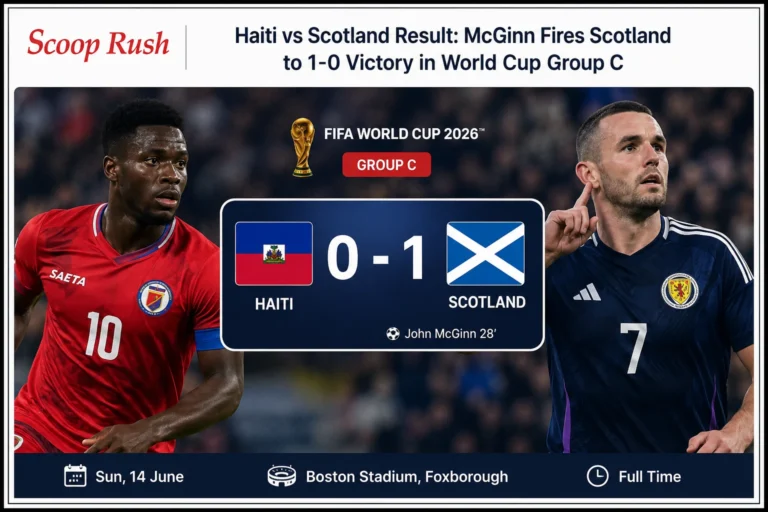
Haiti vs Scotland Result: McGinn Fires Scotland to 1-0 Victory in World Cup Group C 

0

FIFA World Cup 2026™ – Group C

Full Time: Haiti 0–1 Scotland
Venue: Boston Stadium, Foxborough
Date: Sunday, 14 June

Scotland kicked off their FIFA World Cup 2026 Group C campaign with a narrow but valuable 1-0 victory over Haiti, thanks to an early strike from John McGinn. While the scoreline suggests a comfortable result, the match was anything but straightforward as Haiti pushed Scotland throughout an intense and competitive encounter.

Early Breakthrough Sets the Tone

The decisive moment arrived in the opening half when John McGinn found the net in the 28th minute, giving Scotland an advantage they would ultimately protect until the final whistle. The midfielder’s goal proved crucial in a match where clear-cut chances were limited and defensive discipline became increasingly important.

Scotland entered the contest looking to establish themselves in a challenging Group C and managed exactly that by securing all three points.

Haiti Show Resilience Despite Defeat

Although Haiti left empty-handed, their performance demonstrated why they should not be underestimated in the tournament.

The Caribbean side enjoyed:

  • 50% possession
  • 13 total shots
  • 3 shots on target
  • 391 completed passes with 89% accuracy

Those numbers highlight Haiti’s ability to compete with Scotland for long periods. They moved the ball effectively and created several attacking opportunities but lacked the finishing touch needed to break through Scotland’s defense.

Scotland’s Efficiency Makes the Difference

Scotland’s statistics reveal a more pragmatic approach:

  • 8 total shots
  • 3 shots on target
  • 373 passes
  • 81% passing accuracy
  • 21 fouls committed

Despite creating fewer chances than Haiti, Scotland were more clinical when it mattered. McGinn’s goal separated the sides, while the Scottish defense remained organized under pressure.

The match became increasingly physical as Scotland sought to protect their lead, committing 21 fouls compared to Haiti’s 23.

Key Match Incidents

Yellow Cards

Discipline became a talking point during the second half.

  • Kenny McLean (Scotland) received a yellow card in stoppage time.
  • Findlay Curtis (Scotland) was also booked late in the match.

The cautions reflected Scotland’s determination to preserve their slender advantage as Haiti pushed forward searching for an equalizer.

Tactical Changes

Both managers turned to their benches in the closing stages to inject fresh energy and alter the game’s momentum. Scotland focused on defensive stability, while Haiti introduced attacking options in an attempt to rescue a point.

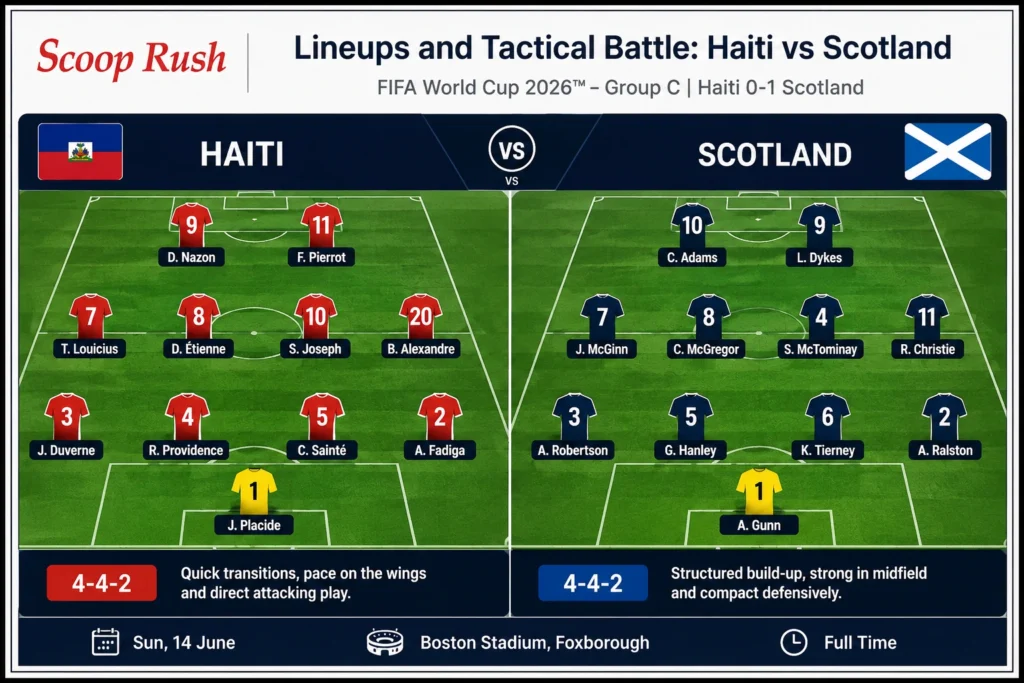
Lineups and Tactical Battle

Lineups and Tactical Battle

Both teams lined up in a 4-4-2 formation, creating an intriguing tactical contest across the pitch.

Haiti

Haiti relied on pace in wide areas and looked dangerous in transition. Their midfield worked tirelessly to disrupt Scotland’s rhythm and generate shooting opportunities.

Scotland

Scotland’s structure proved effective, with McGinn providing the key moment of quality. Defensively, the team remained compact and disciplined, limiting Haiti’s ability to convert possession into goals.

Group C Standings After Matchday One

Following the result, Scotland move to the top section of Group C with three points and a positive goal difference.

TeamPWDLGFGAGDPts
Scotland110010+13
Morocco10101101
Brazil10101101
Haiti100101-10

With Brazil and Morocco drawing their opening fixture, Scotland have taken an early advantage in what promises to be a highly competitive group.

Player of the Match: John McGinn

The Scottish midfielder delivered the game’s defining moment with his first-half goal. In a match where opportunities were scarce, McGinn’s composure in front of goal proved decisive and handed Scotland a dream start to their World Cup campaign.

Final Thoughts

Scotland will be delighted with the result, if not entirely satisfied with the performance. Three points in an opening World Cup match can be invaluable, and the Scots showed the resilience needed to grind out victories on football’s biggest stage.

For Haiti, the defeat will be frustrating given their competitive display. Their equal share of possession and superior shot count suggest there are positives to build upon. If they can improve their finishing, they remain capable of causing problems for the remaining teams in Group C.

As the tournament progresses, Scotland have laid down an early marker, while Haiti will look to bounce back and keep their qualification hopes alive.

Qatar vs Switzerland Result: Late Equalizer Earns Qatar 1-1 Draw in World Cup 2026 Group B

0

FIFA World Cup 2026 – Group B
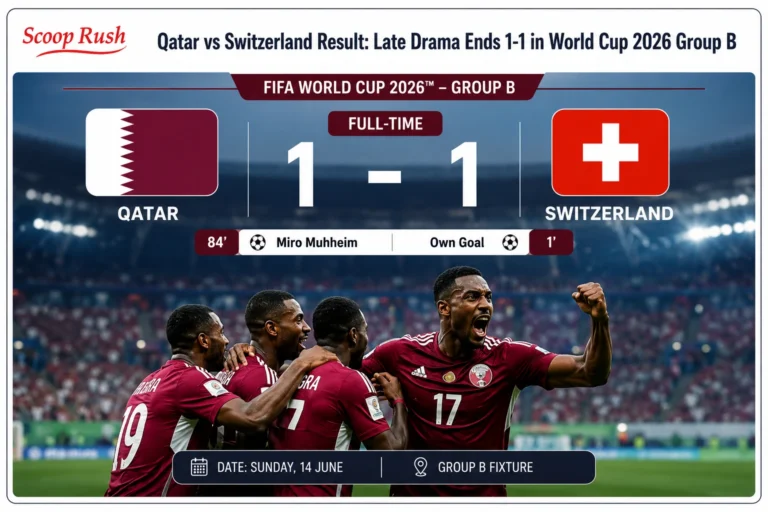
Full-Time: Qatar 1–1 Switzerland
Date: Sunday, 14 June

The Qatar vs Switzerland Result ended in a dramatic 1–1 draw as both teams shared the points in an entertaining Group B clash at the FIFA World Cup 2026. The match featured vibrant attacking football, a late equalizer, and several key moments that kept fans gripped until the final whistle. Qatar showed remarkable resilience to earn a valuable point, while Switzerland will feel disappointed after letting victory slip away in the closing stages.

Match Summary

The game remained closely contested throughout, with both teams creating chances and battling for control in midfield. Switzerland enjoyed more possession and produced the greater number of attacking opportunities, but Qatar defended resolutely and looked dangerous on the counterattack.

Switzerland eventually broke the deadlock in the second half through a fortunate own goal by Qatar defender Miro Muheim. A dangerous Swiss attack forced the defender into an awkward clearance that ended up in his own net, giving Switzerland a 1–0 advantage.

However, Qatar refused to back down. The hosts continued pushing forward and were rewarded late in the match when Muheim redeemed himself by scoring a dramatic equalizer in the 84th minute. His goal sparked wild celebrations among the Qatar supporters and ensured his side earned a valuable point.

Key Statistics

StatQatarSwitzerland
Shots527
Shots on Target310
Possession30%70%
Passes261651
Pass Accuracy73%93%
Corners310

The statistics highlight Switzerland’s dominance in possession and attacking play, but Qatar’s resilience and efficiency allowed them to stay competitive.

Tactical Overview

  • Qatar: Lined up in a 4-2-3-1 formation, focusing on defensive organization and rapid transitions. Despite seeing little of the ball, they stayed compact and made the most of their limited opportunities.
  • Switzerland: Employed a 3-4-3 system, controlling possession and applying constant pressure. Their midfield dictated the tempo, while the wing-backs provided width and numerous crossing opportunities.

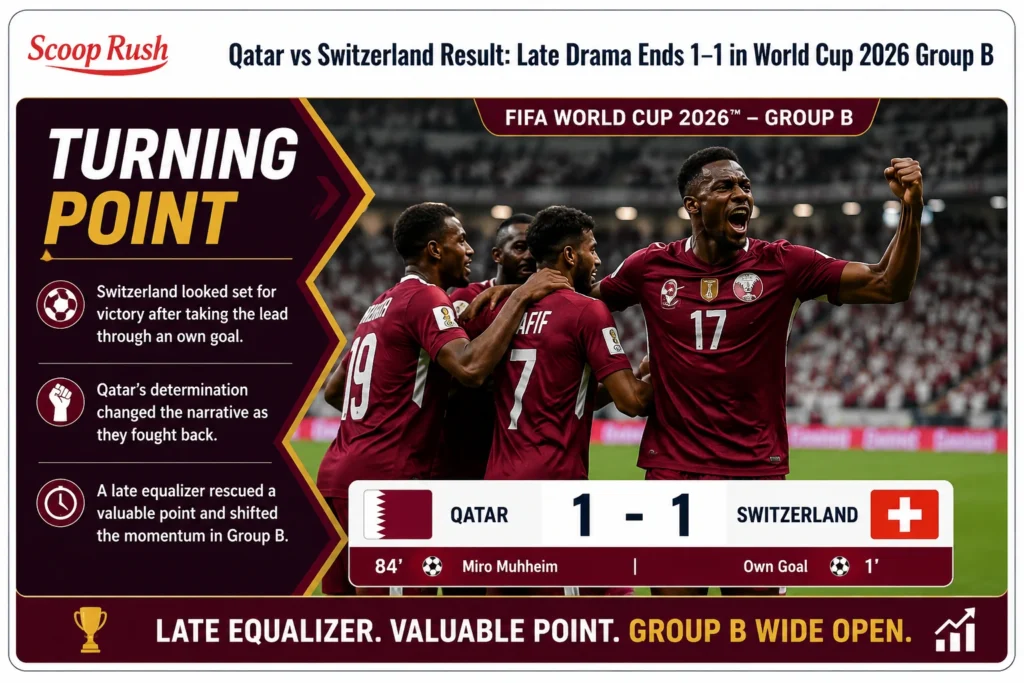
Turning Point

Qatar vs Switzerland Result, turning point

The match appeared destined for a Swiss victory after the own goal handed them the lead. Yet Qatar’s determination completely changed the narrative. The late equalizer not only rescued a point but also shifted the momentum in Group B.

What This Means for Group B

Following the draw, both Qatar and Switzerland open their World Cup campaigns with one point each. The result keeps Group B wide open, making every upcoming fixture critical in the race for knockout stage qualification.

Final Verdict

Switzerland will feel disappointed after dominating possession and creating far more chances, while Qatar can be proud of their fighting spirit and ability to recover from adversity. In the end, this 1–1 draw perfectly showcased football’s unpredictability a match where determination and resilience proved just as important as statistics.

Final Score: Qatar 1–1 Switzerland

Goals:

  • Switzerland: Own Goal (Qatar)
  • Qatar: Miro Muheim (84′)

Player of the Match: Miro Muheim – From scoring a heartbreaking own goal to netting the vital equalizer, he experienced a remarkable turnaround and played the most decisive role in the final result.