Home Blog Page 57

SpaceX IPO 2026: SPCX Stock Makes History on Nasdaq, Pushing Elon Musk Toward Trillionaire Status

0

SpaceX IPO 2026: The Biggest Market Debut Ever

SpaceX just pulled off the largest IPO in stock market history. On June 12, 2026, the rocket company opened on the Nasdaq under the ticker SPCX. The stock jumped right out of the gate. By the end of the day, it had soared close to 19 percent and turned Elon Musk into the world’s first trillionaire.

This was not a quiet listing. It was a full event. A bell rang in Times Square and another rang at Starbase in Texas. And while traders watched the numbers climb, SpaceX did something only SpaceX would do. It launched a Falcon 9 with Starlink satellites on the very same morning.

Here is what happened, why it matters, and what comes next.

What Is the SpaceX IPO?

An IPO, or initial public offering, is when a private company sells shares to the public for the first time. SpaceX stayed private for 24 years. The company was founded in 2002 to build reusable rockets and one day carry humans to Mars.

For most of that time, going public was off the table. Leadership wanted to focus on long-term goals, not quarterly earnings reports. That changed in late 2025, and the listing moved fast after that.

Key facts from the debut:

  • Ticker: SPCX on Nasdaq
  • IPO price: 135 dollars per share
  • Opening price: 150 dollars per share
  • Closing price: around 161 dollars per share, up roughly 19 percent
  • Money raised: about 75 billion dollars
  • Valuation: around 1.77 trillion dollars at the IPO price, climbing above 2 trillion during trading
  • Listing date: June 12, 2026

The deal also used a dual listing with Nasdaq and Nasdaq Texas, a nod to the company’s Starbase headquarters.

Why This IPO Is a Big Deal

Size is the headline. This was the biggest IPO Wall Street has ever seen. More than 500 million shares changed hands on day one. That came close to Facebook’s record first-day trading back in 2012.

But the scope matters just as much. SpaceX is now a public bet on rockets, satellites, and AI all at once. That mix is rare. Most companies do one thing. This one does several.

A few reasons the listing stands out:

  • It made Elon Musk the world’s first trillionaire on paper.
  • It pushed SpaceX past most public companies in total market value.
  • It marked the first of several expected AI-linked mega IPOs, with OpenAI and Anthropic also eyeing the public market.
  • More than half of the roughly 22,000 employees bought extra stock during the offering, totaling close to 1 billion dollars.

That last point is worth a pause. When staff put their own money in at this scale, it sends a strong signal about belief in the mission.

How SpaceX Got Here

The road was not smooth. Musk has openly said he gave the company less than a 10 percent chance of survival in the early years. The first three Falcon 1 flights failed before the fourth reached orbit in 2008.

Each milestone faced doubters. Here is the short version of what the company proved over time:

  • 2008: First privately built liquid-fueled rocket to reach orbit
  • 2010: Falcon 9 reaches orbit
  • Later years: First private company to send astronauts to the International Space Station
  • Reusability: Landing and reflying rockets, which slashed launch costs
  • 2025: A record 165 orbital launches in a single year

Then came Starlink. The satellite internet network now serves more than 12 million subscribers across 164 countries. It runs on roughly 9,600 satellites in low Earth orbit. It reaches places that traditional internet cables never could.

The xAI Merger and the AI Angle

There is one more piece that shaped this IPO. In February 2026, SpaceX completed its merger with xAI, Musk’s artificial intelligence company. That combined SpaceX’s space and connectivity work with a large AI compute operation under one roof.

The plan goes beyond Earth. Musk has talked openly about building solar-powered data centers in space. The idea is simple to state and hard to do. Power and cooling for AI are getting expensive on the ground. Space offers free solar energy and natural cold.

So SPCX is not only a space stock now. It is also an AI story. That dual identity is part of why investors paid so much attention.

What It Means for Investors

A historic debut is exciting. It is also worth a calm look. A few things to keep in mind:

  • Valuations can swing. SPCX moved fast on day one, both up and during the session. Early volatility is normal for a hot IPO.
  • Profit questions remain. Like other AI-heavy companies, SpaceX faces real spending as it builds. The bottom line will get close attention in future filings.
  • Retail access is wide. The offering set aside a large share for everyday investors through major brokerages.

None of this is financial advice. It is a snapshot of what the market saw on launch day. Always do your own research before you buy any stock.

Frequently Asked Questions

1. When did SpaceX go public?

SpaceX went public on June 12, 2026. It began trading on the Nasdaq Stock Market under the ticker symbol SPCX after 24 years as a private company.

2. What is the SpaceX stock ticker?

The SpaceX stock ticker is SPCX. The shares trade on the Nasdaq, with a dual listing that also ties the company to Nasdaq Texas.

3. How much did SpaceX raise in its IPO?

SpaceX raised about 75 billion dollars in the offering. That gave the company a valuation near 1.77 trillion dollars at the IPO price, making it the largest IPO in history.

4. Why is the SpaceX IPO considered historic?

It was the biggest IPO ever by money raised. It also made Elon Musk the world’s first trillionaire and combined space, satellite internet, and AI into one public company.

5. How does the xAI merger affect SpaceX stock?

The xAI merger, completed in February 2026, added a major AI compute business to SpaceX. This gives SPCX exposure to both space and artificial intelligence, including plans for data centers in orbit.

Final Thoughts

The SpaceX IPO was more than a stock listing. It was a milestone for the whole space and AI sector. A company that almost failed three times now sits among the most valuable in the world.

Want to keep up with market-moving tech news and what it means for your strategy? Follow along for clear, no-jargon breakdowns of the stories that matter.


AI Smart Glasses for Travel: Are Ray-Ban Meta Glasses Worth It for Travelers?

0

AI Travel Glasses Promise Convenience, But Can You Really Trust Them?

Imagine exploring one of the world’s most famous cities with an AI assistant built into your glasses. It sounds futuristic and convenient, but what happens when that assistant confidently gives you the wrong answer? A weekend trip to Paris using Ray-Ban Meta smart glasses revealed both the exciting possibilities and the surprising limitations of wearable AI technology for travelers.

Wearable AI Is Changing the Way People Travel

Wearable AI Is Changing the Way People Travel

Ray-Ban Meta smart glasses, launched through a partnership between Meta and EssilorLuxottica, are becoming increasingly popular among travelers. The glasses combine cameras, microphones, speakers, and artificial intelligence into a frame that looks like ordinary eyewear.

They promise to help users with tasks such as:

  • Translating menus and signs
  • Providing travel information
  • Giving navigation assistance
  • Taking hands-free photos and videos
  • Answering questions about landmarks
  • Offering restaurant recommendations

For people visiting unfamiliar destinations, these features could reduce the need to constantly check a smartphone.

Testing the Glasses in Paris

During a weekend in Paris, the smart glasses proved useful for many everyday travel situations.

They successfully translated French text into English, summarized café menus, converted currencies, and provided historical facts about famous locations. The voice-guided navigation also allowed the traveler to keep listening to surroundings instead of wearing headphones.

Using AI through audio rather than a screen made sightseeing feel more natural in many situations.

Accuracy Problems Raise Concerns

Despite their convenience, the glasses were not always reliable.

When asked about the height of the Eiffel Tower, they gave two different answers within minutes. Although the difference was small, the inconsistency highlighted a larger issue: users may not always know whether the information provided by AI is accurate.

The glasses often answered with great confidence, even when details could be incorrect or inconsistent. This means travelers should still verify important facts instead of relying entirely on AI.

Translation and Travel Assistance Perform Well

Some of the strongest features involved language support.

The glasses accurately translated newspaper text and café menus while providing spoken explanations. They also worked well for quick currency conversions and basic travel questions, reducing the need to search on a phone.

For travelers visiting countries where they do not speak the language, these tools could save time and reduce stress.

Camera Features Have Limitations

The built-in camera offers hands-free photography from the wearer’s perspective, but it lacks many controls available on smartphones.

Users cannot manually zoom or adjust focus, and images may appear tilted if the glasses are not positioned perfectly. As a result, travelers looking for high-quality vacation photos may still prefer using their phones or dedicated cameras.

Privacy Remains a Major Issue

One of the biggest concerns surrounding AI smart glasses is privacy.

Because the devices contain discreet cameras, people nearby may not realize they are being recorded or photographed. Critics argue that this raises ethical questions, especially in public spaces.

In addition, some voice interactions and recordings may be processed or stored to improve AI systems, prompting concerns about how user data is handled.

Does AI Improve the Travel Experience?

While the technology can simplify navigation and information gathering, it may also reduce spontaneous human interactions.

Instead of asking locals for directions or recommendations, users may increasingly rely on AI assistants. Some travelers believe that getting lost, discovering hidden places by chance, or talking to strangers creates the most memorable travel experiences.

Smart glasses make travel more efficient, but they may also place another layer of technology between visitors and the places they are exploring.

Best Uses for AI Smart Glasses

The technology appears most valuable for:

  • International trips where language barriers exist
  • Business travel with limited time
  • Quick translation of menus and signs
  • Hands-free navigation
  • Fast access to historical facts and local information

However, users should still double-check important information and remain aware of privacy considerations.

Final Verdict

Ray-Ban Meta smart glasses showcase the exciting future of wearable AI, offering practical tools that can make travel easier and more convenient. Features like live translation, voice navigation, and instant answers are genuinely useful.

At the same time, occasional factual errors, privacy concerns, and reduced human interaction remind travelers that technology should enhance experiences rather than replace them. For many people, the best adventures still come from unexpected discoveries that no AI can plan.

FAQs 

1. What are Ray-Ban Meta smart glasses?

They are AI-powered wearable glasses that combine a camera, microphones, speakers, and a voice assistant to help users take photos, translate text, answer questions, and navigate hands-free.

2. Can AI smart glasses translate foreign languages?

Yes. They can translate text and provide spoken explanations, making them useful for reading menus, signs, newspapers, and other written content while traveling.

3. Are AI travel glasses always accurate?

No. While they often provide helpful information, they can occasionally produce incorrect or inconsistent answers. Important facts should always be verified through reliable sources.

4. What are the biggest privacy concerns with smart glasses?

The built-in cameras may record or photograph people without their knowledge, and some voice interactions may be processed to improve AI services, raising concerns about personal privacy and data handling.

5. Are AI smart glasses worth buying for travel?

They can be valuable for travelers who need translation, hands-free navigation, or quick information, especially in unfamiliar countries. However, users should balance convenience with privacy considerations and avoid relying on AI for critical information.

World Cup 2026 Group A: Mexico Beat South Africa and South Korea Edge Czechia

0

FIFA World Cup 2026: South Korea Launches Epic 2-1 Comeback Over Czechia

A masterclass performance from Hwang In-beom inspired South Korea to come from a goal down to defeat Czechia 2-1 in their thrilling Group A opener at Estadio Guadalajara.


Match Summary & Key Details

Fixture South Korea vs. Czechia
Tournament / Stage FIFA World Cup 2026 – Group Stage (Group A)
Date / Kick-off Friday, June 12, 2026
Venue Estadio Guadalajara, Mexico
Final Score South Korea 2 – 1 Czechia
Goal Scorers Czechia: Ladislav Krejčí (59′)
South Korea: Hwang In-beom (67′), Oh Hyeon-gyu (80′)
Match Statistics Possession: 62% – 38% | Shots: 15 – 8 | Shots on Target: 7 – 3

How the Match Unfolded

  • First Half Dominance: South Korea asserted complete command of the midfield traffic during the initial 45 minutes, circulating play through captain Son Heung-min and keeping Czechia goalkeeper Matej Kovář active with multiple close-range saves.
  • Krejčí Stunner (59′): Despite struggling to orchestrate open-play sequences, the Czechs weaponized their signature set-piece threat. Captain Ladislav Krejčí soared high to head home a massive long throw-in delivered by Vladimír Coufal, shattering the deadlock against the run of play.
  • The Equalizer (67′): The Taegeuk Warriors responded swiftly. Midfielder Hwang In-beom carved his way through the Czech low-block defense to deliver a clinical finish, restoring parity for the passionate local crowds backing the Asian side in Guadalajara.
  • VAR Intervention (78′): In a massive emotional swing, Czechia’s Tomáš Souček thought he had recaptured the lead with a powerful header from a free kick. However, a lengthy VAR review overturned the play, ruling the goal out for offside.
  • The Winning Strike (80′): Capitalizing immediately on the momentum shift, Hwang In-beom turned playmaker to slice open the flank, fizzing a cross to substitute forward Oh Hyeon-gyu, who safely tapped it home from point-blank range to wrap up the 2-1 victory.

Group A Implications

With this thrilling triumph, South Korea moves tied on points with tournament co-hosts Mexico, who safely registered a commanding 2-0 win over South Africa earlier on opening night at the Estadio Azteca. Read the complete ScoopRush Football Analysis and browse live updates across our comprehensive ScoopRush Sports Hub to track the Group A qualification race.

Team Played Won GD Points
Mexico 1 1 +2 3
South Korea 1 1 +1 3
Czechia 1 0 -1 0
South Africa 1 0 -2 0

Antoni Porowski Says the Best Travel Memories Begin With Great Food

0

For Antoni Porowski, every trip starts with one important question: “Where should I eat first?” The Queer Eye food expert has traveled across the globe tasting local specialties, and now he has revealed the six meals that left the biggest impression on him. From seaside lobster rolls in Maine to elegant desserts in Mexico City, these dishes represent some of his favorite culinary experiences.

Food Comes Before Everything Else

Porowski, who is known for his passion for food and travel, says eating is always his top priority when visiting a new destination. According to him, discovering local restaurants is one of the best ways to understand a city’s culture, history, and people.

He also shared a simple travel tip: if you find a small restaurant where a grandmother is cooking in the kitchen, there is a good chance the food will be exceptional.

1. Fresh Lobster Rolls in Maine, USA

One of Porowski’s all-time favorite meals is the lobster roll served at The Clam Shack in Kennebunk, Maine. He loves its fresh lobster meat, lightly salted flavor, and sweet bun.

The experience is just as memorable as the food itself. Sitting by the water while watching fishing boats and enjoying fresh blueberries afterward makes it one of his happiest travel memories.

2. Steak Tartare in Warsaw, Poland

While visiting Poland with family, Porowski enjoyed a traditional steak tartare at Stary Dom in Warsaw. Prepared by hand at the table with egg yolk, horseradish, and pickles, the dish impressed him with its texture and flavor.

He described it as a perfect introduction to authentic Polish cuisine for his partner, who was visiting the country for the first time.

3. Rosemary Ice Cream at Rosetta in Mexico City

During filming in Mexico City, Porowski became a regular guest at Rosetta, the restaurant led by renowned chef Elena Reygadas.

Although he loved the restaurant’s pastries and tamales, one dessert stood above the rest: rosemary ice cream served with an herb salad. He praised it for being refreshing while still offering a rich and satisfying taste.

4. Soft Scrambled Eggs and Smoked Salmon in Paris

Even with only one day in Paris, Porowski found time for an unforgettable breakfast at Hôtel de Crillon.

The soft scrambled eggs, delicate smoked salmon, buttery croissant, and strawberry jam created what he considers one of the most perfectly prepared meals he has ever enjoyed.

5. Grilled Pork Chop on Mykonos, Greece

On the Greek island of Mykonos, Porowski discovered a rustic restaurant called Kiki’s Tavern.

Although seafood is usually his first choice in Greece, he ordered a grilled pork chop after seeing it cooking over the fire. The juicy meat and caramelized crust made it one of the best dishes he has ever tasted.

6. Stuffed Guinea Fowl in Emilia-Romagna, Italy

While filming in Italy with actor Justin Theroux, Porowski visited Locanda del Falco and sampled a local specialty: guinea fowl cooked in clay and stuffed with figs and lard.

He described the meal as outstanding and also shared a simple Italian food tip he learned during the trip: drizzle high-quality Parmigiano Reggiano with premium balsamic vinegar for an unforgettable flavor combination.

Why Antoni Porowski Loves Local Restaurants

Rather than relying only on social media recommendations, Porowski enjoys finding restaurants by exploring neighborhoods on foot. He believes the busiest local spots often provide the most authentic dining experiences.

His travels have reinforced his belief that food is more than nourishment. It is a window into a community’s traditions, identity, and everyday life.

Final Thoughts

Antoni Porowski’s list of favorite meals highlights the diversity of global cuisine and the value of seeking authentic local experiences. Whether enjoying lobster by the ocean, sampling traditional Polish dishes, or tasting creative desserts in Mexico City, his culinary adventures show that some of the best travel memories are created around the dining table.

FAQs

1. Who is Antoni Porowski?

Antoni Porowski is a chef, television personality, author, and the food and wine expert featured on Queer Eye.

2. What is Antoni Porowski’s favorite travel tip for finding good food?

He recommends looking for small local restaurants, especially ones where family members or older home-style cooks prepare the meals.

3. Which dessert impressed Antoni Porowski the most?

He singled out the rosemary ice cream with herb salad at Rosetta in Mexico City as one of the most memorable desserts he has ever tasted.

4. What was his favorite meal in Greece?

His standout Greek meal was a grilled pork chop at Kiki’s Tavern on the island of Mykonos.

5. Why does Antoni Porowski focus so much on food while traveling?

He believes food offers one of the best ways to understand local culture, traditions, and history while creating lasting travel memories.

Live Schedule · Auto-updates daily: FIFA World Cup 2026

0
Live Schedule · Auto-updates daily

FIFA World Cup 2026

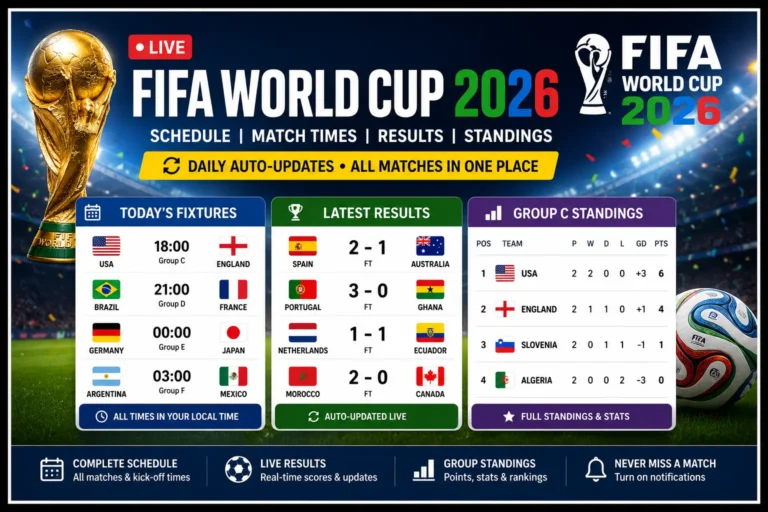
48 teams · 104 matches · USA · Canada · Mexico · 11 Jun – 19 Jul
Times shown in your local timezone · Updated automatically

WhatsApp, Facebook and Instagram Down for Thousands of Users Worldwide as Meta Confirms Outage

0

Millions of people rely on WhatsApp, Facebook and Instagram every day, so when the platforms suddenly stopped working for thousands of users, frustration quickly spread across the internet. Reports of problems flooded outage-tracking websites as users around the world struggled to access Meta’s services on June 12.

Meta Services Experience Widespread Outage

Thousands of users reported issues with WhatsApp, Facebook and Instagram after the platforms experienced a major disruption affecting several countries.

While many users were unable to access the services through desktop browsers and desktop applications, some people found that the mobile versions continued working normally. This meant the outage did not affect everyone in the same way.

The problems were reported in multiple countries, including the United Kingdom, United States, Canada, Australia, India and the Philippines.

WhatsApp Desktop Users Hit Hardest

WhatsApp-Desktop-Users-Hit-Hardest.

Many of the complaints focused on WhatsApp’s desktop application and web-based services. Users attempting to send messages or access conversations on their computers encountered errors or were unable to connect.

Meanwhile, a significant number of mobile users reported little or no disruption, allowing them to continue using the messaging service as normal.

The mixed experience left many users confused about whether the issue was affecting only them or a wider group of people.

Thousands Turn to Outage Tracking Websites

As the disruption continued, users flocked to outage monitoring platforms to check whether others were experiencing similar problems.

By around 2 p.m., tens of thousands of reports had been submitted regarding Facebook, Instagram and WhatsApp accessibility issues. Common complaints included services being inaccessible, connection errors and login problems.

The sudden surge in reports confirmed that the outage was not limited to a single region or internet provider.

Meta Responds to the Service Disruption

Meta-Responds-to-the-Service-Disruption

Meta acknowledged the issue after users began reporting problems across its platforms.

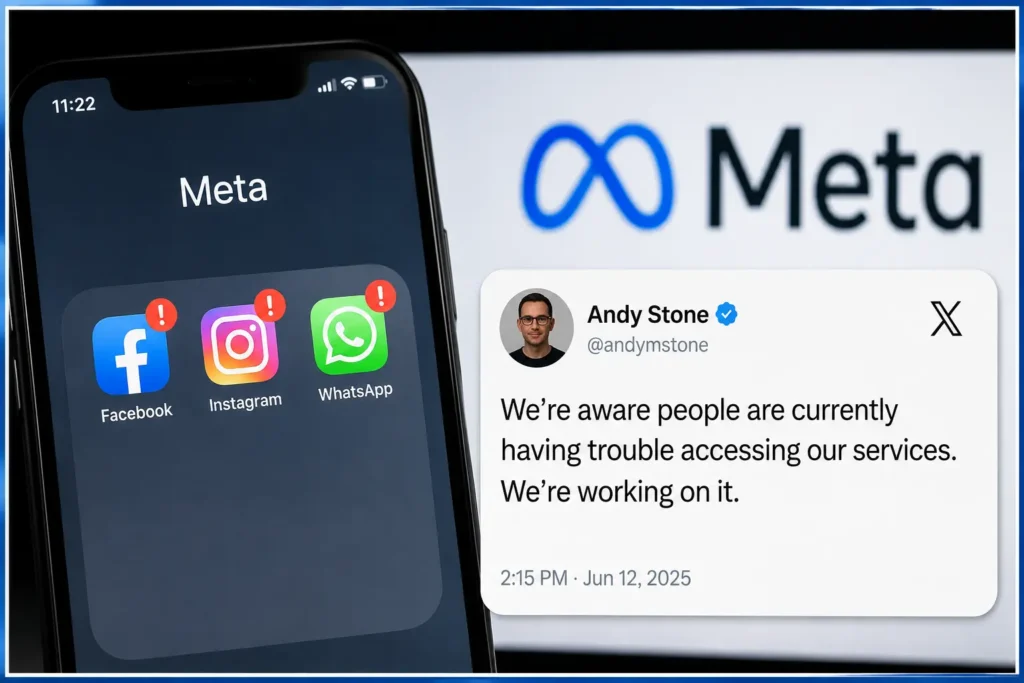
Andy Stone, a communications officer at Meta, posted a statement on X, saying:

“We’re aware people are currently having trouble accessing our services. We’re working on it.”

The company did not immediately provide details about what caused the outage, but service restoration efforts began shortly after the reports emerged.

Services Gradually Return Online

As engineers worked to resolve the issue, access to Facebook and other Meta services gradually started returning for many users.

Outages of this scale are usually temporary, and services often return to normal within a relatively short period. For Meta, every minute of downtime can affect user activity, advertising revenue and business operations.

By the time access was being restored, many users had already taken to alternative social media platforms to discuss the outage and share reactions.

Another Reminder of How Dependent We Are on Social Media

The disruption highlighted how heavily people rely on Meta’s platforms for communication, entertainment and business activities. Even a short outage can impact millions of users worldwide, especially when services like WhatsApp are used for both personal and professional communication.

Although the interruption appears to have been temporary, it served as another reminder of the challenges major technology companies face in keeping global platforms running smoothly around the clock.

FAQs

1. Why were WhatsApp, Facebook and Instagram not working?

Meta experienced a service disruption that affected access to several of its platforms. The company acknowledged the issue and worked to restore services.

2. Was the outage worldwide?

Yes. Users in several countries, including the UK, US, Canada, Australia, India and the Philippines, reported problems accessing Meta services.

3. Did the outage affect all users?

No. Some users, particularly those using mobile apps, reported little or no disruption, while many desktop users experienced problems.

4. What did Meta say about the outage?

Meta communications officer Andy Stone stated that the company was aware of the issues and was working to fix them.

5. Are WhatsApp, Facebook and Instagram working again?

Services began returning for many users after the outage, and Meta worked to restore full functionality across its platforms.

The ‘Wildest Woman in America’: How Carol Ruckdeschel Has Spent 53 Years Protecting Cumberland Island

0

A Life of Solitude, Survival, and Conservation

For more than five decades, one remarkable woman has chosen a life far removed from modern conveniences to protect one of America’s last truly wild coastal landscapes. At 84 years old, Carol Ruckdeschel continues to patrol the beaches of Georgia’s Cumberland Island, documenting wildlife, studying sea turtles, and fighting against development that she believes could permanently damage the island’s fragile ecosystem.

Known by many as the “wildest woman in America,” Ruckdeschel has become a legendary figure in conservation through her fearless dedication to preserving nature.

Who Is Carol Ruckdeschel?

Carol Ruckdeschel is an ecologist and naturalist who moved to Cumberland Island full-time in 1973 after falling in love with its untouched beauty during an earlier visit. Since then, she has lived almost entirely off the land, making her one of the island’s few permanent residents.

Her work with sea turtles earned her comparisons to famed primatologist Jane Goodall, while her unconventional lifestyle has attracted widespread attention. Over the years, she has carefully documented wildlife, collected scientific data, and helped researchers better understand the island’s unique environment.

A Daily Mission to Study and Protect Wildlife

A Daily Mission to Study and Protect Wildlife

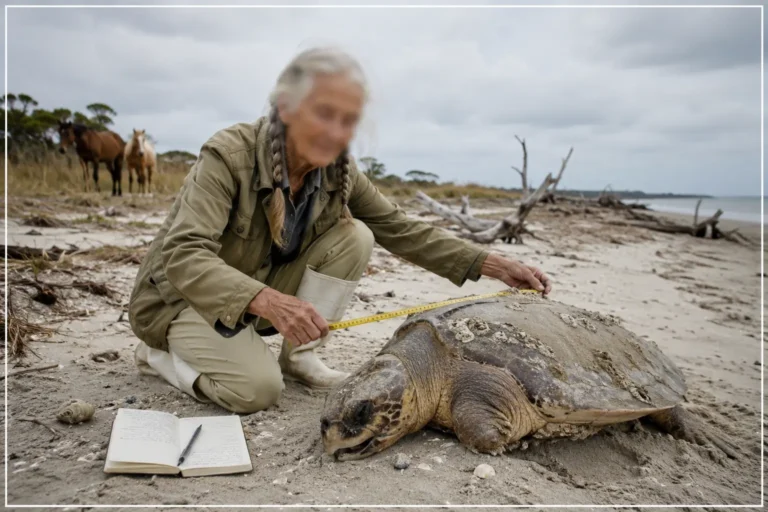
Every week, Ruckdeschel walks miles along Cumberland Island’s beaches, recording everything she sees in detailed field journals. Her observations include birds, marine life, shells, and other coastal species.

One of her most important contributions has been examining dead sea turtles that wash ashore. Through thousands of necropsies, she discovered evidence that many turtles were drowning after becoming trapped in shrimp fishing nets. Her findings helped support improvements in fishing practices and equipment designed to reduce turtle deaths.

Her meticulous research has earned recognition from scientists and museums alike.

Life on a Remote Island Without Modern Comforts

Life on a Remote Island Without Modern Comforts

Living on Cumberland Island is far from easy. The island has no grocery stores, gas stations, paved roads, or many of the services people take for granted. Visitors must bring supplies with them, and access is primarily by boat.

Ruckdeschel built her home using reclaimed materials and depends heavily on rainwater collection, gardening, fishing, and foraging. She grows fruits and vegetables while also making use of natural resources around her to maintain a largely self-sufficient lifestyle.

She says years of hard work have allowed her to adapt to the island’s challenging conditions.

Why Cumberland Island Is So Special

Covering more than 36,000 acres, Cumberland Island is the largest barrier island along Georgia’s coast and one of the least-developed national seashores in the United States.

The island is known for:

  • Miles of undeveloped beaches.
  • Maritime forests and salt marshes.
  • Nesting grounds for endangered sea turtles.
  • Rare bird species and abundant wildlife.
  • Free-roaming feral horses.

Strict visitor limits help preserve its natural character, making it a rare destination where wilderness remains largely untouched.

A Lifelong Fight Against Development

Protecting the island has become Ruckdeschel’s life’s mission. Throughout the decades, she has opposed projects she believes threaten Cumberland’s ecosystem, including proposals for expanded tourism infrastructure and other developments.

She has worked with conservation groups and grassroots organizations to raise awareness and advocate for keeping the island as wild as possible for future generations.

Currently, she remains concerned about proposals that could increase visitor numbers and introduce additional construction or facilities on the island.

Living for Science and Future Generations

Despite being in her eighties, Ruckdeschel continues her research with the same passion that first brought her to Cumberland Island over 50 years ago. She believes there is always something new to discover in nature and remains committed to protecting the environment she calls home.

Her extraordinary dedication has inspired scientists, conservationists, and travelers alike, proving that one determined individual can make a lasting impact on preserving the natural world.

FAQs

1. Why is Carol Ruckdeschel called the “wildest woman in America”?

She earned the nickname because of her unconventional lifestyle, including living off the land, handling wildlife, and dedicating her life to conservation in remote wilderness.

2. Where does Carol Ruckdeschel live?

She lives on Cumberland Island in Georgia, a protected barrier island known for its beaches, forests, and diverse wildlife.

3. What is Carol Ruckdeschel famous for?

She is best known for her decades of sea turtle research, environmental conservation efforts, and commitment to protecting Cumberland Island.

4. How has her research helped sea turtles?

Her investigations into turtle deaths helped identify problems with shrimp fishing practices, contributing to changes that reduced accidental turtle drownings.

5. Why is Cumberland Island considered unique?

The island remains largely undeveloped, has limited daily visitors, supports endangered wildlife, and offers one of the most preserved coastal ecosystems in the United States.

IPTV Crackdown Before 2026 World Cup: 27,000 Illegal Streaming Sites Shut Down in Major International Operation

0

Massive IPTV Enforcement Hits Just Before the 2026 World Cup

Millions of football fans preparing to watch the 2026 FIFA World Cup could face fewer illegal streaming options after authorities carried out one of the biggest anti-piracy operations in recent years. A large international crackdown has led to the removal of 27,000 illegal streaming links and the dismantling of several criminal networks involved in IPTV piracy.

The operation comes just days before the World Cup begins, a time when demand for live sports streaming is expected to surge worldwide.

Operation Kratos 2 Targets Illegal IPTV Networks

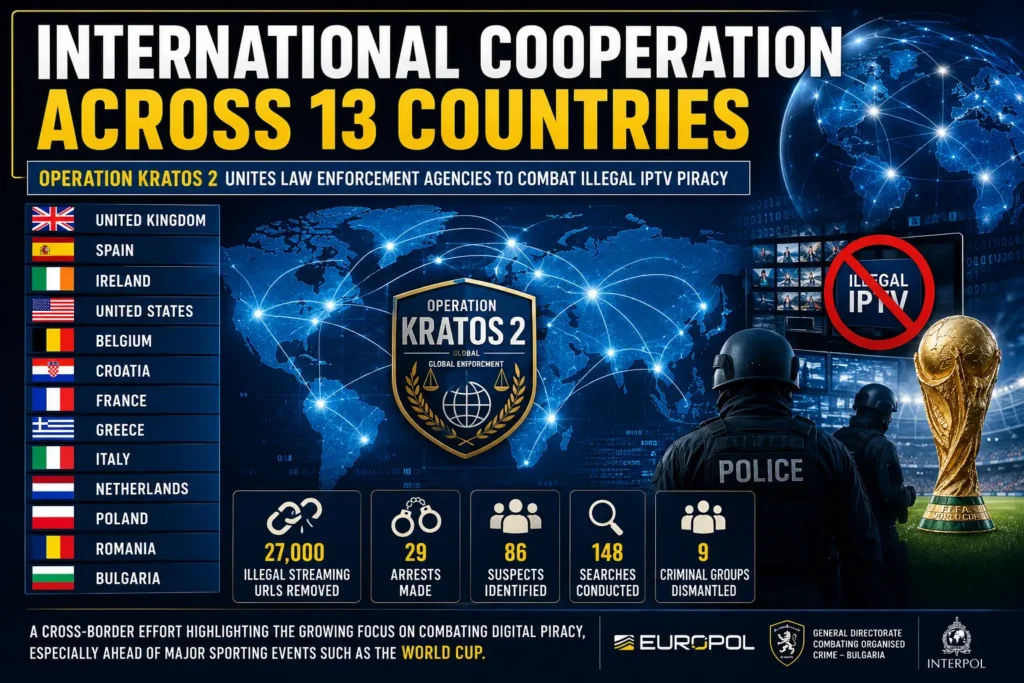
The enforcement campaign, known as Operation Kratos 2, was jointly led by Europol and Bulgaria’s General Directorate Combating Organised Crime.

The seven-month operation ran from September 2025 to April 26, 2026. During that period, investigators targeted illegal IPTV services that distributed copyrighted television channels, sporting events, movies, and television shows without authorization.

According to reports, authorities successfully removed approximately 27,000 illegal streaming URLs that were being used to provide unauthorized access to premium content.

Nine Criminal Groups Dismantled

The operation produced significant results across multiple countries.

Authorities reported:

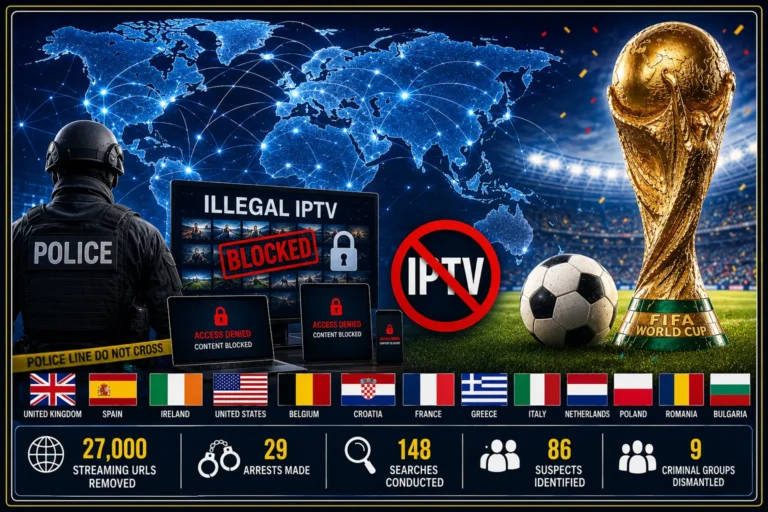
  • 27,000 illegal streaming URLs removed
  • 9 organized criminal groups dismantled
  • 29 arrests made
  • 148 searches conducted
  • 86 suspects identified

Investigators believe these networks generated substantial revenue by offering unauthorized access to sports broadcasts and entertainment content through IPTV subscriptions and so-called “dodgy boxes.”

International Cooperation Across 13 Countries

International-Cooperation-Across-13-Countries

Operation Kratos 2 involved law enforcement agencies from 13 countries:

  • United Kingdom
  • Spain
  • Ireland
  • United States
  • Belgium
  • Croatia
  • France
  • Greece
  • Italy
  • Netherlands
  • Poland
  • Romania
  • Bulgaria

The cross-border effort highlights the growing focus on combating digital piracy, especially ahead of major sporting events such as the World Cup.

Why IPTV Services Have Become So Popular

Illegal IPTV services have gained popularity in recent years as consumers face rising subscription costs for television and streaming platforms.

Many unauthorized services offer access to:

  • Live football matches
  • Boxing pay-per-view events
  • Premium sports channels
  • Movies and TV series

These services often attract users by providing content at a fraction of the cost of legitimate subscriptions. However, they operate without broadcasting rights and frequently violate copyright laws.

UEFA Welcomes the Results

Football governing body UEFA welcomed the outcome of the operation.

A UEFA spokesperson praised the coordinated international effort and thanked law enforcement agencies and industry partners for their continued cooperation in tackling organized crime in the digital environment.

Sports broadcasters and rights holders have increasingly pushed for stronger action against piracy, arguing that illegal streaming causes major financial losses to the sports and entertainment industries.

Legal Ways to Watch the 2026 World Cup in the UK

Fans in the United Kingdom will still have free options to watch World Cup matches legally.

England and Scotland matches will be available on free-to-air television through BBC and ITV, provided viewers hold a valid TV licence.

England’s Group Stage Coverage

  • England vs Croatia: ITV
  • England vs Ghana: BBC
  • England vs Panama: ITV

Scotland’s Group Stage Coverage

  • Scotland vs Haiti: BBC
  • Scotland vs Brazil: BBC
  • Scotland vs Morocco: ITV

These broadcasts provide fans with legal access to World Cup coverage without requiring paid streaming services.

What This Means for IPTV Users

The latest enforcement action signals that authorities are increasing efforts to disrupt illegal streaming operations ahead of major sporting events. While the shutdown of thousands of streaming links may affect access to unauthorized content, it also demonstrates growing international cooperation against digital piracy networks.

With the 2026 World Cup expected to attract a global audience of billions, authorities and broadcasters are likely to continue monitoring and targeting illegal streaming services throughout the tournament.

FAQs

1. What is Operation Kratos 2?

Operation Kratos 2 is an international anti-piracy operation led by Europol and Bulgarian authorities that targeted illegal IPTV and streaming networks between September 2025 and April 2026.

2. How many illegal IPTV streams were shut down?

Authorities reported that approximately 27,000 illegal streaming URLs were removed during the operation.

3. How many people were arrested?

The operation resulted in 29 arrests, while 86 suspects were identified during the investigation.

4. Which countries participated in the crackdown?

Thirteen countries took part, including the UK, United States, Spain, Ireland, France, Italy, Bulgaria, and several other European nations.

5. Can fans still watch the 2026 World Cup legally for free?

Yes. In the UK, England and Scotland matches will be available on BBC and ITV, allowing viewers with a valid TV licence to watch legally without paying for additional subscriptions.

World’s Safest Countries in 2026 Revealed: Iceland Tops Global Peace Rankings Again

0

A world facing growing conflict still has places where peace and safety remain part of everyday life. The latest Global Peace Index for 2026 highlights the countries that continue to provide security, stability, and a high quality of life for both residents and visitors.

As international tensions rise and many nations experience increasing instability, a select group of countries continues to stand out for their peaceful environments. According to the 2026 Global Peace Index, Iceland remains the safest country in the world for the 19th consecutive year, followed by New Zealand and Switzerland.

The report evaluates 163 countries using factors such as crime rates, military activity, ongoing conflicts, public safety, and social stability. While many nations have become less peaceful over the past year, the highest-ranked countries continue to demonstrate strong institutions, low violence, and high levels of trust among their citizens.

Iceland Retains the Top Spot

Iceland once again ranks as the world’s safest country. The nation’s low crime rates, minimal militarization, strong public services, and close-knit communities all contribute to its consistent performance.

Residents also credit the country’s focus on equality, renewable energy, and social inclusion. Its remote geographic location and breathtaking natural environment further support a peaceful way of life.

New Zealand Climbs to Second Place

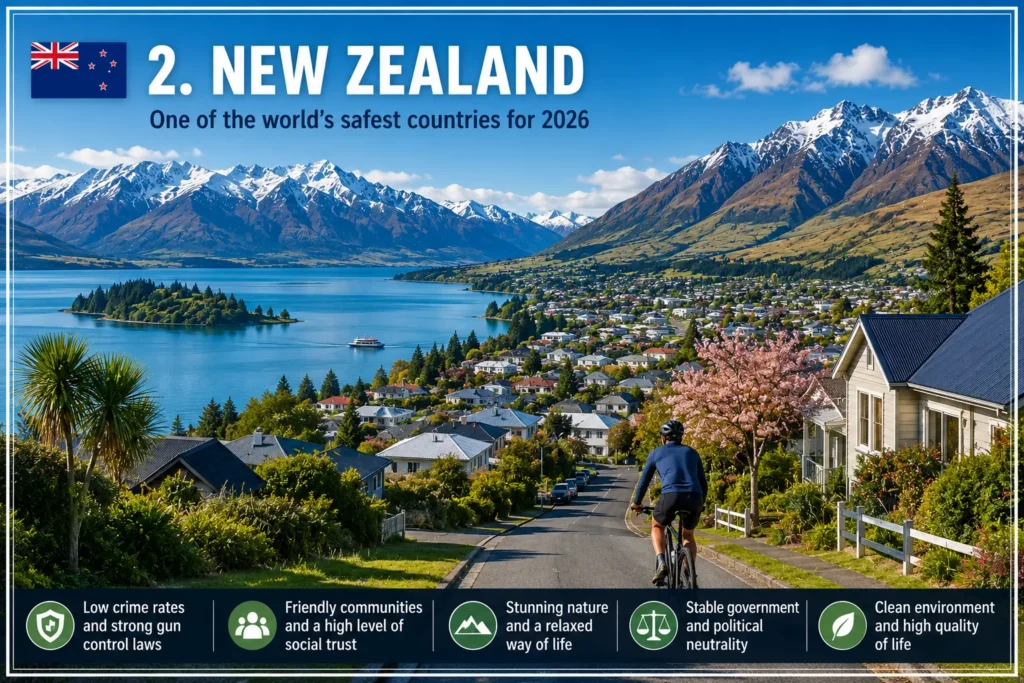
New Zealand moved up to second place in the 2026 rankings and remains the safest country in the Asia-Pacific region.

Experts point to its geographic isolation, strict gun laws, and community-focused culture as key reasons for its stability. The country’s residents enjoy easy access to nature, while neighborhoods often maintain strong social connections and mutual trust.

Switzerland Moves into Third Position

Switzerland rose to third place thanks to its low crime rates and long-standing tradition of neutrality.

Many residents describe daily life as being built on trust, cooperation, and practical problem-solving. The country’s multicultural society and emphasis on compromise help create a stable and secure environment where people generally feel safe.

Slovenia Enters the Top Five

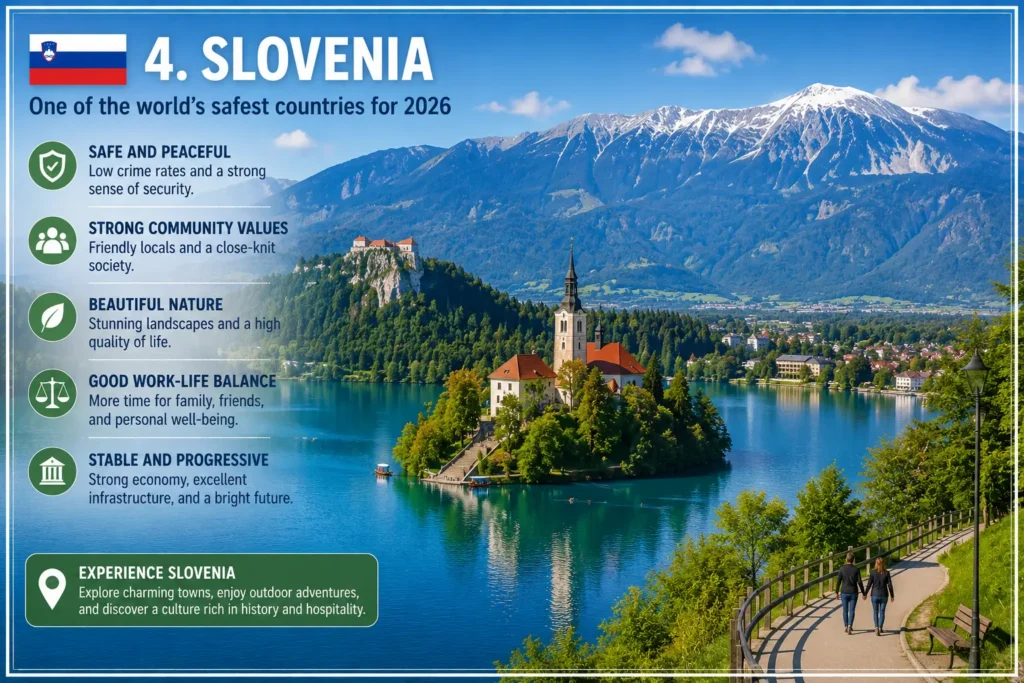
Slovenia reached the top five for the first time in the Global Peace Index.

Its relatively low military spending, safe communities, and strong work-life balance contribute to its success. Residents often spend significant time outdoors and place high value on family, friendships, and community life.

Ireland Completes the Top Five

Ireland ranks fifth, benefiting from low levels of violence and limited involvement in international conflicts.

Its long tradition of hospitality and neutrality has helped foster a welcoming and secure atmosphere. Visitors are encouraged to explore the country’s scenic coastlines, countryside, and historic sites to experience its peaceful character.

Top 10 Safest Countries in the World for 2026

  1. Iceland
  2. New Zealand
  3. Switzerland
  4. Slovenia
  5. Ireland
  6. Austria
  7. Portugal
  8. Singapore
  9. Finland
  10. Japan

Why These Countries Rank So Highly

The nations leading the Global Peace Index share several important characteristics:

  • Low levels of violent crime.
  • Stable governments and effective public institutions.
  • High levels of social trust.
  • Limited military involvement and conflict.
  • Strong quality of life and public services.
  • Emphasis on community, equality, and work-life balance.

These factors combine to create environments where residents generally feel secure and visitors can travel with confidence.

Final Thoughts

Although the 2026 Global Peace Index shows that global peace has declined overall, countries such as Iceland, New Zealand, and Switzerland demonstrate that stability and safety can still thrive. Their commitment to social cohesion, effective governance, and peaceful living continues to make them attractive destinations for both citizens and travelers seeking a secure environment.

FAQs

1. Which country is the safest in the world in 2026?

Iceland is ranked as the safest country in the world according to the 2026 Global Peace Index.

2. What is the Global Peace Index?

The Global Peace Index is an annual report that measures the peacefulness of countries using indicators such as crime, conflict, militarization, and public safety.

3. Which countries are in the top five safest nations for 2026?

The top five are Iceland, New Zealand, Switzerland, Slovenia, and Ireland.

4. Why is Iceland considered so safe?

Iceland benefits from low crime, strong social trust, effective public services, limited militarization, and a close-knit society.

5. Are peaceful countries good destinations for travelers?

Yes. Countries that rank highly for peace generally offer safer environments, stable infrastructure, and a welcoming atmosphere for tourists.

Scientists Find Hidden DNA Factor That Could Reduce Ozempic’s Effectiveness

0

Millions of people have turned to weight loss drugs like Ozempic, Wegovy, and Mounjaro hoping to lose weight and improve their health. While many users have reported impressive results, others have seen little to no change. Now, scientists believe they may have discovered the hidden reason why these medications do not work equally well for everyone.

Scientists Find Hidden DNA Factor That Could Reduce Ozempic's Effectiveness

Researchers at Stanford Medicine have identified a genetic factor that could make some people less responsive to GLP-1 medications, the class of drugs that includes Ozempic and Wegovy. Their findings suggest that a person’s DNA may play an important role in determining how effective these popular treatments are.

Stanford Scientists Investigate Why Some Patients Respond Differently

Stanford Scientists Investigate Why Some Patients Respond Differently

The research, published in Genome Medicine in April 2026, was the result of nearly a decade of scientific investigation. The study included experiments involving both humans and mice, along with an analysis of diabetes drug trial data.

Scientists wanted to understand why some patients experience significant improvements while others do not get the expected benefits from GLP-1 medications.

Their findings point to specific genetic variations that may interfere with the body’s ability to respond properly to these drugs.

The Genetic Variants Behind GLP-1 Resistance

According to the researchers, around 10 percent of the population may carry certain genetic variants that affect a key enzyme called PAM (Peptidyl-glycine Alpha-amidating Monooxygenase).

This enzyme helps activate several important hormones in the body, including GLP-1, a hormone responsible for regulating blood sugar levels and controlling appetite.

Scientists discovered that people carrying these genetic variants develop what researchers call “GLP-1 resistance.”

This means their bodies produce higher levels of the GLP-1 hormone, but the hormone is less effective at performing its normal functions.

What Is GLP-1 Resistance?

GLP-1 resistance occurs when the body does not respond properly to the GLP-1 hormone, even when plenty of it is present.

Researchers found that individuals with the genetic variant had increased GLP-1 levels in their bloodstream. However, despite having more of the hormone, their blood sugar levels did not improve faster than those without the variant.

In simple terms, their bodies needed more GLP-1 to achieve the same biological effect.

Professor Anna Gloyn, one of the lead researchers, explained that this result was unexpected.

The team initially believed that problems with the PAM enzyme would reduce GLP-1 levels. Instead, they found the opposite. Patients had more GLP-1, but it was not working as efficiently.

How Researchers Conducted the Study

To test their theory, scientists recruited adults who either carried or did not carry a PAM genetic variant known as p.S539W.

Participants consumed a sugary drink, and researchers monitored their blood samples every five minutes over a four-hour period.

The results consistently showed that people with the genetic variant had higher circulating levels of GLP-1 but no corresponding improvement in blood sugar control.

Additional analyses and clinical trial data further supported the idea that this resistance is specifically linked to medications that work through GLP-1 receptors.

Does This Affect Weight Loss Results?

While the study clearly demonstrated an impact on blood sugar regulation, researchers say it is still unclear whether these genetic variants directly reduce weight loss from medications such as Ozempic and Wegovy.

The reason for this uncertainty is that weight loss treatments typically use higher doses than those prescribed for diabetes management.

Scientists believe more research is needed to determine whether GLP-1 resistance also explains why some people lose less weight than expected while taking these medications.

Why This Discovery Matters

As the popularity of weight loss medications continues to grow worldwide, understanding why patients respond differently has become increasingly important.

This discovery could eventually help doctors identify which patients are most likely to benefit from GLP-1 drugs and which individuals may require alternative treatments.

Researchers hope that future studies will uncover the exact biological mechanism behind GLP-1 resistance and improve personalized treatment options for obesity and diabetes.

For now, experts say genetics may be one important piece of the puzzle when it comes to explaining why Ozempic and similar medications do not work the same way for everyone.

FAQs

1. Why doesn’t Ozempic work for some people?

Researchers believe certain genetic variants may cause GLP-1 resistance, making the body less responsive to the medication’s effects.

2. What is GLP-1 resistance?

GLP-1 resistance occurs when the body does not respond effectively to the GLP-1 hormone, even when hormone levels are high.

3. How common are these genetic variants?

Scientists estimate that around 10 percent of people may carry the genetic variants linked to GLP-1 resistance.

4. Does this mean Ozempic cannot help people with these genes?

Not necessarily. The study showed reduced biological response, but researchers are still investigating how much this affects weight loss outcomes.

5. Can genetic testing determine whether Ozempic will work for me?

Currently, genetic testing is not routinely used to predict Ozempic effectiveness. More research is needed before such testing becomes part of standard treatment decisions.