Home Blog Page 55

BBC Cancels Ashley Cain Series After Misogynistic Tweets Resurface

0

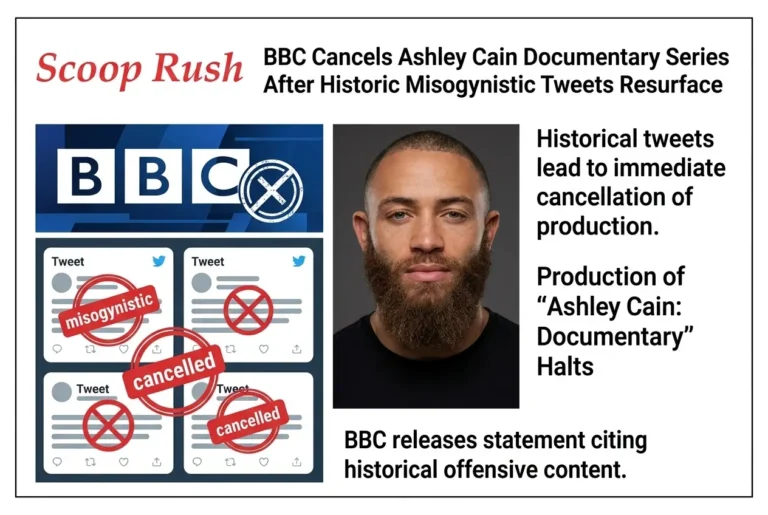
A BBC documentary series has been cancelled before reaching viewers after a wave of controversy surrounding historic social media posts. BBC Cancels Ashley Cain Series has become a major entertainment news story after the broadcaster confirmed it will not air the second season of Ashley Cain: Into the Danger Zone following an investigation into alleged misogynistic tweets.

The decision has raised questions about celebrity accountability, social media history checks, and the standards expected from people working with major broadcasters.

The BBC said it was taking the issue seriously after historic posts linked to Ashley Cain were brought to attention. The broadcaster later confirmed that the second series, which had already been filmed, would not be broadcast.

BBC Cancels Ashley Cain Series After Historic Tweets Investigation

The BBC announced that it has decided not to move forward with the second season of Ashley Cain: Into the Danger Zone after reviewing reports about old posts from Cain’s social media account.

According to reports, the posts included offensive language aimed at women, along with comments described as misogynistic and inappropriate. The comments were reportedly made several years ago and were uncovered through an investigation by The Guardian.

Following the reports, Cain’s X account was removed from the platform. The BBC said the posts did not meet the standards expected from people working with the broadcaster.

In its statement, the BBC said the posts were “completely unacceptable” and explained that it was reviewing its production and vetting procedures.

The broadcaster also confirmed that it has no future projects planned with Ashley Cain.

Why The BBC Made The Decision

The BBC explained that social media checks and background reviews are part of its production process. However, the organisation said the checks failed in this case and that it would investigate why.

The broadcaster stated that it continues to strengthen its processes to ensure everyone working for or with the BBC follows its values and standards.

The decision means that viewers will not see the already filmed second season of Ashley Cain: Into the Danger Zone. The first season remains available on BBC iPlayer.

The controversy highlights how historic online activity can affect public figures years later, especially when they are connected with major media organisations.

Ashley Cain’s Television Career Before BBC Documentary

Ashley Cain first became known through football before moving into reality television.

He played football professionally, including for Coventry City FC, before appearing on MTV’s reality show Ex on the Beach between 2014 and 2016.

Later, Cain appeared in other television programmes, including Celebrity SAS: Who Dares Wins and Celebrity MasterChef.

His BBC documentary series, Ashley Cain: Into the Danger Zone, focused on his travels to dangerous locations around the world. The programme featured interviews with young men living on the edges of society.

The series was previously praised for its connection with younger audiences and was considered part of BBC Three’s programming strategy.

The Controversy Surrounding The Resurfaced Posts

The reports about Ashley Cain focused on a number of old social media posts that allegedly contained offensive and sexist remarks.

Some of the posts reportedly used insulting terms toward women and included language that many people considered unacceptable.

Additionally, reports stated that Cain made comments involving violence toward women. The resurfaced posts led to public criticism and prompted the BBC to review the situation.

However, the BBC’s decision was based on its own standards and expectations for people involved with its content.

The broadcaster said that although the comments were from years ago, they did not reflect the standards it expects.

BBC’s Response And Future Plans

The BBC said it has no plans to broadcast the new series of Into the Danger Zone and confirmed there are no upcoming projects involving Ashley Cain.

The broadcaster also contacted production partners to review the checks completed before Cain was involved in the programme.

Meanwhile, representatives for Cain were contacted for a response regarding the allegations and the BBC’s decision.

The situation has become another example of how past social media activity can impact public figures, especially when old posts resurface in a different cultural and professional environment.

What Happens To Ashley Cain’s Documentary Series Now?

The second season of Ashley Cain: Into the Danger Zone had already been filmed before the controversy emerged.

However, the BBC has decided not to release the series. As a result, viewers will only have access to the first season through BBC iPlayer.

The decision also means Ashley Cain will no longer have planned projects with the BBC.

Ultimately, the case shows the increasing importance of digital reputation and social media checks in the entertainment industry.

Conclusion

The BBC Cancels Ashley Cain Series decision follows controversy over historic social media posts that the broadcaster described as unacceptable.

Although the comments were made years ago, the BBC decided that they did not align with its values and standards. The broadcaster has cancelled the second season of Ashley Cain: Into the Danger Zone and confirmed there are no future projects planned with Cain.

The story has renewed discussions about accountability, online behaviour, and the long-term impact of social media history on public careers.

FAQs

Why did the BBC cancel Ashley Cain’s series?

The BBC cancelled the second season of Ashley Cain: Into the Danger Zone after reviewing historic social media posts that were reported as containing misogynistic and offensive language.

Was Ashley Cain’s documentary already filmed?

Yes, the second season had already been filmed before the BBC decided not to broadcast it.

Will the first season of Ashley Cain’s documentary still be available?

Yes, the first season of Ashley Cain: Into the Danger Zone remains available on BBC iPlayer.

Did Ashley Cain respond to the controversy?

Representatives for Ashley Cain were contacted for comment, but a response was not included in the reports provided.

Does Ashley Cain have future BBC projects?

No. The BBC confirmed that it has no future projects planned with Ashley Cain.
France vs Senegal: Mbappé’s Brilliance Fires France to Winning Start

0

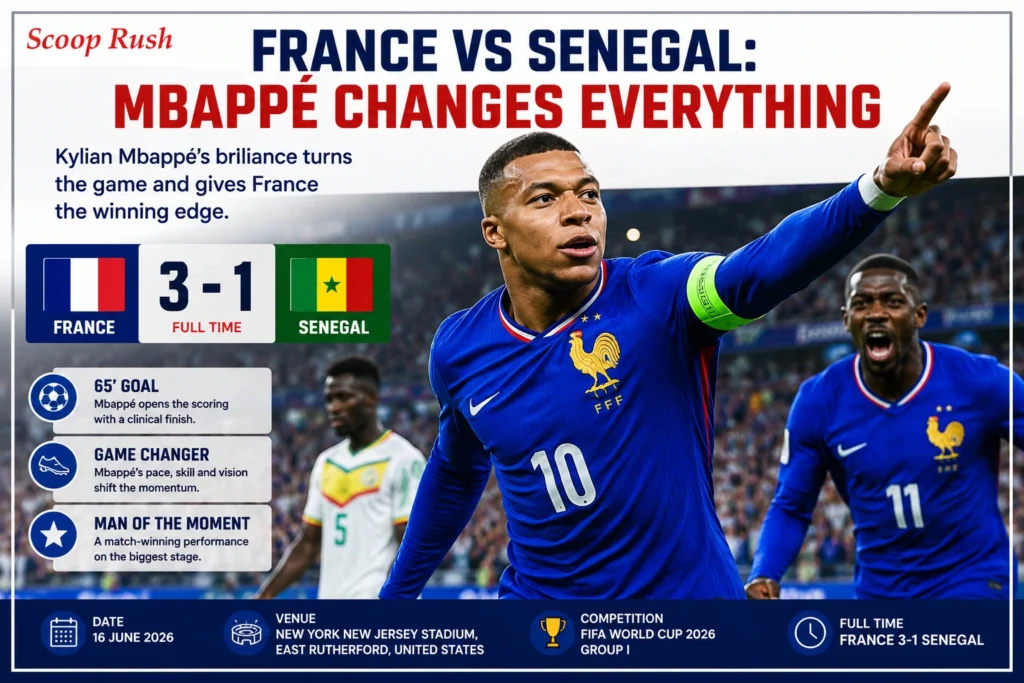
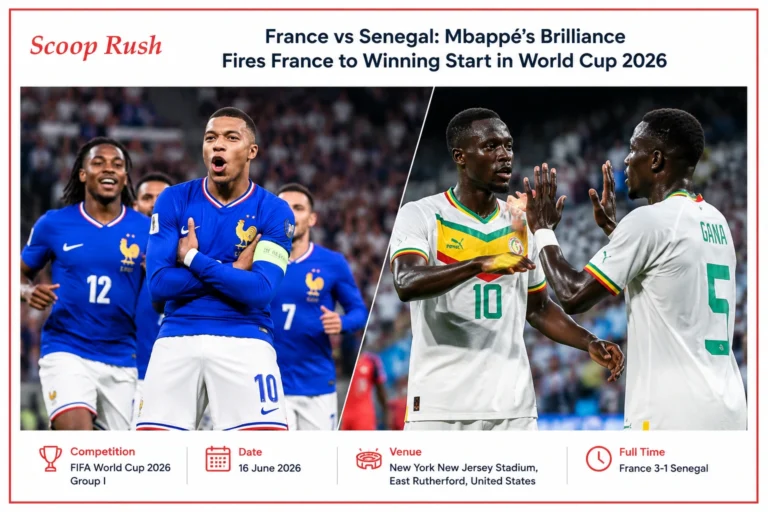
Full Time: France 3-1 Senegal
Date: 16 June 2026
Venue: New York New Jersey Stadium, East Rutherford, United States
Competition: FIFA World Cup 2026 – Group I

France opened their FIFA World Cup 2026 campaign with a hard-fought 3-1 victory over Senegal. While the final score appears comfortable, the match was far more competitive than the scoreboard suggests. Senegal challenged France for long periods before Kylian Mbappé produced a match-winning performance.

France vs Senegal Match Summary

Senegal impressed early and looked capable of causing a major upset. France struggled to settle into their usual rhythm during the first half.

However, the second half belonged to Les Bleus. Mbappé’s quality, combined with France’s squad depth, proved decisive as they secured all three points in Group I.

France vs Senegal: Senegal Threaten France Early

Senegal Start on the Front Foot

Senegal began the match with confidence and intensity. Their aggressive pressing disrupted France’s build-up play and forced several mistakes.

Jackson and Sarr Come Close

Nicolas Jackson nearly gave Senegal the lead when his effort struck the post. The African side continued creating dangerous opportunities throughout the first half.

Ismaïla Sarr also missed a golden chance before halftime. France survived the pressure and reached the break with the score level at 0-0.

France vs Senegal: Mbappé Changes Everything

France-vs-Senegal-Mbappe-Changes-Everything

After the Break France Improve

The second half brought a noticeable improvement from France. Their passing became sharper and their attacking movement looked far more dangerous.

Olise Creates, Mbappé Finishes

Michael Olise played a key role in France’s resurgence. His creativity opened spaces in Senegal’s defensive line.

The breakthrough arrived in the 65th minute. Olise delivered a perfectly weighted pass, allowing Mbappé to race through and calmly finish past the goalkeeper.

That goal completely shifted the momentum in France’s favor.

France vs Senegal: Barcola Delivers the Knockout Blow

Substitute Makes Immediate Impact

Senegal continued searching for an equalizer, but France remained clinical.

Bradley Barcola entered the match in the closing stages and quickly made his presence felt.

France Double Their Advantage

In the 81st minute, Barcola finished confidently after being set up by Adrien Rabiot.

The goal gave France a crucial two-goal cushion and placed them firmly in control of the contest.

France vs Senegal: Late Drama Lights Up Group I

France-vs-Senegal-Late-Drama-Lights-Up-Group-I

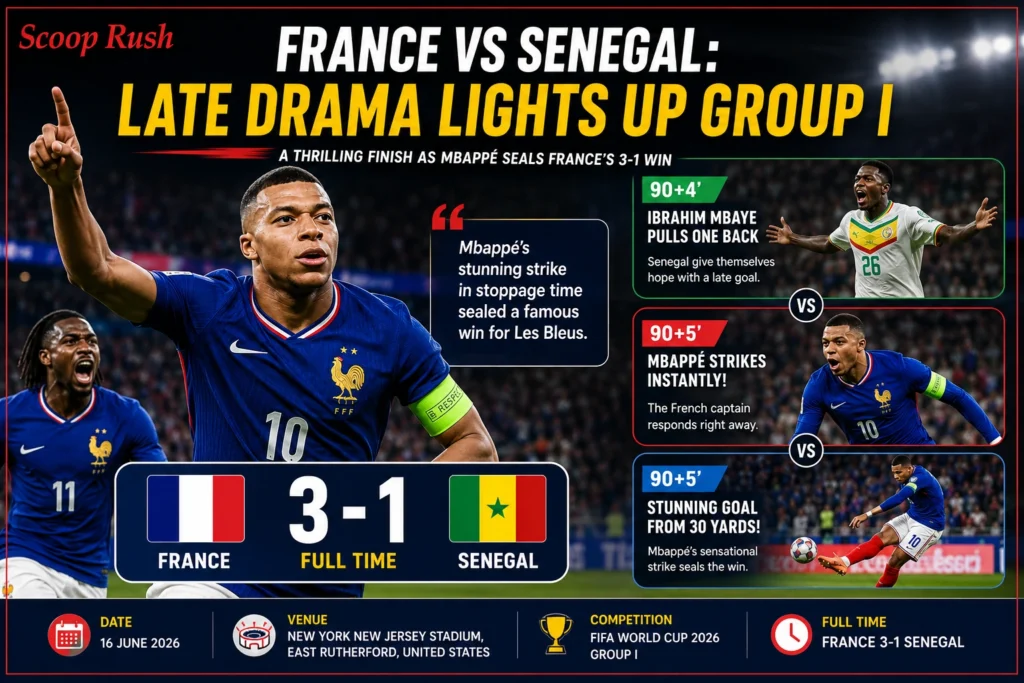
Mbaye Gives Senegal Hope

The closing minutes produced one final twist.

Ibrahim Mbaye scored in stoppage time, finding the net in the 90+4th minute to reduce the deficit to 2-1.

For a brief moment, Senegal believed they could rescue something from the match.

Mbappé Ends the Contest

Those hopes disappeared almost immediately.

Just one minute later, Mbappé unleashed a stunning strike from around 30 yards out. The spectacular effort flew into the net and sealed France’s 3-1 victory.

It was a fitting finish to a memorable performance from the French captain.

France vs Senegal: Mbappé Makes History

A Record-Breaking Night

Mbappé achieved more than just a match-winning brace.

His two goals took him to 58 international goals, moving him past Olivier Giroud as France’s all-time leading goalscorer.

Climbing the World Cup Rankings

The French superstar also reached 14 career FIFA World Cup goals, strengthening his place among the tournament’s greatest scorers.

His performance once again highlighted his ability to shine on football’s biggest stage.

What This Result Means

France Gain Early Momentum

France collect three valuable points and make a strong start to their Group I campaign.

They now turn their attention to their upcoming match against Iraq.

Encouragement for Senegal

Despite the defeat, Senegal can take positives from their performance.

Their first-half display showed they have the quality to compete with the world’s best teams and remain capable of challenging for qualification.

Conclusion

The France vs Senegal clash delivered intensity, quality, and late drama. Senegal impressed for long periods but failed to convert key opportunities.

France showed patience, experience, and clinical finishing when it mattered most. Mbappé’s brilliance ultimately proved decisive as Les Bleus launched their FIFA World Cup 2026 campaign with a valuable victory.

Austria vs Jordan Result: Austria Beat Jordan 3-1 in FIFA World Cup 2026 Group J Match                            

0

FIFA World Cup 2026™ – Group J

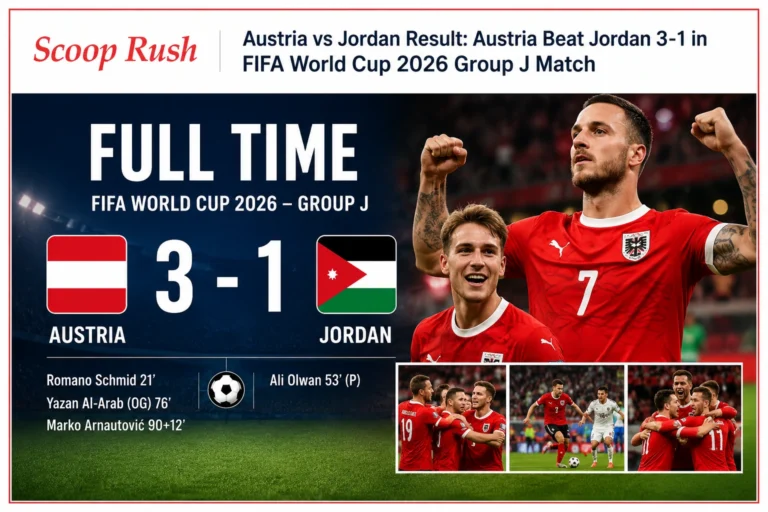
Full-Time: Austria 3-1 Jordan

Date: Wednesday, 17 June

Venue: San Francisco Bay Area Stadium, Santa Clara

Austria made a strong start to their FIFA World Cup 2026 Group J campaign with a convincing 3-1 victory over Jordan on Wednesday, 17 June, at San Francisco Bay Area Stadium in Santa Clara. The match showcased Austria’s attacking efficiency, dominance in possession, and ability to capitalize on key moments, while Jordan fought hard but ultimately could not overcome the European side’s control of the game.

The result places Austria near the top of Group J after Matchday One, while Jordan will look to recover in their upcoming fixtures. Goals from Romano Schmid, Yazan Al-Arab’s own goal, and Marko Arnautović secured all three points for Austria, while Ali Olwan scored Jordan’s lone goal from the penalty spot.

Austria Start Brightly and Take Early Control

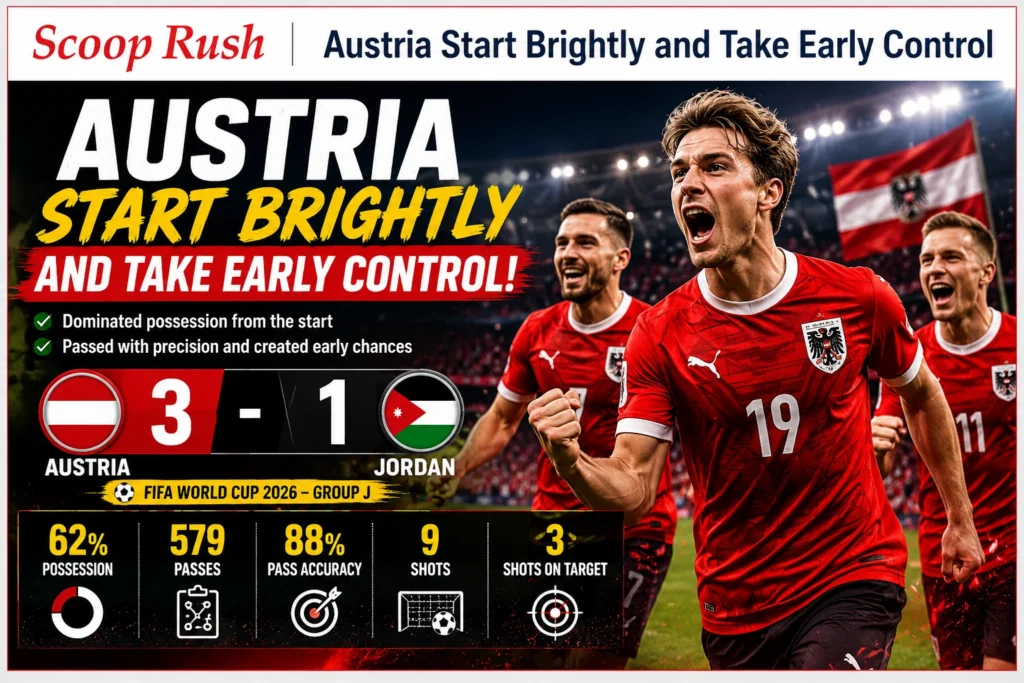
From the opening whistle, Austria looked determined to impose their style of play. Their midfield controlled possession, and their passing accuracy allowed them to dictate the tempo throughout much of the contest.

The statistics reflected Austria’s dominance. They finished with 62% possession compared to Jordan’s 38%, while also completing significantly more passes. Austria recorded 579 passes with an impressive 88% accuracy rate, compared to Jordan’s 325 passes and 77% accuracy.

Austria’s control quickly translated into opportunities. Their attackers frequently pushed forward, forcing Jordan’s defensive line to remain compact and organized. The pressure eventually paid off when Austria opened the scoring through Romano Schmid.

The early breakthrough gave Austria confidence and allowed them to continue playing on the front foot. Jordan attempted to stay disciplined and search for opportunities on the counterattack, but Austria’s organized shape made it difficult for them to create sustained pressure.

Romano Schmid Opens the Scoring

Austria’s first goal came from Romano Schmid, who found the net to give his side a deserved lead. The goal rewarded Austria’s positive start and reflected their superiority during the opening stages.

With the lead secured, Austria continued attacking rather than sitting back. Their willingness to press high and maintain possession prevented Jordan from building momentum.

The Austrian midfield remained influential throughout the first half, linking defense and attack effectively. Jordan’s players worked hard to close down space, but Austria’s movement and passing created several dangerous situations around the penalty area.

Jordan Find a Way Back Through Ali Olwan

Despite Austria’s strong start, Jordan remained competitive and eventually found a route back into the match. Their persistence earned them a penalty opportunity, which Ali Olwan converted successfully.

The penalty brought Jordan level and briefly shifted the momentum. At 1-1, the match became more balanced, and Jordan gained confidence knowing they had responded to Austria’s early advantage.

Ali Olwan’s goal highlighted Jordan’s determination and gave their supporters hope that an upset could be possible. However, Austria responded well to the setback and quickly regained control of possession.

The equalizer also demonstrated Jordan’s ability to capitalize on important moments even when they were seeing less of the ball.

A Crucial Own Goal Restores Austria’s Advantage

Austria’s pressure continued after Jordan’s equalizer, and the breakthrough arrived in unfortunate circumstances for the Asian side.

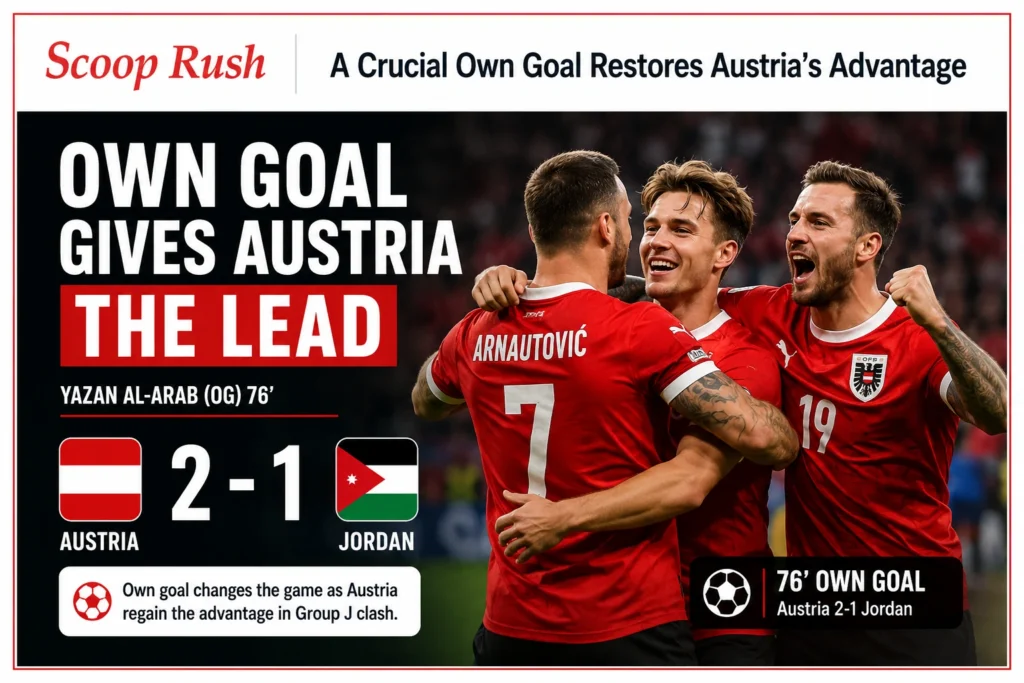
Yazan Al-Arab scored an own goal, restoring Austria’s lead and changing the complexion of the match once again. The own goal came at a critical stage and handed Austria a significant psychological boost.

With the score now 2-1, Austria returned to a position of control. Jordan attempted to respond, making changes from the bench in an effort to find another equalizer, but Austria’s defensive structure remained solid.

The Austrian back line dealt effectively with Jordan’s attacks and ensured that clear scoring opportunities remained limited.

VAR Drama and Missed Opportunity

One of the key moments of the match came when a penalty awarded to Austria was reviewed by VAR.

Initially, Austria appeared set to receive an excellent chance to extend their lead from the spot. However, following the video review, the penalty decision was overturned.

The incident added drama to the contest and temporarily kept Jordan within touching distance. Nevertheless, Austria remained composed and continued searching for a decisive third goal.

Rather than allowing frustration to affect their performance, Austria maintained their attacking focus and continued creating chances in the final third.

Marko Arnautović Seals the Victory

Austria eventually found the goal that effectively ended Jordan’s hopes of a comeback.

Veteran forward Marko Arnautović scored Austria’s third goal in the 90th minute, ensuring the match would finish 3-1. According to the match report, Arnautović struck from the left side of the box after being set up by Patrick Wimmer.

The late goal provided the perfect finish to Austria’s performance. It rewarded their persistence and confirmed a well-earned three points.

For Jordan, conceding so late was disappointing after working hard throughout the match, but Austria’s overall superiority made the result difficult to argue with.

Arnautović’s goal also highlighted the importance of experience in major tournaments, as the striker delivered when his team needed a decisive moment.

Austria’s Statistical Advantage

The final statistics underline why Austria emerged as deserved winners.

Team Statistics

StatisticAustriaJordan
Shots911
Shots on Target34
Possession62%38%
Passes579325
Pass Accuracy88%77%
Fouls126
Yellow Cards10
Red Cards00
Offsides31
Corners43

Interestingly, Jordan actually recorded more total shots and more shots on target than Austria. However, Austria proved far more clinical in front of goal and made better use of their opportunities.

Possession and passing statistics heavily favored Austria, demonstrating their ability to control the flow of the game and limit Jordan’s time on the ball.

Tactical Setup and Key Performers

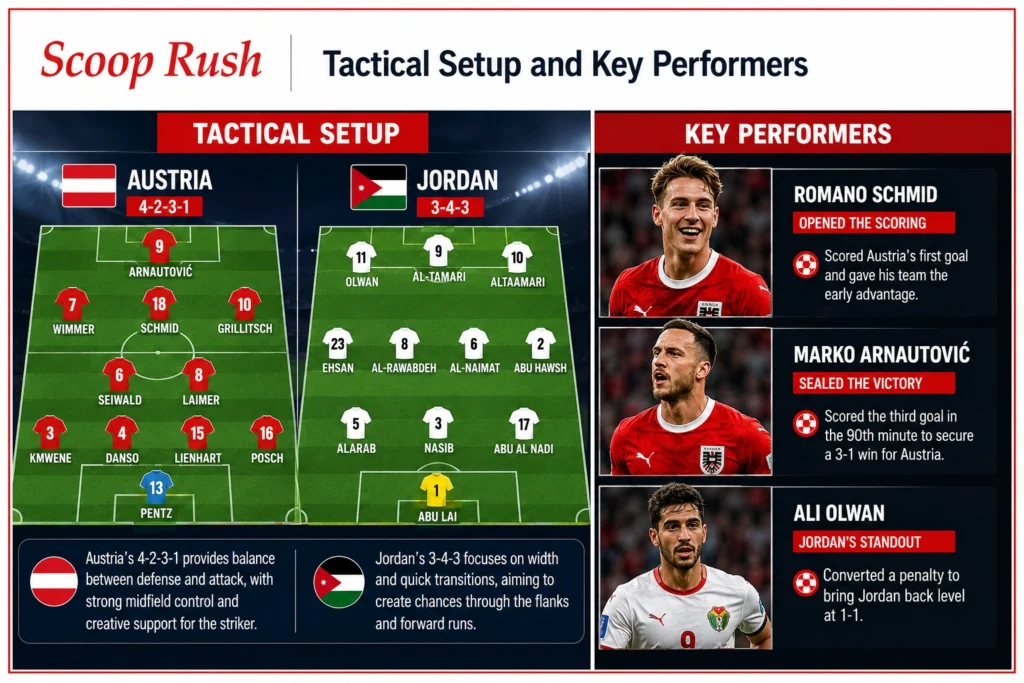
Austria lined up in a 4-2-3-1 formation, giving them balance between attack and defense. The formation allowed their midfielders to maintain possession while supporting forward movements.

Jordan used a 3-4-3 setup, aiming to provide width and create opportunities through quick transitions. While the system produced several attempts on goal, Austria’s organization limited the effectiveness of many attacks.

Several Austrian players played important roles in the victory. Romano Schmid opened the scoring, Marko Arnautović delivered the decisive late goal, and Patrick Wimmer contributed with the assist for the final strike.

Jordan’s standout moment came through Ali Olwan, whose successful penalty kept his side competitive for much of the contest.

Group J Standings After Matchday One

Following the opening round of fixtures, Group J presents an interesting early picture.

  1. Argentina – 3 points
  2. Austria – 3 points
  3. Jordan – 0 points
  4. Algeria – 0 points

Austria’s victory places them level on points with Argentina and provides an excellent foundation for the remainder of the group stage.

Jordan, meanwhile, remain within reach of qualification possibilities but will need positive results in their upcoming matches to improve their position.

What the Result Means

Austria’s 3-1 win over Jordan represents an ideal beginning to their FIFA World Cup 2026 campaign. They demonstrated composure, possession-based control, and efficiency in key moments. While Jordan showed determination and created opportunities of their own, Austria’s overall quality ultimately proved decisive.

The match featured several important moments, including Romano Schmid’s opener, Ali Olwan’s penalty equalizer, Yazan Al-Arab’s unfortunate own goal, a VAR-overturned penalty, and Marko Arnautović’s late finish.

For Austria, the victory provides momentum and confidence heading into the next round of Group J fixtures. For Jordan, there were still encouraging signs despite the defeat, particularly their ability to compete against a strong opponent and create chances.

As the FIFA World Cup 2026 group stage continues, Austria will be pleased with a professional opening performance, while Jordan will aim to learn from this result and respond strongly in the matches ahead.

Iraq vs Norway: Haaland Scores Twice as Norway Win 4-1 in World Cup 2026

0

FIFA World Cup 2026™ – Group I

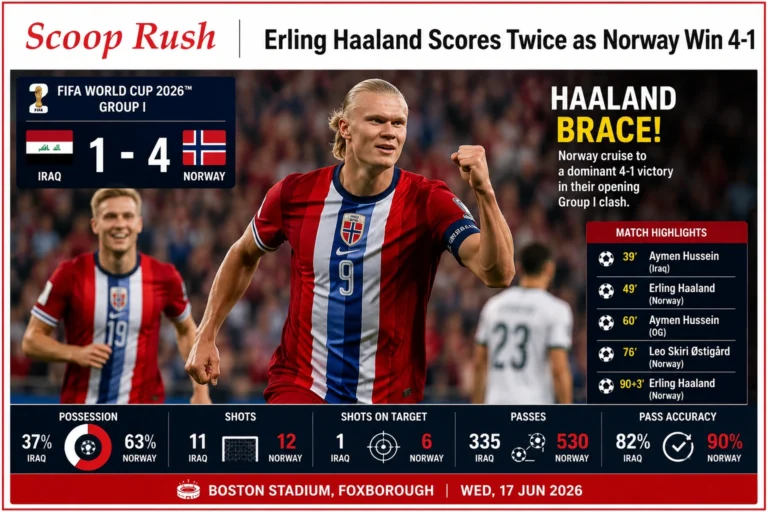
Full-Time: Iraq 1-4 Norway

Date: 17 June

Venue: Boston Stadium, Foxborough

 
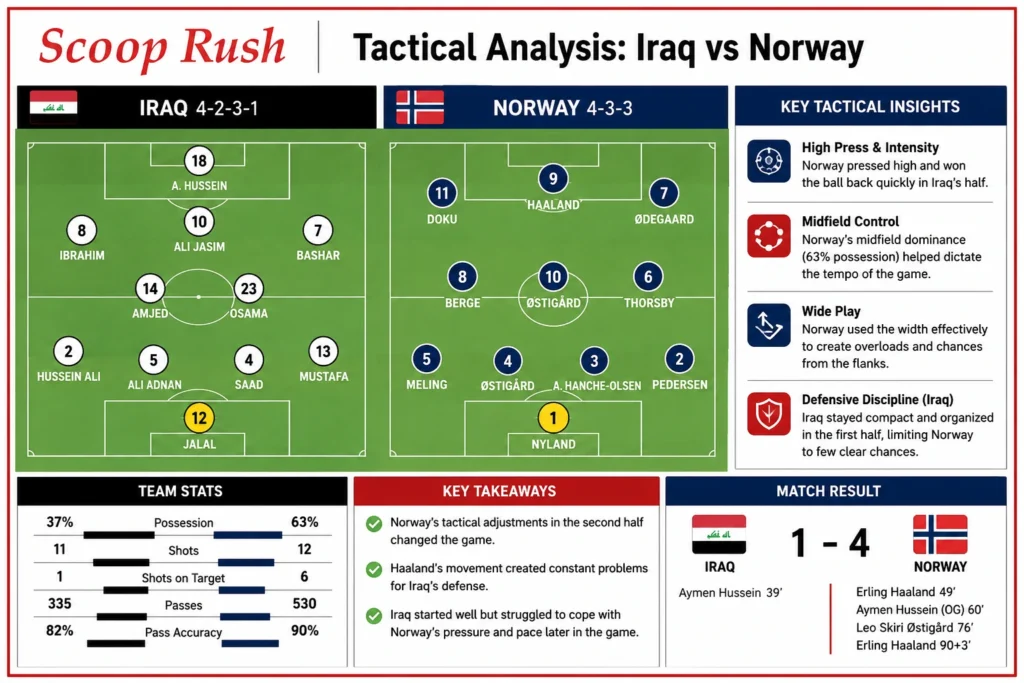
Norway made a powerful statement in their FIFA World Cup 2026 Group I opener, defeating Iraq 4-1 in an entertaining contest on June 17. Despite Iraq taking the lead and showing early promise, Norway’s quality and attacking depth proved too much over 90 minutes. Led by star striker Erling Haaland, the Scandinavian side produced a dominant second-half display to secure all three points and move to the top of Group I.

The match, played at Boston Stadium in Foxborough, delivered goals, drama, and a memorable comeback as Norway overturned a first-half deficit to begin their World Cup campaign in impressive fashion.

Iraq Start Brightly and Take an Early Lead

Iraq entered the match as underdogs but showed no signs of fear in the opening stages. Their disciplined defensive shape and quick transitions caused Norway problems during the first half.

The breakthrough arrived in the 39th minute when Aymen Hussein found the back of the net. The Iraqi striker capitalized on a well-worked attacking move and finished confidently to give his side a surprising 1-0 advantage.

The goal sparked celebrations among Iraqi supporters, who sensed the possibility of a major upset against one of Europe’s strongest teams. Iraq defended with determination after taking the lead, limiting Norway’s opportunities and frustrating their star-studded attack.

For much of the first half, Iraq appeared organized and compact, forcing Norway to rely on possession rather than creating clear-cut chances. At halftime, Iraq held a deserved lead and looked capable of protecting their advantage.

Norway Dominate Possession but Struggle for Breakthrough While Iraq enjoyed the lead, Norway controlled most of the ball throughout the match. According to the match statistics shown in the images, Norway finished with 63% possession compared to Iraq’s 37%.

Norway also completed significantly more passes, registering 530 passes with an impressive 90% pass accuracy. Iraq managed 335 passes with an 82% completion rate.

The possession dominance highlighted Norway’s patient approach. Midfielders continuously circulated the ball, searching for openings against Iraq’s compact defensive setup. However, during the first half, Iraq’s defensive organization prevented Norway from converting their territorial advantage into goals.

The difference in quality became increasingly evident as the game progressed. Norway continued to push forward, creating pressure that eventually led to the turning point of the match.

Haaland Sparks the Comeback

The momentum shifted dramatically after halftime.

Norway emerged from the break with greater urgency and intensity. Their attacking players moved the ball quicker and began finding spaces between Iraq’s defensive lines.

The equalizer arrived in the 49th minute through Erling Haaland. The prolific striker once again demonstrated why he is considered one of the world’s elite forwards. Positioned inside the penalty area, Haaland finished clinically to level the score at 1-1.

The goal transformed the atmosphere of the match.

Suddenly, Norway looked energized while Iraq appeared shaken by the loss of their lead. Norway’s confidence grew with every attack, and the pressure on Iraq’s defense intensified.

Haaland’s equalizer was a crucial moment because it shifted the psychological balance entirely in Norway’s favor. From that point onward, the Scandinavian side looked increasingly likely to take control.

Own Goal Gives Norway the Advantage

Just eleven minutes after the equalizer, Norway completed the turnaround.

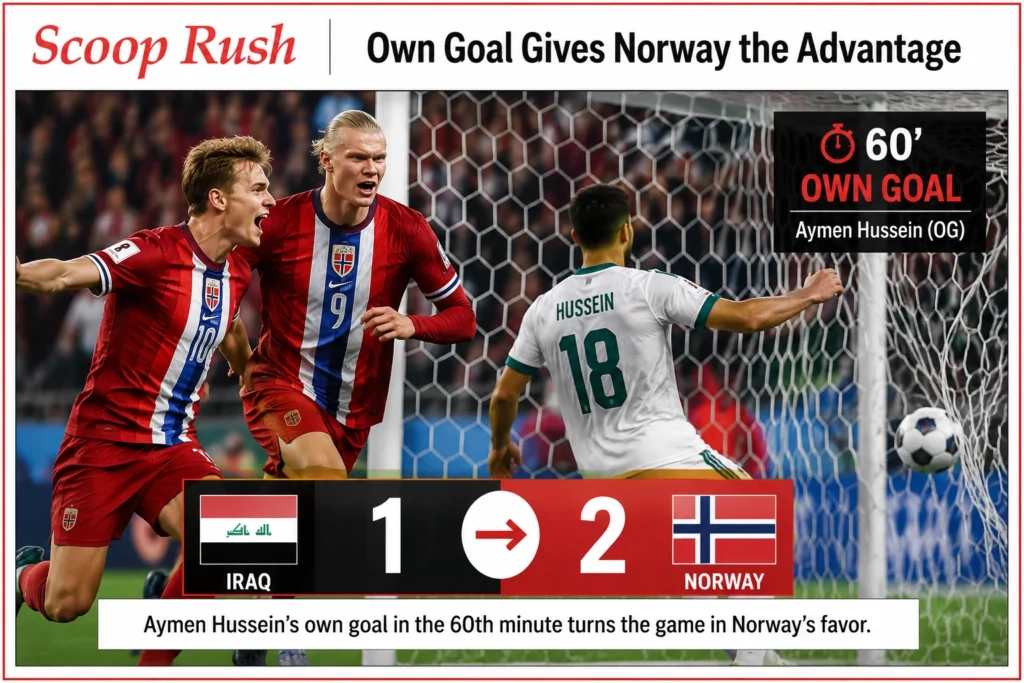
In the 60th minute, Iraq suffered a major setback when Aymen Hussein inadvertently turned the ball into his own net. The unfortunate own goal gave Norway a 2-1 lead and completely changed the complexion of the contest.

For Iraq, the moment was heartbreaking. Hussein had been the hero earlier after scoring his team’s opener, but his own goal handed Norway a lead they would never relinquish.

The own goal also highlighted Norway’s relentless pressure. Their continuous attacking play forced Iraq into difficult defensive situations, eventually leading to the costly mistake.

With the score now 2-1, Norway gained full control of the match.

Norway’s Attack Comes Alive

After taking the lead, Norway showcased the attacking quality that has made them one of Europe’s most dangerous teams.

The images reveal a formation built around attacking talent, with Haaland leading the line and receiving strong support from teammates across the midfield and forward positions.

Norway’s ability to maintain possession and move the ball efficiently wore down Iraq’s resistance. Their superior technical quality became increasingly visible as the match entered its final stages.

The statistics reflected this dominance:

  • Norway recorded 12 total shots.
  • Iraq managed 11 shots.
  • Norway produced 6 shots on target.
  • Iraq registered only 1 shot on target.

Although the overall shot totals were relatively close, Norway’s finishing quality and accuracy made the difference. Their attacks consistently tested the Iraqi goalkeeper, while Iraq struggled to create dangerous opportunities after halftime.

Late Goals Seal an Emphatic Win

As Iraq pushed forward in search of an equalizer, gaps began to appear in their defensive structure.

Norway exploited those spaces brilliantly.

In the 76th minute, Leo Skiri Østigård extended Norway’s lead to 3-1. The goal provided breathing room and effectively ended Iraq’s hopes of mounting a comeback.

The Norwegian supporters sensed victory, but their team was not finished.

Deep into stoppage time, Haaland added his second goal of the evening in the 90+3rd minute. The striker’s late finish completed a dominant second-half performance and put the final score beyond doubt.

The goal also underlined Haaland’s importance to Norway’s World Cup ambitions. His movement, finishing ability, and leadership in attack continue to make him one of the tournament’s most influential players.

By the final whistle, Norway had transformed a difficult situation into a comfortable 4-1 victory.

Tactical Analysis

Iraq’s Strong Start

Iraq’s game plan worked effectively during the first half. They defended in numbers, remained compact, and looked dangerous on the counterattack.

The opening goal rewarded their disciplined approach, and for long periods they successfully frustrated Norway’s attack.

However, maintaining that level of concentration against a team with Norway’s attacking quality proved difficult over the full 90 minutes.

Norway’s Midfield Control

Norway’s dominance in possession was a key factor.

The midfield dictated the tempo of the game, recycling possession and forcing Iraq to spend long periods defending. Over time, this constant pressure exhausted Iraq’s defensive unit.

The 90% passing accuracy demonstrated Norway’s composure and technical superiority.

Haaland’s Influence

The match changed when Haaland scored the equalizer.

Beyond his two goals, the striker occupied defenders, created space for teammates, and provided a constant threat inside the penalty area.

His performance once again highlighted why he is regarded as one of the most dangerous forwards in international football.

Group I Standings After Matchday One

The victory puts Norway at the top of Group I after the opening round of fixtures.

Current standings:

TeamPWDLGFGAGDPoints
Norway110041+33
France110031+23
Senega100113-20
Iraq100114-30

Norway’s superior goal difference gives them an early advantage at the summit of the group.

What This Result Means

For Norway, this was the perfect start to their FIFA World Cup 2026 campaign. Overcoming an early deficit demonstrated resilience, while scoring four goals showcased the team’s attacking potential.

The performance will boost confidence ahead of tougher challenges in Group I, particularly against fellow contenders France.

For Iraq, the result was disappointing after such a promising first half. They showed enough quality to suggest they can compete in the group, but defensive lapses and a lack of attacking threat after the break ultimately proved costly.

If Iraq can replicate their first-half discipline while improving their consistency over 90 minutes, they still have an opportunity to challenge for valuable points in upcoming matches.

Final Thoughts

The Iraq vs Norway result delivered one of the most entertaining matches of the opening Group I fixtures. Iraq impressed early and took a deserved lead through Aymen Hussein, but Norway responded with a dominant second-half display inspired by Erling Haaland.

Two goals from Haaland, an unfortunate own goal, and a late strike from Leo Skiri Østigård completed a convincing 4-1 victory that sent Norway to the top of Group I.

As the FIFA World Cup 2026 continues, Norway have already shown why they are considered serious contenders, while Iraq will look to regroup and bounce back in their next group-stage encounter.

Iran 2-2 New Zealand: Pulsating Draw Leaves Group G Wide Open

0

FIFA World Cup 2026, Group G
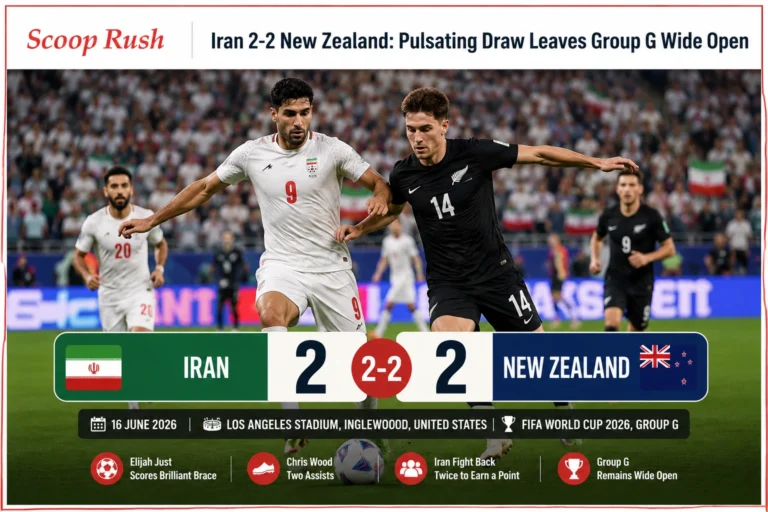
Full Time: Iran 2-2 New Zealand
Venue: Los Angeles Stadium, Inglewood, United States
Date: 16 June 2026

Iran vs New Zealand delivered one of the most entertaining matches of the FIFA World Cup 2026 group stage, with the two sides battling to a thrilling 2-2 draw in Group G. The contest featured stunning goals, dramatic momentum swings, and relentless attacking football as both teams fought hard for a valuable result.

New Zealand appeared on course for a memorable victory on two separate occasions, but Iran showed remarkable determination to recover each time and secure a point in a match that keeps Group G wide open.

New Zealand Take an Early Lead

The Kiwis made the perfect start, silencing the crowd in Inglewood with an early breakthrough in the seventh minute.

Elijah Just opened the scoring after a clever piece of hold-up play from Chris Wood, giving New Zealand an early advantage and putting Iran under immediate pressure.

Captain Chris Wood played a crucial role in the opening goal, holding off defenders before delivering an intelligent pass into the path of Elijah Just. The winger made no mistake, guiding a composed volley beyond the Iranian goalkeeper to give the Kiwis an early advantage.

Iran Grow Into the Game

Despite falling behind, Iran remained calm and gradually took control of possession. The Asian side began creating chances through sustained pressure and attacking movement down the flanks.

Their persistence was rewarded in the 32nd minute when experienced right-back Ramin Rezaeian pushed forward and finished from close range to bring Iran level. The equalizer reflected Iran’s growing dominance and ensured the teams went into halftime tied at 1-1.

Elijah Just Restores New Zealand’s Advantage

Elijah-Just-Restores-New-Zealands-Advantage

The second half continued at a high tempo, with both teams searching for a decisive edge.

Just Completes His Brace

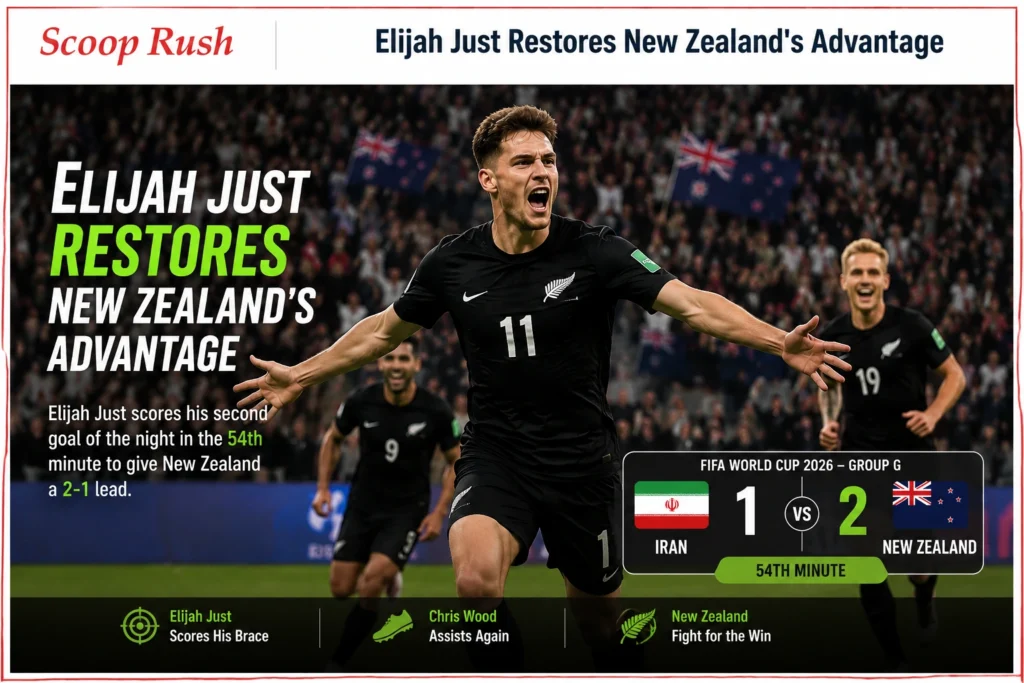
New Zealand regained the lead in the 54th minute thanks to another excellent move involving Chris Wood and Elijah Just.

Wood once again provided the final pass, setting up Just for his second goal of the evening. The forward finished confidently to put New Zealand back in front and complete a standout individual performance.

Mohammad Mohebbi Rescues Iran

Iran responded positively after conceding and increased the pressure on the New Zealand defense.

Iran Fight Back Again

The equalizer arrived in the 64th minute when Mohammad Mohebbi rose highest inside the penalty area to power a header off the post and into the net.

The goal energized Iran and set up a tense final half-hour. Both teams pushed for a winner, creating several dangerous moments, but neither side could find the breakthrough needed to claim all three points.

Key Moments from Iran vs New Zealand

Elijah Just Shines for New Zealand

The winger delivered one of the best performances of the match, scoring both of New Zealand’s goals and constantly threatening Iran’s defense.

Chris Wood Provides Two Assists

The veteran striker played a vital creative role, setting up both goals and leading New Zealand’s attack with intelligence and experience.

Iran Show Their Resilience

Iran twice came from behind to earn a point, demonstrating strong character and determination under pressure.

Group G Remains Wide Open

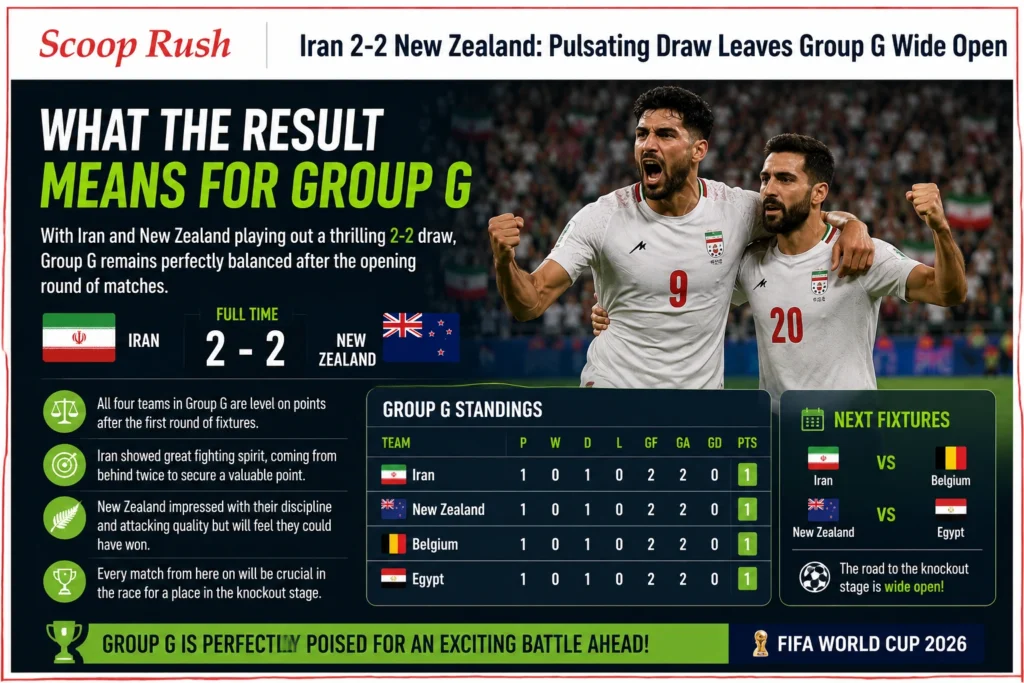
The draw keeps all four Group G teams in contention after the opening round. 

What the Result Means for Group G

What the Result Means for Group G

The result leaves both nations with plenty to play for in the battle to reach the knockout stage. With Belgium and Egypt also sharing the points in the other Group G fixture, all four teams sit level after the first round of matches. The group remains perfectly balanced, setting up an intriguing race for qualification.

Iran will take encouragement from their attacking threat and ability to respond under pressure, although they may feel they missed opportunities to secure victory. New Zealand, meanwhile, can be proud of their disciplined performance but may be frustrated after surrendering the lead twice.

Match Summary

Result

Iran 2-2 New Zealand

Goalscorers

  • New Zealand: Elijah Just (7′, 54′)
  • Iran: Ramin Rezaeian (32′), Mohammad Mohebbi (64′)

Assists

  • New Zealand: Chris Wood (2)

The 2-2 draw between Iran and New Zealand was a perfect example of the excitement and unpredictability that make the FIFA World Cup special. With both teams displaying attacking quality and fighting spirit, Group G remains one of the most competitive groups in the tournament.

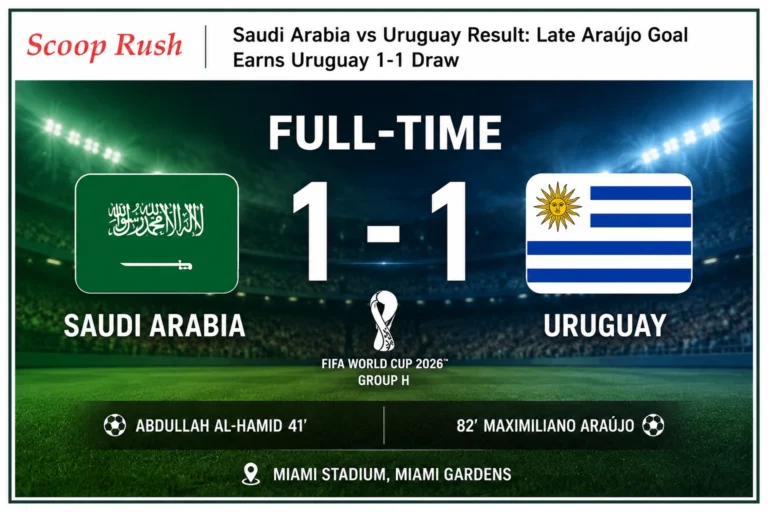
Saudi Arabia vs Uruguay Result: Late Araújo Goal Earns Uruguay 1-1 Draw

0

FIFA World Cup 2026™ – Group H

Full-Time: Saudi Arabia1-1Uruguay                                                                   Date: 16,June                                                                                                          Venue: Miami Stadium, Miami Gardens

The Saudi Arabia vs Uruguay result delivered one of the most competitive matches of the opening round in FIFA World Cup 2026 Group H, as the two sides played out an entertaining 1-1 draw at Miami Stadium, Miami Gardens. Saudi Arabia showed resilience and tactical discipline to earn a valuable point against a Uruguay side that dominated possession and created more chances throughout the contest.

Goals from Abdullah Al-Hamid (41′) and Maximiliano Araújo (82′) ensured the points were shared, leaving Group H finely balanced after Matchday One.

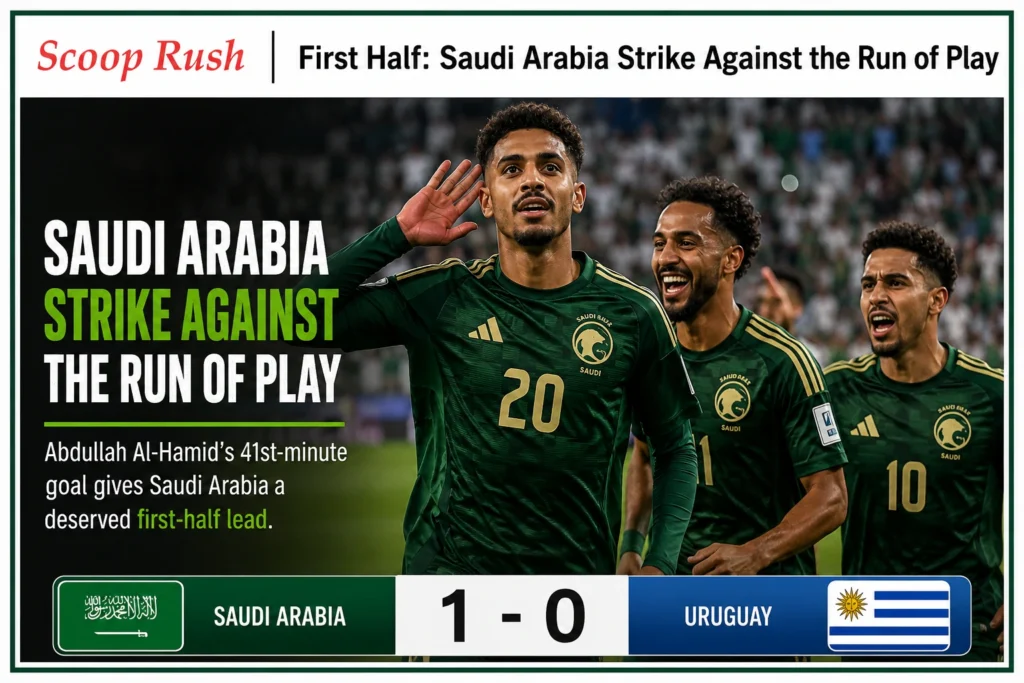
First Half: Saudi Arabia Strike Against the Run of Play

Uruguay entered the match as favorites and immediately took control of possession. The South American side circulated the ball confidently, using their midfield to dictate tempo and push Saudi Arabia deep into their own half.

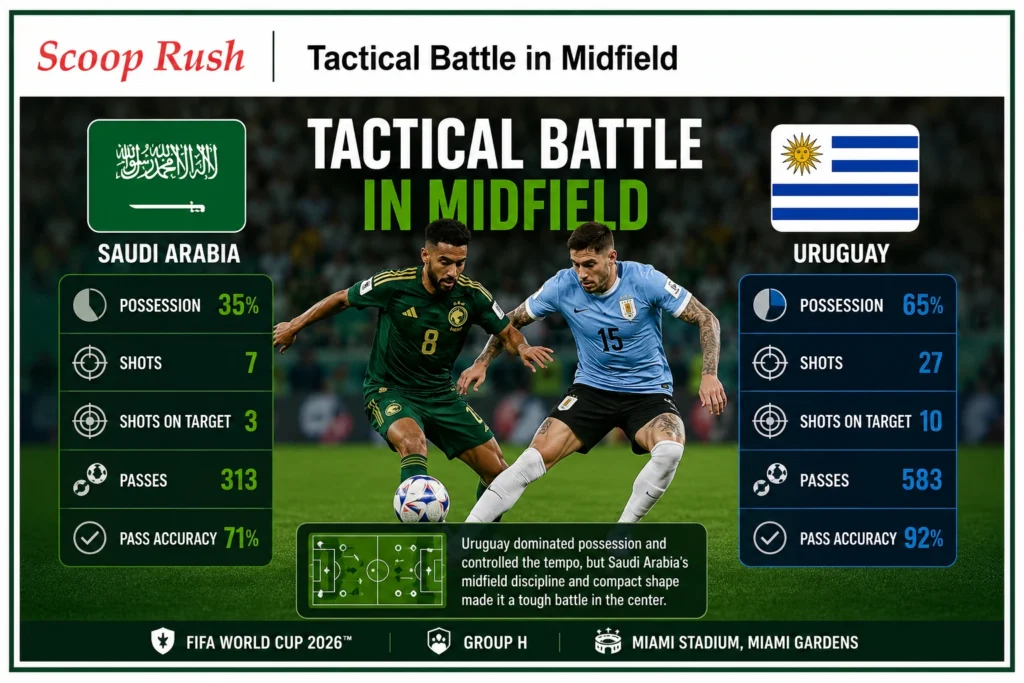
Statistics from the match underline Uruguay’s dominance with 65% possession compared to Saudi Arabia’s 35%. Uruguay also completed 583 passes with an impressive 92% pass accuracy, while Saudi Arabia managed 313 passes at 71% accuracy.

However, possession alone did not guarantee clear opportunities. Saudi Arabia defended in a compact shape and looked to exploit transitions whenever possible.

The Green Falcons lined up in a 4-2-3-1 formation, with Ali Majrashi leading the attack. Behind him, Saudi Arabia relied on quick movement from the attacking midfield trio and disciplined defensive work from the entire team.

Uruguay also adopted a 4-2-3-1 system, with Brian Rodríguez operating as the central attacking threat. The South Americans sought to stretch Saudi Arabia through wide areas while maintaining pressure in midfield.

As the first half progressed, Saudi Arabia grew in confidence. Their defensive organization frustrated Uruguay, forcing many attacks into less dangerous areas.

The breakthrough arrived in the 41st minute.

A well-worked Saudi attack caught Uruguay off balance, and Abdullah Al-Hamid found the net to give the Green Falcons a surprising 1-0 lead. The goal rewarded Saudi Arabia’s disciplined approach and sent their supporters into celebration.

At halftime, Saudi Arabia held a narrow advantage despite spending much of the opening period without the ball.

Tactical Battle in Midfield

One of the defining features of the Saudi Arabia vs Uruguay result was the contrast in playing styles.

Uruguay focused heavily on ball retention and territorial dominance. Their midfield dictated possession, moving the ball patiently while searching for openings in Saudi Arabia’s defensive structure.

Saudi Arabia, meanwhile, accepted periods without possession and concentrated on maintaining defensive shape. Rather than pressing aggressively, they remained compact and attempted to break forward quickly whenever opportunities emerged.

The statistics reveal how differently the teams approached the game:

StatSaudi ArabiaUruguay
Shots727
Shots on Target310
Possession35%65%
Passes313583
Pass Accuracy71%92%
Fouls116
Corners414
Offsides06

Uruguay’s advantage in shots and corners demonstrates the pressure they applied for long stretches. However, Saudi Arabia’s ability to stay organized prevented many of those opportunities from becoming goals.

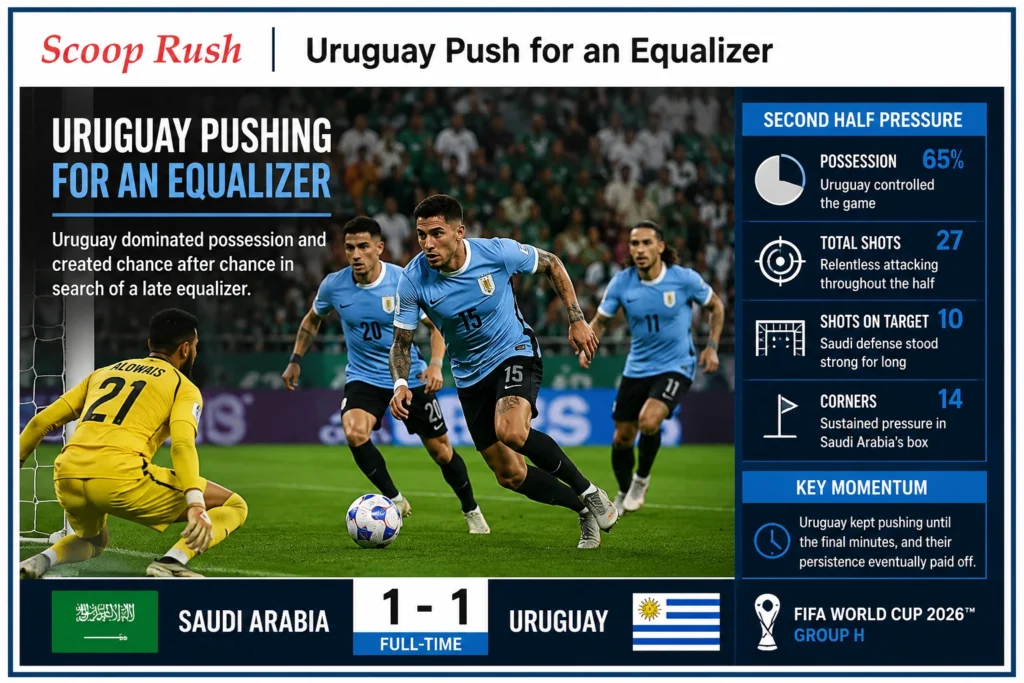
Uruguay Push for an Equalizer

Trailing at halftime, Uruguay increased their attacking intensity after the break.

The South Americans created a series of chances, testing Saudi Arabia’s defensive line repeatedly. Their wide players delivered dangerous balls into the penalty area, while midfield runners attempted to exploit spaces between defenders.

Saudi Arabia’s back line responded superbly, blocking shots and limiting clear-cut opportunities.

The Saudi goalkeeper also played a crucial role, making important interventions as Uruguay’s pressure continued to build.

As the second half wore on, Uruguay became increasingly aggressive in attack. Their 14 corner kicks reflected the sustained pressure they generated around the Saudi penalty area.

Still, Saudi Arabia remained difficult to break down.

Substitutions Influence the Match

Both managers turned to their benches in search of fresh energy during the closing stages.

Saudi Arabia introduced several substitutes to strengthen defensive areas and preserve their lead.

Among the notable changes:

  • Abdullah Al-Hamdan replaced Moaz Ali-Harbi.
  • Ali Lajami came on for Saud Abdulhamid.
  • Additional midfield and defensive adjustments followed as Saudi Arabia attempted to protect their advantage.

Uruguay also made attacking substitutions in pursuit of an equalizer.

The fresh legs helped increase the tempo of their attacks and allowed them to sustain pressure against a tiring Saudi defense.

The substitutions ultimately played a major role in shaping the final outcome.

Maximiliano Araújo Rescues Uruguay

After wave upon wave of attacks, Uruguay finally found the breakthrough in the 82nd minute.

Maximiliano Araújo produced the crucial moment, scoring the equalizer that Uruguay had been searching for throughout the second half.

The goal was a deserved reward for Uruguay’s persistence. Having registered 27 shots and 10 efforts on target, they continued attacking despite Saudi Arabia’s determined resistance.

Araújo’s strike changed the mood of the contest instantly.

Saudi Arabia, who had been protecting their lead for over forty minutes, suddenly found themselves under renewed pressure as Uruguay pushed for a winning goal.

The final minutes were tense and dramatic, with both teams looking for one decisive opportunity.

However, neither side could find a breakthrough.

The referee eventually brought an end to a highly competitive encounter.

Standout Performers

Abdullah Al-Hamid (Saudi Arabia)

Al-Hamid delivered one of the defining moments of the match by opening the scoring in the 41st minute. His goal rewarded Saudi Arabia’s disciplined first-half display and nearly secured a famous victory.

Maximiliano Araújo (Uruguay)

Uruguay’s hero on the night was Araújo. His late strike rescued a point and prevented a frustrating defeat for the South American side.

Saudi Arabia Defense

Although Uruguay recorded 27 shots, Saudi Arabia’s defenders remained organized throughout the match. Their compact shape and determination kept the Green Falcons competitive against sustained pressure.

Uruguay Midfield

Uruguay controlled possession for most of the game and consistently moved the ball with precision. Their 92% passing accuracy highlighted their technical quality and dominance in midfield.

Group H Standings After Matchday One

Following the draw, Group H remains wide open.

PositionTeamPoints
1Uruguay1
2Saudi Arabia1
3Spain1
4Cabo Verde1

With all four teams earning a point from their opening matches, the battle for qualification remains completely balanced heading into Matchday Two.

Every upcoming fixture in Group H could have a major impact on the final standings.

What This Result Means

The Saudi Arabia vs Uruguay result will be viewed differently by each side.For Saudi Arabia, the draw represents an encouraging start. Taking a point against one of the strongest teams in the group demonstrates that the Green Falcons can compete at this level. Their defensive organization and tactical discipline were particularly impressive.

For Uruguay, there will be mixed emotions. While they avoided defeat thanks to Araújo’s late goal, they may feel disappointed after dominating possession, shots, and territorial control for much of the match.

Nevertheless, securing a point ensures Uruguay remain firmly in contention for progression from Group H.


Conclusion

The Saudi Arabia vs Uruguay result ended in a hard-fought 1-1 draw, providing one of the most intriguing contests of the opening round in Group H. Saudi Arabia impressed with their defensive resilience and took the lead through Abdullah Al-Hamid before Uruguay responded late via Maximiliano Araújo.

While Uruguay controlled possession and created significantly more opportunities, Saudi Arabia showed tremendous determination to earn a valuable point. With all four teams level after Matchday One, Group H promises to be one of the most competitive groups of the FIFA World Cup 2026.

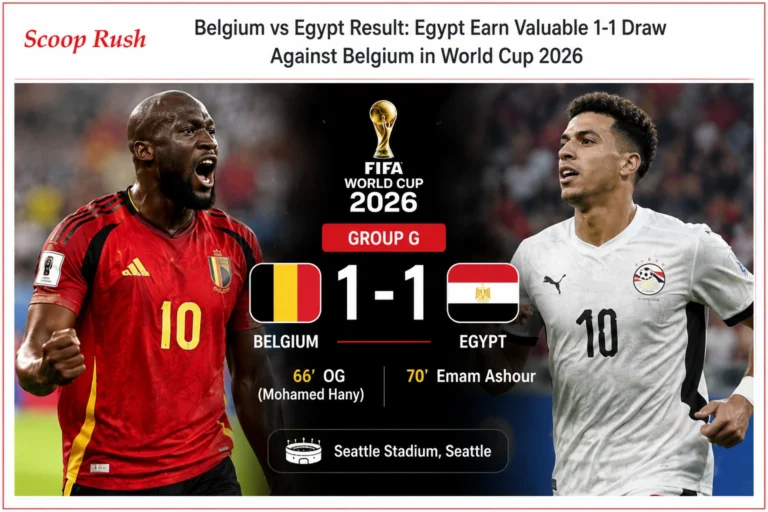
Belgium vs Egypt Result: Egypt Earn Valuable 1-1 Draw Against Belgium in World Cup 2026 

0

FIFA World Cup 2026™ – Group G

Full-Time: Belgium 1-1 Egypt

Date: 16,June

Venue: Seattle Stadium, Seattle

The Belgium vs Egypt result ended in a hard-fought 1-1 draw as both teams shared the points in an entertaining FIFA World Cup 2026 Group G encounter on June 16. Belgium enjoyed more possession and controlled large parts of the match, but Egypt showed resilience and capitalized on their opportunities to secure a valuable point.

Played at Seattle Stadium in Seattle, the match featured contrasting styles. Belgium attempted to dominate through possession and passing, while Egypt relied on defensive organization and quick attacking transitions. In the end, neither side could find a winning goal, leaving Group G finely balanced after the opening round of fixtures.

Belgium and Egypt Start Group G Campaigns with a Point

Heading into the tournament, Belgium were viewed as one of the favorites to advance from Group G. With a squad packed with experience and technical quality, the Red Devils entered the match expecting to claim all three points.

Egypt, however, arrived with a clear tactical plan. Their objective was to remain compact defensively, frustrate Belgium’s attacking players, and exploit spaces on the counterattack. The strategy worked effectively for long periods and ultimately earned the Pharaohs a deserved draw.

The result leaves both nations with one point after Matchday One, alongside the other teams in Group G. With qualification still wide open, every point could prove crucial in determining who advances to the knockout stages.

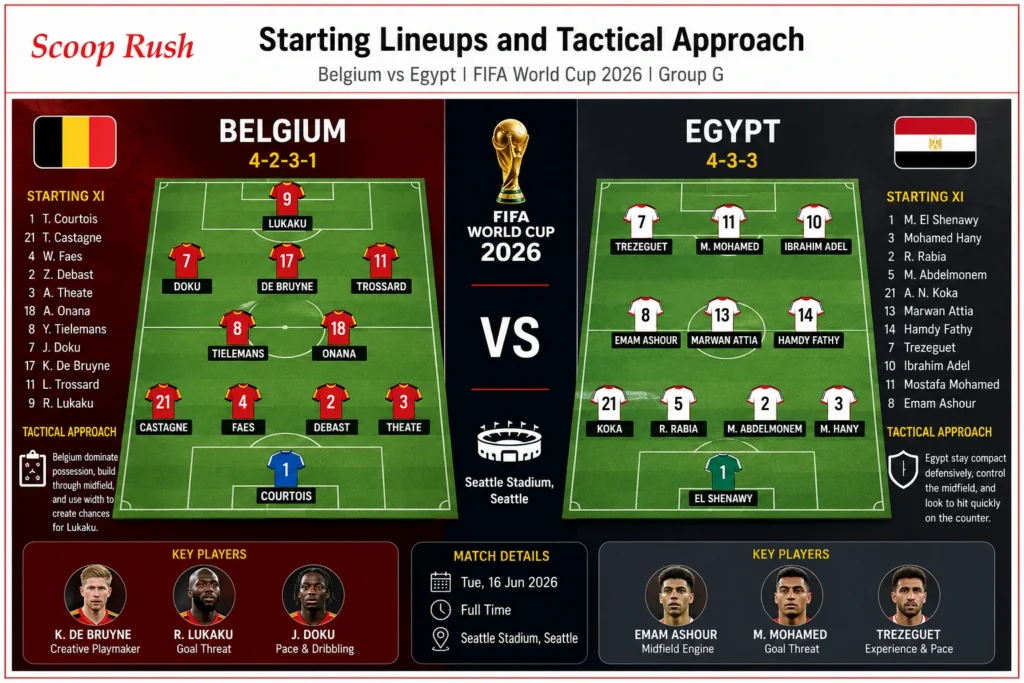
Starting Lineups and Tactical Approach

Belgium lined up in a 4-2-3-1 formation designed to maximize possession and attacking creativity.

Belgium Starting XI

  • Thibaut Courtois
  • Timothy Castagne
  • Wout Faes
  • Zeno Debast
  • Arthur Theate
  • Amadou Onana
  • Youri Tielemans
  • Jérémy Doku
  • Kevin De Bruyne
  • Leandro Trossard
  • Romelu Lukaku

The Belgian side focused on building attacks through midfield, with Kevin De Bruyne operating as the creative hub behind Romelu Lukaku. Wide players attempted to stretch Egypt’s defense and create crossing opportunities.

Egypt Starting XI

  • Mohamed El Shenawy
  • Mohamed Hany
  • Rami Rabia
  • Mohamed Abdelmonem
  • Ahmed Nabil Koka
  • Marwan Attia
  • Hamdy Fathy
  • Mahmoud Trezeguet
  • Ibrahim Adel
  • Mostafa Mohamed
  • Emam Ashour

Egypt employed a 4-3-3 shape that frequently became more defensive when Belgium had possession. The midfield trio worked tirelessly to close spaces, while the front line remained ready to launch rapid counterattacks.

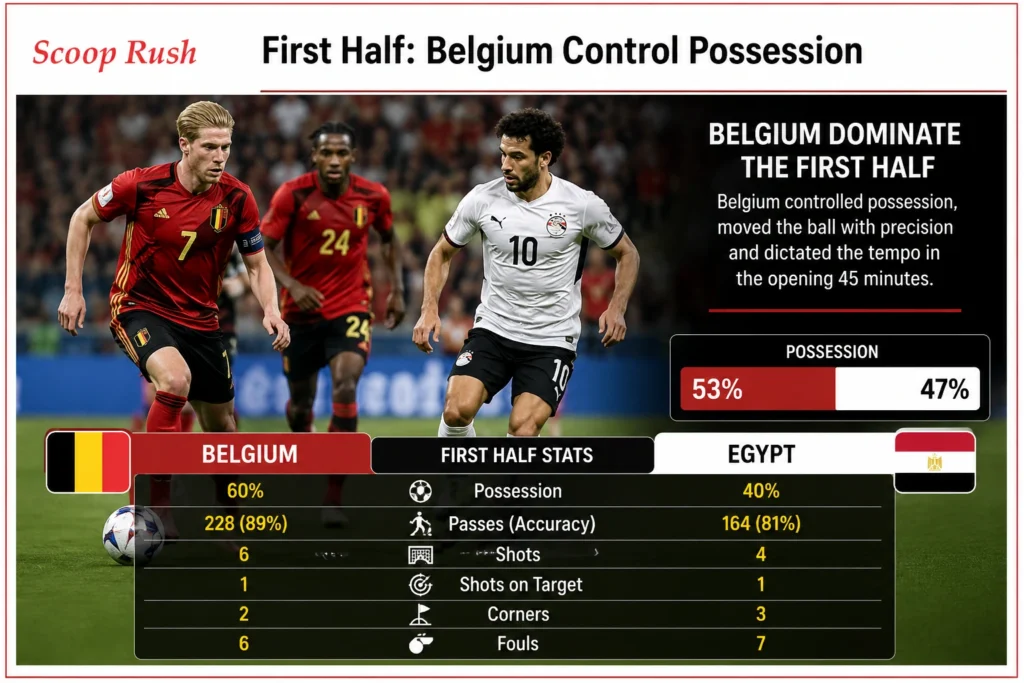
First Half: Belgium Control Possession

The opening stages followed a predictable pattern. Belgium controlled the ball and attempted to dictate the tempo through short passing sequences. Their midfield circulated possession effectively, forcing Egypt to spend long periods defending deep inside their own half.

Statistically, Belgium finished the match with 53% possession, completing 445 passes at an impressive 88% accuracy rate. Egypt recorded 47% possession, 367 passes, and 82% pass accuracy.

Despite Belgium’s territorial advantage, Egypt defended with discipline. The back four remained compact, while the midfield shielded dangerous central areas.

Belgium managed several promising attacks but struggled to create clear-cut opportunities. Egypt’s defenders blocked passing lanes into Lukaku and limited the space available for De Bruyne to operate.

The match remained competitive and balanced despite Belgium’s greater control of possession.

Belgium Strike First Through an Own Goal

Belgium eventually found a breakthrough, although it arrived in unusual circumstances.

The opening goal was officially recorded as an own goal by Mohamed Hany in the 66th minute. Belgium had increased the pressure around Egypt’s penalty area, and a dangerous attacking move ultimately resulted in the unfortunate deflection that gave the Red Devils a 1-0 lead.

At that stage, Belgium appeared to be in a strong position. Their dominance of possession suggested they might push for a second goal and secure all three points.

The Belgian players celebrated enthusiastically, believing the breakthrough might finally unlock Egypt’s stubborn defense.

Egypt Respond with Determination

Instead of collapsing after conceding, Egypt responded impressively.

The Pharaohs became more adventurous in possession and started committing additional players forward. Their attacking intent was rewarded just four minutes later.

In the 70th minute, Emam Ashour scored the equalizer for Egypt, bringing his side level at 1-1.

The goal transformed the atmosphere of the match. Egypt’s confidence grew significantly, while Belgium suddenly faced pressure to regain control.

Ashour’s strike highlighted Egypt’s ability to transition quickly from defense to attack. It was exactly the type of moment their tactical setup had been designed to create throughout the contest.

Statistical Comparison

The match statistics reveal how closely contested the encounter was.

Team Statistics

CategoryBelgiumEgypt
Shots1514
Shots on Target34
Possession53%47%
Passes445367
Pass Accuracy88%82%
Fouls1515
Yellow Cards22
Red Cards00
Offsides01
Corners27

Although Belgium had slightly more possession and passing accuracy, Egypt actually recorded more shots on target (4 to 3) and won significantly more corners (7 to 2).

These numbers underline Egypt’s effectiveness whenever they advanced into attacking areas.

Key Substitutions Influence the Match

Both managers used their benches in an effort to gain a decisive advantage during the final stages.

Egypt introduced fresh attacking options, including:

  • Ibrahim Adel replacing Hamdy Fathy
  • Karim Hafez replacing Ahmed Fattouh

These changes provided additional energy and helped Egypt maintain their attacking threat after scoring the equalizer.

Belgium also turned to experienced players from the bench, including:

  • Maxim De Cuyper
  • Hans Vanaken
  • Nicolas Raskin
  • Alexis Saelemaekers

The substitutions increased the intensity of the match, but neither team could find a winning goal.

End-to-End Action in the Closing Stages

The final twenty minutes produced some of the most exciting moments of the game.

Belgium pushed forward searching for a late winner. De Bruyne continued to orchestrate attacks, while Lukaku battled tirelessly against Egypt’s central defenders.

Egypt remained dangerous on the counterattack and looked capable of snatching a surprise victory. Several promising attacks forced Belgium’s defense to stay alert until the final whistle.

The match became increasingly open as both sides chased three points. However, strong defensive work and a lack of clinical finishing prevented either team from breaking the deadlock.

When the referee blew for full time, the score remained 1-1.

Group G Standings After Matchday One

Following the draw, the Group G table remained extremely tight:

PositionTeamPoints
1New Zealand1
2Iran1
3Belgium1
4Egypt1

With every team level on points after the opening round, the group remains completely open heading into Matchday Two.

What the Result Means

For Belgium, the draw will feel like a missed opportunity. The Red Devils controlled possession and enjoyed long spells of dominance but failed to convert that superiority into a victory. Their attacking players showed flashes of quality, yet they lacked the clinical edge needed to secure all three points.

For Egypt, the result represents a significant achievement. Holding one of the group’s strongest teams demonstrates their competitiveness and gives them confidence for the matches ahead. The disciplined defensive display and quick response after conceding highlight the team’s resilience.

Final Thoughts

The Belgium vs Egypt result delivered one of the most competitive matches of the opening round in FIFA World Cup 2026 Group G. Belgium dominated possession and took the lead through a Mohamed Hany own goal, but Egypt refused to surrender and responded through Emam Ashour to earn a deserved 1-1 draw.

The statistics reflected the balance of the contest, with Belgium enjoying more of the ball while Egypt created enough chances to justify their equalizer. As Group G moves into its next round of fixtures, both teams remain firmly in contention for qualification.

For Belgium, improvement in front of goal will be essential. For Egypt, this performance provides a strong foundation and proof that they can compete with the group’s biggest names. The Belgium vs Egypt result may ultimately prove to be one of the defining outcomes in a tightly contested race for a place in the knockout stages.

Live Precious Metals Widget – Real-Time Gold, Silver, Platinum & Palladium Prices

0

Live Precious Metals

Spot prices · Gold, Silver, Platinum & Palladium

Live
Showing sample data. The live feed (your site’s price proxy) is not reachable right now. Check that pmx-metals-proxy.php is installed.
MetalLastBidAsk Change%LowHigh
Estimated value
$0

Based on the latest spot price.

Updated — · next refresh in — Indicative spot prices for information only, not investment advice. Markets close on weekends & holidays.

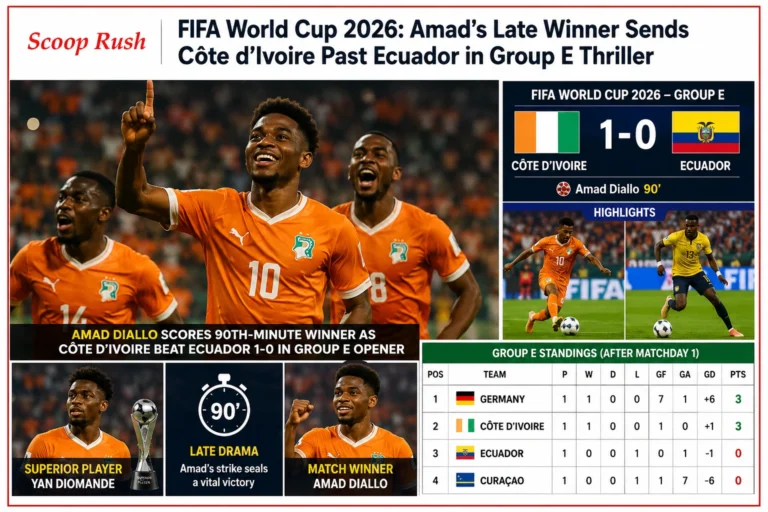
FIFA World Cup 2026: Amad’s Late Winner Sends Côte d’Ivoire Past Ecuador in Group E Thriller

0

FIFA World Cup 2026 – Group E
Full Time:
Côte d’Ivoire 1-0 Ecuador
Venue: Philadelphia, United States
Date: June 15, 2026

A dramatic late goal from substitute Amad Diallo gave Côte d’Ivoire a hard-fought 1-0 victory over Ecuador in their opening FIFA World Cup 2026 Group E match in Philadelphia.

In a contest packed with attacking intent, near misses, and four strikes against the woodwork, the game appeared destined to finish goalless before Amad produced a moment of quality in the 90th minute. The Manchester United winger calmly guided his shot into the bottom corner, sparking celebrations among the Ivorian players and supporters.

The victory moves Côte d’Ivoire level on points with Germany at the top of Group E, while Ecuador are left searching for points in their remaining group fixtures.

Amad Delivers When It Matters Most

For much of the evening, both teams struggled to find a breakthrough despite creating several excellent opportunities.

With time running out and the match heading toward a draw, Côte d’Ivoire launched one final attack. After a powerful run and delivery from Wilfried Singo, Amad Diallo found space on the edge of the box and clinically steered his effort inside the post.

The late winner capped an impressive second-half display from Les Éléphants, who gradually gained control of possession and pushed Ecuador deeper into their own half.

Ecuador Hit the Woodwork Repeatedly

Ecuador will feel unfortunate not to have taken something from the match after creating several dangerous chances.

John Yeboah came closest in the first half when his powerful long-range strike crashed against the crossbar. Shortly afterward, Alan Minda also struck the woodwork after being played through by Pedro Vite.

Veteran forward Enner Valencia nearly opened the scoring early in the second half, but his effort from a tight angle struck the outside of the post.

Despite those opportunities, Ecuador could not convert their chances and were ultimately punished by Amad’s late intervention.

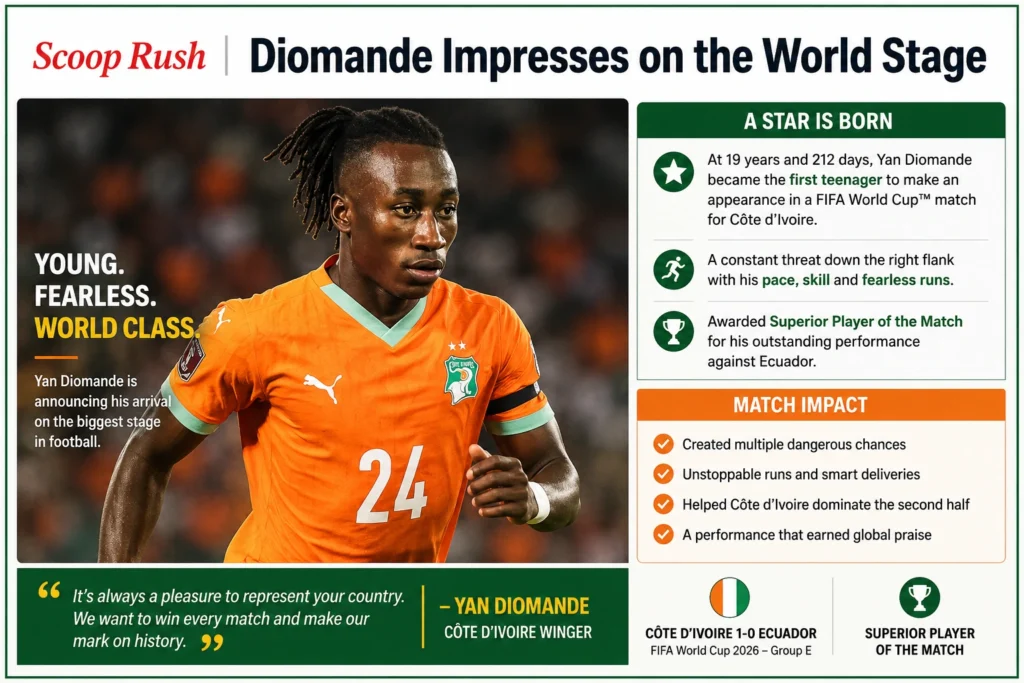
Diomande Impresses on the World Stage

Diomande-Impresses-on-the-World-Stage

One of the standout performers was Yan Diomande, who consistently troubled Ecuador’s defense with his pace and direct running down the right flank.

The 19-year-old winger created multiple dangerous situations and helped drive Côte d’Ivoire forward throughout the match. His energetic display earned him the Superior Player of the Match award.

Diomande also made history by becoming the first teenager to appear in a FIFA World Cup match for Côte d’Ivoire.

Côte d’Ivoire Grow Stronger After the Break

While Ecuador arguably created the better openings during the first half, Côte d’Ivoire looked increasingly confident after the interval.

Elye Wahi nearly scored when his first-time strike rattled the crossbar, while Diomande continued to stretch Ecuador’s defense with several dangerous runs into the penalty area.

The Ivorians gradually established control in midfield, maintained pressure, and were rewarded for their persistence with Amad’s decisive goal in stoppage time.

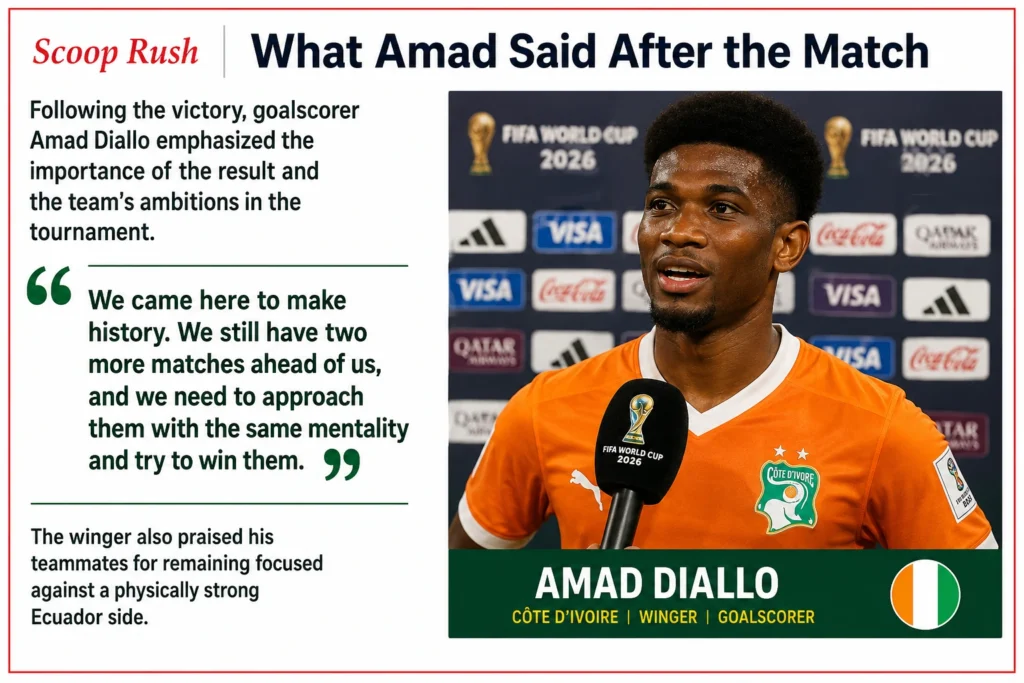
What Amad Said After the Match

What-Amad-Said-After-the-Match

Following the victory, goalscorer Amad Diallo emphasized the importance of the result and the team’s ambitions in the tournament.

“We came here to make history. We still have two more matches ahead of us, and we need to approach them with the same mentality and try to win them.”

The winger also praised his teammates for remaining focused against a physically strong Ecuador side.

Diomande Dedicates Award to His Mother

After receiving the Superior Player of the Match award, Yan Diomande dedicated the honor to his mother, who is currently recovering from surgery.

The young winger expressed pride in representing his country and highlighted the motivation the squad feels while competing on football’s biggest stage.

Group E Standings After Matchday 1

PositionTeamPWDLGFGAGDPts
1Germany110071+63
2Côte d’Ivoire110010+13
3Ecuador100101-10
4Curaçao100117-60

Key Takeaways

  • Amad Diallo scored the winning goal in the 90th minute.
  • Ecuador hit the woodwork three times during the match.
  • Côte d’Ivoire also struck the crossbar once through Elye Wahi.
  • Yan Diomande earned Superior Player of the Match honors.
  • Côte d’Ivoire moved level on points with Germany at the top of Group E.
  • Ecuador suffered a narrow defeat despite creating several clear chances.

Final Thoughts

Côte d’Ivoire’s World Cup campaign got off to the perfect start thanks to Amad Diallo’s dramatic late winner. Although Ecuador produced enough opportunities to avoid defeat, their inability to convert chances proved costly.

With Germany already making a statement in Group E, every point could prove crucial. Côte d’Ivoire now carry momentum into their next fixture, while Ecuador must quickly regroup to keep their qualification hopes alive.

Spain vs Cabo Verde Result: Spain Held to 0-0 Draw by Cabo Verde in World Cup 2026 Group H 

0

FIFA World Cup 2026 – Group H

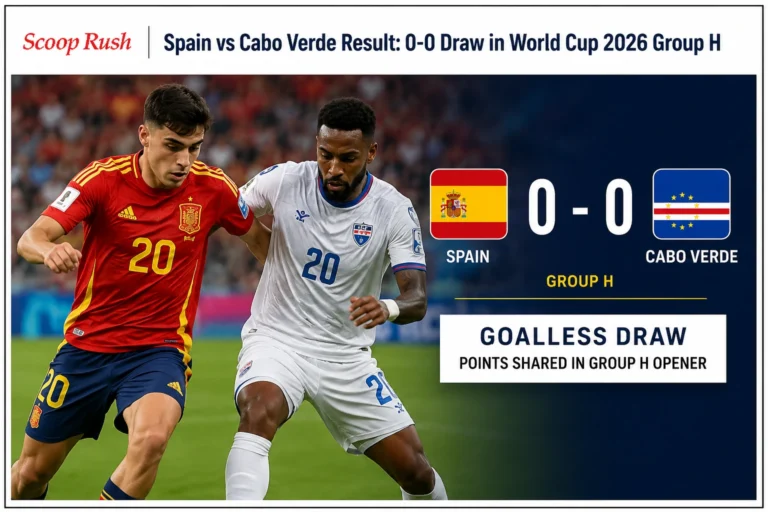
Full Time:Spain 0–0 Cabo Verde

Venue:Atlanta Stadium

Date: Mon,15 Jun

The Spain vs Cabo Verde result ended in a hard-fought 0-0 draw as both teams opened their FIFA World Cup 2026 Group H campaign with a point apiece on Monday, June 15. Despite dominating possession and creating more chances, Spain could not find a breakthrough against a disciplined Cabo Verde side that defended resolutely throughout the match at Atlanta Stadium.

The encounter showcased contrasting styles. Spain controlled the ball for long periods and dictated the tempo, while Cabo Verde remained organized, compact, and dangerous on occasional counterattacks. In the end, neither side managed to convert their opportunities, leaving Group H wide open after the first round of matches.

Spain Control Possession but Lack Cutting Edge

From the opening whistle, Spain established their familiar possession-based approach. The European side enjoyed an overwhelming share of the ball, finishing with 74% possession compared to Cabo Verde’s 26%.

Spain completed 764 passes with an impressive 92% pass accuracy, highlighting their dominance in midfield and ability to retain possession. Cabo Verde, meanwhile, completed 275 passes at 74% accuracy as they focused primarily on maintaining defensive shape and limiting Spain’s attacking opportunities.

Although Spain controlled proceedings, they struggled to translate possession into goals. They recorded 23 shots during the match, but only eight efforts were on target. Time and again, Spain’s attacking moves broke down in the final third as Cabo Verde’s defense remained compact and disciplined.

The lack of a clinical finish proved costly, as Spain failed to capitalize on the numerous opportunities they created.

Cabo Verde’s Defensive Organization Shines

One of the major stories of the Spain vs Cabo Verde result was the outstanding defensive performance from the African nation. Cabo Verde entered the match as underdogs but executed their game plan effectively.

Despite facing constant pressure, Cabo Verde limited Spain’s clear-cut chances and remained composed throughout the contest. Their defenders worked tirelessly to close down spaces and block shooting lanes, forcing Spain into increasingly difficult attempts on goal.

Goalkeeper Vozinha also played an important role, providing a calm presence at the back whenever Spain managed to test the defense. The team remained organized for the full 90 minutes and successfully earned a valuable clean sheet against one of the tournament favorites.

For Cabo Verde, the point could prove significant as the group stage progresses.

Starting Lineups and Tactical Setup

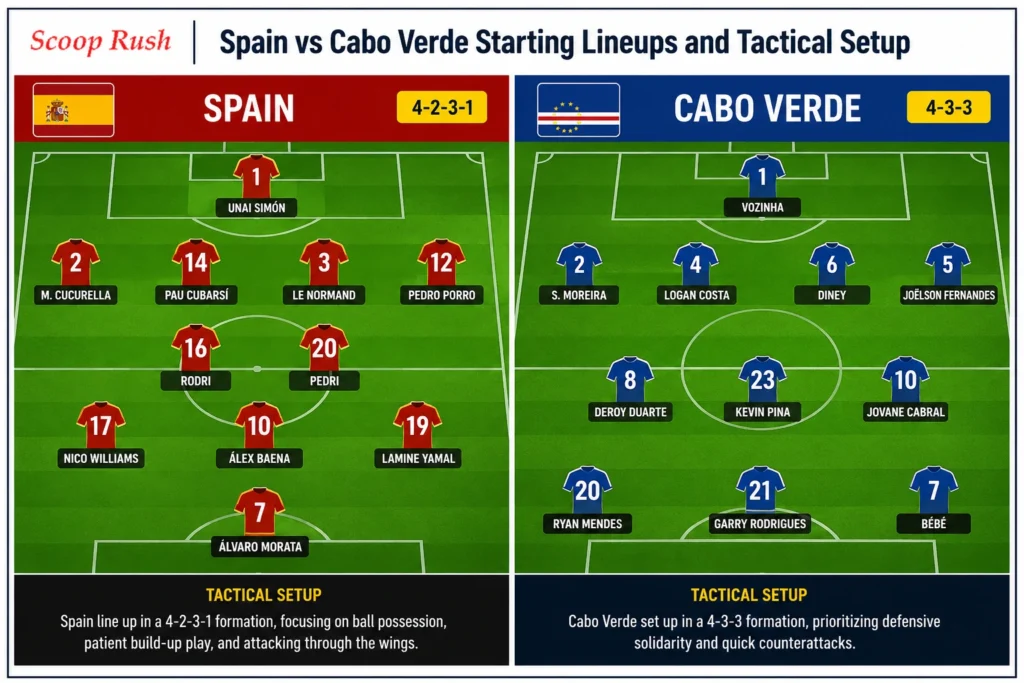
Spain lined up in a 4-2-3-1 formation, aiming to dominate possession and create chances through patient build-up play.

Spain Starting XI

  • Unai Simón
  • Marc Cucurella
  • Pau Cubarsí
  • Robin Le Normand
  • Pedro Porro
  • Rodri
  • Pedri
  • Nico Williams
  • Álex Baena
  • Lamine Yamal
  • Álvaro Morata

Spain relied heavily on Rodri and Pedri to control the midfield, while young stars Nico Williams and Lamine Yamal attempted to stretch Cabo Verde’s defensive line from wide positions.

Cabo Verde adopted a more conservative approach, focusing on defensive solidity and quick transitions.

Cabo Verde Starting XI

  • Vozinha
  • Steven Moreira
  • Logan Costa
  • Diney
  • Joëlson Fernandes
  • Deroy Duarte
  • Kevin Pina
  • Jovane Cabral
  • Ryan Mendes
  • Garry Rodrigues
  • Bébé

The tactical discipline shown by Cabo Verde frustrated Spain throughout the evening and prevented the European side from finding rhythm in dangerous areas.

First Half: Spain Dominate, Cabo Verde Hold Firm

The opening half followed a predictable pattern as Spain monopolized possession and pushed forward in search of an early goal.

Spain circulated the ball confidently through midfield, probing for weaknesses in Cabo Verde’s defensive structure. Morata and Yamal were involved in several promising attacking moves, while Nico Williams frequently attempted to create opportunities down the flank.

However, Cabo Verde’s defenders remained compact and rarely allowed Spain space inside the penalty area. Whenever Spain entered dangerous positions, a timely interception or block prevented a clear scoring opportunity.

At the other end, Cabo Verde looked to exploit counterattacks but found limited opportunities against Spain’s organized defensive unit.

The first half concluded goalless, with Spain enjoying territorial dominance but lacking the final touch needed to break the deadlock.

Second Half: Increased Pressure but No Goal

Spain intensified their attacking efforts after the break, pushing more players forward and increasing the pace of their passing.

The pressure generated several chances, but the finishing remained inconsistent. Cabo Verde continued to defend bravely, with players committing fully to every challenge and block.

One notable moment came when Spain midfielder Pedri received a yellow card in the second half. The booking reflected the growing intensity of the contest as Spain searched desperately for a breakthrough.

Spain also introduced fresh legs from the bench. Nico Williams entered the action and immediately provided additional energy in attacking areas. The substitutions helped maintain pressure but ultimately failed to produce the winning goal.

As the minutes ticked away, Cabo Verde grew increasingly confident. Their defensive line remained disciplined, and every successful clearance brought them closer to an important result.

The final whistle confirmed a 0-0 draw, earning Cabo Verde a memorable point while leaving Spain frustrated.

Match Statistics

The statistics illustrate Spain’s dominance in possession and attacking volume, but they also reveal Cabo Verde’s resilience.

StatisticSpainCabo Verde
Possession74%26%
Shots236
Shots on Target81
Passes764275
Pass Accuracy92%74%
Fouls101
Yellow Cards11
Red Cards00
Offsides23
Corners111

While Spain dominated nearly every statistical category, Cabo Verde’s disciplined defensive effort ensured the scoreline remained level.

Group H Standings After Matchday One

Following the draw, both teams collected one point in Group H.

At the conclusion of the first round of fixtures:

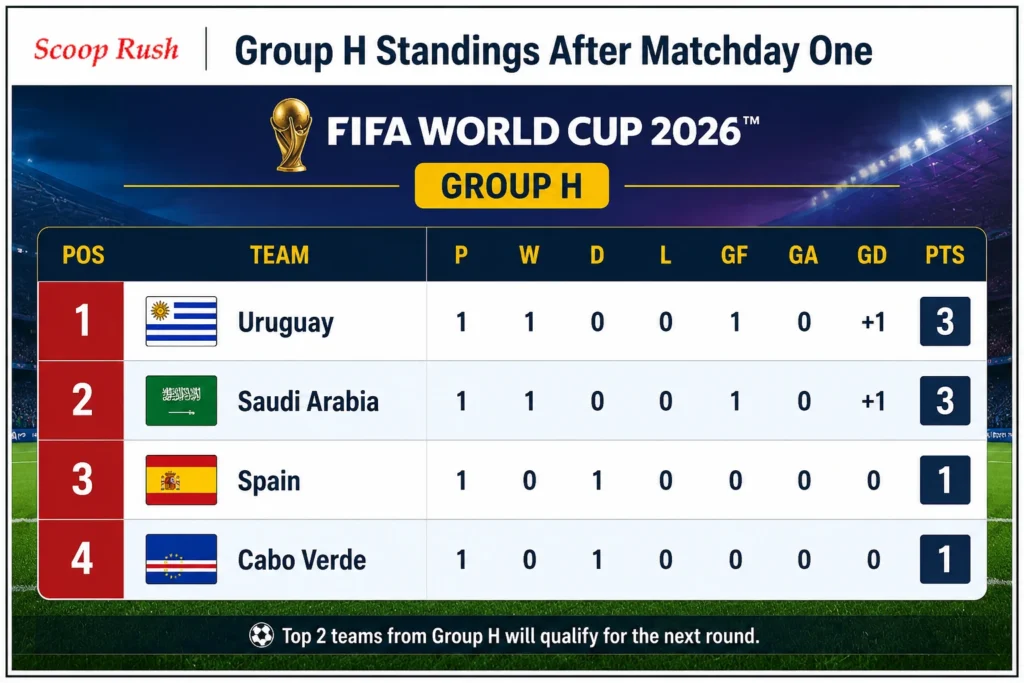
  1. Uruguay – 3 points
  2. Saudi Arabia – 3 points
  3. Spain – 1 point
  4. Cabo Verde – 1 point

With Uruguay and Saudi Arabia winning their opening matches, both Spain and Cabo Verde now face increased pressure in their upcoming fixtures.

Spain will likely view the result as two points dropped considering their dominance and expectations entering the tournament. Cabo Verde, however, can take confidence from securing a clean sheet and a valuable point against one of the strongest teams in the group.

Key Takeaways from the Spain vs Cabo Verde Result

Several important themes emerged from the match:

1. Spain Need Greater Efficiency

Spain created enough opportunities to win comfortably but failed to convert their chances. Improving their finishing will be essential in future Group H matches.

2. Cabo Verde’s Defense Is Legitimate

The African side demonstrated excellent organization and discipline. Their defensive structure frustrated Spain for the full 90 minutes and could trouble other teams in the group.

3. Possession Does Not Guarantee Victory

Despite enjoying 74% possession and attempting 23 shots, Spain could not secure three points. The match served as another reminder that efficiency in front of goal remains crucial.

4. Group H Remains Wide Open

With both Spain and Cabo Verde earning one point, every remaining fixture in the group becomes increasingly important.

Final Thoughts

The Spain vs Cabo Verde result may not have produced goals, but it delivered an intriguing tactical battle. Spain dominated possession, created numerous opportunities, and controlled much of the game, yet Cabo Verde’s disciplined defensive performance earned a deserved point.

For Spain, the draw will feel disappointing after registering 23 shots and controlling 74% of possession. However, there were still positive signs in their overall play and chance creation. Improving efficiency in front of goal will be their primary focus moving forward.

For Cabo Verde, this was a result to celebrate. Their organization, resilience, and commitment allowed them to frustrate one of the tournament favorites and begin their World Cup campaign with a valuable clean sheet and a hard-earned point.

As Group H continues, both teams remain firmly in contention, ensuring that the race for qualification promises to be one of the most compelling storylines of the tournament.