
Stress rarely announces itself politely. It shows up as a tight jaw during a work call, a racing heart before a big decision, or the low hum of worry that keeps you scrolling your phone at 2 a.m. instead of sleeping. Whether it’s a single bad day or a pressure that’s been building for months, the good news is that stress relief doesn’t have to mean a spa weekend or a total life overhaul.
Quick Fixes and Lasting Habits, Side by Side
Sometimes stress relief is a five-minute breathing exercise. Sometimes it’s a long-term shift in how you plan your week. This guide walks through both the quick fixes and the lasting habits so you can build a stress-relief toolkit that actually fits your life, whether you need help right now or you’re looking to build resilience over the coming months.
What Exactly Is Stress, and Why Should You Take It Seriously?
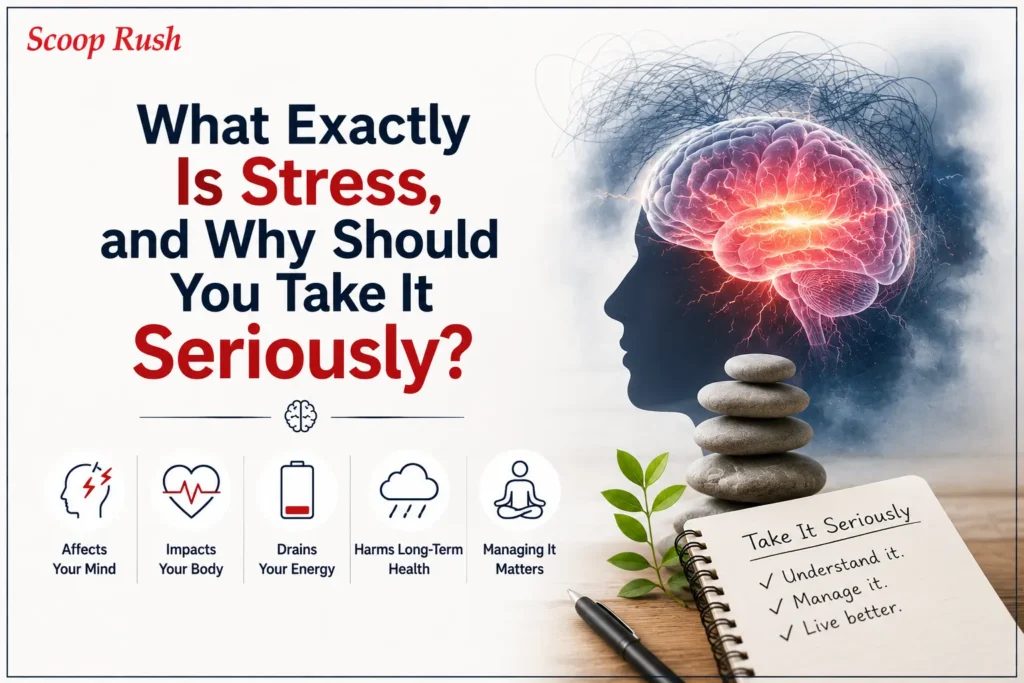
Stress is your body’s natural response to pressure or perceived threats. In small, short bursts, it can sharpen focus and motivate you to meet a deadline. The trouble starts when stress becomes constant.
How Chronic Stress Affects Your Body and Mind
Left unmanaged, chronic stress has been linked to a higher risk of heart disease, anxiety disorders, and depression, and it can make it harder to think clearly, sleep well, or enjoy everyday life. Over time, it can also affect digestion, immune function, and energy levels, which is part of why people under chronic stress often report feeling run-down even when they haven’t done anything physically demanding.
Why Stress Feels Different for Everyone
Not everyone experiences stress the same way, and part of the reason comes down to individual differences such as genetics, personality, coping style, level of social support, past trauma, and even the demands of a particular job. Understanding that stress isn’t one-size-fits-all is the first step toward finding relief strategies that actually work for you, rather than borrowing a routine that works for someone else’s life and circumstances.
The Three Main Types of Stress
| Type of Stress | What It Looks Like | Example |
| Acute stress | A short-term reaction to a specific event | Worrying about an upcoming exam or a delayed flight |
| Episodic acute stress | Acute stress that keeps repeating | Constantly feeling overwhelmed because of poor time management |
| Chronic stress | A long-running pressure with no clear end date | Ongoing financial strain or caring for a family member with a long-term illness |
It’s worth noting that stress and mental health conditions like anxiety or depression are not the same thing. The strategies below can help manage everyday stress, but they are not a replacement for support from a licensed mental health professional if you’re struggling with a diagnosable condition.
How Do You Figure Out What’s Actually Causing Your Stress?
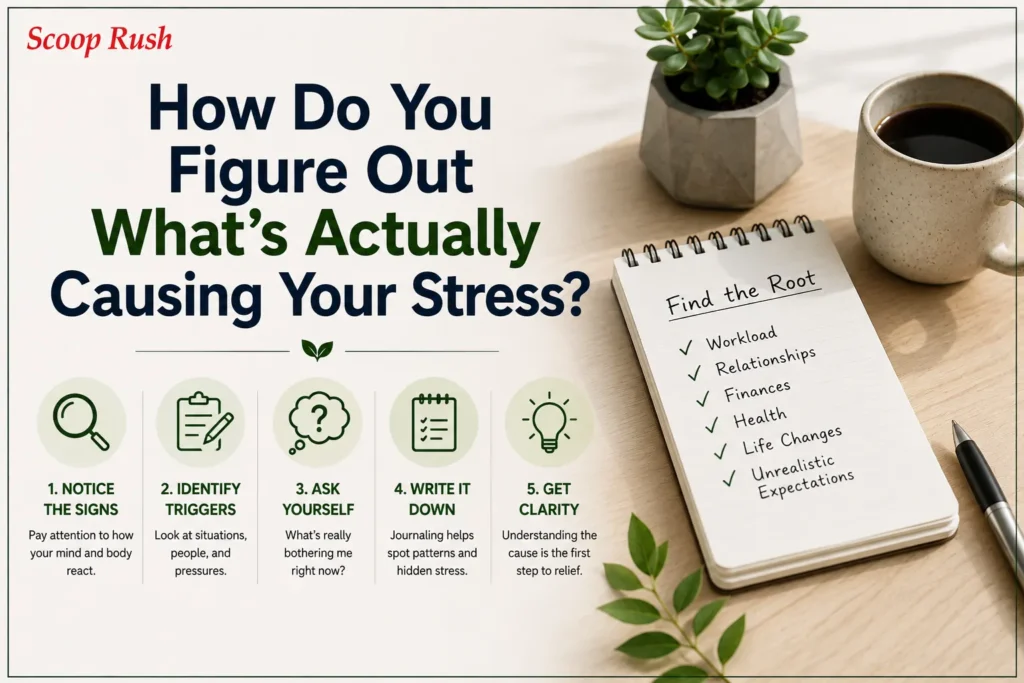
Before you can manage stress, it helps to know where it’s coming from and that’s often less obvious than it seems. It’s easy to blame an external factor like a heavy workload, but sometimes it’s a habit, like procrastination, that’s quietly driving the pressure.
Questions Worth Sitting With
A few questions worth asking yourself honestly:
- Do you brush off stress as “temporary,” even though it’s been building for months?
- Do you treat stress as just part of your job, home life, or personality?
- Do you consistently blame outside events or other people for how you feel?
- Have you noticed patterns in what triggers your stress and how you typically respond?
Why a Stress Journal Helps
Keeping a simple stress journal noting what triggered the stress, how you felt physically and emotionally, and how you responded can reveal patterns you’d otherwise miss. Over a few weeks, you may start to notice that certain people, times of day, or types of tasks consistently spike your stress levels, which makes it much easier to plan around them.
What Are the 4 As of Stress Management?
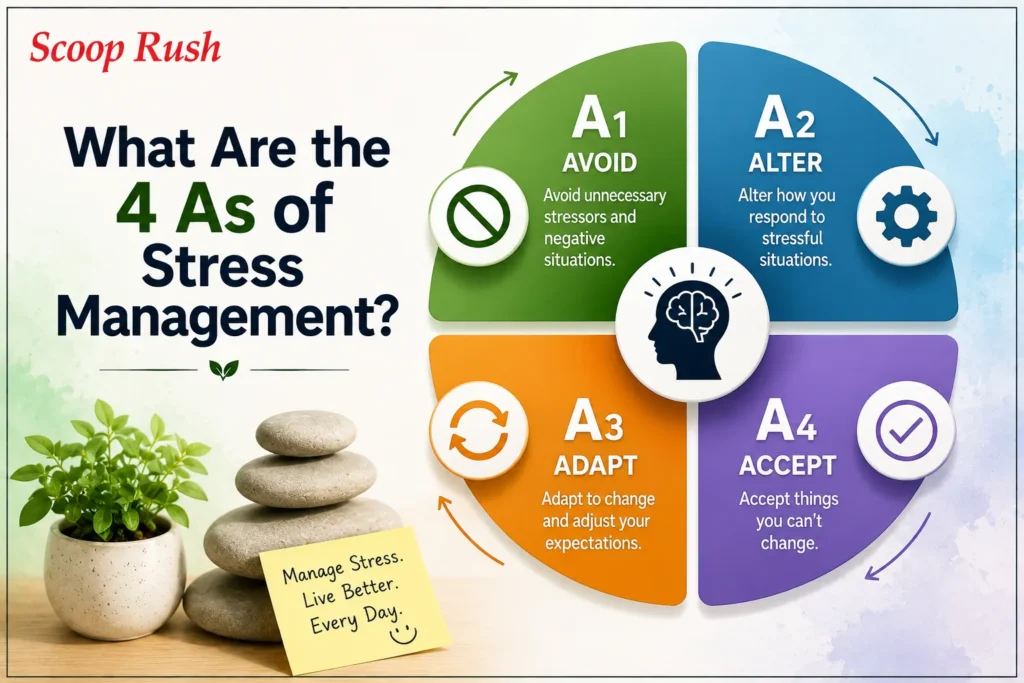
One widely used framework for managing stress breaks your options down into four approaches: avoid, alter, accept, or adapt. The right one depends on whether the stressor is something you can change.
1. Avoid Unnecessary Stress
- Learn to say no and protect your limits, both at work and at home
- Limit time with people who consistently add stress to your life
- Take more control over your environment for example, choosing a quieter commute route
- Steer conversations away from repeated hot-button arguments
- Trim your to-do list down to what truly needs to get done
2. Alter the Situation
- Speak up about what’s bothering you instead of bottling it up
- Be willing to compromise when negotiating with others
- Practice assertiveness rather than avoiding problems
- Build in a real balance between work, responsibilities, and downtime
3. Adapt to the Stressor
- Reframe a frustrating situation as an opportunity, like using traffic time to catch up on a podcast
- Zoom out and ask whether the issue will matter in a month or a year
- Loosen perfectionist standards and aim for “good enough”
- Make a habit of noting things you’re grateful for
4. Accept What You Can’t Change
- Focus your energy on your own reactions rather than trying to control others
- Look for lessons or growth opportunities in difficult situations
- Practice forgiveness and let go of resentment
- Talk openly about what you’re going through, even if the situation itself can’t change
What Long-Term Habits Actually Reduce Stress Over Time?
Quick fixes matter, but lasting stress resilience usually comes down to daily habits. Here’s what the research and expert guidance consistently point to.
Move Your Body Regularly
Exercise remains one of the most reliable stress relievers because it triggers the release of endorphins and gives your mind a break from looping worries.
How Much Exercise Is Actually Enough?
Health guidelines generally recommend around 150 minutes of moderate exercise a week, plus strength training a couple of times a week. If that sounds like a lot, start small a daily walk or bike ride still counts, and consistency matters more than intensity. Even splitting that time into short 10-minute bursts throughout the day appears to offer real benefits, and pairing this with other healthy habits in your 20s and 30s can compound the stress-reducing effect over time.
Eat in a Way That Supports Your Mood
Diets heavy in ultra-processed foods and added sugar have been associated with higher perceived stress, while nutrient-dense whole foods vegetables, fruit, beans, fish, nuts, and seeds help supply the vitamins and minerals your body needs to regulate mood, including magnesium and B vitamins. If you’re looking to shift toward more whole-food meals, a plant-based diet guide can be a useful starting point. Skipping meals or relying heavily on caffeine and sugar to get through the day can create a cycle where your blood sugar swings make stress feel even more intense than it actually is.
Cut Back on Screens
Excessive smartphone and screen use has been linked to higher stress levels, partly because it interferes with sleep quality, which in turn drives stress even higher. A digital curfew an hour before bed can make a noticeable difference, as can turning off non-essential notifications during focused work blocks.
Build In Real Self-Care
Self-care doesn’t need to be elaborate. It can be as simple as:
- Taking a walk outside
- Reading for pleasure
- Preparing a nourishing meal
- Stretching before bed
- Practicing a hobby you enjoy
- Using calming scents or a warm bath to unwind
Try Journaling
Writing down your thoughts gives stress and difficult emotions a place to go instead of circling endlessly in your head. A guided journal can help if you’re not sure where to start, and even five minutes before bed can be enough to notice a difference in how quickly you fall asleep.
Watch Your Caffeine Intake
Too much caffeine can intensify stress and disrupt sleep. Health guidance generally suggests staying under about 400 mg a day roughly four to five cups of coffee. It also matters when you drink it for instance, drinking coffee on an empty stomach can amplify jitteriness for some people. If you notice jitteriness or a racing heart, it may be worth switching your afternoon cup for a lower-caffeine alternative like green tea.
Prioritize Your Relationships
Strong social support is consistently tied to lower stress levels. If friends or family aren’t available, consider a club, volunteer group, or sports team as an alternative source of connection. Even brief, regular check-ins with one or two close people can meaningfully lower your baseline stress over time.
Set Boundaries and Learn to Say No
Taking on too much is one of the most common and most avoidable sources of stress. Protecting your time and energy is a form of self-respect, not selfishness. Practicing a simple, polite way to decline requests in advance can make it much easier to actually say no when the moment comes.
Tackle Procrastination Head-On
Putting things off tends to increase stress rather than reduce it. A simple prioritized to-do list with realistic deadlines can break the cycle. Breaking a large task into smaller, clearly defined steps also makes it far less intimidating to simply get started.
Practice Yoga and Mindfulness
Both have been shown to lower stress hormones like cortisol while promoting a sense of calm. Mindfulness-based approaches, including meditation, are widely available through apps, classes, and therapists trained in mindfulness-based cognitive therapy. Even a few consistent minutes a day appears to matter more than occasional long sessions.
Get Outside and Spend Time in Nature
Even short exposure to a natural setting a park, garden, or green space has been linked to measurable improvements in perceived stress and overall well-being. You don’t need a dramatic hike; a short walk through a nearby green space during a lunch break can offer a similar reset.
Spend Time With a Pet
Physical affection with a pet can trigger the release of oxytocin, a hormone associated with calm and connection, while also lowering cortisol. Beyond the physical effects, caring for a pet can also add structure and a sense of purpose to your day, both of which help buffer against stress.
Talk to a Doctor About Supplements
Nutrients like magnesium play a role in your body’s stress response, and chronic stress can deplete your stores of it. Any supplement decision should involve a conversation with a healthcare provider first, since not every supplement is appropriate for everyone, especially alongside existing medications or health conditions and it’s worth understanding the risks of taking too many vitamins before adding several new supplements at once.
What Can You Do to Relieve Stress in Under Five Minutes?
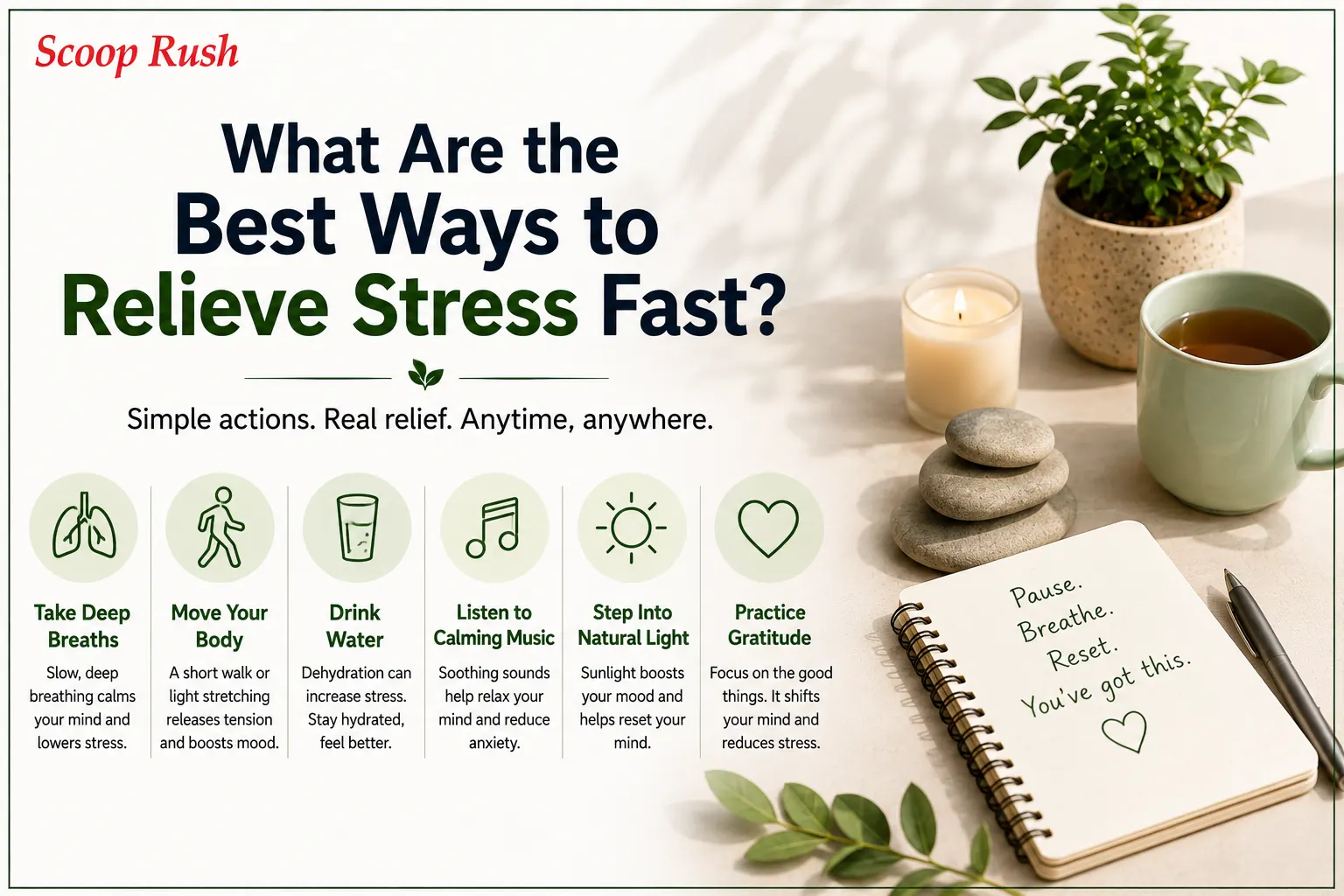
Sometimes you don’t have time for a workout or a nature walk — you need relief right now, in the middle of a stressful meeting or a chaotic afternoon. These quick techniques are designed for exactly that, and simple habits like a 5-minute walk every hour can be worked into even the busiest schedule.
| Quick Technique | Why It Works |
| Deep, slow breathing | Lowers heart rate and blood pressure almost immediately |
| A short walk | Combines movement, fresh air, and a mental reset |
| Listening to music | Shifts mood and can lower tension within minutes |
| Stepping into sunlight | Bright light has a mood-lifting effect |
| A hand or foot self-massage | Releases tension that builds up in the hands and feet |
| Counting slowly to ten and back | Interrupts spiraling thoughts |
| Stretching at your desk | Relieves physical tension from sitting still |
| Closing your eyes for a moment | Offers a quick mental reset from visual overload |
| Squeezing a stress ball | Channels nervous energy in a harmless way |
| Progressive muscle relaxation | Tensing and releasing muscles calms the whole body |
| A few minutes alone | Gives your mind space to reset |
| Tidying your immediate space | Reduces the visual clutter that can add to mental clutter |
| A supported yoga pose, like legs-up-the-wall | Encourages physical and mental relaxation |
| A small piece of dark chocolate | May help regulate cortisol in small amounts |
| A brief meditation | Just a couple of minutes of focused breathing can lower stress |
| Cuddling a pet | Triggers oxytocin release and eases tension |
| Chewing gum | Has been associated with lower cortisol levels |
| Sipping green tea | Contains L-theanine, which may promote calm |
| Watching something that makes you laugh | Boosts blood flow and mood |
| Splashing cold water on your wrists | Cools major arteries close to the skin, which can have a calming effect |
| Creating a small “zen zone” | A dedicated calm space you can retreat to for a few minutes |
| Jotting down your feelings | Makes emotions feel more manageable |
| A spoonful of honey | Has anti-inflammatory compounds that may ease anxiety |
| Talking to a friend | Sharing what’s bothering you is one of the fastest ways to feel supported |
How to Choose the Right Quick Technique for the Moment
Not every technique fits every situation you probably can’t cuddle a pet in the middle of a client meeting. It helps to keep a mental shortlist of two or three options for different settings: something discreet for the office (breathing, stretching, closing your eyes), something physical for home (a short walk, stress ball, progressive relaxation), and something social for tougher days (calling a friend, talking things through with someone you trust).
Why Is Box Breathing Becoming a Go-To Stress Technique?
Among all the quick stress-relief tools available, one breathing method in particular has been gaining attention: box breathing. The technique is simple — inhale for a set count, hold, exhale for the same count, then hold again before repeating the cycle. Four seconds is a common starting point, though the exact length matters less than keeping each phase equal.
One Woman’s Story: Coping With Distance and Disaster
Maria Medina, a 31-year-old programme manager living in Florida, experienced this firsthand. When catastrophic earthquakes struck her hometown of La Guaira, Venezuela, she found herself more than a thousand miles away, unable to help and unable to sleep. She had first learned box breathing years earlier from a therapist while juggling a demanding job and a master’s degree during the pandemic, and she returned to it during the sleepless nights that followed the earthquakes.
Where Box Breathing Comes From
Breathwork coach Stuart Sandeman explains that box breathing traces back to practices like yoga and has long been used in fields such as martial arts. He notes it has become popular recently because it can calm the mind while helping regulate the nervous system reportedly a technique favored by military units before high-pressure situations.
What Happens in Your Body During the Final Hold
According to Dr. Helen Garr, a GP who treats healthcare workers for stress-related mental health struggles, the final hold after exhaling may be the most physiologically important part of the cycle. During that pause, carbon dioxide briefly builds up in the body, and learning to tolerate that sensation without panicking can train the nervous system to handle stress more effectively over time.
How Others Are Using It Day to Day
Life coach Brittany Lamm uses box breathing every morning and incorporates it into sessions with her own clients, saying it helps people feel calmer before diving into difficult conversations. She points out that breathwork isn’t a single fixed technique different patterns can suit different moods or situations, which is part of why so many people experiment until they find a rhythm that works for them.
What the Research Says
Recent research out of Texas State University and the University of Toronto Mississauga found that the technique may help prevent sharp spikes in heart rate and other stress markers during high-pressure moments lending some scientific backing to why so many people, from therapists to elite athletes, keep coming back to it.
How to Try Box Breathing
- Sit comfortably and exhale fully
- Inhale slowly through your nose for a count of four
- Hold your breath for a count of four
- Exhale slowly for a count of four
- Hold again for a count of four before repeating
There’s no strict time requirement some people notice a difference after just a couple of minutes, while others prefer to continue for up to fifteen.
What Are Some Common Myths About Stress Relief?
Misunderstanding how stress works can lead people to try things that don’t actually help, or to feel discouraged when a technique doesn’t produce instant results.
Myth: You Need to Eliminate All Stress
In reality, a certain amount of stress is normal and even useful — it can sharpen focus and motivate action. The goal isn’t a stress-free life; it’s keeping stress at a manageable, temporary level rather than letting it become constant.
Myth: Relaxation Techniques Work Instantly for Everyone
Breathing exercises, meditation, and similar techniques often take a bit of practice before they feel natural or effective. Expecting immediate, dramatic results can lead people to give up too soon.
Myth: Only Big Life Changes Count as Stress Management
Small daily habits a short walk, a few minutes of journaling, a boundary set with a coworker often add up to more meaningful stress reduction than a single big lifestyle overhaul that’s hard to sustain.
Myth: Coping Mechanisms Like Screen Time or Snacking Are Harmless
Occasional use isn’t the issue, but relying on these as a primary coping strategy can mask the underlying stressor while adding new problems, like poor sleep or low energy, on top of it.
How Can You Build a Simple Weekly Stress-Management Routine?
Rather than trying to adopt every strategy above at once, it often works better to build a small, sustainable weekly rhythm.
A Sample Weekly Approach
- Daily: A few minutes of deep or box breathing, ideally at the same time each day
- Most days: 20–30 minutes of movement, even if it’s just a walk
- A few times a week: Time with a friend, family member, or pet
- Weekly: One dedicated block of leisure time with no obligations attached
- Ongoing: A running to-do list with realistic deadlines, reviewed and adjusted regularly
- As needed: A quick five-minute technique from the table above whenever stress spikes unexpectedly
Why Starting Small Matters
Trying to overhaul your entire lifestyle overnight often backfires, since it adds another source of pressure rather than relieving it. Picking just one or two habits to start with, and building from there once they feel automatic, tends to lead to changes that actually stick.
When Is It Time to Seek Professional Help for Stress?
Self-help strategies go a long way, but they’re not always enough on their own. It may be time to reach out to a therapist or other mental health professional if you notice:
- Increasing reliance on alcohol, drugs, or other unhealthy coping habits
- Withdrawal from friends, family, or social activities
- Ongoing physical symptoms like headaches, muscle tension, or insomnia
- Difficulty concentrating at work or school because of stress
- A persistent sense that stress is out of your control, no matter what you try
Reaching out for support isn’t a last resort it’s simply another tool, and often one of the most effective ones available.
The Takeaway
Stress isn’t something you can eliminate completely, but it is something you can manage. Quick techniques like box breathing, a short walk, or a few minutes with a pet can help you get through a rough moment, while long-term habits regular movement, better sleep, stronger relationships, and healthier boundaries build resilience that lasts well beyond that moment. The goal isn’t a stress-free life; it’s a life where stress doesn’t run the show.
FAQs
What is the fastest way to relieve stress?
Slow, deep breathing such as box breathing is one of the fastest ways to calm your body down, often within a couple of minutes. It works by directly lowering your heart rate and blood pressure, which helps interrupt the physical stress response.
How long does it take to feel calmer after a stressful event?
This varies by person and situation, but many quick techniques, like deep breathing or a short walk, can noticeably ease tension within five to ten minutes. Fully processing a stressful event emotionally can take longer, especially for major or ongoing stressors.
Can exercise really reduce stress, or is that a myth?
It’s not a myth. Physical activity releases endorphins and gives your mind a break from repetitive worry, and research consistently links regular movement to lower perceived stress. You don’t need an intense workout — even a daily walk provides real benefits.
Is it normal to feel stressed every day?
Occasional daily stress is common and often manageable with the techniques in this guide. However, if stress feels constant, uncontrollable, or is affecting your sleep, relationships, or ability to function, it may be worth speaking with a healthcare provider or therapist.
Does box breathing actually work, or is it just a trend?
There is genuine physiological reasoning behind it, and a recent academic study found it can help prevent sharp increases in heart rate and other stress markers during high-pressure situations. It’s not a cure-all, but it’s a low-effort technique with real potential benefit.
What’s the difference between stress and anxiety?
Stress is typically a response to an external pressure or demand and tends to ease once the situation resolves. Anxiety can persist even without a clear external trigger and, when it’s frequent or intense, may point to an anxiety disorder which is a medical condition best addressed with professional support rather than general stress-relief techniques alone.
Can diet really affect how stressed I feel?
Yes. Diets high in ultra-processed foods and added sugar have been associated with higher perceived stress, while balanced meals with whole foods help supply nutrients like magnesium and B vitamins that support your body’s stress response.
When should I stop trying to manage stress on my own and see a professional?
If you notice you’re relying on unhealthy coping habits, withdrawing from people you care about, struggling to concentrate, or experiencing ongoing physical symptoms like insomnia or headaches, it’s a good sign to reach out to a therapist or doctor rather than continuing to manage it alone.

