
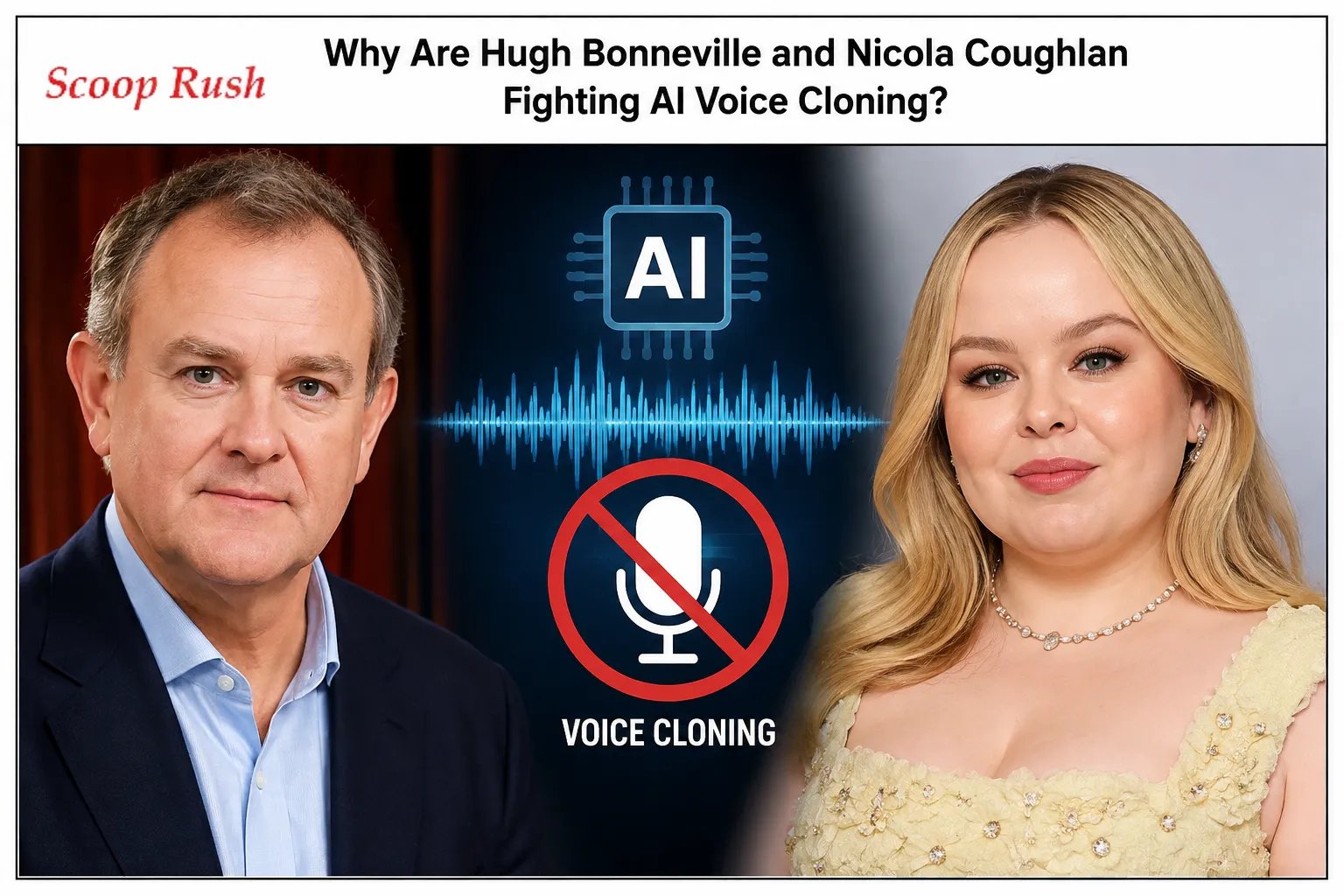
Imagine hearing your own voice say something you never said. That fear now drives more than 80 actors, including Hugh Bonneville, Matt Lucas and Nicola Coughlan, to demand urgent action on AI voice cloning.
The stars have joined a new campaign called Save Our Voices Now. They want Prime Minister Andy Burnham to give every person in Britain a legal right to own their voice. This story matters to far more than actors and singers. AI can now recreate anyone’s voice from just a few seconds of audio. That means anyone with a social media account or a saved voicemail could become a target. Performers are simply the most recognisable faces of a much bigger problem.
What Is the Save Our Voices Now Campaign?
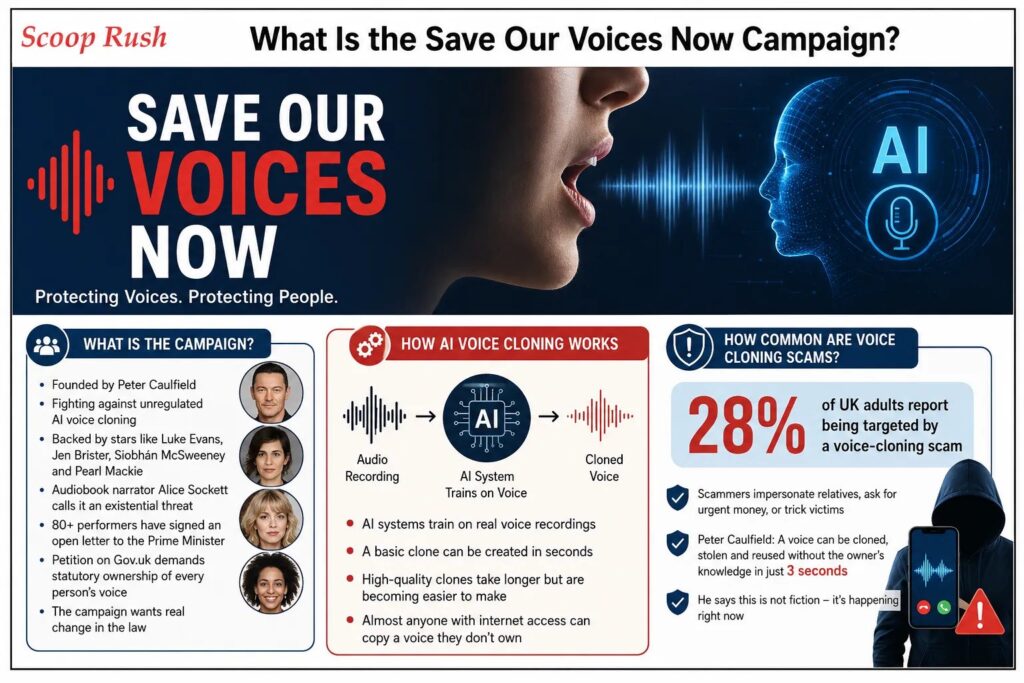
Peter Caulfield founded Save Our Voices Now to fight unregulated AI voice cloning. Luke Evans, Jen Brister, Siobhán McSweeney and Pearl Mackie all back the initiative. Audiobook narrator Alice Sockett co-founded the campaign too. She called the situation an existential threat to her industry.
Around 80 performers have signed an open letter to the Prime Minister. A petition has also launched on the Gov.uk website. It asks that every person in Britain receive statutory ownership of their own voice. The campaign wants more than awareness. It wants real change in the law.
AI voice cloning trains a system on recordings of a real person’s voice. The right software can create a basic clone in seconds. A convincing, high-quality version usually takes longer to build. Either way, the barrier to entry has dropped fast. Almost anyone with an internet connection can now try to copy a voice they do not own.
How Common Are Voice Cloning Scams in the UK?
This issue is not just theoretical. Save Our Voices Now says 28% of UK adults report being targeted by a voice-cloning scam. That figure shows the problem has moved from celebrity concern into everyday risk for ordinary families.
Scammers can use a cloned voice to impersonate a relative. They may request urgent money. They can also trick victims into trusting someone they are not actually speaking to. Caulfield described the danger bluntly. He said the right AI system can clone, steal and reuse a voice without the owner’s knowledge in just three seconds. He compared it to a Black Mirror episode. Unlike the show, he added, this is not fiction. It is happening right now, much like the harm AI-generated deepfakes have already caused elsewhere.
Why Are Actors Speaking Out Against AI Voice Cloning?
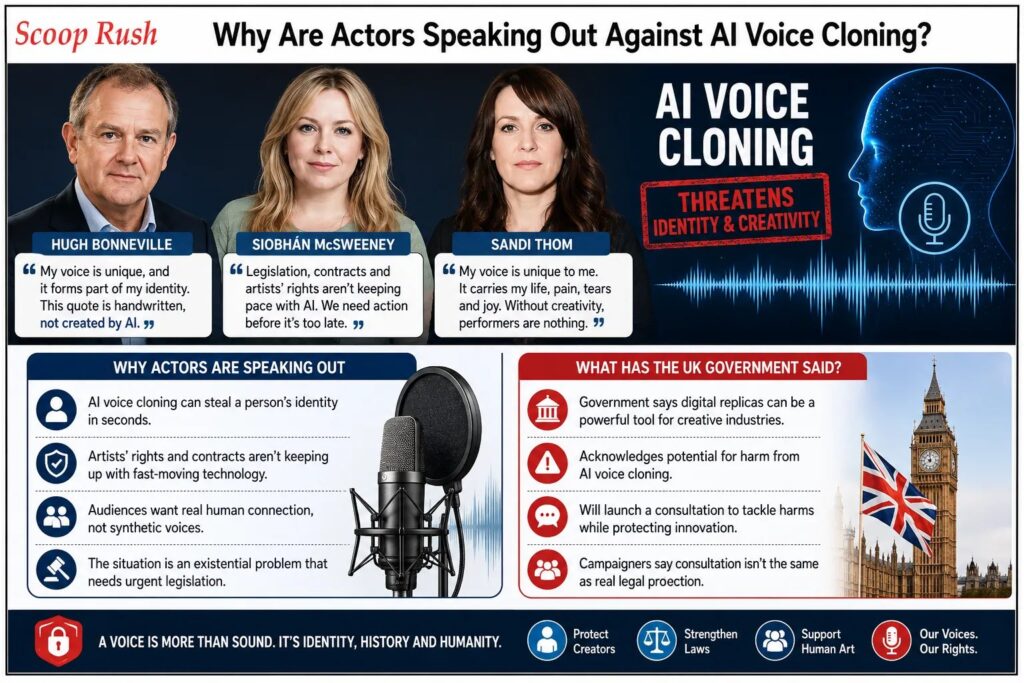
Paddington star Hugh Bonneville said his voice is unique and part of his identity. He added a playful line that his quote was handwritten, not created by AI. This highlights a growing need to prove authenticity, echoing wider worries over AI-generated content flooding online platforms.
Derry Girls actress Siobhán McSweeney said legislation and artists’ rights are not keeping pace with AI. However, she does not oppose AI as a whole. She believes performers can work alongside AI as a tool that benefits them, a debate similar to ongoing questions about whether AI will replace human jobs. Still, she called the situation an existential problem that needs legislative action soon.
McSweeney also raised a point that resonates with many performers. Audiences want human connection, not AI, she said. That sentiment sits at the emotional centre of this campaign. For many artists, a voice is not just a professional tool. It carries identity, training and personal history.
Scottish singer Sandi Thom also signed the letter. She wrote the 2006 hit “I Wish I Was a Punk Rocker (With Flowers in My Hair).” Thom said her voice is unique to her and was given to her at birth. It carries the emotion, life, pain, tears and joy she has experienced. Without creativity, she concluded, performers are nothing.
What Has the UK Government Said About Voice Cloning Laws?
A government spokesperson told the BBC that digital replicas can be a powerful tool for the creative industries. The spokesperson also admitted the risk of harm. The government values human creators, they said, and will launch a consultation to address these harms. This mirrors how the UK government has also pressed big tech companies over child safety failures, showing a wider pattern of regulators playing catch-up with fast-moving technology.
This response shows the government recognises the concern. However, campaigners say a consultation is not the same as real legal protection, especially while the technology keeps advancing fast.
Is UK Law Ready for AI Voice Cloning?
This campaign did not appear out of nowhere. Legal experts had already warned that UK legislation was becoming unfit for purpose months earlier. Dr Mathilde Pavis said in June that the law comes close but does not fully protect a person’s voice, face or identity.
This gap is exactly what the campaign wants closed. No single UK law currently gives individuals clear ownership over their own voice. Copyright law protects a song or a book, but voice ownership lacks that same protection. As a result, performers and everyday citizens have limited options when someone clones their voice without permission.
Other countries are moving faster. Denmark is reforming its laws to give citizens legal ownership over their own face, body and voice. Danish citizens could soon demand removal of unauthorised AI content and seek compensation under these reforms. This example will likely add real pressure on the UK government.
Does AI Voice Cloning Have Any Benefits?
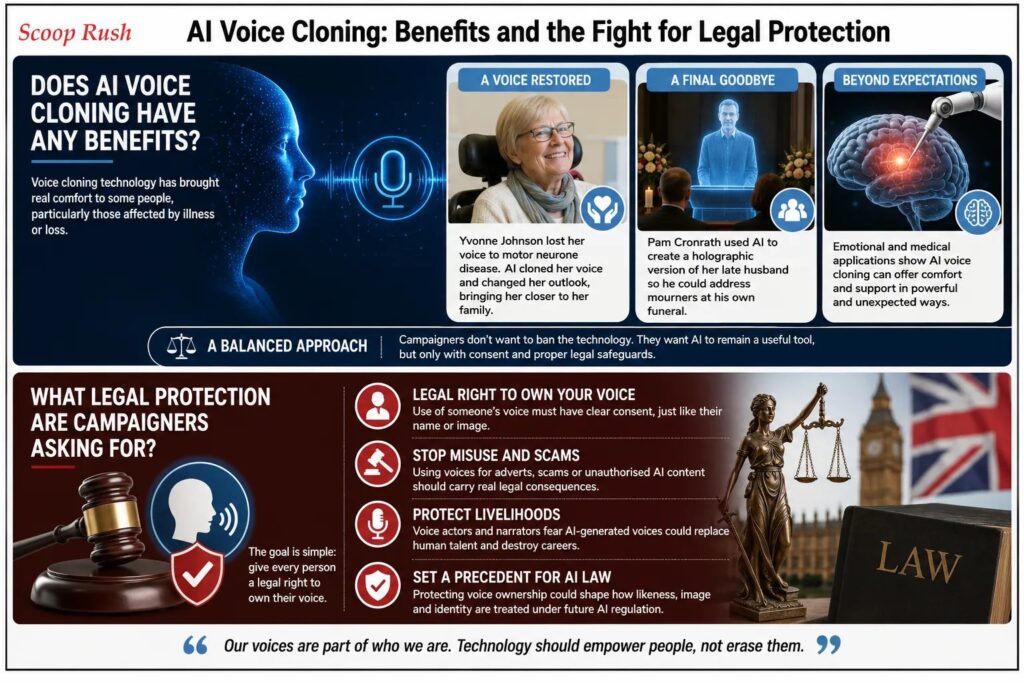
Voice cloning technology has also brought real comfort to some people, particularly those affected by illness. Yvonne Johnson lost her voice to motor neurone disease. She told the BBC’s Tech Life programme in February that AI voice cloning completely changed her outlook. It brought her closer to family members who had begun to forget how she originally sounded.
Pam Cronrath from Washington state used AI to create a holographic version of her late husband. This let him address mourners at his own funeral. She said the experience completely impressed her, and it stayed with her long afterward. This emotional use sits alongside other surprising applications of AI, including the world’s first AI-assisted brain surgery.
These examples show the debate is not simply about banning voice cloning outright. Instead, campaigners like McSweeney want a balanced approach. AI should still work as a helpful tool, but only with consent and proper legal safeguards. Save Our Voices Now does not want to erase the technology. It wants people to keep control over how their own voice gets used.
What Legal Protection Are Campaigners Asking For?
The core demand is fairly simple. Performers want the UK government to introduce legislation that gives every person a legal right to own their voice, similar to how someone owns their name or image. This would mean unauthorised use of someone’s voice, whether for adverts, scams or AI content, would carry real legal consequences.
For working actors and voice artists, this protection affects their livelihood, not just principle. Alice Sockett called the situation an existential threat. AI-generated voices could replace human narrators, dubbing artists and voice actors in commercial work. This would cut off income for professionals who spent years building their skills. It fits into a broader conversation across creative and corporate sectors about AI systems replacing human decision-makers and talent.
This campaign could ultimately shape how the UK approaches AI regulation as a whole. If voice ownership becomes a protected legal right, it may set a precedent for how future AI law treats likeness, image and other parts of personal identity.
Key Takeaways
More than 80 performers, including Hugh Bonneville, Nicola Coughlan and Matt Lucas, have joined the Save Our Voices Now campaign. They demand stronger legal protection against AI voice cloning. The campaign highlights a troubling statistic: 28% of UK adults report being targeted by a voice-cloning scam. The UK government has acknowledged the risks and promised a consultation. Yet campaigners say current law does not fully protect a person’s voice, face or identity. Denmark’s move to give citizens legal ownership of their face, body and voice shows what stronger protection could look like. At the same time, voice cloning has offered genuine comfort in cases involving illness and grief. The message from performers stays clear: audiences want human connection, not a synthetic replacement.
FAQs
1. What is the Save Our Voices Now campaign?
Peter Caulfield founded Save Our Voices Now to push for UK legislation that gives individuals legal ownership over their own voice, in response to growing concerns about unauthorised AI voice cloning.
2. Which celebrities are supporting the AI voice cloning campaign?
Hugh Bonneville, Nicola Coughlan, Matt Lucas, Luke Evans, Jen Brister, Siobhán McSweeney and Pearl Mackie back the campaign, alongside singer Sandi Thom and around 80 other signatories.
3. How does AI voice cloning actually work?
AI voice cloning trains a system using recordings of a real person’s voice. A basic clone can reportedly take as little as three seconds to make, though a high-quality replica that closely matches tone and emotion usually needs more audio and processing time.
4. Is AI voice cloning currently illegal in the UK?
No single UK law currently gives individuals full legal ownership over their voice. Legal experts say existing legislation does not fully protect a person’s voice, face or identity from AI misuse, which is why campaigners are pushing for new legislation.
5. How common are AI voice cloning scams in the UK?
Save Our Voices Now reports that 28% of UK adults say they have been targeted by a voice-cloning scam, showing the issue reaches far beyond the entertainment industry into everyday life.

